NORGES
REALDEMOKRATISKE ALLIANSE - LIBERALE SOSIAL-DEMOKRATER
Postadresse:
Postboks 4777 Sofienberg N-0506 Oslo
ET VEISKILLE I NORSK POLITIKK? SLUTT OPP OM REALDEMOKRATENE - LIBERALE SOSIALDEMOKRATER - ALLE SOM ER INTERESSERT I POLITIKK - BLI NETTVERKSMEDLEM!
REALDEMOKRATENE - LIBERALE SOSIAL-DEMOKRATER
The
Realdemocrats - Liberal
SOCIAL-DEMOCRATS -
Norges Realdemokratiske
- Liberale Sosial-demokratiske - Allianse
Stiftelsmøtet for Realdemokratene - De Liberale Sosial-demokratene, ble avholdt i Oslo 14.11.2002. Alliansen er inspirert av nobelprisvinner Ragnar Frischs, det tredje alternativ: "Et økonomisk og politisk system som setter individets frihet og moralske og etiske verdighet i sentrum (og med frihet mener jeg ikke frihet for de få til å utnytte de mange, men de manges frihet slik som Henrik Wergeland ville ha den), og som samtidig gjør det mulig å utnytte de materielle ressurser - naturrikdommene og den menneskelige kunnskap - på en virkelig rasjonell måte... Er det utopi å tro på det tredje alternativet? Jeg vil aldri holde opp med å tro at det ikke er utopi... R. Frisch, sitert fra artikkelen "Det uopplyste pengevelde", Sosialøkonomen (1961).
Vi regner med å verve medlemmer i flere partier representert på Stortinget, i fylkestingene, byråd og kommunestyrer. Alle som er interessert i humanistisk, rasjonell, frihetlig, liberal sosialdemokratisk politikk er velkomne som nettverksmedlemmer i alliansen.
English Summary: The Realdemocrats - Liberal Social-democrats - was founded in Oslo 14.11.2002. The alliance is a network of politicians from different political parties at The Storting and locally to make a policy similar to Ragnar Frisch's Third alternative: An economical and political system with the individual's freedom and moral and ethical dignity in the center, i.e. significant autonomy combined with a rational, planned socialism, that is not utopian. The real challenge is to develope, more and more, an economical and political system in which freedom and the ethical dignity of the individual hold the center of the stage (not freedom of the few, but for the many - as Henrik Wergeland would have it), at the same time as it opens up for utilizing the material resources in a true rational way. This can only be achieved via an advanced form of economical planning -- 'frihetsplanlegging' -- libertarian planning. This form of anarchist economical political system is called the third alternative .
Mvh Mona Solberg
Sekretær for Realdemokratene - Liberale Sosial-demokrater
REALDEMOCRACY = LIBERAL SOCIAL-DEMOCRACY
(1) DEGREE OF REALDEMOCRACY = 100[1-([(1-(AUTONOMY%/100))2+(1-(SOCIALISM%/100))2]/2) 1/2]%
The degree of realdemocracy (= anarchy degree) is defined for significant societal democracy, i.e. both more than a) 50% economical democracy, socialism, on a scale from 0% to 100%, i.e. significant socialism, and b) 50% political/administrative democracy, autonomy, on a scale from 0% to 100%, i.e. significant autonomy.
All realdemocratic systems are found within the Quadrant of realdemocracy = liberal social democracy = anarchism - defined by [ 50% to 100% AUTONOMY; 50% to 100% SOCIALISM].
In general the libertarian degree = degree of democracy, is used, i.e. also valid outside the realdemocratic = liberal social-democratic = anarchist - quadrant:
(2) LIBERTARIAN DEGREE = DEGREE OF DEMOCRACY = 100[1-([(1-(AUTONOMY%/100))2+(1-(SOCIALISM%/100))2]/2) 1/2]%
In general, for the whole map, the authoritarian degree is used, i.e. 100% minus the libertarian = democracy degree.
AUTHORITARIAN DEGREE = 100% - 100[1-([(1-(AUTONOMY%/100))2+(1-(SOCIALISM%/100))2]/2) 1/2]% <=>
AUTHORITARIAN DEGREE = 100[ 1 - [1-([(1-(AUTONOMY%/100))2+(1-(SOCIALISM%/100))2]/2) 1/2]]% <=>
(3) AUTHORITARIAN DEGREE = 100[([(1-(AUTONOMY%/100))2+(1-(SOCIALISM%/100))2]/2) 1/2]%
(4) The degree of autonomy is 100% - the degree of statism and the degree of socialism is 100% - the degree of capitalism
From (3) and (4) we get:
(5) AUTHORITARIAN DEGREE = 100[([(STATISM%/100)2+(CAPITALISM%/100)2]/2) 1/2]%
If the authoritarian degree is not significant, i.e. less than 50%, outside the realdemocratic quadrant, the term semilibertarian system is used.
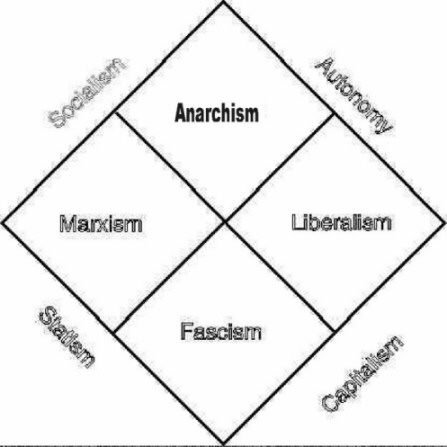
Systems within the realdemocratic quadrant have as mentioned the degree of both autonomy and socialism > 50%. Similar the systems within the liberalist quadrant have the degree of both autonomy and capitalism > 50%, the marxist quadrant statism and socialism > 50% and the fascist quadrant statism and capitalism > 50%.
If the degree of capitalism is significant, > 50%, the system is economical plutarchy.
The degree of statism is connected to political/administrative hierarchy, that may be real monarchy, oligarchy, polyarchy, ochlarchy, and/or political/administrative plutarchy, i.e. if the degree of statism is significant, > 50%.
Very significant capitalism and/or statism also include the archies of rivaling "states within the state" (chaos), the tyranny of structurelessness (disorganization) and ochlarchy (mob rule broadly defined).
If a system has insignificant degree of statism and capitalism, both < 50%, i.e. the degree of both autonomy and socialism are significant > 50%, and the system is realdemocracy = anarchy.
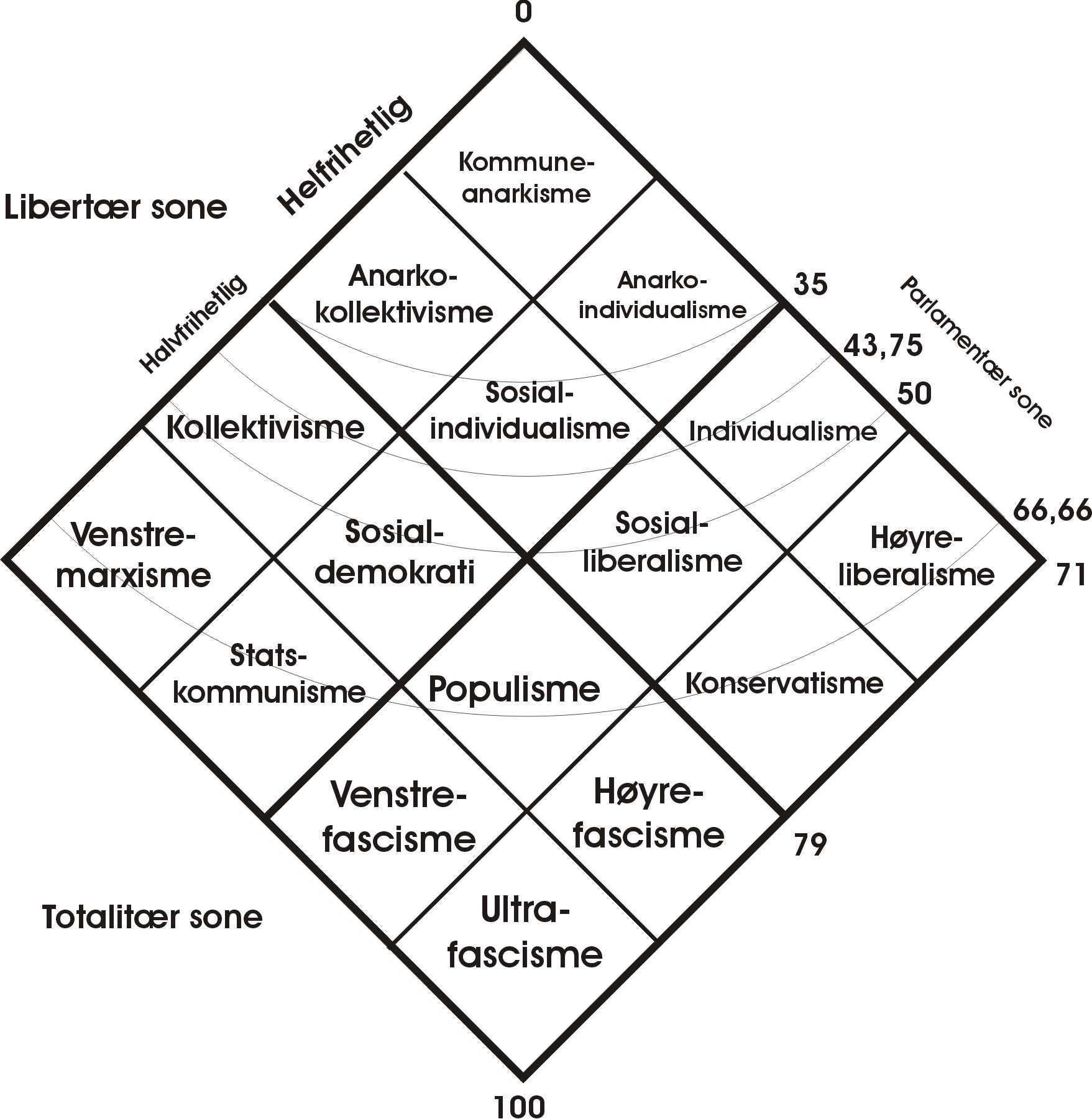
The four quadrants all together define a large quadrant, called the economical political systems' world map, accounting for all possible societal systems.The area of the Economical Political map, i.e. 100%, is divided of course with 25% for each of the main quadrants, marxism, realdemocracy, liberalism, and fascism. Furthermore the area of the systems with the least 1/3 authoritarian degree is Pi(100/18) = ca 17.4 % at the top of the map.
The realdemocratic = liberal social-democratic, also called libertarian (= anarchist) systems, plus the semilibertarian systems to the left and right, i.e. from above the middlepoint of the Economical Political map (see (click on:) EP-map), defined as both 50% autonomy, statism, socialism and capitalism and less than 50% authoritarian degree, cover an area of Pi(100/8) = ca 39,25 %. The democratic systems all in all, i.e. less than ca 67% authoritarian degree, cover an area of Pi(200/9) = ca 69.78 %. Of this the area between about 43,75 % and 66,67 % authoritarian degree is significant parliamentarian democracy, and the area with less than 43,75% authoritarian degree is significant direct democracy. The democracy, parliamentarian or direct, may be real, i.e. libertarian and realdemocratic - within the realdemocratic quadrant of the economical political map, or not, i.e. semilibertarian, also called semi-democratic, or authoritarian semi- or pseudo-democracy - outside the realdemocratic quadrant.
NB! A semilibertarian system is either 1. economically or 2. political/administrative authoritarian (buth not both), i.e. capitalist/economical plutarchy or statist respectively, significant, but in average, measured by the authoritarian degree, not significant authoritarian. Thus only real democratic systems are libertarian (= anarchist), i.e. not authoritarian in general: Libertarian both 1. economically and 2. political/administrative and 3. in average measured by the libertarian degree, significant. And thus either a system is real democratic and also libertarian (= anarchist), or authoritarian economically and/or political/administrative.
And thus the ultra-authoritarian, totalitarian systems, with more than ca 666 per thousand = ca 67% (i.e. 66.6 666... %) authoritarian degree cover 100 - Pi(200/9) = ca 30.22 %. Thus, the systems with more than 666 per thousand authoritarian degree have a lot more room, ca 30% of the map, than the most realdemocratic systems with ca 17 % of the area. This may indicate it is much more easy to create hell than heaven on earth.
The significant direct democratic systems including semilibertarian cover about 30 % of the total area. The totalitarian systems at the bottom of the map also cover about 30 % of the area. The parliamentarian systems all in all cover about 40 % of the area, of which about 30 % are authoritarian systems and about 10 % are semilibertarian or realdemocratic systems, i.e. with average authoritarian degree < or = 50 %.
The realdemocratic, libertarian i.e. liberal social-democratic (= anarchist), systems are sometimes referred to as the third alternative, mentioned by Ragnar Frisch in several articles.
As the word pseudo-democracy is a bit derogative, the more neutral word semi-democracy may sometimes be used as a synonym. However as pseudo-democracy is not real-democracy (= anarchy), the word pseudo-democracy is probably quite correct.
Authoritarian degree % = 100 % - the libertarian degree % =
 "
"
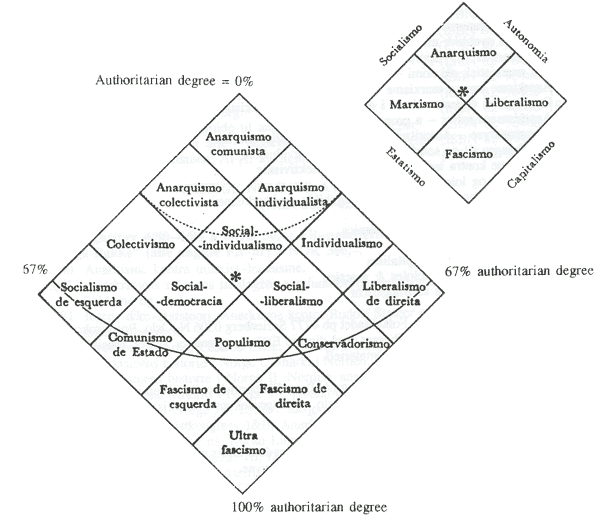
*) The stars indicate the position of the Norwegian economical-political system after the revolutionary change in 1994/95.
Fig. 1. Picture of the Anarchist Economical-Political Map
THE 25 HIGHEST RANKING COUNTRIES ACCORDING TO LIBERTARIAN DEGREE ETC.
THE LIBERTARIAN DEGREE = THE DEGREE OF DEMOCRACY = 100 % - THE AUTHORITARIAN DEGREE
SYSTEM ANALYSIS - DATA FOR 2003-2007
Countries: |
Rank of country according to libertarian degree, and type of system |
Libertarian degree and (authoritarian degree) % |
Degree of socialism |
Degree of autonomy and |
Gini-index |
Norway |
1 Anarchy |
54,0 (46,0) |
55,0 (45.0) |
53,2 (46,8) |
25,8 |
Switzerland |
2 Anarchy |
53,0 (47,0) |
51,0 (49,0) |
55,1 (44,9) |
33,1 |
Iceland |
3 Anarchy |
52,0 (48,0) |
54,0 (46,0) |
50,1 (49,9) |
25,0 (est.) |
Liechtenstein |
4 Soc.dem. |
49,5 (50,5) |
51,4 (48,6) |
47,7 (52,3) |
32,0 (est.) |
Luxembourg |
5 Soc.dem. |
49,2 (50,8) |
52,1 (47,9) |
46,5 (53,5) |
30,8 |
Denmark |
6 Soc.dem. |
48,8 (51,2) |
55,3 (44,7) |
43,0 (57,0) |
24,7 |
Japan |
7 Soc.dem. |
48,5 (51,5) |
55,2 (44,8) |
42,6 (57,4) |
24,9 |
Belgium |
8 Soc.dem. |
48,2 (51,8) |
54,0 (46,0) |
43,0 (57,0) |
25,0 |
Finland |
9 Soc.dem. |
47,9 (52,1) |
53,8 (46,2) |
42,6 (57,4) |
26,9 |
Sweden |
10 Soc.dem. |
47,5 (52,5) |
54,0 (46,0) |
41,7 (58,3) |
25,0 |
Netherlands |
11 Soc.dem. |
47,2 (52,8) |
52,0 (48,0) |
42,8 (57,2) |
30,9 |
Canada |
12 Soc.dem. |
46,8 (53,2) |
50,9 (49,1) |
43,0 (57,0) |
33,1 |
Austria |
13 Soc.dem. |
46,5 (53,5) |
52,1 (47,9) |
41,4 (58,6) |
30,0 |
Ireland |
14 Populist |
46,2 (53,8) |
45,0 (55,0) |
47,4 (52,6) |
35,9 |
Germany |
15 Soc.dem. |
45,9 (54,1) |
53,0 (47,0) |
39,6 (60,4) |
28,3 |
Spain |
16 Soc.dem. |
45,5 (54,5) |
51,5 (48,5) |
40,1 (59,9) |
32,5 |
Australia |
17 Populist |
45,0 (55,0) |
48,0 (52,0) |
42,2 (57,8) |
35,2 |
United King. |
18 Populist |
44,5 (55,5) |
44,7 (55,3) |
44,3 (55,7) |
36.0 |
New Zealand |
19 Populist |
44,0 (56,0) |
44,6 (55,4) |
42,4 (57,6) |
36,2 |
France |
20 Soc.dem. |
43,5 (56,5) |
51,4 (48,6) |
36,6 (63,4) |
32,7 |
Italy |
21 Populist |
43,0 (57,0) |
44,7 (55,3) |
41,3 (58,7) |
36,0 |
USA |
22 Cons. lib. |
42,5 (57,5) |
24,5 (75,5) |
69,8 (30,2) |
40,8 |
Israel |
23 Populist |
42,3 (57,7) |
47,8 (52,2) |
37,3 (62,7) |
35,5 |
Hong Kong |
24 Cons. lib. |
42,1 ( 57,9) |
22,1 (77,9) |
74,8 (25,2) |
43,4 |
Greece |
25 Populist |
42,0 (58,0) |
47,9 (52,1) |
36,6 (63,4) |
35,4 |
WHAT ARE YOUR ECONOMIC-POLITICAL AIMS FOR YOUR COUNTRY?
TRY ANSWERING THE QUESTIONS BELOW IN A RELEVANT REALISTIC WAY -THE EXAM TO THE EXAM. ANARCH. DEGREE. YOU MUST MAKE YOUR OWN ESTIMATE, NOT USE A LINE IN THE TABLE ABOVE. FURTHERMORE, IF YOU ARE AN ANARCHIST = LIBERAL SOCIAL- DEMOCRAT, YOUR AIM SHOULD BE IN THE LIBERAL SOCIAL-DEMOCRATIC = ANARCHIST QUADRANT OF THE ECONOMIC-POLITICAL MAP. AND YOU MUST NOT USE THE TOP OF THE MAP - THE ANARCHIST IDEAL, BECAUSE THIS IS NOT REALISTIC.
Use the equations above to achieve logical answers.
1. The percentage
degree of capitalism? (answer yes or no in a logical way):
Less than 50%?
More than 50%?
Your personal estimate of the percentage degree of capitalism (plutarchy);
select percentage degree with two digits on the scale (0%...50%...100%)?
=>
Don't know? (write yes if you don't know) =>
2. The percentage
degree of socialism? (answer yes or no in a logical way): :
Less than 50%
More than 50%
Your personal estimate of the
percentage degree of socialism; select percentage degree with two
digits on the scale (0%...50%...100%)? =>
Don't know? (write yes if you don't know) =>
3. The percentage
degree of statism? (answer yes or no in a logical way): :
Less than 50%
More than 50%
Your personal estimate of the percentage degree of statism;
select percentage degree with two digits on the scale (0%...50%...100%)?
=>
Don't know? (write yes if you don't know) =>
4. The percentage
degree of autonomy? (answer yes or no in a logical way): :
Less than 50%
More than 50%
Your personal estimate of the percentage degree of autonomy;
select percentage degree with two digits on the scale (0%...50%...100%)?
=>
Don't know? (write yes if you don't know) =>
5. Do you want the
economical political system of your country, or another relevant
organization, write the name here: ................ - to be a real
democracy, i.e. the influence on the societal
management and coordination of this organizational system via a.o.t.
elections, markets, organizations, and the debate at the public room goes more
than 50% from the people, from the bottom, grassroots towards the
top, seen all in all - both in private and public sector, than the
other way around from the top towards the bottom, i.e.
significant socialism and autonomy (= or > 50%) ? If you want
this economical political system to be a real democracy answer
yes, if not - answer no: =>
Don't know? (write yes if you don't know) =>
6. Do you want the economical political system mentioned
above to be a pseudo-democracy,
i.e. the influence on the societal management and
coordination of this
organizational system via a.o.t.
elections, markets, organizations and the debate at the public room goes a)
more than 50% from the top downwards to the bottom, i.e.
grassroots - seen all in all, in public and private sector i.e.
either significant capitalism or statism (> 50%) or
both, than b) the other way around from the bottom, the people (grassroots),
upwards to the top, i.e. significant socialism and autonomy (= or
> 50%)? If you want this
economical political system to
be a pseudo-democracy (or even more authoritarian, a
dictatorship), i.e. significant statism and/or capitalism (>
50%), answer yes, if not - answer no: =>
If you wrote no, continue with question 7.
Don't know? (write yes if you don't know) =>
7. Your personal
estimate of the degree of democracy as defined above, i.e.select one
of the intervals and write "yes" ?:
50->60% from the bottom, grassroots towards the top?
60->70% from the bottom, grassroots towards the top?
70->80% from the bottom, grassroots towards the top?
80->90% from the bottom, grassroots towards the top?
90->100% from the bottom, grassroots towards the top?
"->" indicates "up towards".
Your personal estimate in two digits? Select percentage degree
with two digits on the scale (50%...100%)? =>
Don't know? (write yes if you don't know) =>
Comments ?:
NB! When you shall express your own policy for your country, use e-mail and send to ifa@anarchy.no in the following way: 1. Copy the questions above, 2. Click on ifa@anarchy.no, 3. Paste the questions in the mailform, 4. Answer the questions, and 5. Send the mail.
NB! A note to the
politicians at the Norwegian Storting:
THE PEOPLE AND THE MEDIA DEMAND CLEAR AND
HONEST ANSWERS FROM YOU TO THESE IMPORTANT POLITICAL
QUESTIONS. NB! THIS TEST IS ALSO THE EXAM TO THE EXAM. ANARCH. DEGREE.