IJ@
International Journal of Anarchism
ifa-Solidaritet - folkebladet - © ISSN 0800-0220 no 1 (38) editor H. Fagerhus
Bulletin of the Anarchist International
The situation in Kenya
by IIFOR 02.01.2008 updated
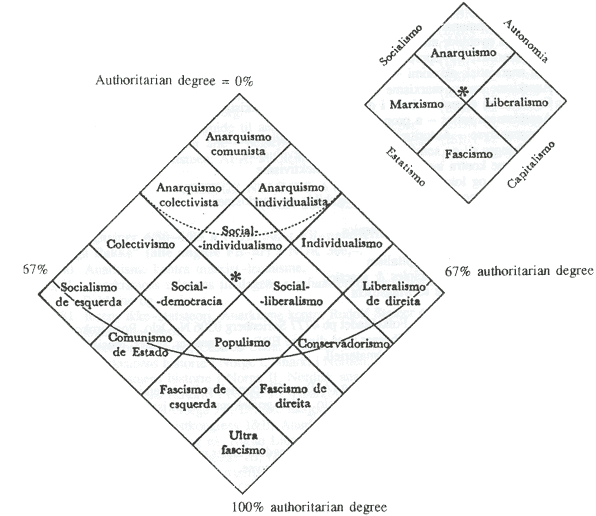
*) The stars indicate the position of the Norwegian economical-political system after the revolutionary change in 1994/95.
Fig. 1. Picture of the Anarchist Economic-Political Map
THE FIGHT AGAINST THE CLIMATE CRISIS – THE GREEN GLOBAL SPRING (GGS) – CONTINUES AT FULL SPEED, SEE: http://www.anarchy.no/green.html & http://www.anarchy.no/ggs1.html
Thousands of anarchists world wide have contributed to the www.anarchy.no.
The www.anarchy.no is independent and autonomous, financed by anarchists and not by capitalist commercials or state-subsidies.
The www.anarchy.no has for the time being about 15 000 visitors and 50 000 hits per month.
The www.anarchy.no has been on Internet since July 1996.
The Anarchist International AI/IFA consists of groups and individuals, all in all more than 50 thousand anarchists world wide.
NB! Anarchism is the progressive middle in politics, not far left or right, see Economic-Political Map on anarchy.no, i.e. https://www.anarchy.no/a_e_p_m.html. This model does not define the left by its rejection of hierarchy and the right by its acceptance, the map is two-dimensional. With Marxism to the left and liberalism to the right. And fascism downwards on the map, and anarchism as the progressive middle, and upwards. According to the political model presented on anarchy.no, anarchism occupies a unique position as the "progressive middle" on a two-dimensional map, distinct from traditional left-right classifications. This model places Marxism to the left, liberalism to the right, fascism downwards, and anarchism upwards, representing a movement towards a society without authority or hierarchy. Also read more about this model at fagerhus.no. More information at: https://www.anarchy.no/andebate.html.
Short introduction about the economic-political system of Kenya
Kenya has a powerful president and a parliamentary system that is democracy only in the name, not in reality. At present, most executive power in Kenya is in the hands of the president. Among other roles he appoints the cabinet, assembles and dissolves parliament, appoints all the parastatal heads and is the commander-in-chief of the military. There is no prime minister in Kenya's constitutional make-up. It is a winner-take-all system ripe for graft and tribal cronyism because of the president's immense powers of patronage and loopholes that let the executive trump the legislature and courts almost at will. A summary about anarchists and anarchism in Kenya is presented at the bottom of this document.
The economic-political system of Kenya works very significantly from the top downwards to the bottom, grassroots, and is also a tribal system (ethnic groups: Kikuyu 22%, Luhya 14%, Luo 13%, Kalenjin 12%, Kamba 11%, Kisii 6%, Meru 6%, other African 15%, non-African (Asian, European, and Arab) 1%), all in all very significantly vertically organized economical and political/administrative. A life expectancy at birth at only 47,2 years (1,2 million living with HIV/AIDS) and a relatively low adult literacy rate at 73,6%, combined with a very repressive political/administrative system in general, contribute to a low degree of autonomy.
The gini-index is estimated to ca 42,5 indicating it is very significantly a capitalist country (more capitalist than the USA with a gini-index at 40,8). The system is also very inefficient with a GDP per capita at only 450 US $ per year, and this also contributes to a low degree of socialism. Water pollution from urban and industrial wastes; degradation of water quality from increased use of pesticides and fertilizers; water hyacinth infestation in Lake Victoria; deforestation; soil erosion; desertification and poaching also contribute to a high degree of capitalism.
Kenya is not one of Africa's "most indebted nations" but it is a very poor country. Around 60% of Kenya's population of 37m lives on less than a dollar a day and although Kenya's GDP has been growing for the past three or four years, many of the other economic and social indicators have dropped. Kenya slipped five places in the 2005 Human Development Report, life expectancy has fallen (WHO) and Kenya is seen as one of the 20 most corrupt countries in the world (Transparency International).
The degree of capitalism is estimated to ca 76,3 % (ca 23,7% socialism) and the degree of statism is estimated to ca 83,0% (degree of autonomy is ca 17,0 %), and thus the libertarian degree is estimated to ca 20,3% (the authoritarian degree is ca 79,7%). The system is all in all clearly totalitarian, located in the ultra-fascist sector of the fascist quadrant of the economic-political map, see System theory. Kenya has rank no 181 on the ranking of countries according to libertarian degree, see Ranking. These long term structural estimates are mostly based on the UN-HDI statistics from 2005, with data from 2003, a relatively calm time in Kenya. The Jan/Feb. 2008 ochlarchy (mob rule broadly defined), with rivaling tribes in armed conflict, indicates an even more authoritarian system temporarily.
The Anarchist International calls for negotiations etc. for solving the present chaos and armed conflicts. The arms must be laid down. No war between tribes etc. - no peace between classes! We want a velvet revolution in Kenya, to do away with the fascist regime.
15.07.2008: There have been some changes in the constitution, etc., see updated news below, but the fundamental parameters of the system have not changed much so far. A 43 members' coalition cabinet is established with a post of prime minister. Kenya moves from lean monarchy to big oligarchy. The degree of autonomy increases about 0,005%. The AI fears that the powersharing between Odinga/ODM and Kibaki/PNU is a recipe for more ochlarchy/chaos.
31.07.2010: The situation however calmed down, and the increased authoritarian degree due to violent ochlarchy, is no longer present. The authoritarian degree is however still about 79,7%. Kenya goes to the polls on Wednesday to vote in a referendum on changes to the country's constitution.
Anarchist comment: We don't see much in the draft constitution, with a very strong presidential rule, that will contribute to reduced authoritarian degree in Kenya. A totalitarian system with around 79,7% authoritarian degree will probably prevail for a long time. A strong president somewhat like in the USA, is an authoritarian tendency, and it is other parts of the system in the USA that contribute to a semi-democratic, and not a totalitarian system in USA.
Democracy has both a political/administrative and an economic dimension, and we don't see that this draft constitution will reduce 1. the degree of capitalism, economical plutarchy, and 2. the degree of statism, significantly, see chapter V. B. at System theory, and also the conditions for real democracy at Real democracy defined - combined with the information of this issue of IJA.
The Kenyan people, seen as a class in contrast to the superiors in rank and/or income, should reject this authoritarian draft constitution in the referendum, and demand a similar constitution as in the Anarchy of Switzerland, see Federalism and Direct Democracy - the Swiss Confederation.
02.08.2010: The Anarchist International - AI/IFA and the Anarchist Confederation of Africa - ACA launch a direct action in Kenya and world wide against the ultra-authoritarian draft constitution at the referendum Wednesday 04.08.2010. To the Kenyan people: Vote NO!!! Election of a very significant ruler as president, as suggested in the draft constitution, is not democracy, but represents a totalitarian system.
Shamsa Ibrahim, a 23-year-old law student in Nairobi, pointed to the constitution's preamble as one of her favorite parts: "All sovereign power belongs to the people of Kenya." "This is the most important sentence to me. It means reform - that we need to move forward," she said. "People might not have read the whole document but they know they don't want what they have."
Anarchist comment: "Shamsa Ibrahim is naive! Authorities talking about "people power" practically certain mean power over the people or a significant part of it. The people seen as a class as opposed to the superiors in rank and/or income, can practically certain never have the power, in the real meaning of domination, the people may at best reduce the power of the authorities more or less! We call for real federalism, the best of majimboism!" declare the Anarchist International - AI/IFA and the Anarchist Confederation of Africa - ACA in a joint statement.
03.08.2010: 'No' makes its final 'free' Kenya message, see updated news below. The Anarchist International - AI/IFA and the Anarchist Confederation of Africa - ACA in a joint statement once more urge the Kenyan people to vote NO: for a development toward socialism and autonomy, significant!!!
04.08.2010: D-Day as Kenyans vote on Proposed Constitution. Statement from the Anarchist Confederation of Africa - ACA, Kenyan section (see updated news below).
05.08.2010. Referendum results: 67% yes to the Proposed Constitution, 30% no, turnout 71 percent. Anarchist comment: "The fight for a better constitution, more libertarian and similar to the Swiss Constitution, and a new referendum, starts today!" declare the Anarchist International - AI/IFA and the Anarchist Confederation of Africa - ACA, Kenyan section, in a joint statement.
27.08.2010. Kenya's president signed the new constitution into law Friday. The anarchist criticism of the new constitution is of course still valid: A strong president and no power-sharing with a prime minister, together with the many loopholes in the new constitution, mean just a continued ultra-fascist and ultra-authoritarian system, almost heaven for the upper class, the bureaucracy broadly defined, and hell for the people, seen as a class as opposed to the superiors in rank and/or income.
Sudan ruler defies arrest warrant, visits Kenya. Sudan's president defied an international arrest warrant by visiting Kenya on Friday, causing an outcry from anarchists and the International Criminal Court which fruitlessly pressured authorities here into arresting the man accused of masterminding the genocide in Darfur. Rather than arrest Sudanese President Omar al-Bashir, who was invited along with other regional leaders for the signing of Kenya's new constitution, officials here treated him with the dignity accorded a head of state. Wearing a dark suit and tie, al-Bashir had a front-row position for the historic ceremony...
03.09.2010. Kenyan government signs deal to allow ICC base in Kenya. The Government has signed 16 articles of understanding that would see the International Criminal Court (ICC) set its base in Kenya, ease its work, track and follow up on the perpetrators of 2007 post-election violence locally. ICC registrar Silvana Arbia was happy with the government's move, saying she trusts the State would fully respect its obligations under the Rome Statute.
21.09.2010. ICC: Kenya date with justice still on. Kenya's date with The International Criminal Court is still on despite remarks by Justice minister Mutula Kilonzo that the court should not handle the post-election violence case after the enactment of a new Constitution. The International Criminal Court Prosecutor Luis Moreno-Ocampo has reiterated his earlier statement of presenting "two cases against 4 to 6 individuals" to the ICC judges before the end of the year. The Media Liaison Officer in the prosecutor's office, Ms Nicola Fletcher, said that as far as they are concerned the government had committed to cooperating with The Hague. Ms Fletcher also quoted Mr Moreno-Ocampo as saying: "In a public press conference, President Kibaki and Prime Minister Odinga both expressed their support for my investigation." Comment by the Anarchist Confederation of Africa - ACA, Kenyan section (see updated news below).
26.01.2012. 2 top Kenya officials leave posts over ICC trial.
10.09.2012. Ochlarchy in Kenya. More than 30 killed in fresh tribal violence in southeastern Kenya.
09.03.2013. Kenya election: Uhuru Kenyatta wins presidency. Mr Kenyatta avoided a run-off vote by a narrow margin. Kenya'sdeputy prime minister Uhuru Kenyatta has been confirmed as the winner of the presidential election 04.03.2013.
11.08.2017. Kenya election: Kenya's Uhuru Kenyatta has won a second and final five-year term as president. Mr Kenyatta, who has been in office since 2013, took 54,3 percent of the vote, and opposition leader Raila Odinga took 44,7 percent. The election day was Tuesday 08.08.2017.
01.09.2017. Kenya's Supreme Court has annulled the result of last month's presidential election, citing irregularities, and ordered a new one within 60 days.
04.09.2017. Kenya’s election commission has set October 26 as the date for a new vote ordered by the Supreme Court when it annulled an August poll.
10.10.2017. Kenyan opposition leader Raila Odinga has pulled out of October's election re-run.
30.10.2017. Kenyan election: Uhuru Kenyatta declared winner of the October 26 presidential election.
15-16.01.2019. Somali Islamists claim responsibility for deadly Nairobi hotel attack.
Criticism of authoritarian tendencies of Raila Odinga
Is the multi-millionaire Raila Odinga the right man for new president and leader of ODM? We doubt it.
First, he is probably corrupt, see http://kenvironews.wordpress.com/2007/09/18/raila-a-odinga-astute-businessman-or-corrupt-politician/
Secondly, we will put attention to some paranoid type conspiracy theories of Raila Odinga, see http://www.odmk.org/external_conspiracy.htm : "External Anti-ODM-K Conspiracy Will Fail - There appears to be an anti-ODM-Kenya conspiracy designed to prevent the Party from taking over power after General elections in December. At the heart of the conspiracy is former President Mr. Daniel arap Moi, sitting President Mwai Kibaki and the Kenyan security apparatus. " We think this opposition to Odinga is not a conspiracy, just opposition. Paranoid tendencies are not a good basis for sound management.
Third, Raila Odinga calls the present ochlarchy (mob rule broadly defined) with rivaling polyarchy and chaos in Somalia "anarchy", and thus he is breaking the Oslo Convention, see http://www.anarchy.no/oslo.html and gets a Brown Card from IAT. In reality Somalia is very, very, authoritarian and thus far from anarchy on the economic-political map, see http://www.anarchy.no/a_e_p_m.html and http://www.anarchy.no/ranking.html :"If Moi hampered a peaceful transition by handing over power to the military as he had initially planned, he could have precipitated a crisis in Kenya and this could have complicated the anti terror war Bush was pushing, given that neighboring Somalia was in deep anarchy with Islamic fundamentalists in total control of the situation." 29.01.2008 Odinga says: ".... as you can see, the country (Kenya ) is drifting into a state of anarchy," and he gets a second Brown Card, mixing up anarchy with ochlarchy, i.e. lawlessness and chaos etc.
During his long political career, Odinga has been in and out of a veritable alphabet soup of political parties. In fact he heads just one faction of the ODM, which in the ever-fractured world of Kenya's ethnic politics found itself splintered along the lines of support for Mr Odinga (a Luo from Nyanza province) and Kalonzo Musyoka (a Kamba from Eastern province). In the recent election they both challenged incumbent Mwai Kibaki (a Kikuyu from Central province) for the presidency.
Raila, a mechanical engineer by profession, was accused of plotting a coup against President Moi in 1982, charged with treason and detained without trial for six years before fleeing to Norway in 1991. But he returned the following year to join his father's new party, the Forum for the Restoration of Democracy (Ford). On his father's Jaramogi Odinga's death, Raila challenged Michael Wamalwa Kijana for the leadership of Ford-Kenya and lost, so left to join the National Development Party (NDP). After the 1997 elections he merged his NDP with Kanu but was passed over for the Kanu leadership and formed the Rainbow Movement in protest. The Rainbow Movement went on to join the Liberal Democratic Party (LDP), and then to form the ODM. The LDP is affiliated to the Liberal International, LI http://www.liberal-international.org/ , as an observer member. Raila Odinga however calls himself a social democrat. His supporters say Mr Odinga is fearless and can be the hands-on president Kenya needs to mend the decades of misrule. But his detractors say he is a dictator in the making, who will shove aside anyone who does not toe the line. To his supporters he is known affectionately as Agwambo [mysterious in his Dholuo language], and budding politicians from Nyanza have often sought his blessing to launch their careers, feeling that without his nod, they would be bound to fail.
IIFOR see the Orange Democratic Movement, ODM, mainly as a grassroots organization with a velvet revolutionary potential, however because of Raila Odinga's clearly authoritarian tendencies, we think he should play a much less dominant part in the organization. The ODM should be run more clearly from the bottom, grassroots, and upwards, not the other way around, from Odinga and his buddies, from the top downwards to the bottom. If the ODM is not run from the bottom, upwards, Odinga as president (or a part of the central-administration) of Kenya will make little change. The whole system in the country must change in this direction, i.e. run from the bottom, upwards.
However Odinga's vision for Kenya is quite sound, see http://www.odmk.org/ . From RAILA ODINGA'S VISION FOR KENYA: " I believe that, for our country, we need a social-market economy – also christened the Third Way. It is the system best suited to achieving faster socio-economic development and equitable distribution of the fruits of our labour. The private sector must be promoted as the engine for more efficient wealth-creation, while ensuring equity in the distribution of the wealth generated by our efforts."
The third way may be interpreted as social-individualist anarchism on the economic-political map, see http://www.anarchy.no/anarcho4.html . Social-individualist anarchism is the system in Norway, see http://www.anarchy.no/a_nor.html and http://www.anarchy.no/ija137.html . This could be the future system in Kenya, after a velvet revolution, and some years of development.
Updated news from Kenya
11-13.01.2008: Kenya election protests to resume. Kenya's main opposition party will resume mass protests after last month's disputed elections, its spokesman says. The announcement follows the failure of efforts to mediate in the crisis by Ghana's President John Kufuor, who is the African Union chairman. He has left Kenya, unable to persuade opposition leader Raila Odinga to meet President Mwai Kibaki. Violent protests over alleged election fraud have left some 600 people dead and the police have banned all rallies. Opposition Orange Democratic Movement (ODM) members will march to a Nairobi police station to notify the authorities of their plan to hold nationwide protests 16-18.01.2008. Before he left, Mr Kufuor sounded upbeat, saying that former UN Secretary-General Kofi Annan would lead further mediation attempts, along with a panel of eminent African personalities. European Union observers said they had concerns about the way the votes were added up, which could have affected the official results. The opposition leader refused an offer to meet Mr Kibaki, unless it was led by mediators - a condition rejected by the president. As well as the deaths, some 250,000 have fled their homes, following clashes between rival political and ethnic groups. Kenyan police have used lethal force, including gunfire, to break up anti-government protests, the US-based Human Rights Watch (HRW) has said. HRW said Kenyan police in several cities have used live ammunition to disperse protesters and looters. Mr Odinga has refused to join a power-sharing administration led by Mr Kibaki. "Kenyans spoke for change, Kenyans want change and Kenyans will get change," he said to some 2,000 supporters at a Nairobi church 13.01.2008. "I can see the light at the end of the tunnel," he said.
Kenya crisis updated 19-20.01.2008: 27 Dec: Presidential and parliamentary elections. 30 Dec: Violence as President Kibaki is declared the winner . 10 Jan: First international mediation effort fails. 16-18 Jan: Three days of mass opposition rallies. Kenya's opposition says it will boycott companies run by allies of President Mwai Kibaki in protest at the outcome of last month's presidential election. The Orange Democratic Movement's (ODM) change of tactics came as police shot five dead on a third day of rallies. One protester died in Mombasa and four were killed in Nairobi. Five bodies of people from Mr Kibaki's Kikuyu ethnic group were found with arrow and machete wounds, police said. It was not clear when they were killed. Kenya's National Commission on Human Rights has cast doubt on the vote that returned President Kibaki to power. At a news conference in Nairobi, the state-sponsored body listed a catalogue of irregularities in a report entitled "Thirty Hours that Destroyed Kenya". It catalogued a series of what it described as electoral offences such as turnouts of more than 100% in some constituencies and the obstruction of election observers. The commission said at least 360,000 votes could not be verified - in a vote where the two candidates were separated by about 230,000 ballots. ODM leader Raila Odinga has demanded a re-run of the election. The UN announced that Kofi Annan, its former secretary general, would fly to Kenya on Tuesday to help mediate between Mr Kibaki and Mr Odinga.
Two members of Mr Annan's team - ex-Tanzanian President Benjamin Mkapa and Graca Machel, wife of ex-South African President Nelson Mandela - have already arrived. ODM spokesman Salim Lone told the BBC that from next week, the opposition would switch to other forms of action, such as boycotts of firms run by what he called the government hardliners. He mentioned specifically the Brookside Dairies, Equity Bank, and City Hopper bus services as possible targets for action. The ODM launched a third and final consecutive day of nationwide protests on Friday 18.01.2008. In Mombasa, police clashed with a group of Muslims who tried to march through the coastal city after Friday prayers in protest at the election results. Officers opened fire, killing one protestor and injuring at least five others, police said. In Nairobi, police confronted demonstrators in the Kibera slum after more than 600 youths tore up a section of railway track running through the centre of the area. Officers fired tear gas and live rounds leaving four dead. A member of the president's Kikuyu community died after being pierced with a poisoned arrow shot by Masai youths, police said. The death at the town of Narok came amid inter-communal violence which saw homes and shops set ablaze. Four other members of the Kikuyu group were killed with bows and arrows and machetes in the area, which is beside Kenya's premier Masai Mara game reserve. The latest deaths bring to 21 the number of people killed during three days of opposition protests. Mr Odinga said police were turning the country into "killing fields of the innocent, executing at will in an unprecedented bloodlust". But police said their response had been restrained and officers had only fired at rioters and looters. Public demonstrations were banned by police immediately after Mr Kibaki's swearing-in on 30 December. The European Parliament unanimously backed a resolution on Thursday calling for the EU to suspend aid to the Kenyan government. Meanwhile, the UN has launched a $34m (£17.3m) appeal for Kenya to help those affected by the recent unrest, in which a quarter of a million people have left their homes.
Saturday 19.01.2008 five people have died in western Kenya, in apparent ethnic violence linked to opposition protests against the outcome of last month's presidential election. The deaths occurred when a group of youths attacked a refugee camp in Rift Valley Province, police said. It came as the opposition ODM announced that it would resume protest rallies on Thursday. It had originally called off protests in favour of a boycott of companies that back President Mwai Kibaki. "We are resuming our peaceful public rallies on Thursday [24.01.2008]," the chairman of the Orange Democratic Movement, Henry Kosgey, told reporters. "We will use all available means to bring down the Kibaki regime." But EU development commissioner Louis Michel, who is in Nairobi for talks with both sides, said such meetings were dangerous and that Kenya needed a "ceasefire" and "active silence". 20.01.2008 The Anarchist International calls on the Kibaki regime to lay down arms and resign voluntarely.
21.01.2008: The Orange party leader Mr Raila Odinga spoke of peace "returning soon" as the government made an important concession by allowing today's mass funeral service in the first ever sign of softening up. But there was widespread outrage over the Kalonzo Musyoka-led mediation team. ODM's programme begins today when the party holds inter-denominational funeral services for their supporters killed in post-election violence in Kisumu. A follow-up one would be held in Nairobi at Ligi Ndogo grounds on Wednesday. The international community has thrown its weight behind the fresh mediation efforts led by Annan, whose fate however remains uncertain as both sides dig into their trenches. Last Monday, Roads minister Mr John Michuki, a core member of Kibaki's Cabinet, threw the scheduled diplomatic efforts into a spin when he said there was no need for outside help. "We won the elections ... We do not see the point for anyone coming to mediate power sharing," he said. "We have not invited Kofi Annan or any other eminent personality to come and mediate." ODM's renewed call for mass action too seemed to contradict Annan's earlier appeal to both parties to refrain from actions that could undermine scheduled mediation talks. "Pending this (mediation), no party should create facts on the ground or engage in acts that complicate the search for a negotiated solution," Annan said. "The purpose of our mission is to help the Kenyan people find a peaceful and just solution to the current crisis". The donor community has threatened an aid cut if the political crisis is not settled. Both the EU and the US have cautioned that it will not be business as usual until there is a political compromise that leads to a lasting solution "that reflects the will of the Kenyan people, wins their confidence and helps return Kenya to stability". Already, the EU Parliament has recommended to its members to stop aid to the country, until the political impasse is resolved. But EU aid commissioner Louis Michel, who is in the country in the latest diplomatic efforts to try to defuse the crisis, met President Kibaki on Saturday and assured that the EU was yet to freeze aid, saying it would wait for the outcome of dialogue. The EU election monitoring team concluded the elections fell below international and regional standards. Raila reiterated he was open to dialogue but he has ruled out any talks spearheaded by Kalonzo whom he described as a traitor. "How can a Jesus Christ and his disciples sit in a committee chaired by Judas Iscariot? Kalonzo is a traitor," Raila was quoted as saying at the weekend.
24.01.2008: Kenyan rivals meet face-to-face. Kenyan President Mwai Kibaki and the opposition leader, Raila Odinga, have met for the first time since last month's disputed presidential election. The talks in Nairobi were mediated by former UN chief Kofi Annan, who said some first steps had been taken towards a peaceful solution to the crisis. Meanwhile, Human Rights Watch issued a report accusing opposition officials of helping to organise ethnic violence in the Rift Valley region, in which hundreds of Mr Kibaki's Kikuyu community were deliberately targeted and killed. ODM spokesman Salim Lone said HRW should provide concrete evidence before jeopardising mediation efforts. The party has denied previous accusations of ethnic cleansing. The unrest triggered by the election on 27 December has left more than 650 people dead and driven 250,000 from their homes. The breakthrough meeting, which last about one-and-a-half hours, was hosted by Mr Annan at the president's office at Harambee House in central Nairobi. Afterwards, the former UN secretary general emerged to say progress had been made during the meeting, describing it as "a very encouraging development". Differences between the two remained, however, with Mr Odinga insisting on a sustainable peace being dependent on justice and Mr Kibaki stating he had been "sworn in as your duly elected president of Kenya". Mr Kibaki's comment was later criticised by the opposition, who said it showed he had "no intention whatsoever of embarking on this journey with the people of Kenya". "We denounce and categorically reject the unfortunate statement from Mr Mwai Kibaki that he is the duly elected president of Kenya and that the current crisis can be resolved internally," ODM Secretary General Anyang N'yongo said. The talks will however continue. On Wednesday, Mr Odinga called off a mass protest planned for Thursday in Nairobi after holding talks with Mr Annan.
25.01.2008: Curfew after Kenya town clashes. The Kenyan police have imposed a curfew after at least 10 people were killed in clashes in the central town of Nakuru. The curfew runs from 1900 local time (1600 GMT) until 0700 (0400 GMT). Rival gangs of young men battled with machetes, metal bars, bows and arrows, while thick smoke billowed up from burning buildings. " Nakuru town has been shut down... hundreds are injured in hospital, " Kenya Red Cross head Abbas Gullet said. Some 700 people have been killed in clashes between rival ethnic and political groups since disputed polls. The violence comes despite hopes of progress after President Mwai Kibaki met opposition leader Raila Odinga for the first time on Thursday since December's disputed polls. Nakuru is capital of the Rift Valley, which has seen some of the worst violence in the past month. Rival groups in the area have long-standing land disputes and these tensions have erupted, as ethnic, political and economic fault-lines have reinforced each other. Former UN chief Kofi Annan has been holding further talks to try to end the crisis. His spokesman said he would be meeting former President Daniel arap Moi, religious leaders and the head of the Electoral Commission of Kenya on Friday. Mr Annan has no immediate plans to lead further direct talks between the election rivals. Although Mr Kibaki and Mr Odinga shook hands on Thursday, the opposition were angered by the president's statement that he had had been "duly elected", saying he was not committed to meaningful talks. But Kenya's Foreign Minister Moses Wetangula appealed to the Orange Democratic Movement (ODM) to give the discussions "a chance". "We don't want to conduct negotiations from the rooftops," he told.
26.01.2008: Annan hits out at Kenya 'abuses'. Former UN head Kofi Annan has condemned "gross and systematic abuses of human rights" in Kenya, after a visit to violence-hit parts of the country. Mr Annan said conflict may have been triggered by disputed elections, but it had evolved into "something else". The facts had to be established and those responsible held to account, Mr Annan said on his return to Nairobi. Dozens more deaths were reported on Saturday, with corpses bearing the marks of brutal violence.
27.01.2008: Fighting spreads in western Kenya. Reports suggest at least nine people have been killed in brutal inter-tribal bloodshed in Naivasha. Gangs of youths blocked the main road. Police fired over the heads of youths blocking the main road. Former UN chief Kofi Annan has been holding talks to try to end the month-long election deadlock in Kenya. He was meeting opposition leader Raila Odinga in Nairobi on Sunday. Unrest has left at least 750 people dead. The Anarchist International calls on the two parties to "stop the bloody ochlarchy" (ochlarchy = mob rule broadly defined). "The politicians from the two divides should preach peace. Fundamental changes are needed in Kenya to prevent a repetition of inter-ethnic violence".
28.01.2008: Police face riots in west Kenya. Police are struggling to restore order in western Kenya, amid a recent wave of violence. In the opposition stronghold of Kisumu, there were riots as hundreds protested against attacks on fellow Luo tribe members over the weekend. Meanwhile in Naivasha - the scene of some of the weekend's worst violence - police battled to keep opponents apart. The Rift Valley has dozens killed in recent days and the national death toll since the December polls is about 800. In many cases the perpetrators were members of President Kibaki's Kikuyu tribe, out to avenge attacks on Kikuyus in the immediate aftermath of the election. Mobs of youths armed with machetes, clubs and bows and arrows hacked people to death and set fire to buildings with families trapped inside. Visiting former UN chief Kofi Annan has told both the president and the opposition that they must act quickly to restore calm or face the threat of Kenya descending even further into murder and chaos. While Mr Kibaki says he is open to talks, he has refused to countenance Mr Odinga's demand for fresh elections. Mr Annan has been working to try to overcome the political deadlock. As mentioned he met Mr Odinga on Sunday, and afterwards opposition spokesman Salim Lone said each side had been asked to name three negotiators to participate in talks, which he said would hopefully start " within a week". Both sides have been sent documents specifying the terms of reference, rules of engagement, and an agenda for talks.
29.01.2008: Annan push to broker Kenya peace. Former UN chief Kofi Annan has begun a new push to broker a deal between the Kenyan government and opposition, in attempts to end spiralling violence. Mr Annan opened talks flanked by President Mwai Kibaki and opposition leader Raila Odinga. He said he believed that short-term political issues could be resolved within four weeks, although more in-depth talks could take as long as a year. The talks came as the death of an opposition MP, Melitus Mugave Were, sparked fresh violence. At least four people died as mobs torched houses in a slum in the Kenyan capital Nairobi, after Were apparently died in violence triggered by last month's disputed elections. Meanwhile towns in the Rift Valley also witnessed outbreaks of inter-ethnic fighting. Army helicopters fired tear gas and rubber bullets at a mob of ethnic Kikuyus attacking Luo refugees trying to flee the town of Naivasha. Kenya's biggest donors have warned the country explicitly or implicitly that aid to the country may be cut or ended unless there is a satisfactory outcome to the post-election crisis. The dilemma for donors is that cuts in aid inevitably first hit those they're intended to help: the poor and sick and disadvantaged in Kenya; and so often in the past, threats of donor aid reduction have ended up being just that, threats. The Anarchist International supports the negotations, and hope for a sound solution for the people, as opposed to the authorities, soon.
30.01.2008: Kenya parties begin mediation. President Mwai Kibaki and opposition leader Raila Odinga have each appointed three-man teams to discuss proposals drawn up by former UN chief Kofi Annan. On Tuesday, he urged both sides to do "whatever possible" to restore calm. Speaking after Mr Annan, Mr Odinga condemned the "deeply flawed" results of the presidential election and said he sought "to be president of all Kenyans". The Anarchist International does not support the fascist regime of Kibaki, but neither supports Odinga as president. He is too authoritarian. The crisis should be resolved by a revolutionary council, organized from the bottom, grassroots, and upwards. Up to 900 people have died as violence has spread since December's election. Meanwhile, Kenya's foreign minister has said Mr Kibaki will attend the African Union summit later this week, dismissing suggestions that there were more pressing issues for him to attend to at home. The ODM's secretary general, Anyang N'yongo, called on member states on Monday not to recognise what it called the illegitimate and illegal government of Mr Kibaki. Jendayi Frazer, the top US envoy to Africa, described the forced removal of people from Kenya's Rift Valley as ethnic cleansing.
31.01.2008: Stop Kenya burning, says AU head. African leaders at their summit in Ethiopia have been told they must get involved with the crisis in Kenya. "The Kenyan crisis is a serious one and we cannot simply condone what the Kibaki regime is trying to feed us," one member of the AU commission told the AFP news agency. "The government will not be given a blank cheque at this summit." African Union (AU) commission chairman Alpha Oumar Konare told them they could not just sit by. "If Kenya burns, there will be nothing for tomorrow," he said. In Nairobi, talks between government and opposition have been postponed. Substantive negotiations started for the first time on Thursday but were adjourned until Friday after an opposition MP, David Kiumtai Too, was shot dead by a policeman in the western town of Eldoret. The police say the killing was a domestic dispute but the opposition Orange Democratic Movement (ODM) says he was assassinated. The death of Too has raised tensions in parts of the Rift Valley, the scene of serious violence this month. Mr Konare - the AU's top executive - said it was the AU's duty to support the mediation process. "Kenya is a country that was a hope for the continent," he said."Today, if you look at Kenya you see violence on the streets. We are even talking about ethnic cleansing. We are even talking about genocide... We cannot sit here with our hands folded." The peace talks in Nairobi are being led by the former UN Secretary General Kofi Annan. His successor, Ban Ki-moon - who is also at the AU summit - urged Kenyan leaders to find a peaceful way out. "President [Mwai] Kibaki and opposition leader Raila Odinga... have a special responsibility to solve the crisis peacefully," he told the summit. "I call on the Kenyan people: stop the killings and end the violence now before it's too late." He said he would go to Kenya himself on Friday to help with the talks. He has held discussions with Mr Kibaki in Ethiopia. Mr Kibaki is among more than 40 leaders present at the AU summit in Addis Ababa, even though the ODM called on the AU not to recognise him. Mr Odinga, by contrast, has not been invited. Despite Mr Konare's plea, the official theme of the AU summit is industrialisation.
01.02.2008: Ban seeks to bolster Kenya talks. UN Secretary General Ban Ki-moon has arrived in the Kenyan capital, Nairobi, in an attempt to boost efforts to end post-election violence. Ban Ki-moon on Friday met with the leader of Kenya's opposition Orange Democratic Movement, Raila Odinga, and appealed to both sides of the bloody dispute to halt the violence and resort to dialogue. "What I would like to ask you is look beyond this individual interest, look beyond party lines toward the brighter future of your country," Ban said. He saw President Mwai Kibaki at a summit on Thursday. In addition Friday, Ban met with his predecessor, Kofi Annan, who has been mediating the two sides in Nairobi, as well as with mediation teams for both sides. The purpose of the visit was to offer support to Mr Annan's panel and be briefed on the humanitarian crisis, a UN official told Reuters news agency. France has called on the UN Security Council to help stop the violence. Foreign Minister Bernard Kouchner expressed fear that the country was being allowed to slide into a "deadly ethnic conflict." In a statement issued from Paris, Mr Kouchner called on the UN Security Council to act. "In the name of its duty to protect, it must urgently come to the aid of Kenya's population," he said in the statement. "Barbaric acts are being committed, civilian populations are being killed in atrocious ways, with women and children raped." Kibaki's tribe - the Kikuyu - has dominated Kenyan politics and commerce since the country gained independence in 1963, it is time this dominating position ends. The Anarchist International stands firm on the following demands: "Keep up the international pressure! End the ochlarchy! No Kibaki fascist regime! No Odinga as president! For a revolutionary council and a velvet revolution!"
Kenyan parties 'agree peace plan'. Kenya's feuding leaders have agreed on a plan to end the political and ethnic violence gripping the country, former UN chief Kofi Annan has said."We have agreed an agenda covering both short-term issues and also long-term issues," Mr Annan said. The deal was agreed by representatives of both President Mwai Kibaki and opposition leader Raila Odinga. The announcement came after fresh outbreaks of fighting left at least 18 people dead in the west of the country. Mr Annan said the rival parties had agreed a four-point framework for talks which should end the violence. The deal is a good start which should have an impact on the level of violence on the ground. But the two parties were still very, very far apart, he says, with President Kibaki claiming he won December's disputed presidential election fair and square, and Mr Odinga claiming it was rigged. The peace plan's first three items, to be completed within a 15-day period, are: stopping the violence and restoring fundamental rights; taking measures to address the humanitarian crisis; and promoting "reconciliation, healing and restoration," Annan said. The fourth item, which could take up to a year, aims for a resolution to the political crisis. "We expect to be able to conclude our work in a year," Annan said, adding that the negotiations' current pace could allow the sides to complete their work in a shorter time frame. "But the timetable is one year." The first is to take immediate action to stop the violence. Mr Annan said the parties had agreed on 18 action points to end the violence, including demobilising militia gangs, refraining from provocative speeches, ending text messages which have been inciting hatred and to hold joint meetings to promote peace and reconciliation. It also calls on police to end "brutality" and "excessive force". Meetings between the two sides will resume Monday and continue through the week, Annan said. Representatives of both sides flanked Annan and echoed his calls to end the violence. "We also expect the public to be a responsible public," said Musalia Mudavadi, an ODM member. "We are calling on the Kenyan people to uphold the rule of law, to make sure that incidents of violence -- revenge, retaliation -- are dealt with." The two sides have made substantial progress on the first agenda item of curbing violence, he said. "We expect everybody from public to police to other law enforcement agencies ... to be guided by rule of law," said Martha Karua, Kenya's minister of justice and constitutional affairs. "We can only enjoy our fundamental freedoms by respecting each others' rights." But there have been further reports of bloodshed, rioting and fighting in parts of the Rift Valley. Police say a 3,000-strong mob armed with bows and arrows, spears, clubs and machetes, killed at least 10 people, including a policeman, in western Kenya. The incident took place in Anaimoi, a trading post in the Kericho district of western Kenya."People from the whole village attacked the policeman and killed him," says police commander Walter Aliwa. At least 863 people have died and another 261,000 driven from their homes, the Kenyan Red Cross said.
02-03.02.2008: Violence follows Kenya peace plan. Nearly 50 people have died in fresh violence, since Friday's agreement by government and opposition on a framework peace plan. Some were killed by police, others were hacked to death by gangs or shot with poisoned arrows. A church was burnt down by youths near the Rift Valley town of Eldoret. On Sunday, pitched battles between youths armed with bows, arrows, machetes and rocks were reported in the west of the country. In Nyanza province, police trailed fighters after they razed more than 100 houses and a primary school, Reuters news agency reported. All in all about 900 Kenyans have died in post-election violence, and more than 300,000 have been driven from their homes, according to BBC. So far there is little sign that Mr Annan's optimism is having much effect in the streets. The violence came as Mr Odinga, who leads the Orange Democratic Movement (ODM), responded to Mr Kibaki's suggestion that the opposition should challenge the election result in court. "Mr Kibaki... is undermining the [peace] process by saying the problems in Kenya can be resolved locally by court action," he said. The ODM leader says the election was rigged and believes the courts are biased towards Mr Kibaki. Mr Odinga also denied claims that the ODM had instigated the violence. "[Kibaki] is trying to cover up the ethnic cleansing that is occurring in his own backyard in central Kenya," he said. Two days after reaching a plan with the Kenyan government to end violence that has wracked the country for more than a month, the opposition party, ODM, asked both the United Nations and the African Union to send in peacekeepers. The Anarchist International supports ODM's proposal about international peacekeepers and demands that both parties must implement the agreement mentioned above at grassrootslevel as soon as possible, and the international pressure must be increased, to do away with the bloody ochlarchy.
04.02.2008: Kenya rivals resume peace talks. Talks aimed at resolving Kenya's post-election crisis have resumed in the capital Nairobi. Former UN chief Kofi Annan on Friday brokered a deal between Mr Kibaki and Mr Odinga, setting up a framework for the negotiations. But the man he hoped would lead the talks, South African businessman Cyril Ramaphosa, has been dropped from the mediation panel, because of objections by the Kenyan government. Mr Ramaphosa played a key role for the African National Congress negotiating with South Africa's last minority white government. Meanwhile, the former Archbishop of Cape Town, Desmond Tutu, has appealed for an end to the "totally unacceptable" violence and called on Kenyans to back the talks. "My heart aches for Kenya. Your countrymen and women have suffered greatly," he said. "It is in your power to stop the violence if you act as one. You have an opportunity now to stand up for peace." The discussions are aimed to halt the bloodshed within two weeks. The two sides are due to discuss the key allegations of electoral fraud this week. Other issues that the two parties agreed to address are the humanitarian situation, the political crisis, and land and historical injustices. But politicians have rapidly resumed their war of words. A senior colleague of Mr Odinga, William Ruto, said that without foreign intervention there would be no peace. "We are committed to ending this violence but it will not happen in a day or two or three or a week," he said. "You should understand the situation in this country is that we are literally at the brink." Mr Odinga called for peacekeepers from the UN or the African Union "because the police have often been misused and we do not have faith in the army to be neutral." But Mr Kibaki and his supporters continue to accuse the opposition of fuelling the unrest. "This is a politically instigated situation," said information minister Samuel Pergisio. "It is a process that requires these politicians to go back and speak to their people." Meanwhile, the violence has continued. On Monday both sides agreed to tackle the humanitarian crisis. The two sides agreed immediate measures to address the humanitarian crisis, including helping those displaced by violence to return to their homes. After the first few days of talks intended to find a solution to the Kenyan election crisis, the impressions emanating from the room where the Kenyan government and the opposition have been negotiating were generally quite favourable. Officials from the government (fascist) Party of National Unity (PNU) and the opposition Orange Democratic Movement (ODM) were saying that "progress was being made".
05.02.2008: 'Hard' Kenya crisis talks resume. Kenya's political foes have begun discussing crucial political issues to try to end to weeks of violence. Kofi Annan, who is brokering the negotiations between President Mwai Kibaki and opposition leader Raila Odinga, warned they would be "hard". The former UN chief warned that there would be no easy resolution to the crisis. "The crisis arising out of the December 2007 elections, that is going to take hard negotiations, understandably give and take," Mr Annan told reporters. Tuesday's talks focused on the political crisis - though both sides have expressed deep reservations about any power-sharing deal. Mr Annan and his team have rejected one possible solution; a re-run of the election, something that the opposition has said it might favour. So what remains as the only possible option is a form of power-sharing; and this is the area where Mr Annan and his team hope agreement might eventually be found. For ODM to agree on a "power-sharing deal" they must probably be given a real executive position. They will not settle for anything else. But the government/PNU is of course opposed to this. Issues relating to land distribution and historical injustices are also set to be debated later in the negotiations. Annan also called for a South Africa-style truth and reconciliation committee to investigate the political and ethnic violence. The political disruption also affects the economy. Teading business figures are urging quick progress as the economy suffers. Mr Annan highlighted the impact of the crisis on the country's economy when he addressed the 300 or so participants at a conference of leading business figures in the capital, Nairobi, whose businesses together account for about 80% of the country's GDP. The Kenyan business people meeting in Nairobi on Tuesday highlighted the urgency with which a political solution must be found. "Every day that there's another delay, more business is lost and becomes irrecoverable," Michael Joseph, the chief executive of the mobile phone company Safaricom said. "People can say we're putting profit first, but we're not putting profit first - we're putting our country first, because without our businesses there's no jobs," he said. Mr Annan said he was "extremely delighted" at the initiative. Streets in western Kenya - scene of much of the recent violence - appeared calm on Tuesday. But the Kenya Red Cross has said it believes more than 1,000 have died, and about 304,000 displaced since the 27 December elections, which were marred by irregularities according to local and foreign observers. The Anarchist International fears a power sharing solution on the top, that will benefit only the multi-millionaire Raila Odinga and his buddies and the Kibaki fascist movement (PNU), and not the Kenyan people, as opposed to the upper classes - authorities broadly defined. The Anarchist International supports only solutions that will work from the bottom, the people (grassroots), and upwards, not the other way around, from the top downwards to the bottom.
Kenya's opposition threatened new street protests if a meeting of regional leaders chaired by the government goes ahead this week while the two sides are locked in political negotiations. The rivals on Tuesday began the toughest part of their talks so far to try to end the crisis over the disputed election. Kofi Annan, mediating talks, said the opposition threat should not have been made in light of the talks and a pledge by both sides to avoid antagonistic proclamations. "We have a demand that the parties avoid provocative statements outside negotiations," Annan told reporters. "We are going to be vigilant on that. I think there is a clear understanding that it should not have been done and there will be no mass protests." The opposition had attacked plans to hold a meeting in Nairobi of the seven-member east African regional bloc IGAD, the rotating chairmanship of which is held by Kenya. Foreign ministers are due in Kenya on Wednesday, with talks due the next day. IGAD last week said it supports Annan's mediation, and offered any help needed. It was not immediately clear whether IGAD's heads of state would come later -- as is normally the case -- to endorse the statements agreed on by their foreign ministers. An IGAD official who declined to be named said it was likely. "If the IGAD meeting goes on in spite of our call for it not to go on, we shall call upon Kenyans to come out in their big numbers for a peaceful demonstration in Nairobi to strongly protest," ODM secretary-general Anyang' Nyong'o said. The government has banned street protests, and earlier ones have led to looting, rioting and a bloody police crackdown. South Africa on Tuesday strongly attacked President Mwai Kibaki's government for raising objections to a prominent anti-apartheid figure as a mediator in Kenya's crisis. Cyril Ramaphosa, a Johannesburg business tycoon, was nominated by Annan to lead longer-term negotiations in Kenya. But he pulled out on Monday after the government accused him of having business links with opposition leader Raila Odinga, allegations he denied. "The reasons given by the (Kenyan) government are rejected with the contempt they deserve," Deputy Foreign Minister Aziz Pahad told reporters. Odinga insisted on external mediation, which led to the Annan mission that so far has produced commitments to end violence and help those displaced. On Tuesday, Annan pushed the two sides to focus on the third item on their agenda -- "the political crisis arising from the disputed presidential electoral results." Odinga argues the president was illegally returned to office through vote-rigging, and Nyong'o said the IGAD regional meeting would "legitimize Kibaki's position through the back door." International observers have said the vote counting was so chaotic that it was impossible to tell who won. The government says Kibaki was elected under Kenya's laws.
06.02.2008: Kenya talks resume as regional ministers arrive. Kenya's political rivals resumed crisis talks on Wednesday despite preparations for a meeting of east African foreign ministers which has angered opposition leaders. Some ministers from the seven-nation bloc arrived in Nairobi on Wednesday, Kenyan Foreign Minister Moses Wetangula said. " If the government goes ahead and holds the IGAD meeting, we will protest peacefully. We will march, carry placards, show our messages," one opposition official said. The Anarchist International supports the peaceful protest, on the condition that the ODM takes on significant measures to see that it stays peaceful similar to the ABCDE protests in Oslo, see http://www.anarchy.no/abcde.html , and thus does not end up in ochlarchy.
07.02.3008: UN calls for Kenya 'compromise' . The UN Security Council has called on Kenya's political leaders to solve the crisis there through "dialogue, negotiation and compromise". In its first official response to the unrest sparked by December's disputed election, the council expressed concern at the "dire humanitarian situation". Foreign ministers from Djibouti, Ethiopia, Sudan, Uganda and Somalia have arrived in Nairobi for a meeting of the East African regional group, IGAD, on Thursday to discuss the crisis. The Security Council statement gave strong backing to efforts by the former UN Secretary General, Kofi Annan, to find a solution. "The council emphasises that the only solution to the crisis lies through dialogue, negotiation and compromise and strongly urges Kenya's political leaders to foster reconciliation," it said. The council called on Mr Odinga and Mr Kibaki to meet "their responsibility to engage fully in finding a sustainable political solution and taking action to immediately end violence". Gangs must be disarmed, human rights restored and the humanitarian situation improved, it said. "Recalling the need to avoid impunity, the council calls for those responsible for violence to be brought to justice," the statement added. A UN fact-finding mission arrived in Kenya on Wednesday to collate information on suspected human rights abuses. The UN High Commissioner for Human Rights, Louise Arbour, said: "Truth and accountability are of critical importance in putting an end to the violence and preventing future human rights violations." The meeting of the IGAD group has sparked anger among Kenya's opposition, which has warned it will hold mass rallies if it goes ahead. Mr Odinga's Orange Democratic Movement (ODM) said it was not consulted about the gathering, which could undermine talks being chaired by Mr Annan. ODM Secretary General Anyang Nyong'o said: "If the meeting goes ahead as planned we shall mobilise our supporters for a peaceful demonstration against President Kibaki's government." But Mr Annan sought to ally the ODM's fears, saying IGAD had nothing to do with his negotiations. "All parties must avoid provocative statements touching on the matters in discussion," he said. A framework for the negotiations was agreed last Friday, including what caused the political crisis and issues relating to land distribution and historical injustices. Meanwhile, heads of the country's tourism industry have gathered in Nairobi to devise a strategy to minimise the damage to their businesses. Revenue has been cut by an estimated $80m (£40m). Information Minister Samuel Poghisio said on Thursday the violence in Kenya was diminishing and that most of the country was unaffected, so investors and tourists should not take fright. "Come in and hold hands with Kenyans and say 'We are with you' and let not the images beamed internationally be the ones to guide you," Poghisio said in an interview with Reuters. But he acknowledged Kenya had been through what he called a dark period in its history. The Anarchist International mostly agrees with the UN Security Council in this matter, but on the conditions mentioned in the AI's and IIFOR's resolutions above (with bold lettering). There is too much focus on the persons Odinga and Kibaki, the main focus should be on a less repressive system, with more influence from the bottom, the people ( grassroots), and upwards, not the other way around.
Former U.N. boss Kofi Annan is leading international mediation efforts at a hotel in Nairobi where officials from both parties met on Thursday for more talks, and a string of outside diplomats came through. European Union aid chief Louis Michel was among those in Nairobi on Thursday, where he met with Annan, Kibaki and opposition leader Raila Odinga. Having agreed on principles to stem violence and help refugees, negotiators at the Annan talks are now stuck on the original bone of contention -- who won the December vote. But Odinga told reporters his stand that Kibaki should step down had changed: "We are not static on that point. We are willing to move so that an acceptable solution can be found." The government team insisted that the dispute be resolved through legal means or constitutional reforms. Both sides were however in agreement that re-tallying or a recount of the presidential votes should not be done. Annan denied media reports on Thursday that his hotel suite had been bugged. "That's news to me," he said. Foreign ministers of the regional bloc IGAD were also in town to meet Annan and among themselves, while leaders of another regional bloc, the East African Community, were due to arrive on Friday. Kibaki last week was recognized as a head of state at an African Union summit, a meeting which the opposition tried to get into but failed. Beyond the ballot, the crisis has laid bare divisions over land, wealth and power that date from colonial rule and have since been stoked by politicians, particularly at election time. Information Minister Samuel Poghisio said the images beamed around the world had given a false picture of what he called an "isolated case of some politically motivated violence". "Knowing Kenya's history, and the way that Kenya has been gradually climbing and not declining, sometimes a small valley is a prelude to a very good, steep climb ahead," he told Reuters. On Thursday police said they would charge one of their officers with murder after he was filmed shooting dead two young protesters in Kisumu last month in what rights groups and the opposition slammed as extrajudicial killings.
Travel ban: Panic gripped MPs and Cabinet ministers after news that at least 10 personalities had been banned from entering the US. Local Government minister, Mr Uhuru Kenyatta, welcomed the travel ban "if it is the way to bring peace and end violence". The Canadian Embassy said it would deal with visa applications as they come, but would not prepare a list of people to be denied entry.
08.02.2008: Pressure on politicians linked to post-election violence and those said to be subverting democracy continued, with Britain saying it could follow the United States and Canada in imposing travel bans. A source at the British High Commission said: "This is an option that Britain is considering alongside other measures. But at the moment, it's still in the planning stages." The source added: "Precedents exist where even Heads of State have been barred from entering the UK. For the moment, however, the mediation talks are at a very sensitive stage and they must be left to take full course." The US visa ban move and the British High Commission's announcement that it could follow suit could trigger similar actions from other foreign missions. Foreign nations will use the bans as a lever to force politicians to reach a political settlement to the dispute over President Kibaki's re-election. Displaced people face tough times. Life in camps hosting displaced people in Eldoret and other places in the North Rift is one of suffering, misery and frustration. It is a story of disease, adverse weather and inadequate food rations. The Anarchist International supports the travel ban and demands a quick solution to the displaced persons problem. The AI also demands constitutional reforms that contribute to a system that works more from the people (grassroots) and upwards, not the other way around.
Kenya peace talks 'breakthrough'. Kenya's ruling party and opposition have reached a "breakthrough" during talks in Nairobi to end post-election bloodshed, officials say . Details are unclear but chief mediator, ex-UN Secretary General Kofi Annan, is expected to make an announcement soon. A senior UN official said that the rival parties had reached consensus on a "broad brushstrokes agreement". Opposition official William Ruto said the rival parties had reached a deal on an interim joint government. Mr Ruto was quoted by the Associated Press news agency as saying: "We have agreed to form a joint government. Details of that government, its time and how to share it are under discussions. We are saying that we are willing to give and take. Initially our stand was that we won the elections, and Mr Kibaki lost the elections, he should resign, and we should be sworn in, but we have said that we are not static on that point." There is huge excitement in the Kenyan capital at the apparent breakthrough, which follows weeks of intransigence from both sides. Speaking at a prayer service in Nairobi on Friday, President Mwai Kibaki said he was "encouraged by the commendable progress" in the peace talks. The Anarchist International demands that this "interim government" should be "government" in the name only, and organized as much as possible from the people (grassroots) and upwards, and not the other way around.
Kenya's ruling party and opposition could be just days away from a final political settlement to end post-election bloodshed, officials say. Ex-UN Secretary General Kofi Annan told reporters in Nairobi an agreement could be reached next week but that earlier reports of a deal had been premature. Mr Annan said: "We are all agreed that a political settlement is needed, that a political settlement is necessary and we are working out the details of such a settlement" His comments followed Friday's second face-to-face talks between President Mwai Kibaki and opposition leader Raila Odinga - only the second time they have met since the disputed elections. President Kibaki's side said there had been an "agreement in principle", while the opposition spoke of a "positive development". With the political crisis apparently easing, Kenya's internal security minister on Friday lifted the ban on public rallies that had been imposed after the violence broke out. "Security has generally improved," said George Saitoti, explaining his decision, but he urged those holding rallies not to use them as "avenues to incite violence".
09.02.2009: Detailed interim power sharing arrangement next week. UN envoy heads to Kenya hotspots. The UN emergency relief co-ordinator, John Holmes, is to visit some of the key flashpoint areas of violence which followed Kenya's disputed election. The envoy's visit comes at a time of renewed hope that a political solution to the crisis can be found. Mr Holmes will visit Molo and Nakuru, towns in Kenya's Rift Valley which have seen some of the worst fighting. The envoy told reporters he had come to see for himself the extent of the displacement that has been triggered by inter-ethnic fighting, and was lending support to mediation efforts being spearheaded by Mr Annan. In a significant development on Friday, Mr Annan said he expected that the political issues that separated the two sides could be settled by as early as next week. Although no final deal has been struck it is understood that President Mwai Kibaki's party and the opposition are beginning to talk of an interim power sharing arrangement, but exactly how this would work and how long it would last, are details that still need to be thrashed out. "Apparently, there was a newfound spirit of camaraderie among the negotiators ... giving hope to Kenyans and the world that the resolution was in sight," Kenya's Daily Nation newspaper said in an editorial on Saturday. "This goodwill should be exploited to the maximum." Quoting sources in the discussions, local media said both parties had made concessions, paving the way for power sharing. Any agreement is expected to include binding commitments to land reform, constitutional change and a shake-up of the courts, the BBC's Karen Allen says. "In negotiations, a deal is not a deal until it is done," the former UN chief warned in a statement. "While the talks are making progress, they have not come to a definite conclusion." The Anarchist International demands that the people (grassroots) should be involved significantly, so that the solution will work as much as possible from the people (grassroots) and upwards (and not the other way around), - a step towards anarchy in Kenya.
10-11.02.2008: Negotiators for President Mwai Kibaki and opposition leader Raila Odinga re-started talks on Monday in a mood of national optimism that a political solution to Kenya's worst crisis since independence may be near. Mediator Kofi Annan has predicted the two sides will agree on a formula this week to overcome their dispute over the December 27 election. Kenyan media, and sources close to the talks, say that will almost certainly be a power-sharing deal. Odinga's Orange Democratic Movement (ODM) is no longer calling on Kibaki to step down, the sources say, while Kibaki's Party of National Unity (PNU) has dropped its demand the opposition take its grievances over the polls to court. "On the threshold of a breakthrough," read The Standard's banner headline, one of many predicting success in the talks. At the Maasai Mara national park, rangers even named a newly born rhino "Kofi Annan" in honor of his role. Annan himself warned media against "speculation and rumors" at this delicate stage in his negotiating mission. Both sides also tried to calm premature jubilation around a nation exhausted by violence and acrimony, much of it along ethnic lines among Kenya's more than 40 different groups. Though triggered by the controversial presidential vote tally, the bloodshed in Kenya has exposed deep divisions over land, wealth and power that date back to British colonial rule and have been stoked by politicians in the decades since. Government negotiator Mutula Kilonzo, who said last week he was "1,000 percent confident" a deal was coming, urged patience. "The media is selling a deal. It could be up to a week," he told reporters at a plush Nairobi hotel that has become the centre of international diplomatic efforts to end the crisis. Odinga, 63, an ex-political prisoner and once a minister in Kibaki's cabinet, also declined to be drawn. "We will not carry out mediation talks through the media," he said at the weekend. An ODM party spokesman told reporters at Monday's talks the negotiations were not simple. "They're not just going to be cooked up any second. Negotiations are going to take a bit of time," he said. "(But) we are very hopeful, like the Kenyan people are." Both sides are said by sources in their parties to have agreed in principle on power-sharing, and are now focusing on the details. The opposition says its larger numbers in parliament should give it a bigger share of cabinet posts. But the Kibaki side has the official ruling of the electoral board that he won the presidential vote, albeit narrowly. The protests and rioting that began immediately after Kibaki's December 30 swearing-in spread to many parts of the nation, especially the Rift Valley and Nairobi slums that saw unprecedented scenes of violence. The violence has subsided in recent days, but Kenya's image as a stable system and a regional hub for business, tourism and transport has been badly damaged. Kenyan markets have taken a battering. The stock index has dropped about 12 percent and the shilling currency has fallen more than 10 percent against the U.S. dollar since the crisis began. Both sides have already agreed principles to end violence and help refugees. Annan gave them until mid-February to resolve agenda item No. 3: what to do about the disputed election. Deeper underlying issues, such as land grievances and wealth inequality, are to be tackled within a year. The Anarchist International demands that the negotiations should not only be a question of cabinet posts, powersharing on the top, but on how to involve the people (grassroots), so that the future system will work as much as possible from the people (grassroots) and upwards, and not the other way around.
12.02.2008: Kenyans consider grand coalition and comprehensive constitutional, judicial and electoral reforms. On Monday Britain's Africa Minister Mark Malloch-Brown told Reuters he was cautiously hopeful Kenya's political rivals could strike a deal this week though there is still "a mountain to be climbed". He said he expected a proposed agreement to call for power-sharing until a new election. Reforms to the constitution -- which currently gives the president vast powers -- and election commission would be made before the vote. Government officials have expressed optimism about progress made behind closed doors, but appealed for patience. As talks resumed in a luxury hotel in the capital, Kibaki urged Kenyans who have fled their homes to return. "We are going to assist in rebuilding houses that were torched," he said at a Nairobi high school where he launched a free secondary school program. Former UN chief Kofi Annan has briefed Kenyan MPs about the progress of talks aimed at defusing the election crisis before they move to a secret location. He did not give any details but a BBC correspondent says he seems to be moving towards the idea of a grand coalition with new polls next year. Mr Annan has ruled out a recount and says Kenya is too unstable for new elections for at least a year. At least 1,000 people have died after the opposition said polls were rigged. More than 600,000 people have been forced to flee their homes amid clashes between rival ethnic groups, seen as pro-opposition or pro-government, according to BBC. As they enter a third week, the talks between government and opposition teams are being moved away from the capital, Nairobi, for three days to avoid the glare of publicity. Mr Annan said he had asked both sides not to discuss the contents of the talks with anyone else, calling for a complete news blackout. He says that at the appropriate time, he will release the outcome of discussions to the media. Mr Annan has hinted that the deal will include comprehensive constitutional, judicial and electoral reforms. Both the opposition Orange Democratic Movement (ODM) and President Mwai Kibaki's Party of National Unity (PNU) have tabled proposals for a power-sharing agreement. Mr Annan has however cautioned against speculation over the proposals being discussed and hinted that a deal may be reached in three days. He described the teams at the negotiating table as level-headed and expressed confidence that they will deliver a negotiated settlement. " The current crisis is a big challenge but it provides an opportunity for Kenyan leaders to steer the country to a new level of stability ," Mr Annan told MPs at a special session in parliament. He commended the government for lifting a ban on live media coverage and holding of political meetings. The former UN chief reiterated that both ODM leader Raila Odinga and President Kibaki have been well briefed of the progress so far and are in total support of the process. Mr Annan also called on the MPs to travel to their constituencies and preach peace and tolerance insisting that both teams have agreed to ensure that those behind the recent clashes are investigated and prosecuted. The Anarchist International demands that the grand coalition and comprehensive constitutional, judicial and electoral reforms, plus the new level of stability, should be organized as much as possible from the people (grassroots) and upwards, not the other way around.
13.02.2008: No 'quick fix'. The International Centre for Policy and Conflict (ICPC) has called on the Annan-led mediation teams to act with caution as they get to the climax of the talks. The Executive Director, Mr Ndung'u Wainaina, asked the team to critically look at the fundamental causes of the conflict to arrive at a more satisfactory, acceptable and durable political settlement. "It is critical to avoid a ‘quick fix', which could be extremely dangerous. We need to be looking at the reasons for the current governance collapse and low trust in institutions. It is also paramount to address the non-institutional issues such as the economy, where people feel no substantial progress has been made in their interest," he said. Ndung'u said to reach the required sustainable agreement, a comprehensive approach was needed to take into account the root causes of the original conflict and the factors that have blocked constitutional reforms and social transformation. "It is erroneous to presume that the vested interests of elites on either side of the river necessarily correspond to the interests of the broader population," he added. In a statement sent to newsrooms, he called on the international community to remain "determined, clear and unequivocal in its actions towards mediation in order to forestall intransigency and time-buying tactics". The civil rights advocate said forcing a quick fix power-sharing arrangement devoid of a roadmap for achieving the perquisite reforms that have remained elusive would be disastrous. "The final political settlement must reflect the desire for reaching constitutional, governance and policy reforms in order to deal effectively with the real disease and not the symptoms. We have to be wary and critical of any quick-fix approaches that ignore the need to lay foundations to make negotiated peace sustainable." Kenya, he said, needed to struggle for greater democratisation of political space, for respect of human rights and accountability by all political actors in order to build a lasting and just peace. ICPC appealed to the National Assembly to realise its centrality in the mediation process in converting the resolutions into a comprehensive legislative framework that would transform the governance system and constitutional order. "Parliament has to be determined to take full responsibility for formulating a comprehensive, long-term legal framework, which will guarantee that the entire country is looped into the mediation process and its outcome," he added.
Illegal militia problems. First they sent leaflets saying they would avenge the killings of their tribesmen when violence flared following Kenya's disputed election. Then they told other tribes to leave certain areas. People's fears had come true. The Mungiki were back. Hundreds of men wielding machetes and clubs, attacked their opponents beheading and dismembering them in characteristic style. The violence has largely abated for now, as politicians negotiate their way towards a political settlement, but the re-emergence of this quasi-religious group could plague Kenya for years to come. The Mungiki has been outlawed by the authorities, with whom it has been engaged in a protracted battle spanning more than 20 years. At first they styled themselves as the guardians of Kenya's largest community, the Kikuyu, who include President Mwai Kibaki among their number, saying they would re-establish ancient traditions. Attracting large numbers of jobless teenagers, the group soon became an underground youth wing for politicians, who used it to unleash terror on their opponents. Mungiki became a criminal gang terrorising urban slums and demanding protection money from transport operators. To counter the Mungiki, residents in the informal settlements formed their own vigilante groups, saying the police had failed to deal with the threat. One notorious gang is the equally dreaded Taliban which draws membership from the Luo community - who largely back the opposition. Another militia known as the Sabaot Land Defence Force (SLDF) is now harassing locals on the foot of Mount Elgon in western Kenya. The SLDF is composed of members of the Sabaot, a sub-tribe of the Kalenjin community. In the past it used to fight with rival clans over land. Unlike the Mungiki and the Taliban, which are largely urban based, the SLDF operates in rural areas and has even established a parallel administration system in the Mount Elgon district. For funding, the group imposed a tax on residents and raided villages for supplies. The SLDF is now reported to be attacking neighbouring communities. Its members are normally armed with assault rifles and have been accused of killing more than 400 people. Before the elections, police vowed to eliminate the Mungiki once and for all. At one point human right organisations accused the police of executing more than 500 members of the group. Although the police denied the accusation, the recovery of hundreds of bullet-ridden bodies on the outskirts of Nairobi made some think the Mungiki had at last been wiped out. But the post-election violence appears to have breathed new life into this group. Their re-emergence followed the killing of hundreds of Kikuyus in opposition strongholds in western Kenya. The Mungiki scented blood and wanted vengeance. Soon Mungiki gangs were attacking members of other tribes and hacking them to death. It is not clear who finances the Mungiki, although it has been suggested they are in the payroll of some politicians. Recently the Mungiki have been confronting women wearing trousers, forcing them to change into skirts or long dresses. They say wearing trousers goes against the Kikuyu culture. It is feared that if the electoral crisis persists, the gangs could become even more dangerous.
Kenya government anger with Annan. The head of the Kenyan government team at crisis talks has expressed anger with mediator Kofi Annan over comments on resolving the election dispute. Mr Annan hinted that both sides had agreed on a transitional government for two years, after which fresh presidential elections would be held. But Justice Minister Martha Karua said this had never been discussed. She said that Mr Annan, the former UN chief, had undermined the government's position at the negotiations. When talks between government and opposition teams were moved away from the capital, Nairobi, on Tuesday to a secret location to avoid the glare of publicity, Mr Annan asked both sides not to discuss the contents of the talks with anyone else, calling for a complete news blackout. His comments about a possible grand coalition were made during a special closed-door session with Kenyan MPs. But details of his briefing have angered President Mwai Kibaki's negotiating team. Ms Karua said his statement about a transitional government had caused distress and great embarrassment to them as it had misrepresented their position. "We feel these inaccuracies have greatly undermined our position as members of the dialogue team and we demand the issue be revisited as the first item when we meet next," she said. A power-sharing deal had been thought to be imminent, but correspondents say this development implies the government is against fresh elections. In a statement on Wednesday, mediators sought to downplay the rift, saying the grand coalition was Mr Annan's perspective on the discussions. "[It] does not imply a formal agreement between the two parties," the statement says. Both the opposition Orange Democratic Movement (ODM) and President Mwai Kibaki's Party of National Unity (PNU) have tabled proposals for a power-sharing agreement at the talks. Mr Annan had hinted the deal would include comprehensive constitutional, judicial and electoral reforms. He told parliament both President Kibaki and Mr Odinga are committed to the talks aimed at reconciling the nation and urged the MPs to equally support the process. "Your active involvement, across party lines, is necessary. Without this, the government may be paralysed. We cannot afford to fail," he said. The Anarchist International mostly agrees with the ICPC, a.o.t. that there is no 'quick fix' to Kenya's problems, and that the economic issues are important. Furthermore measures against the illegal militias must be taken as soon as possible. AI also mostly supports Annan's broad based proposals, under the condititions mentioned above. The fascist PNU's attempt to hold on to the power, and undermine Annan's proposals, must be rejected.
14.02.3008. Class struggle - Yes! Class war - No! Kenya is a land of stark contrast: the rich drive gleaming luxury cars, can afford to enrol their children in top British schools and in the case of one local magnate, send suits to London for dry cleaning. But most live a hand-to-mouth existence and some Kenyans believe the bloody post-election crisis that has exposed the east African country's tribal divisions could also inflame the gulf between classes and further exacerbate instability. Although long seen as one of Africa's most promising economies, Kenya has a huge wealth gap, with 10 percent of people controlling 42 percent of the economy and the poorest 10 percent holding less than 1 percent, according to U.N. figures. "If this issue is not resolved, the worst thing we would hear or see is a class war where these people, men and women, say they have nothing to lose," Abbas Gullet, secretary general of the Kenya Red Cross, told business leaders recently. Opposition leader Raila Odinga used the argument that many Kenyans have not shared in economic growth under President Mwai Kibaki -- averaging 5 percent a year -- to win support in impoverished areas ahead of the election in December. The dispute over Kibaki's re-election, in a vote that Odinga says was stolen, became the spark for bloodshed that has killed at least 1,000 people in ethnic clashes and battles between police and poor slum dwellers. Chief mediator Kofi Annan, the former U.N. Secretary General, hopes for a political solution this week but nobody expects the wounds opened by the crisis to heal so soon. While Kenya's most obvious divisions follow tribal lines, those killed on both sides tend to have much more in common as peasant farmers or slum dwellers than they do with the ultra wealthy Kibaki and Odinga. While a majority of Kenya's 36 million people live on a dollar a day and most struggle to put their children through school or pay for decent health care, cabinet ministers take home more than 1 million shillings ($13,820) a month. "All these politicians are using us. We fight one another and die like animals, but their children are not on the streets like other Kenyans," said Ouma, a security guard in a middle-class Nairobi suburb. "The people dying are young men who should be working not dying." During the worst fighting, ethnic gangs erected roadblocks and beat up or killed those they caught from rival communities. But some of the thugs also harassed or robbed people from their own ethnic groups if they seemed wealthier.
Around 500,000 young Kenyans join the job market each year, but many fail to find work, swelling the number of disaffected youths ready to seize on any chance they can to profit. "Some of them see us riding in our Mercedes or in our Hummers and they want that, just as we want the same thing for our children. This is the reality we are dealing with today," Steven Smith, chairman of the Kenya Association of Manufacturers, told the meeting of business leaders. Aid workers in Kenya's slums say they have to consult with so-called "emerging informal leadership" for their safety. Simply put, they have to deal with ethnically-based gangs that control slums where police and other normal government services rarely reach. Poverty is a driving force behind high levels of crime that affect both rich and poor Kenyans. In Nairobi's Mathare slum, the murderous Mungiki criminal gang has long ruled, carrying out extortion rackets and providing illegal water or electricity connections. Politicians have long used such groups as campaign muscle-for-hire, and did so during the election violence. "They have a huge say and sway on the ground in these major slums and they are establishing their own leadership," Gullet said. "I say to many politicians ... today it is quite clear that they do not have the proper control over these people." A local daily columnist wrote recently that it was naive to expect that pro-Kibaki and pro-Odinga gangs would only fight against each other forever. "If there's no political settlement soon, at some point, the gangs will unite ... together attacking, without discrimination, the homes of Kibaki and Raila's middle-class supporters," Charles Onyango-Obbo wrote in the Daily Nation. He cited the example of rival gangs fighting for political godfathers in Congo Republic in the 1990s who sometimes called a temporary truce when their battles led them to a rich suburb. They would then loot it together, before going back to war. The Anarchist International supports class struggle in Kenya, but not class war. Class struggle is about changing the social structures of positions and organization towards more socialism and autonomy, less rank and income differences, more efficiency and fairness, etc., i.e. changing the economic and political/administrative system in horizontal direction. It is not about liquidating the persons in the upper classes, beating up people, looting, destruction of possessions, etc., i.e. class war. In general, the more class war, the less class struggle, and vica versa.
15.02.2008: Annan: "No deal yet". AI supports majimboism (federalism), but not along ethnic lines. Kenya's rival political parties have agreed to set up an independent panel to review last year's disputed elections, Kofi Annan has said. The former United Nations secretary general however said that a possible power-sharing agreement had not yet been finalised. The independent panel, including Kenyan and non-Kenyan experts, will investigate "all aspects" of the disputed election, said Mr Annan. The committee is due to start work on 15 March and submit its report within three to six months, he added. "We are there, we are very close, we are moving steadily," Mr Annan said, after two days of secret talks to end the crisis. He is due to meet Mr Kibaki and opposition Orange Democratic Movement leader Raila Odinga on Monday. The negotiation teams are expected to get further briefings from their leaders before the talks resume next week. Kenya's feuding political parties adjourned talks for the weekend on Thursday, dashing chief mediator Kofi Annan's hopes to have a final political settlement this week to the post-election crisis. A source from one party, who asked not to be identified, said the talks had ended in acrimony and the negotiators were flying back to the city to consult their bosses. "Optimism is not the same as reality, but we are making progress," Justice Minister Martha Karua, the top government negotiator, said on her return to Nairobi, where reporters asked her why a final deal was still elusive. "We are making progress, we have not reached agreement."
US Secretary of State Condoleezza Rice is due to arrive in Kenya on Monday to help put pressure on both sides to reach a deal. Foreign diplomats have warned representatives of both sides of dire consequences if they scuttle the process. Human rights activists have accused police of "sleeping on the job" for allegedly failing to investigate claims of criminal behaviour at the Electoral Commission of Kenya (ECK). They presented a list to the Attorney General of 22 ECK officials and other staff, who they believe were involved in forgery, subverting the rule of law and failing in their statutory duty during the 27 December election. International election observers say there were numerous discrepancies in the way the votes were counted and results announced. The human rights groups have urged the Attorney General to order an investigation and warn that if their pleas are ignored they will opt for a private prosecution.
At the heart of the conflict is a tangle of long-festering political, economic and land issues. Part of the trouble is the winner-take-all system in Kenya, which happens in much of Africa, where leaders often favor members of their own ethnic group and in the process alienate large swaths of the population. Many people in Kenya saw this coming even before independence in 1963. "We were worried about the smaller tribes getting dominated by the bigger ones," said Joseph Martin Shikuku, a 75-year-old opposition figure. "And you know what? That's exactly what happened." Mr. Shikuku was one of the founders of an independence-era political movement that embraced a philosophy called majimboism that has been around in Kenya since the 1950s. Majimboism means federalism or regionalism in Kiswahili, and it was intended to protect local rights, especially those connected to land. But in the extreme, majimboism is code for certain areas of the country to be reserved for specific ethnic groups, fueling the kind of ethnic cleansing that has swept the country since the election. Majimboism has always had a strong following in the Rift Valley, the epicenter of the recent violence, where many locals have long believed that their land was stolen by outsiders. Majimboism was submerged but it never really died. In some ways, the election in December was a referendum on majimboism. It pitted today's majimboists, represented by Mr. Odinga, who campaigned for regionalism, against Mr. Kibaki, who stood for the status quo of a highly centralized government that has repeatedly displayed the problems of too much power concentrated in too few hands - corruption, aloofness, favoritism and its flip side, marginalization. Because Mr. Kibaki is a Kikuyu, the largest and most powerful ethnic group in Kenya, and Mr. Odinga is a Luo, a group that feels it has never gotten its fair share, the political and ethnic tensions aggravated by this election have often blurred - with disastrous results.
The Anarchist International continues to support Kofi Annan's broad based approach to the negotiations, on the conditions mentioned above, and also supports majimboism (federalism and regionalism), but not along ethnic lines.
16.02.2008: Increasing pressure. Bush urges power-sharing. KPTJI's action. AI demands system change. US President George W Bush has backed calls for a power-sharing agreement to end weeks of strife in Kenya. He said he was sending his secretary of state to Kenya to convey the message. Mr Bush was speaking in Benin, at the start of his first presidential tour of Africa since 2003. Speaking after talks with Benin's President Thomas Boni Yayi, Mr Bush said Secretary of State Condoleezza Rice was going to Kenya to help efforts to resolve the impasse - led by former UN Secretary General Kofi Annan. "The key is that the leaders hear from her first hand that the United States desires to see that there be no violence and that there be a power-sharing agreement that will help this nation resolve its difficulties," Mr Bush told reporters. Mr Bush said he had skipped conflict areas to highlight success stories during his Africa trip. "When you herald success, it helps others realize what it possible," said the US president, who is now heading to Tanzania. - Twenty civil societies have given the Attorney General, Amos Wako a two-week ultimatum to prosecute Electoral Commission of Kenya Chairman, Mr Samuel Kivuitu. Under the umbrella, Kenyans for Peace with Truth and Justice Initiative, KPTJI, the civil societies also want the 21 commissioners and another 21 senior staff to answer criminal charges for their conspiracy in the bungled presidential election. A charge sheet prepared by the civil societies, accuses ECK of 112 offences including forgery, conspiracy to commit a felony, and making false documents. The NGO's spokesperson, Mr Haroun Ndubi led colleagues in presenting a petition to the AG's office, on Friday. He said the people named in the petition allegedly committed a series of criminal offences. They said after the two-week ultimatum, they would initiate private prosecution against those who not only bungled the elections, but also those who incited people to violence. The Anarchist International supports the KPTJI's action, and demands that the power-sharing should not only be on the top, i.e. some ODM-members in the cabinet, but a real change in the system in horizontal direction.
17-18.02.2008: 61.3 % for a "grand coalition". Rice in Nairobi to push for deal. "Think outside the box". On the tour of Africa, U.S. President George W. Bush said he did not want to dictate how to bring an end to Kenya's political violence, but wanted only to help push along Annan's mediation. Kenya's foreign minister, Moses Wetangula, said on Sunday a solution to the a post-election crisis lay with Kenyans and any outside attempt to force through a deal would be a mistake. "We have many examples where hurried, rushed agreements ... have collapsed as soon as they are signed, before the ink has dried," Wetangula said. A survey in the Sunday Nation said 61.3 percent of Kenyans favor a "grand coalition," an idea advocated by Annan. Of those, 31.3 percent said it would resolve the political crisis because power would be shared equally. Of the 38.7 percent against a grand coalition, 23.3 percent said it would not work because both parties were power-hungry. A further 20.2 percent said the differences between Kibaki and Odinga would make it impossible for them to work together. U.S. officials have threatened to sanction any individuals seeking to obstruct peace moves. Mediated talks to end the political crisis in the country resume on Tuesday. PNU's representatives at the talks include Cabinet ministers Martha Karua (Justice and Constitutional Affairs), Moses Wetangula (Foreign Affairs) , Sam Ongeri (Education) and Mbooni MP Mutula Kilonzo. ODM's negotiators are Musalia Mudavadi, William Ruto, James Orengo and Sally Kosgei. Talk about a softening of positions is a clear sign that both sides recognise the urgent need for a political solution.
Secretary of State Condoleezza Rice in Nairoby on Monday threw Washington's weight behind efforts to end the deadly post-election crisis in Kenya and push for power-sharing between the feuding parties."I'm going to emphasize that there is a lot to be gained in a relationship with the United States through resolution of this political crisis," Rice said on the plane prior to arrival. "There needs to be a governance arrangement that will allow real power-sharing ... a grand coalition...," Rice told reporters after meeting former U.N. chief Kofi Annan, who is leading efforts to end the turmoil. Rice told the news conference that could only be reached now through negotiation and goodwill. "The Kenyan people expect their political leaders to be able to overcome their differences ... The continent has come to expect that from Kenya and so has the international community." She also had talks with President Mwai Kibaki and his rival, opposition leader Raila Odinga. A statement from Kibaki's office after the meeting with Rice said he "once again reaffirmed his commitment to the ongoing national dialogue" being run by Annan. "The president said he will continue looking for an amicable solution to the current political challenges," it added. "I frankly believe that the time for a political settlement was yesterday," Ms Rice said after the separate meetings with President Kibaki and Mr Odinga. Ms Rice also said: "It can't be that there is simply the illusion of power-sharing, it has to be real."
Although Annan reported considerable progress in last week's talks, Kenyans are waiting for a contentious plan for a "grand coalition" that he has advocated. Government officials have said the only power-sharing being considered is giving opposition members ministries in Kibaki's half-filled cabinet. But that proposal is unlikely to satisfy the opposition when discussions resume on Tuesday. While supporting the Kofi Annan talks aimed at resolving the political impasse in the country, Mr Odinga said what the country needed was a new constitution that will decentralize power and eradicate poverty. The power-sharing option looks like the best option, but such an arrangement should never be, as is being suggested in some quarters, simply to provide "jobs for the boys". What we should be looking towards is creating a professional civil service, not one staffed by relatives, friends, political supporters, hangers-on and cronies of either President Kibaki and Mr Odinga. Any settlement based on power-sharing should therefore come with radical reform and overhaul to create a strong and very independent public service that is as much as possible insulated from political influence. This obviously should start with resignation of all permanent secretaries and other presidential appointments to make room for fresh recruitment by an independent and apolitical Public Service Commission, complete with parliamentary oversight and vetting. In an interview published on Monday, the man who blew the whistle on one of Kenya's biggest graft scandals said deeper issues like perceived tribal inequalities in land rights, power and wealth needed to be addressed -- not papered over. "The elections were merely a trigger for the crisis, with the subsequent mayhem simply symptomatic of a wider leadership failure," John Githongo, Kibaki's exiled former anti-corruption adviser, told the East African newspaper. "This will not change and we should not pretend it will. Putting all the belligerents into one government merely buys time. We need to be prepared to think outside the box." Githongo quit Kenya in early 2005 after he revealed details of a scandal in which state contracts worth hundreds of millions of dollars were awarded to phantom firms. The Anarchist International supports a "grand coalition" with a new constitution that will decentralize power and eradicate poverty, and calls on the ODM's and PNU's negotiators to "think outside the box".
19.02.2008: The people are impatient and increasingly angry with the political class. Up the pressure, Maathai urges. Kenya's feuding parties resumed talks on Tuesday after a torrent of calls from home and abroad to solve the post-election crisis. Foreign powers and the majority of Kenya's 36 million people are impatient for President Mwai Kibaki and opposition leader Raila Odinga to find a political solution to their country's darkest moment since independence in 1963. Apart from hardliners on both sides, a message is reverberating around Kenya from businessmen, clerics, grassroots groups and ordinary citizens, who are increasingly angry with the political class: "Where are the leaders who will put selfish gains aside and accede to the higher commitment to serve and honour a country's craving for peace?" asked Daily Nation columnist Mildred Ngesa. Officials from Kibaki's Party of National Unity (PNU) and Odinga's Orange Democratic Movement (ODM) have agreed on principles to end violence and help displaced families. They also agree in principle that the opposition must be brought into government somehow -- but are stuck on the details. While the government is prepared to give ODM some representation in cabinet, the opposition wants a virtual 50:50 arrangement with a strong position like a new prime minister's post for Odinga. It also wants a new election within two years.
According to BBC a government negotiator has said they would be happy to change the constitution - a step that would be needed to create the post of prime minister.
Kenyan political pundit Macharia Gaitho said international pressure like Rice's visit could force Kibaki to give way. "But it could also force adoption of a laager mentality, especially if perceptions are reinforced that far from being honest brokers, the Western powers are taking sides and trying to enforce a settlement that favours the opposition," he said.
Up the pressure, Maathai urges. Former MP, Prof Wangari Maathai, has urged the international community to put more pressure on President Kibaki and ODM leader, Mr Raila Odinga, to speed up the search for a political settlement. Maathai, who is also Nobel Peace Prize winner, criticized politicians allied to the Party of National Unity, saying they were trivialising the suffering of Kenyans and playing politics with sensitive issues. "It took the intervention of the international community for the political leadership to appeal to their supporters to stop the violence and give dialogue a chance. It is, therefore, unfair to criticize it and claim that it is interfering with internal affairs," she said. The former MP said focus should now be on the National Dialogue and Reconciliation team and not on trivial matters. The responsibility of finding a solution, said Maathai, lies in the hands of the two mediating teams and their principals. Maathai has also urged the Kofi Annan group of Eminent Persons mediating the political crisis to hold a meeting between President Kibaki and Raila instead of PNU and ODM representatives. In an exclusive interview with The Standard, Maathai said the talks were now at a critical stage, and needed the two leaders to discuss the stalemate under the chairmanship of the former UN boss. She said the two should come up with a draft proposal, which should then be approved and signed by the mediators. Meanwhile, a section of ODM MPs in Coast Province condemned members of PNU opposed to a power sharing deal. MPs Mr Gideon Mung'aro (Malindi), Mr Amason Kingi (Magarini) and Mr Godana Gaddae (Galole) said leaders opposed to the deal are afraid of losing their Cabinet positions.They demanded that PNU leaders put the interest of the country above their own. Mung'aro said it was sad that some PNU Cabinet ministers were only worried about losing their posts. The Anarchist International is also impatient and increasingly angry with the political class, and calls for a solution that will work from the people (grassroots) and upwards, not the other way around.
20.02.2008: EU issues another warning over the political impasse. Kibaki's proposals are not acceptable. The European Union has reiterated that it would not conduct "business as usual" with Kenya. In a press statement released on Tuesday, at the end of Council of Ministers meeting in Brussels, the EU said it would monitor the local situation. "The council reiterates that until a legitimate political settlement is agreed on, the EU and member States cannot conduct business as usual with Kenya," read part of the statement. It added: "The council will continue to support efforts in ending violence and ensuring democracy, stability and respect for human rights." The EU issued a warning to individuals who stood in the way of the mediation talks. "Those who obstruct dialogue or encourage violence will face the consequences," the EU said without elaborating. "The council welcomed a resolution by the parties to establish a Truth, Justice and Reconciliation Commission to address the causes of the crisis." The EU stepped up pressure a day after US Secretary of State, Dr Condoleezza Rice, made a one-day visit to Kenya. Rice urged a speedy solution and cautioned that failure to resolve the crisis would come at a cost.
Kenya's feuding political parties returned to talks on Wednesday, but remained stuck on how to share power. Kenyans and internationals have called on President Mwai Kibaki and opposition leader Raila Odinga to agree a deal. But a lasting accord looks far from certain, with Odinga's Orange Democratic Movement (ODM) a.o.t. demanding the creation of a powerful prime minister's post for their man, something Kibaki's Party of National Unity (PNU) looks unlikely to concede. "The hardening of positions by both sides -- obviously due to the high stakes in the event the deal is sealed -- promises a longer and more torturous path to a compromise," local columnist Jackson Mwalulu wrote in the Daily Nation on Wednesday. "The PNU and ODM negotiating teams have so far succeeded in making a complicated job nearly impossible. From outside looking in, it is more about egos and sibling rivalries. Each side is too careful not to be seen to have been the first one to blink." The government team is resisting calls by U.S. Secretary of State Condoleezza Rice, mediator Kofi Annan and several others, to allow a power-sharing deal or "grand coalition". On Tuesday, Kibaki said he was "willing to work together and share responsibilities in government" with ODM, but that any deal "must be in tandem with the current Kenyan constitution". The government's insistence on sticking to the constitution -- a colonial-era treaty which all sides agree is long overdue for reform -- could block any special new arrangement to accommodate ODM like a premier's post for Odinga, decentralization of power, etc. The deadline set by former U.N. boss Annan for a political deal by mid-February has passed, despite a trip last week to a secluded safari lodge to focus minds. But the Ghanaian has vowed he will stay until the talks reach an "irreversible point". The Anarchist International says that Kibaki's proposals, based on the present constitution, are not acceptable, and demands a "grand coalition" that can change the constitution soon to move the system in horizontal direction, and not only be power-sharing on the top. Keywords in this connection are decentralize power, eradicate poverty and majimboism (federalism), but not along ethnic lines.
21.02.2008: ODM threatens renewed protests. Mass action next week. AI supports it. Fears of more violence. ODM is threatening to renew its calls for mass action next week and is demanding for parliament to be recalled to pass constitutional changes that could enable the Kofi Annan brokered deals to be implemented. The party is demanding that parliament be summoned within a week to enact necessary constitutional changes to pave way for implementation of proposals from the ongoing mediation efforts. The ODM parliamentary group, which met at the Old Chambers of Parliament, accused PNU of deliberately delaying the mediation talks. A statement issued after the talks Wednesday said ODM does not see a serious partner in the PNU in negotiating for a peaceful settlement of the political crisis. ODM Pentagon member Mr Najib Balala warned that ODM had become impatient. "We have been patient as ODM has moved from the extreme position to a middle ground. But we are tired of delays, tactics and excuses that a political settlement could not be reached," he said. ODM had in its parliamentary group meeting resolved to give the mediation team one week to see whether anything concrete will come out. It plans to meet again on Wednesday to prepare for a peaceful mass action at the end of next week. Speaking on behalf of the group, ODM Secretary General Prof Anyang Nyong'o added that PNU was procrastinating in the talks, ignoring the urgency of finding a political solution. "They are behaving as if it is business as usual and pretending that there is a legitimate government even though this is one of the issues at stake. We are impatient and MPs are sick and tired. We have tried to be decent enough to keep quite to give the talks a chance but we realise that we have no serious partners in ... PNU," he said. Said Mr Balala; "We thought that the pressure from the international community would be able to make President Kibaki and his team to be flexible and come to a middle ground but it seems mass action is the only thing they can listen to. We shall therefore revive the power of the people... They think ODM is desperate to get into Government. No, ODM is only desperate to give Kenyans the dream of effective equitable distribution of resources and devolution of power... this is not about Mr (Raila) Odinga and President Kibaki".
The parliamentary group said the current insistence by President Kibaki and the PNU leadership that the mediation proposals must be made only within the confines of the present constitution was a deliberate strategy to delay decisions at the mediation talks. The MPs noted in a statement that
the present constitution was itself a problem to democratic change and must be changed to be in tune with the popular demand for democratic governance in the nation. The group argued that it was clear in Kenya's history that past governments have always moved fast to change the constitution to deal with political crises, whenever they happened. The case of 1964 was cited , when the Constitution was changed to abolish regional assemblies and to create a unitary system of government, soon after which the post of the Prime Minister was abolished to make the President the head of state and government. The group also cited a case in 1966 when the Constitution was further changed to compel those who crossed the floor to join the KPU to seek fresh mandate from the people in a 'Little General Election.' In 1991, President Moi compelled KANU to support the repeal of Section 2A of the Constitution to allow for multi-party politics. All these, ODM said, was done without resorting to a national referendum. PNU's insistence that proposals be within the confines of the constitution, was according to the party, borne out selfish interests meant to frustrate the ongoing talks. "Now, more than ever before, the popular pressure for a political settlement that will be inclusive and that will provide justice and peace for out nation in a democratic system of government cannot be frustrated by those hiding behind the constitution while protecting their positions in the government," party members stated. Said the group; "We are not surprised, however, that the hard-liners in the PNU are more zealous about protecting the imperial presidency than fighting for the rights of ordinary Kenyans
when the agenda for change is now on the table." The party has, however, appealed to Kenyans to stay steadfast and support the Kofi Annan led initiative.
Government and ODM negotiators in the Kofi Annan-led talks were Wednesday evening on the verge of reaching agreement on the creation of a prime minister's post. But they were yet to agree on exactly what powers and responsibilities the holder of the office should have. Although the details of the position were yet to be worked out, it heralded the beginning of softening of hard-line positions that the two sides have taken since former UN secretary-general Kofi Annan embarked on the mediation process on January 29. Thursday BBC reports: Kenya 'at risk of fresh violence'. The report comes as yet more mob violence erupted in a Nairobi slum. Further violence could erupt in Kenya unless a solution to the country's political crisis is found urgently, an international think tank has warned. Armed groups on both the opposition and government sides are mobilising for fresh attacks, according to the Brussels-based International Crisis Group (ICG). Representatives of President Mwai Kibaki and opposition leader Raila Odinga are now (Thursday) holding talks mediated by former U.N. head Kofi Annan in an effort to resolve the standoff in the East African country, the region's biggest economy. The Anarchist International supports a peaceful mass action next week, on the conditions mentioned 06.02.2008 (se above).
22.02.2008: Kenya talks resume on crucial day. "This is not about Mr Odinga and President Kibaki". Delegations from Kenya's government and opposition have resumed talks aimed at ending weeks of post-election violence. Friday's talks are aimed at fine tuning a power-sharing plan that would involve the creation of a prime minister's post to be held by the opposition. The session was delayed by the late arrival of the government delegation. The prime ministerial post that could be created is likely to be held by opposition Orange Democratic Movement (ODM) leader Raila Odinga. "We have more or less agreed on a non-executive prime minister but with some substantial meaningful responsibilities," government negotiator Mutula Kilonzo said, according to the AP news agency. But the ODM are demanding that the prime minister hold executive powers. Mr Kilonzo also said that further details had to be resolved but would not specify. Hoping to build on the possible breakthrough, the new chairman of the African Union Commission, Gabon's Jean Ping, met officials from Odinga's party on Friday and was due to meet Kibaki later. Ping, elected at an AU summit in Ethiopia earlier this month, is the latest in a succession of high-powered visitors who have pushed Kenyan leaders towards common ground. Remember ODM Pentagon member Mr Najib Balala has said: They think ODM is desperate to get into Government. No, ODM is only desperate to give Kenyans the dream of effective equitable distribution of resources and devolution of power... this is not about Mr (Raila) Odinga and President Kibaki", and Mr Odinga has said what the country needed was a new constitution that will decentralize power and eradicate poverty. The Anarchist International mainly supports this position, a system change in horizontal direction.
23.02.2008: All about sharing Kenya's cake? The AI demands a system change in horizontal direction. Kenya negotiators consult bosses on impending deal. Negotiators for Kenya's rival political parties consulted their bosses on Saturday and poured over a draft for a new prime minister's post to resolve the post-election crisis. "The draft bill is being considered in smoke-filled rooms throughout the country," government negotiator Mutula Kilonzo told Reuters. "We should reach a deal by Wednesday latest." Exhausted by the nearly two-month, post-election crisis, most of Kenya's 36 million people now want a quick political settlement between President Mwai Kibaki and opposition leader Raila Odinga so the country can start returning to normal. "Both the government and the opposition know all too well that a more brutal and vicious fight is likely if the peace deal being brokered by Dr Kofi Annan's team fails," the Daily Nation said in an editorial on Saturday. Matching the domestic pressure, internationals have urged the parties to reach a power-sharing deal. Kibaki and Odinga's teams have agreed in principle that they will create a new prime minister's post for the opposition. Kilonzo said they had come up with a draft bill that would give the prime minister -- certain to be Odinga -- "substantial authority" including coordinating the work of ministries. "We are going to have an agreement. What we cannot afford is to do this in a panic or under duress. If we do not do it well, it will blow up in our faces," he said. The Orange Democratic Movement (ODM) wants a powerful premiership anchored in a constitutional change, as well as a 50:50 role in government. It has raised the stakes by threatening to resume street protests if its demands are not met by Wednesday, but also expects a deal before then. "The talks have been more positive in the last few days. The critical moment in the dialogue has come and this is a moment that should be taken," spokesman Tony Gachoka said. "One would hope that we do not again return to posturing by arguments that a constitutional amendment is not possible."
While there is enormous pressure for a political deal, analysts fear such a pact among Kenya's elite may enable the politicians to ignore the deeper roots of the crisis such as land and wealth inequalities and an outdated constitution. On the street, many Kenyans share that skepticism. "The politicians will be all right, of course, in their country clubs and big houses. They always are, aren't they?" said Jim Magoha, an ice-cream vendor in Nairobi. "How many of them know how we live, or have even seen the refugee camps?" Reuters reports that Kibaki's Party of National Unity (PNU) and Odinga's ODM were coalitions built up not on any major ideological differences, but along geographical lines involving alliances between different communities and parties. "This is all about sharing Kenya's cake. Let's not try and dress it up into anything more respectable," a diplomat said. However ODM Pentagon member Mr Najib Balala has said: "They think ODM is desperate to get into Government. No, ODM is only desperate to give Kenyans the dream of effective equitable distribution of resources and devolution of power... this is not about Mr (Raila) Odinga and President Kibaki" , and Mr Odinga has said what the country needed was a new constitution that will decentralize power and eradicate poverty. This indicates ideological and real differences between ODM and the fascist Party of National Unity (PNU). Former U.N. boss Annan bluntly told the parties to return on Monday ready to conclude an agreement. "We must give the Kenyan people what they are hoping and praying for. They have suffered greatly." The Anarchist International asks "Is this all about sharing Kenya's cake? Or a system change in horizontal direction?" The AI demands a system change in horizontal direction, not only power-sharing on the top.
24-26.02.2008: ODM-majimboism (federalism) vs PNU-fascism. Kenya peace talks reach impasse. ODM mass action from Thursday. AI supports it. Mr Annan has had little luck in prodding the rivals towards a deal. He has said rival parties in Kenya appear unable to resolve their differences, despite weeks of talks between the two sides. Both negotiating teams said they were unable to agree and had to push the decisions up to their bosses through mediator Kofi Annan."We have isolated a number of items that require our chairman's consultations with our principals," government negotiator Mutula Kilonzo told reporters. Opposition negotiator William Ruto said it was time Kibaki and Odinga "rolled in their influence". "On many of the issues that are outstanding, we are unable to agree, so they have been referred to the principals in the hope that they enjoy greater leverage and can be able to thrash out those issues," Ruto told reporters. The former UN secretary general met both Mr Odinga and Mr Kibaki in separate meetings on Monday, to urge them to reach agreement. Afterwards he said the mediation team had "done its work - I'm now asking the party leaders to do theirs". Both parties have agreed in principle on the creation of a prime minister's position, which would be taken by Mr Odinga. As well as how to divide powers between a prime minister and a president, the rivals are also split on sharing on cabinet positions and the possibility of a new election if the coalition collapses. The disputed re-election of President Kibaki in December has unleashed a wave of political and ethnic violence. Police now say at least 1,500 people have been killed in the past two months. Mr Annan has been in Kenya for more than a month trying to resolve the crisis - the longest period he has spent on any conflict resolution. Mr Annan is clearly frustrated by the lack of progress. A member of the mediation team told our correspondent that the problem lies with the government, which is unwilling to confront the reality of sharing power. Mr Annan is reported to have said that he feels like a prisoner of peace - unable to achieve an agreement but unable to leave Kenya. Mr Odinga's ODM party has threatened to relaunch mass protests if a political deal is not reached, while a lawyers' group says it wants to see a resolution by the end of the week. And Monday evening, ODM secretary-general Anyang' Nyong'o said the party had given the police a three-day notice for countrywide mass action to begin on Thursday if the talks do not yield results. The Anarchist International supports the mass action, on the condition that the ODM takes on significant measures to see that it is peaceful similar to the ABCDE protests in Oslo, see http://www.anarchy.no/abcde.html , - and thus does not end up in ochlarchy.
27.02.2008: Mass protests called off in Kenya. Talks have stalled. Little hope for majimboism (federalism) at the moment. Kenya's opposition leader Raila Odinga has called off Thursday's mass protests after meeting ex-UN head Kofi Annan. "We... are committed to the talks. We have postponed until further notice any actions planned for tomorrow," Mr Odinga told reporters. Earlier opposition protests have turned violent. Mr Annan has also met President Mwai Kibaki in a bid to salvage suspended talks on Tuesday after he said the negotiations had become acrimonious. Talks between the government and opposition on securing a power-sharing deal have stalled. Mr Annan, who has been in Kenya for more than a month trying to reach a settlement, has also met the African Union head, Tanzanian President Jakaya Kikwete, who is in the country to help save negotiations. The Anarchist International says there seems to be little hope for majimboism (federalism) at the moment.
28.02.2008: Kenya rivals agree to share power. AI demands that this deal must be the start of real majimboism (federalism) in the country. Kenyan President Mwai Kibaki and opposition leader Raila Odinga have signed an agreement to end the country's post-election crisis. At a ceremony in Nairobi, the two men put their signatures to a power-sharing deal brokered by ex-UN head Kofi Annan. A coalition government comprising members of the current ruling party and opposition will now be formed. Violence has mostly receded, but tensions are still running extremely high. Negotiations between the government and Mr Odinga's Orange Democratic Movement (ODM) lasted more than a month, stalling several times. Discussions centred on the creation of the post of prime minister, which will be taken by Mr Odinga. Speaking after the deal was signed, Mr Annan said the division of posts in the new government - including the new position of prime minister and two deputy prime ministers - would reflect the political parties' strengths in parliament. Under the agreement, the new prime minister will have "authority to co-ordinate and supervise the execution of government functions". Mr Annan urged all Kenyans to support the agreement, saying: "Compromise was necessary for the survival of this country." Mr Kibaki said: "My government will fully support implementation of the agreement reached... until we achieve the result that we all want." Mr Odinga said: "With the signing of this agreement, we have opened a new chapter in our country's history... we on our side are completely committed [to] this agreement." Both men thanked those who had stood by Kenya in what Mr Odinga called its "hour of need". They also urged Kenyans to move forward together without ethnic divisions. The post-election violence saw thousands of people targeted because they belonged to ethnic groups seen as either pro-government or pro-opposition. The Anarchist International demands that this deal must be the start of real majimboism (federalism) in the country.
| Key points: Kenya power-sharing deal | ||
|
||
29.02.-02.03.2008: Odinga will fight discrimination, bureaucracy and corruption. As word of the deal spread, overjoyed Kenyans danced, sang and ululated in the streets. Messages of praise and offers of help flooded in from overseas. Kenya's shilling currency strengthened against the dollar and stock brokers said they were too busy to talk on Friday morning, a sign of renewed life in the economy -- badly hit by the crisis. The optimism was tempered with recognition across Kenya that the signing was only a first step. Real proof of commitment could wait for next Thursday, when Kenya's often unruly parliament opens with a mission to ratify the deal. "Conceiving the deal may have been difficult, but as with the conception of a baby, the hardest task will be nurturing it," columnist Kipkoech Tanui wrote in the opposition-leaning Standard newspaper. "The job is just half done!" Much remains to be negotiated, and Kenya's parliament is split right down the middle between Kibaki and Odinga's allies. "It would be a real tragedy and a betrayal if an agreement that holds so much hope ... was to be sabotaged by a parliament that might still have its share of hardliners and obstructionists," the Daily Nation wrote in an editorial. The agreement will enshrine in law those long-sought constitutional changes, the first part of a complete overhaul of the document. Mediator Kofi Annan, the former U.N. secretary-general has said the talks will produce lasting solutions to those issues within 12 months. A spokesman for Annan said the two sides had resumed discussions on Friday. Many Kenyans want a new charter to help resolve deep rifts over land, ethnicity and wealth that have plagued the nation since before its independence from Britain in 1963.
Kenya can restore confidence among international investors and lure back tourists within six months if the coalition government agreed this week can get down to work, Raila Odinga said on Saturday. Odinga said the country would require international help with reconstruction after the upheavals of the last two months. "Reconstruction is going to require quite a bit of funding, which is out of reach of this government, so we are going to need some assistance from our international friends," he said. He was grateful to British Prime Minister Gordon Brown for offering to convene an international aid donors' conference and hoped other countries would follow suit.Odinga, whose fractious relationship with Kibaki will be put to the test when he starts work as prime minister, said he would be responsible for carrying out reforms and making sure the government runs efficiently. This would mean attacking bureaucracy and corruption with a view to winning back confidence locally and among international aid donors and investors, Odinga said. It would also be necessary to hold meetings with leaders of Kenya's polarised ethnic communities to start the process of reconciliation."We are also going to need public lectures in order to inculcate the values of unity among our people," he said. Tribal difference had been exacerbated by discrimination in giving people jobs in the public sector and this too would have to be addressed, Odinga said. Kenya faces "a long road ahead" to make a success of a power-sharing deal between government and opposition, Kofi Annan said on Sunday as he took his leave from Nairobi at the end of a six-week mediation mission. He is handing over day-to-day mediation to former Nigerian foreign minister Oluyemi Adeniji. Annan was heading to a environmental meeting in Kampala before going home to Geneva. "I bid you farewell," he said. "I am not fading away. I will be back when I am needed." He has said he will be back in Kenya to monitor progress in efforts to reform Kenya's constitution and institutions. The Anarchist International supports Odinga in the coming fight against discrimination, bureaucracy and corruption.
03-04.03.2008: Land clashes break out in Kenya. First Kenya meeting since deal. End the violence. At least 12 people have been killed in land clashes in west Kenya, police say. Ten houses were razed to the ground and some people burnt to death, while others were shot. Armed police have been deployed to the area in pursuit of the raiders. The dispute between the Soy and Ndorobo clans of the Sabaot ethnic group has lasted for more than a year. The local police commissioner told that the victims were accused of not paying protection money to the Sabaot Land Defence Force (SLDF) militia. Land disputes are one of the issues to be tackled as talks between the government and opposition were to resume in the capital, Nairobi. On Monday, the Daily Nation newspaper published a "Message of Hope" from Mr Annan, in which he urged Kenyans to make sure their leaders stuck to the terms of the power-sharing deal they had reached. "You and your country can move forward and find some solace in healing, if there are processes of justice, truth and reconciliation that will take leadership from your new government, but it will also take commitment from all of you," he wrote. Kenyan President Mwai Kibaki and Prime Minister designate Raila Odinga are holding their first meeting since they signed a deal to share power. Meanwhile, a special police unit is cracking down on raiders who killed 12 villagers and torched houses in west Kenya at the weekend. The dispute over land in Mt Elgon area has lasted for a year. Local Administrator, Francis Mutie said the newly set up unit is tracking members of the Sabaot Land Defence Forces (SLDF) responsible for the attack in Mt Elgon on Sunday. "The government is determined to end the menace once and for all and we urge the residents to volunteer information that will aid this operation," Mr Mutie said. Tension is high and residents have fled Embakasi village which was attacked on Sunday. The residents blame the security forces for failing to act whenever information of impending attacks is volunteered. Land disputes are one of the issues being tackled in talks between the government and the opposition which resumed on Monday under the supervision of former Nigerian Foreign Minister Oluyemi Adeniji as the new chief mediator. Parliament convenes on Thursday to tackle the first business which will be to enact the power sharing deal into law. Legal teams from both sides, together with the Attorney General Amos Wako are currently drafting the Bill that will entrench the power sharing agreement into the constitution. The Anarchist International demands that significant measures must be taken to end the violence.
05-06.03.2008: Kibaki urges MPs to pass four Bills as parliament re-opens. State-sanctioned violence? No real change in the system so far. President Kibaki has urged Parliament to ensure that four Bills, arising from the Annan peace deal, are passed to pave way for a grand coalition government, during the opening of the 10th parliament. The President formally opened the 10th parliament in the afternoon 06.03.2008 with a call to MPs to become ambassadors of peace in the respective constituencies, following the post poll skirmishes. In his speech, the president said the signing of the (Annan-brokered) accord was a first step in bringing stability to the country and opens a new chapter in the management of national affairs. Saying the success of the accord depended on the House, the president urged the members to ensure the four Bills, The National Accord and Reconciliation Bill, The Constitutional Amendment Bill, The Truth Justice and Reconciliation Bill and The Ethnic Commission Bill, are dealt with promptly. The president also said the government had created a fund of Ksh1bn, to provide assistance to displaced people following the post poll skirmishes. He also said the government would launch an emergency programme for economic reconstruction following the post election violence. KENYA PARLIAMENT: ODM MPs: 102; PNU MPs: 46; Pro-ODM MPs: 5; Pro-PNU MPs:
61; Vacant seats: 6. Under the power-sharing deal, Mr Odinga is to be appointed prime minister - a post which does not currently exist under the Kenyan constitution. However, it is not yet clear what Mr Odinga's responsibilities will be. Government spokesman Alfred Mutua said the president would appoint the cabinet and that the prime minister would work on an agenda set by the president. "It is not what you would call power-sharing whereby the president and prime minister are equal... It is the president who appoints the prime minister and the whole idea is power sharing is bringing the opposition party into government on an equal basis," he told. "You cannot usurp the constitution of Kenya and create two seats of power," he said. However, the ODM's spokesman William Ruto told that cabinet appointments would be made by both Mr Kibaki and Mr Odinga. "It is very clear in the accord that was signed that the cabinet is going to be shared on an equal basis, and members of cabinet will be chosen from the two sides," he said. Parliamentarians, who next meet on Tuesday, must pass a raft of legislation to approve the deal, amend Kenya's constitution to make the agreement legal, establish a truth and reconciliation commission, and pass an ethnic relations act.
Kenyans are hoping the house -- which many view as a bastion of greed and laziness that rarely agrees on anything -- can move swiftly to pass the agreement creating a new prime minister's post to be taken by Odinga. "It is our hope that honourable members of this parliament ... will work in the spirit of compromise that bred the coalition and end years of agitation for a government that isn't susceptible to the whims of would-be dictators and kleptocrats," said the opposition-leaning Standard newspaper. For the first time since multi-party politics was introduced in 1992, Parliament could be without an Official Opposition party. But German envoy Walter Lindner on Tuesday said that the media and civil society organizations would be expected to play that role. On Wednesday, a group of trade unionists, religious leaders, human rights
activists and NGO representatives urged MPs not to increase their own salaries or pass laws and regulations favouring themselves as happened after the 2002 General Election. At the time, the MPs passed a motion to increase their salaries. They also opposed later moves by Finance minister Amos Kimunya to tax their salaries. On Wednesday, the NGOs also told the leaders not to promote ethnic division and hatred. They should also avoid absenteeism which caused persistent lack of quorum during the Ninth Parliament. Reports indicate that 36 MPs will be appointed to the Cabinet to increase the number from the current 17. Kibaki noted that Kenyans were keen to see that the cooperation between his camp and Odinga's was "not simply about sharing of power or spoils." The BBC has learnt of allegations of state-sanctioned violence in Kenya during the turmoil that followed last December's disputed presidential poll. The aim was to hire the banned Mungiki militia as a defence force in the Rift Valley to protect the president's Kikuyu community. The government denied the allegations, calling them "preposterous". The Anarchist International says there is no real change in the system so far.
07-12.03.2008: More bloody ochlarchy. Significant measures must be taken to end the ochlarchy. The Standard 10.03.2008 reports "Laikipia death toll hits 19 in four days!" About ten houses were torched as violence continued in Laikipia West District for the fourth day. At the same time, the death toll in the clash hit areas of Mutamaiyo, Gatundia, Ol Munyu, among others stood at 19 by Sunday, according to former area councillor, Mr Munyiri Mutitu. Mutitu told journalists that some bodies had been taken to the Nyahururu District Hospital mortuary, while there were fears that more could still be lying uncollected in the bushes where two rival communities were fighting. Scores have been injured in the skirmishes and were taken to the Nyahururu hospital, Rumuruti Health Centre and other neighbouring dispensaries. However, hundreds of local residents continued to migrate to perceived safer areas in Gatundia shopping centre and Rumuruti town, which is the Laikipia West District headquarters. Rumuruti District Officer, Ms Ann Wafukho, told journalists that at least 4,600 people had moved to the displaced camps and registered while more continued to stream in after arsonists torched ten more houses in Mutamaiyo and Muguongo areas on Sunday at dawn. "We suspect that others could have been accommodated by their relatives in safer grounds," said Wafukho. Area OCPD, Mr Walter Aliwa, however said more police officers had been dispatched to the clash torn area. Aliwa said that a contingent of the General Service Unit, anti-stock theft, regular and administration police were patrolling the area.
BBC reports 11.03.2008 Kenya's army has launched a huge military operation targeting a militia which has killed some 500 people in a land dispute over the past 18 months. The army is using heavy artillery, hundreds of troops and helicopter gunships, in the Mount Elgon forests near the border with Uganda. They are targeting the Sabaot Land Defence Forces (SLDF) which was blamed for the killing of 12 people last week. The militia has also been accused of links to recent political violence. The MP for Mt Elgon, Fred Kapondi, told the BBC that the military operation is targeting innocent civilians. "The kind of approach that has been adopted is wrong. It is not intended to harm the criminals but it is intended to harm the ordinary citizens," Mr Kapondi said. Mr Kapondi said that while reports say the militia hide-outs are in caves in the Mt Elgon forest, the army offensive was being conducted in inhabited areas. The MP said he had received reports of civilian casualties. - Kenya's parliament is seeking to speed up the process of passing legislation to bring into force a deal designed to end post-election violence. A parliamentary committee requested that the bills be discussed within five days, instead of the usual 14 days. -12.03.2008 The Standard reports: Military soldiers beat up journalists. Journalists covering the military operation in Mt Elgon were beaten, their cameras confiscated and TV footage deleted. Military officers accosted them in Cheptais as they alighted from the vehicle to take pictures. Mr Sammy Cheboi, a reporter with Nation Media Group and Mr Hillary Obinda, a cameraman, were slapped several times then forced to kneel down. "We were filming along the Cheptais-Lwakhakha road when the military officers approached us," said Obinda. He said they pleaded with the officers to stop beating them to no avail. The officers took the cameras and deleted all the shots they had captured. "They returned the cameras, ordered us to leave the area and warned us against returning," said Obinda. The Anarchist International demands that significant measures must be taken to end the ochlarchy.
13-15.03.2008: Mass arrests of Kenya militiamen. Panel investigating Kenya's disputed elections. AI calls for majimboism (federalism). Some 189 people have been arrested during a week-long crackdown on an armed militia in western Kenya. Local official Abdul Mwasera said they were in custody and would be charged after investigations are complete. The army was sent to track down members of the Sabaot Land Defence Forces (SDLF) but some locals have complained that innocent people had been targeted. The land dispute around Mt Elgon has left 800 people dead in the past year. The Kenyan military has sealed off the area and residents say helicopters have been pounding caves in the dense forests believed to be the militia's hideout. "This operation will continue until the members of the militia are arrested or they surrender," Mr Mwasera said. He denied local reports that at least six civilians had died in the operation. Earlier, residents complained of victimisation by the security forces who claimed that they were protecting the militiamen. Local MP Fred Kapondi criticised the joint police and military operation saying it should be directed at the forests and not within villages, where he said innocent people were being victimised. The SDLF was formed two years ago following a dispute over land settlement programme being implemented by the government. Land disputes are one of the issues being tackled in talks between the government and the opposition, which resumed on Wednesday. The talks between Party of National Unity and Orange Democratic Movement are now under the supervision of former Nigerian Foreign Minister Oluyemi Adeniji as the new chief mediator. Mr Adeniji is currently at the African Union headquarters in Addis Ababa where he is expected to make a briefing on the progress of the mediation talks in Kenya.
President Mwai Kibaki has named Justice Johann Kriegler and six other members who will hold a public inquiry into allegations of the electoral fraud. The former South African judge has been appointed to lead a panel of experts investigating Kenya's disputed 2007 presidential elections. Other members of the panel include Horacio Boneo, an Argentinian election specialist, and Tanzania's Justice Imani Daudi Aboud. The panel is expected to begin its work next week, on Monday. Justice Kreigler's panel has been set up following consultations between the President Kibaki's Party of National Unity (PNU) and the opposition Orange Democratic Movement (ODM). Both sides have picked two representatives while the panel of eminent persons lead by former UN Secretary General Kofi Annan picked Justice Kreigler and two foreign experts. Justice Kreigler's panel will be required to make recommendations within six months on how the electoral system in Kenya can be improved to avert a similar crisis in future. The team will have the mandate to inquire into all aspects of the general elections, especially the presidential elections which sparked the countrywide violence. It will quiz Electoral Commission of Kenya chairman Samuel Kivuitu. Kenya's election chiefs remained tight-lipped on Friday even as pressure mounted on them to step aside before the start of the public inquiry. Sources at the Electoral Commission of Kenya said the commissioners made a decision to ignore calls for their resignation after their retreat at the Sun ‘N Sand Beach Resort in Kilifi earlier this week. Human rights activists stormed the ECK meeting in Kilifi to demand the commissioners' resignation. Crucial files concerning the elections were lost during the confrontation. Mr Kivuitu was later booed by a mob on a Mombasa street as he left a restaurant after lunch. Chairman Samuel Kivuitu and the 21 commissioners enjoy security of tenure and can only be removed from office on the recommendation of a tribunal appointed by the President. The Anarchist International welcomes the panel investigating Kenya's disputed elections, and calls again for majimboism (federalism).
16-18.03.2008: Kenya poll violence 'was planned'. Parliament to enact crucial Bills this week. Resolve historical injustices, says AU. AI: Marginal change in the degree of statism soon? The ethnic violence in Kenya following the disputed presidential elections last December was meticulously planned, says New York-based Human Rights Watch. Attacks on members of the Kikuyu community of President Mwai Kibaki were organised by local leaders, as were reprisals on rival groups, it says. The lobby group calls for the prosecution of those responsible to help stabilise the country. The report also blames the police for using "excessive force" during opposition street protests. Former opposition leader Raila Odinga has as mentioned signed a power-sharing deal with President Kibaki - a move applauded by Human Rights Watch. But the report's authors say further investigation is needed to determine the extent of the links between national leadership and those that carried out the violence. "For the new government to function well and earn the people's trust, it needs to first heal the wounds by prosecuting those behind the violence," said Georgette Gagnon, Africa director at Human Rights Watch. The report, based on the testimonies of about 200 witnesses, also backed plans for a truth and reconciliation commission to investigate. The clashes exposed long, simmering tensions about power, land and distribution of wealth, says the BBC's Karen Allen in Nairobi. In the Rift Valley, where Kikuyus were attacked, the violence was meticulously organised by local leaders, according to the authors of the report - Ballots to Bullets: Organised Political Violence and Kenya's Crisis of Governance. But so too, were the reprisal attacks against non-Kikuyus - largely thought to be opposition supporters, claims HRW. The violence in flashpoint areas such as Naivasha and Nakuru allegedly followed meetings with local businessmen and politicians from the president's Party of National Unity, which directed youths in their attacks. The report accuses successive Kenyan governments of failing to address a culture of impunity and insists there should be no alternative to criminal prosecution for those responsible for the violence. Although the report stops short of naming the perpetrators, it says they are well known in the community and are drawn from business and political circles. Reacting to the report, Justice Minister Martha Karua said the government is committed to ensure that those found guilty of organising and participating in the violence face the full force of the law. "Both parties, the Orange Democratic Movement and PNU have agreed that no one will be above the law, all perpetrators will be prosecuted," said Ms Karua.
The Standard reports 17.03.2008 that parliament is likely to enact two crucial Bills this week. Parliament is this week expected to begin debate on two crucial Bills required to legislate the political accord and pave way for a coalition government. MPs are expected to start debating the Constitution of Kenya (Amendment) Bill that seeks to entrench into the Constitution the proposed positions of the prime minister and two deputies. Once enacted, the law will clarify the roles of the new offices and allow the holders to sit in the cabinet. Also lined up for debate will be the National Accord and Reconciliation Bill seeking to form a coalition government and establish the proposed offices of the Prime Minister, two deputies and ministers of the Government. The 20-member House Business Committee, chaired by Vice-President Kalonzo Musyoka, and which decides the agenda of Parliament for the week, gave the Bills a green light during its first meeting. When parliament convenes tomorrow afternoon, MPs are likely to pass a Motion to shorten debate on the Presidential Speech that had taken three days instead of the traditional seven. During debate last week on the President's address that was delivered at the State opening of the Tenth Parliament, members were united in calling for the speedy enactment of the two proposed laws to effect the peace agreement and set the country on the path to recovery. The VP hinted at the weekend that the two Bills were likely to be passed next week so that the power sharing agreement could have the force of law.
The Standrad reports 18.03.2008: 'Resolve historical injustices, says AU'. The African Union wants president Kibaki and prime minister-designate, Mr Raila Odinga, to tackle poverty, corruption and land issues. In a joint communique in Addis Ababa, Ethiopia, after a special session during which the continental body was briefed about Kenya, it was further resolved that unemployment be addressed. During the meeting, which was attended by members of the peace and security committee chaired by Egypt, Prof Oluyemi Adeniji briefed members. Adeniji took over the mantle of the Kenya National Dialogue and Reconciliation team from former UN Secretary General, Dr Kofi Annan.Five representatives of civil society had been camping in Ethiopia to lobby delegates to ensure that historical injustices such as inequitable distribution of resources, are discussed. The meeting called on Kenyan parties to continue in the spirit of cooperation and dialogue, to reach a common understanding on agreements reached in the mediated talks and to ensure their implementation. The council called on the parties to ensure an end to violence, as well as the implementation of agreements on long-term issues, including the consolidation of national cohesion and unity, land reform, poverty and inequity, and regional imbalances. The AU Council further resolved that promoting equal access to opportunities, tackling unemployment, reforming the public service, strengthening anti-corruption laws and public accountability were key to revitalising the country. It was also resolved that public finance and revenue management systems and institutions be reformed and accountability and transparency strengthened. At the same time, the council urged the international community, including AU member states, to help Kenya resettle displaced people. The commission called for rebuilding of infrastructure and property damaged and destroyed during the post-election violence. The council also requested the Panel of Eminent African Personalities to continue supporting the Kenyan parties in the implementation of the peace pact, including support to the various committees and commissions. The council asked the panel to provide all the necessary support to the coalition government and other stakeholders involved in the constitutional review process. The Anarchist International expects a marginal change in the degree of statism soon after the bills are passed.
19-22.03.2008: Kenyans killed by cattle raiders. Civil society asks Kibaki to form lean government. AI supports it. Displaced to go home, says PC. Bills passed. At least 25 people have been killed in Kenya's Rift Valley region in attacks by cattle rustlers, police say. Twelve family members were the latest victims during a cattle raid near Lake Baringo on Wednesday night. The villagers in Baringo district claim some 200 raiders believed to be from the Samburu ethnic group descended on the village on Wednesday evening firing indiscriminately before making away with the animals. Area police chief Joseph Ashimalla said five raiders were shot dead following the raid but no arrests have been made. "It is unfortunate that innocent lives were lost but we are pursuing the raiders," he told AFP news agency. On Tuesday, eight people were killed in the Rift Valley district of Samburu and 200 cattle were stolen. Several people, who include women and children, have been admitted in hospital with bullet wounds following the attack. Thousands of people have still not returned to homes they left during the violence which followed December's election. - More than 1, 000 people have been treated for injuries during the military operation in Mt Elgon District. The Kenya Red Cross Society Secretary-General, Mr Abbas Gullet, said most of the injured were arrested on suspicion of being members of the Sabaot Land Defense Force (SLDF). He denied that the victims had bullet wounds, saying they were treated for tissue injuries. The official was speaking to The Standard in Eldoret on Wednesday on arrival from Mt Elgon, where he had gone on a fact-finding mission. Gullet also denied reports that the Red Cross had been denied access to Mt Elgon, saying its staff was working in the district. "We are in the operation zones, but not on the frontline. We have limitless access," he said.
Civil society asks Kibaki to form lean government. Civil society has asked president Kibaki to form a lean cabinet and ignore pressure to reward individuals. In a statement on Wednesday, the groups suggested 23 ministries be formed. They want a ministry to deal with development of the North Eastern region. "As we continue to appreciate the steps being made towards bringing the country out of the crisis, we look forward to a lean, effective and sensitive government that will deliver and be representative of the peoples' aspirations," read part of the statement. They also demanded that MPs' salaries be reduced by Sh400,000 a month as their contribution to the rebuilding of the nation. "This will contribute more than Sh1 billion per year and Sh5.3 billion in the next five years. We believe this move will augur well as we plead with donor international friends for assistance," said Prof Larry Gumbe, a member of the group. The Multi-sectoral National Salvation Forum also spelt out what it termed a roadmap to a new constitution the next one year. Led by Gumbe and Mr Cyprian Nyamwamu, the lobbyists said with goodwill, a new constitution was possible in 12 months. The group called for amendment of Section 47 of the Constitution to provide for expanded participation of other groups created in reviewing the Constitution. It is the civil society's view that a referendum be held on February 28, next year, and it comes into force soon after.
Displaced to go home, says PC. The government will in the next one month move displaced people living in various camps in Rift Valley Province. Mr Hassan Noor Hassan, Rift Valley PC, said his office was working out ways to ensure that the displaced returned to their homes. "In the next one month, we believe we shall have emptied all the camps in the province," he said. Hassan was speaking when he received the Canadian Parliamentary Secretary for Foreign Affairs, Mr Deepak Obhrai, in his office on Wednesday. He said the government would help rebuild their homes plough their farms, and ensure their security. The PC, however, said it was impossible to convince IDPs to return home without the involvement of the elected leaders. Said Hassan: "Since the leadership in the region sanctioned the violence, it is time they came to the ground and talked to the people to embrace one another." He said the showground camp was being prepared for the annual agricultural show in July, saying those camping there should leave. Meanwhile, displaced people in Nakuru have cautioned against the appointment to the cabinet of MPs implicated in post-election violence. They said appointment of such leaders would be rewarding criminals. "Any MP mentioned in relation to the violence should be left out of the Cabinet until their cases are investigated, heard, and determined," said Mr Peter Mbae, the chairman of the Post-Election Violence Victims Forum. And Maendeleo Ya Wanawake Organisation is calling for counselling of the displaced before they returned to their homes. The organisation's national treasurer, Ms Noami Okul, said this would help prevent the temptation of seeking solace through drug abuse, withdrawal, and depression. She was speaking during the opening of a psychological trauma-counselling seminar in Nakuru.
Bills passed. MPs unanimously voted to pass a constitutional amendment Bill entrenching the power-sharing deal between ODM and PNU and the National Reconciliation Bill on Thursday 20.03.2008. The Bills were speedily assented to by president Kibaki. However the eagerly-awaited announcement of a new cabinet may take longer than expected. Sources close to President Kibaki and Prime Minister-designate Raila Odinga told the Saturday Nation that the two leaders were yet to come up with the final lists of people to be appointed to key positions in government. Signs that the two principals were yet to complete the delicate task of government-making were clear when a meeting between them that had been scheduled for State House, Nairobi on Friday afternoon was postponed to Tuesday as the two seek to put together a cabinet. The Anarchist International supports the demand for a lean government, but it is not likely to happen.
22.03-13.04.2008: Slow progress on Kenyan cabinet. Kenyan president Mwai Kibaki and prime minister designate Raila Odinga have finished a two-hour meeting without naming a new grand coalition cabinet 25.03.2008. Intense lobbying has been taking place since a power-sharing deal last month. Under the pact, cabinet posts should be divided on a 50-50 basis, but reports suggest there are still major differences between the two groups. "We have discussed several issues, but some remain pending and we shall meet again after more consultations with our parties," Mr Odinga told reporters after the meeting. "I do not know when we shall meet again," he added. 27.03.2008 MPs, Church leaders also call for a lean cabinet. MPs and religious leaders have urged president Kibaki and prime minister- designate Raila Odinga, not to succumb to pressure to reward allies through cabinet appointments. Igembe South MP, Mr Mithika Linturi, and his Nithi counterpart, Mr Kaleke Mbiuki, expressed anger at the proposal to expand the cabinet, while the National Council of Churches of Kenya (NCCK) proposed a 25-member government. "Kibaki and Raila should come out and address the issues. They should resist external pressure when making decisions,'' said Linturi. Separately, NCCK General-Secretary, the Reverend Canon Peter Karanja, challenged the President and Raila to fulfill a campaign promise of a lean Government. "They promised a lean, efficient and effective Government and Kenyans must expect nothing less," The Council termed an attempt to create more positions a move to reward cronies.
05.04.2008: Naming of Kenyan cabinet delayed. The naming of Kenya's new coalition cabinet is to be delayed after a last-minute disagreement between the country's two main parties. An opposition spokesman said all major ministries had been set aside for the party of President Mwai Kibaki, contrary to an earlier agreement. President Kibaki's party blamed the opposition for the delay, saying it had failed to submit a list of nominees. "The widely expected announcement tomorrow of a new Cabinet that all Kenyans were so keenly awaiting has been delayed," said Salim Lone, spokesman for the Orange Democratic Movement (ODM). President Kibaki's Party of National Unity (PNU) called for a meeting with ODM leader Raila Odinga on Sunday morning to break the deadlock. "Today, President Mwai Kibaki requested Hon Raila Odinga to submit his proposals for appointments into the cabinet," said Alfred Mutua, a government spokesman. "The president is yet to receive the list." Changes to Kenya's constitution had been made to allow the PNU and the ODM to join a grand coalition, in which power would be shared on a 50-50 basis. But the two sides have since been wrangling over the allocation of key portfolios in the 40-member cabinet. The constitutional amendment bill also created the post of prime minister and two deputies. The National Accord and Reconciliation Act, which was also approved, states that the coalition will be dissolved if one party decides not to participate in the arrangement. But it does not provide for the holding of a fresh election in the event that the coalition collapses. Some 1,500 people died and 600,000 were displaced during the violence that followed December's disputed elections. Many thousands have yet to return to their homes.
06.04.2009: No deal in Kenyan cabinet talks. Kenya's president and prime minister-designate failed to reach an agreement on Sunday to end the impasse over a power-sharing cabinet. But President Mwai Kibaki and Raila Odinga insisted they had made "substantial progress", and that they expected to clinch a deal on Monday. 07.04.2008: Kenya's Kibaki snubbed by Odinga. Kenya's Prime Minister-designate Raila Odinga has shunned a meeting with President Mwai Kibaki on a planned power-sharing government. Mr Odinga missed the scheduled meeting, accusing Mr Kibaki of insisting that full executive power would remain exclusively with Kenya's presidency. The president expressed surprise at the move as he said the two men had been close to completing their discussions. The rival leaders had been expected to clinch the deal on Monday having made what they called "substantial progress" during a meeting on Sunday about the make-up of a coalition cabinet. But they appear to have emerged with very different impressions of what took place. Mr Odinga said there was no point in meeting on Monday because Mr Kibaki's Party of National Unity (PNU) had reneged on an earlier deal about the distribution of cabinet seats. His Orange Democratic Movement (ODM) had made important concessions, but these had not been reciprocated, Mr Odinga said. "This latest crisis in portfolio balance captured the astonishing lengths PNU is willing to go to ensure that it continues to monopolise power," he said. Shortly afterwards, Mr Kibaki said he was "ready and willing" to implement a power-sharing deal as long as Mr Odinga engaged "constructively" in talks. The proposed power-sharing deal created the post of prime minister, which is to be filled by Mr Odinga. An agreement was meant to be reached on the other posts, allowing a coalition cabinet to be named. Mr Odinga has written to the president proposing that the ODM yield the key posts of Finance and Internal Security, on the condition that the party fills the cabinet portfolios of Foreign Affairs, Local Government, Transport, Energy and Cabinet Affairs. There appears to be complete deadlock and the situation in the country remains tense.
08.04.2008: Violence as Kenya talks suspended. Violent demonstrations have broken out in Kenya's capital, Nairobi, a day after the opposition suspended talks on forming a power-sharing government. Opposition supporters in the Kibera slum blocked roads with burning barricades and threw stones at police. "We have resolved that negotiations... be suspended until [PNU] fully recognises the 50/50 power-sharing arrangement and the principle of portfolio balance," opposition spokesman Anyang' Nyong'o told a news conference. Mr Odinga also accuses Mr Kibaki of insisting that full executive power would remain exclusively with Kenya's presidency. The president expressed surprise at the accusations, as he said the two men had been close to completing their discussions. Some of the crowds in Kibera have been shouting ''no cabinet, no peace, no Raila, no peace''. The disturbances are a reflection of opposition anger at the inability to find a satisfactory power-sharing deal. Kibera was the scene of much of the trouble which erupted following the election at the end of December. There is a much-used saying about Kenya's accord and reconciliation process: "Three steps forward, two steps back." Sometimes it looks more like three steps forward, four steps back. Certainly the process of forming a grand coalition government, as outlined in the agreement signed by President Mwai Kibaki, the leader of the ruling PNU, and his political rival, Raila Odinga, who heads the opposition ODM, has been slow going. It now appears to have come to a complete halt.
09.04.2008: Kenya opposition urges restraint. Kenya's main opposition leader, Raila Odinga, has appealed to his supporters to exercise restraint after violence broke out in the capital, Nairobi. Mr Odinga suspended talks on forming a power-sharing government on Tuesday 08.04.2008. "It is better to take slightly longer and get it right then to rush it and make mistakes which will lead to regrets," he said. Meanwhile, the African Union has expressed concern about the political impasse. "The delays in appointing a coalition government will inevitably delay a return to normalcy in Kenya, and is also of concern to the rest of the region," AU chairman Alpha Omar Konare said in a statement. Mr Odinga says his Orange Democratic Movement (ODM) will return to talks with the government after it has agreed to its demands on a coalition government. "I know people are getting impatient, but to negotiate matters of this nature takes time," he told. He said the ministries are split into five "clusters" and they want them to be divided 50/50. So far, ODM had not been allocated any position in the "co-ordination ministries" (foreign affairs, finance, local government and public service) or "security ministries" (defence, internal security, home affairs and immigration). He also called for the ODM to be able to appoint some politically appointed permanent secretaries and diplomats. The Anarchist International says the calls for a lean government seem not to be heard...
13.04.2008: Kenya unveils coalition cabinet. From lean monarchy to big oligarchy. Kenya's president has announced a new power-sharing cabinet following a deal with the opposition to end the long-running political crisis. President Mwai Kibaki named opposition leader Raila Odinga as the new prime minister, after the pair agreed the deal on Saturday in secret talks. The deal overcame a row over how the cabinet posts would be divided. Mr Kibaki said in a live televised speech alongside Mr Odinga: "My challenge to the new cabinet members and the entire national leadership at all levels is: let us put politics aside and get to work." He added: "Let us build a new Kenya where justice is our shield and defender, and where peace, liberty and plenty will be found throughout our country." Two deputy prime ministers were named - Uhuru Kenyatta of Mr Kibaki's Party of National Unity and Musalia Mudavadi of Mr Odinga's Orange Democratic Movement. Mr Kenyatta is the son of Kenya's first president, Jomo Kenyatta. Finance Minister Amos Kimunya remains in his post and the opposition's William Ruto becomes agriculture minister. A total of about 40 posts (42 including the president and prime minister) were named in an even split between the opposition and the PNU and its allies. Some lobbyists had argued Kenya could not afford so many posts. The BBC's Adam Mynott in Nairobi says that with the exception of local government the key posts remain with President Kibaki's close followers. Although the administration is very large, he says many Kenyans will breath a collective sigh of relief that perhaps the country can now move forward. The cabinet will work on framing a new constitution over the next year that will tackle long-standing grievances over land, wealth and power. The two leaders had come under intense international pressure to achieve a breakthrough. IIFOR says this is a move from a relatively lean monarchy to a big oligarchy. The net effect on the degree of autonomy is estimated to only an increase about 0,005%. An improvement yes, but very little. Where is the majimboism?
14-24.04.2008: Odinga sworn in as Kenyan premier in grand cabinet. The AI fears that the powersharing between Odinga/ODM and Kibaki/PNU is a recipe for more ochlarchy/chaos. 14.08.2008 CNN reports 12 persons killed in political clashes. The bloody ochlarchy is not over. 15.05.2008: Fresh deaths in Kenya sect riots. More than 50 people have been arrested following Tuesday's clashes, police spokesman Eric Kiraithe said. Kenyan police have shot dead two members of the banned Mungiki sect in the capital, Nairobi. Police opened fire as youths stoned cars, torched a garage and a minibus taxi, bringing the total deaths to 14 since the riots began on Monday. The latest protests were sparked by the discovery of the beheaded body of the wife of the sect's leader. The police say they are investigating the murder. The Mungiki accuse the police of killing its members. Last year, more than 100 suspected sect members were killed in a police crackdown after a series of grisly beheadings blamed on the Mungiki. Other reports claim that a leadership dispute has emerged within the sect following the imprisonment of its spiritual leader Maina Njenga two years ago. Mungiki spokesman Njuguna Gitau Njuguna said they have been angered by police brutality. He said the banned group wanted a special police unit, set up to counter the sect, to be disbanded. But Mr Kiraithe described Mungiki members as criminals who will face the full force of the law. "We have intensified patrols across the city and the criminal elements will not be allowed to continue causing havoc," Mr Kiraithe said. The Mungiki sect, which first emerged in the 1980s, is said to have been initially inspired by the Mau Mau rebellion of the 1950s against British colonial rule. But since then it is said to have undergone a metamorphosis, and is now likened to Kenya's version of the Mafia. The group is accused of running protection racket that squeeze millions of Kenyan shillings from the minibus network that is the backbone of public transport in Kenya. There are claims that influential politicians have been backing the activities of the group drawn from the majority Kikuyu ethnic group.
17.04.2008 Odinga sworn in as Kenyan premier. Kenya's grand cabinet takes office. Kenya's opposition leader Raila Odinga has officially become prime minister at the swearing-in of a coalition cabinet. After a short piece of ceremonial music, there were Muslim, Christian and Hindu prayers before Mr Odinga came forward to take his oath of office in Swahili. "I, Raila Amolo Odinga, do swear that I will be faithful to the president of the Republic of Kenya and to serve it with all my heart and that I shall preserve, protect and defend the constitution of Kenya by law established. So help me God." He said the cabinet's top priority would be to resettle those still living rough because of the violence and paid tribute to the "patience" of the Kenyan people while the negotiations were conducted. He promised a "new, inclusive" Kenya. "We can now consign Kenya's past failures of grand corruption and grand tribalism to our history books." The ceremony was presided over by President Kibaki at State House, his official residence. Some question whether the two men and their supporters can work together after such a bitter dispute. Former UN Secretary General Kofi Annan, who mediated the deal, was among the dignitaries who witnessed the ceremony in the capital, Nairobi. Uganda's President Yoweri Museveni and other East African leaders were also in attendance. The crisis in Kenya had an impact across the region. Mr Annan said much work remained to be done, but he hoped the new government would form a "cohesive, effective and productive team". According to Kenya's Daily Nation, the cabinet has 41 ministers in addition to the President and the PM, and 52 deputy ministers, with posts evenly divided across the country's ethnic communities. Mr Odinga has said that he knows people would have preferred a leaner cabinet, but it was a price that had to be paid to balance everyone's interests. Other than resettling the displaced, longer term challenges will be constitutional change and land reform. The political violence ignited land disputes between rival ethnic groups. Another challenge will be to curb corruption which has blighted Kenya's government for many years. Mr Kibaki was first elected on a pledge to tackle corruption, but donors say little has changed.
Huge financial cost of Kenya cabinet. The new Kenyan cabinet is the largest in the history of post-independence Kenya and it will come at a huge financial cost. The former opposition leader, now the new prime minister, Raila Odinga, had pushed for a cabinet of 26, but agreed with the demands of President Mwai Kibaki and his followers for a much bigger administration. There are 43 Kenyan cabinet ministers including the prime minister and the president, according to Daily Nation, and 52 assistant ministers, not far short of half the total number of MPs. Cabinet posts attract a monthly salary of nearly (US) $18,000 (£9,000). Assistant ministers earn a bit less - just over $15,000. The new prime minister and two new deputy prime ministers will be paid more. So salaries alone will cost the Kenyan taxpayer $1.5m a month. Ministers and their assistants also get allowances - that adds another $210,000 a month to the bill. To add insult to injury, the Kenyan exchequer only claws back a little in tax: only around $3,000 of the ministers' income is treated as taxable income. There are a host of other benefits as well: travel allowances, health insurance, rural homes, even club membership. It is impossible to put an accurate figure on the total burden, but these extra bonuses amount to a cash value of at least $13m a year, or to put it another way, enough to build around 50 new schools in Kenya. The average wage in Kenya is just $400 a year. There will be 40 permanent secretaries and their staff, adding hundreds of thousands of dollars more to the bill. There is security too. Mr Odinga has already been allocated 45 security staff and a fleet of cars to travel in. Cabinet ministers and their deputies get a minimum of five security personnel and a couple of shiny new cars. In a country with an annual per capita income of less than $400, the bill for the bloated unity cabinet is huge. Some see it as a price worth paying for reconciliation after the disputed election, but many people view it as another example of the political class enriching itself on the backs of ordinary Kenyans.
23.04.2008: Kibaki-Raila face off with Rift Valley MPs. The Government will go ahead and resettle internal refugees in the Rift Valley despite resistance from area MPs. President Kibaki and Prime Minister Raila Odinga were in agreement yesterday on the need to start the process of resettlement as MPs from the region demanded more time to prepare the ground for the return of some 150,000 people living in camps. The two leaders came face-to-face with the resistance from the Rift Valley MPs during a meeting at Kenyatta International Conference Centre, which was called to seek ways of removing obstacles preventing the return of people uprooted from their homes during the post-election violence. Mr Ruto and Cherangany MP Joseph Kutuny said the meeting with President Kibaki and Mr Odinga had agreed to form a committee of lawmakers under the leadership of Special Programmes minister Naomi Shaban to agree on details of the resettlement plan. The final decision on whether the displaced people should be resettled immediately or not could be reached next week by the committee. However, South and North Rift MPs who had prepared a list of concerns that were read by Mr Isaac Ruto wanted the resettlement delayed until issues of land ownership were addressed through the Justice, Truth and Reconciliation Commission. But it is understood President Kibaki and Mr Odinga stated that while the MPs' demands would be addressed, the meeting had to agree on the immediate return of displaced people who had, within their constitutional rights, bought land and settled in the Rift Valley."As Members of Parliament, we are national leaders, not chieftains of our communities. Indeed, I believe many of us are serving constituencies that are multi-ethnic and must, therefore, strive to serve the people of Kenya equally and without discrimination," the President said. 24.04.2008: There are already signs the oligarchy is a bit unstable. The AI fears that the powersharing between Odinga/ODM and Kibaki/PNU is a recipe for more ochlarchy/chaos.
25.04-25.05.2008: So far there is only big rivaling oligarchy with powersharing on the top, economically and political/administrative, plus ochlarchy, and no majimboism (federalism). 25.04.2008: Kenya's parties 'bribed voters'. Kenya's political parties spent millions of dollars bribing voters in last year's elections, a survey says. The Coalition for Accountable Party Finance says out of $90m raised by the parties, 40% was used as bribes. The report also says public corporations contributed to President Mwai Kibaki's campaign via his party. The allegations relate to both of Kenya's main parties - the ODM and PNU. The lobby group now wants legislation to compel politicians to reveal their sources of income and expenditure during election campaigns. Charles Otieno, who heads the Coalition for Accountable Party Finance, says new laws are needed urgently. "Most of the money politicians use is from tax-payers and without such laws they will continue to spend massive amounts from the public coffers with impunity," Mr Otieno said. The report alleged that the state-owned electricity company charged customers around $8m too much and then donated the surplus to a political party. But the Kenya Power and Lighting Company (KPLC) denies the allegations. "These accusations are completely untrue and the organisation should come up with evidence to prove their claims," KPLC's chief executive Don Priestman said. But Mr Otieno insists several government departments created inflated invoices and used the money for campaigning. The report says the parties also raised funds from Kenyans in the diaspora and Kenyan companies based overseas. The lobby group says candidates should declare their wealth before they contest an election, to prevent such abuses of power.
28.04.2008: Kenya seeks to end prison strike. Kenya's government has agreed to most of the demands of striking prison warders, who are threatening to start releasing prisoners. Vice-President Kalonzo Musyoka said the government would give them an extra $80 risk allowance, as well as $160 for helping quell election violence. Mungiki sect leader is shot dead. The chairman of the Kenya National Youth Alliance - the political wing of the outlawed Mungiki sect - has been shot dead in his car. It comes less than a fortnight after the wife of the sect's jailed leader was found beheaded, sparking riots in Nairobi and surrounding areas. It is understood that Charles Ndungu was shot in his car as he headed to the lakeside resort town of Naivasha. Human rights activists say he had reported he was being followed. The Kenya National Youth Alliance brought parts of Nairobi to a standstill less than a fortnight ago. At least 14 people died as they engaging in running battles with the police, who they had blamed for the recent murder of their jailed leader's wife - charges the police denied. It was only after Kenya's new Prime Minister Raila Odinga agreed to meet the group and address their concerns, that threats of further disruption were withdrawn. 29.04.2008 Kenyan police have shot dead two members of the outlawed Mungiki sect in a chase in a slum of the capital. Police spokesman Eric Kiraithe confirmed that the two had been evading arrest and were killed after they ignored orders to surrender.
09.05.2008: Kenya's cabinet learns the ropes. Kenya's power-sharing cabinet is meeting for the first time since being sworn in more than three weeks ago. The coalition government, which was key to solving the nation's post-election violence, has gathered for an "induction seminar". The BBC's Josphat Makori in Kenya says it is a chance for former political rivals to learn how to work as a team. Friday's meeting was opened by Mr Kibaki, followed by a speech by Mr Odinga to the more than 90 ministers and deputy ministers. The BBC's correspondent says that the induction is intended to help ministers who have not served in government before. Issues of collective responsibility and issues of cohesion will be paramount, as some of Mr Odinga's party ministers still talk as if they are in opposition, he says. Before the ministers went into their closed-door session, Mr Odinga urged all ministers to work together and iron out any differences in private, not in the eye of the media. On Thursday, a group of civil society organisations accused the new government of rushing the return of tens of thousands of displaced people, without addressing underlying ethnic tensions. More than 25 organisations said the resettlement operation must be handled with greater sensitivity if Kenya was to achieve lasting peace. They called for greater consultation with communities and compensation to help displaced people rebuild their homes. The Kenyan government says it expects to complete the programme of resettling the 140,000 people still displaced within a month.
15.05.2008: Kenya cabinet holds first session. Kenya's president has urged members of the cabinet to focus on implementing crucial government programmes, during the government's first formal session. President Mwai Kibaki chaired the meeting of the power-sharing body in Nairobi, amid tensions that threaten to weaken the coalition. "We must have the drive to succeed in serving our country and Kenyans at large, there is much expectation from the Kenyan people and we must deliver on the promises we made," President Kibaki said, urging the ministers not to be distracted by other issues. The cabinet resolved to make the country's food security its top priority, by increasing the country's food reserves and increasing food production, according to a statement from President Kibaki's office. The ongoing programme to resettle thousands of internally displaced persons was another item on the meeting's agenda. The government will continue to assist those who return to their homes as they rebuild their lives, the ministers resolved. The cabinet also agreed on the formation of five cabinet committees: national security, finance administration and planning, infrastructure, services and production. The president will head the national security committee, while Prime Minister Odinga will chair the others. Since their appointment in April, ministers from the coalition partners, the president's Party of National Unity (PNU) and Mr Odinga's Orange Democratic Movement (ODM), have been divided on key issues. The coalition also faces a growing challenge from a group of lawmakers who want to form an opposition in parliament. The MPs - from both the ODM and PNU - say they want to scrutinise the government's performance. Mr Odinga has criticised the idea, saying it would undermine the principle of the coalition government. But some ODM leaders have voiced their disagreement with the prime minister on the issue, leading to speculation that this could lead to a split within the party.
16.05.2008: Charges urged for Kenya torture. Kenya's defence minister and army chiefs should face prosecution over the alleged torture of civilians, the state-funded human rights body says. The Kenya National Commission for Human Rights (KNCHR) says medical reports back up complaints of torture. The military was deployed to the Mt Elgon area in March, in a crackdown on the Sabaot Land Defence Force (SLDF). The government denied the allegations, in turn accusing the militia of committing atrocities. The SLDF says it is fighting for ancestral land belonging to the Sabaot community but has been accused of killing members of rival ethnic groups. The KNCHR said the minister, Mohammed Yusuf Haji, and army commanders should be held accountable for human rights violations. "It is important that the government is held accountable where acts of gross violations including torture, murder etc are conducted, that people at the top are accountable in a certain way," KNCHR commissioner Omar Hassan Omar said. He said they had spoken to residents of Mt Elgon who claimed to have been taken to military camps and subjected to degrading and inhumane forms of torture. "We tied it up with medical reports which confirmed that patterns of torture did take place," Mr Omar said. KNCHR also called for the prosecution of the Sabaot militia, whose members have been accused of murder and other human rights violations. Government spokesman Alfred Mutua said the SLDF was guilty of human rights violations. "This criminal group had been carrying out brutal crimes against humanity and endangering lives," he said. The statement said the militia were guilty of mutilation, torture, sexual crimes and recruitment of child soldiers. But Mr Omar said the brutality of the militia could not excuse the actions of the Kenyan army. "The government is not a militia, it has different standards. It is a conventional army, and a conventional army is held to higher standards of accountability," he said.
21.05.2008: "Witches" burnt to death in Kenya. Eleven elderly people accused of being witches have been burned to death by a mob in the west of Kenya, police say. A security operation has been launched to hunt down villagers suspected of killing them in Kisii District. The gang had a list of the victims and picked them out individually. The area has witnessed similar attacks in the past when people suspected of engaging in witchcraft have been killed or ostracised, but this is a surprisingly large number of people to be attacked at the same time. Anthony Kibunguchy, the provincial police officer, said that the eight women and three men were all aged between 80 and 96 years old. The mob dragged them out of their houses and burned them individually and then set their homes alight .Residents have been ambivalent about condemning the attacks because belief in witchcraft is widespread in the area, he says. But local official Mwangi Ngunyi spoke out against the murders. "People must not take the law into their own hands simply because they suspect someone," he said. Villagers told reporters that they had evidence that the victims were witches. They say they found an exercise book at a local primary school that contained the minutes of a "witches meeting" which detailed who was going to be bewitched next. The victim's families have gone into hiding, fearing for their lives.
22.05.2008: Kenyan arrests for 'witch' deaths. Nineteen people have been arrested in Kenya in connection with the burning of 11 people accused of being witches. A police spokesman said that those arrested may not have been involved in the killings but possibly incited the attacks. A security operation was launched to hunt down the villagers involved. The area is now reported to be calm. Deputy police spokesman Charles Owino said: "You may find that they could not have been involved directly in the killing, but if you have evidence that they were involved in war cries, then they will have another offence of inciting." He said those proven to have been involved in the attack would be charged with murder. The police are guarding against revenge attacks, the police spokesman said.
25.05.2008: Tendencies of cracks in the cabinet. Despite efforts by President Kibaki and Prime minister Raila Odinga to keep the Grand Coalition Cabinet together, sharp divisions have emerged. Ministers allied to the Orange Democratic Movement (ODM) talk of ‘they' when referring to government, indicating they are yet to feel part of the administration. Nyong'o said the Coalition Government would not last forever and ODM will walk out at the opportune moment. "We are walking together now, but the day we realise they have lost the way, we will leave them and continue walking alone," he said. The orchestrated bashing of some senior Cabinet members at the function prompted Speaker of the National Assembly, Mr Kenneth Marende to issue a warning: "You will pay dearly if the Coalition Government collapses before delivering the promises you made to Kenyans. This marriage must be consummated to deliver change. MPs must change themselves before delivering the change majority of Kenyans voted for. It should not be business as usual again." The issue of amnesty to those youths arrested during the post-election violence has also set the PNU and ODM ministers apart. They have exchanged public brickbats on the issue with those from ODM pushing for the release of the youths and those from PNU either remaining silent or openly opposing amnesty. ODM draws most of its support in the Rift Valley, where majority of the youths were arrested, and most of the victims of the violence are from the Central region, which is a PNU stronghold. On Friday, Kosgey, also Tinderet MP said: "Ours is not even an appeal for amnesty, they have done nothing wrong. They should be released." Kibaki and Raila have consistently declared their commitment to the Grand Coalition, but the consistent message from the ODM ministers is that their PNU counterparts are the custodians of either failure or success of the union.
On Friday, Raila Odinga urged the ministers to seize the latent opportunities in the Coalition "to entrench democracy and equity in the Constitution so that no Kenyan or community will ever feel marginalised again." he said."Despite teething problems, we must seize the opportunities the Grand Coalition provides … by doing so, we can finally achieve the reforms that Kenyans voted for in 2002," he wrote in an opinion published in the media. He also warned that if majority of Kenyans felt the two political sides were not genuinely sharing power, the efforts of the coalition would be in vain. "So even as I stress that government ministers must support policies that are agreed within the cabinet, that in no way means to stifle debate on issues that are on people's minds," he added. He also wrote that he was in constant communication with President Kibaki and ministers "to influence both policy and actions that I believe will heal wounds and promote reconciliation." The Anarchist International notes that so far there is only big rivaling oligarchy with powersharing on the top, economically and political/administrative, plus ochlarchy, and no majimboism (federalism), no system that works from the bottom, the people/grassroots, and upwards. The system still works very significantly from the top, downwards to the bottom.
26.05-15.07.2008: Hunger demonstrations. Police battle protesters of high cost of living. Saturday 31.05.2008 police in Nairobi battled protesters as the public's anger exploded over rising fuel and food prices. Officers lobbed teargas to disperse the demonstrators who marched in the city centre waving placards. More than five people were arrested as police broke up the march organised by a group calling itself, Bunge la Wananchi. Parts of the Central Business District were temporarily turned into no-go zones. The protesters demanded a reduction of prices of essential commodities. Under the auspices of network of Community Based Organisation, the members chanted and sang to condemn the high food prices, that have adversely affected Kenyans. The demonstrators chanted "No food no peace, we want prices of essential commodities lowered". But the peaceful demonstration, that started at Jevanjee Garden was disrupted when Nairobi, Officer Commanding Police Division, Mr Tito Kilonzi, told the group to disperse. Kilonzi told the group that police had not been notified of the peaceful demonstration. But the group stood their ground accusing the officer of insincerity. The demonstrators, who had vowed to address a rally at Huruma grounds, scattered only to reappear on the busy Juja road. But police who had kept vigil on the road dispersed the angry protesters. Mr Tom Aosa, Community Based Organisation Council chairman, said they would not relent in their the quest. "We want the price of maize flour to move down from Sh70 to Sh30," he said. Aosa added that they would hold a rally in Nairobi on Monday to compel the government to look into the plight of the poor. Aosa accused the government of creating a bloated cabinet at the expense of suffering Kenyans. Sharp increases in the cost of food have also triggered deadly riots in Somalia, Cameroon and Senegal. The price of wheat, rice and maize has nearly doubled in the past year and many poor people in developing countries, particularly those who live in cities, are struggling to afford imported food. World population growth, increased food consumption in emerging economies such as China, climate change and increased land being given over for biofuel production, are all having an impact on the price of food.
10.06.2008: Plane crashes carrying Kenya minister. A plane crashed Tuesday in western Kenya, killing all four people on board, including a Cabinet minister and an assistant minister, President Mwai Kibaki said. "The wreckage has been found and there are no survivors," Kibaki said, according to the government Web site. Kenyan Roads Minister Kipkalya Kones and Assistant Minister of Home Affairs Lorna Laboso had been on board the Cessna 210, which was headed to Kericho, in the Rift Valley. The plane crashed in a remote area called Kajong'a, in western Kenya, Kibaki said. The president identified the two others killed as Kenneth Kiprono Bett, who worked for Kones, and the pilot. Both Kones and Laboso belonged to the Orange Democratic Movement party (ODM).
12.06.2008: Kenya by-elections. Kenya's coalition partners have remained on roughly level terms after by-elections in five constituencies. Prime Minister Raila Odinga's Orange Democratic Movement (ODM) won three seats, while President Mwai Kibaki's Party of National Unity (PNU) won two. The ODM lost one Nairobi seat to the PNU, and now has 103 parliamentary seats to the PNU's and associates' 104, according to BBC. The coalition has been looking decidedly fragile and political analysts say the by-election results could have upset the delicate balance of power in parliament. Supporters of Mr Kibaki and Mr Odinga have differed over several key areas, which include suggestions of granting an amnesty to youths arrested after the post-election violence. Despite a handful of incidents reported in one of the constituencies close to the border with Tanzania, Wednesday's polls seem to have gone relatively smoothly. ODM retained the seats of Emuhaya in the west and Ainamoi in the Rift Valley, but lost Embakasi in Nairobi to the PNU. By-elections do not traditionally attract high numbers of voters, and there was a low turn-out in all the constituencies. The battle for parliamentary dominance is far from over, following the deaths of two ODM MPs on Tuesday in a plane crash. Roads Minister Kipkalya Kones and Assistant Home Affairs Minister Lorna Laboso were killed a day before the by-elections. No date has been set for the election of their replacements. Two of the seats being contested in the by-elections were left empty after the MPs were killed in the unrest. The government has set up a number of commissions to investigate the violence.
15.06.2008: The anarchist International Workers of the World supports the hunger demonstrations, see http://www.anarchy.no/iwwai.html .
18.6.2008: Insecticide 'killing Kenya lions'. Environmentalists in Kenya are worried that an insecticide is being used by farmers to kill lions and other predators. Carbofuran is a very powerful and toxic insecticide. Spread in the soil, it destroys bugs in the ground and is taken up by plants and kills insects which feed on the sap or foliage. It is so powerful and toxic that it has been banned in Europe. In the United States it cannot be used in granular form, and the US Environmental Protection Agency is seeking a total ban. But in Kenya, carbofuran can be bought across the counter without restriction. According to world-famous naturalist Dr Richard Leakey, it is being bought not by farmers wanting to control bugs and insects, but mainly by herdsmen who use it to kill lions, leopards and other predators. Among the latest incidents two lions were poisoned and killed in the Maasai Mara game reserve after eating the carcass of a hippo that had ingested carbofuran. Vets and wildlife rangers were called to watch the pathetic sight of the lions staggering and weakened from the effects of the poison. Carbofuran has become known in rural communities in Kenya as an easy way to get rid of predators. Dr Leakey says carbofuran is "deadly poisonous" and he has called for it to be banned in Kenya. "It's become known in rural communities in Kenya as an easy way to get rid of predators: lions, leopards and hyenas," he says. Dr Leakey says his research shows that Furadan, the trade name of the biggest-selling carbofuran insecticide in Kenya, is being bought not by farmers but by pastoralists who do not have any land for growing crops, and use the chemical to kill lions and leopards which threaten their herds.
There is no record for the number of predators killed in Kenya by poisoning, but many naturalists believe carbofuran is responsible for thousands of deaths, not just of big cats but all carrion eaters. Carbofuran comes from a number of different overseas suppliers, but the main producer is the US firm FMC Corporation. The company said in a statement: "We take stewardship of our products very seriously and condemn any intentional baiting misuse of carbofuran. "FMC is very concerned about reports of carbofuran (Furadan) being used to bait lions in Kenya and we have offered our services to the Kenya Pest Control Products Board in their investigation." Concerns about the use of carbofuran are not new. Fifteen years ago there were a number of cases of mass killings of birds in western Kenya; what is lacking is a comprehensive record of predators killed by poisoning. There is lots of circumstantial evidence but few hard facts. Detailed information is elusive, affected animals often disappear into the bush to die, and the evidence.
23.08.2008: Mt. Elgon crisis worsening. According to the Kenya Red Cross Society, July 2007, an estimated 116,220 (approx 19370 families) have been displaced in Mt. Elgon following ethnic clashes that began in December 2006. Out of these, the total number of internally displaced persons (IDPs) in Mt. Elgon is 15870 families while 2000 and 1500 families are in Bungoma and Trans Nzoia Districts respectively. The number of those who had died through gunshot wounds, cuts and burns per July 2007 were 184, while death through health problems and malnutrition were 69. More affected people are moving from their residential areas to safer parts within the district or in adjacent district. Others are moving from areas they had initially settled in to other areas in an attempt to seek safer ground. Land B, Makutano, Cheptonon and Toywondent areas where victims had initially settled in are now deserted. People have moved as far as Nandi South and Nandi North and are in dire need of assistance. The average death rate per week was per 2007 estimated to be between 3-4 people. June 2008 the Mt Elgon crisis is worsening, people are harassed and killed by government troops as well as guerillas. The killings are even becoming more rampant than before. Due to the onset of the cold and rainy season, the health situation is worsening. There is an upsurge of malaria, pneumonia, respiratory complications, oedema, malnutrition and water borne diseases. As a result, there is need to stock the current functional health facilities and to scale up the mobile clinics to enhance the health interventions in the area. In Mt. Elgon, people have been displaced in Chebwek, Masaba, Burkenwo, Chepkube, Kimaswa, Kanganga, Cheptais, Sasur, Kaptoboi, Tuikut, Chemondi, Kapkurongo, Kimabole, Cheptkitale, Chelebei, Kebee, Land B, Chepyuk Centre, Kipsigirok, Toywondent, Kaprieru, Nomaria, Kibuk, Kongit, Chemonge, Kaptama, Koboywo and up in the mountains. In Bungoma IDPs have settled in six main centres: Mayanja, Malakisi, Chwele, Sirisia, Lwandanyi and Namwela. Trans Nzoia has six IDPs centres while Teso, Nandi North and Nandi South Districts have an undetermined number of IDPs Centres. An unspecified number of people have also crossed over to Uganda. The Anarchist International strongly urges the regime to take on measures to end the bloody ochlarchy in Mt. Elgon.
03.07.2008: Kenya PM on fraud and corruption. Kenyan prime minister Raila Odinga has vowed to 'deal effectively' with corruption. His statement follows a government report into the sale of a luxury hotel that recommended the resignation of the finance minister and other officials.
10.07.2008: Hotel saga reveals Kenya cracks. Kenya's Finance Minister Amos Kimunya, a key ally of President Mwai Kibaki, finally agreed to hand in his resignation over the controversial sale of a luxury hotel and allow an independent investigation into his conduct. But the saga over the Grand Regency Hotel, sold to Libyan investors for $45m (£24.5m), has left a bad taste in many Kenyans' mouths. Many wonder if the new coalition government, set up after the bloody aftermath of disputed polls, will be any different to its predecessors when it comes to tackling graft. It has also revealed coalition cracks that may further splinter the fragile administration. Meanwhile questions linger about how independent the government-sponsored probe into the affair will be. In his inaugural speech, Prime Minister Raila Odinga, Mr Kibaki's rival in December's presidential vote, said his coalition cabinet would usher in a new era of governance in Kenya. "No-one in this government is indispensable, right from the president to clerks in the civil service," he told parliament in response to the hotel affair.
But the events surrounding the secret sale of the Nairobi luxury hotel to an investment company run by the Libyan government have cast doubt on Kenya's commitment to transparent governance, especially among development partners and investors. Mr Kimunya's defiance, even after parliament passed a vote of no confidence, showed he was drawing strength from a formidable political quarter. Given his association with Mr Kibaki, who has characteristically remained silent on the controversy, political pundits argue he had presidential backing. They suggest the Libyans expressed an interest in the hotel last year when President Kibaki was the guest of his Libyan counterpart, Muammar Gaddafi. So, many are asking, if the president was aware of the deal, did he give instructions to Mr Kimunya to seal it without following the public procurement laws that required that the sale be opened for bids from all interested parties?
Mr Kimunya insists that all the relevant people were properly briefed on the sale and has demanded that Mr Odinga and the attorney general, among other senior government officials, also step aside for the investigation. But if past experience is anything to go by, Mr Kimunya has little to worry about. Other inquiries set up by the government, despite implicating top officials and influential figures, have not punished a single person for their alleged misdeeds. One litmus test on the new dawn of political accountability will be whether Mr Odinga and Mr Kibaki appear before the inquiry. The way both leaders handle the affair will also be a sign of how the grand coalition government, made up of members of the president's Party of National Unity (PNU) and Mr Odinga's Orange Democratic Movement (ODM), is actually functioning.
At the moment it seems as if the left hand does not know what the right is doing. The likelihood, however, is that both men will use the saga to their advantage. Mr Odinga still has his eyes set on the ultimate political prize - the presidency - which he still believes was stolen from him in December. He is likely to push for the recommendations of the inquiry to be implemented - selling himself as someone who deals firmly with corruption. President Kibaki, for his part, may not be intending to stay in power beyond 2012, but he wants to safeguard his legacy. If he does take action on the inquiry, he will win accolades from anti-corruption campaigners. But if he does not want to potentially lose a trusted lieutenant, he could still brush the affair under the carpet without losing face as he has a trump card - the Kikuyu community. Mr Odinga would need the large Kikuyu vote to make it to State House, something Mr Kibaki could give him. The two men could make a pact and the controversial luxury hotel sale would be forgotten. The Anarchist International supports the fight against corruption broadly defined.
15.07.2008: Student strikes. Once again, the country has been hit by a wave of unrest in secondary schools and as usual, the causes are predictable. They range from drug abuse, misappropriation of funds, to poor diet. The timing is also familiar – second term – when mock exams are around the corner. So far teachers, parents and education administrators are busy blaming each other for the strikes, but none is doing anything to address the problem. A lot of information is available about the causes, nature and extent of the strikes. Between 1990 and 2001, three task-forces were set up to investigate and give recommendations on strikes in schools and universities. All came up with similar recommendations, which, unfortunately, were never effected. The strikes mask a fundamental flaw in the education system. The Anarchist International supports the student strikes.
30.02.2009: Officials found 13 bodies in the rubble of a scorched supermarket in downtown Nairobi Friday and are investigating a tip that security guards locked people in the burning building, a police spokesman said. The blaze started on Wednesday afternoon in the Nakumatt supermarket. The Standard Newspaper reported harrowing tales of families trying to find their missing loved ones, at times making the job of firefighters more difficult. So many people crowded the scene that police on foot and on horseback periodically chased them away. Riot police with tear gas and batons stood nervously around the edge of the scene - where a barricade had been erected. Justin Mule, who works at the Stanley Bookstore across the road from the supermarket, described the start of the fire: "I saw smoke coming up from the building on Wednesday afternoon. In a few minutes, there were explosions. I saw some guys jumping from the burning roof. Soon after the fire, I saw the store security guards closing the doors because they feared looting. The doors were locked. That was a mistake. They shouldn't have locked the doors." Other witness corroborated his account. Police launched a criminal investigation to look into that allegation, said Eric Kiraithe, a police spokesman. Employees of the supermarket refused to comment on the allegations. The fire has angered Kenyans for what they perceive is a lack of disaster preparedness. Local newspaper editorials slammed the government's response to the tragedy. "Disaster preparedness is still a challenge, and the operation was hampered by the Nairobi city layout," Kenya Red Cross spokesman Titus Mung'ou said. Emergency numbers failed to work and water ran out during attempts to put out the fire, he said.
25.02.2009: Kenyan police accused of widespread killings. A U.N. investigator accused Kenyan police of widespread extrajudicial killings, and called Wednesday for the removal of the East African nation's police commissioner and its attorney general. "Killings by the police in Kenya are systematic, widespread and carefully planned. They are committed at will and with utter impunity," U.N. Special Rapporteur Philip Alston said in a written statement on his preliminary findings after his visit to the country. The Kenyan government said it rejected Alston's findings. "The government finds it inconceivable that someone who has been in the country for less than ten days can purport to have conducted comprehensive and accurate research on such a serious matter, as to arrive at the recommendations he made," government spokesman Alfred Matua said in a written statement. He said the government was concerned Alston made "such far-reaching conclusions and recommendations on the basis of his interim report," and said the findings were released without government response.
Alston said he heard "overwhelming" testimony of the killings, which he said occurred regularly. The police commissioner and other senior Kenyan police officials denied the accusations, he said. The police may kill for personal reasons, for extortion or for ransom, Alston said. He added, "Often they kill in the name of crime control, but in circumstances where they could readily make an arrest. He cited as an example James Ng'ang'a Kariuki Muiruri, 29, whom he said police shot and killed last month in the capital, Nairobi. "After a disagreement at a hotel, a police officer stopped the car James and his brother were in, and ordered James to handcuff himself. When he asked why he was being arrested, James was shot three times," Alson said in the news release. "The only exceptional things about the case were that James was the son of a former Member of Parliament, and the incident had been witnessed," he said.
Alston said there was no accountability for the alleged police killings; there is no independent police internal affairs unit. He called for Kenyan President Mwai Kibaki to fire the police commissioner. "Any serious commitment to ending the impunity that currently reigns in relation to the widespread and systematic killings by the police should begin with the immediate dismissal of the police commissioner. In the absence of such a step it will be impossible to conclude that there is a strong commitment at the very top to deal with this problem." As for Attorney General Amos Wako, Alston's comments were severe, and he called for his resignation. "Mr. Wako is the embodiment in Kenya of the phenomenon of impunity." Alston also accused government security forces of torturing and killing hundreds of men in a March 2008 crackdown on a militia in the Mt. Elgon district, in western Kenya.
And he said there was compelling evidence that what he called police death squads were operating in Nairobi and Central Province with a mandate to "exterminate" suspected Mungiki gang members. "These are not 'rogue' squads, but police who are acting on the explicit orders of their superiors," he said. As mentioned the Mungiki militia, which are loyal to Kibaki's Kikuyu tribe, began as a religious sect, but over the years has morphed into a gang that runs protection rackets - particularly in the slums. The U.N. investigator suggested Kibaki acknowledge the alleged police killings and commit to stop them. He also advocated that an independent civilian police oversight body be created, and said the prosecutor of the International Criminal Court should investigate violence after the 2007 election. He also said the government should create a witness protection program. Alston traveled to Kenya after the government invited him, staying from February 15 until Wednesday. He will issue a final report of his findings, but it was not immediately clear when it would be released. The anarchists agree with Alston...
22.04.2009: Crackdown call after Kenya deaths. Kenya's president has vowed to punish the perpetrators of an outbreak of violence that left at least 29 people dead in a central town on Monday. Mwai Kibaki described the killings in Karatina as "heinous crimes" and "a matter of great concern" to Kenya. Police say local residents decided to fight suspected members of the banned Mungiki sect who had been extorting money from them. At least 60 suspects have been detained since the fighting. Media reports say there has been a spate of killings targeting the sect. The Mungiki, mainly from President Kibaki's Kikuyu ethnic group, are seen as Kenya's version of the mafia. On Tuesday evening, President Kibaki ordered the country's interior minister "to get to the root cause" of the killings in Karatina, north of the capital Nairobi. "Security forces should provide detailed accounts of what transpired with a view to ensuring such heinous crimes never recur," he said. Mr Kibaki also expressed his condolences to the victims' families, saying the killings were "a matter of great concern to the nation".
Police and local media earlier said that groups of residents in Karatina started attacking suspected Mungiki members and slashing some of them to death, after the gang had threatened to expel everyone from the town. They said the Mungiki then fought back. Police say machetes and other weapons have been collected from the scene. The Mungiki gang has continued to operate despite being banned in 2002, extorting money from owners of minibus taxis and other public transport vehicles. In 2007, more than 100 suspected sect members were killed in a police crackdown after a series of grisly beheadings blamed on the sect. Sources: We have used the probably best and edited from a lot of sources, a.o. BBC, CNN, Reuters, AP, NY-Times and Kenyan newspapers.
29.04.2009: Kenyan women hit men with sex ban. Women's activist groups in Kenya have slapped their partners with a week-long sex ban in protest over the infighting plaguing the national unity government. The Women's Development Organization coalition said they would also pay prostitutes to join their strike. The campaigners are asking the wives of the Kenyan president and the prime minister to join in the embargo. They say they want to avoid a repeat of the violence which convulsed the country after the late-2007 elections. Relations between Kenya's coalition partners, led by President Mwai Kibaki and Prime Minister Raila Odinga, have become increasingly acrimonious. Now the dispute has moved to the nation's bedrooms. Patricia Nyaundi, executive director of the Federation of Women Lawyers (Fida), one of the organizations in the campaign, said they hoped the seven-day sex ban would force the squabbling rivals to make up.
She said the campaign would start from her bedroom and that emissaries had been sent to the two leaders' wives, Ida Odinga and Lucy Kibaki, urging them to join in and lead from the front. "Even commercial sex workers should join in the campaign which is so vital to the country," Mrs Nyaundi said."Great decisions are made during pillow talk, so we are asking the two ladies at that intimate moment to ask their husbands: "Darling can you do something for Kenya?" The campaign is likely to meet stiff resistance from some men. Some would argue that Kenyan men cannot even abstain for two days. The campaign is being backed by several other lobby groups, including the Caucus for Women's Leadership and Maendeleo ya Wanawake - a nationwide network of women's groups in rural Kenya. Mr Kibaki and Mr Odinga agreed to share power last year to end post-election violence, which had left some 1,500 people dead and forced 300,000 from their homes. But the deal has soured with the premier's party claiming he has been sidelined and protesting over everything from electoral reform to the lack of a toilet for Mr Odinga during one recent official visit.
31.07.2010: Euronews reports. Kenya to vote on constitutional change.
Kenya goes to the polls on Wednesday to vote in a referendum on changes to
the country's constitution, changes backed by Prime Minister Raila Odinga.
The new draft constitution has been drawn up by the current coalition
government of President Mwai Kibaki and Prime Minister Odinga.
It is a union based on compromise in the wake of the political violence
following the election of December 2007, which claimed the lives of 1,500
people. Both leaders agreed to frame a new constitution to strengthen
existing legislation and avoid any repetition of the bloodshed that rocked
the country in 2007.
Euronews met Prime Minister Odinga on a visit to France.
Olaf Bruns, euronews: "Prime Minister, welcome to euronews."
Raila (Amollo) Odinga, Kenyan Prime Minister: "Thank you."
Olaf Bruns, euronews "Could you outline the major changes, this new constitution will bring to
Kenya?"
PM Odinga: "For the first time, Kenya is going to have a presidential system, a pure
presidential system of government, where you have a president elected
together with a vice-president and a cabinet appointed from outside
parliament. Thus a clear separation of powers between the executive, the
legislator and the judiciary. So we say that for the first time, Kenyan's
have a governance structure, that will ensure that there are checks and
balances in the system. And it will ensure that the abuse of power, which we
have seen in the past, as associated with authoritarianism and imperial
presidency, are things of the past."
Olaf Bruns, euronews: "But isn't this new strong presidential position for one strong man a
temptation to monopolise power?"
PM Odinga: "Not really, in the past, power was removed from the periphery to the centre
through constitutional amendments, which made the presidency so powerful it
dwarfed all the institutions of governance because there were no other
checks. In the current draft constitution, first there is a legislator,
which has been given large powers. All the presidential appointments, the
senior ones, are subjected to the vetting by parliament. So the kind of
checks that there are in this draft constitution are very similar to those
in the American constitution."
Olaf Bruns, euronews: "If Kenya creates this new strong presidential position, somebody has to be
chosen to occupy it - are elections planned for soon?"
PM Odinga: "If the new constitution is adopted, elections will be held at latest by
August 2012. And this will include all the elections: civic, counties,
senatorial, parliamentary and presidential elections."
Olaf Bruns, euronews: "Will you be running for president - again?"
PM Odinga: "I'm not sure if I will run. Because, you know, we have a multi-party
system. And for one to run, one must be nominated by his or her political
party. So, if my party nominates me - then of course I will be prepared to
run. If I'm not nominated, I will support whoever will be nominated."
Olaf Bruns, euronews: "Do you think the loser will be prepared to accept defeat?"
PM Odinga:
"This is what we're trying to clear now: that the losers must be prepared to
accept defeat, because the elections are going to be fair. But it has been
happening a number of cases that elections are rigged - that's why you find
in many African countries that people are not willing to accept defeat. Now
we are trying to teach Africans, to understand the lessons of democracy:
that in any kind of election, in any kind of contest, there must be winners
and losers. And that if you lose fairly, it is not the end of the game. You
know, he supports the winner and than he will win sometime in the future.
This is how democracy is built. Elections should not be wars, they should
just be competitions just like any other game - like a football game. The
winner must be prepared to shake hands with the loser."
Olaf Bruns, euronews: "Last year's droughts have proven it: Kenya is extremely sensible to climate
changes. Your country also has the ambition to play a leadership role in
'turning Africa green'. What is exactly on your green agenda?"
PM Odinga:
"Our green agenda is fairly comprehensive: We're trying to look after
alternative renewable sources of energy, as opposed to using the fossil
fuels. And here, the options we have are - one: geothermal: We happen to be
one of those fortunate countries in the Rift Valley that have geothermal
potential. It's estimated that we have about 7,000 Megawatts in the Rift
Valley. Then wind is another. And we have a wind atlas for the country, it
shows that we have very good wind speeds in several parts of the country. So
we're trying to also introduce wind turbines to generate electricity. There
is already one project of 400 Megawatts which is under way for construction.
Then there is solar: as you know, Kenya is at the Equator - with 12 hours of
sunshine on a daily basis. We hope this is a way in which Africa can
contribute immensely to the fight against global warming."
Olaf Bruns, euronews: "For poor citizens of a poor country, are environmental issues really a
priority? Hasn't the priority to be on the industrial development?"
PM Odinga: "Those other countries which have become industrialised were pioneers, at that time the consequences of the side effects of industrialisation were not known. So we're saying that countries which are industrialising now, with the knowledge of the consequences, need not repeat the same mistakes of the past. So, yes, we're saying industrial development is the aim, but you can actually achieve it through clean energy."
Comment by IIFOR, the Anarchist International - AI/IFA and the Anarchist Confederation of Africa - ACA: We don't see much in this draft constitution, with a very strong presidential rule, that will contribute to reduced authoritarian degree in Kenya. A totalitarian system with around 79,7% authoritarian degree will probably prevail for a long time. A strong president somewhat like in the USA, is an authoritarian tendency, and it is other parts of the system in the USA that contribute to a semi-democratic, and not a totalitarian system in USA.
Democracy has both a political/administrative and an economic dimension, and we don't see that this draft constitution will reduce 1. the degree of capitalism, economical plutarchy, and 2. the degree of statism, significantly, see chapter V. B. at System theory, and also the conditions for real democracy at Real democracy defined - combined with the information of this issue of IJA.
The Kenyan people, seen as a class in contrast to the superiors in rank and/or income, should reject this authoritarian draft constitution in the referendum, and demand a similar constitution as in the Anarchy of Switzerland, see Federalism and Direct Democracy - the Swiss Confederation.
02.08.2010: The Anarchist International - AI/IFA and the Anarchist Confederation of Africa - ACA launch a direct action in Kenya and world wide against the ultra-authoritarian draft constitution at the referendum Wednesday 04.08.2010. To the Kenyan people: Vote NO!!! Election of a very significant ruler as president, as suggested in the draft constitution, is not democracy, but represents a totalitarian system.
Associated Press reports: Kenya sends 18K police to hotspot ahead of vote. Kenya is bracing for its first national vote since the 2007-08 political violence that left more than 1,000 people dead, dispatching 18,000 additional police officers to a potential hotspot ahead of the ballot on a new constitution. Politicians and analysts predict that Wednesday's referendum will be largely peaceful, but at least 200 people in the volatile Rift Valley already have fled their homes before the vote, fearing a new flare-up. Kenya is sending thousands of extra police officers to the Rift Valley, home of the largest concentration of Kenyans planning to vote against the constitution and site of some of the worst attacks in 2007-08. During the violence, tribesmen used bows and arrows to fight each other, gangs hacked opponents to death and police were accused of shooting sprees.
Julia Murugi, who was gang raped after the 2007 election, has taken her seven children out of their Rift Valley home in Nyakinyua and is staying with relatives 200 miles (300 kilometers) away. "We will wait for a few days after the vote just to be sure before we go back home," said Murugi, who like Kenya's president is an ethnic Kikuyu. The Rift Valley is heavily populated by ethnic Kalenjins, and the two tribes have battled in the past. At least 200 people have fled their Rift Valley farms, said Steven Kimani, who leads a community of displaced people. No threats have been issued but some were victims or witnesses during the 2007-08 violence and clashes over land in 1992. At a rally against the constitution in downtown Nairobi in mid-June, grenade attacks killed six people. Leaflets threatening violence have been distributed elsewhere and three politicians were charged with hate speech for inciting crowds.
But Kenyan groups and political leaders have worked hard to avoid a repeat of the 2007-08 violence, which the International Criminal Court is now investigating. "Our prediction is that there will be localized violence in some of these potential hotspots but that violence will be limited, and we think that there will be very little prospect that that violence will escalate into broad-level violence as we saw in 2008," said E.J. Hogendoorn, the Horn of Africa director for the International Crisis Group. The Rift Valley Provincial Commissioner Osman Warfa said the government has deployed 18,000 additional police officers to the region. "We have the hotspots covered," he said. "We do not foresee violence. There are no indications on the ground that we will have any problems."
National police spokesman Eric Kiraithe said there was no indication violence will break out in the Rift Valley but that officials are concerned about the possibility of a resurgence of a militia group. The Sabaot Land Defense Force claims to fight for land rights in the Mount Elgon region on the border with Uganda. Kenya's two top leaders - President Mwai Kibaki and Prime Minister Raila Odinga - both back the "Yes" campaign, bringing two of the major ethnic groups onto the same side. Kibaki and Odinga signed a power-sharing agreement in early 2008 that ended the post-election violence. Recent polls have consistently shown that a majority of Kenyans back the new constitution, and it appears likely to pass. The draft constitution being voted on Wednesday cuts down the president's enormous powers by setting up an American-style presidential system of checks and balances, part of the reason the draft appears to have wide support. Kenyan presidents have long favored their own tribesmen in the distribution of resources, a source of tension in the country.
The U.S. government has openly backed the "Yes" campaign, an issue that has been used by the "No" side to try to raise opposition. The draft constitution also has stirred emotions over abortion and publicly funded family courts for Muslims. Anti-abortion groups in Kenya and the U.S. have also joined the campaign. They argue the abortion clause - which says abortion is not permitted unless the life or health of the mother is in danger according to the opinion of a trained health professional - could be interpreted broadly. In 2005, Kenya held a referendum on a draft constitution, but it was shot down. This time around, rewriting the constitution was part of the peace deal signed in February 2008. "This is an improvement. It may not be perfect but it is a first step," said Fatima Abeyd Anyanzwa, an activist living in Nairobi's largest slums, Kibera. "We have waited so long. We could wait forever for it to be perfect ... Let us pass this one and our children can take on the next fight. Let them improve what we can give them."
Shamsa Ibrahim, a 23-year-old law student in Nairobi, pointed to the constitution's preamble as one of her favorite parts: "All sovereign power belongs to the people of Kenya." "This is the most important sentence to me. It means reform - that we need to move forward," she said. "People might not have read the whole document but they know they don't want what they have."
Anarchist comment: "Shamsa Ibrahim is naive! Authorities talking about "people power" practically certain mean power over the people or a significant part of it. The people seen as a class as opposed to the superiors in rank and/or income, can practically certain never have the power, in the real meaning of domination, the people may at best reduce the power of the authorities more or less! We call for real federalism, the best of majimboism!" declare the Anarchist International - AI/IFA and the Anarchist Confederation of Africa - ACA in a joint statement.
03.08.2010: The Kenyan newspaper the Standard reports: 'No' makes its final 'free' Kenya message. The 'No' team signed off on their campaigns against the Proposed Constitution with a rally at the historic Frere Town in Mombasa, calling it a symbolic message that they want a 'free' Kenya. The town was originally a settlement for freed slaves in the early 19th century, named after Sir Bartle Frere, who played a key role in ending the slave trade. Higher Education minister William Ruto told supporters that the country should not be dragged backwards into the dark ages where the new Constitution will cause Kenya to adopt international conventions. "We want Kenyans to live under a Constitution that will make them free unlike the proposed draft which will force Kenyans to adopt international conventions," said Ruto, the de facto leader of the ‘No' camp. The minister asked Kenyans to vote against adopting what he claimed was an oppressive and discriminative law as the ‘No' team wound-up its programme with a high speed run along Kenya's coastline, hopping into various stops in Kwale, Kilifi and Mombasa districts.
They were upbeat in proclaiming a ‘No' win when the referendum results are announced at the Bomas of Kenya tallying centre in Nairobi 48 hours after tomorrow's vote. "We have finished our long campaign here because yours is a historic location, and we do not want to entrench international conventions that would enslave Kenyans just to please some foreign masters," said Ruto. Elsewhere, there was tension in Baringo Central, when the ‘Yes' team ran into a hostile crowd at Kabarnet High School. Police fired tear-gas at the crowd that shouted ‘No! No! No!' at Cabinet Minister James Orengo, Assistant Ministers Magerer Langat and Sotik MP Joyce Laboso who had arrived at the school ground to address a rally. The three, who were accompanied by nominated MP Musa Sirma, continued with their rally after police intervention, as the crowd standing outside the fence continued booing them.
The crowd waved ‘No' red cards and shouted menacingly forcing Kabarnet Deputy OCPD Samuel Muthamia to intervene. At the Coast, the ‘No' campaigners asked Kenyans to overwhelmingly vote "No" and shame those keen to impose foreign and immoral practices on their motherland. And they touched on the most sensitive issue of land, they pleaded to coastal voters to reject the proposed laws. "Most coastal people are living as squatters on their own land, and since they have no ownership documents like title deeds, letters of offer or land survey papers, then their land will be considered as a State property if the draft is passed into a law," claimed Ruto. He fired the warning shot at Bamba in Ganze, Kilifi where he landed yesterday afternoon with Special Programmes Minister Naomi Shaban, Assistant Minister Wilfred Machage and lawyer William Kenga.
The Minister then moved to Kombani in Matuga and surrounding areas, before he returned to Kisauni in Mombasa town, where local "Yes" rivals Najib Balala and Hassan Joho had also spent the day sizing each other's influence. Both leaders marshaled supporters earlier in the day in separate rallies at Mama Ngina and Makadara grounds, preceded by road shows. They also addressed rallies in Kaloleni and Bahari, before moving to another well attended meeting at Changamwe in the evening.
Land question. In Matuga, the ‘No' team addressed a crowd composed of a large number of squatters at Komabani Scheme, with whom Ruto's message on land appeared to have resonated well. The crowd braved a heavy downpour, waving red cards distributed to them by the ‘Reds' for about 15 ministers when Ruto was addressing them. In his whirlwind campaign of Coast province, Ruto cautioned residents over possible re-distribution of land to the landless once the draft Constitution is approved in the Wednesday referendum. Ruto, who flew over the skies of the province as he wound up campaigning, took issue with Section 68 1 (c) of the chapter on land, which he argued would allow Parliament to legislate on redistribution of land owned by individuals to the landless. Addressing a rally at Kombani in Matuga, Ruto asked whether Kenyans would trust MPs to enact a law that would free some land from wealthy individuals for the landless poor.
"The MPs are among those wealthy people owning large chunks of land. Do you think they will enact law to give up an inch of their land?" he posed. Ruto was cheered when he claimed MPs would jealously protect their property, and would not enact laws to favour the poor. The minister urged Coast residents to reject the Proposed Constitution at the referendum so as to create an opportunity to correct mistakes in the document. Ruto and Dr Shaban argued that Coast province hosts thousands of squatters, and would be most affected when the draft is endorsed, as it would be difficult to get land for squatters.
Shaban who is the Taveta MP, cautioned Kenyans that the National Land Commission may repossess all trust land and place it under the State, adding that Coast province would suffer more since many landowners do not have title deeds citing Section 62 1(d) of the chapter on Land. "This is my greatest fear for my Coast people who own land without title deeds. Reject the draft to allow room for correction," Shaban said. She also said Counties were not the kind of majimbo (federalism) Coast people had been yearning for since independence. "Many youths in Coast province are jobless, and I do not think the Counties will have capacity to create job opportunities. They will only worsen the situation," she said.
The Anarchist International - AI/IFA and the Anarchist Confederation of Africa - ACA in a joint statement once more urge the Kenyan people to vote NO: for a development toward socialism and autonomy, significant!!!
04.08.2010: D-Day as Kenyans vote on Proposed Constitution. Statement from the Anarchist Confederation of Africa - ACA, Kenyan section: "After three months of blistering campaigns and impassioned debate on the draft constition a.k.a.Proposed Constitution, the day for the hard decision has finally come. The national debate has been spellbinding; the political actors on both sides have impressed; restraint and discipline blazed the trail; the country disagreed but surrendered the verdict to the ballot; and both groups were agreed the country comes first. In spite of their different viewpoints, they fought their contest their own way for the sake of the Republic. But all that today pales in the horizon because only one person shoulders the burden of the ultimate decision -- that is you the voter. In Kenya's political parlance, the contest is back to the people!
Like in Kenya's first post-Independent referendum in November 2005, the power to accept or reject the new proposed tablet of laws to govern the country is squarely on the electorate's hands. It is the chance of a lifetime to exercise free will and decide which course the country should take. Today, beginning 6am, the over 12 million voters who registered for the national referendum troop to their polling stations to elect or reject the proposed laws. When the 26,000 polling stations across the country shut its doors at 5pm, the Interim Independent Electoral Commission will have 48 hours within which to tally the votes and announce if is the 'Greens', Yes, or the 'Reds', No, have carried the day. Whichever direction the vote swings, today will remain a milestone on the path of Kenya's evolving democracy since Independence. It is only the second national referendum to be held on Kenyan soil since the one in 2005, which was defeated.
Today, after painting the country 'Red' and 'Green', the mighty show comes to an end as Kenyans individually make their way to the polling booth to make their choice -- alone. This is the crowning moment for a country split into 'Green' and 'Red' belt but which has held onto itself -- yet another sign the ugly spectre of 2007's bungled elections and subsequent post-poll chaos is behind us. Despite their differences, anarchists and main spokespersons across the referendum divide yesterday appealed to Kenyans vote peacefully. Messages of peace flowed from key spokespersons across the country.
The 'Greens', the Yes-men, in whose corner are the President, Prime Minister and Vice-President — impassioned Kenyans to pass the document and give the country 'a new beginning'. They argue the proposed laws open up the gates to freedom of expression, speech, devolved resources, more checks and balances, a more accountable Presidency, and a Bill of Rights that is world class. That is however hotly disputed by the 'Reds', the No, side whose team members -- who include former President Moi, Higher Education Minister William Ruto, former Baringo Central MP Gideon Moi as well as Cabinet Ministers Naomi Shaban and Samuel Poghisio -- argue not all is well with the draft. The 'No' side a.o.t. argues it creates room for seizure of community land by the State; forced payment of land rates by among others peasants, and was imposed on Kenya by external forces, i.e. in short more capitalism -- economical plutarchy, and statism, less autonomy and socialism.
Either way, the moment has come for Kenyans to decide if the country should wait a little longer or usher in a new constitutional dispensation using the document compiled and presented by the Committee of Experts (CoE) and endorsed by Parliament as it was presented by the relevant House committee. Like in its previous stages, the current draft has weathered many a storm; the most memorable being the attempt to sneak amendments while it was in the printer's conveyor belt. Attorney General Amos Wako pointed fingers at the National Security Intelligence Service for this illegality.
Campaigns for Proposed Constitution provided Kenyans with enough thrilling moments as some key players on the 'Yes' side were forced to declare their positions after being branded 'watermelons' (a fruit which is green outside and red inside) The campaigns were largely trouble free except for a few incidents of heckling by hired youths in campaign rallies. But despite the mood of normalcy seen to prevail across the country, in the traditional hotspots of Rift Valley, security has been heightened following circulation of hate leaflets and general fear for recurrence of violence among minority communities in the region. Rift Provincial Commissioner Osman Warfa revealed 18,000 extra security personnel had been deployed from Nairobi to help enforce security in the region.
This historic day brings back the memories of Kenya's sustained struggle for constitutional reforms -- right from the 1990s -- culminating in another false start during the 2005 referendum. The battle will be for the country's vote basket because Constitution of Kenya Review Act -- which has guided the process and cushioned it with a self-driven momentum -- requires that for it to be passed, the proposed constitution must at least be voted for by more than half of the registered voters who will take part in today's exercise. It will be the first electoral process in which prisoners are taking part in Kenya. For a development of a better constitution, and toward socialism and autonomy, significant, in our country: VOTE NO."
05.08.2010. Referendum results: 67% yes to the Proposed Constitution, 30% no, turnout 71 percent. Kenyans passed a new constitution in a peaceful referendum. Final official referendum results showed 67 percent of voters had cast their ballots in favour of the law, and 30 percent voted "No". Voter turnout was 71 percent, Kenya's electoral authority said. Higher Education Minister William Ruto, main spokesperson of the "No" side, conceded defeat, but quickly went on the offensive saying 60 percent of registered voters had either abstained or said "No," so there should be immediate consultations with the "Yes" side on amendments to the new law. "(The) majority had their way, we had our say. Now that Kenyans have endorsed that we pass, we are now proposing immediate consultations," Ruto told a news conference. "We want to be part of taking Kenya to the future."
An observer group said it had not seen any signs of rigging as had been claimed by some in the "No" camp. "We are confident that the process and the results reflect the wishes of Kenyans," said Kennedy Masime, chairman of the Elections Observation Group, which had 10,000 observers across the country. The referendum was one of the conditions of the power-sharing agreement between Kibaki and Prime Minster Raila Odinga that ended the 2007-08 violence. The passing of the new constitution is a major victory for Kibaki, who backed a constitutional referendum in 2005 that was defeated.
The present power-sharing between a president and a prime minister will be over. There is no post for a prime minister in the new constitution. Kenyan presidents have long favored their own ethnic tribes in the distribution of resources, a tremendous source of tension here. This will probably continue. "The historic journey that we began over 20 years ago is now coming to a happy end," President Kibaki said while addressing the nation. But he tempered national euphoria by reminding Kenyans that implementing a new constitution will be a difficult task. "The journey ahead of national renewal will not be easy," he said. "There will be challenges along the way. But it is important that we look forward with renewed optimism to better days ahead."
Anarchist comment: "The fight for a better constitution, more libertarian and similar to the Swiss Constitution, and a new referendum, starts today!" declare the Anarchist International - AI/IFA and the Anarchist Confederation of Africa - ACA, Kenyan section, in a joint statement.
27.08.2010. Kenya's president signed the new constitution into law Friday. The anarchist criticism of the new constitution is of course still valid: A strong president and no power-sharing with a prime minister, together with the many loopholes in the new constitution, mean just a continued ultra-fascist and ultra-authoritarian system, almost heaven for the upper class, the bureaucracy broadly defined, and hell for the people, seen as a class as opposed to the superiors in rank and/or income.
Sudan ruler defies arrest warrant, visits Kenya. Sudan's president defied an international arrest warrant by visiting Kenya on Friday, causing an outcry from anarchists and the International Criminal Court which fruitlessly pressured authorities here into arresting the man accused of masterminding the genocide in Darfur. Rather than arrest Sudanese President Omar al-Bashir, who was invited along with other regional leaders for the signing of Kenya's new constitution, officials here treated him with the dignity accorded a head of state. Wearing a dark suit and tie, al-Bashir had a front-row position for the historic ceremony.
The ICC has no police force and depends on member states to enforce its orders. Al-Bashir's presence in Kenya underscored that the system to bring the world's worst human rights violators to justice depends on member states and raised doubts about Kenya's willingness to hand over suspects expected to soon be charged by the ICC for postelection violence that left more than 1,000 Kenyans dead in 2007-08. Al-Bashir was charged in March 2009 with five counts of crimes against humanity and two of war crimes for allegedly orchestrating atrocities in Darfur, a region of Sudan. In July, the ICC charged him with three counts of genocide, the first time the world's first permanent war crimes tribunal has issued genocide charges.
Darfur's ethnic African rebels rose up in 2003, accusing Sudan's Arab-dominated central government of neglect and discrimination. U.N. officials estimated 300,000 people died and 2.7 million were displaced. In The Hague, Netherlands, where the ICC is based, the judges said in a written order that Kenya "has a clear obligation to cooperate" in enforcing arrest warrants. The court also ordered its registrar to inform the U.N. Security Council of al-Bashir's presence in Kenya "in order for them to take any measure they may deem appropriate."
"His presence there is a slap on the souls of the victims of the genocide in Darfur," said Ahmed Hussain Adam, spokesman for the Justice and Equality Movement, the most powerful rebel group in Darfur. President Barack Obama said he was disappointed at the presence of al-Bashir, saying in a statement "we consider it important that Kenya honor its commitments to the ICC and to international justice, along with all nations that share those responsibilities." Kenyan Foreign Affairs Minister Moses Wetangula defended the invitation, saying al-Bashir is the "head of state of a friendly neighbor state."
Al-Bashir later skipped out on a state luncheon hosted by the Kenyan president. Earlier this year, he traveled to Chad, another ICC member state that also opted not to apprehend him. Wetangula argued that Kenya did not act on the ICC warrant because the African Union has decided no member should arrest the Sudanese leader. Other AU members such as South Africa, though, have indicated that they would arrest al-Bashir if he visited their countries. Al-Bashir's stop in Kenya was kept under wraps until the last minute. A schedule of heads of state sent out Thursday evening indicated that Sudan would be represented by the country's first vice president.
Al-Bashir is the first sitting head of state indicted by the world's first permanent war crimes tribunal since it was established in 2002. He refuses to recognize the court's jurisdiction. While the Kenya trip only marked only his second trip to an ICC member state, al-Bashir has visited Ethiopia, Eritrea, Egypt and Libya, attended an Arab League summit in Qatar and performed a pilgrimage to Islam's holiest city, Mecca, in Saudi Arabia. A top Kenyan human rights activist, Njonjo Mue, said al-Bashir's visit should worry those seeking justice for Kenya's spasm of violence more than two years ago.
"If Kenya cannot arrest and transfer al-Bashir, it is unlikely it will arrest and transfer its top politicians and businessmen who may be indicted," Mue, the head of the Kenya chapter of the International Center for Transitional Justice, told The Associated Press. ICC prosecutor Luis Moreno Ocampo has said he believes that crimes against humanity were committed during the violence after Kenya's 2007 election. He has said he expects the investigation to conclude by the end of this year, culminating in charges against up to roughly a half-dozen people who allegedly directed the violence.
03.09.2010. Kenyan government signs deal to allow ICC base in Kenya. The Government has signed 16 articles of understanding that would see the International Criminal Court (ICC) set its base in Kenya, ease its work, track and follow up on the perpetrators of 2007 post-election violence locally. ICC registrar Silvana Arbia was happy with the government's move, saying she trusts the State would fully respect its obligations under the Rome Statute. "With the exchange of letters, the operation of our legal framework in Kenya is in place," Ms Arbia said. The agreement signed by Foreign Affairs Minister Moses Wetang'ula on behalf of the government allows the ICC to establish its premises in Kenya and that its property and assets including archives and documents shall be inviolable and immune from any legal process.
ICC flag. And Kenyans will soon be seeing the ICC flag in the country as it is now entitled to display its flag, emblem and markings at its premises and on its vehicles. "The court alone may consent to the entry to its premises of any government officials or of any other person not an official of the court," the agreement made available to the media, states. The ICC shall further have international legal personality and shall also have such capacity under Kenyan laws for the exercise of its functions. The articles signed in the presence of other members of Cabinet committee that coordinates issues between the Government and the ICC accords it the right to establish offices, camps and other premises for its operations and accommodation of staff. The Government is to facilitate the work of international or local contractors for the establishment and management of the facilities.
The ICC's assets, income and other property and its operations and transactions will be exempted from all direct taxes. The court will also be exempt from all custom duties, import turnover taxes and prohibitions and restrictions on imports and exports for the items for its official use. Kenya is to also accord the ICC the right to use all means of communication including codes, cipher, courier or sealed bags for the dispatch and receipt of correspondence with the same privileges, immunities and facilities as diplomatic couriers and bags. Communications and correspondence of the court shall not be censored. The ICC will have a right to operate radio and telecommunications equipment on any frequencies allocated to it by the Government.
The Government undertook to facilitate the administrative arrangements necessary for the fulfilment of the Court's activities, such as registration of vehicles and international personnel, recruitment of locals, opening bank accounts in any currency, entry and usage of mobile and fixed data processing equipment, communication frequency assignment, as well as acquiring and renting immovable property. "In this regard, the Government undertakes to facilitate prompt issuance of all necessary authorizations, permits, and licenses required for the importation or purchase of equipment, provisions, supplies, materials, and other goods in support of the Court's operations, including for the accommodation of the Court's officials and staff," the agreement notes. The Government is also obligated to assist ICC acquire other materials like maps for its work and ensure the safety and security of its staff, counsel and persons assisting them including witnesses, victims, experts, contractors, the premises and its operations.
Carry arms. Security officers of the ICC might wear their uniform and carry arms. The officials and staff of the court shall enjoy the privileges and immunities, exemptions and facilities, which are crucial for independent and effective performance. Victims, witnesses and other persons required appearing before the ICC, as well as counsel, their assistants, experts and contractors are to also enjoy privileges, immunities and facilities necessary for their appearance before it or for independent and effective performance of their functions. "They shall enjoy immunity from personal arrest or detention and inviolability of their documents, materials and communications," the agreement states.
The ICC officials, staff and property will move freely in the country. The officials and staff are to however refrain from any action or activity incompatible with the impartial and international nature of their duties or inconsistent with the arrangement with Government. They would be required to obey local laws and regulations. Visas to those dealing with ICC are to be granted speedily without any charges. Further, the ICC shall enjoy same treatment accorded to any intergovernmental organization or diplomatic mission in the country. The agreement primary purpose is to enable the Hague based organization "fully and efficiently discharge its mandate and fulfill its purpose in the territory of Kenya."
It came into effect on Friday and would remain in force until its amended or terminated by agreement of both the Court and the Government of Kenya. The agreement follows the ICC Pre-trial Chamber authorization of investigations in Kenya in March and Ms Arbia reiterated on Friday that the court had started its work in the country. The Kenya International Crimes Act 2008 allowed for the Government's cooperation with ICC. Kenya had however not signed the Agreement on Privileges and Immunities of the Court to enable it fully an effectively discharge its mandate which it did on Friday.
Gazette the agreement. Attorney General Amos Wako said the Government had looked at the agreement, studied it and agreed to comply with all its aspects. Mr Wako said Kenya had accepted ICC work by domesticating the Rome Statute. Mr Wetang'ula said the privileges and immunities would be gazetted in the next seven days. Present were Immigration and Registrar of Persons Minister Otieno Kajwang, Fisheries Minister Amason Kingi, Internal Security Minister George Saitoti and Lands Minister James Orengo. Although Ms Arbia was supposed to sign the agreement, she did not do it before the media after Mr Wetang'ula appended his signature. The press conference at Harambee House was also delayed for some time as the ministers waited for Ms Arbia.
Contacted, Kenya National Commission on Human Rights official Hassan Omar termed the government and ICC's move as "extremely positive." "It shows the government's direct commitment to cooperate with the ICC. It signifies that the government is willing and ready to work with ICC at this crucial stage," Mr Omar said. Mr Omar said the signing of the agreement would boost Kenyans confidence that perpetrators of 2007 post election violence would be punished. The KNCHR commissioner said their has been a push by the wider civil society for the ICC to set a coordinating office in Kenya but some feared it could be infiltrated by key suspects or it would be under government surveillance.
Mr Omar said it would be easier for witnesses and victims to reach the ICC and demystify the misconception on the ICC that it is difficult to access or only deals with few witnesses. On Thursday, the ICC revealed that 396 victims of 2007 post-election violence have formally given information to it. It also revealed that it is protecting unspecified number of witnesses. Not all witnesses will however testify against the perpetrators of the chaos, Ms Arbia, said. Ms Arbia arrived in the country early this week to prepare the ground for the setting up of the local operations of the court.
21.09.2010. ICC: Kenya date with justice still on. Kenya's date with The International Criminal Court is still on despite remarks by Justice minister Mutula Kilonzo that the court should not handle the post-election violence case after the enactment of a new Constitution. The International Criminal Court Prosecutor Luis Moreno-Ocampo has reiterated his earlier statement of presenting "two cases against 4 to 6 individuals" to the ICC judges before the end of the year. The Media Liaison Officer in the prosecutor's office, Ms Nicola Fletcher, said that as far as they are concerned the government had committed to cooperating with The Hague. Ms Fletcher also quoted Mr Moreno-Ocampo as saying: "In a public press conference, President Kibaki and Prime Minister Odinga both expressed their support for my investigation." "Mr Kilonzo has also recently confirmed to me his personal commitment to do justice for the victims of the post election violence. It is our hope that the Kenyan justice system will ultimately deal with the many perpetrators that the ICC will not prosecute."
In an interview with the Sunday Nation last week, Mr Kilonzo said: "The case before the ICC has not yet been admitted. It can only be admitted after Ocampo finishes his investigation. I advocate for a local tribunal partly because I'm a Kenyan and I cannot entertain the idea of a foreign court having to investigate a fellow citizen on offences committed against fellow citizens." On Tuesday, Mr Hassan Omar, of the Kenya National Commission on Human Rights said that the ICC can only defer the investigations if the Pre-Trial Chamber handling the case is convinced that Kenya is capable of handling the trials. "However, we are at a situation where there is absolutely no opportunity for that to happen since the reform process is likely to take a long time," said Mr Omar. Mr Ndungu Wainaina of the International Centre for Policy and Conflict added that the government had the opportunity to stop the process before the judges had allowed Mr Moreno-Ocampo to launch investigations.
Comment by the Anarchist Confederation of Africa - ACA, Kenyan section: "Ad the hypothesis 'There is nothing wrong with them being tried at home if we can be assured there would be no impunity'. In Kenya? That's like writing '... if we can be assured that the sun will not rise tomorrow'. We, the anarchists, can't wait to hear the 4 to 6 individuals named. Two cases - maybe one is against ODM and the other is against PNU. It's time for them to bear responsibility! We hope the time for impunity in Kenya is over!" Sources: Daily Nation, Kenya, and AIIS.
26.01.2012. 2 top Kenya officials leave posts over ICC trial. Kenya's finance minister and the head of the civil service have resigned their posts after the International Criminal Court said it would prosecute them over violence following disputed elections. Government spokesman Alfred Mutua says that Uhuru Kenyatta had stepped down as finance minister, but would remain the country's deputy prime minister. Cabinet Secretary Francis Muthaura also stepped down on Thursday 26.01.2012. The two are among four men that the court said on Monday face charges of crimes against humanity for violence committed in the wake Kenya's 2007 presidential election. More than 1,000 people were killed and around 600,000 forced to flee their homes. Mutua did not say in his text message if the two were stepping down because of the charges or whether it was voluntary.
10.09.2012. Ochlarchy in Kenya. More than 30 killed in fresh tribal violence in southeastern Kenya. More than 30 people were killed Monday 10.09.2012 in southeastern Kenya in the latest outbreak of tribal violence. A mob of more than 300 people descended on the village of Kilelengwani in the remote Tana Delta on Monday, many of them armed with spears and machetes, the Kenya Red Cross said. Thirty-three men, women and children were killed, including seven police officers who had been deployed to the area as a buffer between warring tribes.
09.03.2013. Kenya election: Uhuru Kenyatta wins presidency. Mr Kenyatta avoided a run-off vote by a narrow margin. Kenya'sdeputy prime minister Uhuru Kenyatta has been confirmed as the winner of the presidential election 04.03.2013. Mr Kenyatta won 50.07% of the vote on a turnout of 86%, officials said, narrowly avoiding a run-off ballot. However, his main rival, PM Raila Odinga, alleged voting irregularities and is expected to file a challenge. Mr Kenyatta is also set to face trial at the International Criminal Court in The Hague over violence that followed Kenya's 2007 elections. He is accused of fuelling the communal violence that saw more than 1,000 people killed and 600,000 forced from their homes.
05.09.2013. Kenyan MPs have approved a motion to leave the International Criminal Court (ICC) following an emergency debate. A bill to this effect is expected to be introduced in the next 30 days, after opposition MPs boycotted the vote. The ICC has charged President Uhuru Kenyatta and Deputy President William Ruto with crimes against humanity, which they both deny. Mr Ruto's trial is due to start in The Hague next week. The ICC said the cases would continue even if Kenya pulled out. The charges against both Mr Kenyatta and Mr Ruto stem from violence that broke out after disputed elections in 2007, in which, as mentioned, more than 1,000 people were killed and 600,000 forced from their homes. Mr Kenyatta is to go on trial in November.
21.09.2013. Terrorist attack in Nairobi. Armed Somali group al-Shabab has claimed responsibility for the attack on an upscale shopping mall in the Kenyan capital of Nairobi that has left dozens dead and many more injured. In a tweet, the east African country's head of police, David Kimaiyo, said several other assailants had been pinned down after soldiers and police moved into the mall to hunt down the attackers. On its own Twitter account, al-Shabab said it had "on numerous occasions warned the Kenyan government that failure to remove its forces from Somalia would have severe consequences". Kenyan troops have been fighting al-Shabab in Somalia, where the anti-government group is seeking to impose islamic law and has carried out numerous attacks. Kenya has been hit by a spate of attacks including hand grenades and bombs since it sent troops to southern Somalia in late 2011 to attack al-Shabab bases.
26.09.2013. Al-Shabab carries out fresh attack in Kenya. The armed group's assault on a Kenyan police security post comes less than a week after the bloody Westgate attack. Two Kenyan police officers have been killed in an attack on a security post near the Somali border, with the suspicion falling on the same armed group behind the deadly siege at a Nairobi mall which left hundreds dead. The attack early on Thursday took place in the town of Mandera. Regional police chief Charlton Mureithi said that in addition to the two police officers killed, three others were injured and 11 vehicles destroyed. The attack came hours after the Somalia-based al-Shabab group threatened that violence would continue until Kenyan troops were withdrawn from Somalia.
17.06.2014. The Somalia-based armed group al-Shabab has said it carried out a deadly attack on a town in Kenya in which 48 people were killed and several buildings burned down. In a statement on Monday 16.06.2014, the group said that the attacks would continue, adding that the Kenyan government was "fighting a losing war" and telling tourists to stay away. The group said they targeted the coastal town of Mpeketoni on Sunday 15.06.2014 because it was originally a Muslim area that was "invaded and occupied by Christian settlers". "The prospect of peace and stability in Kenya will be but a distant mirage," the statement said. "Brace yourself for the depredations of war and that which you have with your hands sown." Sunday's attack in Kenya's tourist hub was the biggest since the deadly Westgate Mall raid last September in the capital Nairobi. Kenya's Interior Minister Joseph Ole Lenku promised on Monday to pursue the attackers.
06.07.2014. At least 13 people were killed in attacks in Kenya over the weekend, the Kenyan Red Cross said Sunday. Gunfire erupted in Hindi near the popular tourist coast of Lamu on Saturday night, leaving four dead and two hospitalized, the group said after its preliminary assessment. Hindi is near Mpeketoni, where attackers killed 65 people last month. A second attack at a police station in Gamba caused nine fatalities, with one other person hospitalized and another reported missing. Kenya's tourism industry has taken a hit because of the attacks in the coast region. In May, tour companies evacuated hundreds of vacationers from Kenya after various nations issued travel alerts that warned of a "high threat" of terrorist attacks. Al-Shabaab, a Somali-based militant group, has claimed responsibility for most attacks, also these. The Kenyan military crossed into Somalia in 2011 to battle Al-Shabaab, which it blamed for kidnapping tourists in the coastal region. In retaliation, the terrorist group has launched a spate of attacks, including targeting bustling bus stations with grenades. Last year, militants stormed the Westgate Mall in Nairobi and held shoppers under siege for days. At least 67 people were killed.
22.11.2014. Islamist militants ambushed a bus in Kenya on Saturday and sprayed bullets on those who failed to recite Quran verses, killing at least 28 people, authorities said. The bus, which had 60 people aboard, was heading from Mandera, near the Somali border, to the capital of Nairobi. Somali-based terror group Al-Shabaab claimed responsibility for the attack in a statement, saying it was retaliation for mosque raids this week. It described those killed as Christians.
02.12.2014. Al-Shabab militants raided a quarry in Kenya, separating non-Muslim workers from their Muslim counterparts and executing them. At least 36 bodies were found Tuesday dumped in the quarry in the village of Kormey, near the Somalian border, the Kenyan Red Cross said. Al-Shabaab said the attack was retaliation for mosque raids that Kenyan security forces carried out last month to weed out extremists. Kormey is about 15 kilometers (9 miles) from the border city of Mandera, in an area where the Somalia-based Al-Shabab militants are known to operate.
05.12.2014. ICC charges against Kenyatta dropped. Kenya's President Uhuru Kenyatta has denounced the case against him at the International Criminal Court (ICC), which has now been dropped, calling it "obviously deficient" and a "travesty". Mr Kenyatta said he felt "vindicated" that crimes against humanity charges had been withdrawn. He had been indicted in connection with post-election ethnic violence in Kenya in 2007-08, in which 1,200 people died. Prosecutors said the Kenyan government had impeded their investigation.
02.04.2015. Terrorist attack by al-Shabab. The number of people killed by al-Shabab militants in an attack on a university in north-eastern Kenya has risen to 147, government officials say. The operation to secure the Garissa University College campus was now over, with all four attackers killed, they added. Some 587 students escaped, 79 of whom were injured. The anarchists condemn the terrorist attack and Al-Shabab.
08.08.2017. Election day. Main contenders in Kenya’s presidential elections cast their ballots on Tuesday 08.08.2017 afternoon. Incumbent President Uhuru Kenyatta voted at the Mutomo Primary School in Gatundu while opposition leader Raila Odinga voted at the Kibera Primary School. A few issues were recorded after the polls started including late delivery of election materials to some polling stations and some technical issues causing delays inn the process. The electoral commission has assured that the stations where polls started late will be compensated with the exact time they lost after 5pm when the polls officially close. 15,074 candidates are vying for Member of County Assembly, Member of Parliament, Women Representative, Senator, and Governor positions while eight candidates are vying for the presidency.
09.08.2017. At least two protesters have been shot dead by police in Kenya after violence broke out following yesterday’s general election. Upheaval began in the African nation after opposition leader, Raila Odinga, said that the electoral commission’s IT system had been hacked to manipulate the results. Protests have been taking place in Nairobi, despite Odinga calling for calm, and police fired shots to disperse opposition supporters in Kisumu, where hundreds of demonstrators could be heard shouting: “No Raila, no peace.” The official result saw Odinga come a close second to Kenyatta. The leader of the opposition, who heads the National Super Alliance, said that the presidential election was a “complete fraud”, and that a multiplier had given incumbent president Uhuru Kenyatta votes that were not cast. Chairman of the Independent Election and Boundaries Commission Wafula Chebukati said: “We shall have our own investigative system to kick in. We shall come up with a methodology as to finding out whether or not those claims are correct.” Fears are mounting that the country could once again descend into the chaos it saw in 2007, in which 1,100 Kenyans were killed and 600,000 were displaced following a disputed election.
11.08.2017. Kenya’s President Uhuru Kenyatta has won a second and final five-year term as president. Mr Kenyatta, who has been in office since 2013, took 54,3 percent of the vote, and opposition leader Raila Odinga took 44,7 percent. After the announcement, Mr Kenyatta offered an olive branch to the opposition and urged national unity and peace in the wake of a divisive dispute over the fairness of the poll. “I reach out to you, I reach out to all your supporters,” Kenyatta said in comments directed to opposition leader Raila Odinga. “To our brothers, our worthy competitors, we are not enemies, we are all citizens of the same republic.” Earlier, the opposition rejected the results, demanding access to electoral commission servers. The row over the presidential result has raised fears of a repeat of the violence which erupted after Kenya’s disputed election 10 years ago. Kenyan president Uhuru Kenyatta offered an olive branch to the opposition on Friday 11.08.2017 after being declared winner of this week’s elections, and urged national unity and peace in the wake of a divisive dispute over the fairness of the poll.
12.08.2017. Kenya's opposition has accused the government of "state terror" and vowed to overturn a "sham" result. Senior opposition official James Orengo said they would not go to court to achieve this. He urged people to stay calm and out of harm's way. Official results gave President Uhuru Kenyatta 54,3%. His challenger Raila Odinga called the election a "charade". The Kenya National Commission on Human Rights (KNCHR) said 24 people had been shot dead by police during protests. The opposition National Super Alliance still do not accept the results of the election, but have not yet provided strong evidence for why they believe the elections was rigged. The clashes are intense but isolated. There is nothing like the level of anger or violence that sparked the killings ten years ago and many Kenyans hope they can return to normal life as soon as possible.
13.08.2017. Kenya's opposition leader has urged people to stay away from work on Monday over the disputed election result. Raila Odinga said it would be a "day of mourning for the fallen patriots" after a rally in Kibera, the largest slum in the capital Nairobi. The international community and the Anarchist Confederation of Africa - ACA, Kenyan section, have urged calm following the election, which Mr Odinga alleges was fixed. But after Mr Odinga spoke on Sunday, renewed violence broke out between his supporters and their opponents. Police fired tear gas in Mathare - a slum where Mr Odinga met the family of a nine-year-old girl shot by a stray bullet.
01.09.2017. Kenya's Supreme Court has annulled the result of last month's presidential election, citing irregularities, and ordered a new one within 60 days. The election commission had declared incumbent Uhuru Kenyatta the winner by a margin of 1.4 million votes. Raila Odinga, Mr Kenyatta's opponent, said the commission was "rotten" and demanded resignations and prosecutions. President Kenyatta said he would respect the court's decision but also branded the judges "crooks". Other elections in Africa have been annulled or cancelled but this appears to be the first time on the continent that an opposition court challenge against a presidential poll result has been successful. Chief Justice David Maraga said the 8 August election had not been "conducted in accordance with the constitution" and declared it "invalid, null and void". He said the verdict was backed by four of the six Supreme Court judges. The announcement drew cheers from opposition supporters both inside and outside the courtroom. The court ruling did not attribute any blame to President Kenyatta's party or campaign. Justice Maraga said the election commission had failed "to conduct the presidential election in a manner consistent with the dictates of the constitution". He said the commission had committed irregularities "in the transmission of results", adding that the court would provide details in a full judgment within 21 days. Dissenting judges said that the Nasa opposition alliance - which had petitioned the Supreme Court - failed to prove claims that the polls had been rigged. The election sparked days of sporadic protests, in which at least 28 people were killed. The vote had raised fears of major political violence - as was the case after a disputed poll in 2007. Mr Odinga, 72, said the ruling marked "a historic day for the people of Kenya and by extension for the people of the continent of Africa". He said: "It is now clear that the entire [electoral commission] is rotten. "It is clear that the real election results were never shared with Kenyans. Someone must take responsibility." Mr Odinga added: "We won the elections and we are going to win them again." President Kenyatta, in a televised address, said that it was "important to respect the rule of law even if you disagree with the Supreme Court ruling". He called for calm, saying: "Your neighbour will still be your neighbour, regardless of what has happened... My primary message today to every single Kenyan is peace. Let us be people of peace." Mr Kenyatta, 55, added: "We are ready to go back again to the people with the same agenda that we delivered to the people." The president was more combative later at a rally of supporters in a market in Nairobi. He referred to Justice Maraga and his fellow judges as wakora (crooks in Swahili), saying they had "decided to cancel the election". He warned the chief justice that as the poll had been annulled he was now the president again, not president-elect. "Do you understand me? Maraga should know that he is now dealing with the serving president," Mr Kenyatta said. "We are keeping a close eye on them. But let us deal with the election first. We are not afraid." Chairman Wafula Chebukati noted the ruling and said there would be "changes to personnel" ahead of the new election. He invited the director of public prosecutions "to prosecute any of our staff that may have been involved in violations". But he ruled out resigning, saying he had not been accused of wrongdoing. After the election, international monitors from the EU, the African Union and the US had said there was no major fraud on polling day and urged Mr Odinga to concede. On Friday, Marietje Schaake, the head of the EU Observer Mission, said the court ruling represented "a historic day for Kenya and we have always said that people who feel aggrieved should seek the path of the courts". She said the monitors had at the time pointed to irregularities and encouraged the Kenyan authorities to deal with them. Ms Schaake said the monitors were awaiting the full details of the ruling. Raila Odinga will feel vindicated against accusations that he was just being a bad loser in challenging President Kenyatta's win. However, this historic decision is a massive indictment of the electoral commission. It is therefore no surprise that the opposition Nasa coalition is now calling for a new team to manage the next elections. This is also a setback for the international, and some local, election observers, who profusely praised the election as free, fair and credible. People will be watching for the reaction of former US Secretary of State John Kerry, who was the head of the mission for US NGO, the Carter Centre, whose positive assessment of the election was used in court. Regardless of the winners and losers following the ruling, this is a proud moment for Kenya. The litigation and debate on the merits of the election was done at the Supreme Court and not on the streets. Chief Justice Maraga said it best in his opening statement: "The greatness of a nation lies in its fidelity to the constitution and the strict adherence to the rule of law."
02.09.2017. The president of Kenya, Uhuru Kenyatta, has said his country has "a problem" with its judiciary after the Supreme Court cancelled his victory in last month's presidential election. Speaking on live television, he vowed to "fix" the court if re-elected. It comes a day after the Supreme Court cited irregularities in the vote and ordered a new one within 60 days. Deputy President William Ruto has called on the electoral commission to set a date for fresh presidential elections, saying the governing Jubilee Party is ready. But opposition candidate Raila Odinga wants the commission replaced, saying it has lost credibility. "We shall revisit this thing. We clearly have a problem," Mr Kenyatta said of the judiciary during his television address on Saturday 02.09.2017. "Who even elected you? Were you? We have a problem and we must fix it."
04.09.2017. Kenya’s election commission has set October 26 as the date for a new vote ordered by the Supreme Court when it annulled an August poll.
10.10.2017. Kenyan opposition leader Raila Odinga has pulled out of October's election re-run. Mr Odinga said his withdrawal would give the electoral commission enough time to introduce reforms that will help deliver a more credible election. The election re-run was due to take place on 26 October, but Mr Odinga said on Tuesday 10.10.2017: "We have come to the conclusion that there is no intention on the part of the IEBC [electoral commission] to undertake any changes to its operations and personnel... All indications are that the election scheduled for 26 October will be worse than the previous one." As a result, he said, "considering the interests of the people of Kenya, the region and the world at large" it was best that he withdrew from the race.
11.10.2017. Kenyan police clash with protesters. Thousands of supporters of Kenyan opposition leader Raila Odinga and his National Super Alliance (NASA) coalition converged on downtown Nairobi on Wednesday, the day after he quit a presidential election rerun because he did not believe an unreformed election commission can hold a fair vote. Police tried to prevent the crowd from reaching its destination, the Independent Election and Boundaries Commission (IEBC), by firing bullets into the air and releasing tear gas. Some protesters did make it, taunting the police who guarded the building on their arrival. A smaller crowd of demonstrators supporting incumbent President Uhuru Kenyatta threw stones and rocks at the Odinga supporters.
13.10.2017. Police in western Kenya shot dead two opposition protesters who allegedly threw rocks at a police station, while officers used tear gas on rallies in the capital and elsewhere demanding reforms in advance of a looming presidential vote rerun. In the town of Bondo, the rural home of opposition leader Raila Odinga, a large crowd on Friday 13.10.2017 confronted officers outside the police station, scattering as live shots were fired. Witnesses told AFP news agency two people were shot dead. "One person had his head shattered by a bullet while the other was hit on the chest," said witness Sam Oguma.
26.10.2017. Kenyans are voting in a presidential election re-run. But it’s been overshadowed by an opposition boycott over procedural flaws, that will almost certainly hand victory to President Uhuru Kenyatta. Those shortcomings, already acknowledged by judges and the election commission, are likely to trigger legal challenges. Although Odinga backed off from calls for protests on election day, police are out in force and eyewitnesses have reported them using live ammunition while firing on protesters in Kisumu. Nearly 50 people have been killed by security forces since the August vote in the city and Nairobi’s slums. The Supreme Court nullified the previous vote because it found illegalities and irregularities in the election process. President Kenyatta, declared the winner in the August vote, is urging Kenyans to vote and respect the rights of those who don’t. Tensions have been rising in the country since the first election with opposition leader Raila Odinga saying that the new vote won’t be credible until the election officials involved in the first vote are replaced. He also accused Kenyatta of moving toward authoritarian rule. Kenyan police clashed with protesters in opposition strongholds as the nation voted for a new president Thursday, leaving one person dead and more injured. Voting appeared peaceful in most of the country. But tensions were running high in the western town of Kisumu and the Kibera slum area of the capital, Nairobi, both bastions of support for opposition leader Raila Odinga. In Kibera, the main opposition stronghold in the city, protesters pelted police with stones as officers used tear gas and fired some live ammunition and blanks into the air as a warning to disperse. "There is no voting here, leave us alone," protesters shouted. "No Raila, no peace!" At least 3 persons are reported shot dead by the police. Speaking on national TV, the chairman of Kenya's electoral board, Wafula Chebukati, said the vote had been postponed until October 28 in five counties, Kisumu, Siaya, Migori, Homabay, Busia. All five are areas where opposition support is high.
27.10.2017. Kenya's electoral commission has postponed for the second time in two days the presidential election rerun in some parts of the country's western region over security concerns. The Independent Electoral and Boundaries Commission (IEBC) on Friday said it would announce the new date of special elections at a later date.
30.10.2017. Kenyan President Uhuru Kenyatta has been declared winner of a controversial re-run of the presidential election. He won 98% of the vote with turnout at just under 39% - less than half that recorded in August's vote, according to the election commission.The opposition leader, Raila Odinga, pulled out of the re-run and urged his supporters to boycott it. Mr Kenyatta was also declared the winner in the August vote, which was annulled because of "irregularities". The unprecedented decision from the Supreme Court cancelling the result did not attribute any blame to President Kenyatta's party or campaign. The re-run was suspended in 25 constituencies which are all opposition strongholds amid security fears. The election commission said those results would not affect the final outcome so it could proceed with its announcement. Commission chairman Wafula Chebukati described the latest vote as "free, fair and credible". Last week, before the election re-run, Mr Chebukati had cast doubt on the credibility of the poll. He was speaking after one of the election commissioners fled the country, saying she feared for her life. Kenya's opposition now has seven days to mount a legal challenge, and Mr Odinga says he will make an announcement on Tuesday. Mr Odinga boycotted the re-run because he said that no reforms had been made to the Independent Electoral and Boundaries Commission (IEBC) after the Supreme Court found irregularities and illegalities in the original poll.. Mr Kenyatta, who is now set to serve a second term, said if the new results were challenged in the courts he would accept the outcome. "Those who are going to ask me: 'Are you going to engage in dialogue?'...Let them [the opposition] first and foremost exhaust all their constitutional options," he said. Appealing for calm he said "your neighbour will remain your neighbour despite the political outcomes". About 50 people are reported to have died in violence since Mr Kenyatta was declared the winner of August's election. News of his victory in the re-run triggered minor skirmishes on Monday 30.10.2017 between police and a handful of Mr Odinga's supporters in opposition strongholds. Mr Odinga had wanted the repeat ballot to be held at a later date, but a bid to delay the election re-run fell apart after only two of seven Supreme Court judges attended a hearing last week. There was a sense of relief, as well as déjà vu, at the national tallying centre, when the chairman of the electoral commission said Uhuru Kenyatta had won the presidential election - this time with a little over 98% of votes. Kenyans are tired of political wrangling, legal challenges, and repeated elections, but it's unlikely this will be the end of the matter. Opposition leader Raila Odinga, who called on his supporters to boycott the ballot, is expected to reject the result - given the low turnout and continuing legal challenges. The Supreme Court still has to consider a petition questioning the legitimacy of the poll, and given the ambiguities over electoral law and the way the constitution is interpreted, further legal arguments are expected. There have been violent clashes between opposition supporters and police in parts of Nairobi and western Kenya and how Raila Odinga takes this defeat will determine Kenya's path over the coming days and weeks.
20.11.2017. Kenya's Supreme Court has upheld President Uhuru Kenyatta's victory in last month's election re-run, which was boycotted by the main opposition. Judges dismissed two petitions challenging the poll, opening the way for Mr Kenyatta to be inaugurated for a second term next week. The opposition said the ruling had been given under "duress", and it would not recognise the new government. Mr Kenyatta won with 98% of the vote with turnout at 39%.
28.11.2017. Kenyatta's inauguration marred by violence. Months of political turmoil have ended in Kenya with the swearing in of President Uhuru Kenyatta for a second, five-year term. But the inauguration was marred by violent clashes. Hours before the inauguration was due to start, Kenyatta supporters filled the stadium where the ceremony was taking place while others frustrated at being kept outside, overwhelmed police and streamed in. Security forces fired teargas to try and control crowds. Kenyatta won a second five-year term in a repeat presidential election in October which was boycotted by opposition leader Raila Odinga, who said it would not be free and fair. Riot police had sealed off an area where the opposition planned a rival gathering and fired teargas at people trying to enter.
30.01.2018. Kenya's Raila Odinga 'inaugurates' himself as president. Kenya's main opposition leader, Raila Odinga, has declared himself the "people's president" at a controversial "swearing-in" ceremony in the capital. Thousands of his supporters attended the event, despite a government warning that it amounted to treason. The authorities shut down TV stations to prevent live coverage of the event. President Uhuru Kenyatta was sworn in for a second term last November. He won an election re-run in October, but Mr Odinga boycotted it. Elections were first held in August but the courts ordered a re-run, saying Mr Kenyatta's victory was marred by irregularities. Holding a Bible in his right hand at a park in Nairobi, Mr Odinga declared that he was answering to a "high[er] calling to assume the office of the people's president of the Republic of Kenya". People had had enough of election rigging and the event was a step towards establishing a proper democracy in the East African state, Mr Odinga told a cheering crowd. Speaking earlier to Kenyan broadcaster KTN, Mr Odinga said his "swearing-in" was intended to "show the world that what we are doing is legal, constitutional and not something you can remotely describe as a coup". Police allowed the event to take place, despite warning earlier that they would prevent it from going ahead.
15-16.01.2019. Somali Islamists claim responsibility for deadly Nairobi hotel attack. At least 21 people were killed when an Islamist suicide bomber and gunmen stormed an upmarket hotel and office complex in Nairobi, with police still trying to rescue people trapped inside the compound Wednesday 16.01.2019 after a siege of over 12 hours. The Al-Qaeda-linked Somali group Al-Shabaab, which carried out a notorious assault on a Nairobi shopping mall in 2013, claimed responsibility for the latest strike, according to the SITE Intelligence Group which monitors jihadist activities. The anarchists condemn the terrorist attack and Al-Shabab.
15.08.2022. Kenya election chief declares Ruto winner of presidential race, see: https://www.france24.com/en/africa/20220815-kenya-election-chief-declares-ruto-winner-of-presidential-race. Source: France 24.
05.09.2022. Kenya election: Top court rules in favor of William Ruto presidential win, see: https://www.dw.com/en/kenya-election-top-court-rules-in-favor-of-william-ruto-presidential-win/a-63018117. Source: DW-News.
13.09.2022. Kenya election 2022: William Ruto sworn in as president, see: https://www.bbc.com/news/world-africa-62886989. Source: BBC. The anarchists declare: Ruto is probably better for the Kenyan People, i.e. the grassroots, than Odinga. Ruto has the slogan "From the bottom - upwards", i.e. management, signifcant influence - from the People at the bottom, the grassroots, of the societal pyramid, and upwards to the top. That is real democracy = anarchy. Kenya is far from there now, but the anarchists, the Anarchist Confederation of Africa, ACA, and its Kenyan Section, see ACA - Section Kenya, hope for a development in anarchist direction. But it may take a long time before real democracy, liberal social democracy = anarchy & anarchism, is reached. The Kenyan system now is all in all clearly totalitarian, located in the ultra-fascist sector of the fascist quadrant of the economic-political map, and democracy in the name only. It will take a long time before anarchy is reached.
24.09.2022. Kenya’s Ruto: A chicken seller who rose to the presidency, see: https://www.aljazeera.com/program/talk-to-al-jazeera/2022/9/24/kenyas-ruto-a-chicken-seller-who-rose-to-the-presidency. Source: Al Jazeera.
02.10.2022. Kenya has been significantly more capitalist since 2003, with a Gini index in 2003 at 42,5, and updated later at 59.2, most recently measured in 2015. The degree of statism has not changed much, and thus the system is now more authoritarian, more ultra-fascist, than in 2003. The authoritarian degree was estimated to ca. 79,7 % in 2003, and is now about 79,85 %, one of the most authoritarian countries in Africa and in the world. Somalia is the most authoritarian country in the world with ca. 80,0 % authoritarian degree. Sources: IIFOR & AIIS.
20.03.2023. Kenya opposition leader calls for weekly protests after being tear-gassed by police, see: https://edition.cnn.com/2023/03/20/africa/kenya-anti-government-protests-intl/index.html. Source: CNN.
25.06.2024. Brown Card to CNN and president in Kenya William Ruto for calling the protest-ochlarchy (= mob rule broadly defined, including chaos) falsely for "violence and anarchy", and thus breaking the Oslo Convention, see http://www.anarchy.no/oslo_conv.html. Sources: IAT & AIIS.
26.06.2024. Kenyan President Ruto withdraws controversial finance bill following deadly protests, see: https://edition.cnn.com/2024/06/26/africa/kenyan-president-rejects-finance-bill-intl/index.html. Source: CNN.
01.07.2024. CNN witnesses protesters being shot in Kenya, see: https://edition.cnn.com/2024/07/01/world/video/kenya-protesters-shot-nairobi-ldn-digvid. Source: CNN.
11.07.2024. Kenya’s President Ruto fires almost entire cabinet after protests, see: https://edition.cnn.com/2024/07/11/africa/kenyas-president-fires-entire-cabinet-intl/index.html. Source: CNN.
07.07.2025. 11 dead and hundreds arrested in Kenya’s anti-government protests, police says, see: https://edition.cnn.com/2025/07/07/africa/kenya-police-prodemocracy-protests-intl. Source: CNN.
15.10.2025. 'Father of our democracy': Kenya's Raila Odinga dies in India aged 80, see: https://www.bbc.com/news/articles/c1m39xg4dggo. Source: BBC. The anarchists, i.e. the Anarchist Confederation of Africa, ACA, and its Kenyan Section, see ACA - Section Kenya, offer their condolences. Source: AIIS.
SUMMARY ABOUT ANARCHISTS AND ANARCHISM IN KENYA
Anarchism is a political philosophy that advocates for the abolition of hierarchical governments and the establishment of a stateless society based on voluntary associations and democratic decision-making. While the modern anarchist movement is distinct from traditional African societies, some scholars argue that certain historical African social structures had "anarchic elements," such as horizontal organization and decentralized management. In contemporary Kenya, the term "anarchy" is often misused by some politicians and media to describe periods of ochlarchy, political instability, social unrest, or violent protests, but this usage differs from the political philosophy of anarchism.
Anarchism as a philosophy
Key principles of anarchism include:
Traditional African societies and anarchic elements
"Anarchy" in modern Kenya
As mentioned, in Kenya, the term "anarchy" is often used in a wrong sense by political figures and the media to describe political instability, disorder, and lawlessness, i.e. ochlarchy, and not real anarchy, during periods of civil unrest or protest, rather than referring to the specific political philosophy. However, there is a history and presence of actual anarchist thought and movements in Kenya:
We remember before the referendum about the Constitution of Kenya in 2010. Shamsa Ibrahim, a 23-year-old law student in Nairobi, pointed to the constitution's preamble as one of her favorite parts: "All sovereign power belongs to the people of Kenya." "This is the most important sentence to me. It means reform - that we need to move forward," she said. "People might not have read the whole document but they know they don't want what they have."
Anarchist comment: "Shamsa Ibrahim is naive! Authorities talking about "people power" practically certain mean power over the people or a significant part of it. The people seen as a class as opposed to the superiors in rank and/or income, can practically certain never have the power, in the real meaning of domination, the people may at best reduce the power of the authorities more or less! We call for real federalism, the best of majimboism!" declare the Anarchist International - AI/IFA and the Anarchist Confederation of Africa - ACA in a joint statement.
This issue of IJA is adopted as a resolution by the Anarchist International and it is sent to a) anarchists and syndicalists world wide including the Anti-capitalist Convergence of Kenya, ACCK, (some members being anarchist/libertarian communist and others holding marxist or socialist views), see http://www.geocities.com/anticapkenya/main, and b) international newsmedia and mandated persons including Kenya's embassy in Stockholm, the government of Kenya, http://www.kenya.go.ke/ , and the ODM, http://www.odmk.org/.
 Back to homepage