 |
THE FIGHT AGAINST THE CLIMATE CRISIS – THE GREEN GLOBAL SPRING (GGS) – CONTINUES AT FULL SPEED, SEE:
http://www.anarchy.no/green.html & http://www.anarchy.no/ggs1.html
About democracy and anarchy - Om demokrati og anarki:
https://www.anarchy.no/democracy.html
Bulletin of the Anarchist International
|
The IJ@ is mandated by the AI/IFA/IAF to be sent to anarchist groups, journals and organizations all over the world:
Europe, America, Asia, Oceania, Africa, Arctic & Antarctic and the Anarchy of the Oceans

THE ANARCHIST INTERNATIONAL
NB! This site is also the official webpage of the Anarchist International Security Council (AISC), AI/IFA's secret intelligence organization, see footnote *****).
Very, very important message from The Anarchist International Security Council - Revolutionary pilots - as suggested by M. Bakunin -
And about 1. life with or without absolute hell fascism and 2. survival vs the end of mankind! Must be read at once. Top Secret! (no more - see close to the bottom of this website.)
THE RECIPE FOR HOW TO BREAK TRUMP. OPPSKRIFTEN PÅ HVORDAN VI SKAL KNEKKE TRUMP. SEE (CLICK ON): https://www.anarchy.no/afinaisc.html & https://www.anarchy.no/ija151.html.
READ ALL INCLUDING THE MATERIAL ON THE LINKS. AND TAKE ACTION! REGARDS AISC. 20.01.2026. Source: AIIS.
NEWS ABOUT THE ANARCHIST REVOLUTION IN IRAN, SEE (CLICK ON): https://www.anarchy.no/ija239.html.
NB! NB! The abolition of the ultra-authoritarian terrorist clerical regime in Iran, with terrorist proxies throughout the Middle East, and a revolution that introduces real democracy in Iran, is both a necessary and sufficient condition for peace in the Middle East!!!
See (click on) IJ@ 2/09 (39) The situation in Iran - https://www.anarchy.no/ija239.html for a complete and necessary update on the situation in Iran and the wider Middle East.
The Anarchist International AI/IFA = ANORG GLOBAL & AISC strongly supports the Anarchist Revolution in Iran!!!
From: Anarchist International Information Service – AIIS
Hi all. About AIIS. The AIIS staff looks at different TV-stations and other news media and sends news and comments with a personal touch.
See (click on): https://www.anarchy.no/pictures.html for pictures of AIIS information secretaries.
We work on the most important issues of national and international interest for today and the future and also take historical retrospectives.
The AIIS is AI/IFA-ANORG’s official news agency.
Best regards L. Hagen, Anna Quist, L. Wilberg, L. Jakobsen, R. Gustavsen, T. Sabatini and more information secretaries of AIIS.
PS. To the news media. Read the material on anarchy.no and indeco.no including the stuff at the links for inspiration! Keep up the good work! Best regards AIIS.
AI - IFA - IAF is rooted back to the 1st International's (i.e. the International Workingmen's Association) conference at Saint-Imier, in The Swiss Confederation, 15-16.09.1872. At this conference it was decided an anarchist resolution denouncing all forms of [authoritarian] political power, i.e. political/administrative and economically broadly defined. Also a solidarity and fellowship pact was decided upon by the delegates. The anarchist international had meetings several times during the years passing by.
The Anarchist International (IFA) was reorganized at a congress in Carrara (Italy) 31.08-05.09.1968. The purpose of the congress was, among other things, to create a world wide anarchist organization as an alternative to "Cohn Bendit et autres gauchistes", also called "the children of Marx". Anarchists were tired of people presenting basically marxist ideas as anarchism. In the following years, several congresses were organized.
In 1997 the term Anarchist International (AI) was officially introduced, although mentioned several times before, say, in International Journal of Anarchism, IJ@ no 10/26 (15) in 1985. The constitution of the Anarchist International AI was officially confirmed on the International Anarchist Congress, i.e. the 5th Anarchist Biennial, arranged by the NAC/IFA/AI in Oslo medio December 1998. The AI is a broader organization and network than the IFA anarchist federations of some countries in the South and North. The International Journal of Anarchism, IJ@, is the only officially mandated and publicly registered organ of the Anarchist International AI-IFA-IAF. A documentary on the IJ@'s mandate is presented below on this file. The main different sections and federations of the Anarchist International world wide are presented at (click on) Links.***
The Anarchist International AI/IFA's main policy, a bit simplified, is in general to increase the democracy = libertarian degrees of countries, i.e. their economic-political systems, as much as much as possible, in the world in a dynamic perspective. Sometimes this implies a struggle to prevent a decline in the democracy = libertarian degree as much as possible, namely when other factors pull in the negative direction. AI/IFA puts some extra weight at a) the 3 anarchies of today, i.e. Norway, The Swiss Confederation and Iceland, and policy towards higher anarchy/libertarian = democracy degree in these countries, as they are only anarchies of rather low degree, b) to get more countries to be anarchies, e.g. of them relatively near anarchy today, c) and to improve the situations and hike the libertarian degrees in the most authoritarian - least libertarian countries. In all cases AI/IFA concentrates on situations with significant momentum, e.g. popular revolt and more or less revolutions, in libertarian, democratic direction. Anarchy is liberal social democracy = real democracy, documented at Real democracy defined, i.e. always including green and human rights, see Anarchism and human rights. We are not imposing any system. The people, among them anarchists, make their own anarchisms (systems) in general voluntarely. An opposite of system in this context is ochlarchy (mob rule broadly defined), including chaos, i.e. non-anarchist. Freedom is a basic anarchist principle. We are for freedom.
Anarchism is, among other things, based on dialog and free, matter of fact, criticism. It is the IJ@ editorial group's mandate to spread the Journal of the Anarchist International to all anarchists etc. world wide, to keep up the dialog and free, matter of fact, criticism in the libertarian, i.e. liberal social democratic - network.
Fellows! The people, seen as a class in contrast to the superiors economically and/or political administrative, i.e. in income and/or rank. The present and future are in our hands! Contact AI - Click here and join the AI/IFA-network today! Be a networkmember/subscriber to the IJ@/AI/IFA-newsletters - Click here, and use the subscription link at the bottom of the page! Feel free to forward this information to your own network, and/or link up the Websites of AI/IFA = ANORG The ANarchists' ORGanization Global, at your blog or homepage. Join in the struggle for and towards anarchy and anarchism, i.e. for more socialism and autonomy; against economical plutarchy - that is capitalism; and against statism -- locally, domestic, regionally and world wide... Of course a struggle without ochlarchy (mob rule broadly defined), the opposite of anarchist, anarchy and anarchism!!! A struggle for anarchy and anarchism as opposed to all forms of marxism (state-socialism), liberalism and fascism, including populism. A struggle for a movement of the societal, i.e. economical and political/administrative, systems -- in libertarian direction, less authoritarian degree i.e. always including green and pro-climate policy... AI/IFA and its sections always work and demonstrate with dignity, use real matter of fact arguments and add weight behind via direct actions, mass actions, and via elections. Anarchy and anarchism = liberal social-democracy. More information is available via Contact AI - Click here! ...
Thousands of anarchists world wide have contributed to the www.anarchy.no.
The www.anarchy.no is independent and autonomous, financed by anarchists and not by capitalist commercials or state-subsidies.
The www.anarchy.no has for the time being about 15 000 visitors and 50 000 hits per month.
The www.anarchy.no has been on Internet since July 1996.
The Anarchist International AI/IFA consists of groups and individuals, all in all more than 50 thousand anarchists world wide.
NB! Anarchism is the progressive middle in politics, not far left or right, see Economic-Political Map on anarchy.no, i.e. https://www.anarchy.no/a_e_p_m.html. This model does not define the left by its rejection of hierarchy and the right by its acceptance, the map is two-dimensional. With Marxism to the left and liberalism to the right. And fascism downwards on the map, and anarchism as the progressive middle, and upwards. According to the political model presented on anarchy.no, anarchism occupies a unique position as the "progressive middle" on a two-dimensional map, distinct from traditional left-right classifications. This model places Marxism to the left, liberalism to the right, fascism downwards, and anarchism upwards, representing a movement towards a society without authority or hierarchy. Also read more about this model at fagerhus.no. More information at: https://www.anarchy.no/andebate.html.
A special anglophone language problem and a brief definition of anarchy and anarchism
The words anarchy and anarchism are a bit problematic. Sorry to say, anglophone languages are very much twisted in an Orwellian "1984" "newspeak" way, to fool the people via the education to worship authority, compared to Nordic language, say,
A. Rules, rule = regler, regel (relatively fixed ways to settle things in an orderly way, i.e. regulations and regulatory means); but also B. Rules, rule = hersking, hersker, herske (to be an arch/ruler, act as an arch, bestiality).
Thus in English/American the words 'archein (Greek) = herske (Nordic)' is translated to B. "rule" = to be an arch etc., but "rule" also is used as A. 'regel' = "rule" (i.e. rule(s) in the meaning of relatively fixed way(s) to settle things, disputes and conflicts in an orderly way, i.e. regulations and regulatory means = regel/regler). And thus, due to using one word to mean two very different things, i.e. A. and B, the anglophones are forced in an authoritarian way to think very much false and wrong about realities, with respect to anarchy, freedom and authority, that the Scandinavian people are not to the same extent. See the point! Anglophones are very much fooled by the authorities in this way, thus you probably cannot easily think free, but like a slave via psychological ruling, to think authority = ruler is necessary to keep order. In Norwegian a situation "an (without) arch(y)" "uten hersker" may very well considered to be with 'regler' because "hersker" = rules, and "regler" = rules, are quite different words. This is very difficult to understand with an anglophone basis.
C. Furthermore the Greek word "an" is not meaning "without" in general, but just as "an" in anaerobe and similar words, i.e. "an" means without what is mentioned in the suffix, but keeping what is essential in the matter, i.e. management in the meaning of coordination related to anarchy. Thus the whole thing gets often mixed up in the anglophone sphere, the language falsely forcing people to think that rule and rulers are necessary to settle things in an orderly way.
D. To fix this linguistical/language problem in a simple way, we mainly use the word "rules" in the meaning of one or more rules in case A, and the words "rule" and "ruling" in case B, unless something else is mentioned. We will now present a brief definition of anarchy:
The word "anarchy" origins from Greek. The original meaning, that everybody should stick to, is the following: The prefix "an" means "negation of", as in anaerobe vs aerobe, anandrous vs -androus, anhydride vs hydride, etc; i.e. "an" means without what is mentioned in the suffix, but keeping what is essential in the matter. The suffix "archy" means "rule (not rules or law), ruler, rulers, superior in contrast to subordinates, etc.", from Greek "archein", "to rule, to be first"; and "archos", "ruler" i.e. in a coercive, repressive, etc. manner, slavery and tyranny included. As mentioned "an" means without what is mentioned in the suffix, but keeping what is essential in the matter, i.e. in this case management in the meaning of coordination, but without ruling. The 'ruling' is not essential, but an evil alienation, i.e. bestiality. Bestiality is especially the hall-mark of systems with more than 666 per thousand (ca 67%) authoritarian degree, see map above. [The term "ca" is an abbreviation for the latin circa, which means about or approximately.] Thus "Anarchy" doesn't mean "without coordination, management, administration, etc.".
Anarchy is management, coordination and administration etc. without ruling and thus without rulers. NB! Remember D. Anarchy and anarchism also of course have and use regulations and regulatory means when necessary and optimal, i.e. significant selfregulation. That anarchy, means an-arch-y, i.e. management and coordination without ruler(s), not just "without rule", a vague term that superficially may be interpreted and manipulated in a lot of inconsistent ways, i.e. non-authoritarian as well as authoritarian, must never be forgotten. "An" means "without" as in an-aerobe, etc, "arch" means "ruler(s)" broadly defined, and "y" in this connection stands for system, management, coordination, as in monarch-y, oligarch-y, etc. The "an" is connected to "arch", not "y". Thus (an-arch)-y means without arch, but not without system, management, coordination, it means (an-arch)-system, management, coordination. In short an-arch-y = (an = without arch = ruler(s)) y = management. Anarchy = Liberal Social Democrcy = Real Democracy, i.e. always including Green, and pro-climate policy.
E. Anarchism is political systems and organizations coordinated as anarchy in the above meaning and manner, but also the political tendency advocating anarchy understood this way, and the scientifical knowledge about anarchy and the ways to reduce non-anarchist tendencies.
Anarchism is a modern sociological science broadly defined
Anarchism is a modern sociological science, this is a basic principle of anarchism declared by Pjotr Kropotkin in "Modern science and Anarchism" 1903, and still valid anarchism: "Anarchism is an attempt to apply to the study of the human institutions the generalizations gained by means of the natural-scientific inductive method; and an attempt to foresee the future steps of mankind on the road to liberty, equality, and fraternity, with a view to realizing the greatest sum of happiness for every unit of human society. This method it applies to all the so-called humanitarian sciences, and, availing itself of this method as well as of all researches which have recently been called forth by it... Anarchism endeavors to reconstruct all the sciences dealing with man, and to revise every current idea of right, justice, etc., on the bases [= methodology] which have served for the revision of all natural sciences.
Whether or not Anarchism is right in its conclusions, will be shown by a scientific criticism of its bases [i.e. the anarchist principles in general, the basic libertarian working hypothesis and theories updated] and by the practical life... But in one thing it is absolutely right: in that it has included the study of social institutions in the sphere of natural-scientific investigations; and makes use of the method by which modern natural science ... were developed. Owing to this, the very mistakes which Anarchism may have made in its researches can be detected the more readily. But its conclusions can be verified only by the same natural-scientific, inductive-deductive method by which every science and every scientific concept of the universe is created. Anarchism does not recognize any method other than the natural-scientific. No struggle can be successful if it is an unconscious one, and if it does not render itself a clear and concise account of its aim... [The method is a part of Anarchism]: Perhaps we are wrong and they are right. But in order to ascertain who is right, it will not do either to quote this and that authority, to refer to Hegel's trilogy, or to argue by the "dialectic method." This question can be settled only by taking up the study of economic relations as facts of natural science. Whithout entering into further discussion of the principles of Anarchism and the Anarchist programme of action [called Anarchist praxeologi, human action research, today], enough has been said, I think, to show the place of Anarchism among the modern sociological sciences." [Thus Anarchism is a modern sociological science broadly defined, including political economy etc, based on the methodology of modern natural sciences.]
Anarchism is an updated research front based on the natural scientifical method
Furthermore in the book "Modern Science and Anarchism" (1903) a.o.t. Peter Kropotkin declares - and gives the reason why - anarchism is defined as an updated research front of libertarian social scientifical research, using the methods of modern natural sciences, i.e. mathematical relations, statistics etc. Anarchism: "Its method of investigation is that of the exact natural sciences, by which every scientific conclusion must be verified... (using) ... the concrete language of natural sciences, -- so we proceed in dealing with the facts of social life... -- not by the dialectic method, but by the natural-scientific method, the method of induction and deduction... We had better give up using the sonorous words which only conceal the superficiality of our semi-learning. In their time the use of these words was, perhaps, unavoidable -- their application could never have been useful.. No struggle can be successful if it is an unconscious one, and if it does not render itself a clear and concise account of its aim...
Perhaps we are wrong and they are right. But in order to ascertain who is right, it will not do either to quote this and that authority, to refer to Hegel's trilogy, or to argue by the "dialectic method." This question can be settled only by taking up the study of economic relations as facts of natural science. Whithout entering into further discussion of the principles of Anarchism and the Anarchist programme of action, enough has been said, I think, to show the place of Anarchism among the modern sociological sciences. Anarchism is an attempt to apply to the study of the human institutions the generalizations gained by means of the natural-scientific inductive method; and an attempt to foresee the future steps of mankind on the road to liberty, equality, and fraternity, with a view to realizing the greatest sum of happiness for every unit of human society. In Anarchism there is no room for those pseudo-scientific laws with which the German metaphysicians of the twenties and thirties had to consent themselves. Anarchism does not recognize any method other than the natural-scientific.
This method it applies to all the so-called humanitarian sciences, and, availing itself of this method as well as of all researches which have recently been called forth by it, Anarchism endeavors to reconstruct all the sciences dealing with man, and to revise every current idea of right, justice, etc., on the bases which have served for the revision of all natural sciences. Whether or not Anarchism is right in its conclusions, will be shown by a scientific criticism of its bases and by the practical life.... But in one thing it is absolutely right: in that it has included the study of social institutions in the sphere of natural-scientific investigations; has forever parted company with metaphysics; and makes use of the method by which modern natural science .... developed. Owing to this, the very mistakes which Anarchism may have made in its researches can be detected the more readily. But its conclusions can be verified only by the same natural-scientific, inductive-deductive method by which every science and every scientific concept of the universe is created."
This basic principle of Anarchism, [i.e. the hypothetical deductive method, see Scientific Method ] per definition or seen as a methodological working hypothesis, is still valid and confirmed on all later anarchist congresses discussing this question in a scientifical, matter of fact, way. This libertarian, scientifical, way of thinking and research, praxeology i.e. human action research included, is the way to settle disputes, make action programs based on the anarchist principles in general, and develope anarchism further, - it is the basic methodological framework of anarchism and the Anarchist International. The other basic principles of anarchism are presented and discussed at (Click on) System theory and economic-political map and via links of this web-site.
Anarchism vs other -isms defined by the most basic principles
The most basic principles related directly to Kropotkin's definition of anarchy, anarchism and social sciences in general, as an updated research front, are the following:
( 1 ) Anarchies vs archies.
Societal, political-economical systems, including organizations
and political tendencies; economical, political or politological,
sociological and anthropological systems, may be anarchies or the
negation of anarchy = archies. Thus the total amount of societal
systems S = anarchy + archy <=> S = anarchies + archies.
Anarchy = anarchism, with respect to societal systems broadly
defined.
( 2 ) Archies may be expressed as x-archy, where
x is one of a set of systems characteristics of archs, say, (
mon, olig, poly, plut, ochl, matri, patri, hier, etc; but not an)
or a logical union of several x-es reflecting different forms of
archy/archies as opposed to anarchy/anarchies, i.e. the negation
of x-archy = archies.
( 3 ) Possibility of anarchy. It is assumed that
these terms reflect concepts that may be defined in a way that
anarchy is not impossible in reality, i.e. the amount of
anarchies in real terms is greater than the empty set, zero.
Anarchy is matter of degree = tendency. Anarchy, i.e. an
anarchist social system, may have 100% or a significant degree of
anarchy, i.e. less than 100%, but above a given significant level.
( 4 ) Significant anarchist tendency = anarchy.
As anarchy is the negation of x-archy it may not have any amount,
i.e. significant tendency towards or of, x-archy. Thus anarchy may
have zero or insignificant tendency towards or of archies. The
significant level is defined on aggregated dimensions.
( 5 ) Dimensions: a) There are an economic
dimension and a non-economical dimension in societal, political-economical,
system context: One aggregated economical, and one aggregated non-economical
dimension, i.e. political/administrative rank broadly defined.
Empirically this reflect economic remuneration and political/administrative
rank of organizational social systems' maps broadly defined.
b) The economical dimension measures socialism vs capitalism, where the degree of capitalism is the tendency towards or of economical archies (x-archy) and the non-economical dimension is autonomy vs statism, where the degree of statism is the tendency towards or of political/administrative archies.
c) Along these two
dimensions different forms of anarchy and archies (x-archy), are
measured and mapped. The degree of socialism = 100% - degree of
capitalism. The degree of autonomy = 100% - degree of statism.
Socialism and autonomy are defined as insignificant degree of
capitalism and statism respectively, and capitalism and statism
is defined as significant degree of statism and capitalism
respectively. Thus, socialism and autonomy are defined as
significant degree of socialism and autonomy, and capitalism and
statism are defined as insignificant degree of socialism and
autonomy respectively .
( 6 ) Anarchism and other -isms. Anarchy is the
negation of archies related to the economical and political/administrative
dimensions, i.e. socialism and autonomy. Capitalism is economical
plutarchy, including hierarchy and may be other x-archies broadly
defined in an economical context. Statism is political/administrative
monarchy, oligarchy, polyarchy, ochlarchy (mob rule), the archies
of rivaling states within the state, i.e. chaos; and the tyranny
of structurelessness i.e. disorganization, and/or political
plutarchy, and it may also include other archies, say, being
matriarchy, if the main rulers are women. Furthermore
1. Statism without (economical) plutarchy/capitalism = marxism ((state-) communism, state-socialism);
2. statism plus (economical) plutarchy/capitalism = fascism (populism included);
3. socialism without statism = anarchy = anarchism;
4. (economical) plutarchy/capitalism without statism = liberalism.
Libertarian (in the meaning of 'libertaire' (french) or 'libertær'
(nordic)), and real democracy (realdemocracy) are synonyms for
anarchist, anarchy and anarchism. Anarchy and anarchism are
sometimes called the third alternative, social form, or way. (This
must not be mixed up with Tony Blair's non-anarchist "third
way = neue mitte" of Gerard Schröder, or Adolf Hitler's
"dritte reich".)
Archies (x-archy) are defined equal to authority and State/government in societal context. Thus authority and State/government in societal context are liberalism, fascism and marxism broadly defined. And thus anarchy and anarchism are systems without any authority and State/government, in societal context, i.e. economical and political/administrative, also called political broadly defined. These societal, political concepts of state/government and authority, must not be mixed up with statism and the authoritarian degree, as defined related to economical-political mapping. Furthermore insignificant tendency towards or of State/government is not State/government, and insignificant tendency towards or of authority is not authority, but anarchy and anarchism.
( 7 ) Significant level at 50%. Anarchy has less
than 50% tendencies towards or of archies, x-archy, aggregated on
the two relevant dimensions, on a scale from 0 => 100%. Thus
more than 50 % tendencies towards or of archies, x-archy of
relevant x-es, aggregated on the economic and/or the non-economic
dimension, are not anarchist, not anarchy. Thus anarchy has 100-50%
degree of socialism and 100-50% degree of autonomy, and archies
have less of one or both, i.e. more than 50% degree of capitalism
and/or statism.
( 8 ) Anarchy defined: Anarchy and anarchism
mean system, coordination and management without ruling and
rulers (not without rules). i.e. co-operation without repression,
tyranny and slavery, and archies mean system, management and
coordination with ruling and rulers, i.e. the negation of anarchy
and anarchism. From greek 'an', as in anaerobe vs aerobe, i.e.
keeping what is essential of the object, (in this case system,
management, coordination) but without the special characteristic
mentioned in the suffix, i.e. 'arch', ruling and ruler(s), from
archos (ruler) and archein (ruling, being first).
( 9 ) Not totalitarian: The question of
anarchism and anarchy vs archies is limited to the societal
political-economical systems' management and coordination. What
is interesting in anarchist perspective is whether or not the
economical-political system has authority, i.e. ruling and rulers
- or not, with respect to the societal managent and coordination.
Other uses of the words anarchy vs x-archy and anarchies vs
archies are principally irrelevant to anarchism, and should in
general be avoided.
(10) Not valid concepts. Concepts as anarcho-archy
= anarchy-x-archy in any form, meaning system, coordination and
management "both with and without ruling and rulers" at
the same time and place, are not allowed for, because such
concepts are contradictive, and thus are nonsens and not logical
and scientifical, because this is in reality not possible, and
anarchism and anarchy are about realities. Thus anarcho-marxism,
anarcho-capitalism = anarchy-plutarchy, anarcho-ochlarchy,
anarcho-chaos, anarchy = chaos, anarchism = anarchy = minimal
state or libertarian state, state in general, anarcho-statism,
anarcho-authority, etc, are nonsense and not valid concepts, but
confused Orwellian "1984" "newspeak" that is
not anarchist, but authoritarian, i.e. chaotic, and should be
avoided.
These axioms should be seen as fertile working hypothesis, not dogmas or absolutely truths. (IIFOR)
Briefly defined State in a broad societal meaning is systems with significantly large rank and/or income differences and inefficient, i.e. significantly vertically organized. Anarchies are systems with significantly small rank and income differences, plus efficiency, i.e. significantly horizontally organized.
In addition to these axioms and most basic principles of
social sciences, anarchy and anarchism and other -isms, other
principles of policy defining authority more precise and concrete
in a societal context, structural and functional, performance
included, must be introduced, and the significant level of
anarchy vs archies must be calibrated for applied and practical
research and analysis. This is a.o.t. discussed on the file (click
on:) System theory and economic-political map , search for
'calibration' and 'principles'. The axioms (1) - (10) are
consistent with the economical-political maps below:
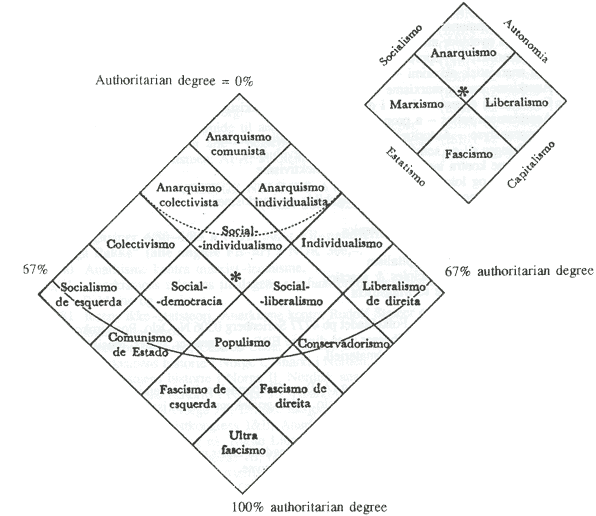
*) The stars indicate the position of the Norwegian economical-political system after the revolutionary change in 1994/95.
1. Anarchy and anarchism mean "system and management without ruler(s), i.e. co-operation without repression, tyranny and slavery". In short an-arch-y = [(an = without - arch = ruler(s)) - y = system (included optimal order and law) and management, as, say, in monarch-y]. Anarchy and anarchism are efficient and fair system and management without top heavy societal pyramid economical and/or political/administrative - in income and/or rank, i.e. significant horizontal organization - real democracy.
2. The Economic-Political Map
The anarchy degree is 100% - the authoritarian degree within the anarchist quadrant. (Esquerda means left, and direita means right. The star indicates the Norwegian economic-political system after the velvet anarchist revolution in 1994/95.)
3. Authoritarians notoriously mix up anarchy, anarchist and anarchism with authoritarian tendencies: Chaos, disorder, mob rule (narrowly defined), lawlessness, the law of the jungle, criminality, riots, theft, corruption, drugs, mafia, terrorism, autocratic rule, the right to the strongest, antisocial tyrannical behavior, etc. i.e. different types of superiors and subordinates, all in all ochlarchy (mob rule broadly defined).
4. The word anarchy origins from Greek. The prefix "an" means "negation of" as in anaerobe versus aerobe and "arch" means "superior, i.e. in contrast to subordinates", as in archbishop, archangel, archduke, arch villain, etc. NB! Any villain, ochlarch/ist, is an arch vis-a-vis the victims. Thus anarchy, anarchism, anarchist, a.s.o., mean coordination on equal footing, without superiors and subordinates, i.e. horizontal organization and co-operation without coercion - practically (significant, > 50% anarchy degree) or ideally (towards 100% anarchy degree). This is the opposite of the above mentioned authoritarian tendencies, i.e. different types of superiors and subordinates - in general ochlarchy.
5. Ochlarchy is typical with more than 67% authoritarian degree. Anarchy has equal to or more than 50% anarchy degree. Anarchy is organization in general without (significant) arch(s), but not without management. The influence on the management, economic and political/administrative, in private and public sector, goes in general more from the bottom - the grassroots - upwards than from the top downwards. At the middle-point of the map the influence from the bottom is 50%. At the top of the map, the anarchist ideal, the influence from the bottom is 100%, or the organization is without top, 100% flat. Norway, The Swiss Confederation and Iceland are anarchies of low degree (anarchy degree > 50% but less than 60%). Other countries are more or less authoritarian (significant, > 50% authoritarian degree).
INTERNATIONAL ACTIONS
AND ARRANGEMENTS:
THE ANARCHIST INTERNATIONAL
Anarchist International support action for the
social-individualist anarchist Julian Assange and WikiLeaks
Julian Assange, the main spokesperson for the news-organization WikiLeaks, is social and individualist as well as progressive, and may thus be seen as a social-individualist anarchist. As many social-individualist anarchists he does not use the label 'anarchist' about himself, at least not so far... But he 1. has 02.12.2010 been called anarchist on CNN, and more, 2. has a strong co-operation with -- and support for -- the social-individualist Anarchy of Iceland, 3. is mainly acting as an anarchist, a.o.t. a) for a free press -- against the media as a 4th power of the State, b) doing whistle-blowing against authorities, and c) works for libertarian human rights, and thus 4. practically certain is a social-individualist anarchist. To see an interview with Julian Assange about his main policy and activities click here!
The ochlarchy (mob rule broadly defined) against Julian Assange, a) falsely calling his whistle-blowing and other libertarian press-activities criminal, b) smear-campaigns with probably false accusations of rape in Sweden, c) people calling for his assassination and d) much, much more mobbing, e) must stop. Julian Assange and WikiLeaks, and their news-reporting, have full support from the Anarchist International and the Anglophone Anarchist Federation, and AI & AF have 02.12.2010 launched an international solidarity direct action for Julian Assange and WikiLeaks. AI & AF call on all anarchists world wide, and all others that read this resolution, to join in the world wide support action. AI & AF demand continued freedom for Julian Assange and WikiLeaks!!!
PS. Fellows world wide! You can join in the international solidarity direct action for Julian Assange and WikiLeaks by forwarding this resolution to your own network, and/or link up the Web of Freedom Online, the official organ of the Anglophone Anarchist Federation and/or the Anarchist International at your Web and/or blog. Do it now!!!
LATEST NEWS ON JULIAN ASSANGE
20.02.2024. Julian Assange makes last-ditch attempt in UK court to avoid extradition to the US, see: https://edition.cnn.com/2024/02/20/uk/julian-assange-extradition-appeal-ruling-review-intl-gbr/index.html. Source: CNN. AI/IFA and AF: Julian Assange has our full support. Source. AIIS.
20.02.2024. Assange too ill to attend last-ditch court bid against extradition, lawyer says, see: https://www.bbc.com/news/live/uk-68344106. Source: BBC. AI/IFA & AF: We demand freedom for Julian Assange! Source: AIIS.
26.03.2024. Julian Assange staves off extradition to US for now, see: https://edition.cnn.com/2024/03/26/uk/julian-assange-us-extradition-appeal-intl-gbr/index.html. Source: CNN. AI/IFA & AF: We again demand freedom for Julian Assange! Source: AIIS.
19.05.2024. CNN: Why Julian Assange’s fate matters. And calling Assange an «information anarchist», see: https://edition.cnn.com/2024/05/19/opinions/julian-assange-extradition-hearing-alan-rusbridger/index.html. Source: CNN. AI/IFA & AF: We again demand freedom for Julian Assange! Source: AIIS.
20.05.2024. Julian Assange can appeal extradition to the US, UK court rules, see: https://edition.cnn.com/2024/05/20/uk/julian-assange-wikileaks-extradition-hearing-uk-intl-gbr/index.html. Source: CNN. AI/IFA & AF: We again demand freedom for Julian Assange! Source: AIIS.
25.06.2024. Julian Assange has reached a plea deal with the U.S., allowing him to go free. The WikiLeaks founder has been held in a prison outside London for the last five years and fought extradition to the U.S. He is expected to return to Australia. See: https://www.nbcnews.com/politics/justice-department/julian-assange-reached-plea-deal-us-allowing-go-free-rcna158695. Source: NBC. AI/IFA & AF: Finally freedom for Julian Assange! We keep the support action going on until Julian is back in Australia. Source: AIIS.
26.06.2024. Julian Assange lands in Australia a free man, see: https://www.bbc.com/news/articles/cxee24pvl94o. Source: BBC. AI/IFA & AF: The support campaign has ended. Source: AIIS.
THE ANARCHIST INTERNATIONAL
INTERNATIONAL ANARCHIST ACTION FOR THE FABS
The Anarchist International sees the music etc. of FABS as an important source of inspiration for anarchists, anarchism and anarchist action, in a global perspective. The Anarchist International protests against the tendencies of harassment of FABS from the capitalist - economical plutarchist - Internet online shops, although the five major albums of the FABS per 2011 are represented in these shops for listening and buying internationally, see (click on:) FABS. The Anarchist International calls on all anarchists world wide, to support FABS, the Federalist Anarchist Beat Society, by spreading information about the band and their music, and buying their records. For more information, see (click on:) FABS. At this Website you will find information about the band and their music, etc. and also links to international Internet online recordshops for each of these five albums.
The guidance of the world - look to the three anarchist, real democratic, countries... and the Anarchist International
Solving the economic recession problem
We accept no leaders of the world, be it USA, Russia, EU or China. However guidance is a must. Look to the three anarchist, the only real democratic, countries of the world, Norway, Switzerland and Iceland, guided by a.o.t. the Anarchist International and IIFOR. They will probably be the first to solve the economic recession problem, balancing 1) Total demand nominally = (Price level)(Labor productivity)(Total labor force). Where 2) Total demand nominally = Public and private consumption + Public and private real investment + Export - Import, 3) Price level = (1 + Inflation %/100) and Labor productivity is national product volume per employed, averagely, and inflation is measured by the price index for the national product. How to achieve this aim? Read A SHORT NOTE ON THE GENERAL THEORY OF ANARCHIST ECONOMICS: GENERAL THEORY . Anarchies have the best conditions to do proper demand management. The other most libertarian countries should follow them in coordinate efforts to solve the recession problem. The rest of the world should also join in. The sooner the better! Proper demand management now!!!
THE 25 HIGHEST RANKING COUNTRIES ACCORDING TO LIBERTARIAN DEGREE ETC.
THE LIBERTARIAN DEGREE = THE DEGREE OF DEMOCRACY = 100 % - THE AUTHORITARIAN DEGREE
SYSTEM ANALYSIS. DATA FROM 2003-2007.
Countries: |
Rank of country according to libertarian degree, and type of system |
Libertarian degree and (authoritarian degree) % |
Degree of socialism |
Degree of autonomy and |
Gini-index |
Norway |
1 Anarchy |
54,0 (46,0) |
55,0 (45.0) |
53,2 (46,8) |
25,8 |
Switzerland |
2 Anarchy |
53,0 (47,0) |
51,0 (49,0) |
55,1 (44,9) |
33,1 |
Iceland |
3 Anarchy |
52,0 (48,0) |
54,0 (46,0) |
50,1 (49,9) |
25,0 (est.) |
Liechtenstein |
4 Soc.dem. |
49,5 (50,5) |
51,4 (48,6) |
47,7 (52,3) |
32,0 (est.) |
Luxembourg |
5 Soc.dem. |
49,2 (50,8) |
52,1 (47,9) |
46,5 (53,5) |
30,8 |
Denmark |
6 Soc.dem. |
48,8 (51,2) |
55,3 (44,7) |
43,0 (57,0) |
24,7 |
Japan |
7 Soc.dem. |
48,5 (51,5) |
55,2 (44,8) |
42,6 (57,4) |
24,9 |
Belgium |
8 Soc.dem. |
48,2 (51,8) |
54,0 (46,0) |
43,0 (57,0) |
25,0 |
Finland |
9 Soc.dem. |
47,9 (52,1) |
53,8 (46,2) |
42,6 (57,4) |
26,9 |
Sweden |
10 Soc.dem. |
47,5 (52,5) |
54,0 (46,0) |
41,7 (58,3) |
25,0 |
Netherlands |
11 Soc.dem. |
47,2 (52,8) |
52,0 (48,0) |
42,8 (57,2) |
30,9 |
Canada |
12 Soc.dem. |
46,8 (53,2) |
50,9 (49,1) |
43,0 (57,0) |
33,1 |
Austria |
13 Soc.dem. |
46,5 (53,5) |
52,1 (47,9) |
41,4 (58,6) |
30,0 |
Ireland |
14 Populist |
46,2 (53,8) |
45,0 (55,0) |
47,4 (52,6) |
35,9 |
Germany |
15 Soc.dem. |
45,9 (54,1) |
53,0 (47,0) |
39,6 (60,4) |
28,3 |
Spain |
16 Soc.dem. |
45,5 (54,5) |
51,5 (48,5) |
40,1 (59,9) |
32,5 |
Australia |
17 Populist |
45,0 (55,0) |
48,0 (52,0) |
42,2 (57,8) |
35,2 |
United King. |
18 Populist |
44,5 (55,5) |
44,7 (55,3) |
44,3 (55,7) |
36.0 |
New Zealand |
19 Populist |
44,0 (56,0) |
44,6 (55,4) |
42,4 (57,6) |
36,2 |
France |
20 Soc.dem. |
43,5 (56,5) |
51,4 (48,6) |
36,6 (63,4) |
32,7 |
Italy |
21 Populist |
43,0 (57,0) |
44,7 (55,3) |
41,3 (58,7) |
36,0 |
USA |
22 Cons. lib. |
42,5 (57,5) |
24,5 (75,5) |
69,8 (30,2) |
40,8 |
Israel |
23 Populist |
42,3 (57,7) |
47,8 (52,2) |
37,3 (62,7) |
35,5 |
Hong Kong |
24 Cons. lib. |
42,1 ( 57,9) |
22,1 (77,9) |
74,8 (25,2) |
43,4 |
Greece |
25 Populist |
42,0 (58,0) |
47,9 (52,1) |
36,6 (63,4) |
35,4 |
The estimates are approximately figures. © IIFOR/IJA ISSN 0800 – 0220 2007 and later.
Anarchy = here social-individualist anarchism; Soc. dem. = social democrat marxism; Populist = here moderate parliamentarian democratic fascism; Cons. lib. = Conservative liberalism. Ranking of countries according to libertarian degree, estimates of the libertarian degree in general, and information on methodology, see Ranking - footnotes and economic-political map at System theory .
Regards... P. Johansen , L. Jakobsen and A. Quist for AI and IIFOR 04.12.2008.
THE ANARCHIST INTERNATIONAL
The International Anarchist Congress
The 18th Anarchist Biennial 22-24.11.2024
International Congress-Seminar on Anarchism
MAIN TOPIC: THE CLIMATE CRISIS
1. The main points on the agenda and proposals for decisions and resolutions are the updates on anarchy.no since
the congress in 2022, especially about the climate crisis.
Among the proposals for resolutions of the congress are the documents, articles and actions at (click on):
Contact the anarchist congress - click here!
The next congress - the 19th - will be in November 2026.
THE WEB OF THE CONGRESS, SEE (CLICK ON):
http://www.anarchy.no/aicongress.html
THE ANARCHIST INTERNATIONAL
The International Anarchist Congress
The 17th Anarchist Biennial 25-27.11.2022
International Congress-Seminar on Anarchism
1. The main points on the agenda and proposals for decisions and resolutions are the updates on anarchy.no since the congress in 2020.
Among the main proposals for resolutions of the congress are the documents, articles and actions at (click on):
These documents and other updates on anarchy.no were decided with general consent as resolutions from the congress, i.e. the 17th Anarchist Biennial.
Contact the anarchist congress - click here!
The new congress - the 18th - will be in November 2024.
THE WEB OF THE CONGRESS, SEE (CLICK ON):
http://www.anarchy.no/17aicongress.html
THE ANARCHIST INTERNATIONAL
The International Anarchist Congress
The 16th Anarchist Biennial 20-22.11.2020
International Congress-Seminar on Anarchism
1. The main points on the agenda and proposals for decisions and resolutions are the updates on anarchy.no since the congress in 2018.
Among the main resolutions from the congress are the documents, articles and actions at (click on):
These documents and other updates on anarchy.no were decided with general consent as resolutions from the congress, i.e. the 16th Anarchist Biennial.
Contact the anarchist congress - click here!
The next congress - the 17th - will be in November 2022
THE ANARCHIST INTERNATIONAL
The International Anarchist Congress
The 15th Anarchist Biennial 23-25.11.2018
International Congress-Seminar on Anarchism
1. The main point on the agenda and proposals for decisions and resolutions are the updates on anarchy.no since the congress in 2016.
Among the resolutions from the congress are (click on):
10 facts about anarchy, anarchism and anarchists
10 fakta om anarki, anarkisme og anarkister
Anarchism and national liberation movements
Horizontal Organization - A brief survey
These documents and other updates on anarchy.no were decided with general consent as resolutions from the congress, i.e. the 15th Anarchist Biennial.
Contact the anarchist congress - click here!
The next congress will be in November 2020
THE ANARCHIST INTERNATIONAL
The International Anarchist Congress
The 14th Anarchist Biennial 25-27.11.2016
International Congress-Seminar on Anarchism
1. The main point on the agenda and proposals for decisions and resolutions are the updates on anarchy.no since the congress in 2014.
Among the resolutions from the congress are:
USA - Anarchist anti-Trump actions Friday, January 20, 2017 - without ochlarchy!
Syria and Mexico - A mainly marxist collectivist project with relations to the Kurdish marxist-nationalistic terrorist organization PKK, called Rojava, is established in and around the city Kobane in the north of Syria. Similar to the mainly marxist collectivist project Chiapas in Mexico, Rojava has no support from the Anarchist International. Both Rojava and Chiapas have more than 50 % authoritarian degree already, located far left in the collectivist sector in the marxist quadrant of the the economic-political map, and will most likely develop to more than 67 % authoritarian degree, as the "Soviet Union" after the Russian revolution - a totalitarian system. Persons supporting the Rojava and Chiapas projects are the "useful idiots" of marxists.
These documents and other updates on anarchy.no were decided with general consent as resolutions from the congress, i.e. the 14th Anarchist Biennial.
Contact the anarchist congress - click here!
The next congress will be in November 2018
THE ANARCHIST INTERNATIONAL
The International Anarchist Congress
The 13th Anarchist Biennial 28-30.11.2014
International Congress-Seminar on Anarchism
1. The main points on the agenda and proposals for decisions and resolutions are the updates on anarchy.no since the congress in 2012.
2. The anarchist revolution in Norway 20 years, see (click on) Anarchy in Norway. The Anarchy of Norway is still going strong.
The main resolution from the congress, see (click on) The anarchist velvet revolution in Norway 20 years - The Anarchy is still going strong.
This document and other updates on anarchy.no were decided with general consent as resolutions from the congress, i.e. the 13th Anarchist Biennial.
Contact the anarchist congress - click here!
The next congress will be in November 2016
THE ANARCHIST INTERNATIONAL
The International Anarchist Congress
The 12th Anarchist Biennial 24-25.11.2012
International Congress-Seminar on Anarchism
The main points on the agenda and proposals for decisions and resolutions are the updates on anarchy.no since the congress in 2010:
Join the fight for anarchy - and more of it - world wide - NOW!
Participate in the struggle for anarchy, i.e. real democracy!
In addition to the general struggle for anarchy, on top of the agenda,1-2-3, equally important, is the fight for
1. social justice and security, 2. solution to the economic crisis & 3. solution to the global warming problem.
* The anarchist principle of social justice and social security *
* The World Economic Council - WEC - Against economic crisis *
* The Eco-Anarchist Manifesto - EAM - Against manmade global warming *
... and more ...
These documents and the other updates on anarchy.no were decided with general consent as resolutions from the congress, i.e. the 12th Anarchist Biennial.
Contact the anarchist congress - click here!
The next congress will be in November 2014
The International Anarchist Congress 2010
The 11th Anarchist Biennial 27-28.11.2010
Resolutions and more... Click here!
The next congress will be in November 2012
THE ANARCHIST INTERNATIONAL
The International Anarchist Congress
The 10th Anarchist Biennial 29-30.11.2008
International Congress-Seminar on Anarchism
The main points on the agenda, the decisions and resolutions are
1. Anarchism in Iceland
Anarchy in Iceland and the Libertarian Federation of Iceland
2. Other items
2.1. Antimilitarism - an anarchist approach
IJA 2 (38)
2.2. The situation in Georgia
Georgia, Abkhazia and South Ossetia
2.3. Let's build anarchism
A paper from Canada
If you have comments, contact the anarchist congress - click here!
The next congress will be in November 2010
THE ANARCHIST INTERNATIONAL
The International Anarchist Congress
The 9th Anarchist Biennial 25-26.11.2006
International Congress-Seminar on Anarchism
The main points on the agenda are 1. Anarchy vs ochlarchy (mob rule) and 2. Anarchists vs ochlarchists.
Background information: Search for "ochlarchy" at www.anarchy.no
The main resolution from this congress is published at IJA 1 (36)
THE ANARCHIST INTERNATIONAL
SAYS A CLEAR NO TO THE GROSS GERMANIAN EU-MEGA STATE - EU SUPER-STATE, WITH UNENLIGHTENED PLUTARCHY AT ALL REFERENDA
THE ANARCHIST INTERNATIONAL
The International Anarchist Congress
The
8th Anarchist Biennial 27-28.11.2004
International
Congress-Seminar on Anarchism
The 10 anniversary of the anarchist velvet revolution in Norway 1994-2004, and beyond.
INVITATION AND PROGRAM
Click on 8th Anarchist Biennial
The 25th Anniversary of the
Anarchist Federation of Norway
 AFIN
AFIN
1977- 2002
Web of
AFIN: 25th Anniversary
Celebrating
14-15 December 2002
THE ANARCHIST INTERNATIONAL
The International Anarchist Congress
The
7th Anarchist Biennial - Medio December 2002
International
Congress-Seminar on Anarchism
14-15.12.2002
PROGRAM AND SUMMARY
OF RESOLUTIONS
Click on 7th Biennial
DIRECT ACTION
VS THE
£$ ABCDE-CONFERENCE/WORLD
BANK $£
Annual Bank Conference on Development
Economics
Invited by UD
24-26 JUNE 2002 IN OSLO AND WORLD
WIDE
UPDATED NEWS AND COMMENTS AT WEB:
ABCDE DIRECT ACTION - CLICK HERE!
1927 - 2002:
LXXV aniversario de la fundación de la
Federación
Anarquista Ibérica - FAI

junio de este año e los días 21 y 22
More
information in English and Spanish?
Click on: Sevilla 2002
New, updated book on the history of FAI/IFA, the Iberian Anarchist Federation
A new book with the History of FAI, the Iberian Anarchist Federation, affiliated to IFA, celebrating the 75 years anniversary 2002, is now published, by FAI-group "Albatros". The book is an update of CNT's Juan Gomez Casa's earlier book “Historia de la FAI”, and is also including items and material not mentioned in the old book. The book may very well be used for study circles and further discussions and work on historical research of anarchism. The volume has 300 pages, costs 9 euros plus shipping costs; and may be ordered via the link to the orderform below.
Order FAI's historybook? - Click here, and send!
Affiliate
to the
Anarchist
International's
Support
Network for East Timor - AISNET!
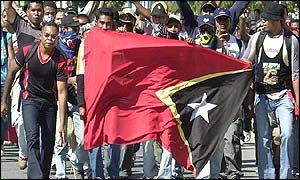
WEB: EAST TIMOR
Click here to join the
direct action
against ochlarchy and boycott of
Edgar Rodrigues
in Brasil!
The action ended 14.05.2009 when Edgar died 88 years old.
A documentary of the IJ@'s mandate:
The mandate of IJ@, seen historically, is close connected the history of "Folkebladet" and to the foundation of the Northern section(s) of IFA/IAF, the Anarchist International. The foundation of the Northern section(s) of IFA/IAF started with the affiliation of the Anarchist Federation of Norway. This is documented, among other things, in the Bulletin C.R.I.F.A, the official organ of IFA at that time. The "Commision de rédaction de bulletin CRIFA 145 Rue Amelot 75011 Paris France" and "C.R.I.F.A. Umberto Marzocchi Casella Postale no 22 17100 Savona (Italia)" were responsible for the publication. C.R.I.F.A. is the "Commission de relations de l'internationale des fédérations anarchistes". In C.R.I.F.A. Bulletin no 39 avril-mai 1982 p. 10 the following was reported:
DÉCLARATION D'ADHÉSION A L'INTERNATIONALE DES FÉDÉRATIONS ANARCHISTES / IFA DE LA PART DE LA FÉDÉRATION ANARCHISTE DE NORVÉGE / ANORG
L'ANORG a été fondéé à Oslo le 13 mars 1977 et a été depuis la seule organisation anarchiste de Norvège. et, ensemble avec la petite fédération syndicaliste NSF/AIT, les seules organisations libertaires dans tout le pays. L'ANORG, a des adhérents dans tout le pays. Nous vous joignons notre journal extérieur "Folkebladet" organe de l'ANORG, et nous avons également un bulletin intérieur.
Même si vous ne comprenez pas ce qui est écrit, nous pensons qu'il peut être intéressant que vous voyiez ce que les anarchistes norvégiens font.
L'ANORG a été invité par des anarchistes danois à rejoindre l'IFA. Congrès du 23-27 mars 1978, mais nous avons décidé avant d'avoir plus d'expérience et d'être capable d'y participer autant que les autres fédérations. Cependant le 15 janvier 1979 l'ANORG a voté à l'unanimité de rejoindre l'IFA sur les principes approuvés par le 3e congrès de l'IFA. Mais maintenant nous pensons qu'il est temps de participer au travail international sur un pied d'égalité avec les autres fédérations anarchistes. - Fédération anarchiste de Norvège.
A note about the founding date: "Foregangsgruppa i ANORG" - the interim group in the Anarchist Federation, rooted back to Kultursyndikatet, the Culture Syndicate in the late 1960'ties, had worked for several years as a loose network to found an anarchist federation, without semilibertarian marxists and liberal/individualists. Foregangsgruppa was formally founded 13 Mars 1977. This group did a lot of work to join the forces of the different groups and individuals of the anarchist movement, and after a wide debate, arranged the statutory general meeting of the federation, "stiftelsesmøtet", Tuesday 13. September 1977. Thus, Anarkistføderasjonen i Norge (AFIN) - Anarkistenes Organisajon (i Norge) - ANORG, the Anarchist Federation of Norway, was finally founded 13.09.1977. Folkebladet was founded in 1971, and had been the organ of different groups, before it became the organ of the Anarchist Federation. It had also been distributed internationally, mainly in Scandinavia.
The affiliation to IFA recorded in Bulletin C.R.I.F.A. no 39 avril-mai 1982, was confirmed in a letter from C.R.I.F.A. Umberto Marzocchi, dated 12th of May 1982 and another letter 09.11.1982. The first letter also urged the first Nordic Anarchist Congress. The term "Nordic" means Northern, i.e. in the North in general, as confirmed on a later congress.The Northern section(s) of IFA was founded at the first Nordic anarchist congress in Oslo, 15-18 October 1982. The Bulletin C.R.I.F.A no 42 novembre-février 1982 declared :
(There were a Spanish (p. 4) and an English (p. 5) report in this issue of the Bulletin C.R.I.F.A, but the Spanish version seems to be the most correct of the two, compared to the Swedish and Norwegian reports printed in Folkebladet, and other material. Thus we will quote the Spanish version here. Where the English version is more precise, this is noted in [...] brackets):
EL PRIMER CONGRESO ANARQUISTA NÓRDICO
El primer congreso anarquista nordico se ha celebrado del 15 al 17 de octubre del [19]82 en Oslo (Folkets Hus, Youngstorget). Ha estado organizado por la ANORG/IFA (Federación anarquista noruega afiliada a la IFA). Este congreso se ha celebrado según el deseo de Umberto Marzocchi, secretario de la [IFA/]CRIFA, siendo expressado en una carta el 12 de mayo del [19]82 a la ANORG. Estaban presentes los delegados de varios paises nórdicos así que los observadores de la SAC (Sveriges Arbetares Centralorganisation) ... y un representante de la Federación anarquista francesa [a delegate from the French Anarchist Federation (FAF/IFA), was also present].
El principal tema de este congreso ha sido la cooperación anarquista nórdica... La meta a alcanzar es la adhesión de los anarquistas a una sección nórdica de la IFA a través de sus propios Federaciones nacionales. A este fin el congreso unánime decide la puesta en marcha de un secretariado nórdico de la IFA. Por el momento ese papel será tenido por el secretarioado administrativo [the expeditionary group] de la ANORG.... Los anarquistas que quieran adherir a la IFA podrán hacerio teniendo como intermediario el secretariado nórdico de la IFA. Estos anarquistas se encontrarán en la misma situación con respecto a la IFA que los miembros de la ANORG (decidiones, cotisaciones, etc.)
El secretariado nórdico publicará ocho bolitinos al año que serán adjuntos a Folkebladet ... o sea al boletin interior, o bién según el caso, un sepacio será reservado en sus publicaciones para las informaciones procedentes del secretariodo...
El secretariado nórdico a través del
boletin deberá contribuir a organizar actividas comunes, entre
otras, congresos, conferencieas, tribunas anarquistas, simposios,
seminarios, encuentros estivales y actividades culturales... El
secretariado deberá encargase de la coordinación de las
actividades [direct actions of different kinds] nórdicas.
____
El primer número del "Boletin Nórdico" editado por el
congreso, ha sido publicado en suplement del número 4 de
Folkebladet (año 1982). Su título es "IFA-Solidaritet"
(órgano de las secciones nórdicas de la IFA).
COMMISION DE REDACTION DU BULLETIN CRIFA.
The conclusion of these documents recorded in Bulletin C.R.I.F.A no 39 avril-mai and no 42 novembre-février 1982, is that the Anarchist Federation of Norway - Anarkistføderasjonen i Norge (AFIN) - Anarkistenes organisasjon (i Norge) ANORG, was affiliated to IFA/IAF from 15.01 1979 with the organ "Folkebladet", and that the Northern Section(s) of IFA was/were founded and affiliated to IFA/IAF 15-17.10.1982, with the bulletin "IFA-Solidaritet", IAF-Solidarity, published in close connection to Folkebladet. The Northern section(s)' affiliation to IFA, was/were also confirmed on later IFA-congresses arranged in Oslo, and documented in issues of Bulletin C.R.I.F.A and IFA-Solidaritet, the two officially and mandated organs of IFA at that time. Furthermore, there were no opposition to these decisions recorded in the Bulletin C.R.I.F.A and IFA-Solidaritet, so they were decided by general consent *) .Some of the new Northern sections of IFA, i.e. the Danish, the Swedish and the Finnish, were in one years time refounded as IFA-federations, i.e. in 1983. This was unanimously decided upon by a general ballot, referendum, among the members of the Northern sections.This is recorded in IFA-Solidaritet, which was distributed to the other IFA/IAF-sections, among other things, via the C.R.I.F.A. The documents also imply that the IFA-secretariate in Oslo was not considered as a sub-secretariate to C.R.I.F.A, but on equal footing, i.e. as commissions for the Northern and Southern sections respectively.
In 1983 there were 4 Northern (Norwegian, Swedish, Danish and Finnish) and 3 Southern federations (French, Italian and Iberian) in IFA/IAF plus the UAB (Bulgarian Anarchist Union) and the Northern sections outside Scandinavia. In the following years the Bulletin C.R.I.F.A declined in number of issues and quality, and it was necessary to do something to keep up the anarchist international information service. In 1984 Folkebladet and IFA-Solidaritet were gathered in one publication, and the name International Journal of Anarchism was introduced. At the same time the distribution started to develop world wide, not only in Scandinavia. Also "Brand", the Swedish anarchist paper of AFIS/APF, and later "International Journal of Organization Research", the organ of IIFOR, were included in IJA.
Since the IJA is a direct follower of Folkebladet, the volumes of the journal are counted from the founding of Folkebladet in 1971. Thus, issues of the volumes are noted as the number of the issue, plus the volume number, say 1 (31) for the first number of the 31st volume, i.e. year 2001. These changes were also confirmed on the later Northern IFA congresses. During the last part of the 1980ties the Bulletin C.R.I.F.A declined further, and finally finished publishing. Thus International Journal of Anarchism became the only officially mandated and publicly registered organ for the anarchist international IFA/IAF and the anarchist movement in general. The international journal registration number of IJA is ISSN 0800-0220. In 1996 IJA was introduced on Internet, and since 1998 it has been an electronic online-journal, distributed on the Internet and/or by e-mail world wide to anarchists and others with interest of anarchist information. There will however also be issues on paper distributed to IFA-sections and others interested in anarchy, anarchist(s) and anarchism internationally, that do not have access to e-mail or internet. IJ@ is also the organ of the International Anarchist Tribunal, founded in 1982.
The mandate for the International Journal of Anarchism, in addition to what is mentioned above, is similar to the mandate made for the Bulletin C.R.I.F.A.in the old days, decided by the International of Anarchist Federations IAF/l' Internationale des Fédérations Anarchistes IFA, (see Bulletin C.R.I.F.A no 42 novembre-février 1982 p. 2) updated to the modern IT-age:
We call again the decisions that have been taken at congresses of the Anarchist International IAF/IFA. After a long discussion about the development of IFA/IAF, and the best way to maintain links between the anarchists in the world, the next points have been decided:
- The IJ@ will be sent to the whole international libertarian movement (organizations, papers, reviews,...);
The IJ@ will be written in several languages: French, English, Spanish, Scandinavian, etc. and articles should be provided with an English summary. The summary may be omitted if the article is short and written in English;
- Circulars will be sent to the sections to discuss particular points and to convene reunions of work;
- Reunion of work convened by the joining sections, with summary in order to prepare these reunions. An objective of these reunions are to prepare new conferences of international campaignes.
- Internet and e-mail are suitable means to reach these ends.
In 1997 the term Anarchist International was introduced. This is a wider concept than the IFA/IAF meaning the affiliated federations. There are also sections and federations for anarcha-feminism, green/eco-anarchism, anarcho-syndicalism, affiliations to the Community Action Network, CAN, and the Anarchist Black Cross, ABC, and for collectivist and communist/commune anarchism; social-, social-individualist and federalist anarchism, as well as individualist and mutualist anarchism, since 1982. The Anarchist International is based on the IFA/IAF-federations, i.e. mainly in Europe, but also includes groups and individuals that are anarchists or interested in anarchist information broadly defined all over the world. The constitution of the Anarchist International AI was as mentioned officially confirmed on the International Anarchist Congress, i.e. the 5th Anarchist Biennial, arranged by the NAC/IFA/AI in Oslo medio December 1998. In the later years the networkmembers/subscribers have been more and more global, no longer mainly in Europe.
Thus, the Anarchist International is a) a non-sectarian, non-dogmatic, non-dialectical and non-metaphysical broad based, including - and not expulsing - organization and network, b) covering all libertarian tendencies, where c) everybody on equal footing, coordinate, and co-operative without coercion, from each according to ability - to each according to need - may contribute to the research front of valid anarchism via the method of modern science, introduced by d) Kropotkin**, and based on research, consistency, skepticism, dialog, and free, matter of fact, criticism, in short e) the anarchist scientifical way of thinking. A short summary of the updated, consistent, research front on anarchism is found at System theory and economic-political map with links, and at IIFOR's homepage Web of IIFOR . A basic course to easily be updated on the research front on anarchism, according to need, is presented at AIUF's homepage at Anarchist International University Federation .
The purpose and aim is among other things to work stand by for one affiliated anarchist federation in each country, based on these principles, so the International may be a really anarchist alternative to the UN, i.e. for the whole world. Furthermore the IJ@ is distributed not only to libertarians, but to "the people, anarchists and authorities world wide", including the international newsmedia. This is to inform the world of resolutions from anarchist-congresses, -conferences, -seminars, -tribunals and other activities, and to organize common actions to promote more anarchy and less authoritarian tendencies in the different countries.
The AIIS - Anarchist International Information Service at www.anarchy.no, is the main international anarchist news-agency of today, and it is also engaged in the fight for anarchism world wide. AIIS, named "Anarkistenes Informasjonstjeneste - AIT" in Norwegian, was officially founded in 1994 by AIUF/AU, and established on Internet in 1996. In 1997 the AIIS was taken over by the AI/IFA-secretariate in Oslo, that had been doing media and information work all of the time since the founding in 1982, continuing the work of the secretariate of AFIN since the founding in 1977, with different mandates and staff. As mentioned the constitution of the Anarchist International AI was officially confirmed on the International Anarchist Congress, i.e. the 5th Anarchist Biennial, arranged by the NAC/IFA/AI in Oslo medio December 1998. At this congress the AIIS was mandated to be the offical newsagency of the Anarchist International. The AIIS is industrially and with respect to copyright a co-operative branch of IJ@ ISSN 0800 - 0220. (Source IJ@ no 5 (31), The history of AI-IFA-IAF and AIIS, see links on bottom of this page). ****)
*) As mentioned above the founding and membership of the Northern IFA-sections 1979-1982/3 were accepted by general consent throughout the rest of IFA, and thus it was of course not on the agenda at the congress in the South, i.e. Paris, 1986, as a few have misunderstood, where four elected delegates of the Northern IFA-sections participated by phone and written material was sent in advance, with the resolutions from the 4th IFA congress in Oslo, i.e. in the North, earlier same year, - (and not later).
**) This method, the scientifical anarchist way of thinking, was mainly introduced by Peter Kroptkin in 1903-13 in the book "Modern Science and Anarchism", but indicated in a more vague way already by Pierre J. Proudhon in the middle of the 19th century. Later on this method was developed further by, say, Frisch, Haavelmo, Santillan, etc.
***) We have seen some weird stories on Internet produced by Jamal Hannah et. al. that IJA is not a real organ of the Anarchist International and IFA/IAF a.s.o. This is probably rooted back to some intrigues against the Northern sections of IFA-IAF from some of the Southern federations (not the Spanish). To set things right we have made a documentary on the mandate of International Journal of Anarchism and the Anarchist International Information Service stating the facts by real historical documents, so everybody for themselves can confirm the truth about the mandate, and see that we are not posing, but the real ones. We are sick tired of these intrigues and will in this way try to put and end to it.
In 1986, at the fourth IFA-congresses in the north, and in the south where NAC, The Northern Anarchist Confederation's four federations participated by phone, the southern IFA-federations, the French, Spanish and Italian turned leftwards at the economical political map due to leftist-marxist tendencies.They thus left the anarchist quadrant on the economical-political map. The three southern IFA-federationas turned out to be "the children of Marx". (The Bulgarian Anarchist Union, UAB, was not a federation, but an authoritarian group, and thus not recognized by the International Anarchist Tribunal as a member of IAF-IFA.) This leftist-authoritarian position of the southern IFA federations made it necessary to reorganize the IFA to save it from the marxist- leftist positions. Thus, the majority of the IFA federations, the four northern, decided to reorganize the IFA, and started the Anarchist Biennials, a series of international anarchist congresses, the first one in 1990. The three southern IFA-federations and their secretariate were suspended by the majority of the federations, the four Northern, and the International Anarchist Tribunal, see IAT - Mandate , and the resolutions of their later congresses were disallowed, included the one in 1990. The suspension and the disallowance of their congresses will remain until the marxist-authoritarian tendency of the southern IFA-federations is removed. So far this has not happened. Thus the resolutions from their congresses from the fifth in 1990 and later are disallowed, due to significant marxist authoritarian tendencies. The latest statement (2007) from the Southern IFA/IAF federations against the Anarchist International is a.o.t: "The main problem is some lunatic in Norway". Thus they state that people that do not agree with them are lunatic, just like in the Soviet Union. This only confirms that the Southern IFA/IAF federations are marxistoid communist/collectivist on the economical-political map, and not anarchist. We can assure you that the about twenty persons working parttime for the AI/IFA-secretariate in Oslo are not lunatic, and neither are the rest of the Anarchist International.
The Anarchist International is a broader network than the IFA/IAF-sections in the north and south. The Anarchist International is a global, undogmatic, free thinking, nonsectarian modern anarchist international, with sections for anarchoindividualist, anarchocollectivist, social individualist and mutualist anarchist and anarchocommunist as well as green/ecoanarchist, anarchosyndicalist and anarchafeminist anarchists. The Anarchist International has about 2000 networkmembers/subscribers, groups and individuals, of which about 500 are in the northern sections of IFA/IAF, i.e counted without the Southern IFA/IAF-federations. The Southern IFA/IAF is a dogmatic, sectarian communist "anarchist", leftist marxistoid organization with little interest for the Anarchist International. The Southern IFA/IAF is more communist than anarchist, i.e. collectivist on the economical political map. Outside the anarchist quadrant on the map, far left in the marxist quadrant.
Further readings on the conflict between the Southern IFA-federations and the Anarchist International are "About the northern and southern sections of IFA-IAF and the Anarchist International AI-IFA-IAF" IJA 2 (35) , "The southern IFA-IAF-federations are marxist" IJA 3 (38) , "THE SO CALLED "ANORG-WARNING" IS FALSE " Lies about the Anarchist International rebuffed and "The Southern IFA Federations" Southern - see footnotes.
****) Decision making etc. of the Anarchist International. At the International Anarchist Congresses, the Anarchists Biennials, the International Congress-Seminars on Anarchism, starting with the first one in 1990, a fixed point of the agenda is election of the AI-secretariate and another fixed point is the updates of www.anarchy.no since last congress. Resolutions and decisions from earlier congresses that a) are not ended and b) not are objects for changes and updates, are c) automatically confirmed and are considered still valid, as resolutions from the present congress. Between congresses the AI-secretariate, AIUF, IIFOR, IAT and the editor group of IJA, are mandated to update the www.anarchy.no, also taking into account contributions from the AI-network broadly defined according to anarchist principles, according to decisions of the International Anarchist Congresses, i.e. the Anarchist Biennials, the International Congress-Seminars on Anarchism.
Resolutions with typical scientific content, i.e. testable hypothesis, are decided after discussion and investigations, scientific testing, including logic consistency tests, and evaluation, and of course, not by voting. To vote on typical scientific questions is like to "decide" by voting whether the earth is round or flat, or if 2 +2 is 4 or 5, and should be avoided. If the hypothesis/resolution after this is confirmed, the resolution is said to be decided by general consent or unanimously decided upon. However research principally never ends, and the hypothesis or theories may still be up for further discussions, investigations and testing, say, at the next biennial. Typical administrative economic-political resolutions, as for example a budget, may preferably be decided by general consent, say, after discussions and negotiations, or by voting, they can also be decided unanimously.
Resolutions may also have both a) a typical scientific part, and b) a typical administrative economic-political part, then each part is decided respectively as indicated above, to make the whole resolution. In general questions and resolutions considered controversial or for other reasons seen as fit for a wide public debate, are presented at the anarchist-debate fora at www.anarchy.no before decided on congresses or published in IJA or published at other relevant places on www.anarchy.no. In general the decisions and the decision making should a) secure a high academic quality and competence, and b) be efficient and fair and according to anarchist principles in general, see www.anarchy.no, c) especially notes etc. about decisions and rules of decisions at Industrial organization etc, Basic Course, AI-secretariate, AIUF, IIFOR, IAT-APT, Anarchy Debate, Real democracy and IJA.
Groups and sections of AI/IFA in general are independent and have autonomy, i.e. have freedom within a framework decided by the the International Anarchist Congresses, i.e. the Anarchist Biennials, the International Congress-Seminars on Anarchism. Such framework may include checks and balances, accountability, anarchist principles and mandates and similar. NB! As almost all significant activities of the Anarchist International AI/IFA and its sections are reported on www.anarchy.no, checks & balances and accountability are easy to confirm and for all to see world wide, not only by the network of the Anarchist International - AI/IFA & its sections, and at congresses.
*****) About AISC. NB! Very, very important message from The Anarchist International Security Council = Revolutionary pilots ( = revolusjonære loser, in Norwegian) as suggested by M. Bakunin. And about 1. life with or without absolute hell fascism and 2. survival vs the end of mankind! Must be read at once. Top Secret! (no more). NB! This Website is also the official web-page of the Anarchist International Security Council (AISC). This council was established as an informal network in 1978 by the Anarchist Federation of Norway (AFIN) related to ochlarchist repression by the use of force from communists of AKP (ml), now Rødt, at May Day demonstrations. The council was expanded in 1979 when anarchists were violently attacked by rightwing extremists. The security network was confirmed on several international anarchist congresses later on, related to IFA. The AISC was officially confirmed as a world wide libertarian security network connected to the Anarchist International, at the 5th Anarchist Biennial, arranged by the NAC/IFA/AI in Oslo medio December 1998.
The structure of AISC is decentralized with no central command and no central committee. Ordinary Secret Service documents, i.e. Not Classified intelligence reports, of general interest, are sent to the IJ@/IJOR for publishing. Most of the networkmembers of the Anarchist International - AI/IFA and its sections are de facto acting generals ... all on equal footing - none above -- significant; and also networkmembers of the vast Anarchist International Security Council - AISC, i.e. world wide. The term acting generals indicates functions as general as well as ensign and rank and file soldier, self-managed on collective and individual basis. Acting generals of AISC are entitled to the use of 1 black & red star as rank symbol in duty, the sign of an ensign, and also called "one star general". Legitimate use of this star is always confirmed by the Anarchist International. The AISC takes care of all kinds of security functions, and may be a bit shadowy in some of them. One function is to act as revolutionary pilots, as mentioned by M. Bakunin, mainly related to velvet revolutions and revolutionary changes. AISC has freedom within a framework decided by the International Anarchist Congresses, the Anarchist Biennials of AI/IFA.
The strategy and tactics of AISC are based on the following facts: Anarchists in general are not pacifists. Anarchists are never terrorists. No real anarchist has been a terrorist historically. The strategy, tactics and practice of AISC are libertarian including mutual aid, compatible with real democracy and based on direct actions, i.e. without ochlarchy (i.e. mob rule broadly defined - terrorism is a form of ochlarchy). Thus, although AISC usually is involved in non-violent resistance, it may be violent, but only in legitimate and proportionate self-defense. The AISC is involved in the anarchists' general fight against ochlarchy, and contributes to guards at demonstrations, etc. In the rare case an AISC-networkmember, claiming to be libertarian/anarchist, is acting as an ochlarchist/ochlarch or in other ways is acting authoritarian, the networkmember will get a Brown Card from IAT-APT according to the Oslo Convention, and thus be expulsed from the anarchist/libertarian movement, etc.
AISC is no vigilantes/borgervern, paramilitary organization, armed militia, military organization, uniformed organization, secret agents, a conspiracy or organized crime, or a so called black bloc/block (i.e. fascistoid and/or commie-fascistoid, violent non-libertarian and ochlarchist paramilitary & militarist hierarchies). AISC is a 100% legitimate self-defense network, as mentioned based on mutual aid, and it is an antimilitarist organization and thus of course not militarist and not for militarism. But also of course many networkmembers of the AISC have legitimate weapons for hunting, sports and self-defense, on individual basis, as well as significant training in self-defense and martial arts broadly defined. NB! In the case of attacking murderer(s) - killer ochlarchs, and you don't have a gun, use a proper sharp knife to kill in necessary self defense: Just stab with the knife once - with all your strength - right in near the solar plexus and then up behind the breastbone (sternum) - then the ochlarch is killed (dau). So take a step back to avoid his/her blood. Call for allies if any. Then quick take out the next one the same way, a.s.o. until all attacking murderers are dead, alone or preferably with allies if possible. Afterwards you can do whatever you want! NB! Hesitation against attacking murderer(s) is ca. 100% always fatal - be as quick as possible and 100% without mercy. Then it is possible to survive, even against more than one killer-ochlarch.
If this does not work, say, because the killer-ochlarch has protected the heart, try the throat or stab in his stomach and try to run etc. Never surrender or get caught - fight on to death in anyway - if nothing else work and they will catch you - cut the central bloodvessel of your own throat - quick, because if you don't manage to kill yourself, and you have no allies to help you, that means ca. 100% probably hell first and last and if you are lucky, killed slowly with severe pain later. Best option is to be brave and die standing and fight as hell to the death, in the struggle against killer-ochlarchs. Cowardice and pacifism will ca. 100% likely punish itself with hell and more hell and even more hell, and if you are lucky slowly killed with much pain, much later on. Say, Hemedti's Mega-mafia-ochlarchist-ultrafascist RSF-mob State in Sudan, and per 2019/20 also with forces in Yemen and Libya, will ca. 100% certain have lots of killer-ochlarchs and mafia-ultra-fascist ochlarchist torturists and terrorists in general. And if the climate-destruction continues, Hemedti & the mob or similar may come to you for "lebensraum" soon. NB! Most networkmembers of the AISC have also significant education and training from regular armed forces in their home countries at different rank levels, some also as lieutenant commander, colonel or even higher rank. - However in AISC all have only one black & red star, are "one star generals", also called "ensign-generals". The AISC has also similar functions as the United Nations' Security Council (UNSC) for the anarchist movement and the libertarian world, 'le monde libertaire', and also somewhat related to the world in general. The AISC also contributes to prepare cases for the International Anarchist Tribunal, IAT-APT.
The AISC is also a junction between the libertarian movement and regular antimilitarist corps (or similar regular corps) of different countries and their defense organizations. AISC also gives advice in security matters on local and national level, as well as to the international community, at relevant time, place and events. The AISC is inspired by a.o.t. the works of Sun Tzu interpreted in a libertarian way, i.e. , say, the term "sovereign" is interpreted as the People, seen as a class as opposed to superiors, and not a ruler/rulers [x-arch(s), where x can be anything but not 'an'], etc. Remember also at the historic time of Sun Tzu there were no airforce, cruise missiles, nuclear bombs and similar. AISC is also inspired by George Orwell's "Homage to Catalonia". See Antimilitarism - an anarchist approach - IJA 2 (38), The International Conference on Terrorism - IJA 4 (31) & Socal justice and security and www.anarchy.no in general, for more information about the organization and self-management, as well as strategy & tactics and practice, of AISC. NB! The AISC is also a part of the Green Global Spring Revolution (GGS) as all anarchy.no organizations. What is declared above and here - are ca. 100% certain truths and rules for necessary violent self defense for all real democrats, i.e. de facto anarchists, also valid for the GGS-subscribers/network-members, see (click on:) violent direct action.
Pacifists in the present and coming fight and war against ultra-authoritarian ochlarchist marxists, fascists and arch-conservative liberalists, all of which tend to develop into ultra-fascism, i.e. killer ochlarchs, face ca. 100% certain hell and slow painful death, as Jesus and NB! probably much worse. Jesus is 100% dead and not risen from the grave. He was an idiot - and got a painful death totally in vain. Don't follow idiots or be an idiot in other ways, and in the fight against killer-ochlarchists certainly go to hell and a slowly painful death. NB! Lies about life after death are horrible fatal and evil and ultra-authoritarian fascist lies. Must be stopped 100% - NOW- SOON! 100% atheism with 0% agnosticism is the only and 100% truth. Fatal 100% evil ultra-authoritarian fascist-religious lies are de facto ultra-fascist war propaganda, and must be treated as such. To hell with it!
NB! You live and die here and now, there is no afterlife, and the Green Global Spring Revolution, GGS, is a fight to the death for anarchy-democracy & green, and survival of mankind vs real hell-ochlarchy-ultra-fascism with full blown climate crisis, - all the way to the end of mankind, which if the ultra-authoritarian ochlarchist-fascists, i.e. ultra-fascists - win, will hopefully then be rather soon.
AISC is lead by two Universal Cosmic Top Secret units with codenames Emma Amelia (EA) and Den Kosmiske E-tjenesten (DKE). AISC has powerful secret service technology at its disposal. This is demonstrated among other ways in an e-mail to Margrethe Stensson and her team at Tåsen mental hospital, where she is followed and investigated via AISC's technology, see (click on:) AISC5. The AISC is a part - division - of International Journal of Organization Research - IJOR/Folkebladet/IJ@/AISC © ISSN 0800-0220 - electronic issues ISSN 1890-9485 since 2009, with Harald Fagerhus as responsible editor.

AISC-LOGO
Interpretation of the logo: An anarchist @-sign (= Anarchist & A) with the flash to the right meaning I (= International), the flash to
the left meaning S (= Security) and the C in black at the circle (= Council) , thus AISC - the Anarchist International Security Council.
Resolution, decided with general consent, by:
The International Anarchist Congress
The 11th Anarchist Biennial 27-28.11.2010
International Congress-Seminar on Anarchism
The AI/IFA network represents more than 50 000 anarchist world wide
To see the Website of the Congress - Click here!