IJ@
International Journal of Anarchism
ifa-Solidaritet - folkebladet - © ISSN 0800-0220 - electronic issues ISSN 1890-9485 since 2009 - no 1 (41) editor H. Fagerhus
Bulletin of the Anarchist International
Qatar,
Tunisia, Egypt and other
Arab countries on the economic-political map, GGS and more.
THE FIGHT AGAINST THE CLIMATE CRISIS – THE GREEN GLOBAL SPRING (GGS) – CONTINUES AT FULL SPEED, SEE: http://www.anarchy.no/green.html & http://www.anarchy.no/ggs1.html
Thousands of anarchists world wide have contributed to the www.anarchy.no.
The www.anarchy.no is independent and autonomous, financed by anarchists and not by capitalist commercials or state-subsidies.
The www.anarchy.no has for the time being about 15 000 visitors and 50 000 hits per month.
The www.anarchy.no has been on Internet since July 1996.
The Anarchist International AI/IFA consists of groups and individuals, all in all more than 50 thousand anarchists world wide.
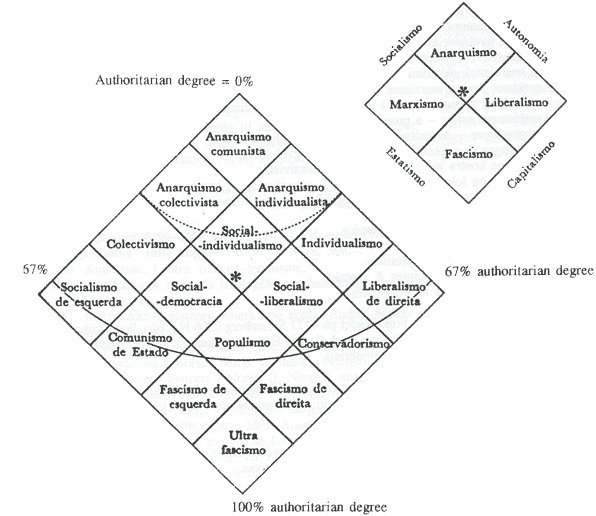
NB! Anarchism is the progressive middle in politics, not far left or right, see Economic-Political Map on anarchy.no, i.e. https://www.anarchy.no/a_e_p_m.html. This model does not define the left by its rejection of hierarchy and the right by its acceptance, the map is two-dimensional. With Marxism to the left and liberalism to the right. And fascism downwards on the map, and anarchism as the progressive middle, and upwards. According to the political model presented on anarchy.no, anarchism occupies a unique position as the "progressive middle" on a two-dimensional map, distinct from traditional left-right classifications. This model places Marxism to the left, liberalism to the right, fascism downwards, and anarchism upwards, representing a movement towards a society without authority or hierarchy. Also read more about this model at fagerhus.no. More information at: https://www.anarchy.no/andebate.html.
Authoritarian degree % =
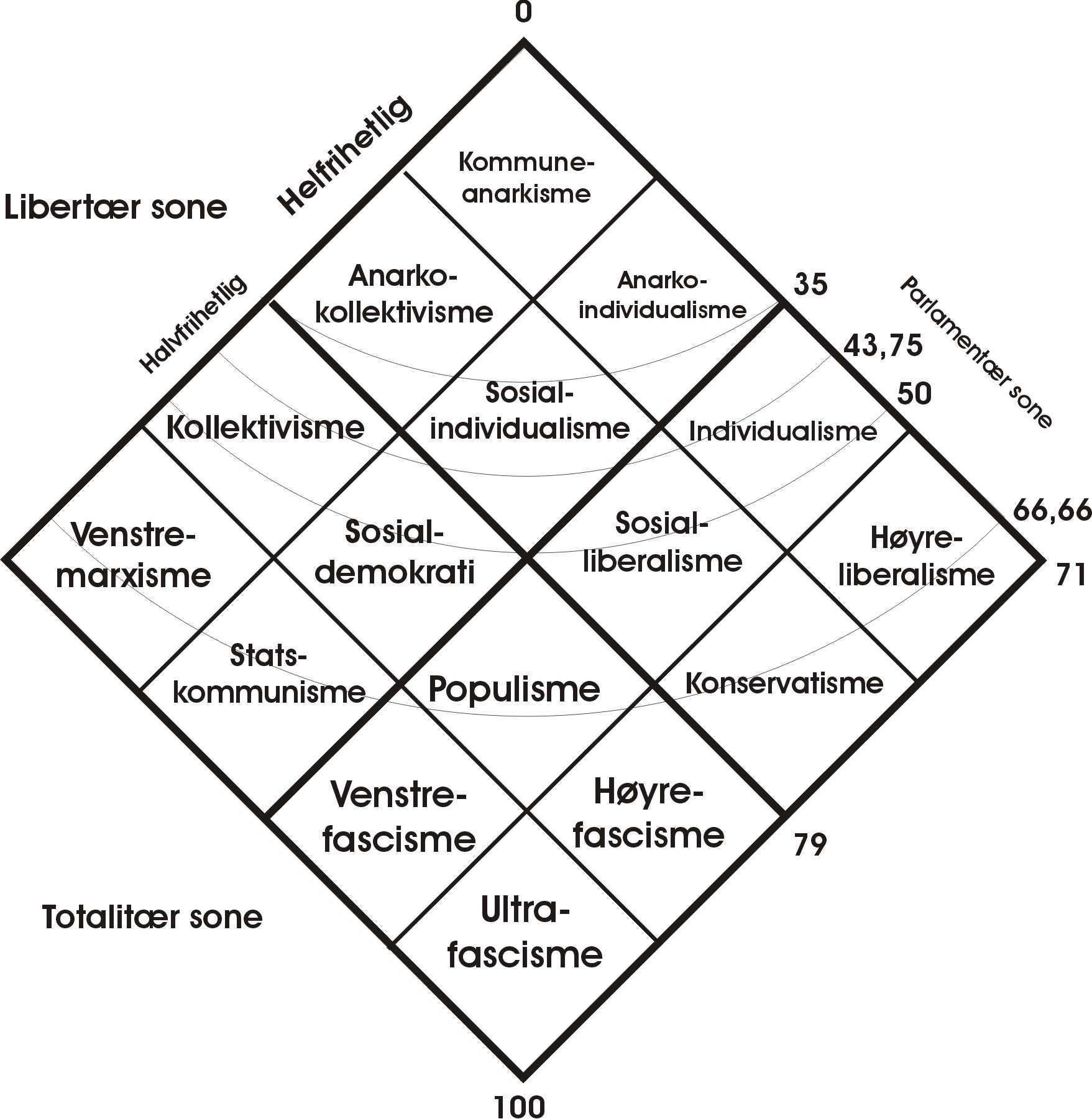
*) The stars indicate the position of the Norwegian economical-political system after the revolutionary change in 1994/95. All Arab countries are located in the fascist main quadrant of the map. For democracy and the libertarian vs authoritarian, capitalist vs socialist and statism vs autonomy degree we have used ",", the European standard instead of American/UK standard, i.e. "." as decimal separator. For most other figures we have used the American/UK standard. The term "ca" is an abbreviation for the latin circa, which means about or approximately.
Fig. 1. Picture of the Anarchist Economic-Political Map
Resolution from:
THE ANARCHIST INTERNATIONAL
www.anarchy.no
Introduction
With Arab countries we mean the 22 members of the Arab League. The main goal of the League is to "draw closer the relations between member States and co-ordinate collaboration between them, to safeguard their independence and sovereignty, and to consider in a general way the affairs and interests of the Arab countries." The Arab League is the main fascist organization in the modern world, with four moderate fascist systems and eighteen totalitarian fascist systems, with more than 67% authoritarian degree (per 2010-11).
In 2011 (i.e. since December 2010) we have seen popular revolts, called the Arab Spring, in most of the Arab countries, and embryo-revolutions in Tunisia, Egypt and Libya and less significant in some other countries, but no real revolution in democratic direction yet. The concept 'real revolution' is defined as a "significant change of a societal system's coordinates on the Economic-Political Map and in reality". A real revolution in democratic direction implies a significant increase in the libertarian degree of the economic-political system of a country, following the significant change of the societal system's coordinates upwards on the Economic-Political Map and in reality. The libertarian degree = 100 % - the authoritarian degree %, and the authoritarian degrees for different economic-political systems are presented at the Economic-Political Map. The fundamental parameters, coordinates, of the systems, see System theory - chapter V., have not changed significantly in the Arab countries so far (2012), i.e. in democratic direction. There have been elections in Tunisia and Egypt, but in general election is just a necessary, but not a sufficient condition for getting rid of a totalitarian system.
The Arab Spring is mainly a popular uprising against the totalitarian, ultra-authoritarian fascism in most Arab countries, and for (non-totalitarian) democracy, including "Freedom, Peace and Justice", and later on perhaps even real democracy, i.e. anarchy. To succeed in this anti-fascist class struggle, mainly by the People (the bottom class - grassroots), is however easier said than done... To get rid of an (autocratic) ultra-authoritarian ruler of a totalitarian system and hold multi-party elections, can be hard enough, but still is the more easy part of an embryo-revolution, and usually this implies only a small and not significant shift in the libertarian degree. To get rid of a totalitarian, ultra-authoritarian System, i.e. to develop the embryo-revolution to a real revolution and achieve a stable, non-totalitarian democracy, is the really hard part, and is very, very difficult and takes usually also a very long time. In practice, most embryo-revolutions are aborted before achieving a real revolution, mainly due to heavy counter-revolutionary actions and forces broadly defined. This is valid for the Arab countries, as well as for revolutionary "Springs" world wide, say, The Hong Kong Spring Revolution in 2019 and perhaps later. Further revolutionary development towards real democracy, i.e. anarchy, first of low degree and later a high degree of anarchy (see the Economic-Political Map, the degree of anarchy is equal to the libertarian degree within the Quadrant of Anarchism of the Map) is even harder, and very rare. There are only 3 anarchist, real democratic, countries in the world today; Norway, The Swiss Confederation and Iceland, and they are only anarchies of rather low degree (between 50-55% degree of anarchy). No whole country in the world has so far achieved anarchy of high degree, not to mention having a system close to the anarchist ideal at the top of the Economic-Political Map, with 90 % towards 100 % degree of anarchy. But there are smaller societies/organizations with a high degree of anarchy, say, the quite significant Anarchist Federation of Norway (AFIN), so it should not be impossible for a country to have such a system in the future. The recent threats from global warming have put some pressure on the degree of anarchy in the real (and green) democracies, and there are perhaps some tendencies indicating a temporary small dip in authoritarian direction, but so far not significant. Norway, The Swiss Confederation and Iceland are still anarchies, i.e. significant.
Elections and "checks and balances". In general, (multi-party) elections are necessary for democracy, both semi- and real-democracy, but not a sufficient condition. Elections may end in tears, not to mention grand larceny, murder and even genocide. Elections alone do not amount to a democracy, in the meaning of being within the parliamentary zone of the economic-political map (see above), or even more libertarian. First there must be clearly democratic, non-totalitarian parties, preferably with real democracy, i.e. anarchy, on the agenda. And without institutions that promote accountability, etc., they (multi-party electoral systems with significantly free elections) are too easily exploited by cynical, greedy ultra-authoritarian elites/archs, i.e. the bureaucracy (upper class). Real democracy and non-totalitarian (democratic) system in general include a significant amount of "checks and balances", i.e. 1. "checks", include free critical investigations and research where the results are publicly available, via education and the media etc., i.e. sufficient measures to prevent and counteract ultra-authoritarian propaganda, present and historic, manufacturing consent of the ultra-authoritarian; 2. "balances", include balance of strength, significantly without domination and power-concentration - in societal perspective broadly defined, and 3. institutions promoting and securing the "checks and balances". In general "checks and balances" are various procedures set in place to reduce mistakes, prevent improper behavior (ochlarchy - mob rule broadly defined), and/or decrease the risk of centralization of power, economically and/or political/administrative. "Checks and balances" ensure that no one person or department/party has absolute control over decisions. The term is most commonly used in the context of public central administration, but is also used in business and management in general. The term "checks and balances" is rooted back to USA (the Constitution), that has a system only with rather limited "checks and balances", not ruling out severe unenlightened plutarchy in the country. More information about democratic institutions broadly defined, see real democracy - definition.
So far the elections in Tunisia (2011) and Egypt (2012), within the framework of the Arab Spring, have brought quite reactionary, ultra-authoritarian, islamists to power, lacking "checks and balances". They will probably not be better than the old ultra-authoritarian rulers. The elections in Tunisia and Egypt do most likely not fulfill the conditions for entering the parliamentary democratic (non-totalitarian) zone of the economic-political map and in reality, not to mention be more libertarian. As mentioned, the fundamental parameters - coordinates - of the systems have not changed significantly in libertarian direction. Tunisia seems closest to a real revolution in democratic direction, but in case this happens - it seems not very likely, it will probably take a long time.
03.07.2013. The islamists in Egypt were thrown out of office by the military, and a non-islamist interim president was put at place, also by the military. Per 28.08.2019 Egypt has a totalitarian, ultra-authoritarian, economic-political system, a de facto military dictatorship with heavy ochlarchy, i.e. mob rule broadly defined. The Egyptian Spring, the embryo-revolution in Egypt, has been aborted by an ochlarchist military junta, headed by President Abdel Fattah Saeed Hussein Khalil al-Sisi. Sisi led a bloody coup d'état 03.07.2013 (which ousted the first somewhat democratically elected president of Egyptian history, the ultra-authoritarian islamist Mohamed Morsi from the Muslim Brotherhood), and he has since been in power. The libertarian opposition broadly defined - revolutionaries from 2011 - are in jail (with beating and torture) or mainly silenced, and some have fled Egypt. NB! However 20-22.09.2019 the Egyptian Spring is revived! A new embryo-revolution is probably on the way! Thousands of protesters took to the streets chanting "the people demand the fall of the regime"! And the Anarchists (AI/ACA-Egyptian Section) have called for a "million-man march" on Friday 27.09.2019. The Sisi-regime has arrested more than 2000 per 27.09, but the uprising continues. 27.09.2019 the Egyptian Spring still continues, protests calling for the fall of al-Sisi broke out across Egypt in defiance of the heavy security crackdown, but much less than a million marched. Full and updated reports about the revived Egyptian Spring below in this issue of IJ@ 1 (41), however soon after 27.09.2019 the open protests in the country mainly were repressed and turned out to be mostly a silent protest until later.
Tunisia has many problems, but seems to be on the road to (non-totalitarian) democracy, i.e. the embryo-revolution is still per 2021 alive, but it may still take a long time to achieve a functioning democracy - a real revolution, not to mention achieve real democracy, i.e. anarchy (more information see a.o.t. PS & PPS below). The embryo-revolution in Libya aborted many years ago (i.e. finally when renegade General Khalifa Haftar launched his "Operation Dignity" in May 2014), and the country ended up as a Failed State, with rivaling polyarchy/oligarchy and ochlarchy, i.e. chaos and ultra-fascism - and thus an ultra-authoritarian & totalitarian system, see the economic-political map above. Also most other Arab countries, beyond the revolts of the Arab Spring, still have fascist-ochlarchist and totalitarian economic-political systems. But NB! many of the Arab systems would probably have been worse, i.e. even more authoritarian, without the Arab Spring.
The Arab Leauge is still (per January 2021) the world's main fascist organization, with A. four moderate fascist countries, with quite authoritarian but not totalitarian systems (but very far from real democracy), and B. sixteen countries with more or less stable, but totalitarian fascist systems, i.e. with more than 67% authoritarian degree, plus C. the two countries with ongoing embryo-revolutions, also including some libertarian Bottom - Up democratic tendencies, but still with mainly top-heavy pyramid economic-political systems of populist/fascist type, i.e. totalitarian fascism (Tunisia and Sudan). More information about the situation and development in Tunisia and Sudan, see below. And the fight against totalitarian, ultra-authoritarian fascism, i.e. the anti-fascist struggle, within the Arab World, continues in different forms and shapes. Sooner or later one or may be more (of the totalitarian fascist) Arab countries will probably manage to achieve a non-totalitarian, democratic, economic-political system, via the anti-fascist struggle broadly defined, i.e. including establishment of institutions that secure accountability and sufficient "checks and balances". That is what we, i.e. anti-fascists in general, including ACA & ACAME and most of the Arab People, are fighting for, and we will not give in.
08.10.2019. GGS and the Arab Spring in Iraq - The Iraqi Spring. Anti-government revolt in 2018-2019. The Anarchists i.e. AI/ACAME-Iraqi Section condemn the violence and more state-ochlarchy and call for anarchy, i.e. real & green democracy in Iraq as soon as possible. 12.10.2019. The Anarchists i.e. AI/ACAME-Iraqi Section together with the GGS had a domestic and international direct action e-mail campaign for anarchy, i.e. real & green democracy, in Iraq. 02.03.2020 the report about Iraq is updated, and distributed in Iraq and world wide.
18.10.2019. GGS and the Arab Spring in Lebanon. About the Lebanese Spring Revolution: thousands, including the Anarchists, i.e. AI/ACAME-Lebanese Section demand "fall of the regime" in Lebanon, an ultra-authoritarian and totalitarian fascist system, with only about 30,9 % democracy = libertarian degree, and thus 69,1 % authoritarian-degree. And call for - as soon as possible - a real revolution in direction Anarchy, i.e. real, including green democracy. 21.10.2019. Lebanon cabinet fast-tracks reforms as the Lebanese Spring Revolution, a part of GGS, rage on. The People shouts "revolution, revolution"! 25.10.2019. Anti-government protests in Lebanon break out also on Hezbollah's heartland. 29.10.2019. PM Hariri offers resignation amid protests by the Anarchists and the People in general. February, March, April 2020 and further, also in 2021, the revolt in Lebanon continues.
23.02.2020. The Arab Spring in Algeria has mainly turned away from reactionary islamism and continues in the Hirak (movement), see full report below about the situation in Algeria.
12.2018. Sudan. Protests ongoing in Sudan. A series of demonstrations broke out in several cities due to dramatically rising costs of living and the deterioration of the country's economy, 19.12.2018, and later in December 2018. This is the preliminary start of the Sudanese Spring revolt, but in December 2018 there was just a broad uprising, not yet a revolution. The Sudanese Spring later developed into an embryo-revolution, but per 25.09.2019 was still not developed to a real revolution, in democratic direction, meaning a significant shift (downwards) in the authoritarian degree and the coordinates of the system on the economic-political map and in reality. The Anarchist Confederation of Africa (ACA) - Sudanese Section is a relatively small, but active and important part of the Pro-Democracy and Green Movement in Sudan. The anarchists (AI/ACA-Sudanese Section) are now de facto the Spearhead of the Pro-Democracy and Green Movement in Sudan, the popular basis for the Sudanese Spring, earlier an embryo-revolution now an opposition to the Hemedti Fascist Mega Terrorist State. In June and July 2019 the anarchists of AI/ACA and the Sudanese Section, were very active, a) trying to make the embryo-revolution in Sudan to a real revolution - and achieve (non-totalitarian) democracy - as soon as possible, and b) with domestic and international solidarity direct actions for the Sudanese people (i.e. the grassroots including the libertarians) and their pro-democracy and green class struggle! In August 2019 a new Bottom - Up Management System of the Central Administration of Sudan, with the bottom - The People as The Sovereign - via The People's Council, was established. This represents a small but important libertarian Bottom - Up democratic tendency within the still (per 25.09.2019) mainly top-heavy pyramid economic-political system of totalitarian populist/fascist type, in Sudan. Here the Sudanese Anarchists, both within and outside the revolutionary People's Council, played and play a central role. The anarchists of AI/ACA, including the Sudanese Section, will continue to participate with opposition and revolutionary information work in Sudan, for the Sudanese People and their Sudanese Spring - as long as needed. This also includes opposition to the counter-revolutionary forces broadly defined, that are strong within the newly established, non-elected hybrid military-civilian system in the country, as mentioned still per 25.09.2019 a totalitarian fascist system and per 16.11.2019 also further developed to the Hemedti Fascist Mega Terrorist State! It is clear that the Anarchists of Sudan and the Sudanese People need stronger allies with more military muscles to achieve a green real democracy and get rid of Hemedti and his brown terrorist mob in the Rapid Support Forces RSF ruling the Sudanese State. 10.04.2020 Radio Dabanga about Sudan: authoritarian totalitarian. Further development, see below.
01.08.2019. North Africa and the Middle East. The Arab Spring with its many revolts and several embryo-revolutions, although most are aborted at this moment, is far from over and can probably return stronger with widespread new popular revolts and embryo-revolutions, and perhaps the protesters may achieve some form of functioning democracy, and even real & green democracy i.e. anarchy - in some of the (now totalitarian fascist) Arab countries, that is achieve real revolutions - in the coming years. The Arab People (seen as a class as opposed to the superiors in rank and/or income, i.e. the Bureaucracy economical and/or political/administrative broadly defined in private and public sector - the upper class/authorities) is in general fed up with the fascist systems and their bureaucracies in the Arab countries, both in Africa and the Middle East. Opposition and resistance to the authoritarian fascist Arab societal systems from the People are rising and increasing, despite rather often increased repression and more suppression from the Bureaucracy. The opposition and resistance may sometimes turn into popular protests and uprisings in the Arab countries, as several times before, and may also sometimes develop into embryo-revolutions, and a few later perhaps even develop to real revolutions. The Arab People's class struggle continues, backed by international solidarity.
The anarchists, i.e. The Anarchist International (AI/IFA), The Anarchist Confederation of Asia and the Middle East (ACAME) and The Anarchist Confederation of Africa (ACA), with the Arab country-sections, are ready to participate in a more general revival of the Arab Spring, as well as embryo-revolutions and "national Springs" of single countries (such as now in Sudan, and in Tunisia - where the Arab Spring started in 2010/11), and possibly further development to real revolutions! The arch-enemies of a more general revival of the Arab Spring etc., counter-revolutionaries, are in general the top rulers of the fascist member-states of the Arab League, especially a) ultra-authoritarian military forces and juntas (as say, in Egypt, and NB! the arch-counter-revolutionary general Hemedti and his followers in the powerful Sovereignty Council in Sudan), b) the ultra-authoritarian rulers of the Arab monarchies (especially in the UAE and the Saudis, remember Crown Prince Mohammed Bin Salman, in short MBS, a.k.a. More Bull Shit (MBS)), c) the Arab movements of ultra-authoritarian, extremist islamists; al-Qaeda, the Islamic State/Daesh, the Muslim Brotherhood, Hamas and Hizbollah - as well as other Arab islamist, ochlarchist extremists, and ultra-authoritarian islamist parties and organizations in general, d) ultra-authoritarian, ochlarchist marxists (leftists), a.k.a. communists, i.e. socialists and democrats in the name only, and often de facto left-fascists, and e) ultra-authoritarian liberalists and right populists/fascists (rightists), mainly and typically conservative and/or reactionary de facto supporters of the unenlightened plutarchy! A more general revival of the Arab Spring, must deal efficiently and firm with these totalitarian, ultra-authoritarian, counter-revolutionary, ochlarchical powers and forces, to succeed. In this connection, the Arab People, including the anarchists, must among other things learn from the history of the Arab Spring since 2010/11 and to this day, presented here in this file IJA 1 (41). For revolution and other class struggle with success! THE ANARCHISTS ARE READY FOR A FIGHT! BUT NB! NEED MUCH STRONGER ALLIES FOR ACHIEVING GLOBAL GREEN DEMOCRACY - SAY, NATO!
28.09.2019. NB! The Arab Spring joined The Green Global Spring (GGS) for development of a world wide People's Revolution, and also joined the global green actions of GGS. The GGS will support the Arab Spring and vice versa. In this connection the People's Council of Sudan was changed to the Global People's Council, i.e. with a similar mandate as before, but now working for the GGS. More information, also about the present main joint global actions of the GGS, in the PPPPS to this Introduction of the IJ@ 1 (41), below.
This file IJ@ 1 (41) will be updated when something significant happens - follow the history, news, comments and actions of the anarchists and the people in general...
Empirical economic-political system-analyses of the Arab countries: 1. estimates of place on the economic-political map and in reality, 2. estimates of the libertarian degree (100% - the authoritarian degree), and 3. more information about the Arab systems.
This investigation is done by IIFOR in 2010 and 2011, a.o.t. based on UN and national statistics with data mainly from 2002-2007, with a small update in 2019. NB! Such estimates are in general, i.e. unless special cases, probably usually valid for a very long time, reflecting relative stability of systems in general, i.e. unless special cases. Thus these estimates are probably also in general, i.e. unless special cases, valid for 2010-2019. Results:
Qatar is the least authoritarian Arab country. Ruled by the al-Thani family since the mid-1800s, Qatar transformed itself from a poor British protectorate noted mainly for pearling into an independent state with significant oil and natural gas revenues. During the late 1980s and early 1990s, the Qatari economy was crippled by a continuous siphoning off of petroleum revenues by the Amir, who had ruled the country since 1972. His son, the current Amir Hamad bin Khalifa al-Thani, overthrew him in a bloodless coup in 1995. In 2001, Qatar resolved its longstanding border disputes with both Bahrain and Saudi Arabia. Oil and natural gas revenues enable Qatar to have a high GDP per capita, 31 558 US $ (2005). For 2007 it is estimated to $ 75 900 PPP, and $ 86 600 at current exchange rate, one of the worlds highest. This contributes to lower the degree of capitalism, but the income-distribution is significantly uneven. The unemployment rate was as low as 0.7% (2007). All in all this is significantly a capitalist country, the degree of capitalism is estimated to 59,5 %. Ethnic groups are Arab 40%, Indian 18%, Pakistani 18%, Iranian 10% and other 14%. Religion: Muslim 77.5%, Christian 8.5%, other 14% (2004 census) . It is ranked as no 40 on the UN's Human Development Index of 2005.
Government type is emirate, a form of monarchy headed by the Amir, but not without tendencies of democracy, say, the constitution was ratified by a public referendum on 29 April 2003 (and endorsed by the Amir on 8 June 2004, made effective on 9 June 2005). Legal system based on islamic and civil law codes, discretionary system of law controlled by the Amir although civil codes are being implemented. Islamic law dominates family and personal matters. Legislative branch is a unicameral Advisory Council or Majlis al-Shura. The constitution provides for a new 45-member Majlis al-Shura; the public would elect two-thirds of the Majlis al-Shura; the Amir would appoint the remaining members; preparations are (2011) underway to conduct elections to the Majlis al-Shura. The Council of Ministers is appointed by the monarch. In April 2007, Qatar held nationwide elections for a 29-member Central Municipal Council (CMC), which has limited consultative powers aimed at improving the provision of municipal services; the first election for the CMC was held in March 1999. There are however no political parties.
The degree of statism is estimated to 65,4 %, clearly a statist country. Thus the authoritarian degree is estimated to 62,5 % and the libertarian degree 37,5 %, ranked as no 47 of countries according to libertarian degree. It is thus not a totalitarian system with more than 67% authoritarian degree, but rather authoritarian. It is located to the left in the populist sector of the fascist quadrant on the economic-political map, thus it is a left populist regime, moderate fascism. Similar systems, but a bit more authoritarian are in the United Arab Emirates, (UAE), ranked as no 48 of countries according to libertarian degree, with ca 37,4 % libertarian degree, Bahrain 49 (ca 37,3%) and Kuwait 50 (ca 37,2%). The limit for totalitarian systems is 33,33 % libertarian degree, i.e. less than 33,33 % libertarian degree means a totalitarian, ultra-authoritarian system and regime.
The other 18 Arab countries are totalitarian fascist states, i.e. with less than 33,33 % libertarian degree: Libya ranked as no 68 (ca 32,5% libertarian degree), Oman 74 (ca 31,9%), Saudi Arabia 82 (ca 31,1%), Lebanon 84 (ca 30,9%), Tunisia 92 (ca 30,1%), Jordan 93 (ca 30%), Algeria 105 (ca 28,5%), Syria 108 (ca 28,2%), Occupied Palestinian Territories 110 (ca 28%), Egypt 122 (ca 26,7%), Morocco 127 (ca 25,8%), Comoros 135 (ca 24,5%), Sudan 144 (ca 23,6%), Djibouti 152 (ca 22,8%), Yemen 154 (ca 22,6%), Mauritania 155 (ca 22,5%), Iraq 177 (ca 20,5%) and Somalia 186 ( ca 20%).
Somalia, a failed state with its rivaling polyarchy and heavy ochlarchy, resulting in chaos and ultra-fascism, is the most authoritarian country in the world, with only ca. 20 % libertarian degree. Libya is a special case, in 2019 about equally authoritarian as Somalia with only ca. 20 % libertarian degree, also a failed state with rivaling polyarchy and heavy ochlarchy, resulting in chaos and ultra-fascism, but in 2010 had ca. 32,5 % libertarian degree, and thus was clearly less authoritarian. The embryo-revolutions in Tunisia and Sudan have so far not managed to change the libertarian degree significantly, these two countries are still mainly totalitarian fascist states, and ultra-authoritarian. Tunisia is clearly less authoritarian than Sudan, with ca 30,1 % libertarian degree, compared to Sudan's ca 23,6 % libertarian degree. In general these 18 totalitarian fascist states have very little respect for human rights and are ruled very significantly from the top downwards to the bottom/grassroots, both economically and political/administrative. There are per 2019 relatively small anarchist opposition groups in many of the Arab countries, but most of the oppositions are fundamentalist, islamist, fascist terrorist groups, even worse than the existing regimes. The Anarchist International supports human rights, including labor and women's rights, and anarchist opposition, in general in the Arab countries, and the AI-note "What anarchists are against and what they are for" is translated to Arabic by Arab anarchists, see Anarchism in Arabic. However it is a long way to go before anything close to anarchy, i.e. real democracy, regarding the societal system seen all in all, can be achieved in the Arab countries, also taking into account the popular uprisings related to the Arab Spring from the start in 2010/11 to today. But the Arab Spring may in the long run improve at least some of the Arab systems/countries in democratic direction. It is worth while fighting for it. Source: IIFOR.
PS. 04.09.2019. Tunisia: authoritarian tendencies, i.e. not non-totalitarian democracy, create problems. Tunisia will forever be remembered as the birthplace of the Arab Spring in 2011. That has been both a blessing and a curse for the country. The upside is that further development in democratic direction, away from totalitarian “democracy” towards non-totalitarian democracy, and later on perhaps even towards real democracy, i.e. anarchy, has become a point on the economic-political agenda, especially after the architects of the transition won the Nobel Peace Prize in 2015. The downside is that Tunisia’s halting progress in democratic development, and still lots of authoritarian tendencies, continues to disappoint those who hope others will follow its path. Egypt’s retreat into military dictatorship, Libya’s fragmentation, chaos and ultra-fascism, and Syria’s catastrophic civil war, make Tunisia that much more important for those who insist that the Arab Spring should continue, i.e. anarchists and others. Eight years after the uprising, many Tunisians are angry at how their society is faring, with more and more authoritarian non-democratic tendencies broadly defined. The economic-political system in Tunisia, democratic in the name only, is dominated by ultra-authoritarian, counter-revolutionary forces, with the large more moderate islamist Ennahdha Party up front, supplemented with islamist extremist terrorists from IS/Daesh and other, similar groups. The other main party, the mainly populist-authoritarian Nidaa Tounes, is no non-totalitarian democratic force, but as the islamists, a clearly counter-revolutionary force. Also, the US International Republican Institute (IRI) is manipulating many of the political parties in Tunisia, towards unenlightened plutarchy, clearly counter-revolutionary from the People's perspective. Eight years after the (so far only embryo-) revolution, political leaders are struggling to address basic citizen demands. What is needed is new, clearly non-totalitarian democratic parties, preferably with real democracy, i.e. anarchy, as a long term aim.
The Economist Intelligence Unit (UK) has rated the Tunisian economic-political system as a "flawed democracy" in 2016. Flawed "democracies" are nations where elections are somewhat fair and free and basic civil liberties are more or less honored, but have severe authoritarian issues (e.g. media freedom infringement). These nations have significant faults in other democratic aspects, including under-developed political culture, low levels of participation in politics, and issues in the functioning of societal management. Flawed “democracy” is mainly an illiberal "democracy", also called a partial "democracy", low intensity "democracy", empty "democracy" or a "hybrid regime". It is a governing system in which although elections take place, citizens are cut off from knowledge about the activities of those who exercise real power because of lack of civil liberties, etc.; thus it is not an "open society". This may be because a constitution limiting government powers exists, but those in power ignore its liberties, or because an adequate legal constitutional framework of liberties does not exist. Tunisia has been (since 2011) and is still today, a "flawed democracy", that is it has not achieved non-totalitarian democracy yet, despite elections and revolution (however so far only an embryo-revolution), and the country is thus very far from real democracy, i.e. anarchy, on the economic-political map and in reality.
The unemployment rate for graduates is about 30%. For those who have jobs, wages remain stagnant, and GDP per capita is down since 2014. Tens of thousands have fled the country in search of better prospects. Little wonder then that demonstrations have become commonplace in recent years. According to the Tunisian Forum for Economic and Social Rights, their number has surged from 5,001 in 2015 to more than 11,000 in 2018. On November 22, 2018, nearly 670,000 people participated in multiple labor strikes across the country to protest the government’s failure to address rising inflation and dwindling buying power. Frustrated civil servants want better pay. At the same time, street unrest will discourage investment and create more political-economic problems. And protesters are demanding that the government tackle rising corruption, reduce income inequality and create jobs, i.e. in general working more from the bottom - the People - and upwards, not the other way around - from the top towards the bottom. This is a crisis, created by authoritarian non-democracy tendencies. The Arab Spring succeeded in producing at least one country that’s holding relatively free and fair elections, however still mainly not sufficient non-totalitarian democratic institutions, and still within the framework of an embryo-revolution, not a real revolution. But with each passing year, the glow of that achievement dims and demands for prosperity and fairness, non-totalitarian democracy, and a development towards real democracy, grow more urgent. If these demands are not met, then one day Tunisians might decide the revolution – and all it ushered in – was more curse than blessing. Now it is time for achieving non-totalitarian democracy, and later a development towards real democracy, i.e. anarchy, in Tunisia. Resolution by The Anarchist Confederation of Africa (ACA) - Tunisian Section. Source: AIIS.
PPS. 10.09.2019. Ad the autumn 2019 elections in Tunisia. The "flawed democracy" in Tunisia is a very much top-heavy pyramid economic-political system, i.e. still a totalitarian and ultra-authoritarian societal managerial system after 8 years of embryo-revolution and several elections. The embryo-revolution in Tunisia in 2010/11 (and later, until today and probably longer), represented a small, but not significant shift upwards in the country's libertarian degree, as with the Arab Spring in general, including also the Sudanese Spring so far. NB! 1. Doing away with an (autocratic) ultra-authoritarian ruler, 2. followed by (de facto, via ultra-authoritarian propaganda, present and historic, manufacturing consent of the ultra-authoritarian, lack of "checks and balances" in general) election between two (or more) ultra-authoritarian rulers and their parties (shifting on ruling or ruling together), means 3. a continued ultra-authoritarian, i.e. totalitarian system, - as in Tunisia and many more countries - a continued "flawed democracy" and not a non-totalitarian democracy or real democracy (i.e. Anarchy).
The autumn 2019 president and parliament elections in Tunisia will most likely not change the very much top-heavy pyramid societal system in the country significantly in non-totalitarian, democratic direction. The embryo-revolution will probably continue, with small ups and downs, and not be aborted, but it will still not yet develop to a real revolution, i.e. achieving non-totalitarian democracy with a significantly less top-heavy pyramid societal system in the country, in the short run. The counter-revolutionary forces in Tunisia are strong, but have not been able to abort the embryo-revolution so far. It is still a draw and status quo (since 2011) in the revolutionary class struggle between the People (the grassroots - the bottom) and (the populist/fascist) upper class (the Bureaucracy broadly defined in private and public sector - the top) in Tunisia.
We, the Anarchists of Tunisia work hard (of course without ochlarchy), to push the economic-political System in non-totalitarian, democratic direction, as a part of the The People, and perhaps we together with the rest of the People may achieve non-totalitarian democracy in Tunisia in the somewhat longer run, and later even Real Democracy i.e. Anarchy. In this connection we also work with the main problem, the necessary more "checks and balances" (more information see above in the "Introduction"), but with very limited resources that will take a long time! We also work with international solidarity, and support our fellows in Sudan, and the Arab Spring in general. All should learn from our long term revolutionary experience and problems with achieving the necessary "checks and balances" and a non-totalitarian democracy, i.e. develop the embryo-revolution to a real revolution! For more "checks and balances" and non-totalitarian democracy, and later Real Democracy, i.e. Anarchy, in Tunisia, Sudan and the other Arab countries, and world wide. Resolution by The Anarchist Confederation of Africa (ACA) - Tunisian Section. Source: AIIS.
NB! The part of IJ@ 1 (41) above, updated per 10.09.2019, was sent as a Resolution and Press Release 10.09.2019 world wide, from the Anarchist International, with the headline: "More about "checks and balances", a.o.t. a necessary condition for development of the embryo-revolutions in Tunisia and Sudan to real revolutions, and achieve non-totalitarian democracy, and later even real democracy, i.e. Anarchy."
PPPS. 17.09.2019. Ad the Presidential election in Tunisia 15.09.2019. 26 candidates, all mainly ultra-authoritarian, were running. Turnout only 45 %, few young voted. Tunisia will still be a totalitarian and ultra-authoritarian “flawed democracy” in the coming years.
Twenty-six candidates, including two women, all rather and mainly ultra-authoritarian and many directly populist/fascist, were running in the election. Turnout has been low at about 45%, despite an earlier call for young Tunisians to get out and vote. The election is widely viewed as a test of one of the world's youngest, however still “flawed democracy”, but there were reports that few of those travelling to polling booths were young. We don't have the Official results yet, but exit polls suggest that the ultra-authoritarian conservative Kais Saied, a 61-year-old law professor, and Nabil Karoui – an ultra-authoritarian media magnate currently in jail - could be well placed to make it to the second round.
The exit polls indicate that a) faced with widespread disillusion over the country’s lack of democratic progress in the past eight years since its embryo-revolution started, b) Tunisians have rejected politicians associated with the country’s two main political trends who have dominated for the last years, including the ultra-authoritarian islamist Ennahda party and the splintering, and also ultra-authoritarian, secularist Nidaa Tounes party, but c) NB! another ultra-authoritarian president and ruler with staff will now take over the top of the totalitarian populist/fascist system in Tunisia.
There will still probably not be sufficient "checks and balances" in the coming years, necessary for a development to a non-totalitarian democracy. The economic-political system in Tunisia will thus still most likely be a totalitarian and ultra-authoritarian “flawed democracy”, and thus not a non-totalitarian democracy - and far from real democracy, i.e. Anarchy - for several years to come. The ongoing embryo-revolution will most likely still not be developed to a real revolution in democratic direction - to achieve non-totalitarian democracy and later real democracy, i.e. Anarchy; but we, the Anarchists, will continue to work for it - hard! Resolution by The Anarchist Confederation of Africa (ACA) - Tunisian Section. NB! Later 17.09.2019 Tunisia’s electoral commission confirmed that Saied and Karoui won the most votes. Source: AIIS.
NB! The part of IJ@ 1 (41) above, updated per 17.09.2019, was sent as a Resolution and Press Release 17.09.2019 world wide, from the Anarchist International, with the headline of the PPPS. 17.09.2019. A similar updated version was sent 18.09.2019, with the headline: "Update about the Arab Spring included the Sudanese Spring - and the Hong Kong Spring, as well as the Presidential election in Tunisia. Official results, and more..."
PPPPS. 28.09.2019. The Arab Spring joins The Green Global Spring, in a world wide People's Revolution. The GGS' "Action: China, USA and EU! Drop Coal!" continues. Main target: the 3 evil, i.e. ochlarchist, Coal-Monarchs! The People's Council is now Global.
After the merger, joint "Action: China, USA and EU! Drop Coal!". In general the international revolutionary co-operation for Real (i.e. included Green) Democracy, i.e. Anarchy, including more Bottom - Up managerial systems, working from the People and upwards, where the bottom - the People's demands, including a safe pathway under 1.5C global warming, are met - will be strengthened as a result of the merger. And as a first part of this joint general action & revolutionary approach, the People of the world, via the Peoples Council, demand: China, USA and EU! Drop Coal! And thus the Green Global Spring, GGS, now including the Arab Spring with the Sudanese Spring (and more), continues with the "Action: China, USA and EU! Drop Coal!".
The strategy of the anti-coal action. In this "Action: China, USA and EU! Drop Coal!" we, the GGS, including the Arab Spring, and associates & allies, will work hard and use all legal means; diplomacy, direct actions and indirect actions - with sanctions - and more, to achieve this aim as soon as possible! As stated 24.09.2019 in the GGS Report no 1: "The main strategy of the GGS is direct actions, sometimes supplemented with indirect actions (e.g. via elections), both with sanctions broadly defined, creating strength, force and pressure against the top (upper class), to achieve a more bottom - up approach, where the bottom - the People's demands, including “a safe pathway under 1.5C” global warming, are met." And as part of this general approach, the People now demand: China, USA and EU! Drop Coal!, and we will not stop the action until this demand is met. Start to drop coal significantly NOW! We repeat: to China, USA, EU and also all other countries that use lots of coal, say, India and Australia: NB! Drop coal as soon as possible – start NOW! But first and foremost, the anti-coal action is directed at China, USA and EU. The top three greenhouse gas emitters — China, the United States (USA) and the European Union (EU) — contribute more than half of total global emissions. The main problem in these countries is coal.
Targeting the highest tops. Most of all these above indicated and coming parts, i.e. part-actions, of the main "Action: China, USA and EU! Drop Coal!", will be addressed and directed to the highest top of the 3 economic-political pyramids: the 3 evil, i.e. ochlarchist, Coal-Monarchs: Xi Jinping of China, Donald Trump of USA and Jean-Claude Juncker of EU. NB! Soon Ursula von der Leyen will replace Juncker and thus be the evil, i.e. ochlarchist, Coal-Monarch of EU. The Coal-Monarchs and the Coal-Monarchy & Oligarchy Top - Down systems in China, USA and EU, must be replaced with a significant Bottom - Up managerial approach, where the Bottom - the People's, no 1 green demand - Drop Coal, is met. The People's Green demands no 2., 3., 4. and more, mainly connected to the general aim "under 1.5C global warming", will be introduced via the People's Council later. First " Drop Coal!" for the main polluters, China, USA, and EU is the main target. In this connection the first, main and primary target is the 3 evil, i.e. ochlarchist, Coal-Monarchs.
The Arab Spring is now a part of the Green Global Spring, and more. After wide discussions, a.o.t. based on research, 23-28.09.2019, The Anarchist International - AI/IFA, including The Anarchist Confederation of Africa - ACA and The Anarchist Confederation of Asia and the Middle East - ACAME, plus all the different sections of these organizations, decided with general consent 28.09.2019 to join The Green Global Spring Revolution (GGS), initiated by the eco-anarchists of GAIA and GAIA's Support-Network for Greta Thunberg (GSNGT) 23.08.2019. As AI/IFA, including ACA and ACAME, and the 22 Arabic libertarian country-sections, now at large are Spearheading the Arab Spring, this also means the Arab Spring now mainly has joined The Green Global Spring i.e. the main trendsetting activists of the Arab Spring - largely. And this also means the non-Arab network-members of ACA and ACAME, including the Hong Kong Spring, have joined the GGS. This also includes a revolutionary global People's Council (PC) of the GGS, as the PC of Sudan, that has worked for a while, has been - and is - a great revolutionary success so far in the Sudanese Spring, now a part of the Green Global Spring.
The mandate of the Global People's Council (PC), and spokesperson for the PC of GGS. The mandate of the People's Council is now global, i.e. 1. to collect, analyze & formulate and put forward the demands of the People, the Bottom Class - Grassroots, including The Green demands, 2. within as much as possible a Bottom - Up managerial approach, established by the actions of the GGS or/and in general - so 3. the demands of the People, including the green, are met, as much as possible - world wide. Mr. Dabanga, elected spokesperson of the Sudanese PC, continues as official spokesperson for the new global People's Council (PC). This means that an experienced and important Third World representation within the Green Global Spring Revolution is established.
Spokesperson for the GGS, and the Real & Green Democracy revolution in Norway. The veteran eco-anarchist and anarcha-feminist Anna Quist from the Anarchy of Norway, is elected as the official spokesperson for the GGS. She was elected 28.09.2019 unanimously by the GGS/AI- secretariat in Oslo, the capital of Norway, a country in Northern Europe, and an Anarchy (of low degree) since the velvet anarchist revolution 1994/95, also with a significant green tendency. A.o.t. there is no significant coal problem in this country. The revolution started 28.11.1994 with the EU-referendum and more actions. The Anarchy of Norway is still going strong, and in 2019 The 25th anniversary of the anarchist revolution in Norway will be celebrated world wide by Real and Green Democrats Thursday 28. November, the Day of the Anarchist Revolution in Norway. "The Real and Green Democracy Revolution in Norway is a significant inspiration for The Green Global Spring Revolution (GGS) because it demonstrates fully that 1. Anarchy, i.e. including a significant green tendency, works, and 2. that the GGS may very well succeed world wide! But not without hard work and using all legal means and actions!" said Anna Quist, a 1. veteran Real and Green Democracy, i.e. Anarchist, activist since 1965, also 2. activist in the Norwegian anarchist, including green, revolution in 1994/95 and later, and 3. now and in the future official spokesperson for The Green Global Spring Revolution (GGS).
Greta Thunberg & Fridays For Future International and the GGS - Arab Spring merger a.m. The GGS in general, and especially the young network-members/subscribers, say, Fridays For Future International, fridaysforfuture.int@gmail.com, and the greatest eco-activist Greta Thunberg, at GretaThunbergMedia@gmail, can probably learn a lot from the Arab Spring Revolution. Furthermore the necessary green element of the Arab Spring can be strengthened via the GGS, plus more global solidarity actions for the Arab Spring can be introduced. And the Third World participation in The Global Green Spring Revolution will be strengthened. Resolution of The Green Global Spring Revolution and The Anarchist International - AI/IFA Saturday 28.09.2019. Source: AIIS.
Typical for the situation in 2009/10 - 22.07.2009: Amnesty says Saudi terror fight plagued with abuse. Saudi Arabia is holding more than 3,000 people in secret detention and has used torture to extract confessions in its anti-terrorism crackdown since the Sept. 11, 2001 terror attacks, Amnesty International said in a report. The report criticized the international community for turning a blind eye to the kingdom's methods in its crackdown. Asked about the report, a Saudi Interior Ministry official, Abdulrahman Alhadlaq, said, "These are claims that have to be proven." "Our policies on human rights are very clear and the orders given are for prisoners to be treated with respect and according to international human rights principles," Alhadlaq said. "If anything happened, it would be an individual case and if it is brought to anybody's attention it will be dealt with." - In 2011 the situations have changed a bit...
2011: Is now the time for a development towards Arab democracy? Say, 27.01.2011 protests against the present government, general repression and exploitation in Egypt are entering their third day, angry demonstrators torched a police post and up to a thousand people have been detained. There is a pledge for more people to take the streets again... Similarly protests have broken out in the Yemeni capital of Sanaa calling for the president to step down. Like those in Egypt, they say they have been inspired by events in Tunisia earlier this month, see below. There have also been rallys in Jordan calling for the government to resign over rising prices, unemployment and repression in general. Protests in Lebanon, Algeria, and later Sudan, may also be mentioned.
While many of the protestors are drawing strength from one another, each country in the region has different challenges and pressures and political set ups. It's far from a foregone conclusion that what happened in Tunisia will create a domino effect. Certainly the demonstrators in Tunisia and Egypt have talked about their desire for change and the fear disappearing as they realize they can bring about that change. Are the people at large ready to be paying the personal price to achieve those aims? Is the Middle East ready for a democratic revolution? Are Tunisia and Egypt the future of Arab democracy?
If Arabic countries are to change, the west and particularly the USA must probably also change in the way it treats them. So are streets protests that bring down a government the future model for democracy in Arab countries? Is this the way to bring about change? Is there a danger that with democracy comes instability? Here we will try to answer these questions and present updated news, comments and analysis, from anarchist point of view!
NB! Early in 2011 we have seen popular revolts in most of the Arab countries and embryo revolutions in Tunisia and Egypt, but no real revolution in democratic direction yet, i.e. a significant change of a societal system's coordinates on the Economic-Political Map and in reality. And Libya is at the moment (early in 2011) the most authoritarian country in the world, down from ca 32,5% libertarian degree in 2010 to less than 20% now, even worse than Somalia with about 20% libertarian degree in the latest years (se above). Tunisia seems closest to a real revolution in democratic direction. Furthermore the anarchist movement is now present in most Arab countries, both in North Africa and the Middle East. And, say, in Egypt a social-individualist libertarian movement is now quite significant, see the report of 22.02.2011 below.
Direct action against discrimination of minorities in the Arab countries. It is time for international as well as domestic direct actions against discrimination of the popular minorities in the revolts and embryo-revolutions in the Arab countries, especially in Egypt and Tunisia. There have been several reports internationally about violations of human rights of minorities, even reports of murder. Such discrimination must now stop! Majority dictatorship may be as bad as minority dictatorship, and is the opposite of freedom and democracy. If 'two wolves', the majority, decide to eat 'the sheep', the minority, it is the opposite of freedom and democracy. A condition for freedom and democracy is full respect for minorities; religious, ethnic, political and economical etc. and their human rights. 12.06.2011.
Below we follow the Arab Spring over time from the start.
The situation in Tunisia 2010/11 - The Jasmine Revolution...
14.01.2011. Tunisians drive ruler from power in mass uprising. Protesters enraged over soaring unemployment and corruption drove Tunisian President Zine El Abidine Ben Ali from power Friday after 23 years of iron-fisted rule, an unprecedented popular uprising in a region, i.e. the fascist Arab Leauge, dominated by strongmen who do not answer to their people. Tunisians buoyant over Ben Ali's ouster immediately worried, however, about what's next: the caretaker leadership of the prime minister who took control, and the role of the army in the transition. The upheaval took place after weeks of escalating unrest fueled partly by social media and cell phones, as thousands of demonstrators from all walks of life rejected Ben Ali's promises of change and mobbed the capital of Tunis to demand his ouster in the country's largest demonstrations in generations. "The fall of Ben Ali marks the first ever collapse of an autocratic regime in the face of a popular uprising in the Arab world," said US political risk consultancy Stratfor.
At least 23 people have been killed in the riots, according to the government, but opposition members put the death toll at more than three times that. On Friday, police repeatedly clashed with protesters, some of whom climbed onto the entrance roof of the dreaded Interior Ministry, widely believed for years to be a place where the regime's opponents were tortured. With clouds of tear gas and black smoke drifting over the city's whitewashed buildings, Prime Minister Mohammed Ghannouchi went on state television to announce that he was assuming power in this North African nation previously known mostly for its wide sandy beaches and ancient ruins. "I take over the responsibilities temporarily of the leadership of the country at this difficult time to help restore security," Ghannouchi said in a solemn statement on state television. "I promise ... to respect the constitution, to work on reforming economic and social issues with care and to consult with all sides."
The president promised legislative elections in six months, a pledge that appeared to open at least the possibility of a new government. The Anarchist International applauded the courage and dignity of protesting Tunisians, and urged all parties to keep calm and avoid violence. Ben Ali's downfall sent a potentially frightening message to autocratic leaders across the Arab world. He deftly managed the economy of his small country of 10 million better than many other Middle Eastern nations grappling with sclerotic economies and booming, young populations, turning it into a beach haven for tourists and beacon of stability in volatile North Africa. There was a lack of civil rights and little or no freedom of speech, but a better quality of life for many than in neighboring countries. He had won frequent praise from abroad for presiding over reforms to make the economy more competitive and attract business; growth last year was at 3.1 percent.
But unemployment was officially measured at 14 percent, but far higher among the young - 52 percent of Tunisia's 10 million people - and despair among job-seeking young graduates was palpable. Arabs across the region celebrated on Twitter, Facebook and blogs at news of the Tunisian uprising. Thousands of Tweets congratulating the Tunisian people flooded the Internet and many people changed their profile pictures to Tunisian flags. Egyptian activists opposed to President Hosni Mubarak's three-decade regime also looked to the events in Tunisia with hope. About 50 Egyptians gathered outside the Tunisian embassy in Cairo Friday to celebrate with singing and dancing. They chanted, "Ben Ali, tell Mubarak a plane is waiting for him too!" Unconfirmed rumors about Ben Ali's location reached such a fevered pitch that the governments of France and Malta - just two of several countries where Ben Ali was speculated to be heading - put out statements saying they have had no requests to accommodate him. US Secretary of State Hillary Clinton said Ben Ali had left the country, as widely reported by Arabic TV stations. Saudi Arabian-owned Al Arabiya TV reported that he had landed in the Saudi city of Jeddah.
The 74-year-old leader came to power in a bloodless palace coup in 1987. He took over from a man called formally President-for-Life - Habib Bourguiba, the founder of modern-day Tunisia who set the Muslim country on a pro-Western course after independence from France in 1956. Ben Ali removed Bourguiba from office for "incompetence," saying he had become too old, senile and sick to rule. Ben Ali promised then that his leadership would "open the horizons to a truly democratic and evolved political life." But after a brief period of reforms, Tunisia's political evolution stopped. Ben Ali consistently won elections with overwhelmingly questionable tallies: In 2009, he was re-elected for a fifth five-year term with 89 percent of the vote. Beforehand, he had warned opponents they would face legal retaliation if they questioned the vote's fairness.
US diplomatic cables released by WikiLeaks have called Tunisia a "police state" and described the corruption there, saying Ben Ali had lost touch with his people. Social networks like Facebook helped spread the comments to the delight of ordinary Tunisians, who have complained about the same issues for years. Under Ben Ali, most opposition parties were illegal. Amnesty International said authorities infiltrated human rights groups and harassed dissenters. Reporters Without Borders described Ben Ali as a "press predator" who controlled the media. The riots started after an educated but jobless 26-year-old committed suicide in mid-December when police confiscated the fruits and vegetables he was selling without a permit. His desperate act hit a nerve, sparked copycat suicides and focused generalized anger against the regime into a widespread, outright revolt.
The president tried vainly to hold onto power. On Thursday night he went on television to promise not to run for re-election in 2014 and slashed prices on key foods such as sugar, bread and milk. A day later he declared the state of emergency, dissolving the government and promising new legislative elections within six months. Hundreds of police with shields and riot gear moved into the peaceful demonstration nearly six hours after it began on the capital's main Friday in front of the Interior Ministry. Helmeted police fired dozens of rounds of tear gas and kicked and clubbed unarmed protesters - one of whom cowered on the ground, covering his face.
An AP Television News reporter heard gunfire in the center of the Tunisian capital late Friday afternoon, in addition to the popping of tear gas pistols. A few youths were spotted throwing stones, but most demonstrated calmly. Protesters were of all ages and from all walks of life, from students holding mid-street sit-ins to doctors in white coats to black-robed lawyers waving posters. "A month ago, we didn't believe this uprising was possible," said Beya Mannai, a geology professor at the University of Tunis. "But the people rose up." The prime minister suggested that Ben Ali had willingly handed over control, but the exact circumstances of his removal from power were unclear. The prime minister did not say anything about a coup or about the army being in charge, saying only that he was taking over while the president is "temporarily indisposed." "Under Article 56 of the Constitution that holds that in a case of temporary incapacity, the president can delegate by decree his power to the prime minister. Given the temporary incapacity of the President to carry out his duties, I take over the responsibilities temporarily of the leadership of the country at this difficult time to help restore security," Ghannouchi said.
Ghannouchi, 69, is a trained economist who has been a longtime close ally of Ben Ali. Prime minister since 1999, he is one of the best-known faces of Tunisia's government. He also has served as the country's minister for international cooperation and its minister of foreign investment. A founder of the main legal opposition party said the dramatic developments do not amount to a coup d'état. "It's an unannounced resignation," Nejib Chebbi said by telephone. To declare a permanent absence of a head of state, such as in a coup, elections would have to be held within 60 days, he said. "So they declare a temporary vacating of power." In Sudan in 1985, a collapsing economy and other grievances sparked a popular uprising, although the government was eventually ousted by a military coup. However, the closest parallel in the broader Middle East comes from Iran - which is not an Arab nation - where mass demonstrations helped topple the Shah and usher in the establishment of the Islamic Republic in 1979.
Tunisia's giant neighbor Algeria saw huge protests before it was shaken by a military coup in 1992, with a five-man leadership put in place after the army canceled the nation's first multiparty legislative elections that a Muslim fundamentalist party was poised to win. The party, the Islamic Salvation Front, became a vehicle for popular dissent. There were also massive demonstrations in Lebanon in 2005, dubbed the "Cedar Revolution," but those were directed against Syrian influence in the country and not the Lebanese government per se. The protests led to the withdrawal of Syrian forces from Lebanon and the resignation of Lebanon's pro-Syrian prime minister and fresh elections. Al-Qaeda's North African offshoot appeared to try to capitalize on the Tunisian unrest, offering its support for protesters this week. There has been no sign of islamic extremist involvement in the rioting.
Organized mainly by the country's lawyers' union and other unions, Friday's demonstration took place under the watchful eyes of a contingent of riot police officers. But their presence did not keep protesters from slamming the government and Ben Ali. "Public trial for the president's family!" some shouted. "Yes to water and bread, but no to Ben Ali!" There were also calls for democracy, real democracy, i.e. anarchy. So far the libertarian degree has not increased significantly, it may increase, but the situation is far from anarchy by now.
Now the protesters will want to see the fruits of their demonstrations. They won't settle for meagre reform, they won't settle for the same elite remaining in power. They're very happy that the president has gone, but they don't like the regime that surrounded him, and they'll want his cronies out as well. The protests started after an unemployed graduate set himself on fire when police tried to prevent him from selling vegetables without a permit. He died a few weeks later...
15.01.2011. Tunisia: security stepped up after leader Ben Ali flees. Shops sacked, train station burned. Security has been stepped up in centre of the Tunisian capital, a day after President Zine al-Abidine Ben Ali was forced from power by street protests. Hundreds of troops are patrolling Tunis and a state of emergency is in force. Interim leader Mohammed Ghannouchi has said his priority is restoring order. Late on Friday Mr Ghannouchi said his "absolute priority" was restoring security in the face of looting and robberies. "We are at the service of the Tunisian people. Our country does not deserve everything that is happening. We must regain the trust of citizens in the government," he said.
Turmoil has continued in Tunisia overnight. Looters and gangs have exploited the security vacuum in the capital. There were scenes of looting overnight in several areas, witnesses said. Rioters burned the Tunisian capital's main train station to the ground and sacked and looted shops in a wave of unrest after the North African nation's president was forced from power. The departure of President Zine El Abidine Ben Ali after 23 years of iron-fisted rule - demanded by protesters - appeared not to be enough to quell the unrest -- over soaring unemployment, food price rises, corruption and repression in general -- that has swept Tunisia for nearly a month. Security forces used live ammunition against protesters and dozens of people died...
Soldiers were intervening early Saturday to try to stop looters from sacking a huge supermarket in the Ariana area, 30 kilometers (20 miles) north of the capital. A helicopter circled low over the capital, apparently acting as a spotter for fires or pillaging. Gunfire was heard crackling anew in the mid-morning. Overnight, public television station TV7 broadcast phone calls from residents of working-class neighborhoods on the capital's outskirts, recounting attacks against their homes by knife-wielding assailants. The country's interim leader, former Prime Minister Mohammed Ghannouchi, called in to TV stations overnight to say he had ordered the army and other security forces to intervene immediately in those neighborhoods. The UK, the US, France and the Anarchy of Norway are among the countries advising against non-essential travel to Tunisia.
The palace of Saudi King Abdullah confirmed early Saturday that the ousted president and his family had landed in Saudi Arabia, saying that the kingdom welcomed him with a wish for "peace and security to return to the people of Tunisia." The ouster followed the country's largest protests in generations and weeks of escalating unrest, as mentioned sparked by one man's suicide, and fueled by social media, cell phones and young people who have seen relatively little benefit from Tunisia's recent economic growth. Thousands of demonstrators from all walks of life rejected Ben Ali's promises of change and mobbed Tunis, the capital, to demand that he leave.
As mentioned, the prime minister is now caretaker president. He says he will meet political parties today to try to form a coalition to take Tunisia to early elections. But Mohamed Ghannouchi is closely linked to President Ben Ali's rule and it is unclear if his leadership will be accepted on the streets. A spokesperson for the Anarchist International - AI/IFA and the Anarchist Confederation of Africa - ACA said: "This is mainly a velvet revolution, a new independence for people who belived in their right to freedom and dignity. This is what thousands of Tunisians on the streets exclaimed, despite a curfew and state of emergency, expressing their delight and joy at the president's departure. He has been replaced by the prime minister on a temporary basis. What lies ahead for Tunisia remains to be seen. The people are now waiting for some indication that the interim administration is prepared to bring in widespread economic and political changes. However, the ochlarchy, mob rule broadly defined, including chaos, must be stopped as soon as possible."
Power change. Later on Saturday the Constitutional Council declared that parliamentary Speaker Foued Mebazaa should be the country's new interim president. Power changed hands for the second time in 24 hours in this North African country after the President fled the country. The head of the Constitutional Court declared that Ben Ali has left office for good, not temporally, negating the prime minister's move to assume power. The speaker of the lower house of parliament, Fouad Mebazaa, temporarily took the highest office, and he has two months (60 days) to organize new elections. An opposition leader said the prime minister had agreed to the creation of a coalition government. In the afternoon Foued Mebazaa was formally sworn in as interim president. In a sign that Ben Ali's rule was over, workers were taking down a portrait of the former president outside the headquarters of his RCD party on Mohamed V Avenue in the center of Tunis.
The people at large are very happy to be free after 23 years of prison. But this optimism could be short-lived as parts of the country descended in to chaos. Squads of men shot at random from cars in Tunis on Saturday. The drive-by shootings, about 10 km from the city center on Saturday and in another suburb on Friday night are practically certain done by the presidential police. They still hope to regain power. Hundreds of troops are patrolling Tunis and a state of emergency is still in force. But looting has continued and a prison fire is reported to have killed many in the resort town of Monastir. Dozens of inmates were killed when they broke out of Mahdia prison and the prison at Monastir, also south of the capital, was on fire after a separate escape attempt, witnesses said, according to Reuters. "They tried to escape and the police fired on them. Now there are tens of people dead and everybody has escaped," said a local man, Imed, who lives 200 metres from Mahdia jail. Forty-two people died in the Monastir break-out, the official news agency said.
PS. 26.01.2011. The interim justice minister said "Some 11,029 prisoners - about a third of the country's prison population - were able to escape... 1,532 prisoners are back behind bars and 74 other prisoners died in fires that broke out."
In suburban Tunis, the big Geant shopping center was on fire, witnesses said. Protesters have threatened to continue their campaign against poverty and repression until the government is gone. "We will be back on the streets, in Martyrs Square, to continue this civil disobedience until ... the regime is gone. The street has spoken," said Fadhel Bel Taher, whose brother was one of dozens of people killed in the protests. A spokesperson for the Anarchist International - AI/IFA and the Anarchist Confederation of Africa - ACA said that "without a definitive timetable for elections or a transitional government, protests could continue: Although the streets of Tunis are calmer than they have been in several days, Ben Ali's departure is not likely to immediately defuse tension across the country."
An opposition leader who had talks with Prime Minister Mohamed Ghannouchi on Saturday told Reuters Ghannouchi had accepted a proposal from opposition parties to form a coalition government and more talks would be held on Sunday. "We discussed the idea of a coalition government and the prime minister accepted our request to have a coalition government," Mustafa Ben Jaafar, leader of the Union of Freedom and Labour party, told Reuters. "Tomorrow there will be another meeting with the aim of getting the country out of this situation and to have real reforms. The results of these discussions will be announced tomorrow." As mentioned, Ghannouchi said on Friday he was taking over as interim president, before the constitutional announcement. A Tunisian analyst said the announcement did not signify conflict between Ghannouchi and the speaker but that officials were making sure they were in compliance with the constitution.
Troops are patrolling the city centre and a state of emergency is still in force, the soldiers are trying hard to do away with the security vacuum and ochlarchy. The BBC's Wyre Davies said: "There are tanks on virtually every corner in downtown Tunis." The violent ochlarchy came as the Speaker of parliament, Foued Mebazaa, took over as interim president. The political developments came against a backdrop of increasing violence. The new interim president said he had asked Prime Minister Mohammed Ghannouchi - who as mentioned earlier said he was in temporary charge - to form a national unity government. In a televised address, Mr Mebazaa said all political parties including the opposition would be consulted. "All Tunisians without exception and exclusion must be associated in the political process," he said after taking the oath. Under the constitution a new presidential election must be held within 60 days. Ghannouchi confirmed reports that members of Ben Ali's family had been arrested, but did not say who.
Tunisian air space, closed on Friday, was reopened and the official news agency said all airports were open. Lots of European tourists have been stranded by the unrest and were flown home on emergency flights. European travel companies rushed Saturday to retrieve thousands of tourists on package tours to Tunisia. More than 1,000 tourists arrived back in Britain on Saturday after being evacuated from Tunisia, with several hundred more expected to arrive on special flights Sunday. German companies are scrambling to repatriate more than 5,000 tourists in Tunisia. The French national travel agency association, CETO, said French tour operators planned to evacuate tourists shortly and urged people planning trips to Tunisia in the next few days to cancel their plans and change their tickets. Tunisia in recent years has become a popular sun-and-sand destination for Europeans looking to escape wintry weather, and the uprising there caught tour operators by surprise after a sustained period of stability.
Later the exiled head of Tunisia's Islamist party, Rachid Ghannouchi, says he plans to return to the country within weeks. Rachid Ghannouchi has told the BBC he is prepared to join a government of national unity but has not been invited to do so. Mr Ghannouchi says his party is a democratic islamist movement and will not pose a threat of militancy if allowed to take part in democratic politics. A representative in France of the PDP opposition party said it was impossible to organize elections within two months, as proposed by the Constitutional Council. "We do not accept this deadline because at the time there is a revolution in Tunisia and they're in the process of transforming it into a coup d'état so that the party in power can keep its grip," Iyed Dahmani told Reuters in Paris.
The violence and fall of Ben Ali sent shockwaves across the Arab world where authoritarian rulers face pressure from young populations disenchanted with their repressive policies and lack of economic prospects. The Arab League called for calm, Egypt, where Hosni Mubarak has ruled for nearly 30 years, said it respected the choice of the Tunisian people. A small number of Egyptians have held a demonstration in Cairo in support of the Tunisian uprising, closely watched by the security forces. The signs in Arabic read: "Revolution in Tunis, tomorrow in Egypt". The ousting of Tunisia's president after widespread protests could embolden Arab opposition movements and ordinary people to challenge entrenched governments across the Middle East and North Africa. The African Union has condemned what it called "excessive use of force against the demonstrators".
Western powers have long turned a blind eye to rulers in the region who provide a bulwark against islamist radicals. The United States led international calls for calm and for the people of Tunisia to be given a free choice of leaders. French President Nicolas Sarkozy, who refused permission for Ben Ali to enter the country, called for free elections as soon as possible and said it had taken steps to block suspicious movements of Tunisian assets in France. "France is prepared to meet any request for help to ensure the democratic process takes place in indisputable fashion," said the statement, issued after the president met ministers at his office. Paris says Mr Ben Ali's family members who took refuge in France are not welcome in the country and will be leaving. Two of the ousted president's daughters, Cyrine and Nesrine, are said to be in France. French media reports say they are staying in a hotel just outside Disneyland Paris.
Britain condemned the violence and looting and urged restraint from all sides. Germany's Angela Merkel urged Tunisia to introduce "a true democracy" and said the European Union would support it. A spokesperson for the Anarchist International - AI/IFA and the Anarchist Confederation of Africa - ACA said Merkel's "true democracy" is probably not the same as real democracy...
In the evening some people in Tunis are reporting that the shops are running out of food. "There isn't even any flour," one man told Reuters, "there is nothing. The VIPs have laundered the money and fled and now we are left struggling... My mother will die of starvation. I have not been able to get anything but some pasta and they say they will give us water." Another one said: "There is no flour, no bread and no water. All the stores are closed; only a few are left open." And a third added: "There is a lack of security despite so many soldiers in the streets; it is not enough." As the sun sets, Tunis is once again under curfew. As night fell, a Reuters reporter said suburban neighborhoods were being guarded from looters by impromptu militias, made up of residents armed with clubs and knives. They blocked neighborhoods and only allowed local people to pass.
The future of the country hangs in the balance. There have been reports of looting and gunfire, but also talk of possible moves towards democracy and a unity cabinet... Presidential elections must be held in 60 days according to the constitution. A spokesperson for the Anarchist International - AI/IFA and the Anarchist Confederation of Africa - ACA condemned the ochlarchy and calls for "a steady development of the Tunisian economic-political system towards real democracy -- in the long run -- but as fast as possible!"
16.01.2011. Tension in Tunis amid fear of Ben Ali vigilantes. Sunday has seen an uneasy calm in Tunis following the turmoil and violence, i.e. ochlarchy, surrounding the fall of the deposed dictator Zine al-Abidine Ben Ali. Occasional gunfire was heard overnight, a change from the heavy shooting of the previous evening. An acrid burning smell was detectable in the Tunisian capital, but at noon no new fires were reported. Despite the strong security presence, witnesses of the recent looting and other ochlarchy believe it was carried out by forces, i.e. vigilantes, loyal to the ousted Tunisian president in a bid to provoke chaos. Today the volatile security situation seems to be somewhat better. Citizens defense groups, i.e. impromptu militias, are protecting their neighborhoods.
One man in November 7th Square called for it to be renamed. Instead of marking the date Ben Ali came to power, he said, it should become January 14th Square to celebrate the revolution. The recent violence has claimed another victim. A Paris-based photographer struck in the face by a tear gas canister on Friday has died of his injuries. Prime Minister Mohamed Ghannouchi was due to hold more talks to try form a coalition government. One opposition leader, Najib Chebbi, has said he believes internationally supervised elections could be held within six or seven months.
Mideast asks after Tunisian revolution: Where next? The stunning collapse of Tunisia's long-ruling president brought cheers from the streets and a flood of messages on Middle East websites Saturday with one overriding question: Could it happen next in Egypt or other iron-fist regimes in the region? There's little doubt that Tunisia's mainly velvet grassroots revolution - a potent mix of economic gripes and demands for political freedoms - will embolden similar calls in a region dominated by ultra-authoritarian leaders and ruling monarchs. Protesters in Cairo mocked Egyptian President Hosni Mubarak and trade union activists in Jordan chanted: "Tunisia is teaching us a lesson."
But chances appear far less likely of a rapid domino-style political housecleaning such as what occurred in Eastern Europe after the Cold War. Many states with deep political rifts, such as Egypt and Iran, maintain vast security forces heavily vested in the status quo and they have shown no signs of breaking ranks to join protesters. Other hard-line regimes like Syria come down harshly and swiftly against dissent. And smaller, less authoritarian states, with well-organized political opposition, including Kuwait and Bahrain, provide their native citizens with wide-ranging social benefits that few would dare put at risk with a full-scale mutiny.
"We only have to look at Iran to see the challenges for anyone thinking they can bring change just by going to the streets," said B. Hansen from the IJA-editor group, referring to the massive protests that were eventually crushed after the disputed re-election of Iranian President Mahmoud Ahmadinejad in June 2009, see The situation in Iran - IJA 2 (39). Still, he said it's a mistake to underestimate the power of the upheaval in Tunisia. "This gets planted in minds that it is possible. They believe it can happen in their country," Hansen said: "Leaders cannot just dismiss that. Now the bell is ringing and it should be a reminder to other ultra-authoritarian leaders that people are fed up. They need political freedoms and serious economic reforms, that there must be an end to corruption and nepotism!"
Friday's ouster of President Zine El Abidine Ben Ali followed the country's largest protests in generations and weeks of escalating unrest among young people and others who have seen relatively little benefit from Tunisia's recent economic growth. Those issues have echoed across the region as many other regimes face similar complaints. In Jordan, more than 5,000 people joined rallies on Friday to protest rising prices and demand the removal of the prime minister. King Abdullah II last week ordered reductions in prices and taxes on some foods and fuels to help ease the burden on the poor.
Messages congratulating the Tunisian people also flooded the Internet on Twitter, Facebook and blogs in the latest example of the web's important role to galvanize and organize political movements. Arab rulers issued few official statements in a possible sign of the tense political climate. The Arab League, the largest fascist organization on the planet Earth, urged calm, saying it was "the beginning of one era and the end of another." In Cairo, a small group of activists gathered outside the Tunisian Embassy for a second day and drew comparisons between the North African countries: claims of chronic corruption and poverty, a heavy-handed security force and limits on the press and Internet. The protesters outnumbered 5-to-1 by riot police - chanted "soon we will follow Tunis" and other slogans against the government of Mubarak, who has ruled for three decades. What happened in Tunis gives hope to that fear can be broken and that dictatorships can be defeated. The time for change will come!
It's this street-born nature of Tunisia's revolt that also has captivated the region, where the standard script of opposition has been islamic-inspired movements such as the Muslim Brotherhood in Egypt or Lebanon's Hezbollah challenging Western-backed governments. The popular uprising in Tunisia differed because it wasn't led by a political movement. The factors that led to the beginning of the process in Tunisia exist through the region. But there specific factors, like the extraordinary stupidity and arrogance to which Ben Ali responded to the protests. Iran's state-run media gave matter-of-fact coverage to the Tunisian rebellion and left out any analysis or commentary. Iran's Foreign Ministry spokesman Ramin Mehmanparast, however, urged Tunisian authorities to heed the "demand of the Tunisian people."
Iranian authorities, meanwhile, have waged an all-out battle on political opposition since the protests and clashes after Ahmadinejad's re-election. It was the country's worst internal unrest since the 1979 Islamic Revolution - perhaps the closest modern parallel to the events in Tunisia, see The situation in Iran - IJA 2 (39). Mohsen Sazegara, a US-based leader of the Iranian opposition, dedicated 15 minutes of his daily webcast to comparing Tunisia to Iran's "Green Movement." He concluded that the Tunisians succeeded because many members of the army and police refused to battle protesters.
The events in Tunisia, however, found an unreceptive audience in ultra-authoritarian archos Moammar Gadhafi, who has ruled neighboring Libya for more than 40 years. In a speech on national television, the Libyan leader criticized the loss of life and questioned the wisdom of ousting one president to replace him with another, and said the Tunisians were making a mistake by causing chaos in their country. "What reason is there to fight?" asked Gadhafi, dressed in an uncharacteristically demure black suit. "Tunisia's situation has never really been so bad that it deserved such a reaction from the people."
The uprising in Tunis also had ripples in Sudan, where voters in the south were marking the end of a weeklong independence referendum that is widely expected to lead to the creation of the world's newest country. Sudan's President Omar al-Bashir, who is wanted on an international indictment for war crimes in the western region of Darfur, also faces a rebellion in the west and east, and internal opposition. A recent hike in prices of oil and basic commodities had caused protests in Sudan universities and calls for resignation of local officials. The economic crunch is expected to increase with the likely southern separation.
Similar cries came from the streets in Damascus, where President Bashar Assad has not matched his liberal economic policies with any political reforms. Rulers in the Arab world should beware, they should work to bring down food prices and allay people's concerns otherwise they could meet the same fate. Activists in the tiny Gulf nation of Bahrain - where majority Shiites have challenged Sunni rulers for greater rights - were denied a license to hold a rally and gathered instead at the Tunisian Embassy to silently place flowers in solidarity with the Tunisian people and their revolution. The Tunisian people seen as a class opposed to the superiors in private and public sector, economically and/or political/administrative, i.e. in income and/or rank.
Israel's prime minister said Sunday that the unrest in Tunisia over the weekend shows why Israel must be cautious as it pursues peace with the Palestinians. Benjamin Netanyahu told his cabinet that the violence following the ouster of Tunisia's longtime president illustrated the widespread instability plaguing the Middle East. He also said it underscored the need for strong security arrangements in any future peace deal with the Palestinians. "We need to lay the foundations of security in any agreement that we make," he said. "We cannot simply say 'We are signing a peace agreement,' close our eyes and say 'We did it' because we do not know with any clarity that the peace will indeed be honored," he said. Netanyahu, who leads the nationalist Likud Party, has long made security a top demand for any future peace deal with the Palestinians.
Palestinian Prime Minister Salam Fayyad has spent several years reforming his security forces, which now include hundreds of officers who have received US training. Both US and Israeli officials have praised the progress of the Palestinian forces in cracking down on militants and maintaining law and order in the West Bank. But Israeli officials say the forces are limited in their capabilities. They also note that the Gaza Strip, the other territory claimed for a future Palestinian state, is ruled by the Hamas militant group.
The Palestinians have refused to negotiate with Israel until Netanyahu renews a freeze on Jewish settlement construction in captured areas claimed by the Palestinians. Israel's Tunisian-born deputy prime minister, Silvan Shalom, voiced concern that the tiny Jewish community that remains in his homeland could be in danger. Tunisia has experienced lootings, arsons and random violence, i.e. ochlarchy, since autocratic President Zine El Abidine Ben Ali was driven from power Friday. Speaking to the Associated Press, Shalom said it was important that Tunisia's next ruler remain allied with the West. "What needs to be done these days is to help Tunisia to get over this crisis in order to stick to the moderation and to have good relations with the Western countries," he said. "For sure there are many islamic groups that would like to take an advantage ... What needs to be done these days, is to stop them."
A spokesperson for the Anarchist International - AI/IFA and the Anarchist Confederation of Africa - ACA said: "We mainly agree with Silvan Shalom regarding the threat from militant islamist groups, i.e. terrorists." Israel Radio played an interview with a man who said he was a leader of Tunisia's 1,300-strong Jewish community. The man, who was not identified because of safety concerns, said Jews were terrified. "We saw the situation deteriorate in seconds ," he said. "The gangs are taking advantage of the fact that there is no government. Nobody is in charge here." The spokesperson for the Anarchist International - AI/IFA and the Anarchist Confederation of Africa - ACA said "ochlarchy, i.e. mob rule broadly defined, is a form of government/archy", and once more declared: "Stop the ochlarchy!" and called for "a steady development of the Tunisian economic-political system towards real democracy, i.e. anarchy -- in the long run -- but as fast as possible!"
Gunfire rings out near Tunisia opposition building. Gunfire has rung out in central Tunis near the Interior Ministry, as police and troops try to calm tensions after the president's ouster. Issam Chebbi, a senior member of the main opposition party PDP, says a gunfight also broke out Sunday between security forces and unidentified attackers in front of the opposition party headquarters. A big crowd was gathered in front of the building and heavy security was deployed in the area. Soon afterward, repeated volleys of gunfire were heard nearby, near the Interior Ministry. The source of the shots was unclear. A spokesperson for the Anarchist International - AI/IFA and the Anarchist Confederation of Africa - ACA said: "We believe this shooting and most of the other ochlarchy are carried out by forces, i.e. vigilantes, loyal to the ousted Tunisian president in a bid to provoke chaos, and call for the return of the "strong man" Ben Ali and his "law and order". A well known fascist tactic, see IAT-APT - Terrorist ochlarchists ... of our time.
The typical fascist tactic of creating chaos (ochlarchy = mob rule broadly defined), falsely naming it "anarchy", and call for the "strong man" and a totalitarian arch/archy, to do away with the "anarchy", is internationally well known. This will however practically certain only result in another form of ochlarchy and no real law and order for the people seen as a class opposed to the superiors, i.e. archs, in private and public sector, economically and/or political/administrative, i.e. in income and/or rank. Other ultra-authoritarian groups of marxist and liberalist origin have often similar tactics! This tactic is just an extension of the very frequent Orwellian "1984" Big Brother type newspeak calling ochlarchy falsely "anarchy" to support archy in general, i.e. x-archy, where x can be anything but not 'an'; in itself an ultra-authoritarian tendency of newsmedia, etc, mentioned in the Oslo Convention. Anarchy is however not ochlarchy, but real democracy. Stop the ochlarchy!"
More gunfire in Tunisian capital as future in question. Tunisian security forces struggled to restore law and order Sunday, arresting the top presidential security chief and trying to stop gunfights that erupted across the capital. Observers worldwide, anarchists and others, were looking to see which way the North African nation would turn as its security forces sought to tamp down the looting, arson and random violence, i.e. ochlarchy, that has erupted since autocratic President Ben Ali fled. Tensions appeared to be mounting between Tunisians buoyant over Ben Ali's departure and his loyalists, who could be losing major perks. Tunisian police arrested the head of the presidential guard and dozens of others, some suspected in drive-by shooting attacks at buildings and people in the capital, Tunis.
To cheers and smiles, some residents of Tunis tore down massive portraits of Ben Ali that were omnipresent during his reign, hanging on lampposts and billboards, gazing down over shops and hotels. Some stretched several stories high. Some gas stations and stores reopened Sunday morning, and it appeared that calm might be returning. But as mentioned a gunfight broke out in the afternoon between security forces and unidentified attackers, probably vigilantes loyal to the ousted Tunisian president, in front of the main opposition party PDP's headquarters. A large crowd swarmed the area in central Tunis after the incident, and heavy security was deployed. Soon after the clash, repeated volleys of gunfire were heard close by near the Interior Ministry, once feared as a torture site. The battle raged for more than an hour.
The prime minister is working on forming a national unity cabinet on orders from the interim president, former parliament speaker Fouad Mebazaa, who has urged him to consult opposition forces. As mentioned, police arrested the head of Ben Ali's presidential guard, Ali Seriati, and several colleagues over accusations they had plotted against state security, aggressive acts and for "provoking disorder, murder and pillaging," the state news agency TAP reported Sunday. Security agents had often fired on unarmed protesters in the last month. More than 50 people have been arrested in the last day on suspicion of using ambulances, rental cars and civil protection vehicles for random shootings, a police official told Associated Press. A crowd of 200 in Tunis cheered one such arrest Sunday.
Dozens of people have died in a month of clashes between police and protesters angry about the repression and corruption of Ben Ali's rule - unrest that ultimately marked the end of his 23-year regime. Tunisians in the capital scurried about for food. Most shops remained closed Sunday and bread and milk were running short. "We're starting to feel it now, but it's temporary. We have to reorganize," said Imed Jaound, who unloads goods at the Tunis port, which has been closed since Friday. Fish mongers were selling 2- to 3-day-old fish from their stocks, said Ezzedine Gaesmi, a salesman at the indoor market in downtown Tunis, where numerous stands were empty. "There's no fresh fish. If it continues for two or three more days, we'll close," he said.
Businesses owned by Ben Ali's family were major targets of looters. The family of the ex-president's wife, Leila Trabelsi, has financial interests from banking to car dealerships. A branch of the Zeitouna bank in Tunis founded by Ben Ali's son-in-law was torched, as were vehicles made by Kia, Fiat and Porsche - brands distributed in Tunisia by members of the ruling family. Many Tunisians were especially overjoyed at the prospect of life without Ben Ali's wife and her family. US diplomatic cables released by WikiLeaks discussed the high levels of nepotism and corruption displayed by her clan. This is however probably not a "WikiLeaks revolution". The Tunisian people knew about corruption etc. long ago. They alone are the catalysts of this unfolding drama. Tunisian media reported one brother-in-law of the president, Imed Trabelsi, was attacked by an angry mob at Tunis airport and died from his injuries. The reports could not be immediately confirmed.
A spokesperson for the Anarchist International - AI/IFA and the Anarchist Confederation of Africa - ACA said: "We call for real law and order! Stop the ochlarchy!! Ad ochlarchy, mob rule broadly defined, any ochlarchist is an arch, not only their bosses -- the arch-ochlarchists -- and thus ochlarchists are not members of the people, seen as a class opposed to the superiors, i.e. archs, in private and public sector, economically and/or political/administrative, i.e. in income and/or rank. We call on the armed defense to continue to support the people! We call on the armed defense and the people's militias: Do away with the ochlarchy, stop and arrest the ochlarchists - NOW!!!"
Tunis gun battles erupt after Ben Ali aide arrested. New interim cabinet Monday? Tunisian forces are exchanging fire near the presidential palace with members of deposed President Zine al-Abidine Ben Ali's guard, reports say. Witnesses reported heavy gunfire in Carthage, north of the capital Tunis, where the palace is located. It comes after the ex-head of presidential security, Ali Seriati, was arrested and accused of threatening state security by fomenting violence.
Meanwhile, political leaders are holding talks about a new cabinet. Interim leader Foued Mebazaa, who until Saturday was the speaker of parliament, has as mentioned asked Prime Minister Mohammed Ghannouchi to form a government of national unity. In a national TV address, Mr Ghannouchi said an agreement between the political parties would be announced on Monday. He also pledged "zero tolerance" against anyone threatening the security of the country.
The announcement of Mr Seriati's arrest on Sunday came after the previous day saw widespread violence across Tunisia, including looting, arson and deadly jail riots, i.e. severe ochlarchy. The BBC's Wyre Davies, in Tunis, says that while the Tunisian army does not appear to be interfering in the process of political reform, the motives of some members of the police and security services loyal to the ousted president may be more sinister. Hours after Mr Seriati's arrest was announced, heavy gunfire erupted near the presidential palace in the Carthage area. "The army has launched an assault on the palace... where elements of the presidential guard have taken refuge," AFP news agency quoted a Tunisian military source as saying.
An eyewitness quoted by Reuters news agency said: "There is firing from around the presidential palace, intensive and continuous." There was as mentioned also gunfire near the interior ministry and the headquarters of an opposition party. Two gunmen firing from a roof near the interior ministry were reportedly shot dead by the security forces. In another development, a group of Swedish nationals - who were apparently in the country on a wild boar hunting trip - were attacked and badly beaten in Tunis amid reports that foreign nationals were among the presidential guard. There have also as mentioned been attacks targeting businesses and buildings connected with the former president and his family.
Before the upsurge in violence on Sunday, the interim government had shortened the overnight curfew by four hours. Curfew hours - which ran from 17.00 (16.00 GMT) to 07.00 (06.00 GMT) for two nights - are now between 18.00 and 05.00. A state of emergency remains in force and there is very little economic activity. Schools, government offices and most shops are closed. The US Secretary of State, Hillary Clinton, has urged Tunisia's new leadership to restore order and adopt broad economic and political reforms. A spokesperson for the Anarchist International - AI/IFA and the Anarchist Confederation of Africa - ACA once more declared: "Stop the ochlarchy!" and called for "a steady development of the Tunisian economic-political system towards real democracy, i.e. anarchy -- in the long run -- but as fast as possible! But the situation is very far from anarchy now!!"
Police made more arrests Sunday, including looters and some of the deposed president's relatives. Imed Trabelsi, the nephew of the ousted president, was detained along with 23 other relatives, Tunis TV reported. Tanks patrolled the streets of Tunis on Sunday. Government troops appeared to be in control of the presidential palace in the seaside suburb of Carthage on Sunday evening, but sporadic gunfire continued around the neighborhood as night fell, said Mohamad Guiga, a nearby resident, according to CNN. CNN-TV also falsely called the present situation i Tunisia "anarchy", and gets a Brown Card from IAT-APT according to the Oslo Convention.
Guiga said most Tunisians are happy with Ben Ali's ouster and have rallied to each other's aid since the uprising. "We are proud of those people -- simple people, young people, normal people -- who take care of each other," Guiga said. "One who doesn't have bread gives the other one bread, or water." Human rights groups and unions have said more than 50 people were killed in the protests before Ben Ali fled. As mentioned, at least 42 more died when a blaze swept through a prison in the eastern city of Monastir, but the cause of the blaze had not been determined.
Prime Minister Mohamed Ghannouchi said on Tunis TV Sunday night that a deal to form a new government -- with members of the opposition in the cabinet -- was near. Among those Abid said would be joining the government was Mustapha Ben Jafar, who is expected to serve as health minister. Earlier, Jafar said opposition leaders don't want to be a fig leaf for the ruling party, but want an active role in running Tunisia after more than two decades of authoritarian rule. "The most important thing for me is to build during this period the basis for a democratic Tunisia where all the citizens participate and where we can build a civic society -- this is what I spent 40 years of my life working for," Jafar said. Restrictions on internet use -- including filters on social networking sites such as Facebook and YouTube -- that were put in place under Ben Ali have been dropped, and the new government has vowed to ease restrictions on freedoms.
Meanwhile, Tunisians armed with sticks and knives, i.e. impromptu militias, continue to guard their neighborhoods, stopping suspicious cars near their homes. Security forces did not have the manpower to guard the suburbs, they say. On Sunday evening, some Tunis residents blocked roads with makeshift barriers of branches and bins, in an attempt to protect their homes from looters. The impromptu militias have support from the Anarchist International - AI/IFA and the Anarchist Confederation of Africa - ACA.
17.01.2011. Tunisia's ruling party target of new protests. Tunisia's ruling party is calling for calm after the ousting of the country's president, and is promising to quickly announce a new coalition government. But police have attempted to break up a protest by hundreds of people calling for the ruling party to also relinquish power. Officers are using water cannon, teargas and firing shots into the air. It seems the complaints against unemployment, corruption and repression will not disappear easily. Shooting could be heard in parts of the capital overnight, as Tunisian special forces clashed with former presidential security personnel. The Anarchist International - AI/IFA and the Anarchist Confederation of Africa - ACA support the people's demand to get the old ruling party out of the central administration.
An Algerian who set fire to himself on Wednesday survived, but another who staged the same sort of protest on Saturday has died of his injuries. Three other Algerians have set fire to themselves in recent days in what appears to be an imitation of the December the 17th protest by a Tunisian which started the revolt against the government there. The men appear to have had similar demands, chose to stage their protests in front of administrative buildings or police stations. Protests last week in Algeria led to five deaths, 800 injuries and more than 1000 arrests, and forced the government to slash prices of basic foodstuffs. Reports of self-immollations surfaced also in Egypt and Mauritania on Monday, in apparent imitation of the Tunisian events. The downfall of the 74-year-old Ben Ali, who had taken power in a bloodless coup in 1987, served as a warning to other autocratic leaders in the Arab world. His Mediterranean nation, an ally in the US fight against terrorism and a popular tourist destination known for its wide beaches, deserts and ancient ruins, had seemed more stable than many in the region.
The European Union said Monday it stood ready to offer economic aid and help Tunisia become a democracy. Finance Minister Christine Lagarde of France - a former colonial overseer of Tunisia - told French radio Monday that Paris is keeping a close watch on the assets of Tunisians in French banks. During a visit to neighboring Algeria on Monday, US President Barack Obama's top counterterrorism official, John Brennan, said the United States was ready to help the Tunisian government in holding "free and fair elections in the near future that reflect the true will and aspirations" of Tunisians. Moncef Marzouki, a professor of medicine who leads the once-banned CPR party from exile in France where he has lived for the last 20 years, told France-Info radio he would be a candidate in the presidential election. "The question is whether there will be or won't be free and fair elections," said Marzouki, whose movement is of the secular left.
Later UN Secretary-General Ban Ki-moon called for a return to stability "as soon as possible." Speaking in Abu Dhabi, Ban told reporters the new government should protect human rights and guarantee freedom of speech and association. But he said he remained "extremely concerned" about the ongoing clashes in the streets. "This is a moment for the Tunisian people to strengthen the country's longstanding culture of political moderation and its attachment to peace," he said. "I call on the government and all stakeholders to ensure a prompt restoration of the rule of law, and to respect and accommodate the aspirations of the people. Tunisia must regain its stability as soon as possible, to pursue the path of development and prosperity."
Tunisia analysis. It is becoming increasingly obvious that opposition parties, groups not recognized by the present temporary interim government, and the protesters in Tunisia in general, are not going to sit quietly and let the remnants of the old regime continue to rule after making some cosmetic changes. They have taken to the streets demanding nothing short of dismantling the very system of repression and control the ruling party had in place for 50 years. How the interim prime minister and president respond to such protests will give an indication as to whether they are serious about making genuine political reforms, or whether the old political upper class is determined to hold on to power.
Monday's protesters shouted slogans against Mr Ben Ali's Constitutional Democratic Rally (RCD), as they made it clear they wanted the ruling party to have no place in the new government. The atmosphere was mixed, with the sound of teargas being fired and gunshots ringing out during occasional skirmishes, interspersed with scenes of celebration and a rendition of the national anthem. After a night of fighting between troops and gunmen loyal to Mr Ben Ali, tanks were patrolling in the capital and other cities in an attempt to restore order on Monday.
Meanwhile France urged Tunisia to quickly form a new government and denounced "criminal gangs" which it said were opposing the change of government. However the problem is that the Constitutional Democratic Rally (RCD) in general is criminal and ochlarchist! The new cabinet should thus be without the RCD!
PS. 18.02.2011 BBC reported: French Foreign Minister Michele Alliot-Marie has defended her handling of the Tunisian crisis, saying France had been surprised by events. Socialist opposition leader Martine Aubry accused the government earlier of a "deafening silence". It had failed to condemn the violent repression of protests, she said. The government long supported President Zine al-Abidine Ben Ali as an economic ally and as a perceived bulwark against islamist militancy. However, once it became evident he had lost power on Friday, President Nicolas Sarkozy's government appeared to drop him abruptly. Ms Alliot-Marie said that France had a duty to support democracy while respecting the rule of law and refraining from meddling in the affairs of another state. "Be honest, all of us, politicians, diplomats, researchers and journalists, were surprised by the Jasmine Revolution," she told the National Assembly's foreign affairs committee on Tuesday.
The foreign minister said she had been "scandalised" by French opposition reaction to her suggestion last week that France might help Mr Ben Ali's government restore order. Her words, she said, had been distorted and she insisted she was "sensitive to the sufferings of the Tunisian people". Earlier, in an interview on French TV channel France 2, Ms Aubry said: "There has been an absolutely deafening silence from the French government." She condemned Ms Alliot-Marie for having suggested that France might help the Ben Ali authorities to "restore calm". "She probably did not mean sending troops but when a people is fighting with extraordinary dignity to restore democracy and France, land of freedoms, steps back, the world cannot understand and the Tunisian people cannot understand," she said.
Tunisia was a French protectorate until 1956. Christian Bouquet, a North Africa expert and geopolitics professor at the University of Bordeaux III, says the French government relied for years on Mr Ben Ali as a "rampart against islamic militancy". But policy towards the Tunisian president "suddenly went into reverse gear" last week, he told Reuters news agency. "There was without question a brutal realisation of the fact that France's initial position was going to hit a wall," the political scientist said.
And meanwhile, long queues have appeared at petrol stations and many people are complaining of food shortages caused by the unrest. Shops in the center of Tunis remained shuttered Monday, and police were deployed in force. A semblance of normal daily life returned in other areas of the capital where shops, gas stations, pharmacies and supermarkets reopened. Many people returned to their jobs and others rushed to buy scarce stables like bread, fish and milk.
New interim national unity cabinet. In the afternoon Tunisia's interim prime minister announced a national unity cabinet, probably hoping to quell simmering unrest following the ouster of President Zine El Abidine Ben Ali amid huge street protests. Prime Minister Mohamed Ghannouchi, a longtime ally of Ben Ali, and several top ministers retained their posts in the shake-up of the new interim cabinet. The move comes amid continued unrest in the North African country after Ben Ali fled the North African country on Friday - 23 years after he first took power. The cabinet will be led by incumbent Prime Minister Mohammed Ghannouchi, and aims to prepare Tunisia for elections. Ghannouchi, who has been premier since 1999 and has kept his post throughout the upheaval, said the current ministers of defense, interior and foreign affairs would keep their posts. Until new presidential elections are held, the country is being run by interim president Fouad Mebazaa, former speaker of the lower house of parliament, also a veteran of Tunisia's ruling party.
The announcement of the new interim government included the news that Tunisia's information ministry would be abolished. Mr Ghannouchi also announced that all political prisoners would be freed, as one of an array of measures aimed at loosening up a political system that for decades was effectively under one-party rule. Ghannouchi said all non-governmental associations that seek it would be automatically recognized, and all the restrictions on the Tunisian League for the Defense of Human Rights would be lifted. He also said the government would create three new state commissions to study political reform, investigate corruption and bribery, and examine abuses during the recent upheaval.
CNN reported: Tunisia's new government leadership will include members of the current regime, opposition leaders, and independents, Prime Minister Mohamed Ghannouchi announced Monday. Speaking on state TV, Ghannouchi said the 19 ministers leading an interim unity government will include six members of the current regime, three opposition leaders, and 10 independents. The opposition figures include Mustafa Ben Jaafar, who will serve as health minister; Ahmad Ibrahim, education minister, and Ahmad Najib Al Shabi, a.k.a. Najib Chebbi, minister of local development. Among those leaders who will stay in place from the current regime is Ahmad Friaa, the interior minister. According to BBC he was appointed by Mr Ben Ali to mollify demonstrators. Foreign Minister Kamal Morjane retains post. Slim Amamou, a prominent blogger who was arrested during protests, is secretary of state for youth and sport. The ministers include two women.
The new cabinet will be tasked with leading Tunisia toward new elections, the prime minister said. Under Tunisia's constitution election must be called within 60 days. But some members of the opposition want more time, to allow the public to get know the choices in a country known for one-party rule.
Friaa, speaking later on state TV, said 78 people have died in the clashes across several weeks and 94 have been injured, among them many police officers. He urged people to stop riots and to work with police. He vowed that those who should be held responsible for mistakes of the past will be punished. And Friaa ended his speech saying, "Yes for democracy, yes freedom, no for chaos." Friaa also said the cost of the turmoil of recent weeks is 3 billion Tunisian dinars (about 1.6 billion euros, about $2 billion US).
Whatever emerges, the new leadership will first face the challenge of restoring order. Looting, gunbattles, and score-settling have roiled the country since Friday, when a month of street protests against years of repression, corruption and a lack of jobs brought down Ben Ali.
Prime Minister Mohammed Ghannouchi's announcement came amid growing pressure from demonstrators for Tunisia to make a clean break with the policies of the former president, who as mentioned was in office for 23 years. Many opponents of Ben Ali's rule have taken to the streets to express their hopes that the new government would not include of any remnants of his iron-fisted regime, i.e. the Constitutional Democratic Rally (RCD). As mentioned, earlier Monday security forces fired tear gas to repel angry demonstrators ahead of the announcement of the new interim government. About two thousand people packed into a major road in Tunis. As the demonstrators tried to work their way toward the headquarters of the ruling party, police opened fire with tear gas. Later, a small, peaceful group of youths carried signs reading "GET OUT" - marching under the gaze of police, some of hundreds of security forces deployed in the capital. Lots of protesters demanded Ben Ali's former cronies be locked out. Opposition officials told CNN there were other peaceful demonstrations in towns in central and southern Tunisia...
A union leader upset at the prospect of a government full of old guard ministers, predicted growing demonstrations to press for an end to power positions for the RCD - Ben Ali's political party. "It (RCD) left by the back door and is coming back through the window," said Habib Jerjir, member of the executive bureau of the Regional Workers' Union of Tunis. "The RCD still holds the power," said Hedi Guazaouni, 29. With the potential for change after Ben Ali's flight from the country Friday, "This is a chance not to be missed," he said. Hylel Belhassen, a 51-year-old insurance salesman, summing up the concerns of some, saying: "We're afraid that the president has left, but the powers-that-be remain. We're afraid of being manipulated."
There is much uncertainty over whether the inclusion of several veteran ministers in senior positions will be acceptable to those protesting on the streets. Is this enough to stop the protests? Probably not, but what will the police and the army do then?? And the people, seen as a class opposed to the superiors in private and public sector, economically and/or political/administrative, i.e. in income and/or rank -- at large???
A spokesperson for the Anarchist International - AI/IFA and the Anarchist Confederation of Africa - ACA declared: "Stop the ochlarchy! We have seen a short glimpse of real democracy - anarchy, i.e. more influence on the management of the societal system from the grassroots, the people, seen as a class opposed to the superiors in private and public sector, economically and/or political/administrative that is in income and/or rank; than the other way around -- when the old ruler Ben Ali left due to popular protests Friday!! But the system seen all in all is very far from real democracy - anarchy!!! We call for a steady development of the Tunisian societal system i.e. the economic-political system seen all in all, towards real democracy - anarchy -- in the long run -- but as fast as possible!!!! Thus we call for a) more socialism, less capitalism, i.e. economical plutarchy; and b) more autonomy, less statism, in Tunisia, see System theory - Chapter V.B.!!!!!"
18.01.2011. Tunisia's Mohammed Ghannouchi defends new government. Tunisia's PM Mohammed Ghannouchi has defended the inclusion of members of the old regime in his new government. The retained ministers have "clean hands" and have always acted "to preserve the international interest", he told French radio Europe 1. But he promised "justice" for those behind recent street "massacres". As mentioned President Zine al-Abidine Ben Ali was overthrown on Friday after a month of protests in which the government now admits 78 people died. In the interview on Tuesday, Mr Ghannouchi described Tunisia as going through a "historic change".
He repeated pledges made on Monday of a new "era of freedom", which would see political parties free to operate and a free press. Ghannouchi told Europe 1 that Tunisia is heading toward a new era in which freedom of the media -- including TV, internet and the press -- will be enforced."This is an essential measure that needs to be done," Ghannouchi said. Tunisia has entered "an era of liberty," the interim PM said in the interview with France's Europe-1 radio posted on its website. "Give us a chance so that we can put in place this ambitious program of reform." He insisted the ministers chosen "have clean hands, in addition to great competence," suggesting that experienced officials are needed along with opposition leaders in a caretaker government to guide the country before free elections are held in coming months. He said free and fair elections would be held within six months, controlled by an independent election commission and monitored by international observers. Ghannouchi emphasized that a new election will take place in six months and will be the first election to be held in a free Tunisia.
He described himself as a "transition" leader and said he did not claim to be "legitimate". Ghannouchi also said that "we will not forgive" those responsible for wrongful shootings, including people who may have been personal officers of Ben Ali, and that "all those who were behind this massacre will be held responsible." As mentioned, weeks of demonstrations have left 78 dead, the government said. Many of the injured were police officers, according to the country's interior minister. It was not immediately clear how many may have been shot by those affiliated with Ben Ali. Ghannouchi -- who said the military didn't shoot people -- emphasized that he never gave any order for police to shoot people and only allowed tear gas and rubber bullets. "It is better to give your life up than to create a carnage," Ghannouchi said he told police. Despite vowing that those behind the deaths of protesters should face justice, when asked whether he thought Mr Ben Ali himself should face trial, he replied: "I cannot say that."
Mr Ghannouchi defended ministers who retained their jobs in his new unity government, saying that they were "needed", and that "thanks to their dedication they managed to reduce certain people's capacity to do harm. They manoeuvred, delayed and bought time to preserve the national interest," he said. The interim PM claimed that his announcement Monday to include ministers from iron-fisted President Zine al-Abidine Ben Ali's old guard in a new unity government was a necessary step "because we need them in this phase." In the interview with Europe 1 radio, he said such officials kept their positions "because we need them in this time of building democracy." "All ministers who have retained their jobs have clean hands and they are very competent. They also have a merit. With their dedication, they have succeeded in reducing the destructive capacity of some areas," he said.
But Mr Ghannouchi told Europe 1 that the head of Tunisia's banned islamist party Ennahdha, Rached Ghannouchi, would only be allowed to return to Tunisia if a life sentence imposed on him in 1991 was cancelled by an amnesty. Responding to a question about claims that it was really Mr Ben Ali's wife, Leila Trabelsi, who held the reins of power towards the end of his rule, Mr Ghannouchi replied: "We have that impression". Western governments, as well as the Anarchist International - AI/IFA and the Anarchist Confederation of Africa - ACA, earlier indicated they expected more reforms and political freedoms to be announced. But there has been little official reaction from the other, mainly ultra-authoritarian governments, in North Africa and the wider Arab world.
Police fire tear gas on Tunisia protesters. Riot police fired tear gas at angry protesters Tuesday as Tunisia's prime minister defended the decision to include members of the deeply unpopular old regime in a government shake-up aimed at quelling the country's simmering unrest. Tunisia's capital awoke to bustling, everyday life for the first time since its ousted president fled the country last week, but the peace quickly ended downtown as police lobbed tear gas to scatter about 200 protesters marching toward the Interior Ministry - many in the crowd coughing, sputtering and tearing up. Helicopters circled overhead. All in all about 300 protesters gathered in central Tunis Tuesday morning, with police lobbing tear gas canisters to disperse them. Officers beat some demonstrators. One man had his arm broken. The people were angry about the country's new "unity" government, saying they don't want anyone from the old administration, which fell apart after longtime president Ben Ali fled last week. "No leftovers from the old regime!" they chanted.
Later BBC reported: Tuesday saw new demonstrations in Tunis and reports of protests elsewhere. For hours protests have been starting and stopping in Tunis, as the police fire into the air and use tear gas and rubber batons to break up the crowds. Hundreds of people have been forced to scatter, but they then regroup to recommence their demonstrations. The protesters' message is clear - they are holding placards reading "The RCD must go!" - and the protests seem unlikely to stop soon. Fresh demonstrations were reported in Sfax, Regueb, Kasserine and Sidi Bouzid - where the revolt began in December when a 26-year-old man set himself on fire.
Riot police were deployed in central Tunis as large crowds gathered to voice their anger at the make-up of the new government. Police broke up at least one rally and clashed with some protesters, who waved banners and chanted anti-RCD slogans. "We don't want this revolution to come from this criminal party," one protester told Reuters news agency. "We do not want this [Prime Minister Mohammed] Ghannouchi who ruled the country with [former President Zine al-Abidine] Ben Ali and was a witness to our slaughter for 23 years. We never want him." Selma Beji, a Tunisian native who is pursuing a master's degree in the United States, said: "There are a couple of oppositionists, but honestly, in Tunisia, it's known that the opposition is with the government." L. Jakobsen S.G. ICC of the anarcho-syndicalist labor confederation International Workers of the World (IWW) said to AIIS that "The Constitutional Democratic Rally (RCD) in general is not only criminal but also ochlarchist! The new cabinet should thus be without the RCD!"
Lotfi Al Ahwal, a senior member of the General Union of Tunisian Workers (UGTT), has confirmed that the union's administrative committee is calling for all of its members to resign from the recently formed "unity" government. Three secretaries have already resigned, Al Ahwal said. The union's administrative committee, which met on Tuesday in a Tunisian suburb, decided not to accept any government that has officials from the old regime and called for demonstrations against the ruling party. UGTT held an extraordinary meeting at which it decided not to recognize the new government. The junior transport minister, Anouar Ben Gueddour, has said he and two other ministers, Abdeljelil Bedoui and Houssine Dimassi, are leaving the interim government. All three are members of the UGTT. A UGTT representative reportedly told state TV their decision was due to the continued presence of the RCD in the government.
The UGTT played a key role in the protests that ousted the former president. UGTT is not a party but a movement that acts like a lobby and has a big nationwide base to mobilize people around the country. The group's supporters staged the protest in central Tunis on Tuesday, calling for a general strike, constitutional changes and the release of all imprisoned union leaders. Meanwhile, police fired tear gas at protesters angry that the old guard retained so much power.
Mr Ghannouchi had hoped to placate protesters on Monday by announcing a government of national unity - which as mentioned included members of the opposition, but also retained members of the RCD in key ministerial positions including the defense, interior and foreign portfolios. But while some protesters appeared ready to wait and see, many immediately described the new interim government as a sham. As mentioned already three ministers have left Mohammed Ghannouchi's interim "unity" cabinet... Later, Mr Ghannouchi's choice as health minister, Mustafa ben Jaafar from the Union of Freedom and Labour, refused to take up his position, a senior party official said. Thus in the evening four ministers have left the interim "unity" cabinet.
BBC has a summary of the situation: Tunisia: Key players. The most interesting news is the following: The Congress for the Republic is a banned secular party led by Moncef Marzouki from Paris. Mr Marzouki has denounced political parties in Tunisia for co-operating with the Ben Ali regime. He has said he intends to contest elections when they are held and returned to Tunisia on 18 January. The party has campaigned for human rights, an independent judiciary and free elections.
A spokesperson for the Anarchist International - AI/IFA and the Anarchist Confederation of Africa - ACA declared: "We have seen a short glimpse of real democracy - anarchy, i.e. a bottom up approach, more influence on the management of the societal system from the grassroots, the people, seen as a class opposed to the superiors in private and public sector, economically and/or political/administrative that is in income and/or rank; than the other way around, a top down approach -- when the old ruler Ben Ali left due to popular protests Friday! The Jasmine Revolution started Friday 14.01.2011 with a glimpse of anarchy!! But the system seen all in all is very far from real democracy - anarchy!!! We call for a steady development of the Tunisian societal system i.e. the economic-political system seen all in all, towards real democracy - anarchy -- in the long run -- but as fast as possible!!!! Thus we call for a) more socialism, less capitalism, i.e. economical plutarchy; and b) more autonomy, less statism, in Tunisia, see System theory - Chapter V.B.!!!!! As a start The Constitutional Democratic Rally (RCD) should give up the powerful key positions in the new interim cabinet...and the interim president... and play a small minority role!!!!!!"
The president and prime minister in Tunisia's day-old interim government have left the ruling RCD party, state TV says, in an apparent bid to calm protests that have raged for days. State TV reported that the two men were quitting the RCD to "split the state from the party". The AFP news agency quoted state news agency TAP as saying that the RCD (Constitutional Democratic Rally) had also expelled former President Ben Ali from its ranks. But protesters say no members of the old regime should retain power, and have demanded the RCD be disbanded. Despite the resignations and the street protests, a number of ministers were sworn in on Tuesday in official ceremonies in Tunis.
A spokesperson for the Anarchist International - AI/IFA and the Anarchist Confederation of Africa - ACA declared: "We have seen a short glimpse of real democracy - anarchy, i.e. a bottom up approach, more influence on the management of the societal system from the grassroots, the people, seen as a class opposed to the superiors in private and public sector, economically and/or political/administrative that is in income and/or rank; than the other way around, a top down approach -- when the old ruler Ben Ali left due to popular protests Friday! The Jasmine Revolution started Friday 14.01.2011 with a glimpse of anarchy!! But the system seen all in all is very far from real democracy - anarchy!!! We call for a steady development of the Tunisian societal system i.e. the economic-political system seen all in all, towards real democracy - anarchy -- in the long run -- but as fast as possible!!!! Thus we call for a) more socialism, less capitalism, i.e. economical plutarchy; and b) more autonomy, less statism, in Tunisia, see System theory - Chapter V.B.!!!!! As a start The Constitutional Democratic Rally (RCD) and members of the old regime in general, should give up the powerful key positions in the new interim cabinet...and the interim president... and play a small minority role!!!!!!"
19.01.2011. "Tunisia is divided over whether to tolerate the interim cabinet. We suggest an international UN-based representation in the caretaker government, say, from the Anarchies of Norway and Switzerland!" a spokesperson for the Anarchist International - AI/IFA and the Anarchist Confederation of Africa - ACA said to AIIS.
Swiss ban on Ben Ali funds. Tunisia 'to investigate Ben Ali family's assets'. Tunisian prosecutors have opened an investigation into foreign assets of toppled President Zine al-Abidine Ben Ali and his family, reports say. The inquiry will examine possible illegal transactions and foreign bank accounts, the official TAP news agency reported. The move came as Swiss officials ordered a freeze on any funds held there by Mr Ben Ali. In Geneva, Swiss Foreign Minister Micheline Calmy-Rey said the decision to freeze any funds of Mr Ben Ali was to prevent assets being withdrawn and also to ensure that a new Tunisian administration would be able to retrieve assets taken illicitly. The ban also applies to any assets held by "his entourage", the foreign ministry said in a statement. A Swiss judicial source told Reuters news agency that an association of Tunisians living in Switzerland had sought the freezing of assets including a building on Geneva's exclusive Rue du Rhone and a Falcon 9000 jet said to be at Geneva airport.
Meanwhile, more than thousand Tunisians rallied against their new interim government, as the leadership tried to defuse public anger over the continued power of the former ruling party. In central Tunis on Wednesday protesters waved banners and chanted, calling for all links to the old regime to be severed. "This will continue every day until we get rid of the ruling party," said Faydi Borni, a teacher. "We got rid of the dictator but not the dictatorship. We want rid of this government that shut us up for 30 years." "Ben Ali has gone to Saudi Arabia! The government should go there too," more than 1,000 protesters chanted in central Tunis, referring to former president Zine El Abidine Ben Ali who fled on Friday after 23 years of iron-fisted rule. "We want a new parliament, a new constitution, a new republic! People rise up against the Ben Ali loyalists!" they chanted at the peaceful demonstration. Some of them waved placards reading: "Down with the RCD!" In the evening BBC reported that several thousand demonstrated...
Cabinet meeting 'still up in the air'. An opposition leader who has joined the government as regional development minister told AFP the first cabinet meeting would be held on Thursday, but a government spokesman said the exact date was still up in the air. An opposition source said the priorities at the cabinet meeting would be to draw up a national amnesty law for victims of the former regime, as well as concrete moves to break up the RCD's stranglehold on organs of state. The authorities meanwhile eased the timing of a curfew that has been in place for days, saying the security situation had improved, but a state of emergency that bans any public assemblies remained in place. Traffic was visibly heavier in Tunis and some shops and offices re-opened.
The UN said on Wednesday it would send a team of human rights officials to Tunisia to investigate the recent violent protests in which more than 100 people have died. "This team should be on the ground by next week," UN High Commissioner for Human Rights Navi Pillay said in Geneva.
20.01.2011. Old sour RCD-wine in new bottles. All ministers in Tunisia's transitional government who were members of the ousted president's RCD party have quit the party, state television reported. However, the ministers are to keep their seats in the country's unity cabinet, the report added. "This represents just old sour RCD-wine in new bottles, it does not increase the credibility of the interim cabinet, and the protests will probably continue!" a spokesperson for the Anarchist International - AI/IFA and the Anarchist Confederation of Africa - ACA said to AIIS.
Earlier, it was announced that more than 30 members of the former president's family had been arrested. State television showed what it said was gold and jewellery seized during raids on their properties. The official statement said those being held were suspected of crimes against Tunisia.
As the situation in Tunisia remained tense, troops fired warning shots as protesters marched in central Tunis. Protesters climbed over the RCD party offices in central Tunis and dismantled the sign bearing its name, carrying off pieces of its red letters. They also dismantled a sign with yellow letters. While police repeatedly shot at protesters in the weeks leading up to Ben Ali's ouster, killing several, the army has been playing more of a peacekeeping role since it was brought in to try to restore order last week. Soldiers were called in to protect strategic sites and public buildings, and have been manning checkpoints around the capital.
Several thousand demonstrated Thursday, many chanting "The people want the government down!" Others waved baguettes to symbolize the need to end food shortages. One father, Ahmad al-Ouni, brought his children aged 8 and 4 to the demonstration with a backpack of snacks and juice. "I want them to smell their free country and to see the new Tunis without fear," al-Ouni said while his children used colored pens to draw Tunisian flags on paper. Another demonstrator said the protests will continue until all ministers and members of parliament with links to the RCD party are removed from power. "This revolution cannot be stolen from us and we will not tire from demonstrating, and we will come out everyday if we have to," said Mohsen Kaabi, 55, a former military officer.
Judges also staged a demonstration in Tunis demanding the resignation of all judges who worked for the ousted president. There were also reports of protests on Thursday in the towns of Gafsa and Kef .
Tunisia's new interim government held its first cabinet meeting, nearly a week after the fall of President Zine al-Abidine Ben Ali. The meeting had been postponed amid opposition calls not to give key posts to members of Mr Ben Ali's RCD party. Political wrangling had delayed the inaugural meeting of the interim cabinet. Hours before it was due to start, a minister (Zouheir M'dhaffar), who had belonged to the RCD announced he was pulling out of the government. Earlier, the RCD dissolved its central committee after its members on the interim cabinet quit the party.
In a sign of the difficulties facing the interim cabinet, one minister, a former member of the ruling party [RCD], resigned Thursday, the official TAP news agency said. Zouheir M'dhaffar was a member of Ben Ali's party but was not considered close to the ousted leader. "I am stepping down for the higher interests of the country in this delicate situation to try to bring the country out of crisis and ensure a democratic transition," the official Tap news agency quoted Zouheir M'Dhaffar, minister of state in the prime minister's office, as saying. As mentioned, four other ministers - among the former outsiders named to the "unity" government - resigned earlier in the week. Demonstrators have criticized the country's new "unity" government for being mostly made up of old guard politicians from the RCD, which was founded by ousted President Zine El Abidine Ben Ali. Associated Press reported that demonstrators today, "demanded that the government - dominated by members of the old guard - be dismantled..."
Top of hypocrisy. Ministers in the interim "unity" cabinet met for four hours Thursday afternoon and came out showing a united front. The new government spokesman Tayyib Al Bakouchi told reporters: "We will not sleep until normalcy returns to all aspects of life in [the] country." Higher Education Minister Naguib Ahmed Ibrahim said that all political prisoners would be released no matter what their ideology. The government declared three days of national mourning, and held a moment of silence for the people killed in nearly a month of unrest leading up to Ben Ali's departure Friday. "Three days of national mourning is the top of hypocrisy from the old sour RCD-wine in new bottles. We recommend 'tea and coffee'," a spokesperson for the Anarchist International - AI/IFA and the Anarchist Confederation of Africa - ACA said to AIIS.
21.01.2011. The demonstrations, almost festive, continue. About 1,000 demonstrators gathered in the courtyard of Prime Minister Mohamed Ghannouchi's offices, some climbing lampposts and hanging Tunisian flags and hand-lettered signs. Central Tunis has seen near-daily protests in the past week by those who say the caretaker government is still too dominated by cronies of ousted President Zine El Abidine Ben Ali. Friday's protest in Tunis, the seaside capital, started at the long-dreaded Interior Ministry then moved to Ghannouchi's offices. The wall of one building was covered with anti-government and pro-revolutionary graffiti, including "Death to the Dictatorship" spray-painted in black letters.
Police in some locations were joining ranks with protesters. Officers climbed atop their patrol cars with protesters, waving flags and chanting along with demonstrators outside the prime minister's office. Outside the Interior Ministry a policeman in tears took off his uniform cap and joined the marching demonstrators to applause by protesters. The government as mentioned says 78 civilians were killed, many shot by police, in nearly a month of protests over unemployment, corruption and repression in general that eventually forced Ben Ali to flee. Also as mentioned, a French photographer was killed as were some security forces, and scores of people were injured. Opposition members say the death toll was much higher.
Tunisians began three days of mourning Friday, lowering flags and broadcasting recitations of the Quran to mourn dozens who died in the protests that drove their autocratic leader from power. On Friday, flags were lowered at public buildings around Tunisia, and television showed little but Quran recitations. In Tunis, however, many shops and businesses opened as usual.
And the protest near the Interior Ministry was almost festive, with women ululating and crowds carrying balloons. Omar Shahbani, a 43-year-old auditor, carried 15 balloons of different sizes and colors. "I brought the beautiful colors of the Tunisian people," he said. "The balloons make people happy and remind us of the festival that freedom is." He said the mood was similar to 1987, when Ben Ali took power in a bloodless coup. "I was 23 in 1987 and today I feel like I'm 23 again. My youth has returned to me with this revolution," he said. Some protesters held a sign in English referring to President Barack Obama's "Yes, we can" campaign slogan: "They said 'We can,' Tunisians say, 'We DO!"
As mentioned, ministers in the interim government, Tunisia's first multiparty cabinet, met for the first time Thursday. The government has already seen several resignations since it was formed Monday. The government suggested that islamists imprisoned under Ben Ali would be given amnesty and pledged to restore goods and real estate appropriated by the ruling party. Tunisians espousing political islam are now seeking a place in the government. Still, they will face many challenges in this westward-looking nation where abortions - taboo in many muslim societies - are legal and -- according to Associated Press -- muslim headscarves are banned in public buildings. Tunisia is also a beach and desert haven for European tourists and a US ally in the fight against terror.
Family of dead Tunisian hero wants democracy. The family of the young man who set himself ablaze, triggering a popular uprising that overthrew Tunisia's autocratic president, wants Tunisians to honor his memory by fighting for democracy. Mohamed Bouazizi's mother calls every day for "...new fair policies - policies that my son inspired," at her son's concrete tomb, according to the Associated Press. Mohamed Bouazizi was a 26-year-old university graduate without a steady job. He struggled to make ends meet for his widowed mother, four brothers and three sisters.
Having failed to find better employment, he would fill up a rickety wooden cart with fruits and vegetables and wheel it into the town market. His relatives said he was harassed by municipal officials for not having a license to sell the vegetables. When he didn't pay bribes, town authorities broke up his cart and stopped him from selling his wares. His family said a municipal official hit him, spat in his face, and called him filthy when they destroyed his small business. In despair, he stood on his vegetable cart, poured a liter and a half of gas on his body and set it on fire. "My son has always been a hardworking person, and it never occurred to me that he would think about burning himself," said his mother. "But the insults and humiliation from the municipal authorities became too much - how was he supposed to pay bribes and keep his family fed?"
His self-immolation Dec. 17 - which left him in intensive care, wrapped head to toe in white bandages - resonated with other young graduates struggling to find jobs, sparking protests first in his town and then, town by town, around the country. After two weeks days hovering between life and death, he died Jan. 5. Others died too, protesters killed in clashes with Tunisian police, or those who imitated Bouazizi's suicidal act. As mentioned, in recent days self-immolations have taken place in Egypt, Algeria and Mauritania, apparently inspired by Bouazizi...
For decades, Tunisia has falsely promoted itself as an Arab world success story, a stable place where the economy is stronger than in neighboring countries, women's rights are respected, unrest is rare and European tourists can take stress-free vacations at beach resorts. But the recent protests have exposed a side of Tunisia that the country has long tried to hide: general repression and exploitation, the poverty of the countryside, poor job prospects for youths and seething resentment at the government of President Zine El Abidine Ben Ali, who had ruled Tunisia with an iron fist since 1987. As mentioned, nearly a month of protests following Bouazizi's self-immolation drove Ben Ali to flee to Saudi Arabia a week ago...
Bouazizi's sister, Samia, called for a new system "that will give us our rights as (a) real citizens, not just lip service ... that knows the value of the word 'citizen' because this is the right of my brother and it is the right of all Tunisians." The young man's house is small and bare, with uncarpeted floors, a few couches to sit on and a refrigerator in the hallway. A set of vegetable scales that he used on his cart lays on the floor as a reminder of the profession he used to feed his family. "The day Mohamed burned was like a small tree that burned but left its roots deeply planted in the ground," said his aunt Radia Bouazizi. "I pray that the people of Tunisia do not waste this opportunity for revolution." Visiting Bouazizi's tomb, a teenage brother cried softly as he fell on the grave.
IAT issued a honorary Black Star to the dead heros of the Jasmine Revolution. The Internationa Anarchist Tribunal issued a honorary Black Star in memory of Mohamed Bouazizi and the other dead heros of the Jasmine Revolution, declaring that their loss of life in struggle for real democracy, including Human Rights, must not be in vain. They will always be remembered...

Meanwhile Tunisia's UGTT labor confederation urges a 'collegial salvation cabinet'. Tunisia's main labor confederation has called for the government appointed after the overthrow of President Zine al-Abedine Ben Ali to be replaced by a cabinet not linked with his regime. A spokesman for the General Tunisian Workers' Union (UGTT) told AFP news agency such a "collegial national salvation" cabinet was what Tunisians demanded. As mentioned, on Tuesday the UGTT withdrew from the interim administration, led by long-time PM Mohammed Ghannouchi. Mr Ghannouchi has since formally left Mr Ben Ali's RCD party saying his government needed "clean hands", but also said the transition to democracy needed experienced politicians. The UGTT's deputy head, Abid Briki, told AFP that its officials had met on Friday and were calling for the government to stand down. They also called for a "collegial national salvation cabinet to be set up, in accordance with the demands of the street and political parties". The Anarchist International - AI/IFA, the Anarchist Confederation of Africa - ACA and International Workers of the World (IWW) mainly agree with UGTT in this case!
"Day of Rage" in Jordan. Thousands of Jordanians calling for their government to step down marched in several cities Friday in an outpouring of anger over economic hardship and a lack of democratic reforms in the constitutional monarchy. The organizers of what was dubbed a "Day of Rage" represented a broad swath of Jordan's opposition, including the Muslim Brotherhood, left-wing groups, anarchists and trade unions.
Later the Tunisian prime minister pledged to quit politics. Tunisia's prime minister pledged Friday to quit politics after elections that he says will be held as soon as possible, amid protests by citizens still angry at officials linked to their deposed president's regime. Mohamed Ghannouchi said in an interview on Tunisian television Friday he will leave power after a transition phase leading to legislative and presidential elections "in the shortest possible timeframe." Protesters have been demanding for days the departure of all remnants of the old guard under ousted President, including Mohamed Ghannouchi.
"My role is to bring my country out of this temporary phase and even if I am nominated I will refuse it and leave politics," Ghannouchi insisted. Ghannouchi did not say why he is leaving politics or specify when the elections would be held. He said the elections must be a success "to show the world that our country has a civilization." The prime minister also pledged that all of the assets held abroad by Ben Ali's regime had been frozen and would be returned to Tunisia after an investigation. He did not elaborate. "Mohamed Ghannouchi's only real legitimate and civilized role is to contribute to an interim 'collegial salvation cabinet' or similar as soon as possible!" the Anarchist International - AI/IFA, the Anarchist Confederation of Africa - ACA and International Workers of the World (IWW) declared, in a joint statement Friday evening.
22.01.2011. Street pressure mounts on PM to go. Police rallied. A hike in their salaries is necessary to do away with corruption. It's time for libertarian economics. This means work, and protests in the evening!
Thousands of protesters who overthrew Tunisia's president took to the streets again on Saturday to accuse his lieutenants of clinging to power and to demand new leaders now. Hundreds broke through a half-hearted police cordon at the office of Prime Minister Mohamed Ghannouchi: "No place for men of tyranny in a national unity government," read one banner. Ghannouchi, who stayed on to head a would-be unity coalition when strongman Zine al-Abidine Ben Ali fled a week ago, made an emotional late-night plea for patience on television on Friday. He portrayed himself as a fellow victim and pledged to end his political career as soon as he could organize elections.
But as he held meetings with cabinet colleagues on Saturday, thousands of people on the streets of Tunis and other towns demonstrated their rejection of what many call his token attempt to co-opt a handful of little-known dissidents into government. One demonstrator outside the premier's office said: "We want to tell Mr Ghannouchi the definition of 'revolution' -- it means a radical change, not keeping on the same prime minister." Even policemen, once the feared blunt instrument of Ben Ali's 24-year rule, were declaring changed loyalties -- in Tunis thousands joined in chant of "We are innocent of the blood of the martyrs!" at a rally to show their support for the "Jasmine Revolution," in which police bullets and batons killed dozens. As mentioned, it was police harassment of a young vegetable seller last month that prompted him to burn himself to death in protest at unemployment and corrupt rule, triggering the wave of unrest.
The response of the street protesters, who have electrified oppressed and impoverished Arabs from the Atlantic to the Gulf, was scornful: "Since 1990, Ghannouchi has been finance minister, then prime minister," said student Firass Hermassi outside Ghannouchi's office. "He knows everything, he's an accomplice." Another protester, Habib Dridi, said Ghannouchi was "too late" in making apologies and distancing himself from a system he served at cabinet level for 20 years: "We need people with a new mentality. People with dirty hands cannot implement a clean program," he said. "He needs to apologize and withdraw." Meanwhile in Algeria, riot police have broken up a march by hundreds of protesters demanding the authorities overturn a law banning public gatherings. Some demonstrators waved Tunisian flags - a nod to the street unrest that led Tunisia's president to flee.
Former leaders of Ben Ali's ruling party, the RCD, have retained high profile ministries such as interior and foreign affairs in Ghannouchi's makeshift unity coalition. Dissident politicians brought into government were given less influential posts such as higher education and regional development. As mentioned, five ministers have already quit the interim government, including one opponent of Ben Ali and three representatives of Tunisia's big trade union, a key player in the revolt. Authorities have said they arrested 33 members of Ben Ali's family for crimes against the state. On Friday, Interior Minister Ahmed Friia named one of those held as Imed Trabelsi, a nephew of Ben Ali's wife Leila. Others would be hunted abroad. The new government has said schools and universities will reopen on Monday and sporting events will resume soon.
At least 2,000 police rallied in downtown Tunis, an epicenter of protest and clashes between youths and police that forced President Zine El Abidine Ben Ali to quit the country he ruled with an iron fist for 23 years. It was a significant development for this North African country where police who carried out Ben Ali's policies were widely feared by citizens. The rally took place near the hulking Interior Ministry, a symbol of the dread that Ben Ali's regime inspired for many Tunisians. Saturday's crowd on Avenue Bourguiba, where daily protests have been held, drew many plainclothe and uniformed police with red armbands.
They sought to press demands like the creation of a labor union, better pay and - like other protests in recent days - the ousting of any members from Ben Ali's party from the government. Officers climbed onto their official cars, blew their whistles and waved flags and signs. Some exchanged hugs to congratulate each other about their chance to protest. Many were joined by their families. "I am not afraid to come down to the street," said Rida Barreh, 30, who has been an internal security officer for five years. "I work 12 hours a day and yet only get paid 500 dinars ($350, 250 euros) a month."
"A hike, especially in bottom line police's salaries, is necessary to do away with corruption," a spokesperson for the World Economic Council (WEC) said to AIIS, also declaring, "it is time for libertarian economics to do away with the unemployment and increase GDP in Tunisia! This means work, and protests mainly in the evening!!
23.01.2011. Ad new leaders? We are against all leaders = rulers! For leaders = managers, i.e. significant self management, i.e. real democracy including human rights!
As mentioned, thousands of protesters who overthrew Tunisia's president took to the streets again on Saturday [22.01.2011] to accuse his lieutenants [including interim president Mr Ghannouchi] of clinging to power and to demand new leaders now. One demonstrator outside the premier's office said: "We want to tell Mr Ghannouchi the definition of 'revolution' -- it means a radical change, not keeping on the same prime minister." At least 2,000 police rallied in downtown Tunis. They sought to press demands like ... the ousting of any members from Ben Ali's party from the government...
"The Jasmine Revolution must have a clear aim: Ad new leaders? We are against all leaders = rulers! For leaders = managers, i.e. significant self management, i.e. real democracy including human rights!" the Anarchist International - AI/IFA, the Anarchist Confederation of Africa - ACA, the International Workers of the World (IWW) and the World Economic Council declared, in a joint statement early Sunday 23.01.2011.
Caravan of Liberation - Topple the government! A "Caravan of Liberation", from the poor rural areas, set of Saturday 22.01.2011 and reached the capital Tunis Sunday 23.01.2011, joining other protesters. The caravan used cars, trucks and motorcycles and some hitch-hiked or walked. The demonstrators scattered throughout the capital - near the prime minister's office, and the finance and defense ministries, and a city office building. The main trade union, the General Tunisian Workers' Union (UGTT) backed the protest. All in all thousands of protester demonstrated against the government in Tunis Sunday. Some 1,000 demonstrators from Menzel Bouzaiane - the rural area where protests against Tunisia's authoritarian rule began in December - had joined the "Caravan of Liberation" to the capital, according to BBC. Many were from Sidi Bouzid, the bleak central city where the "Jasmine Revolution" was sparked a month ago by one despairing young man's suicide. The protesters from Tunisia's poor rural heartlands demanded that the revolution they started should now sweep the remnants of the fallen president's old guard from power.
Protesters have in general not been satisfied by the PM's pledge to quit after elections. He and other former loyalists of the feared ruling party placed in powerful key-positions in the interim government face mounting pressure to step down. For days, lots of protesters have gathered at the premier's office, mainly tolerated by policemen anxious for their own futures after Ben Ali. The demonstrators enjoy wider support among a population that is unused to free political expression. Euronews reported: "The Caravan of Liberation" has arrived in Tunis and chants of "topple the government" are echoing round the Tunisian capital. On the final day of national mourning Tunisians from across the country are demanding an end to the interim government of Prime Minister Mohammed Ghannouchi. "We have to finish it forever. Ghannouchi and his lot, get rid of them all," said one protester... Ghannouchi was as mentioned prime minister under deposed President Ben Ali.
"The aim of this caravan is to make the government fall," said Rabia Slimane, a teacher taking part in the caravan protest. On Sunday lots of people who had been driven to the capital in the "freedom caravan" surrounded Ghannouchi's building in central Tunis. "We are marginalized. Our land is owned by the government. We have nothing," said Mahfouzi Chouki from near the city Sidi Bouzid, which lies about 300 km (200 miles) south of Tunis and a world away from the opulent coastal resorts favored by Ben Ali's elite. According to Euronews, reports suggest a group tried to storm the prime ministers office but were repelled. Protesters outside unfurled a banner in honor of Mohammed Bouazizi, the 26-year-old street seller who set himself alight after police in Sidi Bouzid confiscated his wares and scales last December. Demonstrators said they would not let the legacy of Mohamed Bouazizi, who set himself alight in protest at poverty and oppression, end with Ben Ali's flight to Saudi Arabia and the establishment of a government dominated by his lieutenants. "The people want this government to fall," they chanted.
Some new arrivals brought food and bedding. They planned to defy a curfew to camp out and press home their demands. "We came from Sidi Bouzid, from Kairouan, from Gefsa ... to bring our voice to the capital," said one man, Safi Adel. Amin Kahli, also from the Sidi Bouzid region, said he was honoring the memory not only of Bouazizi but dozens of others who died when demonstrators took on Ben Ali's armed police. "My brother was leaving home for work when a sniper shot him in the chest," Kahli said. "He was only 21. I want justice for him and I want this government to fall." "We don't want Sidi Bouzid to continue to be marginalized like it was in the previous decades," said Nabil, a French language teacher who lives in the town of Menzel Bouzayane near Sidi Bouzid.
Many marchers held aloft signs saying "Long live a Free Tunisia". "We have gotten rid of the head of the snake but the tail is still alive - and we need to completely kill it," said protester Nizar Bouazziz, a 24-year-old student who said he walked to the rally from Sidi Bouzid. "We are here to support our people and the revolution," he added. "We don't want to see one party gone and then another same oppressive party in its place. We want the Tunisians who have been forced into exile and who have good education and money to come back and invest in this country." An exile blogger who won fame for his lampoons of Ben Ali returned to Tunisia from Canada on Sunday to a cheering welcome from hundreds of young fans, some of whom urged him to run for president. "The internet ... was the basic motor in getting rid of the tyrant," the blogger, Tarek Mekki, told Reuters.
Arrests - Probably none of the old rulers, including the present interim president and PM, have "clean hands". Tunisian police have placed two former allies of the ousted president under house arrest, the official news agency reported Sunday, as protesters kept up pressure on the caretaker government to lock the old guard out of power. The news came as the new protest march, the "Caravan of Liberation", against the interim government reached the capital Tunis. The crackdown against some former cronies of ousted President Zine El Abidine Ben Ali marked the latest desperate moves by the tenuous interim government, full of Ben Ali's old guard, to respond to an incessant groundswell of opposition. State news agency TAP said former Ben Ali allies Abdallah Kallel and Abdelaziz Ben Dhia have been placed under house arrest. The media also said that the police were searching for Abdelwahhab Abdalla - another former adviser to Mr Ben Ali. Kallel, the Senate president and a former government minister, was stopped from leaving the country after Ben Ali fled.
A Geneva-based legal advocacy group, Trial, said torture was widespread in Tunisia while Kallel was interior minister in the early 1990s. Officials said on Saturday they would investigate the interior ministry's role in the deaths of protesters and revise laws to prevent the rise of another strongman, but probably none of the old rulers, including the present interim president and PM, have "clean hands". Ben Dhia is considered one of Ben Ali's most influential advisers, and Abdallah was a top political adviser to the former president who kept tabs on communication - notably on Tunisia's powerful state-run media. Sunday was the last of three days of national mourning.
Probably on the way out... After weeks of public upheaval and the shooting deaths of some protesters by police on orders from Ben Ali's government, which included present interim Prime Minister Mohamed Ghannouchi, demonstrators have led peaceful protests daily in Tunis to call on the caretaker government to rid itself of Ben Ali's old guard. The PM and many other interim cabinet members and the interim president are Ben Ali-era holdovers. They are all probably on the way out...
In Yemen hundreds of students demonstrated. Tunisians' revolt has electrified millions across the Arab world who suffer similarly from high unemployment, rising prices and corrupt rule -- heavy repression and exploitation in general -- often by rulers backed by Western powers as a bulwark against radical islam. Arab governments have responded to recent protests with some concessions -- and a lot of police repression. In Yemen hundreds of students demonstrated on Sunday after the arrest of a woman who had led previous protests demanding a Tunisian-style uprising. Among worrying signs for authoritarian rulers has been the way new technologies and social networks appeared to galvanize diffuse popular rage into a movement capable of overthrowing what was one of the region's most durable police states, Tunisia.
24.01.2011. While the protests continue... IIFOR's proposals to a new "The people's interim cabinet", a slim cabinet for and of the people, seen as a class as opposed to the superiors in private and public sector, in rank and/or income.
As further Tunisian protests break out Monday 24.01.2011, the International Institute for Organization Research, IIFOR, presented proposals to a new "The people's interim cabinet". It is a slim secular 12 members' cabinet, assuming that a majority of Tunisians would vote yes to a secular central and local administration to avoid a.o.t. a Taleban like regime -- and strong anti-terrorism laws -- in a constitutional referendum:
1 - international representation/minister from UN say, from the Anarchy of Norway or the Anarchy of Switzerland.
3 - from the main labor confederation, UGTT, one of them PM.
1 - from agricultural cooperatives or farmers' confederation, municipal and development minister
1 - from domestic opposition parties, secular
1 - from exiled opposition parties, secular
2 - from economists' rank, industrial and finance ministers
1 - from lawyers' ranks, justice minister
1 - from bloggers/internet experts
1 - ex-RCD, earlier member of the old ruling party, with the most "clean hands", to participate in an orderly dismantling of this ultra-fascist party in public and other administration.
All members of the new cabinet are assumed to have a) managerial experience and b) be well educated, and of course c) have no ochlarchical record and d) have participated in direct actions against the old regime as well as the present "unity" cabinet. Clerics, military, police and judges are not allowed in the cabinet. The new cabinet, "The people's interim cabinet", shall of course work within the framework of and/or compatible with real democracy. The IIFOR will monitor the situation in Tunisia and the work of "The people's interim cabinet" and give advice!
"The Jasmine Revolution must have a clear aim: Ad new leaders? We are against all leaders = rulers! For leaders = managers, i.e. significant self management, i.e. real democracy including human rights!" the Anarchist International - AI/IFA, the Anarchist Confederation of Africa - ACA, the International Workers of the World (IWW) and the World Economic Council repeated, in a joint statement Monday 24.01.2011.
Further demonstrations have been held in Tunisia's capital Tunis Monday with scuffles breaking out between authorities and protesters. The latest unrest, which saw police fire teargas, took place on Monday morning after hundreds of activists defied an overnight curfew. They had camped out to demand all of the old guard, former RCD-members, and allies of ousted President Ben Ali, quit the transitional government. Observers believe the next week could prove crucial for Prime Minister Mohamed Ghannouchi's interim government. Many Tunisians, especially those from the country's rural heartlands – continue to see it as tainted with the old guard of the fallen president. The Prime Minister Mohamed Ghannouchi's ultra-fascist interim "unity" government must be replaced with The people's interim cabinet!!!
As for the interim president, also from RCD, his next and only duty should be to appoint The people's interim cabinet, and then in practice be sacked, and the president job be de facto vacant until new presidential elections are held. The PM can be the head of the country in practice.
By the way, ad the report about the "scuffels" in the morning today, more and somewhat other information was published later on. Associated Press reported: Tunisian protest tear-gassed, teachers strike. Authorities clashed with anti-government protesters outside the prime minister's office Monday, teachers went on strike, and police demanded the right to form a union... Following an overnight 'sleep-in' in defiance of the country's curfew, scores of protesters from Tunisian provinces gathered in central Tunis, shouting anti-government slogans. As the crowd grew rowdy, police fired tear gas grenades in the air, and some demonstrators shattered the windows of police cars. Thus some protesters were quite ochlarchical and perhaps not the police? The situation seems to have been somewhat in a "grey zone" regarding ochlarchy vs direct action.
Noisy street demonstrations have continued since Ben Ali's departure, but most have been peaceful and non-ochlarchical. The confrontation Monday morning was brief and involved a small group of protesters, and the atmosphere seemed calm soon afterward. At one point the army chief of staff, Gen. Rachid Ammar, addressed the protesters, promising the army would be the "guarantor of the revolution" and urging calm. Gen. Ammar is widely considered a hero in Tunisia for reportedly refusing an order to open fire on protesters, leading Ben Ali to fire him. He was reinstated once Ben Ali was ousted. While Tunisia's army is respected, police have long been feared. Scores of protesters in Tunisia's recent unrest were shot by police bullets and heavy repressed in general. Thus the RCD went from just ultra-authoritarian to very ultra-fascist on the economic-political map. The RCD-gangsters, although several of them formally have left the party, are still in reality probably rather ultra-fascist.
Police officers were holding a separate protest of their own near the Interior Ministry in central Tunis, demanding to be able to form a union. Schools were set to reopen Monday after protracted closure because of the unrest, but teachers went on strike. Some students joined the demonstrations instead of heading to their classrooms. The protesters are angry that holdovers from former President Zine El Abidine Ben Ali's regime have leading posts in the interim government in place since last week. State TV also reported Monday that a former Ben Ali political adviser who had been sought by police, Abdelwaheb Abdallah, has been located and placed under house arrest. ITUC, France and USA have today declared support for a movement of the Tunisian system towards democracy.
25.01.2011. Towards trials of suspected criminals of former RCDs included the interim PM and president, inspired by the Nuremberg-trials and the International Criminal Cort (ICC)... ITUC reaffirms its support.
"We call for trials of suspected criminals, the ultra-fascists, of RCD and former RCDs included the present interim PM Mohamed Ghannouchi, the interim president and the rest of the RCD-gang, inspired by the Nuremberg-trials and the International Criminal Cort (ICC). We will say no more at the moment, but this is a strong argument for the present so called "unity" government to step down or in an other way be sacked!" the Anarchist International - AI/IFA, the Anarchist Confederation of Africa - ACA, the International Workers of the World (IWW) and the World Economic Council declared in a joint statement Tuesday 25.01.2011.
INTERNATIONAL TRADE UNION CONFEDERATION - ITUC OnLine 014/250111 - Tunisia: ITUC Reaffirms Its Support for the UGTT and Calls for Genuine Democratic Transition
Brussels, 25 January 2011: The International Trade Union Confederation reiterates its total support for its Tunisian affiliate the UGTT and the Tunisian people in their struggle for the establishment of true democracy after the fall of the dictatorship of the deposed president, Ben Ali.
Although the government decreed that schools would reopen on Monday, the overwhelming success of the first day of the teachers' strike, with a participation rate of over 90%, decided otherwise. The striking primary school teachers, like most of the demonstrators still gathered outside the Prime Minister's offices in the Casbah in Tunis, are calling for the resignation of the transition government owing to the presence of former leaders of President Ben Ali's regime. Yesterday afternoon, police used tear gas and violence against the protestors. The ITUC firmly condemns such tactics.
"We fully support our Tunisian affiliate the UGTT," stated Sharan Burrow, general secretary of the ITUC. "The violence perpetrated over the last five weeks against the demonstrators has already cost too many lives and too much suffering. It must stop immediately. The opening of genuine, constructive dialogue with the UGTT – instead of the attacks on our affiliate that have appeared in the pro-government media in the last few days – and with the rest of the democratic forces in the country is necessary to ensure a peaceful transition towards true democracy that will protect fundamental freedoms, notably the freedom of expression, and will ensure social justice and economic development for all."
The ITUC welcomes the United Nations initiative to send a mission to Tunisia, due to arrive on Tuesday, but hopes that the mission will be able to live up to the challenges faced. The International Trade Union Confederation again calls on its affiliated organisations worldwide to mobilise against the violence meted out to the Tunisian demonstrators and express their solidarity with their legitimate demands. It was the suicide, on 17 December 2010, of a young street vendor in Sidi Bouzid following the confiscation of his merchandise by the authorities that triggered the movement of popular revolt which spread rapidly throughout the country, claiming the lives of over 100 people according to the UN, and led to the departure of former President Ben Ali.
As the street demonstrations multiply the ITUC has expressed serious concern, on 21 January, at the gestures of despair by citizens in several other countries of the region who see no hope for the future. Sharan Burrow calls once again on the governments of the region to be open to real social dialogue and listen to the legitimate aspirations of their people.
The ITUC represents 176 million workers in 301 affiliated national organisations from 151 countries and territories. Website: http://www.ituc-csi.org and http://www.youtube.com/ITUCCSI. For more information, please contact the ITUC Press Department on: +32 2 224 0204 or +32 476 621 018
Undaunted Tunisian protesters rally again. Lots of Tunisian protesters demonstrated outside the interim prime minister's office to demand the removal of members of the ousted president's regime still in the government. A rally in Tunis early Tuesday took place a day after authorities fired tear gas on protesters in the same area. Many people bundled up in blankets slept outside near the prime minister's office overnight, in defiance of a curfew initiated in response to unrest that forced President Zine El Abidine Ben Ali to flee. Politicians in Tunisia plan to create a council to monitor the country's interim government.
It follows days of angry protests outside the interim prime minister's office in Tunis. People are angry that members of the ousted Ben Ali regime are trying to cling to power. On Monday a government official promised that a reshuffle was imminent but still argued that ministers from the ousted regime may remain in the interests of "policy continuity", i.e. a power grab with probably more ultra-fascism. Thus, there will most likely be more demonstratons etc.! Tunisia's "Jasmine Revolution" has sparked protests in the Middle East and North Africa, and much of the world is watching to see how the birth pangs of Tunisian democracy play out.
"Day of revolt" in Egypt. Tens of thousands of protesters have taken part in unprecedented anti-government demonstrations in Egypt, organized via Facebook, drawing inspiration from Tunisia's recent popular revolt. At least three people are reported to have been killed during a day of rare anti-government protests. In Cairo, where the biggest rallies were held, state TV said a policeman had died in clashes. Two protesters died in Suez, doctors there said. In Cairo, police used tear gas, water cannon and more in an attempt to disperse the angry crowds. As night fell in Cairo, thousands of demonstrators remained in the city centre around Tahrir Square, vowing to camp out overnight and setting the stage for further confrontation. There were appeals on Facebook for food and blankets for those staying put. Activists had called for a "day of revolt" in a web message.
New "Day of Rage" in Lebanon. Grass-roots fury rippled across Lebanon on Tuesday. Lebanon's president, Michel Suleiman, appointed Hezbollah-backed Najib Mikati to lead the country's government, a step seen by supporters of caretaker prime minister Saad Hariri's Western-backed Future Movement as a power grab by the Iranian-backed Shiite movement. Supporters of Hariri called for a "Day of Rage." About 2,000 protesters gathered in Al Nour Square in Tripoli, Lebanese internal security forces said. Protesters burned tires along roadsides in the northern towns of Halba and Al Abdeh. Demonstrators were also beginning to gather in the southern port city of Sidon and across the capital, Beirut. Mikati spoke shortly after his appointment, telling CNN he is not Hezbollah's man and asking for time to prove himself in the new post.
26.01.2011. Fascist government supporters get Brown Cards. The anti-government protests continue. UGTT is arranging a general strike... In the central city of Gefsa, Tunisian soldiers fired in the air to disperse hundreds of demonstrators, the first time the army has intervened since Ben Ali's departure on Jan. 14, and a young man set himself alight. Witnesses said Alaadine Kmat had set himself alight in Gefsa but remained alive. Kmat burned himself after the army intervened to break up a protest outside the union headquarters. Also a few fascist Tunisians have demonstrated in support of the RCD-dominated interim government formed after Ben Ali's fall, later clashing with protesters who complain that it is dominated by former members of his RCD party.
"Now this is a dictatorship of the people where there is anarchy...," said a spokesperson for the fascist government supporters, a doctor who gave his name as Labib, according to France24. The IAT-APT handed out Brown Cards to Labib and the other fascist government supporters, according to the Oslo Convention, declaring: The fascist Doctor Abab [a.k.a. Labib] and the other RCD-government supporters by "dictatorship of the people", in reality an oxymoron, most likely mean a form of ochlarchy, the opposite of anarchy. Anarchy is real democracy including optimal order - not chaos. The present situation and system in Tunisia, a) with a.o.t. an autocratic self-appointed so called "unity" government, corruption, curfew, teargas, shooting and violent attacks on mainly peaceful, non-ochlarchical, anti-government protesters by the authorities, b) lead by the ultra-fascist RCD (including former RCD) rulers, c) are in reality very, very authoritarian and thus far from anarchy. It is the RCD (including former RCD) rulers in the so called "unity" interim government that stands for ochlarchy, including chaos.
The typical fascist tactic of creating chaos (ochlarchy = mob rule broadly defined), falsely naming it "anarchy", and support for the "strong man", in this case the present interim PM; and a totalitarian arch/archy, here the extremist RCD-rulers, to do away with the "anarchy", is internationally well known. This tactic is just an extension of the very frequent Orwellian "1984" Big Brother type newspeak calling ochlarchy falsely "anarchy" to support archy in general, i.e. x-archy, where x can be anything but not 'an'; in itself an ultra-authoritarian tendency of newsmedia, etc, mentioned in the Oslo Convention. Anarchy is not ochlarchy, but real democracy. Also France24 gets a Brown Card for publishing the authoritarian nonsense of Doctor Labib, according to the Oslo Convention.
The IAT-APT supports a) trials of suspected criminals of former RCDs included the interim PM and president, inspired by the Nuremberg-trials and the International Criminal Cort (ICC), b) the International Institute for Organization Research's (IIFOR) proposals for a new The people's interim cabinet etc, and continued direct actions against the so called "unity" government, i.e. without ochlarchy.
Cosmetic change in the government. According to France 24, a cosmetic change of the interim cabinet will be announced on Wednesday, mainly to fill posts vacated by five resignations over the past week. Some provincial governors will also be replaced, but the government remains dominated by former RCD members. The protests will continue...
Interpol! Arrest the ultra-fascist suspected criminal interim ruler Mohammed Ghannouchi! Tunisia announced that it is seeking Interpol's help to arrest ousted President Zine El Abidine Ben Ali, his wife and several of his relatives. However it is difficult to imagine Saudi Arabia, which just welcomed the president and his family, all of a sudden arresting them. Arrest of exiled dictators is in general rare. Interpol should rather arrest the ultra-fascist suspected criminal interim Prime Minister Mohammed Ghannouchi, as well as the interim president and the other former RCDs in the present "caretaker" government.
The protests against the autocratic self-appointed ultra-fascist Ghannouchi-government continued. Thousands marched through Tunisia's second biggest city, Sfax, in an anti-government demonstration timed to coincide with the general strike called by the main UGTT trade union. However riot police fired tear gas at protesters who have swarmed central Tunis - near the ultra-fascist interim PM's office - over the past four days. A gang of ochlarchists had been hurling bottles and stones at the police. The IAT-APT condemned the provocateurs and ochlarchists hurling bottles and stones against the police, and called for continued direct actions against the so called "unity" government, i.e. without ochlarchy. IAT-APT also called on the Tunisian police to be less 'trigger happy' with the tear gas. "Police and the military should in general be less 'trigger happy'," IAT-APT declared, also mentioning "members of the ultra-fascist violent vigilantes of the RCD are probably still around...".
Meanwhile police fought with thousands of Egyptians who defied a government ban on Wednesday to protest against President Hosni Mubarak's 30-year-old rule, firing rubber bullets and tear gas and dragging away demonstrators. Several hundred protesters were arrested.
ITUC sent AIIS a press release today, stating: Tunisia - ITUC Calls for End to Attacks on UGTT. The offices of the UGTT in six Tunisian towns have been attacked. The ITUC is launching an appeal for an immediate end to the violence against the UGTT. "These physical attacks and the climate of intimidation are inadmissible. At a time when Tunisia is not only full of hope but also full of uncertainty, the UGTT stands as an undisputable force of stability and progress for the future of Tunisian society," said ITUC General Secretary Sharan Burrow. "The international trade union movement once again reaffirms its support for its Tunisian affiliate, the UGTT, which played a key and essential role in the mass revolt that brought down the dictatorship in Tunisia." The ITUC is preparing to file an appeal with the ILO concerning the violent practices deployed in total breach of trade union rights and freedoms.
The situation in the evening: The new strongman PM Mohammed Ghannouchi of ex-RCD and most of the old RCD, has probably given his orders to his provocateurs and UGTT is violently attacked. The 'anarchy' = ochlarchy card is played... The military shoots so far in the air and the police so far mainly use tear gas against the people. What is next?
More about the cosmetic change in the government late Wednesday. The state news agency TAP, citing a government spokesman late Wednesday, said officials planned to announce changes to the lineup of ministers on Thursday. The "caretaker" government as mentioned includes some former opposition leaders, but many top posts - including prime minister and the ministers of defense, foreign affairs and the interior - were retained by Ben Ali cronies. Demonstrators want those old-guard rulers out. The interim government also eased back on its nightly curfew, now setting it at 10 p.m. to 4 a.m., TAP reported.
27.01.2011. Tunisia's foreign minister resigns amid protests. Tunisia's foreign minister Kamel Morjane announced his resignation Thursday, state media, i.e. the TAP news agency, reported. Protesters have complained bitterly about corruption, lack of jobs and general repression and exploitation, and want to oust all cronies of deposed former President Zine El Abidine Ben Ali from the government, including the interim PM and president.
Meanwhile, tens of thousands of people are calling for the Yemeni president's ouster in protests across the capital inspired by the popular revolt in Tunisia. "We will not accept anything less than the president leaving," said independent parliamentarian Ahmed Hashid. Opposition leaders called for more demonstrations on Friday.
Tens of thousands of demonstrators have filled the streets of Cairo and other parts of Egypt in the largest anti-government protests in years. Demonstrators are calling for Mubarak's ouster after 30 years in power. The rallies will probably continue on Friday, the start of the weekend in much of the Arab world. Nobel peace laureate Mohamed ElBaradei is expected to take part in rallies in Cairo on Friday, according to his spokesman. His presence could, if not further galvanize the demonstrators, at least place at thont an internationally respected diplomat - a move that could further force the government's hand.
Later Thursday: Some change in the Tunisian government - but not enough! Tunisian interim so called "unity" government ditched some more loyalists to its ousted president, but the ultra-fascist new strongman (of ex-RCD plus most of the old RCD), Prime Minister Mohamed Ghannouchi insisted on retaining his job. 12 ministers would be replaced including the interior and defense ministers, and as mentioned the foreign minister. "This government is a transitional, interim government that will remain until it completes its mission of taking the country to democracy," Ghannouchi insisted in a live television address. The purge is unlikely to quell protests in Tunisia.
After the prime minister's television address, chants of "bread, water but no Ghannouchi" broke out among protesters who had launched a sit-in outside his office to demand he resign. "We reject Ghannouchi totally. We were surprised to see him announce the government," said protester Mohammed Fadel. "Since he did not fight corruption under Ben Ali, he is an accomplice." Earlier on Thursday, thousands of demonstrators thronged Bourguiba Avenue, the main boulevard in the capital Tunis, demanding that the government resign. They also broke through police lines outside the prime minister's office, where hundreds of demonstrators had pledged to camp out until the government resigned. The purge replaced members of Ben Ali's former ruling RCD party with ministers who Ghannouchi said were chosen for their high levels of experience and qualifications. The UGTT labor union will not join the new interim government, but was somewhat positive to the new line up.
"This is a small step in the right direction, but not enough. We a) call for trials of suspected criminals of former RCDs included the interim PM and president, inspired by the Nuremberg-trials and the International Criminal Cort (ICC), b) support the International Institute for Organization Research's (IIFOR) proposals for a new The people's interim cabinet etc. of 24.01.2011 (se report above), and c) call for continued direct actions against the so called "unity" government, i.e. without ochlarchy. The ultra-fascist new strongman Prime Minister Mohamed Ghannouchi, must go!" the Anarchist International - AI/IFA, the Anarchist Confederation of Africa - ACA, the International Workers of the World (IWW) and the World Economic Council declared in a joint statement.
28.01.2011. Thousands of protesters in Tunisia demand "Ghannouchi OUT!" and mainly support IIFOR's proposals for a new The people's interim cabinet!
The new so called "unity cabinet" includes 12 new ministers and nine holdovers from the prior interim government that had been named on Jan. 17, in addition to the ultra-fascist new strongman Ghannouchi. The newcomers include Interior Minister Farhat Rajhi, Defense Minister Abdelkrim Zbidi, and Foreign Affairs Minister Ahmed Ounaies. Only three ministers in the government named Thursday have official roots in Ben Ali's RCD party, compared to 10 in the previous interim cabinet. But many people question how independent the newcomers really are? Earlier Thursday the main UGTT union announced it would refuse to join the interim cabinet, saying it preferred to remain as an opposition force force outside the government.
Thousands of protesters in Tunisia continue direct actions and demand a.o.t. "Ghannouchi OUT!", and mainly support IIFOR's proposals for a new The people's interim cabinet of 24.01.2011 (se report above)! Since Ben Ali was forced to flee on January 14 in the face of unrest over poverty and severe economical and political repression in general, protesters have a.o.t. been gathering in Tunis to demand a new interim government without Ben Ali loyalists. On Friday police stormed a camp where many have been holding a round-the clock sit-in for the past five days, and thus the police clearly acted against human rights. A few provocateurs and ochlarchists among the protesters threw stones at police, who fired tear gas to disperse the protesters. Saifeddine Missraoui, a student, took a hard line: "We are not leaving here until Ghannouchi leaves and we get a brand new government," he said, according to Reuters. Many said they would not go until Ghannouchi did.
The IAT-APT called for respect for human rights, but condemned the provocateurs and ochlarchists hurling stones against the police. IAT-APT also called on the Tunisian police to be less 'trigger happy' with the tear gas. "Police and the military should in general be less 'trigger happy'," IAT-APT declared, also mentioning "members of the ultra-fascist violent vigilantes of the RCD are probably still around...".
Also a few islamists demonstrated on Friday. Some carried placards reading: "We want freedom for the hijab, the niqab and the beard." Under Ben Ali's rule, women who covered their hair by wearing the hijab, in the Muslim tradition, were denied jobs or education. Men with long beards were stopped by police. "We demand the revision of the terrorism law ... and say no to the war on the niqab," one woman told Reuters TV, her face entirely covered by a black veil, or niqab. islamists played no visible part in the "Jasmine Revolution" that toppled Ben Ali, but when the Ennahda, the country's largest islamist movement, was allowed to contest elections in 1989, it came second to the ruling party. The Anarchist International - AI/IFA and the Anarchist Confederation of Africa - ACA declared: "The struggle against islamist jihad-terrorism in Tunisia and in general must continue, as outlined in the resolutions of The International Conference On Terrorism (ICOT)- IJA 4 (31)!" .
Tunisia's uprising has as mentioned electrified Arabs across the Middle East and North Africa, where many countries share the complaints of poor living standards and totalitarian rule. Inspired by Tunisia's example, tens of thousands of Egyptians have taken to the streets, also today, to demand an end to President Hosni Mubarak's 30-year rule. Tunisians protested outside the Egyptian embassy in Tunis, calling for the overthrow of Mubarak and other Arab leaders. "Hosni Mubarak must fall," some protesters chanted. "Hosni Mubarak, Saudi Arabia awaits," others said... In Brussels, diplomats said European Union foreign ministers were expected to agree on Monday to freeze Ben Ali's assets and offer Tunisia better trade terms.
"This new interim cabinet is a small step in the right direction, but not enough. We a) call for trials of i) suspected criminals of former RCDs, included ii) the interim PM and president, and also iii) of suspected criminals among the police, inspired by the Nuremberg-trials and the International Criminal Cort (ICC), b) support the International Institute for Organization Research's (IIFOR) proposals for a new The people's interim cabinet etc. of 24.01.2011 (se report above), and c) call for continued direct actions against the so called 'unity cabinet', i.e. without ochlarchy. The ultra-fascist new strongman Prime Minister Mohamed Ghannouchi, must go! The protests against the autocratic self-appointed ultra-fascist Ghannouchi-government will continue!!" the Anarchist International - AI/IFA, the Anarchist Confederation of Africa - ACA, the International Workers of the World (IWW), the International Anarchist Tribunal - IAT-APT and the World Economic Council declared in a joint statement.
"Day of Rage" in Egypt - more anti-government protests. Egypt's President Mubarak imposes overnight curfew throughout all areas of country, state-run Nile TV reports, as the Egyptian government battles to restore control after the biggest protests so far. But live television pictures from Cairo continue to show large crowds on the streets. Across the country tens of thousands of protesters turned out after Friday prayers and clashed with police. President Hosni Mubarak, facing the biggest challenge to his authority of his 31 years in power, has ordered the army onto the streets of Cairo. The Egyptian opposition's main spokesperson Mohamed ElBaradei is placed under house arrest, according CNN.
Flames have been seen from the area around the headquarters of the governing National Democratic Party (NDP) in Cairo. Army vehicles have also been seen on the streets of Cairo. In one location, an army vehicle appeared to go into reverse when it was surrounded by protesters who raised their fists in celebration... The protesters on the street are so many, that even if the security forces are using ordinary bullets at large, it will probably not stop the protests -- and very likely only contribute to bring the government and the totalitarian rule down!!!
Later: Egypt's President Mubarak clings on to totalitarian power with lukewarm support from Obama. Wrong move from both. The protests will most likely continue until Mubarak resigns, and USA will be a loser on the wrong side of history... "In a speech Friday night Egypt's President Mubarak expressed he would change his cabinet, but clings on to totalitarian power, showing he will continue as top ruler and president, and not stepping down. US President Obamma in a speech soon afterwards talked loosely about human rights, and gave lukewarm support to Egypt's President Mubarak, and Obama gave no clear support for the Egyptian people as opposed to Mubarak. The protests will most likely continue until Mubarak resigns, and USA will be a loser on the wrong side of history. A joker in Egypt is the military," a spokesperson for the Anarchist International - AI/IFA and the Anarchist Confederation of Africa - ACA said to AIIS.
The mass protests continue... Soon after Mubarak's speech, lots of demonstrators returned to the streets and the mass protests continue... despite an overnight curfew, which is not according to human rights. The Egyptian police ochlarchy on orders from Mubarak will probably continue, but most likely in vain! Later in the night somewhat less people participated in the mass protests, but more people will probably be on the streets tomorrow, although perhaps somewhat less than on Friday. There are no signs so far that the military will turn against the people.
29.01.2011. The mass protests in Egypt continue... Yesterday the protesting people were able to repel a lot of the ochlarchical police, which may be seen as a victory, and the army did not attack the people. Saturday the mass protests on the streets continue, guarded by the military. The main parole is "Mubarak out!". "Demonstrate with dignity, not ochlarchy!!!" a spokesperson for the Anarchist International - AI/IFA and the Anarchist Confederation of Africa - ACA said to AIIS, adding "the loss of life is regrettable."
Ochlarchy - not Anarchy in Cairo. Brown Card to Mubarak's "useful idiot" the BBC's Lyse Doucet. Anarchy is not ochlarchy including chaos, but real democracy including optimal order! Ochlarchy including chaos is the situation in parts of Cairo -- not anarchy -- as BBC's Lyse Doucet suggests, getting a Brown Card from the International Anarchist Tribunal - IAT-APT, according to the Oslo Convention. The BBC's Lyse Doucet says:" ... there is a situation of anarchy, with police stations ransacked and looted, and weapons stolen..." Ochlarchy including chaos, is not anarchy, which includes optimal order. Anarchy is not ochlarchy, but real democracy. De facto: ochlarchy (mob rule) and anarchy are opposites as war and peace. To say de facto ochlarchy is anarchy is a lie equal to war is peace, i.e. Orwellian "1984" newspeak type lies. And it has similar authoritarian, repressive, functions as Big Brother in "1984".
The typical fascist tactic of creating chaos (ochlarchy = mob rule broadly defined), falsely naming it "anarchy", and de facto support for the "strong man", in this case Egypt's President Mubarak and his totalitarian archs/archy to do away with the "anarchy", is internationally well known. This tactic is just an extension of the very frequent Orwellian "1984" Big Brother type newspeak calling ochlarchy falsely "anarchy" to support archy in general, i.e. x-archy, where x can be anything but not 'an'; in itself an ultra-authoritarian tendency of newsmedia, etc, stated in the Oslo Convention. Anarchy is as mentioned not ochlarchy including chaos, but real democracy including optimal order. BBC's Lyse Doucet plays the role of Mubarak's "useful idiot", remember Lenin. The International Anarchist Tribunal - IAT-APT calls on the newsmedia to "Stop acting as "useful idiots" of Egypt's President Mubarak and his totalitarian archs/archy. To the armed corps and in general: Do away with the ochlarchy - stop and arrest the ochlarchists! For a development towards anarchy in Egypt!! Do it NOW!!!"
An urgent program and organization in Egypt. "Food for the poor". "Food is urgently needed for the very poor in Egypt. They are starving. The poor people's looting is used as an excuse for continued totalitarian rule. To do away with the ochlarchy including looting a "Food for the poor" program and organization should be established as soon as possible. Say, the military may take an initial managing and practical role in organizing food collection and distribution together with other charity organizations and interested groups in Egypt and world wide. Food from the military emergency stocks may be used as a start!" a spokesperson for the Anarchist International - AI/IFA and the Anarchist Confederation of Africa - ACA said to AIIS.
As small a start of "Food for the poor" the Anarchist International - AI/IFA and the Anarchist Confederation of Africa - ACA have started a joint action with the Arabic section of Food Not Bombs (FNB), with Website http://www.foodnotbombs.net/arabic.html. FNB has been communicating with Egyptian activists for some time. Please forward this website to all those you know in Egypt and others that may join in. Thanks! Best regards, Keith for FNB and Anna Q. for AI & ACA.
Meanwhile in Tunisia thousands of protesters continued to demand "Ghannouchi OUT!" and mainly supported IIFOR's proposals for a new The people's interim cabinet! A few fascist supporters of the ultra-fascist Ghannouchi-government armed with sticks tried to attack the anti-government protesters, but was repelled. It was also a demonstration for women's rights.
"We a) call for trials of i) suspected criminals of former RCDs, included ii) the interim PM Ghannouchi and the president, and also iii) of suspected criminals among the police, inspired by the Nuremberg-trials and the International Criminal Cort (ICC), b) support the International Institute for Organization Research's (IIFOR) proposals for a new The people's interim cabinet etc. of 24.01.2011 (se report above), and c) call for continued direct actions against the so called 'unity cabinet', i.e. without ochlarchy. The ultra-fascist new strongman Prime Minister Mohamed Ghannouchi, must go! The protests against the autocratic self-appointed ultra-fascist Ghannouchi-government will continue!!" the Anarchist International - AI/IFA, the Anarchist Confederation of Africa - ACA, the International Workers of the World (IWW), the International Anarchist Tribunal - IAT-APT and the World Economic Council declared in a joint statement.
30.01.2011. The mass protests in Egypt continue. Tens of thousands are on the streets... The main spokesperson of the opposition, Mohammed ElBaradei, has renewed his call for President Mubarak to step down. The nomination of a vice-president and a prime minister is not sufficient, he added, calling on the army to protect the people: "The Egyptian people will remember who stood by them and who stood by the [totalitarian] regime when it falls," he said in a speech. By the way, CNN's report about ElBaradei in house arrest was false.
At noon a coalition of opposition groups issue a statement asking Mohamed ElBaradei to form a transitional government. They call on the Nobel Laureate "during this transitional stage, to act in the internal and external affairs of the nation, and to form a temporary government… and to dissolve parliament and draft a new constitution which enables the Egyptian people to freely choose its representatives in parliament and elect a legitimate president." The statement was signed by the 6 April Movement, the We are all Khalid Said Movement, the National Assembly for Change and the 25 January Movement.
With ongoing skirmishes between looters and private home defense groups, several hundred escaped convicts reportedly on the run, and a complete absence of police on Egypt's streets, the situation remains precarious. The military is however very present and at large so far supporting the people. Sunday is the sixth day of protests against Hosni Mubarak's totalitarian regime, which is seemingly teetering on the brink of collapse. However the reports about looting and ochlarchy in general seem to be exaggerated, in an attempt by the Mubarak-regime to create support for a continued totalitarian police state.
Human Rights Watch says that looting is becoming a real problem in Alexandria. Peter Bouckaert, the organization's emergencies director, tells the BBC that some of it was a deliberate attempt by the authorities to frighten people: "Some of [the looters] are criminals who've been released from the prisons and we have confirmed reports that some of the looters are actually undercover policemen. So we're not quite sure how much of this is spontaneous and how much of it is an organized attempt by the government to create instability now."
Egyptian state TV broadcasts footage of dozens of prisoners escaping and being recaptured by the military. The prisoners are shown seated on the floor, many of them with their hands tied behind their backs. The newsreader also announces that the army has arrested 450 rioters in different parts of the country. The station also shows footage of confiscated rifles, AK-47 assault rifles, Molotov cocktails, ammunition, and knives, which the announcer says were to be used by "criminals to terrorise the public".
In the early afternoon there are reports of renewed military activity in central Cairo: two Egyptian jets are repeatedly buzzing Tahrir Square, a helicopter is hovering nearby and a column of tanks has arrived. Soon after protesters have painted a "Down with Mubarak" slogan in the midst of Tahrir Square.
Meanwhile, in what appear to be some of the strongest US comments yet on the situation in Egypt, Mrs Clinton has called for "an orderly transition", according to BBC. Mr ElBaradei commented: "It is loud and clear from everybody in Egypt that Mubarak has to leave today," according to CNN: "He needs to leave today... to be followed by a smooth transition [to] a national unity government to be followed by all the measures set in place for a free and fair election." The AFP news agency reported the former UN nuclear chief saying, the US is "losing credibility by the day" by supporting the Mubarak regime.
In the afteroon there are reports about food shortages and people are worried about looting and about the availability of supplies in general. The "Food for the poor" program and organization in Egypt, see the report of 29.01.2011, may be mentioned in this connection.
Mohamed ElBaradei joined the protesters in Tahrir Square and held a speech, speaking via a megaphone. According to Reuters he said: "You have taken back your rights and what we have begun cannot go back. We have one main demand - the end of the [totalitarian] regime and the beginning of a new stage, [towards] a new Egypt. I bow to the people of Egypt in respect. I ask of you patience, change is coming in the next few days." He also tweeted: "We shall continue to exercise our right of peaceful demonstration and restore our freedom & dignity. Regime violence will backfire badly".
Egyptian state TV showed footage of President Hosni Mubarak meeting with new Vice-President Omar Suleiman and the new Prime Minister Ahmed Shafiq. The meeting was to "set the priorities of the new government", the broadcaster reported.
In the evening the police, having been off the streets for most of Sunday, returned. Will this mean more police ochlarchy or real law and order? BBC reported that dozens of judges joined the protesters in Tahrir Square on Sunday. One of them, Hosam Makawi, accused the police of corruption and of destroying incriminating evidence, i.e. ochlarchy... Egypt's authorities order the curfew in Cairo, Alexandria and Suez to be extended from 1500 to 0800 local time (1300 - 0600 GMT), state TV reported. A tweet with wry humour: "The only Egyptian citizen obeying the curfew is Hosni Mubarak," was quoted by BBC. Another tweet on the policing situation in the capital was: "Yesterday the intersections were being organized by civilian volunteers. Today? Volunteers AND uniformed police officers together."
Egyptian opposition politician Ayman Nour -- an opponent of Hosni Mubarak who spent over three years in jail -- says he and his allies have agreed to co-operate with Mohamed ElBaradei and the movement against Hosni Mubarak. Negotiations will not be conducted with the government but with the army. They will push the army to try and help them in their cause, he says, according to BBC. Howeer the BBC's Jim Muir, in Tahrir Square, said there was no sense that Mohamed ElBaradei was being carried along on a wave of euphoria on his entry to the square... Some of the people in the square saw him and heard him speak, but by no means all, BBC's correspondent reported.
At midnight a spokesperson for the Anarchist International - AI/IFA and the Egyptian section of the Anarchist Confederation of Africa - ACA said to AIIS: "It's difficult to know how things will turn out in Cairo and Egypt in general. Tens of thousands of anti-government protesters will very likely be back on the streets tomorrow, and there seems little likelihood of a deal between Hosni Mubarak and the people. Mubarak's plan now is probably to depend on people getting tired and hungry for food and security. Our plan is to survive. We're younger." Meanwhile private home defense groups is back to protect against ochlarchy.
There have also been reports of continued protests on Sunday in Tunisia, Jordan and Yemen, and now also Sudan...
31.01.2011. Egypt's anti-government protesters step up pressure. In brief:
The joker - the military - what's next? The International Institute for Organization Research (IIFOR) declares: "The joker - the military - what's next? The Egyptian military is now facing the biggest dilemma. There are many reports that especially the rank and files mainly are supporting the people. But today there are also reports that the military has shot live ammunition in the air, to frighten demonstrators. Should the Egyptian military, i.e. mainly the generals, continue to support their clearly unpopular president, or urge him to step down as Tunisia's military did with their president earlier this month? Clearly, the street protests have not yet reached the tipping point where senior military officers withdraw that vital support, even if some units have been allowing protesters to draw graffiti on their vehicles calling for the president's removal.
Featuring prominently in their calculations will probably be the annual military subsidy from Washington, totalling about $1.3bn. Thus, USA is also a joker in this game!!! The Egyptian military know that the US's military subsidy would probably be withdrawn if their country moved to an islamist government so there will most likely be many who want to preserve something of a status quo, at least regarding islamists. However the situation in Iran is not popular in Egypt, and will probably be rejected by a clear majority of the population in free and fair elections. The struggle against islamist jihad-terrorism in Egypt and in general must continue, as outlined in the resolutions of The International Conference On Terrorism (ICOT)- IJA 4 (31), i.e. based on human rights.
USA's signals are so far somewhat unclear, but probably US officials seem to have in mind a managed orderly transition that avoids the creation of an economic-political vacuum that extremist elements might exploit. This could mean the creation of a caretaker new interim government that oversees the rewriting of the constitution and the holding of free and fair elections, i.e. a constitutional referendum, and general and local elections. We see this as a reasonable solution in the short run.
It is clear that Mubarak must go, the sooner the better. We are for a peaceful solution. We believe dialogue is the way for Egypt to achieve changes that address at the same time the challenge of a development towards democracy and the challenge of stability. We believe that the freedom of expression and the right to assemble peacefully, and non-ochlarchical -- and based on human rights, should be respected by the authorities. Demonstrations should not be repressed by force. At the same time, we hope that demonstrators behave responsibly and refrain from any use of violence, act non-ochlarchical!
The military probably holds Egypt's future in its hands, as it has for almost 60 years - ever since Gamal Abdul Nasser led a military coup against the monarchy in 1952. In the 1973 war against Israel, the army crossed the Suez Canal and captured territory held by Israel - an achievement that Egypt is still immensely proud of. Today, the army is the 10th biggest in the world. President Mubarak has made its commanders rich and powerful, but now they seem anxious to shift away from him. The true test for the military may yet be to come. And that is if the street protests grow out of control and Egypt's largely popular military are ordered to open fire on their own people, a nightmare scenario for government and protesters alike.
The announcement by the Egyptian army on the evening 31.01.2011 that it will not use force against their own people, and that it considers the demands of the protesters "legitimate", could be a devastating blow to President Mubarak. To regain control of the streets, he would need the use -- or at least the threat -- of force from the army. It comes after a call by the opposition for a million-strong demonstration on Tuesday in central Cairo. It now seems increasingly likely that the 30-year rule of Mr Mubarak is drawing to a close... The regime is probably waiting to see how many people actually turn up to the protests tomorrow, and if around a million or more appear, as the organizers are hoping, something will have to give... Our best advice to the Egyptian generals is to follow Tunisia's example as soon as possible!!"
01.02.2011. The largest anti-government protest in Egypt so far. Hundreds of thousands protesters are in the streets! In brief:
More about the Egyptian army's antimilitarist statement. Yesterday, in a move likely to embolden protesters demanding the overthrow of President Hosni Mubarak, the Egyptian army vowed not to use force against the people. BBC has translated and published the full text of the statement relayed by an army spokesman on 31 January 2011, quoting:
Your Armed Forces acknowledges the legitimacy of the people's demands and is adamant on carrying out its responsibilities in protecting the country and its citizens as ever.
We stress the following:
1. Peaceful freedom of expression is guaranteed for everyone.
2. [No-one] shall carry out an action that could endanger the country's safety and security or vandalise public and private property.
3. It is not acceptable that some outlaws have terrorised citizens. The Armed Forces will not allow it. It will not allow the safety and security of the country to be tampered with.
4. [To citizens] Keep safe the assets and capabilities of your great people. Resist any vandalism against public or private property.
5. The Armed Forces is aware of the legitimate demands of the honourable citizens.
6. The Armed Forces' presence on the Egyptian streets is for your own sake, safety and security. Your Armed Forces have not and will not resort to the use of force against this great people.
02.02.2011. The large anti-government protests in Egypt continue. Ultra-fascist pro-Mubarak ochlarchists are attacking anti-government protesters, creating chaos. In brief:
Ochlarchy - not Anarchy in Cairo. Brown Card to Mubarak's "useful idiot" the CNN. Anarchy is not ochlarchy including chaos, but real democracy including optimal order! Ochlarchy including chaos is the situation in parts of Cairo -- not anarchy -- as CNN suggests, getting a Brown Card from the International Anarchist Tribunal - IAT-APT, according to the Oslo Convention. CNN-TV is falsely calling the present ochlarchy, incuding chaos made by ultra-fascist pro-Mubarak ochlarchists in Cairo, anarchy. Ochlarchy including chaos, is not anarchy, which includes optimal order. Anarchy is not ochlarchy, but real democracy. De facto: ochlarchy (mob rule) and anarchy are opposites as war and peace. To say de facto ochlarchy is anarchy is a lie equal to war is peace, i.e. Orwellian "1984" newspeak type lies. And it has similar authoritarian, repressive, functions as Big Brother in "1984".
The typical fascist tactic of creating chaos (ochlarchy = mob rule broadly defined), falsely naming it "anarchy", and de facto support for the "strong man", in this case Egypt's President Mubarak and his totalitarian archs/archy to do away with the "anarchy", is internationally well known. This tactic is just an extension of the very frequent Orwellian "1984" Big Brother type newspeak calling ochlarchy falsely "anarchy" to support archy in general, i.e. x-archy, where x can be anything but not 'an'; in itself an ultra-authoritarian tendency of newsmedia, etc, stated in the Oslo Convention. Anarchy is as mentioned not ochlarchy including chaos, but real democracy including optimal order. CNN plays the role of Mubarak's "useful idiot", remember Lenin. The International Anarchist Tribunal - IAT-APT calls on the newsmedia to "Stop acting as "useful idiots" of Egypt's President Mubarak and his totalitarian archs/archy. To the armed corps and in general: Do away with the ochlarchy - stop and arrest the ochlarchists! For a development towards anarchy in Egypt!! Do it NOW!!!"
03.02.2011. Ad ochlarchy in Cairo. Warning: The people of Egypt and the World hold Mubarak responible for the ochlarchy, including deadly! Stop the ochlarchy!! In brief:
04.02.2011. "Friday of Departure"- Warning: The people of Egypt and the World hold Mubarak responible for any significant ochlarchy, including deadly! Stop the ochlarchy!! In brief:
05.02.2011. The mass protests continue, but smaller than Friday. Analysis: the present economic-political situation. No revolution so far, just an uprising - a popular revolt! In brief:
The demonstrations in Tunisia against the representation and influence of the 'old guard' in the interim government have continued, and the situation is still tense. A police chief, Khaled Ghazouani, in the north-western town of Kef, was arrested after his officers opened fire at protesters and several were killed.
06.02.2011. The mass protests continue. A united People's Front against the divide and rule policy of the Mubarak-regime - for a steady and orderly development towards real democracy in Egypt. In brief:
07.02.2011. The mass protests continue. Slowly towards a more firm organization of the now informal united People's Front - for a steady and orderly development towards real democracy in Egypt no 1. In brief:
08.02.2011. The mass protests continue. A major anti-Mubarak day, with large domestic and international anti-government direct actions. Mubarak behind closed doors... In brief:
09.02.2011. The mass uprising is spreading. No significant constructive from Mubarak and the vice president so far. Strange considering their weak position. In brief:
10.02.2011. While the people's uprising is spreading and increasing some generals of the vast Anarchist International Security Council (AISC) comment the Egyptian poker game, especially the pair of knights Mubarak and his henchman Suleiman... In brief:
11.02.2011.While peaceful mass protests are increasing, the generals, including Mubarak's henchmen and the partly criminal military police, are wondering what to do... In brief:
Mr. Mubarak, an 82-year-old former air force commander, left without comment for his home by the Red Sea in Sharm el Sheik. His departure overturns, after six decades, the Arab world's original secular dictatorship. He was toppled by a radically new force in regional politics — a largely secular, nonviolent, youth-led democracy movement that brought Egypt's leftist, libertarian, liberal/liberalist and islamist opposition groups together for the first time under its banner, i.e. a de facto informal united People's Front, as suggested by the anarchists, although formally nameless.
One by one the protesters, i.e. the united People's Front, withstood each weapon in the arsenal of the Egyptian autocracy — first the heavily armed riot police, then a ruling party militia and finally the state's powerful propaganda machine.
Mr. Mubarak's fall removed a bulwark of American foreign policy in the region. The United States, its Arab allies and Israel are now pondering whether the Egyptian military, which has a.o.t. vowed to hold free elections, will give way to a new era of democratic dynamism or to a perilous lurch into instability or islamist rule.
The upheaval comes less than a month after a sudden youth revolt in nearby Tunisia toppled another enduring Arab strongman, President Zine el-Abidine Ben Ali. And on Friday night some of the revelers celebrating in the streets of Cairo marched under a Tunisian flag and pointed to the surviving autocracies in Syria, Saudi Arabia, Jordan and Yemen. "We are setting a role model for the dictatorships around us," said Khalid Shaheen, 39. "Democracy is coming." "We can breathe fresh air, we can feel our freedom," said Gamal Heshamt, a former independent member of Parliament. "After 30 years of absence from the world, Egypt is back."
President Obama, in a televised address, praised the Egyptian revolution. "Egyptians have made it clear that nothing less than genuine democracy will carry the day," he said. "It was the moral force of nonviolence — not terrorism and mindless killing — that bent the arc of history toward justice once more."
The Muslim Brotherhood, the outlawed islamist movement that until 18 days ago was considered Egypt's only viable opposition, said it was merely a supporting player in the revolt. "We participated with everyone else and did not lead this or raise islamic slogans so that it can be the revolution of everyone," said Mohamed Saad el-Katatni, a spokesman for the Brotherhood. "This is a revolution for all Egyptians; there is no room for a single group's slogans, not the Brotherhood's or anybody else." The Brotherhood, which was slow to follow the lead of its own youth wing into the streets, has said it will not field a candidate for president or seek a parliamentary majority in the expected elections.
The Mubarak era ended without any of the stability and predictability that were the hallmarks of his tenure. USA and some Egyptian officials had expected Mr. Mubarak to leave office on Thursday and irrevocably delegate his authority to Vice President Suleiman.
But whether because of pride or stubbornness, Mr. Mubarak instead spoke once again as the unbowed "father of the nation", barely alluding to a vague "delegation" of authority. The resulting disappointment enraged the Egyptian public, sent a million people into the streets of Cairo on Friday morning and put in motion an unceremonious retreat at the behest of the military he had commanded for so long. "Taking into consideration the difficult circumstances the country is going through, President Mohammed Hosni Mubarak has decided to leave the post of president of the republic and has tasked the Supreme Council of the Armed Forces [a.k.a. the Military High Council], to manage the state's affairs," Mr. Suleiman, grave and ashen, said in a brief televised statement.
Standing guard near the presidential palace, soldiers passed photographs of "martyrs" killed during the revolution through barbed wire to attach them to their tanks. At Tahrir Square, some slipped out of position to join the roaring crowds flooding the streets.
Whether the military will subordinate itself to a civilian democracy or install a new military dictator will be impossible to know for months. Military leaders will inevitably face pressure to deliver the genuine transition that protesters did not trust Mr. Mubarak to give them. Yet it may also seek to protect the enormous political and economic privileges it accumulated during Mr. Mubarak's reign. And the army has itself been infused for years with the notion that Egypt's survival depends on fighting threats, real and imagined, from foreign enemies, islamists, Iran and the frustrations of its own people.
Throughout the revolt, the army stood mainly passively on the sidelines — its soldiers literally standing behind the iron fence of the Egyptian Museum — as the police or armed Mubarak loyalists fought the protesters centered in Tahrir Square. But Western diplomats, speaking on the condition of anonymity because they were violating confidences, said that top army officials had told them that their troops would never use force against civilians, depriving Mr. Mubarak of a decisive tool to suppress the dissent. It has been "increasingly clear," a Western diplomat said Friday, that "the army will not go down with Mubarak."
Now the military, which owns vast commercial interests here but has not fought in decades, must keep order and rebuild a shattered economy and security forces. Its top official, Field Marshal Hussein Tantawi, 75, served for decades as a top official of Mr. Mubarak's government. And its top uniformed official, Gen. Sami Hafez Enan, hasso far not spoken publicly.
Egypt's opposition has said for weeks that it welcomed a military role in securing the country, ideally under a three-member, or two- to five-member, presidential council with only one military member, compatible with the anarchists' advice.
The initial reaction to the military takeover was positive by many, but others were more skeptical, among them some libertarians -- fearing a possible military dictatorship. However "welcome back," said Wael Ghonim, the Google executive who administered the Facebook group that helped start the revolt. Mr. Ghonim, who was detained for 12 days in blindfolded isolation by the Mubarak government as it tried to stamp out the revolt, helped protesters turn the tide in a propaganda war against the state media earlier this week, when he described his captivity in an emotional interview on a satellite television station. "Egypt is going to be a democratic state [i.e. in the meaning of country]," he declared Friday, in another interview. "You will be impressed."
The opposition groups participating in the protest movement had previously settled on a committee with Mohamed ElBaradei as primus moter, the former diplomat and Nobel laureate, to negotiate with the army if Mr. Mubarak resigned, mainly compatible with the anarchists' advice. In a television interview he indicated that he expected the talks with the military to begin within days. "I'd like to see that started tomorrow so we can have a sharing of power, the civilian and the military, and tell them what our demands are, what they need to do," he said. By evening, Egyptian politicians were beginning to position themselves to run for office. Amr Moussa, one of the country's most popular public figures, resigned his position as secretary general of the Arab League, and an aide, Hesham Youssef, confirmed that Mr. Moussa was considering seeking office. Both Amr Moussa and Mohamed ElBaradei were suggested earlier by the anarchists as candidates to an interim civil caretaker cabinet or council.
Thus the informal united People's Front is now moving towards a more firmly organized united People's Front, as suggested by the anarchists.
In the military's final communiqué of the day, its spokesman thanked Mr. Mubarak for his service and saluted the "martyrs" of the revolution. In Tahrir Square, protesters said they were not quite ready to disband the little republic they had built up during their two-week occupation, setting up makeshift clinics, soundstages, a detention center and security teams to protect the barricades. Many have boasted that their encampment was a rare example of community spirit here, and after Mr. Mubarak's resignation the organizers called on the thousands who protested here to return once again on Saturday morning to help clean it up.
12.02.2011. A development towards real democracy by the people via organization, dialog and elections. Election of significant rulers is not real democracy. Report by Associated Press. Anarchist comments.
Saturday was the real start of the Egyptian revolution, i.e. a development of the country's system towards real democracy. Yesterday the anarchists declared:
Mubarak was toppled Friday by a radically new force in Egyptian and regional politics — a largely secular, nonviolent, youth-led democracy movement that brought Egypt's leftist, libertarian, liberal/liberalist and islamist opposition groups together for the first time under its banner, i.e. a de facto informal united People's Front, as suggested by the anarchists, although formally nameless.
The opposition groups participating in the protest movement had as mentioned previously settled on a committee with Mohamed ElBaradei as primus motor, the former diplomat and Nobel laureate, to negotiate with the army if Mr. Mubarak resigned, mainly compatible with the anarchists' advice. In a television interview Friday he indicated that he expected the talks with the military to begin within days. "I'd like to see that started tomorrow so we can have a sharing of power, the civilian and the military, and tell them what our demands are, what they need to do," he said. Egypt's opposition has said for weeks that it welcomed a military role in securing the country, ideally under a three-member, or two- to five-member, presidential council with only one military member, compatible with the anarchists' advice.
By evening, Egyptian politicians were beginning to position themselves to run for office. Amr Moussa, one of the country's most popular public figures, resigned his position as secretary general of the Arab League, and an aide, Hesham Youssef, confirmed that Mr. Moussa was considering seeking office. Both Amr Moussa and Mohamed ElBaradei were suggested earlier by the anarchists as candidates to an interim civil caretaker cabinet or council. Thus the informal united People's Front is now moving towards a more firmly organized united People's Front, as suggested by the anarchists in the reports of 06.02.2011 and 07.02.2011 above. See also The official link-site of AI/IFA in this connection.
the Associated Press reported: The ruling military pledged Saturday to eventually hand power to an elected [NB! Election of significant rulers is not real democracy] civilian government [i.e. public sector, hopefully not x-archy, see dialog] and reassured allies that Egypt will abide by its peace treaty with Israel after the ouster of President Hosni Mubarak, as it outlined the first cautious steps in a promised transition to greater democracy.
The military's statement Saturday had been eagerly awaited by the public and thousands of protesters still massed in Cairo's central Tahrir Square. The crowds were still riding high on jubiliation over the success in removing Mubarak on Friday after 18 days of unprecedented popular protests, but they were looking for a sign of the military's plans.
Appearing on state TV, a military spokesman said the Armed Forces Supreme Council [a.k.a. the Military High Council] asked the current government appointed by Mubarak in his final weeks to continue operating until a new one is formed. The step appeared to be a stop-gap measure to keep the state [i.e. public sector, hopefully not x-archy, see dialog] and economy functioning while a transitional administration is set up.
Protesters have called for dramatic steps to ensure Egypt moves to a real democracy after nearly 30 years of autocratic rule under Mubarak and his ruling party. Protest organizers have called for the dissolving of parliament - which is almost entirely made up of ruling party lawmakers - the forming of a new, broad-based transitional government [i.e. cabinet or public sector, hopefully not x-archy, see dialog] and creation of a committee to either amend the constitution or totally re-write it.
The Armed Forces Supreme Council, a body of the top-most generals that now rules Egypt, has not said whether it will carry out any of those steps. But Saturday's statement also did not rule it out.
In the square, some protesters welcomed the cautious first measures, despite distrust of the government put together by Mubarak as a gesture early in the wave of protests. "It was a good thing," said Muhammed Ibrahim, a 21-year-old from the Nile Delta town of Banha who joined the crowds in Tahrir. "We don't want there to be a political void."
The spokesman, Gen. Mohsen el-Fangari, appeared on state TV in front of a row of Egyptian military and national flags and read the council statement, proclaiming respect for the rule of law - perhaps a sign that the military aims to avoid imposing martial law. The military is "looking forward to a peaceful transition, for a free democratic system, to permit an elected civil authority [i.e. cabinet and public sector, hopefully not x-archy, see dialog] to be in charge of the country, to build a democratic free nation," he said.
The military underlined Egypt's "commitment to all its international treaties." Israel has been deeply concerned that Egypt's turmoil could threaten the 1979 peace accord signed between the two countries. The United States, Egypt's top ally, is also eager to ensure the accord remains in place. The military strongly supports the accord, not in small part because it guarantees US aid for the armed forces, currently running at $1.3 billion a year. Anti-Israeli feeling is strong in Egypt, and many of the hundreds of thousands of protesters expressed anger at Mubarak's close cooperation with Israel on a range of issues. Still, few seriously call for the abrogation of the treaty, realizing the international impact.
The emphasis in the military statement was on keeping the state [i.e. public sector, hopefully not x-archy, see dialog] and economy functioning after the turmoil of the past three weeks, which were a heavy blow to Egypt's economy. For days, many businesses and shops were closed, much of Cairo's population of 18 million stayed home under heavy curfew, and foreign tourists - one of the top sources of revenues - fled the country. This week, even as businesses began to reopen on a wide scale, labor strikes erupted around the country, many at state industries or branches of the bureaucracy [i.e. public sector, hopefully not x-archy, see dialog].
The military relaxed the curfew - now to run from midnight to 6 a.m. instead of 8 p.m. to 6 a.m. - and the Stock Market announced plans to reopen on Wednesday. The Supreme Council asked the public, particularly the millions in the government sector [i.e. in the meaning of public secor], to "work to push the economy forward," el-Fangari said, an apparent call for everyone to return to work. The military also called on the "current government [i.e. in the meaning of public secor] and provincial governors to continue their activities until a new government [i.e. cabinet and public sector, hopefully not x-archy, see dialog] is formed," el-Fangari said. The statement did not address when a new government [i.e. cabinet and public sector, hopefully not x-archy, see dialog] would be formed.
Direct actions are a part of real democracy. Fridays are the main direct action days, but continued protests at Tahrir Square are also a tourist attraction. Co-operate with Israel, the most libertarian country in the region! - is today's main anarchist resolution.
13.02.2011. A development towards real democracy must be done by the people's actions, i.e. act with dignity, use real matter of fact arguments and add weight behind via direct actions, and via organization, dialog and elections.
The road ahead. What must be done. Friday 11.02.2011, when the dictator left, the Egyptians experienced a glimpse of real democracy i.e. anarchy and anarchism, an Egyptian brand...
Anarchy and anarchism mean "system and management without ruler(s), i.e. co-operation without repression, tyranny and slavery". In short an-arch-y = (an = without - arch = ruler(s)) - y = system and management, as, say, in monarch-y. Anarchists are for and contribute to anarchy and anarchism world wide. One of the main tasks of anarchists is the fight against ochlarchy (mob rule broadly defined). To mix up opposites as a) anarchy and ochlarchy and b) anarchists with ochlarchists/ochlarchs, as outdated dictionaries, newsmedia and mislead youths often do, is equally authoritarian as mixing up opposites as peace and war, as Big Brother did in Orwell's "1984" newspeak. It should be stopped and anarchists make resolutions with free, libertarian criticism of this authoritarian tendency, and also contribute to other direct actions against ochlarchy, guards at demonstrations, etc.
Anarchists are not only against ochlarchy, but also monarchy, oligarchy, polyarchy, plutarchy, matriarchy, patriarchy, hierarchy, etc, i.e. in real terms, economic and/or political/administrative. Anarchists mean all forms of archies should be done away with, practically toward ideally. Anarchy and anarchism are coordination on equal footing, without superiors and subordinates, i.e. horizontal organization and co-operation without coercion. This means practically or ideally, i.e. ordinary vs perfect horizontal organization respectively. Thus, anarchy and anarchism mean real democracy, economical and political/administrative, in private and public sector.
Briefly defined State/archy in a broad societal meaning is systems with significantly large rank and/or income differences and inefficient, i.e. significantly vertically organized. Anarchies are systems with significantly small rank and income differences, plus efficiency, i.e. significantly horizontally organized.
Thus, if the system works significantly more from the bottom, grassroots - the people, and upwards, than from the top downwards, to the bottom, it is anarchism and anarchy. The grassroots - the people - is here defined as a class as opposed to the superiors economical and/or political/administrative, i.e. in income/remuneration and/or political/administrative rank. And thus anarchy and anarchism may happen just 1. a brief moment - a glimpse of anarchy, 2. in the short term, 3. medium term and 4. in the long term.
The fundamental parameters of a system, the coordinates on the economic-political map, are usually estimated as average, say, as moving averages, rather long term structural estimates, including the libertarian degree (= 100% - the authoritarian degree). Around the long term average structural estimates, there may be medium or short term dips or the opposite, a hike, without changing the fundamental rather long term average parameters.
Just a brief moment - a glimpse of anarchy, will of course in itself not change the long term structural average coordinates. There may however of course also be shift in the rather long term average structural estimates. A significant change of a system's coordinates is a revolution or a revolutionary change, and this may be short lived or a lasting change of a system's coordinates on the economic-political map. State/archy, seen as a societal concept, may be a form of marxism, populism/fascism or liberalism, see the economic-political map, click on: System theory, with the four main quadrants and the 16 sectors for different subsystems. Capitalism is economical plutarchy. Friday 11.02.2011, when the dictator left, the Egyptians experienced a glimpse of real democracy i.e. anarchy and anarchism, an Egyptian brand.
An Egyptian roadmap towards real democracy. The way to estimate the coordinates of the Egyptian, and other countries' economic-political system, is described in System theory - Chapter V.B. Thus, this chapter also gives information, a general roadmap, of what must be done to develope a system from a totalitarian right fascist system as the present Egyptian autocracy, towards real democracy, and higher on the EP-map. The de facto systems of a) the Anarchies of Norway, The Swiss Confederation and Iceland, and b) the Anarchist International - AI/IFA and all its sections, may c) give some hints about a long term aim, but also this aim must of course be of an Egyptian brand.
In the short run, and in general, a development towards real democracy must be done by the people's actions, i.e. act with dignity, use real matter of fact arguments and add weight behind via direct actions, and via organization, dialog and elections.
Saturday 12.02.2011 was the real start of the Egyptian revolution, i.e. a development of the country's system towards real democracy. Friday 11.02.2011 the anarchists declared:
Informal and more firmly organized People's Front. Mubarak was toppled Friday 11.02.2011 by a radically new force in Egyptian and regional politics — a largely secular, nonviolent, youth-led democracy movement that brought Egypt's leftist, libertarian, liberal/liberalist and islamist opposition groups together for the first time under its banner, i.e. a de facto informal united People's Front, as suggested by the anarchists, although formally nameless.
The opposition groups participating in the protest movement had as mentioned previously settled on a committee with Mohamed ElBaradei as primus motor, the former diplomat and Nobel laureate, to negotiate with the army if Mr. Mubarak resigned, mainly compatible with the anarchists' advice. In a television interview Friday 11.02.2011 he indicated that he expected the talks with the military to begin within days. "I'd like to see that started tomorrow so we can have a sharing of power, the civilian and the military, and tell them what our demands are, what they need to do," he said. Egypt's opposition has said for weeks that it welcomed a military role in securing the country, ideally under a three-member, or two- to five-member, presidential council with only one military member, compatible with the anarchists' advice.
By evening, Egyptian politicians were beginning to position themselves to run for office. Amr Moussa, one of the country's most popular public figures, resigned his position as secretary general of the Arab League, and an aide, Hesham Youssef, confirmed that Mr. Moussa was considering seeking office. Both Amr Moussa and Mohamed ElBaradei were suggested earlier by the anarchists as candidates to an interim civil caretaker cabinet or council. Thus the informal united People's Front is now moving towards a more firmly organized united People's Front, as suggested by the anarchists in the reports of 06.02.2011 and 07.02.2011 above. See also The official link-site of AI/IFA in this connection.
Informal Front still OK. But the informal united People's Front is still there, and can still be used for what it is good at. The informal united People's Front is made up of Egypt's independent labor confederations, human rights organizations, anti-government protesters, our fellows in the Egyptian sections of ACA & IWW and the other forces for democracy. Say, BBC has showed pictures of christians and muslims hugging each other, indicating there is an informal united People's Front. The informal united People's Front is efficient regarding more elementary demands of the opposition: With elementary demands we mean 1. "Mubarak must go" - already achieved, 2. release of all political prisoners, 3. lifting the curfew and ruling under martial law, 4. full freedom of speech and assembly, in general human rights, and 5. similar.
Firm Front needed soon. However, many other calls and demands are proposed and this require a more firm organization of a united People's Front, and a representative elected council of delegates of the opposition for a) more coordinate actions and b) continued dialogue with the so far totalitarian autocratic central administration. The People's Front should be organized as a real democratic confederation. The different opposition groups, or best the people in general (as opposed to the superiors), should organize with a controlled membership statistics, or such likely estimates, i.e. controlled by an interim council with the main informal spokespersons of the opposition, Mohamed ElBaradei and the "new group of 10 people" mentioned in the report 05.02.2011, and some more relevant persons, say, Amr Moussa; hold general assemblies each, and elect delegates to the representative elected council of delegates, proportional to the (estimated) membership. A minimum representation should be introduced for minorities, to avoid majority dictatorship. Internet etc. may be used in the same way as the Anarchist International - AI/IFA, to achieve transparency, checks and balances. The Council of delegates of the united People's Front, may have similar functions as the AI-secretariate. This should be done as soon as possible, to avoid chaos.
Slowly towards... Not a blueprint: The resolution above about a more firm organization of a united People's Front etc. is not meant as a blueprint, but as soon as the more elementary demands of the opposition, in general the people seen as a class as opposed to the superiors economically and/or political/admnistrative, i.e. in income and/or rank, are met, a more firm organization is urgently needed to avoid chaos. As soon as more advanced societal demands, i.e. economical and political/administrative, are on the agenda, a more firm organization of a united People's Front somewhat similar to our suggestions above is necessary to achieve optimal order and solutions, and avoid chaos. That is a steady and orderly development towards real democracy in Egypt, in a dynamic perspective, see System theory - Chapter V.B. It may take some time to develope such a more firm organization of the now informal united People's Front, but it should be developed slowly while the more elementary demands are met, and as soon as possible.
In the evening the situation in Egypt was the following:
Protests at symbolic Tahrir/Liberation Square almost wiped out by Ex-Mubarak military autocracy, saying it will rule to new elections, perhaps 6 months. The people's influence, if any..., will a.o.t. depend on planned mass protests each Friday, and direct actions in general.
Egypt's military rulers dissolved the corrupt parliament, both the lower and upper houses, and suspended the constitution Sunday. The military junta that took over when Mubarak stepped down Friday set as a top priority the restoration of security, which collapsed during the 18 days of protests. The military ruling council said it will run the country for six months, or until presidential and parliament elections can be held. It said it was forming a committee to amend the constitution and set the rules for a popular referendum to endorse the amendments. Such a referendum is a form of direct action, and earlier suggested by the anarchists.
The so called caretaker cabinet, which was appointed by Mubarak shortly after the pro-democracy protests began on Jan. 25, will remain in place until a new cabinet is formed - a step that perhaps not will happen until after elections, and which probably is not popular among the people. The ruling military council reiterated that it would abide by all of Egypt's international treaties agreed in the Mubarak era, most importantly the peace treaty with Israel, a move approved by the libertarians.
The so called caretaker government met for the first time since Mubarak stepped down. "Our concern now in the cabinet is security, to bring security back to the Egyptian citizen," Prime Minister Ahmed Shafiq told a news conference after the meeting. Shafiq said the military would decide whether Omar Suleiman, who was appointed vice president by Mubarak in a failed attempt to appease protesters, would play some role in Egypt's transition. "He might fill an important position in the coming era," the prime minister said, probably not popular among the people. He also denied rumors that Mubarak had fled to the United Arab Emirates, saying the former president remained in the Red Sea resort of Sharm el-Sheikh. He went there just hours after stepping down.
Protests at symbolic Tahrir/Liberation Square almost wiped out by Ex-Mubarak military autocracy. Egyptian troops scuffled with holdout protesters in Tahrir/Liberation Square, in the evening relatively few protesters were at the square. There were outbreaks of labor unrest, including police protest. There were protests by workers at a ceramic factory, a textile factory and at least two banks, as Egyptians emboldened by Mubarak's fall sought to improve their lot in a country where poverty and other challenges will take years or decades to address.
Military troops took down makeshift tents and made some headway in dispersing protesters who didn't want to abandon their encampment in Tahrir Square, fearful that the generals entrusted with a transition to democratic rule will not fulfill all their pledges. Still, most protesters had left the square in downtown Cairo, and traffic moved through the area. The crowd on the square, the center of protests during the 18-day uprising, was down from a peak of a quarter-million at the height of the demonstrations to a few thousand on Sunday.
The Armed Forces Supreme Council, a.k.a. The Military High Council, is now the official ruler of Egypt after Mubarak handed it power. It consists of the commanders of each military branch, the chief of staff and Defense Minister Tantawi. The military has promised to ensure democratic change, but many are somewhat skeptical. The institution was tightly bound to Mubarak's ruling system, and it has substantial economic and political/administrative interests that it will likely seek to preserve. As mentioned a development towards real democracy must be done by the people's actions, i.e. act with dignity, use real matter of fact arguments and add weight behind via direct actions, and via organization, dialog and elections. The people's influence -- economical and political/administrative, if any..., will a.o.t. depend on planned mass protests each Friday, and direct actions in general.
Corruption. Far-reaching corruption probes could test the resolve of senior military rulers who are running the country in the transition period. They are probably also corrupt...
The Anarchy of Switzerland - The Swiss Confederation has as mentioned frozen whatever assets Hosni Mubarak and his associates may have there, and anti-corruption campaigners are demanding the same of other countries. But experts say hunting for the deposed Egyptian leader's purported hidden wealth - let alone recovering it - will be an enormous task. Mubarak's actual worth remains a mystery. A recent claim that he and his sons Gamal and Alaa may have amassed a fortune of up to $70 billion - greater than that of Microsoft's Bill Gates - helped drive the protests that eventually brought him down. "Oh, Mubarak, tell us where you got 70 billion dollars!" protesters chanted in demonstrations before Egypt's ruler of 30 years was driven from office Friday, and left Cairo for a gated compound in the Red Sea resort of Sharm el-Sheikh. Corruption was endemic in Mubarak's Egypt where 40 percent of the country's 80 million people live on $2 or less a day, and critics accused officials of usurping the nation's wealth. Egyptians have long complained of an unspoken policy of sweetheart deals that allowed top officials and businessmen to enrich themselves.
In recent days, watchdog groups and private lawyers have demanded that the country's chief prosecutor launch criminal investigations against the Mubaraks and some of their wealthy associates. Scores of former government officials have already been banned from travel and several, among them four former cabinet ministers, have had their assets frozen. How far these investigations will go ultimately depends on the political will of Egypt's leadership. What you often find is that while there's a kind of political impetus that seems to want to do it, the reality is that the real urge for transparency is more symbolic than real. Far-reaching corruption probes could test the resolve of senior military rulers who are running the country in the transition period. They are probably also corrupt. Anti-corruption campaigners are calling for a speedy investigation and are urging countries other than Switzerland to freeze assets pre-emptively. "It's going to be a very difficult task, but in the interest of public money, things need to move now," said Omnia Hussien, Egypt expert at the advocacy group Transparency International.
Meanwhile...
Tunisia's foreign minister has resigned just weeks after he was named to replace the month-old transitional government's first, short-lived foreign minister, the official TAP news agency said Sunday. The report didn't provide any details about the reasons behind Ahmed Ounaies' resignation, but critics have decried what they saw as the offhand way he described the "people's revolution" that ousted the North African nation's longtime autocratic president, Zine Al Abidine Ben Ali, on Jan. 14. It was not immediately clear when Ounaies' replacement would be named.
Bahrain's security forces set up checkpoints and clashed with marchers in at least one village Sunday as opposition groups blanketed social media sites with calls to stage the first major anti-government protests in the Gulf since the uprising in Egypt. The wide-ranging clampdown appeared directed toward Bahrain's Shiite majority - which had led the drive for Monday's rallies - and reflected the increasing worries of the Sunni rulers who have already doled out cash and promised greater media reforms in an effort to quell the protest fervor. A prominent human rights activist predicted "chaos and bloodshed" if attempts are made to crush the planned demonstrations.
The United Arab Emirates says a man arrested for an outburst in a mosque that a rights group says was in support of the Egypt and Tunisia protests has not had his rights taken away. Last week, London-based Amnesty International said he was detained for speaking out in support of the uprisings in Egypt and Tunisia during Friday prayers Feb. 4 and was being denied visits. A statement on the state-run WAM news agency Sunday says Hassan Mohammed al-Hammadi has access to his attorney and family members. The UAE said the man violated the "norms" of mosque worship by grabbing the microphone from the imam. It gave no further details, but the UAE strictly limits public protests.
Yemeni police armed with sticks and daggers on Sunday beat back thousands of protesters marching through the capital in a third straight day of demonstrations calling for political reforms and the resignation of the country's US-allied president. The protests have mushroomed since crowds gathered Friday to celebrate the ouster of Egyptian President Hosni Mubarak after an 18-day revolt fueled by similar grievances. Yemen is one of several countries in the Middle East feeling the aftershocks of pro-reform uprisings in Egypt and Tunisia. Police used truncheons to stop protesters, many of them university students, from reaching the capital's central Hada Square. Witnesses said plainclothes policemen wielding daggers and sticks also joined security forces in driving the protesters back. The Ministry of Interior called on people not to heed "suspicious calls for chaos" and to avoid rallies which "obstruct the course of daily life." Yemen's president Ali Abdullah Saleh also postponed a trip to Washington scheduled for next month due to the "circumstances in the country," the state news agency reported.
In Algeria... The organizers of a pro-reform protest that brought thousands of Algerians onto the streets of the capital over the weekend called Sunday for another rally next week. The Coordination for Democratic Change in Algeria - an umbrella group for human rights activists, unionists, lawyers and others - has called for the Feb. 19 demonstrations to take place throughout the country. Saturday's rally - which came a day after an uprising in Egypt toppled that country's autocratic ruler - took place only in the capital, Algiers. Organizers said around 10,000 took part in the gathering, though officials put turnout at 1,500. Many protesters held signs reading "Bouteflika out," in reference to President Abdelaziz Bouteflika, in power in the impoverished but gas-rich North African nation since 1999. Under the country's long-standing state of emergency, public protests are banned in Algiers, and an estimated 26,000 riot police set up barriers throughout the city in a failed bid to quash Saturday's gathering, organizers said.
14.02.2011. Protests in Tahrir Square crushed by the partly criminal military police. Several anti-government protesters arrested. But later police protested in the square - to show solidarity with the anti-government movement. Direct actions continue. Dialog.
For the second day running, military police in red berets surrounded the last protesters at Tahrir/Liberation Square. This time they told the demonstrators in no uncertain terms that it was time to leave. The soldiers have been persuading them to leave, pushing them away and in a few cases arresting them. The blankets used by the protesters are being loaded on to a lorry and soldiers are surrounding the scene. But just as the protests end, a wave of strikes is hitting Egypt, including bank workers, transport workers and even the police marching on the interior ministry. After years of pent up frustrations it is going to be very difficult controlling these powerful new movements. However, it had to instruct banks to remain closed on Monday following the strike threats. The Egyptian stock exchange has also postponed its reopening until Sunday 20 February at the earliest.
Hundreds of bank employees protested outside a branch of the Bank of Alexandria in central Cairo, calling for their managers to resign. Outside the state TV and radio building, hundreds of public transport workers took part in a demonstration, calling for better pay. One protester, Ahmed Ali, told Reuters news agency: "The big people steal and the little people get nothing." Many employees blame bosses for what they consider to be huge earnings gaps in companies.
Ambulance drivers parked 70 of their emergency vehicles along a riverside road in a pay protest. Near the Great Pyramids, some 150 tourism industry workers also demanded higher wages. The tourism sector, which accounts for 6% of GDP and is in its peak season, has been badly hit by the anti-government demonstrations. Strikes and protests at other state-owned firms across Egypt have hit the postal, media, textile and steel industries. Fresh protests and strikes have flared in Egypt as demonstrators demand better pay and conditions from the country's new military rulers. Bank, transport and tourism workers all demonstrated in Cairo after 18 days of protests succeeded in removing President Hosni Mubarak.
Police also protested in Cairo's Tahrir Square - to show solidarity with the anti-government movement. Hundreds of uniformed and plain-clothes police marched to Tahrir Square shouting "We and the people are one" and vowing to "honor the martyrs of the revolution". The officers wanted to convey the message that they had been forced to act against their wishes in using force on protesters early in the anti-government demonstration. Seems like the bottom line police are joining the united People's Front. Also several hundred protesters from the state Youth and Sports Organization protested Monday in Tahrir, or Liberation, Square. The military had earlier cleared the square of protesters.
The ruling military junta has urged people to return to work to try to get the country back to normal. There are reports the military is planning to prevent meetings by labor unions or professional organizations, effectively banning strikes. This could cause more unrest and trouble. Monday has been declared a public holiday in Egypt after disruption by workers at state banks. It means there will be a two-day break as Tuesday is already a scheduled holiday.
Workers in many state industries have been staging sit-ins and strikes, citing a variety of grievances. Inspired by the success of the protests which finally forced Hosni Mubarak to step down as president on Friday, they are united by a new sense of being able to speak out.
Dialog. Key activist Wael Ghonim said that there had been an encouraging meeting between the military and youth representatives on Sunday.
Thus the fight for a revolutionary change, i.e. a revolution, mainly compatible with anarchist policy, continues, but the non-progressiv Ex-Mubarak military autocracy is powerful.
Meanwhile there are protests and chaos in Iran, see IJA 2(39) for more information.
In Egypt the new autocratic ruling generals have called on EU to freeze whatever asset, suspected criminal, that Hosni Mubarak and his associates may have there. In the afternoon the protests in Egypt are increasing...
Direct actions against the top heavy economic pyramid, also in Tahrir/Liberation Square. The anarchists warn the autocratic ruling generals about mutiny by the bottom line military and police if these demands are not met.
Fresh protests and strikes have flared in Egypt as demonstrators demand better pay and conditions from the country's new autocratic ruling generals. Bank, transport and tourism workers all demonstrated in Cairo after 18 days of protests succeeded in removing President Hosni Mubarak. In a TV statement, the military urged all Egyptians to go back to work, most likely in vain. In a televised statement, the autocratic ruling generals said the best guarantee of a smooth transition to civilian rule would be if all Egyptians went back to work. Strikes and disputes "will damage the security of the country", the army's autocratic ruling high council falsely declared. Earlier Cairo's Tahrir Square was cleared of protesters, but thousands soon returned, joined by bottom line police.
As mentioned, early on Monday, the criminal military police moved in to clear the last remaining democracy protesters. But Tahrir Square was not left to the motorists for long. Wave upon wave of new protesters have been coming through. They include the police, blamed by many for repressing the earlier protests and maintaining President Mubarak in power. But the police wanted to let everyone know that they're being treated as scapegoats. Then various groups of workers joined the demonstrations, including some employees from the vast government building on the edge of the square and more anti-government demonstrators. Across Egypt, it's a slightly chaotic situation -- due to the destructive contra-revolutionary policy by the new autocratic ruling generals -- with workers staging their own mini-revolts against their bosses. And there is no sign it's going to calm down any time soon.
Thus the fight for a revolutionary change, i.e. a revolution -- in libertarian, real democratic direction -- and mainly compatible with anarchist policy, continues, but the non-progressive Ex-Mubarak military autocracy is still powerful. There are significant direct actions, i.e. strikes, sit-ins and rallies, against the top heavy Egyptian economic pyramid, also protests in Tahrir/Liberation Square. The anarchists warn the autocratic ruling generals about mutiny by the bottom line military and police if these fair demands are not met.
Egypt echoes across region: Iran, Bahrain, Yemen, Associated Press reports: The possible heirs of Egypt's uprising took to the streets Monday in different corners of the Middle East: Iran's beleaguered opposition stormed back to central Tehran and came under a tear gas attack by police. Demonstrators faced rubber bullets and birdshot to demand more freedoms in the relative wealth of Bahrain. And protesters pressed for the ouster of the ruler in poverty-drained Yemen. The protests - all with critical interests for Washington - offer an important lesson about how groups across Middle East are absorbing the message from Cairo and tailoring it to their own aspirations. The heady themes of democracy, justice and empowerment remain intact as the protest wave works it way through the Arab world and beyond. What changes, however, are the objectives. The Egypt effect, it seems, is elastic.
"This isn't a one-size-fits-all thing," said Mustafa Alani, a regional analyst at the Gulf Research Center in Dubai. "Each place will interpret the fallout from Egypt in their own way and in their own context." For the Iranian opposition - not seen on the streets in more than a year - it's become a moment to reassert its presence after facing relentless pressures. Tens of thousands of protesters clashed with security forces along some of Tehran's main boulevards, which were shrouded in clouds of tear gas in scenes that recalled the chaos after the disputed re-election of President Mahmoud Ahmadinejad in June 2009. A pro-government news agency reported one bystander killed by gunfire. "Death to the dictator," many yelled in reference to Ahmadinejad. Others took aim Iran's all-powerful Supreme Leader Ayatollah Ali Khamenei with chants linking him with toppled rulers Hosni Mubarak in Egypt and Tunisia's Zine Al Abidine Ben Ali. "Bin Ali, Mubarak, it's Seyed Ali's turn," protesters cried.
The reformist website kaleme.com said police stationed several cars in front of the home of opposition leader Mir Hossein Mousavi ahead of the demonstration. Mousavi and fellow opposition leader Mahdi Karroubi have been under house arrest since last week after they asked the government for permission to hold a rally in support of Egypt's uprising - which Iran's leaders have claimed was a modern-day replay of their 1979 Islamic Revolution. Karroubi and Mousavi, however, have compared the unrest in Egypt and Tunisia with their own struggles. Mousavi said all region's revolts aimed at ending the "oppression of the rulers." A new US State Department Twitter account in Farsi took a jab at Iran in one of its first messages Sunday, calling on Tehran to "allow people to enjoy same universal rights to peacefully assemble, demonstrate as in Cairo." US Secretary of State Hillary Rodham Clinton expressed support for the Iranian protesters, saying they "deserve to have the same rights that they saw being played out in Egypt and are part of their own birthright."
In Yemen, meanwhile, the protests are about speeding the ouster of the US allied president, Ali Abdullah Saleh, who has promised he would step down in 2013. Monday's protests mirrored the calls in Egypt and Tunisia against the leaders there who had been in power for decades: "The people want the regime to step down." Protesters in the tiny Gulf nation of Bahrain are not looking to topple its monarchy. But their demands are no less lofty: greater political freedom and sweeping changes in how the country is run. The next possible round of demonstrations gives a similar divide.
A coalition in Algeria - human rights activists, unionists, lawyers and others - has called protests Saturday to push for the end of President Abdelaziz Bouteflika's 12-year rule. Kuwait's highly organized opposition, including parliament members, plans gatherings March 8 to demand a wholesale change of cabinet officials, but not the ruling emir. "We are experiencing a pan-Arab democratic moment of sorts," said Shadi Hamid, director of research at The Brookings Doha Center in Qatar. "For opposition groups, it comes down the question of, 'If not now, when?'" But he noted that the newfound Arab confidence for change will go in various directions. "The Arab opposition are using the Egyptian model as a message that anything is possible," Hamid said. "Then they interpret that into their local context."
In Yemen, more than 1,000 people, including lawyers in their black courtroom robes, joined a fourth consecutive day of protests in the capital of Sanaa - a day after police attacked anti-government marchers with sticks and daggers. Human Rights Watch said police on Sunday also used stun guns and batons to disperse protesters. "We will continue our protests until the regime falls," independent lawmaker Ahmed Hashid said. Police separated the opposition rally from a hundred government supporters holding pictures of the president.
Bahrain was more violent. Security forces fired tear gas, rubber bullets and birdshot pellets at thousands of anti-government protesters heeding calls to unite in a major rally and bring the Arab reform wave to the Gulf for the first time. At least 25 people were injured, and one man died after suffering severe head trauma. Police later used vans and other vehicles to block main roads into the capital of Manama to prevent a mass gathering that organizers intended as an homage to Egypt's Tahrir Square. Social media sites have been flooded with calls by an array of political youth groups, rights activists and others to join demonstrations Monday, a symbolic day in Bahrain as the anniversary of the country's 2002 constitution that brought pro-democracy reforms such as an elected parliament.
But opposition groups seek deeper changes from the country's ruling dynasty, including transferring more decision-making powers to the parliament and breaking the monarchy's grip on senior government posts. Bahrain's majority Shiites - about 70 percent of the population - have long complained of systemic discrimination by the Sunni rulers. The nation - no bigger in area than New York City - is among the most politically volatile in the Gulf. A crackdown on perceived dissidents last year touched off riots and street battles in Shiite areas. Some protesters carried mock Valentine's Day greetings from a prominent Bahraini blogger in custody, Ali Abdul-Imam.
"Arabs have been inspired by Egypt and empowered to believe that their voices must be heard and respected," wrote James Zogby, president of the Arab American Institute, in a commentary in Abu Dhabi's The National newspaper. "It will make life more complicated for Western and Arab policy makers." Monday's unrest touched on two key points of Washington's Mideast constellation. Bahrain is home to the US Navy's 5th Fleet, one of the Pentagon's main counterweights to Iran's attempts to expand influence in the Gulf. Yemen's militant networks offer safe haven for al-Qaeda in the Arabian Peninsula, which has planned and launched several attack against the US, including the attempted airliner bombing on Christmas Day 2009 and the failed mail bomb plot involving cargo planes last summer.
The US military plans a $75 million training program with Yemen's counterterrorism unit to expand its size and capabilities in the nation's difficult mountain terrain. Last month, the US also delivered four Huey helicopters to Yemen and has been training the aviation units. "What has happened in Tunisia and Egypt has terrified pro-Western Arab rulers," said Fawaz Gerges, a professor of Middle Eastern politics at the London School of Economics. "One of the lessons that the US will take from current unrest is that the status quo is no longer sustainable," he added. "There are huge cracks in the Arab authoritarian wall. It's the end of an era and the US must make very tough choices and decisions." Turkish President Abdullah Gul, who is visiting Iran, urged governments in the Middle East to listen to the their people. "When leaders and heads of countries do not pay attention to the demands of their nations, the people themselves take action to achieve their demands," the official Islamic Republic News Agency quoted Gul as saying.
15.02.2011. Industrial actions against the economic plutarchy. There is capacity for GDP/capita per day = 6 200/365 = 17 $ per day equal pay, up from 2 $ for the poor now, and less for the economical plutarchists/capitalists.
The fight for a revolutionary change, i.e. a revolution -- in libertarian, real democratic direction -- and mainly compatible with anarchist policy, continues, but the non-progressive Ex-Mubarak military junta autocracy is still powerful. There are significant direct actions, i.e. strikes, sit-ins and rallies etc., against the top heavy Egyptian economic pyramid, i.e. economical plutarchy. For more information about economical plutarchy/capitalism, i.e. top heavy income pyramid, economic hierarchy, and the fight against it, see the introduction at the AI's official links-site, Anarchy is optimal order - in the preamble to IAT-APT, System theory and economic-political map (search for plutarchy in this file) and the Resolutions of the World Economic Council (WEC) with links. Industrial actions, direct actions, against the economic plutarchy are going on in Egypt and increasing. The themes of democracy, justice and empowerment remain intact as the protest wave in Egypt increases and gets broader...
There is capacity/ability for GDP/capita per day = 6 200/365 = 17 $ per day PPP equal pay, up from 2 $ for the poor, and less for the economical plutarchists/capitalists. Thus there is capacity/ability for (17/2)100 %, i.e. 850 % pay hike for the poor up to equal pay, with 100% flat pay-distribution, i.e. about 100% horizontal economical organization, but then of course much less pay for the present top of the economic pyramid and hierarchy, the economical plutarchists/capitalists. Thus there is capacity/ability for significant realistic pay hikes, say, 100 % to 200 % perhaps more, for the poor - the bottom line workers, in general the people seen as a societal class. The anarchists again warn the autocratic ruling generals, the military junta, about mutiny by the bottom line military and police if these fair demands are not met. As mentioned a development towards real democracy must be done by the people's actions, i.e. act with dignity, use real matter of fact arguments and add weight behind via direct actions, and via organization, dialog and elections. GDP/capita = 6 200 $ is 2010 estimate US $ PPP, purchasing power parity, for Egypt, according to the CIA Factbook.
As mentioned yesterday, Monday and Tuesday this week are decided to be public holidays, and the industrial actions are less noticeable, but they will almost certain be very noticeable later in the week.
Mubarak loyalist becomes Egypt's transition leader, Associated Press reports: A US diplomatic cable reported that the defense minister was known as "Mubarak's poodle," a derisive reference to his unswerving loyalty to the former [ultra-]authoritarian president. Yet huge crowds of Egyptians who demonstrated for 18 days against Hosni Mubarak's rule saw Defense Minister Hussein Tantawi and his troops as their savior. They appealed to the military to intervene in Egypt's crisis, and the generals did. Tantawi, the head of the ruling council that took power from Mubarak on Friday, is the new leader of what many Egyptians hope will be a radical transformation of their nation. The 75-year-old career soldier will be one of the most scrutinized figures in Egypt in the months ahead when his council has promised to steer the country toward a democratic system, sealed by elections.
But he is an unlikely steward for the task, a man said to be resistant to change and out of touch with the younger officer corps. "Tantawi and the army gave a strong message to the public and Mubarak: We are with the people and their legitimate demands," said Abdullah el-Sinnawi, editor-in-chief of el-Araby, an opposition weekly newspaper. "He managed to unify the army under his command," el-Sinnawi added. Some low- and middle-ranking officers did not hide their sympathy for the protesters, cheering and mingling with demonstrators. The generally positive reviews of the military's actions, coming so soon after they took power, surprised some who thought Tantawi lacked the reflex for change.
On Tuesday, the Armed Forces Supreme Council said a panel of experts would craft constitutional amendments so as to allow free elections later this year. Previously, the military dissolved parliament, which was stacked with Mubarak loyalists, and suspended the constitution, meeting key demands of pro-democracy activists. The military, which has long received huge quantities of US aid, maneuvered deftly in the crisis. It did not use force against protesters, earning the gratitude of crowds that appealed for the armed forces to push Mubarak from power after nearly 30 years.
The military had sought a neutral role in the conflict. But it swung against the president in his final hours to prevent more bloodshed and chaos, saying it did not want all of Egypt's achievements to be lost. The shift was evident on the ground, where soldiers tossed sweets, cookies and bottles of water to protesters outside a presidential palace in Cairo. Also leaked US diplomatic indicated there may have been some tensions between Tantawi and the Mubarak family. They said Tantawi was frustrated with the prospect that Mubarak's son Gamal. might ascend to the presidency. Gamal Mubarak, in turn, was believed to be hostile to Tantawi and wanted him to be removed. Tantawi himself showed populist savvy during the crisis by visiting Tahrir Square, the protest encampment occupied by tens of thousands of anti-Mubarak activists, who frequently chanted slogans such as "the army, the people, one hand," extolling their unity.
During his visit about midway through the crisis, he appealed to the crowds to recognize Mubarak's early concessions, including a promise not to run for re-election and an offer of dialogue. Protesters, however, were not satisfied. Tantawi was the former commander of the elite Republican Guards, who protect the president and his palaces. As defense minister, he had a much lower profile than a predecessor, Abdel-Halim Abu Ghazala, who was widely popular among troops and civilians and was even talked about as a possible successor to Mubarak.
Mindful of that popularity, Mubarak sacked Abu Ghazala in 1989. In contrast, US diplomatic cables released by WikiLeaks, the secret-sharing website, cited a report that army officers were disgruntled and disdainful of Tantawi, referring to him as a lackey of Mubarak who was incompetent and driving the military into decay. A 2008 cable said of Tantawi: "He and Mubarak are focused on regime stability and maintaining the status quo through the end of their time. They simply do not have the energy, inclination or world view to do anything differently." Tantawi rarely appears in public, and has not made an appearance since Mubarak's resignation on Friday. Previously, Egyptians saw him on television, saluting troops during annual celebrations, at funerals of top commander and at meetings with Mubarak.
One former sports and youth minister, Abdel Moneim Emra, said Tantawi opposed privatization, which was associated with Gamal Mubarak - a wealthy businessman [i.e. economical plutarchist/capitalist, see System theory (search for 'plutarch' in this file)] who rose in the ranks of the ruling National Democratic Party and was considered a possible successor to his father. El-Sinnawi, the newspaper editor, said Tantawi always perceived the privatization policies of Gamal and his associates as a kind of "new imperialism" that was draining Egypt's ownership of its resources. "He saw them as Western-minded kids who are selling the country," el-Sinnawi said.
Tantawi's philosophy recalls the anti-imperialism of Gamal Abdel Nasser, an Arab nationalist and military man who overthrew the monarchy in 1952 and implemented reforms in Egypt that were inspired by socialism [see System theory (search for 'socialism' in this file)]. Tantawi fought in Egypt's three wars with Israel: in 1956, 1967 and 1973. In the last war, he led a battalion in a well-known battle called the "Chinese Farm." He was appointed chief commander of the armed forces in May 1991.
The development in other countries in North Africa and the Middle East Tuesday: Thousands of protesters took over a main square in Bahrain's capital Tuesday - carting in tents and raising banners - in a bold attempt to copy Egypt's uprising and force high-level changes in one of Washington's key allies in the Gulf. The move by demonstrators capped two days of clashes across the tiny island kingdom that left at least two people dead, parliament in limbo by an opposition boycott and the king making a rare address on national television to offer condolences for the bloodshed. Security forces - apparently under orders to hold back - watched from the sidelines as protesters chanted slogans mocking the nation's ruling sheiks and called for sweeping political reforms and an end to monarchy's grip on key decisions and government posts.
The unrest in Bahrain, home to the US Navy's 5th Fleet, adds another layer to Washington's worries in the region. Many in Bahrain boiled down their discontent to a cry for economic justice as well - saying the Sunni rulers control the privileges and opportunities and the Shiite majority struggles with what's left over and are effectively blackballed from important state jobs. "I demand what every Bahraini should have: a job and a house," said student Iftikhar Ali, 27, who joined the crowds in the seaside Pearl Square. "I believe in change."
Protesters quickly renamed it "Nation's Square" and erected banners such as "Peaceful" that were prominent in Cairo's Tahrir Square. Many waved Bahraini flags and chanted: "No Sunnis, no Shiites. We are all Bahrainis." Others set up tents and distributed tea and kabobs for those planning to spend the night under one of the city's landmarks: a nearly 300-foot (90-meter) monument cradling a giant white pearl-shaped ball that symbolizes the country's heritage as a pearl diving center. Someone used stones to spell out the message in Arabic: "The real criminals are the royal family." There is no direct call to bring down the king, whose family has ruled Bahrain for more than two centuries. But he is suddenly under unprecedented pressure to make serious changes in how the country is run.
The key demands - listed on a poster erected in the square - included the release of all political prisoners, more jobs and housing, an elected cabinet and the replacement of the longtime prime minister, Sheik Khalifa bin Salman Al Khalifa. Even the security forces they have battled represent something more than just state-backed muscle. Bahrain's leaders have for years granted citizenship to Sunnis from across the region to expand their base of loyalists and try to gain demographic ground against Shiites, about 70 percent of the population of some 500,000. Many of the Sunnis - Jordanians, Syrians and others - receive police jobs or other security-related posts.
In a clear sign of concern over the widening crisis, King Hamad bin Isa Al Khalifa went on nationwide TV to offer condolences for the deaths, pledge an investigation into the killings and promising to push ahead with promised reforms, which include loosening state controls on the media and Internet. "We extend our condolences to the parents of the dear sons who died yesterday and today. We pray that they are inspired by the Almighty's patience, solace and tranquility," said the king, who had previously called for an emergency Arab summit to discuss the growing unrest. Bahrain is one of the most politically volatile nations in the Middle East's wealthiest corner despite having one of the few elected parliaments and some of the most robust civil society groups.
The nation's Shiites have long complained of discrimination. A crackdown on perceived dissent last year touched off weeks of riots and clashes in Shiite villages, and an ongoing trial in Bahrain accuses 25 Shiites of plotting against the leadership. The detainees allege they have been tortured behind bars. Bahrain is also an economic weakling compared with the staggering energy riches of Gulf neighbors such as Saudi Arabia and Qatar, which can afford far more generous social benefits. Bahrain's oil reserves are small and its role as the region's international financial hub have been greatly eclipsed by Dubai. In Geneva, a statement by the UN High Commissioner for Human Rights Navi Pillay called on Bahrain to "curb the excesses" of security forces. "Too many peaceful protesters have recently been killed across the Middle East and North Africa," Pillay said.
The deaths also brought sharp denunciations from the largest Shiite political bloc, Al Wefaq, which suspended its participation in parliament, and could threaten the nation's gradual pro-democracy reforms that have given Shiites a greater political voice. The group has 18 seats in the 40-member chamber. The second day of turmoil began after police tried to disperse up to 10,000 mourners gathering at a hospital parking lot to begin a funeral procession for Ali Abdulhadi Mushaima, 21, who died in Monday's marches. Officials at Bahrain's Salmaniya Medical Complex said a 31-year-old man, Fadhel Salman Matrook, became the second fatality when he died of injuries from birdshot fired during the melee in the hospital's parking lot. The officials spoke on condition of anonymity because they were not allowed to speak to journalists.
A statement from Bahrain's interior minister, Lt. Gen. Rashid bin Abdulla Al Khalifa, expressed "sincere condolences and deep sympathy" to Mushaima's family. He expanded on the king's pledge: stressing that the deaths will be investigated and charges would be filed if authorities determined excessive force was used against the protesters. But that's unlikely to appease the protesters. In the past week, Bahrain's rulers have tried to defuse calls for reform by promising nearly $2,700 for each family and pledging to loosen state controls on the media.
In Yemen, police and government supporters battled nearly 3,000 marchers calling for the ouster of President Ali Abdullah Saleh in a fifth straight day of violence. Yemen is seen as a critical partner in the US fight against a network inspired by al-Qaeda. The Pentagon plans to boost its training of Yemen's counterterrorism forces to expand the push against the al-Qaeda in the Arabian Peninsula faction, which has been linked to attacks including the attempted airliner bombing in December 2009 and the failed mail bomb plot involving cargo planes last summer. Saleh has been holding talks with Yemen's powerful tribes, which can either tip the balance against him or give him enough strength to possibly ride out the crisis. The political mutinies in the Arab world show the wide reach of the calls for change spurred by the toppling of old-guard regimes in Tunisia and Egypt. Yemen's grinding poverty and tribal complexities also stand in contrast to the relative wealth and Western-style malls and coffee shops in Bahrain's capital of Manama.
In Jordan, hundreds of Bedouin tribesmen blocked roads to demand the government return lands they once owned. Saudi activists are seeking to form a political party in a rare challenge to the near-absolute power of the pro-Western monarchy.
Iran update. For an update on the protests and chaos in Iran, see IJA 2(39) for more information.
Tunisia extended a state of emergency that has been in place since the country's long time autocratic president was overthrown during an uprising last month, while it ended the curfew imposed during the deadly protests, the Interior Ministry said Tuesday. The curfew was in place since Jan. 13, the day before President Zine El Abidine Ben Ali fled to Saudi Arabia in the wake of clashes between police and protesters angry about unemployment, corruption and repression. A United Nations mission has said at least 219 people were killed in the unrest - including dozens in prison fires - while 510 were injured. The curfew's hours had gradually been reduced in ensuing weeks. Most recently, it prevented people from walking outside or driving from midnight until 4 a.m.
The state of emergency, declared Jan. 14, forbids any public street gathering of three people or more, though that rule has rarely been enforced. It also authorizes police and security forces to use their weapons against suspects who do not turn themselves in when ordered to do so, and against fleeing suspects who cannot be apprehended. Life in Tunisia has largely returned to normal as a caretaker government tries to stabilize the largely Muslim country ahead of elections, supposed to take place later in 2011. Stores, markets, gas stations and schools have reopened, and people have returned to work. The marauding gangs of suspected regime loyalists who pillaged homes and businesses in the early days of upheaval have mostly faded away, though sporadic incidents persist.
There have also been questions over whether radical islam could emerge in Tunisia. Ben Ali maintained a relentless crackdown on islamists. His tactics drew frequent complaints from human rights groups who said he used the sweeping crackdown to justify his repressive policies. On Friday, several Muslim fundamentalists broke away from a demonstration and stopped in front of the capital's synagogue, making anti-Semitic remarks, said Roger Bismuth, the leader of Tunisia's small, historic Jewish community. Bismuth, however, downplayed the incident. "There's no reason to be worried about a few inappropriate comments by a few rowdy people passing by the synagogue," he told the Associated Press. The Tunisian Interior Ministry, in a statement carried by the official TAP news agency, said it strongly condemned the incident and said it would work to preserve religious harmony "and fight all those who incite violence or discord."
Tunisian migrants marched through the tiny Sicilian island Lampedusa on Tuesday to thank Italy for welcoming them, but the government and EU moved to stem the exodus of North African migrants to Europe. The migrant flight was prompted by clashes between police and protesters in Tunisia that forced its president, Zine El Abidine Ben Ali, to flee to Saudi Arabia on Jan. 14, and inspired the uprisings in Egypt and beyond. Some 2,000 of the 5,337 Tunisians who arrived in recent days remained on Lampedusa, a tiny island with a permanent population of about 6,000 that is closer to Africa than the Italian mainland, awaiting transfer to immigrant holding centers elsewhere in Italy.
"We want to thank all the Italians and the people from Lampedusa because they gave housing and food to 5,000 people and they were very nice to us," said Zawhir Kermiti, a 32-year-old who was one of a few dozen people who marched Tuesday. He and others arrived in Sicily in fishing boats from Tunisia. Overnight, Italian authorities intercepted a boat of 32 people believed to be from Egypt off the coast of Ragusa on Sicily, indicating that the exodus was not confined to Tunisia alone. "The institutional earthquake that took place in Egypt could provoke significant immigration flows," Italian Interior Minister Roberto Maroni warned Tuesday. "Europe cannot remain indifferent: it must take a strong and decisive political decision."
Italy has arrested 26 people who operated the boats and seized 41 vessels. Identity checks have found some of the arrivals were criminals who escaped from Tunisian jails in the chaos, Maroni said. He spoke at a news conference in the Sicilian city of Catania, where he and Premier Silvio Berlusconi toured a NATO military residence with a capacity of 7,000 people that the government is considering turning into a "village" for possible asylum-seekers. Lampedusa Mayor Bernardino Rubeis has said that the Tunisians have mostly been respectful and that the situation is under control. "There is no security emergency because they are free to walk around the island, but they are respecting our territory, not creating any trouble," he said.
On Tuesday, many of new arrivals awaited ferries to take them from Lampedusa to immigrant holding centers elsewhere in Sicily or on the Italian mainland. "It took 30 hours from Djerba to here. It wasn't very dangerous. We were 260 people on this boat," said Samir, a 24-year-old Tunisian who asked not to give his last name. Djerba is an island located off the coast of Tunisia. He spoke as he and others picked through the wreckage of their fishing boats that have been hauled out of the harbor and piled in a sort of boat cemetery near a soccer field. Among the debris in the boats are blankets, gloves and cell phone battery chargers.
No boats arrived overnight on Lampedusa, primarily because of poor weather. But Maroni, who has said the exodus was of "biblical" proportions, said he had no illusions that the onslaught was over. "So far, the (Tunisian) border controls have stopped four boats and turned them back, but 47 more escaped the controls," Italian Interior Minister Roberto Maroni said. He said he planned to meet with his counterparts in France, Spain, Malta, Greece and Cyprus in the coming days to decide on further immediate measures to take. He said Italy alone needed some euro100 million from EU funds to confront the emergency over the next three months.
EU Commission spokesman Michele Cercone said the EU had received a letter from Italy listing its needs and that the EU was looking to give Italy aid through its refugee and border fund. On Monday, the EU announced a euro258 million ($347 million) aid package to Tunisia from now until 2013, with euro17 million ($22.9 million) of that to be delivered immediately. EU foreign policy chief Catherine Ashton, visiting Tunisia, said the funds were a gift, not a loan. Italian Foreign Minister Franco Frattini met with Tunisian authorities Monday night in Tunis and concurred that Tunisia was responsible for patrolling its coast but that European border agency Frontex should beef up its presence in international waters. Tunisia had strongly rejected an offer by Maroni for Italian police contingents to help patrol the coast.
EU Home Affairs Commissioner Cecilia Malmstroem late Tuesday declared the exodus a "matter of importance for the whole EU," and said Frontex had sent two experts to the scene. Italian Foreign Minister Franco Frattini said Italy cannot accept everyone who arrives, but at the same time must help Tunisia and other North African countries create conditions so young people don't feel the need to flee. "We can't package them up and send them back home," Frattini said Tuesday. "We have to help them reintegrate themselves" with economic help. After his visit, Tunisia's TAP news agency reported that Italy would provide euro5 million ($6.8 million) in emergency aid to Tunisia, as well as radar equipment and patrol boats to the Tunisian military, and offer a euro100 million ($135 million) credit line. It's unclear whether this is part of the overall EU package announced Monday.
Egypt again - later Tuesday. The Associated Press reported: Egypt: Muslim Brotherhood plans political party. The long banned Muslim Brotherhood said Tuesday it will form a political party once democracy is established in Egypt but promised not to field a candidate for president, trying to allay fears at home and abroad that it seeks power. Still, the fundamentalist movement is poised to be a significant player in the new order. Egypt's new military rulers gave a strong sign they recognize that the Brotherhood, which calls for creation of an islamic state in the Arab world's most populous nation, can no longer be barred from politics after the mass uprising that forced out President Hosni Mubarak with 18 days of protests.
The Armed Forces Supreme Council included a former Brotherhood lawmaker on an eight-member panel tasked with amending the constitution enough to allow democratic elections later this year. The panel is comprised of legal experts of various ideologies, including secular liberal scholars and three judges from the current Supreme Constitutional Court, one of them a Christian, Maher Sami Youssef. The changes aim to open the field for political parties to form, loosen restrictions on who can run for president and write in guarantees to prevent the rampant election rigging that ensured Mubarak's ruling party a lock on power. The panel's head is Tareq el-Bishri, considered one of Egypt's top legal minds. A former judge, he was once a secular leftist but became a prominent thinker in the "moderate islamic" political trend. He is respected on both sides as a bridge between the movements. Sobhi Saleh, the Brotherhood representative, was jailed for three days during the protests.
The military is pushing ahead with a quick transition. Generals on the council said the military wants to hand power to a government and elected president within six months, the firmest timetable yet outlined. The constitutional panel has 10 days to propose its changes to be put to a referendum. In Washington, President Barack Obama praised Egypt's military council for working toward elections and a return of civilian control."Egypt's going to require help in building democratic institutions, for strengthening an economy that's taken a hit. So far, at least, we're seeing the right signals coming out of Egypt," Obama said. The potential that the Brotherhood will emerge from Egypt's upheaval with greater influence has worried many Egyptians. It also raised alarms in neighboring Israel and among some in the United States, fearing a spread of islamic militancy in the region. During his 29 years in power, Mubarak stoked such concerns at home and abroad, depicting his authoritarian grip as the only thing standing between Egypt and a Brotherhood takeover.
But many in Egypt contend the Brotherhood's strength is exaggerated. Police crackdowns on the group raised sympathy for it in some quarters. Government restrictions kept liberal opposition parties weak, meaning the Brotherhood was the only organized vehicle for action against the regime. Public apathy at elections made the more motivated pro-Brotherhood voters loom larger."If the freedom to create political parties is seriously allowed, the Muslim Brotherhood will be part of the scene, but just not all the scene as they were in the past regime," said Ammar Ali Hassan, an Egyptian expert on islamic movements. Last week, Obama played down the Brotherhood's power, calling it only "one faction in Egypt" that does not enjoy majority support. The wave of protests that ousted Mubarak may have hurt the Brotherhood's popularity, as well. The group initially balked at joining the demonstrations when they began Jan. 25, until its younger cadres forced its leadership to join, fearing they would be left behind.
Hundreds of thousands from across the spectrum of Egyptian society joined the protests. Brotherhood youth were a major source of manpower and organizational experience, but they never became the majority. Those crowds are now energized to participate in Egyptian politics, said Diaa Rashwan, a political analyst with Al-Ahram Center for Strategic and Political Studies."Egypt before Jan. 25 is completely different from an post-Jan. 25 Egypt," he said. "The Muslim Brotherhood is in a state of shock because they have discovered that the developments happening around them in society aren't what they had imagined." "In the upcoming elections, we are expecting huge numbers of people to show up to vote, a new generation. No one knows where it's going to go, and I don't expect it to go to the Muslim Brotherhood," he said.
Still, the Brotherhood, founded in the 1920s, would enter as a strong contender in a multiparty democracy, if that's the ultimate result of Egypt's turmoil. The Brotherhood has long been the most organized opposition movement. Though banned since 1954, the Brotherhood ran candidates for parliament as independents. In 2005, it made a strong showing, winning 20 percent of parliament. But it was pushed out completely in the November and December elections, largely because of widespread vote-rigging. The group is eager to have a legitimate role after decades of suppression under Mubarak, whose regime arrested thousands of its members in regular crackdowns. The Brotherhood said Tuesday it would form a party once promised freer laws are in place. "The Muslim Brotherhood group believes in the freedom of the formation of political parties. They are eager to have a political party," spokesman Mohammed Mursi said in a statement on the Brotherhood's website.
Essam el-Erian, a senior leader in the Brotherhood, said the movement would not run any candidate for upcoming presidential elections, acknowledging that such a move would be too controversial."We are also not targeting to have a majority in the upcoming parliament. This is a time for solidarity, unity, we need a national consensus," he told Associated Press Television News. He said the Brotherhood's top leadership, the Shoura Council, had decided on the creation of a party. "Now it is time to organize ourselves and for others to have the opportunity to organize themselves in political parties," he said. The Brotherhood advocates implementing islamic shariah law in Egypt, though it is far less radical than Afghanistan's former Taleban rulers and less restrictive and puritanical than the Wahhabi school of islam that reigns in US ally Saudi Arabia.
Some in Egypt fear it would take steps like imposing the islamic headscarf on women - already almost universal among Egyptian Muslims - or banning alcohol. The Brotherhood renounced violence in the 1970s, but supports its Palestinian offshoot Hamas in its "resistance" against Israel. The group is staunchly anti-Israel, but Brotherhood leaders say they don't seek the breaking of Egypt's 1979 peace deal with Israel. Al-Qaeda, which includes Egyptian Ayman el-Zawahri among its leadership, despises the Brotherhood, accusing it of compromising by renouncing violence and running in elections.
Since his fall, Mubarak has been hidden away at one of his palaces in the Red Sea resort of Sharm el-Sheikh, some 250 miles from Cairo, reportedly in worsening health. Two Cairo newspapers said Mubarak was refusing to take medication, depressed and repeatedly passing out. There was no immediate confirmation of the reports. Mubarak had surgery in Germany last year to remove his gallbladder.
Mubarak's stranglehold on Egyptian politics went beyond suppressing the Brotherhood. Any opposition parties had to be approved by a commission run by his ruling National Democratic Party. The constitution stiffly restricts who can run for president, preventing a real challenger. It also lifted judicial supervision of elections, making vote-rigging easier. As a result, the existing political parties are hollow shells, with little public following.
The constitutional panel is limited to changing or annulling the six articles that consecrate those rules, "along with changes to any connected articles that the committee deems necessary," according to the military's order to its members. The constitution has been suspended by the military council.
Protest organizers and many other pro-democracy activists [including the libertarians] want far wider changes, demanding the constitution be thrown out completely and rewritten to loosen the heavily presidential system that put vast powers in the hands of Mubarak. Many advocate a more parliamentary system. Under the military's plans, any deeper changes would have to be made by a new, elected parliament. "After the transition to a democratic life and freedoms, parties and political forces can get together and work on a complete constitution," said Saleh, the Brotherhood member on the panel.
Meanwhile, the military urged an end to the labor strikes spreading wildly across the country since last week and hitting many government offices and industries. The strikes, though they eased Tuesday because of an islamic holiday, have further damaged Egypt's economy. In a move likely to deepen the economic crisis, state TV said the Central Bank of Egypt ordered banks to remain closed Wednesday and Thursday, the last two days of the business week. The stock market has been closed for three weeks and there is no word on when it will reopen. It lost about 17 percent of its value in two sessions after protests began. The Supreme Council warned that continuing strikes and protests would be "disastrous," the state news agency MENA reported.
"Perhaps the 'continuing strikes and protests would be "disastrous,"' for the economical plutarchists/capitalists, including the autocratic ruling generals, but not for the Egyptian people!!!", a spokesperson for The International Workers of the World - Egyptian section and The Anarchist Confederation of Africa - Egyptian section, said to AIIS, also adding: "We will comment on changes to the constitution tomorrow..."
16.02.2011. Marginal constitutional changes to referendum are a mockery of the people. The people want the best of Norway, Switzerland and Iceland's constitutions, and secular with an Egyptian touch now. Stop the MB from " taking a Hamas" now!
Yesterday Associated Press reported the following about a new constitution and referendum in Egypt:"Mubarak's stranglehold on Egyptian politics went beyond suppressing the Brotherhood. Any opposition parties had to be approved by a commission run by his ruling National Democratic Party. The constitution stiffly restricts who can run for president, preventing a real challenger. It also lifted judicial supervision of elections, making vote-rigging easier. As a result, the existing political parties are hollow shells, with little public following.
The constitutional panel is limited to changing or annulling the six articles that consecrate those rules, "along with changes to any connected articles that the committee deems necessary," according to the military's order to its members. The constitution has been suspended by the military council.
Protest organizers and many other pro-democracy activists [including the libertarians] want far wider changes, demanding the constitution be thrown out completely and rewritten to loosen the heavily presidential system that put vast powers in the hands of Mubarak. Many advocate a more parliamentary system. Under the military's plans, any deeper changes would have to be made by a new, elected parliament. "After the transition to a democratic life and freedoms, parties and political forces can get together and work on a complete constitution," said Saleh, the Brotherhood member on the panel."
"Seems like the Muslim Brotherhood and the military junta are "one hand" regarding postponing real changes to the constitution. This indicates that the Muslim Brotherhood can buy the joker, the Military, in the Egyptian political game, and makes it possible for the Brotherhood to "take a Hamas" in an Egyptian way.
The Brotherhood has plans to keep a low profile in the first elections of parliament and president, according to their leaders. However the aspirations of the people are high, and they may very well be disappointed and lose hope with the economic and political/administrative results after the first election. People without hope and very frustrated may buy the Brotherhood's slogan "Islam is the solution" so they get a majority in the parliament and the president in the next elections. If the Brotherhood then can buy the joker, the Military, which is likely, we have an islamist state in Egypt "democratically elected". Then the ultra-authoritarian, totalitarian islamist hell will soon start, and we get a Hamas-rule like situation in Egypt - dictatorship with practically no way out. Remember also Hitler and Hamas were "democratically elected".
We declare: Marginal constitutional changes to referendum are a mockery of the people. The people want the best of Norway, Switzerland and Iceland's constitutions, and secular with an Egyptian touch now, and should have this option in the referendum now. Stop the Muslim Brotherhood from "taking a Hamas" now. It is perhaps not possible later!" said a spokesperson for The International Workers of the World - Egyptian section and The Anarchist Confederation of Africa - Egyptian section to AIIS.
Meanwhile the industrial actions against the economic plutarchy continue. Associated Press reports: Egypt's Health Ministry says at least 365 killed in anti-government unrest; strikes continue. At least 365 people died in the 18 days of anti-government protests that pushed out longtime Egyptian leader Hosni Mubarak, the Health Ministry said Wednesday in the first official accounting of the death toll. Minister Ahmed Sameh Farid said it was only a preliminary count of civilians killed and did not include police or prisoners. And while Mubarak is gone, frustration with the quality of life - from working conditions to environmental concerns - has kept demonstrators in the streets as the economy continues to falter.
Airport employees protested for better pay Wednesday, textile workers went on strike to demand a corruption probe and residents of a Suez Canal city pressed for the closing of a chemical factory they say is dumping toxic waste into a lake. The ruling military council issued its second statement in three days calling for an immediate halt to all labor actions. The new warning raised expectations of an outright ban on protests and strikes that could easily raise the tension between authorities and the protest movement.
"We urge citizens and members of professional and labor unions to go on with their jobs, each in their position," a text message sent to Egyptian cell phones from the military said. So far, the warnings have been defied by people airing grievances everywhere over just about everything, from meager wages to police brutality and corruption. One of the youth groups that helped organize the uprising tweeted Wednesday: "Strikes and protests should NOT stop." The group also promoted a planned march this Friday to Cairo's Tahrir Square, the democracy movement's key gathering point.
The council that took power from Mubarak, the result of the protests that began Jan. 25, says all the strikes and unrest are hampering efforts to salvage the economy and return the nation to normal life. Egypt's economy has been in virtual paralysis with the labor unrest, extended bank and stock market closures and an evaporation of tourism - a key source of income for the country. Banks were closed Wednesday and will be again Thursday, the last day of the business week in Egypt. There was no word on whether they would reopen Sunday, the start of the business week. The stock market has been closed for the past three weeks and, again, and it's uncertain when it will resume operating. The market lost nearly 17 percent of its value in two tumultuous sessions in late January before it was ordered shut to halt the slide.
While the economy sags, a wide array of groups are making it known they want change now. Hundreds of airport employees protested inside the arrivals terminal at Cairo International Airport to press demands for better wages and health coverage. The protest did not disrupt flights. In the industrial Nile Delta city of Mahallah al-Koubra, workers from Egypt's largest textile factory went on strike over pay and calls for an investigation into alleged corruption at the factory, according to labor rights activist Mustafa Bassiouni.
More than 60 women's and community groups condemned the new panel formed by the Armed Forces Supreme Council to amend Egypt's constitution, saying it is an all-male group which "excludes half of society." "This casts doubt on the future of democratic transformation in Egypt after the revolution, and raises questions about ... whether the revolution was seeking to free the whole society or only certain segments," the statement said.
In Port Said, a coastal city at the northern tip of the Suez Canal, about 1,000 people demonstrated to demand that a chemical factory be closed because it was dumping waste in a lake near the city. In the wake of protests Monday and Wednesday outside the office of the UN refugee agency, UNHCR, a spokeswoman for the group said it has started giving each refugee a small, one-time payment to help with their immediate needs. The refugees demonstrating at the UNHCR office on the outskirts of Cairo complained they have been stuck in Egypt for several years, sometimes as long as a decade. Wilkes said there are some 40,000 registered refugees in the country, many from East Africa.
The European Union said Wednesday that its foreign policy chief Catherine Ashton would visit Egypt next week after the Egyptian Foreign Ministry asked the international community for aid. Ashton, already in the region, would be the most senior foreign official to come to Cairo since Mubarak's Feb. 11 ouster. Details of her visit and who she would meet while in Cairo were yet to be announced. There was one crumb of good news for Egyptian authorities. The country's chief archaeologist announced the recovery of three of 18 pieces reported missing from the famed Egyptian Museum during the anti-Mubarak uprising."God almighty saved the antiquities from this hell because God loves Egypt," Antiquities Minister Zahi Hawass said.
Associated Press continued in another article: Virtually every sector has seen stoppages or protests, from the airlines to textiles and steel to ship repair services along the Suez Canal. The ruling military council that took power from Mubarak on Friday has issued two statements in the past three days calling for all labor unrest to end immediately. That has raised expectations that the council may soon ban all protests and strikes, something that would almost certainly raise tensions at a time when many are already feeling anxious about Egypt's uncertain future.
"Except for the glimpse of anarchy - real democracy when Mubarak left, i.e. just a revolutionary moment or a symbolic revolution, see the report of 13.02.2011, there are no significant changes in the Egyptian system's coordinates on the economic-political map so far, and thus in reality just a revolt, and no real revolution, i.e. with substance, yet!"said a spokesperson for The International Workers of the World - Egyptian section and The Anarchist Confederation of Africa - Egyptian section to AIIS.
There were also anti-government demonstrations in Libya, Bahrain, Jordan, Yemen and Iraq on Wednesday.
17.02.2011. The industrial actions against the economic plutarchy in Egypt continue. Associated Press reports: Egypt's Suez Canal workers stage protest over pay. At least 1,500 workers from the Suez Canal Authority protested Thursday in three Egyptian cities alongside the strategic waterway, demanding better pay and working conditions. The workers, however, vowed their protest would not disrupt traffic through the waterway. The workers, mainly administrative and technical employees with the canal authority, said they were not receiving the required government pay increases and that the authority adopts a two-tiered system that provides better benefits to professional employees. About 500 people protested in front of the authority's headquarters in the city of Ismailia east of Cairo. there were similar protests in Suez to the south and Port Said to the north.
The canal links the Red Sea and the Mediterranean and spares shipping the long journey around Africa to reach the Atlantic or the Indian oceans. About one million barrels of oil is shipped through the canal daily. Also Thursday, security officials said Egyptian security forces have deployed along a pipeline in the northern part of the Sinai Peninsula that carries natural gas to Israel. The area - long known for resistance to government control - has witnessed a security void during the unrest surrounding the 18 days of massive street protests that began Jan. 25 and led to the ouster of Egyptian President Hosni Mubarak on Feb. 11. At least 1,500 workers from the Suez Canal Authority protested Thursday in three Egyptian cities alongside the strategic waterway, demanding better pay and working conditions. The workers, however, vowed their protest would not disrupt traffic through the waterway.
[As mentioned] on Feb. 5, assailants bombed a gas terminal in the area, disrupting the flow of gas to Israel and Jordan. Armed groups have also bombed the state security building in Rafah on the border with Gaza and attacked and lit fire to police stations and other government facilities throughout the region. Security and hospital officials say about 35 people have been killed in the clashes, two-thirds of them police. Northern Sinai is home to Bedouin tribes who resist government control. Officials say tribesmen have joined forces with islamic militants, some of whom escaped from prisons during the uprising. The security officials said Thursday that soldiers have been taking up positions along the pipeline since Tuesday. They spoke on condition of anonymity because they were not authorized to speak to the media.
Meanwhile: Riot police storm Bahrain camp; 4 reported dead, Thousands of Yemenis protest nationwide, Egyptian troops protect Sinai gas line to Israel, Egyptian women's issues highlighted by Logan case, WH official: Obama calls reporter Logan after Egypt attack, Algeria PM: state of emergency gone by month's end.
Recent development in Libya. BBC reports: Activists call for 'day of anger'. Anti-government activists in Libya have been using social networking sites to rally support for protests on what they are describing as a "day of anger". There were reports of clashes in two cities late on Wednesday, with about four people reported dead in the eastern city of al-Bayda. Dozens of people were injured in violent demonstrations on Tuesday night in the eastern city of Benghazi. The unrest there followed the detention of an outspoken government critic. Pro-democracy protests have recently swept through several Arab nations, with the presidents of Tunisia and Egypt forced to resign amid growing unrest. But this week's demonstrations were the first display of defiance in Libya, where dissent is rarely tolerated.
'The revolution continues!' It is not clear what kind of response there has been to the call for more protests on Thursday. The New York-based organisation Human Rights Watch said 14 people had been arrested in connection with the planned demonstrations. Gaddafi supporters held rallies in Benghazi and other Libyan cities, state TV reported. A pro-government rally is now taking place in Green Square in the centre of the capital Tripoli, with reports of students arriving from outside the city. The demonstrators have been shouting: "We are defending Gaddafi and the revolution!" and "The revolution continues!" Apart from the square the city is said to be calm, with banks and shops open as normal.
Wednesday's unrest occurred in other cities. A newspaper connected to one of Libyan leader Col Muammar Gaddafi's sons, Libya al-Yawm, showed the police station in al-Bayda on fire. There are a number of unconfirmed reports of the government opening fire on the protesters on Wednesday. Reports on social networks talk of government forces possibly firing from helicopters on to the crowds. Other sources said snipers were used. Exiled groups say at least four people were killed but figures are impossible to verify. Witnesses say that at one stage up to 2,000 people were involved in the protests early on Wednesday in Benghazi, which saw a march on government offices in the city. The protesters are said to have thrown stones and petrol bombs and set vehicles alight. Witnesses said police used rubber bullets and water cannon to disperse them. The protests reportedly began after the arrest of Fathi Terbil, who represents relatives of more than 1,000 prisoners allegedly massacred by security forces in Tripoli's Abu Salim jail in 1996. He was later said to have been freed.
In a speech broadcast on Wednesday evening, Col Gaddafi made no mention of the unrest but said the "revolutionaries" would prevail. "Down with the enemies, down with them everywhere; down with the puppets everywhere, the puppets are falling, the autumn leaves are falling!" he said. "The puppets of the USA, the puppets of Zionism are falling." In a statement issued after the Benghazi clashes, a senior Libyan official warned that the authorities "will not allow a group of people to move around at night and play with the security of Libya". It added: "The clashes last night were between small groups of people - up to 150. Some outsiders infiltrated that group. They were trying to corrupt the local legal process which has long been in place. "We will not permit that at all, and we call on Libyans to voice their issues through existing channels, even if it is to call for the downfall of the government," said the official, who was not identified.
Some facts about Libya: Muammar Gaddafi, 68, has been in power since 1969. Ranks 146 out of 178 on corruption. A population with a median age of 24.2 years, and a literacy rate of 88%. In the evening BBC reported: "To recap the situation in Libya: In Tripoli, pro-government demonstrators have been rallying in the streets. In several towns, there have been anti-government protests, which eyewitnesses say have been suppressed. Dissidents say at least six people have been killed."
Bahrain in the evening. BBC reports: Hundreds of demonstrators are still gathered under porch of casualty department at Salmaniya Hospital in Bahrain. They are chanting defiance against government. All are tired, many seem shocked. A common theme - last night's deadly violence has hardened attitudes towards the regime. Ammar Hussain Ali in Bahrain, says: "My mother went to the hospital to give blood. She said there were 4,000 people gathered there. People were angry, shouting 'down with the government', 'it's over now' and 'we want peace in Bahrain'. My mother said that there were policemen around the hospital with guns, mixing with the crowds."
Protests have been banned in Bahrain and the military has been ordered to tighten its grip after the violent removal of anti-government demonstrators, state TV reports. The army would take every measure necessary to preserve security, the interior ministry said. Three people died and 231 were injured when police broke up the main protest camp, said Bahrain's health minister. The unrest comes amid a wave of protest in the Middle East and North Africa. Bahrain's demonstrators want wide-ranging political reforms and had been camped out in the capital, Manama, since Tuesday.
US Secretary of State Hillary Clinton expressed Washington's "deep concern" in a call to the Bahraini foreign minister on Thursday. Mrs Clinton "urged restraint moving forward. They discussed political and economic reform efforts to respond to the citizens of Bahrain," a state department official told the BBC. Police action was necessary to pull Bahrain back from the "brink of a sectarian abyss", Bahraini Foreign Minister Khaled bin Ahmed al-Khalifa said on Thursday. Bahrain's Shia Muslim majority has been ruled by a Sunni Muslim royal family since the 18th Century. The announcement on state television said the army had taken control of "key parts" of the city.
Tanks, army patrols and military checkpoints are out on key streets, with helicopters deployed overhead. Barbed wire has been erected on roads leading to the main protest area, Pearl Square, and the interior ministry has warned people to stay off the streets. Protesters and opposition politicians expressed outrage at the violence of the crackdown. A leader of the main minority Shia opposition, Abdul Jalil Khalil, said 18 MPs were resigning in protest. Ibrahim Sharif, of Bahrain's secular Waad party, told the BBC the protests would continue. "We are going to do what's necessary to change this into a democratic country, even if some of us lose our lives," he said. "We want a proper, functioning, constitutional democracy." [Apropos constitution, see the report of 16.02.2011.]
Mr Sharif said the riot police had moved into Pearl Square at about 03.00 (00.00 GMT) as people were sleeping. Hundreds of protesters were injured. Bahrain's authorities defended their actions. Finance Minister Sheikh Ahmed Bin Mohammed Al Khalifa told the BBC up to 70 police officers had been hurt. "When (the police) first went in, they went in without any intention to harm anybody, just to move the people who were occupying the roundabout and blocking traffic," Sheikh Al Khalifa said. "Some of those people left but some of those people came back and fought." He added: "I think restraint is being used."
But many protesters said there had been no warning about the raid. On Thursday morning there were angry scenes outside Manama's main hospital, Salmaniya, as hundreds of people gathered, some answering calls to donate blood and others defacing images of the Bahraini royal family. The crackdown has caused unease in the West. Bahrain is a key UK and US ally and hosts the US Navy's Fifth Fleet. UK Foreign Secretary William Hague condemned the violent clashes, calling on Bahrain's government to "exercise restraint". Britain has also said it will review its licences for arms exports to Bahrain. The UK has sold tear gas and riot control equipment to Bahrain, but the Foreign Offices says these licences will be revoked if it is found those arms were used to facilitate internal repression.
Since independence from the UK in 1971, tensions between the Sunni elite and the less affluent Shia have frequently caused civil unrest. Shia groups say they are marginalised, subject to unfair laws, and repressed. The conflict lessened in 1999 when Sheikh Hamad bin Isa Al Khalifa became emir. He began a cautious process of democratic reform. In 2002, he proclaimed himself king and landmark elections were held. But the opposition boycotted the polls because the appointed upper chamber of parliament was given equal powers to the elected lower chamber.
The BBC's Kim Ghattas's thoughts on Hillary Clinton's comments: "On a visit to the kingdom in December, Mrs Clinton had said she was impressed by the commitment the government had shown to walking on the democratic path. She has not retracted that statement in the wake of the violence but said Bahrain needed real and meaningful reforms."
Associated Press reported: Bahrain official: Crackdown was 'regrettable'. Foreign Minister Khalid Al Khalifa said the violence was "regrettable." While the protests began as a cry for the country's Sunni monarchy to loosen its grip, the uprising's demands have steadily grown bolder. Many protesters called for the government to provide more jobs and better housing, free all political detainees and abolish the system that offers Bahraini citizenship to Sunnis from around the Middle East. Increasingly, protesters also chanted slogans to wipe away the entire ruling dynasty that has led Bahrain for more than 200 years and is firmly backed by the Sunni sheiks and monarchs across the Gulf.
The stability of Bahrain's government is seen as crucial by its other allies in the Gulf, who - though they rarely say it in public - see Bahrain's Shiite majority as the weak link in their unity against Iranian influence. Hard-liners in Iran have often expressed kinship and support for Bahrain's Shiites. But in Bahrain, the community staunchly denies being a tool of Tehran, saying their complaints are rooted in their country's unbalanced system. Although Bahrain is sandwiched between OPEC heavyweights Saudi Arabia and Qatar, it has limited oil resources and depends heavily on its role as a regional financial hub and playground for Saudis, who can drive over a causeway to enjoy Bahrain's Western-style bars, hotels and beaches. The unrest could threaten the opening next month of Formula One racing, one of the centerpieces of Bahrain's claims for international prestige. The GP2 Asia Series race, due to start Friday on the same circuit used by Formula One, was called off at the request of the Bahrain Motorsport Federation "due to force majeure," race organizers announced Thursday.
Social networking websites had been abuzz Wednesday with calls to press ahead with the protests. They were matched by insults from presumed government backers who called the demonstrators traitors and agents of Iran. The protest movement's next move is unclear. Before the attack on the square, protesters had called for major rallies after Friday prayers. The reported deaths, however, could become a fresh rallying point. Thousands of mourners had turned out for the funeral processions of two other people killed in the protests earlier in the week. After prayers Wednesday evening, a Shiite imam in the square had urged Bahrain's youth not to back down. "This square is a trust in your hands and so will you whittle away this trust or keep fast?" the imam said. "So be careful and be concerned for your country and remember that the regime will try to rip this country from your hand but if we must leave it in coffins then so be it!"
Across the city, government supporters in a caravan of cars waved national flags and displayed portraits of the king. "Come join us!" they yelled into markets and along busy streets. "Show your loyalty." Thousands of mourners turned out Wednesday for the funeral procession of 31-year-old Fadhel al-Matrook, one of two people killed Monday in the protests. Later, in Pearl Square, his father Salman pleaded with protesters not to give up. "He is not only my son. He is the son of Bahrain, the son of this nation," he yelled. "His blood shouldn't be wasted."
Also in the evening. Egypt arrests former interior minister Habib El-Adly for alleged corruption, according officials. The arrest of Mr Adly makes three ministers now under arrest - former tourism minister Zuheir Garana and former housing minister Ahmed al-Maghrabi were held earlier on suspicion of diverting public funds.
Associated Press reports about severe ochlarhy: Security remains shaky in Egypt after revolt. Families in quiet Cairo suburbs are investing heavily in locks and steel doors. Fake checkpoints set up by hardened criminals who escaped prisons terrorize travelers on highways. Thousands of looted firearms have flooded the black market. Egypt's political upheaval has been followed by an unprecedented breakdown of security, with few police on the streets and the army unable to fill the vacuum. Some Egyptians who have just seen their longtime authoritarian ruler Hosni Mubarak overthrown by a popular uprising are already nostalgic for his police state.
Egypt's security forces, including police, number at least 500,000, slightly more than the armed forces. Though hated by Egyptians for their heavy handedness and rampant corruption, they had kept the country relatively safe. That was the case before they mysteriously disappeared from the streets Jan. 28 following deadly clashes with protesters whose massive anti-government demonstrations forced Mubarak to step down. The cabinet member in charge of the police at the time, former Interior Minister Habib el-Adly, was arrested Thursday pending the completion of an investigation into corruption allegations leveled against him. El-Adly, whose job gave him control over the security forces, has been widely blamed for the deadly brutality used by riot police against demonstrators.
About 50 percent of the police force nationwide is now back on the streets and security officials speak of at least another two months before the force could be back in its full strength. Another problem, they say, is that the police have been demoralized by the tidal wave of resentment they now face over their brutality in confronting the protesters. In the early days of the uprising, neighborhood protection committees were set up across the nation in response to the lawlessness. Youths armed themselves with knifes, baseball bats, golf clubs and hunting rifles and manned checkpoints to protect property. But the committees have mostly vanished now and the police are back on the streets, though below their normal numbers.
The security situation has dramatically improved since those days in late January and early February when looting, arson and armed robberies swept the country. But conditions are far from normal. So, for now, many Egyptians find themselves in a situation where they have to fend for themselves. Egypt has not experienced such a total collapse of law and order since 1986, when police conscripts went on a rampage for several days, looting and setting property ablaze before the army quelled their revolt. For days after the initial outbreak of looting and arson, families in remote suburbs stayed home, stacked up furniture behind doors and hurriedly commissioned steel doors and windows. Many go to sleep with a large kitchen knife or a gun on their bedside tables. Others take turns sleeping so at least one family member is awake to sound the alarm if intruders come into the house.
Stores sold out of locks and bolts within days and the price of firearms in licensed stores skyrocketed in the face of increased demand. In a neighborhood in Giza, a province that partially belongs to Cairo, residents worried about their property and personal safety were handed firearms by the local police station if they left their identity cards as insurance. In parts of the country, the security vacuum was taken advantage of by groups with a grudge against the police or the local officials of the hated state security agency.
The Bedouins of northern Sinai are a case in point. The area is home to Bedouin tribes who resist government control, and officials there say tribesmen have joined forces with islamic militants, some of whom escaped from prisons during the uprising. Armed groups have bombed the state security building in Rafah on the border with the Palestinian Gaza Strip, and set fire to police stations. Security and hospital officials say about 35 people have been killed in clashes between the two sides, about two-thirds of them police, since Jan. 25 when the anti-Mubarak protests began.
Mohammed Hassan, a 23-year-old dental student, got his Beretta pistol out of his safe when he heard rumors about the looting in his upscale Cairo neighborhood. He gave it to his 25-year-old sister when he stepped out to see what was going on in his neighborhood. "I gave it to her because there were no police around," he said. "I was just worried, and my sister lives with me, and she was alone. I told her 'Just in case anything happens,' and showed her where the safety was, and how to take it off." Residents in a new compound east of Cairo bought firearms and guard dogs immediately after they learned that escaped inmates found refuge in some of the unfinished homes. The owners of a large and glitzy shopping mall on the western outskirts of Cairo have sealed off the entrances of the glass-and-steel facility with cement walls and hired Security guards with sniffing dogs.
On Sunday, a gang of heavily armed men stormed a prison in a suburb east of Cairo and freed nearly 600 inmates, according to the security officials, who said the attackers were hired by drug dealers who wanted to free associates serving long jail terms. A similar attempt was made Tuesday in the province of Minyah south of Cairo but was foiled by the guards, said the officials who spoke on condition of anonymity because they not authorized to brief the media. In Both cases, said the officials, the attacks were timed with rioting inside the prisons by inmates who set mattresses and blankets ablaze to distract the guards from the attacking gunmen.
Of the estimated 23,000 inmates who broke out of six jails so far, 10,000, mostly hardened criminals who were serving long jail terms, remain at large. Security officials say some of the escapees don police uniforms and set up fake checkpoints at isolated parts of highways and even on a main road linking the southern and eastern parts of the Egyptian capital that is known as the "autostrad." The wave of crime has been exacerbated by the influx of thousands of firearms into the black market following the storming of the jails and looting of the rifles and guns used by the guards.
Additionally, 99 police stations across the country, 36 of them in Cairo, have been stormed and looted by criminal gangs since security collapsed Jan. 28 when police mysteriously pulled back from the streets and the army stepped in to fill the vacuum and restore law and order. Initially, an automatic rifle that normally sells for about $4,000 was sold for $200 and a handgun fetched about $100, or less than 10 percent of its actual price. Later, when it became known that firearms were in much demand, the prices went up dramatically. The lawlessness also has crept into real estate. Low-income apartments built by the Housing Ministry or local governments have been seized by criminal gangs and poor families looking to move from shanty towns. Owners of farmland in rural areas hurriedly built homes on their land in violation of building restrictions.
"The present severe ochlarchy in Egypt is dangerous both because it is an evil in itself and because it falsely legitimates 'strong man' rule and a police state, and it should be stopped as soon as possible compatible with real democracy! Arrest the ochlarchists NOW!!" said a spokesperson for The International Workers of the World - Egyptian section and The Anarchist Confederation of Africa - Egyptian section to AIIS, and added: "There are many reports about political prisoners, non-ochlarchical protesters, still detained in Egypt. Release all political prisoners, NOW!!! Severe criminals at large and innocent political prisoners in jail, as in Egypt now, that is a police state as far as we know... Do away with the police state in Egypt NOW!!!!"
18.02.2011. With lots of innocent protesters held as hostages in jail by the Egyptian police state of the military junta, thousands are celebrating the fall of Hosni Mubarak in a "Friday of Victory and Continuation" at Tahrir Square. In Bahrain mourners call for toppling of monarchy.
Egyptians by the thousands gathered for prayers Friday at Tahrir Square, and to mark the fall of longtime leader Hosni Mubarak a week ago. The groups that sparked the 18-day revolt that led to Mubarak's downfall are calling this the "Friday of Victory and Continuation," a name reflecting both their pride in forcing a change in national leadership and their worries about the future. People streamed into the square, even though a main access road was blocked by an army jeep and a barricade, and those entering on foot had to present identification to soldiers.
The atmosphere was festive, in keeping with the aim of the event, which was to maintain the upbeat spirit of the earlier protests. Families brought their children and some flag-draped Egyptians clapped or played musical instruments as they waited for prayers to begin. Organizers planned a lineup of bands in the afternoon, while an ad agency was looking to shoot footage to promote Egypt's tourism industry, which has been hard hit by the nation's political tumult. Among those waiting in line was a group of about 30 activists from the "Visit Egypt" campaign. They wore matching T-shirts with the slogan "Support Freedom, Visit Egypt" printed on the front.
Despite Friday's festivities, the situation in Egypt remains unsettled amid worries the military council running the country won't implement promised reforms. Banks and the stock market have been shuttered, and the military has twice warned Egyptians not to strike, so far in vain. Even so, as mentioned, at least 1,500 employees of the Suez Canal Authority protested for better pay, housing and benefits Thursday in three cities - just one example of workers nationwide using this opportunity to voice long-held grievances. Industrial actions against the economic plutarchy will probably continue.
In Bahrain mourners call for toppling of monarchy. Thousands of mourners called for the downfall of Bahrain's ruling monarchy as burials began Friday after a deadly assault on pro-reform protesters that has brought army tanks into the streets of one of the most strategic Western allies in the Gulf. The cries against Bahrain's king and his inner circle reflect an escalation of the demands from a political uprising that began just with calls to weaken the Sunni monarchy's hold on top government posts and address claims of discrimination against the Shiite majority in the tiny island nation.
The mood appears to have turned toward defiance of the entire ruling system after the brutal attack Thursday on a protest encampment in Bahrain's capital, Manama, which left at least five dead according to updated figures, more than 230 injured and put the nation under emergency-style footing with military forces in key areas and checkpoints on main roadways. Outside a village mosque, several thousand mourners gathered to bury three men killed in the crackdown. The first body, covered in black velvet, was passed hand to hand toward a grave as it was being dug.
Egypt a bit later: Tens of thousands of flag-waving Egyptians packed into Tahrir Square for a day of prayer and celebration to mark the fall of longtime leader Hosni Mubarak a week ago and to maintain pressure on the new military rulers to steer the country toward democratic reforms. According to the Associated Press, influential Egyptian cleric Sheik Youssef el-Qaradawi led Friday prayers at the square, hailing the uprising and saying "the illegitimate can never defeat the truth." "I congratulate the youth," he said. "They knew that the revolution will win in the end." "The revolution is not over, until we have a new Egypt," he added.
The atmosphere was festive, as organizers hoped it would be, maintaining the upbeat spirit of the earlier protests. A military-style brass band marched through the crowd, while a few vendors sold vuvuzelas, the buzzing horns that became the soundtrack to the World Cup in South Africa last summer. "We came here because we are excited about Egypt and the revolution," said 48-year-old Ashraf Abdel-Azim, who made his way to the square with his wife, Nadwa, and their 9-year-old son, Ahmed. "We want freedom and change, so we are happy to see it coming."
His wife had prepared a handwritten cardboard sign. "The people want to cleanse the country of corruption," it read. The three young children of Nizar Mohammad and his wife, Rasha, were caught up in the patriotic fervor of the moment with Egypt's red, white and black flag painted on their faces. They carried small flags, too. "We want our kids to see where all of this happened," Rasha Mohammad said. In one area of the vast plaza, a monument to those killed in the uprising - the Health Ministry has said at least 365 civilians died - had been erected. Many stopped before the monument, laying flowers on the ground or taking pictures of the pictures of those killed.
"Despite Friday's festivities, the situation in Egypt remains unsettled amid labor unrest and worries the military council running the country won't implement promised reforms," Associated Press reported, as usual anxious and worrying about the position and interests of the economical putarchists/capitalists... Typical for USA, remember Noam Chomsky's "Manufacturing Consent" and the "red lines" of American media, and to some extent all of the Anglophone World. AIIS of course reports in an opposite way, analyzing from the people's perspective in an objective, scientific, way.
Associated Press continued: Defense Minister Hussein Tantawi, head of the ruling council, hasn't even appeared in public since Mubarak stepped down under enormous pressure from the crowds that began protesting Jan. 25, and would not stop despite being attacked by pro-Mubarak forces. Supporters of the ousted president set up a Facebook page calling for a competing "rally in gratitude for President Hosni Mubarak."
Wael Hassan, a 32-year-old dentist who participated in the Cairo protests and witnessed major clashes on Jan. 28, went to Tahrir Square on Friday and captured the anxiety many Egyptians have about the future. "For me, it's not a celebration. It's a message to the army and the government that we're still here and we will still protest, that we won't stop until we see a civilian government, not a government appointed by Mubarak himself," he said, a reference to the former president's confidants in the transition government.
"The protests must continue until Egypt achieves real democracy!" said a spokesperson for The International Workers of the World - Egyptian section and The Anarchist Confederation of Africa - Egyptian section to AIIS.
In the afteroon CNN reported that hundreds of thousands of people participated in the rally in Cairo, and also about major protests all over Egypt...
Meanwhile ad Libya BBC reported: Witnesses in the Libyan city of Benghazi say thousands of people have gathered for an anti-government protest outside the city's courthouse. There are also reports that some prisoners escaped from a city jail but that 100 were later arrested. Benghazi has been the scene of protests in recent days, with reports that at least 15 people were killed in clashes with security forces on Thursday. Large protests are rare in Libya, where dissent is seldom allowed. A leading pro-government newspaper, Al-Zahf Al-Akhdar, called for tough action against the protesters. "Any risk from these miniscule groups [protesters] - this people and the noble revolutionary power will violently and thunderously respond," the paper said. "The people's power [i.e. power over the people], the Jamahiriya [system of rule], the revolution, and Colonel Gaddafi are all red lines and those who try to cross or come near these lines are suicidal and playing with fire."
Pro-democracy protests have recently swept through several Arab nations, with the presidents of Tunisia and Egypt forced from power amid growing unrest. The US-based Human Rights Watch said at least 24 people had been killed across Libya in unrest on Wednesday and Thursday. Many others were wounded in the clashes between security forces and protesters, the campaign group said. Witnesses told the BBC there were no police at the protest at the courthouse, though security forces have been widely deployed around the city. The protesters said they planned to march to the hospital later to take 23 bodies to the cemetery. Other witness reports spoke of three deaths in clashes in another part of the city, and of more people killed elsewhere in Benghazi and al-Bayda.
In Bahrain security forces fire tear gas and heavy weapons at crowds of protesters, hours after those killed earlier are buried. Violence flared again in the center of Bahrain's capital Friday evening, as a confrontation between security forces and protesters resulted in several deaths and dozens of injuries. The government's actions prompted a denunciation from the White House. "I am deeply concerned by reports of violence," President Barack Obama said, mentioning Yemen and Libya as well as Bahrain. "The United States condemns the use of violence by governments against peaceful protesters in those countries and wherever else it may occur." At least four people were killed and others were wounded in the Bahrain clash, an ambulance worker told CNN. Medical sources at a hospital said at least 50 people were treated for injuries after clashes in Manama on Friday, and five of them were in critical condition, including one with a bullet wound to the head.
Some news now from Kuwait: Dozens of protesters are said to have been arrested in a big demonstration by stateless people demanding citizenship, Reuters reported.
Yemen. Medics tell the AFP news agency that there has been a third fatality in the southern Yemeni city of Aden. Witnesses say police opened fire when trying to disperse a protest demanding the resignation of President Ali Abdullah Saleh.
19.02.2011. Embryo-revolution now in Egypt. Veteran activist sees revolution as ongoing, the symbolic glimpse of anarchy 11.02.2011 removing Mubarak was just the start...
In the General resolution no 1 about the situation in Egypt, updated 11.02.2011 during the revolutionary glimps of anarchy, the Egyptian anarchists, The International Workers of the World - Egyptian section and The Anarchist Confederation of Africa - Egyptian section, declared: "Wild cheers after President Hosni Mubarak has stepped down. There is no real change of the system itself so far, but it may now change. Our work for a revolutionary change i.e. a revolution, of the Egyptian economic-political system in libertarian direction has now really started."
And 16.02.2011 The International Workers of the World - Egyptian section and The Anarchist Confederation of Africa - Egyptian section declared: "Except for the glimpse of anarchy - real democracy when Mubarak left, i.e. just a revolutionary moment or a symbolic revolution, see the report of 13.02.2011, there are no significant changes in the Egyptian system's coordinates on the economic-political map so far, and thus in reality just a revolt, and no real revolution, i.e. with substance, yet!"
Today The International Workers of the World - Egyptian section and The Anarchist Confederation of Africa - Egyptian section declared: "The revolution is by no means over, we have seen a glimpse of anarchy, a symbolic revolution, and no real revolution, i.e. with substance, yet. Our work for a revolutionary change i.e. a revolution, of the Egyptian economic-political system in libertarian direction continues. A real revolution means significant changes in the Egyptian system's coordinates on the economic-political map in libertarian direction. All in all the present situation of continued revolt is just an embryo-revolution, it may result in a) an abortion, an aborted revolution, or b) a real revolution, i.e. with substance. The revolution may in a way be seen as ongoing, but it is just an embryo-revolution - and no real revolution yet!"
The veteran Egyptian activist Hossam el-Hamalawy organized his first demonstration while still a student in 1998, then got arrested and tortured by Egyptian police two years later at age 23. Now he has seen the fall of the president he spent his adult life struggling against. For 33-year-old el-Hamalawy, though, Egypt's three-week youth revolution is by no means over - there remains a repressive state to be dismantled and workers who need to get their rights. "The job is unfinished, we got rid of (Hosni) Mubarak but we didn't get rid of his dictatorship, we didn't get rid of the state security police," he told the Associated Press while sipping strong Arabic coffee in a traditional downtown cafe that weeks before had been the scene of street battles.
The activism career of el-Hamalawy typifies the long, and highly improbable, trajectory of the mass revolt that ousted Mubarak, Egypt's long-entrenched leader. Once a dreamer organizing more or less on his own, el-Hamalawy's dreams suddenly hardened into reality. The next step, he says, is the Egyptian people must press their advantage. "This is phase two of the revolution," said el-Hamalawy, who works as a journalist for an English-language online Egyptian paper and runs the Arabawy blog, a clearing house for information on the country's fledgling independent labor movement - a campaign that has become increasingly assertive since the fall of the old government.
For years, activists in Egypt planted seeds - sometimes separately, sometimes in coordination - building networks and pushing campaigns on specific causes. They fought lonely fights: anti-war protests here, labor strikes there, an effort to raise awareness about police abuse, another to organize "Keep Our City Clean" trash collection. Then one day in late January, it all came together for them. They were part of a movement, hundreds of thousands strong. For three weeks, el-Hamalawy fought regime supporters and manned the barricades in Tahrir Square, but unlike the youth leaders who have come to prominence in the aftermath of the uprising, he refuses to talk to the generals now ruling Egypt and fears the uprising's momentum is being lost as everyone waits for the military to transition the country to a new government.
"Activists can take some rest from the protest and go back to their well-paying jobs for six months, waiting for the military to give us salvation, but the worker can't go back to his factory and still get paid 250 pounds," he said, referring to the wave of labor unrest sweeping the country as workers protest their abysmal wages. "The strikes now will continue, that's our only hope at the moment, the mission is not accomplished," el-Hamalawy said, sardonically echoing the triumphant tweet of one youth leader when Mubarak stepped down. Only a few years ago, activists could hardly dream that their actions might bring down the president and they rarely dared say it out loud. Those that did, like el-Hamalawy, were mocked as crazy dreamers.
When he went to interview for his first job after graduate school, about a decade ago at a local English-language magazine, he told the editor this was just a side show to his main goal of overthrowing the regime. The editor laughed but hired him anyway, often ridiculing his idealism and notions of popular revolution in the newsroom. Now, however, el-Hamalawy's vision of a vibrant labor movement shaking the country seems to be coming to pass - at least temporarily. Despite increasingly severe warnings from the generals running the show, factory workers and government employees across the country are hitting the streets.
Egypt's long-suppressed labor movement found a voice in December 2006, when the 26,000 workers at Mahalla Spinning and Weaving, north of Cairo, went on strike. The government acquiesced to their demands, but soon flurries of copy cat strikes were erupting across the country at other public and private sector factories. El-Hamalawy was first covering the disturbances as a journalist, then helping to mobilize them as an activist, working with veteran shop floor leaders at the factories to help organize the laborers and, most importantly, get their message out to the rest of the world. In the ensuing years, workers took up the mantle of challenging the status quo, after the crushing security presence in the big cities had largely suffocated the street protests that were once active in the first half of the decade.
"Because of my involvement in the labor movement I was playing the role of their international spokesperson in cases," he said, speaking the fluent English he gained from an education at the elite American University in Cairo. "The tax collectors were joking that I was their strike's foreign minister." Raised in the middle class suburb of Nasr City by an academic father and an artist mother, el-Hamalawy is a long way from working class, but he says labor organizers have welcomed his advice and help in their struggles. El-Hamalawy maintains that it was the eruption of strikes in the final days of the Tahrir Square uprising that prompted the generals to finally push out Mubarak after the protest seemed to have degenerated into a waiting game.
Those strikes are certainly a long way from his modest first protest, which was groundbreaking in its own way. El-Hamalawy convinced a few hundred AUC students to protest the 1998 US bombing of Iraq by marching off campus, something students hadn't done in decades. They were greeted by baton-wielding riot police. It was hard to say who was more surprised - the police that the elite students would leave the safety of their campus or the students themselves when security forces had the temerity to hit them. In those early days, protests could only be about foreign policy issues, and denouncing Mubarak was still a long way off. Over the next 10 years there was a gradual shift to from foreign to domestic issues.
"I still remember I would be chanting against Mubarak and there would be people silencing me, (saying) 'Don't get us in trouble,'" el-Hamalawy recalled. His activism finally brought him to the attention of the country's dreaded State Security, and one night in 2000 while was driving with his girlfriend, el-Hamalawy was cut off by two cars and snatched. Agents blindfolded him with his own Palestinian protest scarf, tied his hands behind his back and took him to their downtown headquarters where he remained for four days. He refused to answer their questions, and like so many activists before him, he was tortured and threatened with rape, electric shocks and deprived of sleep. "I would say I'm not going to speak and they would keep on beating me. Then they stripped off my clothes completely and they said I'm going to bring a gay soldier to rape you now," he recalled.
El-Hamalawy said he never did talk and was eventually released. He was taken twice more in the ensuing years, including in 2003 while walking with two American journalists in the aftermath of the anti-war protests. "The whole thing just damages you," he said. "I couldn't go to bed from three to five in the morning for years," because that's when the police raids would come. Rather than discourage him, though, the beatings solidified his resolve that the regime had to be brought down, and over the years even as he drifted from job to job, the late night blogging and labor organizing continued. His gaunt frame shows the effects of a sustained diet of coffee, cigarettes and no sleep. He looks much older than his years with gray shooting through his close-cropped curly hair and dark circles under his eyes.
His handsome face, however, still splits into a brilliant smile, energized by what's at least a partial victory against a regime that had seemed unbeatable. "It's easy to talk about (the beatings) now because I feel I partially took my revenge against those police officers," he said. "Since the police withdrew on that Friday, my mother has been saying, 'Now I have revenge for my son.'" El-Hamalawy's zeal has mellowed little over the years, and just like when he was talking about overthrowing the regime 10 years before it happened, his demands today seem a bit unrealistic - like investigating the now-ruling generals for their own links to corruption in the Mubarak era. But then a decade ago, no one would have thought Egypt's quiescent workers and civil servants would be taking to the streets.
"There is a revolutionary mood in the country and you need to push for those strikes," he said. "If you hold them back now we are actually screwed - those who carry out half a revolution dig their own graves." El-Hamalawy was quoting Louis Antoine Saint Just of the French Revolution, a choice that carries an historical warning of its own. Together with Robespierre, Saint Juste was executed in 1794 in the conservative backlash against the revolutionary reign of terror they initiated.
The International Workers of the World - Egyptian section and The Anarchist Confederation of Africa - Egyptian section declared: "The present situation of continued revolt in Egypt is just an embryo-revolution, it may result in a) an abortion, an aborted revolution, or b) a real revolution, i.e. with substance. The revolution may in a way be seen as ongoing, but it is just an embryo-revolution - and no real revolution yet. We call for an end of the present totalitarian right fascist regime of the military junta, and a steady and orderly movement of the Egyptian system towards real democracy, i.e. anarchy - a real revolution and continued increased libertarian degree, see System theory - Chapter V. B.!"
Libya, Yemen crack down; Bahrain pulls back tanks, Associated Press reports: Security forces fired on pro-democracy demonstrators Saturday in Libya and Yemen as the two hard-line regimes regimes struck back against the wave of protests that has already toppled autocrats in Egypt and Tunisia. At least 15 died when police shot into crowds of mourners in Libya's second largest city, a hospital official said. Bahrain's royal family bowed to international pressure, however, and pulled tanks off the street to allow protesters to camp once again in a central square. Libyans returned to the street for a fifth straight day of protest against Gadhafi's 42-year grip on power despite estimates by human rights groups of 84 deaths in the North African country - with 35 on Friday alone. But snipers fired on thousands of mourners in Benghazi, a focal point of unrest, as they attended the funerals of other protesters, a hospital official said. He spoke on condition of anonymity for fear of reprisal.
Before dawn, special forces had attacked hundreds of demonstrators, including lawyers and judges, who were camped out in front of a courthouse in Benghazi, Libya's second-largest city. "They fired tear gas on protesters in tents and cleared the areas after many fled carrying the dead and the injured," one demonstrator said by phone. Authorities cut off the Internet across Libya, further isolating the country. Just after 2 a.m. local time in Libya, the US-based Arbor Networks security company detected a total cessation of online traffic. Protesters confirmed they could not get online.
Information is tightly controlled in Libya, where journalists cannot work freely, and activists this week have posted videos on the Internet that have been an important source of images of the revolt. Other information about the protests has come from opposition activists in exile. Gadhafi is facing the biggest popular uprising of his autocratic reign, with much of the action in the country's impoverished east. He's responded forcefully. A female protester in Tripoli, the capital city to the west, said it was much harder to demonstrate there. Police were out in force and Gadhafi was greeted rapturously when he drove through town in a motorcade on Thursday.
In Yemen's capital of Sanaa, riot police opened fire on thousands of protesters, killing one anti-government demonstrator and injuring five others on a 10th day of revolt against President Ali Abdullah Saleh, a key US ally who has been in power for three decades. As on other days earlier this week, protesters marching from Sanaa's university were met by police and government supporters with clubs and knives who engaged in a stone-throwing battle with the demonstrators. At one point, police fired in the air to disperse the march. A medical official said one man was shot in the neck and killed. He spoke on condition of anonymity because he was not authorized to speak to the press. The death was the seventh this week in Yemen.
In a meeting with civic leaders, Saleh said Yemenis have the right to express themselves peacefully and that the perpetrators of the unrest were trying to seize power by fomenting instability. "The homeland is facing a foreign plot that threatens its future," Saleh said, without elaborating. Saleh, a key US ally in fighting al-Qaeda terrorists, has tried to blunt discontent by promising not to seek re-election when his term ends in 2013. But he is facing a restless population, with threats from al-Qaeda militants who want to oust him, a southern secessionist movement and a sporadic armed rebellion in the north. To try to quell new outbursts of dissent, Saleh pledged to meet some of the protesters' demands and has reached out to tribal chiefs, who are a major base of support for him.
In the tiny island nation of Bahrain, thousands of joyful protesters streamed back into the capital's central Pearl Square after the armed forces withdrew from the streets following two straight days of a bloody crackdown by security forces. The royal family, which was quick to use force earlier this week against demonstrators in the landmark square that has been the heart of the anti-government demonstrations, appeared to back away from further confrontation following international pressure. President Barack Obama discussed the situation with King Hamad bin Isa Al Khalifa, asking him to hold those responsible for the violence accountable. He said in a statement that Bahrain must respect the "universal rights" of its people and embrace "meaningful reform."
British Foreign Secretary William Hague also expressed his concern about "clearly unacceptable and horrifying" violence against demonstrators in Bahrain. He urged Bahraini authorities to hold accountable those responsible for the deaths in protests there and to halt the intimidation of journalists. The demonstrators had emulated successful uprisings in Tunisia and Egypt in attempting to bring political change to Bahrain, home to the US Navy's 5th Fleet - the centerpiece of Washington's efforts to confront Iranian military influence in the region.
Crown Prince Salman bin Hamad Al Khalifa, deputy supreme commander of the armed forces, appealed for calm and political dialogue in a brief address on state TV. As night fell, though, defiant protesters in Pearl Square erected barriers, wired a sound system, set up a makeshift medical tent and deployed lookouts to warn of approaching security forces. Protesters took over the square earlier in the week, setting up a camp with tents and placards, but they were driven out by riot police in a deadly assault Thursday that killed five people and injured more than 200. The government then clamped down on Manama by sending the tanks and other armored vehicles into the streets around the square, putting up barbed wire and establishing checkpoints to deter gatherings.
On Friday, army units shot at marchers streaming toward the square. More than 50 people were injured in the second consecutive day of clashes. Some of the protesters were wary of Bahrain's leaders, despite the military withdrawal. "Of course we don't trust them," said Ahmed al-Shaik, a 23-year-old civil servant. "They will probably attack more and more, but we have no fear now." The cries against the king and his inner circle - at a main Shiite mosque and at burials for those killed when security forces attacked a protest camp in Pearl Square - reflected a sharp escalation of the political uprising, which began with calls to weaken the Sunni monarchy's power and address claims of discrimination against the Shiite majority. The mood, however, has turned toward defiance of the entire ruling system after the crackdown, which put the nation under emergency-style footing with military forces in key areas and checkpoints on main roads.
Algerian police, meanwhile, thwarted a rally by thousands of pro-democracy supporters, breaking up the crowd into isolated groups to keep them from marching. Police brandishing clubs, but no firearms, weaved their way through the crowd in central Algiers, banging their shields, tackling some protesters and keeping traffic flowing through the planned march route. A demonstrating lawmaker was hospitalized after suffering a head wound when he fell after police kicked and hit him, colleagues said. The gathering, organized by the Coordination for Democratic Change in Algeria, comes a week after a similar protest, which organizers said brought an estimated 10,000 people and up to 26,000 riot police onto the streets of Algiers. Algeria has also been hit by numerous strikes over the past month.
President Abdelaziz Bouteflika has [as mentioned] promised to lift the state of emergency, which has been in place since early 1992 to combat a budding insurgency by islamist extremists. The insurgency, which continues sporadically, has killed an estimated 200,000 people. Bouteflika has warned, however, that a long-standing ban on protests in Algiers would remain in place, even once the state of emergency is lifted. Foreign Minister Mourad Medelci, on a visit to Madrid, said in a French radio interview earlier this week that the protesters were only a minority. "Algeria is not Tunisia. Algeria is not Egypt," he said in an interview with France's Europe 1 radio.
Algeria does have many of the ingredients for a popular revolt. It is riddled with corruption and has never successfully grappled with its soaring jobless rate among youth - estimated by some to be up to 42 percent - despite its oil and gas wealth. "The people are for change, but peacefully," said sociologist Nasser Djebbi. "We have paid a high price."
"Ad the embryo-revolution in Egypt. NRK reports that most of the international newsmedia have left Egypt. We call on these media to continue to report from Egypt, and thus contribute so the present embryo-revolution can be a real revolution soon!" The Anarchist International - AI/IFA and all its sections, see The official link-site of AI/IFA, including The International Workers of the World - Egyptian section and The Anarchist Confederation of Africa - Egyptian section, declared in a joint statement, published by AIIS and a.o.t. distributed to all the main international newsmedia Saturday evening.
Egypt officially recognizes moderate islamic party, Associated Press reported: A moderate islamic party outlawed for 15 years was granted official recognition Saturday by an Egyptian court in a sign of increasing political openness after the fall of autocratic President Hosni Mubarak. Al-Wasat Al-Jadid, or the New Center, was founded in 1996 by activists who split off from the conservative [totalitarian, extremist and supporters of Hamas type sharia-rule] Muslim Brotherhood and sought to create a political movement promoting a tolerant version of islam with liberal tendencies. Its attempts to register as an official party were rejected four times since then, most recently in 2009. In 2007, Human Rights Watch accused Mubarak and his ruling National Democratic Party of using the law that governs the formation of political parties to maintain a virtual monopoly over political power in Egypt by denying opponents the right to form parties.
The founder of the newly recognized party, Abu al-Ila Madi, said Saturday's ruling by the Supreme Administrative Court was "a positive fruit of the Jan. 25 revolution of the freedom generation." Eighteen days of protests in the heart of Cairo and across the country forced the country's president of 29 years to step down. Madi said his party would immediately get to work organizing its membership and opening branches to freely participate in Egypt's political life. Mubarak's party had dominated Egyptian politics and the national parliament. The military rulers who took control of the country after his ouster dissolved the legislature - one of the protesters' key demands - as a step toward democratic reforms [read: revolution, as reforms just mean changes within the present autocratic system] and eventually returning the country to civilian control. November's parliamentary elections were widely criticized as fraudulent.
Several opposition parties had been authorized under Mubarak's rule, but their representation in parliament was small and they had little influence. Egypt's largest and most popular opposition movement, the Muslim Brotherhood, was also outlawed under Mubarak but ran candidates in parliamentary elections as independents. There is some concern in Washington and other world capitals that the Brotherhood, which calls for the formation of an islamic state in Egypt, could now dramatically increase its influence in Egyptian politics. [See the report of 16.02.2011.] Seeking to prove Al-Wasat Al-Jadid has a more moderate position, Madi said two Coptic Christians and three women were among the party's 24 top members. "We will cooperate with all political powers, secular or democratic, to develop the democratic process," Madi said.
Brotherhood leader Mohammed Badie sought in a statement Saturday to calm fears about his movement's intentions in post-Mubarak Egypt, saying the Brotherhood is part of Egyptian society but does not seek to control it. He repeated that the group would not put up a candidate for the presidential election later this year. [That is a part of MB's very likely strategy to achieve a totalitarian islamic state in Egypt, see the report of 16.02.2011.] The group's members "are an inseparable part of the fabric of the nation and one of its essential components," he wrote. "They have no ambition for the presidency or a majority or any extra positions. This is not a new position today but a fixed position of the Muslim Brotherhood." Badie also addressed Egypt's military rulers, calling on them to assure workers that the economy will improve.
Workers calling for better wages have held labor strikes throughout the country, and the army has expressed impatience, saying it will no longer allow "illegal" demonstrations that stop production and will take action against them. Badie advised the army to "promise them that the situation will improve gradually with the improvement of the national economic situation." He also called on the army to "carry out productive dialogue" with representatives of different groups. "This will calm spirits and move people to work and production, and all will come together in an environment of trust and love" he said.
Libertarians repel the Egyptian military junta's talk that they "will no longer allow [so called] 'illegal' demonstrations that stop production", and call for continued industrial actions.
The Anarchist International - AI/IFA and all its sections, see The official link-site of AI/IFA, including The International Workers of the World - Egyptian section and The Anarchist Confederation of Africa - Egyptian section, responding to the ruling right fascist military junta's talk that they "will no longer allow [so called] 'illegal' demonstrations that stop production and will take action against them", declared in a joint statement:
"We call for continued industrial actions in Egypt. The industrial actions against the economic plutarchy in Egypt are legitimate and not illegal. There is capacity for GDP/capita per day = 6 200/365 = 17 $ per day equal pay, up from 2 $ for the poor now, and less for the economical plutarchists/capitalists - NOW! The fight for a revolutionary change, i.e. a revolution -- in libertarian, real democratic direction -- and mainly compatible with anarchist policy, continues, but the non-progressive Ex-Mubarak military junta autocracy is still powerful. There are significant direct actions, i.e. strikes, sit-ins and rallies etc., against the top heavy Egyptian economic pyramid, i.e. economical plutarchy.
For more information about economical plutarchy/capitalism, i.e. top heavy income pyramid, economic hierarchy, and the fight against it in general and in Egypt, see the introduction at the AI's official links-site, Anarchy is optimal order - in the preamble to IAT-APT, System theory and economic-political map (search for plutarchy in this file) and the Resolutions of the World Economic Council (WEC) with links. Industrial actions, direct actions, against the economic plutarchy are going on in Egypt and increasing. The themes of democracy, justice and empowerment remain intact as the protest wave in Egypt increases and gets broader...
There is capacity/ability for GDP/capita per day = 6 200/365 = 17 $ per day PPP equal pay, up from 2 $ for the poor, and less for the economical plutarchists/capitalists - NOW! Thus there is capacity/ability for (17/2)100 %, i.e. 850 % pay hike for the poor up to equal pay, with 100% flat pay-distribution, i.e. about 100% horizontal economical organization, but then of course much less pay for the present top of the economic pyramid and hierarchy, the economical plutarchists/capitalists. Thus there is capacity/ability for significant realistic pay hikes, say, 100 % to 200 % perhaps more, for the poor - the bottom line workers, in general the people seen as a societal class - NOW!! And more pay hikes later!!!
The anarchists again warn the right fascist autocratic ruling generals, the military junta, about mutiny by the bottom line military and police if these fair demands are not met. As mentioned a development towards real democracy must be done by the people's actions, i.e. act with dignity, use real matter of fact arguments and add weight behind via direct actions, including industrial actions, and via organization, dialog and elections. GDP/capita = 6 200 $ is 2010 estimate US $ PPP, purchasing power parity, for Egypt, according to the CIA Factbook."
20.02.2011. Apropos religious parties and groups in Egypt and the other Arab countries, Iran and world wide, and life, esprit de corps, and death, today's speech by Anarchon is relevant. It is published in IJA online and distributed as a newsletter, quoting:
Sunday's speech by Anarchon - the real pope in Rome - 20.02.2011 - Spirituality defined and explained scientifically - For libertarian spirituality - Anarchist protest against the pope - And more.
Introduction about A. Spirituality defined and explained scientifically, and B. The catholic pope and similar vs Anarchon - the real pope in Rome
A. Spirituality defined and explained scientifically
The concept 'spirituality' is sometimes connected to religion, hierarchy, or so called supernatural forces and similar, but this is not the way most libertarians define it. By spirituality libertarians at large just mean, 'the state, quality, manner, or fact of being spiritual', including 'preoccupation with what concerns human inner nature (especially ethical or basic values and principles of systems, i.e. economic & political/administrative; for libertarians mainly anarchist principles and human ethics, etc.). Spiritual is defined as 'of, relating to, consisting of, or affecting the spirit'.
Spirit is defined in the following way: a) temper or disposition of mind or outlook especially when vigorous, as say, 'in high spirits'; b) the intelligent or sentient part of a persons mind; c) the activating or essential principle influencing a person, as say in 'acted in a spirit of helpfulness'; d) the feeling, quality, or disposition characterizing something, as say, 'undertaken in a spirit of fun'; and e) the regard entertained by the members of a [libertarian] group for the honor and interests of the group as a whole, as say in 'spirit of the corps' (French: Esprit de corps).
The spirit is thus a part of the mind, located to the material brain, and not connected to an 'eternal soul', a non-material substance, or similar. Thus the spirit of a person is practically certain forever gone, when a person dies, with the present and near future technology. In a very distant future it will perhaps a) be possible to scan the brain and store a picture of it including the spirit, and also perhaps transfer it to a new, cloned body, and thus achieve b) an almost eternal life with mind, soul and spirit, within a pure materialist framework, but c) so far this is only science fiction. There may perhaps be god-like beings, with 'seven men's strength' and living almost eternally, etc, somewhere in the Universe, but they are practically certain not here on planet Gaia and have never been, and have practically certain no influence here.
The origin of religion is practically certain not divine, but is, a.o.t. according to modern brain-research and the psychology and psychiatry of religion, located to some parts of the brain. Like the ability to speak, the ability to religion, or more general spirituality, was developed genetically via the "missing links" from apeman to human, according to survival of the fittest, also including mutual aid. As for the parts in the brain developed for speech, which may be used for different languages (including Orwellian "1984" newspeak - and the opposite at www.anarchy.no), the parts for spirituality in the brain may be used for different religions as well as non-religious spirituality.
These parts of the brain may be especially activated during meditation, extreme stress, mental illness, epilepsy, by some drugs/narcotics or other artificial stimulation, say, strong magnetic fields, electric stimulation, etc. When activated it may give -- an of course false -- feeling of "something (which may be wrongly interpreted as extramental or supernatural) being near" and sometimes, more rare, (mainly religious) hallucinations of taste, smell, touch, sound and/or vision. This genetic primitive instinct towards religion, rooted back to apemen and "missing links", that modern men and women may have more or less, is today mainly useless, like the too strong instinct and taste for sugar.
And the spiritual instinct is sometimes directly harmful, say, related to jihad terrorism and charismatic rule with sectarianism and extremism in general. These parts of the brain, the instinct of ability towards spirituality, may however be used positively to develope a libertarian spirituality, mainly atheistic with a touch of agnosticism, humanistic, and an anarchist 'esprit de corps'.
B. The catholic pope and similar vs Anarchon - the real pope in Rome
(We have not quoted 5 points of criticism of the catholic pope, for more information see (click on:) For libertarian spirituality - Anarchist protest against the pope - IJA 1 (40) )
6. This resolution of the Anarchist International [IJA 1 (40)] also includes the libertarian comments of Anarchon, also known as 'the real pope in Rome', as opposed to the catholic beast-pope Benedict XVI. Anarchon is the elected spokesperson of AI in religious affairs, human ethics, spirituality and so on. Anarchon speaks for a) a movement toward heaven on earth, toward 100 percent anarchy and 0 percent authoritarian degree, and b) against hell on planet GAIA, i.e. economic-political systems with equal to or more than 666 per thousand authoritarian degree. That is why many call him 'the real pope in Rome'.
Anarchon is an atheist with a small dash of agnosticism, and promotes anarchist spirituality and human ethics, a scientific naturalistic point of view, as opposed to religion and similar, i.e. escapistic pseudo-sciences as astrology, reincarnation, supernaturalism, mysticism, so called 'miracles', kabbalah, anthroposophy (Rudolf Steiner) and new-age ideology in general. If you have questions or need advice in such matters, including the 'meaning of life', 'where do we come from', 'where do we go', 'life and death' and so on, feel free to contact Anarchon - Click here! For a libertarian spirituality!
The AIIS ( www.anarchy.no ) mainly avoids capital letters when writing about religion, as usual in the Nordic countries, except in names of organizations and as the first letter in a sentence. This is also a part of the 'Nordlish' brand of English of AIIS, a negation of Orwellian '1984' newspeak, and it is a part of a campaign to avoid negative effects of the primitive religious instinct, somewhat similar to a campaign for less sugar in the food we eat.
Say, AIIS usually writes 'islam', a name practically certain falsely assumed given by a so called allah (god) to this religion (quran 5:4). Islam is an Arabic word which literally means submission, obedience and peace = sometimes aggresive, violent jihad, i.e. holy war, remember Orwell's "1984" Big Brother newspeak: war = peace. Islam is derived from the Arabic root "salema" that means peace, purity, submission and obedience. Islam-followers are called muslims. Of course this 'submission' is made up by some cleric(s) manipulating on the spiritual instinct, and have no divine origin, as is the case with all religions, and anarchists are in general against total submission to authorities and for organization on equal footing, significant. AIIS also writes catholic, the word catholic (from Latin catholicus ) meaning "universal", and this is of course a lie that does not deserve a capital letter, because catholicism is not universal, but a special christian sect, etc., etc....
(The rest of For libertarian spirituality - Anarchist protest against the pope - IJA 1 (40) is matter of fact and strong criticism of the catholic pope, and comments and speeches of Anarchon in this connection.)
Meanwhile Sunday: BBC reports about a new spirit among the Arab people, calling for freedom and democracy. Egypt state media: Mubarak has no assets abroad (probably a lie). Dozens of former ministers, businessmen and senior leaders of Mubarak's ruling party are under investigation for alleged corruption. Egyptian tourism struggles to revive. Lots of industrial actions continue, but banks, which closed last week as their workers staged protests demanding better pay and an end to corruption, reopened for business on Sunday.
Egypt banks and pyramids open as some protest in Cairo, Reuters reported Sunday: ... There were some pockets of protest in Cairo. Attempting to placate pro-democracy reformers who want swift change, the military said at the weekend constitutional changes paving the way for elections in six months should be ready soon and the hated emergency law would be lifted before the polls. "A new constitution is a long-term goal. Let's first get the flaws out of the system to bring the process along," one expert on a key constitutional change committee said. "The say of the people is the most important factor in this process."
At pains to distance itself from Mubarak's old guard, the government plans to reshuffle the cabinet, probably on Monday. The new military rulers were also facing their first foreign policy test on Sunday with two Iranian naval vessels about to sail through the Suez Canal, causing grave concern in Israel. In a difficult decision, the military approved the Iranian ships' passage. Cairo is an ally of Washington, was the first Arab nation to sign a peace treaty with Israel and its relations with Iran have been strained for more than three decades.
Egyptians generally respect the 470,000-strong military, which played a key role in the downfall of Mubarak by not intervening, but some mistrust its intentions in reshaping a corrupt and oppressive system which it supported for decades. "I don't think the military is the best incubator of democracy anywhere," one Western diplomat said, adding: "You have to create an open political space now, so parties can be formed with freedom of association, assembly, peaceful activities, freedom of expression without interference from police sources. That should start right away."...
Any sign the army is reneging on its promises of democracy and civilian rule could reignite mass protests on the street and newly-empowered political voices are urging the army to proceed quickly with democracy and to free political prisoners. In another move to reach out to reformists, Prime Minister Ahmed Shafiq said 222 political prisoners would soon be freed. The government said that 365 died in the bloodshed that accompanied the revolution, with about 5,000 people injured. Not everyone in the Egyptian capital heeded the army's warning that "the Supreme Council for the Armed forces will not allow the continuation of these illegal practices." About 70 employees were demonstrating in front of the head office of the Omar Effendi department store chain in central Cairo, demanding that the company be renationalized.
According to AFP, France24 and AIIS: Workers at Egypt's largest factory Misr Spinning and Weaving, ended a strike and went back to work on Sunday. Faisal Naousha, one of the main activists of the walkout, said the factory was running again after the strikers' main demands were met. "We ended the strike, the factory is working. Our demands were met," including a 25-percent increase in wages and the dismissal of a manager involved in corruption, Naousha said. Misr Spinning and Weaving is the largest plant in the Egyptian textile industry, which employs 48 percent of the nation's total workforce, according to the Centre for Trade Union and Workers' Services. Around 15,000 workers from the plant -- which employs 24,000 people in the Nile Delta city of Al-Mahalla al-Kubra, 100 kilometres (60 miles) north of Cairo -- went on strike last week. Both the public and private sectors, all over the country, have seen lots of industrial action since longtime president Hosni Mubarak stood down on February 11.
ElBaradei warns against early Egypt election. All the gains of Egypt's revolution will be lost if elections are held too soon because supporters of ousted president Hosni Mubarak will get back in power, opposition leader Mohamed ElBaradei warned on Sunday. "If we go too fast, if we organize elections in four or five months, it will be all over for the revolution, the old regime will perpetuate itself in another guise," the Nobel Peace Prize laureate told the Turkish daily Milliyet. "Mubarak's party will make a comeback under a new banner. These people already have everything, money, the media.... Move too fast towards elections will mean allowing the old regime to get back into power with a new face," he said. ElBaradei envisaged the creation of a presidential council, also mentioned by the libertarians, composed of two civilians and one military member to manage a transition phase, which would include: 1. forming a constituent assembly, 2. a referendum on a new constitution and 3. the strengthening of political parties before elections. He said polls should not be held until at least a year from now. IIFOR commented to AIIS: "One year to elections may be a dangerous postponing, due to other contra-revolutionary factors... The opposition and the people in general should speed up at point 3. at once!"
In other Arab countries, Iran and USA Sunday: Tunisia: Several thousand protesters swarm the governmental palace to demand the ouster of the provisional government. Thousands march in Morocco to seek reform. Yemen's president offers to oversee a dialogue between the ruling party and the opposition, in a bid to diffuse 11 days of protests across the country calling for his ouster. Opposition groups refuse all dialogue with President Ali Abdullah Saleh, a key US ally, as long as security forces suppress demonstrations.
Jordan's King Abdullah II calls for "quick and real" reforms to give the public a greater role in governing and to eliminate corruption following anti-government protests over the last seven weeks. Activists are demanding a stronger role in politics and greater political freedoms. Kuwait: Descendants of desert nomads demonstrate for a third day to demand Kuwaiti citizenship and its lavish benefits. The stateless Arabs hold no citizenship but have been settled in the oil-rich Gulf nation for generations. Security forces fired tear gas to disperse them on Saturday. Kuwait's parliament speaker appeals for an end to the protests.
Gunmen torch Iraqi TV station that showed protest. Gulf shares drop on Mideast unrest. Bahrain opposition plots strategy before talks. Israeli PM: Iran exploiting regional instability, Iran briefly detains daughter of former president. Turkey plays growing political role in Middle East. Libyan forces fire on mourners at funeral again - AP estimates the death toll to at least 204 since Wednesday. US condemns crackdowns on Mideast protests.
21.02.2011. Egypt's activists skeptical about army intentions. The popular revolt in Libya: "We call on Colonel Gaddafi and his henchmen to step down - NOW!" - ITUC-resolutions - And more.
Egypt's activists skeptical about army intentions, Associated Press reported: Some of the young activists who launched the Egyptian uprising that toppled President Hosni Mubarak say they are skeptical about the military's pledges to hand over power to a democratically elected government [i.e. central administration, hopefully not x-archy, where x can be anything but not 'an']. They also warned Western diplomats in Cairo Monday that the remnants of Mubarak's regime that still hold positions of power could overturn the uprising's gains. The seven activists - representatives of a broad coalition of youth groups - also called on the international community to support Egypt's transition toward democracy, and asked for help in tracking down Mubarak's assets - rumored to be in the billions of dollars. The activists spoke as senior US and European officials, including British Prime minister David Cameron, were to arrive in Cairo for talks with the country's military leaders.
Later AP reported: Egypt's activists ask West to guarantee reform. In a meeting with Western diplomats in Cairo, the activists appealed to the US and Europe to change their policies toward governments in the Middle East. Many activists in the 18-days of mass protests that toppled Mubarak on Feb. 11 complain that Western governments have long supported dictators who back their interests at the expense of local democracy. "It is time that United States and Europe to revise and correct their policies in the region," said Bahey al-Din Hussein, director of the human rights institute that hosted the meeting. "This has always been our message, and we hope it won't fall on a deaf ears."
The seven activists, representatives of a broad coalition of youth groups, warned the diplomats that remnants of Mubarak's regime that still hold power could overturn the uprising's accomplishments. While the Egyptian army seized power when Mubarak stepped down, it has allowed a cabinet he appointed to remain in place as a caretaker government until elections can be held. The activists also asked for help in tracking down assets belonging to Mubarak and his associates that were acquired illegally - rumored to be in the billions of dollars. "When Egypt gets back that money, it won't need the foreign aid, and you will be relieved of that burden," said Islam Lutfi, who represent the Muslim Brotherhood on the activist coalition.
The meeting took place as senior US and European officials arrived in Egypt to meet with the country's military leaders. US Undersecretary of State for Political Affairs William Burns arrived Monday for three-day visit. And British Prime Minister David Cameron came to meet Egypt's Defense Minister Hussein Tantawi, Prime Minister Prime Minister Ahmed Shafiq and members of the country's opposition groups. He told reporters on the plane to Cairo that he would to "talk to those currently running Egypt to make sure this really is a genuine transition from military rule to civilian rule." He lauded what he considered the secular, democratic goals of the protesters.
"This is not an islamist revolt, this is not extremists on the streets. This is people who want to have the sort of basic freedoms that we take for granted in the UK," he said. Cameron said he would not meet with representatives of the Muslim Brotherhood, Egypt's [probably] largest and best organized opposition group, which was banned but tolerated under Mubarak. Cameron will not visit Libya or Bahrain - whose government's have both violently repressed recent protests calling for democratic reform [i.e. revolution, as reform is just changes within the present system] - on his four-day Middle East tour. But addressing recent anti-government protests around the region, Cameron called on Middle Eastern governments to respond with "reform not repression."
Recent anti-government demonstrations have led to the ouster of presidents in Tunisia and Egypt, while governments have violently tried to suppress similar protests in other countries including Yemen, Bahrain and Libya. Libya's response has been particularly brutal, with human rights groups and Libyan medical sources reporting more than 200 people killed by security forces in seven days of protests. Cameron called Libya's treatment of protesters "completely appalling and unacceptable."
ITUC Urges Gaddafi to End Massacre of Civilians in Libya. Horrified by the ferocity of the repression seen over the last five days in Libya, where at least 300 protestors have been killed and the number of injured has reached startling proportions, the ITUC has called on its affiliated organisations to mobilise without delay to urge their governments to put pressure on the 42-year old tyranny of Colonel Gaddafi and ensure an immediate end to the atrocities. "The unprecedented violence with which the authorities have responded to demonstrations by civilians legitimately demanding respect for their fundamental rights, freedom of expression and assembly, is dragging the country into a dreadful bloodbath," said ITUC General Secretary Sharan Burrow.
"Colonel Gaddafi must bring this ferocious repression to an immediate halt; the ITUC is pressing the international community to take urgent action in this direction. These massacres must not go unpunished," she added. As workers at the Nafoora oilfield down tools this morning in solidarity with the protestors and solidarity demonstrations are held in Cairo and Tunisia, the ITUC expresses its total solidarity with the civilian populations in Libya, firmly condemning the violence being used against them. Having received reports on the arrival at the Ras-Jdir border post of hundreds of Tunisian workers fleeing the violence in Libya, the ITUC also called for the protection of the many migrant workers in the country. The ITUC represents 176 million workers in 151 countries and territories and has 301 national affiliates.
The Anarchist International - AI/IFA and all its sections, see The official link-site of AI/IFA, including the anarchosyndicalist labor confederation International Workers of the World and The Anarchist Confederation of Africa, mainly agree to the trade union international ITUC's resolution above, but are adding: "We call on Colonel Gaddafi and his henchmen to step down - NOW!" Also EU ministers urge Libya to end attacks on protests, according to AP... Later on Monday ITUC sent the following resolution to the AI and IWW secretariate:
Middle East/Maghreb: "End the repression. Social and political responses are needed!" insists ITUC. Triggered by the Tunisian revolution, then given impetus by that of Egypt, the wave of protests spreading throughout the Middle East and the Maghreb is growing by the day. The response to it has become increasingly violent, culminating in recent days with the atrocious massacres committed in Libya by the brutal dictatorship of Colonel Gaddafi, regarding which the ITUC has just launched an urgent appeal [see the ITUC-resolution above].
"Unemployment, poverty, inequalities, corruption, the repression of fundamental human rights... over and above the features specific to each country, the causes of the revolt are the same everywhere, and lie at the root of the vast and brave mobilisation of so many young people deprived of a future and freedoms. At this truly historic moment, the international trade union movement expresses its support for the legitimate aspirations of the region's people for greater democracy and social justice. Those in power must stop responding with repression and listen, once and for all, to their peoples' demands," said ITUC General Secretary Sharan Burrow.
In Libya alone, hundreds of civilians have been savagely massacred in less than a week. Following the terrible loss of lives in Tunisia and Egypt, repression has also claimed all too many victims in Bahrain, Djibouti, Iraq, the autonomous Kurdistan region, and Yemen. Demonstrations have also been suppressed in Algeria. The ITUC is calling on the international community to ensure that those responsible for these repressive criminal acts are brought to justice.
As revolt also brews in Mauritania, national trade union centres affiliated to the ITUC (CGTM, CLTM, CNTM) held demonstrations last week to press for the opening of a social dialogue to tackle the "explosive situation in the country". On 17 February, Sharan Burrow sent a message to the G20 stressing the urgent need to respond to the problems of unemployment and inequalities that are driving the wave of protest, by implementing global policies supporting growth in employment and incomes. "Jobs and rights, that is what young people in the Arab world are rightly demanding," said Sharan Burrow.
From the very outset, the ITUC, together with its Tunisian affiliate the UGTT, which played a key role in the overthrow of Ben Ali's dictatorial regime, expressed its full support for the thousands of trade unionists involved in the vast movement for change. "The ITUC, which strengthened its presence in the Arab region at its last Congress in Vancouver in June, is continuing to work closely with the UGTT to meet the future challenges in Tunisia. As two million Egyptians demonstrated their determination, on Friday, to secure a regime change, the ITUC is also continuing to support the new independent trade union movement, a key player in the transition underway. Likewise, in Bahrain, we are standing by our affiliate (GFBTU), which we have joined in condemning the repression and calling for national dialogue," said Sharan Burrow.
"The days ahead are extremely critical. The international community must take action commensurate with the magnitude of the challenges raised by these popular movements, to ensure an end to repression, and the emergence of political, social and economic solutions including employment and social protection as well as bringing the long-awaited freedoms and development to everyone in the region. The building of free and independent trade unionism in the region is essential to the construction of a better future. Trade union freedoms and social dialogue go hand in hand with democracy and development."
As journalists are killed, injured and prevented on a massive scale from performing their key task of informing the public, the ITUC also calls for respect for freedom of the press and the exercise of that right. Responding to the sentencing of a 15-year-old Syrian blogger to five years in prison, the ITUC is calling for an immediate end to obstacles to the use of Internet and other means of communication imposed by all too many rulers in the region. In Kuwait, hundreds of migrant workers from a range of countries have been demonstrating over recent days for equal civil rights. In Libya, thousands of migrant workers are trying to flee the violence. The ITUC recalls that the fight for human and trade union rights in the region goes hand in hand with the global fight for migrant workers' rights, especially in the Persian Gulf, where they represent a huge share of the labour force facing widespread exploitation and discrimination.
In modern usage the Maghreb comprises the political units of Morocco, Algeria, Tunisia, Libya and Mauritania. The Anarchist International - AI/IFA and all its sections, see The official link-site of AI/IFA, including the anarchosyndicalist labor confederation International Workers of the World and The Anarchist Confederation of Africa, mainly agree to the trade union international ITUC's resolution above, but are repeating: "We call on Colonel Gaddafi and his henchmen to step down - NOW!"
In Libya protests have spread from the eastern region and the cities Benghazi and Bayda to the capital, Tripoli and more... One of Colonel Gaddafi's sons, Saif al-Islam Gaddafi, falsely declared the protests are being stirred up by people outside Libya. In a long address on Libyan TV (also published by BBC), which the libertarian think-tank IIFOR described as "rambling" to AIIS, Gaddafi said the deaths reported from anti-government protests were "imaginary". He also warned people not to get "carried away" - saying his father's supporters would fight "to the last bullet."
But IIFOR and many others say the regime's days probably are very much numbered. Syed Wasif, Professor of International Law in Washington says Colonel Gaddafi has lost all legitimacy - and some of his military support. Speaking to PressTV, Professor Wasif said Colonel Gaddafi has lost the support of part of the military - and has to go; echoing the call from The Anarchist International - AI/IFA and all its sections for "Colonel Gaddafi and his henchmen to step down - NOW!" i.e. if not today, within a few days or weeks.
In the evening CNN sends the following short note to the AI/IFA and IWW secretariate: "Situation in Libya appears to worsen with reports that helicopters fired on protesters. CNN working to confirm." This may be difficult, as communications to the capital appeared to have been cut, and residents could not be reached by phone from outside the country, according to AP. State TV quoted Gadhafi's son, Seif al-Islam [a.k.a. Saif al-Islam Gaddafi], as saying the military conducted airstrikes on remote areas, away from residential neighborhoods, on munitions warehouses, denying reports that warplanes attacked Tripoli and Benghazi. Jordanians who fled Libya gave horrific accounts of a "bloodbath" in Tripoli, saying they saw people shot, scores of burned cars and shops, and what appeared to be armed mercenaries who looked as if they were from other African countries.
Libya at night: Deep cracks opened in Moammar Gadhafi's [a.k.a. Colonel Gaddafi] regime Monday, with Libyan government officials at home and abroad resigning, air force pilots defecting and a major government building ablaze after clashes in the capital of Tripoli. Gadhafi appeared to have lost the support of at least one major tribe, several military units and some of his own diplomats, including the delegation to the United Nations. Deputy UN Ambassador Ibrahim Dabbashi accused Gadhafi of committing genocide against his own people in the current crisis. One resident who lived near Green Square in the capital described a "very, very violent" situation. "We know that the regime is reaching its end and Libyans are not retreating," the resident said. "People have a strange determination after all that happened." Protesters called for another night of defiance against the Arab world's longest-serving leader despite a crackdown, according to AP.
22.02.2011. Social-individualist anarchist tendency in the Egyptian revolt. The anarchist black flag with a white fist, a symbol of peaceful non-ochlarchical libertarian resistance is carried by many protesters. The situation in Libya.
The anarchist black flag with a white fist, a symbol of peaceful and non-ochlarchical libertarian resistance, was carried by many through the streets of Cairo a.o.t. during the symbolic revolution that ousted president Hosni Mubarak. This is a symbol used by peaceful non-ochlarchical anarchists in different mixes at least since the 1970s. Black stands for anarchism, the fist for resistance or protest, and white for peace and the non-ochlarchical. This time it was probably imported via the Canvas (Center for Applied Nonviolent Action and Strategies, Serbia and international), rooted back to Otpor (Resistance), that some paranoid marxist leftists think is run by the CIA. It is however likely that organizations and individuals in USA, also some with links to CIA, may have given some money to Canvas, as many others world wide have. Canvas in general exaggerates its influence.
But Canvas' program and ideas stand on its own feet, i.e. a somewhat Tolstoy-inspired but secular, non-violent, form of social-individualist anarchism and resistance. Canvas' strategy and Tolstoy-inspired strategies in general have however its limitations, and may be manipulated in contra-revolutionary direction. But it is useful as a part of a more general strategy: As mentioned a development towards real democracy in Egypt must be done by the people's actions, i.e. act with dignity, use real matter of fact arguments and add weight behind via direct actions, including industrial actions, and via organization, dialog and elections. The main strategy of The Anarchist International - AI/IFA is basically neither pacifism nor terrorism, and for as little as possible violence. The limitations of a pacifist strategy are clear in Libya, and the policy in Egypt was not 100% pacifist. For more information about the main anarchist strategy, see Antimilitarism - an anarchist approach - IJA 2 (38) and The International Conference on Terrorism - IJA 4 (31).
Anyway Canvas' influence in Egypt was and is limited, although in 2009, in Belgrade, Canvas gave Egyptian youthgroup April 6 lessons in peaceful protest. The Egyptians however did not adopt some of Otpor's more whimsical tactics. The influence of The Anarchist International - AI/IFA, and all its sections, see The official link-site of AI/IFA, including The International Workers of the World - Egyptian section and The Anarchist Confederation of Africa - Egyptian section, is most likely more important in this connection. A somewhat anarchist, and mainly social-individualist anarchist tendency, with an Egyptian local touch, was and is significant in the still mostly informal people's movement in the country. The anarchist black flag with a white fist, a symbol of peacful non-ochlarchical libertarian resistance is carried by many protesters in Egypt.
Social-individualism, a libertarian tendency, is a centrist and progressive moderate form of anarchism, also called the third alternative, located between advanced social-democratic marxism and advanced social-liberalism on the economic-political map. Many social-individualists don't label themselves as anarchists for different reasons, but they are practically certain all de facto mainly moderate libertarians, i.e. for freedom and real democracy.
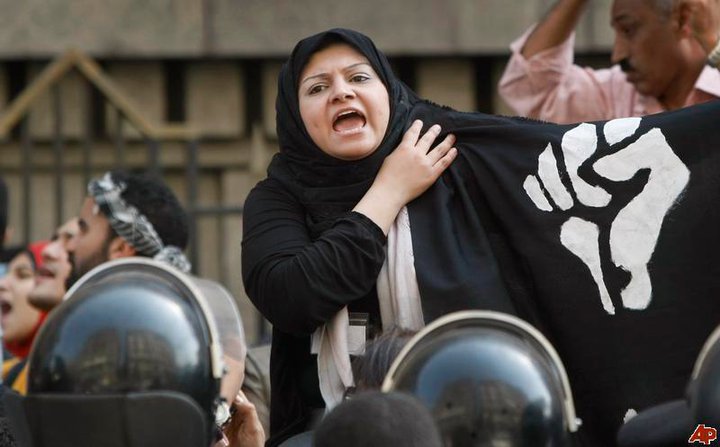
The anarchist black flag with a white fist, a symbol of peaceful non-ochlarchical libertarian resistance is carried by many during protests in Egypt.
By the way, the ultra-authoritarian, totalitarian, Muslim Brotherhood is sometimes sailing unders false anarchist black flag, documented by BBC 04.02.2011, and the International Anarchist Tribunal - IAT-APT handed out a Brown Card to the islamist movement for this serious break of the Oslo Convention.
Social-individualism, i.e. moderate libertarianism, including freedom and real democracy, is today an important tendency, especially regarding the middle to long term aim, also in Tunisia and in many other oppositions in North Africa and the Middle East. The earlier dominant islamist oppositions are less important today because the oppositions are broader people's movements, but islamism represents a contra-revolutionary strategic danger.
New interim cabinet, still mostly made up of the old guard Mubarak-gang. Key portfolios of defense interior, foreign, finance and justice were unchanged in a cabinet reshuffle, state television confirmed on Tuesday when it broadcast the swearing in ceremony for the new ministers. The list of new ministers included changing the veteran oil minister, as well as introducing politicians who had formally been opposed to the rule of Hosni Mubarak, who stepped down from office on February 11. Field Marshal Mohamed Hussein Tantawi, a.k.a. 'Mubarak's Poodle', who leads the ruling military council and has been defense minister for about 20 years, took the new ministers' oaths of office.
The latest reshuffle brought into the cabinet a few so called opposition figures including Yehia el-Gamal, deputy prime minister, the Wafd party's Mounir Abdel Nour as tourism minister and Tagammu party's Gowdat Abdel-Khaleq as minister of social solidarity and social justice. Both Wafd and Tagammu had often been close to Mubarak's government.
The Center for Trade Unions and Workers Services (CTUWS) said the government's appointment of Ismail Ibrahim Fahmy as new labor minister showed it continued to "co-opt formal labor unions and the labor ministry," it said in a statement. Fahmy was the treasurer of the so called general union for workers syndicates, one of the Mubarak-regime's organizations, in Egypt. "We warn of the dire consequences of defying the will of the workers and their legitimate right to enjoy union rights," CTUWS said.
The ultra-authoritarian, totalitarian, islamist Muslim Brotherhood, strongly related to Hamas, and perhaps the country's biggest opposition group, said the new cabinet showed that Mubarak's "cronies" still controlled the country's politics. "This new cabinet is an illusion," Brotherhood senior member Essam el-Erian said. "It pretends it includes real opposition but in reality this new government puts Egypt under the tutelage of the West," he added. "The main defense, justice, interior and foreign ministries remain unchanged, signaling Egypt's politics remain in the hands of Mubarak and his cronies," Erian said.
Both the Brotherhood and secular youth protesters had demanded that all Mubarak's ministers must be changed in the new government sworn in ahead of parliamentary and presidential elections. Egyptian online democracy activists called for demonstrations to demand the removal of the country's interim government, saying it contains too many old faces. "The call for the million-man march on Friday would show people's anger and frustration," Erian said.
Libya: Gadhafi vows to die a martyr, calls on supporters to fight protesters in the street, Asscoiated Press reported: Libyan leader Moammar Gadhafi vowed to fight on to his "last drop of blood" and roared at his supporters to take to the streets against protesters in a furious, fist-pounding speech Tuesday after two nights of bloodshed in the capital as his forces tried to crush the uprising that has fragmented his regime. Gadhafi's call portended a new round of mayhem in the capital of 2 million people. The night before, residents described a rampage by pro-regime militiamen, who shot on sight anyone found in the streets and opened fire from speeding vehicles at people watching from windows of their homes. Tuesday morning, bodies still lay strewn in some streets. Gunshots in celebration were heard after Gadhafi's speech, aired on state TV and on a screen to several hundred supporters in Tripoli's central Green Square, witnesses said.
Swathed in brown robes and a turban, the country's leader for nearly 42 years spoke from behind a podium in the entrance of his bombed-out Tripoli residence hit by US airstrikes in the 1980s and left unrepaired as a symbol of defiance. At times the camera panned back to show the outside of the building and its towering monument of a gold-colored fist crushing an American fighter jet. But the view also gave a surreal image of Gadhafi, shouting and waving his arms wildly all alone in a broken-down lobby with no audience, surrounded by torn tiles dangling from the ceiling, shattered concrete pillars and bare plumbing pipes. "Libya wants glory, Libya wants to be at the pinnacle, at the pinnacle of the world," he proclaimed, pounding his fist on the podium. "I am a fighter, a revolutionary from tents ... I will die as a martyr at the end," he said, vowing to fight "to my last drop of blood."
Gadhafi [falsely] depicted the protesters as misguided youths, who had been given drugs and money by a "small, sick group" to attack police and government buildings. He said the uprising was fomented by "bearded men" - a reference to islamic fundamentalists - and Libyans living abroad. He called on supporters to take to the streets to attack protesters. "You men and women who love Gadhafi ... get out of your homes and fill the streets," he said. "Leave your homes and attack them in their lairs." "The police cordons will be lifted, go out and fight them," he said, urging youth to form local committees across the country "for the defense of the revolution and the defense of Gadhafi." "Forward, forward, forward!" he barked at the speech's conclusion, pumping both fists in the air as he stormed away from the podium. He was kissed by about a dozen supporters, some in security force uniforms. Then he climbed into a golf cart-like vehicle and puttered away.
The turmoil in the capital escalates a week of protests and bloody clashes in Libya's eastern cities that have shattered Gadhafi's grip on the nation. Many cities in the east appeared to be under the control of protesters after units of Gadhafi's army defected. Protesters in the east claimed to hold several oil fields and facilities and said they were protecting them against damage or vandalism. The regime has been hit by a string of defections by ambassadors abroad, including its UN delegation, and a few officials at home. In response, Gadhafi's security forces have unleashed the bloodiest crackdown of any Arab country against the wave of protests sweeping the region, which toppled leaders of Egypt and Tunisia. At least 62 people were killed in violence in Tripoli since Sunday, according to the New York-based Human Rights Watch, but it cautioned that that figure came from only two hospitals. That comes on top of at least 233 people killed across the so far in the uprising, counted by the group from hospitals around the country.
The head of the UN human rights agency, Navi Pillay, called for an investigation, saying widespread and systematic attacks against civilians "may amount to crimes against humanity." The UN Security Council was holding an emergency session Tuesday, and Western diplomats were pushing for it to demand an end to the retaliation against protesters. Libya's deputy UN ambassador Ibrahim Dabbashi called Monday for the world body to enforce a no-fly zone over cities to prevent mercenaries and military equipment from reaching the regime. UN Secretary-General Ban Ki-moon said it was up to the council whether to discuss the proposal.
The first major protests to hit an OPEC country - and major supplier to Europe - sent oil prices soaring to more than $93 a barrel Tuesday. A string of international oil companies have begun evacuating their expatriate workers or their families, and the Spanish oil company Repsol-YPF said it suspended production in Libya on Tuesday. It accounted for about 3.8 percent of Libya's total production of 1.6 million barrels a day. World leaders also have expressed outrage. US Secretary of State Hillary Rodham Clinton called on Gadhafi to "stop this unacceptable bloodshed" and said the world was watching the events "with alarm."
Tripoli streets were largely empty during the day Tuesday, except for people venturing out for food, wary of militia attacks. One man in his 50s said residents of his neighborhood were piling up roadblocks of concrete, bricks and wood to try to slow militiamen. He said he had seen several streets with funeral tents mourning the dead. He described spending the night before barricaded in his home, blankets over the windows, as militiamen rampaged in the streets until dawn. Buses unloaded militia fighters - Libyans and foreigners - in several neighborhoods. Others sped in vehicles with guns mounted on the top, opening fire, including at people watching from windows, he said. "I know of two different families, one family had a 4-year-old who was shot and killed on a balcony in the eastern part of the city, and another lady on the balcony was shot in the head," he said. He, like other residents, contacted by the Associated Press, spoke on condition of anonymity for fear of retaliation.
One of the heaviest battlegrounds was the impoverished, densely populated district of Fashloum. There, militiamen shot any "moving human being" with live ammunition, including ambulances, so wounded were left in the streets to die, one resident said. He said that as he fled the neighborhood Monday night, he ran across a group of militiamen, including foreign fighters. "The Libyans (among them) warned me to leave and showed me bodies of the dead and told me: `We were given orders to shoot anybody who moves in the place,'" said the resident. Militias - which many witnesses say include foreign fighters who appear to be from sub-Saharan Africa - have taken the forefront in the crackdown in Tripoli. That is in part because Gadhafi has traditionally kept his military and other armed forces weakened to prevent any challenge.
The week of upheaval in Libya has weakened - if not broken for now - the control of Gadhafi's regime in parts of the east. Protesters claim to control a string of cities across just under half of Libya's 1,600-kilometer-long (1,000 mile) Mediterranean coast, from the Egyptian border in the east to the city of Ajdabiya, an important site in the oil fields of central Libya, said Tawfiq al-Shahbi, a protest organizer in the eastern city of Tobruk. He said had visited the crossing station into Egypt and that border guards had fled. In Tobruk and Benghazi, the country's second largest city, protesters were raising the pre-Gadhafi flag of Libya's monarchy on public buildings, he and other protesters said. Protesters and local tribesmen were protecting several oil fields and facilities around Ajdabiya, said Ahmed al-Zawi, a resident there. They had also organized watch groups to guard streets and entrances to the city, he said.
Residents are also guarding one of Libya's main oil export ports, Zuweita, and the pipelines feeding into it, he said. The pipelines are off and several tankers in the part left empty, said al-Zawi, who said he visited Zuweita on Tuesday morning. In Benghazi, protesters over the weekend overran police stations and security headquarters, taking control of the streets with the help of army units that broke away and sided with them. Benghazi residents, however, remained in fear of a regime backlash. One doctor in the city said Tuesday many spent the night outside their homes, hearing rumors that airstrikes and artillery assaults were imminent. "We know that although we are in control of the city, Gadhafi loyalists are still here hiding and they can do anything anytime," he said.
Gadhafi, the longest serving Arab leader, appeared briefly on TV early Tuesday to dispel rumors that he had fled. Sitting in a car in front of what appeared to be his residence and holding an umbrella out of the passenger side door, he told an interviewer that he had wanted to go to the capital's Green Square to talk to his supporters gathered there, but the rain stopped him. "I am here to show that I am in Tripoli and not in Venezuela. Don't believe those misleading dog stations," Gadhafi said, referring to the media reports that he had left the country. The video clip and comments lasted less than a minute. But Tuesday evening's speech lasted well over a half hour. During it, Gadhafi recounting his days as a young revolutionary leader who "liberated" Libya - a reference to the 1969 military coup that brought him to power - and his defiance against US airstrikes.
He insisted that since he has no official title, he cannot resign - Gadhafi is referred to as the "brother leader," but is not president. He [falsely] said he had not ordered police to use any force force used against protesters [i.e. the people] - that his supporters had come out voluntarily to defend him. "I haven't ordered a single bullet fired," he [falsely] said, warning that if he does, "everything will burn." He said that if protests didn't end, he would stage a "holy march" with millions of supporters to cleanse Libya. He demanded protesters in Benghazi hand over weapons taken from captured police stations and military bases, warning of separatism and civil war. "No one allows his country to be a joke or let a mad man separate a part of it," he declared.
Later Tuesday the UN Security Council condemned the use of violence in Libya and called for those responsible for attacks on civilians to be held to account. The call came in a statement agreed by the 15-nation council after a day of debate on the clashes in the North African country.
The Anarchist International - AI/IFA and all its sections, see The official link-site of AI/IFA, including the anarchosyndicalist labor confederation International Workers of the World and The Anarchist Confederation of Africa, declared: "We call on Colonel Gaddafi and his henchmen to step down - NOW!... i.e. if not today, within a few days or weeks!! And we call on the Libyan people: Remember Direct Action and Antimilitarism - an anarchist approach - IJA 2 (38) & The International Conference on Terrorism - IJA 4 (31)!!!"
23.02.2011. The concepts of revolution and reform defined and analyzed - News and comments about Egypt & Tunisia and the other Arab countries Wednesday:
The concepts of revolution and reform defined and analyzed - At the moment there are ongoing revolts plus embryo-revolutions in Tunisia and Egypt, but still no delivery and birth of real revolutions. In other Arab countries there are only revolts. IIFOR reports to AIIS:
If the system works significantly more from the bottom, grassroots - the people, and upwards, than from the top downwards, to the bottom, it is anarchism and anarchy. The grassroots - the people - is here defined as a class as opposed to the superiors economical and/or political/administrative, i.e. in income/remuneration and/or political/administrative rank. Anarchy and anarchism may happen just 1. a brief moment - a glimpse of anarchy, 2. in the short term, 3. medium term and 4. in the long term.
The fundamental parameters of a system, the coordinates on the economic-political map, are usually estimated as average, say, as moving averages, rather long term structural estimates, including the libertarian degree (= 100% - the authoritarian degree). Around the long term average structural estimates, there may be medium or short term dips or the opposite, a hike, without changing the fundamental rather long term average parameters.
Just a brief moment - a glimpse of anarchy, will in itself not change the long term structural average coordinates. There may however of course also be shift in the rather long term average structural estimates. A significant change of a system's coordinates on the economic-political map and in reality, is per definition a revolution or a revolutionary change, i.e. a real revolution. Nothing else is a societal, i.e. economic and/or political/administrative, real revolution, i.e. with substance, in short revolution. A revolution may be short lived or a lasting change of a system's coordinates on the economic-political map.
State/archy, seen as a societal concept, may be a form of marxism, populism/fascism or liberalism, see the economic-political map, click on: System theory, with the four main quadrants and the 16 sectors for different subsystems. Capitalism is economical plutarchy. A revolution may be in libertarian direction, in direction towards anarchy, but still the system may be a form of marxism, populism/fascism or liberalism. Via a series of revolutions in libertarian direction, the system may reach the anarchist quadrant of the economic-political map. This may take years, a long time, see System theory - Chapter V. B.! Revolutions increasing the authoritarian degree or the distance of a system vis-a-vis the anarchist quadrant of the map, are contra-revolutions.
Reform is per definition changes within a given system, i.e. without a significant change of a system's coordinates on the economic-political map and in reality, and this means status quo and/or at best insignificant change of a system's coordinates. Usually a waste of time and fooling the people. However a series of incremental reforms, each with insignificant change of a system's coordinates, may add up to a revolutionary change over time, a significant change of a system's coordinates on the economic-political map and in reality, and thus in reality be a revolution. But this is not reform, but revolution, revolutionary policy, revolution in reforms' disguise.
In addition to 1. real revolution, in short revolution, 2. revolution as a glimpse, i.e. a symbolic revolution, and 3. embryo-revolution, that may result in a) an aborted revolution or b) delivery and birth of a real revolution, are relevant concepts. Point 2 and 3 and 3.a) are pseudo-revolutions, not real revolutions. Ad 2. and 3. (except a) and b)) the term half-revolution may perhaps be relevant. To explain this further we may look on the following examples.
When the dictators left, the Tunisians and Egyptians experienced a glimpse of real democracy i.e. anarchy and anarchism. But the dictators were replaced with autocratic interim governments mainly from the 'old guard' and there are no significant changes in these systems' coordinates on the economic-political map so far, and thus so far no real revolutions have happened.
After the revolutionary glimpses, a glimpse of anarchy, i.e. symbolic revolutions, the systems in Tunisia and Egypt have had -- and still have -- embryo-revolutions. The Tunisian Jasmine revolution and the Egypthian Tahrir Square revolution are still ongoing, but they are only embryo-revolutions, not real revolutions, in short revolution. The present situation of continued revolt in Tunisia respectively Egypt is just embryo-revolution, it may result in a) an abortion, an aborted revolution, or b) a real revolution, i.e. with substance -- a significant change of a system's coordinates -- in short revolution. Delivery and birth of a real revolution, hopefully in libertarian direction, may still take some time, perhaps long time. And then there is the fight for keeping the revolution alive, and develope further.
In other Arab countries there are only revolts so far, no revolutions of any kind, but there may be some later.
Ad Tunisia respectively Egypt: The Anarchist International - AI/IFA and all its sections, see The official link-site of AI/IFA, including the anarchosyndicalist labor confederation International Workers of the World and The Anarchist Confederation of Africa, declared: "The present situation of continued revolt is just an embryo-revolution, it may result in a) an abortion, an aborted revolution, or b) a real revolution, i.e. with substance. The revolution may in a way be seen as ongoing, but it is just an embryo-revolution - and no real revolution yet.
We call for an end of the present totalitarian right fascist regime, and a steady and orderly movement of the system towards real democracy, i.e. anarchy - a real revolution and continued increased libertarian degree, see System theory - Chapter V. B.! A development towards real democracy must be done by the people's actions, i.e. act with dignity, use real matter of fact arguments and add weight behind via direct actions, including industrial actions, and via organization, dialog and elections!"
Also in Egypt: Egyptian authorities impose a travel ban on former Prime Minister Atef Obeid and long-serving Culture Minister Farouq Hosni. The restrictions also cover the head of state TV and radio, as well as nine businessmen. Such measures are normally a prelude to a criminal investigation and possible trial.
Libya Wednesday. New videos posted by Libya's opposition show anti-government protesters raising the pre-Moammar Gaddafi flag on a building outside Tripoli and lining up cement blocks to defend themselves on a square inside the capital. The videos were posted on Facebook Wednesday, a day after Gaddafi as mentioned vowed to fight to his "last drop of blood" in a televised speech that signaled an escalation of a bloody crackdown on dissent by his supporters. The footage couldn't be independently confirmed.
The violence which has accompanied Libya's bloody revolt against the totalitarian fascist Gaddafi regime regime has left 300 dead, including over 100 soldiers, according to the Libyan authorities. But as families buried their dead at a cemetery in Tripoli, residents believing their own eyes put the toll far higher. Human Rights Watch and opposition groups say more than twice that number have died. Italy's Foreign Minister Franco Frattini told lawmakers it's "likely" more than 1,000 people have been killed in the violence, according to Italian media reports citing witnesses and hospital sources.
In towns where Gaddafi's grip has been challenged, locals have been tearing down symbols of the regime. But overnight, in the town of Sabratah, large numbers of the Libyan army are said to have been deployed following the destruction of government buildings. In the east of the country, earlier fierce battles that accounted for many of the dead were caught on mobile phone cameras. But now Benghazi and Tobruk are reported calm and under the control of the protesters while Libya's interior minister became the latest senior official to defect.
Anti-Gaddafi rebels are in control of the eastern city of Tobruk. Soldiers said they no longer backed the Libyan leader and that the eastern region was out of his control. They have been operating checkpoints and denouncing Gaddafi. One general said he decided to switch sides after hearing the authorities had given orders to fire on civilians. Tobruk lies close to the Egyptian border. Thousands have been fleeing across the frontier to make it home to Egypt and escape the violence. In eastern Libya the military are now said to be mobilizing to defend people against possible attack from Gaddafi's forces. Accounts say his supporters have been shooting people and a munitions store in Tobruk was bombed. However in Tripoli many Gaddafi supporters are in the streets, shouting euphorically "Gaddafi, Gaddafi", waving his green flags.
The scope of the totalitarian fascist Colonel Gaddafi's rule in Libya was whittled away Wednesday as major cities and towns closer to the capital fell into the hands of protesters demanding his ouster. In Libya's east, now all but broken away, the opposition vowed to liberate Tripoli, where the Libyan ruler is holed up with a force of militiamen roaming the streets. In a further sign of Gaddafi's faltering hold, two air force pilots - one from the leader's own tribe - parachuted out of their warplane and let it crash into the deserts of eastern Libya, rather than follow orders to bomb a opposition-held city. In Tripoli, Gaddafi's stronghold, protest organizers were calling for new rallies Thursday and Friday, raising the potential for a new bloody confrontation. However in many neighborhoods, residents set up watch groups to keep militiamen out, barricading their streets with concrete blocks, metal and rocks and searching those trying to enter, said a Tripoli activist.
International momentum was building for action to punish Gaddafi's regime for the bloody crackdown it has unleashed against the week-old uprising against his rule. At midnight CNN reports: US sending officials to Europe to coordinate effort to stop "outrageous" violence in Libya, President Obama says.
The Anarchist International - AI/IFA and all its sections, see The official link-site of AI/IFA, including the anarchosyndicalist labor confederation International Workers of the World and The Anarchist Confederation of Africa, repeated: "We call on Colonel Gaddafi and his henchmen to step down - NOW!... i.e. if not today, within a few days or weeks!! And we call on the Libyan people: Remember Direct Action and Antimilitarism - an anarchist approach - IJA 2 (38) & The International Conference on Terrorism - IJA 4 (31)!!!"
Bahrain. In contrast to Libya, yesterday the centre of the Bahraini capital Manama was filled with thousands of demonstrators calling for the government's downfall – and to remember the victims of the past week's violence. Many majority Shi'ite Muslims claim they are the victims of long-term discrimination by the ruling Sunni elite. Joining the protest was a group of army and police officers, conscious that the military firing on protesters had contributed to the death toll of seven. "We decided that our job is to protect people and not to beat them up," said policeman Abu Noah. "The weapons that have been used against the people are weapons of shame, these weapons should be used to protect the people, and not be used against them. That's why we've decided to be with the people."
A key test will be the impact of the return from exile of a leading opposition figure, Hassan Mushaimaa of the Haq movement, one of a group of 25 on trial over an alleged coup plot. "These peaceful Muslim people are coming today to raise the flag of the homeland," said Sheikh Hussein Al-Deehi, deputy head of another opposition group, the Shi'ite Al-Wefaq Society. "We've been asking for freedom for decades and we've been denied it. We've lost blood but we'll keep struggling, God willing." The royal family has offered concessions – announcing the release of some convicted prisoners for example – but it is not clear whether such moves will be enough to get opposition groups to agree to talks. They have repeated demands for a constitutional monarchy to replace Bahrain's ruling dynasty.
Wednesday thousands of anti-government protesters flood Manama's Pearl Square following the release of at least 100 political prisoners - including 25 Shiite activists on trial since last year for allegedly plotting against the state. The move underlines how much the absolute rulers of the Gulf kingdom want to get reform talks with protest leaders under way. The release of the activists was one of the major demands of the emboldened political movement seeking constitutional reform. Amid concerns that the island nation's uprising could spread to Saudi Arabia, where the monarchy permits few political freedoms, King Hamad bin Isa Al Khalifa holds talks on the unrest with the Saudi king in Riyadh.
Jordan Wednesday. Jordan's cabinet approves laws making it easier to organize protests and will revive a government body that works to ensure basic commodities remain affordable to the poor.
Saudi Arabia Wednesday. Saudi Arabia's King Abdullah nearly doubles a development fund that helps citizens buy homes, get married and start businesses, and sets up unemployment assistance for the first time. The move pumps 40 billion riyals ($10.7 billion) into the fund, in a step that appears aimed at shoring up popular support and fending off unrest that has spread to neighboring Bahrain. The measures were ordered by the king even before he returned Wednesday to Saudi Arabia. The 86-year-old monarch was abroad for medical treatment in the United States and recuperation in Morocco. Other measures include a 15 percent cost of living adjustment for government workers, a year of unemployment assistance for youth and nearly doubling to 15 individuals the size of families that are eligible for state aid.
Yemen. Thousands stream into a square in the capital of Sanaa, trying to bolster anti-government protesters after club-wielding backers of President Ali Abdullah Saleh tried to drive them out. Amnesty International says two people are killed in Sanaa. Protesters also rally in the Red Sea city of Hodeida, the southern port of Aden and the eastern port city of al-Mukalla. The demonstrators are calling for the ouster of Saleh, who has ruled for 32 years. Saleh's promises not to run for re-election in 2013 or to set up his son as an heir have failed to quell the anger. Also, seven lawmakers who belong to Saleh's ruling Congress Party resign from the group because of the situation in the country and say they will form their own independent bloc. The resignations raise to nine the number of legislators who left the party since protests began nearly a month ago.
24.02.2011. News, comments and anarchist actions related to Egypt, Tunisia & Libya and other Arab countries Thursday:
Egypt: 'Fridays are the main direct action days, but continued protests at Tahrir Square are also a tourist attraction,' was the anarchists' main resolution 12.02.2010. The Anarchist International - AI/IFA, and all its sections, see The official link-site of AI/IFA, including The International Workers of the World - Egyptian section and The Anarchist Confederation of Africa - Egyptian section now call for mass demonstrations for freedom and democracy and against the totalitarian right fascist autocratic rule of Tantawi - Mubarak's Poodle, in Cairo -Tahrir Square, and all over Egypt tomorrow Friday 25.02.2011.
The present situation of continued revolt in Egypt is just an embryo-revolution, it may result in a) an abortion, an aborted revolution, or b) a real revolution, i.e. with substance. The revolution may in a way be seen as ongoing, but it is just an embryo-revolution - and no real revolution yet.
We call for an end of the present totalitarian right fascist autocratic regime, and a steady and orderly movement of the Egyptian social, i.e. economic and political/administrative - system towards real democracy, i.e. anarchy - a real revolution and continued increased libertarian degree, see System theory - Chapter V. B.! A development towards real democracy must be done by the people's actions - more and more, i.e. act with dignity, use real matter of fact arguments and add weight behind via direct actions, including mass actions & industrial actions, and via organization, dialog and elections!
Anarchists and UN hail Egyptian, Tunisian moves to restore tourism. The UN World Tourism Organisation welcomed Thursday moves by Egypt and Tunisia to restore normality to their key tourism sectors after the popular uprisings that toppled the leaders of both countries. Both nations are favored destinations for Europeans seeking Mediterranean sun and ancient ruins but tourists fled the two countries in droves after the protests erupted last month, first in Tunisia, then in Egypt. The upheaval of recent weeks and media coverage of days of violent clashes have combined to scare off visitors although Western capitals like London and Paris have eased their travel warnings to both nations as the dust settles.
The Madrid-based UN World Tourism Organisation said it "welcomes efforts by the national authorities of Egypt and Tunisia to restore confidence among tourists and by foreign governments to update travel advisories accordingly." "Tourism is a central component of both countries' economies and, as tourists begin to return, can play an important role in overall economic recovery," it added in a statement. The head of the UN tourism body, Jordan's Taleb Rifai, said he was "pleased to see that travel advisories have been kept accurate, confined to the affected areas and regularly updated."
Egypt, ruled by the military since the ouster on February 11 of President Hosni Mubarak, reopened its historic sites, including the great pyramids and the antiquities museum in Cairo, to tourism on Sunday. Both Egypt and Tunisia are mostly calm for now but tourism experts say the fear of a backslide into chaos is likely to deter many visitors in the short term. Egypt reported 12 million international tourist arrivals in 2009 and preliminary results for 2010 are 14 million arrivals, who generated 12.5 billion dollars (9.1 billion euros) in tourism receipts that year, according to the World Travel Organisation. Tunisia received seven million international visitors in 2009, the last year for which figures are available, who generated 3.0 billion dollars in tourism receipts. The anarchists mostly agree with the UN World Tourism Organisation.
Regime forces attack rebelling Libyans near capital, 12 dead; Gadhafi blames bin Laden, Associated Press reported: Army units and militiamen loyal to Moammar Gadhafi [a.k.a. Colonel Gaddafi] struck back against rebellious Libyans who have risen up in cities close to the capital Thursday, attacking a mosque where many were holding an anti-government sit-in and battling with others who had seized control of an airport. A doctor at the mosque said 10 people were killed. Gadhafi accused al-Qaeda leader Osama bin Laden of being behind the uprising in Libya, in a rambling phone call to state TV. The Libyan leader said the more than week-long revolt has been carried out by young men hopped up on hallucinogenic pills given to them "in their coffee with milk, like Nescafe."
"Shame on you, people of Zawiya, control your children," he said, addressing residents of the city outside Tripoli where the mosque attack took place. "They are loyal to bin Laden," he said of those involved in the uprising. What do you have to do with bin Laden, people of Zawiya? They are exploiting young people ... I insist it is bin Laden." The attacks Thursday aimed to push back a revolt that has moved closer to Gadhafi's bastion in the capital, Tripoli. Most of the eastern half of Libya has already broken away, and parts of Gadhafi's regime have frayed.
In the latest blow to the Libyan leader, a cousin who is one of his closest aides, Ahmed Gadhaf al-Dam, announced that he has defected to Egypt in protest against the regime's bloody crackdown against the uprising, denouncing what he called "grave violations to human rights and human and international laws." In Zawiya, 30 miles (50 kilometers) west of Tripoli, an army unit attacked the city' Souq Mosque, where regime opponents had been camped for days in a protest calling for Gadhafi's ouster, a witness said.The soldiers opened fire with automatic weapons and hit the mosque's minaret with fire from an anti-aircraft gun, he said.
Some of the young men among the protesters, who were inside the mosque and in a nearby lot, had hunting rifles for protection. A doctor at a field clinic set up at the mosque said he saw the bodies of 10 dead, shot in the head and chest, as well as arond 150 wounded. The witness said that a day earlier an envoy from Gadhafi had come to the city and warned protesters, "Either leave or you will see a massacre." Zawiya is a key city near an oil port and refineries. After Thursday's assault, thousands massed in Zawiya's main Martyrs Square by the mosque, shouting "leave, leave," in reference to Gadhafi, the witness said. "People came to send a clear message: We are not afraid of death or your bullets," he said.
The other attack came at a small airport outside Misrata, Libya's third largest city, where rebel residents claimed control Wednesday. Militiamen with rocket-propelled grenades and mortars barraged a line of them who were guarding the airport, some armed with automatic rifles and hunting rifles, said one of the rebels who was involved in the battle. During the fighting, the airport's defenders seized an anti-aircraft gun used by the militias and turned it against them, he said. A medical official at a military air base by the airport said two people were killed in the fighting - one from each side - and five were wounded. He said personnel at the base had sided with the Misrata uprising and had disabled fighter jets there to prevent them being used against rebellious populaces.
"Now Misrata is totally under control of the people, but we are worried because we squeezed between Sirte and Tripoli, which are strongholds of Gadhafi," he said. Sirte, a center for Gadhafi's tribes, lies to the southeast of Misrata. The militias pulled back in the late morning. In Misrata, the local radio - controlled by the opposition like the rest of the city - called on residents to march to the airport to reinforce it, said a woman who lives in downtown Misrata. In the afternoon, it appeared fighting erupted again, she said, reporting heavy booms from the direction of the airport on the edge of the city, located about 120 miles (200 kilometers) east of Tripoli. The witnesses around Libya spoke on condition of anonymity for fear of reprisals.
Gadhafi's crackdown has so far helped him maintain control of Tripoli, a city that holds about a third of Libya's 6 million population. But the uprising has divided the country and threatened to push it toward civil war: In cities across the east, residents rose up and overwhelmed government buildings and army bases, joined in many cases by local army units that defected. In those cities, tribal leaders, residents and military officers have formed local administrations, passing out weapons looted from the security forces' arsenals. The leader's cousin, Gadhaf al-Dam, is one of the most high level defections to hit the regime so far, after many ambassadors around the world, the justice minister and the interior minister all sided with the protesters. Gadhaf al-Dam belonged to Gadhafi's inner circle, officially his liaison with Egypt, but he also served as Gadhafi's envoy to other world leaders and frequently appeared by his side. In a statement issued in Cairo on Thursday, Gadhaf al-Dam said he had left Libya for Egypt "in protest and to show disagreement" with the crackdown.
Gadhafi's control now has been reduced to the northwest corner around Tripoli, the southwest deserts and parts of the center. The uprisings in Misrata, Zawiya and several small towns between the capital and Tunisian border have further whittled away at that bastion. The Zawiya resident said that until Thursday's attack, Gadhafi opponents held total sway in the city after police fled days earlier. Residents had organized local watchgroups to protect government buildings and homes. The capital, Tripoli, saw an outbreak of major protests against Gadhafi's rule earlier this week, met with attacks by militiamen that reportedly left dozens dead.
Pro-Gadhafi militiamen - a mix of Libyans and foreign mercenaries - have clamped down on the city since the Libyan leader went on state TV Tuesday night and called on his supporters to take back the streets. Residents say militiamen roam Tripoli's main avenues, firing the air, while neighborhood watch groups have barricaded side streets trying to keep the fighters out and protesters lay low. At the same time, regular security forces have launched raids on homes around the city. A resident in the Ben Ashour neighborhood said a number of SUVs full of armed men swept into his district Wednesday night, broke into his neighbor's home and dragged out a family friend as women in the house screamed.
He said other similar raids had taken place on Thursday in other districts. "Now is the time of secret terror and secret arrests. They are going to go home to home and liquidate opponents that way, and impose his (Gadhafi's) control on Tripoli," said the witness. Another Tripoli resident said armed militiamen had entered a hospital, searching for protesters among the injured. He said a friend's relative being treated there escaped only because doctors hid him. International momentum has been building for action to punish Gadhafi's regime for the bloodshed...
Earlier Thursday, Libyan TV showed Egyptian passports, CDs and cell phones purportedly belonging to detainees who had allegedly confessed to plotting "terrorist" operations against the Libyan people. Other footage showed a dozen men lying on the ground, with their faces down, blindfolded and handcuffed. Rifles and guns were laid out next to them.
The Anarchist International - AI/IFA and all its sections, see The official link-site of AI/IFA, including the anarchosyndicalist labor confederation International Workers of the World and The Anarchist Confederation of Africa, repeated: "We call on Colonel Gaddafi and his henchmen to step down - NOW!... i.e. if not today, within a few days or weeks!! And we call on the Libyan people: Remember Direct Action and Antimilitarism - an anarchist approach - IJA 2 (38) & The International Conference on Terrorism - IJA 4 (31)!!!"
Algeria lifts state of emergency after 19 years: official. Algeria on Thursday lifted its state of emergency, 19 years after it was imposed, according to a decree published in the official gazette. President Abdelaziz Bouteflika has "ordered the cancellation of the extension of the emergency measure put in place by presidential decree on February 9, 1992," said a statement published on the state newspaper. His cabinet on Tuesday said the move was imminent after it adopted a draft order repealing the emergency measures, which the government adopted when islamists waged a protracted guerrilla war following the cancellation of local election results in 1991.
Those results would have given a majority to the now-dissolved Islamic Salvation Front. Bouteflika pledged three weeks ago to lift the state of emergency as demanded by the opposition following unprecedented protests last month that left five people dead and more than 800 injured. The state of emergency gave free rein to security forces that effectively served to repress political freedom. The 1990s war turned into a bloodbath, killing up to 200,000 people, according to official figures.
Ending the emergency powers was one of the key demands of the opposition. Algeria - like other countries in the region - has recently witnessed demonstrations for greater freedoms. There have also been riots over rising food prices. The move is seen as a concession to opposition parties and human rights activists, who have been staging marches calling for democracy and greater freedoms. President Bouteflika said protests in the capital Algiers would still be banned. Inspired by popular revolts across the Arab world, the opposition says its supporters will rally every Saturday in the capital until there has been a change in the regime.
25.02.2011. News and comments related to Egypt Friday. Introduction: The heads of the present right fascist hydra must be cleaved off. Call for action today! Later: mass action! Also news from Libya and other Arab countries.
Introduction: The demission of Mubarak does not mean the end of the right fascist regime in
Egypt. Nevertheless, it represents the cleaving off of its main head (there are several heads of this fascist hydra). It is
expected that the regime will work on a recycled version of itself,
maintaining the maximum of the old policy it can afford. That is why the
regime, lots of news-media and some other forces try to de-politicize the popular demands and to focus on the narrow circle around Mubarak being responsible for all the evil. Nevertheless, any new economic-political system in Egypt in the future
will have to take the Egyptian people more seriously than Mubarak did.
The victory of the Egyptians is a victory of libertarians all
over the world. A battle has been won, but the final victory is still
ahead - the total removal of the right fascist system. To prevent a set-back, it is
indispensible to raise the demand to take over the "transition period"
from the hands of the government set by Mubarak and maintained by the
army. The new constitution must be drafted by a new constituent assembly
set together by the representative activists of the uprising. A serious democratic and economical change in favor of the people is only possible by the
removal of the present regime. Issues of freedom, social justice, etc., can not be separated from the question of democratization. All the heads of this right fascist hydra must be cleaved off.
The Anarchist International - AI/IFA, and all its sections, see The official link-site of AI/IFA, including The International Workers of the World - Egyptian section and The Anarchist Confederation of Africa - Egyptian section call for mass demonstrations for freedom and democracy and against the totalitarian right fascist autocratic rule of Tantawi - Mubarak's Poodle, in Cairo -Tahrir Square, and all over Egypt - today Friday 25.02.2011.
The present situation of continued revolt in Egypt is just an embryo-revolution, it may result in a) an abortion, an aborted revolution, or b) a real revolution, i.e. with substance. The revolution may in a way be seen as ongoing, but it is just an embryo-revolution - and no real revolution yet.
We call for an end of the present totalitarian right fascist autocratic regime, and a steady and orderly movement of the Egyptian social, i.e. economic and political/administrative - system towards real democracy, i.e. anarchy - a real revolution and continued increased libertarian degree, see System theory - Chapter V. B.! A development towards real democracy must be done by the people's actions - more and more, i.e. act with dignity, use real matter of fact arguments and add weight behind via direct actions, including mass actions & industrial actions, and via organization, dialog and elections!
Later... Large mass demonstration at Tahrir Square. Thousands gather in Tahrir Square to protest against the present cabinet and government in general, the totalitarian right fascist autocratic regime. The people also celebrate two weeks since the downfall of Mubarak. Egypt's new military rulers, promising to guard against "counter-revolution", faced political pressure on Friday a.o.t. to purge the cabinet of ministers appointed by Hosni Mubarak as thousands of protesters gathered in Cairo. On the eve of the rally that will also celebrate two weeks since Mubarak's removal, the military, which has promised elections within six months, assured Egyptians there would be "no return to the past" of the Mubarak era.
In a gathering at Tahrir Square, which will also remind the military of the people's determination and strength that ended Mubarak's 30-year iron rule, the protesting people are urging the military to overhaul the newly appointed cabinet and install a fresh team representative for the people. Here we mean the people seen as a class as opposed to the superiors economically and/or political/administrative, i.e. the bureaucracy broadly defined, including the economical plutarchists/capitalists. "Friday is another day of protest to bring together Egyptians who bravely ousted Mubarak but still struggle as remnants of the old regime try to hang on and ruin the revolution," activist protester Sameha Metwali told Reuters.
In the fragmented political arena of the so far only embryo-revolutionary Egypt, those with wealth, whatever its source - and the bureaucracy in general, i.e. the upper classes as opposed to the people, may still be able to hold on to their power and influence, and win in the coming elections. For decades past, voting in Egypt has been determined by thuggery, bribery and manipulation. The activists of the uprising and also the Muslim Brotherhood are particularly concerned about the key portfolios of defense, interior, justice and foreign affairs and want a clean break from Mubarak's old guard.
The military, facing mass protests and strikes over pay and working conditions as well as turmoil in its western neighbor Libya, treads a fine line between granting people their new freedoms and restoring "normal life". If "normal life" means a system continuing to be a signifcant echo of the old Mubarak-regime, as it is today, i.e. still a totalitarian right fascist autocratic regime, "restoring normal life" is not acceptable by the people. Strikes, sometimes even general strike, and other industrial actions, are a part of normal life, at least in non-totalitarian countries, although perhaps not so often in the union-busting economical plutarchist USA. Having dissolved parliament and while preparing a referendum to amend the constitution to dismantle the apparatus that kept Mubarak in power, the military-junta has banned strikes and urged the nation to get back to work. Banning strikes are clearly totalitarian, contra-revolutionary.
The military-junta told the Arab world's most populous nation on Thursday night to guard against "attempts to create strife". "The military council emphasises that it will take all steps to fulfil its promises, so that there is no return to the past and the sublime goal is to achieve the hopes and aspirations of this great nation," the military said on its Facebook page. Thus they are promoting a nationalist policy, not a policy for people. Nationalism most likely means continued totalitarian right fascist autocratic regime in Egypt.
Jubilant crowds started to gather for the protest early on Friday. Men, women and children, carrying different banners and flags -- anarchist, other and many even the Egyptian national flag -- streamed towards Tahrir Square, the epicentre of the protests that toppled Mubarak. The atmosphere was festive. Mothers pushed little children in strollers. Street vendors stood at rickety sidewalk tables, hawking t-shirts, buttons, flags and stickers of all kinds, from "I love Egypt" to "January 25, 2011" -- the day Egypt's so far only embryo-revolution began -- and with other, including libertarian, slogans.
Egypt's "new" interim cabinet met for the first time on Wednesday with security high on its agenda and under attack activists of the people who want it purged of ministers appointed by ousted president Hosni Mubarak, a demand underlined by today's mass demonstrations. The interim cabinet discussed security issues in the post-Mubarak era and the provision of basic foods and subsidies. The Egyptian stock market, which closed two days after the uprising started, has announced that it will stay shut until next week.
A former diplomat, Abdallah Alashaal, was quoted by MENA news agency on Wednesday as saying he was setting up a new political party "Egypt the Free" to participate in the polls. "The establishment of the party comes within the framework and desire to make a real representation of the youth of January 25 revolution during the coming period," Alashaal said. "This "new" party of Abdallah Alashaal is very likely an attempt to hijack the embryo-revolution to make and abortion of it, by a representative of the "old guard"!" a spokesperson for The International Workers of the World - Egyptian section and The Anarchist Confederation of Africa - Egyptian section said to AIIS.
In the afternoon tens of thousands rallied in Cairo's Tahrir Square, trying to keep up pressure on Egypt's military rulers to carry out real change and calling for the dismissal of holdovers from the regime of ousted President Hosni Mubarak. The downtown square had been the center of an 18-day uprising that brought down Mubarak on Feb. 11. The Egyptian military took over from Mubarak, but assigned some government affairs to a caretaker cabinet until elections can be held. Demonstrators said Friday they are worried the army is not moving quickly enough a.o.t. on repealing emergency laws, releasing political prisoners and removing members of Mubarak's regime from power.
Thousands chanted Friday that they won't leave until they see Prime Minister Ahmed Shafiq, one of the Mubarak-era holdovers, removed from office. Some waved flags of Libya to show support for the uprising in the North African country next to Egypt. "We made Mubarak step down and we must make Shafiq also step down," said Safwat Hegazy, a protester from the Muslim Brotherhood, Egypt's largest and best-organized opposition group. Demonstrators said they would stage large rallies every Friday until their demands are met, compatible with the anarchists' policy.
Protester Wael Hassan, 32, said he felt much still needs to be done to ensure change. "Mubarak is still free and moving around. His sons and his wife and the members of his regime are still moving freely, except for a few scapegoats," he said by phone from the square, according to Associated Press. He said he is skeptical about the military's resolve to fulfill all the protesters' demands, adding that the military benefited from the old regime. "It's the people who have to force the army to change. If we leave it to the army, we'll be back to dictatorship again," he said. "The regime in Egypt is still totalitarian right fascist and autocratic!" a spokesperson for The International Workers of the World - Egyptian section and The Anarchist Confederation of Africa - Egyptian section said to AIIS.
Since Mubarak's fall, the military totalitarian right fascist and autocratic rulers have disbanded both houses of parliament and promised constitutional reforms that will allow wider participation in elections, to be held within six months. They have also promised to repeal emergency laws that give security forces largely unchecked powers, though only when conditions permit - a caveat that worries protesters. Authorities have also moved against members of Mubarak's regime, arresting a number of former ministers and prominent businessmen on corruption allegations. Some two dozen ex-ministers and business leaders are under investigation. Protesters have often mentioned corruption, a clearly authoritarian tendency, as a key motive behind their movement.
Some of Friday's crowd also performed Muslim prayers in the square. In a sermon to the worshippers, Sheik Mohammed Jibril called for the dissolution of Mubarak's National Democratic Party, Egypt's official Middle East News Agency said. He falsely declared that 'God' had helped the uprising bring down bad rulers. "This is the natural end of all corruption," he said. "Lies, lies and more lies from the islamists! Remember: the totalitarian, islamist rule of Hamas, the Muslim Brotherhood's brother organization, is very corrupt!!" a spokesperson for The International Workers of the World - Egyptian section and The Anarchist Confederation of Africa - Egyptian section said to AIIS, and added: "The majority of the people are for a secular administration of Egypt, NOW!!! -- and against islamist rule!!!!"
In the afternoon the Anarchist International AI/IFA commented the coverage of Egypt today by the main international newsmedia: "Reuters reported mostly in favor of economical plutarchists/capitalists and a nationalist perspective, mainly supporting the present totalitarian right fascist autocratic rule of Tantawi - Mubarak's Poodle; Associated Press reported in the same way but somewhat more objective; and the main TV-stations, such as the CNN and BBC, seem mostly to have forgotten Egypt today. As usual only AIIS reports objectively and scientfic from a democratic and the people's perspective. More people should read the IJ@ no 1/11 (41) Qatar, Tunisia, Egypt and other Arab countries on the economic-political map, updated several times every day!"...
The Anarchist International AI/IFA and IWW sent this message a.o.t. to the international newsmedia... Soon after the BBC-TV had a report and video from the mass demonstration in Cairo's Tahrir Square... and later an interview with a guy with a rather social-individualist libertarian point of view. "Not bad at all," said a spokesperson for the Anarchist International AI/IFA to AIIS. Later also CNN's Fionnuala Sweeny had a short report about the mass demonstration in Cairo's Tahrir Square, mentioning the anger against corruption and support for the Libyan people in their struggle against the rule of Moammar Gadhafi and his henchmen.
Libya Friday. Gunfire in Libya capital as protesters march, Associated Press reported: Militias loyal to Moammar Gadhafi [a.k.a. Colonel Gaddafi] fired in the air Friday to disperse marches by regime opponents defying a fierce clampdown to attempt their first major protest in the Libyan capital Tripoli in days. Protesters streamed out of a mosque in central Tripoli after prayers, chanting for Gadhafi's ouster, and they were confronted by a force of troops and militiamen near Green Square, said one witness. The militiamen fired in the air, sending some in the anti-Gadhafi crowd running, he said. "The situation is chaotic in parts of Tripoli now," he said, adding that armed Gadhafi supporters were also speeding through some streets in vehicles. Other residents reported gunfire heard in other districts of the capital.
Later protesters said they came under fire from pro-Gadhafi militias. One man among a crowd of thousands said gunmen on rooftops and in the streets opened fire with automatic weapons and even an anti-aircraft gun. "In the first wave of fire, seven people within 10 meters (yards) of me were killed. Many people were shot in the head," the man, who was marching from Tripoli's eastern Tajoura district, told the Associated Press. "It was really like we are dogs."
The call for regime opponents march from mosques after prayers was the first attempt to hold a major anti-Gadhafi rally in the capital - the Libyan leaders biggest remaining stronghold - since bloody clashes Tuesday night. SMS messages were sent around urging, "Let us make this Friday the Friday of liberation," residents said. Starting Friday morning, Gadhafi militiamen set up heavy security around many mosques in the city, intimidating opposition worshippers. Armed young men with green armbands to show their support of Gadhafi set up checkpoints on many streets, stopping cars and searching them.
Tanks and checkpoints lined the road to Tripoli's airport, witnesses said. Tripoli, home to nearly a third of Libya's 6 million people, is the center of the territory that remains under Gadhafi's control after the uprising that began Feb. 15 swept over nearly the entire eastern half of the country, breaking cities there out of his regime's hold. Even in the pocket of northwestern Libya around Tripoli, several cities have also fallen into the hands of the rebellion. Militiamen and Gadhafi forces on Thursday were repelled in trying to take back territory in the cities of Zawiya and Misrata in fighting that killed at least 30 people. Across cities that have come under control of the rebels, tens of thousands held rallies to support their comrades in Tripoli.
Brown Card to Reuters. In the afternoon BBC reports that Reuters mentions "anarchy" related to the situation in Libya, and they both get Brown Cards (a smaller one to BBC) from the Internationa Anarchist Tribunal, for breaking the Oslo Convention. The typical fascist tactic of creating chaos (ochlarchy = mob rule broadly defined), falsely naming it "anarchy", and support for the "strong man", in this case the Colonel Gaddafi and his totalitarian, extremist, oligarchy, to do away with the "anarchy", is internationally well known. This tactic is just an extension of the very frequent Orwellian "1984" Big Brother type newspeak calling ochlarchy falsely "anarchy" to support archy in general, i.e. x-archy, where x can be anything but not 'an'; in itself an ultra-authoritarian tendency of newsmedia, etc, mentioned in the Oslo Convention. Anarchy is not ochlarchy, but real democracy. That Reuters mentions "anarchy" related to the situation in Libya only confirms their economical plutarchists/capitalists and nationalist, totalitarian, fascist perspective, false reporting seen from a democratic and the people's perspective.
Brown Card to CNN. "Quest means business" at CNN reports that the situation in Libya is not "chaos and anarchy", but also falsely indicating anarchy is lawlessness. Thus CNN also gets a Brown Card for breaking the Oslo Convention, but somewhat smaller than Reuters. The right expression is: Anarchy or Chaos, not Anarchy and Chaos. Anarchy is not lawlessness and chaos, i.e. ochlarchy - the quite opposite of anarchy. "Thus today we handed out a large Brown Card to Reuters, a medium to Richard & Co at CNN, and a very small one to BBC," said a spokesperson of the Internationa Anarchist Tribunal - ITA-APT to AIIS, ... and we at the International Journal of Anarchism's editorial group have written it all down at IJA 1 (41).
The Anarchist International Security Council (AISC) & The Anarchist International - AI/IFA and all its sections, see The official link-site of AI/IFA, including the anarchosyndicalist labor confederation International Workers of the World and The Anarchist Confederation of Africa, declared: "We call on Colonel Gaddafi and his henchmen to step down - NOW!... i.e. if not today, within a few days or weeks!! And we call on the Libyan people: Remember Direct Action and Antimilitarism - an anarchist approach - IJA 2 (38) & The International Conference on Terrorism - IJA 4 (31)!!! It is about time for NATO (or similar international forces) airstrikes and bombing of Colonel Gaddafi and his henchmen, similar to the campaign against the Serbian ruler and his henchmen in the Balkan more or less civil wars. Gaddafi is very likely worse than the Serbian ruler!!!!"
Other Arab countries Friday. Hundreds of thousands poured out of mosques and staged protests across the Arab world Friday, some trying to shake off autocratic rulers and others pressuring embattled leaders to carry out democratic change, not only in Egypt and Libya. In Iraq, troops opened fire in several cities to push back crowds marching on government offices, killing at least 12. Scuffles were reported in Yemen, while marches Bahrain and Jordan were largely peaceful. The large crowds signaled that the push for change in North Africa and the Middle East continues to build momentum. The first anti-government protests erupted several weeks ago, toppling rulers in Tunisia and Egypt and quickly spreading to other countries.
Iraq saw its biggest and most violent anti-government protests since the wave of regional unrest began. Thousands marched on government buildings and clashed with security forces in several cities, an outpouring of anger that left 12 people dead. The protests were fueled by frustration over corruption, chronic unemployment and shoddy public services. "We want a good life like human beings, not like animals," said Khalil Ibrahim, 44, one of about 3,000 protesters in the capital, Baghdad. Demonstrators knocked down blast walls, threw rocks and scuffled with club-wielding troops who chased them down the street. Many Iraqis rail against a government that locks itself in the highly fortified Green Zone, home to the parliament and the US Embassy, and is viewed by most of its citizens as more interested in personal gain than public service. Iraq's deadliest clashes Friday were reported in the northern city of Mosul, where hundreds rallying outside a provincial council building came under fire from guards. Officials said five people were killed. The other deaths were reported in four other cities.
In Bahrain, the first Gulf state to be thrown into turmoil by the Arab world's wave of change, tens of thousands rallying in the central square demanded sweeping political concessions from the ruling monarch. Security forces made no attempt to halt the marchers, an apparent sign that Bahrain's rulers do not want more bloodshed denunciations from their Western allies. In the early stage of the two-week-old rallies, troops had used lethal force. The unrest is highly significant for Washington. Bahrain is as mentioned home to the US Navy's 5th Fleet, which is the Pentagon's main counterweight against Iran's widening military ambitions. Bahrain's Sunni monarchy, meanwhile, is under pressure from Saudi Arabia and other Gulf rulers not to yield to the Shiite-led protesters, fearing it could open footholds for Shiite powerhouse Iran.
In the Arab world's poorest country, Yemen, tens of thousands marching in the capital of Sanaa demanded that their US-backed president, Ali Abdullah Saleh, step down. It was one of the largest crowds since protests erupted earlier this month. A Muslim preacher who led Friday's prayer told protesters it was their religious duty to topple Saleh, describing him as a "devil who has driven us to the stone ages." Shouts from the crowd of "Allahu akbar," or "God is great," accompanied his words. "We are coming to take you from the presidential palace," activist Tawakul Kermal told the gathering, addressing Saleh. Yemen has a weak central government and an active branch of al-Qaeda. Saleh has promised to step down after elections in 2013, but the demonstrators want him out now. Activists have been digging in, setting up encampments in some public areas.
A record crowd turned out Friday in Jordan, where Jordan's largest opposition group, the Muslim Brotherhood, has warned that citizens' patience is wearing thin with the government's "slow" moves toward reform. Hamza Mansour, a leader of the Muslim Brotherhood, called for quicker steps to give Jordanians a bigger say in politics and to have them elect their prime minister - now selected by King Abdullah II. Mansour spoke to 4,000 Jordanian protesters, the largest crowd yet to take to the streets of downtown Amman for the pro-reform cause.
In Tunisia thousands protested against the government Friday. Pride is palpable on the streets of the capital six weeks after the people toppled its dictator and unleashed a wave of revolt in the Arab world. And there's an atmosphere of cautious optimism about how Tunisia's "people's revolution", a.k.a. the Jasmine revolution, so far only and embryo-revolution, is turning out. However Tunisia's caretaker government is still somewhat repressive, but foreign diplomats are flying in to pledge support. Tunisians are even offering food and assistance to displaced people pouring across their border from chaotic Libya. "Like everybody, I'm full of hope for the future, a future that was cloudy until now," said Chawki Hani, a 42-year-old engineer to Associated Press. He's especially proud that Tunisians harnessed Facebook and the Internet "to break the wall of silence that has paralyzed Arabs."
The repressive tendency was clear Friday as police fired warning shots and used tear gas to disperse a protest of thousands in front of the Interior Ministry calling for the fall of Tunisia's interim government, which is led by a longtime ally of ousted president Zine El Abidine Ben Ali. As elsewhere in the Middle East, dissent in Tunisia had long been squelched, opponents were jailed or fled into exile, and people were afraid to talk politics with neighbors. The sudden, unexpected rebellion forced former Ben Ali to flee to Saudi Arabia on Jan. 14, ending 23 years of rule. Many uncertainties about the future remain. No date has yet been set for a presidential election, which would be the first free ballot in the history of Tunisia, a French colony until 1956. Fearing the unknown, nearly 6,000 Tunisians have fled on rickety boats to the Italian island of Lampedusa.
Many say change isn't coming fast enough. Protesters have waged sit-ins in the capital, saying the old guard still holds too much power. Though the government has carried out successive purges of politicians with roots in the longtime ruling party, the provisional government is still headed by Prime Minister Mohamed Ghannouchi, who was part of Ben Ali's inner circle. Rumors have swirled about Ben Ali's health, amid reports he had a stroke and is in a coma in Saudi Arabia. The new government doesn't seem to know what happened: it says it has asked Saudi Arabia whether he is dead and demanded his extradition if he is still alive. One of Ben Ali's nephews, now living in Paris, said he has had no contact with the ousted president or his wife since they fled. Mohamed Ben Moncef Trabelsi told Le Parisien newspaper that most of his relatives were behind bars now. Trabelsi also said he found online photos of people looting his house back in Tunisia - even ripping the sinks from bathroom walls - in post-revolt looting that targeted the president's family in the days after his ouster. "They left us nothing," Trabelsi said.
'I'm muslim, I'm secular, I'm Tunisian.' The violence and looting have largely subsided, though there have been sporadic incidents. A week ago, a Polish priest was found with his throat slit in the parking lot of a religious school outside the capital. It was the first deadly attack on a member of a religious minority since Ben Ali's ouster. Amid fears that islamic radicals might try to take advantage of the political vacuum in moderate Tunisia, at least 2,000 people staged a peaceful demonstration in Tunis against extremism last weekend, with one sign reading, "I'm muslim, I'm secular, I'm Tunisian." Ben Ali's flight inspired protesters in Egypt, who toppled President Hosni Mubarak. In Libya, Moammar Gadhafi [a.k.a. Colonel Gaddafi] has been waging a bloody crackdown on pro-democracy protesters.
In recent days, thousands of Tunisians fleeing Libya, as well as several hundred Libyans and people of other nationalities, have fled across the border into Tunisia. "The Tunisian population is really expressing solidarity and being very supportive of the people who are crossing in terms of offering assistance," said Jemini Pandya, a spokeswoman for the International Organization for Migration. Tunisian doctors went to the border to care for the injured. And ordinary Tunisians have offered to donate blood and showed up with food, ready to help others going through turbulent times.
26.02.2011. Ad Libya ... about time for NATO (or similar international forces) airstrikes and bombing of Colonel Gaddafi and his henchmen ...
The situation in Libya is now in reality genocide against the people, most likely thousands murdered by Colonel Gaddafi and his henchmen, i.e. a totalitarian, extremist, oligarchy with severe ochlarchy. The situation in Libya is more and more similar to the more or less civil wars in the Balkan where the Serbian ruler and his henchmen were responsible for genocide. Now Colonel Gaddafi and his henchmen in a similar way are responsible for genocide and rule of terror, i.e. terrorism, in Libya, against the Libyan people... The Libyan people legitimate claiming a development towards freedom & democracy and human rights - where Colonel Gaddafi and his henchmen, i.e. a totalitarian, extremist, oligarchy with severe ochlarchy, stand in the way...
The Anarchist International Security Council (AISC) & The Anarchist International - AI/IFA and all its sections, see The official link-site of AI/IFA, including the anarchosyndicalist labor confederation International Workers of the World and The Anarchist Confederation of Africa, repeated: "We call on Colonel Gaddafi and his henchmen to step down - NOW!... i.e. if not today, within a few days or weeks!! And we call on the Libyan people: Remember Direct Action and Antimilitarism - an anarchist approach - IJA 2 (38) & The International Conference on Terrorism - IJA 4 (31)!!! It is about time for NATO (or similar international forces) airstrikes and bombing of Colonel Gaddafi and his henchmen, similar to the campaign against the Serbian ruler and his henchmen in the Balkan more or less civil wars. Gaddafi is very likely worse than the Serbian ruler!!!!"
Also, after a lot of discussion in the past week, the US has announced sanctions against the Libyan government. The United States also closed its embassy in Tripoli on Friday. On Friday night President Barack Obama signed an executive order blocking property and transactions related to the country. Transactions involving assets of Muammar Gaddafi and some close associates were blocked. US banks have been put on alert. But the New York Times reported, from the American perspective: With Colonel Qaddafi [a.k.a. Gaddafi] killing more of his people every day in a desperate bid to remain in power, it was not clear that these actions would do much to mitigate the worsening crisis.
Sanctions, for instance, take time to put in place, and every other option comes with its own set of complications. Colonel Qaddafi, increasingly erratic, has seemed to shrug off outside pressure, becoming even more bizarre — with charges that protesters are on drugs — in the face of the world's scorn. And unlike with Egypt and Bahrain, close American allies that also erupted into crisis, the United States has few contacts deep inside the Libyan government, and little personal sway with its leadership."Libya and the United States resumed full diplomatic relations only in 2008; before that it was regarded as an outlaw state. In fact, even as he was announcing that the Obama administration was cutting off military to military cooperation with the Libyan Army, Mr. Carney noted that such cooperation was "limited" — a stark contrast to the deep ties that the Pentagon has cultivated with other Arab armies.
The tougher American response came nine days into the Libyan crisis and six days after Colonel Qaddafi's security forces first opened fire on protesters at a funeral in Benghazi, plunging Libya into something close to civil war and igniting worldwide condemnation. In the days after, the Obama administration repeatedly called for an end to the violence, but avoided criticizing Colonel Qaddafi by name — a cautious policy that brought criticism from the president's Republican rivals. Countering those criticisms, administration officials said they feared a hostage crisis, which tied President Obama's hands until American citizens, diplomats and their families were evacuated from Libya. A ferry with 167 Americans left Tripoli on Friday afternoon, having been delayed for two days by 15- to 18-foot waves in the Mediterranean, and a charter plane with additional Americans left Friday night. The embassy, Mr. Carney said, "has been shuttered."
European leaders have been more aggressive. President Nicolas Sarkozy of France has called on Colonel Qaddafi to resign, a step that Mr. Obama has yet to take. But American allies and the United Nations also moved to isolate Libya diplomatically. A senior United Nations official said that the world should intervene to stop the bloodshed in Libya, and France and Britain called on the international organization to approve an arms embargo and sanctions. NATO said it was ready to help evacuate refugees. In Geneva, the normally passive United Nations Human Rights Council voted unanimously on Friday to suspend Libya's membership, but not before a junior delegate of the Libyan mission announced that he and his colleagues had resigned after deciding to side with the Libyan people. The gesture drew a standing ovation and a handshake from the United States ambassador, Eileen Donahoe.
Administration officials said that getting the people around Colonel Qaddafi to abandon him is a key part of the American and international strategy to isolate him. Administration officials say they are supporting a British proposal to try to bring before a war crimes tribunal Colonel Qaddafi and those who support or enable his violent crackdown. "It's hard to do, but the point is to encourage the remaining supporters of Qaddafi to peel off," said Robert Malley, the Middle East and North Africa program director at the International Crisis Group. "If you want to accelerate his demise, you send the message that those who do not participate in the violence might not be prosecuted for their association with the regime."
American officials are also discussing a no-flight zone over Libya to prevent Colonel Qaddafi from using military aircraft against demonstrators. But such a move would have to be coordinated with NATO, and would require a Security Council resolution, diplomats said. Arab governments might object on sovereignty grounds. Administration officials have avoided public discussion of additional military options. When asked whether the United States was considering using its military assets in the region — including a marine amphibious ship in the Red Sea — to support the rebellion in Libya, Mr. Carney said, "We are not taking any options off the table in the future." But administration officials said there were no immediate plans to intervene militarily.
The administration's measures appeared to satisfy human-rights groups. Analysts said they wanted more details about the sanctions, but they were encouraged by signs that the United States would support the effort to have Colonel Qaddafi referred to the International Criminal Court on war-crimes charges, as well as by a special NATO meeting. "Even if people aren't explicitly talking about no-fly zones, the fact that NATO met today suggests there is more on people's minds than diplomacy," said Tom Malinowski, the director of the Washington office of Human Rights Watch. "I sense military contingencies are on the table." One complication that could speed up consideration of any military action would be evidence that Colonel Qaddafi was prepared to use his remaining stockpile of mustard gas.
The American sanctions will also include travel bans against Colonel Qaddafi and senior members of his government, and the freezing of assets, including a move to freeze all American-controlled portions of Libya's sovereign wealth fund, administration officials said. Sanctions, once they go into effect, could have an impact on oil-rich Libya. According to an American diplomatic cable obtained by WikiLeaks, a senior Libyan official told American diplomats in January 2010 that the Libyan Investment Authority, which manages the country's oil revenue, had $32 billion in cash, and that several American banks managed up to $500 million in each of those funds. Administration officials said they planned to go after that money as part of the punitive sanctions.
"The government of Libya has claimed that it holds as much as $130 billion in reserves and its sovereign wealth fund reportedly holds more than $70 billion in foreign assets," an Obama administration official said. The official said that "while we are aware of certain assets owned by the Libyan government in the US, there are likely additional funds that we are not aware of." Analysts said that going after the assets of Colonel Qaddafi's aides would probably be more effective than going after those held by the leader himself, given that he is engaged in an all-or-nothing defense of his rule.
A more draconian approach, suggested Danielle Pletka, an expert on sanctions at the American Enterprise Institute, would be to impose a trade embargo on Libya, excepting only food and other humanitarian aid. The United Nations Security Council will discuss a proposal backed by France and Britain for multilateral sanctions, including an arms embargo and financial sanctions. But no definitive move was expected until next week. Italy, which is not in the Security Council and has deep investments in Libya, said Friday that it also backed sanctions.
NB! Lots of sub-Saharan Africans are stranded in Libya, where they say they are being attacked by people accusing them of being mercenaries fighting for Colonel Gaddafi. Also many other foreigners, thousands, are stuck in the country... "It is important to get possible hostages of Gaddafi and his henchmen out of the country soon!" said general H. Mann of the Anarchist International Security Council (AISC), and added: "Take a look at Strategy and tactics, with links... especially the links!" Co-editor G. Johnson of AIIS declared:"Most of the members of The Anarchist International Security Council (AISC) & The Anarchist International - AI/IFA and its sections are de facto acting generals... all on equal footing - none above!!"
Armed pro-Gadhafi gangs roll in Libyan capital, Associated Press reported: The embattled Libyan regime passed out guns to civilian supporters, set up checkpoints Saturday and sent armed patrols roving the terrorized capital to try to maintain control of Moammar Gadhafi's [a.k.a. Colonel Gaddafi] stronghold and quash dissent as rebels consolidate control elsewhere in the North African nation. Residents of its eastern Tajoura district spread concrete blocks, large rocks and even chopped-down palm trees as makeshift barricades to prevent the SUVs filled with young men wielding automatic weapons from entering their neighborhood - a hotspot of previous protests. With tensions running high in Tripoli, scores of people in the neighborhood turned out at a funeral for a 44-year-old man killed in clashes with pro-regime forces. Anwar Algadi was killed Friday, with the cause of death listed as "a live bullet to the head," according to his brother, Mohammed.
Armed men in green armbands, along with uniformed security forces check those trying to enter the district, where graffiti that says "Gadhafi, you Jew," "Down to the dog," and "Tajoura is free" was scrawled on walls. Outside the capital, rebels held a long swath of about half of Libya's 1,000-mile (1,600-kilometer) Mediterranean coastline where most of the population lives, and even captured a brigadier general and a soldier Saturday as the Libyan army tried to retake an air base east of Tripoli. The state-run news agency also said the opposition held an air defense commander and several other officers. On Friday, pro-Gadhafi militiamen - including snipers - fired on protesters trying to mount the first significant anti-government marches in days in Tripoli.
Gadhafi, speaking from the ramparts of a historic Tripoli fort, told supporters to prepare to defend the nation as he faced the biggest challenge to his 42-year rule. "At the suitable time, we will open the arms depot so all Libyans and tribes become armed, so that Libya becomes red with fire," Gadhafi said. The international community toughened its response to the bloodshed, while Americans and other foreigners were evacuated from the chaos roiling the North African nation. The UN Security Council began deliberations to consider an arms embargo against the Libyan government and a travel ban and asset freeze against Gadhafi, his relatives and key members of his government. UN Secretary-General Ban Ki-moon said some estimates indicate more than 1,000 people have been killed in less than two weeks since the protests broke out in Libya.
President Barack Obama [as mentioned] signed an executive order Friday freezing assets held by Gadhafi and four of his children in the United States. The Treasury Department said the sanctions against Gadhafi, three of his sons and a daughter also apply to the Libyan government. In Tripoli, most residents stayed in their homes Saturday, terrified of bands of armed men at checkpoints and patrolling the city. A 40-year-old business owner said he had seen Gadhafi supporters enter one of the regime's Revolutionary Committee headquarters Saturday and leave with arms. He said the regime is offering a car and money to any supporters bringing three people with them to join the effort. "Someone from the old revolutionary committees will go with them so they'll be four," the witness said when reached by telephone from Cairo. "They'll arm them to drive around the city and terrorize people."
Other residents reported seeing trucks full of civilians with automatic rifles patrolling their neighborhoods. Many were young, even teenagers, and wore green arm bands or cloths on their heads to show their affiliation to the regime, residents said. All spoke on condition of anonymity for fear of reprisals. Tripoli, home to about a third of Libya's population of 6 million, is the center of the eroding territory that Gadhafi still controls. Even in the Gadhafi-held pocket of northwestern Libya around Tripoli, several cities have also fallen to the rebellion. Militiamen and pro-Gadhafi troops were repelled when they launched attacks trying to take back opposition-held territory in Zawiya and Misrata in fighting that killed at least 30 people.
Gadhafi's son, Seif al-Islam, told [lies to] foreign journalists invited by the government to Tripoli that there were no casualties in Tripoli and that the capital was "calm." "Everything is peaceful," he said. "Peace is coming back to our country." He said the regime wants negotiations with the opposition and said there were "two minor problems" in Misrata and Zawiya. There, he said, "we are dealing with terrorist people [NB! he is one of the terrorists]," but he hoped to reach a peaceful settlement with them. Most shops in Tripoli were closed and long lines formed at bakeries as people ventured out for supplies. In the Souq al-Jomaa neighborhood, piles of ashes stood in front of a burned-out police station. Graffiti on the walls read, "Down, down with Gadhafi." Elsewhere, shattered glass and rocks littered the streets.
A law school graduate walking to his house in the Fashloum area said he had seen many people killed by snipers in recent days. "People are panicked, they are terrified. Few leave their houses. When it gets dark, you can't walk in the streets because anybody who walks is subject to be shot to death," he said. He said Gadhafi's use of force against protesters had turned him against the regime. "We Libyans cannot hear that there were other Libyans killed and remain silent," he said. "Now everything he says is a lie."
In Tripoli's Green Square, where state television has shown crowds of Gadhafi supporters in recent days, armed security men in blue uniforms were stationed around the plaza. Pro-Gadhafi billboards and posters were everywhere. A burned restaurant was the only sign of the unrest. Supporters in about 50 cars covered with Gadhafi posters drove slowly around the square, waving green flags from the windows and honking horns. A camera crew filmed the procession. Taxi driver Nasser Mohammed was among those who had a picture of Gadhafi and a green flag on his car. "Have you heard the speech last night?" he asked.
"It was great. Libyans don't want anyone but Gadhafi. He gave us loans." Mohammed, 25, said each family will receive 500 Libyan dinars (about $400) after the start of the protests, plus the equivalent of about $100 credit for phone service. State TV said the distribution will take place starting Sunday. Gadhafi loyalists manned a street barricade, turning away motorists trying to enter. After turning around, the drivers were then stopped at another checkpoint, manned by armed men in uniform, who searched cars and checked IDs of drivers and passengers.
In Misrata, a resident said the opposition was still in control of the city, which was calm Saturday, with many shops open and a local committee running civic affairs. But the opposition only held parts of the sprawling Misrata Air Base after Friday's attack by Gadhafi supporters, he added. The troops used tanks against the rebels at the base and succeeded in retaking part of it in battles with residents and army units who had joined the uprising against Gadhafi, said a doctor and a resident wounded in the battle on the edge of opposition-held Misrata, Libya's third-largest city, about 120 miles (200 kilometers) from the capital. The doctor said 25 people were killed in fighting at the base since Thursday.
The resident said pro-Gadhafi troops captured several members of the opposition Friday and now the two sides are talking about a possible swap since the opposition also captured a soldier and a brigadier general. Libyan state TV confirmed that an army Brig. Gen. Abu Bakr Ali was captured, although it said he was "kidnapped by terrorist gangs." The state-run news agency JANA also said regime opponents held the commander of the air defense's 2nd Division and several other officers.
State-run TV reported that the website of the JANA news agency was hacked. The opposition also held complete control of Sabratha, a town west of Tripoli famed for nearby ancient Roman ruins, with no police or any security forces associated with the Gadhafi regime, said Khalid Ahmed, a resident. He added that tribes were trying to organize a march on Tripoli, although a checkpoint outside the capital would stop anyone from entering. "All of Libya is together," Ahmed said. "We are not far from toppling the regime."
Thousands of evacuees from Libya reached ports Saturday across the Mediterranean, with many more still trying to flee the North African nation by sea, air or land. More than 2,800 Chinese workers landed in Heraklion on the Greek island of Crete aboard a Greek ship Saturday, while another 2,200 Chinese arrived in Valletta, the capital of Malta, on a ship from the eastern Libyan port of Benghazi. Thousands of expatriates streamed out of Libya at the bustling Tunisian border, most of them Egyptians and Tunisians. More than 20,000 have arrived since early this week, said Heinke Veit of the European Union Humanitarian Aid group. Food, water and medical help is available, as are facilities to contact their families.
In the evening Obama called on Gaddafi to step down. Associated press reported: Obama says Gadhafi must leave 'now'. Ratcheting up the pressure, President Barack Obama on Saturday said Moammar Gadhafi [a.k.a. Colonel Gaddafi] has lost his legitimacy to rule and urged the Libyan leader to leave power immediately. It was the first time Obama has called for Gadhafi to step down, coming after days of bloodshed in Libya. Gadhafi has vowed to fight to the end to maintain his four-decade grip on power in the North African country.
"When a leader's only means of staying in power is to use mass violence against his own people, he has lost the legitimacy to rule and needs to do what is right for his country by leaving now," the White House said in a statement, summarizing Obama's telephone conversation with German Chancellor Angela Merkel. Until now, US officials have held back from such a pronouncement, insisting it is for the Libyan people to determine who their leader should be. Obama commented a day after the administration [as mentioned above] froze all Libyan assets in the US that belong to Gadhafi, his government and four of his children. The US also closed its embassy in Libya and suspended the limited defense trade between the countries.
Secretary of State Hillary Rodham Clinton announced further sanctions Saturday, revoking visas for senior Libyan officials and their immediate family members. She said future applications from those blacklisted for travel to the United States would be rejected. Gadhafi "should go without further bloodshed and violence," Clinton said in a separate statement.
Obama has been holding a series of discussions with world leaders about the unrest in Libya. The administration is hoping that the world speaks with a single voice against Gadhafi's violent crackdown on protesters, and the president is sending Clinton to Geneva on Sunday to coordinate with foreign policy chiefs from several countries. [As mentioned above] the US tone shifted sharply on Friday after Americans in Libya were evacuated from the country by ferry and a chartered airplane. Shortly after, Obama signed an executive order outlining financial penalties designed to pressure Gadhafi's government into halting the violence.
27.02.2011. Ad Libya Sunday... Even more about time for NATO (or similar international forces) airstrikes and bombing of Colonel Gaddafi and his henchmen ... And in Tunisia 'old guard' interim PM resigns ... Oman ...
The Anarchist International Security Council (AISC) & The Anarchist International - AI/IFA and all its sections, see The official link-site of AI/IFA, including the anarchosyndicalist labor confederation International Workers of the World and The Anarchist Confederation of Africa, declared in a joint statement, to AIIS: Many more Libyan people have been killed Saturday and today by Colonel Gaddafi and his henchmen. The situation in Libya is in reality genocide against the people, most likely thousands murdered by Colonel Gaddafi and his henchmen, i.e. a totalitarian, extremist, oligarchy with severe ochlarchy.
The situation in Libya is more and more similar to the more or less civil wars in the Balkan where the Serbian ruler and his henchmen were responsible for genocide. Now Colonel Gaddafi and his henchmen in a similar way are responsible for genocide and rule of terror, i.e. terrorism, in Libya, against the Libyan people. Quite legitimate the Libyan people are claiming a development towards freedom & democracy and human rights - where Colonel Gaddafi and his henchmen, i.e. a totalitarian, extremist, oligarchy with severe violent ochlarchy, stand in the way...
In the Balkan more or less civil wars, the international anarchist movement (i.e. at that time IFA, see The official link-site of AI/IFA) via the AIIS/AIT was among the first to call for NATO airstrikes and bombing of the Serbian ruler and his henchmen, responsible for genocide - to stop this crime against humanity. The Americans and thus NATO waited far too long, but at last took relevant action against the Serbian ruler and his henchmen. This time we expect a more quick action, including direct actions, against the terror rule, i.e. terrorism, and genocide by Colonel Gaddafi and his henchmen, murdering the Libyan people.
As mentioned lots of sub-Saharan Africans are stranded in Libya, where they say they are being attacked by people accusing them of being mercenaries fighting for Colonel Gaddafi. Also many other foreigners, thousands, are stuck in the country... It is important to get possible hostages of Gaddafi and his henchmen out of the country soon! And take a look at Strategy and tactics, with links... especially the links! Remember: most of the members of The Anarchist International Security Council (AISC) & The Anarchist International - AI/IFA and its sections are de facto acting generals... all on equal footing - none above!! Thus listen to our advice!
We call on Colonel Gaddafi and his henchmen to step down - NOW!... i.e. if not today, within a few days rather than weeks!! And we call on the Libyan people: Remember Direct Action and Antimilitarism - an anarchist approach - IJA 2 (38) & The International Conference on Terrorism - IJA 4 (31)!!! It is about time for NATO (or similar international forces) airstrikes and bombing of Colonel Gaddafi and his henchmen, similar to the campaign against the Serbian ruler and his henchmen in the Balkan more or less civil wars. Gaddafi is very likely worse than the Serbian ruler!!!!
About an hour after the above anarchist resolution was published around 00.30 GMT + 1 early Sunday, the UN made a move. CNN reported: UN Security Council comes down on Gadhafi as opposition takes shape. The UN Security Council voted unanimously Saturday night [i.e. early Sunday morning GMT + 1] to punish Moammar Gadhafi's government in Libya for violence against unarmed civilians, hours after the nation's budding opposition picked a former top official as its interim leader [i.e. UNSC Resolution 1970.]
City councils in areas no longer loyal to Gadhafi have chosen former Justice Minister Mustafa Abdul Jalil to head an interim government that would represent all of Libya and ultimately be based in Tripoli, according to Amal Bogagies, a member of the coalition of the February 17 Uprising, and a separate Libyan opposition source. Both are based in Benghazi. Jalil was in Gadhafi's government through February 21, when he quit to protest the "bloody situation" and "use of excessive force" against unarmed protesters, according to Libyan newspaper Quryna. Days later, he told a Swedish newspaper he had evidence that Gadhafi ordered the 1988 bombing of a jet over Lockerbie, Scotland, that killed 270 people.
Ibrahim Dabbashi, Libya's deputy ambassador to the United Nations who earlier voiced opposition to Gadhafi's government along with a host of other diplomats, told CNN that "we support ... in principle" a caretaker government led by Jalil. [There is an 'old guard' power problem here similar to in Tunisia and Egypt, according to IIFOR] Meanwhile, across the Atlantic at United Nations headquarters in New York, the 15-member Security Council agreed to slap new sanctions on Gadhafi's government and referring the strongman to the International Criminal Court for alleged crimes against humanity. Military and security forces loyal to Gadhafi have killed more than 1,000 people, the United Nations estimated [NB! This is an old and too low estimate, according to IIFOR].
Libya's foreign minister earlier Saturday said that talks are underway between Moammar Gadhafi's government and figures in the eastern part of the North African nation. Benghazi-based opposition spokesman Jalal Igallal, however, strongly knocked down reports of any discussions between anti-government figures and officials in Gadhafi's regime. He urged Foreign Minister Musa Kasa to say who is being talked to, if such negotiations are in fact ongoing. Protests began February 15 in the eastern city of Benghazi, Libya's second largest. It and many others are now thought to be under opposition control, according to eyewitnesses. There have been numerous reports of widespread violence, some of it perpetrated by foreign mercenaries and military and security forces loyal to Gadhafi.
Kasa, the foreign minister, told CNN's Nic Robertson that the country was close to a civil war situation. Earlier Saturday, Saif al-Islam Gadhafi -- one of Moammar's sons and a top official in his government -- blamed foreigners and wayward youth for the bloodshed, while telling reporters that "life is normal" in Tripoli and that the unrest had ceased. "The Libyan people, they woke up and now they realize the danger around them," Saif Gadhafi told Channel 4 immediately after a media presentation Saturday. "We are more united, we are more optimistic, and we are much stronger." While CNN does have staff in some cities, the network could not independently confirm reports for many areas in Libya. But CNN has compiled information through telephone interviews with witnesses.
Tripoli itself was noticeably tense but largely quiet overnight Saturday, its streets largely barren except for police, armed men in civilian clothing and young people with sticks at some intersections. One man, who is not named for safety reasons, described an "eerie feeling" around the capital, even as fear of violence drove many people to hunker down in their homes. "You can feel the tension and the anticipation that something big is going to happen," he said. "Everyone is waiting for it."
The situation at the main airport, about 20 miles south of Tripoli, was far more chaotic. Several thousand people camped outside in makeshift tents, waiting for the chance to leave the war-torn country. More than 200 Arab organizations and a group of 30 prominent intellectuals from across the Middle East and North Africa urged global bodies, including the Security Council, the European Union and the African Union, to take action to limit further death and destruction [i.e. may be echoing the anarchists first call 25.02.2011 "... for NATO (or similar international forces) airstrikes and bombing of Colonel Gaddafi and his henchmen..."].
"We fear we may be witnessing the calm before the storm," said their statement. "The window of opportunity to prevent further atrocities from occurring is closing fast. The people of Libya need you to act quickly and decisively." The group urged the international community to devise contingency plans for intervention and impose immediate sanctions on the Libyan regime. "We appeal to you as leaders who have the power to bring an end to this horror," the statement said. "Your failure to do so would be a lasting stain on the responsibilities of world leadership and on humanity itself."
[As earlier reported in this issue of IJA] US President Barack Obama also weighed in Saturday, telling German Chancellor Angela Merkel to "coordinate our urgent efforts to respond to developments and ensure appropriate accountability," according to a White House statement. In some of his strongest wording to date, Obama said, "when a leader's only means of staying in power is to use mass violence against his own people, he has lost the legitimacy to rule and needs to do what is right for his country by leaving now." Later, US Secretary of State Hillary Clinton issued a statement urging Gadhafi to step down. "Moammar Gadhafi has lost the confidence of his people and he should go without further bloodshed and violence," Clinton said. "The Libyan people deserve a government that is responsive to their aspirations and that protects their universally recognized human rights."
Tripoli's Green Square, occupied by pro-Gadhafi demonstrators on previous evenings, was empty Saturday night, a witness told CNN. She said her neighborhood near the square was eerily quiet. Another man said men carrying automatic weapons had set up checkpoints at "every major intersection or traffic light," while hospitals are heavily guarded by armed security personnel. Other frightened residents said they stayed indoors, though unable to shut off the sound of gunfire or put aside the words of Gadhafi in a public address the day before in which he vowed to keep unleashing force. "We can destroy any assault with the people's will, with the armed people," he said [by 'people' meaning his own henchmen, not the Libyan people] on state television Friday. "And when it is necessary, the weapons depots will be open to all the Libyan people to be armed." Libya's prime minister, meanwhile, announced [as mentioned above] on state television that every family would receive 500 Libyan dinars ($406) from the government.
The humanitarian group Doctors Without Borders said in a statement Saturday one of its teams was in Benghazi, Libya's second-biggest city. Their arrival, and a promise of future aid, marked one of the first humanitarian inroads into Libya in recent weeks. Three main hospitals were all "well equipped and have managed to deal with the numbers of wounded people and medical needs," according to the group. But the facilities also face shortages of drugs, bandages and other medical items, which Doctors Without Borders said it will provide. The group plans to send an orthopedic surgeon, anesthesiologist and nurse on Monday.
The advocacy group Human Rights Watch said the situation was appreciably worse in Zawiya -- about 55 kilometers (35 miles) west of Tripoli and the epicenter of violent protests Thursday. "West of Tripoli in Zawiya city, government security forces firing on demonstrators are causing bloodshed and chaos," said Sarah Leah Whitson, the group's Middle East and North Africa director. Operations at several embassies -- including those of Great Britain and the United States -- in Tripoli have been effectively shuttered, for the safety of their personnel. UN Secretary-General Ban Ki-moon said he planned to speak with Obama in Washington on Monday.
For now, Libyans themselves are left to wait to see what happens next. "We wait and see what tomorrow will bring," a Tripoli man said early Sunday. "We pray for a quick ending to this nightmare, with minimum bloodshed. No one is naive, however, to believe that Gadhafi is going to go easily." ... A Libyan said: US 'doesn't give a damn' according to a CNN video-title.
The New York Times later reported: Security Council Calls for War Crimes Inquiry in Libya: The United Nations Security Council voted unanimously on Saturday night to impose sanctions on Libya's leader, Col. Muammar el-Qaddafi, [a.k.a. Colonel Gaddafi] and his inner circle of advisers, and called for an international war crimes investigation into "widespread and systemic attacks" against Libyan citizens who have protested against his government over the last two weeks. The vote, thought to be the first time the Security Council has voted unanimously to refer a member state to the International Criminal Court, came on the same day that President Obama [a.k.a. the US-oracle and 'the mouse and not a man'] said that Colonel Qaddafi had lost the legitimacy to rule and should step down.
Mr. Obama's statement, which the White House said was made during a telephone call with Chancellor Angela Merkel of Germany, was the strongest statement yet from any American official against Colonel Qaddafi. The Security Council resolution also imposes an arms embargo against Libya, an international travel ban on 16 Libyan leaders and freezes the assets of Colonel Qaddafi and members of his family, including seven of his sons and a daughter. Also included in the sanctions were measures against defense and intelligence officials who are believed to have played a role in the violence against civilians in Libya.
Security forces in Libya have opened fire on protesters several times in recent days, drawing international condemnation and leading the United States to close its embassy in Tripoli on Friday and impose unilateral sanctions against Libya. It froze billions of dollars of Libyan government assets and announced that it would do the same with the assets of high-ranking Libyan officials who took part in the violent crackdown. Turkey's prime minister, Recep Tayyip Erdogan, warned Saturday that sanctions would do more harm to Libya's people than to Colonel Qaddafi.
Britain and France closed their embassies in Tripoli on Saturday as well, and a pair of British military transport planes swooped into the desert south of Benghazi and picked up more than 150 civilians, the British Defense Ministry said. At the United Nations, Security Council members disagreed during deliberations Saturday whether to approve the resolution, circulated by France, Germany, Britain and the United States, that would refer Colonel Qaddafi and his top aides to the International Criminal Court for prosecution. Libya's own delegation to the United Nations, which renounced Colonel Qaddafi on Monday, sent a letter to the Security Council president, Ambassador Maria Luiza Ribeiro Viotti of Brazil, saying that it backed such a referral.
A White House account of the telephone call Saturday between Mr. Obama and Chancellor Merkel of Germany said that the two leaders reviewed options for dealing with the situation in Libya, and that the president told Mrs. Merkel that "when a leader's only means of staying in power is to use mass violence against his own people, he has lost the legitimacy to rule and needs to do what is right for his country by leaving now." A version of this article appeared in print on February 27, 2011, on page A10 of the New York edition.
Armed Gaddafi opponents hold town west of Tripoli, Reuters report: Armed men opposed to Libyan leader Muammar Gaddafi were in control of Zawiyah, about 50 km (30 miles) west of the capital Tripoli, on Sunday and their red, green and black flag flew above the town. "This is our revolution," a crowd of several hundred people chanted in the center of the town where charred buildings stood pockmarked with bullet holes and burned-out vehicles lay abandoned in the streets. One man in the center of Zawiyah, who gave his name as Mustafa, said seven people were killed in the latest clashes with pro-Gaddafi security forces and many more were wounded.
"But Zawiyah is free like Misrata and Benghazi. Gaddafi is crazy. His people shot at us using rocket-propelled grenades," he said, referring to towns in the east of the country freed a week ago by a disparate coalition that combined people power with defecting military units. Another man in Zawiyah, called Chawki, said: "We need justice. People are being killed. Gaddafi's people shot my nephew. "We need help from outside. We will never use force or harm anyone. We just want our civil rights ... He (Gaddafi) has to go. There is no other way."
GOVERNMENT PUSH REPULSED. The scene in Zawiyah was another indication that Gaddafi's grip on power appears to be shrinking by the day. Reuters correspondents have found residents in some neighborhoods of the capital Tripoli proclaiming open defiance after security forces melted away. "Gaddafi is the enemy of God!" a crowd chanted on Saturday in Tajoura, a poor neighborhood of Tripoli, at the funeral of a man they said was shot down by Gaddafi loyalists the day before. Now, residents said, those security forces had disappeared. Locals had erected barricades of rocks and palm trees across rubbish-strewn streets, and graffiti covered many walls. Bullet holes in the walls of the houses bore testimony to the violence. The residents, still unwilling to be identified for fear of reprisals, said troops fired on demonstrators who tried to march from Tajoura to central Green Square overnight, killing at least five people.
The number could not be independently confirmed. Libyan state television again showed a crowd chanting their loyalty to Gaddafi in Green Square on Saturday. But journalists there estimated their number at scarcely 200. From Misrata, a major city 200 km (120 miles) east of Tripoli, residents said by telephone that a thrust by forces loyal to Gaddafi, operating from the local airport, had been rebuffed with bloodshed by the opposition. "There were violent clashes last night and in the early hours of the morning near the airport," one resident, Mohammed, told Reuters. "An extreme state of alert prevails in the city." He said several mercenaries from Chad had been detained by rebels in Misrata. The report could not be verified but was similar to accounts elsewhere of Gaddafi deploying fighters brought in from African states where he has long had allies...
UN SANCTIONS. [As mentioned above] the UN Security Council unanimously imposed travel and asset sanctions on Gaddafi and close aides, ratcheting up pressure on him to quit before any more blood is shed in a popular revolt against his rule. It also adopted an arms embargo and called for the deadly crackdown against anti-Gaddafi protesters to be referred to the International Criminal Court for investigation and possible prosecution of anyone responsible for killing civilians. Western leaders, their rhetoric emboldened by evacuations that have sharply reduced the number of their citizens stranded in the oilfields and cities of the sprawling desert state, spoke out more clearly to say Gaddafi's 41-year rule must now end... The death toll from 10 days of violence in Libya is estimated by diplomats at about 2,000. Talk of possible military action by foreign governments remained [so far] vague, however. It was unclear how long Gaddafi, with some thousands of loyalists -- including his tribesmen and military units commanded by his sons -- might hold out against rebel forces comprised of youthful gunmen and mutinous soldiers.
100,000 have fled Libya, UN refugee agency says, Reuters reported: Nearly 100,000 people have fled violence in Libya in the past week, streaming into Tunisia and Egypt in a growing humanitarian crisis, the UN refugee agency said on Sunday. They include Tunisians, Egyptians, Libyans and third country nationals including Chinese and other Asians, the UN High Commissioner for Refugees (UNHCR) said in a statement. About half of the 100,000 have gone to Tunisia and half to Egypt. "We call upon the international community to respond quickly and generously to enable these governments to cope with this humanitarian emergency," UN High Commissioner for Refugees Antonio Guterres said. The Geneva-based UNHCR began an airlift of shelter and other relief supplies on Saturday night to Djerba, Tunisia, and the aid will be brought to the Libyan border, it said.
"Ad a Libyan saying 'we need help from outside'; in addition to airstrikes and bombing of Gaddafi and his henchmen's positions, the international community should supply the struggling Libyan people with arms. However several Libyans have said that they are not interested in regular ground forces from foreign powers. Furthermore, considering that a) about 100,000 have fled Libya, and b) evacuations have sharply reduced the number of citizens from Western countries stranded in Libya, c) the problem with possible hostages is mostly solved, and it is now about time for international armed actions!" said general H. Mann of the Anarchist International Security Council (AISC), and repeated: "Take a look at Strategy and tactics, with links... especially the links!"
Tunisia prime minister resigns after protests, Reuters reported: Tunisian Prime Minister Mohamed Ghannouchi resigned on Sunday to try to smooth the way for elections in the North African state, but analysts said the move could backfire. Shortly after the announcement, security forces fired into the air in the capital Tunis to disperse hundreds of youths who were throwing rocks and smashing shop windows. Critics have accused Ghannouchi of being too close to former President Zine al-Abidine Ben Ali, toppled on January 14 after a series of protests that sent shockwaves across the Arab world and encouraged a similar uprising in Egypt. "My resignation will provide a better atmosphere for the new era," he said, adding he wanted to prevent more deaths. Three people have been killed since Friday in clashes between security forces and demonstrators at protests against Ghannouchi. "My resignation is in the service of the country," he said during a speech on state TV. "I am not a man of repression."
Ghannouchi restated the government's pledge to hold elections to replace Ben Ali, widely seen by Tunisians as repressive and corrupt, by July 15. Analysts said Ghannouchi's resignation had the potential to ease street tensions, but may also backfire. "The hope is that, with this concession, street protests will calm down and this will allow the government to get to the task of preparing elections," said Kamran Bokhari, regional director of the Middle East and South Asia for political risk consultancy Stratfor. "But the risk is that it will embolden the opposition forces to demand more concessions."
A Reuters witness said Tunisian soldiers had barricaded a commercial district of Tunis where youths were breaking windows and throwing stones. They fired tear gas and rounds in the air to disperse them. There was no sign of any wounded. An official at Tunisia's powerful umbrella union UGTT, which has been demanding labor reforms since Ben Ali's removal, told Reuters that Ghannouchi's resignation was "a step in the right direction." A spokesman for Tunisia's main islamist group, Ennahda, said the move could pave the way to broader participation in the interim government. Ennahda, banned for two decades under Ben Ali's rule, had complained of being shut out of the caretaker government run by Ghannouchi.
Oman police kill two in clashes with protesters, Reuters reported: Omani police fired rubber bullets at stone-throwing protesters demanding political reform on Sunday, killing two people, and demonstrators set government buildings and cars ablaze, witnesses said. The trouble in the town of Sohar, Oman's main industrial center, was a rare sign of discontent in the normally sleepy Gulf Arab sultanate and followed a wave of pro-democracy protests across the Arab world. Witnesses said more than 2,000 protesters had gathered for a second day in a square in Sohar demanding political reforms, more jobs and better pay before police tried to disperse them, first with tear gas and batons and then rubber bullets. "Two people have died after police fired rubber bullets into the crowd," one witness, who declined to be named, told Reuters from Sohar. A third person was reported in critical condition after being shot.
Another witness said the police had used live ammunition, but that could not immediately be confirmed. Troops deployed in the area, but did not intervene, witnesses said. Sultan Qaboos bin Said, trying to ease tensions in US ally Oman, reshuffled his cabinet on Saturday, a week after a small protest in the capital Muscat. He has ruled for four decades, exercising absolute power. Political parties are banned. Oman's state news agency said riots in Sohar had destroyed public and private property but did not mention any deaths. "Police and anti-riot units moved against this subversive group to protect citizens and their property, which led to some injuries," the news agency said.
Smoke billowed over a square that has been the center of protests. A Reuters journalist said a local office of the ministry of manpower was on fire, and witnesses said the main police station and another state building were burning. Oman is a non-OPEC oil exporter with strong military and political ties to Washington. Sultan Qaboos deposed his father in a 1970 palace coup to end the country's isolation and use its oil revenue for modernization. He appoints the cabinet and in 1992 introduced an elected advisory Shura Council with 84 members. Twenty five of them, unhappy with the authorities' handling of the Sohar protests, met with the government to discuss their concerns, one council member said.
POLICE STATION ATTACKED. Protesters in Sohar, after initial clashes, marched to the town's police station with petrol and matches, hoping to storm it to free comrades detained after protests on Saturday. Police tried to halt them, firing in the air and using tear gas. The protesters retreated without freeing any detainees, who were reported to have already been moved to Muscat. "The security forces pushed the protesters out of the police station," said one witness, who gave his name only as Mohammed. "There are no skirmishes now. There is calm at the moment." Helicopters circled over the town, and witnesses said troops had moved in but were not confronting protesters. "The army is neutral. They are in the middle," said Mohammed, adding that at least eight people had been hurt, apart from the two dead.
Security forces set up roadblocks on a main road between Muscat and Sohar, about 200 km (125 miles) up the Gulf of Oman coast from the capital. A spokeswoman for Sohar's port said it was operating normally. Protests also took place in the southern town of Salalah where a small number of demonstrators have camped out since Friday near the office of a provincial governor. Mostly wealthy Gulf Arab countries have stepped up measures to appease their populations following popular unrest that toppled the leaders of Tunisia and Egypt. Last week about 300 Omanis demanded political reforms and better pay in a peaceful protest in Muscat. Protesters in Oman have so far avoided calling for regime change. In mid-February, the sultanate increased the salary for national workers in the private sector by 43 percent to $520 per month. There is no official unemployment rate.
Meanwhile in Libya - Libya rebels form council and reject Gaddafi talks, Reuters reported: Rebels in eastern Libya, who have seized control of the region from Muammar Gaddafi, said on Sunday they had formed a national council to act as the face of the revolution but said it was not an interim government. Hafiz Ghoga, the spokesman for the new National Libyan Council formed after a meeting of Gaddafi opponents in the eastern city of Benghazi, also said he saw no room for talks with the Libyan leader who has lost control of large swathes of the country. "The main aim of the national council is to have a political face ... for the revolution," Ghoga told a news conference after the gathering. "We cannot call it an transition government. It is a national council," he said.
The online edition of the Libya's Quryna newspaper said on Saturday former Justice Minister Mustafa Mohamed Abud Ajleil had led the formation of an interim government based in Benghazi. Libya's envoy to the United States supported Ajleil's move. Ghoga described Ajleil initiative as his "personal view." The spokesman also dismissed talk of negotiating with Gaddafi, saying: "In my view ... there is no room for negotiation." "It is premature to talk about elections. We still have a capital under siege," he said, adding that membership of the national council and workings were still being drawn up. Tripoli is still in Gaddafi's hands. He [Ghoga] insisted that the council was seeking to keep the country united. "There is no such thing as a divided Libya," he said.
Associated Press reported: In the capital Tripoli, where Gadhafi [a.k.a. Gaddafi] is still firmly in control, state banks began handing out the equivalent of $400 per family in a bid to shore up public loyalty. "The Libyan people are fully behind me," Gadhafi defiantly told Serbian TV, even as about half of the country was turning against him and world leaders moved to isolate him. "A small group (of rebels) is surrounded ... and it will be dealt with." A day after President Barack Obama branded Gadhafi an illegitimate ruler who must leave power immediately, US Secretary of State Hillary Rodham Clinton kept up pressure for him to step down and "call off the mercenaries" and other troops that remain loyal to him.
"We are just at the beginning of what will follow Gadhafi. ... But we've been reaching out to many different Libyans who are attempting to organize in the east and as the revolution moves westward there as well," Clinton said. "I think it's way too soon to tell how this is going to play out, but we're going to be ready and prepared to offer any kind of assistance that anyone wishes to have from the United States." Two US senators said Washington should recognize and arm a provisional government in rebel-held areas of eastern Libya and impose a no-fly zone over the area - enforced by US warplanes - to stop attacks by the regime. Gadhafi's son, Seif al-Islam, in an interview with US television, insisted that his father won't relinquish power and that Libya had not used force or airstrikes against its own people [lies]. There were no reports of major violence or clashes on Sunday, although gunfire was heard after nightfall in Tripoli.
The regime, eager to reinforce its view that Libya is calm and under its control, took visiting journalists to Zawiya [a.k.a. Zawiyah], 30 miles (50 kilometers) west of the capital of Tripoli on Sunday. The tour, however, confirmed that anti-government rebels control the center of the city of 200,000 people, with army tanks and anti-aircraft guns mounted on pickup trucks at the ready. Hundreds of people chanted "Gadhafi out!" in central Zawiya, a key city close to an oil port and refineries. It also is the nearest population center to Tripoli to fall into rebel hands. The charred hulks of cars littered the city, many buildings were pockmarked by bullets, and most streets were blocked by felled palm trees or metal barricades. Police stations and government offices have been torched, and anti-Gadhafi graffiti - labeling him a "mass murderer" - was everywhere. In the main square, an effigy of the leader hung from a light pole with the words "Execute Gadhafi" on its chest.
"To us, Gadhafi is the 'Dracula' of Libya," said Wael al-Oraibi, an army officer in Zawiya who decided to join the rebels in large part after Gadhafi used mercenaries from sub-Saharan Africa against residents of the city. The mood in Zawiya was generally upbeat, with chants of "Free, free Libya," although the anticipation of a renewed attempt to retake the city was causing some anxiety among the rebels. "We are all wanted," said one rebel at the square who did not want to give his name for fear of reprisals. "Zawiya in our hands is a direct threat to Tripoli." On Zawiya's outskirts were pro-Gadhafi forces, also backed by tanks and anti-aircraft guns.
About 20 miles (30 kilometers) west of Zawiya, some 3,000 pro-Gadhafi demonstrators gathered on the coastal highway, chanting slogans in support of the Libyan leader. Rebels and defecting army forces largely consolidated control of Zawiya on Thursday, after an army unit loyal to Gadhafi opened fire on a mosque where residents - some armed with hunting rifles - had been holding a sit-in. The square has become the burial site of six of 11 rebels killed by pro-Gadhafi forces who failed to retake the town that day. Residents reported several skirmishes between both sides since then. At least six checkpoints controlled by troops loyal to Gadhafi stood on the road from Tripoli to Zawiya. Each one was reinforced by at least one tank, with troops who concealed their faces with scarves.
28.02.2011. Ad Libya Monday... Send in arms! Airstrikes! Very soon time for NATO (or similar international forces) airstrikes and bombing of Colonel Gaddafi and his henchmen, to avoid his probable tactic of using human shields...
The Anarchist International Security Council (AISC) & The Anarchist International - AI/IFA and all its sections, see The official link-site of AI/IFA, including the anarchosyndicalist labor confederation International Workers of the World and The Anarchist Confederation of Africa, declared in a joint statement, to AIIS: Many Libyan people have been killed (estimated to more than 2000 Sunday, and more will probably follow) by Colonel Gaddafi and his henchmen. The situation in Libya is in reality genocide against the people, thousands murdered by Colonel Gaddafi and his henchmen, i.e. a totalitarian, fascist, extremist, oligarchy with severe ochlarchy.
The situation in Libya is more and more similar to the more or less civil wars in the Balkan where the Serbian ruler and his henchmen were responsible for genocide. Now Colonel Gaddafi and his henchmen in a similar way are responsible for genocide and rule of terror, i.e. terrorism, in Libya, against the Libyan people. Quite legitimate the Libyan people are claiming a development towards freedom & democracy and human rights - where Colonel Gaddafi and his henchmen, i.e. a totalitarian, fascist , extremist, oligarchy with severe violent ochlarchy, stand in the way...
In the Balkan more or less civil wars, the international anarchist movement (i.e. at that time IFA, see The official link-site of AI/IFA) via the AIIS/AIT was among the first to call for NATO airstrikes and bombing of the Serbian ruler and his henchmen, responsible for genocide - to stop this crime against humanity. The Americans and thus NATO waited far too long, but at last took relevant action against the Serbian ruler and his henchmen. This time we expect a more quick action, including direct actions, against the terror rule, i.e. terrorism, and genocide by Colonel Gaddafi and his henchmen, murdering the Libyan people.
Send in arms! Ad Libyans saying 'we need help from outside' and similar; in addition to airstrikes and bombing of Gaddafi and his henchmen's positions, the international community should supply the struggling Libyan people with arms. However several Libyans have said that they are not interested in regular ground forces from foreign powers... Furthermore, considering that a) about 100,000 have fled Libya, and b) evacuations have sharply reduced the number of citizens from Western countries stranded in Libya, c) a problem with possible hostages taken by Gaddafi and his henchmen is mostly solved, and it is now very soon time for international armed actions!
Airstrikes! It is very soon time for NATO (or similar international forces) airstrikes and bombing of Colonel Gaddafi and his henchmen's positions, to avoid his probable tactic of using human shields, mixing with civilians in Tripoli, etc. Although this tactic may backfire somewhat due to too much spreading of his troops...
And take a look at Strategy and tactics, with links... especially the links! Remember: most of the members of The Anarchist International Security Council (AISC) & The Anarchist International - AI/IFA and its sections are de facto acting generals... all on equal footing - none above!! Thus listen to our advice!
We call on Colonel Gaddafi and his henchmen to step down - NOW!... i.e. if not today, within a few days rather than a week!! And we call on the Libyan people: Remember Direct Action and Antimilitarism - an anarchist approach - IJA 2 (38) & The International Conference on Terrorism - IJA 4 (31)!!! As mentioned, it is very soon time for NATO (or similar international forces) airstrikes and bombing of Colonel Gaddafi and his henchmen, similar to the campaign against the Serbian ruler and his henchmen in the Balkan more or less civil wars. Gaddafi is very likely worse than the Serbian ruler!!!!
In the evening in Europe, North Africa and the Middle East, afternoon in USA, while yesterday US Secretary of State Hillary Clinton said. "I think it's way too soon to tell how this is going to play out, but we're going to be ready and prepared to offer any kind of assistance that anyone wishes to have from the United States...", also military assistance is being discussed by the world's main leaders, mainly in Europe and America. It is now relatively clear that an armed support action most likely will be a joint European and American action, may be with more countries, and not an action by USA alone, according to sources of AIIS. The Anarchist International Security Council (AISC) & The Anarchist International - AI/IFA and its sections continue to push for international armed assistance as soon as possible!
Colonel Gaddafi out of touch with reality. Libya protests: Gaddafi says 'all my people love me', BBC reported: 'Col Muammar Gaddafi denies there is any fighting on the streets of Tripoli'. Libyan leader Col Muammar Gaddafi has told the BBC he is loved by all his people and has denied there have been any protests in Tripoli. Col Gaddafi said that his people would die to protect him. He laughed at the suggestion he would leave Libya and said he felt betrayed by leaders who had urged him to quit. Earlier world governments [as well as lots of labor confederations, human rights groups, etc., and The Anarchist International Security Council (AISC) & The Anarchist International - AI/IFA and its sections] condemned attacks on Libyan civilians, with US Secretary of State Hillary Clinton saying Col Gaddafi must "go now". The EU on Monday imposed sanctions including an arms embargo, asset freeze and travel ban on Col Gaddafi and his close entourage. Col Gaddafi is facing a massive challenge to his 41-year rule, with protesters in control of towns in the east.
'Mercenaries and thugs'. Col Gaddafi was speaking in an interview with the BBC's Jeremy Bowen in Tripoli. Col Gaddafi accused Western countries of abandoning Libya and said that they had no morals and wanted to colonise the country. When asked whether he would resign, he said he could not step down as he did not have an official position and insistedthat the power was with the people [i.e. power over the Libyan people]. Col Gaddafi challenged those, including UK Prime Minister David Cameron, who have accused him of having money abroad to produce evidence. He said he would "put two fingers in their eye". Col Gaddafi said true Libyans had not demonstrated but those who had come on to the streets were under the influence of drugs supplied by al-Qaeda [lies].
He said those people had seized weapons and that his supporters were under orders not to shoot back [lies]. Foreign ministers who had gathered at a UN human rights conference in Geneva called earlier for Col Gaddafi to go. Mrs Clinton accused Col Gaddafi and his followers of using "mercenaries and thugs" to attack unarmed civilians, and of executing soldiers who refused to turn their guns on fellow citizens. "It is time for Gaddafi to go, now, without further violence or delay," she said. Mrs Clinton also said that although US naval vessels were being repositioned near Libya there was no military action pending. When asked whether the US would back Col Gaddafi going into exile, Mrs Clinton said: "If violence could be ended by his leaving... it might be a good step but we believe accountability must be obtained for what he has done." The US Treasury said it had blocked $30bn (£18.5bn) in Libyan assets - the largest sum it had ever frozen.
'Blood of martyrs'. Although protesters have secured towns in the east, Col Gaddafi shows no signs of giving up in and around Tripoli. In Tajoura, a suburb of the capital, about 400 people protested against him on Monday, chanting: "The blood of martyrs won't go to waste." Gaddafi supporters have reportedly tried to break up the protest by firing into the air. Reporters say there have been long queues at banks in the capital as people tried to collect the 500 dinars ($410) promised to all families by the government in an attempt to quell the unrest. There has been fighting in the coastal town of Misrata, 200km (125 miles) east of Tripoli, with Col Gaddafi's opponents repelling a government counter-attack. Anti-government forces still control Zawiya, 50km west of Tripoli, but pro-Gaddafi forces are surrounding the city. One resident told Reuters: "We are expecting attacks at any moment... They are in large numbers."
The BBC's Jim Muir says volunteers are helping to provide food and drink to those who manage to cross Libya's border with Tunisia Libyan air force planes also reportedly attacked ammunition depots in the eastern towns of Ajdabiya and Rajma. Deputy foreign minister Khaled Kaim said the authorities would attempt to talk to protesters in the east, but added: "If all attempts and efforts for dialogue... are exhausted, a very well guided force will be used in accordance with international rules." About 100,000 people have fled anti-government unrest in Libya over the past week, the UN estimates. The exodus of Egyptian workers from western Libya began on Wednesday, but has since been intensifying, says the BBC's Jim Muir at the Ras Jdir border crossing with Tunisia. About 1,000 people an hour are crossing into Tunisia, he says.
Jeremy Bowen BBC Middle East editor, Tripoli, wrote: The interview with Col Gaddafi took place in a restaurant on the seafront overlooking the port in Tripoli. He came in with his entourage, he had sunglasses on, and some kind of autumnal brown robe. He was relaxed throughout the interview. He laughed quite a bit when asked various questions. He seemed very unconcerned about foreign pressure, saying the Libyan people were behind him, the Libyan people loved him. He departed at the head of his motorcade, which consisted of dozens of vehicles. They left at high speed. To see the interview with Gaddafi at BBC, click on: Video - Libya protests: Gaddafi says 'all my people love me'! By the way: One resident told the BBC the situation in Tripoli is "not good" and he fears for the safety of his children...
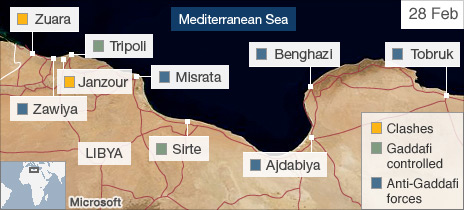
The strategic situation in Libya 28.02.2011
Anarchist policy, strategy and tactic in North Africa and the Middle East.
IIFOR has ranked most countries in the world according to libertarian degree, based on long term average structural estimates for the coordinates on the economic-political map, see System theory and economic-political map, and also published factual estimates of the libertarian degrees, see Ranking. Both domestic and international factors are considered. Around these long term structural estimates there may be short term dips and hikes in the libertarian degree. 100 % - the libertarian degree = the authoritarian degree. The authoritarian degree is an indicator of how dangerous, i.e. repressive economical and/or political/administrative, a government - or more general - an economic-political system is, from the people's perspective, see Class analysis. Systems with more than about 67% authoritarian degree, 666 per thousand, i.e. less than about 33,3% libertarian degree, are totalitarian and thus very repressive, dangerous, systems/regimes, see, System theory and economic-political map. As power corrupts, and the more -- the more power, in general totalitarian systems have a lot of and severe ochlarchy.
Norway is the most libertarian/anarchist country (rank no 1 - 54% libertarian/anarchy degree) and Somalia is the most authoritarian (rank no 186 - 20 % libertarian degree), with Libya ranked as no 68 (ca 32,5% libertarian degree) as a long term structural average, based on historical data, and thus both Somalia and Libya are totalitarian, and they have also fascist regimes. NB! With the present genocide and heavy repression against the people in Libya, there is a significant dip in the libertarian degree, very likely down to under 20 %. Thus at the moment Libya has the most dangerous and repressive system in the world, vis-a-vis the people.
The Anarchist International AI/IFA's main policy, a bit simplified, is in general to increase the libertarian degrees of countries, i.e. their economic-political systems, as much as much as possible, in the world in a dynamic perspective. Sometimes this implies a struggle to prevent a decline in the libertarian degree as much as possible, namely when other factors pull in the negative direction. AI/IFA puts some extra weight at a) the 3 anarchies of today, i.e. Norway, The Swiss Confederation and Iceland, and policy towards higher anarchy/libertarian degree in these countries, as they are only anarchies of rather low degree, b) to get more countries to be anarchies, e.g. of them relatively near anarchy today, c) and to improve the situations and hike the libertarian degrees in the most authoritarian - least libertarian countries. NB! Now a.o.t. Libya! In all cases AI/IFA concentrates on situations with significant momentum, e.g. popular revolt and more or less revolutions, in libertarian direction, as now in North Africa and the Middle East. Anarchys is real democracy, documented at Real democracy defined, i.e. including human rights, see Anarchism and human rights.
Fellows! The people, seen as a class in contrast to the superiors economically and/or political administrative, i.e. in income and/or rank. The present and future are in our hands! Contact AI - Click here and join the AI/IFA-network today! Be a networkmember/subscriber to the IJ@/AI/IFA-newsletters - Click here, and use the subscription link at the bottom of the page! Feel free to forward this information to your own network, and/or link up the Websites of AI/IFA at your blog or homepage. Join in the struggle for and towards anarchy and anarchism, i.e. for more socialism and autonomy; against economical plutarchy - that is capitalism; and against statism -- locally, domestic, regionally and world wide... Of course a struggle without ochlarchy (mob rule broadly defined), the opposite of anarchist, anarchy and anarchism!!! A struggle for anarchy and anarchism as opposed to all forms of marxism (state-socialism), liberalism and fascism, including populism. A struggle for a movement of the societal, i.e. economical and political/administrative, systems -- in libertarian direction, less authoritarian degree... AI/IFA and its sections always work and demonstrate with dignity, use real matter of fact arguments and add weight behind via direct actions, mass actions, and via elections. More information is available via Contact AI - Click here!.
Meanwhile the situation is increasingly more tense in Libya, and the international pressure against Colonel Gaddafi and his henchmen, and their totalitarian, fascist , extremist, system with severe violent ochlarchy, is also increasing.
US, Europe intensify efforts to isolate Gadhafi, Associated Press reported: The United States and European allies intensified efforts to isolate Libyan leader Moammar Gadhafi [a.k.a. Colonel Gaddafi] on Monday, redoubling demands for him to step down, questioning his mental state and warning that those who stay loyal to him risk losing their wealth and being prosecuted for human rights abuses. Europe, which buys most of Libya's oil exports, outlined fresh sanctions to force the dictator to stop attacks on civilians and step down after 42 years of iron-fisted rule. The European Union issued travel bans and an asset freeze against senior Libyan officials, and ordered an arms embargo on the country. Germany proposed a 60-day economic embargo to prevent Gadhafi from using oil and other revenues to repress his people.
The EU has much more leverage over Libya than the United States since Europe buys 85 percent of Libyan oil exports and Gadhafi and his family are thought to have significant assets in Britain, Switzerland and Italy. Switzerland and Britain already have frozen Libyan assets. The travel and financial sanctions are aimed at peeling away loyalists from Gadhafi in the hope of further isolating him. "These sanctions and accountability mechanisms should make all members of the Libyan regime think about the choice they have before them: violate human rights and be held accountable or stop the violence and respect the Libyan people's call for change," US Ambassador to the United Nations Susan Rice told reporters following crisis meetings on Libya at the White House. "There's no escaping that critical choice."
As the Pentagon moved naval and air forces closer to Libya amid active international discussions about imposing a no-fly zone over the country, the US Treasury Department announced it had frozen at least $30 billion in Libyan assets since President Barack Obama imposed financial and travel sanctions on Gadhafi, his family, senior Libyan officials and the government last week. That figure is the largest amount of money ever frozen by a US sanctions order, which also set out travel bans for the Libyan leadership. Administration officials said that as long as the government continues its violent crackdown against opponents who now control most of eastern Libya, all options, including military ones, remain on the table. Speaking in Geneva to the UN Human Rights Council, Secretary of State Hillary Rodham Clinton said the United States and European nations were exploring the idea of restricting airspace to prevent Gadhafi's government from bombing its citizens.
"Gadhafi has lost the legitimacy to govern, and it is time for him to go without further violence or delay," she said. "No option is off the table. That of course includes a no-fly zone." At the Pentagon, officials said they were moving forces in the region in case they were needed but did not say what they might be used for. "We have planners working various contingency plans and ... as part of that we are repositioning forces in the region to be able to provide options and flexibility," said Marine Col. Dave Lapan, a Defense Department spokesman. The US has a regular military presence in the Mediterranean Sea, two aircraft carriers in the Persian Gulf area and a wide range of surveillance equipment available for use in the region. Without specific information about what assets were being moved and where, it was impossible to tell whether the US moves were intended as a military threat or were simply a symbolic show of force.
A flight ban seemed unlikely in the short term. Senior US officials said the issue was not discussed during Clinton's meeting with Russian Foreign Minister Sergey Lavrov, whose country would have to support such a move if the US and its allies wanted authorization from the UN Security Council. Lavrov dismissed the idea in public remarks. Even before the EU announced the new sanctions, France pledged to send two planes with humanitarian aid to Libya's opposition stronghold of Benghazi after days of increasing concern about the hundreds, and potentially thousands, of deaths. After meetings with other nations' foreign policy chiefs in Geneva, Clinton said the US was sending two aid teams to help Libyan refugees. One would go to Egypt and the other to Tunisia to deal with the influx of fleeing Libyans. The US has pledged an initial $10 million to help refugees.
Gadhafi, meanwhile, in an interview with ABC News [also one with BBC, see above], dismissed the idea of leaving, rejected the allegations that he had ordered a crackdown on opponents and repeated his belief that the Libyan people love him, a claim that was met by derision in Washington. "It sounds, just frankly, delusional," Rice said. She said Gadhafi's behavior, including laughing on camera in television interviews amid the chaos, "underscores how unfit he is to lead and how disconnected he is from reality." "He should get out of his tent and see what's really happening in his country," said State Department spokesman P.J. Crowley, with a derisive nod to Gadhafi's favored living quarters.
Crowley said the US ambassador to Libya, Gene Cretz, who has been in Washington since early January for consultations, had been speaking to a broad range of Libyan opposition figures but declined to identify which ones. He also said the Libyan government had notified the administration that it had fired its ambassador to the United States, Ali Aujali, who last week joined the opposition, and had replaced him with a Gadhafi loyalist. The US closed its embassy in Tripoli on Friday after the remaining diplomats were evacuated but has not broken diplomatic relations with Libya. Last Monday, Aujali joined other Libyan diplomats in calling for Gadhafi to step down although he said he would not resign his post as ambassador.
Pro-Gadhafi forces fight rebels in 2 cities. International pressure on Moammar Gadhafi to end a crackdown on opponents escalated Monday as his loyalists fought rebels holding the two cities closest to the capital and his warplanes bombed an ammunition depot in the east. The US moved naval and air forces closer to Libya and said all options were open, including patrols of the North African nation's skies to protect its citizens from their ruler. France said it would fly aid to the opposition-controlled eastern half of the country. The European Union imposed an arms embargo and other sanctions, following the lead of the US and the UN The EU was also considering the creation of a no-fly zone over Libya. And the US and Europe were freezing billions in Libya's foreign assets.
[As mentioned above] "Gadhafi has lost the legitimacy to govern, and it is time for him to go without further violence or delay," US Secretary of State Hillary Rodham Clinton said. "No option is off the table. That of course includes a no-fly zone," she added. British Prime Minister David Cameron told lawmakers: "We do not in any way rule out the use of military assets" to deal with Gadhafi's regime. Gadhafi, who in the past two weeks has launched the most brutal crackdown of any Arab regime facing a wave of popular uprisings, laughed off a question from ABC News about whether he would step down as the Obama administration demands. "My people love me. They would die for me," he said. ABC reported that Gadhafi invited the United Nations or any other organization to Libya on a fact-finding mission.
[As mentioned above] Gadhafi's remarks were met with derision in Washington. "It sounds, just frankly, delusional," said US Ambassador to the UN Susan Rice. She added that Gadhafi's behavior, including laughing on camera in TV interviews amid the chaos, "underscores how unfit he is to lead and how disconnected he is from reality." The turmoil in the oil-rich nation roiled markets for another day. Libya's oil chief said production had been cut by around 50 percent, denting supplies that go primarily to Europe. The country provides 2 percent of the world's oil, but concerns the unrest will spread to other oil-rich nations has sent oil prices rising worldwide.
The uprising that began Feb. 15 has posed the most serious challenge to Gadhafi in his more than four decades in power. His bloody crackdown has left hundreds, and perhaps thousands, dead. But clashes appear to have eased considerably in the past few days after planeloads of foreign journalists arrived in the capital at the government's invitation. The two sides are entrenched, and the direction the uprising takes next could depend on which can hold out longest. Gadhafi is dug in in Tripoli and nearby cities, backed by his elite security forces and militiamen who are generally better armed than the military. His opponents, holding the east and much of the country's oil infrastructure, also control pockets in western Libya near Tripoli. They are backed by mutinous army units, but those forces [the people more or less armed] appear to have limited supplies of ammunition and weapons.
Gadhafi opponents have moved to consolidate their hold in the east, centered on Benghazi - Libya's second- largest city, where the uprising began. Politicians there on Sunday set up their first leadership council to manage day-to-day affairs, taking a step toward forming what could be an alternative to Gadhafi's regime. The opposition is backed by numerous units of the military in the east that joined the uprising, and they hold several bases and Benghazi's airport. But so far, the units do not appear to have melded into a unified fighting force. Gadhafi long kept the military weak, fearing a challenge to his rule, so many units are plagued by shortages of supplies and ammunition.
On Monday, pro-Gadhafi forces retook control of the western border crossings with Tunisia that had fallen under opposition control and they bombed an ammunition depot in the rebel-held east, residents in the area said. The Libyan Defense Ministry denied the bombing. Regime forces also moved to tighten their ring around two opposition-controlled cities closest to the capital Tripoli - Zawiya and Misrata - where the two sides are locked in standoffs. An Associated Press reporter saw a large, pro-Gadhafi force massed on the western edge of Zawiya, some 30 miles (50 kilometers) west of Tripoli, with about a dozen armored vehicles along with tanks and jeeps mounted with anti-aircraft guns. An officer said they were from the elite Khamis Brigade, named after one of Gadhafi's sons who commands it. US diplomats have said the brigade is the best-equipped force in Libya.
A resident of Zawiya said by telephone that fighting started in the evening and intensified after sundown when troops loyal to Gadhafi attacked the city from the west and east. "We were able to repulse the attack. We damaged a tank with an RPG. The mercenaries fled after that," said the resident, who spoke on condition of anonymity for fear of government reprisals. He said Gadhafi called Zawiya's influential tribal leader Mohammed al-Maktouf and warned him that if the rebels don't leave the city's main square by early Tuesday, they will be hit by warplanes. "We are expecting a major battle," the resident said, added that the rebels killed eight soldiers and mercenaries Monday. Another resident of Zawiya said he heard gunfire well into the night on the outskirts of town.
In Misrata, Libya's third-largest city 125 miles (200 kilometers) east of Tripoli, pro-Gadhafi troops who control part of an air base on the outskirts tried to advance Monday. But they were repulsed by opposition forces, who included residents with automatic weapons and defected army units allied with them, one of the opposition fighters said. No casualties were reported and the fighter claimed that his side had captured eight soldiers, including a senior officer. The opposition controls most of the air base, and the fighter said dozens of anti-Gadhafi gunmen have arrived from farther east in recent days as reinforcements.
Several residents of the eastern city of Ajdabiya said Gadhafi's air force also bombed an ammunition depot nearby held by rebels. One resident, 17-year-old Abdel-Bari Zwei, reported intermittent explosions and a fire, and another, Faraj al-Maghrabi, said the facility was partially damaged. The site contains bombs, missiles and ammunition - key for the undersupplied opposition military forces. State TV carried a statement by Libya's Defense Ministry denying any attempt to bomb the depot. Ajdabiya is about 450 miles (750 kilometers) east of Tripoli along the Mediterranean coast.
Gadhafi supporters said they were in control of the city of Sabratha, west of Tripoli, which has seemed to go back and forth between the two camps in the past week. Several residents told the AP that protesters set fire to a police station, but then were dispersed. Anti-Gadhafi graffiti - "Down with the enemy of freedom" and "Libya is free, Gadhafi must leave" - were scrawled on some walls, but residents were painting them over. There were signs of economic distress in the country, with prices skyrocketing and long lines forming for bread and gasoline.
Global efforts to halt Gadhafi's crackdown [as mentioned] escalated Monday. In Washington, the Pentagon said it was moving some naval and air forces closer to Libya in case they are needed. The US has a regular military presence in the Mediterranean and farther to the south has two aircraft carriers in the Persian Gulf area. The US Treasury Department said that at least $30 billion in Libyan assets have been frozen since President Barack Obama imposed sanctions on Libya last week.
France promised to send two planes with humanitarian aid the eastern opposition stronghold city of Benghazi, hoping to give it the momentum to oust Gadhafi. The aid to included medicine and doctors, would be the first direct Western help for the uprising that has taken control of the entire eastern half of Libya. French Prime Minister Francois Fillon said it was the start of a "massive operation of humanitarian support" for the east and that Paris was studying "all solutions" - including military options.
The EU slapped its own arms embargo, visa ban and other sanctions on Gadhafi's regime, following sanctions imposed by the US and the UN in the past week. And Europe was also considering the imposition of a no-fly zone over Libya to prevent any air attacks by the regime on rebellious citizens. Clinton met in Geneva with foreign ministers from Britain, France Germany and Italy to press for tough sanctions on the Libyan government.
Wolfowitz on Obama slowness. Former deputy secretary of Defense Paul Wolfowitz said he's been "mystified" at how the White House has handled the bloody crisis in Libya. "We've been just way too slow," Wolfowitz said in an interview airing Sunday 27.02.2011 on CNN's "Fareed Zakaria GPS." "And that slowness, we're going to pay a price for, for a long time." "Al Jazeera, which is no friend to the United States but which has become, with some justification, a hero of these revolutionary movements is taking the [situation] -- showing a picture of the White House or the president, [saying] why is the US being so silent?" he said. "Why is it being as silent as these people? And then it shows pictures of the people who have been killed in the protests. It's a devastating image."
The former Bush administration official, who also served as president of the World Bank, was asked if the US applying pressure to endangered leaders in the region would rattle countries such as Saudi Arabia and spread a message that Washington is angling for regime change. "I don't think that's a legitimate reason to stand by a man who's slaughtering his own people," Wolfowitz said. "And I have a lot of criticisms to make of the Saudis, but I don't believe they're capable of this sort of butchery."We'd be in a much better position to say, look, with all its faults, Saudi Arabia doesn't treat its subjects as trash," he continued. "It doesn't kill them, brutalize them, and threaten to take them back to the Stone Age. So let's put Saudi Arabia in one category. We'd be in a much better position to do that if we were clear about Gadhafi."
Of the Bush administration decision to normalize relations with Libya in return for the country giving up its weapons of mass destruction, Wolfowitz said the White House gave Gadhafi "a lot by, in effect, saying you won't suffer the fate of Saddam Hussein." "Some move was appropriate," he said of the restoration of relations. "I think we went too far. And I think the Obama administration continued that. "Al Jazeera is having great fun showing pictures of Hillary Clinton meeting with Mutassim Gadhafi who is, I don't know which of his sons is the most hideous, but this is the National Security Advisor, he's a pretty bad man," Wolfowitz said...
01.03.2011. Ad Libya Tuesday. RED ALERT - While the grass grows, the cow is dying! While international officials just talk about armed support, Gaddafi bombs and threatens with more bombing today. Armed international actions are urgently needed!! Send in arms! Airstrikes! Very, very soon time for NATO (or similar international forces) airstrikes and bombing of Colonel Gaddafi and his henchmen!!! Tunisia, Iran, Oman, Yemen...
Ad. 'While international officials just talk about armed support to the Libyan people...' 1. The US moved naval and air forces closer to Libya and said all options were open, including patrols of the North African nation's skies to protect its citizens from their ruler. 2. British Prime Minister David Cameron told lawmakers: "We do not in any way rule out the use of military assets". 3. Paris was studying "all solutions" - including military options. 4. Even a flight ban seemed unlikely in the short term. Russian Foreign Minister Sergey Lavrov, whose country would have to support such a move if the US and its allies wanted authorization from the UN Security Council... dismissed the idea in public remarks.
Ad. 'Gaddafi bombs and threatens with more bombing today of the Libyan people...' 1. Gaddafi called Zawiya's influential tribal leader Mohammed al-Maktouf and warned him that if the rebels don't leave the city's main square by early Tuesday, they will be hit by warplanes. 2. Several residents of the eastern city of Ajdabiya said Gaddafi's air force also bombed an ammunition depot nearby held by rebels. 3. On Monday, pro-Gaddafi forces retook control of the western border crossings with Tunisia that had fallen under opposition control and they bombed an ammunition depot in the rebel-held east, residents in the area said. 4. The opposition is backed by numerous units of the military. Gaddafi long kept the military weak, fearing a challenge to his rule, so many units are plagued by shortages of supplies and ammunition.
RED ALERT - The conclusion: Armed international support actions for the Libyan people are urgently needed!! Send in arms! Airstrikes! Very, very soon time for NATO (or similar international forces) airstrikes and bombing of Colonel Gaddafi and his henchmen!!!
The Anarchist International Security Council (AISC) & The Anarchist International - AI/IFA and all its sections, see The official link-site of AI/IFA, including the anarchosyndicalist labor confederation International Workers of the World and The Anarchist Confederation of Africa, declared in a joint statement, to AIIS: Many Libyan people have been killed -- estimated to more than 2000 Monday, and more will probably follow, say, due to probable bombing/airstrikes today -- by Colonel Gaddafi and his henchmen. The situation in Libya is in reality genocide against the people, thousands murdered by Colonel Gaddafi and his henchmen, i.e. a totalitarian, fascist, extremist, oligarchy with severe ochlarchy.
The situation in Libya is more and more similar to the more or less civil wars in the Balkan where the Serbian ruler and his henchmen were responsible for genocide. Now Colonel Gaddafi and his henchmen in a similar way are responsible for genocide and rule of terror, i.e. terrorism, in Libya, against the Libyan people. Quite legitimate the Libyan people are claiming a development towards freedom & democracy and human rights - where Colonel Gaddafi and his henchmen, i.e. a totalitarian, fascist , extremist, oligarchy with severe violent ochlarchy, stand in the way...
In the Balkan more or less civil wars, the international anarchist movement (i.e. at that time IFA, see The official link-site of AI/IFA) via the AIIS/AIT was among the first to call for NATO airstrikes and bombing of the Serbian ruler and his henchmen, responsible for genocide - to stop this crime against humanity. The Americans and thus NATO waited far too long, but at last took relevant action against the Serbian ruler and his henchmen. This time we expect a more quick action, including direct actions, against the terror rule, i.e. terrorism, and genocide by Colonel Gaddafi and his henchmen, murdering the Libyan people. While the grass grows, the cow is dying! This means RED ALERT and armed international actions very, very soon!!!
Send in arms! Ad Libyans saying 'we need help from outside' and similar; in addition to airstrikes and bombing of Gaddafi and his henchmen's positions, the international community should supply the struggling Libyan people with arms. However several Libyans have said that they are not interested in regular ground forces from foreign powers... Furthermore, considering that a) more than 100,000 have fled Libya, and b) evacuations have sharply reduced the number of citizens from Western countries stranded in Libya, c) a problem with possible hostages taken by Gaddafi and his henchmen is practically solved, and it is now very, very soon time for international armed actions!
Airstrikes! It is very, very soon time for NATO (or similar international forces) airstrikes and bombing of Colonel Gaddafi and his henchmen's positions, to avoid his probable tactic of using human shields, mixing with civilians in Tripoli, etc. Although this tactic may backfire somewhat due to too much spreading of his troops...
And take a look at Strategy and tactics, with links... especially the links! Remember: most of the members of The Anarchist International Security Council (AISC) & The Anarchist International - AI/IFA and its sections are de facto acting generals... all on equal footing - none above!! Thus listen to our advice!
We call on Colonel Gaddafi and his henchmen to step down - NOW!... i.e. if not today, within a few days rather than a week!! And we call on the Libyan people: Remember Direct Action and Antimilitarism - an anarchist approach - IJA 2 (38) & The International Conference on Terrorism - IJA 4 (31)!!! As mentioned, it is very, very soon time for NATO (or similar international forces) airstrikes and bombing of Colonel Gaddafi and his henchmen, similar to the campaign against the Serbian ruler and his henchmen in the Balkan more or less civil wars. Gaddafi is very likely worse than the Serbian ruler!!!!
Libyan rebels celebrate win in battle near Tripoli, Associated Press reported: Residents of the rebel-held city closest to Libya's capital celebrated with a victory march Tuesday after repelling an overnight attack by Moammar Gadhafi's [a.k.a. Colonel Gaddafi] forces. But troops loyal to the longtime leader clamped down on a strategic mountain town as they fought to reclaim areas near Tripoli, residents said. The rebels have been fighting to consolidate their gains as the international community weighs new moves to isolate the longtime Libyan leader, including the possibility of creating a no-fly zone over Libya. Secretary of State Hillary Rodham Clinton warned that Libya is at risk of collapsing into a "protracted civil war" amid increasingly violent clashes between the two sides.
Witnesses in Zawiya [a.k.a. Zawiyah] said pro-Gadhafi forces battled rebels for six hours overnight but could not retake control of the city 30 miles (50 kilometers) west of Tripoli. They said the last of several assaults by the Gadhafi loyalists came at around 3 a.m. local time. "Allahu Akbar (God is Great) for our victory," residents of Zawiya chanted as they paraded through the city's main square. Some carried on their shoulders an air force colonel they said had just defected to the rebels' side. "We were worried about air raids but that did not happen," said one resident, who spoke on condition of anonymity for fear of reprisals.
The Zawiya rebels, who include mutinous army forces, are armed with tanks, machine guns and anti-aircraft guns. They fought back pro-Gadhafi troops, armed with the same weapons, who attacked from six directions. There was no word on casualties. "We will not give up Zawiya at any price," said one witness. "We know it is significant strategically. They will fight to get it, but we will not give up. We managed to defeat them because our spirits are high and their spirits are zero." The witnesses in Zawiya said youths from the city were stationed on the rooftops of high-rise buildings in the city to monitor the movements of the pro-Gadhafi forces and sound the warning if they thought an attack was imminent. They also spoke about generous offers of cash by the regime for the rebels to hand control of the city back to authorities.
Residents passed out sweets and cold drinks to fighters in Zawiya. Pro-Gadhafi forces also were repelled as they tried to retake two other opposition-held cities: Misrata, Libya's third-largest city 125 miles (200 kilometers) east of Tripoli, and Zintan, 75 miles (120 kilometers) south of the Libyan capital. Government loyalists, however, had recaptured the town of Gharyan in the Nafusa mountain range overlooking Tripoli and had set up checkpoints along the road connecting it and Zintan, the resident said, speaking on condition of anonymity for fear of reprisals. Protesters had control of the area until Friday, when a battalion appeared in the middle of the night, deploying tanks and troops.
"They were so quiet we were surprised. We thought they had joined the protesters," the witness said, adding that the resistance in the town was unarmed and easily outmaneuvered. The resident said the pro-Gadhafi forces had launched a manhunt with a list of wanted protesters. He said at least four officers had been detained for joining the protesters' side. Gadhafi supporters also have said they were in control of the city of Sabratha, west of Tripoli, which has seemed to go back and forth between the two camps in the past week. Since the revolt against Gadhafi's 41-year-old rule began two weeks ago, his regime has launched the harshest crackdown in the Arab world where authoritarian rulers are facing an unprecedented wave of uprisings. Gadhafi has already lost control of the eastern half of the country. He still holds the capital Tripoli and other nearby cities.
An exact death toll has been difficult to obtain in the chaos, but a medical committee in the eastern city of Benghazi, where the uprising began on Feb. 15, said at least 228 people had been killed, including 30 unidentified bodies, and 1,932 injured. UN Secretary General Ban Ki-moon has cited reports that perhaps 1,000 have died amid the popular uprising and the government's violent crackdown on Gadhafi critics. [Diplomats have estimated the death toll to about 2000 in the last weekend of February.] More than 140,000 people also have fled Libya to Egypt and Tunisia in a growing exodus from the chaos engulfing the country, refugee officials said. UN refugee agency spokeswoman Melissa Fleming said Tuesday "the situation is reaching crisis point" at the Libya-Tunisia border where authorities say up to 75,000 people have fled Libya since Feb. 20. Egyptian authorities say 69,000 people have crossed over from Libya since Feb. 19.
International pressure to end the crackdown has escalated dramatically in the past few days. The US moved naval and air forces closer to Libya on Monday and said all options were open, including patrols of the North African nation's skies to protect its citizens from their ruler. The Obama administration is demanding that Gadhafi relinquish power immediately. "In the years ahead, Libya could become a peaceful democracy, or it could face protracted civil war. The stakes are high," Clinton told Congress in Washington. France said it would fly aid to the opposition-controlled eastern half of the country. The European Union imposed an arms embargo and other sanctions, following the lead of the US and the UN.
The EU and the US have also talked about the possibility of creating a no-fly zone over Libya. However, Russia's top diplomat ruled out the idea as "superfluous" and said world powers must instead focus on fully using the sanctions the UN Security Council approved over the weekend. Others suggested the tactic - used successfully in northern Iraq and Bosnia - to prevent Gadhafi from bombing his own people. But Russia's consent is required as a veto-wielding member of the Security Council. Susan Rice, the US ambassador to the United Nations, on Tuesday urged Gadhafi to consider exile, saying she's worried the African nation could plummet into a "humanitarian disaster." "It's important that he get off the stage," Rice said told CBS on "The Early Show." She said that exile "may be an option that he looks at." But the ambassador added that not even that scenario would inoculate Gadhafi from possible prosecution "for the crimes that he and those closest to him have committed."
In Misrata, pro-Gadhafi troops who control part of an air base on the city's outskirts tried to advance Monday. But they were repulsed by opposition forces, who included residents with automatic weapons and defected army units allied with them, one of the opposition fighters said. In Zintan, residents said an attack by pro-Gadhafi forces Monday night was the second since the city fell in rebel hands late last month. But, they added, Gadhafi's loyalists were bringing in reinforcements, possibly to stage a much bigger attack on the city. They said rebel forces also were in control of a nearby area known as the Arab Mountain Line that includes several towns that includes the small towns of Lanut, Kikla and Kabo.
In Zawiya, an Associated Press reporter saw a large, pro-Gadhafi force massed on the western edge of the city Monday night, with about a dozen armored vehicles along with tanks and jeeps mounted with anti-aircraft guns. An officer said they were from the elite Khamis Brigade, named after one of Gadhafi's sons who commands it. US diplomats have said the brigade is the best-equipped force in Libya. "We were able to repulse the attack. We damaged a tank with an RPG. The mercenaries fled after that," said a resident, who spoke on condition of anonymity for fear of government reprisals. He said Gadhafi called Zawiya's influential tribal leader Mohammed al-Maktouf and had warned him that if the rebels don't leave the city's main square by early Tuesday, they will be hit by warplanes.
Residents of Tripoli said the city was calm Tuesday but that some residents were anxious over what is seen there as a growing chance of foreign intervention. "People are worried about foreign intervention [probably meaning regular grouna troops]," said one resident who spoke on condition of anonymity because he feared reprisals. "Many Libyans see this as a conspiracy that will lead into dividing Libya to an eastern and western sectors. There will be massacres." On Tuesday, Gadhafi's regime sought to show that it was the country's only legitimate authority and that it continued to feel compassion for areas in the east that fell under the control of its opponents. A total of 18 trucks loaded with rice, wheat-flour, sugar and eggs left Tripoli for Benghazi, the country's second largest city 620 miles (1,000 kilometers) east of the capital. Also in the convoy were two refrigerated cars carrying medical supplies. The convoy was met with a small pro-Gadhafi demonstration as it made its way out of Tripoli. "God, Gadhafi, Libya and that's it," chanted the demonstrators. "The state is very generous with the people," said 22-year-old Ahmed Mahmoud as he watched the convoy.
In Benghazi, the epicenter of the opposition-controlled east, activists said they had no objection to the imposition of a no-fly zone over eastern Libya, but were divided whether to accept relief from the Gadhafi regime. "Gadhafi's air force is a serious threat to us," said lawyer Nasser Bin Nour. "We will welcome a no-fly zone on Gadhafi's warplanes over the whole of Libya. The only thing we object to is foreign troops on Libyan soil." said Bin Nour, who said many in the city would not oppose shelling the positions of pro-Gadhafi forces by foreign warships or planes. Another Benghazi activist, Najlaa al-Manqoush, echoed Bin Nour's comments on foreign aid, but pointed out that to accept the relief supplies sent Tuesday by the regime would help Gadhafi's propaganda machine. "We reject any attempt by the regime to beautify its image in the media," she said. "We are much smarter than that. We accept all the aid they send us from friendly nations, but not from Gadhafi."
UN suspends Libya from rights council. The full membership of the United Nations on Tuesday suspended Libya from the UN Human Rights Council in the latest international effort to isolate Moammar Gadhafi's government for its violent attacks on civilian protesters. The UN General Assembly voted by consensus on the council's own recommendation to suspend Libya's rights of council membership for committing "gross and systematic violations of human rights." The assembly also expressed "deep concern" about the human rights situation in Libya. The vote does not permanently remove Libya from the council, but prevents it from participation until the General Assembly determines whether to restore the country to full status.
The resolution was sponsored by Arab and African states. Venezuelan Ambassador Jorge Valero expressed reservations about the vote. "A decision such as this one could only take place after a genuine investigation," he said. US Ambassador Susan Rice said, "People who turn their guns on their own people have no place on the human rights council." "This is a harsh rebuke, but one that Libya's leaders have brought down upon themselves," she said. "It sends another clear warning to Mr. Gadhafi and those who stand by him: They most stop the killing." Gadhafi "has lost any legitimacy to rule," Rice said. "He must go, and he must go now."
Refugees swamp borders in fleeing Libyan unrest, France24 reported: Tunisian border officials are struggling to process crowds of Libyans and foreign migrant workers who are desperate to escape the unrest in Libya. Soldiers fired into the air on Tuesday in an effort to disperse a wave of would-be entrants. Soldiers fired into the air in an effort to subdue a wave of Egyptian labourers desperate to escape Libya on Tuesday, as the refugee crisis created by the rebellion against Muammar Gaddafi escalated. Aid workers threw bottles of water and loaves of bread over the wall to a sea of men surging forward towards the safety of Tunisian soil, in a futile attempt to calm them. Young Tunisians with branches torn from the trees kept them from clambering over the wall between border posts.
Tunisian officials were processing entrants as fast as they could, as medics plucked fainting men from the heaving mass sweeping over the chest-high steel gate. Panicking migrants passed their bulging suitcases, rugs, and blankets overhead at the gate where soldiers with sticks tried to hold them back. A Tunisian officer with a loud hailer shouted reassurances that they would be let in. Order looked close to collapse at one brief point in the overflowing border compound on the Tunisian side, where throngs of men jostled and long lines of exhausted migrants in torn jackets and headcloths queued for water, food, and toilets. Troops fired warning shots in the air and white-faced officers unholstered their automatic pistols.
Thousands yet to come. Many tens of thousands more are expected to flee west from the violence that has consumed Liby as Gaddafi's regime teeters on the verge of collapse. "We can't see beyond that building on the Libyan side but we think there are many more waiting to come through, " said Ayman Gharaibeh, team leader for the United Nations High Commissioner for Refugees (UNHCR) at Ras Jdir. "The numbers are daunting," he said. The last couple of days had seen an upsurge and refugees were now crossing at a rate of up to 15,000 a day, he said. There was no one to coordinate relief and establish order on the Libyan side and the UNHCR judged it was not safe to go over there. Medecins sans Frontieres and the Red Cross-Red Crescent were trying to liaise with the Libyans to slow the flow. "It looks like it's going to get worse ... They are going to break down the wall in the end," said Gharaibeh grimly. In the mass of people behind the wall on the Libyan side, Bangladeshis held up a sheet with the words: "Help Help Help." In the Tunisian compound, a few hundred Vietnamese squatted stoically, waiting their turn to be bussed out and home.
Planes and ships needed. About 70,000 refugees had entered Tunisia since the uprising began in Libya and only an estimated 20 percent had been repatriated, the UNHCR team-leader said. Tunisia's capacity to feed, shelter and provide sanitation for the destitute workers is being pushed to breaking point. The UN agency built a transit camp of hundreds of white tents overnight about 7 km (4 miles) back from the border, with the capacity to provide temporary relief for up to 20,000. "When are we going to be taken out of here? We cannot accept this," said one Egyptian. "Give me a camel. I will take a camel. I just want to go home." Evacuation flights were picking up refugees from Djerba airport in the plush beach resort area in the north of Tunisia, a world away from the chaos. Ships have taken boatloads away from the port of Zarzis but not nearly fast enough to ease the pressure, said Tunisian army Colonel Mohamed Essoussi.
"We need the most rapid possible evacuation," he said. "The major weaknesses are in transport, air and maritime transport." The emergency shelters and transit camp could handle 5,000 a day, he said. "We are now feeding 17,000 people." International aid agencies at the scene agreed with the assessment. Tunisia's capacity to shelter the flow was at its limit. They said faster evacuation was needed and control on the Libyan side would greatly ease the crisis. However, there appeared to be almost no one with the power and authority to achieve order there, the UNHCR said. Thousands have no money to pay for their passage home, and no employer responsible for their repatriation. Many have been sleeping out in the open for days in cold, wet conditions. As the sun went down and rain clouds approached, campfires flickered under a grove of trees at the border, where hundreds of refugees huddled in shelters built of their baggage, under blankets and plastic sheeting.
US warns of civil war in Libya unless Gaddafi goes, Reuters reported: Libya could descend into civil war unless Muammar Gaddafi quits, the United States said on Tuesday, its demand for his departure intensifying pressure on the longtime leader after news of Western military preparations. Gaddafi remained defiant, dispatching forces to a western border area amid fears that the most violent Arab revolt may grow bloodier and cause a humanitarian crisis. Tunsian border guards fired into the air on Tuesday to try to control a crowd of people clamoring to cross the frontier and escape the violence. About 70,000 people have passed through the Ras Jdir border post in the past two weeks, and many more of the hundreds of thousands of foreign workers in Libya are expected to follow.
Gaddafi's son Saif al-Islam warned the West against launching any military action to topple Gaddafi, and said the veteran ruler would not step down or go into exile. "Using force against Libya is not acceptable. There's no reason, but if they want...we are ready, we are not afraid," he told Sky television, adding: "We live here, we die here." Secretary of State Hillary Clinton told US lawmakers: "Libya could become a peaceful democracy or it could face protracted civil war." She said the Obama administration would look into allegations that Gaddafi personally ordered the 1988 Lockerbie bombing, because of new statements by defecting Libyan officials "making it clear that the order came from the very top." The United States said it was moving ships and planes closer to the oil-producing North African state. The destroyer USS Barry moved through the Suez Canal on Monday and into the Mediterranean. Two amphibious assault ships, the USS Kearsarge, which can carry 2,000 Marines, and the USS Ponce, are in the Red Sea and are expected to go through the canal early on Wednesday.
US RULES NOTHING OUT. The White House said the ships were being redeployed in preparation for possible humanitarian efforts but stressed it "was not taking any options off the table." "We are looking at a lot of options and contingencies. No decisions have been made on any other actions," Defense Secretary Robert Gates said. French Foreign Minister Alain Juppe sounded a note of caution, saying military intervention would not happen without a clear United Nations mandate. British Prime Minister David Cameron said it was unacceptable that "Colonel Gaddafi can be murdering his own people using airplanes and helicopter gunships." General James Mattis, commander of US Central Command, told a Senate hearing that imposing a no-fly zone would be a "challenging" operation that would mean actual attack. "You would have to remove air defense capability in order to establish a no-fly zone, so no illusions here," he said. "It would be a military operation -- it wouldn't be just telling people not to fly airplanes."
Analysts said Western leaders were in no mood to rush into conflict after the troubled, drawn-out involvements in Afghanistan and Iraq. "They will be desperate not to place themselves in that situation, unless not doing so would result in even worse massacres," said Shashank Joshi of London's Royal United Services Institute. Suspicions grew that Gaddafi, a survivor of past coup attempts, did not grasp the scale of the forces against him. [As mentioned] "All my people love me," he told the ABC network and the BBC on Monday, dismissing the significance of a rebellion that has ended his control over much of oil-rich eastern Libya.
REBELS CLAIM STRENGTH GROWING. Rebel fighters claimed the balance of the conflict was swinging their way. "Our strength is growing and we are getting more weapons. We are attacking checkpoints," said Yousef Shagan, a spokesman in Zawiyah, only 50 km (30 miles) from Tripoli. A rebel army officer in the eastern city of Ajdabiyah said rebel units were becoming more organised. "All the military councils of Free Libya are meeting to form a unified military council to plan an attack on Gaddafi security units, militias and mercenaries," Captain Faris Zwei said. He said there were more than 10,000 volunteers in the city, plus defecting soldiers.
Rebels guarding a munitions store said they feared a direct hit by Gaddafi's warplanes could cause destruction for miles around. But Zwei said pilots appeared to be aiming to miss. "We have complete confidence in the Libyan air force not to hit anything that affects their relatives in the east," he said. Despite the widespread collapse of Gaddafi's writ, his forces were fighting back in some regions. A reporter on the Tunisian border saw Libyan troops reassert control at a crossing abandoned on Monday, and residents of Nalut, about 60 km (35 miles) from the border, said they feared pro-Gaddafi forces were planning to recapture the town. Mohamed, a resident of rebel-held Misrata, told Reuters by phone: "Symbols of Gaddafi's regime have been swept away from the city. Only a (pro-Gaddafi) battalion remains at the city's air base but they appear to be willing to negotiate safe exit out of the air base. We are not sure if this is genuine or just a trick to attack the city again." Across the country, tribal leaders, officials, military officers and army units have defected to the rebels. Sanctions will squeeze his access to funds.
BREAD QUEUES. Tripoli is a clear Gaddafi stronghold, but even in the capital, loyalties are divided. Many on the streets on Tuesday expressed loyalty but a man who described himself as a military pilot said: "One hundred percent of Libyans don't like him." There were queues outside bread shops on Tuesday morning. Some residents said many shops were limiting the number of loaves customers could buy.... National Oil Corporation said output had halved because of the departure of foreign workers. Brent crude prices surged above $116 a barrel as supply disruptions and the potential for more unrest in the Middle East and North Africa kept investors on edge.
Meanwhile in Tunisia - Struggling unity govt hit by new resignations, France24 reported: Local development minister Nejib Chebbi, founder of the opposition Democratic Progressive Party, and minister of higher education Ahmed Ibrahim became the latest figures to resign from Tunisia's struggling unity government on Tuesday. Two more ministers left Tunisia's interim government Tuesday following the resignations of the prime minister and two other ministers after weeks of protests about the caretaker authority. Higher education and scientific research minister Ahmed Ibrahim, head of Ettajdid party, told AFP that he had resigned believing he "could better serve the revolution by being outside of the government". "The Ettajdid movement will have full freedom to act to contribute to the democratic transition," he said.
Local development minister Ahmed Nejib Chebbi, from the Progressive Democratic Party, announced his departure at a press conference criticising the "hesitation and fuzziness" of the interim authority. The interim government was appointed after the fall of president Zine El Abidine Ben Ali on January 14, after weeks of demonstrations and a security force crackdown that left about 200 people dead. It included several members of Ben Ali's regime, and protests continued to demand they also leave.
Mohammed Ghannouchi, prime minister in the interim government and for Ben Ali, quit on Sunday after clashes at weekend demonstrations left five [NB! updated figure] people dead. "I am not ready to be the person who takes decisions that would end up causing casualties," Ghannouchi said, announcing his decision to resign after just over six weeks as interim prime minister. He was swiftly replaced as prime minister by 84-year-old Beji Caid Essebsi, a minister under independent Tunisia's founding president Habib Bourguiba. Industry and technology minister Mohamed Afif Chelbi and planification and international cooperation minister Mohamed Nouri Jouini, who were both also in Ben Ali's regime, resigned on Monday.
In Iran police fired tear gas to disperse protesters, see The situation in Iran - IJA 2 (39).
Omani troops fired in the air, wounding one person, when they moved in to disperse protesters at the northern port of Sohar, witnesses said.
Yemen's President Ali Abdullah Saleh chastised Washington for its criticism of Arab leaders' responses to regional unrest.
02.03.2011. Ad Libya Wednesday. STILL RED ALERT! Must a large massacre happen before world leaders give armed support? Then, who are responsible if a large massacre happens? While the grass grows, the cow is dying! World leaders still just talk about armed support, while the Libyan people ask for airstrikes, and Gaddafi continues the genocide. Armed international actions are urgently needed!! Send in arms! Airstrikes! Still very, very soon time for NATO (or similar international forces) airstrikes and bombing of Colonel Gaddafi and his henchmen!!!
Monday 28.01.2011 the strategic picture was the following:
1. Ad. 'While international officials just talk about armed support to the Libyan people...' 1. The US moved naval and air forces closer to Libya and said all options were open, including patrols of the North African nation's skies to protect its citizens from their ruler. 2. British Prime Minister David Cameron told lawmakers: "We do not in any way rule out the use of military assets". 3. Paris was studying "all solutions" - including military options. 4. Even a flight ban seemed unlikely in the short term. Russian Foreign Minister Sergey Lavrov, whose country would have to support such a move if the US and its allies wanted authorization from the UN Security Council... dismissed the idea in public remarks.
2. Ad. 'Gaddafi bombs and threatens with more bombing today of the Libyan people...' 1. Gaddafi called Zawiya's influential tribal leader Mohammed al-Maktouf and warned him that if the rebels don't leave the city's main square by early Tuesday, they will be hit by warplanes. 2. Several residents of the eastern city of Ajdabiya said Gaddafi's air force also bombed an ammunition depot nearby held by rebels. 3. On Monday, pro-Gaddafi forces retook control of the western border crossings with Tunisia that had fallen under opposition control and they bombed an ammunition depot in the rebel-held east, residents in the area said. 4. The opposition is backed by numerous units of the military. Gaddafi long kept the military weak, fearing a challenge to his rule, so many units are plagued by shortages of supplies and ammunition.
Tuesday 01.03.2011 the strategic picture was the following. NB! Gaddafi did not bomb any of the Libyan people with airstrikes, as suggested on Monday. But he still probably may do it!
3. Ad. 'World leaders still just talk about armed support to the Libyan people...' The EU and the US have talked about the possibility of creating a no-fly zone over Libya. However, Russia's top diplomat ruled out the idea as "superfluous" and said world powers must instead focus on fully using the sanctions the UN Security Council approved over the weekend. [IIFOR's strategical experts said to AIIS that sanctions at best work in the long run, and are in no way sufficient to stop the genocide!] Others suggested the tactic - used successfully in northern Iraq and Bosnia - to prevent Gaddafi from bombing his own people. [IIFOR said to AIIS that this is compatible with the advice of AISC and the AI/IFA.] But Russia's consent is required as a veto-wielding member of the Security Council.
The White House said [war] ships were being redeployed in preparation for possible humanitarian efforts but stressed it "was not taking any options off the table." "We are looking at a lot of options and contingencies. No decisions have been made on any other actions," Defense Secretary Robert Gates said. French Foreign Minister Alain Juppe sounded a note of caution, saying military intervention would not happen without a clear United Nations mandate. British Prime Minister David Cameron said it was unacceptable that "Colonel Gaddafi can be murdering his own people using airplanes and helicopter gunships." General James Mattis, commander of US Central Command, told a Senate hearing that imposing a no-fly zone would be a "challenging" operation that would mean actual attack. "You would have to remove air defense capability in order to establish a no-fly zone, so no illusions here," he said. "It would be a military operation -- it wouldn't be just telling people not to fly airplanes."
Must a large massacre happen before world leaders give armed support? Then, who are responsible if a large massacre happens? While the grass grows, the cow is dying!
4. Ad. 'The Libyan people ask for airstrikes...' Several of the Libyan people have agreed on the following: Gaddafi's air force is a serious threat to us. We will welcome a no-fly zone on Gaddafi's warplanes over the whole of Libya. The only thing we object to is foreign troops on Libyan soil. Many would not oppose shelling the positions of pro-Gaddafi forces by foreign warships or planes!
Wednesday 02.03.2011 the strategic picture is the following. The need for more arms to the Libyan people is about the same as Monday and Tuesday, i.e. urgent. The Libyan people are not opposed to shelling the positions of pro-Gaddafi forces by foreign planes. The Libyan people object to foreign [regular ground] troops on Libyan soil.
Thus: STILL RED ALERT - The conclusion: Armed international support actions for the Libyan people are urgently needed!! Send in arms! Airstrikes! Still very, very soon time for NATO (or similar international forces) airstrikes and bombing of Colonel Gaddafi and his henchmen!!!
The Anarchist International Security Council (AISC) & The Anarchist International - AI/IFA and all its sections, see The official link-site of AI/IFA, including the anarchosyndicalist labor confederation International Workers of the World and The Anarchist Confederation of Africa, declared in a joint statement, to AIIS: Many Libyan people have been killed -- estimated to more than 2000 Monday, more Tuesday -- and even more will probably follow, say, due to probable bombing/airstrikes -- by Colonel Gaddafi and his henchmen. The situation in Libya is in reality genocide against the people, thousands murdered by Colonel Gaddafi and his henchmen, i.e. a totalitarian, fascist, extremist, oligarchy with severe ochlarchy.
The situation in Libya is more and more similar to the more or less civil wars in the Balkan where the Serbian ruler and his henchmen were responsible for genocide. Now Colonel Gaddafi and his henchmen in a similar way are responsible for genocide and rule of terror, i.e. terrorism, in Libya, against the Libyan people. Quite legitimate the Libyan people are claiming a development towards freedom & democracy and human rights - where Colonel Gaddafi and his henchmen, i.e. a totalitarian, fascist , extremist, oligarchy with severe violent ochlarchy, stand in the way...
In the Balkan more or less civil wars, the international anarchist movement (i.e. at that time IFA, see The official link-site of AI/IFA) via the AIIS/AIT was among the first to call for NATO airstrikes and bombing of the Serbian ruler and his henchmen, responsible for genocide - to stop this crime against humanity. The Americans and thus NATO waited far too long, but at last took relevant action against the Serbian ruler and his henchmen. This time we expect a more quick action, including direct actions, against the terror rule, i.e. terrorism, and genocide by Colonel Gaddafi and his henchmen, murdering the Libyan people. Must a large massacre happen before world leaders give armed support? Then, who are responsible if a large massacre happens? While the grass grows, the cow is dying! This means RED ALERT and armed international actions very, very soon!!!
Send in arms! Ad Libyans saying a) 'we are not opposed to shelling the positions of pro-Gaddafi forces by foreign planes', and b) 'we need help from outside' and similar; in addition to airstrikes and bombing of Gaddafi and his henchmen's positions, the international community should supply the struggling Libyan people with arms. However several Libyans have said that they are not interested in regular ground forces from foreign powers... A problem with possible hostages taken by Gaddafi and his henchmen is practically solved, and it is now very, very soon time for international armed actions!
Airstrikes! It is very, very soon time for NATO (or similar international forces) airstrikes and bombing of Colonel Gaddafi and his henchmen's positions, to avoid his probable tactic of using human shields, mixing with civilians in Tripoli, etc. Although this tactic may backfire somewhat due to too much spreading of his troops...
And take a look at Strategy and tactics, with links... especially the links! Remember: most of the members of The Anarchist International Security Council (AISC) & The Anarchist International - AI/IFA and its sections are de facto acting generals... all on equal footing - none above!! Thus listen to our advice!
We call on Colonel Gaddafi and his henchmen to step down - NOW!... i.e. if not today, within a few days rather than a week!! And we call on the Libyan people: Remember Direct Action and Antimilitarism - an anarchist approach - IJA 2 (38) & The International Conference on Terrorism - IJA 4 (31)!!! As mentioned, it is very, very soon time for NATO (or similar international forces) airstrikes and bombing of Colonel Gaddafi and his henchmen, similar to the campaign against the Serbian ruler and his henchmen in the Balkan more or less civil wars. Gaddafi is very likely worse than the Serbian ruler!!!!
Rebels fend off attack by Gaddafi forces in east Libya, France 24 reported:
Anti-regime forces fended off an attack by troops loyal to Libyan leader Muammar Gaddafi in the eastern town of Brega after a series of battles on Wednesday. Gaddafi forces launched an attack on the rebels at dawn.
Libyan rebels fought intense battles to repel Moamer Kadhafi's forces from the key eastern oil port of Brega Wednesday as the regime's biggest counter-offensive yet left at least 10 people dead.
Opposition fighters said they had finally pushed Kadhafi's men out of the town on the Mediterranean coast after a day of chaotic clashes, even as a government fighter jet fired two missiles near their victory celebrations."Brega is liberated. We have forced them to 30 kilometres (22 miles) west," rebel fighter Khalid al-Aqoly told AFP.
Kadhafi's [a.k.a. Colonel Gaddafi] forces, backed by tanks and heavy weaponry, had attacked at dawn and quickly seized the airport, an oil terminal and a university in Brega, the westernmost town held by the poorly armed Libyan opposition.
While Kadhafi appeared on television to deny there was any opposition to his 41-year rule, the advantage in Brega went back and forth but by the evening the rebels said they had prevailed.
However moments after dozens of men had gathered in a square near the university, flashing victory signs and firing into the air, a fighter jet launched two missiles at them, an AFP reporter witnessed. The attack caused no casualties but gouged out two craters in a street 15 to 20 metres (yards) away.
Rebels chanting "Allahu Akhbar" (God is greatest) ducked for cover and then started firing machine guns at the jet, which streaked low in the sky.
Claiming victory several hours earlier, rebel leaders in the main eastern town of Benghazi said at least 10 people were dead."They tried to claim Brega, they ended up with a failure. We kicked them out, the battle is done," said Mustafa Gheriani, the media organiser for the rebels at their headquarters in Benghazi."We heard numbers of 10 to 15 martyrs but we are still surveying."
Another huge blast believed to be from an airstrike had rocked the town earlier as rebels surrounded regime fighters who were in the university area and at the gates of the Sirte oil company.
Smoke rose from shell fire and heavy machine gun fire rattled through Brega."Now they're limited to the university and the gates of the oil company. Their ammunition is running out. They're firing randomly. We'll take these positions by nightfall," said one rebel fighter who gave his name as Mohammad.
An AFP reporter at one of the two hospitals in Brega, which is 200 kilometres (125 miles) southwest of the rebels' headquarters in Benghazi, saw the bloodied bodies of four young men in a morgue.
Rebel volunteer Mashallah Aqub said: "There are four more bodies in another morgue and at another hospital and other bodies we haven't been able to collect yet."
Anti-regime forces have seized most of the east of the country since the uprising began on February 15 and have taken tentative steps towards setting up a parallel government.
But the opposition forces, mostly comprising military defectors and volunteers, have been watching warily for a fightback.
Oil company official Ahmed Ali said the sound of gunfire had woken him early on Wednesday at his firm's compound. "I saw mercenaries from Chad who had taken up position at the company gates. I left in a car with a colleague. They stopped the car to search us for weapons before letting us go," Ali said.
Meanwhile Kadhafi's forces also launched an airstrike in Ajdabiya, 40 kilometres from Brega, witnesses said.
One witness said the airstrikes had targeted a weapons dump that was also hit two days ago, but residents said it had hit a former army base near the town. There were no casualties, they said.
Kadhafi has lost most of the east of the oil-rich North African country but remains entrenched in the capital Tripoli in the west... IIFOR said to AIIS that it was most likely pure luck that the airstrikes did not kill some of the people.
According to Euronews, rebel fighters disputed the claims by Gaddafi loyalists that they advanced on Brega without using force. "Around 100 cars carrying mercenaries arrived. They came to kill and they had heavy weapons such as rocket launchers and machine guns" one eyewitness told Euronews. Over the past two weeks, Gaddafi's regime has lost control over swathes of Libya's territory. The rebels have seized large parts of the east, although Gaddafi retains a tight grip on the capital, Tripoli. His forces also hold the Libyan leader's hometown of Sirte, as well as Gharyan and Sabratha in the country's northwest. The rebel National Libyan Council told the Reuters news agency its forces will push westwards if Gaddafi refuses to step down.
In the opposition bastion of Benghazi, the rebel National Libyan Council called for UN-backed air strikes on African mercenaries it said Gaddafi was using against his own people. "We call for specific attacks on strongholds of these mercenaries," said council spokesman Hafiz Ghoga. "The presence of any foreign forces on Libyan soil is strongly opposed. There is a big difference between this and strategic air strikes." In a possible response to Western hints that the opposition needs to unify to facilitate rebel links with outside powers, Ghoga added that a former justice minister, Mustafa Abdel Jalil, would be chairman of the Council which will have 30 members and be based in Benghazi before moving later to Tripoli.
Any sort of foreign military involvement in Arab countries is a sensitive topic for Western nations uncomfortably aware that Iraq suffered years of bloodletting and al Qaeda violence after a 2003 US-led invasion toppled Saddam Hussein. The Libyan leader might do something "desperate" to defend his regime, Italy's industry minister said. IIFOR said to AIIS that there is a danger that Gaddafi may use dirty bombs based on his significant stock of mustard gas, i.e. chemical warfare! A Tripoli resident and Gaddafi opponent, who did not want to be identified, told Reuters afterwards: "Gaddafi will hang on for a while. It's not going to be easy for an unarmed crowd to face highly armed forces eager to shoot their own people." IIFOR said to AIIS that sending in arms from the international community, to the opposition forces, now is more and more urgent.
Death toll now at 6000. NRK in the evening reports that the death toll now stands at 6000 people, based on sources of a Libyan human rights organization. Also according to BBC, the rebel National Libyan Council now supports airstrikes by international forces, compatible with the advice of the AISC and the AI/IFA, but as many other Libyans and the AISC and the AI/IFA, they don't want foreign regular ground troops in the country. They fear a similar situation in Libya as in Iraq and Afghanistan, AIIS reports.
When Muammar Gaddafi launched the failing land and air offensive to retake territory in Libya's east at dawn on Wednesday (sparking a rebel call for foreign air strikes), the veteran ruler twinned the attack with a fiery propaganda broadside against the rebels, playing on both nationalist opinion and Western jitters by saying much blood would be shed in "another Vietnam" if foreign powers intervened in the crisis. "We will enter a bloody war and thousands and thousands of Libyans will die if the United States enters or NATO enters," Gaddafi told Tripoli supporters at a gathering televised live. "We are ready to hand out weapons to a million, or 2 million or 3 million, and another Vietnam will begin. It doesn't matter to us. We no longer care about anything."
IIFOR commented to AIIS that Gaddafi is trying the old trick of Sun Tzu: "Appear weak when you are strong, and strong when you are weak." Gaddafi here appears strong, but is weak. But he can still make a lot of deadly chaos, airstrikes directed at the people and perhaps even using mustard gas in dirty bombs against crowds...
On the battlefield, government troops as mentioned briefly captured Brega, an oil export terminal, before being driven back by rebels who have held the town 800 km (500 miles) east of Tripoli for about a week, rebel officers said, adding they were ready to move westwards against Gaddafi's forces if he refused to quit. As mentioned further bombing raids near the oil terminals were carried out in the afternoon. Estimates of the death toll during the day ranged between five and 14. There has been talk among the international community of the possibility of imposing a no-fly zone over Libya, but on Wednesday US Defence Secretary Robert Gates said such a move would first require an attack to cripple Libyan air defences. "One of our biggest concerns is Libya descending into chaos and becoming a giant Somalia," Secretary of State Hillary Clinton told US lawmakers.
Gaddafi, who once said ballot box democracy was for donkeys, told the gathering in Tripoli the world did not understand he had given power to the people long ago. "We put our fingers in the eyes of those who doubt that Libya is ruled by anyone other than its people," he said, referring to his system of "direct democracy" launched at a meeting attended by visiting Cuban leader Fidel Castro in 1977. IIFOR commented to AIIS that this is a lie, there is no direct democracy in Libya, but only direct ruling by the dictator Gaddafi, who falsely most likely assumes that he and the Libyan people are "one".
Referring to an unprecedented two-week-old popular uprising against his rule, Gaddafi also called for the United Nations and NATO to probe what had happened in Libya, and said he saw a conspiracy to colonise Libya and seize its oil. [Sources: Euronews & Reuters and AIIS.]
03.03.2011. Ad Libya Thursday. NB! D-day in the weekend? World leaders talk about armed support on overtime! The Libyan people ask for airstrikes! Gaddafi continues the genocide! Must a large massacre happen before world leaders give armed support? Then, who are responsible if a large massacre happens? While the grass grows, the cow is dying! Armed international actions are urgently needed!! Send in arms! Airstrikes! Still very, very soon time for NATO (or similar international forces) airstrikes and bombing of Colonel Gaddafi and his henchmen!!! STILL RED ALERT! - And Egypt...
Monday 28.01.2011 the strategic picture was the following:
1. Ad. 'While international officials just talk about armed support to the Libyan people...' 1. The US moved naval and air forces closer to Libya and said all options were open, including patrols of the North African nation's skies to protect its citizens from their ruler. 2. British Prime Minister David Cameron told lawmakers: "We do not in any way rule out the use of military assets". 3. Paris was studying "all solutions" - including military options. 4. Even a flight ban seemed unlikely in the short term. Russian Foreign Minister Sergey Lavrov, whose country would have to support such a move if the US and its allies wanted authorization from the UN Security Council... dismissed the idea in public remarks.
2. Ad. 'Gaddafi bombs and threatens with more bombing today of the Libyan people...' 1. Gaddafi called Zawiya's influential tribal leader Mohammed al-Maktouf and warned him that if the rebels don't leave the city's main square by early Tuesday, they will be hit by warplanes. 2. Several residents of the eastern city of Ajdabiya said Gaddafi's air force also bombed an ammunition depot nearby held by rebels. 3. On Monday, pro-Gaddafi forces retook control of the western border crossings with Tunisia that had fallen under opposition control and they bombed an ammunition depot in the rebel-held east, residents in the area said. 4. The opposition is backed by numerous units of the military. Gaddafi long kept the military weak, fearing a challenge to his rule, so many units are plagued by shortages of supplies and ammunition.
Tuesday 01.03.2011 the strategic picture was the following. NB! Gaddafi did not bomb any of the Libyan people with airstrikes, as suggested on Monday. But he still probably may do it!
3. Ad. 'World leaders still just talk about armed support to the Libyan people...' The EU and the US have talked about the possibility of creating a no-fly zone over Libya. However, Russia's top diplomat ruled out the idea as "superfluous" and said world powers must instead focus on fully using the sanctions the UN Security Council approved over the weekend. [IIFOR's strategical experts said to AIIS that sanctions at best work in the long run, and are in no way sufficient to stop the genocide!] Others suggested the tactic - used successfully in northern Iraq and Bosnia - to prevent Gaddafi from bombing his own people. [IIFOR said to AIIS that this is compatible with the advice of AISC and the AI/IFA.] But Russia's consent is required as a veto-wielding member of the Security Council.
The White House said [war] ships were being redeployed in preparation for possible humanitarian efforts but stressed it "was not taking any options off the table." "We are looking at a lot of options and contingencies. No decisions have been made on any other actions," Defense Secretary Robert Gates said. French Foreign Minister Alain Juppe sounded a note of caution, saying military intervention would not happen without a clear United Nations mandate. British Prime Minister David Cameron said it was unacceptable that "Colonel Gaddafi can be murdering his own people using airplanes and helicopter gunships." General James Mattis, commander of US Central Command, told a Senate hearing that imposing a no-fly zone would be a "challenging" operation that would mean actual attack. "You would have to remove air defense capability in order to establish a no-fly zone, so no illusions here," he said. "It would be a military operation -- it wouldn't be just telling people not to fly airplanes."
Must a large massacre happen before world leaders give armed support? Then, who are responsible if a large massacre happens? While the grass grows, the cow is dying!
4. Ad. 'The Libyan people ask for airstrikes...' Several of the Libyan people have agreed on the following: Gaddafi's air force is a serious threat to us. We will welcome a no-fly zone on Gaddafi's warplanes over the whole of Libya. The only thing we object to is foreign troops on Libyan soil. Many would not oppose shelling the positions of pro-Gaddafi forces by foreign warships or planes!
5. Wednesday 02.03.2011 the strategic picture was the following. In the morning the need for more arms to the Libyan people is about the same as Monday and Tuesday, i.e. urgent. The Libyan people are not opposed to shelling the positions of pro-Gaddafi forces by foreign planes. The Libyan people object to foreign [regular ground] troops on Libyan soil. NB! Gaddafi did bomb the Libyan people with airstrikes, but most likely with no fatalities - so far! There may be more -- and more deadly -- later on, i.e. if his airforce is not bombed by internationals, very, very soon!!
Death toll updated to 6000 people according to NRK! More Libyan people including the rebel National Libyan Council ask for airstrikes by international forces! The National Libyan Council also told its forces will push westwards if Gaddafi refuses to step down. Thus, the need for more arms to the Libyan people is more an more urgent. See also the report of 02.03.2011.
* Thursday 03.03.2011 the strategic picture is the following: About the same as Wednesday. But the battle of Tripoli may happen in the weekend, i.e. D-day! Both the need for more arms and airstrikes by international forces are thus more and more urgent, but regular foreign ground forces are ruled out. World leaders talk about armed support on overtime! In this connection the following words of wisdom of Sun Tzu, and the Art of War, may be mentioned:
1. "One may know how to conquer without being able to do it."
2. "There is no instance of a country having benefited from prolonged
warfare."
3. "In war, then, let your great object be victory, not lengthy campaigns."
4. "Invincibility lies in the defence; the possibility of victory in the
attack."
And... "If words of advice are not clear and distinct, and if they are not
thoroughly understood, then the generals are to blame. But, if words of advice are
clear and nothing happens, then it is the fault of the world's main
leaders!" said General H. Mann of the AISC to AIIS. "The advice from the AISC and the AI/IFA, to the world leaders, seems to be clear enough, and should be thoroughly understood..." IIFOR said to AIIS.
Thus: STILL RED ALERT - The conclusion: Armed international support actions for the Libyan people are urgently needed!! Send in arms! Airstrikes! Still very, very soon time for NATO (or similar international forces) airstrikes and bombing of Colonel Gaddafi and his henchmen!!!
The Anarchist International Security Council (AISC) & The Anarchist International - AI/IFA and all its sections, see The official link-site of AI/IFA, including the anarchosyndicalist labor confederation International Workers of the World and The Anarchist Confederation of Africa, declared in a joint statement, to AIIS: Many Libyan people have been killed -- estimated to about 6000 Wednesday -- and even more will probably follow, say, due to probable bombing/airstrikes, and even may be use of mustard gas -- by Colonel Gaddafi and his henchmen. The situation in Libya is in reality genocide against the people, thousands murdered by Colonel Gaddafi and his henchmen, i.e. a totalitarian, fascist, extremist, oligarchy with severe ochlarchy.
The situation in Libya is more and more similar to the more or less civil wars in the Balkan where the Serbian ruler and his henchmen were responsible for genocide. Now Colonel Gaddafi and his henchmen in a similar way are responsible for genocide and rule of terror, i.e. terrorism, in Libya, against the Libyan people. Quite legitimate the Libyan people are claiming a development towards freedom & democracy and human rights - where Colonel Gaddafi and his henchmen, i.e. a totalitarian, fascist , extremist, oligarchy with severe violent ochlarchy, stand in the way...
In the Balkan more or less civil wars, the international anarchist movement (i.e. at that time IFA, see The official link-site of AI/IFA) via the AIIS/AIT was among the first to call for NATO airstrikes and bombing of the Serbian ruler and his henchmen, responsible for genocide - to stop this crime against humanity. The Americans and thus NATO waited far too long, but at last took relevant action against the Serbian ruler and his henchmen. This time we expect a more quick action, including direct actions, against the terror rule, i.e. terrorism, and genocide by Colonel Gaddafi and his henchmen, murdering the Libyan people. Must a large massacre happen before world leaders give armed support? Then, who are responsible if a large massacre happens? While the grass grows, the cow is dying! World leaders talk about armed support on overtime! This means RED ALERT and armed international actions very, very soon!!!
Send in arms! Ad Libyans saying a) 'we are for shelling the positions of pro-Gaddafi forces by foreign planes', and b) 'we need help from outside' and similar; in addition to airstrikes and bombing of Gaddafi and his henchmen's positions, the international community should supply the struggling Libyan people with arms. However many Libyans have said that they are not interested in regular ground forces from foreign powers... A problem with possible hostages taken by Gaddafi and his henchmen is practically solved, and it is now very, very soon time for international armed actions!
Airstrikes! It is very, very soon time for NATO (or similar international forces) airstrikes and bombing of Colonel Gaddafi and his henchmen's positions, to avoid his probable tactic of using human shields, mixing with civilians in Tripoli, etc. Although this tactic may backfire somewhat due to too much spreading of his troops...
And take a look at Strategy and tactics, with links... especially the links! Remember: most of the members of The Anarchist International Security Council (AISC) & The Anarchist International - AI/IFA and its sections are de facto acting generals... all on equal footing - none above!! Thus listen to our advice!
We call on Colonel Gaddafi and his henchmen to step down - NOW!... i.e. if not today, within a few days!! And we call on the Libyan people: Remember Direct Action and Antimilitarism - an anarchist approach - IJA 2 (38) & The International Conference on Terrorism - IJA 4 (31)!!! As mentioned, it is very, very soon time for NATO (or similar international forces) airstrikes and bombing of Colonel Gaddafi and his henchmen, similar to the campaign against the Serbian ruler and his henchmen in the Balkan more or less civil wars. Gaddafi is very likely worse than the Serbian ruler!!!!
Rebels reinforce key Libyan oil port in east, Associated Press reported: Rebels reinforced a key oil port Thursday while facing new regime airstrikes in eastern Libya, and thousands of angry mourners buried victims of a counteroffensive by Moammar Gadhafi's [a.k.a. Colonel Gaddafi] forces, shooting guns in the air, shouting "Down with Gadhafi!" and swearing to take vengeance. Although there have been stirrings of a diplomatic effort to ease the crisis, an opposition spokesman flatly ruled out any negotiations with Gadhafi, saying "his hands are tainted with blood." Signaling he was digging in, Gadhafi's regime apparently has stepped up its recruitment of mercenaries from other African countries, with an official in neighboring Mali saying that 200-300 men have left for Libya in the last week...
Army units that have joined the rebels fanned out in the oil facilities and port at Brega, armed with machine guns and rocket-propelled grenade launchers and dressed in camouflage army uniforms with checkered keffiyehs. They were backed by at least a dozen pickup trucks with mounted machine guns or towing rocket launchers. Government warplanes launched a new airstrike on the town Thursday morning, according to witnesses. It was not clear what they targeted, but it was likely an airstrip of the huge oil complex on the Mediterranean coast. No casualties were reported, and pro-Gadhafi forces withdrew 80 miles (130 kilometers) to the west to another oil port, Ras Lanouf, after their defeat Wednesday by citizen militias from nearby towns and cities.
Despite having little central organization or command, the anti-Gadhafi fighters were able to repel a force of several hundred regime troops that attacked after dawn. "We are in a position to control the area and we are deploying our forces," a rebel officer in Brega told the Associated Press, speaking on condition of anonymity because he was not authorized to talk to the media. At least 14 rebel fighters were killed in Wednesday's battle, including Abdul-Salaam Senoussi, whose father, Mohammed, came to Brega to claim his body. "You know, this is my son," the grieving father said softly after identifying the body. He made a gesture like a pistol and said: "They shot him by plane."
Gadhafi has come under international criticism for firing at his people from warplanes, although his regime denies it. Also among the dead was 7-year-old Hassan Umran, who was killed when he was caught in the crossfire. His body was at the same Brega morgue as Senoussi's son. In the opposition stronghold of Benghazi, 140 miles (220 kilometers) northeast of Brega, thousands of mourners chanted "Down with Gadhafi" and fired weapons into the air as they buried three of the dead. "Our message to Gadhafi is we are coming and we will make Libya free," said one man in the crowd, Sami Mosur. "We will kill him, like he has killed our people here."
The fighting at Brega halted for now the regime's first counteroffensive on the opposition-held eastern half of the country. It also underlined the deadlock that Libya appears to have fallen into. Farj Lashrash, a soldier with the opposition, said the rebels had captured 10 pro-Gadhafi soldiers since Wednesday night. The western gate of the nearby rebel-held town of Ajdabiya, which buried five dead, was reinforced with heavy weaponry - including a tank, four anti-aircraft guns mounted on pickup trucks and four rocket launchers.
Gadhafi's forces seem unable to bring significant strength to dislodge rebels from the territory they hold. But the opposition does not have the capability to go on the offense against Gadhafi's strongholds in the west, including the capital, Tripoli. Its leaders have pleaded for foreign powers to launch airstrikes to help them oust Gadhafi as the United States moves military forces closer to Libyan shores.
A large group of ethnic Tuareg have left from the city of Kidal in northern Mali for Libya in the last week, according to a senior elected official in Mali who spoke on condition of anonymity because he feared government retribution. Kidal, the base of a rebellion by the Tuareg over the years, is about a two days' drive across the desert to southern Libya. The official, who added that even some of his relatives had gone, said the men were lured by money. Another man in Mali who is in touch with people en route to Libya said about 40 cars of prospective fighters have crossed into Algeria. They are hesitating about crossing into Libya, fearing that anti-Gadhafi forces were guarding the frontier, the man said. Both spoke on condition of anonymity for fear of reprisal.
Doubts surround Gaddafi's chemical weapons arsenal, Reuters reported: US intelligence agencies are reporting that forces loyal to Muammar Gaddafi have stepped up security around Libya's principal remaining stockpile of agents used in chemical weapons. But US agencies are unsure they know where all of the Libyan chemical stockpiles are located, officials said. By the same token, international experts say that years ago, Libya destroyed most if not all of the weapons systems which would enable troops to fire chemical agents in combat. This means that even if some of the agents were pilfered, it would be hard for those who stole them to use them.
An official familiar with US government analyses said on Wednesday Washington had indications that in recent days security around the main chemicals cache had been "upgraded." Officials declined to say how the US knows security had been improved. International watchdogs said last month that Libya retained 9.5 metric tons of deadly mustard gas but lacked delivery systems. US officials declined to identify where the remaining chemicals are stored or specify the nature of the security improvements that the United States had learned about. But one of the officials said US agencies believe the security upgrade was made by forces loyal to Gaddafi rather than opponents of his embattled government.
International monitors have reported the chemicals are stored far away from Tripoli. A senior Pentagon official told Congress in 2006 that they were stored at a remote desert location about 375 miles from the Libyan capital. Still, another US official warned it was "not entirely clear that the Libyan government is in full control of all the remaining stockpiles." US officials, who asked for anonymity when discussing sensitive information, said Washington lacks complete confidence about the security of all of Libya's chemical caches because it is possible some material could be stored in locations unknown to US intelligence.
Michael Luhan, a spokesman for the Organization for the Prohibition of Chemical Weapons (OPCW), an international watchdog based in the Netherlands, said his agency could not confirm whether the security of Libya's remaining chemicals stockpile had recently been bolstered. "We have seen nothing to indicate that security has changed," Luhan told Reuters, adding that his agency's mandate "is inspection and verification rather than security, which is the responsibility of the government concerned." Last month the OPCW reported that, in 2004, Libya destroyed its inventory of aerial bombs that could be used to deliver chemical agents.
It also said that Gaddafi's government last year had destroyed a large amount of mustard gas -- about 54 percent of its stockpile -- and agreed to destroy the rest by this May. Given the lack of delivery mechanisms, experts question whether the chemicals pose much of a threat. "The gas isn't weaponized and I doubt if it could be within a military significant timeframe," a former Western government official said. "The residual stocks of mustard gas are probably badly degraded and as much of a threat to those holding them as to any potential targets."
IIFOR said to AIIS that there is still a danger that Gaddafi may use dirty bombs based on his significant stock of mustard gas, i.e. chemical warfare. Say, mustard gas may be placed on trucks together with explosives, as IED-dirty bombs (IED is Improvised Explosive Device], and driven into crowds, and then made to explode, one way or the other! Reuters continued...
Analyst View: How serious is the Chavez Libya peace plan? The Arab League head Amr Moussa said on the Thursday the group would consider a proposal by Venezuelan President Hugo Chavez to negotiate a peaceful settlement to Libya's intensifying conflict. Energy analysts consulted by Reuters said they saw little chance that any Chavez-backed plan would succeed.
JOEL HIRST, FELLOW, US-BASED COUNCIL ON FOREIGN RELATIONS. "Gaddafi is an ideological friend and ally who has stood with Chavez in difficult times and now Chavez is reciprocating. It is unclear whether the Arab League or the UN will agree given his clear bias in favor of Gaddafi. If Chavez can spin this that he is a powerful figure astride the world stage who can solve international problems while propping up an ally who he is really worried will be overthrown, it will help Chavez with anti-American countries who like to see America lose. It won't help him domestically."
SAMUEL CISZUK, Middle East Analyst, IHS Energy, London: "I don't think that another relatively extreme leader who is an ally to Gaddafi has a chance to be accepted as a peace-broker. It's very unlikely to work." "It has become likely that Libyan fighting will affect, and potentially destroy, oil infrastructure serving the country's largest, central basin, which is right on the fault line between Gaddafi loyalists and rebels." "The violence and bomb strikes could hit export terminals, and might extend to upstream infrastructure and pipelines. I think that the risk of Libyan oil exports remaining affected for a long period are already being priced into oil."
OLIVIER JAKOB, Swiss-based research firm Petromatrix: "Prices have weakened on the news, or the rumor, that Gaddafi could accept a proposal made by Chavez for mediation. Chavez' credibility does not fly very high; the only value of such a proposal is if it offers some honorable way out for the Gaddafi clan. The only value is if it offers a face-saving way out to exile."
CHRISTOPHE BARRET, analyst, Credit Agricole CIB, London: "Whatever comes of it, the plan looks very vague and I don't think it will be seriously considered. An earlier press report indicated the Arab League 'accepted' the plan, but we now see that isn't the case." "The possibility of very lengthy conflict in Libya has increased. What is most worrisome today is how close to the country's oil installations the violence has come. Exports from Libya could be wiped out."
CARSTEN FRITSCH, Analyst at Commerzbank in Frankfurt: "There is probably no chance that rebels would be willing to sit down at a negotiating table with Gaddafi now. It's highly unlikely a Chavez peace proposal could work." "Government forces are attacking the oil city of Brega, and this city is at the center of the conflict. According to state oil company NOC, Libya's oil infrastructure hasn't been damaged yet. But the risk of damage is increasing, and that could make it harder for Libya to resume oil supplies any time soon."
TIM RIDDELL, head of technical analysis at ANZ in Singapore: "If it's coming out of Chavez, it might not have a great degree of substance. I don't think it has a lot of credence, but it just looks like it's causing some unwinding of the most recent speculative positions. The market was long oil and long gold."
Rebels push west, doubt over Chavez's Libya plan. Libyan rebels pushed west on Thursday, extending their grip on a key coast road as Muammar Gaddafi received a warning he would be held to account at The Hague for suspected crimes by his security forces. Venezuela said the Libyan leader had agreed to its proposal for an international commission to negotiate an end to the turmoil in the world's 12th largest oil exporting nation. But Gaddafi's son Saif al Islam said there was no need for any foreign mediation in the crisis, a leader of the uprising rejected talks with the veteran leader, and the Arab League said cautiously the plan was "under consideration".
In Paris, French Foreign Minister Alain Juppe said France and Britain would support the idea of setting up a no-fly zone over Libya if Gaddafi's forces continued to attack civilians. US President Barack Obama said the United States and the international community must be ready to act rapidly to stop violence against civilians or a humanitarian crisis in Libya. CNN reported: President Obama repeats call for Libyan leader Moammar Gadhafi to leave, saying he "has lost the legitimacy to lead."
The uprising, the bloodiest yet against a long-serving ruler in the Middle East or North Africa, has torn through the OPEC-member country and knocked out nearly 50 percent of its 1.6 million barrels per day output, the bedrock of its economy. In eastern Libya, witnesses said a warplane bombed Brega the oil terminal town 800 km (500 miles) east of Tripoli, for the second day, part of a struggle for control of a strategically vital coast road and oil industry facilities. Warplanes also launched two raids against the nearby rebel-held town of Ajbadiya, witnesses said.
"CIVILIAN AREAS NOT BOMBED". But Juma Amer, Secretary for African Affairs at the Libyan Foreign Ministry, told journalists: "Media reports that civilian areas were bombed are false. Police had been and are urged to use maximum self restraint." Saif said Brega was bombed to scare off militia fighters and to gain control of oil installations. "First of all the bombs (were) just to frighten them to go away," he told Britain's Sky News. On the ground, rebels leading the unprecedented popular revolt pushed their front line west of Brega. They said they had driven back troops loyal to Gaddafi to Ras Lanuf, site of another major oil terminal and 600 km (375 miles) east of Tripoli. They also said they had captured a group of mercenaries. In an angry scene at al-Uqayla, east of Ras Lanuf, a rebel shouted at a captured young African and alleged mercenary: "You were carrying guns, yes or no? You were with Gaddafi's brigades yes or no?" The silent youth was shoved onto his knees into the dirt. A man held a pistol close to the boy's face before a reporter protested and told the man the rebels were not judges.
In The Hague, International Criminal Court prosecutor Luis Moreno-Ocampo said Gaddafi and members of his inner circle, could be investigated for alleged crimes committed since the uprising broke out in mid-February. "We have identified some individuals in the de facto or former authority who have authority over the security forces who allegedly committed the crimes," Moreno-Ocampo said. "They are Muammar Gaddafi, his inner circle including some of his sons, who had this de facto authority. There are also some people with formal authority who should pay attention to crimes committed by their people."
Libyan government spokesman Musa Ibrahim told BBC radio the news from The Hague was "close to a joke." "No fact-finding mission has been sent to Libya. No diplomats, no ministers, no NGOs or organisations of any type were sent to Libya to check the facts ... No one can be sent to prison based on media reports," he said. Ibrahim Mohammad Ali, a spokesman for the public security department, said Libya had told the United Nations it would allow visits by independent human rights observers. Libya is not a signatory of the ICC treaty, "but we are willing to deal with the ICC and take action against anyone who has acted outside the law," he told a Tripoli news conference.
As mentioned a spokesman for Venezuelan President Hugo Chavez, a Gaddafi ally, said the Libyan government had accepted a Venezuelan plan to seek a negotiated solution to the conflict in Libya. Arab League Secretary-General Amr Moussa said the plan was under consideration and he was waiting for details from Caracas.
SKEPTICISM OVER CHAVEZ PLAN. Oil prices fell briefly on news of the plan, but traders said the fall was due to profit-taking and they were skeptical about any Venezuelan mediation. Brent crude fell more than $3 but by 20.00 GMT had recovered to $114.82. Chavez's plan would involve a commission from Latin America, Europe and the Middle East trying to reach a negotiated outcome between the Libyan leader and rebel forces.
An aide to Mustafa Abdel Jalil, head of the rebels' National Libyan Council, told Reuters the rebels were open to talks only on Gaddafi's resignation or exile to avoid more bloodshed. "There is nothing else to negotiate," he said. He also called for foreign air strikes to set up a "no-fly zone" to help the rebels topple Gaddafi.
Save The Children and Medecins Sans Frontieres said they were struggling to get medicine and care to Libya's needy, with gunmen blocking roads and civilians too scared to seek help. The government has tried to persuade people in Tripoli that life continues as normal. But there were queues at banks, and residents said food prices had gone up and the street value of the Libyan dinar had fallen dramatically against the dollar. The official news agency said the Libyan parliament had cut car fuel prices by 25 percent to 0.15 dinars ($0.12) a liter. A fish market near Tripoli's Green Square was mostly empty. "The situation is affecting us," said Ismail, a fisherman. "All the Egyptian workers who run the boats have left."
Just outside rebel-held Zawiyah, west of Tripoli, officials took foreign journalists to a local refinery to show it was controlled by the state. Officials said it was running normally. But in the center of Zawiyah, rebels were fully in control and said they had enough forces to repel any government attack. In the opposition stronghold of Benghazi, men of all ages gathered next to the courthouse engaged in fierce debates, enjoying their new-found freedom of speech.
"We must go to Tripoli and get rid of Gaddafi," shouted one, to murmurs of approval from those around him. "But we have only our shirts to protect us from the cannon," said Ahmed el Sherif, 60, standing on the edge of the group.
The upheaval is causing a humanitarian crisis, especially on the Tunisian border where tens of thousands of foreign workers have fled to safety. But an organized international airlift started to relieve the human flood from Libya as word spread to refugees that planes were taking them home.
Egypt: 'Fridays are the main direct action days, ... continued protests at Tahrir Square ...' was the anarchists' main resolution 12.02.2010. The Anarchist International - AI/IFA, and all its sections, see The official link-site of AI/IFA, including The International Workers of the World - Egyptian section and The Anarchist Confederation of Africa - Egyptian section now call for mass demonstrations for freedom and democracy and against the totalitarian right fascist autocratic rule of Tantawi - Mubarak's Poodle, in Cairo -Tahrir Square, and all over Egypt tomorrow Friday 04.03.2011.
The present situation of continued revolt in Egypt is just an embryo-revolution, it may result in a) an abortion, an aborted revolution, or b) a real revolution, i.e. with substance. The revolution may in a way be seen as ongoing, but it is just an embryo-revolution - and no real revolution yet.
We call for an end of the present totalitarian right fascist autocratic regime, and a steady and orderly movement of the Egyptian social, i.e. economic and political/administrative - system towards real democracy, i.e. anarchy - a real revolution and continued increased libertarian degree, see System theory - Chapter V. B.! A development towards real democracy must be done by the people's actions - more and more, i.e. act with dignity, use real matter of fact arguments and add weight behind via direct actions, including mass actions & industrial actions, and via organization, dialog and elections!
04.03.2011. Ad Libya Friday. NB! D-day in the weekend? World leaders closer to agreement of armed support to the Libyan people! The Libyan people ask for airstrikes! Gaddafi continues the genocide! Must a large massacre happen before world leaders give armed support? Then, who are responsible if a large massacre happens? While the grass grows, the cow is dying! Armed international actions are urgently needed!! Send in arms! Airstrikes! Still very, very soon time for NATO (or similar international forces) airstrikes and bombing of Colonel Gaddafi and his henchmen!!! STILL RED ALERT! - And Egypt...
Monday 28.01.2011 the strategic picture was the following:
1. Ad. 'While international officials just talk about armed support to the Libyan people...' 1. The US moved naval and air forces closer to Libya and said all options were open, including patrols of the North African nation's skies to protect its citizens from their ruler. 2. British Prime Minister David Cameron told lawmakers: "We do not in any way rule out the use of military assets". 3. Paris was studying "all solutions" - including military options. 4. Even a flight ban seemed unlikely in the short term. Russian Foreign Minister Sergey Lavrov, whose country would have to support such a move if the US and its allies wanted authorization from the UN Security Council... dismissed the idea in public remarks.
2. Ad. 'Gaddafi bombs and threatens with more bombing today of the Libyan people...' 1. Gaddafi called Zawiya's influential tribal leader Mohammed al-Maktouf and warned him that if the rebels don't leave the city's main square by early Tuesday, they will be hit by warplanes. 2. Several residents of the eastern city of Ajdabiya said Gaddafi's air force also bombed an ammunition depot nearby held by rebels. 3. On Monday, pro-Gaddafi forces retook control of the western border crossings with Tunisia that had fallen under opposition control and they bombed an ammunition depot in the rebel-held east, residents in the area said. 4. The opposition is backed by numerous units of the military. Gaddafi long kept the military weak, fearing a challenge to his rule, so many units are plagued by shortages of supplies and ammunition.
Tuesday 01.03.2011 the strategic picture was the following. NB! Gaddafi did not bomb any of the Libyan people with airstrikes, as suggested on Monday. But he still probably may do it!
3. Ad. 'World leaders still just talk about armed support to the Libyan people...' The EU and the US have talked about the possibility of creating a no-fly zone over Libya. However, Russia's top diplomat ruled out the idea as "superfluous" and said world powers must instead focus on fully using the sanctions the UN Security Council approved over the weekend. [IIFOR's strategical experts said to AIIS that sanctions at best work in the long run, and are in no way sufficient to stop the genocide!] Others suggested the tactic - used successfully in northern Iraq and Bosnia - to prevent Gaddafi from bombing his own people. [IIFOR said to AIIS that this is compatible with the advice of AISC and the AI/IFA.] But Russia's consent is required as a veto-wielding member of the Security Council.
The White House said [war] ships were being redeployed in preparation for possible humanitarian efforts but stressed it "was not taking any options off the table." "We are looking at a lot of options and contingencies. No decisions have been made on any other actions," Defense Secretary Robert Gates said. French Foreign Minister Alain Juppe sounded a note of caution, saying military intervention would not happen without a clear United Nations mandate. British Prime Minister David Cameron said it was unacceptable that "Colonel Gaddafi can be murdering his own people using airplanes and helicopter gunships." General James Mattis, commander of US Central Command, told a Senate hearing that imposing a no-fly zone would be a "challenging" operation that would mean actual attack. "You would have to remove air defense capability in order to establish a no-fly zone, so no illusions here," he said. "It would be a military operation -- it wouldn't be just telling people not to fly airplanes."
Must a large massacre happen before world leaders give armed support? Then, who are responsible if a large massacre happens? While the grass grows, the cow is dying!
4. Ad. 'The Libyan people ask for airstrikes...' Several of the Libyan people have agreed on the following: Gaddafi's air force is a serious threat to us. We will welcome a no-fly zone on Gaddafi's warplanes over the whole of Libya. The only thing we object to is foreign troops on Libyan soil. Many would not oppose shelling the positions of pro-Gaddafi forces by foreign warships or planes!
5. Wednesday 02.03.2011 the strategic picture was the following. In the morning the need for more arms to the Libyan people is about the same as Monday and Tuesday, i.e. urgent. The Libyan people are not opposed to shelling the positions of pro-Gaddafi forces by foreign planes. The Libyan people object to foreign [regular ground] troops on Libyan soil. NB! Gaddafi did bomb the Libyan people with airstrikes, but most likely with no fatalities - so far! There may be more -- and more deadly -- later on, i.e. if his airforce is not bombed by internationals, very, very soon!!
Death toll updated to 6000 people according to NRK! More Libyan people including the rebel National Libyan Council ask for airstrikes by international forces! The National Libyan Council also told its forces will push westwards if Gaddafi refuses to step down. Thus, the need for more arms to the Libyan people is more an more urgent. See also the report of 02.03.2011.
6. Thursday 03.03.2011 the strategic picture was the following: About the same as Wednesday. The battle of Tripoli may happen in the weekend, i.e. D-day! Both the need for more arms and airstrikes by international forces are more and more urgent, but regular foreign ground forces are ruled out. World leaders talked about armed support on overtime - and were closer to agreement of armed support to the Libyan people! In this connection the following words of wisdom of Sun Tzu, and the Art of War, were mentioned:
1. "One may know how to conquer without being able to do it."
2. "There is no instance of a country having benefited from prolonged warfare."
3. "In war, then, let your great object be victory, not lengthy campaigns."
4. "Invincibility lies in the defence; the possibility of victory in the attack."
And... "If words of advice are not clear and distinct, and if they are not thoroughly understood, then the generals are to blame. But, if words of advice are clear and nothing happens, then it is the fault of the world's main leaders!" said General H. Mann of the AISC to AIIS. "The advice from the AISC and the AI/IFA, to the world leaders, seems to be clear enough, and should be thoroughly understood..." IIFOR said to AIIS.
Libyan rebels pushed west on Thursday, extending their grip on a key coast road as Muammar Gaddafi received a warning he would be held to account at The Hague for suspected crimes by his security forces.
Thursday AIIS heard about a proposal by Venezuelan President Hugo Chavez to negotiate a peaceful settlement to Libya's intensifying conflict. An aide to Mustafa Abdel Jalil, head of the rebels' National Libyan Council, told Reuters the rebels were open to talks only on Gaddafi's resignation or exile to avoid more bloodshed. "There is nothing else to negotiate," he said.
He also called for foreign air strikes to set up a "no-fly zone" to help the rebels topple Gaddafi. "We must go to Tripoli and get rid of Gaddafi," shouted one, to murmurs of approval from those around him. "But we have only our shirts to protect us from the cannon," said Ahmed el Sherif, 60, standing on the edge of the group.
In Paris, French Foreign Minister Alain Juppe said France and Britain would support the idea of setting up a no-fly zone over Libya if Gaddafi's forces continued to attack civilians. US President Barack Obama said the United States and the international community must be ready to act rapidly to stop violence against civilians or a humanitarian crisis in Libya. CNN reported: President Obama repeats call for Libyan leader Moammar Gadhafi to leave, saying he "has lost the legitimacy to lead."
Doubts surrounded Gaddafi's chemical weapons arsenal. IIFOR said to AIIS that there is still a danger that Gaddafi may use dirty bombs based on his significant stock of mustard gas, i.e. chemical warfare. Say, mustard gas may be placed on trucks together with explosives, as IED-dirty bombs (IED is Improvised Explosive Device], and driven into crowds, and then made to explode, one way or the other!
* Friday 04.03.2011 the strategic picture is the following: About the same as Thursday. The battle of Tripoli may happen in the weekend, i.e. D-day! Both the need for more arms and airstrikes by international forces are more and more urgent, but regular foreign ground forces are ruled out. World leaders are most likely closer to an agreement of armed support to the Libyan people! See also the reports of 02.03.2011 and 03.03.2011.
General H. Mann of the AISC said to AIIS: "World leaders should very, very soon come to an agreement of armed support to the Libyan people! They should not wait for a large massacre to happen before giving armed support! While the grass grows, the cow is dying!" In this connection the following words of wisdom of Sun Tzu, and the Art of War, may be mentioned:
5. "All warfare is based on deception. Hence, when able to attack, we must seem
unable; when using our forces, we must seem inactive; when we are near, we
must make the enemy believe we are far away; when far away, we must make him
believe we are near."
6. "Appear weak when you are strong, and strong when you are weak."
7. "Let your plans be dark and impenetrable as night, and when you move, fall
like a thunderbolt."
8. "When strong, avoid them. If of high morale, depress them. Seem humble to
fill them with conceit. If at ease, exhaust them. If united, separate them.
Attack their weaknesses. Emerge to their surprise."
9."If quick, I survive. If not quick, I am lost. This is 'death'."
Thus: STILL RED ALERT - The conclusion: Armed international support actions for the Libyan people are urgently needed!! Send in arms! Airstrikes! Still very, very soon time for NATO (or similar international forces) airstrikes and bombing of Colonel Gaddafi and his henchmen!!!
The Anarchist International Security Council (AISC) & The Anarchist International - AI/IFA and all its sections, see The official link-site of AI/IFA, including the anarchosyndicalist labor confederation International Workers of the World and The Anarchist Confederation of Africa, declared in a joint statement, to AIIS: Many Libyan people have been killed -- estimated to more than 6000 Thursday -- and even more will probably follow, say, due to probable bombing/airstrikes, and even may be use of mustard gas -- by Colonel Gaddafi and his henchmen. The situation in Libya is in reality genocide against the people, thousands murdered by Colonel Gaddafi and his henchmen, i.e. a totalitarian, fascist, extremist, oligarchy with severe ochlarchy.
The situation in Libya is more and more similar to the more or less civil wars in the Balkan where the Serbian ruler and his henchmen were responsible for genocide. Now Colonel Gaddafi and his henchmen in a similar way are responsible for genocide and rule of terror, i.e. terrorism, in Libya, against the Libyan people. Quite legitimate the Libyan people are claiming a development towards freedom & democracy and human rights - where Colonel Gaddafi and his henchmen, i.e. a totalitarian, fascist , extremist, oligarchy with severe violent ochlarchy, stand in the way...
In the Balkan more or less civil wars, the international anarchist movement (i.e. at that time IFA, see The official link-site of AI/IFA) via the AIIS/AIT was among the first to call for NATO airstrikes and bombing of the Serbian ruler and his henchmen, responsible for genocide - to stop this crime against humanity. The Americans and thus NATO waited far too long, but at last took relevant action against the Serbian ruler and his henchmen. This time we expect a more quick action, including direct actions, against the terror rule, i.e. terrorism, and genocide by Colonel Gaddafi and his henchmen, murdering the Libyan people.
Must a large massacre happen before world leaders give armed support? Then, who are responsible if a large massacre happens? While the grass grows, the cow is dying! NB! World leaders however now seem to be closer to an agreement of armed support to the Libyan people! This means RED ALERT and armed international actions very, very soon!!!
Send in arms! Ad Libyans saying a) 'we are for shelling the positions of pro-Gaddafi forces by foreign planes', and b) 'we need help from outside' & 'we have only our shirts to protect us from the cannon', and similar; in addition to airstrikes and bombing of Gaddafi and his henchmen's positions, the international community should supply the struggling Libyan people with arms - very, very soon! However many Libyans have said that they are not interested in regular ground forces from foreign powers, thus this is ruled out! A problem with possible hostages taken by Gaddafi and his henchmen is practically solved, and it is now very, very soon time for international armed actions!
Airstrikes! It is very, very soon time for NATO (or similar international forces) airstrikes and bombing of Colonel Gaddafi and his henchmen's positions, also to avoid his probable tactic of using human shields, mixing with civilians in Tripoli, etc. Although this tactic may backfire somewhat due to too much spreading of his troops...
And take a look at Strategy and tactics, with links... especially the links! Remember: most of the members of The Anarchist International Security Council (AISC) & The Anarchist International - AI/IFA and its sections are de facto acting generals... all on equal footing - none above!! Thus listen to our advice!
We call on Colonel Gaddafi and his henchmen to step down - NOW!... i.e. if not today, within very few days!! And we call on the Libyan people: Remember Direct Action and Antimilitarism - an anarchist approach - IJA 2 (38) & The International Conference on Terrorism - IJA 4 (31)!!! As mentioned, it is very, very soon time for NATO (or similar international forces) airstrikes and bombing of Colonel Gaddafi and his henchmen, similar to the campaign against the Serbian ruler and his henchmen in the Balkan more or less civil wars. Gaddafi is very likely worse than the Serbian ruler!!!!
Libya clashes widen, Interpol issues Gaddafi alert, Reuters reported: Muammar Gaddafi's forces battled rebels on several fronts in a worsening of Libya's crisis on Friday and unrest erupted in the capital when gunmen fired to break up crowds shouting "Gaddafi is the enemy of God." Paris-based Interpol delivered a global alert against Gaddafi and 15 members of his inner circle to help police around the world enforce UN sanctions aimed at ending turmoil in the world's 12th largest oil exporter.
Vowing "victory or death," eastern-based rebels pressed home a westwards push toward Gaddafi's Tripoli stronghold with an attack on the oil town of Ras Lanuf, which lies on a strategic coastal road, claiming to have taken its airport. In the west, security forces loyal to Gaddafi launched an offensive to retake Zawiyah, a town near the capital that has for days been defying his rule, and residents said 30 civilians had been killed. Among the dead was the town's rebel commander. The rebellion in Zawiyah -- the closest rebel-held territory to the capital and also the site of an oil refinery -- has been an embarrassment to the authorities who are trying to show they control at least the west of the country. The government had said earlier the week it was not using military force to retake rebel-held cities although one official did not rule it out if all other options were exhausted.
POPULAR REVOLT. Eastern regions of the country, around the city of Benghazi, have already spun out of Gaddafi's control after a popular revolt against his four decades of rule. The rebels' grip on the coastal highway appears to be strengthening. The uprising against Gaddafi, the bloodiest yet against a long-serving ruler in the Arab world, has knocked out nearly 50 percent of the OPEC-member's 1.6 million barrels of oil per day output, the bedrock of its economy. The upheaval is causing a humanitarian crisis, especially on the Tunisian border where tens of thousands of foreign workers have fled to safety. But an organized international airlift started to relieve the human flood from Libya as word spread to refugees that planes were taking them home.
The rebels earlier told Reuters they were open to talks only on Gaddafi's exile or resignation following attacks on civilians that have provoked international condemnation, a raft of arms and economic sanctions and a war crimes probe."Victory or death ... We will not stop until we liberate all this country," Mustafa Abdel Jalil, head of the rebel National Libyan Council told supporters of the two-week-old uprising. Abdullah al-Mahdi, a rebel spokesman, told Al Jazeera opposition fighters would attack the capital once a "no-fly" zone was enforced by international powers to try to shatter Gaddafi's grip on the country of six million people.
Western nations have called for Gaddafi to go and are considering various options including the imposition of a no-fly zone, but are wary about any offensive military involvement. In developments likely to raise concern about dwindling food and medical supplies in rebel-held areas, reports from around the vast country suggested a sharp worsening of a conflict that the West fears could trigger a mass refugee exodus to Europe. In the east, rebels were attacking a military base on the outskirts of Ras Lanuf, an oil port on the Mediterranean, which has a refinery, pipelines and a terminal, and the army responded with artillery fire and helicopters firing machine guns. An oil facility at Zueitina, south of the Libyan rebel-held city of Benghazi, has been damaged and was on fire, Al Jazeera said, showing a video of black smoke rising from an oil plant.
In Zawiyah, about 50 km (30 miles) west of the capital, pro-Gaddafi forces fought for hours with rebels who have been holding the town center, two residents told Reuters."From 11 a.m. until now Gaddafi's mercenaries, mainly from Africa, have been opening fire on people here," said a local man called Ibrahim. "Hundreds of victims are now in the town hospital." "We have no choice but to continue our fight against this dictator."
In Tripoli, shooting rang out across Tajoura district as Gaddafi loyalists broke up a crowd of protesters seeking an end to his long rule and shouting "Gaddafi is the enemy of God!" The demonstrators spilled out of the Murat Adha mosque after Friday prayers, and several hundred of them began chanting for an end to Gaddafi's four decades in power."This is the end for Gaddafi. It's over. Forty years of crimes are over," said Faragha Salim, an engineer at the protest in Tajoura. Up to 100 people in Tripoli had been arrested, accused of helping the rebels, Al Jazeera said.
Earlier on Friday, rebel volunteers said a rocket attack by a government warplane just missed a rebel-held military base which houses an arsenal in the eastern town of Ajdabiyah. US President Barack Obama said he was concerned a bloody stalemate could develop between Gaddafi and rebel forces but gave no sign of a willingness to intervene militarily. "Muammar Gaddafi has lost the legitimacy to lead and he must leave," Obama said.
ASSET FREEZE. As international efforts progressed to isolate the Libyan leader, Austria widened an asset freeze list to include a top official at the Libyan Investment Authority, Mustafa Zarti, because of possible ties to Gaddafi's inner circle. Zarti, 40, will be questioned by Austrian authorities on Friday, interior ministry spokesman Rudolf Gollia said. Zarti told Austrian radio he had no clue how much money the Gaddafi clan might have amassed in the Alpine republic. Libya's main sovereign wealth fund, the LIA, controls about $65 billion. It worked to enhance Libya's credibility on the international stage by acquiring stakes in European blue-chip firms including Italian bank UniCredit and British publisher Pearson, owner of the Financial Times.
Gadhafi forces battle rebels as 37 killed in Libya, Associated Press reported later on Friday: Moammar Gadhafi's [a.k.a. Colonel Gaddafi] regime struck back at its opponents with a powerful attack Friday on the closest opposition-held city to Tripoli and a barrage of tear gas and live ammunition to smother new protests in the capital. At least 37 people died in fighting and in an explosion at an ammunitions depot in Libya's rebellious east. The bloodshed signaled an escalation in efforts by both sides to break the deadlock that has gripped Libya's 18-day upheaval, which has lasted longer than the Egyptian revolt that led to the ouster of President Hosni Mubarak and inspired a wave of protests across the region.
So far, Gadhafi has had little success in taking back territory, with several rebel cities repelling assaults and the entire eastern half of the country under rebel control. But the opposition forces have seemed unable to go on the offensive to march on pro-Gadhafi areas. Meanwhile, in Tripoli - Gadhafi's most important bastion - his loyalists have waged a campaign of terror to ensure that protesters do not rise up in significant numbers.
Friday's assault on the rebel city of Zawiya, about 30 miles (50 kilometers) west of Tripoli, appeared to be the strongest yet by Gadhafi's forces after repeated earlier forays against it were beaten back. In the morning, troops from the elite Khamis Brigade - named after the Gadhafi son who commands it - bombarded the city's western edges with mortar shells, heavy machine guns, tanks and anti-aircraft weapons, several residents said. By the evening, another brigade had opened a front on the eastern side. Armed Zawiya citizens backed by allied army units were fighting back. The commander of the rebel forces - Col. Hussein Darbouk - was killed by fire from an anti-aircraft gun, said Alaa al-Zawi, an activist in the city. Darbouk was a colonel in Gadhafi's army who defected along with other troops in Zawiya early in the uprising.
A witness in Zawiya's hospital said at least 18 people were killed and 120 wounded. Libyan state TV reported the attackers had retaken the city. But al-Zawi, the witness and other residents said it remained in rebel hands, with skirmishes continuing after nightfall. A doctor on the scene said pro-Gadhafi fighters would not allow medics to treat the injured, opened fire on ambulances trying to assist and hauled away the bodies of some of the dead in an apparent effort to keep death toll reports low. The gunmen killed a wounded rebel with three shots as a medic tried to pull him to safety, then even threatened to shoot the medic, the doctor said. The doctor and witnesses spoke on condition of anonymity for fear of retaliation.
The day's other fighting took place at Ras Lanouf, a small oil port 380 miles (620 kilometers) east of Tripoli, just outside the long swath of eastern Libya controlled by the opposition. Rebels attacked Ras Lanouf on Friday afternoon, feeling flush with victory after repelling Gadhafi forces who attacked them days earlier at Brega, a larger oil facility just to the east. Fighters armed with Kalashnikovs and heavy machine guns were seen streaming in pickup trucks and other vehicles from Brega heading in the direction of Ras Lanouf. They battled about 3,000 pro-Gadhafi troops, mainly around the facility's airstrip, said a resident of the town. She reported heavy explosions starting around 4 p.m. As night fell, the explosions eased, she said, but it was not clear who was in control of the complex, which includes a port and storage facilities for crude coming from fields in the deserts to the south.
Ahmed al-Zwei, a member of the post-uprising town committee in nearby Ajdabiya, said the rebels were in control of the Ras Lanouf airstrip and the oil and gas facilities, and the regime forces had returned to their base at Sirte, a Gadhafi stronghold. At least two dead and 16 wounded were taken to the hospital at nearby Ajdabiya, although that did not include the toll from other hospitals in the area. Al-Zwei, however, said the Gadhafi forces had killed 20 guards from the two facilities. The death toll couldn't immediately be confirmed.
To the northeast, hospital officials said at least 17 people were killed in an explosion at an ammunition storage facility at a military base about 20 miles (32 kilometers) from the rebel stronghold of Benghazi. The blast destroyed one warehouse in the base and damaged a second, according to an ambulance driver who said he recovered body parts from the scene. The driver spoke on condition of anonymity because he was not authorized to talk to the media. "There were so many people killed. I can't describe it," said a resident of Benghazi who gave his name as Abdullah and whose voice was filled with emotion. Dr. Habib al-Obeidi in Benghazi's al-Jalaa hospital says the blast also hit a residential area. Witnesses on the scene, said secondary explosions destrpued two firetrucks. The cause of the blast was unclear. Al-Obeidi says it apparently was triggered when people went into the storage facility to collect weapons, but others blamed pro-Gadhafi saboteurs.
The fall of other parts of the country has made control of Tripoli crucial for Gahdafi. His loyalists have taken fierce action to ensure protesters cannot rise up and overwhelm the city as they have in other places. Last week, Friday marches were met by gunfire from militiamen shooting into crowds, killing a still undetermined number. Since then, pro-Gadhafi forces have carried out a wave of arrests against suspected demonstrators, snatching some from their homes in nighttime raids and terrorizing even the most restive neighborhoods. The fear seemed to have had an impact, and some protests planned Friday in other parts of the capital didn't get off the ground. One resident said he went to prayers at a downtown mosque and found police officers standing outside to ensure no one marched. After prayers, worshippers dispersed without protests.
Some 400 protesters marched out of the Murad Agha mosque after noon prayers in the eastern Tripoli district of Tajoura, chanting, "The people want to bring the regime down!" and waved the red, black and green flag of Libya's pre-Gadhafi monarchy, which has become the banner of the uprising. Pro-Gadhafi forces quickly moved in. They fired volleys of tear gas and - when the marchers continued - opened fire with live ammunition, according to witnesses. It was not clear if they fired at the crowd or into the air, but the protesters scattered, many of them taking refuge back in the mosque, according to an Associated Press reporter at the scene. A doctor said several people were wounded and taken to a hospital.
"All these people are threatened with death," said a 35-year-old among the Tajoura protesters Friday. "We have no education, no economy, no infrastructure. ... We want nothing but the end of the regime. We were born free but he is suppressing us." He said he had recently had kidney surgery, but "look at me, still I went out with the people because we are oppressed people." "I am not afraid," said another man in the march. "We want to show the world that we are not afraid." Thousands of Gadhafi supporters later packed into the capital's central Green Square, waving green flags and pictures of the Libyan leader in a counterdemonstration complete with fireworks. Armed men dressed in blue formed a security cordon around mosques in Tripoli while helicopters buzzed overhead.
Before prayers, some 1,500 worshippers inside the Murad Agha mosque debated what to do. At one point, they decided to hold a sit-in inside the mosque to avoid coming under gunfire by stepping outside. In the mosque's courtyard, they burned a copy of the Green Book, Gadhafi's political manifesto, as well as the green flag of Gadhafi's Libya. At the same time, young men from the neighborhood transformed a nearby square, tearing down posters of the Libyan leader and replacing them with the flags. They spray-painted walls with graffiti reading, "Down with Gadhafi" and "Tajoura will dig your grave." In the end, the 400 worshippers in the mosque decided to march.
Internet services, which have been spotty throughout Libya's upheaval, appeared to be halted completely in Tripoli on Friday before the protests. Renesys Corp., a Manchester, New Hampshire, company that maps the pathways of the Internet, said it wasn't able to reach any of the websites it tried to access inside Libya. Google's transparency report, which shows traffic to the company's sites from various countries, also showed that Internet traffic in Libya had fallen to zero. Libyan authorities briefly barred many foreign journalists from leaving their Tripoli hotel, claiming it was for their protection because they had information "al-Qaeda elements" planned to open fire on police to spark clashes. They later allowed them to go out. Several hours before prayers, security forces began taking up positions. In Tajoura, police set up two checkpoints on the main highway to downtown. They stopped cars to search them, check IDs and question them.
The Anarchist International Security Council (AISC) & The Anarchist International - AI/IFA and all its sections, see The official link-site of AI/IFA, including the anarchosyndicalist labor confederation International Workers of the World and The Anarchist Confederation of Africa, declared in a joint statement, to AIIS: Ad a) the present stalemate and quagmire in Libya, and b) that opposition fighters would attack the capital Tripoli once a "no-fly" zone is enforced by international powers, c) joint NATO airstrikes in Libya are very, very urgently needed, i.e. similar to the 'Bosnia-case' a.o.t. using Italian NATO bases...
***
Egypt Friday: The Anarchist International - AI/IFA, and all its sections, see The official link-site of AI/IFA, including The International Workers of the World - Egyptian section and The Anarchist Confederation of Africa - Egyptian section call for mass demonstrations for freedom and democracy and against the totalitarian right fascist autocratic rule of Tantawi - Mubarak's Poodle, in Cairo -Tahrir Square, and all over Egypt - today Friday 04.03.2011.
The present situation of continued revolt in Egypt is just an embryo-revolution, it may result in a) an abortion, an aborted revolution, or b) a real revolution, i.e. with substance. The revolution may in a way be seen as ongoing, but it is just an embryo-revolution - and no real revolution yet.
We call for an end of the present totalitarian right fascist autocratic regime, and a steady and orderly movement of the Egyptian social, i.e. economic and political/administrative - system towards real democracy, i.e. anarchy - a real revolution and continued increased libertarian degree, see System theory - Chapter V. B.! A development towards real democracy must be done by the people's actions - more and more, i.e. act with dignity, use real matter of fact arguments and add weight behind via direct actions, including mass actions & industrial actions, and via organization, dialog and elections! And we call on the main international newsmedia to report about today's demonstrations in Egypt!
About 10 000 demonstrated at Tahrir Square - Thus much smaller mass protest than last Friday. The smaller protest was probably due to the replacement of "old guard" interim PM Ahmed Shafiq with more popular Essam Sharaf on Thursday, as the main demand of the earlier planned protest Friday 04.03.2011 was 'Shafiq Out!'. As this demand was met already on Thursday, most of the air of the balloon went out, IIFOR reported to AIIS. Most of the main international newsemedia reported about the event.
CNN reported a.o.t. that the protesters wanted a full overhaul of the constitution, i.e. not the marginal changes so far proposed, and about a very strong opposition against the military rule, and later presented a short video of the event. In this connection the following libertarian resolution of 16.02.2011, may be repeated:
"We declare: Marginal constitutional changes to referendum are a mockery of the people. The people want the best of Norway, Switzerland and Iceland's constitutions, and secular with an Egyptian touch now, and should have this option in the referendum now. Stop the Muslim Brotherhood from "taking a Hamas" now. It is perhaps not possible later!" said a spokesperson for The International Workers of the World - Egyptian section and The Anarchist Confederation of Africa - Egyptian section to AIIS.
Egypt new PM visits Tahrir Square, seeks legitimacy, Reuters reported: Egypt's new Prime Minister-designate Essam Sharaf told thousands of protesters in Tahrir Square on Friday that he would work to meet their demands and saluted the "martyrs" of the country's revolution. He told the crowd he had come "to draw legitimacy" from them. He was cheered by the crowd and carried away from the podium on the shoulders of protesters and escorted by military police. Sharaf, a former transport minister, was appointed by Egypt's military rulers on Thursday [03.03.2011] to replace Ahmed Shafiq, the former air force officer who had been appointed by Hosni Mubarak before he was toppled from the presidency on Feb. 11.
Thursday Reuters reported: ... ElBaradei, who met with the military council for the first time [Thursday] this week along with the Arab League's Secretary-General Amr Moussa, who is also expected to run for president, said he had recommended Sharaf as a potential prime minister after consulting with youth groups."Sharaf was one person on a list of recommendations I presented to the army council. There is a consensus over him as a person of integrity," ElBaradei said.
Shafiq, an air force commander, has been tipped by one military source as a potential contender for the presidency in a forthcoming election. This would ensure the armed forces would have one of their own members in Egypt's top post."His early resignation from office potentially opens the way for him to run in presidential elections," an official said. Shafiq was appointed by Mubarak in his final days in office before he was ousted on February 11 after an 18-day popular uprising which shook the Middle East. Protests have since demanded that he step down.
Asked if he would run for presidency this year, ElBaradei said: "This is a question I do not have to answer today. I need to complete what I set to do which is to shift Egypt from a dictatorship to a liberated Egypt. We will see as we go along."
Egypt sets March 19 date for referendum. A referendum on amendments to Egypt's constitution will take place on March
19, the Egyptian government said on its Facebook page, quoting the ruling
Supreme Council for the Armed Forces. "The process of the referendum on the proposed amendments to the
constitution of the Arab Republic of Egypt will take place on March 19,
2011," a statement on the government's Facebook page said.
Egypt's new PM vows to meet protesters' demands, Associated Press reported:
Egypt's prime minister-designate vowed Friday before thousands of
demonstrators at a central Cairo square to do everything he could to meet
their demands for political change and pleaded with them to turn their
attention to "rebuilding" the country.
Meanwhile, the Supreme Armed Forces Council that took control of the country
from ousted President Hosni Mubarak said a referendum on constitutional
changes to allow for competitive parliamentary and presidential elections
will be held on March 19.
The new prime minister, Essam Sharaf, was picked by Egypt's military rulers on Thursday to replace Ahmed Shafiq. Shafiq was the last premier to be named by Mubarak, and his resignation was among the major opposition demands. A former transport minister, Sharaf endeared himself to the protesters when he joined the demonstrations that forced Mubarak to resign. He made his address Friday at Tahrir Square, the protests' epicenter."I draw will and determination from here," he told the estimated 10,000 demonstrators. "I will do my utmost to realize your demands," he said, pledging to step down if he fails. Sharaf, a US-educated civil engineer, served in the cabinet for 18 months between 2004 and 2005.
His appearance at the square on Friday - he was carried on the shoulders of demonstrators to and from the podium - was the latest evidence of the power retained by the youth groups nearly a month after they ousted Mubarak. Sharaf's government will serve in a caretaker capacity until parliamentary elections are held. However, Sharaf declined to take an oath of office before the demonstrators as they demanded and left the square amid chants of "Swear! Swear!"
The protesters had planned the Friday rally to press for Shafiq's resignation. When he stepped down a day earlier, they said they would go ahead with their gathering to celebrate what they consider the latest victory for the 18-day popular uprising that forced out Mubarak on Feb. 11. Besides Shafiq's resignation, the revolt's leaders [read: main spokerspersons and activists, as the opposition is mainly leaderless] want Mubarak's National Democratic Party dissolved along with the hated State Security Agency blamed for some of the worst human rights violations during Mubarak's rule. Other demands include the prosecution of security officials behind the deaths of protesters and the release of political prisoners.
"I am here because I get my legitimacy from you," Sharaf, in a gray business suit but no tie, told the demonstrators. He called on the protesters to turn their attention to "rebuilding Egypt." "I pray to God that I see an Egypt where free opinions are voiced outside (prison) cells and security agencies are in the service of the nation."
The constitutional changes to be voted on affect 10 articles of the
currently suspended charter. They open presidential elections to competition
and impose a two-term limit on future presidents - a dramatic shift from a
system that allowed Mubarak to rule for three decades.
The proposals address a number of the demands of the reform movement. But
many say the changes don't go far enough and debate is still under way over
which election should come first.
Al-Qaeda No. 2 calls for islamic rule in Egypt.
Osama bin Laden's deputy is urging fellow Egyptians to establish islamic
rule after the ouster of President Hosni Mubarak.
In an Internet audio message, Ayman al-Zawahri warns the "honest and free
people" of Egypt and Tunisia not to allow America and others steal the
fruits of their uprisings by allowing them to install puppet regimes.
It's Al-Zawahri's fourth message since the uprisings in Tunisia and Egypt.
The 28-minute recording was posted on a militant website Friday.
He also urged Yemenis to continue their struggle to topple President Ali
Abdullah Saleh's regime, which he said turned Yemen into an American spy
base. Yemen is home to an al-Qaeda offshoot.
Before becoming deputy al-Qaeda leader, the Egyptian al-Zawahri headed the
Al-Jihad extremist group that battled Mubarak's regime.
Egypt, Tunisia tourism recovering fast, Reuters reported:
Tourists are returning quickly to Egypt and Tunisia after the uprising
there, according to the German travel association DRV.
The two countries are a popular destination for Germans, who spent more than
any other nation on holidays abroad in 2010, said the DRV.
Juergen Buechy, president of the DRV said the unrest would have a short-term
effect on travel there, but that bookings were already significantly
improving."I am certain Egypt and Tunisia will recover quickly and reclaim their place
on the tourism map," he told journalists on Friday. "Many Germans have sympathy with the peaceful uprisings," he added. The anarchists welcome this contribution to the economy in Egypt and Tunisia.
05.03.2011. Ad Libya Saturday. The battle of Tripoli may still happen in the weekend or soon after, i.e. D-day, but at large dependent on more arms to the rebels and airstrikes by international forces; regular foreign ground forces are ruled out! And Egypt.
Monday 28.01.2011 the strategic picture was the following:
1. Ad. 'While international officials just talk about armed support to the Libyan people...' 1. The US moved naval and air forces closer to Libya and said all options were open, including patrols of the North African nation's skies to protect its citizens from their ruler. 2. British Prime Minister David Cameron told lawmakers: "We do not in any way rule out the use of military assets". 3. Paris was studying "all solutions" - including military options. 4. Even a flight ban seemed unlikely in the short term. Russian Foreign Minister Sergey Lavrov, whose country would have to support such a move if the US and its allies wanted authorization from the UN Security Council... dismissed the idea in public remarks.
2. Ad. 'Gaddafi bombs and threatens with more bombing today of the Libyan people...' 1. Gaddafi called Zawiya's influential tribal leader Mohammed al-Maktouf and warned him that if the rebels don't leave the city's main square by early Tuesday, they will be hit by warplanes. 2. Several residents of the eastern city of Ajdabiya said Gaddafi's air force also bombed an ammunition depot nearby held by rebels. 3. On Monday, pro-Gaddafi forces retook control of the western border crossings with Tunisia that had fallen under opposition control and they bombed an ammunition depot in the rebel-held east, residents in the area said. 4. The opposition is backed by numerous units of the military. Gaddafi long kept the military weak, fearing a challenge to his rule, so many units are plagued by shortages of supplies and ammunition.
Tuesday 01.03.2011 the strategic picture was the following. NB! Gaddafi did not bomb any of the Libyan people with airstrikes, as suggested on Monday. But he still probably may do it!
3. Ad. 'World leaders still just talk about armed support to the Libyan people...' The EU and the US have talked about the possibility of creating a no-fly zone over Libya. However, Russia's top diplomat ruled out the idea as "superfluous" and said world powers must instead focus on fully using the sanctions the UN Security Council approved over the weekend. [IIFOR's strategical experts said to AIIS that sanctions at best work in the long run, and are in no way sufficient to stop the genocide!] Others suggested the tactic - used successfully in northern Iraq and Bosnia - to prevent Gaddafi from bombing his own people. [IIFOR said to AIIS that this is compatible with the advice of AISC and the AI/IFA.] But Russia's consent is required as a veto-wielding member of the Security Council.
The White House said [war] ships were being redeployed in preparation for possible humanitarian efforts but stressed it "was not taking any options off the table." "We are looking at a lot of options and contingencies. No decisions have been made on any other actions," Defense Secretary Robert Gates said. French Foreign Minister Alain Juppe sounded a note of caution, saying military intervention would not happen without a clear United Nations mandate. British Prime Minister David Cameron said it was unacceptable that "Colonel Gaddafi can be murdering his own people using airplanes and helicopter gunships." General James Mattis, commander of US Central Command, told a Senate hearing that imposing a no-fly zone would be a "challenging" operation that would mean actual attack. "You would have to remove air defense capability in order to establish a no-fly zone, so no illusions here," he said. "It would be a military operation -- it wouldn't be just telling people not to fly airplanes."
Must a large massacre happen before world leaders give armed support? Then, who are responsible if a large massacre happens? While the grass grows, the cow is dying!
4. Ad. 'The Libyan people ask for airstrikes...' Several of the Libyan people have agreed on the following: Gaddafi's air force is a serious threat to us. We will welcome a no-fly zone on Gaddafi's warplanes over the whole of Libya. The only thing we object to is foreign troops on Libyan soil. Many would not oppose shelling the positions of pro-Gaddafi forces by foreign warships or planes!
5. Wednesday 02.03.2011 the strategic picture was the following. In the morning the need for more arms to the Libyan people is about the same as Monday and Tuesday, i.e. urgent. The Libyan people are not opposed to shelling the positions of pro-Gaddafi forces by foreign planes. The Libyan people object to foreign [regular ground] troops on Libyan soil. NB! Gaddafi did bomb the Libyan people with airstrikes, but most likely with no fatalities - so far! There may be more -- and more deadly -- later on, i.e. if his airforce is not bombed by internationals, very, very soon!!
Death toll updated to 6000 people according to NRK! More Libyan people including the rebel National Libyan Council ask for airstrikes by international forces! The National Libyan Council also told its forces will push westwards if Gaddafi refuses to step down. Thus, the need for more arms to the Libyan people is more an more urgent. See also the report of 02.03.2011.
6. Thursday 03.03.2011 the strategic picture was the following: About the same as Wednesday. The battle of Tripoli may happen in the weekend, i.e. D-day! Both the need for more arms and airstrikes by international forces are more and more urgent, but regular foreign ground forces are ruled out. World leaders talked about armed support on overtime - and were closer to agreement of armed support to the Libyan people! In this connection the following words of wisdom of Sun Tzu, and the Art of War, were mentioned:
1. "One may know how to conquer without being able to do it."
2. "There is no instance of a country having benefited from prolonged warfare."
3. "In war, then, let your great object be victory, not lengthy campaigns."
4. "Invincibility lies in the defence; the possibility of victory in the attack."
And... "If words of advice are not clear and distinct, and if they are not thoroughly understood, then the generals are to blame. But, if words of advice are clear and nothing happens, then it is the fault of the world's main leaders!" said General H. Mann of the AISC to AIIS. "The advice from the AISC and the AI/IFA, to the world leaders, seems to be clear enough, and should be thoroughly understood..." IIFOR said to AIIS.
Libyan rebels pushed west on Thursday, extending their grip on a key coast road as Muammar Gaddafi received a warning he would be held to account at The Hague for suspected crimes by his security forces.
Thursday AIIS heard about a proposal by Venezuelan President Hugo Chavez to negotiate a peaceful settlement to Libya's intensifying conflict. An aide to Mustafa Abdel Jalil, head of the rebels' National Libyan Council, told Reuters the rebels were open to talks only on Gaddafi's resignation or exile to avoid more bloodshed. "There is nothing else to negotiate," he said.
He also called for foreign air strikes to set up a "no-fly zone" to help the rebels topple Gaddafi. "We must go to Tripoli and get rid of Gaddafi," shouted one, to murmurs of approval from those around him. "But we have only our shirts to protect us from the cannon," said Ahmed el Sherif, 60, standing on the edge of the group.
In Paris, French Foreign Minister Alain Juppe said France and Britain would support the idea of setting up a no-fly zone over Libya if Gaddafi's forces continued to attack civilians. US President Barack Obama said the United States and the international community must be ready to act rapidly to stop violence against civilians or a humanitarian crisis in Libya. CNN reported: President Obama repeats call for Libyan leader Moammar Gadhafi to leave, saying he "has lost the legitimacy to lead."
Doubts surrounded Gaddafi's chemical weapons arsenal. IIFOR said to AIIS that there is still a danger that Gaddafi may use dirty bombs based on his significant stock of mustard gas, i.e. chemical warfare. Say, mustard gas may be placed on trucks together with explosives, as IED-dirty bombs (IED is Improvised Explosive Device], and driven into crowds, and then made to explode, one way or the other!
7. Friday 04.03.2011 the strategic picture was the following: About the same as Thursday. The battle of Tripoli may happen in the weekend, i.e. D-day! Both the need for more arms and airstrikes by international forces are more and more urgent, but regular foreign ground forces are ruled out. World leaders are most likely closer to an agreement of armed support to the Libyan people! See also the reports of 02.03.2011 and 03.03.2011.
General H. Mann of the AISC said to AIIS: "World leaders should very, very soon come to an agreement of armed support to the Libyan people! They should not wait for a large massacre to happen before giving armed support! While the grass grows, the cow is dying!" In this connection the following words of wisdom of Sun Tzu, and the Art of War, may be mentioned:
5. "All warfare is based on deception. Hence, when able to attack, we must seem unable; when using our forces, we must seem inactive; when we are near, we must make the enemy believe we are far away; when far away, we must make him believe we are near."
6. "Appear weak when you are strong, and strong when you are weak."
7. "Let your plans be dark and impenetrable as night, and when you move, fall like a thunderbolt."
8. "When strong, avoid them. If of high morale, depress them. Seem humble to fill them with conceit. If at ease, exhaust them. If united, separate them. Attack their weaknesses. Emerge to their surprise."
9."If quick, I survive. If not quick, I am lost. This is 'death'."
Friday Libya clashes widened. More bloodshed signaled an escalation in efforts by both sides to break the deadlock, but mostly in vain. Gaddafi's forces battled rebels on several fronts in a worsening of Libya's crisis, and unrest erupted in the capital Tripoli where Gaddafi's gunmen fired to break up crowds. So far, Gaddafi has had little success in taking back territory, with several rebel cities repelling assaults and the entire eastern half of the country under rebel control. But the opposition forces have seemed unable to go on the offensive to march on pro-Gaddafi areas.
Vowing "victory or death" and declaring "we have no choice but to continue our fight against this dictator"; "all these people are threatened with death"; "we have no [military] education, no economy, no infrastructure"and "we want nothing but the end of the regime"; the opposition forces seem still determined and in high moral, but also more desperate. Abdullah al-Mahdi, a rebel spokesman, told Al Jazeera opposition fighters would attack the capital Tripoli once a "no-fly" zone was enforced by international powers to try to shatter Gaddafi's grip on the country of six million people.
Western nations have called for Gaddafi to go and are considering various options including the imposition of a no-fly zone, but are wary about any offensive military involvement. US President Barack Obama said he was concerned a bloody stalemate could develop between Gaddafi and rebel forces but gave no sign of a willingness to intervene militarily. "Muammar Gaddafi has lost the legitimacy to lead and he must leave," Obama repeated. Meanwhile, in Tripoli - Gaddafi's most important bastion - his loyalists have waged a campaign of terror to ensure that protesters do not rise up in significant numbers.
In the evening The Anarchist International Security Council (AISC) & The Anarchist International - AI/IFA and all its sections, see The official link-site of AI/IFA, including the anarchosyndicalist labor confederation International Workers of the World and The Anarchist Confederation of Africa, declared in a joint statement, to AIIS: Ad a) the present stalemate and quagmire in Libya, and b) that opposition fighters would attack the capital Tripoli once a "no-fly" zone is enforced by international powers, c) joint NATO airstrikes in Libya are very, very urgently needed, i.e. similar to the 'Bosnia-case' a.o.t. using Italian NATO bases...
* Saturday 05.03.2011 the strategic picture is the following: About the same as Friday, i.e. a stalemate and quagmire in Libya. The battle of Tripoli may still happen in the weekend or soon after, i.e. D-day, but opposition fighters will most likely not attack the capital Tripoli unless a "no-fly" zone, all included, is enforced by international powers. On the other hand opposition fighters will most likely attack the capital Tripoli once a "no-fly" zone is enforced by international powers. They also need more arms. Further progress is thus at large dependent on more arms to the rebels and airstrikes by international forces; regular foreign ground forces are ruled out. World leaders are most likely closer to an agreement of armed support to the Libyan people! See also the reports of 02.03.2011, 03.03.2011 and 04.03 2011.
Conclusion: The battle of Tripoli may still happen in the weekend or soon after, i.e. D-day, but at large dependent on more arms to the rebels and airstrikes by international forces; regular foreign ground forces are ruled out!
Thus: STILL RED ALERT - The conclusion: Armed international support actions for the Libyan people are urgently needed!! Send in arms! Airstrikes! Still very, very soon time for NATO (or similar international forces) airstrikes and bombing of Colonel Gaddafi and his henchmen!!!
The Anarchist International Security Council (AISC) & The Anarchist International - AI/IFA and all its sections, see The official link-site of AI/IFA, including the anarchosyndicalist labor confederation International Workers of the World and The Anarchist Confederation of Africa, declared in a joint statement, to AIIS: Many Libyan people have been killed -- estimated to more than 6000 Friday -- and even more will probably follow, say, due to probable bombing/airstrikes, and even may be use of mustard gas -- by Colonel Gaddafi and his henchmen. The situation in Libya is in reality genocide against the people, thousands murdered by Colonel Gaddafi and his henchmen, i.e. a totalitarian, fascist, extremist, oligarchy with severe ochlarchy.
The situation in Libya is more and more similar to the more or less civil wars in the Balkan where the Serbian ruler and his henchmen were responsible for genocide. Now Colonel Gaddafi and his henchmen in a similar way are responsible for genocide and rule of terror, i.e. terrorism, in Libya, against the Libyan people. Quite legitimate the Libyan people are claiming a development towards freedom & democracy and human rights - where Colonel Gaddafi and his henchmen, i.e. a totalitarian, fascist , extremist, oligarchy with severe violent ochlarchy, stand in the way...
In the Balkan more or less civil wars, the international anarchist movement (i.e. at that time IFA, see The official link-site of AI/IFA) via the AIIS/AIT was among the first to call for NATO airstrikes and bombing of the Serbian ruler and his henchmen, responsible for genocide - to stop this crime against humanity. The Americans and thus NATO waited far too long, but at last took relevant action against the Serbian ruler and his henchmen. This time we expect a more quick action, including direct actions, against the terror rule, i.e. terrorism, and genocide by Colonel Gaddafi and his henchmen, murdering the Libyan people.
Must a large massacre happen before world leaders give armed support? Then, world leaders are partly responsible if a large massacre happens! While the grass grows, the cow is dying! NB! World leaders however now seem to be closer to an agreement of armed support to the Libyan people! This means RED ALERT and armed international actions very, very soon!!!
Ad a) the present stalemate and quagmire in Libya, and b) that opposition fighters would attack the capital Tripoli once a "no-fly" zone is enforced by international powers, c) joint NATO airstrikes in Libya are very, very urgently needed, i.e. similar to the 'Bosnia-case' a.o.t. using Italian NATO bases...
Send in arms! Ad Libyans saying a) 'we are for shelling the positions of pro-Gaddafi forces by foreign planes', and b) 'we need help from outside' & 'we have only our shirts to protect us from the cannon', and similar; in addition to airstrikes and bombing of Gaddafi and his henchmen's positions, the international community should supply the struggling Libyan people with arms - very, very soon! However many Libyans have said that they are not interested in regular ground forces from foreign powers, thus this is ruled out! A problem with possible hostages taken by Gaddafi and his henchmen is practically solved, and it is now very, very soon time for international armed actions!
Airstrikes! It is very, very soon time for NATO (or similar international forces) airstrikes and bombing of Colonel Gaddafi and his henchmen's positions, also to avoid his probable tactic of using human shields, mixing with civilians in Tripoli, etc. Although this tactic may backfire somewhat due to too much spreading of his troops...
And take a look at Strategy and tactics, with links... especially the links! Remember: most of the members of The Anarchist International Security Council (AISC) & The Anarchist International - AI/IFA and its sections are de facto acting generals... all on equal footing - none above!! Thus listen to our advice!
We call on Colonel Gaddafi and his henchmen to step down - NOW!... i.e. if not today, within very few days!! And we call on the Libyan people: Remember Direct Action and Antimilitarism - an anarchist approach - IJA 2 (38) & The International Conference on Terrorism - IJA 4 (31)!!! As mentioned, it is very, very soon time for NATO (or similar international forces) airstrikes and bombing of Colonel Gaddafi and his henchmen, similar to the campaign against the Serbian ruler and his henchmen in the Balkan more or less civil wars. Gaddafi is very likely worse than the Serbian ruler!!!!
Gaddafi forces step up attack on western rebel town, Reuters reported: Libyan government forces launched fierce attacks on the western rebel stronghold of Zawiyah on Saturday, while in the east, rebels advanced on Muammar Gaddafi's home town of Sirte. Fighters in Zawiyah [a.k.a. Zawiya], just 50 km (30 miles) west of Tripoli, repelled two attacks by pro-Gaddafi forces who used tanks and artillery. Dozens of rebels armed with rifles manned rooftops, watching nearby streets from behind piles of sandbags. Roads and side streets were barricaded with rebel checkpoints. "After the morning attack they attacked again. They entered from the west and started shooting rockets at buildings in the square," rebel spokesman Youssef Shagan said by telephone. "We are in a good position ... They will attack again at night, we think." A doctor in Zawiyah said at least 30 people, mostly civilians, had been killed during fighting in the day, bringing to at least 60 the death toll from two days of battles. Abu Akeel, a Zawiyah resident, told Reuters that government forces had shelled houses and fired on a mosque where people were taking shelter.
Another resident said he saw more than 20 tanks advance across the main square during the second assault. One resident, Ali, said sporadic fighting after dusk had subsided by late evening. "It is calm but we are afraid," he told Reuters by phone. "We are waiting because there could be another assault. They are still around us." People opposed to Gaddafi's 41-year rule have been fighting his forces in Zawiyah for more than a week, after rebels took over large parts of eastern Libya in an uprising inspired by the overthrow of veteran rulers in Egypt and Tunisia this year. In Tripoli, Deputy Foreign Minister Khaled Kaim told reporters Zawiyah was "quiet and peaceful" late on Saturday. "We hope by tomorrow morning life will be back to normal." The doctor said Gaddafi's tanks had fired at residential buildings and civilian cars trying to flee. "There is a lot of destruction in the city, I look around and all I see is destruction. Bombed buildings and burning cars everywhere -- I cannot even count how many," he said.
GADDAFI HOMETOWN. One fighter vowed to fight to the death. "Gaddafi will never enter this city. He will never set foot here. The only way for him to enter the city is when we are all dead. He has to kill us all to control the city," the rebel, who gave his name as Ibrahim, said by telephone. Rebels in eastern Libya said they were pushing further west after driving forces loyal to Gaddafi from the oil town of Ras Lanuf on Friday. Doctors said at least 26 people had died in Friday's fighting around Ras Lanuf, and what rebels said was an attack by Gaddafi's forces on an arms store on the edge of the eastern town of Benghazi, where the uprising began in mid-February. Rebel fighters took the town of Bin Jawad, some 525 km east of Tripoli, and were moving on toward Sirte, Gaddafi's heavily guarded home town, 160 km (100 miles) away.
In Bin Jawad, rebels played the pre-Gaddafi monarchist national anthem over a loudspeaker. Government fighter jets and a helicopter circled overhead but did not open fire, although the rebels fired at the helicopter with anti-aircraft guns. A Reuters correspondent was shown the wreckage of a warplane, and the bodies of two crew, that rebels said they had shot down on Saturday near Ras Lanuf. Mohammed Abbas, in a brief message from the scene, said he was shown a Sudanese passport that he was told belonged to the pilot, giving his occupation as accountant. Rebels have accused Gaddafi of using African mercenaries to fight for him.
Buoyed by eastern successes, some rebels said an attack on Sirte was imminent. But others were wary of the limitations of a rebel force made up of soldiers who have deserted from Gaddafi's ranks and volunteers who have more enthusiasm than experience. "We're going to attack Sirte, now," rebel fighter Mohamed Salim told Reuters, while another fighter, Mohamed Fathi, said: "Listen, we have no organization and no military plan. We go where we're needed." Both were on the way to Bin Jawad. Where many eastern towns have fallen with little resistance, Sirte may prove a tougher prospect. It has long received hefty handouts from Gaddafi, who liked to host Arab and other international conferences in the coastal city. Sirte is also the site of a major air base and home to military forces loyal to Gaddafi. "If Benghazi (rebels) can expand down into the Gulf of Sirte ... they've got a very good shot at independence at the least -- or maybe even overturning him at the most," said Peter Zeihan, analyst with the US-based Stratfor think tank.
OIL PRODUCTION. The opposition, while it has assembled a loose fighting force, has failed to produce a clear leadership, a weakness Gaddafi clearly hopes to exploit as the struggle continues. In Benghazi, eastern heartland of the insurrection, the opposition National Libyan Council said it had named a three-member crisis committee, including a head of military affairs and foreign affairs. Its head told Al Jazeera television it expected to be formally recognized soon by some countries. The revolt is the bloodiest yet against long-entrenched rulers in the Middle East and North Africa. Brega and Ajdabiyah, eastern oil towns in rebel hands, have both been fired on from the air in the past few days.
The International Energy Agency said the revolt had blocked about 60 percent of Libya's 1.6 million bpd (barrels per day) oil output. The drop, due largely to the flight of thousands of foreign oil workers, will batter the economy. Libyan crude exports are set to slide in the coming days. "You now have a situation where everything is pointing toward a more or less complete shutdown of Libyan production," said Samuel Ciszuk, a senior analyst with IHS Energy. US crude prices have risen to their highest levels since September 2008, and Brent crude futures for April delivery closed at $115.97 a barrel on Friday, up $1.18. Also according to Reuters, Libyan officials say they accept a peace plan put forth by Venezuelan President Hugo Chavez. AIIS reported: The rebels are most likely not interested in such a "peace". Yesterday a rebel said to BBC that Gaddafi rules you or kill you!
Rebels, Gadhafi forces both make gains in Libya, Associated Press reported: Government forces in tanks rolled into the opposition-held city closest to Tripoli after blasting it with artillery and mortar fire, while rebels captured a key oil port and pushed toward Moammar Gadhafi's [a.k.a. Colonel Gaddafi] hometown in a seesaw Saturday for both sides in the bloody battle for control of Libya. With the Gadhafi regime's tanks prowling the center of the city of Zawiya, west of Tripoli, residents ferried the wounded from the fierce fighting in private cars to a makeshift clinic in a mosque, fearing that any injured taken to the military-controlled hospital "will be killed for sure," one rebel said after nightfall.
The rival successes - by Gadhafi's forces in entering resistant Zawiya, and by the rebels in taking over the port of Ras Lanouf - signaled an increasingly long and violent battle that could last weeks or months and veered the country ever closer to civil war. Rebels in the east advanced from their eastern stronghold toward Sirte, setting the stage for fierce fighting with pro-Gadhafi forces who hold sway in the tribal area. Western leaders focused on humanitarian aid instead of military intervention, and the Italian naval vessel Libra left from Catania, Sicily, for the rebel-held port of Benghazi in eastern Libya, with 25 tons of emergency aid, including milk, rice, blankets, emergency generators, water purifying devices and tents. It is due to arrive early Monday.
The crisis in Libya has distinguished itself from the other uprisings sweeping the Arab world, with Gadhafi unleashing a violent crackdown against his political opponents, who themselves have taken up arms in their attempt to remove him from office after ruling the country for more than 41 years. Hundreds have been killed. Gadhafi has drawn international condemnation for his actions. President Barack Obama has insisted that Gadhafi must leave and said Washington was considering a full range of options, including the imposition of a "no-fly" zone over Libya.
The storming of Zawiya, a city of some 200,000 people just 30 miles (50 kilometers) west of Tripoli, began with a surprise dawn attack by pro-Gadhafi forces firing mortar shells and machine guns. "The number of people killed is so big. The number of the wounded is so big. The number of tanks that entered the city is big," the rebel in Zawiya said, speaking on condition of anonymity because he feared government reprisal. The rebels vowed to keep up the fight in the city. Witnesses who spoke to the Associated Press by telephone with gunfire and explosions in the background said the shelling damaged government buildings and homes. Several fires sent heavy black smoke over the city, and witnesses said snipers shot at anybody on the streets, including residents on balconies.
The rebels initially retreated to positions deeper in the city before they launched a counteroffensive in which they regained some ground, according to three residents and activists who spoke on condition of anonymity for fear of reprisals. By midafternoon, the rebels had reoccupied central Martyrs' Square while the pro-regime forces regrouped on the city's fringes, sealing off the city's entry and exit routes, the witnesses said. Members of the elite Khamis Brigade, named for one of Gadhafi's sons who commands it, have been massed outside the city for days. The pro-Gadhafi forces then blasted Zawiya with artillery and mortar fire in late afternoon before the tanks and troops on foot came in, firing at buildings and people, witnesses said. Deputy Foreign Minister Khaled Qaid said "99 percent" of Zawiya is under government control. "The situation in Zawiya is quiet and peaceful right now," he said Saturday at a news conference. "We hope by tomorrow morning, life will be back to normal."
The rebels fared better in the east, capturing the key oil port of Ras Lanouf on Friday night in their first military victory in a potentially long and arduous westward march from the east of the country to Gadhafi's eastern stronghold of Tripoli. Witnesses said Ras Lanouf, about 90 miles (140 kilometers) east of Sirte, fell to rebel hands on Friday night after a fierce battle with pro-regime forces who later fled. "Go to Tripoli!" one of the fighters yelled in English. Another brandished a bayonet, pointed to its blade and said: "I need head Gadhafi! Head Gadhafi I need!" An Associated Press reporter who arrived in Ras Lanouf Saturday morning saw Libya's red, black and green pre-Gadhafi monarchy flag, which has been adopted by the rebels, hoisted over the town's oil facilities.
One of the rebels, Ahmed al-Zawi, said the battle was won after Ras Lanouf residents joined the rebels. Al-Zawi, who participated in the fighting, said 12 rebels were killed in the fighting, in which rocket-propelled grenades and anti-aircraft guns were used. Officials at a hospital in the nearby city of Ajdabiya, however, said only five rebels were killed and 31 wounded in the attack. The discrepancy in the figures could not immediately be explained. "They just follow orders. After a little bit of fighting, they run away," said another rebel at Ras Lanouf, Borawi Saleh, an 11-year veteran of the army who is now an oil company employee. A witness in Ajdabiya said rebels had begun their push toward Sirte, reaching the town of Nawfaliyah, 50 miles (80 kilometers) from Ras Lanouf. The witness said he was going to join them and expected fierce fighting with pro-Gadhafi forces.
Also Saturday, witnesses said a Libyan jet fighter crashed near Ras Lanouf. They displaying pictures showing the pilot's body and twisted wreckage from the plane. The cause of Saturday's crash couldn't immediately be determined. Pro-Gadhafi forces have launched a number of airstrikes against rebel targets as they seek to put down the 19-day-old rebellion. In Benghazi, Libya's second-largest city, funerals were held for some of the 26 people killed in an explosion Friday at a large arms and ammunition depot outside town. The massive blast leveled flattened buildings, cars and trees in an area three times the size of a soccer field. It also deprived the rebels of arms and ammunition. It was not immediately clear how the depot blew up, but suspicion immediately fell on Gadhafi agents. Hundreds lined the streets to pay their respects to the dead before starting chants against Gadhafi.
In Egypt. State security building torched in Cairo, Reuters reported: A state security building on the outskirts of the Egyptian capital was set alight on Saturday, a security source said, one day after some 200 protesters stormed state security headquarters in the coastal city of Alexandria. It was not immediately clear who had set fire to the building in Egypt's Sixth of October city near Cairo. Some witnesses said they had seen police burning documents in the building, which had one floor burned out. Police said the property was set alight by citizens. At least seven people, including police and civilians, were injured, witnesses said.
Suspicion toward the state security police, a branch of the police force which Egyptians say has treated citizens with a very heavy hand, has grown since police clashed with demonstrators during protests that led to the toppling of veteran president Hosni Mubarak on February 11. More than 300 people died during the demonstrations.
The Interior Ministry is studying a plan to restructure the security apparatus but denied a report that the work of part of the service was being temporarily suspended, the state news agency reported, citing a high ranking security official. On Friday, around 200 protesters stormed state security headquarters in Alexandria, gaining control of its lower floors and driving police officers to hide further up. MENA said on Saturday the army had evacuated everyone in the building in Alexandria. It cited a top security official as saying 21 policemen had been injured during the attack.
06.03.2011. Ad Libya Sunday. If a new UN-Security Council resolution is needed for international armed support - it better hurry up! The battle of Tripoli may still happen in the weekend or soon after, i.e. D-day, but at large dependent on more arms to the rebels and airstrikes by international forces; regular foreign ground forces are ruled out! And Egypt.
Monday 28.01.2011 the strategic picture was the following:
1. Ad. 'While international officials just talk about armed support to the Libyan people...' 1. The US moved naval and air forces closer to Libya and said all options were open, including patrols of the North African nation's skies to protect its citizens from their ruler. 2. British Prime Minister David Cameron told lawmakers: "We do not in any way rule out the use of military assets". 3. Paris was studying "all solutions" - including military options. 4. Even a flight ban seemed unlikely in the short term. Russian Foreign Minister Sergey Lavrov, whose country would have to support such a move if the US and its allies wanted authorization from the UN Security Council... dismissed the idea in public remarks.
2. Ad. 'Gaddafi bombs and threatens with more bombing today of the Libyan people...' 1. Gaddafi called Zawiya's influential tribal leader Mohammed al-Maktouf and warned him that if the rebels don't leave the city's main square by early Tuesday, they will be hit by warplanes. 2. Several residents of the eastern city of Ajdabiya said Gaddafi's air force also bombed an ammunition depot nearby held by rebels. 3. On Monday, pro-Gaddafi forces retook control of the western border crossings with Tunisia that had fallen under opposition control and they bombed an ammunition depot in the rebel-held east, residents in the area said. 4. The opposition is backed by numerous units of the military. Gaddafi long kept the military weak, fearing a challenge to his rule, so many units are plagued by shortages of supplies and ammunition.
Tuesday 01.03.2011 the strategic picture was the following. NB! Gaddafi did not bomb any of the Libyan people with airstrikes, as suggested on Monday. But he still probably may do it!
3. Ad. 'World leaders still just talk about armed support to the Libyan people...' The EU and the US have talked about the possibility of creating a no-fly zone over Libya. However, Russia's top diplomat ruled out the idea as "superfluous" and said world powers must instead focus on fully using the sanctions the UN Security Council approved over the weekend. [IIFOR's strategical experts said to AIIS that sanctions at best work in the long run, and are in no way sufficient to stop the genocide!] Others suggested the tactic - used successfully in northern Iraq and Bosnia - to prevent Gaddafi from bombing his own people. [IIFOR said to AIIS that this is compatible with the advice of AISC and the AI/IFA.] But Russia's consent is required as a veto-wielding member of the Security Council.
The White House said [war] ships were being redeployed in preparation for possible humanitarian efforts but stressed it "was not taking any options off the table." "We are looking at a lot of options and contingencies. No decisions have been made on any other actions," Defense Secretary Robert Gates said. French Foreign Minister Alain Juppe sounded a note of caution, saying military intervention would not happen without a clear United Nations mandate. British Prime Minister David Cameron said it was unacceptable that "Colonel Gaddafi can be murdering his own people using airplanes and helicopter gunships." General James Mattis, commander of US Central Command, told a Senate hearing that imposing a no-fly zone would be a "challenging" operation that would mean actual attack. "You would have to remove air defense capability in order to establish a no-fly zone, so no illusions here," he said. "It would be a military operation -- it wouldn't be just telling people not to fly airplanes."
Must a large massacre happen before world leaders give armed support? Then, who are responsible if a large massacre happens? While the grass grows, the cow is dying!
4. Ad. 'The Libyan people ask for airstrikes...' Several of the Libyan people have agreed on the following: Gaddafi's air force is a serious threat to us. We will welcome a no-fly zone on Gaddafi's warplanes over the whole of Libya. The only thing we object to is foreign troops on Libyan soil. Many would not oppose shelling the positions of pro-Gaddafi forces by foreign warships or planes!
5. Wednesday 02.03.2011 the strategic picture was the following. In the morning the need for more arms to the Libyan people is about the same as Monday and Tuesday, i.e. urgent. The Libyan people are not opposed to shelling the positions of pro-Gaddafi forces by foreign planes. The Libyan people object to foreign [regular ground] troops on Libyan soil. NB! Gaddafi did bomb the Libyan people with airstrikes, but most likely with no fatalities - so far! There may be more -- and more deadly -- later on, i.e. if his airforce is not bombed by internationals, very, very soon!!
Death toll updated to 6000 people according to NRK! More Libyan people including the rebel National Libyan Council ask for airstrikes by international forces! The National Libyan Council also told its forces will push westwards if Gaddafi refuses to step down. Thus, the need for more arms to the Libyan people is more an more urgent. See also the report of 02.03.2011.
6. Thursday 03.03.2011 the strategic picture was the following: About the same as Wednesday. The battle of Tripoli may happen in the weekend, i.e. D-day! Both the need for more arms and airstrikes by international forces are more and more urgent, but regular foreign ground forces are ruled out. World leaders talked about armed support on overtime - and were closer to agreement of armed support to the Libyan people! In this connection the following words of wisdom of Sun Tzu, and the Art of War, were mentioned:
1. "One may know how to conquer without being able to do it."
2. "There is no instance of a country having benefited from prolonged warfare."
3. "In war, then, let your great object be victory, not lengthy campaigns."
4. "Invincibility lies in the defence; the possibility of victory in the attack."
And... "If words of advice are not clear and distinct, and if they are not thoroughly understood, then the generals are to blame. But, if words of advice are clear and nothing happens, then it is the fault of the world's main leaders!" said General H. Mann of the AISC to AIIS. "The advice from the AISC and the AI/IFA, to the world leaders, seems to be clear enough, and should be thoroughly understood..." IIFOR said to AIIS.
Libyan rebels pushed west on Thursday, extending their grip on a key coast road as Muammar Gaddafi received a warning he would be held to account at The Hague for suspected crimes by his security forces.
Thursday AIIS heard about a proposal by Venezuelan President Hugo Chavez to negotiate a peaceful settlement to Libya's intensifying conflict. An aide to Mustafa Abdel Jalil, head of the rebels' National Libyan Council, told Reuters the rebels were open to talks only on Gaddafi's resignation or exile to avoid more bloodshed. "There is nothing else to negotiate," he said.
He also called for foreign air strikes to set up a "no-fly zone" to help the rebels topple Gaddafi. "We must go to Tripoli and get rid of Gaddafi," shouted one, to murmurs of approval from those around him. "But we have only our shirts to protect us from the cannon," said Ahmed el Sherif, 60, standing on the edge of the group.
In Paris, French Foreign Minister Alain Juppe said France and Britain would support the idea of setting up a no-fly zone over Libya if Gaddafi's forces continued to attack civilians. US President Barack Obama said the United States and the international community must be ready to act rapidly to stop violence against civilians or a humanitarian crisis in Libya. CNN reported: President Obama repeats call for Libyan leader Moammar Gadhafi to leave, saying he "has lost the legitimacy to lead."
Doubts surrounded Gaddafi's chemical weapons arsenal. IIFOR said to AIIS that there is still a danger that Gaddafi may use dirty bombs based on his significant stock of mustard gas, i.e. chemical warfare. Say, mustard gas may be placed on trucks together with explosives, as IED-dirty bombs (IED is Improvised Explosive Device], and driven into crowds, and then made to explode, one way or the other!
7. Friday 04.03.2011 the strategic picture was the following: About the same as Thursday. The battle of Tripoli may happen in the weekend, i.e. D-day! Both the need for more arms and airstrikes by international forces are more and more urgent, but regular foreign ground forces are ruled out. World leaders are most likely closer to an agreement of armed support to the Libyan people! See also the reports of 02.03.2011 and 03.03.2011.
General H. Mann of the AISC said to AIIS: "World leaders should very, very soon come to an agreement of armed support to the Libyan people! They should not wait for a large massacre to happen before giving armed support! While the grass grows, the cow is dying!" In this connection the following words of wisdom of Sun Tzu, and the Art of War, may be mentioned:
5. "All warfare is based on deception. Hence, when able to attack, we must seem unable; when using our forces, we must seem inactive; when we are near, we must make the enemy believe we are far away; when far away, we must make him believe we are near."
6. "Appear weak when you are strong, and strong when you are weak."
7. "Let your plans be dark and impenetrable as night, and when you move, fall like a thunderbolt."
8. "When strong, avoid them. If of high morale, depress them. Seem humble to fill them with conceit. If at ease, exhaust them. If united, separate them. Attack their weaknesses. Emerge to their surprise."
9."If quick, I survive. If not quick, I am lost. This is 'death'."
Friday Libya clashes widened. More bloodshed signaled an escalation in efforts by both sides to break the deadlock, but mostly in vain. Gaddafi's forces battled rebels on several fronts in a worsening of Libya's crisis, and unrest erupted in the capital Tripoli where Gaddafi's gunmen fired to break up crowds. So far, Gaddafi has had little success in taking back territory, with several rebel cities repelling assaults and the entire eastern half of the country under rebel control. But the opposition forces have seemed unable to go on the offensive to march on pro-Gaddafi areas.
Vowing "victory or death" and declaring "we have no choice but to continue our fight against this dictator"; "all these people are threatened with death"; "we have no [military] education, no economy, no infrastructure"and "we want nothing but the end of the regime"; the opposition forces seem still determined and in high moral, but also more desperate. Abdullah al-Mahdi, a rebel spokesman, told Al Jazeera opposition fighters would attack the capital Tripoli once a "no-fly" zone was enforced by international powers to try to shatter Gaddafi's grip on the country of six million people.
Western nations have called for Gaddafi to go and are considering various options including the imposition of a no-fly zone, but are wary about any offensive military involvement. US President Barack Obama said he was concerned a bloody stalemate could develop between Gaddafi and rebel forces but gave no sign of a willingness to intervene militarily. "Muammar Gaddafi has lost the legitimacy to lead and he must leave," Obama repeated. Meanwhile, in Tripoli - Gaddafi's most important bastion - his loyalists have waged a campaign of terror to ensure that protesters do not rise up in significant numbers.
In the evening The Anarchist International Security Council (AISC) & The Anarchist International - AI/IFA and all its sections, see The official link-site of AI/IFA, including the anarchosyndicalist labor confederation International Workers of the World and The Anarchist Confederation of Africa, declared in a joint statement, to AIIS: Ad a) the present stalemate and quagmire in Libya, and b) that opposition fighters would attack the capital Tripoli once a "no-fly" zone is enforced by international powers, c) joint NATO airstrikes in Libya are very, very urgently needed, i.e. similar to the 'Bosnia-case' a.o.t. using Italian NATO bases...
8. Saturday 05.03.2011 the strategic picture was the following: About the same as Friday, i.e. a stalemate and quagmire in Libya. The battle of Tripoli may still happen in the weekend or soon after, i.e. D-day, but opposition fighters will most likely not attack the capital Tripoli unless a "no-fly" zone, all included, is enforced by international powers. On the other hand opposition fighters will most likely attack the capital Tripoli once a "no-fly" zone is enforced by international powers. They also need more arms. Further progress is thus at large dependent on more arms to the rebels and airstrikes by international forces; regular foreign ground forces are ruled out. World leaders are most likely closer to an agreement of armed support to the Libyan people! See also the reports of 02.03.2011, 03.03.2011 and 04.03 2011. Conclusion: The battle of Tripoli may still happen in the weekend or soon after, i.e. D-day, but at large dependent on more arms to the rebels and airstrikes by international forces; regular foreign ground forces are ruled out!
Saturday there were marginal rival gains - a) by Gaddafi's forces in resistant Zawiya - where Deputy Foreign Minister Khaled Qaid claimed "99 percent" of Zawiya was under government control; and b) by the rebels in taking over the port of Ras Lanouf - signaling an increasingly long and violent battle that could last weeks or months and a situation in Libya ever closer to civil war. Rebels in the east advanced somewhat from their eastern stronghold, took the small town of Bin Jawad, some 525 km east of Tripoli, and were moving on toward Sirte, Gaddafi's heavily guarded home town, 160 km (100 miles) away, setting the stage for fierce fighting with pro-Gadhafi forces who hold sway in the tribal area. It is a question how long superior moral can give victory for the rebels.
Western leaders focused on humanitarian aid instead of military intervention. President Barack Obama has insisted that Gadhafi must leave and said Washington was considering a full range of options, including the imposition of a "no-fly" zone over Libya. Dozens were killed on Saturday. The head of NATO has suggested international armed actions may happen, but are dependent on a new UN-Security Council resolution. At midnight still a stalemate and quagmire in Libya, and this will probably continue until the rebels get more arms and air-support from international powers.
* Sunday 06.03.2011 the strategic picture is the following: About the same as Friday and Saturday, i.e. a stalemate and quagmire in Libya. The battle of Tripoli may still happen in the weekend or soon after, i.e. D-day, but opposition fighters will most likely not attack the capital Tripoli unless a "no-fly" zone, all included, is enforced by international powers. On the other hand opposition fighters will most likely attack the capital Tripoli once a "no-fly" zone is enforced by international powers. They also need more arms. Further progress is thus at large dependent on more arms to the rebels and airstrikes by international forces; regular foreign ground forces are ruled out.
If this is not happening, most likely a long and violent civil war-like situation that could last weeks or months or more will be the result. Also, it is a question how long superior moral can give victory for the rebels. However world leaders are most likely closer to an agreement of armed support to the Libyan people! The head of NATO has suggested international armed actions may happen, but are dependent on a new UN-Security Council resolution. It should hurry up! See also the reports of 02.03.2011, 03.03.2011, 04.03 2011 and 05.03.2011.
Conclusion: The battle of Tripoli may still happen in the weekend or soon after, i.e. D-day, but at large dependent on more arms to the rebels and airstrikes by international forces; regular foreign ground forces are ruled out! If a new UN-Security Council resolution is needed for international armed support - it better hurry up!
Thus: STILL RED ALERT - The conclusion: Armed international support actions for the Libyan people are urgently needed!! Send in arms! Airstrikes! Still very, very soon time for NATO (or similar international forces) airstrikes and bombing of Colonel Gaddafi and his henchmen!!!
The Anarchist International Security Council (AISC) & The Anarchist International - AI/IFA and all its sections, see The official link-site of AI/IFA, including the anarchosyndicalist labor confederation International Workers of the World and The Anarchist Confederation of Africa, declared in a joint statement, to AIIS: Many Libyan people have been killed -- estimated to more than 6000 Saturday -- and even more will probably follow, say, due to probable bombing/airstrikes, and even may be use of mustard gas -- by Colonel Gaddafi and his henchmen. The situation in Libya is in reality genocide against the people, thousands murdered by Colonel Gaddafi and his henchmen, i.e. a totalitarian, fascist, extremist, oligarchy with severe ochlarchy.
The situation in Libya is more and more similar to the more or less civil wars in the Balkan where the Serbian ruler and his henchmen were responsible for genocide. Now Colonel Gaddafi and his henchmen in a similar way are responsible for genocide and rule of terror, i.e. terrorism, in Libya, against the Libyan people. Quite legitimate the Libyan people are claiming a development towards freedom & democracy and human rights - where Colonel Gaddafi and his henchmen, i.e. a totalitarian, fascist , extremist, oligarchy with severe violent ochlarchy, stand in the way...
In the Balkan more or less civil wars, the international anarchist movement (i.e. at that time IFA, see The official link-site of AI/IFA) via the AIIS/AIT was among the first to call for NATO airstrikes and bombing of the Serbian ruler and his henchmen, responsible for genocide - to stop this crime against humanity. The Americans and thus NATO waited far too long, but at last took relevant action against the Serbian ruler and his henchmen. This time we expect a more quick action, including direct actions, against the terror rule, i.e. terrorism, and genocide by Colonel Gaddafi and his henchmen, murdering the Libyan people.
Must a large massacre happen before world leaders give armed support? Then, world leaders are partly responsible if a large massacre happens! While the grass grows, the cow is dying! NB! World leaders however now seem to be closer to an agreement of armed support to the Libyan people! If a new UN-Security Council resolution is needed for international armed support - it better hurry up! This means RED ALERT and armed international actions very, very soon!!!
Ad a) the present stalemate and quagmire in Libya, and b) that opposition fighters would attack the capital Tripoli once a "no-fly" zone is enforced by international powers, c) joint NATO airstrikes in Libya are very, very urgently needed, i.e. similar to the 'Bosnia-case' a.o.t. using Italian NATO bases... As mentioned: if a new UN- Security Council resolution is needed for international armed support - it better hurry up!
Send in arms! Ad Libyans saying a) 'we are for shelling the positions of pro-Gaddafi forces by foreign planes', and b) 'we need help from outside' & 'we have only our shirts to protect us from the cannon', and similar; in addition to airstrikes and bombing of Gaddafi and his henchmen's positions, the international community should supply the struggling Libyan people with arms - very, very soon! However many Libyans have said that they are not interested in regular ground forces from foreign powers, thus this is ruled out! A problem with possible hostages taken by Gaddafi and his henchmen is practically solved, and it is now very, very soon time for international armed actions!
Airstrikes! It is very, very soon time for NATO (or similar international forces) airstrikes and bombing of Colonel Gaddafi and his henchmen's positions, also to avoid his probable tactic of using human shields, mixing with civilians in Tripoli, etc. Although this tactic may backfire somewhat due to too much spreading of his troops...
And take a look at Strategy and tactics, with links... especially the links! Remember: most of the members of The Anarchist International Security Council (AISC) & The Anarchist International - AI/IFA and its sections are de facto acting generals... all on equal footing - none above!! Thus listen to our advice!
We call on Colonel Gaddafi and his henchmen to step down - NOW!... i.e. if not today, within very few days!! And we call on the Libyan people: Remember Direct Action and Antimilitarism - an anarchist approach - IJA 2 (38) & The International Conference on Terrorism - IJA 4 (31)!!! As mentioned, it is very, very soon time for NATO (or similar international forces) airstrikes and bombing of Colonel Gaddafi and his henchmen, similar to the campaign against the Serbian ruler and his henchmen in the Balkan more or less civil wars. Gaddafi is very likely worse than the Serbian ruler!!!!
Libya forces try to halt rebel move toward capital, Associated Press reported: Libyan helicopter gunships strafed opposition fighters as forces loyal to Moammar Gadhafi [a.k.a. Colonel Gaddafi] pounded them with artillery and rockets Sunday, dramatically escalating a counteroffensive to halt the rapid advance of rebels toward the capital, Tripoli.
Another scene of heavy fighting was the city of Misrata, 120 miles (200 kilometers) east of Tripoli, where a doctor told the Associated Press 20 people were killed and 100 wounded. Residents said pro-Gadhafi troops punched into the city with mortars and tanks but were pushed out five hours later by rebel forces. The rebel commanders intentionally opened the way for government tanks to enter the city, then surrounded them and attacked with anti-aircraft guns and mortars, said Abdel Fatah al-Misrati, one of the rebels. "Our spirits are high," he said. "The regime is struggling and what is happening is a desperate attempt to survive and crush the opposition. But the rebels are in control of the city," al-Misrati added.
With the counteroffensive intensifying, Libya sank deeper into chaos and heavy bloodshed while the international community appeared to be struggling to put military muscle behind its demands for Gadhafi to give up power. Britain said one of the most talked about ideas for intervention - the idea of a no-fly zone over Libya - is still in an early stage of planning and ruled out the use of ground forces. "We call on the world to take action, to strike (Gadhafi's) powerful bases to rescue the civilians," one Misrata resident said. "He has all the power to smash the people."
Hundreds, perhaps thousands, have died since Libya's uprising began on Feb. 15, but tight restrictions on media make it near impossible to get an accurate tally. More than 200,000 people have fled the country, most of them foreign workers. The exodus is creating a humanitarian crisis across the border with Tunisia - another North African country in turmoil after an uprising in January that ousted its longtime leader.
Sunday's fighting appeared to signal the start of a new phase in the conflict, with Gadhafi's regime unleashing its air power on the poorly equipped and poorly organized rebel force trying to oust their ruler of 41 years. Resorting to heavy use of air power signaled the regime's concern that it needed to check the advance of the rebel force toward the city of Sirte - Gadhafi's hometown and stronghold. If Sirte were to fall in rebel hands, it would give the anti-Gadhafi forces a massive morale boost and momentum that could carry them all the way to the gates of Tripoli.
The opposition force - estimated between 500 and 1,000 fighters - pushed out of the rebel-held eastern half of Libya late last week for the first time and has been cutting a path west toward Tripoli. On the way, they secured control of two important oil ports at Brega and Ras Lanouf.
On Saturday night, the rebels pushed as far west as the [small] town of Bin Jawwad, about 110 miles (160 kilometers) east of Sirte. But after they reached it, they pulled back east about 30 miles to the town of Ras Lanouf for the night. Unbeknownst to the opposition, pro-Gadhafi forces moved into Bin Jawwad overnight and when they, [the] rebels, returned at daylight, they came under a barrage of fire from helicopter gunships and artillery and rockets from the ground. Associated Press reporters at the scene saw fierce battles raging throughout the day. "We got thrown by bombs and snipers from the side roads that we can't see," recalled Jamal al-Karrari, a Libyan who abandoned his studies in the US to join the uprising. "I didn't even use my Kalashnikov; I didn't find a target. All we were trying to do was escape and come back." The rebels staged several offenses throughout the day, while unarmed spectators, many decorated with the rebel flag, cheered them on from the road.
Each advance, however, was met with a withering barrage of cannon fire that threw the rebels back. From the edge of Bin Jawwad where the rebels massed, a steady barrage of rockets and artillery fired by pro-Gadhafi forces thumped to the ground throughout the day to keep them from advancing. But the mood was still upbeat, with some of the opposition supporters draping themselves in the rebel flag. At one point, about 50 rebel fighters were trapped inside a mosque, and their comrades who had retreated to the edge of the city suddenly surged forward in 20 pickup trucks to try to rescue them. They drove into the bombardment and one of the trucks was hit, sending a huge plume of black smoke into the air. Rebel soldier Musa Ibrahim said Gadhafi's forces took hostages in the town in the morning. "They took one of every family hostage to keep them from fighting," he said. During the fighting, ambulances sped back east toward a hospital in nearby Ras Lanouf while rebel trucks, at least four of them mounted with multiple-rocket launchers, raced west to reinforce the front lines. Six people were killed in the fighting for Bin Jawwad and a French journalist for France24 TV was among 60 people wounded, hospital officials said.
The government also launched airstrikes against Ras Lanouf, the rebel controlled oil port 30 miles east of Bin Jawwad. A warplane attacked a small military base. Regime forces shelled rebel positions there with rockets and artillery. In Misrata, a city east of the capital about halfway down the road to Sirte, residents said the rebels repelled a government counteroffensive to seize back control. The regime forces attacked just before noon with tanks, mortars, artillery and anti-aircraft guns. A heavy gunbattle raged for about five hours and residents said they were choking on the smoke that clogged the air. Abubakr al-Misrati, a doctor at Misrata hospital said 20 people were killed, 14 of them from Gadhafi's forces, and 100 injured.
In Tripoli, the capital of 2 million that is most firmly in Gadhafi's grip, residents awoke before dawn to the crackle of unusually heavy and sustained gunfire that lasted for at least two hours. Some of the gunfire was heard around the sprawling Bab al-Aziziya military camp where Gadhafi lives, giving rise to speculation that there may have been some sort of internal fighting within the forces defending the Libyan leader inside his fortress-like barracks. Gadhafi's whereabouts were unknown. Libyan authorities tried to explain the unusually heavy gunfire by saying it was a celebration of the regime taking back Ras Lanouf and Misrata, though both places appeared to still be in rebel hands. After the gunfire eased in the early morning, thousands of Gadhafi's supporters poured into Tripoli's central square for a rally that lasted all day, waving green flags, firing guns in the air and holding up banners in support of the regime. Hundreds drove past Gadhafi's residence, waving flags and cheering. Armed men in plainclothes were standing at the gates, also shooting in the air.
The uprising against Gadhafi, which began just days after President Hosni Mubarak was ousted by protesters in neighboring Egypt, is already longer and much bloodier than the relatively quick revolts that overthrew the longtime authoritarian leaders of neighboring Egypt and Tunisia. In contrast, Libya appears to be sliding toward a civil war that could drag out for weeks, or even months. Both sides appear relatively weak and poorly trained, though Gadhafi's forces clearly have the advantage in terms of number and equipment. The conflict took a turn late last week when the government opponents, backed by mutinous army units and armed with weaponry seized from storehouses - went on the offensive. At the same time, pro-Gadhafi forces have conducted counteroffensives to try to retake the towns and oil ports the rebels have captured since they moved out of the rebel-held east.
The regime has also fought throughout the weekend to retake control of Zawiya west of Tripoli - where bloody street battles were reported. Zawiya, just 30 miles from Tripoli, is the closest rebel-held city to the capital. On Sunday, Zawiya residents said rebels were back in control of the city after a three-hour battle. Pro-Gadhafi forces entered in full force with tanks, anti-aircraft guns and mortars, firing them at people and buildings. Residents said the fighters seized weapons, ammunition, tanks and pickup trucks from the retreating forces. They said the pro-Gadhafi forces had withdrawn to the outskirts of the city and they were bracing for a new offensive.
On Saturday, residents said the city was attacked by 26 tanks. But thousands went out to fight the attacking [pro-Gaddafi] force at the square. One rebel said opposition fighters also took hostages on Saturday and shot and killed at least 10 of them in a hotel near the square. "The determining factor in these battles is the mercenaries and regime fighters," said the rebel fighter. "Their motive is financial, no more and no less. This is the difference between them and someone like us who is defending his land and country." "At the beginning (of fighting), our weapons were rudimentary. But every time they attack us, we seize their weapons," he said. Most of the residents interviewed spoke on condition of anonymity for fear of reprisals.
The uprising has put Gadhafi back in a position he has known before - international isolation. The UN has imposed sanctions, and Libya's oil production has been seriously crippled by the unrest. The turmoil has caused oil prices to spike on international markets. The US is demanding Gadhafi give up power and has moved military forces closer to Libya's shores to back up its demand. If the rebels continue to advance, even slowly, Gadhafi's heavy dependence on air power could prompt the West to try hurriedly enforce a no-fly zone over the country to prevent the regime from defeating the rebels. However, enforcing a no-fly zone could take weeks to organize and, as US Defense Secretary Robert Gates has said, it must be preceded by a military operation to take out Libya's air defenses. British Foreign Minister William Hague urged Gadhafi to hand over power and put an "immediate stop" to the use of armed force against Libyans and give up power. He said a no-fly zone over Libya is still in an early stage of planning and ruled out the use of ground forces.
The rebels headquartered in the main eastern city of Benghazi have [as mentioned] already set up an interim governing council that is urging international airstrikes on Gadhafi's strongholds and forces.
[British Foreign Minister William] Hague said Sunday that a small British diplomatic team has left Libya after running into a problem while on a mission to try to talk to rebels in the eastern part of the country. The Foreign Office declined to comment on reports earlier in the day the team included special forces soldiers who had been detained in Benghazi by Gadhafi opponents. Earlier, Hague echoed Defense Minister Liam Fox in telling the BBC it would be inappropriate to comment on an article in Britain's Sunday Times newspaper that soldiers were captured by rebel forces when a secret mission to put British diplomats in touch with leading opponents of Libya's embattled leader went awry.
New Egypt PM names most of new cabinet. Egypt's prime minister-designate named a caretaker cabinet on Sunday to help lead the country through reforms and toward free elections after the uprising that ousted President Hosni Mubarak. The changes include new faces in the key foreign, interior and justice ministries - a decision expected to be met with the approval of the pro-reform groups that led an 18-day uprising that force Mubarak to step down on Feb. 11.
Meanwhile, hundreds of protesters staging a rally outside the Interior Ministry in Cairo, which houses offices the hated State Security agency, was violently broken up. Protesters have over the past two days rallied outside some dozen state security offices across the nation. In many cases, protesters stormed the buildings, including the main State Security headquarters in the Cairo suburb of Nasr City. The protests followed reports that agents were burning and shredding documents to destroy evidence that would incriminate them in possible cases of human rights abuses.
On Sunday, army soldiers fired in the air and used stun guns to disperse a crowd that wanted to storm the State security offices inside the Interior Ministry in downtown Cairo. The protesters said they wanted to see for themselves whether the building had secret cells and to stop officers from destroying documents. Thugs armed with rocks, firebombs and machetes [i.e. ochlarchists] also charged at the protesters, but it was not immediately known who had sent them. State TV said 27 arrests were made at the scene.
The State Security agency, which employs about 100,000 of Egypt's 500,0000-strong security forces, is blamed for the worst human rights abuses against Mubarak's opponents. Dismantling the agency has been a key demand of the protest groups that led the uprising.
In a move clearly designed to respond to such demands, Prime Minister designate Essam Sharaf has named a new interior minister. Maj. Gen. Mansour el-Essawy, a former Cairo security chief, was expected to replace Mahmoud Wagdi, who has held the post for less than a month. The Interior Ministry is in charge of the security forces. El-Essawy, according to a report by the state news agency, pledged after meeting Sharaf that he would work to restore security and reduce the role of the State Security.
Sharaf met with 22 other ministerial nominees, including Nabil Elaraby, expected to be Egypt's foreign minister. Elaraby will replace Foreign Minister Ahmed Aboul-Gheit who has held the job since 2004, but has been maligned by the protesters because of his criticism of the uprising in its early days. Elaraby was Egypt's UN representative in the 1990s and served as a judge in the International Court of Justice between 2001 and 2006. He was critical of the government's crackdown against the uprising and was a member of a committee to advise protest leaders on their reform [read: revolutionary, i.e. a change in the system's coordinates on the economic-political map] demands.
The new cabinet also includes a new justice minister, replacing one who was considered a close Mubarak ally and whose dismissal was demanded by the opposition groups. The new cabinet has to be approved and sworn in by Egypt's military rulers. Nasser Abdel-Hamid, a protest leader [read: spokesperson, as the opposition is mainly leaderless] and member of the Youth Coalition, said the new cabinet lineup was acceptable because it did not include Mubarak loyalists. "Most of them are experts in their field, and have a good history," he said.
07.03.2011. Ad Libya Monday. If a new UN-Security Council resolution is needed for international armed support - it better hurry up - especially Russia and China! The battle of Tripoli may happen soon, i.e. D-day, but at large dependent on more arms to the rebels and airstrikes by international forces; regular foreign ground forces are ruled out! And Tunisia.
Monday 28.01.2011 the strategic picture was the following:
1. Ad. 'While international officials just talk about armed support to the Libyan people...' 1. The US moved naval and air forces closer to Libya and said all options were open, including patrols of the North African nation's skies to protect its citizens from their ruler. 2. British Prime Minister David Cameron told lawmakers: "We do not in any way rule out the use of military assets". 3. Paris was studying "all solutions" - including military options. 4. Even a flight ban seemed unlikely in the short term. Russian Foreign Minister Sergey Lavrov, whose country would have to support such a move if the US and its allies wanted authorization from the UN Security Council... dismissed the idea in public remarks.
2. Ad. 'Gaddafi bombs and threatens with more bombing today of the Libyan people...' 1. Gaddafi called Zawiya's influential tribal leader Mohammed al-Maktouf and warned him that if the rebels don't leave the city's main square by early Tuesday, they will be hit by warplanes. 2. Several residents of the eastern city of Ajdabiya said Gaddafi's air force also bombed an ammunition depot nearby held by rebels. 3. On Monday, pro-Gaddafi forces retook control of the western border crossings with Tunisia that had fallen under opposition control and they bombed an ammunition depot in the rebel-held east, residents in the area said. 4. The opposition is backed by numerous units of the military. Gaddafi long kept the military weak, fearing a challenge to his rule, so many units are plagued by shortages of supplies and ammunition.
Tuesday 01.03.2011 the strategic picture was the following. NB! Gaddafi did not bomb any of the Libyan people with airstrikes, as suggested on Monday. But he still probably may do it!
3. Ad. 'World leaders still just talk about armed support to the Libyan people...' The EU and the US have talked about the possibility of creating a no-fly zone over Libya. However, Russia's top diplomat ruled out the idea as "superfluous" and said world powers must instead focus on fully using the sanctions the UN Security Council approved over the weekend. [IIFOR's strategical experts said to AIIS that sanctions at best work in the long run, and are in no way sufficient to stop the genocide!] Others suggested the tactic - used successfully in northern Iraq and Bosnia - to prevent Gaddafi from bombing his own people. [IIFOR said to AIIS that this is compatible with the advice of AISC and the AI/IFA.] But Russia's consent is required as a veto-wielding member of the Security Council.
The White House said [war] ships were being redeployed in preparation for possible humanitarian efforts but stressed it "was not taking any options off the table." "We are looking at a lot of options and contingencies. No decisions have been made on any other actions," Defense Secretary Robert Gates said. French Foreign Minister Alain Juppe sounded a note of caution, saying military intervention would not happen without a clear United Nations mandate. British Prime Minister David Cameron said it was unacceptable that "Colonel Gaddafi can be murdering his own people using airplanes and helicopter gunships." General James Mattis, commander of US Central Command, told a Senate hearing that imposing a no-fly zone would be a "challenging" operation that would mean actual attack. "You would have to remove air defense capability in order to establish a no-fly zone, so no illusions here," he said. "It would be a military operation -- it wouldn't be just telling people not to fly airplanes."
Must a large massacre happen before world leaders give armed support? Then, who are responsible if a large massacre happens? While the grass grows, the cow is dying!
4. Ad. 'The Libyan people ask for airstrikes...' Several of the Libyan people have agreed on the following: Gaddafi's air force is a serious threat to us. We will welcome a no-fly zone on Gaddafi's warplanes over the whole of Libya. The only thing we object to is foreign troops on Libyan soil. Many would not oppose shelling the positions of pro-Gaddafi forces by foreign warships or planes!
5. Wednesday 02.03.2011 the strategic picture was the following. In the morning the need for more arms to the Libyan people is about the same as Monday and Tuesday, i.e. urgent. The Libyan people are not opposed to shelling the positions of pro-Gaddafi forces by foreign planes. The Libyan people object to foreign [regular ground] troops on Libyan soil. NB! Gaddafi did bomb the Libyan people with airstrikes, but most likely with no fatalities - so far! There may be more -- and more deadly -- later on, i.e. if his airforce is not bombed by internationals, very, very soon!!
Death toll updated to 6000 people according to NRK! More Libyan people including the rebel National Libyan Council ask for airstrikes by international forces! The National Libyan Council also told its forces will push westwards if Gaddafi refuses to step down. Thus, the need for more arms to the Libyan people is more an more urgent. See also the report of 02.03.2011.
6. Thursday 03.03.2011 the strategic picture was the following: About the same as Wednesday. The battle of Tripoli may happen in the weekend, i.e. D-day! Both the need for more arms and airstrikes by international forces are more and more urgent, but regular foreign ground forces are ruled out. World leaders talked about armed support on overtime - and were closer to agreement of armed support to the Libyan people! In this connection the following words of wisdom of Sun Tzu, and the Art of War, were mentioned:
1. "One may know how to conquer without being able to do it."
2. "There is no instance of a country having benefited from prolonged warfare."
3. "In war, then, let your great object be victory, not lengthy campaigns."
4. "Invincibility lies in the defence; the possibility of victory in the attack."
And... "If words of advice are not clear and distinct, and if they are not thoroughly understood, then the generals are to blame. But, if words of advice are clear and nothing happens, then it is the fault of the world's main leaders!" said General H. Mann of the AISC to AIIS. "The advice from the AISC and the AI/IFA, to the world leaders, seems to be clear enough, and should be thoroughly understood..." IIFOR said to AIIS.
Libyan rebels pushed west on Thursday, extending their grip on a key coast road as Muammar Gaddafi received a warning he would be held to account at The Hague for suspected crimes by his security forces.
Thursday AIIS heard about a proposal by Venezuelan President Hugo Chavez to negotiate a peaceful settlement to Libya's intensifying conflict. An aide to Mustafa Abdel Jalil, head of the rebels' National Libyan Council, told Reuters the rebels were open to talks only on Gaddafi's resignation or exile to avoid more bloodshed. "There is nothing else to negotiate," he said.
He also called for foreign air strikes to set up a "no-fly zone" to help the rebels topple Gaddafi. "We must go to Tripoli and get rid of Gaddafi," shouted one, to murmurs of approval from those around him. "But we have only our shirts to protect us from the cannon," said Ahmed el Sherif, 60, standing on the edge of the group.
In Paris, French Foreign Minister Alain Juppe said France and Britain would support the idea of setting up a no-fly zone over Libya if Gaddafi's forces continued to attack civilians. US President Barack Obama said the United States and the international community must be ready to act rapidly to stop violence against civilians or a humanitarian crisis in Libya. CNN reported: President Obama repeats call for Libyan leader Moammar Gadhafi to leave, saying he "has lost the legitimacy to lead."
Doubts surrounded Gaddafi's chemical weapons arsenal. IIFOR said to AIIS that there is still a danger that Gaddafi may use dirty bombs based on his significant stock of mustard gas, i.e. chemical warfare. Say, mustard gas may be placed on trucks together with explosives, as IED-dirty bombs (IED is Improvised Explosive Device], and driven into crowds, and then made to explode, one way or the other!
7. Friday 04.03.2011 the strategic picture was the following: About the same as Thursday. The battle of Tripoli may happen in the weekend, i.e. D-day! Both the need for more arms and airstrikes by international forces are more and more urgent, but regular foreign ground forces are ruled out. World leaders are most likely closer to an agreement of armed support to the Libyan people! See also the reports of 02.03.2011 and 03.03.2011.
General H. Mann of the AISC said to AIIS: "World leaders should very, very soon come to an agreement of armed support to the Libyan people! They should not wait for a large massacre to happen before giving armed support! While the grass grows, the cow is dying!" In this connection the following words of wisdom of Sun Tzu, and the Art of War, may be mentioned:
5. "All warfare is based on deception. Hence, when able to attack, we must seem unable; when using our forces, we must seem inactive; when we are near, we must make the enemy believe we are far away; when far away, we must make him believe we are near."
6. "Appear weak when you are strong, and strong when you are weak."
7. "Let your plans be dark and impenetrable as night, and when you move, fall like a thunderbolt."
8. "When strong, avoid them. If of high morale, depress them. Seem humble to fill them with conceit. If at ease, exhaust them. If united, separate them. Attack their weaknesses. Emerge to their surprise."
9."If quick, I survive. If not quick, I am lost. This is 'death'."
Friday Libya clashes widened. More bloodshed signaled an escalation in efforts by both sides to break the deadlock, but mostly in vain. Gaddafi's forces battled rebels on several fronts in a worsening of Libya's crisis, and unrest erupted in the capital Tripoli where Gaddafi's gunmen fired to break up crowds. So far, Gaddafi has had little success in taking back territory, with several rebel cities repelling assaults and the entire eastern half of the country under rebel control. But the opposition forces have seemed unable to go on the offensive to march on pro-Gaddafi areas.
Vowing "victory or death" and declaring "we have no choice but to continue our fight against this dictator"; "all these people are threatened with death"; "we have no [military] education, no economy, no infrastructure"and "we want nothing but the end of the regime"; the opposition forces seem still determined and in high moral, but also more desperate. Abdullah al-Mahdi, a rebel spokesman, told Al Jazeera opposition fighters would attack the capital Tripoli once a "no-fly" zone was enforced by international powers to try to shatter Gaddafi's grip on the country of six million people.
Western nations have called for Gaddafi to go and are considering various options including the imposition of a no-fly zone, but are wary about any offensive military involvement. US President Barack Obama said he was concerned a bloody stalemate could develop between Gaddafi and rebel forces but gave no sign of a willingness to intervene militarily. "Muammar Gaddafi has lost the legitimacy to lead and he must leave," Obama repeated. Meanwhile, in Tripoli - Gaddafi's most important bastion - his loyalists have waged a campaign of terror to ensure that protesters do not rise up in significant numbers.
In the evening The Anarchist International Security Council (AISC) & The Anarchist International - AI/IFA and all its sections, see The official link-site of AI/IFA, including the anarchosyndicalist labor confederation International Workers of the World and The Anarchist Confederation of Africa, declared in a joint statement, to AIIS: Ad a) the present stalemate and quagmire in Libya, and b) that opposition fighters would attack the capital Tripoli once a "no-fly" zone is enforced by international powers, c) joint NATO airstrikes in Libya are very, very urgently needed, i.e. similar to the 'Bosnia-case' a.o.t. using Italian NATO bases...
8. Saturday 05.03.2011 the strategic picture was the following: About the same as Friday, i.e. a stalemate and quagmire in Libya. The battle of Tripoli may still happen in the weekend or soon after, i.e. D-day, but opposition fighters will most likely not attack the capital Tripoli unless a "no-fly" zone, all included, is enforced by international powers. On the other hand opposition fighters will most likely attack the capital Tripoli once a "no-fly" zone is enforced by international powers. They also need more arms. Further progress is thus at large dependent on more arms to the rebels and airstrikes by international forces; regular foreign ground forces are ruled out. World leaders are most likely closer to an agreement of armed support to the Libyan people! See also the reports of 02.03.2011, 03.03.2011 and 04.03 2011. Conclusion: The battle of Tripoli may still happen in the weekend or soon after, i.e. D-day, but at large dependent on more arms to the rebels and airstrikes by international forces; regular foreign ground forces are ruled out!
Saturday there were marginal rival gains - a) by Gaddafi's forces in resistant Zawiya - where Deputy Foreign Minister Khaled Qaid claimed "99 percent" of Zawiya was under government control; and b) by the rebels in taking over the port of Ras Lanouf - signaling an increasingly long and violent battle that could last weeks or months and a situation in Libya ever closer to civil war. Rebels in the east advanced somewhat from their eastern stronghold, took the small town of Bin Jawad, some 525 km east of Tripoli, and were moving on toward Sirte, Gaddafi's heavily guarded home town, 160 km (100 miles) away, setting the stage for fierce fighting with pro-Gadhafi forces who hold sway in the tribal area. It is a question how long superior moral can give victory for the rebels.
Western leaders focused on humanitarian aid instead of military intervention. President Barack Obama has insisted that Gadhafi must leave and said Washington was considering a full range of options, including the imposition of a "no-fly" zone over Libya. Dozens were killed on Saturday. The head of NATO has suggested international armed actions may happen, but are dependent on a new UN-Security Council resolution. At midnight still a stalemate and quagmire in Libya, and this will probably continue until the rebels get more arms and air-support from international powers.
9. Sunday 06.03.2011 the strategic picture was the following: In the morning, about the same as Friday and Saturday, i.e. a stalemate and quagmire in Libya. The battle of Tripoli may still happen in the weekend or soon after, i.e. D-day, but opposition fighters will most likely not attack the capital Tripoli unless a "no-fly" zone, all included, is enforced by international powers. On the other hand opposition fighters will most likely attack the capital Tripoli once a "no-fly" zone is enforced by international powers. They also need more arms. Further progress is thus at large dependent on more arms to the rebels and airstrikes by international forces; regular foreign ground forces are ruled out.
If this is not happening, most likely a long and violent civil war-like situation that could last weeks or months or more will be the result. Also, it is a question how long superior moral can give victory for the rebels. However world leaders are most likely closer to an agreement of armed support to the Libyan people! The head of NATO has suggested international armed actions may happen, but are dependent on a new UN-Security Council resolution. It should hurry up! See also the reports of 02.03.2011, 03.03.2011, 04.03 2011 and 05.03.2011. Conclusion: The battle of Tripoli may still happen in the weekend or soon after, i.e. D-day, but at large dependent on more arms to the rebels and airstrikes by international forces; regular foreign ground forces are ruled out! If a new UN-Security Council resolution is needed for international armed support - it better hurry up!
Gaddafi's forces somewhat halted rebel move toward the capital, unleashing its air power on the poorly equipped and poorly organized oppositionl force. However except for the small town of Bin Jawwad, about 110 miles (160 kilometers) east of Sirte, now most likely on Gaddafi's hands, so far the rebels seem to have managed to repel the counteroffensive in the east. Gaddafi's forces took hostages in the town of Bin Jawwad in the morning. They took one of every family hostage to keep them from fighting.
The regime has also fought throughout the weekend to retake control of Zawiya west of Tripoli - where bloody street battles were reported. Zawiya, just 30 miles from Tripoli, is the closest rebel-held city to the capital. On Sunday, Zawiya residents said rebels were back in control of the city after a three-hour battle.
Thus also Sunday, as Saturday, there were marginal rival gains, and continued stalemate and quagmire in Libya. Hundreds, perhaps thousands, have died since Libya's uprising began on Feb. 15, but tight restrictions on media make it near impossible to get an accurate tally. As mentioned 02.03.2011 NRK estimated the death toll to about 6000 persons. More than 200,000 people have fled the country, most of them foreign workers. The exodus is creating a humanitarian crisis across the border with Tunisia.
The rebels headquartered in the main eastern city of Benghazi have as mentioned already set up an interim governing council that is urging international airstrikes on Gaddafi's strongholds and forces. "We call on the world to take action, to strike (Gaddafi's) powerful bases to rescue the civilians," one Misrata resident said. "He has all the power to smash the people."
Libya appears to be sliding toward a civil war that could drag out for weeks, or even months, perhaps more. Both sides appear relatively weak and poorly trained, though Gaddafi's forces clearly have the advantage in terms of number and equipment.
With the counteroffensive intensifying, Libya sank deeper into chaos and heavy bloodshed while the international community appeared to be struggling to put military muscle behind its demands for Gaddafi to give up power. If the rebels continue to advance, even slowly, Gaddafi's heavy dependence on air power could prompt the West to try hurriedly enforce a no-fly zone over the country to prevent the regime from defeating the rebels. However, enforcing a no-fly zone could take weeks to organize and, as US Defense Secretary Robert Gates has said, it must be preceded by a military operation to take out Libya's air defenses. British Foreign Minister William Hague urged Gaddafi to hand over power and put an "immediate stop" to the use of armed force against Libyans and give up power. He said a no-fly zone over Libya is still in an early stage of planning and ruled out the use of ground forces. D-day this weekend is of course ruled out.
* Monday 07.03.2011 the strategic picture is the following: About the same as Friday, Saturday and Sunday, i.e. a stalemate and quagmire in Libya. The battle of Tripoli may happen soon, i.e. D-day, but opposition fighters will most likely not attack the capital Tripoli unless a "no-fly" zone, all included, is enforced by international powers. On the other hand opposition fighters will most likely attack the capital Tripoli once a "no-fly" zone is enforced by international powers. They also need more arms. 'Soon' may be a rather relative concept...
Further progress is thus at large dependent on more arms to the rebels and airstrikes by international forces; regular foreign ground forces are ruled out. However, enforcing a no-fly zone could take weeks to organize and it must be preceded by a military operation to take out Libya's air defenses. But this should start as soon as possible. The rebel forces may advance as soon as a military operation to take out Libya's air defenses is done.
If this is not happening, most likely a long and violent civil war-like situation that could last weeks or months or more will be the result. Also, it is a question how long superior moral can give victory for the rebels. However world leaders are most likely closer to an agreement of armed support to the Libyan people! The head of NATO has suggested international armed actions may happen, but are dependent on a new UN-Security Council resolution. It should hurry up! Especially Russia and China. See also the reports of 02.03.2011, 03.03.2011, 04.03 2011, 05.03.2011 and 06.03.2011.
Conclusion: The battle of Tripoli may happen soon, i.e. D-day, but at large dependent on more arms to the rebels and airstrikes by international forces; regular foreign ground forces are ruled out! If a new UN-Security Council resolution is needed for international armed support - it better hurry up! Especially Russia and China!
Thus: STILL RED ALERT - The conclusion: Armed international support actions for the Libyan people are urgently needed!! Send in arms! Airstrikes! Still very, very soon time for NATO (or similar international forces) airstrikes and bombing of Colonel Gaddafi and his henchmen!!!
The Anarchist International Security Council (AISC) & The Anarchist International - AI/IFA and all its sections, see The official link-site of AI/IFA, including the anarchosyndicalist labor confederation International Workers of the World and The Anarchist Confederation of Africa, declared in a joint statement, to AIIS: Many Libyan people have been killed -- estimated to more than 6000 Saturday -- and even more will probably follow, say, due to probable bombing/airstrikes, and even may be use of mustard gas -- by Colonel Gaddafi and his henchmen. The situation in Libya is in reality genocide against the people, thousands murdered by Colonel Gaddafi and his henchmen, i.e. a totalitarian, fascist, extremist, oligarchy with severe ochlarchy.
The situation in Libya is more and more similar to the more or less civil wars in the Balkan where the Serbian ruler and his henchmen were responsible for genocide. Now Colonel Gaddafi and his henchmen in a similar way are responsible for genocide and rule of terror, i.e. terrorism, in Libya, against the Libyan people. Quite legitimate the Libyan people are claiming a development towards freedom & democracy and human rights - where Colonel Gaddafi and his henchmen, i.e. a totalitarian, fascist , extremist, oligarchy with severe violent ochlarchy, stand in the way...
In the Balkan more or less civil wars, the international anarchist movement (i.e. at that time IFA, see The official link-site of AI/IFA) via the AIIS/AIT was among the first to call for NATO airstrikes and bombing of the Serbian ruler and his henchmen, responsible for genocide - to stop this crime against humanity. The Americans and thus NATO waited far too long, but at last took relevant action against the Serbian ruler and his henchmen. This time we expect a more quick action, including direct actions, against the terror rule, i.e. terrorism, and genocide by Colonel Gaddafi and his henchmen, murdering the Libyan people.
Must a large massacre happen before world leaders give armed support? Then, world leaders are partly responsible if a large massacre happens! While the grass grows, the cow is dying! NB! World leaders however now seem to be closer to an agreement of armed support to the Libyan people! If a new UN-Security Council resolution is needed for international armed support - it better hurry up! Especially Russia and China! This means RED ALERT and armed international actions very, very soon!!!
Ad a) the present stalemate and quagmire in Libya, and b) that opposition fighters would attack the capital Tripoli once a "no-fly" zone is enforced by international powers, c) joint NATO airstrikes in Libya are very, very urgently needed, i.e. similar to the 'Bosnia-case' a.o.t. using Italian NATO bases... As mentioned: if a new UN-Security Council resolution is needed for international armed support - it better hurry up! Especially Russia and China!
Further progress is at large dependent on more arms to the rebels and airstrikes by international forces; regular foreign ground forces are ruled out. However, enforcing a no-fly zone could take weeks to organize and it must be preceded by a military operation to take out Libya's air defenses. But this should start as soon as possible. The rebel forces may advance as soon as a military operation to take out Libya's air defenses is done.
Send in arms! Ad Libyans saying a) 'we are for shelling the positions of pro-Gaddafi forces by foreign planes', and b) 'we need help from outside' & 'we have only our shirts to protect us from the cannon', and similar; in addition to airstrikes and bombing of Gaddafi and his henchmen's positions, the international community should supply the struggling Libyan people with arms - very, very soon! However many Libyans have said that they are not interested in regular ground forces from foreign powers, thus this is ruled out! A problem with possible hostages taken by Gaddafi and his henchmen is practically solved, and it is now very, very soon time for international armed actions!
Airstrikes! It is very, very soon time for NATO (or similar international forces) airstrikes and bombing of Colonel Gaddafi and his henchmen's positions, also to avoid his probable tactic of using human shields, mixing with civilians in Tripoli, etc. Although this tactic may backfire somewhat due to too much spreading of his troops...
And take a look at Strategy and tactics, with links... especially the links! Remember: most of the members of The Anarchist International Security Council (AISC) & The Anarchist International - AI/IFA and its sections are de facto acting generals... all on equal footing - none above!! Thus listen to our advice!
We call on Colonel Gaddafi and his henchmen to step down - NOW!... i.e. if not today, within very few days!! And we call on the Libyan people: Remember Direct Action and Antimilitarism - an anarchist approach - IJA 2 (38) & The International Conference on Terrorism - IJA 4 (31)!!! As mentioned, it is very, very soon time for NATO (or similar international forces) airstrikes and bombing of Colonel Gaddafi and his henchmen, similar to the campaign against the Serbian ruler and his henchmen in the Balkan more or less civil wars. Gaddafi is very likely worse than the Serbian ruler!!!!
Against Libya's rebels, Gadhafi controls the skies, Associated Press reported: Repeated airstrikes by Libyan warplanes on Monday illustrated the edge Moammar Gadhafi [a.k.a. Colonel Gaddafi] holds in his fight against rebel forces marching toward the capital: He controls the air. After pleading from the uprising's leaders, Britain and France began drafting a UN resolution for a no-fly zone in Libya that could balance the scales. President Barack Obama warned that the US and its NATO allies are still considering military options to stop what he called "unacceptable" violence by Gadhafi's regime. NATO decided to boost flights of AWACs surveillance planes over Libya from 10 to 24 hours a day, the US Ambassador to NATO Ivo Daalder said. "I want to send a very clear message to those who are around Colonel Gadhafi. It is their choice to make how they operate moving forward. And they will be held accountable for whatever violence continues to take place," Obama said during remarks in the Oval Office Monday.
Libyan warplanes launched multiple airstrikes Monday on opposition fighters regrouping at the oil port of Ras Lanouf on the Mediterranean coast a day after they were driven back by a heavy government counteroffensive aimed at stopping the rebel drive toward Tripoli, Gadhafi's stronghold. One strike hit near a gas station in Ras Lanouf, blasting two large craters in the road and wounding at least two people in a pick up truck. The rebels can take on "the rockets and the tanks, but not Gadhafi's air force," said Ali Suleiman, a rebel fighter at Ras Lanouf. "We don't want a foreign military intervention (on the ground), but we do want a no-fly zone. We are all waiting for one."
"That a foreign regular military intervention on the ground seems to be ruled out, does not mean that limited military operations, also on the ground, say, related to a no-fly zone are ruled out," a spokesperson for The Anarchist International Security Council (AISC) & The Anarchist International - AI/IFA said to AIIS.
Associated Press continues: Still, Western military intervention does not seem imminent - and the warnings may be an attempt to intimidate Gadhafi with words before deeds. British and French officials said the no-fly resolution was being drawn up as a contingency and it has not been decided whether to put it before the UN Security Council, where Russia holds veto power and has [so far] rejected such a move. Western officials have said a no-fly zone does not require a UN mandate, but they would prefer to have one.
In the battles over the weekend, Gahdafi's forces unleashed their strongest use of airpower yet in the nearly three-week-old uprising. A powerful assault by warplanes, helicopter gunships and heavy barrages of artillery, rockets and tank fire drove the opposition forces out of the town of Bin Jawwad, 375 miles (600 kilometers) east of the capital. The counteroffensive blunted what had been a steady advance by a [rather small] force of 500 to 1,000 rebel fighters pushing down the coastal highway along the Mediterranean Sea west toward Tripoli. The rebels were forces back to Ras Lanouf, about 40 miles to the east. The past three days of fighting killed 30 rebels and wounded 169, said Gebril Hewadi, a doctor at Al-Jalaa Hospital in Benghazi. The rebels are now struggling to set up supply lines for weapons, ammunition and food, with many living off junk food, cookies and cans of tuna. They are waiting for rocket launchers, tanks and other heavy weapons to arrive with reinforcements from their headquarters in the eastern city of Benghazi.
[As mentioned] Libya appears to be sliding toward a civil war that could drag out for weeks, or even months, as rebels try to oust Gadhafi after 41 years in power. The opposition already controls the entire eastern half of the country - from Ras Lanouf to the Egyptian border. The fighting in Libya, which produces nearly 2 percent of the world's oil and delivers most of it to Europe, continued to push oil prices ever higher. Traders are worried the strife may spread to other oil-rich nations. Crude prices settled at $105.44 on Monday. They peaked earlier in the day at $106.98 per barrel, the highest since Sept. 26, 2008.
Libya's main population centers lie along the country's main east-west highway on the Mediterranean coast and rebels are trying to push the front line westward toward the capital. Their biggest obstacle along the way is Sirte, Gadhafi's hometown and a bastion for his forces, just west of Bin Jawwad. Taking Sirte [as mentioned] would be a major morale boost to the opposition and give it almost a clear way to Tripoli. The opposition also holds several cities in the west close to Tripoli. But the government appeared to have taken back one of them, Zawiya, after days of heavy fighting. Monday saw the heaviest bombardment yet in the city, just 30 miles outside Tripoli, said one resident. He said tanks and artillery opened fire around 9 a.m. and by the afternoon, rebels had been driven out [of] Zawiya's main square. "The tanks are everywhere," said the resident, who fled the city in the afternoon. "The hospital is running out of supplies. There are injured everywhere who can't find a place to go."
Gadhafi's warplanes give him an extra edge in the fight against rebels. At the very least, they intimidate rebel fighters battling in open desert with little cover. Still, so far Gadhafi has not brought - or not been able to bring - the full firepower of the air forces against the rebellion. In Sunday's fighting, the massive artillery and rocket bombardment did more to break the rebel ranks. That may be in part because of the weakness of his air arsenal and worries over the loyalty of its personnel. Over the decades, Gadhafi built a large air force, estimated at around 500 combat aircraft and helicopters. On Google Earth, dozens of Soviet-era MiG and Tupolev fighters can be seen lined up at air bases in Sirte and in the deserts of the southwestern part of the country.
But well over half of the aircraft are believed to be unable to fly, because they are outdated and because under decades of sanctions Libya was unable to procure spare parts, according to GlobalSecurity, a US-based website that monitors world militaries. Several years ago, Libya signed a deal with France to repair its 1970s-era French Mirage fighters, but only four of them were brought up to speed. Two of those repaired Mirages are now in Malta, illustrating another of Gadhafi's worries - the loyalty of his pilots.
Early on in the uprising, two air force colonels defected and flew their Mirages to the Mediterranean island nation. The crew of a Sukhoi fighter ditched their aircraft in flight, parachuting away and letting it crash south of Benghazi, rather than bomb targets. In fighting Saturday, rebels succeeded in shooting down a warplane, using anti-aircraft guns captured in the uprising. But rebels clearly fear Gadhafi could bring out even heavier firepower from the air.
Mustafa Abdul-Jalil, the head of the interim government National Council set up by the opposition in Benghazi, has met with delegations from European countries and discussed possibilities for a no-fly zone, or even Western airstrikes on bases from which attacks are launched, an opposition official close to the council said Monday. He did not say where the discussions stood and would not specify which European countries sent delegations. He also said they discussed the possibility of Western recognition of the National Council as Libya's government. The official spoke on condition of anonymity because of the sensitivity of the discussions.
In Tripoli, Libyan Foreign Minister Moussa Koussa denounced what he said were US, French and British contacts with the eastern rebels. "There is a tremendous conspiracy against Libya," he said. "For sure there is a conspiracy to divide Libya. It seems that the British are yearning for the colonial era."
In Washington, White House spokesman Jay Carney said the US and its partners are considering a wide variety of military actions, including a no-fly zone. He said another option was to provide weapons to rebel forces, though he cautioned that there were still many unanswered questions about what groups comprise those forces. "I think that it would be premature to send a bunch of weapons to a post office box in eastern Libya. We need to not get ahead of ourselves in terms of the options we're pursuing," Carney said.
[In another article Associated Press reported: At the State Department, spokesman P.J. Crowley pointed out that arming the rebels would be illegal unless the UN arms embargo were modified or lifted. "There is an arms embargo that affects Libya, which means it's a violation for any country to provide arms to anyone in Libya," he said. "That is not permitted. But, depending on how events unfold, there are a wide range of options available to the international community." "Then modify the UN arms embargo!" a spokesperson for The Anarchist International Security Council (AISC) & The Anarchist International - AI/IFA said to AIIS. ]
British Foreign Secretary William Hague told the House of Commons Monday that "we are working closely with partners on a contingency basis on elements of a resolution on a no-fly zone, making clear the need for regional support, a clear trigger for such a resolution and an appropriate legal basis."
But US Defense Secretary Robert Gates warned last week that imposing a no-fly zone would amount to an act of war because "a no-fly zone begins with an attack on Libya" to destroy its air defenses. He also cautioned that an attack on Libya could drag the US military into another conflict, even as nearly 150,000 troops continue to battle in Afghanistan and Iraq.
NATO starts 24/7 surveillance of Libya,CNN reported: NATO has launched around-the-clock surveillance flights of Libya as it considers various options for dealing with escalating violence in the war-torn country, America's ambassador to the organization told reporters Monday. Representatives of key Western powers also highlighted the possibility of establishing a no-fly zone in Libya -- part of growing campaign to break strongman Moammar Gadhafi's [a.k.a. Colonel Gaddafi] grip on power. British, French and US officials were working on a draft text that includes language on a no-fly zone, diplomatic sources at the United Nations told CNN.
The language in the text will deal with triggers rather than timelines for taking such a step, one diplomat noted. If gross violations of human rights are committed, the diplomat added, the elements of the text could be quickly turned into a resolution. Any resolution on military intervention in Libya, however, would be subject to a vote by the 15 members of the UN Security Council. Such intervention could face sharp criticism from Russia and China, who rarely approve of such measures. "The violence that's been taking place and perpetrated by the government in Libya is unacceptable," US President Barack Obama said at the White House. Moammar Gadhafi's government "will be held accountable for whatever violence continues to take place there."
Obama stressed that NATO is considering a wide range of responses -- including military options -- for dealing with the crisis. White House Press Secretary Jay Carney later cited three potential responses under active consideration: establishing the no-fly zone, military-backed humanitarian aid, and stronger enforcement of the UN arms embargo. Carney downplayed speculation about the possibility of providing arms to the Libyan rebels, telling reporters that "it would be premature to send a bunch of weapons to a post office box in eastern Libya." "We need to not get ahead of ourselves in terms of the options we're pursuing," he warned. A senior US official familiar with the administration's deliberations on Libya denied a report in the British press that the administration had asked Saudi Arabia to arm the rebels. UK Foreign Secretary William Hague told members of the British parliament, however, that "we are making contingency plans for all eventualities in Libya."
NATO Secretary General Anders Fogh Rasmussen told reporters in Belgium that the organization has no immediate intention to intervene in the Libyan civil war. But "as a defense alliance and a security organization, it is our job to conduct prudent planning for any eventuality," he said. Rasmussen stressed that it is important to "remain vigilant" in light of "systemic attacks" by Gadhafi's regime against the Libyan population. "The violation of human rights and international humanitarian law is outrageous," he said. Rasmussen also noted that the defense ministers from member states will meet Friday and Saturday to discuss how the organization can help partner countries in North Africa and the broader Middle East. "We can see a strong wind of change blowing across the region -- and it is blowing in the direction of freedom and democracy," he asserted. Libyan Foreign Minister Musa Kasa lashed out the Western leaders, calling their response part of "a conspiracy to divide (and) partition the country." "The English are yearning for the colonial era" while Obama is acting "like a child," he said. "Territorial integrity is sacrosanct and we will die for it."
UN Secretary-General Ban Ki-moon, meanwhile, appointed a new special envoy to Libya to discuss the crisis with officials in Tripoli, the United Nations said in a statement Monday. Abdelilah Al-Khatib, a former foreign minister of Jordan, will "undertake urgent consultations with the authorities in Tripoli and in the region on the immediate humanitarian situation as well as the wider dimensions of the crisis," according to the statement. As diplomats debated various options, the violence in Libya continued to intensify. Forces loyal to Gadhafi took aim at the rebel-controlled town of Ras Lanuf, launching aerial strikes meant to help crush the uprising against him. Death toll estimates from the conflict have reached as high as 2,000 people. Roughly 200,000 people have fled Libya, with nearly equal numbers going to Tunisia and Egypt, according to the United Nations.
Al Jazeera says rebels reject Gaddafi talks offer, Reuters reported: Al Jazeera television said Libyan rebels on Monday rejected an offer by Muammar Gaddafi to hold a meeting of parliament to work out a deal under which he would step down. Al Jazeera said sources from the rebel interim council told its correspondent in Benghazi that the offer was rejected because it would have amounted to an "honorable" exit for Gaddafi and would offend his victims. Al Jazeera said Gaddafi wanted guarantees of personal safety for him and his family and a pledge that they not be put on trial. It said that Gaddafi had sent former prime minister Jadallah Azzouz Talhi to meet the rebels and offer to hold a meeting of the General People's Congress to work out the details of such a deal. The offer aimed at having Gaddafi hand over power to a committee formed by the General People's Congress, the television said.
Africans say Libyan troops try to make them fight. Libyan troops loyal to Muammar Gaddafi are rounding up black African migrants to force them to fight anti-Gaddafi rebels, young African men who fled to Tunisia said Monday. In separate accounts at this refugee camp, they said they were raided in their homes by soldiers, beaten and robbed of their savings and identity papers, then detained and finally offered money to take up arms for the state. Those who refused were told they would never leave, said Fergo Fevomoye, a 23-year-old who crossed the border Sunday. "They will give you a gun and train you like a soldier. Then you fight the war of Libya. As I am talking to you now there is many blacks in training who say they are going to fight this war. They have prized (paid) them with lots of money. He said Africans who are first intimidated and stripped of everything were then offered 250 Libyan dinars ($200) to train as fighters. "They said I should take money and fight. They would give me 250 dinars. I said No. When I told them No they told me I would not go anywhere," he told Reuters. The Libyan government has denied using foreign nationals to fight the rebels, saying instead that dark-skinned Libyans serving in its security forces had been mistaken for African mercenaries.
INSTANT "MERCENARIES". When protests against Gaddafi's government led to violence three weeks ago, rebels spread reports that the Libyan leader had brought in African mercenaries from such states as Chad and Zimbabwe. But the suggestion that trained, uniformed troops were being flown in to help suppress the revolt has not been proven. The accounts now emerging of how some black migrants are successfully being forced into taking up arms for the Libyan state may be one explanation of these reports of black fighters. Whatever the truth, Nigerian and Ghanaians in this transit camp all say they were suddenly very afraid to show their faces in the cities of western Libya where they worked, in case they were taken for mercenaries or dragooned by government troops.
Obinna Obielu, an electrician who had worked in Libya for 12 years and said he had saved 10,000 dollars, escaped with his two friends and their wives and two babies in an old Land Cruiser. Obielu said the main road from Zawiyah, 50 km (30 miles) west of Tripoli was too dangerous, and he had driven through the bush close to the frontier. "I go off, because it is not a good road. Because they are attacking people and sending them back to go and fight in the war," he said. "The car is left back there." Daniel Chibuzor and Tijanx Sadiki also recounted how they were raided and robbed at home and left with no papers and no money for food, terrified of appearing on the streets, before they decided to risk traveling west to Tunisia. A baby daughter, Ability, and infant son, Miracle, traveled with the group. Ability needed treatment at the Tunisian Army's mobile hospital for tear-gas inhalation.
Nigerian Ike Emanuel, who made it to the safety of Tunisian territory last week after burying his six-month-old baby in the desert, said he had talked to many of the latest arrivals among his countrymen and heard the same theme: Africans were being trapped and forced to either fight or flee. Over 105,000 migrant workers have fled from Libya into Tunisia in the past 10 days, most of them Egyptians but also including some 20,000 Bangladeshis. The Egyptians have since been repatriated by airlift, after making angry protests about the Cairo government's alleged inaction. The Bangladeshis and thousands of west Africans remain in the United Nations refugee agency's transit camp, which is being prepared for a possible influx of refugees the agency fears may be trapped inside Libya but desperate to escape. Fergo Fevomoye said it was a sympathetic Libyan policeman who eventually helped him escape, "because if not I am going to stay here 20 years, I am going to die here."
Obama treads carefully on Libya and rebuffs pressure. The White House pushed back on Monday against rising pressure from some lawmakers for direct intervention in Libya, saying it first wanted to figure out what various military options could achieve. "It would be premature to send a bunch of weapons to a post office box in eastern Libya," said White House spokesman Jay Carney. "We need to not get ahead of ourselves in terms of the options we're pursuing." Officials cautioned that a "no-fly" zone over Libya, an idea popular among Democratic and Republican lawmakers, would be difficult to enforce and might not stop helicopter gunships from attacking rebels fighting to end Muammar Gaddafi's four-decade rule.
The Obama administration has faced sharp criticism, especially from Republicans and conservative commentators, for being too cautious over the turmoil in Libya but has signaled it will not be rushed into hasty decisions that could suck the US military into a new war and fuel anti-American sentiment. One major obstacle: US officials are still trying to identify the main actors within the opposition fighting to oust Gaddafi. The aims of these groups are unclear and it is not even certain they view the United States favorably. Carney said the United States was trying to "reach out" to Gaddafi opponents through diplomats, business people and non-governmental groups.
He also had a fresh warning to Gaddafi's close associates, saying US intelligence agencies were seeking to identify those involved in the violence which has forced tens of thousands of people to flee the country. President Barack Obama said he wanted to "send a very clear message to the Libyan people that we will stand with them in the face of unwarranted violence and the continuing suppression of democratic ideals that we've seen there." But Kori Schake, an associate professor at West Point military academy, was critical of Obama's statement, saying it followed a "pattern of broad pronouncements without practical follow-through."
The White House has long said all options are on the table over Libya but, for the first time on Monday, it gave a vague priority to the possible military steps being studied. Bottom of the list is sending in ground troops, Carney told a briefing. Enforcing a no-fly zone was a "serious" option, he said, as was a UN arms embargo and humanitarian assistance. Arming the rebels was also a possibility, he added. But State Department spokesman P.J. Crowley appeared to contradict Carney when he noted that a February 26 UN Security Council resolution barred all weapons transfers to Libya. Crowley also denied a British newspaper report that Washington had asked Saudi Arabia to supply weapons to rebels. Military analysts say the rebels do not appear to be short of weapons and the United States would be wary of providing arms that could end up in the wrong hands and be used against US forces elsewhere.
CONSENSUS ELUSIVE. Brian Katulis, a Middle East expert who has informally advised the White House on the turmoil sweeping the region, said the Obama administration was constrained by its reluctance to act militarily without international support. Defense Secretary Robert Gates reiterated on Monday that any intervention in Libya would require broad backing. Underscoring the lack of consensus, Russian Foreign Minister Sergei Lavrov said Moscow opposed military intervention. China, a fellow veto-wielding member of the UN Security Council, has expressed similar misgivings.
The United States has deployed two amphibious assault ships off the Libyan coast, ostensibly to help with any humanitarian emergencies, while dispatching military transport aircraft to airlift stranded Egyptian refugees from neighboring Tunisia. Over the weekend, leading Republican and Democratic senators urged Obama to do more to help Libya's rebels, who have fought Gaddafi's security forces to a standstill in some areas but are all but powerless to stop repeated air strikes. Mitch McConnell, the top Republican in the Senate, said one option was "simply aiding and arming the insurgents," noting that the United States often did this during the Cold War. John Kerry, the influential Democratic chairman of the Senate Foreign Relations Committee who is close to Obama, repeated his call for a no-fly zone and floated another idea -- bombing Libyan runways to ground Gaddafi's warplanes.
Ground troops not high on list of US options for Libya. The United States has not ruled out the use of US ground troops for the response to the bloodshed in Libya but that option is not high on the list, the White House said on Monday.
Calls for a Libya no-fly zone mount - A million Libyans need aid; UK, France seek no-fly zone. Britain and France said they were seeking UN authority for a no-fly zone over Libya, as Muammar Gaddafi's warplanes counter-attacked against rebels and aid officials said a million people were in need. Rebels swiftly rejected an olive branch offered by an associate of Gaddafi, and fighting escalated around a key oil port. The aging autocrat warned that if he fell thousands of refugees would "invade Europe." With civilians surrounded by forces loyal to Gaddafi in two western towns, Misrata and Zawiyah, fears grew of a rising humanitarian crisis if the fighting continued. UN aid coordinator Valerie Amos said more than a million people fleeing or inside the country needed humanitarian aid. "Humanitarian organisations need urgent access now," she said. "People are injured and dying and need help immediately." The UN appealed for financial support totaling $160 million to fund an operation over the next three months to get shelter, food and medicines ready.
MILITARY DEBATE. "We are working closely with partners on a contingency basis on elements of a resolution on a no-fly zone, making clear the need for regional support, a clear trigger for such a resolution and an appropriate legal basis," British Foreign Secretary William Hague said on Monday. A French diplomatic source said France was "working with our partners in New York on a no-fly zone resolution." Gulf states called for a no-fly zone and for an urgent Arab League meeting. Defense Secretary Robert Gates, visiting Afghanistan where foreign forces have been fighting for a decade, cautioned any action in Libya "should be the result of international sanction." The White House said all options were on the table, including arming rebels. Russia, a permanent member of the UN Security Council with veto powers, said it opposed foreign military intervention.
"The Libyans have to solve their problems by themselves," Foreign Minister Sergei Lavrov said. NATO Secretary-General Anders Fogh Rasmussen stressed the need for UN authorization. "I can't imagine the international community and the United Nations would stand idly by if Gaddafi and his regime continue to attack their own people," he said. "We have asked our military to conduct all necessary planning so that we stand ready at short notice," he added. NATO has launched 24-hour air surveillance of Libya with AWACS reconnaissance aircraft, US ambassador to NATO Ivo Daalder said. Daalder said NATO representatives were discussing other possible moves, including a no-fly zone and helping to enforce the UN-mandated arms embargo on Libya, ahead of a meeting of NATO defense ministers on Thursday.
Scenarios: Where does Libya's armed conflict go from here? The Libyan army is attempting to drive out loose formations of rebels opposed to Muammar Gaddafi that have seized towns along the country's Mediterranean coast. Though facing a vastly superior armory of tanks, artillery and aircraft, the rebels are largely standing their ground, controlling vast swathes of the east. Following are some scenarios for how the conflict could develop, and the clues that could indicate which one of them is most likely to become a reality:
MILITARY STALEMATE. This is now looking like the most probable scenario, at least for the time being. Stalemate would in effect produce a divided country and raise complex questions for the outside world in its trade and political relations with the oil producer. "Neither side in the Libyan conflict currently appears strong enough to defeat the other in the short term," said think tank IHS Global Insight. "This prospect of military stalemate has raised the prospect of a protracted civil war."
What to watch:
-- The ground-based fighting so far has been in a stretch of desert along the Mediterranean coast. The front line can move back and forth in this area without giving either side a significant military advantage, because there are no major population centers or bases in the area. The stretch is bookended by two important locations: Ajdabiyah in the east, gateway to the rebels' eastern strongholds, and in the west Gaddafi's hometown of Sirte. If the fighting stays between these two locations, it amounts to stalemate.
-- Foot-dragging among major Western powers about military intervention. Foreign military help could tip the balance in favor of the rebels.
REBEL VICTORY. Many Libya-watchers see this as the most likely outcome in the long-term, based on the calculation that Gaddafi's forces have spilled too much blood in the last few weeks to retain legitimacy. The question is, how quickly could such a victory come?
What to watch:
-- Can the rebels organize an effective military hierarchy [The most effective is probably a form of horizontal organization, of course not 100% flat, but still not a significant hierarchy, see Antimilitarism - an anarchist approach - IJA 2 (38), ed. note.] So far, the forces have shown more zeal than military skill. The rebels' National Libyan Council named Omar Hariri, one of the officers who took part in Gaddafi's 1969 coup, as head of the military. But it is not clear how much authority he would have. Evidence on the ground that fighters are wearing standard uniforms, have received training, are operating as units, and have radios to pass orders down the chain of command, would be the clearest signs that they are getting organized.
-- Will the rebels in Misrata hold out? This city is the biggest population center still defying Gaddafi's control outside the eastern regions. Troops from the 32nd Brigade, commanded by Gaddafi's son Khamis and reputed to be the best forces in Libya, have so far failed to capture it. This is telling about the quality of Gaddafi's forces. If they cannot take an isolated city defended by armed civilians, they must have serious shortcomings.
-- Outside military intervention. If Western powers remain wary of intervening openly, then more discreet assistance -- sending in weapons or military advisers -- could also tip the scales toward the rebels.
-- Can the rebels take Sirte? If they can, they will score the psychological victory of seizing Gaddafi's hometown, and also control a major air base. "(Sirte) controls the coast approach to Tripoli from the east and to the key nearby cities of Misrata and Zawiyah, which are the doorway to the Tripoli region," said Saad Djebbar, an Algerian lawyer and expert on Libya.
GADDAFI DEFEATS THE REBELS. This is the least likely scenario, mainly because the rebels control a huge chunk of territory and seem very well entrenched there. "Gaddafi has lost the east," said Djebbar, who advised Tripoli when two Libyans were tried for the 1988 Lockerbie bombing. But Gaddafi is a proven survivor who has held on to power for more than four decades, so it is impossible to count him out. He has around him a coterie of political and military supporters who have much to lose if the regime collapses. The conflict could conceivably be decided in Tripoli, rather than the small towns on the coast, if senior military commanders or Gaddafi supporters decided the conflict could not be won.
What to watch:
-- The eastern rebellion collapses under the weight of its own internal divisions and military weakness. This may be the only real opportunity for Gaddafi to make a comeback. "In the east, the opposition are holding but they need to be careful that they don't collapse completely," said David Hartwell, Middle East analyst with IHS Global Insight.
-- Could the rebels hold together and hold the country together? All opposition in Libya has been stifled over forty years of Gaddafi rule and there are no organized civic groups to provide a ready basis for government. One of Muammar Gaddafi's sons, Saadi, said Libya would descend into civil war if his father stepped down. He said Libya would turn into a new Somalia and that the country's tribes would fight against each other. - The focus of events could switch from the smaller towns of the Mediterranean coast.
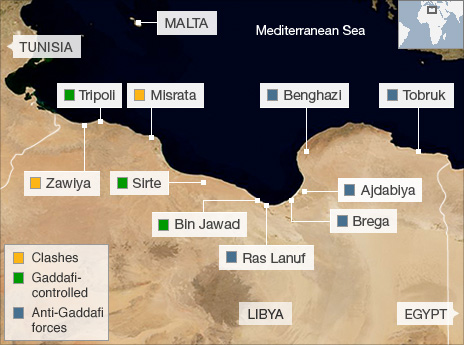
The strategic situation in Libya 07.03.2011. Some reports suggest Gaddafi
has taken Zawiya, after days of heavy fighting. (Map source BBC)
Tunisia interim leaders dissolve secret police agency, BBC reports: Tunisia's interior ministry has announced it is dissolving the country's secret police service. The agency had been widely accused of committing human rights abuses during the rule of President Zine al-Abidine Ben Ali, who was ousted on 14 January. Interim Prime Minister Caid Essebsi has also announced a new government, which includes no members of the old regime. The interim government is running Tunisia until elections scheduled to take place on 24 July. The interior ministry announced online that it was disbanding the State Security Department, under which the secret police operated, and would respect "civic freedoms and rights".
The move was a "definitive break with any form of organisation resembling the political police at the level of structure, mission or practice," it said. "These practical measures are in harmony with the values of the revolution, in the wish to respect the law, in word and deed, and in consecrating the climate of confidence and transparency in the relationship between the security services and the citizen," the ministry said in a statement. The secret police had played a key role in suppressing the opposition in the country. Human Rights Watch said members of the agency "hounded dissidents, tortured islamists, and shook down their compatriots". The BBC's regional analyst Magdi Abdelhadi says dismantling the agency had been a key demand of the opposition, so the move will be seen as the ultimate victory over the Ben Ali regime.
New ministers. The announcement came shortly after Mr Essebsi named the new interim government which contains no former members of the regime. The new line-up retains most of the key ministers from the previous interim administration, including those for defence, interior, justice and foreign affairs. But a number of new appointments have been made following a spate of resignations last week which included Prime Minister Mohammed Ghannouchi. He was seen by the protesters as being too close to the old regime. Members of the government will not be allowed to stand as candidates in future elections. Tunisia has struggled to restore stability since mass protests ousted Mr Ben Ali. The victorious protesters have been demanding that the new leaders move faster to bring about political and social change. However, other Tunisians have been urging the protesters to return to work and bring an end to the rallies. With the two announcements on Monday, our correspondent says the Tunisian [embryo] revolution appears to have met two of its main goals.
"Remember tomorrow: * Action day: International Women's Day - 8th of March - Anarcha-feminist actions, history and manifesto! Click here! * - We have a solidaric action for our struggling libertarian sisters in the Arab revolt, see also the reports of 29.01.2011, 10.02.2011 and 22.02.2011," main spokeswoman of the Anarchafeminist International, A. Quist, said to AIIS, which also has the 8th of March event at the front page.
08.03.2011. Ad Libya Tuesday. Stalemate. Calls for a Libya no-fly zone mount. Western officials have said a no-fly zone does not require a UN mandate, but they would prefer to have one. The battle of Tripoli may happen soon, i.e. D-day, but at large dependent on more arms to the rebels and airstrikes by international forces; regular foreign ground forces are ruled out! Development in other Arab countries. 8th of March - International Women's Day.
Monday 28.01.2011 the strategic picture was the following:
1. Ad. 'While international officials just talk about armed support to the Libyan people...' 1. The US moved naval and air forces closer to Libya and said all options were open, including patrols of the North African nation's skies to protect its citizens from their ruler. 2. British Prime Minister David Cameron told lawmakers: "We do not in any way rule out the use of military assets". 3. Paris was studying "all solutions" - including military options. 4. Even a flight ban seemed unlikely in the short term. Russian Foreign Minister Sergey Lavrov, whose country would have to support such a move if the US and its allies wanted authorization from the UN Security Council... dismissed the idea in public remarks.
2. Ad. 'Gaddafi bombs and threatens with more bombing today of the Libyan people...' 1. Gaddafi called Zawiya's influential tribal leader Mohammed al-Maktouf and warned him that if the rebels don't leave the city's main square by early Tuesday, they will be hit by warplanes. 2. Several residents of the eastern city of Ajdabiya said Gaddafi's air force also bombed an ammunition depot nearby held by rebels. 3. On Monday, pro-Gaddafi forces retook control of the western border crossings with Tunisia that had fallen under opposition control and they bombed an ammunition depot in the rebel-held east, residents in the area said. 4. The opposition is backed by numerous units of the military. Gaddafi long kept the military weak, fearing a challenge to his rule, so many units are plagued by shortages of supplies and ammunition.
Tuesday 01.03.2011 the strategic picture was the following. NB! Gaddafi did not bomb any of the Libyan people with airstrikes, as suggested on Monday. But he still probably may do it!
3. Ad. 'World leaders still just talk about armed support to the Libyan people...' The EU and the US have talked about the possibility of creating a no-fly zone over Libya. However, Russia's top diplomat ruled out the idea as "superfluous" and said world powers must instead focus on fully using the sanctions the UN Security Council approved over the weekend. [IIFOR's strategical experts said to AIIS that sanctions at best work in the long run, and are in no way sufficient to stop the genocide!] Others suggested the tactic - used successfully in northern Iraq and Bosnia - to prevent Gaddafi from bombing his own people. [IIFOR said to AIIS that this is compatible with the advice of AISC and the AI/IFA.] But Russia's consent is required as a veto-wielding member of the Security Council.
The White House said [war] ships were being redeployed in preparation for possible humanitarian efforts but stressed it "was not taking any options off the table." "We are looking at a lot of options and contingencies. No decisions have been made on any other actions," Defense Secretary Robert Gates said. French Foreign Minister Alain Juppe sounded a note of caution, saying military intervention would not happen without a clear United Nations mandate. British Prime Minister David Cameron said it was unacceptable that "Colonel Gaddafi can be murdering his own people using airplanes and helicopter gunships." General James Mattis, commander of US Central Command, told a Senate hearing that imposing a no-fly zone would be a "challenging" operation that would mean actual attack. "You would have to remove air defense capability in order to establish a no-fly zone, so no illusions here," he said. "It would be a military operation -- it wouldn't be just telling people not to fly airplanes."
Must a large massacre happen before world leaders give armed support? Then, who are responsible if a large massacre happens? While the grass grows, the cow is dying!
4. Ad. 'The Libyan people ask for airstrikes...' Several of the Libyan people have agreed on the following: Gaddafi's air force is a serious threat to us. We will welcome a no-fly zone on Gaddafi's warplanes over the whole of Libya. The only thing we object to is foreign troops on Libyan soil. Many would not oppose shelling the positions of pro-Gaddafi forces by foreign warships or planes!
5. Wednesday 02.03.2011 the strategic picture was the following. In the morning the need for more arms to the Libyan people is about the same as Monday and Tuesday, i.e. urgent. The Libyan people are not opposed to shelling the positions of pro-Gaddafi forces by foreign planes. The Libyan people object to foreign [regular ground] troops on Libyan soil. NB! Gaddafi did bomb the Libyan people with airstrikes, but most likely with no fatalities - so far! There may be more -- and more deadly -- later on, i.e. if his airforce is not bombed by internationals, very, very soon!!
Death toll updated to 6000 people according to NRK! More Libyan people including the rebel National Libyan Council ask for airstrikes by international forces! The National Libyan Council also told its forces will push westwards if Gaddafi refuses to step down. Thus, the need for more arms to the Libyan people is more an more urgent. See also the report of 02.03.2011.
6. Thursday 03.03.2011 the strategic picture was the following: About the same as Wednesday. The battle of Tripoli may happen in the weekend, i.e. D-day! Both the need for more arms and airstrikes by international forces are more and more urgent, but regular foreign ground forces are ruled out. World leaders talked about armed support on overtime - and were closer to agreement of armed support to the Libyan people! In this connection the following words of wisdom of Sun Tzu, and the Art of War, were mentioned:
1. "One may know how to conquer without being able to do it."
2. "There is no instance of a country having benefited from prolonged warfare."
3. "In war, then, let your great object be victory, not lengthy campaigns."
4. "Invincibility lies in the defence; the possibility of victory in the attack."
And... "If words of advice are not clear and distinct, and if they are not thoroughly understood, then the generals are to blame. But, if words of advice are clear and nothing happens, then it is the fault of the world's main leaders!" said General H. Mann of the AISC to AIIS. "The advice from the AISC and the AI/IFA, to the world leaders, seems to be clear enough, and should be thoroughly understood..." IIFOR said to AIIS.
Libyan rebels pushed west on Thursday, extending their grip on a key coast road as Muammar Gaddafi received a warning he would be held to account at The Hague for suspected crimes by his security forces.
Thursday AIIS heard about a proposal by Venezuelan President Hugo Chavez to negotiate a peaceful settlement to Libya's intensifying conflict. An aide to Mustafa Abdel Jalil, head of the rebels' National Libyan Council, told Reuters the rebels were open to talks only on Gaddafi's resignation or exile to avoid more bloodshed. "There is nothing else to negotiate," he said.
He also called for foreign air strikes to set up a "no-fly zone" to help the rebels topple Gaddafi. "We must go to Tripoli and get rid of Gaddafi," shouted one, to murmurs of approval from those around him. "But we have only our shirts to protect us from the cannon," said Ahmed el Sherif, 60, standing on the edge of the group.
In Paris, French Foreign Minister Alain Juppe said France and Britain would support the idea of setting up a no-fly zone over Libya if Gaddafi's forces continued to attack civilians. US President Barack Obama said the United States and the international community must be ready to act rapidly to stop violence against civilians or a humanitarian crisis in Libya. CNN reported: President Obama repeats call for Libyan leader Moammar Gadhafi to leave, saying he "has lost the legitimacy to lead."
Doubts surrounded Gaddafi's chemical weapons arsenal. IIFOR said to AIIS that there is still a danger that Gaddafi may use dirty bombs based on his significant stock of mustard gas, i.e. chemical warfare. Say, mustard gas may be placed on trucks together with explosives, as IED-dirty bombs (IED is Improvised Explosive Device], and driven into crowds, and then made to explode, one way or the other!
7. Friday 04.03.2011 the strategic picture was the following: About the same as Thursday. The battle of Tripoli may happen in the weekend, i.e. D-day! Both the need for more arms and airstrikes by international forces are more and more urgent, but regular foreign ground forces are ruled out. World leaders are most likely closer to an agreement of armed support to the Libyan people! See also the reports of 02.03.2011 and 03.03.2011.
General H. Mann of the AISC said to AIIS: "World leaders should very, very soon come to an agreement of armed support to the Libyan people! They should not wait for a large massacre to happen before giving armed support! While the grass grows, the cow is dying!" In this connection the following words of wisdom of Sun Tzu, and the Art of War, may be mentioned:
5. "All warfare is based on deception. Hence, when able to attack, we must seem unable; when using our forces, we must seem inactive; when we are near, we must make the enemy believe we are far away; when far away, we must make him believe we are near."
6. "Appear weak when you are strong, and strong when you are weak."
7. "Let your plans be dark and impenetrable as night, and when you move, fall like a thunderbolt."
8. "When strong, avoid them. If of high morale, depress them. Seem humble to fill them with conceit. If at ease, exhaust them. If united, separate them. Attack their weaknesses. Emerge to their surprise."
9."If quick, I survive. If not quick, I am lost. This is 'death'."
Friday Libya clashes widened. More bloodshed signaled an escalation in efforts by both sides to break the deadlock, but mostly in vain. Gaddafi's forces battled rebels on several fronts in a worsening of Libya's crisis, and unrest erupted in the capital Tripoli where Gaddafi's gunmen fired to break up crowds. So far, Gaddafi has had little success in taking back territory, with several rebel cities repelling assaults and the entire eastern half of the country under rebel control. But the opposition forces have seemed unable to go on the offensive to march on pro-Gaddafi areas.
Vowing "victory or death" and declaring "we have no choice but to continue our fight against this dictator"; "all these people are threatened with death"; "we have no [military] education, no economy, no infrastructure"and "we want nothing but the end of the regime"; the opposition forces seem still determined and in high moral, but also more desperate. Abdullah al-Mahdi, a rebel spokesman, told Al Jazeera opposition fighters would attack the capital Tripoli once a "no-fly" zone was enforced by international powers to try to shatter Gaddafi's grip on the country of six million people.
Western nations have called for Gaddafi to go and are considering various options including the imposition of a no-fly zone, but are wary about any offensive military involvement. US President Barack Obama said he was concerned a bloody stalemate could develop between Gaddafi and rebel forces but gave no sign of a willingness to intervene militarily. "Muammar Gaddafi has lost the legitimacy to lead and he must leave," Obama repeated. Meanwhile, in Tripoli - Gaddafi's most important bastion - his loyalists have waged a campaign of terror to ensure that protesters do not rise up in significant numbers.
In the evening The Anarchist International Security Council (AISC) & The Anarchist International - AI/IFA and all its sections, see The official link-site of AI/IFA, including the anarchosyndicalist labor confederation International Workers of the World and The Anarchist Confederation of Africa, declared in a joint statement, to AIIS: Ad a) the present stalemate and quagmire in Libya, and b) that opposition fighters would attack the capital Tripoli once a "no-fly" zone is enforced by international powers, c) joint NATO airstrikes in Libya are very, very urgently needed, i.e. similar to the 'Bosnia-case' a.o.t. using Italian NATO bases...
8. Saturday 05.03.2011 the strategic picture was the following: About the same as Friday, i.e. a stalemate and quagmire in Libya. The battle of Tripoli may still happen in the weekend or soon after, i.e. D-day, but opposition fighters will most likely not attack the capital Tripoli unless a "no-fly" zone, all included, is enforced by international powers. On the other hand opposition fighters will most likely attack the capital Tripoli once a "no-fly" zone is enforced by international powers. They also need more arms. Further progress is thus at large dependent on more arms to the rebels and airstrikes by international forces; regular foreign ground forces are ruled out. World leaders are most likely closer to an agreement of armed support to the Libyan people! See also the reports of 02.03.2011, 03.03.2011 and 04.03 2011. Conclusion: The battle of Tripoli may still happen in the weekend or soon after, i.e. D-day, but at large dependent on more arms to the rebels and airstrikes by international forces; regular foreign ground forces are ruled out!
Saturday there were marginal rival gains - a) by Gaddafi's forces in resistant Zawiya - where Deputy Foreign Minister Khaled Qaid claimed "99 percent" of Zawiya was under government control; and b) by the rebels in taking over the port of Ras Lanouf - signaling an increasingly long and violent battle that could last weeks or months and a situation in Libya ever closer to civil war. Rebels in the east advanced somewhat from their eastern stronghold, took the small town of Bin Jawad, some 525 km east of Tripoli, and were moving on toward Sirte, Gaddafi's heavily guarded home town, 160 km (100 miles) away, setting the stage for fierce fighting with pro-Gadhafi forces who hold sway in the tribal area. It is a question how long superior moral can give victory for the rebels.
Western leaders focused on humanitarian aid instead of military intervention. President Barack Obama has insisted that Gadhafi must leave and said Washington was considering a full range of options, including the imposition of a "no-fly" zone over Libya. Dozens were killed on Saturday. The head of NATO has suggested international armed actions may happen, but are dependent on a new UN-Security Council resolution. At midnight still a stalemate and quagmire in Libya, and this will probably continue until the rebels get more arms and air-support from international powers.
9. Sunday 06.03.2011 the strategic picture was the following: In the morning, about the same as Friday and Saturday, i.e. a stalemate and quagmire in Libya. The battle of Tripoli may still happen in the weekend or soon after, i.e. D-day, but opposition fighters will most likely not attack the capital Tripoli unless a "no-fly" zone, all included, is enforced by international powers. On the other hand opposition fighters will most likely attack the capital Tripoli once a "no-fly" zone is enforced by international powers. They also need more arms. Further progress is thus at large dependent on more arms to the rebels and airstrikes by international forces; regular foreign ground forces are ruled out.
If this is not happening, most likely a long and violent civil war-like situation that could last weeks or months or more will be the result. Also, it is a question how long superior moral can give victory for the rebels. However world leaders are most likely closer to an agreement of armed support to the Libyan people! The head of NATO has suggested international armed actions may happen, but are dependent on a new UN-Security Council resolution. It should hurry up! See also the reports of 02.03.2011, 03.03.2011, 04.03 2011 and 05.03.2011. Conclusion: The battle of Tripoli may still happen in the weekend or soon after, i.e. D-day, but at large dependent on more arms to the rebels and airstrikes by international forces; regular foreign ground forces are ruled out! If a new UN-Security Council resolution is needed for international armed support - it better hurry up!
Gaddafi's forces somewhat halted rebel move toward the capital, unleashing its air power on the poorly equipped and poorly organized oppositionl force. However except for the small town of Bin Jawwad, about 110 miles (160 kilometers) east of Sirte, now most likely on Gaddafi's hands, so far the rebels seem to have managed to repel the counteroffensive in the east. Gaddafi's forces took hostages in the town of Bin Jawwad in the morning. They took one of every family hostage to keep them from fighting.
The regime has also fought throughout the weekend to retake control of Zawiya west of Tripoli - where bloody street battles were reported. Zawiya, just 30 miles from Tripoli, is the closest rebel-held city to the capital. On Sunday, Zawiya residents said rebels were back in control of the city after a three-hour battle.
Thus also Sunday, as Saturday, there were marginal rival gains, and continued stalemate and quagmire in Libya. Hundreds, perhaps thousands, have died since Libya's uprising began on Feb. 15, but tight restrictions on media make it near impossible to get an accurate tally. As mentioned 02.03.2011 NRK estimated the death toll to about 6000 persons. More than 200,000 people have fled the country, most of them foreign workers. The exodus is creating a humanitarian crisis across the border with Tunisia.
The rebels headquartered in the main eastern city of Benghazi have as mentioned already set up an interim governing council that is urging international airstrikes on Gaddafi's strongholds and forces. "We call on the world to take action, to strike (Gaddafi's) powerful bases to rescue the civilians," one Misrata resident said. "He has all the power to smash the people."
Libya appears to be sliding toward a civil war that could drag out for weeks, or even months, perhaps more. Both sides appear relatively weak and poorly trained, though Gaddafi's forces clearly have the advantage in terms of number and equipment.
With the counteroffensive intensifying, Libya sank deeper into chaos and heavy bloodshed while the international community appeared to be struggling to put military muscle behind its demands for Gaddafi to give up power. If the rebels continue to advance, even slowly, Gaddafi's heavy dependence on air power could prompt the West to try hurriedly enforce a no-fly zone over the country to prevent the regime from defeating the rebels. However, enforcing a no-fly zone could take weeks to organize and, as US Defense Secretary Robert Gates has said, it must be preceded by a military operation to take out Libya's air defenses. British Foreign Minister William Hague urged Gaddafi to hand over power and put an "immediate stop" to the use of armed force against Libyans and give up power. He said a no-fly zone over Libya is still in an early stage of planning and ruled out the use of ground forces. D-day this weekend is of course ruled out.
10. Monday 07.03.2011 the strategic picture was the following: About the same as Friday, Saturday and Sunday, i.e. a stalemate and quagmire in Libya. The battle of Tripoli may happen soon, i.e. D-day, but opposition fighters will most likely not attack the capital Tripoli unless a "no-fly" zone, all included, is enforced by international powers. On the other hand opposition fighters will most likely attack the capital Tripoli once a "no-fly" zone is enforced by international powers. They also need more arms. 'Soon' may be a rather relative concept...
Further progress is thus at large dependent on more arms to the rebels and airstrikes by international forces; regular foreign ground forces are ruled out. However, enforcing a no-fly zone could take weeks to organize and it must be preceded by a military operation to take out Libya's air defenses. But this should start as soon as possible. The rebel forces may advance as soon as a military operation to take out Libya's air defenses is done.
If this is not happening, most likely a long and violent civil war-like situation that could last weeks or months or more will be the result. Also, it is a question how long superior moral can give victory for the rebels. However world leaders are most likely closer to an agreement of armed support to the Libyan people! The head of NATO has suggested international armed actions may happen, but are dependent on a new UN-Security Council resolution. It should hurry up! Especially Russia and China. See also the reports of 02.03.2011, 03.03.2011, 04.03 2011, 05.03.2011 and 06.03.2011. Conclusion: The battle of Tripoli may happen soon, i.e. D-day, but at large dependent on more arms to the rebels and airstrikes by international forces; regular foreign ground forces are ruled out! If a new UN-Security Council resolution is needed for international armed support - it better hurry up! Especially Russia and China!
Mustafa Abdul-Jalil, the head of the interim government National Council set up by the opposition in Benghazi, has met with delegations from European countries and discussed possibilities for a no-fly zone, or even Western airstrikes on bases from which attacks are launched, an opposition official close to the council said Monday. He did not say where the discussions stood and would not specify which European countries sent delegations. He also said they discussed the possibility of Western recognition of the National Council as Libya's government. The official spoke on condition of anonymity because of the sensitivity of the discussions. Western officials have said a no-fly zone does not require a UN mandate, but they would prefer to have one. John Kerry, the influential Democratic chairman of the Senate Foreign Relations Committee who is close to Obama, repeated his call for a no-fly zone and floated another idea -- bombing Libyan runways to ground Gaddafi's warplanes.
A rebel repeated: "We don't want a foreign military intervention (on the ground), but we do want a no-fly zone. We are all waiting for one." "That a foreign regular military intervention on the ground seems to be ruled out, does not mean that limited military operations, also on the ground, say, related to a no-fly zone are ruled out," a spokesperson for The Anarchist International Security Council (AISC) & The Anarchist International - AI/IFA said to AIIS. Calls for a Libya no-fly zone mount - A million Libyans need aid; UK, France seek no-fly zone.
The strategic situation in Libya 07.03.2011. Some reports suggested Gaddafi
had taken Zawiya, after days of heavy fighting. (Map source BBC)
* Tuesday 08.03.2011 the strategic picture is the following: About the same as Friday, Saturday, Sunday and Monday, i.e. a stalemate and quagmire in Libya. The battle of Tripoli may happen soon, i.e. D-day, but opposition fighters will most likely not attack the capital Tripoli unless a "no-fly" zone, all included, is enforced by international powers. On the other hand opposition fighters will most likely attack the capital Tripoli once a "no-fly" zone is enforced by international powers. They also need more arms. 'Soon' may be a rather relative concept...
Further progress is thus at large dependent on more arms to the rebels and airstrikes by international forces; regular foreign ground forces are ruled out. However, enforcing a no-fly zone could take weeks to organize and it must be preceded by a military operation to take out Libya's air defenses. But this should start as soon as possible. The rebel forces may advance as soon as a military operation to take out Libya's air defenses is done.
If this is not happening, most likely a long and violent civil war-like situation that could last weeks or months or more will be the result. Also, it is a question how long superior moral can give victory for the rebels. However world leaders are most likely closer to an agreement of armed support to the Libyan people! The head of NATO has suggested international armed actions may happen, but are dependent on a new UN-Security Council resolution. It should hurry up! Especially Russia and China. Calls for a Libya no-fly zone mount. Western officials have said a no-fly zone does not require a UN mandate, but they would prefer to have one. Bombing Libyan runways to ground Gaddafi's warplanes seems to be reasonable! See also the reports of 02.03.2011, 03.03.2011, 04.03 2011, 05.03.2011, 06.03.2011 and 07.03.2011.
Yesterday a rebel repeated: "We don't want a foreign military intervention (on the ground), but we do want a no-fly zone. We are all waiting for one." "That a foreign regular military intervention on the ground seems to be ruled out, does not mean that limited military operations, also on the ground, say, related to a no-fly zone are ruled out," a spokesperson for The Anarchist International Security Council (AISC) & The Anarchist International - AI/IFA said to AIIS.
Conclusion: The battle of Tripoli may happen soon, i.e. D-day, but at large dependent on more arms to the rebels and airstrikes by international forces; regular foreign ground forces are ruled out! If a new UN-Security Council resolution is needed for international armed support - it better hurry up! Especially Russia and China! However Western officials have said a no-fly zone does not require a UN mandate, but they would prefer to have one. Calls for a Libya no-fly zone mount. Bombing Libyan runways to ground Gaddafi's warplanes seems to be reasonable!
Thus: STILL RED ALERT - The conclusion: Armed international support actions for the Libyan people are urgently needed!! Send in arms! Airstrikes! Still very, very soon time for NATO (or similar international forces) airstrikes and bombing of Colonel Gaddafi and his henchmen!!!
The Anarchist International Security Council (AISC) & The Anarchist International - AI/IFA and all its sections, see The official link-site of AI/IFA, including the anarchosyndicalist labor confederation International Workers of the World and The Anarchist Confederation of Africa, declared in a joint statement, to AIIS: Many Libyan people have been killed -- estimated to 6000 02.03.2011 by NRK (but as low as 2000 by CNN 07.03.2011) -- and even more will probably follow, say, due to probable bombing/airstrikes, and even may be use of mustard gas -- by Colonel Gaddafi and his henchmen. The situation in Libya is in reality genocide against the people, thousands murdered by Colonel Gaddafi and his henchmen, i.e. a totalitarian, fascist, extremist, oligarchy with severe ochlarchy.
The situation in Libya is more and more similar to the more or less civil wars in the Balkan where the Serbian ruler and his henchmen were responsible for genocide. Now Colonel Gaddafi and his henchmen in a similar way are responsible for genocide and rule of terror, i.e. terrorism, in Libya, against the Libyan people. Quite legitimate the Libyan people are claiming a development towards freedom & democracy and human rights - where Colonel Gaddafi and his henchmen, i.e. a totalitarian, fascist , extremist, oligarchy with severe violent ochlarchy, stand in the way...
In the Balkan more or less civil wars, the international anarchist movement (i.e. at that time IFA, see The official link-site of AI/IFA) via the AIIS/AIT was among the first to call for NATO airstrikes and bombing of the Serbian ruler and his henchmen, responsible for genocide - to stop this crime against humanity. The Americans and thus NATO waited far too long, but at last took relevant action against the Serbian ruler and his henchmen. This time we expect a more quick action, including direct actions, against the terror rule, i.e. terrorism, and genocide by Colonel Gaddafi and his henchmen, murdering the Libyan people.
Must a large massacre happen before world leaders give armed support? Then, world leaders are partly responsible if a large massacre happens! While the grass grows, the cow is dying! NB! World leaders however now seem to be closer to an agreement of armed support to the Libyan people! This means RED ALERT and armed international actions very, very soon!!!
Ad a) the present stalemate and quagmire in Libya, and b) that opposition fighters would attack the capital Tripoli once a "no-fly" zone is enforced by international powers, c) joint NATO airstrikes in Libya are very, very urgently needed, i.e. similar to the 'Bosnia-case' a.o.t. using Italian NATO bases... As mentioned: if a new UN-Security Council resolution is needed for international armed support - it better hurry up! Especially Russia and China! However Western officials have said a no-fly zone does not require a UN mandate, but they would prefer to have one. Calls for a Libya no-fly zone mount.
Further progress is at large dependent on more arms to the rebels and airstrikes by international forces; regular foreign ground forces are ruled out. However, enforcing a no-fly zone could take weeks to organize and it must be preceded by a military operation to take out Libya's air defenses. But this should start as soon as possible. The rebel forces may advance as soon as a military operation to take out Libya's air defenses is done. That a foreign regular military intervention on the ground seems to be ruled out, does not mean that limited military operations, also on the ground, say, related to a no-fly zone are ruled out! Bombing Libyan runways to ground Gaddafi's warplanes seems to be reasonable!
Send in arms! Ad Libyans saying a) 'we are for shelling the positions of pro-Gaddafi forces by foreign planes', and b) 'we need help from outside' & 'we have only our shirts to protect us from the cannon', and similar; in addition to airstrikes and bombing of Gaddafi and his henchmen's positions, the international community should supply the struggling Libyan people with arms - very, very soon! However many Libyans have said that they are not interested in regular ground forces from foreign powers, thus this is mainly ruled out! A problem with possible hostages taken by Gaddafi and his henchmen is practically solved, and it is now very, very soon time for international armed actions!
Airstrikes! It is very, very soon time for NATO (or similar international forces) airstrikes and bombing of Colonel Gaddafi and his henchmen's positions, also to avoid his probable tactic of using human shields, mixing with civilians in Tripoli, etc. Although this tactic may backfire somewhat due to too much spreading of his troops...
And take a look at Strategy and tactics, with links... especially the links! Remember: most of the members of The Anarchist International Security Council (AISC) & The Anarchist International - AI/IFA and its sections are de facto acting generals... all on equal footing - none above!! Thus listen to our advice!
We call on Colonel Gaddafi and his henchmen to step down - NOW!... i.e. if not today, within very few days!! And we call on the Libyan people: Remember Direct Action and Antimilitarism - an anarchist approach - IJA 2 (38) & The International Conference on Terrorism - IJA 4 (31)!!! As mentioned, it is very, very soon time for NATO (or similar international forces) airstrikes and bombing of Colonel Gaddafi and his henchmen, similar to the campaign against the Serbian ruler and his henchmen in the Balkan more or less civil wars. Gaddafi is very likely worse than the Serbian ruler!!!!
Gadhafi forces barrage rebels in east and west, Associated Press reported: After dramatic successes over the past weeks, Libya's rebel movement appears to have hit a wall of overwhelming power from loyalists of Moammar Gadhafi [a.k.a. Colonel Gaddafi]. Pro-regime forces halted their drive on Tripoli with a heavy barrage of rockets in the east and threatened Tuesday to recapture the closest rebel-held city to the capital in the west. If Zawiya, on Tripoli's doorstep, is ultimately retaken, the contours of a stalemate would emerge - with Libya divided between a largely loyalist west and a rebel east as the world wrestles with the thorny question of how deeply to intervene.
President Barack Obama and British Prime Minister David Cameron agreed to plan for the "full spectrum of possible responses" on Libya, including imposing a no-fly zone to prevent Gadhafi's warplanes from striking rebels. According to a White House statement, the two leaders spoke Tuesday and agreed that the objective must be an end to violence and the departure of Gadhafi "as quickly as possible."
A spokesman for the opposition's newly created Interim Governing Council in Benghazi, meanwhile, said a man who claimed to represent Gadhafi made contact with the council to discuss terms for the leader of four decades to step down. Mustafa Gheriani told the Associated Press the council could not be certain whether the man was acting on his own initiative or did in fact represent Gadhafi. "But our position is clear: No negotiations with the Gadhafi regime," said Gheriani, who declined to say when contact was made or reveal the identity of the purported envoy. Libyan state television denied that Gadhafi had sent an envoy to talk to the rebels.
In London, British Foreign Secretary William Hague said that neither Gadhafi nor rebel forces appeared currently able to establish supremacy. "At the moment ... it seems that either side lacks the immediate power to overthrow the other," he said.
Later Tuesday, Gadhafi made a surprise appearance at a hotel hosting foreign correspondents in Tripoli, arriving just before midnight. He raised his fist in the air as he walked from his car to the hotel, then he went into a room separated by curtains for exclusive interviews with a Turkish and a French television station. He stayed about an hour, then he left without speaking to the AP and other news organizations waiting outside. "Gadhafi was in a very good mood and he wanted to clarify the situation in Libya," Abdelmajid al-Dursi, Gadhafi's director of foreign media said afterward.
Zawiya, a city of 200,000, was sealed off under a fifth day of a destructive siege, with conflicting reports of who was in control. A brigade led by one of Gadhafi's sons, Khamis, is believed to be leading the assault, shelling neighborhoods with tank and artillery fire from the outskirts and trying to push troops in to the city's central Martyrs Square where rebels had set up camp. The city hospital has been overwhelmed with dead and wounded and many houses have been damaged, according to residents who escaped the past two days. One man who slipped out of the city on Monday said pro-Gadhafi forces had seized the central square. An adviser to the Libyan Foreign Ministry in Tripoli on Tuesday also claimed that government troops were in control, raising the green flag over the square. The adviser, who is originally from Zawiya, said he was trying to mediate a cease-fire with remaining rebels. He spoke on condition of anonymity because of the sensitivity of the talks. But a resident of the nearby town of Sabratha said people who fled from Zawiya on Tuesday afternoon told him fighting continued, with rebels back in control of the square. He said they reported hit-and-run attacks between the two sides.
The various reports could not be independently confirmed. Electricity, phone and Internet services have all been cut in the city, making it impossible to reach witnesses inside Zawiya, just 30 miles west of Tripoli. The recapture of Zawiya would be a significant victory for Gadhafi, easing a threat just outside his main bastion in the capital. If his forces can hold it, it would free up troops to deploy against other rebel-held areas. The fall of Zawiya to anti-Gadhafi residents early on in the uprising that began Feb. 15 had illustrated the initial, blazing progress of the opposition. The uprising swept over the entire eastern half of the country, breaking it out of the regime's control, and seized Zawiya and several other cities and towns in the northwestern pocket of the country where Gadhafi's regime was confined.
But the government could be regaining some balance and its capability to lash back with powerful force. The battle is far from over and could be drawn out into a long and bloody civil war. The latest round of fighting on opposite ends of Libya's Mediterranean coast once again revealed the weakness and disorganization of both sides. Even if it ends with Zawiya's recapture, the long siege of the city underlined the rebels' tenacity and the struggles of even a reportedly elite force like the Khamis Brigades to crush them.
At the same time, Gadhafi's regime has been using its air power advantage more each day to check a rebel advance west toward Tripoli on the main coastal highway leading out of the opposition-controlled eastern half of the country. The increasing use of air power underlines the vulnerability of the rebel forces as they attempt to march across open, desert terrain - but it also could prompt world powers to impose a no-fly zone over Libya to deny Gadhafi that edge.
In the east, Gadhafi's forces succeeded over the weekend in blunting the rebels' attempt to march toward Tripoli, repelling them from Bin Jawwad, a small town 375 miles (600 kilometers) east of the capital, and driving them back to the oil port of Ras Lanouf, further east.
On Tuesday, troops fired barrages of rockets at a rebel contingent that tried to move out from Ras Lanouf. At least 26 wounded were rushed to the hospital in the town, some of them with legs lost and other serious injuries, according to doctors there. "I was hit in the arm and leg, my friend was wounded in the stomach," Momen Mohammad, 31, said while lying in a hospital bed. Earlier in the day, warplanes launched at least five new airstrikes near rebel position in Ras Lanouf, one hitting a two-story house in a residential area, causing some damage. None of the strikes appeared to cause casualties, suggesting they were intended to intimidate the fighters, according to an Associated Press reporter who saw the strikes. The anti-regime forces were not taking any chances and were spreading out deep inside the desert around the area in small groups. The rebels seem to have reached a point of their campaign where they need to figure out how to organize resupply lines and avoid becoming easy targets for warplanes in their march across the open desert region with little cover. The extent of their westward reach is a checkpoint about six miles (10 kilometers) west of Ras Lanouf.
In Benghazi, Libya's second largest city and the main rebel stronghold in east, there was an unusual attack after weeks of quiet that followed the rebel capture of the territory. Assailants in a car tossed a grenade at a hotel where foreign journalists were staying, but there were no casualties and only some light damage to windows, an opposition official said.
In diplomatic action, the United States and its NATO allies edged closer Monday to formulating a military response to the escalating violence in Libya as the alliance boosted surveillance flights over the country and the Obama administration signaled it might be willing to help arm Gadhafi's opponents. Europe, meanwhile, kick-started international efforts to impose a no-fly zone. France and Britain have taken the lead in drafting a UN Security Council resolution that would establish a no-fly zone over Libya to prevent Gadhafi's warplanes from bombing civilians and rebels. It still appeared unlikely that US warplanes or missiles soon would deploy in Libya. British and French officials said the no-fly resolution was being drawn up as a contingency and it has not been decided whether to put it before the UN Security Council, where Russia holds veto power and has rejected such a move. [As mentioned] Western officials have said a no-fly zone does not require a UN mandate, but they would prefer to have one.
An official with a subsidiary of Libya's national oil company said Tuesday that production has dropped by about 90 percent, a reflection of the beating the OPEC member's oil sector is taking amid violence raging in the country. Sirte Oil Co. is producing about 9,500 barrels per day, compared to normal production levels at about 95,000 barrels per day, said company official Ahmed Jerski. Analysts estimate that more than half of Libya's almost 1.6 million barrels per day in production is being shut-in, and the disruption in exports has sent global oil prices skyrocketing. The US benchmark crude contract for April delivery was hovering slightly below $104 per barrel on Tuesday, retreating from highs of almost $107 per barrel a day earlier. The drop came as several OPEC ministers said they were talking informally about whether to ramp up production to offset the Libya supply drop.
The upheaval has also sparked a massive exodus by foreign workers in Libya fleeing the violence. As of Tuesday, 224,661 migrants had reached Libya's borders with Tunisia, Egypt, Niger and Algeria since February 20, according to the latest International Organization for Migration figures provided Tuesday to AP. But a Red Crescent official said Tuesday that soldiers loyal to Gadhafi have blocked some 30,000 migrant workers from fleeing into Tunisia and forced many to return to work in Tripoli. Ibrahim Osman of the International Federation of Red Cross and Red Crescent Societies told the Associated Press that the migrant workers were rounded up and held in Libyan immigration buildings near the Tunisian border last week. Osman, who heads the agency's assessment teams in northern Africa, said Gadhafi soldiers were forcibly returning many of the 30,000 Bangladeshis, Egyptians and sub-Saharan Africans nearing the Ras Ajdir border crossing. He said loyalists held a pro-government demonstration at the crossing and appear to have forcibly return the migrants to service jobs.
Obama and his team mull responses on Libya. Preparing for the prospect of deeper international intervention, President Barack Obama and British Prime Minister David Cameron conferred Tuesday on the spectrum of military and humanitarian responses to Libya's worsening civil strife. The British leader bluntly said after the talk that the world cannot stand aside and let Moammar Gadhafi brutalize his people. In weighing the options, the Obama administration underscored that any authorization of a no-fly zone over Libya must come from the United Nations Security Council. "We think it's important that the United Nations make this decision - not the United States," Secretary of State Hillary Rodham Clinton told Britain's Sky News. The comment reflected Obama's thinking that any action intended to halt Libya's violence must carry the legitimacy and strength of an international coalition.
Obama's top national security advisers were to meet Wednesday at the White House to outline what steps are realistic to pressure Gadhafi to end the violence and leave power, officials said. Clinton, national security adviser Tom Donilon and CIA chief Leon Panetta are among those expected to attend as Obama's team centered in on recommendations for him. The president himself was not expected to attend. Obama and Cameron agreed to press ahead on potential responses from the US and its NATO allies, including the creation of a no-fly zone over Libyan airspace to keep Gadhafi from bombarding the rebels seeking to oust him from power, according to statements released from their offices. Other options including steeper surveillance, humanitarian assistance and enforcement of an arms embargo as Libya slips from Gadhafi's grip and into a civil war. "We have got to prepare for what we might have to do if he (Gadhafi) goes on brutalizing his own people," Cameron told the BBC.
Cameron said his call with Obama was to talk "about the planning we have to do in case this continues and in case he does terrible things to his own people." The prime minister added: "I don't think we can stand aside and let that happen." Libya's rebel movement has been countered by overwhelming power from loyalists to Gadhafi. Pro-regime forces halted its drive on Tripoli with a heavy barrage of rockets in the east and threatened on Tuesday to recapture the closest rebel-held city to the capital in the west. The continuing violence increased pressure, from NATO to Washington, for intervention.
Rebels are fighting to oust Gadhafi from power after more than 41 years, and his bloody crackdown has left hundreds, and perhaps thousands, dead. Libya's UN ambassador, who broke with the regime, has urged the UN Security Council to impose a no-fly zone to prevent Gadhafi's forces from bombing civilians. Britain and France are drafting a resolution, but no decision has been made. The United States has taken action itself and worked with world partners to impose sanctions on the Libyan regime and freeze its assets.
Republican Sen. John McCain of Arizona said Tuesday that the creation of a no-fly zone could help hasten Gadhafi's exit. "Every day and every hour that goes by, innocent Libyans are being attacked and massacred from the air," McCain said. "I also worry about additional actions that Gadhafi could take such as bombing oil facilities, which could have extreme environmental consequences."
Earlier in the day, at a Senate Armed Services Committee hearing, McCain pressed senior Navy and Marine Corps officials about US military equipment in the region and how difficult it would be to impose a no-fly zone. The senior military officials described Libya's air defense as "modest but insisted that combat operations would be a precursor to any action. In order to ground the Libyan air force - thereby providing air cover for the rebels - US and partner aircraft would first attack Libya's anti-aircraft defenses.
The White House meeting of the president's highest security advisers on Wednesday will examine the ramifications of a no-fly zone over Libya and potential military options, although the final decision will rest with Obama, officials said. A highly visible show of force could involve US ships moving into the Gulf of Sidra and lingering in international waters, which would be about 14 miles off shore. Other options include greater use of surveillance flights, intelligence-gathering and ongoing support for evacuations and humanitarian assistance.
On Capitol Hill, House Armed Services Committee Chairman Rep. Buck McKeon, R-Calif., took a swipe at Obama at the end of a news conference. "He's doing a great job of doing nothing on Libya," McKeon said. Clinton, in the Sky News interview, said the United States wants Gadhafi to go peacefully. He has shown no intention to do so. "If that's not possible, then we are going to work with the international community," she said. "Now, there are countries that do not agree with that. We think it's important that the United Nations make this decision, not the United States, and so far the United Nations has not done that. I think it's very important that this not be a US-led effort, because this comes from the people of Libya themselves; this doesn't come from the outside."
YEMEN: The head of Sanaa University's student body says the Yemeni army has fired rubber bullets at tear gas at students who were protesting on campus. Ridwan al-Masoud says students were injured as the army moved in. In another incident, thousands of inmates riot at a prison in Sanaa, taking a dozen guards hostage and joining the growing calls for the country's president to step down. Police say at least one prisoner is killed and 80 people are wounded. Yemen has been rocked by weeks of protests against the president the last several weeks.
KUWAIT: More than 1,000 protesters call for sweeping political changes in Kuwait as the surge for reforms around the Arab world moves into another Gulf state. Security forces stand by as demonstrators move into an area outside a building holding key offices including those of Kuwait's emir and the prime minister, who is accused by pro-reform groups of stifling political freedoms and muzzling dissent.
BAHRAIN: A senior opposition leader says he would support demands to oust Bahrain's monarchy if that becomes the overwhelming sentiment of protesters whose chants have increasingly targeted the 200-year-old dynasty. The statement by Hassan Mushaima appears to open the door for a more hard-line approach by key opposition factions that have not yet unified their stance on how deeply to press for reforms.
OMAN: More than 150 protesters rally outside Oman's state television headquarters in the capital Muscat to call for greater press freedoms. The peaceful demonstration comes a day after Sultan Qaboos bin Said makes another concession to protesters' calls for more jobs and political openness by dissolving the office overseeing economic affairs.
SYRIA: Syria releases a leading lawyer and human rights activist who was imprisoned since 2009 for "spreading false information" after giving a television interview that criticized excessive government security and corruption. Haitham al-Maleh, who is 80 and has diabetes and thyroid problems, was convicted in July and sentenced to three years in prison.
EGYPT: Clashes between christians and muslims escalate with thousands of people burning tires, smashing parked cars and cutting off a main road despite military moves to control a day of violent protests in Egypt's capital. Also, an Egyptian court rejects an appeal by ousted President Hosni Mubarak and his family against a top prosecutor's move to seize funds that could total in the billions of dollars. The decision clears the way for a criminal investigation and a possible trial of Mubarak, who stepped down Feb. 11 after 18 days of massive protests. [See also 8th of March report below.]
"Remember today: * Action day: International Women's Day - 8th of March - Anarcha-feminist actions, history and manifesto! Click here! * - We have a solidaric action for our struggling libertarian sisters in the Arab revolt, see also the reports of 29.01.2011, 10.02.2011 and 22.02.2011," main spokeswoman of the Anarchafeminist International, A. Quist, said to AIIS, which also has the 8th of March event at the front page.
Thousand in 8th of March demonstration in Cairo. According to CNN, about 1000 people showed up for a pro-women demonstration in a major Cairo square on Tuesday -- including some men who chanted anti-feminist slogans. Egyptian activists had called for a Million Woman March on Tuesday, demanding "fair and equal opportunity for all Egyptian citizens -- beyond gender, religion or class." But the turnout appeared to be no more than than 1,000, and the event quickly degenerated into shouting matches between the two sides. "Men are men and women are women and that will never change and go home, that's where you belong," some of the anti-feminist demonstrators chanted. There were men on both sides of the protest. Organizers calling for the demonstration said on Facebook they were "not after minority rights. We are not after symbolic political representation."
Activists highlighted the role of women in the protests that swept Egypt this year. "The bodies of women, so often used as ideological battlegrounds, have withstood all kinds of police violence, from tear gas to live bullets. The real battleground did not differentiate between women and men," they said on Facebook. Women were very visible among demonstrators who toppled Egypt's President Hosni Mubarak last month, which feminists called a breakthrough for Egyptian society. "The barrier of patriarchal control is one that Egyptians have managed to break since day one of the revolution," march organizers said in calling for the demonstration on Tuesday, which is International Women's Day. "For a long time, (patriarchy) had stifled Egyptian society as a whole and was felt most acutely by women," they said.
But since protests took off in late January, "Egyptian women have resisted unjust control and fought to bring down the patriarchal regime and liberate themselves and their country," they said. "What Egyptian women have done and continue to do in this revolution is not new to them," they argued. "It is a continuation of the role they have always played throughout history for the advancement of their country and its liberation from various forms of tyranny. Women's roles shall not be ignored nor their sacrifices forgotten," they insisted. The march started in Tahrir Square, the focal point of anti-Mubarak demonstrations, on Tuesday afternoon. A survey in 2008 by the Egyptian Center for Women's Rights claimed that 98% of foreign women and 83% of Egyptian women in the country had been sexually harassed.
CBS reporter Lara Logan was attacked in Tahrir Square after Mubarak stepped down, and other women reported incidents ranging from mild harassment to violent attacks. Five years ago, the Egyptian Center for Women's Rights closed its program helping young women get involved in local politics because of lack of interest. Today, the organization says it is inundated with young women wanting to get involved in its campaigns.
09.03.2011. Ad Libya Wednesday. Stalemate, but Gaddafi seems near an upper hand in Zawiya and Ras Lanuf. Gaddafi's regime has been using its air power advantage more each day. Obama drags his feet, but calls for a Libya no-fly zone mount before the NATO-meeting Thursday. Western officials have said a no-fly zone does not require a UN mandate, but they would prefer to have one. The battle of Tripoli may happen soon, i.e. D-day, but at large dependent on more arms to the rebels and airstrikes by international forces; regular foreign ground forces are ruled out! Development in other Arab countries.
Monday 28.01.2011 the strategic picture was the following:
1. Ad. 'While international officials just talk about armed support to the Libyan people...' 1. The US moved naval and air forces closer to Libya and said all options were open, including patrols of the North African nation's skies to protect its citizens from their ruler. 2. British Prime Minister David Cameron told lawmakers: "We do not in any way rule out the use of military assets". 3. Paris was studying "all solutions" - including military options. 4. Even a flight ban seemed unlikely in the short term. Russian Foreign Minister Sergey Lavrov, whose country would have to support such a move if the US and its allies wanted authorization from the UN Security Council... dismissed the idea in public remarks.
2. Ad. 'Gaddafi bombs and threatens with more bombing today of the Libyan people...' 1. Gaddafi called Zawiya's influential tribal leader Mohammed al-Maktouf and warned him that if the rebels don't leave the city's main square by early Tuesday, they will be hit by warplanes. 2. Several residents of the eastern city of Ajdabiya said Gaddafi's air force also bombed an ammunition depot nearby held by rebels. 3. On Monday, pro-Gaddafi forces retook control of the western border crossings with Tunisia that had fallen under opposition control and they bombed an ammunition depot in the rebel-held east, residents in the area said. 4. The opposition is backed by numerous units of the military. Gaddafi long kept the military weak, fearing a challenge to his rule, so many units are plagued by shortages of supplies and ammunition.
Tuesday 01.03.2011 the strategic picture was the following. NB! Gaddafi did not bomb any of the Libyan people with airstrikes, as suggested on Monday. But he still probably may do it!
3. Ad. 'World leaders still just talk about armed support to the Libyan people...' The EU and the US have talked about the possibility of creating a no-fly zone over Libya. However, Russia's top diplomat ruled out the idea as "superfluous" and said world powers must instead focus on fully using the sanctions the UN Security Council approved over the weekend. [IIFOR's strategical experts said to AIIS that sanctions at best work in the long run, and are in no way sufficient to stop the genocide!] Others suggested the tactic - used successfully in northern Iraq and Bosnia - to prevent Gaddafi from bombing his own people. [IIFOR said to AIIS that this is compatible with the advice of AISC and the AI/IFA.] But Russia's consent is required as a veto-wielding member of the Security Council.
The White House said [war] ships were being redeployed in preparation for possible humanitarian efforts but stressed it "was not taking any options off the table." "We are looking at a lot of options and contingencies. No decisions have been made on any other actions," Defense Secretary Robert Gates said. French Foreign Minister Alain Juppe sounded a note of caution, saying military intervention would not happen without a clear United Nations mandate. British Prime Minister David Cameron said it was unacceptable that "Colonel Gaddafi can be murdering his own people using airplanes and helicopter gunships." General James Mattis, commander of US Central Command, told a Senate hearing that imposing a no-fly zone would be a "challenging" operation that would mean actual attack. "You would have to remove air defense capability in order to establish a no-fly zone, so no illusions here," he said. "It would be a military operation -- it wouldn't be just telling people not to fly airplanes."
Must a large massacre happen before world leaders give armed support? Then, who are responsible if a large massacre happens? While the grass grows, the cow is dying!
4. Ad. 'The Libyan people ask for airstrikes...' Several of the Libyan people have agreed on the following: Gaddafi's air force is a serious threat to us. We will welcome a no-fly zone on Gaddafi's warplanes over the whole of Libya. The only thing we object to is foreign troops on Libyan soil. Many would not oppose shelling the positions of pro-Gaddafi forces by foreign warships or planes!
5. Wednesday 02.03.2011 the strategic picture was the following. In the morning the need for more arms to the Libyan people is about the same as Monday and Tuesday, i.e. urgent. The Libyan people are not opposed to shelling the positions of pro-Gaddafi forces by foreign planes. The Libyan people object to foreign [regular ground] troops on Libyan soil. NB! Gaddafi did bomb the Libyan people with airstrikes, but most likely with no fatalities - so far! There may be more -- and more deadly -- later on, i.e. if his airforce is not bombed by internationals, very, very soon!!
Death toll updated to 6000 people according to NRK! More Libyan people including the rebel National Libyan Council ask for airstrikes by international forces! The National Libyan Council also told its forces will push westwards if Gaddafi refuses to step down. Thus, the need for more arms to the Libyan people is more an more urgent. See also the report of 02.03.2011.
6. Thursday 03.03.2011 the strategic picture was the following: About the same as Wednesday. The battle of Tripoli may happen in the weekend, i.e. D-day! Both the need for more arms and airstrikes by international forces are more and more urgent, but regular foreign ground forces are ruled out. World leaders talked about armed support on overtime - and were closer to agreement of armed support to the Libyan people! In this connection the following words of wisdom of Sun Tzu, and the Art of War, were mentioned:
1. "One may know how to conquer without being able to do it."
2. "There is no instance of a country having benefited from prolonged warfare."
3. "In war, then, let your great object be victory, not lengthy campaigns."
4. "Invincibility lies in the defence; the possibility of victory in the attack."
And... "If words of advice are not clear and distinct, and if they are not thoroughly understood, then the generals are to blame. But, if words of advice are clear and nothing happens, then it is the fault of the world's main leaders!" said General H. Mann of the AISC to AIIS. "The advice from the AISC and the AI/IFA, to the world leaders, seems to be clear enough, and should be thoroughly understood..." IIFOR said to AIIS.
Libyan rebels pushed west on Thursday, extending their grip on a key coast road as Muammar Gaddafi received a warning he would be held to account at The Hague for suspected crimes by his security forces.
Thursday AIIS heard about a proposal by Venezuelan President Hugo Chavez to negotiate a peaceful settlement to Libya's intensifying conflict. An aide to Mustafa Abdel Jalil, head of the rebels' National Libyan Council, told Reuters the rebels were open to talks only on Gaddafi's resignation or exile to avoid more bloodshed. "There is nothing else to negotiate," he said.
He also called for foreign air strikes to set up a "no-fly zone" to help the rebels topple Gaddafi. "We must go to Tripoli and get rid of Gaddafi," shouted one, to murmurs of approval from those around him. "But we have only our shirts to protect us from the cannon," said Ahmed el Sherif, 60, standing on the edge of the group.
In Paris, French Foreign Minister Alain Juppe said France and Britain would support the idea of setting up a no-fly zone over Libya if Gaddafi's forces continued to attack civilians. US President Barack Obama said the United States and the international community must be ready to act rapidly to stop violence against civilians or a humanitarian crisis in Libya. CNN reported: President Obama repeats call for Libyan leader Moammar Gadhafi to leave, saying he "has lost the legitimacy to lead."
Doubts surrounded Gaddafi's chemical weapons arsenal. IIFOR said to AIIS that there is still a danger that Gaddafi may use dirty bombs based on his significant stock of mustard gas, i.e. chemical warfare. Say, mustard gas may be placed on trucks together with explosives, as IED-dirty bombs (IED is Improvised Explosive Device], and driven into crowds, and then made to explode, one way or the other!
7. Friday 04.03.2011 the strategic picture was the following: About the same as Thursday. The battle of Tripoli may happen in the weekend, i.e. D-day! Both the need for more arms and airstrikes by international forces are more and more urgent, but regular foreign ground forces are ruled out. World leaders are most likely closer to an agreement of armed support to the Libyan people! See also the reports of 02.03.2011 and 03.03.2011.
General H. Mann of the AISC said to AIIS: "World leaders should very, very soon come to an agreement of armed support to the Libyan people! They should not wait for a large massacre to happen before giving armed support! While the grass grows, the cow is dying!" In this connection the following words of wisdom of Sun Tzu, and the Art of War, may be mentioned:
5. "All warfare is based on deception. Hence, when able to attack, we must seem unable; when using our forces, we must seem inactive; when we are near, we must make the enemy believe we are far away; when far away, we must make him believe we are near."
6. "Appear weak when you are strong, and strong when you are weak."
7. "Let your plans be dark and impenetrable as night, and when you move, fall like a thunderbolt."
8. "When strong, avoid them. If of high morale, depress them. Seem humble to fill them with conceit. If at ease, exhaust them. If united, separate them. Attack their weaknesses. Emerge to their surprise."
9."If quick, I survive. If not quick, I am lost. This is 'death'."
Friday Libya clashes widened. More bloodshed signaled an escalation in efforts by both sides to break the deadlock, but mostly in vain. Gaddafi's forces battled rebels on several fronts in a worsening of Libya's crisis, and unrest erupted in the capital Tripoli where Gaddafi's gunmen fired to break up crowds. So far, Gaddafi has had little success in taking back territory, with several rebel cities repelling assaults and the entire eastern half of the country under rebel control. But the opposition forces have seemed unable to go on the offensive to march on pro-Gaddafi areas.
Vowing "victory or death" and declaring "we have no choice but to continue our fight against this dictator"; "all these people are threatened with death"; "we have no [military] education, no economy, no infrastructure"and "we want nothing but the end of the regime"; the opposition forces seem still determined and in high moral, but also more desperate. Abdullah al-Mahdi, a rebel spokesman, told Al Jazeera opposition fighters would attack the capital Tripoli once a "no-fly" zone was enforced by international powers to try to shatter Gaddafi's grip on the country of six million people.
Western nations have called for Gaddafi to go and are considering various options including the imposition of a no-fly zone, but are wary about any offensive military involvement. US President Barack Obama said he was concerned a bloody stalemate could develop between Gaddafi and rebel forces but gave no sign of a willingness to intervene militarily. "Muammar Gaddafi has lost the legitimacy to lead and he must leave," Obama repeated. Meanwhile, in Tripoli - Gaddafi's most important bastion - his loyalists have waged a campaign of terror to ensure that protesters do not rise up in significant numbers.
In the evening The Anarchist International Security Council (AISC) & The Anarchist International - AI/IFA and all its sections, see The official link-site of AI/IFA, including the anarchosyndicalist labor confederation International Workers of the World and The Anarchist Confederation of Africa, declared in a joint statement, to AIIS: Ad a) the present stalemate and quagmire in Libya, and b) that opposition fighters would attack the capital Tripoli once a "no-fly" zone is enforced by international powers, c) joint NATO airstrikes in Libya are very, very urgently needed, i.e. similar to the 'Bosnia-case' a.o.t. using Italian NATO bases...
8. Saturday 05.03.2011 the strategic picture was the following: About the same as Friday, i.e. a stalemate and quagmire in Libya. The battle of Tripoli may still happen in the weekend or soon after, i.e. D-day, but opposition fighters will most likely not attack the capital Tripoli unless a "no-fly" zone, all included, is enforced by international powers. On the other hand opposition fighters will most likely attack the capital Tripoli once a "no-fly" zone is enforced by international powers. They also need more arms. Further progress is thus at large dependent on more arms to the rebels and airstrikes by international forces; regular foreign ground forces are ruled out. World leaders are most likely closer to an agreement of armed support to the Libyan people! See also the reports of 02.03.2011, 03.03.2011 and 04.03 2011. Conclusion: The battle of Tripoli may still happen in the weekend or soon after, i.e. D-day, but at large dependent on more arms to the rebels and airstrikes by international forces; regular foreign ground forces are ruled out!
Saturday there were marginal rival gains - a) by Gaddafi's forces in resistant Zawiya - where Deputy Foreign Minister Khaled Qaid claimed "99 percent" of Zawiya was under government control; and b) by the rebels in taking over the port of Ras Lanouf - signaling an increasingly long and violent battle that could last weeks or months and a situation in Libya ever closer to civil war. Rebels in the east advanced somewhat from their eastern stronghold, took the small town of Bin Jawad, some 525 km east of Tripoli, and were moving on toward Sirte, Gaddafi's heavily guarded home town, 160 km (100 miles) away, setting the stage for fierce fighting with pro-Gadhafi forces who hold sway in the tribal area. It is a question how long superior moral can give victory for the rebels.
Western leaders focused on humanitarian aid instead of military intervention. President Barack Obama has insisted that Gadhafi must leave and said Washington was considering a full range of options, including the imposition of a "no-fly" zone over Libya. Dozens were killed on Saturday. The head of NATO has suggested international armed actions may happen, but are dependent on a new UN-Security Council resolution. At midnight still a stalemate and quagmire in Libya, and this will probably continue until the rebels get more arms and air-support from international powers.
9. Sunday 06.03.2011 the strategic picture was the following: In the morning, about the same as Friday and Saturday, i.e. a stalemate and quagmire in Libya. The battle of Tripoli may still happen in the weekend or soon after, i.e. D-day, but opposition fighters will most likely not attack the capital Tripoli unless a "no-fly" zone, all included, is enforced by international powers. On the other hand opposition fighters will most likely attack the capital Tripoli once a "no-fly" zone is enforced by international powers. They also need more arms. Further progress is thus at large dependent on more arms to the rebels and airstrikes by international forces; regular foreign ground forces are ruled out.
If this is not happening, most likely a long and violent civil war-like situation that could last weeks or months or more will be the result. Also, it is a question how long superior moral can give victory for the rebels. However world leaders are most likely closer to an agreement of armed support to the Libyan people! The head of NATO has suggested international armed actions may happen, but are dependent on a new UN-Security Council resolution. It should hurry up! See also the reports of 02.03.2011, 03.03.2011, 04.03 2011 and 05.03.2011. Conclusion: The battle of Tripoli may still happen in the weekend or soon after, i.e. D-day, but at large dependent on more arms to the rebels and airstrikes by international forces; regular foreign ground forces are ruled out! If a new UN-Security Council resolution is needed for international armed support - it better hurry up!
Gaddafi's forces somewhat halted rebel move toward the capital, unleashing its air power on the poorly equipped and poorly organized oppositionl force. However except for the small town of Bin Jawwad, about 110 miles (160 kilometers) east of Sirte, now most likely on Gaddafi's hands, so far the rebels seem to have managed to repel the counteroffensive in the east. Gaddafi's forces took hostages in the town of Bin Jawwad in the morning. They took one of every family hostage to keep them from fighting.
The regime has also fought throughout the weekend to retake control of Zawiya west of Tripoli - where bloody street battles were reported. Zawiya, just 30 miles from Tripoli, is the closest rebel-held city to the capital. On Sunday, Zawiya residents said rebels were back in control of the city after a three-hour battle.
Thus also Sunday, as Saturday, there were marginal rival gains, and continued stalemate and quagmire in Libya. Hundreds, perhaps thousands, have died since Libya's uprising began on Feb. 15, but tight restrictions on media make it near impossible to get an accurate tally. As mentioned 02.03.2011 NRK estimated the death toll to about 6000 persons. More than 200,000 people have fled the country, most of them foreign workers. The exodus is creating a humanitarian crisis across the border with Tunisia.
The rebels headquartered in the main eastern city of Benghazi have as mentioned already set up an interim governing council that is urging international airstrikes on Gaddafi's strongholds and forces. "We call on the world to take action, to strike (Gaddafi's) powerful bases to rescue the civilians," one Misrata resident said. "He has all the power to smash the people."
Libya appears to be sliding toward a civil war that could drag out for weeks, or even months, perhaps more. Both sides appear relatively weak and poorly trained, though Gaddafi's forces clearly have the advantage in terms of number and equipment.
With the counteroffensive intensifying, Libya sank deeper into chaos and heavy bloodshed while the international community appeared to be struggling to put military muscle behind its demands for Gaddafi to give up power. If the rebels continue to advance, even slowly, Gaddafi's heavy dependence on air power could prompt the West to try hurriedly enforce a no-fly zone over the country to prevent the regime from defeating the rebels. However, enforcing a no-fly zone could take weeks to organize and, as US Defense Secretary Robert Gates has said, it must be preceded by a military operation to take out Libya's air defenses. British Foreign Minister William Hague urged Gaddafi to hand over power and put an "immediate stop" to the use of armed force against Libyans and give up power. He said a no-fly zone over Libya is still in an early stage of planning and ruled out the use of ground forces. D-day this weekend is of course ruled out.
10. Monday 07.03.2011 the strategic picture was the following: About the same as Friday, Saturday and Sunday, i.e. a stalemate and quagmire in Libya. The battle of Tripoli may happen soon, i.e. D-day, but opposition fighters will most likely not attack the capital Tripoli unless a "no-fly" zone, all included, is enforced by international powers. On the other hand opposition fighters will most likely attack the capital Tripoli once a "no-fly" zone is enforced by international powers. They also need more arms. 'Soon' may be a rather relative concept...
Further progress is thus at large dependent on more arms to the rebels and airstrikes by international forces; regular foreign ground forces are ruled out. However, enforcing a no-fly zone could take weeks to organize and it must be preceded by a military operation to take out Libya's air defenses. But this should start as soon as possible. The rebel forces may advance as soon as a military operation to take out Libya's air defenses is done.
If this is not happening, most likely a long and violent civil war-like situation that could last weeks or months or more will be the result. Also, it is a question how long superior moral can give victory for the rebels. However world leaders are most likely closer to an agreement of armed support to the Libyan people! The head of NATO has suggested international armed actions may happen, but are dependent on a new UN-Security Council resolution. It should hurry up! Especially Russia and China. See also the reports of 02.03.2011, 03.03.2011, 04.03 2011, 05.03.2011 and 06.03.2011. Conclusion: The battle of Tripoli may happen soon, i.e. D-day, but at large dependent on more arms to the rebels and airstrikes by international forces; regular foreign ground forces are ruled out! If a new UN-Security Council resolution is needed for international armed support - it better hurry up! Especially Russia and China!
Mustafa Abdul-Jalil, the head of the interim government National Council set up by the opposition in Benghazi, has met with delegations from European countries and discussed possibilities for a no-fly zone, or even Western airstrikes on bases from which attacks are launched, an opposition official close to the council said Monday. He did not say where the discussions stood and would not specify which European countries sent delegations. He also said they discussed the possibility of Western recognition of the National Council as Libya's government. The official spoke on condition of anonymity because of the sensitivity of the discussions. Western officials have said a no-fly zone does not require a UN mandate, but they would prefer to have one. John Kerry, the influential Democratic chairman of the Senate Foreign Relations Committee who is close to Obama, repeated his call for a no-fly zone and floated another idea -- bombing Libyan runways to ground Gaddafi's warplanes.
A rebel repeated: "We don't want a foreign military intervention (on the ground), but we do want a no-fly zone. We are all waiting for one." "That a foreign regular military intervention on the ground seems to be ruled out, does not mean that limited military operations, also on the ground, say, related to a no-fly zone are ruled out," a spokesperson for The Anarchist International Security Council (AISC) & The Anarchist International - AI/IFA said to AIIS. Calls for a Libya no-fly zone mount - A million Libyans need aid; UK, France seek no-fly zone.
The strategic situation in Libya 07.03.2011. Some reports suggested Gaddafi
had taken Zawiya, after days of heavy fighting. (Map source BBC)
11. Tuesday 08.03.2011 the strategic picture was the following: About the same as Friday, Saturday, Sunday and Monday, i.e. a stalemate and quagmire in Libya. The battle of Tripoli may happen soon, i.e. D-day, but opposition fighters will most likely not attack the capital Tripoli unless a "no-fly" zone, all included, is enforced by international powers. On the other hand opposition fighters will most likely attack the capital Tripoli once a "no-fly" zone is enforced by international powers. They also need more arms. 'Soon' may be a rather relative concept...
Further progress is thus at large dependent on more arms to the rebels and airstrikes by international forces; regular foreign ground forces are ruled out. However, enforcing a no-fly zone could take weeks to organize and it must be preceded by a military operation to take out Libya's air defenses. But this should start as soon as possible. The rebel forces may advance as soon as a military operation to take out Libya's air defenses is done.
If this is not happening, most likely a long and violent civil war-like situation that could last weeks or months or more will be the result. Also, it is a question how long superior moral can give victory for the rebels. However world leaders are most likely closer to an agreement of armed support to the Libyan people! The head of NATO has suggested international armed actions may happen, but are dependent on a new UN-Security Council resolution. It should hurry up! Especially Russia and China. Calls for a Libya no-fly zone mount. Western officials have said a no-fly zone does not require a UN mandate, but they would prefer to have one. Bombing Libyan runways to ground Gaddafi's warplanes seems to be reasonable! See also the reports of 02.03.2011, 03.03.2011, 04.03 2011, 05.03.2011, 06.03.2011 and 07.03.2011.
Yesterday a rebel repeated: "We don't want a foreign military intervention (on the ground), but we do want a no-fly zone. We are all waiting for one." "That a foreign regular military intervention on the ground seems to be ruled out, does not mean that limited military operations, also on the ground, say, related to a no-fly zone are ruled out," a spokesperson for The Anarchist International Security Council (AISC) & The Anarchist International - AI/IFA said to AIIS.
Gaddafi's regime has been using its air power advantage more each day. Zawiya, a city of 200,000, was sealed off under a fifth day of a destructive siege, with conflicting reports of who was in control. Obama and his team mull responses on Libya.
Conclusion: The battle of Tripoli may happen soon, i.e. D-day, but at large dependent on more arms to the rebels and airstrikes by international forces; regular foreign ground forces are ruled out! If a new UN-Security Council resolution is needed for international armed support - it better hurry up! Especially Russia and China! However Western officials have said a no-fly zone does not require a UN mandate, but they would prefer to have one. Calls for a Libya no-fly zone mount. Bombing Libyan runways to ground Gaddafi's warplanes seems to be reasonable!
* Wednesday 09.03.2011 the strategic picture is the following: About the same as Friday, Saturday, Sunday, Monday and Tuesday, i.e. still a stalemate and quagmire in Libya, but Gaddafi seems near an upper hand in Zawiya and Ras Lanuf. Gaddafi's regime has been using its air power advantage more each day. The battle of Tripoli may happen soon, i.e. D-day, but opposition fighters will most likely not attack the capital Tripoli unless a "no-fly" zone, all included, is enforced by international powers. On the other hand opposition fighters will most likely attack the capital Tripoli once a "no-fly" zone is enforced by international powers. They also need more arms. 'Soon' may be a rather relative concept...
Further progress is thus at large dependent on more arms to the rebels and airstrikes by international forces; regular foreign ground forces are ruled out. However, enforcing a no-fly zone could take weeks to organize and it must be preceded by a military operation to take out Libya's air defenses. But this should start as soon as possible. The rebel forces may advance as soon as a military operation to take out Libya's air defenses is done. That a foreign regular military intervention on the ground seems to be ruled out, does not mean that limited military operations, also on the ground, say, related to a no-fly zone are ruled out! Bombing Libyan runways to ground Gaddafi's warplanes seems to be reasonable!
If this is not happening, most likely a long and violent civil war-like situation that could last weeks or months or more will be the result. Also, it is a question how long superior moral can give victory for the rebels. However world leaders are most likely closer to an agreement of armed support to the Libyan people! The head of NATO has suggested international armed actions may happen, but are dependent on a new UN-Security Council resolution. It should hurry up! Especially Russia and China. However Western officials have said a no-fly zone does not require a UN mandate, but they would prefer to have one. Obama drags his feet, but calls for a Libya no-fly zone mount before the NATO-meeting Thursday. See also the reports of 02.03.2011, 03.03.2011, 04.03 2011, 05.03.2011, 06.03.2011, 07.03.2011 and 08.03.2011.
Conclusion: Still stalemate, but Gaddafi seems near an upper hand in Zawiya and Ras Lanuf. Gaddafi's regime has been using its air power advantage more each day. Obama drags his feet, but calls for a Libya no-fly zone mount before the NATO-meeting Thursday. Western officials have said a no-fly zone does not require a UN mandate, but they would prefer to have one. The battle of Tripoli may happen soon, i.e. D-day, but at large dependent on more arms to the rebels and airstrikes by international forces; regular foreign ground forces are ruled out!
Thus: STILL RED ALERT - The conclusion: Armed international support actions for the Libyan people are urgently needed!! Send in arms! Airstrikes! Still very, very soon time for NATO (or similar international forces) airstrikes and bombing of Colonel Gaddafi and his henchmen!!!
The Anarchist International Security Council (AISC) & The Anarchist International - AI/IFA and all its sections, see The official link-site of AI/IFA, including the anarchosyndicalist labor confederation International Workers of the World and The Anarchist Confederation of Africa, declared in a joint statement, to AIIS: Many Libyan people have been killed -- estimated to 6000 02.03.2011 by NRK (but as low as 2000 by CNN 07.03.2011) -- and even more will probably follow, say, due to probable bombing/airstrikes, and even may be use of mustard gas -- by Colonel Gaddafi and his henchmen. The situation in Libya is in reality genocide against the people, thousands murdered by Colonel Gaddafi and his henchmen, i.e. a totalitarian, fascist, extremist, oligarchy with severe ochlarchy.
The situation in Libya is more and more similar to the more or less civil wars in the Balkan where the Serbian ruler and his henchmen were responsible for genocide. Now Colonel Gaddafi and his henchmen in a similar way are responsible for genocide and rule of terror, i.e. terrorism, in Libya, against the Libyan people. Quite legitimate the Libyan people are claiming a development towards freedom & democracy and human rights - where Colonel Gaddafi and his henchmen, i.e. a totalitarian, fascist , extremist, oligarchy with severe violent ochlarchy, stand in the way...
In the Balkan more or less civil wars, the international anarchist movement (i.e. at that time IFA, see The official link-site of AI/IFA) via the AIIS/AIT was among the first to call for NATO airstrikes and bombing of the Serbian ruler and his henchmen, responsible for genocide - to stop this crime against humanity. The Americans and thus NATO waited far too long, but at last took relevant action against the Serbian ruler and his henchmen. This time we expect a more quick action, including direct actions, against the terror rule, i.e. terrorism, and genocide by Colonel Gaddafi and his henchmen, murdering the Libyan people.
Must a large massacre happen before world leaders give armed support? Then, world leaders are partly responsible if a large massacre happens! While the grass grows, the cow is dying! NB! World leaders however now seem to be closer to an agreement of armed support to the Libyan people! This means RED ALERT and armed international actions very, very soon!!!
Ad a) 1. the present stalemate and quagmire in Libya, and 2. that Gaddafi seems near an upper hand in Zawiya and Ras Lanuf, and 3. that Gaddafi's regime has been using its air power advantage more each day; and b) that opposition fighters would attack the capital Tripoli once a "no-fly" zone is enforced by international powers, c) joint NATO airstrikes in Libya are very, very urgently needed, i.e. similar to the 'Bosnia-case' a.o.t. using Italian NATO bases... As mentioned: if a new UN-Security Council resolution is needed for international armed support - it better hurry up! Especially Russia and China! However Western officials have said a no-fly zone does not require a UN mandate, but they would prefer to have one. Calls for a Libya no-fly zone mount before the NATO-meeting Thursday.
Further progress is at large dependent on more arms to the rebels and airstrikes by international forces; regular foreign ground forces are ruled out. However, enforcing a no-fly zone could take weeks to organize and it must be preceded by a military operation to take out Libya's air defenses. But this should start as soon as possible. The rebel forces may advance as soon as a military operation to take out Libya's air defenses is done. That a foreign regular military intervention on the ground seems to be ruled out, does not mean that limited military operations, also on the ground, say, related to a no-fly zone are ruled out! Bombing Libyan runways to ground Gaddafi's warplanes seems to be reasonable!
Send in arms! Ad Libyans saying a) 'we are for shelling the positions of pro-Gaddafi forces by foreign planes', and b) 'we need help from outside' & 'we have only our shirts to protect us from the cannon', and similar; in addition to airstrikes and bombing of Gaddafi and his henchmen's positions, the international community should supply the struggling Libyan people with arms - very, very soon! However many Libyans have said that they are not interested in regular ground forces from foreign powers, thus this is mainly ruled out! A problem with possible hostages taken by Gaddafi and his henchmen is practically solved, and it is now very, very soon time for international armed actions!
Airstrikes! It is very, very soon time for NATO (or similar international forces) airstrikes and bombing of Colonel Gaddafi and his henchmen's positions, also to avoid his probable tactic of using human shields, mixing with civilians in Tripoli, etc. Although this tactic may backfire somewhat due to too much spreading of his troops...
And take a look at Strategy and tactics, with links... especially the links! Remember: most of the members of The Anarchist International Security Council (AISC) & The Anarchist International - AI/IFA and its sections are de facto acting generals... all on equal footing - none above!! Thus listen to our advice!
We call on Colonel Gaddafi and his henchmen to step down - NOW!... i.e. if not today, within very few days!! And we call on the Libyan people: Remember Direct Action and Antimilitarism - an anarchist approach - IJA 2 (38) & The International Conference on Terrorism - IJA 4 (31)!!! As mentioned, it is very, very soon time for NATO (or similar international forces) airstrikes and bombing of Colonel Gaddafi and his henchmen, similar to the campaign against the Serbian ruler and his henchmen in the Balkan more or less civil wars. Gaddafi is very likely worse than the Serbian ruler!!!!
NATO increases airborne surveillance in the Mediterranean, according to NATO's Website:
NATO has decided to enhance its surveillance operation in the Central
Mediterranean by increasing the operating capability of NATO AWACS aircraft
to 24 hours a day. This is part of our long-standing counter-terrorist
Operation Active Endeavour.
This decision to increase the air surveillance in the Mediterranean has been
taken this week by the 28 Permanent Representatives of the North Atlantic
Council, who remain concerned over the situation in Libya.
NATO Airborne Warning and Control System aircraft, or AWACS, routinely
monitor the airspace in the Mediterranean, as part of Operation Active
Endeavour, a long standing mission which has given the Alliance an enhanced
awareness of activity across the Mediterranean since 2001.
"We have extended surveillance in the Mediterranean. Having our AWACs
monitoring the situation 24/7, will provide us with a better picture of what
is going on and of course this improved picture is a prerequisite for
evaluating the situation accurately", NATO Secretary General, Anders Fogh
Rasmussen, told a group of defence journalists in Brussels on March 9.
This enhanced mission is expected to achieve its 24/7 capability this week,
as aircraft move to their forward operating base in Italy. The NATO AWACS
aircraft will not be required to fly into Libyan airspace to monitor air
activity given that the range of its radar is several hundred kilometres.
Meetings of the North Atlantic Council (NAC) at the level of Defence Ministers will be held at NATO Headquarters on Thursday 10 and Friday 11 March 2011. All information about this meeting will be made available via the NATO website. The meetings will be chaired by the NATO Secretary General, Anders Fogh Rasmussen. Defence Ministers from NATO's member countries will gather in Brussels to discuss the situation in Libya and the longer-term prospects for the region. [The North Atlantic Council (NAC) should not be confused with the Northern Anarchist Confederation (NAC), ed. note.]
As briefly mentioned above, Monday 07.03.2011, at a press conference in the NATO Headquarters, the Secretary General [Anders Fogh Rasmussen] said that at their upcoming meeting on 10 and 11 March ministers will consider how NATO can do more to help partner countries in North Africa and the wider Middle East. "We can see a strong wind of change blowing across the region – and it is blowing in the direction of freedom and democracy", the Secretary General said in a press conference in Brussels. The Secretary General stated that NATO has no intention to intervene in Libya. However, he said, "as a defence Alliance and a security organisation, it is our job to conduct prudent planning for any eventuality." The Secretary General stressed that NATO is in close coordination and consultation with other international and regional organisations, including with the United Nations, the European Union, the Arab League and the African Union.
In the evening a spokesperson of The Anarchist International Security Council (AISC) & The Anarchist International - AI/IFA said to AIIS: "The new situation with Gaddafi most likely having an upper hand in Zawiya and may be in Misrata in the West, and also to some extent in Ras Lanuf in the East of Libya, clearly is a new "eventuality". Thus we expect more than just talk -- and thus some actions very soon by NATO, based on Thursday and Friday's meeting."
Oil installations ablaze in Libya as battles rage, Associated Press reported. A giant yellow fireball shot into the sky, trailed by thick plumes of black smoke Wednesday after fighting between rebels and forces loyal to Moammar Gadhafi [a.k.a. Colonel Gaddafi] set two oil installations ablaze and inflicted yet more damage on Libya's crippled energy industry. In the west, Gadhafi claimed victory in recapturing Zawiya, the city closest to the capital that had fallen into opposition hands. The claim could not immediately be verified; phone lines there have not been working during a deadly, six-day siege. The government twice promised to escort foreign journalists to Zawiya on Wednesday, only to cancel the visit at the last minute. But state TV showed a crowd of hundreds, purportedly in Zawiya's main square, shouting "The people want Colonel Gadhafi!" The fall of Zawiya to anti-Gadhafi residents early on in the uprising that began Feb. 15 illustrated the initial, blazing progress of the opposition. But Gadhafi has seized the momentum, battering the rebels with airstrikes and artillery fire and repulsing their westward march toward the capital, Tripoli.
Gadhafi's successes have left Western powers struggling to come up with a plan to support the rebels without becoming ensnared in the complex and fast-moving conflict. On Wednesday, a high-ranking member of the Libyan military flew to Cairo with a message for Egyptian army officials from Gadhafi, but no further details were known. President Barack Obama's most senior advisers met Wednesday to outline possible steps to pressure Gadhafi to halt the violence and give up power. They planned to examine the ramifications of a no-fly zone over Libya and other potential military options, US officials said, speaking on condition of anonymity to discuss internal administration deliberations.
A rebel spokesman said Wednesday they will buy weapons if the international community fails to declare a no-fly zone. "If a no-fly zone is not imposed, we do have the means to get armaments. We don't expect any country to refuse to deal with us in terms of an arms sale," said Abdel-Hafidh Ghoga, a spokesman for the rebels' provisional transitional national council. He did not elaborate or say where the rebels would get the money for arms.
Britain and France are pushing for the UN to create a no-fly zone over the country, and while the US may be persuaded to sign on, such a move is unlikely to win the backing of veto-wielding Security Council members Russia and China, which traditionally object to such steps as infringements on national sovereignty. [However Western officials have said a no-fly zone does not require a UN mandate, but they would prefer to have one.]
Gadhafi said in a Turkish television interview that Libyans would fight back if Western nations imposed a no-fly zone to prevent his regime from using its air force to bomb government opponents staging a rebellion. He said imposing the restrictions would prove the West's real intention was to seize his country's oil wealth. "Such a situation would be useful," Gadhafi said. "The Libyan people would understand their real aims to take Libya under their control, to take their freedoms and to take their oil and all Libyan people will take up arms and fight." [Most likely lies!]
In eastern Libya, an Associated Press reporter at Ras Lanouf near the front line of fighting saw an explosion from the area of the Sidr oil facility, 360 miles (580 kilometers) east of Tripoli. Three columns of thick smoke rose from the area, apparently from burning oil. Mustafa Gheriani, an opposition spokesman, said the government artillery hit a pipeline supplying Sidr from oil fields in the desert. An oil storage depot also was hit, apparently by an airstrike, he said. Gheriani accused Gadhafi forces of intentionally targeting oil facilities as a warning to Europe that the chaos in Libya will hurt oil supplies. "Gadhafi thinks he can put pressure on Europe, but I think this is just going to work against him," Gheriani told the AP. Ras Lanouf is the westernmost point seized by rebels moving along the country's main highway on the Mediterranean coast. Four bodies were brought to the morgue at the hospital in Ras Lanouf, doctors said.
In Cairo, an Egyptian army official told the AP on condition of anonymity that Maj. Gen. Abdul-Rahman bin Ali al-Said al-Zawi, the head of Libya's logistics and supply authority, was asking to meet Egypt's military rulers. There were some diplomatic attempts to calm the crisis.
Portugal's Foreign Minister Luis Amado met Wednesday in Lisbon with an envoy from Tripoli to discuss the upheaval in Libya, a statement said. The meeting was arranged in agreement with European Union foreign policy chief Catherine Ashton and was part of preparations for a meeting of EU foreign ministers later this week in Brussels to discuss the situation in Libya, the ministry said.
The violence in Libya has taken a toll on the country's oil production. For the past week, government forces and rebels have been battling around several key oil ports east - Brega, Ras Lanouf and Sidr. At their peak, those three export terminals handled about 715,000 barrels of crude per day, or roughly 45 percent of the country's exports, according to figures published in industry publication Africa Energy. A fourth eastern port, Marsa al-Harigah, handled another 220,000 barrels per day. In total, those four ports would then account for almost 60 percent of the country's crude exports. "We were already seeing Libya as pretty much being closed," said Samuel Cizsuk, Mideast oil analyst with IHS Global Insight in London. "It was only a question of time before the escalating violence would damage oil facilities." "Libya has been discounted from the global markets," he said.
Gaddafi forces beat up BBC team. Libyan leader Col Muammar Gaddafi's security forces detained and beat up a BBC news team who were trying to reach the strife-torn western city of Zawiya. The three were beaten with fists, knees and rifles, hooded and subjected to mock executions by members of Libya's army and secret police. The men were detained on Monday and held for 21 hours, but have now flown out of Libya. Government forces are in a fierce fight to wrest Zawiya from rebel control. Artillery and tanks have pounded the city - which lies 50km (30 miles) from the capital Tripoli - over the last four days.
'Gun against neck'. The BBC team showed their identification when they were detained at an army roadblock on Monday. They had been seeking, like many journalists, to get around government restrictions by reaching besieged Zawiya. The three of them were taken to a huge military barracks in Tripoli, where they were blindfolded, handcuffed and beaten. One of the three, Chris Cobb-Smith, said: "We were lined up against the wall. I was the last in line - facing the wall. "I looked and I saw a plain-clothes guy with a small sub-machine gun. He put it to everyone's neck. I saw him and he screamed at me. "Then he walked up to me, put the gun to my neck and pulled the trigger twice. The bullets whisked past my ear. The soldiers just laughed." A second member of the team - Feras Killani, a correspondent of Palestinian descent - is said to have been singled out for repeated beatings. Their captors told him they did not like his reporting of the Libyan popular uprising and accused him of being a spy. The third member of the team, cameraman Goktay Koraltan, said they were all convinced they were going to die. During their detention, the BBC team saw evidence of torture against Libyan detainees, many of whom were from Zawiya.
'Abusive treatment'. Koraltan said: "I cannot describe how bad it was. Most of them [other detainees] were hooded and handcuffed really tightly, all with swollen hands and broken ribs. They were in agony. They were screaming." Killani said: "Four of them [detainees] were in a very bad situation. There was evidence of torture on their faces and bodies. One of them said he had at least two broken ribs. I spent at least six hours helping them drink, sleep, urinate and move from one side to another." A senior Libyan government official later apologised for the BBC team's ordeal. But the BBC said in a statement that it "strongly condemns this abusive treatment". "The safety of our staff is our primary concern especially when they are working in such difficult circumstances and it is essential that journalists working for the BBC, or any media organisation, are allowed to report on the situation in Libya without fear of attack," said the statement from Liliane Landor, languages controller of BBC Global News. "Despite these attacks, the BBC will continue to cover the evolving story in Libya for our audiences both inside and outside the country."
Rebel bounty. Government forces have been mounting a strong fightback against the rebels who rose up in mid-February to end Col Gaddafi's 41 years in power. The main square of Zawiya reportedly changed hands twice on Wednesday in the fighting between pro-Gaddafi forces and the insurgents. State TV reported that the army had retaken Zawiya, and showed pictures of what it said were residents staging a pro-Gaddafi rally. On the eastern front around the Mediterranean oil port of Ras Lanuf, rebels retreated in the face of heavy government shelling and ongoing air strikes, amid reports that oil facilities were blown up. Col Gaddafi also launched a diplomatic offensive, dispatching envoys overseas on the eve of a summit by NATO defence ministers in Brussels. High-ranking members of the Libyan leader's inner circle were sent to Cairo, Brussels, Lisbon and Malta to approach government officials. The Libyan government meanwhile offered a reward for the capture of rebel leader Mustafa Abdel Jalil, the ex-justice minister. The amount was 500,000 Libyan dinars ($400,000; £250,000).
At 22.48 GMT BBC reported: State television in Libya has shown pictures of government forces celebrating in the centre of the town of Zawiya, after a battle to dislodge rebel fighters. The rebel Voice of Free Libya radio station has said the city is prey to "attacks, death, hunger and continuous shelling by Grad rocket launchers". It also urged Libyan youths to come to the rescue of Zawiya and "help their brethren" there. "Please, please come and help!"
A look at anti-government protests, political unrest and key developments in the Middle East [and North Africa, outside Libya] on Wednesday, by Associated Press:
EGYPT: The death toll in muslim-christian clashes over the burning of a church rises to 13, with about 140 wounded, the bloodiest clashes in years. The clashes add to a sense of chaos after a popular revolution toppled longtime leader Hosni Mubarak on Feb. 11. Police move into Tahrir Square, focus of the revolution, after violence erupts between opposing groups, some demanding more reforms and others opposed to their presence. Police remove the groups and some of their tents.
ElBaradei sets conditions for presidential run. Nobel laureate Mohamed ElBaradei, former head of the UN nuclear watchdog agency, said Wednesday that he will run for president only if a real democratic system is in place, not the reforms Egypt's military leaders are proposing. ElBaradei told a private Egyptian television that suggested constitutional amendments to move Egypt toward democracy are "superficial." He appealed to the military rulers to scrap them or delay a scheduled March 19 referendum on them. "We are at a decisive period in Egypt's history," he told ONTV. "We shouldn't rush. Everything should be on a solid basis."
The constitutional amendments limit a president to two four-year terms. They also allow independents and opposition members to run, impossible under the regime of deposed President Hosni Mubarak. Even so, ElBaradei said he would vote against the amendments. He said the changes don't limit the powers of president or give enough time for political parties to form, setting parliamentary elections soon. The military rulers have said they want to hand over power six months after the ouster of Mubarak. The proposed amendments suggest that elections, both presidential and parliamentary, would take place during that period.
However, there is no proposed change in the laws that regulate forming political parties. This, ElBaradei said, would allow remnants of Mubarak's party and the well organized Muslim Brotherhood to control the new parliament. He also expressed concern that the current lack of security would hamper ability of authorities to secure the elections or protect people going to vote. "After all this, how can the parliament be representative," he said. "I can't rule Egypt for one day under this constitution."
Since his return to Egypt last year, ElBaradei has reinvigorated a youth movement that reached out to him as a leader in their calls for reform, seeing him as independent, untainted by state corruption and as a figure who represents international success. ElBaradei, a prominent figure in the mass protests that forced Mubarak out, appeals to educated and middle class Egyptians, but lacks a wider popular following. ElBaradei described himself as a social democrat [a form of marxism, see economic-political map], and said, "democracy is my program." "My first decision would be to bring all experts locally and abroad to install a new education system," he said. "Without education there will be no Egypt of the future."
YEMEN: Thousands of Yemenis defiantly demonstrate at a public square, a day after the army storms Sanaa University, firing rubber bullets and tear gas, killing one person and wounding scores of others. The attack escalated tensions in Yemen, which has been rocked by weeks of protests against President Ali Abdullah Saleh, a key US ally in the campaign against al-Qaeda who has been in power 32 years.
SAUDI ARABIA: Nearly 200 shiites chanting "We want freedom!" protest in Saudi Arabia's eastern province, even as the foreign minister warns that the oil-rich nation will take strong action if activists take to the streets. The gathering in Qatif by members of the country's shiite muslim minority is a smaller version of a planned "Day of Rage" on Friday to demand the Saudi regime's ouster, inspired by the wave of uprisings in the Arab world.
BAHRAIN: Thousands of shiite protesters demand that naturalized Sunnis be stripped of their citizenship and sent out of the Gulf country. The latest demand comes after three weeks of marches demanding political change in the strategically important island kingdom.
OMAN: Workers at two major state-owned companies join protests in Oman, calling for pay hikes and greater benefits. Work comes to a stop at Oman Telecommunications Co. and Petroleum Development Oman as several hundred employees join sit-ins. Protesters also stage a second day of rallies in front of the Ministry of Information to demand more media freedom.
UNITED ARAB EMIRATES: A group of citizens sign a petition to allow a popularly elected parliament, signaling that demands for leadership overhauls raging across the Middle East and North Africa have also reached the oil-rich Gulf federation. There are no official opposition groups in the Emirates, a union of seven sheikdoms. Activists who advocate change have until now been largely idle during the region's political unrest.
TUNISIA: A court dissolves the party of ousted President Zine El Abidine Ben Ali and orders all its assets seized, demolishing a key symbol of his autocratic regime. Protesters had demanded its dissolution since Ben Ali was driven from power on Jan. 14 following weeks of protests that led to uprisings across the Arab world.
MOROCCO: King Mohammed VI announces a broad revision of Morocco's constitution, a move aimed to boost democracy in the North African country amid recent turmoil in the Arab world. In a rare speech to the nation, the king says a new commission would be created to examine revisions to the constitution, and it would issue its recommendations to the royal palace by June.
10.03.2011. Ad Libya Thursday. Stalemate, but Gaddafi seems to have an upper hand in Zawiya and to somewhat less extent in Misrata and Ras Lanuf. Gaddafi has seized the momentum, battering the rebels with airstrikes and artillery fire and repulsing their westward march toward the capital, Tripoli. Calls for a Libya no-fly zone mount before the NATO-meeting today and Friday. Western officials have said a no-fly zone does not require a UN mandate, but they would prefer to have one. The battle of Tripoli may happen soon, i.e. D-day, but at large dependent on more arms to the rebels and airstrikes by international forces; regular foreign ground forces are ruled out! NATO can do more to help partner countries in North Africa and the wider Middle East. The Secretary General Anders Fogh Rasmussen stated that NATO has no intention to intervene in Libya. However, he said, "as a defence Alliance and a security organisation, it is our job to conduct prudent planning for any eventuality." The new situation with Gaddafi most likely having an upper hand clearly is a new "eventuality". Thus we expect more than just talk -- and thus some actions very soon by NATO, based on today's and Friday's meeting. NATO help to the rebels is not an intervention.
Monday 28.01.2011 the strategic picture was the following:
1. Ad. 'While international officials just talk about armed support to the Libyan people...' 1. The US moved naval and air forces closer to Libya and said all options were open, including patrols of the North African nation's skies to protect its citizens from their ruler. 2. British Prime Minister David Cameron told lawmakers: "We do not in any way rule out the use of military assets". 3. Paris was studying "all solutions" - including military options. 4. Even a flight ban seemed unlikely in the short term. Russian Foreign Minister Sergey Lavrov, whose country would have to support such a move if the US and its allies wanted authorization from the UN Security Council... dismissed the idea in public remarks.
2. Ad. 'Gaddafi bombs and threatens with more bombing today of the Libyan people...' 1. Gaddafi called Zawiya's influential tribal leader Mohammed al-Maktouf and warned him that if the rebels don't leave the city's main square by early Tuesday, they will be hit by warplanes. 2. Several residents of the eastern city of Ajdabiya said Gaddafi's air force also bombed an ammunition depot nearby held by rebels. 3. On Monday, pro-Gaddafi forces retook control of the western border crossings with Tunisia that had fallen under opposition control and they bombed an ammunition depot in the rebel-held east, residents in the area said. 4. The opposition is backed by numerous units of the military. Gaddafi long kept the military weak, fearing a challenge to his rule, so many units are plagued by shortages of supplies and ammunition.
Tuesday 01.03.2011 the strategic picture was the following. NB! Gaddafi did not bomb any of the Libyan people with airstrikes, as suggested on Monday. But he still probably may do it!
3. Ad. 'World leaders still just talk about armed support to the Libyan people...' The EU and the US have talked about the possibility of creating a no-fly zone over Libya. However, Russia's top diplomat ruled out the idea as "superfluous" and said world powers must instead focus on fully using the sanctions the UN Security Council approved over the weekend. [IIFOR's strategical experts said to AIIS that sanctions at best work in the long run, and are in no way sufficient to stop the genocide!] Others suggested the tactic - used successfully in northern Iraq and Bosnia - to prevent Gaddafi from bombing his own people. [IIFOR said to AIIS that this is compatible with the advice of AISC and the AI/IFA.] But Russia's consent is required as a veto-wielding member of the Security Council.
The White House said [war] ships were being redeployed in preparation for possible humanitarian efforts but stressed it "was not taking any options off the table." "We are looking at a lot of options and contingencies. No decisions have been made on any other actions," Defense Secretary Robert Gates said. French Foreign Minister Alain Juppe sounded a note of caution, saying military intervention would not happen without a clear United Nations mandate. British Prime Minister David Cameron said it was unacceptable that "Colonel Gaddafi can be murdering his own people using airplanes and helicopter gunships." General James Mattis, commander of US Central Command, told a Senate hearing that imposing a no-fly zone would be a "challenging" operation that would mean actual attack. "You would have to remove air defense capability in order to establish a no-fly zone, so no illusions here," he said. "It would be a military operation -- it wouldn't be just telling people not to fly airplanes."
Must a large massacre happen before world leaders give armed support? Then, who are responsible if a large massacre happens? While the grass grows, the cow is dying!
4. Ad. 'The Libyan people ask for airstrikes...' Several of the Libyan people have agreed on the following: Gaddafi's air force is a serious threat to us. We will welcome a no-fly zone on Gaddafi's warplanes over the whole of Libya. The only thing we object to is foreign troops on Libyan soil. Many would not oppose shelling the positions of pro-Gaddafi forces by foreign warships or planes!
5. Wednesday 02.03.2011 the strategic picture was the following. In the morning the need for more arms to the Libyan people is about the same as Monday and Tuesday, i.e. urgent. The Libyan people are not opposed to shelling the positions of pro-Gaddafi forces by foreign planes. The Libyan people object to foreign [regular ground] troops on Libyan soil. NB! Gaddafi did bomb the Libyan people with airstrikes, but most likely with no fatalities - so far! There may be more -- and more deadly -- later on, i.e. if his airforce is not bombed by internationals, very, very soon!!
Death toll updated to 6000 people according to NRK! More Libyan people including the rebel National Libyan Council ask for airstrikes by international forces! The National Libyan Council also told its forces will push westwards if Gaddafi refuses to step down. Thus, the need for more arms to the Libyan people is more an more urgent. See also the report of 02.03.2011.
6. Thursday 03.03.2011 the strategic picture was the following: About the same as Wednesday. The battle of Tripoli may happen in the weekend, i.e. D-day! Both the need for more arms and airstrikes by international forces are more and more urgent, but regular foreign ground forces are ruled out. World leaders talked about armed support on overtime - and were closer to agreement of armed support to the Libyan people! In this connection the following words of wisdom of Sun Tzu, and the Art of War, were mentioned:
1. "One may know how to conquer without being able to do it."
2. "There is no instance of a country having benefited from prolonged warfare."
3. "In war, then, let your great object be victory, not lengthy campaigns."
4. "Invincibility lies in the defence; the possibility of victory in the attack."
And... "If words of advice are not clear and distinct, and if they are not thoroughly understood, then the generals are to blame. But, if words of advice are clear and nothing happens, then it is the fault of the world's main leaders!" said General H. Mann of the AISC to AIIS. "The advice from the AISC and the AI/IFA, to the world leaders, seems to be clear enough, and should be thoroughly understood..." IIFOR said to AIIS.
Libyan rebels pushed west on Thursday, extending their grip on a key coast road as Muammar Gaddafi received a warning he would be held to account at The Hague for suspected crimes by his security forces.
Thursday AIIS heard about a proposal by Venezuelan President Hugo Chavez to negotiate a peaceful settlement to Libya's intensifying conflict. An aide to Mustafa Abdel Jalil, head of the rebels' National Libyan Council, told Reuters the rebels were open to talks only on Gaddafi's resignation or exile to avoid more bloodshed. "There is nothing else to negotiate," he said.
He also called for foreign air strikes to set up a "no-fly zone" to help the rebels topple Gaddafi. "We must go to Tripoli and get rid of Gaddafi," shouted one, to murmurs of approval from those around him. "But we have only our shirts to protect us from the cannon," said Ahmed el Sherif, 60, standing on the edge of the group.
In Paris, French Foreign Minister Alain Juppe said France and Britain would support the idea of setting up a no-fly zone over Libya if Gaddafi's forces continued to attack civilians. US President Barack Obama said the United States and the international community must be ready to act rapidly to stop violence against civilians or a humanitarian crisis in Libya. CNN reported: President Obama repeats call for Libyan leader Moammar Gadhafi to leave, saying he "has lost the legitimacy to lead."
Doubts surrounded Gaddafi's chemical weapons arsenal. IIFOR said to AIIS that there is still a danger that Gaddafi may use dirty bombs based on his significant stock of mustard gas, i.e. chemical warfare. Say, mustard gas may be placed on trucks together with explosives, as IED-dirty bombs (IED is Improvised Explosive Device], and driven into crowds, and then made to explode, one way or the other!
7. Friday 04.03.2011 the strategic picture was the following: About the same as Thursday. The battle of Tripoli may happen in the weekend, i.e. D-day! Both the need for more arms and airstrikes by international forces are more and more urgent, but regular foreign ground forces are ruled out. World leaders are most likely closer to an agreement of armed support to the Libyan people! See also the reports of 02.03.2011 and 03.03.2011.
General H. Mann of the AISC said to AIIS: "World leaders should very, very soon come to an agreement of armed support to the Libyan people! They should not wait for a large massacre to happen before giving armed support! While the grass grows, the cow is dying!" In this connection the following words of wisdom of Sun Tzu, and the Art of War, may be mentioned:
5. "All warfare is based on deception. Hence, when able to attack, we must seem unable; when using our forces, we must seem inactive; when we are near, we must make the enemy believe we are far away; when far away, we must make him believe we are near."
6. "Appear weak when you are strong, and strong when you are weak."
7. "Let your plans be dark and impenetrable as night, and when you move, fall like a thunderbolt."
8. "When strong, avoid them. If of high morale, depress them. Seem humble to fill them with conceit. If at ease, exhaust them. If united, separate them. Attack their weaknesses. Emerge to their surprise."
9."If quick, I survive. If not quick, I am lost. This is 'death'."
Friday Libya clashes widened. More bloodshed signaled an escalation in efforts by both sides to break the deadlock, but mostly in vain. Gaddafi's forces battled rebels on several fronts in a worsening of Libya's crisis, and unrest erupted in the capital Tripoli where Gaddafi's gunmen fired to break up crowds. So far, Gaddafi has had little success in taking back territory, with several rebel cities repelling assaults and the entire eastern half of the country under rebel control. But the opposition forces have seemed unable to go on the offensive to march on pro-Gaddafi areas.
Vowing "victory or death" and declaring "we have no choice but to continue our fight against this dictator"; "all these people are threatened with death"; "we have no [military] education, no economy, no infrastructure"and "we want nothing but the end of the regime"; the opposition forces seem still determined and in high moral, but also more desperate. Abdullah al-Mahdi, a rebel spokesman, told Al Jazeera opposition fighters would attack the capital Tripoli once a "no-fly" zone was enforced by international powers to try to shatter Gaddafi's grip on the country of six million people.
Western nations have called for Gaddafi to go and are considering various options including the imposition of a no-fly zone, but are wary about any offensive military involvement. US President Barack Obama said he was concerned a bloody stalemate could develop between Gaddafi and rebel forces but gave no sign of a willingness to intervene militarily. "Muammar Gaddafi has lost the legitimacy to lead and he must leave," Obama repeated. Meanwhile, in Tripoli - Gaddafi's most important bastion - his loyalists have waged a campaign of terror to ensure that protesters do not rise up in significant numbers.
In the evening The Anarchist International Security Council (AISC) & The Anarchist International - AI/IFA and all its sections, see The official link-site of AI/IFA, including the anarchosyndicalist labor confederation International Workers of the World and The Anarchist Confederation of Africa, declared in a joint statement, to AIIS: Ad a) the present stalemate and quagmire in Libya, and b) that opposition fighters would attack the capital Tripoli once a "no-fly" zone is enforced by international powers, c) joint NATO airstrikes in Libya are very, very urgently needed, i.e. similar to the 'Bosnia-case' a.o.t. using Italian NATO bases...
8. Saturday 05.03.2011 the strategic picture was the following: About the same as Friday, i.e. a stalemate and quagmire in Libya. The battle of Tripoli may still happen in the weekend or soon after, i.e. D-day, but opposition fighters will most likely not attack the capital Tripoli unless a "no-fly" zone, all included, is enforced by international powers. On the other hand opposition fighters will most likely attack the capital Tripoli once a "no-fly" zone is enforced by international powers. They also need more arms. Further progress is thus at large dependent on more arms to the rebels and airstrikes by international forces; regular foreign ground forces are ruled out. World leaders are most likely closer to an agreement of armed support to the Libyan people! See also the reports of 02.03.2011, 03.03.2011 and 04.03 2011. Conclusion: The battle of Tripoli may still happen in the weekend or soon after, i.e. D-day, but at large dependent on more arms to the rebels and airstrikes by international forces; regular foreign ground forces are ruled out!
Saturday there were marginal rival gains - a) by Gaddafi's forces in resistant Zawiya - where Deputy Foreign Minister Khaled Qaid claimed "99 percent" of Zawiya was under government control; and b) by the rebels in taking over the port of Ras Lanouf - signaling an increasingly long and violent battle that could last weeks or months and a situation in Libya ever closer to civil war. Rebels in the east advanced somewhat from their eastern stronghold, took the small town of Bin Jawad, some 525 km east of Tripoli, and were moving on toward Sirte, Gaddafi's heavily guarded home town, 160 km (100 miles) away, setting the stage for fierce fighting with pro-Gadhafi forces who hold sway in the tribal area. It is a question how long superior moral can give victory for the rebels.
Western leaders focused on humanitarian aid instead of military intervention. President Barack Obama has insisted that Gadhafi must leave and said Washington was considering a full range of options, including the imposition of a "no-fly" zone over Libya. Dozens were killed on Saturday. The head of NATO has suggested international armed actions may happen, but are dependent on a new UN-Security Council resolution. At midnight still a stalemate and quagmire in Libya, and this will probably continue until the rebels get more arms and air-support from international powers.
9. Sunday 06.03.2011 the strategic picture was the following: In the morning, about the same as Friday and Saturday, i.e. a stalemate and quagmire in Libya. The battle of Tripoli may still happen in the weekend or soon after, i.e. D-day, but opposition fighters will most likely not attack the capital Tripoli unless a "no-fly" zone, all included, is enforced by international powers. On the other hand opposition fighters will most likely attack the capital Tripoli once a "no-fly" zone is enforced by international powers. They also need more arms. Further progress is thus at large dependent on more arms to the rebels and airstrikes by international forces; regular foreign ground forces are ruled out.
If this is not happening, most likely a long and violent civil war-like situation that could last weeks or months or more will be the result. Also, it is a question how long superior moral can give victory for the rebels. However world leaders are most likely closer to an agreement of armed support to the Libyan people! The head of NATO has suggested international armed actions may happen, but are dependent on a new UN-Security Council resolution. It should hurry up! See also the reports of 02.03.2011, 03.03.2011, 04.03 2011 and 05.03.2011. Conclusion: The battle of Tripoli may still happen in the weekend or soon after, i.e. D-day, but at large dependent on more arms to the rebels and airstrikes by international forces; regular foreign ground forces are ruled out! If a new UN-Security Council resolution is needed for international armed support - it better hurry up!
Gaddafi's forces somewhat halted rebel move toward the capital, unleashing its air power on the poorly equipped and poorly organized oppositionl force. However except for the small town of Bin Jawwad, about 110 miles (160 kilometers) east of Sirte, now most likely on Gaddafi's hands, so far the rebels seem to have managed to repel the counteroffensive in the east. Gaddafi's forces took hostages in the town of Bin Jawwad in the morning. They took one of every family hostage to keep them from fighting.
The regime has also fought throughout the weekend to retake control of Zawiya west of Tripoli - where bloody street battles were reported. Zawiya, just 30 miles from Tripoli, is the closest rebel-held city to the capital. On Sunday, Zawiya residents said rebels were back in control of the city after a three-hour battle.
Thus also Sunday, as Saturday, there were marginal rival gains, and continued stalemate and quagmire in Libya. Hundreds, perhaps thousands, have died since Libya's uprising began on Feb. 15, but tight restrictions on media make it near impossible to get an accurate tally. As mentioned 02.03.2011 NRK estimated the death toll to about 6000 persons. More than 200,000 people have fled the country, most of them foreign workers. The exodus is creating a humanitarian crisis across the border with Tunisia.
The rebels headquartered in the main eastern city of Benghazi have as mentioned already set up an interim governing council that is urging international airstrikes on Gaddafi's strongholds and forces. "We call on the world to take action, to strike (Gaddafi's) powerful bases to rescue the civilians," one Misrata resident said. "He has all the power to smash the people."
Libya appears to be sliding toward a civil war that could drag out for weeks, or even months, perhaps more. Both sides appear relatively weak and poorly trained, though Gaddafi's forces clearly have the advantage in terms of number and equipment.
With the counteroffensive intensifying, Libya sank deeper into chaos and heavy bloodshed while the international community appeared to be struggling to put military muscle behind its demands for Gaddafi to give up power. If the rebels continue to advance, even slowly, Gaddafi's heavy dependence on air power could prompt the West to try hurriedly enforce a no-fly zone over the country to prevent the regime from defeating the rebels. However, enforcing a no-fly zone could take weeks to organize and, as US Defense Secretary Robert Gates has said, it must be preceded by a military operation to take out Libya's air defenses. British Foreign Minister William Hague urged Gaddafi to hand over power and put an "immediate stop" to the use of armed force against Libyans and give up power. He said a no-fly zone over Libya is still in an early stage of planning and ruled out the use of ground forces. D-day this weekend is of course ruled out.
10. Monday 07.03.2011 the strategic picture was the following: About the same as Friday, Saturday and Sunday, i.e. a stalemate and quagmire in Libya. The battle of Tripoli may happen soon, i.e. D-day, but opposition fighters will most likely not attack the capital Tripoli unless a "no-fly" zone, all included, is enforced by international powers. On the other hand opposition fighters will most likely attack the capital Tripoli once a "no-fly" zone is enforced by international powers. They also need more arms. 'Soon' may be a rather relative concept...
Further progress is thus at large dependent on more arms to the rebels and airstrikes by international forces; regular foreign ground forces are ruled out. However, enforcing a no-fly zone could take weeks to organize and it must be preceded by a military operation to take out Libya's air defenses. But this should start as soon as possible. The rebel forces may advance as soon as a military operation to take out Libya's air defenses is done.
If this is not happening, most likely a long and violent civil war-like situation that could last weeks or months or more will be the result. Also, it is a question how long superior moral can give victory for the rebels. However world leaders are most likely closer to an agreement of armed support to the Libyan people! The head of NATO has suggested international armed actions may happen, but are dependent on a new UN-Security Council resolution. It should hurry up! Especially Russia and China. See also the reports of 02.03.2011, 03.03.2011, 04.03 2011, 05.03.2011 and 06.03.2011. Conclusion: The battle of Tripoli may happen soon, i.e. D-day, but at large dependent on more arms to the rebels and airstrikes by international forces; regular foreign ground forces are ruled out! If a new UN-Security Council resolution is needed for international armed support - it better hurry up! Especially Russia and China!
Mustafa Abdul-Jalil, the head of the interim government National Council set up by the opposition in Benghazi, has met with delegations from European countries and discussed possibilities for a no-fly zone, or even Western airstrikes on bases from which attacks are launched, an opposition official close to the council said Monday. He did not say where the discussions stood and would not specify which European countries sent delegations. He also said they discussed the possibility of Western recognition of the National Council as Libya's government. The official spoke on condition of anonymity because of the sensitivity of the discussions. Western officials have said a no-fly zone does not require a UN mandate, but they would prefer to have one. John Kerry, the influential Democratic chairman of the Senate Foreign Relations Committee who is close to Obama, repeated his call for a no-fly zone and floated another idea -- bombing Libyan runways to ground Gaddafi's warplanes.
A rebel repeated: "We don't want a foreign military intervention (on the ground), but we do want a no-fly zone. We are all waiting for one." "That a foreign regular military intervention on the ground seems to be ruled out, does not mean that limited military operations, also on the ground, say, related to a no-fly zone are ruled out," a spokesperson for The Anarchist International Security Council (AISC) & The Anarchist International - AI/IFA said to AIIS. Calls for a Libya no-fly zone mount - A million Libyans need aid; UK, France seek no-fly zone.
The strategic situation in Libya 07.03.2011. Some reports suggested Gaddafi
had taken Zawiya, after days of heavy fighting. (Map source BBC)
11. Tuesday 08.03.2011 the strategic picture was the following: About the same as Friday, Saturday, Sunday and Monday, i.e. a stalemate and quagmire in Libya. The battle of Tripoli may happen soon, i.e. D-day, but opposition fighters will most likely not attack the capital Tripoli unless a "no-fly" zone, all included, is enforced by international powers. On the other hand opposition fighters will most likely attack the capital Tripoli once a "no-fly" zone is enforced by international powers. They also need more arms. 'Soon' may be a rather relative concept...
Further progress is thus at large dependent on more arms to the rebels and airstrikes by international forces; regular foreign ground forces are ruled out. However, enforcing a no-fly zone could take weeks to organize and it must be preceded by a military operation to take out Libya's air defenses. But this should start as soon as possible. The rebel forces may advance as soon as a military operation to take out Libya's air defenses is done.
If this is not happening, most likely a long and violent civil war-like situation that could last weeks or months or more will be the result. Also, it is a question how long superior moral can give victory for the rebels. However world leaders are most likely closer to an agreement of armed support to the Libyan people! The head of NATO has suggested international armed actions may happen, but are dependent on a new UN-Security Council resolution. It should hurry up! Especially Russia and China. Calls for a Libya no-fly zone mount. Western officials have said a no-fly zone does not require a UN mandate, but they would prefer to have one. Bombing Libyan runways to ground Gaddafi's warplanes seems to be reasonable! See also the reports of 02.03.2011, 03.03.2011, 04.03 2011, 05.03.2011, 06.03.2011 and 07.03.2011.
Yesterday a rebel repeated: "We don't want a foreign military intervention (on the ground), but we do want a no-fly zone. We are all waiting for one." "That a foreign regular military intervention on the ground seems to be ruled out, does not mean that limited military operations, also on the ground, say, related to a no-fly zone are ruled out," a spokesperson for The Anarchist International Security Council (AISC) & The Anarchist International - AI/IFA said to AIIS.
Gaddafi's regime has been using its air power advantage more each day. Zawiya, a city of 200,000, was sealed off under a fifth day of a destructive siege, with conflicting reports of who was in control. Obama and his team mull responses on Libya.
Conclusion: The battle of Tripoli may happen soon, i.e. D-day, but at large dependent on more arms to the rebels and airstrikes by international forces; regular foreign ground forces are ruled out! If a new UN-Security Council resolution is needed for international armed support - it better hurry up! Especially Russia and China! However Western officials have said a no-fly zone does not require a UN mandate, but they would prefer to have one. Calls for a Libya no-fly zone mount. Bombing Libyan runways to ground Gaddafi's warplanes seems to be reasonable!
12. Wednesday 09.03.2011 the strategic picture was the following: In the morning, about the same as Friday, Saturday, Sunday, Monday and Tuesday, i.e. still a stalemate and quagmire in Libya, but Gaddafi seems near an upper hand in Zawiya and Ras Lanuf. Gaddafi's regime has been using its air power advantage more each day. The battle of Tripoli may happen soon, i.e. D-day, but opposition fighters will most likely not attack the capital Tripoli unless a "no-fly" zone, all included, is enforced by international powers. On the other hand opposition fighters will most likely attack the capital Tripoli once a "no-fly" zone is enforced by international powers. They also need more arms. 'Soon' may be a rather relative concept...
Further progress is thus at large dependent on more arms to the rebels and airstrikes by international forces; regular foreign ground forces are ruled out. However, enforcing a no-fly zone could take weeks to organize and it must be preceded by a military operation to take out Libya's air defenses. But this should start as soon as possible. The rebel forces may advance as soon as a military operation to take out Libya's air defenses is done. That a foreign regular military intervention on the ground seems to be ruled out, does not mean that limited military operations, also on the ground, say, related to a no-fly zone are ruled out! Bombing Libyan runways to ground Gaddafi's warplanes seems to be reasonable!
If this is not happening, most likely a long and violent civil war-like situation that could last weeks or months or more will be the result. Also, it is a question how long superior moral can give victory for the rebels. However world leaders are most likely closer to an agreement of armed support to the Libyan people! The head of NATO has suggested international armed actions may happen, but are dependent on a new UN-Security Council resolution. It should hurry up! Especially Russia and China. However Western officials have said a no-fly zone does not require a UN mandate, but they would prefer to have one. Obama drags his feet, but calls for a Libya no-fly zone mount before the NATO-meeting Thursday. See also the reports of 02.03.2011, 03.03.2011, 04.03 2011, 05.03.2011, 06.03.2011, 07.03.2011 and 08.03.2011.
Conclusion early Wednesday: Still stalemate, but Gaddafi seems near an upper hand in Zawiya and Ras Lanuf. Gaddafi's regime has been using its air power advantage more each day. Obama drags his feet, but calls for a Libya no-fly zone mount before the NATO-meeting Thursday. Western officials have said a no-fly zone does not require a UN mandate, but they would prefer to have one. The battle of Tripoli may happen soon, i.e. D-day, but at large dependent on more arms to the rebels and airstrikes by international forces; regular foreign ground forces are ruled out!
Later, in the west, Gaddafi claimed victory in recapturing Zawiya, the city closest to the capital that had fallen into opposition hands. The claim could not immediately be verified. At 22.48 GMT BBC reported: State television in Libya has shown pictures of government forces celebrating in the centre of the town of Zawiya, after a battle to dislodge rebel fighters. The rebel Voice of Free Libya radio station has said the city is prey to "attacks, death, hunger and continuous shelling by Grad rocket launchers". It also urged Libyan youths to come to the rescue of Zawiya and "help their brethren" there. "Please, please come and help!"
Misrata, also in the west, is under pressure. In eastern Libya, an Associated Press reporter at Ras Lanouf near the front line of fighting saw an explosion from the area of the Sidr oil facility , 360 miles (580 kilometers) east of Tripoli. Three columns of thick smoke rose from the area, apparently from burning oil. Mustafa Gheriani, an opposition spokesman, said the government artillery hit a pipeline supplying Sidr from oil fields in the desert. An oil storage depot also was hit, apparently by an airstrike.
Thus around midnight, still stalemate, but Gaddafi seems to have an upper hand in Zawiya and to somewhat less extent in Misrata in the west -- and around Ras Lanuf in the east. Gaddafi has seized the momentum, battering the rebels with airstrikes and artillery fire and repulsing their westward march toward the capital, Tripoli.
Britain and France are pushing for the UN to create a no-fly zone over the country, and while the US may be persuaded to sign on, such a move is unlikely to win the backing of veto-wielding Security Council members Russia and China, which traditionally object to such steps as infringements on national sovereignty. However Western officials have said a no-fly zone does not require a UN mandate, but they would prefer to have one. A rebel spokesman said Wednesday they will buy weapons if the international community fails to declare a no-fly zone.
Meetings of the North Atlantic Council (NAC) at the level of Defence Ministers will be held at NATO Headquarters on Thursday 10 and Friday 11 March 2011. All information about this meeting will be made available via the NATO website. The meetings will be chaired by the NATO Secretary General, Anders Fogh Rasmussen. Defence Ministers from NATO's member countries will gather in Brussels to discuss the situation in Libya and the longer-term prospects for the region. The North Atlantic Council (NAC) should not be confused with the Northern Anarchist Confederation ( NAC).
As briefly mentioned above, Monday 07.03.2011, at a press conference in the NATO Headquarters, the Secretary General [Anders Fogh Rasmussen] said that at their upcoming meeting on 10 and 11 March ministers will consider how NATO can do more to help partner countries in North Africa and the wider Middle East . "We can see a strong wind of change blowing across the region – and it is blowing in the direction of freedom and democracy", the Secretary General said in a press conference in Brussels. The Secretary General stated that NATO has no intention to intervene in Libya. However, he said, " as a defence Alliance and a security organisation, it is our job to conduct prudent planning for any eventuality ." The Secretary General stressed that NATO is in close coordination and consultation with other international and regional organisations, including with the United Nations, the European Union, the Arab League and the African Union.
In the evening a spokesperson of The Anarchist International Security Council (AISC) & The Anarchist International - AI/IFA said to AIIS: "The new situation with Gaddafi most likely having an upper hand in Zawiya and may be in Misrata in the West, and also to some extent in Ras Lanuf in the East of Libya, clearly is a new " eventuality ". Thus we expect more than just talk -- and thus some actions very soon by NATO, based on Thursday and Friday's meeting."
Before midnight the anarchists sent a press release titled: T-update 118 - The new situation with Gaddafi most likely having an upper hand clearly is a new "eventuality". Thus we expect more than just talk -- and thus some actions very soon by NATO, based on Thursday and Friday's meeting!
* Thursday 10.03.2011 the strategic picture is the following: About the same as Friday, Saturday, Sunday, Monday, Tuesday and Wednesday, i.e. still a stalemate and quagmire in Libya, but Gaddafi seems to have an upper hand in Zawiya and to somewhat less extent in Misrata and Ras Lanuf. Gaddafi has seized the momentum, battering the rebels with airstrikes and artillery fire and repulsing their westward march toward the capital, Tripoli. The battle of Tripoli may happen soon, i.e. D-day, but opposition fighters will most likely not attack the capital Tripoli unless a "no-fly" zone, all included, is enforced by international powers. On the other hand opposition fighters will most likely attack the capital Tripoli once a "no-fly" zone is enforced by international powers. They also need more arms. 'Soon' may be a rather relative concept... A rebel spokesman said Wednesday they will buy weapons if the international community fails to declare a no-fly zone.
Further progress is thus at large dependent on more arms to the rebels and airstrikes by international forces; regular foreign ground forces are ruled out. However, enforcing a no-fly zone could take weeks to organize and it must be preceded by a military operation to take out Libya's air defenses. But this should start as soon as possible. The rebel forces may advance as soon as a military operation to take out Libya's air defenses is done. That a foreign regular military intervention on the ground seems to be ruled out, does not mean that limited military operations, also on the ground, say, related to a no-fly zone are ruled out! Bombing Libyan runways to ground Gaddafi's warplanes seems to be reasonable!
If this is not happening, most likely a long and violent civil war-like situation that could last weeks or months or more will be the result. Also, it is a question how long superior moral can give victory for the rebels. However world leaders are most likely closer to an agreement of armed support to the Libyan people! The head of NATO has suggested international armed actions may happen, but are dependent on a new UN-Security Council resolution. It should hurry up! Especially Russia and China. However Western officials have said a no-fly zone does not require a UN mandate, but they would prefer to have one. Obama drags his feet, but calls for a Libya no-fly zone mount before the NATO-meeting today. See also the reports of 02.03.2011, 03.03.2011, 04.03 2011, 05.03.2011, 06.03.2011, 07.03.2011, 08.03.2011. and 09.03.2011.
Meetings of the North Atlantic Council (NAC) at the level of Defence Ministers will be held at NATO Headquarters today and tomorrow Friday 11 March 2011. All information about this meeting will be made available via the NATO website. The meetings will be chaired by the NATO Secretary General, Anders Fogh Rasmussen. Defence Ministers from NATO's member countries will gather in Brussels to discuss the situation in Libya and the longer-term prospects for the region.
Monday 07.03.2011, at a press conference in the NATO Headquarters, the Secretary General Anders Fogh Rasmussen said that at their upcoming meeting on 10 and 11 March ministers will consider how NATO can do more to help partner countries in North Africa and the wider Middle East. "We can see a strong wind of change blowing across the region – and it is blowing in the direction of freedom and democracy", the Secretary General said in a press conference in Brussels. The Secretary General stated that NATO has no intention to intervene in Libya. However, he said, "as a defence Alliance and a security organisation, it is our job to conduct prudent planning for any eventuality." The Secretary General stressed that NATO is in close coordination and consultation with other international and regional organisations, including with the United Nations, the European Union, the Arab League and the African Union.
Yesterday a spokesperson of The Anarchist International Security Council (AISC) & The Anarchist International - AI/IFA said to AIIS: "The new situation with Gaddafi most likely having an upper hand in Zawiya and may be in Misrata in the West, and also to some extent in Ras Lanuf in the East of Libya, clearly is a new "eventuality". Thus we expect more than just talk -- and thus some actions very soon by NATO, based on Thursday and Friday's meeting."
NB! The new situation with Gaddafi most likely having an upper hand clearly is a new "eventuality". Thus we expect more than just talk -- and thus some actions very soon by NATO, based on today's and Friday's meeting! NATO help to the rebels is not an intervention.
Conclusion: Still stalemate, but Gaddafi seems to have an upper hand in Zawiya and to somewhat less extent in Misrata and Ras Lanuf. Gaddafi has seized the momentum, battering the rebels with airstrikes and artillery fire and repulsing their westward march toward the capital, Tripoli. Obama drags his feet, but calls for a Libya no-fly zone mount before the NATO-meeting today and tomorrow. Western officials have said a no-fly zone does not require a UN mandate, but they would prefer to have one. NATO can do more to help partner countries in North Africa and the wider Middle East. The Secretary General Anders Fogh Rasmussen stated that NATO has no intention to intervene in Libya. However, he said, "as a defence Alliance and a security organisation, it is our job to conduct prudent planning for any eventuality." The new situation with Gaddafi most likely having an upper hand clearly is a new "eventuality". Thus we expect more than just talk -- and thus some actions very soon by NATO, based on today's and Friday's meeting. The battle of Tripoli may happen soon, i.e. D-day, but at large dependent on more arms to the rebels and airstrikes by international forces; regular foreign ground forces are ruled out! A rebel spokesman said Wednesday they will buy weapons if the international community fails to declare a no-fly zone. NATO help to the rebels is not an intervention.
Thus: STILL RED ALERT - The conclusion: Armed international support actions for the Libyan people are urgently needed!! Send in arms! Airstrikes! Still very, very soon time for NATO (or similar international forces) airstrikes and bombing of Colonel Gaddafi and his henchmen!!!
The Anarchist International Security Council (AISC) & The Anarchist International - AI/IFA and all its sections, see The official link-site of AI/IFA, including the anarchosyndicalist labor confederation International Workers of the World and The Anarchist Confederation of Africa, declared in a joint statement, to AIIS: Many Libyan people have been killed -- estimated to 6000 02.03.2011 by NRK (but as low as 2000 by CNN 07.03.2011) -- and even more will probably follow, say, due to probable bombing/airstrikes, and even may be use of mustard gas -- by Colonel Gaddafi and his henchmen. The situation in Libya is in reality genocide against the people, thousands murdered by Colonel Gaddafi and his henchmen, i.e. a totalitarian, fascist, extremist, oligarchy with severe ochlarchy.
The situation in Libya is more and more similar to the more or less civil wars in the Balkan where the Serbian ruler and his henchmen were responsible for genocide. Now Colonel Gaddafi and his henchmen in a similar way are responsible for genocide and rule of terror, i.e. terrorism, in Libya, against the Libyan people. Quite legitimate the Libyan people are claiming a development towards freedom & democracy and human rights - where Colonel Gaddafi and his henchmen, i.e. a totalitarian, fascist , extremist, oligarchy with severe violent ochlarchy, stand in the way...
In the Balkan more or less civil wars, the international anarchist movement (i.e. at that time IFA, see The official link-site of AI/IFA) via the AIIS/AIT was among the first to call for NATO airstrikes and bombing of the Serbian ruler and his henchmen, responsible for genocide - to stop this crime against humanity. The Americans and thus NATO waited far too long, but at last took relevant action against the Serbian ruler and his henchmen. This time we expect a more quick action, including direct actions, against the terror rule, i.e. terrorism, and genocide by Colonel Gaddafi and his henchmen, murdering the Libyan people.
Must a large massacre happen before world leaders give armed support? Then, world leaders are partly responsible if a large massacre happens! While the grass grows, the cow is dying! NB! World leaders however now seem to be closer to an agreement of armed support to the Libyan people! This means RED ALERT and armed international actions very, very soon!!!
Ad a) 1. the present stalemate and quagmire in Libya, and 2. that Gaddafi seems to have an upper hand in Zawiya and to somewhat less extent in Misrata and Ras Lanuf, and 3. that Gaddafi has seized the momentum, battering the rebels with airstrikes and artillery fire and repulsing their westward march toward the capital, Tripoli, and b) that opposition fighters would attack the capital Tripoli once a "no-fly" zone is enforced by international powers, c) joint NATO airstrikes in Libya are very, very urgently needed, i.e. similar to the 'Bosnia-case' a.o.t. using Italian NATO bases... As mentioned: if a new UN-Security Council resolution is needed for international armed support - it better hurry up! Especially Russia and China! However Western officials have said a no-fly zone does not require a UN mandate, but they would prefer to have one. Calls for a Libya no-fly zone mount before the NATO-meeting today.
NATO can do more to help partner countries in North Africa and the wider Middle East. The Secretary General Anders Fogh Rasmussen stated that NATO has no intention to intervene in Libya. However, he said, "as a defence Alliance and a security organisation, it is our job to conduct prudent planning for any eventuality." The new situation with Gaddafi most likely having an upper hand clearly is a new "eventuality". Thus we expect more than just talk -- and thus some actions very soon by NATO, based on today's and Friday's meeting. A rebel spokesman said Wednesday they will buy weapons if the international community fails to declare a no-fly zone. NATO help to the rebels is not an intervention.
Further progress is at large dependent on more arms to the rebels and airstrikes by international forces; regular foreign ground forces are ruled out. However, enforcing a no-fly zone could take weeks to organize and it must be preceded by a military operation to take out Libya's air defenses. But this should start as soon as possible. The rebel forces may advance as soon as a military operation to take out Libya's air defenses is done. That a foreign regular military intervention on the ground seems to be ruled out, does not mean that limited military operations, also on the ground, say, related to a no-fly zone are ruled out! Bombing Libyan runways to ground Gaddafi's warplanes seems to be reasonable!
Send in arms! Ad Libyans saying a) 'we are for shelling the positions of pro-Gaddafi forces by foreign planes', and b) 'we need help from outside' & 'we have only our shirts to protect us from the cannon', and similar; in addition to airstrikes and bombing of Gaddafi and his henchmen's positions, the international community should supply the struggling Libyan people with arms - very, very soon! However many Libyans have said that they are not interested in regular ground forces from foreign powers, thus this is mainly ruled out! A problem with possible hostages taken by Gaddafi and his henchmen is practically solved, and it is now very, very soon time for international armed actions!
Airstrikes! It is very, very soon time for NATO (or similar international forces) airstrikes and bombing of Colonel Gaddafi and his henchmen's positions, also to avoid his probable tactic of using human shields, mixing with civilians in Tripoli, etc. Although this tactic may backfire somewhat due to too much spreading of his troops...
And take a look at Strategy and tactics, with links... especially the links! Remember: most of the members of The Anarchist International Security Council (AISC) & The Anarchist International - AI/IFA and its sections are de facto acting generals... all on equal footing - none above!! Thus listen to our advice!
We call on Colonel Gaddafi and his henchmen to step down - NOW!... i.e. if not today, within very few days!! And we call on the Libyan people: Remember Direct Action and Antimilitarism - an anarchist approach - IJA 2 (38) & The International Conference on Terrorism - IJA 4 (31)!!! As mentioned, it is very, very soon time for NATO (or similar international forces) airstrikes and bombing of Colonel Gaddafi and his henchmen, similar to the campaign against the Serbian ruler and his henchmen in the Balkan more or less civil wars. Gaddafi is very likely worse than the Serbian ruler!!!!
In the afternoon NATO's SG Anders Fogh Rasmussen gave a bold message, declaring NATO is ready to act, also on the main international TV-channels, but in practice no quick & significant NATO-action seems to be on the table, quoting from NATO's Website:
NATO ready to support international efforts on Libya - NATO is united, NATO is vigilant and NATO is ready to act!
NATO Defence Ministers, meeting in Brussels today, agreed to increase the presence of NATO Maritime assets in the Central Mediterranean using ships from two of NATO's Standing Maritime Groups. "It has been decided to increase the presence of NATO maritime assets in the Central Mediterranean under the command of Supreme Allied Commander Admiral Stavridis,"said the Secretary General, Anders Fogh Rasmussen, in a news conference following the meeting. "These ships will improve NATO's situational awareness which is vital in the current circumstances and they will contribute to our surveillance and monitoring capability, including with regard to the arms embargo established by the UN Security Council Resolution 1970" .
Admiral Stavridis will determine the number of ships required to provide this enhanced presence and it is expected that these ships, drawn from the Standing NATO Maritime Group and the Standing Mine Countermeasures Group, will begin moving to the region in the very near term. Defence Ministers also agreed to have more detailed planning options for humanitarian assistance and support to the arms embargo.
"We have also directed NATO military authorities to develop, as a matter of urgency, detailed planning with regard to humanitarian assistance and, provided there is a further UN Security Council Resolution, more active measures to enforce the arms embargo", the Secretary General highlighted. The topic of a possible No-Fly Zone over Libya was also discussed and it was agreed that further planning will be required in case NATO were to receive a clear UN Mandate.
The NATO Secretary General stressed that the Alliance was not looking to intervene, still has no intention to intervene in Libya. "All Allies have agreed to three principles, which will act as a guide for any future considerations or actions regarding Libya : demonstrable need, a clear legal mandate and solid support from the region," added the Secretary General.
"In particular, regional support is crucial, which is why I will continue to consult the international community and our partners in the region, including the UN, EU, the Arab League and the African Union , because we need their support to ensure that our actions, both in the near term and in the long-term, are seen as helping the situation and the democratic movement that is sweeping the region". "Our message today is; NATO is united, NATO is vigilant and NATO is ready to act", Rasmussen concluded.
Remember NATO! While the grass grows, the cow is dying!
Gaddafi tanks, jets strike deeper into rebel hear, Reuters reported: Libyan tanks fired on rebel positions around the oil port of Ras Lanuf and warplanes hit another oil hub further east Thursday as Muammar Gaddafi carried counter-attacks deeper into the insurgent heartland. In the west, Gaddafi's army laid siege to try to starve out insurgents clinging to parts of the shattered city of Zawiyah, strategically significant because it is close to his powerbase in the capital Tripoli, after fierce see-saw battles this week. But the rebels took an important step toward international legitimacy when France recognized their national council.
While oil prices have been kept high by the bombardments in the east of the Arab North African state, there was no clear sign of deliberate intent by Gaddafi to ruin oil infrastructure. NATO and the European Union were looking into imposing a "no-fly" zone over Libya to stop the government using jets and helicopters against the outgunned rebels, who seized a string of cities east and west of Tripoli early in the three-week-old war to end Gaddafi's 41 years of iron-fisted rule. Despite rebel appeals to take the skies away from Gaddafi's forces, no quick action was expected as NATO has made clear it needs wider, United Nations endorsement for such a move.
More than 500 km (300 miles) east of Tripoli, Gaddafi's warplanes and gunboats off the Mediterranean coast bombarded rebels around Ras Lanuf, with projectiles crashing close to a building of the Libyan Emirates Oil Refinery Company. There was a series of air strikes, and insurgents fired anti-aircraft guns toward warplanes and rockets out to sea toward Gaddafi's naval forces, without visible effect. Two rebel fighters said they saw Ras Lanuf's residential area, including the vicinity of its hospital, get bombed and that government forces had fired rockets from sea, air and ground. There was no apparent damage to the hospital.
Later, at least two tanks were seen bearing down on ragged rebel lines outside Ras Lanuf and opening fire. The rebels also reported an air strike on Brega, another oil port 90 km (50 miles) east of Ras Lanuf, indicating that Gaddafi loyalists had not only halted a westwards insurgent push in its tracks but were making inroads into the rebels' eastern centers. State television said rebels had been ousted from the port and airport of Es Sider, a further oil terminus about 40 km (25 miles) up the coast west of Ras Lanuf.
OPEC member Libya was turning away tankers from ports as storage depots dried up because of supply disruptions caused by the fighting. Libya's oil trade has virtually been paralyzed as banks refuse to clear payments in dollars due to US sanctions, cutting off major importers such as Italy and France. The intensified fighting near oil installations kept crude prices hovering near recent 2.5-year highs, with Brent crude trading at $114.55 a barrel.
FADING REBEL FORTUNES? The rebels, hitherto bursting with confidence that they would soon charge hundreds of km (miles) up the Mediterranean desert coast, overwhelming any resistance, to capture Gaddafi's main bastion Tripoli, now conceded they were struggling to hold ground against the government's vastly superior firepower."(Gaddafi) might take it. With planes, tanks, mortars and rockets, he might take it," said rebel fighter Basim Khaled."A no-fly zone would be great," said rebel fighter Salem al-Burqy, echoing the view of many beleaguered cohorts.
Gaddafi's counter-offensive has stymied a rebel advance from their eastern power base of Benghazi. They were forced to withdraw from the front-line town of Bin Jawad, just west of Ras Lanuf, after coming under heavy shelling earlier this week. One fighter said rebels had retaken the heart of Zawiyah, the closest city -- 50 km (30 miles) west -- to Tripoli, from the army overnight. Zawiyah's center appeared to change hands twice during the day in a fierce battle."We fought until after three in the morning. It's all quiet here this morning," said the insurgent, named Ibrahim, by phone.
Mohamed, a Libyan in exile abroad who got through to a relative on the outskirts of Zawiyah Thursday morning, said it was simply not clear who was winning the battle for the city but the army had it under siege to break the rebels' will."Yesterday (rebel sympathizers) tried to bring food and medicine from Subratha but failed. Government troops surround Zawiyah from everywhere. It is unclear who controls the center. It changes all the time. It's street to street fighting." Authorities have kept journalists away from Zawiyah.
FRENCH RECOGNITION. France became the first significant country Thursday to recognize the rebel Libyan National Council as the legitimate representative of the Libyan people. An official at President Nicolas Sarkozy's office said France would send an ambassador to Benghazi and receive a Libyan envoy in Paris. He was speaking after Sarkozy met officials from the Libyan National Council. Britain's Foreign Office suggested it could make the same opening as France, saying Libyan National Council members were "valid interlocutors" and Gaddafi should step down now. "The UK recognizes states, not governments. The interim national council are valid interlocutors, with whom we wish to work closely," a Foreign Office spokesman said.
The US Defense Department said it was preparing a "full range" of military options for Libya, including a no-fly zone. NATO ministers were to weigh up options at talks in Brussels on Thursday. Military officers said a zone could be set up quickly. Rebel forces have appealed to Washington and its allies to impose a no-fly zone to deny Gaddafi's forces the advantage of using warplanes and prevent him moving troops by helicopter. A no-fly zone could also help protect civilians who have been caught in the fighting, with scores if not more people reported killed so far in cities like Zawiyah. A burgeoning humanitarian emergency could hasten a no-fly decision.
CALL TO AVOID SHOOTING AT CIVILIANS. In Geneva, the International Committee of the Red Cross said Libya had descended into civil war with increasing numbers of wounded civilians arriving in hospitals in the east. ICRC President Jakob Kellenberger called on Libyan authorities to grant the humanitarian agency access to western areas including the capital Tripoli and reminded both sides that civilians and medical facilities must not be targeted. General Raymond Odierno, commander of the US Joint Forces Command, said the US military was probably capable of establishing a "no-fly" zone over Libya "within a couple of days" if the international community so decided.
US Secretary of State Hillary Clinton has made it clear imposing a no-fly zone is a matter for the United Nations and should not be a US-led initiative. Russia and China, permanent members of the UN Security Council, oppose the idea, which could entail bombing Libyan air defenses as a first step. Russia said Thursday military intervention would be unacceptable, but acted to help isolate Gaddafi by banning all weapons sales to Libya, effectively suspending major arms contracts with his government. Italy, whose bases could play a critical role in any military action, has said it will back any decisions taken by NATO, the EU or the United Nations, clearing the way for US naval forces based in Naples to be deployed if needed.
Two members of Libya's opposition council visited the European Parliament Wednesday and said they wanted EU moral support, political recognition and a no-fly zone shielding the territory they hold -- but not any form of military intervention in a country sensitive about former colonial domination.
Counter-attacks by Gaddafi loyalists suggest the flamboyant leader, in power since a 1969 coup, will not go as quietly or quickly as fellow leaders in Egypt and Tunisia did in a tide of popular unrest rolling across the Arab world.
Rebels forced from Libyan oil port, BBC reported in the evening: Libyan rebels are fleeing the oil port of Ras Lanuf after sustained attacks by forces loyal to Col Muammar Gaddafi. There were reports of severe civilian casualties after rebel positions and residential areas came under fire from rockets and shells. Libyan state TV said pro-Gaddafi troops had also cleared rebels from the oil port of Sidra, west of Ras Lanuf. One of Col Gaddafi's sons, Saif al-Islam, said it was time for "liberation" and "action".
In other developments:
In recent days, Col Gaddafi's forces have been trying to regain ground in the rebel-held east, as well as the town of Zawiya, west of Tripoli.
Hospital evacuated. One report on Thursday said that pro-Gaddafi tanks advancing on Ras Lanuf had reached their easternmost position since the conflict began. A witness in the oil port said he had seen dozens of dead bodies in the residential part of the town. A BBC reporter said the Ras Lanuf hospital had been evacuated due to the bombardment, and a mosque had been hit in an oil workers' residential area. "We've been defeated," a rebel fighter told AFP news agency. "They are shelling and we are running away." But Reuters quoted rebels as denying Ras Lanuf had fallen. Government planes also targeted Brega, another oil port further east.
Shifting balance? Zawiya, 50km (30 miles) west of Tripoli, is now reported to be either largely or wholly under the control of government forces, after being bombarded for days with tanks and artillery. Residents of the city have said women and children are among the dead. Western journalists in Tripoli were taken late on Wednesday to a stadium on the outskirts of Zawiya that was filled with Gaddafi loyalists waving green flags. BBC diplomatic correspondent Jonathan Marcus says fears the military balance may be shifting in Col Gaddafi's favour have prompted calls for urgent international action.
However, the African Union said on Thursday evening from the Ethiopian capital Addis Ababa that it rejected any idea of foreign military intervention in Libya. Ramtane Lamamra, commissioner of the AU's Peace and Security Council, said that body would appoint five heads of state to travel to Libya shortly in an effort to end the conflict.
France earlier became the first country to recognise the Libyan rebel leadership, the National Transitional Council (NTC), as the country's legitimate government. Britain later followed suit, with its Prime Minister David Cameron and French President Nicolas Sarkozy jointly urging other EU countries to do likewise. In a letter to European Council President Herman Van Rompuy, Mr Cameron and Mr Sarkozy also backed plans for the possible imposition of a no-fly zone over Libya "or other options against air attacks". NATO defence ministers discussed a no-fly zone during talks on the Libyan crisis in Brussels, but they decided more planning was needed.
Mustafa Abdul Jalil, head of the rebel council, urged other countries to recognise them as Libya's leaders. The revolt began in mid-February when opponents to Col Gaddafi's 41-year rule seized towns and cities in the east, after successful popular uprisings in neighbouring Tunisia and Egypt.
11.03.2011. Ad Libya Friday. Shifting balance and civil war! The rebels are losing ground. Yesterday NATO declared: "NATO is united, NATO is vigilant and NATO is ready to act!" Act NOW! ... And news about Egypt and other Arab countries...
Ad Libya Friday. Shifting balance and civil war! Gaddafi has seized the momentum, battering the rebels with airstrikes and artillery fire. The rebels are losing ground both in the west and the east. NATO declared yesterday it is ready to support international efforts on Libya: "NATO is united, NATO is vigilant and NATO is ready to act!" If NATO does not act very soon with armed help, the rebels will probably lose the civil war! NB! NATO help to the rebels is not an intervention.
BBC reported early in the morning Friday: Forces loyal to Libyan leader Col Muammar Gaddafi have made major gains against anti-government rebels, pushing them from two key areas. Western journalists in the city of Zawiya, west of Tripoli, confirmed the Gaddafi regime's claims that the city had fallen after days of bombardment. And rebels have fled from the oil port of Ras Lanuf in the east. Pro-Gaddafi troops have also most likely cleared rebels from the oil port of Sidra, west of Ras Lanuf. There were reports of severe civilian casualties after rebel positions and residential areas came under fire from rockets and shells. Col Gaddafi's son Saif al-Islam warned the rebel stronghold of Benghazi that government troops were on their way.
But Mustafa Abdul Jalil, who has emerged as the main opposition leader, has given a defiant interview to the BBC. He urged the international community to follow the lead of France by recognising the rebel administration in Benghazi as the legitimate government of Libya. He called on Western governments to help with the fight, saying: "Everybody should know that there is no balance between our capabilities and Muammar Gaddafi's. He is besieging cities to ban people from leaving them."
The strategic situation in Libya 07.03.2011.
Friday 11.03.2011 Zawiya and Ras Lanuf are in the hands of Gaddafi.
Other rebel strongholds, also their capital Benghazi, are under pressure (Map source BBC)
Calls for a Libya no-fly zone mount, but a no-fly zone is probably not enough. Western officials have said a no-fly zone does not require a UN mandate, but they would prefer to have one. The battle of Tripoli may still happen, i.e. D-day, but at large dependent on more arms to the rebels and airstrikes by international forces; regular foreign ground forces are ruled out! The Anarchist International Security Council (AISC) & The Anarchist International - AI/IFA expect more than just talk -- and thus some significant actions -- very soon by NATO, based on Friday's meeting. See also the AISC and AI/IFA resolution of 10.03.2011.
25.02.2011 The Anarchist International Security Council (AISC) & The Anarchist International - AI/IFA and all its sections, see The official link-site of AI/IFA, including the anarchosyndicalist labor confederation International Workers of the World and The Anarchist Confederation of Africa, declared: "We call on Colonel Gaddafi and his henchmen to step down - NOW! ... i.e. if not today, within a few days or weeks!! And we call on the Libyan people: Remember Direct Action and Antimilitarism - an anarchist approach - IJA 2 (38) & The International Conference on Terrorism - IJA 4 (31)!!! It is about time for NATO (or similar international forces) airstrikes and bombing of Colonel Gaddafi and his henchmen, similar to the campaign against the Serbian ruler and his henchmen in the Balkan more or less civil wars. Gaddafi is very likely worse than the Serbian ruler!!!!"
This two weeks old call for NATO actions is still valid. It may soon be too late. Remember NATO! While the grass grows, the cow is dying! It may soon be dead! Act NOW! ... means within a few days!
Obama says Gaddafi squeezed, Libyan rebels want more, Reuters reported: President Barack Obama said Friday the international community was "tightening the noose" on Muammar Gaddafi, but Libyan rebels said their three-week-old insurrection could fail without a no-fly zone. European Union leaders meeting in Brussels Friday said they would consider all options to force leader Gaddafi to step down but stopped short of endorsing air strikes, a no-fly zone or other military-backed means. Obama, accused by critics of reacting too slowly, said he believed international sanctions, an arms embargo and other measures already in place were having an impact. "Across the board we are slowly tightening the noose on Gaddafi. He is more and more isolated internationally," Obama said. "I have not taken any options off the table."
But Gaddafi's forces, with air supremacy and a big advantage in tanks, appeared to be maintaining the momentum on the ground. The sound of explosions and small arms fire came from the oil port town of Ras Lanuf Friday as government troops landed from the sea, backed by tanks and air power. Rebels had advanced until the town of Bin Jawad about 60 km (38 miles) west of Ras Lanuf a week ago, but have been driven back across the strip of desert and scrub. Though out-gunned, they have kept up stiff resistance. "Ras Lanuf is a ghost town. There are skirmishes between rebels and Gaddafi forces going back and forth," said rebel captain Mustafa al-Agoury, adding that rebels were positioned on the east and Gaddafi's forces on the west of the town. Neither side had full control, although Libyan state television said the town was cleared of "armed gangs" opposed to Gaddafi and a spokesman for the rebel movement, Hamid al-Hasi, told Al Arabiya that Ras Lanuf was back in rebel hands.
"TIME FOR ACTION". Gaddafi's warplanes are carrying out air strikes seemingly unhindered by insurgent anti-aircraft guns mounted on the back of pick-up trucks. Many rebels were angry at international inaction. "Where is the West? How are they helping? What are they doing," shouted one angry fighter. Gaddafi's son Saif al-Islam told the rebels they faced a full-scale assault to crush their uprising which began after Hosni Mubarak was overthrown in neighboring Egypt a month ago. "It's time for action. We are moving now," he told Reuters in an interview Thursday. In Tripoli, Libyan security forces used tear gas and fired in the air to disperse worshippers near a mosque before they could even attempt any protest, a Libyan said, citing witnesses.
The revolt in Zawiyah, 50 km (30 miles) west of Tripoli and held by rebels for days against fierce attacks, appeared to have been definitively crushed. Foreign journalists brought to the city center by government forces Friday saw buildings scorched and pockmarked by bullets, patches of fresh paint and loyalists chanting "I love Gaddafi." The facade of a hotel on the square that had been the rebel command center was scorched and in ruins. Facades not covered by large cloths were pockmarked by bullets from days of battles around the open space the rebels called Martyrs' Square.
The only town now holding out in western Libya is Misrata, about 200 km (125 miles) east of Tripoli. It was calm Friday, but rebels said they were expecting an attack to come soon.
"HELP US". Libya's insurgent leader warned that any delay in imposing a no-fly zone could let Gaddafi regain control. "We ask the international community to shoulder their responsibilities," Mustafa Abdel-Jalil, head of the rebels' National Libyan Council, told the BBC. "The Libyans are being cleansed by Gaddafi's air force. We asked for a no-fly zone to be imposed from day one, we also want a sea embargo," he said.
Some 15,000 worshippers gathered outside the courthouse that has become the headquarters of the National Libyan Council in the rebel stronghold of Benghazi. "Help us to become a democratic country," said one banner strung between lampposts and written in English and Arabic.
The 27 EU leaders meeting in Brussels sidestepped a British and French initiative for a UN Security Council resolution that would authorize a no-fly zone. They also did not back French President Nicolas Sarkozy's call to follow his lead and recognize the National Libyan Council as the country's legitimate authority, or his call for "defensive" air strikes against Gaddafi's forces if they used chemical weapons or warplanes against civilians. Libya Friday suspended diplomatic relations with France. German Defense Minister Thomas de Maiziere said flatly that the situation in Libya was "not the basis for any kind of military intervention by NATO." "The issue needs to be resolved in Libya and the region ... Military actions need to be thought out. We cannot get ourselves into something which we later are not convinced about and which cannot be pushed through," he told reporters in Brussels.
***
Egypt security officials held in protest shootings, Associated Press reported: Egypt has jailed four top security officials accused of ordering police to shoot and kill protesters during country's 18-day uprising, which ousted longtime leader Hosni Mubarak, officials said Friday. Rights activists welcomed the move as a step toward ending the culture of impunity in Egypt's massive security forces, which are hated and feared in Egypt. Officials put the number of protesters killed during the uprising at 365, but human rights activists and others have said the figure is much higher. According to a count by the Front to Defend Egypt Protesters, a group that provides medical and legal assistance to the demonstrators, 685 people died as of March 7.
The suspects jailed are the former Cairo security chief, the head of the State Security agency and the heads of General Security and riot police. They are the most senior security officials to be interrogated in the violence that marred the early days of the protests. The men are accused of "inciting, assisting and agreeing to the killing" of protesters under instructions from their superior, said Adel al-Said, deputy General Prosecutor. They allegedly obeyed directives that "contradict government orders to preserve public order." "This is the beginning of the process of healing from those abuses we faced for years and the first step in getting rid of the culture of impunity," said Soha Abdelati, a lawyer with the Egyptian Initiative for Personal Rights.
Egypt's security forces number at least 500,000, slightly more than the armed forces. Loathed for their heavy handedness and rampant corruption, the security forces are accused of some of the worst human rights abuses in the suppression of dissent against Mubarak's nearly 30-year rule. The cabinet member in charge of the police at the time of the protests, former Interior Minister Habib el-Adly, has blamed his subordinates for the violence. El-Adly is on trial on unrelated charges of corruption and money laundering, but he is being interrogated on charges connected to the protests. The prosecution also is interrogating the former head of the State Security agency, Hassan Abdel-Rahman, for allegedly ordering the destruction of thousands of official documents after Mubarak stepped down. Abdel-Rahman has acknowledged issuing the orders, saying the papers were secret and related to national security, according to the prosecutor's office. But he said copies of the documents remain stored on the ministry's central computer system.
Thousands of people stormed the security offices earlier this week upon hearing reports of officers destroying documents, which protesters say can be used to incriminate officials in abuse. Protesters have found thousands of shredded and burned documents and seized others. They posted them on websites to expose the incredible network of intelligence gathered on dissidents and public figures. What to do with Egypt's tainted security agencies remains one of the most contentious issues facing the military rulers, who took charge after Mubarak was forced to step down on Feb. 11. The new minister of interior has apologized for "violations" by the force and promised a formal apology by the police soon.
The Front to Defend Egypt Protesters says the military beat and detained some 100 protesters during a March 9 rally in Cairo's Tahrir Square and denied them legal representation in front of the military prosecution. New-York based Human Rights Watch had criticized Egypt's military for sending civilians to military trials, calling it a vestige of the Mubarak regime.
Also Friday, thousands of people turned out for a demonstration in Tahrir Square calling for religious unity, after clashes between christians and muslims this week killed 13 and wounded 140. "We have to talk sense at this critical time and get the reasonable people to take action, and all of us are calling today to try to avoid religious tensions," said Ahmed Mohamed, a muslim protester. Tuesday's clashes deepened a sense of chaos as the police and ruling military struggle to maintain order a month after Mubarak stepped down. The Coptic Christian minority makes up 10 percent of Egypt's 80 million people and complains of widespread discrimination that they say relegates them to second-class citizen status.
As protests roil neighbors, Saudis quash rallies. A massive show of force by Saudi Arabia's government snuffed out a Facebook-based effort to stage unprecedented pro-democracy protests in the capital on Friday, but political unrest and sectarian tensions roiled neighboring Yemen and Bahrain. Yemen's largest demonstrations in a month were met by police gunfire that left at least six protesters injured and seemed certain to fuel more anger against the deeply unpopular US-allied president. In Bahrain, a conflict deepened between the island kingdom's Shiite majority and its Sunni Muslim royal family, whose security forces and pro-government mobs attacked demonstrators with tear gas, rocks and swords. US Defense Secretary Robert Gates visited the tiny country, the home of the US Navy's 5th Fleet, to reassure its rulers of unwavering US support, officials said.
With uprisings threatening allies on its eastern and southern flanks, the Sunni Saudi monarchy appeared to be taking no chances in its effort to keep the popular push for democracy in the Arab world from spreading to the world's largest crude oil exporter. In the heavily Shiite eastern Saudi province, hundreds of protesters marched in at least four different locations, calling for the release of political prisoners and demanding reform. In the city of Qatif, not far from Bahrain, armored personnel carriers and dozens of officers in riot gear surrounded several hundred demonstrators shouting calls for reforms and equality between the sects. Police opened fire in the city to disperse a protest late Thursday in an incident that left three protesters and one officer wounded, but there was no repeat of that violence.
In a video posted on social networking websites, a helicopter hovered over a few hundreds male protesters in a small street in the town of al-Ahsa in the Eastern Province. Protesters chanted: "The people want justice and equality." It was not possible to independently confirm the footage. Yemen's president of 32 years appeared to be one of the Arab leaders most threatened by the regional unrest inspired by pro-democracy revolts in Egypt and Tunisia. Hundreds of thousands of protesters gathered in Yemen's four largest provinces, ripping down and burning President Ali Abdullah Saleh's portraits in Sheikh Othman, the most populated district in the southern port city of Aden, witnesses said. Security forces hurled tear gas into crowds close to a stadium and then opened fire, using machine guns mounted on vehicles, said eyewitness Sind Abdullah, 25.
In the conservative capital, Sanaa, thousands of women participated in demonstrations - a startling move in a deeply tribal society where women are expected to stay out of sight. Demonstrators demanded jobs and greater political freedom and decried Saleh's proposal Thursday that the government create a new constitution guaranteeing the independence of parliament and the judiciary, calling it too little and too late. The autocratic leader is also an ally in the Obama adminstration's push to eliminate the local branch of al-Qaeda, which has attempted to attack the United States. He has also worked closely with the Saudis to quash his own Shiite uprising in the north.
In the Saudi capital, security forces who took up positions on corners and intersections as at least one helicopter buzzed overhead. Police blocked roads and set up random checkpoints, searching residents and vehicles around a central mosque as large numbers of people gathered for Friday prayers. Government minders escorted journalists around the city, where they were shown a man, who gave his name as Khaled al-Juhni, standing outside a government building, shouting calls for more freedoms. Police and journalists watched as the man criticized the regime as a "police state" and "a big prison" before he got in his car and left.
A government official said security measures around state-run oil giant Saudi Aramco and its oil facilities in the east were beefed up protectively in case of any violence. The company is based in the Dhahran district on the kingdom's eastern coast. Investors are sensitive to any sign of upheaval in Saudi Arabia because the OPEC leader has been using its spare capacity to make up for output lost amid the violent uprising against Libya's government. When news broke that Saudi Arabian police fired shots to break up the protest Thursday, prices soared $3 in just 12 minutes.
Shiites make up 10 percent of the kingdom's 23 million citizens and have long complained of discrimination, saying they are barred from key positions in the military and government and are not given an equal share of the country's wealth. Last month, the ultraconservative [NB! This regime is in reality not ultraconservative but right fascist] Saudi government announced an unprecedented economic package worth an estimated $36 billion that will give Saudis interest-free home loans, unemployment assistance and debt forgiveness. At the same time, it reiterated that demonstrations are forbidden in the kingdom. So far, any demonstrations have been small, concentrated in the east among Shiites demanding the release of detainees. But activists set up Facebook groups calling for protests in Riyadh and one group garnered more than 30,000 supporters of its demands for free elections.
12.03.2011. Ad Libya Saturday. Obama has said the international community is 'tightening the noose' on Gaddafi. This does not mean much as 'the rope' is miles away from his 'neck'. NATO! Act NOW! Send in arms! Airstrikes! Sea embargo!
The strategic picture Saturday morning is about the same as Friday, see the report of 11.03.2011, but Gaddafi is most likely closer to full control in Ras Lanuf. The only town now holding out in western Libya is Misrata, about 200 km (125 miles) east of Tripoli. It was calm Friday, but rebels said they were expecting an attack to come soon. In the east Brega and later also the rebels' capital Benghazi, may be next!
Libya's insurgent leader warned that any delay in imposing a no-fly zone could let Gaddafi regain control. "We ask the international community to shoulder their responsibilities," Mustafa Abdel-Jalil, head of the rebels' National Libyan Council, told the BBC. "The Libyans are being cleansed by Gaddafi's air force. We asked for a no-fly zone to be imposed from day one, we also want a sea embargo," he said. Many rebels were angry at international inaction. "Where is the West? How are they helping? What are they doing," shouted one angry rebel fighter. "Nothing significant so far..." a spokesperson for AISC and AI/IFA replied to AIIS.
The Anarchist International Security Council (AISC) & The Anarchist International - AI/IFA and all its sections, see The official link-site of AI/IFA, including the anarchosyndicalist labor confederation International Workers of the World and The Anarchist Confederation of Africa, declared in a joint statement, to AIIS: "Obama has said the international community is 'tightening the noose' on Gaddafi. This does not mean much as 'the rope' is miles away from his 'neck'. NATO! Act NOW! Send in arms! Airstrikes! Sea embargo! We call on Colonel Gaddafi and his henchmen to step down - NOW! ... i.e. if not today, within a few days!! And we call on the Libyan people: Remember Direct Action and Antimilitarism - an anarchist approach - IJA 2 (38) & The International Conference on Terrorism - IJA 4 (31)!!! It is NOW time for NATO (or similar international forces) airstrikes and bombing etc. of Colonel Gaddafi and his henchmen, similar to the campaign against the Serbian ruler and his henchmen in the Balkan more or less civil wars. Gaddafi is very likely worse than the Serbian ruler!!!!"
Libyan rebels lose oil port, but vow to regroup, Associated Press reports later: Moammar Gadhafi's [a.k.a. Colonel Gaddafi] regime drove out pockets of rebel fighters who were keeping a tenuous hold around oil facilities in a key port city, showing growing strength Saturday after days of relentless shelling against protesters-turned-rebels. Gen. Abdel-Fattah Younis, who was the country's interior minister before he defected to the rebel side, acknowledged Saturday that Gadhafi's forces now control both the town and the oil refinery in Ras Lanouf, 380 miles (615 kilometers) southeast of the capital, Tripoli. It was the latest setback for opposition forces who just a week ago held the entire eastern half of the country and were charging toward the capital. But Younis vowed a comeback, saying "we should be back today or at the latest tomorrow."
The assault on Ras Lanouf in recent days was a sign the Gadhafi camp had regrouped after it first seemed to reel in confusion for the much of the uprising that began Feb. 15. With Gadhafi's men on the march against rebels, the international community appeared in disarray over how to stop the bloodshed.
Arab foreign ministers were meeting in Egypt on Saturday to discuss a no-fly zone over Libya to protect the civilian population from the Gadhafi regime's fighter jets. But the Arab League's member states are divided over how to deal with the Libyan crisis, signaling it would be a tough debate. The European Union's foreign policy chief, Catherine Ashton, also will be in Cairo on Saturday to meet with leaders of the Arab League. In Washington, President Barack Obama said a no-fly zone remains a possibility as "we are slowly tightening the noose" around Gadhafi, but he stopped short of moving toward military action. He cited actions already taken, including getting American citizens and embassy workers out of the country, slapping tough United Nations sanctions on Libya and seizing $30 billion in Gadhafi's assets. The European Union, meanwhile, said a no-fly zone would need diplomatic backing from international organizations like the Arab League.
Government forces [as mentioned] also recaptured the strategic town of Zawiya, near Tripoli, on Friday. Zawiya's main square, which had been a key center of resistance to the west of the capital, bore the scars of battle and the streets were lined with tanks as loyalists waving green flags rallied amid a heavy presence of uniformed pro-Gadhafi troops and snipers. There was talk of rebel bodies having been bulldozed away, and the dome and minaret of the nearby mosque were demolished. The capture of Zawiya, a coastal city of about 200,000 people that is located near an oil port and refineries, seals off a corridor around the capital and solidifies the government's control over the western third of the country to the border with Tunisia. The government still faced a rebel challenge in Misrata, Libya's third-largest city, 125 miles (200 kilometers) southeast of Tripoli.
Libya: Gaddafi troops take rebel oil town, BBC reports about noon (GMT + 1): Rebels forces opposed to Libyan leader Colonel Gaddafi have been forced out of the northern oil town of Ras Lanuf, reports say. Rebel leaders told reporters that their fighters had been driven 20km (12 miles) from the outskirts of Ras Lanuf. Government forces now control the town and its oil refinery.
The Arab League is due to hold an emergency meeting in Cairo on Saturday to discuss supporting the imposition of a no-fly zone over Libya. In comments made ahead of the meeting, the League's Secretary General, Amr Mussa [earlier suggested by the anarchists as head of an Egyptian interim cabinet], backed the creation of a no-fly zone and said he wanted the pan-Arab organisation to play a role in implementing it. "The United Nations, the Arab League, the African Union, the Europeans - everyone should participate," Mr Mussa told German weekly Der Spiegel. On Friday, EU leaders in Brussels stopped short of supporting the British and French initiative, saying instead that they would "examine all necessary options" to protect civilians.
PS. Later the Arab League raised the pressure on the US and its NATO allies by asking the UN Security Council to impose a no-fly zone.
War planes. General Abdel-Fattah Younis, who was the country's interior minister before he joined the rebels, told the Associated Press news agency that his forces would make a comeback by Sunday "at the latest". There has been intense fighting for Ras Lanuf, 600km east of Tripoli, for several days. Government warplanes bombed the town's oil refinery and a rebel checkpoint, and there were reports of fierce battles in the town. Earlier this week [as mentioned] , pro-Gaddafi forces re-took the town of Zawiya, 30 miles (48km) west of Tripoli. Foreign journalists allowed by the Libyan government into the town reported scenes of devastation, with virtually every building around the city's main square flattened or damaged by heavy fighting. Reuters also reported strikes at Uqaylah [a.k.a. Ujala] and another bombing further east near Brega. On Friday, the US and the EU repeated their calls for Col Gaddafi to step down.
The strategic situation in Libya 12.03.2011.
Gaddafi has practically full control of Sirte, Bin Jawad, Zawiya and Ras Lanuf.
Ujala and Brega are under heavy attack by Gaddafi's forces.
Other rebel strongholds, Misrata west of Sirte, and also
Ajdabiya and their capital Benghazi
east of Ajdabiya, are under
pressure.
See also the map in the 11.03.2011 report. (Map source BBC)
13.03.2011. Gaddafi forces drive rebels from key oil town... More protests in Lebanon. Other regional developments.
Gadhafi [a.k.a. colonel Gaddafi] forces drive rebels from key oil town, Associated Press reported: Moammar Gadhafi's forces swept rebels from a key oil town Sunday with waves of strikes from warships, tanks and warplanes, closing on the opposition-held eastern half of Libya as insurgents pleaded for a UN-imposed no-fly zone. Gadhafi's troops have been emboldened by a string of victories in the struggle for Libya's main coastal highway but their supply lines are stretched and their dependence on artillery, airstrikes and naval attacks makes it hard for them to swiftly consolidate control of territory, particularly at night. The insurgents claimed they moved back into the strategic town of Brega after dusk in a fast-moving battle with a constantly shifting front line, destroying armored vehicles and capturing dozens of fighters from Gadhafi's elite Khamis Brigade.
The United States sent US Secretary of State Hilary Rodham Clinton to meet with rebel leaders in Paris on Monday as world powers consider trying to ground Gadhafi's air force. The Obama administration and other governments have expressed deep reservations about a tactic that would require them to destroy Gadhafi's air defenses and possibly shoot down his planes. The Arab League raised the pressure on the US and its NATO allies on Saturday by asking the UN Security Council to impose a no-fly zone, but a day later they appeared no closer to taking action.
"This was a rare decision of the Arab League," rebel spokesman Abdul Basit al-Muzayrik told Al-Jazeera. "We call on the international community to quickly make a firm decision against these crimes." The poorly equipped and loosely organized rebel fighters said throughout the day they were fleeing the oil town of Brega under heavy attack, losing a vital source of fuel for their vehicles and leaving Gadhafi's military less than 150 miles from the main opposition city of Benghazi.
A spokesman for Gadhafi's military declared it had seized control of the town and was "dealing with the situation." It was impossible to independently confirm either side's account because it has become too dangerous for reporters to operate in the contested area. Ajdabiya is the only other major population center between Gadhafi's forces and the rebel headquarters. If his successes continue, the Libyan strongman will soon face the choice of consolidating his control of the Mediterranean coast or moving swiftly toward Benghazi and the prospect of a devastating battle. "Benghazi doesn't deserve a full-scale military action," army spokesman Milad Hussein told reporters in the capital, Tripoli. "They are a group of rats and vermin and as soon as we go in, they will raise their hands and surrender."
Gadhafi's navy, army and air force began pounding Brega with artillery, rockets and bombs Sunday morning and didn't let up all day, forcing doctors and wounded people from the town's hospital with a missile strike, several rebels told the Associated Press after fleeing. "There wasn't any time to breathe, to do anything," one fighter with responsibility for logistics said by telephone as he fled Brega for Ajdabiya, about 50 miles (80 kilometers) by road to the east. Explosions went off in the background. Speaking on condition of anonymity for fear of retaliation, he said the opposition was bracing for conflict in Ajdabiya by evacuating doctors and the wounded from there, too. He said some rebels had gathered in a seaside village a few miles east of Brega, hoping to halt Gadhafi's forces. He said more fighters from rebel strongholds in the east were heading to Ajdabiya to prepare for a battle there. The rebels were trying to secure the southern and eastern roads to Ajdabiya and storing provisions and weapons there after the loss of free access to gasoline in Brega. "I think they are bombing heavily because they want to win time before a no-fly zone is imposed," the rebel shouted over the phone.
An opposition leader in Ajdabiya said the rebels planned to retake Brega and were attacking Gadhafi's forces with guns and roadside bombs as they moved in reinforcements from government-held cities in the west. Another rebel said that after their initial defeat, opposition forces destroyed armored vehicles and captured dozens of fighters from Gadhafi's elite Khamis Brigade, driving others back into Brega's airport. A fourth opposition fighter told the Associated Press by telephone that celebrations had broken out in the nearby city of Ajdabiya, and celebratory gunfire, honking and shouting could be heard in the background. "We are on our way to Brega to celebrate with our brothers there," he said. However, about an hour later he said Gadhafi's forces had pushed the rebels back to a town called al-Ojela, about 12 miles (20 kilometers) east of Brega.
The rebels fighting to oust Gadhafi from power after more than 41 years were inspired by protesters who toppled authoritarian rulers in neighboring Tunisia and Egypt. A week ago they held the entire eastern half of the country and were charging toward the capital, Tripoli. Then Gadhafi's troops began reversing those early gains with superior weaponry and firepower from the air. With much of the fighting in the east taking place along the coastal highway bounded by strips of desert, there are few places for the rebels to take cover, forcing them to withdraw under fire before attempting to surge back.
On Sunday, Gadhafi's forces also appeared to edge closer to Misrata, battling rebel fighters on the outskirts of Libya's third-largest city, 125 miles (200 kilometers) southeast of Tripoli, residents reported. One resident, who did not want his name used because he fears for his safety, said streets inside the city were empty as people took cover in their homes and the noise of tanks, anti-aircraft fire and machine guns grew ever nearer. He said several tank shells had struck inside the city, hitting a mosque and an apartment building.
In Lebanon thousands of people have been protesting in the capital Beirut against what they see as the country's sectarian political system. They were also voicing their anger at the assassination in 2005 of former Prime Minister Rafik al-Hariri, which has been blamed on senior Hezbollah figures. The organizers handed out leaflets demanding a secular, civil, democratic and socially just state. The demonstrators also called for an end to what they see as illegitimate weapons held be Hezbollah. Lebanon has been without a government since Prime Minister Saad al-Hariri, the son of murdered Rafik, was toppled by Hezbollah in January.
In other regional developments:
14.03.2011. Ad Libya Monday. Oil exports on hold at last rebel-held Libyan port. EU chief proposes discussion of no-fly over Libya. France, Britain pushing for action on Libya. US eyes Libyan opposition, allies call for action. Air and ground: Gadhafi, rebels each claim control. Rebels face attack in Ajdabiya and Zuwara.
Oil exports on hold at last rebel-held Libyan port, Associated Press reported: The last major eastern Libyan oil port firmly under rebel control is not expecting another crude tanker for a month, a senior oil official said Monday, raising new questions whether the OPEC member was still exporting crude at all. Rajab Sahnoun, a top executive with the Arabian Gulf Oil Co., or Agoco, in Tobruk also warned that the Marsa al-Harigah facility's two functioning storage tanks could be full, forcing a shutdown in production if the tanker does not come as expected. "There is no export right now," Sahnoun told the Associated Press, adding they expected a tanker in mid-April. "If there is no tanker by the middle of April, then we'll run out of storage space."
Marsa al-Harigah was the last of the four main export terminals in eastern Libya to continue operations amid heavy fighting between the eastern opposition and forces loyal to Libyan leader Moammar Gadhafi [a.k.a Colonel Gaddafi]. The three others - Ras Lanouf, Sidr and Marsa al-Brega - were said to have been closed for several days. The battles have hammered Libya's crude production, slashing it by at least two-thirds, according to Shukri Ghanem, head of Libya's National Oil Company, who said on Sunday that output was down "drastically." Analysts and experts have questioned whether Libya was still producing or exporting any substantial volumes of oil. In addition, world oil prices had, until the end of last week, shot up on the disruption in the country's supplies, and experts noted that buyers are increasingly wary of sending in tankers into an area where fighting is raging.
Libya's east is home to roughly 70 to 75 percent of the country's reserves - the largest in Africa. As the protests that began Feb. 15 snowballed into a full scale conflict, foreign oil companies withdrew their staff and workers fled the country, depriving Libya of the brains behind much of its output. Ghanem and Libyan government officials have called on the foreign oil companies to return, but the calls have gone unanswered as the conflict deepens and the international community begins to pile on sanctions. Meanwhile, the rebels in the east have worked to cast themselves as credible partners for the international community. Agoco was among the subsidiaries of the state-run National Oil Co. that split off from the parent firm. Sahnoun said current production levels were between 75 to 80 percent of the roughly 220,000 barrels per day from the two fields that feed into the Marsa al-Hariga terminal. He also said that the pipeline running to the facility was running at a normal capacity that he put at 100,000 barrels per day.
Analysts, however, have said they believe production and pipeline flows have dropped sharply. Before it closed, an official at Sirte Oil Co., which handles oil at the Marsa al-Brega facility, said output was down by as much as 90 percent last week. "Nothing is operating in Brega at all," said Ahmed Jerski, a senior official at the Sirte Oil Co.'s Brega offices, adding the facility has been evacuated completely. "We were forced because of all the shooting to leave the place." Analysts questioned even if the pipelines were running at anywhere near their capacity. "I don't think anything in Libya is running at capacity," said Samuel Ciszuk, Mideast energy analyst with IHS Global Insight in London. "It just seems unlikely given the amount of skilled personnel that have fled, including the Libyans." "You don't want to be stuck in the desert when the supply chain is down," he said, referring to the fields located deep in the heart of the Sahara desert.
The disruption in production and exports is the tip of the iceberg in terms of problems for Libya's oil sector. If storage facilities fill up, any fields that are still operational will have to shut down. If that is not done in what the industry refers to as "orderly" shutoffs, then there could be problems restarting the production. Oil companies are also facing a difficult political balancing act. While Ghanem, for example, called on Italy's Eni SpA to help them extinguish a blaze at the Ras Lanouf facility, international companies may not want to appear either too distant or too deferential for fear of alienating whichever side emerges the winner. International oil companies "will come under tremendous pressure from the Gadhafi regime should he re-cement his grip over most of the country and at least some of the main oil areas," Ciszuk said. "The regime has previously used pressure on IOCs as a way to gain political concessions from their home governments, even if in completely unrelated areas."
EU chief proposes discussion of no-fly over Libya. The European Union's foreign policy chief says a no-fly zone over Libya should be on the table at a proposed tripartite summit of the EU, Arab League and African Union to discuss developments in the Middle East. Catherine Ashton says all options should be discussed, including a no-fly zone. The Arab League has asked the UN to impose the flight ban to try to stop Libyan ruler Moammar Gadhafi's airstrikes. Ashton spoke at a news conference Monday with Arab League chief Amr Moussa. Ashton did not set a date for the proposed meeting. The UN Security Council was meeting Monday to hear a briefing from UN political chief B. Lynn Pascoe about the Arab League's request. Ashton met Egyptian officials Sunday. She expressed the EU's support for Egypt's democratic process.
France, Britain pushing for action on Libya. France and Britain stepped up calls Monday for other world powers to isolate Libya's Moammar Gadhafi with a no-fly zone, amid diplomatic differences over how much backing to give Libyan rebels. The accelerated push came as US Secretary of State Hillary Clinton and other top diplomats from the Group of Eight prominent world economies met in Paris for a previously planned foreign ministers meeting. France, which has angered some allies by offering diplomatic recognition to Libya's opposition, said it is important to act urgently against "barbarity" by Gadhafi's forces. French President Nicolas Sarkozy and British Prime Minister David Cameron, in an letter to the EU president last week, said they supported "continued planning to be ready for all possible contingencies" in the Libyan situation - "including a no-fly zone or other options against air attacks."
On Monday, Cameron said that time was of essence in responding to the situation in Libya, and NATO was drawing up contingency plans for a no-fly zone. "Every day Gadhafi is brutalizing his own people. Time is of the essence," Cameron told the parliament in London. "There should be no let up in the pressure we put on this regime." He added: "No one is talking about invasion or boots on the ground." Insurgents who control much of eastern Libya have called for a no-fly zone, as forces loyal to Gadhafi strike back with tanks and planes - pressing eastward against the rebels Monday. British Foreign Secretary William Hague said Libyans will face a "nightmare" if Gadhafi regains control, insisting that the world is "reaching a point of decision" on whether foreign forces will impose a no-fly zone. Hague also said he "wouldn't exclude" amending a ban on arms exports to Libya so that weapons could be shipped to the rebels - but that talks with allies on that are needed.
The Arab League has backed a no-fly zone, and Hague told BBC Radio Monday that "in cases of great, overwhelming humanitarian need" one could be enforced without a UN Security Council resolution. French Foreign Ministry spokesman Bernard Valero, speaking to the Associated Press, pointed to an "urgency" to act because violence against civilians was increasing in Libya. He said France also was working on a list of sanctions against Gadhafi's regime at the UN Security Council. Other countries, including the United States, have been more cautious. Germany's foreign minister, Guido Westerwelle, acknowledged that the Arab League supported a UN-approved no-fly zone, "but at the same time, it rejected any form of foreign, international intervention." "These are questions that have to be discussed, these are not clear signals being sent, because a no-fly zone would be a military intervention," he said in Berlin. Westerwelle said the Arab League would need to "not just support but also participate" in any action beyond targeted sanctions. He also stressed that Germany and other European countries don't want to be drawn into a long-lasting war in North Africa.
Italy, a G-8 member that has close economic ties to Libya, has said it would support a no-fly zone, but is against unilateral actions by its allies. Before flying to Paris, Foreign Minister Franco Frattini said Italy believes the Libyan crisis requires "an immediate cease-fire accompanied by international measures." He echoed the sense of urgency. "If these decisions come too late, they nullify the goal of preventing Gadhafi from carrying out a massacre," Frattini said. A no-fly zone could be a deterrent, he said. Turkish Prime Minister Recep Tayyip Erdogan, however, said that a foreign military intervention would not work. "We have unfortunately seen from previous examples that external interventions, especially through military means, do not contribute to solutions, on the contrary, they deepen them," Erdogan said. "Therefore, we regard a NATO intervention on Libya or any other country to be extremely useless, and furthermore, we fear that it would yield dangerous results."
US eyes Libyan opposition, allies call for action. Under pressure from allies and growing calls for military intervention in Libya, the Obama administration held its first high-level talks with the Libyan opposition on Monday but remained undecided about exactly how much support to lend a group it still knows little about while turmoil and uncertainty increase across the Arab world. In Paris, US Secretary of State Hillary Rodham Clinton held a late-night, 45-minute meeting with a senior Libyan opposition figure after discussing the widening crisis with French President Nicolas Sarkozy. Sarkozy, along with British Prime Minister David Cameron, meanwhile, stepped up calls for world powers to isolate Libyan leader Moammar Gadhafi with a no-fly zone, amid diplomatic differences over how much backing to give rebels.
Clinton's closed-door meeting with opposition figure member Mahmoud Jibril in a luxury Paris hotel was shrouded in secrecy until it happened, with neither the time nor the identity of her interlocutors announced beforehand. Neither Jibril, an official in the newly formed Interim Governing Council based in the eastern Libyan city of Benghazi, nor Clinton appeared or made any comments about their talks. Jibril met with Sarkozy in Paris last week before photographers and journalists. The talks might have been a deciding factor in the administration's approach to the opposition but no announcements were made afterward and the mystery surrounding the meeting underscored the administration's lack of clarity as to who is who in the movement that has sprung up to topple Gadhafi from the perch he has held for 42 years.
Sarkozy has [as mentioned] taken the lead in recognizing an interim council as Libya's legitimate government. The US has yet to decide on such recognition but has severed ties with the Libyan embassy in Washington and boosted its outreach to the opposition while maintaining caution on a no-fly zone. But France, which has angered some allies with its diplomatic recognition to the opposition, [as mentioned] said it is important to act urgently against "barbarity" by Gadhafi's forces, which are using heavy weaponry backed by air support to reclaim rebel-held territory. French Foreign Ministry spokesman Bernard Valero, speaking to the Associated Press, pointed to an "urgency" to act because violence against civilians was increasing in Libya. Speaking to parliament in London, Cameron [as mentioned] said that time was of essence in responding to the situation in Libya, and said NATO was drawing up contingency plans for a no-fly zone. "Every day Gadhafi is brutalizing his own people," he said. "Time is of the essence. There should be no letup in the pressure we put on this regime."
In Washington, President Barack Obama repeated his demand that Gadhafi step down. "We will be continuing to coordinate closely both through NATO as well as the United Nations," and elsewhere, Obama said, "to look at every single option that's available to us in bringing about a better outcome for the Libyan people." Germany's foreign minister, Guido Westerwelle, [as mentioned] acknowledged that the Arab League supported a UN-approved no-fly zone, but had also rejected any form of foreign or international intervention." He said the Arab League would need to "not just support but also participate" in any action beyond targeted sanctions. Italy, a G-8 member that has close economic ties to Libya, has [as mentioned] said it would support a no-fly zone, but is against unilateral actions by its allies. Before flying to Paris, Foreign Minister Franco Frattini said Italy believes the Libyan crisis requires "an immediate cease-fire accompanied by international measures." Within NATO, Turkish Prime Minister Recep Tayyip Erdogan, however, said that foreign military intervention would not work. "We regard a NATO intervention on Libya or any other country to be extremely useless, and furthermore, we fear that it would yield dangerous results."
The debate has turned increasingly heated in the US with demands from some in Congress to support the rebels with air cover and weapons. Obama and his top national security aides have so far demurred, fearing it would further strain America's already stretched military and entangle the US in an expensive and messy conflict that could be perceived as meddling. In his last public comment on the matter, on Friday, Obama said all the risks and consequences had to be weighed before intervening. The sparring has transcended traditional political divisions in Washington with lawmakers from both parties on each side. Even families have been split. Clinton herself has been very cautious on the subject while her husband, former President Bill Clinton, has endorsed the move.
On Monday, one of Hillary Clinton's closest confidantes, Anne Marie Slaughter, who until last month was the State Department's director of policy planning, wrote an opinion piece in The New York Times entitled "Fiddling While Libya Burns" that implored the administration to act. Now a professor at Princeton, Slaughter argued that the US has an obligation to intervene to prevent wholesale slaughter and embrace the potential emergence of democracy in Libya. Meanwhile, contingency planning continues. The Pentagon has ordered warships into the Mediterranean in case they are needed for Libya-related operations ranging from humanitarian assistance to possible military action. There are now at least five major US warships in the Mediterranean, including the USS Kearsarge with a contingent of US Marines on board.
Air and ground: Gadhafi, rebels each claim control. Moammar Gadhafi's warplanes, artillery and mortar shells can control huge swaths of territory by day, including oil ports, rebel supply routes and even hostile towns. Rebels say anti-government forces can still return in darkness to take advantage of Gadhafi's own thin supply lines and overstretched ground troops. The eastern port city of Brega has gone back and forth with the setting of the sun in recent days and is key to the battle for Libya's oil centers - so key that both sides claimed control of it nearly simultaneously on Monday. The regime offensive appears to be hampered by a lack of manpower: They can drive out rebels with barrages, but not necessarily hold the territory.
Rebels, on the other hand, didn't dare come out in the open on Monday in Brega, with a spokesman saying they were taking cover instead in the industrial oil area where they believed Gadhafi forces wouldn't fire. Brega and the city of Ajdabiya about 35 miles (70 kilometers) away again came under government bombardment on Monday, freshly exposing their importance as key crossroads for rebel supply lines, a main weakness in the Libyan region that contains most of its oil wealth. To get ammunition, reinforcements and arms to the front, they must drive along open desert highways, exposed to airstrikes. Gadhafi warplanes struck at least three targets Monday morning in Ajdabiya, missing a weapons storage site but hitting rebel fighters at a checkpoint in an attempt to stop supplies, rebels said.
Oil installations - and the ports that allow Libyan crude exports - are just as key as supply lines, and so the government and rebels both went out of their way late Monday to claim victory in Brega at nearly the same time, with a state television reporter in the town going so far as to show the hour on his watch. Production has [as mentioned] been cut drastically since fighting began and new questions arose Monday about whether the OPEC member was still exporting crude at all. Marsa al-Harigah, the last major oil port firmly under rebel control, is not expecting another tanker for a month, said Rajab Sahnoun, a top executive with the Arabian Gulf Oil Co., and its two functioning storage tanks could be full soon, forcing a production shutdown.
The rebels have [as mentioned] pleaded for the West to impose a no-fly zone. France and Britain [as mentioned] stepped up calls Monday for other world powers to isolate Gadhafi, but other countries, including the United States, have been cautious about backing the rebels. British Prime Minister David Cameron said NATO was drawing up contingency plans for a no-fly zone. "Every day Gadhafi is brutalizing his own people. Time is of the essence," Cameron [as mentioned] told the parliament in London. "There should be no let up in the pressure we put on this regime."
Meanwhile, fighting raged in Brega, said Abdul-Bari Zwei, a rebel spokesman. He said the rebels controlled the neighborhoods, but Gadhafi forces were pounding them with bombs from the air, land and sea. He said the rebels were hiding in parts of the industrial oil area, believing Gadhafi forces would hold fire there. "They won't fire at the fuel trucks, they (Gadhafi's forces) need them," said Zwei.
Libya's east is [as mentioned] home to roughly 70 to 75 percent of the country's reserves - the largest in Africa - and Gadhafi has every reason to try to regain control of the region quickly. Government troops have scored victories using overpowering bombardments with artillery, tanks, warplanes and warships. Such an assault drove rebel fighters out of the oil port of Ras Lanouf several days ago. After fleeing the bombardment Sunday, the rebels then pushed back into Brega in the evening and claimed to have captured dozens of fighters from Gadhafi's elite Khamis Brigade. On Monday, about 2,000 rebel fighters - mainly members of a special commando unit that defected to the opposition - held Brega's residential district, while pro-Gadhafi troops controlled the industrial oil facilities some distance away, said Zwei. Rebel fighters were searching the residential area for any remaining Gadhafi troops.
Libyan state TV showed images Monday from Brega's port, claiming that it was in government control and at peace. The announcer urged Russia, China and India to invest in Libya's oil sector. Western Libya remains Gadhafi's stronghold, centered on Tripoli where his militiamen have crushed any attempts at an uprising. But since early on in the revolt, which began Feb. 15, several cities in the west fell into rebel hands. Regime forces on Friday took back the most crucial of those cities, Zawiya, which lies on the capital's doorstep, after a reportedly bloody and destructive week-long siege.
On Monday, pro-Gadhafi forces launched an attempt to take another, nearby town, Zwara, 70 miles (110 kilometers) west of Tripoli, close to the Tunisian border. Government troops surrounded the town of 45,000 and bombarded it with tanks and artillery for hours starting in the morning, several residents said. At least four rebel fighters were killed in the barrage, said one resident, speaking on condition of anonymity for fear of retribution against him. The sound of gunfire could be heard over the telephone as he spoke. One rebel fighter, Shukri Nael, said he helped fend off an assault at a rebel checkpoint at one of the entrances to the city. "I don't care how far the Gadhafi forces went east or how many cities they take back - this is a chance for me to die for this country and become a martyr," he said.
On Sunday, regime forces began shelling the most significant rebel-held city in the west - Misrata, Libya's third largest city, 125 miles (200 kilometers) southeast of Tripoli. Troops on the city's outskirts and on ships off shore had sealed the city, cutting off water pipes to many of its neighborhoods and preventing water tankers from reaching the residents, said a local doctor and other residents. Residents were conserving existing water and food supplies, he said. Opposition fighters were building sandbag fortifications and other defenses in anticipation that Gadhafi troops, positioned at an air base and military college about six miles (10 kilometers) from the city could launch an assault. On Monday morning, a barrage of shelling slammed into houses on the edge of the city, said one resident. But by the afternoon the guns fell silent.
"There are divisions inside the (pro-Gadhafi) militia," said one rebel fighter, citing reports from fellow fighters closest to the government troops. "Some of the forces don't want to enter the town and attack civilians. Others want to attack the city. Others want to join the rebels. Those wanting to attack the town are attacking the refuseniks." The report of divisions could not be independently confirmed.
The opposition has [as mentioned] been pleading with the West to impose a no-fly zone to help balance the scales with Gadhafi's forces. But for weeks, Western nations have been divided and hesitant on the move. France and Britain were making an accelerated push Monday for a no-fly zone as US Secretary of State Hillary Clinton and other top diplomats from the G-8 group of prominent world economies were gathering in Paris for a previously planned foreign ministers meeting. Other countries, including the United States, have [as mentioned] been more cautious.
Libya: Rebels face attack in Ajdabiya and Zuwara, BBC reported at night Monday: Col Muammar Gaddafi's forces are slowly pushing towards the main rebel-held towns in Libya, reports say. Ajdabiya, the last major town before the rebel base in Benghazi, came under heavy aerial attack. In the west, ground forces and tanks have begun shelling the town of Zuwara. Rebels say they have retaken Brega, but the government has denied the claim. Earlier, the UN Security Council met to discuss the imposition of a no-fly zone, but there was no consensus. The BBC's Barbara Plett says there were divisions about authorising such a zone, with France calling it a game-changer, but countries such as Russia expressed caution, saying serious questions remained.
Meanwhile, a UN envoy, Abdul Ilah Khatib, has met with Libyan Foreign Minister Moussa Kusa in Tripoli. In the meeting, Mr Khatib, a former Jordanian foreign minister, reiterated demands for an end to the violence and requested access for humanitarian groups, a UN spokesman said.
Fresh clashes. With fighting continuing in the east of Libya, it is not clear exactly where the front line is. The eastern oil town of Brega changed hands several times over the weekend, amid a relentless barrage of air and ground attacks by government forces. Rebel forces said on Monday that they had retaken the town, capturing a number of elite government troops and killing others. The statement has not been independently confirmed. In western Libya, a government assault on the rebel-held city of Misrata seems to have stalled, says the BBC's Jon Leyne from the rebel stronghold of Benghazi. Misrata, some 200km (130 miles) east of the capital, is the only major city held by insurgents outside the east of the country. According to rebel leaders, [as mentioned] fighting has broken out amongst government army units, some of whom do not want to attack Libyan civilians.Col Gaddafi's forces have meanwhile entered the opposition held town of Zuwara, west of the city of Zawiya which they retook last week, according to Reuters news agency. "I can see the tanks from where I am now and they are around 500 meters from the centre of Zuwara," Tarek Abdullah, a resident, told Reuters. "There are still clashes but I think soon the whole town will fall into their hands," he said. Other residents have reported intensified shelling which sent people running from their houses, afraid of being hit.
Libyan army spokesman Col Milad Hussein said in Tripoli that government troops were "marching to cleanse the country" of insurgents, whom he called "rats and terrorists." East of Brega, and beyond rebel lines, pro-Gaddafi planes bombed the town of Ajdabiya, rebels said. Ajdabiya is the last big population centre before the main rebel city, Benghazi. The rebel's top commander, former interior minister Gen Abdel Fatah Younis, said that the war was entering a crucial phase. "The battle for Ajdabiya is very important for us," he told a news conference in Benghazi on Sunday. "We feel that the enemy will have serious logistical problems in supplying their troops," he added.
'Dragged into war'. As the fighting gets closer to the major city of Benghazi, there is the potential for many more civilian casualties, particularly if Col Gaddafi's aircraft can operate unchecked, our correspondent says. The policy would be aimed at preventing Col Gaddafi's forces using warplanes to attack rebel positions, although no clear position has emerged on exactly how this would be achieved. The Arab League [as mentioned] threw its support behind the proposal on Saturday, but NATO and the US have so far appeared reluctant about any direct military involvement in the conflict. Our correspondent says that several countries remained cautious about the prospect at the UN Security Council meeting on Monday. Diplomats said these included not only Russia and China, who traditionally oppose international intervention, but also the US, Germany, South Africa and Brazil, our correspondent says. After Monday's meeting, Russian UN envoy Vitaly Churkin said that questions remained about a no-fly zone, but indicated that Moscow was not ruling out the proposal.Foreign ministers of the G8 group of nations have meanwhile been meeting in Paris. German foreign minister, Guido Westerwelle, [as mentioned] said a no-fly zone would constitute military intervention and that Germany did not want to get dragged into a war. Meanwhile, EU's foreign affairs chief Catherine Ashton has said a mission has been sent to rebel-held Benghazi to gather information and assess the situation. British Prime Minister David Cameron continued to press for action, [as mentioned] saying Col Gaddafi should not be allowed to continue "brutalising his own people". In a statement to the British House of Commons, he did not rule out the possibility of arming the Libyan rebels - although he acknowledged that there were difficulties, including the continuing UN arms embargo. NATO has previously cited regional and international support for the idea as a key condition before any intervention could possibly go ahead. Turkey, the only Muslim member of NATO, has [as mentioned] strongly opposed the idea, warning it could create "dangerous results".
15.03.2011. Ad Libya Tuesday: Government and rebels still battling for Brega. Clashes sweep Bahrain as king declares emergency. Other Arab countries.
Libya: Government and rebels still battling for Brega, BBC reported: The situation in Brega and Ajdabiya remains volatile. Heavy fighting has been continuing in Libya between government and rebel forces for the oil town of Brega. The town has changed hands several times over recent days. Reports now suggest the rebels are losing control. In the west, government forces appear to have retaken Zuwara and are shelling Misrata city.
After a meeting in France, the G8 group of nations urged action against Libyan leader Col Muammar Gaddafi, but made no mention of a no-fly zone. United Nations diplomats have meanwhile said they expect to circulate a draft resolution on Libya to UN Security Council members later on Tuesday. Government planes have also been bombing the outskirts of Ajdabiya, the last town before the rebel base in Benghazi. The sound of rocket fire has been getting louder in the town, while the frequency of ambulances and trucks bringing wounded to the main hospital has been increasing, AFP news agency reports. Libyan state TV says the government has gained control of the town, but this has not been independently verified, and reports suggest that fighting is continuing.
'Convoy attacked'. In Brega, it seems rebel fighters have been hiding inside the oil installation in the daytime, in the belief that the government does not want to shell the facility, says the BBC's Jon Leyne in Benghazi. Opposition sources are also saying there are divisions within the government ranks, with some troops apparently reluctant to fire on civilians, our correspondent adds. Meanwhile, a convoy of five civilian vehicles travelling to Brega is reported to have been attacked, killing a number of women and children. A German writer and former member of parliament said he was driving near Brega when he was overtaken by the convoy. He later found the vehicles destroyed and everyone killed, and said he believed it was a ground attack using rocket-propelled grenades. The German man said his own vehicle also came under fire and his driver was killed, while the rest of the passengers walked seven hours through the desert to safety.Meanwhile, it appears that government troops have taken over Zuwara, the last rebel town in the west, near the Tunisian border. A resident in Zuwara said security forces were trying to round up anyone suspected of links to the rebels. "They have lists of names and are looking for the rebels," the resident told Reuters news agency. "They also took a number of rebels as hostages."
According to a report from Libyan state TV, an aircraft carrying people who it called "traitors" landed in an airport in Benghazi on Tuesday and stayed for about two hours. "It is thought that it had carried a number of leading traitors and agents," the channel reported.
The G8 group of foreign ministers, who have been meeting in France, have called on the UN to increase pressure on the Gaddafi regime. But despite recent talk of the imposition of a no-fly zone - an idea backed by France - the group made no mention of the prospect in its final communique. G8 foreign ministers "agreed that the UN Security Council should increase the pressure, including through economic measures, for Muammar Gaddafi to leave", said the French minister, Alain Juppe. The Arab League has been pushing for a no-fly zone that would ground Libyan aircraft to protect people from assault by forces loyal to Col Gaddafi.
'Outpaced by events'. The US, Russia and other EU countries had reacted cautiously to the no-fly zone proposal ahead of the Paris meeting. US Secretary of State Hillary Clinton - who attended the Paris meeting - has met a leader of the new opposition in Libya, Mahmoud Jibril, for 45 minutes at a Paris hotel and discussed ways the US could assist beyond humanitarian aid. Divisions over the idea of military intervention also emerged in a UN Security Council meeting on Monday. A UN diplomat has said the plan is to circulate a draft resolution on Libya to Security Council members on Tuesday afternoon. The BBC's Barbara Plett says it is expected to be in two parts, according to the diplomat.The first will lay out what the Arab League wants in a no-fly zone and be presented by Lebanon, while the second will present tougher measures wanted by the international community, such as tightening sanctions and action against mercenaries, the diplomat said. In effect this places the onus for the no-fly zone on the Arabs, apparently as a way to overcome divisions on the issue in the council, our correspondent says. "It's important that the no-fly zone is seen as coming from the region rather than as a silver bullet from the West," the diplomat said, adding that Arab states would be expected to participate in implementing it, not just support it.
But Mr Juppe [French minister] suggested in a radio interview that events on the ground in Libya have already outpaced diplomatic efforts. Mr Juppe also said that China, a veto-wielding member, is blocking UN Security Council action on Libya while the US has yet to define its position. UN envoy Abdul Ilah Khatib travelled to Libya on Monday and met Foreign Minister Moussa Kusa in the capital, Tripoli. In the meeting, Mr Khatib, a former Jordanian foreign minister, reiterated demands for an end to the violence and requested access for humanitarian groups, a UN spokesman said.
Clashes sweep Bahrain as king declares emergency, Associated Press reported: Frenzied clashes swept Bahrain Tuesday, a day after a Saudi-led military force entered the country to defend its Sunni monarchy from a Shiite-led protest movement. Hundreds of demonstrators were injured by shotgun blasts and clubs, a doctor said. As the government's crackdown intensified, the Bahraini king declared a three-month state of emergency Tuesday that gave his military chief wide authority to battle protesters demanding political reforms and equal rights for Shiites. One demonstrator was shot in the head and killed, and a Saudi official said one of his country's soldiers was shot dead by a protester.
The force of more than 1,000 Saudi-led troops from several Gulf nations saw its first day of action to help prop up the US-backed regime in Bahrain. Its intervention was the first major cross-border military action to challenge one of the revolts sweeping across the Arab world. Further underlining the regional implications of the unrest in Bahrain, Shiite power Iran denounced the foreign intervention as "unacceptable" and predicted it would complicate the kingdom's political crisis. Iran holds no deep political ties to Bahrain's Shiite groups, but some Iranian hard-liners have hailed their efforts over the years for greater rights for their community, which represents a majority of the nation's population.
The United States[as mentioned] bases its Navy's 5th Fleet in the country in part to try to counter Iran's military reach. Other Gulf leaders have urged Bahrain's king not to give ground, fearing that gains by Bahrain's Shiite Muslims could offer a window for Iran to expand its influence on the Arab side of the Gulf. There are also worries that political concessions could embolden more protests against their own regimes, which have already confronted pro-reform cries in Oman, Kuwait and Saudi Arabia. Tuesday's worst confrontations took place on the Bahraini island of Sitra.
A 24-year-old protester, Ahmed Farhan, was shot in the head and killed, said Dr. Ibrahim Youssef, a member of the medical team at the Sitra Health Center. Youssef said hundreds of others were injured by shotgun blasts and clubs. "Hundreds of people are here. They are everywhere - in the halls, on the floor of the health center," he said. "People are screaming. There is lots of blood." There was a growing conviction among the protesters, centered in the tent camp in the capital's Pearl Square, that the monarchy is unwilling to meet their demands for an elected government and a voice for Shiites in running the nation.
"They brought tanks from Saudi Arabia and other Gulf states to keep the monarchy as it is, not to change it," said Ali Issa, a protester manning a checkpoint on a road leading to the square. "We are expecting they will attack us any minute now." At the square, thousands of protesters were still in shock over the arrival of the neighboring armies when the state of emergency was declared. "We are ready for anything, but this protest started peacefully and it will end peacefully," said Ali Hassan, a demonstrator in Pearl Square. "We have no guns, but we will resist by remaining here as long as we possibly can."
The emergency law statement said the head of Bahrain's armed forces has ordered authorities "to take necessary steps to restore national security." Senior opposition leader Abdul Jalil Khalil said the monarchy's steps indicated it has decided to "give a military solution to a political problem." "They want to talk with a gun on our head, and saying, you either take this or you die," said Khalil, a leader of Bahrain's main Shiite group, Al-Wefaq. A security official in Saudi Arabia said a Saudi sergeant was shot and killed by a protester in Bahrain's capital, Manama. No other details were immediately given on the death of the soldier, identified as Sgt. Ahmed al-Raddadi. Throughout the unrest, protesters have displayed no weapons and have adopted the chant of "peaceful" as a main slogan. The Saudi official spoke on condition of anonymity because he was not authorized to talk to the media.
Shiites account for 70 percent of the population, but are widely excluded from high-level political or security posts. The protesters also demand the repeal of a government policy to offset the Shiite demographic advantage by giving citizenship and jobs to Sunnis from other Arab nations and South Asia. The protests began last month with calls for the monarchy to give up most of its powers to the elected parliament. But as violence has deepened, many protesters now say they want to topple the entire royal family.
The foreign troops are from the six-nation Gulf Cooperation Council's Peninsula Shield Force. The bloc is made up of Saudi Arabia, Oman, Kuwait, Bahrain, Qatar and the United Arab Emirates. Saudi Arabia and the UAE have announced roles in the Bahrain force, but the contributions from the other countries were not immediately clear. The US was informed of the foreign troop intervention a day before the deployment, said Defense Department spokesman Col. Dave Lapan. "We have communicated to all parties our concerns regarding actions that could be provocative or inflame sectarian tensions," Lapan said. He said the commander of the Navy's 5th Fleet will decide whether to send military personnel or family members out of the country. A 5th Fleet spokesman did not immediately respond to a telephone query about what is planned.
EGYPT: Egypt's new interior minister dissolves the country's widely hated state security agency, which was accused of torture and other human rights abuses in the suppression of dissent against ousted President Hosni Mubarak's nearly 30-year rule. Dismantling the agency was a major demand of the protest movement that led the 18-day uprising. Visiting US Secretary of State Hillary Rodham Clinton, meanwhile, presses Egypt's transitional leaders to follow through on pledges for democratic reform
YEMEN: Anti-government tribesmen in the north storm a security building and shoot dead four soldiers in a revenge attack after government troops open fire on opposition protesters calling for the president's ouster, witnesses say. The attack is a significant escalation by the anti-government side in a month of daily street protests in which stone-throwing demonstrators have clashed with security.
SYRIA: About 40 people joined a rare Syrian protest on Tuesday, briefly chanting political slogans in central Damascus before dispersing, a witness said. Civil unrest has swept countries across the Arab world, overthrowing the leaders of Egypt and Tunisia and leading to bloody confrontations in Libya, Bahrain and Yemen. Syrian President Bashar al-Assad, who succeeded his father 11 years ago, has said there was no chance the political upheaval shaking the Arab world would spread to Syria. The witness said the protest occurred shortly after noon prayers.
A short YouTube video showed a few dozen people marching down Hameediyeh, near the Umayyad Mosque in Damascus' old city, clapping and chanting "God, Syria, freedom — that's enough." The crowd also chanted "Peaceful, Peaceful," heard in protests that brought down Egypt's President Hosni Mubarak last month. A voice in the background said: "The date is (March) 15 … This is the first obvious uprising against the Syrian regime … Alawite or Sunni, all kinds of Syrians, we want to bring down the regime."
Since mass uprisings overthrew Mubarak and Tunisia's Zine al-Abidine Ben Ali, Syrian authorities have intensified a long-running campaign of arrests of dissidents and opposition figures. The Baath party, in power since 1963, bans opposition and imposes emergency law. New York-based Human Rights Watch has said Syria's authorities were among the worst violators of human rights in 2010, jailing lawyers, torturing opponents and using violence to repress ethnic Kurds. Earlier this month the Syrian Observatory for Human Rights said 13 political prisoners had gone on hunger strike to protest against "political detentions and oppression" in their country.
One of the prisoners, 80-year-old former judge Haitham al-Maleh, was later released under an amnesty marking the anniversary of the 1963 coup which brought the Baath party to power. Officials say political prisoners in Syria have violated the constitution and that outside criticism of the state's human rights record is interference in Syria's affairs. President Assad said in an interview published in January that Syria's ruling hierarchy was "very closely linked to the beliefs of the people" and that there was no mass discontent against the state, Euronews reported.
16.03.2011. Ad Libya Wednesday. Gaddafi targets Ajdabiya and Misrata. Bahrain crackdown on protests in Manama's Pearl Square. Other Arab countries.
Libya revolt: Gaddafi targets Ajdabiya and Misrata, BBC reported: Government forces are undertaking a twin-pronged assault on rebel positions in east and west Libya. Government soldiers have surrounded and made their first ground assault on Ajdabiya - the last town before the main rebel-held city of Benghazi. Tanks are also pounding the last rebel-controlled city in the west, Misrata. Meanwhile, French President Nicolas Sarkozy has urged the UN Security Council to back a draft resolution that would include a military no-fly zone.
In a letter to member states, Mr Sarkozy said Col Muammar Gaddafi had continued his "murderous actions against his people" despite a resolution last month, and that they now had to "assume their responsibilities". "Let's save the martyred Libyan people together. Time is now counted in days, or even hours. The worst would be for the Arab League's call and the Security Council's decisions to fail because of armed force." The UK has also expressed its support for the resolution drafted by Lebanon, which authorises member states "to take all necessary measures to enforce compliance" by the Libyan authorities. UN Secretary General Ban Ki-moon has called for a ceasefire. Meanwhile, the US Secretary of State, Hillary Clinton, told the BBC in Cairo that the Libyan leader seemed "determined to turn the clock back" and kill as many civilians as possible.
'Scorched-earth policy'. The BBC's Jon Leyne Benghazi says forces loyal to Col Gaddafi have now taken up positions outside Ajdabiya, only 160km (100 miles) away from the rebel stronghold of Benghazi, where a million people live. Tanks, artillery and warplanes have been bombarding the town, but the latest reports are that opposition forces inside are holding out. Abdul Karim Mohammed, a local doctor, told the AFP news agency that at least 26 people, mostly civilians, had been killed since Tuesday. Jamal Mansour, a rebel commander, said: "There's heavy fighting around Ajdabiya, they're carrying out a scorched-earth policy.""There's heavy, sustained tank shelling and earlier there were air strikes, but now the revolutionaries managed to take seven tanks from those dogs and, God willing, we will succeed." Mr Mansour said the rebels still controlled the roads to Benghazi and Tobruk. Despite Libyan state television reports on Tuesday that Adjdabiya was "totally controlled and is being cleansed of armed gangs", eyewitness reports suggested that fighting was continuing in the town on Wednesday afternoon. AP reporters travelling with government forces said charred and bullet-ridden vehicles littered the side of the road from Brega, to the south. They also saw several bodies. Their convoy did not enter Ajdabiya because the commander said there were still "pockets of resistance". Meanwhile, the New York Times has said four of its journalists who were reporting from Ajdabiya have gone missing, saying it had received reports they had been "swept up by Libyan government forces". Executive editor Bill Keller said he had not been able to confirm the information, adding that Libyan government officials had told him they were attempting to ascertain the whereabouts of the journalists.
UN decision 'soon'. In Misrata, Libya's third city, rebels said they had managed to hold off government troops who had attacked with tanks and artillery. Saadoun al-Misrati, a rebel spokesman, told BBC Arabic that Gaddafi loyalists had been firing artillery and machine-guns at the city's entrances. He added that the city was in urgent need of medical supplies, but that basic foodstuffs were still available. Al-Jazeera cited rebels in Misrata as saying 11 people had been killed on Wednesday, while a witness said mosques and homes had been bombed. There is no independent way of verifying these details.Our correspondent says the situation in Benghazi is getting more tense by the hour, and the calls for a no-fly zone more desperate. Jalal al-Gallal of the Transitional National Council said there would be a "massacre" if the international community did not intervene. "He [Gaddafi] will kill civilians, he will kill dreams, he will destroy us," he told the BBC. "It will be on the international community's conscience." Countries such as Russia, China and Germany are understood to harbour doubts about military intervention in Libya.
The Arab League has [as mentioned] backed the idea but Tuesday's meeting of G8 foreign ministers in Paris failed to do so. Hillary Clinton said she was confident a decision would be made very soon by the international community to protect the Libyan people. She said authorisation through the UN Security Council was key, and insisted there should be Arab participation and leadership in any action. "Many different actions are being considered," she added. "Yes, a no-fly zone, but others as well to enable the protection of Libyan citizens against their own leader, who seems determined to turn the clock back and kill as many of them as possible." Asked about targeted strikes, she said all options were on the table.
Aid agencies withdraw. One of Col Gaddafi's sons, Saif al-Islam, has claimed Benghazi will be recaptured soon even if a no-fly zone is imposed. "Everything will be over in 48 hours," he told Euronews. But the government probably does not have the forces yet to launch a frontal assault let alone to take the city in such a short time, correspondents say.
Nevertheless, the International Committee of the Red Cross (ICRC) has said it has withdrawn its staff from Benghazi due to the fighting and moved them to Tobruk, further to the east. "We are extremely concerned about what will happen to civilians, the sick and wounded, detainees and others who are entitled to protection in times of conflict," said Simon Brooks, head of the ICRC mission in Libya. Humanitarian activities will still be carried out by the Libyan Red Crescent. The medical aid agency Medecins Sans Frontieres (MSF) also announced earlier on Wednesday that it was pulling out of Benghazi. "Conditions have made it effectively impossible for medical teams to travel safely to areas where the fighting has created the greatest needs."
Bahrain crackdown on protests in Manama's Pearl Square. Security forces with tanks have overrun a square in the centre of Bahrain's capital Manama where anti-government protesters have been camped for weeks. At least three civilians were reportedly killed after police fired on mainly Shia protesters. Officials said three police also died. Troops have taken over a hospital treating the wounded. Officials have imposed a curfew and banned protests. The country's Sunni rulers on Tuesday called in Saudi troops to keep order. US Secretary of State Hillary Clinton said she was alarmed by developments in Bahrain.
"We deplore the use of force against demonstrators, and we deplore the use of force by demonstrators. We want a peaceful resolution," she said in an interview with the BBC in Cairo. America's top diplomat stressed that the US had made it clear to officials in Bahrain that "we think they're on the wrong track", urging the "highest levels of the government" to resume a political dialogue. Bahrain's health minister, himself a Shia, has resigned in protest against the government's use of force, and the BBC's Caroline Hawley in Manama says Shia judges have resigned en masse. Bahrain - which has a population of 800,000 and is home to the US Navy's Fifth Fleet - is the first Gulf country to be thrown into turmoil by the wave of unrest sweeping the Arab world. Protests there began last month.
In other developments:
It is not clear whether soldiers from other Gulf states are taking part in the crackdown, but there are indications that the Saudi troops are being kept in reserve. After security forces moved in on Wednesday, plumes of black smoke rose as tents burned in Pearl Square, the centre of the protests. There was a call for further protests mid-afternoon. But shortly afterwards a military officer announced a 1600 (1300 GMT) - 0400 curfew live on TV, to start just a half hour later, and there were no reports of further demonstrations. The crackdown comes a day after King Hamad Bin Isa al-Khalifa declared a three-month state of emergency. At least two people died in clashes on Tuesday and more than 200 were injured.
On Wednesday, protesters had set up barricades in the square but they were no match for the military, our correspondent says. An eyewitness, Dalal, told the BBC that police were firing rubber bullets at tents in the square, and set fire to cooking oil. "People began retreating," she said. "When the police saw that we were moving they ran towards us." The security forces then moved into Manama's financial district, reopening roads which had been blocked by protesters. Sources at the Salmaniya hospital said it had been surrounded by troops, and no-one was being allowed in or out. The wounded are now reportedly being treated in mosques or at home.
'Terrified'. A doctor there told the BBC that she and her colleagues were hiding from troops who had taken over the building and were shooting at people inside the hospital, threatening the doctors with live ammunition. "They are all around Salmaniya medical complex with their guns and they are shooting anybody," she said. Meanwhile a surgeon told the BBC's Bill Law that he had been called to a private hospital to operate on a man with gunshot wounds but was forced to turn back. He said government claims that protesters were not being denied treatment were false. "I am terrified," he added. "This is a genocide directed against the Shia."Human rights groups said live rounds had been used in some parts of the city. There are reports of dozens injured but our correspondent says it is difficult to get any sense of casualty numbers. Seven people had been killed during a month of protests prior to Tuesday's clashes. The Shia majority complain of economic hardship, lack of political freedom and discrimination in jobs in favour of Sunnis. The king has reshuffled his cabinet but has not replaced the prime minister of more than 40 years, Sheikh Khalifah ibn Salman al-Khalifah. The protesters were inspired by the recent uprisings in Tunisia and Egypt, whose long-serving presidents were forced from power after weeks of demonstrations.
YEMEN: Government supporters armed with sticks, knives and guns attacked thousands of protesters, wounding hundreds in an increasingly violent crackdown on demonstrations calling for Yemen's longtime president to step down. After nearly a month of protests, about 50 demonstrators have been killed in the country, said Amal al-Bashi, of the Yemen Center for Human Rights. Protesters demand that President Ali Abdullah Saleh leave office after 32 years in power.
EGYPT: US Secretary of State Hillary Rodham Clinton went to Tahrir Square, symbolic heart of Egypt's popular uprising, and praised the demonstrators who brought down longtime leader Hosni Mubarak. Clinton said she hoped people everywhere would look back on the revolt and regard it as "one of the most important historic turning points" in the Middle East, Associated Press reported.
17.03.2011. Ad Libya Thursday: UN backs action against Colonel Gaddafi.
Libya: UN backs action against Colonel Gaddafi. BBC reported at night. The UN Security Council has backed a resolution on Libya that supports a no-fly zone and "all necessary measures" to protect civilians. Meeting in New York, the 15-member body agreed "to protect civilians and civilian-populated areas under threat of attack". It also supported a no-fly zone to help halt the advance of Libyan leader Col Muammar Gaddafi's forces. Reports suggest air strikes may begin within hours of the resolution passing.
The US, UK and France proposed the council resolution, backing action short of an invasion. It passed 10-0 with five abstentions. French Foreign Minister Alain Juppe, introducing the resolution, said: "In Libya, for a number of weeks the people's will has been shot down... by Colonel Gaddafi who is attacking his own people. "We cannot let these warmongers do this, we cannot abandon civilians." He added: "We should not arrive too late."
Russia and China - which often oppose the use of force against a sovereign country as they believe it sets a dangerous precedent - abstained rather than using their power of veto. Earlier reports suggested that if the resolution was passed, air attacks on Col Gaddafi's forces by the British and French air forces could begin within hours.
It is not thought that the US would be involved in the first strikes, but the British and French are likely to get logistical backup from Arab allies. Col Gaddafi's forces have recently retaken several towns seized by rebels during an uprising. Earlier on Thursday, addressing the people of Benghazi, the rebels' main stronghold, Col Gaddafi said his troops were coming "tonight" and there would be "no mercy". He told rebels to go home, adding that "whoever lays down his weapons" would be pardoned.
Rebel leaders replied by saying their forces would stand firm and not be deterred by Col Gaddafi's threats. Late on Thursday, anti-aircraft fire and explosions were heard in Benghazi.
'Boots on the ground'. US Undersecretary of State William Burns had earlier said the administration supported international measures in Libya "short of boots on the ground". Draft UN Security Resolution:
The Libyan military has warned that any foreign operations against Libya will expose all maritime and air navigation in the Mediterranean Sea to danger, state TV reports. "All civilian and military activities will be the target of a Libyan counter-attack. The Mediterranean Sea will be in serious danger not only in the short term but also in the long term," a screen caption said.
In other developments:
Following the toppling of the long-time leaders of neighbouring Tunisia and Egypt earlier this year, Libyan protesters started to demand that Col Gaddafi step down after 42 years of autocratic rule. They quickly seized much of eastern Libya.
Analysis by Mark Mardell: After hanging back for days, the Americans have now not only backed the British and French resolution on Libya but beefed it up. Although there have been other recent UN operations, this will be the most serious intervention in a crisis for a long time, a marked contrast to the division over Iraq. That does not ease the worries of some in the administration that this will still be labelled an American war, and they will be dragged deeper and deeper into the affairs of another Arab nation.
UN approves no-fly zone over Libya, Associated Press reported: The UN Security Council on Thursday approved a no-fly zone over Libya and authorized "all necessary measures" to protect civilians from attacks by Moammar Gadhafi's [a.k.a. Colonel Gaddafi] forces. The action came as the Libyan leader was poised to make a final push against rebels holding out in Bengazhi, Libya's second largest city. The vote in the 15-member council was 10-0 with five abstentions, including Russia and China. The United States, France and Britain had pushed for speedy approval.
French Prime Minister Francois Fillon said if the resolution was approved, France would support military action against Gadhafi within hours. The US said it was preparing for action. Several Arab nations were expected to provide backup.
Gadhafi vowed to launch a final assault on Benghazi and crush the rebellion as his forces advanced toward the city and warplanes bombed its airport Thursday. Gadhafi said in an interview broadcast Thursday on Portuguese public broadcaster Radiotelevisao Portuguesa that he rejected any UN threats of action. "The UN Security Council has no mandate," Gadhafi said. "We don't acknowledge their resolutions." He warned that any military action would be construed as "colonization without any justification" and would have "grave repercussions."
The text of the resolution [UNSC resolution 1973] calls on nations to "establish a ban on all flights in the airspace of the Libyan Arab Jamahiriya in order to help protect civilians." It also authorizes UN member states to take "all necessary measures ... to protect civilians and civilian populated areas under threat of attack in the Libyan Arab Jamahiriya, including Benghazi, while excluding a foreign occupation force of any form on any part of Libyan territory."
Remember 10.03.2011 the anarchists declared:
... STILL RED ALERT - The conclusion: Armed international support actions for the Libyan people are urgently needed!! Send in arms! Airstrikes! Still very, very soon time for NATO (or similar international forces) airstrikes and bombing of Colonel Gaddafi and his henchmen!!!
The Anarchist International Security Council (AISC) & The Anarchist International - AI/IFA and all its sections, see The official link-site of AI/IFA, including the anarchosyndicalist labor confederation International Workers of the World and The Anarchist Confederation of Africa, declared in a joint statement, to AIIS: Many Libyan people have been killed -- estimated to 6000 02.03.2011 by NRK (but as low as 2000 by CNN 07.03.2011) -- and even more will probably follow, say, due to probable bombing/airstrikes, and even may be use of mustard gas -- by Colonel Gaddafi and his henchmen. The situation in Libya is in reality genocide against the people, thousands murdered by Colonel Gaddafi and his henchmen, i.e. a totalitarian, fascist, extremist, oligarchy with severe ochlarchy.
The situation in Libya is more and more similar to the more or less civil wars in the Balkan where the Serbian ruler and his henchmen were responsible for genocide. Now Colonel Gaddafi and his henchmen in a similar way are responsible for genocide and rule of terror, i.e. terrorism, in Libya, against the Libyan people. Quite legitimate the Libyan people are claiming a development towards freedom & democracy and human rights - where Colonel Gaddafi and his henchmen, i.e. a totalitarian, fascist , extremist, oligarchy with severe violent ochlarchy, stand in the way...
In the Balkan more or less civil wars, the international anarchist movement (i.e. at that time IFA, see The official link-site of AI/IFA) via the AIIS/AIT was among the first to call for NATO airstrikes and bombing of the Serbian ruler and his henchmen, responsible for genocide - to stop this crime against humanity. The Americans and thus NATO waited far too long, but at last took relevant action against the Serbian ruler and his henchmen. This time we expect a more quick action, including direct actions, against the terror rule, i.e. terrorism, and genocide by Colonel Gaddafi and his henchmen, murdering the Libyan people.
Must a large massacre happen before world leaders give armed support? Then, world leaders are partly responsible if a large massacre happens! While the grass grows, the cow is dying! NB! World leaders however now seem to be closer to an agreement of armed support to the Libyan people! This means RED ALERT and armed international actions very, very soon!!!
Ad a) 1. the present stalemate and quagmire in Libya, and 2. that Gaddafi seems to have an upper hand in Zawiya and to somewhat less extent in Misrata and Ras Lanuf, and 3. that Gaddafi has seized the momentum, battering the rebels with airstrikes and artillery fire and repulsing their westward march toward the capital, Tripoli, and b) that opposition fighters would attack the capital Tripoli once a "no-fly" zone is enforced by international powers, c) joint NATO airstrikes in Libya are very, very urgently needed, i.e. similar to the 'Bosnia-case' a.o.t. using Italian NATO bases... As mentioned: if a new UN-Security Council resolution is needed for international armed support - it better hurry up! Especially Russia and China! However Western officials have said a no-fly zone does not require a UN mandate, but they would prefer to have one. Calls for a Libya no-fly zone mount before the NATO-meeting today.
NATO can do more to help partner countries in North Africa and the wider Middle East. The Secretary General Anders Fogh Rasmussen stated that NATO has no intention to intervene in Libya. However, he said, "as a defence Alliance and a security organisation, it is our job to conduct prudent planning for any eventuality." The new situation with Gaddafi most likely having an upper hand clearly is a new "eventuality". Thus we expect more than just talk -- and thus some actions very soon by NATO, based on today's and Friday's meeting. A rebel spokesman said Wednesday they will buy weapons if the international community fails to declare a no-fly zone. NATO help to the rebels is not an intervention.
Further progress is at large dependent on more arms to the rebels and airstrikes by international forces; regular foreign ground forces are ruled out. However, enforcing a no-fly zone could take weeks to organize and it must be preceded by a military operation to take out Libya's air defenses. But this should start as soon as possible. The rebel forces may advance as soon as a military operation to take out Libya's air defenses is done. That a foreign regular military intervention on the ground seems to be ruled out, does not mean that limited military operations, also on the ground, say, related to a no-fly zone are ruled out! Bombing Libyan runways to ground Gaddafi's warplanes seems to be reasonable!
Send in arms! Ad Libyans saying a) 'we are for shelling the positions of pro-Gaddafi forces by foreign planes', and b) 'we need help from outside' & 'we have only our shirts to protect us from the cannon', and similar; in addition to airstrikes and bombing of Gaddafi and his henchmen's positions, the international community should supply the struggling Libyan people with arms - very, very soon! However many Libyans have said that they are not interested in regular ground forces from foreign powers, thus this is mainly ruled out! A problem with possible hostages taken by Gaddafi and his henchmen is practically solved, and it is now very, very soon time for international armed actions!
Airstrikes! It is very, very soon time for NATO (or similar international forces) airstrikes and bombing of Colonel Gaddafi and his henchmen's positions, also to avoid his probable tactic of using human shields, mixing with civilians in Tripoli, etc. Although this tactic may backfire somewhat due to too much spreading of his troops...
And take a look at Strategy and tactics, with links... especially the links! Remember: most of the members of The Anarchist International Security Council (AISC) & The Anarchist International - AI/IFA and its sections are de facto acting generals... all on equal footing - none above!! Thus listen to our advice!
We call on Colonel Gaddafi and his henchmen to step down - NOW!... i.e. if not today, within very few days!! And we call on the Libyan people: Remember Direct Action and Antimilitarism - an anarchist approach - IJA 2 (38) & The International Conference on Terrorism - IJA 4 (31)!!! As mentioned, it is very, very soon time for NATO (or similar international forces) airstrikes and bombing of Colonel Gaddafi and his henchmen, similar to the campaign against the Serbian ruler and his henchmen in the Balkan more or less civil wars. Gaddafi is very likely worse than the Serbian ruler!!!!
In the afternoon NATO's SG Anders Fogh Rasmussen gave a bold message, declaring NATO is ready to act, also on the main international TV-channels, but in practice no quick & significant NATO-action seems to be on the table...
And 11.03.2011 the anarchists declared: Ad Libya Friday. Shifting balance and civil war! The rebels are losing ground. Yesterday NATO declared: "NATO is united, NATO is vigilant and NATO is ready to act!" Act NOW! ...
Calls for a Libya no-fly zone mount, but a no-fly zone is probably not enough. Western officials have said a no-fly zone does not require a UN mandate, but they would prefer to have one. The battle of Tripoli may still happen, i.e. D-day, but at large dependent on more arms to the rebels and airstrikes by international forces; regular foreign ground forces are ruled out! The Anarchist International Security Council (AISC) & The Anarchist International - AI/IFA expect more than just talk -- and thus some significant actions -- very soon by NATO, based on Friday's meeting. See also the AISC and AI/IFA resolution of 10.03.2011.
25.02.2011 The Anarchist International Security Council (AISC) & The Anarchist International - AI/IFA and all its sections, see The official link-site of AI/IFA, including the anarchosyndicalist labor confederation International Workers of the World and The Anarchist Confederation of Africa, declared: "We call on Colonel Gaddafi and his henchmen to step down - NOW! ... i.e. if not today, within a few days or weeks!! And we call on the Libyan people: Remember Direct Action and Antimilitarism - an anarchist approach - IJA 2 (38) & The International Conference on Terrorism - IJA 4 (31)!!! It is about time for NATO (or similar international forces) airstrikes and bombing of Colonel Gaddafi and his henchmen, similar to the campaign against the Serbian ruler and his henchmen in the Balkan more or less civil wars. Gaddafi is very likely worse than the Serbian ruler!!!!"
This two weeks old call for NATO actions is still valid. It may soon be too late. Remember NATO! While the grass grows, the cow is dying! It may soon be dead! Act NOW! ... means within a few days!
And 12.03.2011 the anarchist declared:
Ad Libya Saturday. Obama has said the international community is 'tightening the noose' on Gaddafi. This does not mean much as 'the rope' is miles away from his 'neck'. NATO! Act NOW! Send in arms! Airstrikes! Sea embargo!
The strategic picture Saturday morning is about the same as Friday, see the report of 11.03.2011, but Gaddafi is most likely closer to full control in Ras Lanuf. The only town now holding out in western Libya is Misrata, about 200 km (125 miles) east of Tripoli. It was calm Friday, but rebels said they were expecting an attack to come soon. In the east Brega and later also the rebels' capital Benghazi, may be next!
Libya's insurgent leader warned that any delay in imposing a no-fly zone could let Gaddafi regain control. "We ask the international community to shoulder their responsibilities," Mustafa Abdel-Jalil, head of the rebels' National Libyan Council, told the BBC. "The Libyans are being cleansed by Gaddafi's air force. We asked for a no-fly zone to be imposed from day one, we also want a sea embargo," he said. Many rebels were angry at international inaction. "Where is the West? How are they helping? What are they doing," shouted one angry rebel fighter. "Nothing significant so far..." a spokesperson for AISC and AI/IFA replied to AIIS.
The Anarchist International Security Council (AISC) & The Anarchist International - AI/IFA and all its sections, see The official link-site of AI/IFA, including the anarchosyndicalist labor confederation International Workers of the World and The Anarchist Confederation of Africa, declared in a joint statement, to AIIS: "Obama has said the international community is 'tightening the noose' on Gaddafi. This does not mean much as 'the rope' is miles away from his 'neck'. NATO! Act NOW! Send in arms! Airstrikes! Sea embargo! We call on Colonel Gaddafi and his henchmen to step down - NOW! ... i.e. if not today, within a few days!! And we call on the Libyan people: Remember Direct Action and Antimilitarism - an anarchist approach - IJA 2 (38) & The International Conference on Terrorism - IJA 4 (31)!!! It is NOW time for NATO (or similar international forces) airstrikes and bombing etc. of Colonel Gaddafi and his henchmen, similar to the campaign against the Serbian ruler and his henchmen in the Balkan more or less civil wars. Gaddafi is very likely worse than the Serbian ruler!!!!"
And 17.03.2011 The Anarchist International Security Council (AISC) & The Anarchist International - AI/IFA and all its sections, see The official link-site of AI/IFA, including the anarchosyndicalist labor confederation International Workers of the World and The Anarchist Confederation of Africa, declared in a joint statement, to AIIS: "OK, better late than never - this was most likely close - 'the cow' was probably 'close to death', at least a significant number of the Libyan people!"
18.03.2011. USA accuses Gaddafi of violating UN resolution.
US accuses Gaddafi of violating UN resolution, Reuters reported: The United States accused Libyan leader Muammar Gaddafi on Friday of defying international demands for an immediate ceasefire, hours after President Barack Obama said he faced military action if he did not comply. A US. National Security official said Gaddafi's forces were continuing to advance toward the eastern rebel stronghold of Benghazi, despite a ceasefire announcement by the Libyan government earlier in the day. In Benghazi, rebels said they feared an attack by Gaddafi's forces, while in the western rebel-held city Misrata, residents said they had faced a day of heavy bombing. "All attacks against civilians must stop," Obama said, a day after the UN Security Council passed a resolution authorizing international military intervention to protect civilians in Libya.
Underlining a commitment to provide protection to people across the country -- and not just in the rebel-held east -- Obama also specifically called on Gaddafi's forces to pull back from the western cities of Zawiyah and Misrata, as well as the eastern town of Ajdabiya: "Gaddafi must stop his troops from advancing on Benghazi, pull them back from Ajdabiya, Misrata and Zawiyah, and establish water, electricity and gas supplies to all areas. Humanitarian assistance must be allowed to reach the people of Libya ... "Let me be clear, these terms are not negotiable ... If Gaddafi does not comply ... the resolution will be enforced through military action." His comments were echoed in a statement that Paris issued on behalf of the United States, Britain, France and Arab states.
GADDAFI TROOPS ADVANCING, OFFICIAL SAYS. In Washington, a national security official, who spoke on condition of anonymity, said the troop movements by Gaddafi's forces toward Benghazi were "purposeful". The assessment was based on official reporting reaching US. national security agencies in Washington, he said. Asked by CNN whether Gaddafi was in violation of the UN resolution, the US. envoy to the United Nations, Susan Rice, said: "Yes, he is." In Tripoli the government said there had been no bombing since it announced the ceasefire. "We have had no bombardment of any kind since the ceasefire was declared," Deputy Foreign Minister Khaled Kaim told journalists when asked about reports of continued government operations in Misrata and other parts of the country. Kaim said Libya was asking China, Germany, Malta and Turkey to send observers to monitor its adherence to the ceasefire.
A doctor in Misrata contacted by phone in the evening said there had been heavy bombing through the day. "Now they are on the outskirts of the city and I can still hear bombing from time to time," he said. Rebels in Benghazi dismissed Gaddafi's ceasefire declaration as a ruse. "He is lying. His troops are advancing. We don't believe what Gaddafi says," said Mohammed Ishmael al-Tajouri, from the rebel coalition in Benghazi. "When he comes to Benghazi he will be fighting. There is no negotiating with Gaddafi." French Foreign Minister Alain Juppe said everything was ready to launch military strikes in Libya. France and Britain have both been strong advocates of military action. After embarking on wars in Afghanistan and Iraq, the United States had insisted it would participate in rather than lead any military action. Obama said the United States would not deploy ground troops in Libya.
The Anarchist International Security Council (AISC) & The Anarchist International - AI/IFA and all its sections, see The official link-site of AI/IFA, including the anarchosyndicalist labor confederation International Workers of the World and The Anarchist Confederation of Africa, declared in a joint statement, to AIIS: "Tomorrow Saturday 19. 03.2011 is most likely D-day..."
19.03.2011. Ad Libya Saturday. Today is most likely D-day... the anarchists suggested very early in the morning. Later this was confirmed! And Egypt's constitutional referendum. Other developments.
The Anarchist International Security Council (AISC) & The Anarchist International - AI/IFA and all its sections, see The official link-site of AI/IFA, including the anarchosyndicalist labor confederation International Workers of the World and The Anarchist Confederation of Africa, declared in a joint statement, to AIIS: "Today Saturday 19. 03.2011 is most likely D-day... or very, very soon after... ", early in the morning Saturday!
In the afternoon French jetplanes were flying over Libya!
French jets make sweep of rebel-held Libyan city besieged by Gadhafi's [a.k.a. Colonel Gaddafi] forces, Associated Press reports: French fighter jets soared over a rebel-held city besieged by Moammar Gadhafi's troops on Saturday, the first mission for an international military force launched in support of the 5-week-old uprising. French President Nicolas Sarkozy said after an emergency summit in Paris that French jets were already targeting Gadhafi's forces. The 22 participants in Saturday's summit "agreed to put in place all the means necessary, in particular military" to make Gadhafi respect a UN Security Council resolution [1973] Thursday demanding a cease-fire, Sarkozy said.
Gadhafi had tried to take advantage of the time lag betwen the UN resolution and the launch of the international operation, making a decisive strike on the Benghazi, Libya's second-largest city and the first major stronghold of the rebellion. Crashing shells shook buildings, and the sounds of battle drew closer to the city center as its residents despaired. A doctor said 27 bodies had reached hospitals by midday. By late in the day, warplanes could be heard overhead and the shelling had stopped. "Our planes are blocking the air attacks on the city" of Benghazi, he [Sarkozy] said, without elaborating. After the announcement, scattered cheers went up from rebels in the city.
In an open letter, Gadafhi warned: "You will regret it if you dare to intervene in our country." Libyan state television showed Gadhafi supporters converging on the international airport and a military garrison in Tripoli, and the airport in Gadhafi's hometown of Sirte, in an apparent attempt to deter bombing.
Earlier Saturday, a [Gaddafi] plane was shot down over the outskirts of Benghazi, sending up a massive black cloud of smoke. An Associated Press reporter saw the plane go down in flames and heard the sound of artillery and crackling gunfire. Before the plane went down, journalists heard what appeared to be airstrikes from it. Rebels cheered and celebrated at the crash, though the government denied a plane had gone down - or that any towns were shelled on Saturday. The fighting galvanized the people of Benghazi, with young men collecting bottles to make gasoline bombs. Some residents dragged bed frames and metal scraps into the streets to make roadblocks. But at Jalaa hospital, where the tile floors and walls were stained with blood, the toll was clear. "There are more dead than injured," said Dr. Ahmed Radwan, an Egyptian who had been there helping for three weeks. Jalaa's Dr. Gebreil Hewadi, a member of the rebel health committee, said city hospitals had received 27 bodies.
At a news conference in the capital, Tripoli, the government spokesman read letters from Gadhafi to President Barack Obama and others involved in the international effort. "Libya is not yours. Libya is for the Libyans. The Security Council resolution [1973] is invalid," he said in the letter to Sarkozy, British Prime Minister David Cameron, and UN Secretary-General Ban Ki-Moon. To Obama, the Libyan leader was slightly more conciliatory: "If you had found them taking over American cities with armed force, tell me what you would do."
In a joint statement to Gadhafi late Friday, the United States, Britain and France - backed by unspecified Arab countries - called on Gadhafi to end his troops' advance toward Benghazi and pull them out of the cities of Misrata, Ajdabiya and Zawiya. It also called for the restoration of water, electricity and gas services in all areas. It said Libyans must be able to receive humanitarian aid or the "international community will make him suffer the consequences" with military action.
Foreign Minister Moussa Koussa said that Libyan officials had informed the UN and the Security Council that the government was holding to the cease-fire it had announced Friday [most likely lies] and called for a team of foreign observers to verify that. "The nation is respecting all the commitments put on it by the international community," he said, leaving the podium before answering any questions about Benghazi.
In the course of the rebellion, Libya has gone from a once-promising economy with the largest proven oil reserves in Africa to a country in turmoil. The foreign workers that underpinned the oil industry have fled; production and exports have all but ground to a halt; and its currency is down 30 percent in just two weeks. The oil minister, Shukri Ghanem, held a news conference calling on foreign oil companies to send back their workers. He said the government would honor all its contracts. "It is not our intention to violate any of these agreements and we hope that from their part they will honor this agreement and they will send back their workforces," he said.
Italy, which had been the main buyer for Libyan oil, offered the use of seven air and navy bases already housing US, NATO and Italian forces to enforce the no-fly zone over Libya [as earlier called for by the anarchists]. Italy's defense minister, Ignazio La Russa, said Saturday that Italy wasn't just "renting out" its bases for others to use but was prepared to offer "moderate but determined" military support.
Mirage and Rafale fighter jets flew over Benghazi and could strike Gadhafi's tanks later Saturday, a senior French official told the Associated Press. The official said the jets are flying over the opposition stronghold and its surroundings. The official spoke on condition of anonymity because of the sensitivity of the operation. British Prime Minister David Cameron said after the summit: "The time for action has come, it needs to be urgent."
General H. Mann, a spokesperson of the AISC said to AIIS: "03-04.03.2011 we declared 'World leaders should very, very soon come to an agreement of armed support to the Libyan people! They should not wait for a large massacre to happen before giving armed support! While the grass grows, the cow is dying!' ... and we quoted Sun Tzu. Now it is time to repeat this message:
1. "One may know how to conquer without being able to do it."
2. "There is no instance of a country having benefited from prolonged warfare."
3. "In war, then, let your great object be victory, not lengthy campaigns."
4. "Invincibility lies in the defence; the possibility of victory in the attack."
5. "All warfare is based on deception. Hence, when able to attack, we must seem unable; when using our forces, we must seem inactive; when we are near, we must make the enemy believe we are far away; when far away, we must make him believe we are near."
6. "Appear weak when you are strong, and strong when you are weak."
7. "Let your plans be dark and impenetrable as night, and when you move, fall like a thunderbolt."
8. "When strong, avoid them. If of high morale, depress them. Seem humble to fill them with conceit. If at ease, exhaust them. If united, separate them. Attack their weaknesses. Emerge to their surprise."
9."If quick, I survive. If not quick, I am lost. This is 'death'."
And... 'If words of advice are not clear and distinct, and if they are not thoroughly understood, then the generals are to blame. But, if words of advice are clear and nothing happens, then it is the fault of the world's main leaders!'; and IIFOR said to AIIS: 'The advice from the AISC and the AI/IFA, to the world leaders, seems to be clear enough, and should be thoroughly understood...' !!
Remember: Most of the members of the Anarchist International - AI/IFA and its sections are de facto acting generals... all on equal footing - none above; and also members of the vast Anarchist International Security Council - AISC. Listen to the generals of the AISC!!!"
In the evening CNN reports to AIIS: 1. French planes fired on Libyan military vehicle Saturday evening, French Defense Ministry says. 2. US, British militaries join French in action against Gadhafi's forces in Libya. 3. US military launches missiles against Gadhafi's forces in Libya, defense official says. 4. US Tomahawk cruise missiles hit Tripoli, Misrata, Pentagon says. The joint international operation is called "Odyssey Dawn".
Meanwhile: Large turnout for Egypt's constitutional referendum, BBC reported: Millions of Egyptians have voted in a referendum on constitutional reforms, a month after a popular uprising swept President Hosni Mubarak from power. If passed, it would allow Egypt to hold fresh elections within six months. Initial results are expected on Sunday. A BBC correspondent in Cairo says that for most Egyptians, this was the first genuinely free vote in their lives. The referendum was marred by an attack on the Nobel Peace Prize winner and opposition figure, Mohamed ElBaradei. A crowd of angry youths pushed and threw rocks at the former head of the International Atomic Energy Agency as he tried to vote in Cairo. "I went to vote with my family and I was attacked by organised thugs," Mr ElBaradei wrote on Twitter. "Top figures of Mubarak's regime still at large and undermining the revolution." Mr ElBaradei was unable to vote at the polling station and eventually cast his ballot elsewhere, the Reuters news agency reported.
Constitutional overhaul. At most polling stations, however, the atmosphere was cheerful. The BBC's Jonathan Head in Cairo says the referendum produced something most Egyptians had never seen before - people queuing patiently for hours in lines that ran around the block to cast their ballots. Under former President Mubarak, elections were stage-managed affairs with pre-determined results and turn out was very low, our correspondent says. For many people it was the first time they had ever voted, he adds. If approved, the constitutional changes would pave the way for Egypt to hold new presidential and parliamentary elections within six months. Among the key proposals are:The country's two main political groups, Mr Mubarak's National Democratic Party and the Muslim Brotherhood, backed the proposals. But pro-democracy activists said the changes did not go far enough and wanted the plan rejected. They said the constitution needed to be entirely rewritten before elections could be held. Mr ElBaradei, who emerged as an opposition figurehead during the uprising, said the referendum dealt only with "minutiae". "It doesn't talk about the imperial power of the president, it doesn't talk about the distortion of the parliament, it doesn't talk about the need to have an independent constituent assembly that represents everybody." "So we are going to say no. Most of the people who triggered the revolution are going to say no."
The scholars who drafted the changes did not radically overhaul presidential powers because they said the next parliament should rewrite entirely the constitution. Analysts say the NDP and Muslim Brotherhood stand to benefit from early elections because dozens of smaller parties set up following the uprising have yet to fully organise themselves. Mr Mubarak stood down in February after 18 days of popular protests, largely centred on Cairo's Tahrir Square. Crowds of activists once again crammed Tahrir Square on Friday, this time to protest against the referendum.
In this connection the following libertarian resolution of 16.02.2011, may be repeated: "We declare: Marginal constitutional changes to referendum are a mockery of the people. The people want the best of Norway, Switzerland and Iceland's constitutions, and secular with an Egyptian touch now, and should have this option in the referendum now. Stop the Muslim Brotherhood from "taking a Hamas" now. It is perhaps not possible later!" said a spokesperson for The International Workers of the World - Egyptian section and The Anarchist Confederation of Africa - Egyptian section to AIIS.
Syria unrest: Tear gas fired at Deraa funeral. Syrian security forces have fired tear gas to disperse crowds at the funeral of two people killed in anti-government protests on Friday, witnesses say. Thousands had gathered for the funeral in the southern city of Deraa, and began chanting anti-government slogans. Rights activists said at least one mourner was arrested by secret police. Syrian President Bashar al-Assad, whose Baath party has dominated politics in the country for almost 50 years, tolerates no dissent. Activists said the mourners had been chanting "God, Syria, freedom" before security forces intervened.
Eyewitnesses told the BBC that the mood at the funeral was angrier than during Friday's protest. The witnesses said the funeral had taken place outside the city, and that the city itself had been sealed off by security forces making it difficult for mourners to get back in. A rights activist told AFP news agency that several people had been injured as the protesters struggled to run away from the security forces. Meanwhile, rights groups say a fourth person has died from his wounds after the protests in Deraa on Friday. They were killed by security forces as protesters demanded political freedom and an end to corruption, eyewitnesses and activists told foreign media. Al-Watan newspaper, which is close to the government, says the authorities have pledged to investigate the deaths. The US and UN both condemned the violence and urged the government not to use repression.
Gaza militants fire dozens of mortars into Israel. More information, click on Terrorism by the islamist Hamas.
20.03.2011. Ad Libya Sunday. Early in the morning the international coalition launches more attacks on Gaddafi and his henchmen: operation "Odyssey Dawn" continues! O. D. is initiated and called for by the Libyan people including The Anarchist Confederation of Africa (ACA) - Libyan section, i.e. the Libyan people seen as a class as opposed to the terrorist ruler Colonel Gaddafi and his henchmen.
Coalition launches Libya attacks, BBC reported early in the morning: US and UK cruise missiles hit more than 20 Libyan air defence targets, Pentagon officials said. The UK, US and France have attacked Libyan leader Col Muammar Gaddafi's forces in the first action to enforce a UN-mandated no-fly zone. Pentagon officials say the US and the UK have fired more than 110 missiles, while French planes struck pro-Gaddafi forces attacking rebel-held Benghazi. Col Gaddafi has vowed retaliation and said he will open arms depots to the people to defend Libya. Missiles struck air defence sites in the capital, Tripoli, and Misrata. A French plane fired the first shots against Libyan government targets at 16.45 GMT, destroying a number of military vehicles, according to a military spokesman. UK Prime Minister David Cameron confirmed that British planes are in action over Libya.
US President Barack Obama, speaking during a visit to Brazil, said the US was taking "limited military action" as part of a "broad coalition". "We cannot stand idly by when a tyrant tells his people there will be no mercy," he said. He repeated that no US ground troops would take part. After the missile bombardment and the air strikes, Col Gaddafi made a brief speech calling on people to resist. "Civilian and military targets in the air and sea will be liable to serious danger in the Mediterranean," he said. "Arms depots are now open and the masses are being equipped with all sorts of weapons in defence of Libya's independence, unity and honour," the Libyan leader warned.
'Necessary'. A British submarine has fired a number of missiles at Libyan air defence targets, the Ministry of Defence said. Mr Cameron said that launching military action against Libya was "necessary, legal and right". Libyan state TV reported that what it called the "crusader enemy" had bombed civilian areas of Tripoli, as well as fuel storage tanks supplying the western city of Misrata. Sources in Tripoli told BBC Arabic that the attacks on the city had so far targeted the eastern areas of Sawani, Airport Road, and Ghasheer. These are all areas believed to host military bases. After midnight on Sunday, heavy bursts of anti-aircraft fire arced into the sky above Tripoli and several explosions were heard. The strikes on Misrata targeted a military airbase, the Reuters news agency reported, quoting two residents who denied the state TV reports that fuel stores were hit. The cruise missiles were fired from one British submarine and a number of American destroyers and subs, said a Pentagon official. The missiles hit more than 20 air defence sites along the Mediterranean coast, said Navy Vice Adm William E Gortney. The action came hours after Western and Arab leaders met in Paris to agree how to enforce the UN resolution, which allows "all necessary measures" to protect civilians from forces loyal to Col Gaddafi.
Benghazi battle. Earlier on Saturday, pro-Gaddafi forces attacked Benghazi despite declaring a ceasefire a day earlier. Reports from the city said that government tanks and artillery had bombarded the city and there was fighting around the university. Rebels in the city said thousands of people were fleeing the attack, heading east, and the UN refugee agency said it was preparing to receive 200,000 refugees from Libya. Journalists later said the bombardment ended in the later afternoon and that rebel forces were in control of Benghazi. The Libyan government blamed the rebels for breaking the ceasefire and said its forces had fought back in self defence. French planes are reported to have hit government tanks and armoured vehicles around Benghazi.
French planes also flew reconnaissance missions over "all Libyan territory", military sources in Paris said earlier. In addition, Canada is sending warplanes to the region, while Italy has offered the use of its military bases. A naval blockade against Libya is also being put in place. The international community was intervening to stop the "murderous madness" of Col Gaddafi, French President Nicolas Sarkozy said. "In Libya, the civilian population, which is demanding nothing more than the right to choose their own destiny, is in mortal danger," he warned. "It is our duty to respond to their anguished appeal."
Shortly after the airstrikes began, Libyan state TV said a French plane had been shot down near Tripoli. However, French military officials said all their planes had returned safely. Col Gaddafi has ruled Libya for more than 40 years. An uprising against him began last month after long-time leaders of neighbouring Tunisia and Egypt were toppled. Allied forces:
Analysis by BBC's Paul Adams: Despite the fact that it was French war planes which launched the first attacks, it's clear that this early phase of the operations is an overwhelmingly American affair - all but a very small number of cruise missiles have been fired from American ships and submarines. Only they have the capability to inflict the sort of damage to Libya's air defences that's needed before a no-fly zone can be safely patrolled, a point alluded to by President Obama even as he repeated the limits of American involvement. President Obama has launched these attacks with great reluctance and seems anxious that this not be interpreted as yet another American-led foray into the Arab world. But for all his desire to be seen to take a back seat, he and everyone else knows that this sort of thing doesn't happen unless Washington is deeply involved.
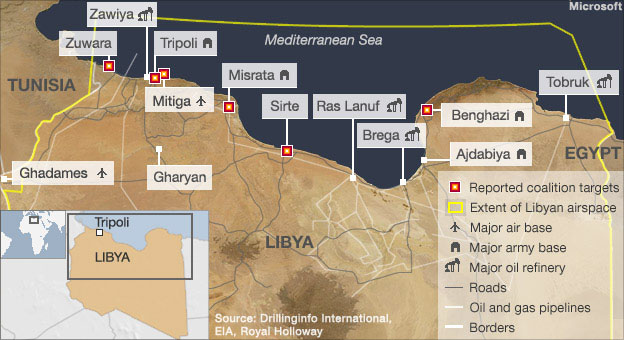
The strategic situation in Libya 20.03.2011 (Source map BBC)
In the afternoon CNN reported: "Nations bombing Libya are 'terrorists,' Gadhafi [a.k.a. Colonel Gaddafi] says," a horrible lie. In fact operation "Odyssey Dawn" is initiated and called for by the Libyan people including The Anarchist Confederation of Africa (ACA) - Libyan section, i.e. the Libyan people seen as a class as opposed to the terrorist ruler Colonel Gaddafi and his henchmen. The regime of Gaddafi is responsible for genocide and rule of terror, i.e. terrorism, in Libya, against the Libyan people. Quite legitimate the Libyan people are claiming a development towards freedom & democracy and human rights - where Colonel Gaddafi and his henchmen stand in the way. Colonel Gaddafi and his henchmen's regime is a totalitarian, fascist, extremist, oligarchy with severe ochlarchy, at the moment the most authoritarian regime in the world, worse than Somalia.
The international community and coalition, supporting the Libyan people against Gaddafi, are just following this legitimate initiative and call from the Libyan people including the Libyan anarchists, and O. D. is of course not a 'terrorist cruisade against muslims', a 'new nazi attack', 'neo-colonialism', an 'imperialist invasion', 'crude oil grab' or something authoritarian at all. Operation "Odyssey Dawn" is significant libertarian and is in general supported by The Anarchist International Security Council (AISC) & The Anarchist International - AI/IFA and all its sections, see The official link-site of AI/IFA.
CNN continued: Libyan ruler Moammar Gadhafi called the allied nations bombing his country "terrorists" Sunday, a day after the United States, United Kingdom and France began to enforce a United Nations-mandated no-fly zone to protect Libya's civilians from their leader. There was violence across the country Sunday, with Gadhafi apparently shelling rebels in the west while allied airstrikes destroyed one of Gadhafi's convoys in the east, according to rebels.
Gadhafi said the strikes were a confrontation between the Libyan people and "the new Nazis," and promised "a long-drawn war." "You have proven to the world that you are not civilized, that you are terrorists -- animals attacking a safe nation that did nothing against you," Gadhafi said in a televised speech. Gadhafi did not appear on screen during the address, leading CNN's Nic Robertson in Tripoli to speculate that the Libyan leader did not want to give the allies clues about his location. Throughout the address, an image of a golden fist crushing a model plane that said "USA" filled the screen -- a monument in Tripoli to the 1986 American bombing of Libya, in which one US plane was downed.
At the same time Gadhafi spoke, his regime was shelling the city of Misrata on Sunday morning using tanks, artillery and cannons, a witness said. "They are destroying the city," said the witness, who is not being identified for safety reasons. He said rebels were fighting back. Sounds of heavy gunfire could be heard during a telephone conversation with the man. There was no immediate word on casualties.
Meanwhile, a senior doctor at the medical center in Benghazi confirmed Sunday that 95 people were killed and an unknown number injured in Saturday's assault on the city by pro-Gadhafi forces. Doctors there also reported a shortage of supplies, especially emergency supplies. When the fighting had begun, they sent supplies to the front lines in areas like Ras Lanouf and Brega. When those cities were recaptured by Gadhafi, those supplies were lost. On Sunday, more rebel checkpoints were noticeable throughout Benghazi, and searches there were much more diligent. While fears of an attack by pro-Gadhafi forces have decreased, the opposition does fear attacks from Gadhafi supporters among their population. Since the assault on Saturday, most shops remain closed.
French Defense Minister Thierry Burkhard said the coalition's aim continues to be support for the civilians. On Sunday, the French forces did not open fire at all because it was not necessary, he said. The previous day, French planes fired and hit four tanks. Reconnaissance missions have been flying over Libya all day, he said. CNN's Arwa Damon saw the remains of a convoy of at least 70 military vehicles destroyed by multiple airstrikes Sunday, leaving at least five charred bodies, plus twisted tanks and smashed trucks as far as she could see. Rebels with Damon told her it was a convoy of Libyan troops loyal to Gadhafi coming to attack Benghazi. Adm. Mike Mullen, chairman of the Joint Chiefs of Staff, told CNN Sunday there would be continuous allied air cover of Benghazi. The no-fly zone is effectively already in place, he said on CNN's "State of the Union," adding that air attacks by coalition forces have taken out most of Libya's air defense systems and some airfields.
The international military coalition targeted air defense positions near the capital, Tripoli, for a second day Sunday.
Also on Sunday, the Arab League -- whose call for a no-fly zone was an essential piece of the diplomacy leading to the United Nations resolution -- held an emergency meeting about the bombardment. Arab League Secretary-General Amre Moussa told reporters before the meeting that what is happening in Libya is different from what was intended by imposing a no-fly zone, according to Egypt's state-run Ahram newspaper. "What we want is the protection of civilians and not the shelling of more civilians," Moussa said, adding that "military operations may not be needed in order to protect the civilians." But Arab League chief of staff Hisham Youssef said Moussa's comments did not signify a shift by the organization. "The Arab League position has not changed. We fully support the implementation of a no-fly zone," Youssef said. "Our ultimate aim is to end the bloodshed and achieve the aspirations of the Libyan people."
A spokesperson for the UK Foreign Office said that for the no-fly zone to be enforced, it was necessary to target Libyan air defenses. "Unlike Gadhafi, the coalition is not attacking civilians," the spokesperson said. "All missions are meticulously planned to ensure every care is taken to avoid civilian casualties. We will continue to work with our Arab partners to enforce the resolution for the good of the Libyan people." At least one Arab nation, Qatar, is making direct contributions to the allied airstrikes. [Qatar is the most libertarian of the Arab countries, and far from totalitarian.] The country made available four fighter planes, the French foreign minister said. Some Libyans welcomed the American, French and British military forces. Others remained fearful of Gadhafi. Libyans are "afraid to come out because when they do, he attacked them very, very severely," a woman in Tripoli said Sunday. "This is putting terror in all neighborhoods."
The multinational [read: international libertarian] military forces launched the attacks Saturday, convinced that Gadhafi was not adhering to a cease-fire mandated by the United Nations. American and British ships and submarines fired more than 110 Tomahawk cruise missiles and hit about 20 Libyan defense targets in western portions of the country, US Vice Adm. William Gortney said at a Saturday Pentagon briefing. Nineteen US warplanes, including stealth bombers and fighter jets, conducted strike operations in Libya on Sunday morning, officials said. Tomahawk cruise missiles are unmanned and fly close to the ground, steering around natural and man-made obstacles to hit a target programmed into them before launch. A senior US military official, who was not authorized to speak on the record, said the cruise missiles landed near Misrata and Tripoli. Scores of missiles were fired in the predawn darkness Sunday, and the exact results of the mission were not immediately clear. The United States is expected to conduct a damage assessment of the sites.
The salvo, in an operation dubbed "Odyssey Dawn," was meant "to deny the Libyan regime from using force against its own people," Gortney said. British Defense Secretary Liam Fox said the Royal Air Force deployed Tornado GR4 fast jets, which flew 3,000 miles from the United Kingdom and back -- making the venture the longest-range bombing mission conducted by the force since the Falklands conflict in 1982. British Prime Minister David Cameron said the international mission "is necessary, it is legal, and it is right." "I believe we should not stand aside while this dictator murders his own people," Cameron said late Saturday night.
But Gadhafi remained defiant, saying Libya will fight back against undeserved "naked aggression." In a statement broadcast on state TV Saturday, his military said the strikes killed 48 people -- "mostly women, children and religious clerics." "The majority of these attacks were on public areas, hospitals and schools. They frightened the children and women near those areas that were subject to this aggression," the military said. CNN could not immediately confirm the claim.
But Russia said Sunday that innocent civilians were being killed, and urged more caution. The Foreign Ministry in Moscow cited reports that "nonmilitary" targets were being bombed, including a cardiac center. "We are calling upon respective nations to stop the indiscriminate use of force ... it is inadmissible to use the mandate resulting from UN Security Council Resolution 1973, the adoption of which was quite a controversial step, beyond the intended goals of the resolution, namely the protection of the civilian population," the ministry said on its website. China's foreign ministry said Sunday it did not agree with the use of force in international relations. And Venezuelan President Hugo Chavez also denounced the military intervention. "They (the United States) want to appropriate the oil in Libya; they don't care about anyone's life in that region," Chavez said [most likely a lie].
Gadhafi vowed to open weapons depots and said the UN charter provides the nation the right to defend itself in a "war zone." He has also issued messages to international powers and said Libyans are ready to die for him. Some residents said they could receive weapons to fight back. "We received a phone call around 3 a.m. that everyone should head out in the streets," a woman in Tripoli said. "Normal civilians are being able to have machine guns and take anti-aircraft machine guns ... to fire back at the airplanes." In Misrata, a witness said Gadhafi's forces are targeting fuel and power stations to make citizens believe the damage is being done by coalition forces. The witness, who was not identified for security reasons, said people celebrated allied airstrikes on loyalist positions in the city. CNN could not verify the account.
US President Barack Obama is planning for the US portion of the military action in Libya to last for only a few days. "After that, we'll take more of a supporting role," said a senior administration official, who was not authorized to speak about sensitive military matters. Obama authorized US military force on what happened to be the eighth anniversary of the start of the war in Iraq. In the next few days, US military officials expect to hand over control to a coalition commander. Canada and Italy are also part of the coalition. Violence has raged in Libya following protests calling for democracy and demanding an end to Gadhafi's almost 42-year-long rule. The protests have been met by force from the Gadhafi regime, and some members of his military defected to the opposition. Another witness in Tripoli said she's terrified about how Gadhafi might respond to the airstrikes. "We're scared. We're not sure what will happen next," she said. "To be honest, I'm scared for my life."
Later US says it won't go beyond UN mandate. Fresh off a "successful start" [of O. D.] against Moammar Gadhafi's air defenses and ground troops, US officials Sunday said they are being careful not to go beyond mandates in the United Nations Security Council resolution [i.e. 1973]. [US] Secretary of Defense Robert Gates warned against widening the current coalition operations [i.e. O. D.] to include a direct attack on Gadhafi. Anything that goes beyond enforcement of the no-fly zone and prevention of new military attacks on rebels risks disrupting the "very diverse coalition" that agreed to the attacks, Gates said. The Libyan military on Sunday called an immediate cease-fire after allied forces pounded one of its convoys near Benghazi and, according to US officials, significantly degraded the regime's air defenses. "We are not going after Gadhafi," US Vice Adm. Bill Gortney said at a Pentagon press briefing. "[Gaddafi's] Regime forces are more pressed and less free to maneuver."
Asked about reports of smoking rise from the area of Gadhafi's palace, Gortney said, "We are not targeting his residence." Gunfire could be heard in Tripoli early Monday. Despite Libyan government contentions that women, children and clerics have died in allied attacks, Gortney and other officials said that's not the case. "We have no indication of any civilian casualties," the admiral said. The alliance of US, European and Arab countries likely won't rely on the word of the Libyan military, which according to its spokesman Milad al Fuqhi, "issued command to all military units to safeguard immediate cease-fire everywhere." "As with previous cease-fire announcements, we have to wait and see if it's genuine," US Africa Command spokesman Vince Crawley told CNN. "We urge the Libyan government to do everything it can to demonstrate its sincerity." [Later BBC reported: The White House dismissed the [Gaddafi's cease-fire] announcement, saying the ceasefire had immediately been violated]. Gates said there are other options to assist opposition fighters beyond arming them, including pressuring the government with political and economic sanctions.
US Joint Chiefs of Staff Chairman Adm. Mike Mullen told CNN that Gadhafi forces have shown little ability to counter coalition firepower. Allied aircraft struck a Misrata area airport that has both civilian and military uses, said Gortney. Three B-2 bombers struck only military positions at the airfield, he said. There was violence across the country Sunday, with Gadhafi apparently shelling rebels in the west while allied airstrikes destroyed one of Gadhafi's convoys in the east. As of Sunday night local time, the United States and British military had fired a total of 124 Tomahawk missiles at Libya's air defense sites, Gortney said.
21.03.2011. Ad Libya Monday: US 'will hand over' Libya command soon. A break-up of Libya would be a formula for instability, chaos and ochlarchy - similar to in Somalia. Emphasis shifts from bombardment to patrol. Syria.
Early in the morning BBC reported: US 'will hand over' Libya command. The US has said it expects to hand over control of military operations against Libya within days to either a UK-France coalition or NATO. Meanwhile in Tripoli, journalists were shown a ruined building in Col Muammar Gaddafi's compound that officials said was hit by a missile late on Sunday. The UK said it again launched Tomahawk missiles as part of a co-ordinated strike on Libyan air defences. Earlier, the Pentagon said Libya's air defences were effectively degraded. US Defence Secretary Robert Gates said that while the US will continue to play a part in military operations against Col Gaddafi's forces, it "will not have the pre-eminent role". "I think there is a sensitivity on the part of the Arab League to being seen to be operating under a NATO umbrella," Mr Gates said. "And so the question is if there is a way we can work out NATO's command and control machinery without it being a NATO mission and without a NATO flag, and so on."
Mr Gates also said a break-up of Libya would be a formula for instability [similar to the situation in Somalia, a totalitarian regime of severe ochlarchy with rivaling polyarchy/oligarchy - i.e. chaos and a failed state]. The east of the country, where the month-old revolt began, has historically been much more opposed to Col Gaddafi's rule, while the west and the area around Tripoli constitute his heartland.
Emphasis shifts from bombardment to patrol, Euronews reported: The first wave of international air strikes on Saturday disabled Libya's air defences, allowing western jets to patrol. Gaddafi's advance on rebel-held Benghazi was halted. In Benghazi itself, armed checkpoints are a common sight. The fear is that some of Gaddafi's troops will head for the city, seeking the protection of the no-fly zone and the shelter of a civilian shield. There seems to be no shortage of food. The second wave of international air strikes hit Gaddafi's troops around the strategic eastern town of Ajdabiyah. Witnesses say they have heard explosions and seen plumes of smoke rising above the town, the gateway to Benghazi and Tobruk. Opposition rebels say they need help to retake it from Gaddafi's forces.
Meanwhile in Syria: Anti government protests have spread across Syria to the south of the country. Several hundred people took to the streets in the town of Jassem although security forces did not intervene. In Deraa, thousands of mourners marched at the funeral of one protester killed during demonstrations last week. Four civilians died after troops sprayed a demonstration with gunfire last Friday. The protesters want greater political freedoms and an end to corruption. The unrest is the most serious challenge to President Bashar al-Assad's rule since the 45-year-old succeeded his father 11 years ago. The ruling Baath Party has banned opposition parties and enforced emergency laws since 1963.
22.03.2011. Ad Libya Tuesday. Clashes continue despite no-fly zone. Yemen. Gaza Strip.
Libya clashes continue despite no-fly zone, Euronews reports: Colonel Muammar Gaddafi's forces have clashed with rebels despite a UN-backed no-fly zone aimed at stopping the violence. Gaddafi loyalists have repelled rebel advances in the oil-producing town of Ajdabiyah, just south of the insurgents' stronghold of Benghazi. Anti aircraft fire has continued to ring out in Tripoli, while residents of Yafran said at least nine people had been killed in clashes between the two sides. His forces have also struck the rebel-held enclave of Misrata, east of the capital, where four children were killed on Tuesday. A rebel spokesman told AFP that Gaddafi's men opened fire with tanks and set up sniper positions to gun down people in the streets.
Security analysts say the rebels are disorganised and unable to match the Libyan leader's military might, explaining why they have struggled to makes further advances, including the taking of Tripoli. As Operation Odyssey Dawn continues over Libya's skies the coalition has suffered its first tangible loss in its effort to establish a no-fly zone. A US F15 fighter jet crashed overnight near Benghazi, after what officials said was a likely mechanical fault. The two crew members escaped and are now reported to be safe after being rescued. The crash comes as criticism of the western allies policing of Libyan skies appears to be growing. China, along with Russia, Brazil and India, condemned the US led air strikes as risky and unwarranted overreaching by the West.
A public clash between Russia's leaders over Libya has revealed cracks in the world's most prominent political duo. President Dmitry Medvedev appeared to criticise his prime minister after Vladimir Putin described the Western military action as a medieval crusade. "There are different comments regarding what is happening but I believe we should be extremely careful in our assessments," said Medvedev. "In no way is it acceptable to use expressions that in essence lead to a clash of civilisations, such as crusades and so forth. Otherwise things can end considerably worse than what's happening today." Putin's remarks came during a visit to a Russian military base. They're in line with his much tougher stance on the UN resolution which he wanted Russia to veto. "In general it reminds me of a medieval crusade when someone rallied others to go and liberate something," Vladimir Putin told workers. This sharp difference between the two comes ahead of next year's presidential elections in which Putin is expected to stand once more.
Meanwhile in Yemen: Thousands of angry protesters have once again gathered in the capital of Yemen, to push their demand for the President to step down immediately. Their numbers have swelled dramatically since 40 protestors were killed on Friday when the security forces opened fire. Anger at the shootings has splintered Saleh's remaining support. There has been a flurry of top-level defections to the opposition. Army officers, including one general who was a close ally of Saleh have defected and now support the pro-reform protesters. Saleh has warned that any attempt at luanching a coup will result in a "bloody" civil war. Saleh has announced he will leave office after elections due in January 2012. But opposition groups have rejected his offer to step down then; they want him out now.
At least eight Palestinians have been killed in Israeli raids on the Gaza Strip. More information, click on Terrorism by the islamist Hamas.
23.03.2011. Ad Libya Wednesday. International antimilitarist corps launches further air strikes against Gaddafi's militarism and militarist attacks on 'his' people. Ad antimilitarist corps, read: Antimilitarism - an anarchist approach - IJA 2 (38). Syria. Algeria. Yemen. Jerusalem.
Coalition launches further air strikes over Libya, Euronews reports. Allied warplanes have launched further air strikes on Muammar Gaddafi's forces for a fourth day, notably in western Libya. The coalition [an international antimilitarist corps] has confirmed artillery and tanks besieging the rebel-held town of Misrata were targeted. Despite some condemnation of the West's intervention, military chiefs have defended their role. Senior US military chief officer Peg Klein said: "Some of those cities still have tanks advancing on them to attack the Libyan people. We are authorised, and the President made the nexus between the Security Council resolution and what he considers our legal mandate to attack those tanks. And so that is the type of target that our strike aircraft will go after." Many of the American air strikes are being launched from ships in the Mediterranean. Despite that, Washington has made it clear it wants to take a back seat in the military mission and is calling on other members of the coalition to take operational command.
NATO involvement in Libya is agreed but questions remain. Western nations backing the UN no-fly zone over Libya have agreed a role for NATO in the campaign but they will have to clarify the mission's aims before winning wider support. President Obama, who wants the US to take a back seat, has persuaded a reluctant France to accept the involvement of the alliance. "I would expect that over the next several days we will have clarity and a meeting of the minds of all of those who are participating in the process. We are already seeing a significant reduction in the number of US planes that are involved in operations over Libya," said Obama.
The UK is willing to accept a NATO command but wants to broaden out the international support for the resolution including more Arab involvement. But at a meeting with the Saudi leadership, Britain's Prime Minister failed to make a convincing argument. In fact the Arab League and NATO member Turkey are looking to Thursday's meeting of the UN Security Council to re-establish the perimeters of the mission, placing the emphasis more on the humanitarian rather than the military. Meanwhile US intelligence has disclosed that people near to the Libyan leader are exploring exile options although it is unclear if Gaddafi would seriously contemplate stepping down.
Rebels deride Gaddafi TV appearance. With international reporters restricted in their movements in Tripoli, there appears to have been a mixed reaction to Muammar Gaddafi typically defiant speech. Making his first television appearance since the start of the Western-led bombing campaign, he pledged victory and condemned the coalition as fascists. Some western reporters say many people are too afraid to speak openly in the Libyan capital for fear of being arrested or detained. Others, however, are willing to support Gaddafi, describing his appearance as reassuring. Tripoli resident Tareq Mansour said: "He came out last night and told us that we should not be scared. In terms of our leader, he is not only the head of government or someone elected but he is the leader of our revolution."
The event was followed by fireworks in the Libyan capital. The sentiments expressed in Tripoli were not shared in the eastern rebel held city of Tobruk."When Gaddafi spoke a guy smashed the screen. Most young people watch Libyan TV to get a good laugh. It's a joke," said Adam al-Mansouri. Although Adam and his father do not believe what they see, it remains unclear how much effect Gaddafi's state TV is having on the wider population.
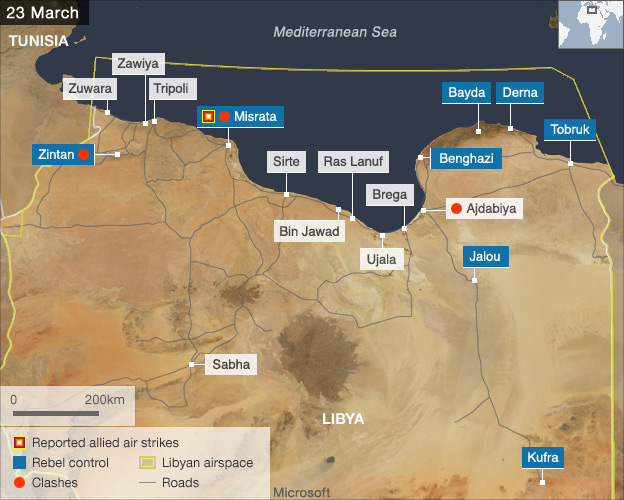
The strategic situation in Libya 23.03.2011. Map source BBC
Zeal of Libyan rebels may not be enough. The allied air bombardment of Libya appears to have done much to blunt the eastern advance of Colonel Gaddafi's forces. With the regimes air defences all but destroyed, the rebels have pushed out to the outskirts of Ajdabiyah, about 150 kilometres south of their stronghold in Benghazi. For the moment, the regime still controls the key strategic outpost and it remains unclear if the opposition has the leadership, soldiering experience and wherewithal to topple the regime. What is more clear is the human cost of this conflict. It continues to mount. Doctors in Benghazi say many civilian victims have been deliberately targeted, insisting those arriving from Ajdabiyah have been shot by Gaddafi snipers.
Six killed in protest crackdown in Syria. Six people are said to have been killed and dozens more wounded in Syria after security forces opened fire on protesters. Residents say the shooting happened at the Omari mosque in the southern city of Deraa, which has been the focal point of a string of small but unprecedented rallies calling for the end of the ruling Assad regime. The demonstrations have also reportedly spilled over into nearby towns. Eyewitnesses reported gatherings of hundreds of people. They said they were dispersed by the security forces. Local sources say ten people have been killed in clashes with the security forces during six days of demonstrations. The ruling Baath Party has banned opposition parties and enforced emergency laws since 1963. But there are now popular calls for political freedom and an end to corruption.
Later: There has been fresh bloodshed in Syria, with up to 15 people killed in Deraa, the southern city that has become the focus of calls for freedom. An 11-year-old girl is said to be among the dead, reportedly hit by a stray bullet fired at the funerals of two people killed by security forces earlier. On the sixth day of demonstrations, the governor of the Deraa region has been dismissed as demands for democracy gather pace. Overnight, police used tear gas and live ammunition in a raid on the mosque at the heart of the Deraa protests, according to witnesses. State television has shown cash, weapons and ammunition it said were found inside the mosque. Witnesses have now reported that President Bashar al-Assad's security forces have fired on hundreds of youths marching to Deraa, in solidarity with the city.
Dozens injured in Algiers as police clear slums. Violent clashes have broken out in Algiers, the Algerian capital, injuring around 40 protesters. Eyewitnesses said about 150 people, mostly youths, confronted security forces in the poor Algiers neighbourhood of Oued Koreich after police attempted to clear out a run-down housing estate. Built around 50 years ago, the area has been earmarked for destruction. Perhaps fearful of the recent riots that have hit Algeria and other Arab countries, police responded with tear gas and rubber bullets. One young protester was reportedly hit in the eye. The opposition continues to call for reform in Algeria, which is one of Europe's biggest suppliers of natural gas. Unlike other countries in the region, however, the unrest in the north African state, appears, so far, to be localised rather than a mass nationwide protest.
Under-pressure Yemeni president offers 2011 poll. Yemen's increasingly embattled leader Ali Abdullah Saleh has offered to step down by the end of the year, proposing constitutional change and elections. But opposition groups show no signs of easing up their efforts to secure his departure now. A pro-democracy movement is escalating. Thousands of protesters have been camped in the streets near the university in the capital, Sanaa, since early February. One of the latest members of Saleh's regime to switch sides, dissident security forces officer Ahmed Mohamad Hussein Ahmed urged the president to "see sense and leave this country" and let Yemen's people choose their leader.
Defections have multiplied since Friday when anti-government protests ended in bloodshed and dozens of deaths. A state of emergency has been rubber-stamped by parliament. Former Yemeni state TV employee Samir Abdelwali said one tent in the protest camp represents the "free" journalists who have left the channel, which he accused of telling lies and misleading the public. The opposition is said to be studying President Saleh's proposals. It had earlier called for massive rallies in Sanaa on Friday to force him from power.
Dozens of casualties in Jerusalem blast. More information, click on Terrorism by the islamist Hamas.
24.03.2011. Ad Libya Thursday. Benghazi rally and The Anarchist Confederation of Africa (ACA) - Libyan section thank coalition for air strikes. The coalition must stay antimilitarist! Syria. Egypt: Referendum results and more.
Benghazi rally thanks coalition for air strikes, Euronews reported around midnight Wednesday: People in Benghazi have held a rally in support of the allied air campaign against Colonel Gaddafi's forces. Coalition [i.e. the international antimilitarist corps, read: Antimilitarism - an anarchist approach - IJA 2 (38)] air strikes are credited with stopping an advance by government forces in its tracks, and giving a huge morale boost to the rebels. Among the crowds were banners expressing thanks – in English and French – to the countries involved, and plenty of pre-Gaddafi era Libyan flags. As the UN prepares again to discuss Libya, there were also some words of advice for those who have not backed military action. "Russia and China, better to be with the Libyan people than this tyrant", read on banner. [The Anarchist Confederation of Africa (ACA) - Libyan section agrees.]
Reports from New York say the breakaway Libyan delegation at the UN, who backs the rebels, is trying to build a diplomatic network parallel to that of the Gaddafi regime. The rebels are asking the international community to do more to protect civilians. Our correspondent in Benghazi, Mustafa Bag, said: "The Gaddafi-controlled Libyan media claimed that the people here didn't support the no-fly zone. But today they reacted against that, as the gathering here in front of the law courts shows. There are plenty of women in the crowd which totals roughly 15,000."
In the morning Euronews continued: Libya [Gaddafi's TV] says civilians killed in fifth night of bombing. French fighter jets joined other coalition forces for a fifth night of bombing – reports of at least eight explosions indicated activity over or near the capital. The allies claim to have hit a military base in the Tajoura area. Libyan [i.e. Gaddafi's] television showed pictures of casualties arriving at hospital. Libyan government officials have accused the Western powers of killing dozens of civilians in the raids [most likely a lie]. South west of Tripoli, Libyan TV also said military and civilian targets in the town of Jafar had been attacked. Meanwhile in besieged Misrata, YouTube footage supported allegations that government backed snipers had positioned themselves on rooftops to shoot at rebels. A rebel spokesman said at least 16 people had been killed. Libya has denied allegations of cutting off water electricity and phone lines to the town claiming there had been merely a technical problem [most likely a lie].
"The coalition must stay antimilitarist! The coalition made up of NATO and some Arab countries with a UN mandate, UNSC resolution 1973, is de facto so far an international antimilitarist corps, see Antimilitarism - an anarchist approach - IJA 2 (38). This of course does not mean that NATO, with USA as a major force, in all cases acts progressive and antimilitarist, although the Anarchies of Norway and Iceland, both significant socialist and autonomous, also are members and pull in a libertarian direction. USA supported Franco in Spain, and has until now supported several oilrich totalitarian fascist Arab rulers, and still supports the totalitarian militarist fascist ruler in Georgia, mainly based on its economical plutarchist/capitalist interests. The Anarchies of Norway and Iceland should stop economical plutarchist/capitalist interests as much as possible and secure that the coalition continues to be an international antimilitarist corps, and not turn into a militarist, economical plutarchist/capitalist, contra-revolutionary force," The Anarchist Confederation of Africa (ACA) - Libyan section declares.
Associated Press reported: Libyan state television showed blackened and mangled bodies that it said were victims of airstrikes in Tripoli. Rebels have accused Gadhafi's forces of taking bodies from the morgue and pretending they are civilian casualties. A US intelligence report on Monday, the day after coalition missiles attacked Gadhafi's Bab al-Aziziya compound in the capitol, said that a senior Gadhafi aide was told to take bodies from a morgue and place them at the scene of the bomb damage, to be displayed for visiting journalists. A senior US defense official revealed the contents of the intelligence report on condition of anonymity because it was classified secret.
As unrest spreads, Syrian government promises to respond, CNN reports: Tensions boiled in a volatile Syrian community Thursday as thousands turned up for the funerals of people killed in unrest, while the government blamed the instability on outsiders and announced plans to study popular demands, including the lifting of the country's decades-old emergency law. Syria is the latest in a string of Arabic-speaking nations beset with discontent over economic and human rights issues. And Syrian discontent centers on Daraa, a southern city in the impoverished country's agricultural region, where violence has been escalating between security forces and anti-government protesters since late last week. Wissam Tarif, executive director of the human rights organization Insan, said at least 34 people have been killed in Daraa in the past two days. While the figure was confirmed by human rights activists who contacted family members of the deceased, other activists believe many more have been killed.
Tarif said as many as 20,000 people followed the funeral procession for those who died in the violence, including a conscripted soldier who was reportedly shot because he refused to fire on demonstrators. The turnout included people from towns and villages near the city, and Tarif said that despite brutal and deadly treatment by security forces, people were able to flock into Daraa. A witness, who asked not to be named, said 10 martyrs were buried following afternoon prayers, with the people in the procession mourning the loss of the victims and chanting anti-government slogans.
Egypt lifts curbs on politics in post-Mubarak era, Reuters reported: Egypt approved a law on Wednesday easing curbs that choked political life under deposed President Hosni Mubarak, opening the door for the formation of new parties that will compete in elections this year. The law is expected to result in a plethora of new parties, including one to be established by the Muslim Brotherhood -- an islamist group that was banned under Mubarak. US Secretary of Defense Robert Gates, visiting Cairo for the first time since Mubarak was toppled, said Egyptians who had become active in politics should have the time "to develop political parties and to develop organization and structure." But he steered clear of an Egyptian debate about the timetable the military has charted toward legislative elections as soon as September -- a timeline criticized as too tight by nascent political groups who want to get organized first.
Some opposition groups, which were crushed for decades by Mubarak, say the schedule favors the well-organized Brotherhood and remnants of Mubarak's ruling party. "We are racing against time," said Shady Ghazali Harb, a member of a coalition of youth groups that mobilized protests against Mubarak. "They are pressuring us with the time factor because of the insistence on holding elections so soon." Asked about the timetable, Gates said: "I'm absolutely not going to second-guess either the supreme council or the interim government." He is due to meet the head of the council, Field Marshal Mohamed Hussein Tantawi, Thursday. Mubarak's Egypt was a close ally of the United States, which still has close defense ties with the Egyptian military. Washington praised the army's role during the Egyptian uprising that helped inspire revolts against autocrats across the region. Washington is also watching closely to see what kind of role the Brotherhood will play in the new Egypt.
The Brotherhood's "Freedom and Justice Party" is expected to be announced within days. Its growing prominence, along with more radical islamist groups that were crushed by Mubarak, has alarmed secular intellectuals and activists who joined forces with the Brotherhood in the uprising. The Brotherhood has sought to reassure other Egyptians, saying it will not seek a parliamentary majority or the presidency in the elections later this year. "This is a temporary position until the time there are forces that can compete. At that point, we will take part in the competition," said Mohamed el-Beltagi, a Brotherhood leader.
REFERENDUM RESULTS. Under Mubarak's rule, [as mentioned] parties needed a license from a committee headed by the head of the upper house of parliament, who was also a leading figure in the ruling party. Opposition parties that did exist were at best seen as a joke and at worst pliant tools of the Mubarak administration. The new law requires parties to secure the backing of 1,000 founding members from at least 10 provinces. It removes a stipulation that parties must not have a religious basis, but says they should not discriminate on the grounds of religion. The military appears keen to relinquish power as quickly as possible to a civilian, elected government. Egypt passed a milestone on the road to elections at the weekend when amendments to the constitution were passed by a large majority in a referendum. The changes open up competition for the presidency held by Mubarak for three decades. The military council issued a constitutional decree on Wednesday which included the amended articles. The decree is designed to "organize authority in the interim period" and will last until legislative and presidential elections are held.
FORMER MINISTER CHARGED WITH KILLING - AND SPREADING CHAOS. Further legal steps were taken against symbols of Mubarak's rule. The public prosecutor referred Habib al-Adli, the former interior minister, and four other high-ranking officers for trial on charges of killing protesters, disrupting stability, and of spreading "chaos in the country" that harmed Egypt's economy, a statement said. A committee set up to investigate violence during demonstrations that toppled Mubarak also laid charges against the former president for intentional murder of protesters, a state newspaper said. The stock exchange opened for the first time since January and the main index tumbled 8.95 percent.
Gates: Egypt's new groups need time to organize, Associated Press reported: US Defense Secretary Robert Gates said Thursday that Egyptian authorities should give nascent political organizations time to organize, as the country begins to take tentative steps toward democracy. It's important to allow new political groups to become active in the government, Gates said, so that they can play the same leading role in Egypt's future that they did in bringing about the change in the first place. Gates, who met Thursday with military leader Field Marshal Mohamed Hussein Tantawi, praised the Egyptian military for protecting the people during the protests that led to the ouster last month of President Hosni Mubarak. "He told me the Army would protect the people," Gates told reporters. "And in everything that ensued, he and the Army kept their word." Gates said the US is being careful not to second-guess the interim government, but will provide assistance to help the transition move forward. The Pentagon chief spoke repeatedly to Tantawi during the protests over the past two months, but Thursday's meeting was the first time they got together in person since the uprising.
Mubarak supporters and opponents clash in Cairo, Associated Press reported: Hundreds of supporters and opponents of Egypt's deposed leader have clashed in front of a court considering whether to remove his name from government institutions. Police and judicial officials said about 200 people carrying pictures of Hosni Mubarak and 300 opponents threw stones and water bottles at each other Thursday before police and soldiers intervened. The officials, speaking on condition of anonymity because they are not authorized to brief the media, said several people were slightly injured. The supporters say Mubarak is a hero of the 1973 war with Israel and deserves respect. Opponents blame him to political repression and corruption during his decades in office. The court adjourned without making a decision until April 14.
25.03.2011. Ad Libya Friday. Western strikes boost rebels' bid to take key Libyan city. Other developments.
Western strikes boost rebels' bid to take key Libyan city, Euronews reported: With coalition bombing of Libyan loyalist positions in Ajdabiyah as support, rebels say they have taken the city's eastern gate and are looking to move back in. Recapturing the crossroads to Benghazi is vital if the rising against Colonel Gaddafi is to push to the capital. The rebels, reinforced and better equipped since they were expelled last week, say they now surround the city and an attack is imminent. Rebel spokesman Mustafa Gheriani is saying they fear "a great crime may have been committed" in Ajdabiyah and that civilian casualties may be heavy. That is one of the things the air bombardment is seeking to prevent in what NATO today said could be a 90-day campaign. However, air power failed to prevent government tanks re-entering Misrata in the west.
At the scene, BBC reported: The coalition know that killing civilians would be disastrous in this war. They're plainly making big efforts to avoid it. Libyan television often shows pictures purporting to portray civilian victims, but they're impossible to verify. Today international journalists in Tripoli were bussed to the suburb of Tajoura, which was genuinely targeted by the coalition last night. Nearby we were shown a farmhouse that had supposedly been hit. But the holes in the wall that we were told were shrapnel could only have been the result of someone firing an automatic rifle at it. And although the farmer, a strong Gaddafi supporter, said his 18-year-old daughter had been injured, the gardener said it was a four-year-old boy. It all looked like a rather inadequate set-up, done for effect.
Libyan leader Colonel Muammar Gaddafi is said to be arming volunteers to fight the uprising against his rule, a senior US military official has said. Vice Admiral William Gortney said Col Gaddafi had "virtually no air defence" and a "diminishing ability to command and sustain his forces on the ground". Coalition forces launched strikes against Libyan tanks around the eastern town of Ajdabiya, he said. Rebels and pro-Gaddafi forces are in a stand-off near the town, witnesses say. Meanwhile, Qatar became the first Arab state to contribute to the air mission over Libya.
'Civilian reinforcements'. Briefing reporters on Friday, Vice Adm Gortney said Col Gaddafi's forces had been severely weakened by international military action. "His air force cannot fly, his warships are staying in port, his ammunitions stores are being destroyed, communications towers are being toppled, his command bunkers rendered useless," he said. "We've received reports today that he has taken to arming what he calls volunteers to fight the opposition," he added. "I'm not sure... if they are truly volunteers or not, and I don't know how many of these recruits he's going to get, but I find it interesting that he may now feel it necessary to seek civilian reinforcements."
Western forces began bombing targets last weekend in a bid to enforce a UN resolution that banned the Libyan military from launching air attacks on civilians. NATO is expected to take over the lead of the entire Libya operation from the Americans in the coming days. It has already taken command of enforcing the no-fly zone. Despite the reports of setbacks for pro-Gaddafi forces considerably, fighting has continued in Misrata in the west and Ajdabiya in the east. French and British jets bombed targets near Ajdabiya the eastern town overnight, including government forces' artillery.
Rebels had tried to attack pro-Gaddafi forces after the air strikes, but were quoted by Reuters as saying they had to call off the assault. The men, driving pick-up trucks armed with rocket launchers, said they had been spurred on by the bombing raids. The AFP news agency reported that Gaddafi loyalists in armoured vehicles had repelled attacks by rebels at the gates of the town. The town has been besieged for days. Fleeing residents said the streets were deserted, and that government troops were opening fire at random.
Air strikes were reported in other cities on Thursday night, including the Tripoli suburb of Tajoura, known to house several military bases. France and Britain initially led calls to impose the no-fly zone over Libya, and have taken a key role in enforcing it. But the leadership of the operation and the bulk of the logistics have been borne by the US. President Barack Obama has been insistent that the US should not continue to lead the intervention. On Friday, both UK and Italian officials said NATO would take command in the coming days. Analysts say the US will continue to play a major role. The move by NATO has come only after days of tortuous negotiation, with France arguing strongly that there should be a broader coalition of nations leading the operation.
Other developments. More reported killed as Syrian protests spread. First death in Jordan since protests began. High tension in Yemen amid rival rallies. Tunisian migrants protest on tiny Italian island. Bahrain's security forces fired tear gas and pellets at anti-government protesters. One person died, activists said. Several hundred Shiite Muslims protest in eastern Saudi Arabia to demand the release of detainees and show support for fellow Shiites protesting against the Sunni monarchy in nearby Bahrain, a Saudi news agency says. The protesters call on the Saudi government to withdraw its troops from Bahrain, where they are leading a 1,500-strong Gulf military force helping shore up the Sunni monarchy.
INTERNATIONAL TRADE UNION CONFEDERATION: Syria: Regime's Promises of Partial Reform Insufficient. Partial reforms promised by the regime of Syrian President Bashar al-Assad are unlikely to quell the anger spreading across the country, nor satisfy demands for democracy and human rights. Dozens of protestors are believed to have been killed by the regime's security forces since unrest began following the arrest of several children for painting anti-regime slogans on walls in the town of Deraa. Scores of people have been detained since the protests began, although the regime has said they will now be released. Despite promises by the regime to introduce limited reforms, reports from Syria indicate that security forces are still using live ammunition against demonstrators as protests spread across the country including to Damascus. Heavy restrictions on journalists trying to report on the situation remain in place.
"Just as in other countries in the region, people are rising up in protest at repression of fundamental rights and the lack of decent jobs and prospects for the future. It is time that the Syrian authorities respect fundamental rights and freedoms, including the right to form and join genuine trade unions to represent their interests. The Assad regime must immediately stop its violent repression, open a dialogue with its opponents, and allow the development of legitimate civil society organisations," said ITUC General Secretary Sharan Burrow. A large proportion of Syria's population lives below the poverty line, with unemployment around 30%. The country has existed under a state of emergency since 1963, with heavy restrictions on civil and political rights, and the trade unions under the full control of the regime. - IWW joins the call by ITUC.
White House urges Mideast leaders to stop violence, Associated Press reported: The White House urged governments in Syria, Yemen and Bahrain to cease attacks on protesters Friday, while saying fighting in those countries has not risen to the same level as in Libya, where US forces are engaged in military action to stop violence perpetrated by forces loyal to Moammar Gadhafi [a.k.a. Colonel Gaddaifi]. White House spokesman Jay Carney said the decision to intervene in Libya was based not only on the violence that had already occurred there, "but also what was about to occur and the promises made by Gadhafi himself." Carney said President Barack Obama would offer a clear explanation of how he reached the decision to take military action in Libya in the very near future, though he wouldn't say exactly when such remarks would occur.
The pro-democracy protests that started in Tunisia and Egypt in January have spread throughout the Middle East. The United States has taken a similar position in almost all of the uprisings, urging leaders to engage in political dialogue and calling for all sides to refrain from violence. Carney made a similar appeal to Middle East leaders Friday. "The stability and future of this region depends upon the decision by governments to listen to their people, to act on their legitimate aspirations and to open up their systems so that the people of these countries can have a greater stake in the future of their country and their own futures," he said.
The situation in Syria appeared particularly tenuous Friday, with troops opening fire on protesters in several cities and pro- and anti-government crowds clashing on the tense streets of the capital Damascus in the most widespread unrest in years, witnesses said. Carney brushed aside questions about whether Syrian President Bashar Assad still has legitimacy, and wouldn't say whether US officials had been speaking with Assad. In Yemen, a key US partner in the fight against terrorism, protesters converged on a square Friday chanting slogans calling for the ouster of President Ali Abdullah Saleh, despite fears of more violence a week after government security forces shot dead more than 40 protesters. Saleh made a rare appearance Friday, saying he's ready to step down, but only if he can leave the country in "safe hands." And in Bahrain, security forces fired tear gas at anti-government protesters Friday after a prominent Shiite cleric vowed that their demands for the Sunni monarchy to loosen its grip on power would not be silenced by "brutal force." Carney said the White House is consulting with allies throughout the region as the situations develop.
26.03.2011. Ad Libya Saturday. Libyan rebels retake Ajdabiya
Libyan rebels retake Ajdabiya, Euronews reports: Libyan rebels said on Saturday that they have retaken the eastern town of Ajdabiya. The town is strategically important as it is in one of Libya's key oil-producing areas. It has been held by Colonel Gaddafi's forces but was subjected to heavy bombardments by coalition forces overnight. There are also reports of allied strikes on the capital of Tripoli, which remains a Gaddafi stronghold. The United States, Britain and France have led the western coalition in enforcing the UN-backed no-fly zone. [Qatar and the United Arab Emirates], Canada, Italy, Spain, Belgium and Denmark [and the Anarchy of Norway] are among other countries also offering military support. The uprising against Colonel Gaddafi's four-decade rule is now in its fifth week. [As mentioned] US Navy Vice Admiral William Gortney said on Friday Gaddafi's air defences have been severely weakened. His ability to command his forces has been so diminished that he has taken to recruiting volunteers to quell the unrest.
27.03.2011. Ad Libya Sunday. Rebels push westwards in Libya. NATO Allies have decided to take on the whole military operation. Other developments.
Rebels push westwards in Libya, Euronews reports: In Libya, convoys of jubilant rebel forces are pushing westwards into the heartland of the Gaddafi regime. It comes after they reportedly took control of the eastern coastal towns of Ras Lanuf, Brega and Uqayla. Pressure from the allied airstrikes forced government forces to fall back. When they arrived in Ras Lanuf, the rebel fighters found it empty. Gaddafi's army, they said, had retreated back towards his western stronghold of Sirte. Piles of abandoned munitions suggest Gaddafi's forces beat a hasty retreat. The key focus in the battle for western Libya has now shifted to Misrata. It is the rebels' only outpost in the west of the country, and has been under government assault for days now. Opposition morale was boosted by their success in taking control of the town of Adjabiya yesterday. Rebel fighters danced on tanks, waved flags and fired in the air near buildings riddled with bullet holes. Coalition air strikes are thought to be targeting sites in the west of Libya, Gaddafi's stronghold of Sirte and Misrata.
Statement by NATO Secretary General Anders Fogh Rasmussen on Libya. NATO Allies have decided to take on the whole military operation in Libya under the United Nations Security Council Resolution. Our goal is to protect civilians and civilian-populated areas under threat of attack from the Gaddafi regime. NATO will implement all aspects of the UN Resolution. Nothing more, nothing less. This is a very significant step, which proves NATO's capability to take decisive action. In the past week, we have put together a complete package of operations in support of the United Nations Resolution by sea and by air. We are already enforcing the arms embargo and the No Fly Zone, and with today's decision we are going beyond. We will be acting in close coordination with our international and regional partners to protect the people of Libya. We have directed NATO's top operational Commander to begin executing this operation with immediate effect. Source: NATO's Website. The Anarchist International Security Council (AISC) & The Anarchist International - AI/IFA have called for this solution many times, placing the economical plutarchist/capitalist USA more in the back seat.
The situation in Libya is a rare and special case of armed revolution, supported by NATO. Per 27.03.2011 this is however just and embryo-revolution, it may still be an abortion or end up in stalemate and a system similar to in Somalia. The system in Somalia seen in long term perspective is the most authoritarian in the world, with only about 20% libertarian degree, and thus the country most far from anarchy on planet Gaia. At the moment the system in Libya is even more authoritarian than in Somalia, and thus the libertarian degree less than ca 20 %.
Other developments. Yemen leader Saleh is negotiating his exit: aides. Syria. While supporters of Syrian President Bashar al-Assad have taken to the streets in his support, protests against his regime gained new ground on Saturday, and there was more shooting of unarmed protesters by security forces. Two people were killed in Latakia in the north, after four others were shot dead on Friday. It is an important port and Bashar's summer residence. There are reports the army entered the city on Saturday night. Protest here marks a new upturn in unrest, after over a week of anger in the south. Until now the focus of protest and repression, which has claimed over 100 lives in a week, has been in Deraa, nearby Tafas and Sanamein. Now there are stirrings in Hama, the centre of a bloody revolt against Bashar's father 29 years ago, and even demonstrations in the capital Damascus. Deraa has suffered the most casualties, and funerals of the latest to be killed were at the centre of Saturday's marches.
28.03.2011. Ad Libya Monday. Libyan rebels bear down on Gaddafi's hometown. Shooting in Syria. Deadly blasts at Yemen ammunition factory.
Libyan rebels bear down on Gadhafi's hometown, Associated Press reported: Rebel forces bore down Monday on Moammar Gadhafi's [a.k.a. Colonel Gaddafi] hometown of Sirte, a key government stronghold where a brigade headed by one of the Libyan leader's sons was digging in to defend the city and setting the stage for a bloody and possibly decisive battle. The opposition made new headway in its rapid advance westward through oil towns and along stretches of empty desert highway toward Sirte and beyond to the big prize - the capital, Tripoli. But the rebels remain woefully outgunned by Gadhafi's forces, who swept the insurgents from positions in eastern Libya until the international intervention forced government troops to withdraw.
Rebels acknowledged they could not have held their ground without international air and cruise missile strikes. Libya state television reported new NATO airstrikes after nightfall, targeting "military and civilian targets" in the cities of Garyan and Mizda about 40 miles and 90 miles respectively from Tripoli. NATO insisted that it was seeking only to protect civilians and not to give air cover to an opposition march. But that line looked set to become even more blurred. The airstrikes now are clearly enabling rebels bent on overthrowing Gadhafi to push toward the final line of defense on the road to the capital.
There was growing criticism from Russia and other countries that the international air campaign is overstepping the bounds of the UN resolution that authorized it. The complaints came at a critical transition in the campaign from a US to a NATO command. That threatens to hamper the operation, as some of the 28 NATO member nations plan to limit their participation to air patrols, rather than attacks on ground targets.
On Monday, rebel fighters moved about 70 miles (110 kilometers) west Monday from the coastal oil terminal and town of Ras Lanouf to just beyond the small town of Bin Jawwad, where their push was halted by government fire along the exposed desert highway and the heavily mined entrance to Sirte. The rebels are currently just 60 miles (100 kilometers) from Sirte, the bastion of Gadhafi's power in the center of the country. Take control of that, and there's only the largely rebel-held city of Misrata - and then empty desert - in the way of the capital. Sirte could therefore see some of the fiercest fighting of the rebellion, which began on Feb. 15.
"Gadhafi is not going to give up Sirte easily because straightaway after Sirte is Misrata, and after that it's straight to Gadhafi's house," said Gamal Mughrabi, a 46-year-old rebel fighter. "So Sirte is the last line of defense." He said there are both anti- and pro-Gadhafi forces inside Sirte. Some residents were fleeing Sirte, as soldiers from a brigade commanded by Gadhafi's son al-Saadi and allied militiamen streamed to positions on the city's outskirts to defend it, witnesses said. Sirte was hit by airstrikes Sunday night and Monday morning, witnesses said, but they did not know what was targeted.
The city is dominated by members of the Libyan leader's Gadhadhfa tribe. But many in another large Sirte tribe - the Firjan - are believed to resent his rule, and rebels are hoping to encourage them and other tribes there to help them. "There's Gadhafi and then there's circles around him of supporters. Each circle is slowly peeling off and disappearing," said Gen. Hamdi Hassi, a rebel commander speaking at the small town of Bin Jawwad, just 18 miles (30 kilometers) from the front. "If they rise up, it would make our job easier."
Sirte, which houses a significant air and military base, is crucial both for its strategic position and its symbolic value. Over the years, Gadhafi has made it effectively Libya's second capital, building up what had been a quiet agricultural community into a city of 150,000 with lavish conference halls where Arab and African summits were held. Fighting in such a densely populated area is likely to complicate the rebels' advance and add to the ambiguity of the NATO-led campaign, authorized by a Security Council resolution to take all necessary measures to protect civilians.
In Russia, which abstained from the UN vote, Foreign Minister Sergey Lavrov said strikes on Gadhafi's forces would amount to taking sides in what he called Libya's civil war, and thus would breach the mandate that was initially envisaged as establishing a no-fly zone only to protect civilians. But the inclusion of language allowing "all necessary means" opened the door to airstrikes and ship-fired cruise missile attacks on Gadhafi's forces to stop attacks on cities and cut supply lines. And Pentagon officials are looking at plans to expand the firepower and airborne surveillance systems, including using the Air Force's AC-130 gunship armed with cannons that shoot from the side doors, as well as helicopters and drones. That weaponry might allow for more precision in urban fighting, while drawing forces closer to the combat.
NATO's commander for the operation, Lt. Gen. Charles Bouchard of Canada, insisted his mission was clear, saying every decision was designed to prevent attacks on civilians. "Our goal is to protect and help the civilians and population centers under the threat of attack," he said. Britain and France, which has been the most vocal supporter of the rebellion and is the only Western nation to officially recognize its political leaders, added their voices to those appeals. In a joint statement, British Prime Minister David Cameron and President Nicolas Sarkozy of France said Gadhafi loyalists should abandon the dictator and side with those seeking his ouster. "We call on all his followers to leave him before it is too late," the two leaders said. "We call on all Libyans who believe that Gadhafi is leading Libya into a disaster to take the initiative now to organize a transition process."
The Gulf nation of Qatar on Monday recognized Libya's rebels as the legitimate representatives of the country - the first Arab state to do so. Qatar is also one of only two Arab states - the other is the United Arab Emirates - that is contributing fighter planes to the air mission. Gadhafi is not on the defensive everywhere. His forces continued to besiege Misrata, the main rebel holdout in the west and Libya's third-largest city. Residents reported fighting between rebels and loyalists who fired from tanks on residential areas. Libyan officials took foreign journalists on a tour of the city's outskirts but not into the center, indicating government control did not extend far. Explosions and gunfire echoed through empty streets lined with burned out tanks and bullet-scarred buildings.
Shooting in Deraa as Syria pledges to reassure the people, Euronews reported: Security forces in the Syrian town of Deraa are said to have opened fire in the air as hundreds of demonstrators called for an end to emergency laws. Euronews has received pictures which appear to show more bloodshed, with bodies lying on the ground amid chaotic scenes. The sound of shooting can clearly be heard. Dozens of people have been killed in the town in 10 days of anti-government protests. Residents said security forces returned in strength after a reduced presence in recent days. The protests, which have spread to at least two other towns, pose a serious challenge to President Bashar al-Assad's rule. The Baath party has been in power in Syria for nearly 50 years but now faces a rebellion similar to others in the Arab world.
The country's northern neighbour Turkey has joined the criticism, condemning the violence and urging the government to deliver on promises of reform. "We want these measures to be implemented with action and not just words. I have encouraged him (the president) to make a public statement and unveil these reforms himself," said the Turkish prime minister Recep Tayyip Erdogan. The capital Damascus has again seen a large pro-government rally. The official news agency says Assad will give an important speech in the next two days that will "reassure the people". So far he has released prisoners and pledged greater freedoms but the moves have failed to quell the protests.
Deadly blasts at Yemen ammunition factory. Explosions at a bullet factory in Yemen have reportedly killed at least 110 people. It happened during clashes between militants and soldiers in the town of Jaar in the southern Abyan province. Witnesses say residents broke into the factory to steal ammunition. It is thought a cigarette triggered a series of explosions. Elsewhere in the country President Ali Abdullah Saleh continues to face pressure from protesters calling for his removal from office. One political analyst in Yemen says both sides are strong and determined.
Ali Seif Hassan, the head of the Political Development Forum, said: "It looks like no one can break either side. Therefore, mediation will be the answer. The mediation should be for change and not destruction. It should be aimed at changing the regime, not damaging it." As pro and anti-government rallies continue, reports from Yemen say talks to broker a transition of power have stalled. However, some news agencies quote opposition sources who say a deal is still within reach. Washington is involved in the negotiations. Some observers say any deal is likely to include the resignations of both President Saleh and his main rival, a general who sent troops to protect the protesters.
29.03.2011. Ad Libya Tuesday. Gaddafi forces repel rebel advance. Top diplomats agree that Libya's Gaddafi must go. Egypt: Decree to criminalise strikes a betrayal of the revolution.
Gaddafi forces repel rebel advance, Euronews reported: Forces loyal to Muammar Gaddafi have repelled a rebel advance towards the Libyan leader's hometown, Sirte. Heavy weapons fire was reported on Tuesday outside Nawfaliyah, some 150 kilometres east of Sirte. The renewed fighting is said to have prompted a mass exodus of civilians from Nawfaliyah and forced the rebels back to Bin Jawad further east along the coastal road. For the moment at least, it means the rebels' swift westward progress over the weekend appears to have ground to a halt. Since coalition strikes began, the insurgents have managed to turn the tide in their favour. However, Sirte appears different with reports that residents in the city fired on rebels as they entered. Elsewhere, the US attacked three Libyan ships on Monday night, including a coast guard vessel. Military officials said the strikes were launched to prevent them firing on merchant shipping.
Top diplomats agree that Libya's Gadhafi must go, Associated Press reported: World powers agreed Tuesday that Moammar Gadhafi [a.k.a. Colonel Gaddafi] should step down after 42 years as Libya's ruler but did not discuss arming the rebels who are seeking to oust him. Top diplomats from up to 40 countries, the United Nations, NATO and the Arab League came to that conclusion Tuesday at crisis talks in London on the future of the North African nation. "One thing is quite clear and has to be made very clear to Gadhafi: His time is over. He must go," German Foreign Minister Guido Westerwelle said in a statement. "We must destroy his illusion that there is a way back to business as usual if he manages to cling to power."
British Foreign Secretary William Hague, however, told reporters the subject of arming rebels simply did not come up. "That was not one of the subjects for discussion," Hague said. "That was not raised at the conference and it was not on the agenda for discussion." Hague's comments suggest that the UN-backed coalition cobbled together to defend civilians from Gadhafi's onslaught is still hanging back from throwing its entire weight behind the ill-organized rebels, whose exact makeup and motives remain unclear.
But Qatari Prime Minister Sheikh Hamad Bin Jabr al-Thani seemed to leave the door open to arms sales when he suggested that the issue might be revisited if the aerial campaign fell short of its stated goal of protecting Libyan civilians. "We have to evaluate the airstrike after a while to see if it's effective," he said. "We are not inviting any military ground (troops) ... but we have to evaluate the situation because we cannot let the people suffer for so long, you know, we have to find a way to stop this bloodshed." Qatar, which has recognized the rebels as Libya's legitimate representatives, also plans to help them sell crude on the international market. Yet while there has been talk of using Qatar to market Libya's oil for days, details have remained thin on the ground. Libya's production relies on joint ventures with foreign companies, like Italy's Eni SpA, that have evacuated employees from the country, and it's unclear how or when Qatar could help restart the country's now-paralyzed energy industry. Still even the possibility of renewed oil sales from Libya would affect the markets.
While diplomats repeated their appeals for Gadhafi to leave Libya, there were few signs that the international community planned to apply any additional pressure on the Libyan ruler. Diplomats are considering more sanctions on Gadhafi associates to send a clear message to Gadhafi that he cannot attack civilians with impunity, Hague said. He says the possible sanctions will be pursued in the United Nations and regional organizations, but did not elaborate further. Britain, Germany, the US and Switzerland have already moved to freeze assets belonging to Gadhafi and the Libyan government. Hague said he believed the Libyan rebels were genuinely committed to democracy, but still sounded a note of caution. "I'm sure they are sincere," Hague said, "but we can never be complacent about how events like this could turn out."
In his speech opening the conference, Prime Minister David Cameron said Britain had received reports that Gadhafi was pounding Misrata, the main rebel holdout in the west, with attacks from land and sea, and relentlessly targeting civilians. "The reason for being here is because the Libyan people cannot reach that future on their own," Cameron said. "We are all here in one united purpose, that is to help the Libyan people in their hour of need."
US Secretary of State Hillary Rodham Clinton said the international community must support calls for democracy sweeping Libya and its neighbors, but warned that change would not be easily won. "Under different governments, under different circumstances, people are expressing the same basic aspirations: A voice in their government, an end to corruption, freedom from violence and fear, the chance to live in dignity and to make the most of their God-given talents," Clinton said. "These goals are not easily achieved. But they are, without question, worth working for together."
INTERNATIONAL TRADE UNION CONFEDERATION: Egypt: Decree to Criminalise Strikes a Betrayal of the Revolution.
The ITUC has called on the Egyptian Prime Minister Essam Sharafm, see Protest against Egypt criminalising strikes, to scrap a proposed decree which would make strikes a criminal offence, with prison terms of up to one year and fines of up to US$ 90,000. The Egyptian Federation of Independent Trade Unions (EFITU) has described the decree as "a grave and worrisome development", which has already been approved by the Supreme Council of the Armed Forces. "Implementing this decree would be nothing less than a betrayal of the revolution. Millions of Egyptian workers continue to work for poverty wages, and depriving them of the right to strike, a fundamental right under international law, would remove an essential means for working people to achieve economic and social justice. By repressing legitimate union activity, it would also suffocate the development of a vibrant civil society, which Egypt desperately needs for building democracy," said ITUC General Secretary Sharan Burrow.
The EFITU has recognised the serious efforts by the Ministers of Manpower and Immigration and of Finance to hold dialogue and negotiations with workers in some sectors and locations, but has called on the authorities to start dealing with Egyptian workers as "citizens, not subjects". The official trade union centre of the Mubarak era, the ETUF, has welcomed the announcement, pointing out that it conforms with the 2003 labour law imposed by Mubarak with the support of the ETUF. "Working people do not need discredited and unrepresentative remnants of the old regime to talk on their behalf. Like workers everywhere, they are perfectly capable of organising their own trade unions, but they can only do this effectively if the authorities refrain from the anti-democratic habits of the past," said Burrow. IWW joins the protest.
30.03.2011. Ad Libya Wednesday. Gaddafi assault reclaims towns as rebels flee. Libyan Foreign Minister Moussa Koussa arrives in London and tells government he has resigned.
Gaddafi assault reclaims towns as rebels flee, Euronews reported: Libyan rebels are in full retreat under attack from Colonel Gaddafi's forces, losing control of more towns along the Mediterranean coast. It seems they are no match for the army's superior organisation and weaponry. Two days ago the rebels were heading westwards, delightedly chasing Gaddafi's troops across the desert. Now they are fleeing in the opposite direction back eastwards. They have lost Bin Jawad and the important oil town of Ras Lanuf; they are also in retreat from Brega.
Pictures taken near the town showed refreshments being distributed as the rebels retreated. Since then an unconfirmed report said the coalition had launched an attack on Gaddafi's forces near Ajdabiyah. But there has been no sign of allied assault on the sort of scale that repelled the army earlier. Injured rebels have been taken to hospital in Ajdabiyah. Their changing fortunes pose plenty of questions. There have been doubts over their lack of organisation and ability to use their weapons properly. Their latest dramatic setbacks bring the role of the international coalition into even sharper focus. [See the map in the report of 23.03.2011 for more information.]
Meanwhile CNN posts: Libyan Foreign Minister Moussa Koussa arrives in London and tells government he has resigned, UK Foreign Office reports.
31.03.2011. Ad Libya Thursday. Retreating rebels play waiting game in the desert. Despite their superiority, Gaddafi's forces have failed to break the rebels decisively. Syria's Assad takes steps towards reforms. Other developments.
Retreating rebels play waiting game in the desert, Euronews reports: Many among the rebel forces have retreated eastwards, under attack from Gaddafi's forces. Euronews correspondent Mustafa Bag has accompanied them. Just a few days ago they were joyously contemplating trying to take Gaddafi's home town of Sirte. Now this group has headed east, past Brega - epicentre of recent clashes – to the outskirts of Ajdabiyah. What was a carnival atmosphere among the rebels has now given way to a tense waiting game, he says. Bag said: "The insurgents have been retreating since losing Bin Jawwad. This is the western gateway to Ajdabiyah. The rebels are taking up position and they want to stop Gaddafi's forces, who are over there, from entering."
With Ras Lanuf now back in the hands of Gaddafi's forces, Brega has been one of the main battlegrounds as the rebels are forced back east. But despite their superiority, Gaddafi's forces have failed to break the rebels decisively. Under attack from the better-equipped Libyan army, the insurgents have been trying to regroup. Many have repeated their call for more and better weapons. [See the map in the report of 23.03.2011 for more information. Later reports by CNN and BBC suggested Brega was in the hands of Gaddafi.]
Syria's Assad takes steps towards reforms. Syrian President Bashar al-Assad, facing a wave of protests demanding greater freedoms, took steps on Thursday towards addressing grievances including lifting emergency law and granting disenfranchised Kurds rights. Assad, who drew international criticism for failing to spell out reforms in his first public comments on Wednesday since unrest swept Syria, also ordered an investigation into protest deaths in the flashpoint city of Deraa and the port of Latakia. Inspired by popular revolts elsewhere in the Arab world, the unrest has presented the gravest challenge to Assad's 11-year rule in Syria, which maintains an anti-Israel alliance with Shi'ite Iran and supports militant groups Hezbollah and Hamas. It was doubtful that Assad's gestures would soon defuse the unprecedented outbreak of public discontent in one of the Middle East's most tightly controlled countries. Online activists have called on protesters to demonstrate across the country on what they have dubbed the "Friday of Martyrs" until their demands for democratisation are met.
In the past, Assad has set up committees to investigate contentious issues but no announcements were made after the initial formation. Officials have repeatedly said a draft law on allowing political parties and lifting emergency law were on the agenda of Assad's Baath Party, but they never materialised. Repealing emergency law, in force since Assad's Baath Party took power in a coup nearly 50 years ago, has been a central demand of protests in which 61 people have been killed. Critics, diplomats and Syrian officials doubted Assad would abolish the omnipresent law, used to snuff out any opposition, justify arbitrary arrest and give free rein to the security apparatus, without replacing it with similar legislation.
The state news agency SANA said on Thursday the panel would study and prepare "legislation including protecting the nation's security and the citizen's dignity and fighting terrorism, paving the way for lifting the emergency law". It said the committee would complete its work by April 25, but did not elaborate. Syrian officials in Assad's inner circle had said last week a decision had been taken to abolish emergency legislation. But Assad, in a speech to parliament on Wednesday, made no reference to rescinding the law, or set a timetable for mooted reforms including legislation on political parties, media freedom and fighting corruption.
"BURY THE ISSUE". The United States dismissed Assad's long awaited speech, saying it failed to meet expectations built up by his aides last week at the height of the protests when they disclosed that he would announce a clear programme of reform. "When you set up a committee in our part of the world, it means you want to bury the issue," said Hilal Khashan, political science professor at the American University of Beirut. "He's buying time". A leading Syrian opposition figure told Reuters in an interview this week the British-educated president would replace the law with legislation couched as anti-terrorist measures. "The law could include a clause against any group or person carrying out actions that would affect national security. And it would be under the guise of terrorism," Maamoun al-Homsi told Reuters from exile in Canada on Monday.
Most of the protests have occurred in the southern city of Deraa, where unrest came to a head after police detained more than a dozen school children for scrawling graffiti inspired by popular uprisings across the Arab world. Syrian officials have also said 12 people were killed in clashes they blamed on "armed elements" in the Mediterranean port city of Latakia last week. The panel tasked with investigating the deaths of civilians and security forces has the right to "call upon whomever it sees fit to complete the appointed task and has the right to demand any information or documents from any party", SANA said. Assad also formed a panel to "solve the problem of the 1962 census" in the eastern region of al-Hasaka. The census resulted in 150,000 Kurds who now live in Syria being denied nationality.
Ethnic Kurds, who make up 10-15 percent of Syria's population of 20 million, mounted violent demonstrations against the state in 2004 that resulted in scores of deaths. Officials subsequently promised to address their demands to grant citizenship. The Kurds also complain of discrimination because they are unable to teach Kurdish in schools and are not allowed to set up Kurdish radio stations. Syria has intensified a wave of arrests of Kurdish activists since the January-February uprisings in Tunisia and Egypt. Media operate in Syria under severe restrictions. Syria expelled Reuters' Damascus correspondent last week and has been holding a second foreign correspondent since Tuesday. Two other foreign Reuters journalists were expelled and a Reuters photographer, a Syrian national, has been missing since Monday.
Other developments. Sudan president pushes Darfur referendum plan. NATO to investigate if civilians killed by bombing in Libya. Hague urges Libyans to follow Koussa's lead and exit. NATO took sole command of international air operations over Libya on Thursday, and said it was strongly opposed to arming the rebels. Pro and anti-government protests in Yemen.
01.04.2011. Egyptians protest to 'protect revolution'. Several die on Syrian 'Day of Martyrs'. Libyan rebels list their terms for ceasefire. Rebel forces are pressing on to the front line around the oil town of Brega.
Egyptians protest to "protect revolution" [i.e. embryo-revolution; NB! No real revolution yet!], Euronews reported: Egyptians demonstrated on Friday demanding that ousted President Hosni Mubarak and other former officials be put on trial and calling for the ruling army council to end 30 years of emergency law. Mubarak was toppled on February 11, but reformers who drove the protests that brought him down are concerned by what they see as the lingering influence of elements from his administration. Activists called for Friday's rally to "protect the revolution." One banner in Cairo's Tahrir Square read: "The people want corruption put on trial to save the revolution."
The reformers want tougher steps to recover assets they say Mubarak and others took from the state and seek deeper change in Egypt which is now ruled by the Supreme Council of the Armed Forces [a.k.a. the Military High Council], led by the defence minister who served under Mubarak. The protesters want to reduce the power of the military ahead of a presidential election, the immediate release of all political detainees and an end to military trials of civilians. Banners renewed demands for a lifting of the emergency law, which was used to detain politicians and members of opposition groups and widely seen as a way of stifling political life.
"I came because the military has been very slow in putting the people in the old regime on trial. Mubarak has not been charged with murder for the people who were killed," said Alaa Hashim, 28, an engineer, among protesters in Tahrir Square, the epicentre of the uprising. A legal representative for Mubarak has denied media reports the former president amassed enormous wealth in office, saying Mubarak submitted his final financial statement to the concerned judicial bodies as required by law.
Tens of thousands streamed in and out of Tahrir Square through the day, fewer than the hundreds of thousands who protested at the height of rallies to topple Mubarak. About 2,000 also protested in Egypt's second city of Alexandria on the Mediterranean Sea. Others gathered in the cities of Suez and Mahalla el-Kubra. But many Egyptians are more concerned about the deterioration in law and order and disruption to their daily lives that they blame on the continued protests.
FREEZING ASSETS. Soon after the resignation of Mubarak, Egypt's public prosecutor issued a list of people whose cash, shares, bonds, real estate and other assets had been frozen. The list includes Mubarak, his wife and their two sons, as well as business executives, former officials and their relatives. It has grown to more than 180 people. "The Supreme Council (of the Armed Forces) [a.k.a. the Military High Council] is arresting people for demonstrating but not putting people on trial who stole millions," said Ahmed al-Sherif, 45, a teacher of religious studies at al-Azhar, a prestigious seat of Sunni learning. A committee set up by Egypt's military rulers that aims to recover frozen assets belonging to Mubarak and other leading officials on Thursday banned three former top officials from leaving Egypt pending a probe into the source of their wealth. The decision applies to Fathi Sorour, the former speaker of the lower house of parliament, Safwat el-Sherif, a senior member of the ruling party and head of the upper house of parliament, and Zakaria Azmi, one of Mubarak's senior aides.
An online group with 300,000 Web supporters called for the prosecution of those three figures, calling them "the trio of evil." It also calls for swift trials. "The counter-revolution is attempting to abort our demands by claiming that with the mere fall of the president and the dissolution of parliament, the people's demands have been accomplished, "the online page read. One protester held a banner reading: "I have lost too much during this revolution, I won't let anyone steal it from me." "This turnout shows we still have legitimacy on our side. I felt like I was suffocating for two weeks and being back here is uplifting. I can breathe again," Ahmed, 24, said.
Activists said they were also protesting over a proposed law they said curtailed freedom of expression. The draft law, that imposes prison sentences and fines for some strike action, has been criticised by rights groups [including anarchists, IWW and ITUC]. Human Rights Watch said the draft law violates international laws on freedom of assembly and must be scrapped. Ministers say the law is aimed at returning order to Egypt.
Up to 10 die in Syrian 'Day of Martyrs'. There are reports that up to 10 people have been killed in protests in Syria on Friday, with at least four deaths in the capital, Damascus. Demonstrators took to the streets in several of the country's major cities, including Hons, Baniyas and Latakia. They named Friday 'The Day of Martyrs'. Security forces have been accused of using heavy-handed tactics, including locking protesters inside a mosque. For the past two weeks, thousands have been demanding greater freedom, and the end of 48 years of martial law. More than 60 of them have lost their lives. Though he has said an investigation will be carried out into the deaths, President Bashar al-Assad has so far refused to announce reforms.
Libyan rebels list their terms for ceasefire. The head of the opposition's National Council, Mustafa Abdul Jalil, met with a UN envoy, to outline the terms of a ceasefire. Before one to take place, the opposition want Colonel Gaddafi's men to withdraw from any cities under siege, such as Misrata. They want their protests against Gaddafi to continue without disruption from the army, and to appoint a new leader of their choice. However, few believe a ceasefire is likely. At Friday prayers in Bengazi, the rebels were keen to show they are not terrorists. Euronews reporter Mustafa Bag was with them: "The preacher is using his speech to deny Gaddafi's claims that the fighters in Bengazi are members of al-Qaeda. The people here are thanking the US, Britain and France, but expressing their disappointment in Turkey." They are angry at Turkish Prime Minister, Recep Tayyip Erdogan, who, whilst in London on Thursday, said he did not support the idea of arming the rebels.
Meanwhile, the BBC's Wyre Davies in Ajdabiya says rebel forces there are pressing on to the front line around the oil town of Brega. Plenty of enthusiastic, if disorganised, insurgents are driving through in pick-up trucks with heavy-duty machine-guns mounted on the back, he reports. The BBC's Nick Springate in Brega says the flagging morale of rebel fighters - in general poorly equipped and untrained - has been boosted by a number of well-armed, apparently well-trained soldiers in full military uniform. It is not clear where they have come from, BBC's correspondent adds. General Abdel-Fatah Younis, the former Libyan interior minister who defected to the rebels, has also addressed rebels outside Brega. [See the map in the report of 23.03.2011 for more information. There were reports that Gaddafi rejected the suggested ceasefire by the rebels.]
02.04.2011. Libyan rebels reject al-Qaeda label. Gaddafi campaign of shelling and sniper fire in the besieged western city of Misrata. NATO strikes on Libya an echo of Serbia conflict. Other developments.
Libyan rebels reject al-Qaeda label, Euronews reported: The Libyan rebels fighting to overthrow the Gaddafi regime are [also as mentioned Friday] keen to dispel suggestions that there is an al-Qaeda presence amongst them. Earlier this week, NATO commander and US Admiral James Stavridis said there were "flickers" of intelligence linking them with the terrorist group. Colonel Gaddafi has also accused them of connections with extremists in an attempt to dissuade western support for their cause. Our correspondent Mustafa Bag reported from Benghazi's Liberation Square. He said: "One of the city's top clerics led Friday prayers, telling the crowd the people here are not members of al-Qaeda." After the service, a number of worshippers waved French and British flags to thank them for their attacks on Gaddafi. Rebels in Libya claim a number of their soldiers were killed in an air strike by coalition forces on Friday. NATO is investigating the incident. Some rebels said the planes were drawn by Gaddafi's men, infiltrating their ranks and deliberately firing into the air. Others said it was the rebels who fired in the air.
Associated Press reported: A NATO airstrike intended to thwart Moammar Gadhafi's [a.k.a. Colonel Gaddafi] forces kills 13 rebels instead, opposition officials say, but they call it an "unfortunate accident" and stress it doesn't diminish their support for the international air campaign that is aimed at protecting them. NATO says it's investigating, but it appears that its aircraft were retaliating against ground fire. Two rebels who survived the strike say it happened after somebody in their convoy fired heavy weaponry into the air. Medical officials in the besieged western city of Misrata say government forces killed 37 civilians over the past two days in an unrelenting campaign of shelling and sniper fire and an attack that burned down the city's main stocks of flour and sugar. [See the map in the report of 23.03.2011 for more information.]
NATO strikes on Libya an echo of Serbia conflict. NATO war planes hit tanks with deadly precision, with the aim of degrading a despot's army and leveling the playing field for a ragtag rebel force. In many ways, the air strikes on Libya mirror the Western alliance's Serbia campaign 12 years ago. Both conflicts targeted easily identifiable villains - Moammar Gadhafi today, Serbian strongman Slobodan Milosevic back then. On both occasions, NATO scrambled its war planes after both leaders ignored international warnings to cease bloody crackdowns against opponents - Kosovo Albanians then, Libyan citizens now. The parallels extend into how the campaigns have developed. Like over Serbia, the Libya no-fly zone has turned in effect into NATO air cover designed to benefit the insurgents by destroying Gadhafi's armor that has given him battlefield superiority.
There are differences in timing, planning and international support. Unlike the air campaign against Serbia, the Libyan operation was organized relatively quickly and its aims, if not its means, are backed not only by NATO but also by the UN Security Council, the Arab League and nations outside the Western alliance. But "in a military sense, these are very similar operations," says Serbian military analyst Sasa Radic. Even the battlefield tactics used by both leaders evoke comparisons in seeking to protect their heavy weapons from being picked off by targeted air strikes.
Gadhafi's forces are now using "battle wagons" - minivans and SUVs fitted with weapons that are harder to distinguish from vehicles used by the rebels. Milosevic, too, pulled most of his battle tanks out of combat in favor of lighter forces, parking them in hospitals, schools and other areas where a strike risked civilian casualties. The success of his tactics became obvious when a mighty column of Serbian armor was seen withdrawing from Kosovo at the end of the campaign. NATO ground troops that moved in on their heels counted only 14 destroyed tank hulks in all of the province after 78 days of air attacks.
No evidence has surfaced about whether Gadhafi loyalists have taken a page from the book of Serbian tactics - but there could be a link. Before Yugoslavia broke up in the series of ethnic wars that culminated in the Serb-Albanian conflict in Kosovo, many of Gadhafi's officers were trained by the Serb-dominated [titoist] Yugoslav armed forces. For all the battlefield similarities, there is one major difference in the two campaigns, however. For Kosovo, there was an endgame. Not so for Libya. Once the allied coalition jelled 12 years ago, there was agreement that Milosevic's hand had to be lifted forever from Kosovo. NATO-dominated forces moved into the province in June. Kosovo declared independence in 2008 with the support of the US and most EU countries.
In the case of Libya, Washington and its allies have said the air campaign was not launched to eliminate Gadhafi. And they have not set an ultimate target beyond the immediate imperative of reducing the chances of large-scale retaliation on Gadhafi foes by driving the dictator's jets from the air and destroying his military hardware on the ground. That effort is now mired in a combination of bad weather grounding NATO planes and evasive tactics by Gadhafi forces, with the rebels retreating this week under the pressure of a renewed eastern offensive by Gadhafi's better-armed and better-trained ground troops. US plans to pull out of the air campaign and bank on other NATO nations taking up the slack could further hurt the rebels.
Any resulting gains by Gadhafi forces could mean that ultimately the divisive issue of sending in ground forces may have to be addressed. Washington has ruled out that option, but it was such a threat that ultimately forced Milosevic to cede Kosovo. And while friend and foe were clearly defined in Serbia, questions about who the rebels are have escalated as the US-led coalition approaches its third week of attacks against Gadhafi's forces. Under questioning by Congress, NATO's top commander, US Navy Adm. James Stavridis, [as mentioned] said last week that officials had seen "flickers" of possible al-Qaeda and Hezbollah involvement with the rebel forces. And he acknowledged goals and operations remain fluid.
"As you look at the spectrum of how this unfolds it's premature to say what is our exit strategy," Stavridis said Tuesday. Radic, the Serbian military analyst, says the lack of direction sets the stage for a potentially violent scenario. "It is not clear what the final goal is - getting rid of Gadhafi, or the partition of Libya?" he says. "The radical option would be to help rebels get to Tripoli to confront Gadhafi. "But that would undoubtedly lead to a bloodbath."
In other developments: SYRIA. Syrian authorities tighten security and make sweeping arrests as President Bashar Assad tries to cut off two weeks of deadly pro-democracy demonstrations that are threatening his family's ruling dynasty. UN Secretary-General Ban Ki-moon expresses deep concern about the violence and calls on Syria's government to address the "legitimate aspirations of the Syrian people."
YEMEN. Yemen's opposition presents its clearest vision yet of how it hopes to see power transferred as it presses for the ouster of longtime leader President Ali Abdullah Saleh. Tens of thousands of anti-government protesters hurl stones at riot police backed by tanks in the southern province of Aden, as dueling rallies are held in the capital.
OMAN. Dozens of protesters stage a sit-in in the capital, Muscat, to demand probes into alleged state abuses after clashes with security forces left at least one person dead and sharply boosted tensions in the strategic Gulf nation. The unrest suggests that high-level shake-ups and other concessions by Oman's rulers have fallen short of the demonstrators' demands for greater political freedoms.
IRAQ. Iraqi Prime Minister Nouri al-Maliki calls the international crackdown on Libya's Moammar Gadhafi "selective," chastising foreign forces for singling out one oppressive Mideast regime without helping peaceful protesters in others. He makes clear he isn't advocating widespread use of military force, but the Shiite-led Iraqi government has been frustrated with the West's hands-off approach to the crackdown in Bahrain, where Shiite protesters are challenging a Sunni-led leadership closely allied with Washington.
03.04.2011. Latest developments in Arab world's unrest.
A look at the latest developments in political unrest across the Middle East and North Africa on Sunday:
LIBYA. The vice chairman of the Libyan rebels' council tells AP that their goal is to set up a parliamentary democracy in all of Libya once ruler Moammar Gaddafi is overthrown. The new regime would not accept extremism and terrorism, he says, and vows not to negotiate with Gaddafi.
Libyan rebels on Saturday called for NATO to continue raids against Colonel Gaddafi despite reports that coalition air strikes killed 13 of their men. Friday's bombing took place during the battle for the strategic oil town of Brega in eastern Libya. Abdel Hafiz Ghoga, a spokesman for the National Transitional Council, said the deaths were a "regrettable incident." "They happened by mistake as a consequence of the advance of the revolutionaries," he said. "The military leadership is working to prevent a repeat of such incidents."
The rebel forces are largely made up of untrained volunteers. The Reuters news agency said hundreds of them fled the battlefield when they came under heavy mortar fire. NATO as mentioned said on Saturday that it would investigate the reports. It is said that a coalition warplane struck a rebel position in Brega after interpreting gunshot celebrations as anti-aircraft fire.
Gaddafi attacks continued Sunday. Fighting is continuing in several Libyan cities between rebels and forces loyal to Colonel Gaddafi. The battle for the control of the eastern oil town of Brega has seen some of the fiercest combat over the past four days. The insurgents claimed to have re-captured the town on Saturday, but fighting is still going on around the eastern side of the settlement. Rebels have been fleeing back and forth along the coast road, coming under fire from what they say are rockets fired by Gaddafi's men. There have also been reports of more shelling of rebel held Misrata, Libya's third biggest city, and of nearby Zintan, where local people say they have been bombarded by tanks.
The rebels are reportedly deploying heavier weapons against Gaddafi, and attempting to bring more discipline into play with a firmer line of command. They have admitted that it could have been their own forces that fired into the air on Friday, bringing a response from a coalition plane that killed at least 13 people. Roadblocks have also been set-up in an attempt to keep inexperienced volunteers away from the front line. [See the map in the report of 23.03.2011 for more information.]
SYRIA. Hundreds march in a suburb of Damascus to honor demonstrators killed while protesting against the government. President Bashar Assad appoints a former agriculture minister, a respected academic, to form a new government in an effort to satisfy the protesters.
YEMEN. Security forces fire tear gas at thousands of demonstrators in southern Yemen demanding the immediate resignation of their president. About 200 suffer from the effects of the gas, and three suffer minor injuries. Women started the protest march, and men joined after police attacked.
OMAN. Authorities release 57 demonstrators detained during the last week in an attempt to calm protesters, out of more than 100 who were detained in demonstrations around the country pushing for more job opportunities and greater political freedom.
BAHRAIN. The government lifted its ban on the main opposition newspaper after the editor resigned. The one-day ban was the latest step in a crackdown against protests rocking the tiny, strategic island kingdom. The paper, Al-Wasat, was expected to appear again on Monday. Majority Shiite Muslims are leading the protests against a Sunni dynasty that has ruled for two centuries. Sources: Associated Press, AIIS and Euronews.
04.04.2011. Latest developments in Arab world's unrest.
A look at the latest developments in political unrest across the Middle East and North Africa on Monday:
LIBYA. Rebels move on Brega, a vital oil port that has changed hands several times during the conflict with ruler Moammar Gaddafi's forces. Italy recognizes the rebels as Libya's government, and Gaddafi sends an envoy to Greece, Malta and Turkey, possibly looking for a diplomatic way to end the crisis. [See the map in the report of 23.03.2011 for more information.]
YEMEN. At least 15 demonstrators are killed in the southern city of Taiz when security forces open fire, some from rooftops. Some protesters are shot to death and others are trampled as the crowd scatters in panic. President Ali Abdullah Saleh, in power for 32 years, rejects demands to resign as the West looks for a peaceful transition to replace Saleh, a US ally in the struggle against al-Qaeda.
BAHRAIN. Iran and the Saudi Arabia-led Gulf Cooperation Council spar over unrest in Bahrain. Iranian President Mahmoud Ahmadinejad denounces the GCC presence of 1,500 soldiers in Bahrain, and the GCC condemned what it called Iran's attempt to aggravate sectarian tension there. Demonstrators, let by majority Shiite Muslims, have been pressing for an end to a 200-year-old Sunni dynasty in Bahrain, home of the US Navy's Fifth Fleet.
SYRIA. A new governor is sworn in to rule the troubled Daraa province, center of anti-government protests in which at least 80 people have been killed. Replacing the governor is one of the gestures by President Bashar Assad aimed at defusing the protests.
EGYPT. A grandniece of assassinated President Anwar Sadat is kidnapped and held for $840,000 ransom. She is released after the ransom is paid. Police recover some of the money. The incident underlines a wave of lawlessness since the fall of President Hosni Mubarak's regime, when police were pulled from the streets. Sources: Associated Press and AIIS.
05.04.2011. Latest developments in Arab world's unrest.
Libyan rebel leader says NATO isn't doing enough, Associated Press reported. A rebel military leader lashed out at NATO Tuesday, saying it was falling short in its mission to protect Libyan civilians. The alliance said ruler Moammar Gadhafi's [a.ka. Colonel Gaddafi] forces position heavy weapons in populated areas, preventing some airstrikes. Abdel-Fattah Younis, chief of staff for the rebel military and Gadhafi's former interior minister, said he was asking the opposition's leadership council to take their grievances to the UN Security Council, which authorized force in Libya to stop government troops from wiping out the anti-Gadhafi uprising that began Feb. 15. NATO forces "don't do anything" even though the United Nations gave them the right to act, Younis said. He said bureaucracy means that NATO strikes sometimes come eight hours after rebels' have communicated targets. "The people will die and this crime will be on the face of the international community forever. What is NATO doing?" Younis said.
NATO last week took control over the international airstrikes that began March 19 as a US-led mission. The airstrikes thwarted Gadhafi's efforts to crush the rebellion in the North African nation he has ruled for more than four decades, but the rebels remain outnumbered and outgunned and have had difficulty pushing into government-held territory even with air support. The government pushed back rebel forces in a strategic oil town [Brega] to the east Tuesday, while rebels claimed they fended off an attack by Gadhafi's forces in one of a string of opposition-controlled towns southwest of Tripoli, the capital. The rebels have maintained control of much of the eastern half of Libya since early in the uprising, while Gadhafi has clung to much of the west.
Gadhafi has been putting out feelers for a cease-fire, but refuses to step down as the opposition is demanding. On Tuesday his government announced a new foreign minister: Abdelati al-Obeidi, who has been in Europe seeking a diplomatic solution. He replaces Moussa Koussa, who defected last week. Al-Obeidi's deputy Khaled Kaim said the opposition council doesn't represent most Libyans and that al-Qaeda is exploiting the crisis. He accused nations supporting the airstrikes of supporting terrorism "by arming the militias, by providing them with materials, and the coalition's decision to starve 85 percent of the Libyan population, while there was another course for solving this crisis, which was the political course." Kaim said "history will not forgive" Libyans who sought foreign help to change the regime. "People will reject them whether they are with or against Moammar Gadhafi," he said.
Some nations, including the US, have considered arming the rebels but have not done so. Brig. Gen. Mark Van Uhm of NATO said Tuesday that airstrikes have so far destroyed 30 percent of Gadhafi's military capacity. On Monday, the alliance said it carried out 14 attacks on ground targets across the country, destroying radars, munitions dumps, armored vehicles and a rocket launcher. Three-quarters of Monday's scheduled strike missions, however, had to return without dropping their bombs or launching their missiles because Gadhafi loyalists made it more difficult for pilots to distinguish between civilians and regime troops, Van Uhm said. The general and a doctor in besieged western city of Misrata said Gadhafi's forces had recently changed tactics in there by moving tanks and other heavy equipment to civilian areas. "They snuck their anti-aircraft weapons and tanks into the city. They are between the apartment buildings and the trees," said the doctor, who spoke on condition of anonymity for fear of reprisals.
Younis, however, said civilians have cleared out of areas of Misrata occupied by Gadhafi's forces and that NATO "would have lifted the siege days ago" if it wanted to. "Children are dying every day and women and men are dying every day from shelling. If NATO waited another week, that will be the end of Misrata. There won't be anyone left." Asked for a response, NATO spokesperson Oana Lungescu said: "The facts speak for themselves. The tempo of operations has continued unabated."
Younis' press conference - a rare public appearance by the top commander - was a sharp break in diplomatic protocol as the opposition seeks more airstrikes and other support, including arms, from the international community. The rebels' political leadership also seeks recognition of its council as the only legitimate government in Libya. The rebels were holding talks with White House envoy Chris Stevens in Benghazi, their de facto capital in eastern Libya. Stevens was trying to get a better idea of who the rebels are, what they want and what their capabilities are, said a US official who spoke on condition of anonymity pending an announcement of the visit by the White House. Stevens' visit could pave the way for US recognition of the Transitional National Council as Libya's legitimate government, although no decision is imminent, the official said. Three countries - France, Qatar and Italy - already have recognized the council.
The Libyan government took foreign journalists to the western city of Zawiya, where an uprising was put down in weeks of battles and the government claimed stability had returned. Journalists were taken to see a hospital where rebels sought treatment. Nurses there staged a pro-Gadhafi rally for the press corps' benefit. Massoud al-Deeb was among the many doctors who helped treat the rebels and said that many of them were Libyan locals from Zawiya - which goes against much of the government line that the rebels were expatriates from Egypt and Algeria. "They are all our people. I helped both sides (rebels and Gadhafi forces)," said al-Deeb. "We had 20-30 injured people every day, mostly with gunshot wounds. We have no statistical data. The injured were sometimes brought in by their families."
The city remained essentially a ghost town, with most of the shops shuttered and buildings pockmarked with bullets and shell fire. Near the main square, the rebels' former base in Zawiya, a dirt lot was all that remained of a mosque that served as their hospital, jail and meeting place. The government razed it, leaving little but bulldozer tracks deeply scratched into the soil. Some locals told reporters that the rebels' acts had desecrated the mosque, but a businessman named Mohammad, sitting in cafe, said many people were in fact unhappy with the decision. "How can you remove a mosque in a central square just like that? It's a Muslim country," said Mohammad, who wouldn't give his last name for fear of reprisals. Even so, he said he wants Gadhafi to stay.
"When the revolutionaries were here, more than 50 percent of people supported them. People thought things would change and improve," he said. "Then the revolutionaries were defeated and they ran away to the west. ... Now I think Gadhafi should stay because I want stability and I want to keep my shop." Also in the west, a rebel said Gadhafi's forces had attempted to take the mountainous town of Yefren, about 80 miles (130 kilometers) southwest of Tripoli, on Monday, but that by Tuesday the rebels had regained control. Shaban Abusitta, a rebel leader from the town of Nalut, about 125 miles southwest of Tripoli, said youths from Nalut and Zintan farther southwest infiltrated Yefren and helped rebels there fight for the town. He said that the armed forces had surrounded the town and began launching rockets into Yefren. The rebels, armed with Kalashnikov rifles, attacked the armed forces' lines and were able to push them farther away from the town.
In eastern Libya, Gadhafi loyalists and opponents have fought a tug-of-war for weeks on the road from Benghazi to Tripoli, with a few main towns and oil ports changing hands repeatedly. Though Gadhafi's forces are stronger, airstrikes have helped the rebels hold back an onslaught. The rebels had managed to take part of the oil town of Brega on Monday, but the rocket and artillery salvos unleashed on the rebels Tuesday indicated the government's offensive capabilities remain very much intact. "When you see this, the situation is very bad. We cannot match their weapons," said Kamal Mughrabi, 64, a retired soldier who joined the rebel army. "If the planes don't come back and hit them, we'll have to keep pulling back."
Rebel attempts to fire rockets and mortars against the government forces were met with aggressive counter bombardments that sent many of the rebel forces scrambling back all the way to the town of Ajdabiya, dozens of miles (kilometers) away. Rebel forces have been helped by the arrival on the front of more trained soldiers and heavier weapons, but they are still struggling to match the more experienced and better equipped government troops. In a step toward getting more money for weapons and other needs, a tanker arrived Tuesday near the eastern city of Tobruk to load up the rebels' first shipment of oil for export in nearly three weeks. The tanker can carry 1 million barrels of oil, less than the 1.6 million barrels Libya produced every day on average before the crisis. Analysts viewed the delivery as a symbolic step forward for a country that had been 17th among the world's oil producers. [See the map in the report of 23.03.2011 for more information.]
YEMEN. An exchange of fire develops as leaders of President Ali Abdullah Saleh's tribe meet with a senior army officer who defected to the rebels. Three tribesmen are killed as Saleh hangs on to power despite loss of support among his people and even his own tribe. More than 120 people have been killed and 5,000 injured since Yemen's protests started in Feb. 11.
BAHRAIN. The government deports two Iraqi journalists working for the main Shiite opposition newspaper, the same one that was closed down for a day until its editor resigned. The strategic island kingdom has been rocked by demonstrations by majority Shiite Muslims protesting against a Sunni dynasty that has ruled for two centuries.
SYRIA. A Facebook campaign is launched to promote demonstrations the rest of the week in honor of more than 80 people killed during protests against the government of President Bashar Assad. In a town near Damascus, two police officers are shot dead, a rare occurrence in tightly ruled Syria. It is not clear if the killings are directly related to the protests.
OMAN. Authorities say they have arrested a number of people gathering weapons, ammunition and firebombs for a demonstration planned for Friday in the northern industrial city of Sohar. No numbers of people arrested are given.
06.04.2011. Latest developments in Arab world's unrest.
A look at the latest developments in political unrest across the Middle East and North Africa on Wednesday:
LIBYA. With a stalemate developing on the battlefield, attention moves to diplomatic efforts. Curt Weldon, a Republican member of the US House of Representatives, arrives in Tripoli on a private mission to try to find a solution. A former minister in Moammar Gadhafi's [a.k.a. Colonel Gaddafi] Cabinet says members of his inner circle would defect but are afraid of the consequences to their families. NATO rejects rebel criticism that its airstrikes are not effective enough. [See the map in the report of 23.03.2011 for more information.]
YEMEN. Tens of thousands of demonstrators fill the streets of the southern city of Taiz, defying a government crackdown, demanding the immediate resignation of President Ali Abdullah Saleh, who has ruled the country for 32 years..
BAHRAIN. A hard-line Iranian cleric calls on Bahrain's people to resist their government, underlining the sectarian nature of the unrest in the strategic island kingdom, where majority Shiite Muslims are demonstrating against a Sunni monarchy that has ruled for two centuries. The government warns that giving in would allow Shiite Iran a foothold there.
SYRIA. President Bashar Assad makes gestures in the direction of conservative Muslims in an attempt to lessen criticism of his government. He lifts a ban on face veils for teachers and closes the country's only casino. Opposition leaders call for demonstrations the rest of the week to honor more than 80 protesters killed in clashes with government forces. Sources: Associated Press and AIIS.
07.04.2011. Latest developments in Arab world's unrest.
A look at the latest developments in political unrest across the Middle East and North Africa on Thursday:
LIBYA. Rebel fighters say NATO airstrikes accidentally hit their forces for the second time in less than a week, this time killing at least two rebels and injuring more than a dozen. Rebels already had been growing more vocal in their criticism of NATO, saying its airstrikes were too slow and imprecise. NATO says it's investigating but rejected a separate claim by the Libyan government that the alliance was responsible for attacks on rebel-held oil fields. Later NRK reports 13 rebels have been killed by NATO. Fights around Brega still go on. See the map in the report of 23.03.2011 for more information.
SYRIA. President Bashar Assad has granted citizenship to more than 250,000 Kurds, fulfilling a key demand of Syria's long ostracized minority and making another overture amid extraordinary anti-government protests. Assad also fired the governor of central Homs province, which has been the scene of clashes between anti-government protesters and security forces. The overtures are part of a series of concessions by the regime designed to subdue the protests that have spread across Syria. At least 80 people have been killed as security forces cracked down on three weeks of demonstrations.
YEMEN. The Yemeni opposition has welcomed an offer by Arab Gulf states to mediate between President Ali Abdullah Saleh and protesters demanding that he step down after 32 years in power. Saleh's government, however, says the proposal by the six-nation Gulf Cooperation Council is unconstitutional. The proposal calls on Saleh to hand over power to his deputy in return for immunity from prosecution for him and his family. More than 120 people have been killed in protests in Yemen since they began Feb. 11.
JORDAN. A Jordanian man set himself on fire Thursday outside the prime minister's office in the first such act since political unrest hit the country in January. A doctor said Mohammed Abdul-Karim was in critical condition. Similar acts of self-immolation have occurred in other Muslim countries to protest repressive governments. The protests calling for political reform in Jordan have generally been smaller and more peaceful than in other Arab nations, but one person died in a protest March 25. On Thursday, prosecutors charged 80 people with resisting arrest in that demonstration.
BAHRAIN. A senior soccer official in Bahrain says four national team players have been suspended by their clubs because "they are against the government," and that means they are automatically disqualified from the national team. The official was speaking on condition of anonymity because he was not authorized to release the information. Bahrain declared emergency rule last month and cracked down on protests by the country's Shiite majority against the Sunni monarchy. Sources: Associated Press and AIIS.
08.04.2011. Latest developments in Arab world's unrest. Libya, Egypt and more.
A look at the latest developments in political unrest across the Middle East and North Africa on Friday:
LIBYA. Anti-government fighters battle forces loyal to Moammar Gaddafi [a.k.a. Gadhafi] for control of a key roadway in the only major rebel-held city in western Libya, Misrata, a witness says. International relief efforts are stepped up for civilians caught in the crossfire. See the map in the report of 23.03.2011 for more information. Moammar Gadhafi's government brought foreign journalists to Misrata on Friday to show that its forces hold significant control over the only major city in western Libya still in rebel hands, but the trip suggested that their situation had if anything grown more dire after weeks of laying siege to the enemy's stronghold.
Reporters were bused to the same intersection, more than a mile (2 kilometers) from downtown, where government officials took them about 10 days ago. Back then, it was to show the effects of a NATO airstrike. This time, it was simply as far as the tour could go before the sounds of gunfire and shelling forced officials to turn around. At one point, the journalists took cover amid gunfire. A Libyan soldier, Walid Mohammed Walid, received a head wound in the shooting and was taken to a hospital. Buildings were heavily pockmarked from battle, as they were previously. But while Gadhafi's forces at the intersection were seen on open ground on the earlier visit, this time the few soldiers there were hiding out in buildings or on rooftops.
The scene along the road from Tripoli, dotted with burned-out tanks, anti-aircraft guns hidden by vegetation and checkpoints made of tires and sand banks, underscored the devastating struggle over Misrata. It is the most sustained conflict in the Libyan uprising and the focus of a growing international efforts to bring aid by sea to besieged residents caught in the crossfire. Just 100 miles (160 kilometers) southeast of the capital Tripoli, Misrata is symbolic and strategic for both sides, each of which holds key parts of Libya's third-largest city. Rebels, who hold central neighborhoods and the critical port area, want to hang onto an important foothold deep in Gadhafi's territory.
Government forces surround the city and patrol the main roadways. Their aim is to consolidate control over the west in preparation for a possible push against largely rebel-held eastern Libya. As a group of international journalists approached Misrata on Friday's government-controlled visit, smoke could be seen coming out of the city from the distance. In the area where the tour turned back, streets and homes were utterly deserted. Even as the showdown deepens, NATO has struggled with how to work Misrata into its airstrike missions. The alliance has been cautious about waging bombing runs in the city because of the risk of civilian casualties.
Even the limited look inside Misrata was unusual. Libyan officials have tried to block journalists from entering the city, although a few reporters have entered previously by sea. It was unclear which side had the upper hand in the latest fighting. But a witness said rebel forces were trying to keep Gadhafi's troops from taking full control of a route linking central Misrata to its port, a crucial lifeline for ships carrying humanitarian supplies into the battle zone. The witness's account could not be independently verified. There also were no credible reports on casualties.
But Misrata has become a rallying cry for aid efforts. In Geneva, UNICEF spokeswoman Marixie Mercado told reporters that the agency has received "reliable and consistent reports of children being among the people targeted by [Gaddafi's] snipers in Misrata." A ship from the UN's World Food Program reached Misrata on Thursday, delivering 600 tons of food as well as medical supplies. The food, including flour, vegetable oil and high-energy biscuits, are enough to feed 40,000 people for a month, the Rome-based WFP said in a statement. A vessel chartered by the International Committee of the Red Cross is expected Saturday, and a Turkish charity planned to dispatch an aid ship to the city next week.
In Brussels, the European Union's foreign policy chief told UN Secretary-General Ban Ki-moon that the EU is ready to launch a humanitarian mission to Misrata if approved by the world body, officials said. The special task force for Misrata could be in action within several days, said the officials, who spoke on condition of anonymity because of the sensitivity of the issue. At the same time, Washington is looking for other ways to further squeeze Gadhafi after turning over the air campaign to NATO last week. The Treasury Department expanded economic sanctions to five additional Libyan officials, including the prime minister and the ministers of oil and finance. The US has already frozen more than $34 billion in assets.
Pentagon officials also are considering plans to provide the rebels with non-lethal aid, including Humvees, medical supplies, body armor and colored panels that can be used on vehicles to help identify them as opposition forces, a defense official said. The official said that the aid must be approved by Defense Secretary Robert Gates, and no final list has been given the green light. The official spoke on condition of anonymity because no final decisions have been made.
The shifting battle lines and similar equipment on both sides are among the complications for NATO airstrike missions, which included an accidental hit on a rebel tank and other vehicles Thursday that killed at least five people. In the rebel stronghold of Benghazi in eastern Libya, angry crowds fired into the air and chanted against Gadhafi's regime as those killed were carried for burial. "The martyrs' blood is not shed in vain!" cried some of the thousands gathered. NATO expressed regret but did not apologize. "The situation on the ground was and remains extremely fluid, and until yesterday we did not have information that (rebel) forces are using tanks," British Rear Adm. Russell Harding told reporters in Naples, Italy, where the alliance's operational center is located.
Harding said Friday that NATO jets had conducted 318 sorties and struck 23 targets across Libya in the past 48 hours. Over the past week, Gadhafi's forces have switched tactics by leaving their heavy armor behind and using only light trucks armed with heavy machine guns and fast-firing anti-aircraft cannons on the front lines between Brega and Ajdabiya in eastern Libya. These have proven very effective in disrupting repeated rebel attempts to push west, but Gadhafi's forces have not been able to drive the rebels back toward Benghazi or establish a solid front line. Outside Ajdabiya, rebel fighters slapped peach-colored paint on their vehicles to try to distinguish from the pro-Gadhafi units. "We are painting the trucks so NATO won't hit us," said Salam Salim, a 29-year-old rebel militiaman.
EGYPT. Egypt's protesters step up their challenge to the country's ruling military, as tens of thousands mass demanding it prosecute ousted president Hosni Mubarak and his family for alleged corruption - and a smaller group test out the army's tolerance with a march on Israel's embassy.
SYRIA. A mass protest calling for sweeping changes in Syria's authoritarian regime turns bloody, with the government and protesters both claiming to have sustained heavy casualties as the country's three-week uprising enters a dangerous new phase.
YEMEN. Yemen's president rejects a mediation offer by Gulf nations that called on him to resign, denouncing the proposal in a speech before tens of thousands of cheering supporters in the capital. Demonstrations around the country demand his ouster and turn bloody in a southern city where three people were shot dead.
UNITED ARAB EMIRATES. Authorities in the United Arab Emirates detain a blogger and rights activist who says he's gotten death threats for calling for political freedoms in the Gulf nation. Sources: Associated Press and AIIS.
09.04.2011. Latest developments in Arab world's unrest. Libya, Egypt and more.
A look at the latest developments in political unrest across the Middle East and North Africa on Saturday:
LIBYA. Libyan rebels face military surge on key outpost. Government soldiers and rebel gunmen battled in the streets of a key front-line city [Ajdabiya] Saturday after the Libyan military used shelling and guerrilla-style tactics to open its most serious push into opposition territory since international airstrikes began. At least eight people were killed, a hospital official said. Recapturing Ajdabiya would give the Libyan military a staging ground to attack the rebels' main stronghold, Benghazi, about 100 miles (160 kilometers) farther east along the coastal highway. Moammar Gadhafi's [a.k.a. Colonel Gaddafi] forces were approaching Benghazi when they were driven back by the international air campaign launched last month to protect civilians and ground Gadhafi's aircraft.
For the rebels, losing the city would effectively bottle them into a coastal strip of eastern Libya and allow government forces to more tightly squeeze the few opposition pockets in the rest of the country, including the besieged western port of Misrata, where heavy clashes continued Saturday for a second day. The push into Ajdabiya was launched even as international envoys opened fresh initiatives for a peace deal. The African Union said it planned to send a team to Libya on Sunday to begin meetings with the government and rebel leaders.
In the capital Tripoli, meanwhile, Gadhafi made his first public appearance in weeks with a visit to a school. Children jumped on desks and gave fist-pumping chants: "The people want Moammar the leader!" Wearing large black sunglasses and a brown turban and robe, Gadhafi made no public comments, according to the account on state TV. Gadhafi has remained mostly in hiding since the airstrikes began, preferring to communicate by telephone to government-run television.
The battle for Ajdabiya showed how Gadhafi's forces are adapting their strategies amid NATO airstrikes seeking to cripple the Libyan military. Small and mobile units - less vulnerable to airstrikes than tanks and other armor - first ambushed a rebel convoy probing the lines outside the city. Government gunners then began shelling Ajdabiya from desert positions and later ferried soldiers into the streets using civilian vehicles in attempts to foil NATO pilots. A possible NATO airstrike, kicking up a huge mushroom cloud, temporarily halted the shelling. NATO officials did not immediately confirm the attack.
A helicopter gunship - possibly a rebel aircraft coming from the direction of Benghazi - passed over the city during the fighting. By nightfall, heavy gunfire was heard from apparent block-to-block combat inside the city, which had about 150,000 residents before many fled for safer areas. A resident leaving the city, Abdul Fatah, said gun battles raged along the city's main street. A rebel fighter, Salah Ali, said Gadhafi's forces were "spreading out inside Ajdabiya" with weapons including heavy machine guns and grenade launchers.
The supervisor at Ajdabiya hospital, Mohammed Idris, said at least eight rebels were killed and nine people were injured, including two civilians. The rebels have maintained control of much of the eastern half of Libya since early in the uprising, while Gadhafi has clung to much of the west. Gadhafi has been putting out feelers for a cease-fire but he refuses to step down as rebels demand. See the map in the report of 23.03.2011 for more information.
EGYPT. Demonstrators burn cars and barricade themselves with barbed wire in Cairo's central Tahrir Square, demanding the resignation of the military's chief hours after troops violently disperse a protest there, killing at least one and injuring 71.
SYRIA. Syrian security forces fire live ammunition to disperse a funeral march for some of the 37 people killed a day earlier in the single bloodiest day of the country's three-week anti-government uprising, a human rights group says.
YEMEN. Yemen, angry over Qatar's suggestion that its leader resign, recalls its ambassador to the fellow Arabian Peninsula nation as hundreds of thousands of Yemeni protesters rallied for a second straight day to demand the ouster of President Ali Abdullah Saleh.
BAHRAIN. Authorities in Bahrain detain and beat a prominent human rights activist a widespread crackdown on the opposition in this tiny Gulf nation continues, a Bahraini human rights group and his relatives say. Sources: Associated Press and AIIS.
10.04.2011. Latest developments in Arab world's unrest. Libya, Egypt and more.
A look at the latest developments in political unrest across the Middle East and North Africa on Sunday:
LIBYA. A delegation of African leaders says Moammar Gaddafi accepts their "road map" for a cease-fire with rebels, whom they will meet with Monday. They met hours after NATO airstrikes battered Gaddafi's tanks, helping Libyan rebels push back government troops that had been advancing quickly toward the opposition's eastern stronghold, say, Ajdabiya. See the map in the report of 23.03.2011 for more information.
EGYPT. Former Egyptian President Hosni Mubarak speaks publicly for the first time since his ouster, denying allegations that he used his position to amass wealth and property. Hundreds of protesters occupying the heart of Cairo shout for him to be brought to trial.
SYRIA. Syrian security forces and pro-government gunmen kill four protesters in the port city of Banias after the army seals off the city as hundreds of protesters gathered, undaunted by the regime's use of deadly force to quell more than three weeks of unrest, witnesses say. State TV reports that nine soldiers are killed in an ambush near the city.
YEMEN. A regional bloc of oil-rich Arab nations along the Gulf, including powerful Saudi Arabia, calls on Yemen's president to give up power as part of a deal with the protest movement demanding for his ouster after 32 years, a Gulf diplomat said. Tens of thousands of protesters marched in the capital, Sanaa.
UNITED ARAB EMIRATES. Authorities detain two more activists, including one of the country's most outspoken academics, who were advocating democratic reforms in the oil-rich Gulf nation where most political activity is banned, a lawyer says. Sources: Associated Press and AIIS.
11.04.2011. Latest developments in Arab world's unrest. Libya, Egypt and more.
A look at the latest developments in political unrest across the Middle East and North Africa on Monday:
LIBYA. Libyan rebels, backed forcefully by European leaders, rejected a cease-fire proposal by African mediators on Monday because it did not insist that Moammar Gaddafi relinquish power.
EGYPT. Egypt blogger gets 3 years for criticizing army. Rights lawyers say the sentence has wide implications for freedom of expression in post-Mubarak Egypt, and could set a precedent for anyone seeking to expose wrongdoing or abuses by the military. It was also the harshest sentence against a blogger since 2004, when one was convicted of insulting the former president and offending Islam and sentenced to four years in prison.
IRAQ. Iraq says safe for Arab summit despite 20 killed. Iraq's top diplomat said Monday his country's security forces are ready to protect Mideast leaders who will attend the Arab League summit in May, even as bombings and shootings across Iraqi killed 20 people, including four policemen. Sources: Associated Press and AIIS.
12.04.2011. Latest developments in Arab world's unrest. Libya, Egypt and more.
A look at the latest developments in political unrest across the Middle East and North Africa on Tuesday:
LIBYA. Sporadic fighting and shelling took place in the two main areas of conflict in Libya, Misrata and Ajdabiya, while French and British foreign ministers questioned whether NATO was being aggressive enough in its campaign of airstrikes to protect Libyan civilians around the embattled towns. See the map in the report of 23.03.2011 for more information.
EGYPT. Former President Hosni Mubarak is admitted to a Sharm el-Sheikh hospital with heart problems the same day he was to be interrogated over allegations of corruption and attacks on the protesters whose 18-day uprising brought about his downfall. Military police cleared a four-day-old protest out of Cairo's Tahrir Square with minimal difficulty.
SYRIA. Pro-government gunmen attacked two villages in the northeast in a move to crush a popular uprising against President Bashar Assad as the country's leading pro-democracy group urged the Arab League to impose sanctions on the regime. The White House joined a growing chorus of international condemnation, saying the "escalating repression by the Syrian government is outrageous."
YEMEN. Tens of thousands of Yemenis, including uniformed officers, demonstrated against President Ali Abdullah Saleh and condemned a mediation proposal by neighboring Gulf countries that called for the long-serving leader to step down, but guaranteed his immunity from prosecution.
BAHRAIN. The daughter of a prominent rights activists beaten up and arrested by police has gone on hunger strike calling for his release and that of her husband and other relatives taken by authorities as part of a widespread crackdown on protests by Shiites calling for more political freedoms. Sources: Associated Press and AIIS.
13.04.2011. Latest developments in Arab world's unrest. Libya, Egypt and more.
A look at the latest developments in political unrest across the Middle East and North Africa on Wednesday:
LIBYA. Carrier officers say Gaddafi's troops hard to spot. Libyan rebels urge stronger US military role. NATO airstrikes hit Gaddafi. US doing limited airstrikes for NATO in Libya. Clinton off to Berlin for NATO talks on Libya.
EGYPT.
Egypt's former president Mubarak detained for investigation
YEMEN.
Rival factions of Yemen's military clash.
SYRIA. Syria uprising broadens as women, students protest. Sources: Associated Press and AIIS.
14.04.2011. Latest developments in Arab world's unrest. Libya and more.
A look at the latest developments in political unrest across the Middle East and North Africa on Thursday:
LIBYA. Gaddafi defiant amid new NATO strikes on Tripoli. State-run Libyan TV has broadcast pictures it says show Colonel Gaddafi being driven around Tripoli on Thursday after NATO strikes on the Libyan capital. Wearing a black hat and jacket, and looking more like a rock star than a military. Gaddafi rockets kill 23 in Misrata. NATO allies reluctant to step up Libya campaign. See the map in the report of 23.03.2011 for more information.
BAHRAIN. Bahrain seeks to dissolve opposition groups.
ISRAEL. Israel foreign minister may face corruption.
MOROCCO. Freedom for 96 as Moroccan king pardons prisoners. Sources: Euronews and AIIS.
15.04.2011. Latest developments in Arab world's unrest. Libya, Egypt and more.
A look at the latest developments in political unrest across the Middle East and North Africa on Friday:
LIBYA. Moammar Gaddafi's troops launch a powerful assault with tanks and rockets on Misrata, the last major rebel city in western Libya, sending residents fleeing to increasingly crowded safe areas of the city. Rebels in Misrata allege Gaddafi's forces have been using cluster bombs, which pose particular risk to civilians because they scatter small bomblets over a wide area. See the map in the report of 23.03.2011 for more information.
EGYPT. Egypt's top prosecutor orders deposed President Hosni Mubarak to be moved from a hospital at a Red Sea resort to a military hospital for questioning about the deaths of protesters and allegations of corruption and abuse of power. Mubarak was hospitalized for unspecified heart problems on Tuesday, the first day of his questioning.
SYRIA. Tens of thousands of protesters shouting "We want freedom!" make a bold march on the Syrian capital, but security forces beat them back with tear gas and batons as the country's monthlong uprising swells to the largest and most widespread gatherings to date, witnesses and activists say.
YEMEN. Dozens of chiefs from Yemen's two largest and most powerful tribes call on the president to immediately step down and strip his son of control over security forces, as rival crowds of protesters take to the streets of the capital. The abandonment of President Ali Abdullah Saleh by the two tribes, including one that is linked to his own, is part of a larger crumbling of support for the autocratic leader after weeks of protests against his rule.
JORDAN. Hundreds of protesting Islamic hard-liners clash with supporters of Jordan's king, wounding dozens, in the latest move by the extremist movement to assert itself amid the country's wave of anti-government demonstrations. A crowd of about 350 extremist Salafi muslims face off with a slightly smaller group of king loyalists in the town of Zarqa. Sources: Associated Press and AIIS.
16.04.2011. Latest developments in Arab world's unrest. Libya, Egypt and more.
A look at the latest developments in political unrest across the Middle East and North Africa on Saturday:
LIBYA. Moammar Gaddafi's forces pour rocket fire into Misrata, the only western city still in rebel hands, and weary residents who have endured more than a month of fighting angrily lash out at NATO for failing to halt the deadly assault. In eastern Libya, fierce fighting leaves seven rebels dead, 27 wounded and four missing as the anti-Gaddafi forces seek to push toward the strategic oil town of Brega, a hospital supervisor says. See the map in the report of 23.03.2011 for more information.
EGYPT. A court orders the dissolving of Egypt's former ruling party, meeting a major demand of the protesters who want to ensure that the party that monopolized the country's politics and government for decades is definitively broken after the fall of President Hosni Mubarak.
SYRIA. Bowing to pressure from a popular uprising, Syria's president promises to end nearly 50 years of emergency rule next week but couples his concession with a stern warning - that further unrest will be considered sabotage.
ALGERIA. Islamist extremists attack an army post and kill at least 13 soldiers watching the Algerian president's televised speech promising reforms, security officials say. Two militants in the group were killed by soldiers.
YEMEN. Yemen's anti-government movement takes up the issue of women's rights in the conservative muslim nation, as thousands of demonstrators seeking the president's ouster denounced his comments against the participation of women in protest rallies. Sources: Associated Press and AIIS.
17.04.2011. Latest developments in Arab world's unrest. Libya, Egypt and more.
A look at the latest developments in political unrest across the Middle East and North Africa on Sunday:
LIBYA. Government troops bombard the city of Ajdabiya, the strategic gateway to Libya's rebel-held east and the scene of fierce fighting in recent weeks between rebels and forces loyal to Libyan leader Moammar Gaddafi. Dozens of vehicles, some of them rebel trucks with heavy machine guns mounted in the back, were seen fleeing farther east toward the rebel stronghold of Benghazi. See the map in the report of 23.03.2011 for more information.
EGYPT. Prosecutors file corruption charges against the former prime minister and two other senior members of the government that served under ousted President Hosni Mubarak. Ahmed Nazif, ex-Finance Minister Yousef Boutros Ghali and former Interior Minister Habib el-Adly were charged with wasting public money and profiteering. Their prosecution is the latest in a sweeping campaign to bring officials of Mubarak's toppled regime to justice.
SYRIA. Tens of thousands of people waving Syrian flags and shouting "We Want Freedom!" take to the streets across the country, a day after President Bashar Assad promises to end nearly 50 years of emergency rule in an attempt to quell the growing uprising. Gunmen wearing black clothes fire on hundreds of mourners at a protester's funeral in the central city of Homs, killing at least two people, according to witnesses.
YEMEN. Security forces fire on anti-government protesters in Yemen's capital, as hundreds of thousands of marchers - including many women - packed cities around the country to denounce the president and remarks he made against women taking part in rallies demanding his ouster.
ALGERIA. Two nearly simultaneous attacks by suspected islamist extremists kill six members of the country's security forces.
UNITED ARAB EMIRATES. Human rights lawyers say authorities have detained a fourth activist for advocating democratic reforms in the oil-rich Gulf nation. The federation of seven sheikdoms heavily restricts political activity but has been spared the unrest hitting other Arab nations.
OMAN. Oman says it will spend about 1 billion rials ($2.6 billion) to address demands by protesters for more jobs and state aid. The spending boost is a centerpiece of efforts to quell two months of sporadic demonstrations for more jobs and a greater political voice in the tightly ruled Gulf monarchy. Sources: Associated Press and AIIS.
18.04.2011. Latest developments in Arab world's unrest. Bahrain, Libya, Egypt and more.
A look at the latest developments in political unrest across the Middle East and North Africa on Monday:
BAHRAIN. INTERNATIONAL TRADE UNION CONFEDERATION - ITUC. Bahrain: Urgent ITUC Mission Warns of Slide into Dictatorship. ITUC Deputy General Secretary Jaap Wienen, on an urgent visit to the Bahrain's capital Manama this weekend, has pledged a comprehensive package of international actions in support of the fundamental rights of Bahrain's working people, as the trade union movement in the Gulf country faces and all-out assault from the government. "Bahrain is sliding rapidly towards absolute dictatorship, and the authorities seem intent on creating and deepening sectarian divisions. The Bahraini trade unions have been at the forefront of the movement for dialogue, peace and reconciliation, yet the government has clearly decided to try and destroy them. The international trade union movement will not simply stand by and allow this to happen. If the government does not change course, the global diplomatic and economic consequences will be severe," said Wienen.
Some 2,000 workers in 30 mainly government enterprises have been sacked for joining trade union actions in support of dialogue and an end to violence, including 6 members of the Executive of the ITUC-affiliated General Federation of Bahraini Trade Unions (GFBTU) and 22 local trade union leaders. The ITUC understands that employees of the key employer body, the Chamber of Commerce, have also been dismissed. The campaign of intimidation by government-sponsored groups has intensified in recent days, with the appearance of billboards including names and photographs of opposition leaders, calling for "no mercy and execution". Journalists are being dismissed and are facing persecution and arrest, and reports continue to emerge of extreme violence by the authorities against people in detention, including the deaths of four detainees.
As ITUC member organisations around the world prepare solidarity actions with the GFBTU and its member unions in different sectors, the ITUC is already planning high-level action at the International Labour Organisation. "Bahrain has ratified ILO Convention 111 which forbids discrimination in employment. The authorities are clearly targeting and discriminating against workers due to their involvement in union activities. Bahrain is also required, as an ILO member state, to respect freedom of association but regrettably the government seems intent on violating these international legal obligations. We will therefore be pursuing this case as a matter of urgency at the ILO as well as in regard to Bahrain's governmental and commercial relations," Wienen added.
As a first step, the ITUC is calling for the establishment of an ILO Commission of Inquiry into Bahrain's violations of Convention 111. Such a Commission, which can be convened under Article 26 of the ILO Constitution, is one of the most powerful instruments within the UN system, and the ITUC call reflects the extreme level of concern at the government's actions. "We are seeing governments around the world now turning their attention to the worsening situation in Bahrain. The trade union movement remains open to serious dialogue to ease tensions and deal with the underlying problems in the economy and society. The government should abandon the path of violence, threats and confrontation including against GFBTU leaders before it is too late," said Wienen. The ITUC represents 175 million workers in 151 countries and territories and has 305 national affiliates. IWW in solidarity supports the ITUC action. "Bahrain, earlier on average ranked as no 49 of countries according to libertarian degree (ca 37,3%), and far from totalitarian, has at the moment clearly less than 33% libertarian degree, and is thus now a totalitarian state," a spokesperson for IIFOR says to AIIS.
LIBYA. UN says Libyan regime promises Misrata access and UN chief says to give humanitarian aid in Tripoli. Revolutionaries in Misrata are saying that Gaddafi forces are burning the bodies of of their own dead mercs & men... Thousands demonstrating in Misrata today and asking: "What is the world going to do about Gaddafi's use of cluster munitions in Libya?". UK plans to evacuate 5000 migrants out of Misrata. Libyan rebel oil chief: No immediate new oil sales. See the map in the report of 23.03.2011 for more information.
EGYPT. Egypt islamists defiant over christian governor. Mubaraks had wealth beyond their means. Egypt stocks extend decline amid corruption probe.
SYRIA. US official: US opposes Syria for UN rights body. Syrian protesters challenge authorities with sit-in calling for Assad ouster. More than 5,000 anti-government protesters in Syria took over the main square of the country's third-largest city Monday, vowing to occupy the site until President Bashar Assad is ousted and defying authorities who warn they will not be forced into reforms. The government, however, blamed the weeks of anti-government unrest in the country on ultraconservative muslims seeking to establish a fundamentalist state and terrorize the people, in the latest official effort to portray the reform movement as populated by extremists.
The Egypt-style standoff in the central city of Homs followed funeral processions by more than 10,000 mourners for some of those killed in clashes Sunday that a rights group said left at least 12 people dead. It also brought a high-stakes challenge to security forces over whether to risk more bloodshed - and international backlash - by trying to clear the square. In the past month, Syrian security forces in uniforms and plainclothes have launched a deadly crackdown on demonstrations, killing at least 200 people, according to human rights groups. Many Syrians also say pro-government thugs - known as Shabiha - have terrorized neighborhoods with tactics such as opening fire into the air. The government has in the past blamed "armed gangs" seeking to stir up unrest for many of the killings, such as the ones who fatally shot seven people, including three army officers, on Sunday in Homs.
YEMEN. Defectors from Yemen president's camp set up party.
ISRAEL. Israel prepares for Passover festival .Obama extends Passover greetings to Netanyahu.
GAZA/PALESTINE. Hamas reveals names of suspects in Italian's death. Sources: Associated Press, BBC, ITUC and AIIS.
19.04.2011. Latest developments in Arab world's unrest. Libya, Egypt and more.
A look at the latest developments in political unrest across the Middle East and North Africa on Tuesday:
LIBYA. British have announced they will send military advisors to help Libya's rebels as shelling and fighting continue in the besieged city of Misrata, the lone rebel outpost in the west. NATO commanders have conceded that they are unable to significantly impact government artillery to aid the rebels. See the map in the report of 23.03.2011 for more information.
EGYPT. A government fact-finding mission has concluded that at least 846 Egyptians died during the three week uprising that brought down the previous government and laid the blame squarely on the former interior minister who ordered police to open fire on demonstrators. The commission also said former President Hosni Mubarak was responsible. Mubarak is under investigation for his role in the deaths.
SYRIA. The government lifted the country's nearly 50-year-old state of emergency, meeting a key demand of anti-government protesters, but opposition leaders dismissed it as an attempt by President Bashar Assad to claim reforms while maintaing his hard-line rule. The blunt response suggested the month-old uprising could be entering a more volatile stage.
YEMEN. Security forces fire on anti-government protesters in Yemen's capital and the city of Taiz, as hundreds of thousands of marchers around the country, killing a total of 3. Representatives from the government traveled to Abu Dhabi to discuss a regional initiative to defuse the crisis. Sources: Associated Press and AIIS.
20.04.2011. Latest developments in Arab world's unrest. Libya, Syria and more.
A look at the latest developments in political unrest across the Middle East and North Africa on Wednesday:
LIBYA. France says it has sent military officers to work with Libyan rebels on the ground, and vows to step up its share of NATO-led airstrikes on Libyan leader Moammar Gaddafi's forces. Italy and Britain have said they're also sending military officers. The US, meanwhile, says it plans to give the Libyan opposition $25 million in non-lethal assistance - the first direct US aid to the rebels - after weeks of assessing their capabilities and intentions.
SYRIA. Thousands of students stage demonstrations in the city of Daraa against Syria's authoritarian regime, brushing off President Bashar Assad's sweeping declarations of reform. Dozens of students also protest at Aleppo University in the country's north. Human rights activists say Syrian authorities have arrested an opposition figure, Mahmoud Issa, at his home during an overnight raid, hours after the government announced an end to emergency rule.
YEMEN. Gunmen on motorcycles speed by and open fire on hundreds of demonstrators camped out in the Red Sea port city of Hodeida, killing one protester and wounding several others. In the southern port city of Aden, one policeman is killed and four others wounded after clashes with gunmen believed to be associated with the southern dissidents, as hundreds of protesters blocked main roads with rocks and burning tires. Sources: Associated Press and AIIS.
21.04.2011. Latest developments in Arab world's unrest. Libya, Egypt, Syria and more.
A look at the latest developments in political unrest across the Middle East and North Africa on Thursday:
LIBYA. Rebels battle Moammar Gaddafi's troops for control of central Misrata, taking over tall buildings used by pro-government snipers overlooking a major street in hours of urban warfare in the opposition-held city in western Libya. The rebels also capture a Libyan border crossing into Tunisia, forcing government soldiers to flee over the frontier and possibly opening a new channel for opposition forces in the west. US Defense Secretary Robert Gates says President Barack Obama has approved the use of armed Predator drones in Libya. The drones allow for low-level precision attacks. The Libyan government, meanwhile, has ramped up its rhetoric against NATO, warning that "it will be hell" for the alliance if it sends in ground troops, even though Britain's prime minister said the Western nations were not moving toward such a deployment. Earlier this week, Britain, Italy and France announced they're dispatching military officers to advise the rebels, prompting speculation that this is a step toward sending in ground forces, at a time when NATO airstrikes fail to break the battlefield stalemate or protect besieged civilians in Misrata. See the map in the report of 23.03.2011 for more information.
EGYPT. An Egyptian court has ordered the name of ousted President Hosni Mubarak and his wife Suzanne removed from all public facilities and institutions - the latest step in dismantling the legacy of the former leader's 29 years in power. The ruling will affect hundreds, perhaps even thousands, of subway stations, schools, streets, squares and libraries across the nation that bore the name of the former leader or his wife over the years. Also, authorities detain former Oil Minister Sameh Fahmi and seven other former ministry officials over allegations of wasting public money and harming the country's national interest by supplying Israel with gas at rates far below market prices. The prosecutor general has ordered they remain in custody for 15 days pending further investigation.
SYRIA. Syrian President Bashar Assad formally ratifies an end to the 50-year-old state of emergency as the regime tries to dampen enthusiasm for the country's monthlong uprising on the eve of massive rallies planned for Friday. The ratification was a formality after the government abolished the emergency laws two days ago. Assad is trying to calm angry protests against his authoritarian rule by issuing a series of concessions, including an end to the emergency law that gave authorities almost boundless powers of surveillance and arrest.
YEMEN. The head of a six-nation Gulf Cooperation Council presents a new proposal to embattled Yemeni President Ali Abdullah Saleh for resolving the country's crisis, calling on him to hand over power to a successor of his choice and leave within a month. The opposition say the monthlong transition is too long, demanding he step down immediately. The proposal is the second attempt to mediate the crisis by the GCC, which in its previous effort called for Saleh to step down but did not propose a timetable.
UNITED ARAB EMIRATES. Authorities have replaced the elected board of the lawyers' association and replace them with state-appointed substitutes as part of a crackdown on reform movements in the oil-rich Gulf nation. The decision appears linked to efforts to silence calls for democratic reforms in the Gulf federation, where nearly all political activity is banned. Four independent activists have been detained after signing a petition calling for an elected parliament. Sources: Associated Press and AIIS.
22.04.2011. Latest developments in Arab world's unrest. Libya, Egypt, Syria and more.
A look at the latest developments in political unrest across the Middle East and North Africa on Friday:
LIBYA. US Sen. John McCain calls for increased military support for Libya's rebels, including weapons, training and stepped-up airstrikes, in a full-throated endorsement of the opposition in its fight to oust Moammar Gaddafi. A day after the US began flying armed drones to bolster NATO firepower, the top Republican on the Senate Armed Services Committee says the United States and other nations should recognize the opposition's political leadership as the "legitimate voice of the Libyan people." The White House disagrees, saying it is for the Libyan people to decide who their leaders are. McCain is the highest profile US visitor to meet with the rebels.
EGYPT. Tens of thousands of Egyptians led by hard-line islamists escalate their protests against the appointment of a coptic christian governor in southern Egypt, deepening mistrust between religious communities during Egypt's bumpy embryo-revolution. Friday's demonstrations were the largest in a week of protests against the newly appointed Qena governor, Emad Mikhail, and coincide with Good Friday services for most of Egypt's estimated 10 million christians. Meanwhile, Egypt's general prosecutor extends the detention of ousted President Hosni Mubarak for a second 15-day period to allow questioning to continue over the killings of protesters.
SYRIA. Syrian security forces fire bullets and tear gas on pro-democracy demonstrations across the country, killing at least 75 people - including a young boy - in the bloodiest day of the uprising against President Bashar Assad's authoritarian regime, witnesses and a human rights group say. The protests, held every Friday, have become weekly bloodbaths as security forces try to crush the demonstrations. But the mounting death tolls have only served to invigorate a protest movement whose demands have snowballed from modest reforms to the downfall of the 40-year Assad dynasty. "Bullets started flying over our heads like heavy rain," says one witness in Izraa, a southern village in Daraa province, the same region where the uprising began in mid-March.
YEMEN. A sea of hundreds of thousands of anti-government protesters swells along a five-lane boulevard reaching across Yemen's capital in the largest of two months of demonstrations, as the government tries to halt military defections by arresting dozens of officers. The defections have chipped away at a critical line of defense for President Ali Abdullah Saleh, who calls his opponents "renegades" and "cowards." Two people are killed in new protests across the country, including a 15-year-old boy shot in the eye and a soldier killed in clashes with demonstrators and armed tribesmen.
OMAN. Witnesses say protesters calling for investigations into state corruption have staged a march in southern Oman in a sign that high-level concessions have failed to quell demands for reforms. The rally in Salalah, about 500 miles (850 kilometers) southwest of the capital, Muscat, includes calls to investigate state officials for alleged financial abuses in the Arabian peninsula nation. Sources: Associated Press and AIIS.
23.04.2011. Latest developments in Arab world's unrest. Libya, Syria and more.
A look at the latest developments in political unrest across the Middle East and North Africa on Saturday:
LIBYA. Heavy fighting rages in Misrata and kills 24 people as Moammar Gadhafi's forces give up more ground inside Libya's third-largest city. The US says its first Predator drone attack in the country destroys a government rocket launcher that had menaced civilians in the western city. See the map in the report of 23.03.2011 for more information.
SYRIA. Security forces fire on funeral processions that drew tens of thousands of people, one day after the bloodiest crackdown so far in the uprising against President Bashar Assad. The shootings push the two-day death toll to more than 120 and two lawmakers and a religious leader resigned in disgust over the killings. The resignations are a possible sign of cracks developing in the regime's base in a nation where nearly all opposition figures have been either jailed or exiled during the 40-year dynasty of the Assad family.
YEMEN. Yemen's embattled president agrees to a proposal by Gulf Arab mediators to step down within 30 days and hand power to his deputy in exchange for immunity from prosecution, a major about-face for the autocratic leader who has ruled for 32 years. A coalition of seven opposition parties say they also accept the deal but with reservations. Even if the differences are overcome, those parties do not speak for all of the hundreds of thousands of protesters seeking President Ali Abdullah Saleh's ouster, and signs were already emerging that a deal on those terms would not end confrontations in the streets.
BAHRAIN. Bahrain's main opposition party says authorities have demolished 16 mosques as part of crackdown on Shiite dissent in the Sunni-ruled Gulf kingdom over the past month. Al Wefaq says 30 Shiite places of worship - including 16 mosques - have been destroyed since martial law was declared last month. Sources: Associated Press and AIIS.
24.04.2011. Latest developments in Arab world's unrest. Libya, Syria and more.
A look at the latest developments in political unrest across the Middle East and North Africa on Sunday:
LIBYA. Forces loyal to Muammar Gaddafi bombarded Misrata on Sunday, a day after rebels celebrated the pullback of government troops from the western Libyan city, a rebel spokesman said. Rebels have so far been unable to advance from eastern Libya as they fight with Gaddafi's troops on the coastal road between the towns of Ajdabiyah and Brega, outgunned and lacking cash for equipment and state-building. Thus, in the east there is a stalemate. Rebel leader Mustafa Abdel Jalil told a news conference in Kuwait on Sunday that the oil state would contribute 50 million Kuwaiti dinar ($177 million) to Libya's rebel council. Fellow Gulf Arab state Qatar, which has joined the Western military operations in Libya, has been marketing Libyan oil on behalf of the rebels to help them generate income. See the map in the report of 23.03.2011 for more information.
SYRIA. Thousands of Syrians called for the overthrow of President Bashar al-Assad on Sunday at a funeral for protesters killed by security forces in the southern town of Nawa, a witness said. "Down with Bashar!" mourners chanted, their calls audible in a telephone call during the funeral in Nawa, 25 km (15 miles) north of the city of Deraa where demonstrations against Assad's authoritarian rule first erupted last month. "Leave, leave. The people want the overthrow of the regime." NY-Times in a newsletter declares: Exiles shaping world's image of Syria revolt. A self-styled vanguard abroad is ferrying out images and news that are anarchic and illuminating, if incomplete. Except for the oxymoron "anarchic-vanguard", as anarchism and vanguardism are opposites, NY-Times may be right.
YEMEN. Yemeni protesters demanding President Ali Abdullah Saleh's immediate resignation vowed to step up street protests and voiced suspicions that Saleh's inner circle could frustrate a Gulf plan for him to step down. Saleh has ruled the impoverished Arabian Peninsula state for nearly 33 years and has agreed to a Gulf Arab initiative that would lead to him standing down within a month of an agreement being signed with the opposition. No announcement has been made as to when and how an agreement would be formalized. The main opposition coalition has welcomed the plan. It says it is still negotiating with Gulf and US mediators over its role in a transition government.
But the youths and activists who provided the momentum for the anti-Saleh protests are skeptical. They worry the ruling party and the opposition, which served in parliament before the protests, will sacrifice for political gain the wishes of tens of thousands in the streets demanding democratic reforms, and they do not trust Saleh's intentions. "There's a lot of resentment among the youths because the opposition agreed to this initiative," Abdulhafez Muajeb, the leader of a protest movement in the Red Sea port of Hudaida, told Reuters. "From our end, we will escalate our protests until we force the president to step down immediately."
MOROCCO. Thousands took to the streets of Morocco on Sunday in peaceful demonstrations to demand sweeping reforms and an end to political detention, the third day of mass protests since they began in February. Desperate to avoid the turmoil that toppled leaders in Tunisia and Egypt, authorities have already announced some changes to placate demands that King Mohammed cede more powers and limit the monarchy's extensive business influence. Some 10,000 people joined the protest in Casablanca, the largest city in one of the West's staunchest Arab allies. Marchers in the capital Rabat also denounced corruption and torture as well as unemployment, very high among youths. Policing has been low-key for protests by the February 20 Movement, named after the date of its first march, particularly compared to the turmoil elsewhere in North Africa.
"This is more about the young ones than it is about us," said Redouane Mellouk, who had brought his 8 year-old son Mohamed Amine, carrying a placard demanding "A New Morocco." "Our parents could not talk to us about political issues. They were too afraid. This must change," said Mellouk. Although levels of popular anger have risen, ratings agencies assess Morocco as the country in the region least likely to become embroiled in the type of unrest that toppled Tunisian and Egyptian regimes and led to the conflict in Libya. In Rabat, several thousand people marched through poor districts with high levels of unemployment and away from the center, where the previous monthly demonstrations have been held. There was no sign of trouble.
A 74 year-old man in Casablanca who gave his name only as Ahmed said Morocco's youths were right to protest. "Look at them. They are educated and like most young educated Moroccans, they are idle," he said. "Everything in this country is done through privileges. You need an uncle or a relative somewhere to get somewhere." Morocco is a constitutional monarchy with an elected parliament, but the constitution empowers the king to dissolve the legislature, impose a state of emergency and have a decisive say in government appointments. King Mohammed last month announced constitutional reforms to give up some of his powers and make the judiciary independent, but protesters want more.
There is also resentment at the royal family's business interests through its holding company SNI. One of the banners waved by the Casablanca marchers depicted the King's holdings as an octopus with tentacles stretching out to subsidiary companies. Either money or power," it said. Islamists also joined in the protests, demanding the release of all political prisoners. Authorities freed 92 political prisoners, most of whom were members of the Islamist Salafist Jihad group, earlier this month. In Rabat, the wife of islamist Bouchta Charef, who has said he was tortured in prison while accused of terrorism, called for all islamists to be freed.
"They have made my children homeless," Zehour Dabdoubu told Reuters. "Every month I move from one house to another. I'm persecuted because people think I am the wife of a terrorist." The banned islamist opposition group Al Adl Wal Ihsane has maintained a low profile at the February 20 demonstrations, but said it supports them. "It's excellent what's happening in Morocco. It's a quiet revolution," Nadia Yassine, daughter of the movement's founder, told Reuters by telephone. "We're moving slowly but surely." Sources: Reuters, NY-Times and AIIS.
25.04.2011. Latest developments in Arab world's unrest. Libya, Syria and more.
A look at the latest developments in political unrest across the Middle East and North Africa on Monday:
LIBYA. NATO airstrikes target the center of Moammar Gaddafi's seat of power, unleashing guided bombs that destroy a multistory library and office in his compound and badly damage a reception hall for visiting dignitaries. A government official says three people were killed and 45 injured. Gaddafi's whereabouts at the time of the attack on his sprawling Bab al-Aziziya compound were unclear, but a spokesman says he is not in hiding and is in "high spirits." Meanwhile, Gaddafi's troops on the outskirts of Misrata unleash more shells into the last major rebel city in western Libya, killing 10 people, including an entire family, a doctor says. See the map in the report of 23.03.2011 for more information.
SYRIA. In a sharp escalation of Syria's crackdown on dissent, thousands of soldiers backed by tanks pour into the southern town of Daraa, where the five-week-old uprising began, opening fire indiscriminately on civilians before dawn and killing at least 11 people, witnesses say. The offensive's detailed planning - from electricity and mobile phone service cuts to checkpoints and house-to-house searches - suggests Syria is planning to impose militarist-ochlarchical control on the town.
YEMEN. Forces loyal to Yemen's embattled president open fire on protesters demanding his ouster, killing two and wounding dozens at demonstrations in two cities, activists say. Raising the prospects of more violence, a deal by Arab mediators to broker President Ali Abdullah Saleh's departure after 32 years in power appears to have failed.
UNITED ARAB EMIRATES. The United Arab Emirates detains five activists who signed a pro-democracy petition last month on accusations of "opposing the government," the state news agency says. The activists are being questioned on suspicion of "perpetrating acts that pose a threat to state security" and insulting the rulers of Abu Dhabi, including Crown Prince Sheik Mohammed bin Zayed Al Nahyan, who is to meet President Barack Obama Tuesday. Political activity is severely restricted in the UAE, an alliance of seven semiautonomous states, each ruled by a hereditary sheik. Sources: Associated Press and AIIS.
26.04.2011. Latest developments in Arab world's unrest. Libya, Egypt, Syria and more.
A look at the latest developments in political unrest across the Middle East and North Africa on Tuesday:
LIBYA. Libyan government forces bombard the port of Misrata, in a virtually nonstop assault on the sole lifeline of a battered population that has been under siege for the past two months. The bombardment is near constant all day, with loud explosions thundering across the city. While forces loyal to Moammar Gaddafi pulled out of the city over the weekend under pressure from NATO airstrikes, they have since unleashed a withering rocket and mortar barrage on Misrata that has killed dozens. See the map in the report of 23.03.2011 for more information.
EGYPT. Egypt's ex-interior minister on trial for murder. One of Egypt's most feared government ministers on Tuesday pleaded innocent to charges of ordering the killing of unarmed protesters during the Jan. 25 uprising that ousted longtime President Hosni Mubarak. Former Interior Minister Habib el-Adly could face a death sentence if convicted. His trial, along with six of his top aides, opened at a courthouse in a Cairo suburb amid tight security. Some 1,000 relatives and friends of the nearly 850 Egyptians killed in the protests demonstrated outside the courthouse demanding el-Adly and his aides be hanged for their alleged crimes. Relatives of the defendants and dozens of defense lawyers packed the courtroom.
El-Adly was one of the most powerful men under Mubarak, controlling the estimated half million security forces. The trial was adjourned until May 21. He is among several stalwarts of the Mubarak regime who have been detained and investigated on charges of corruption or mismanagement of public funds. Mubarak, himself, was also arrested by the country's top prosecutor this month pending an investigation of accusations of illegally amassing wealth and his role in the use of live ammunition against the protesters. Mubarak, 82, is in hospital under guard in the Red Sea resort of Sharm el-Sheikh. Mubarak's two sons, wealthy businessman Alaa and one-time heir apparent Gamal, have also been detained on corruption charges, joining the former prime minister and the speakers of parliament's two chambers in Tora prison just south of Cairo.
SYRIA. Syrian forces heap more punishment on residents of restive towns, detaining hundreds in raids or at checkpoints, firing on people trying to retrieve the bodies of anti-government protesters and even shooting holes in rooftop water tanks in a region parched by drought, witnesses say. Security forces conduct raids in Daraa, the Damascus suburb of Douma and the northern coastal town of Jableh. The crackdown by President Bashar Assad has intensified since Friday, when more than 100 people were killed. Meanwhile, European leaders ramp up their criticism of the Syrian crackdown, with the French president calling the current situation "unacceptable," and Britain's foreign minister raising the possibility of sanctions. Even the Arab League says that those in the region demanding freedom and democracy "require support, and not shooting with bullets."
YEMEN. Yemen's opposition parties say they will soon sign a deal mediated by neighboring Gulf countries for embattled President Ali Abdullah Saleh to step down, possibly defusing months of deadly government protests across this impoverished Arab nation. The coalition of youth groups behind the two-month-old uprising has rejected the deal, and is calling for nationwide civil disobedience between 8 a.m. and noon on Wednesday. The groups vow to repeat this action every Saturday and Wednesday until Saleh steps down. Sources: Associated Press and AIIS.
27.04.2011. Latest developments in Arab world's unrest. Syria, Libya and more.
A look at the latest developments in political unrest across the Middle East and North Africa on Wednesday:
SYRIA. The city at the heart of Syria's monthlong uprising is running low on food, water and medicine as the army sends in more tanks and reinforcements as part of a widening crackdown against opponents of President Bashar Assad's ultra-authoritarian, ochlarchical regime. Two residents in the city of Daraa say at least five army officers have sided with demonstrators, and conscripted soldiers sent into the city were quietly refusing orders to detain people at checkpoints and were allowing some people through to get scarce supplies. But the Syrian government denies that there has been any splits in the military, which is seen as fiercely loyal to Assad.
LIBYA. The EU commissioner for humanitarian aid says the shelling of the Misrata port has worsened the already bad humanitarian situation in the besieged rebel-held city and that the 27-nation group has set aside more than euro100 million ($146 million) to address pressing humanitarian needs. Misrata has become the focal point of the uprising against Gaddafi's regime, and the near-constant shelling of the city by government troops over the past two months has spurred calls for more forceful international intervention to stop the bloodshed. See the map in the report of 23.03.2011 for more information.
YEMEN. Yemeni security forces open fire on a massive anti-government demonstration in the capital Sanaa, killing 12 protesters and wounding some 190, a doctor at the scene says. The violence breaks out as about 100,000 government opponents fill a landmark square at the epicenter of the uprising, spilling into the streets around the state TV building. Witnesses say security forces, including members of the elite Republican Guard, fire live ammunition and tear gas into the crowd to break it up. Also, residents in at least 18 cities and towns across Yemen launch a civil disobedience campaign in an escalation of their more than two-month-old uprising to bring down long-serving President Ali Abdullah Saleh. Shops, schools and government offices were shuttered. The closures are planned twice weekly until Saleh steps down, activists say. Sources: Associated Press and AIIS.
28.04.2011. Latest developments in Arab world's unrest. Syria, Libya and more.
A look at the latest developments in political unrest across the Middle East and North Africa on Thursday:
SYRIA. Syrian army units clash with each other over following President Bashar Assad's orders to crack down on protesters in Daraa, a besieged city at the heart of the uprising, witnesses and human rights groups say. More than 450 people have been killed across Syria - about 100 in Daraa alone - and hundreds detained since the popular revolt against Assad began in mid-March, according to human rights groups.
LIBYA. Moammar Gaddafi's forces shell civilian areas in the rebel-held city of Misrata, killing 10 people. Regime supporters and opponents battle on another front in western Libya for control of a crossing point along the Tunisian border, killing refugees as they flee. See the map in the report of 23.03.2011 for more information.
YEMEN. Yemeni government opponents clash with police in the southern province of Aden, as tens of thousands of protesters rally nationwide to denounce a deadly government crackdown and demand the president's ouster. The street clashes were triggered by a bomb attack by an unknown armed group on a checkpoint in the provincial capital, Krater, and signal the rapid deterioration of security.
BAHRAIN. A military court in Bahrain sentences four Shiite protesters to death after convicting them of killing two policemen during anti-government demonstrations last month, state media says.
MOROCCO. Terrorist attack hits cafe in Morocco, 14 dead. A massive terrorist bombing tore through a tourist cafe in the bustling heart of Marrakech's old quarter, killing at least 11 foreigners and three Moroccans in the country's deadliest attack in eight years. At least 23 people were wounded in the Thursday blast a few minutes before noon in Djemma el-Fna square, one of the top attractions in a country that depends heavily on tourism, Moroccan Interior Minister Taib Chergaoui said. Government spokesman Khalid Naciri told the AP it was too soon to lay blame for what he called a terrorist attack but he noted that Morocco regularly dismantles cells linked to al-Qaeda in the Islamic Maghreb and says it has disrupted several plots. At least eight French citizens were being treated at Marrakech's main Tofail Hospital, along with one Canadian, a British citizen and three Moroccans, emergency room chief Hicham Nejmi said. Others were being treated at a military hospital and a handful in private clinics. The Anarchist International (AI/IFA) condemns the terrorist attack. Sources: Associated Press and AIIS.
29.04.2011. Latest developments in Arab world's unrest. Syria, Libya and more.
A look at the latest developments in political unrest across the Middle East and North Africa on Friday:
SYRIA. Security forces open fire on demonstrators trying to break an army blockade on the southern city of Daraa, while thousands of others across Syria defy a protest ban and denounce President Bashar Assad's harsh crackdown on a six-week uprising. At least 42 people are killed, including 15 in the march on Daraa, according to witnesses and a human rights group.
LIBYA. Libyan forces in more than a dozen military vehicles and armed with anti-aircraft guns and rocket launchers cross into Tunisia as fighting with rebels rages along the western frontier, witnesses say. Tunisia's government was furious after clashes broke out on its territory and demanded Libya halt all incursions. NATO: Gadhafi forces caught mining Misrata port. NATO warships have intercepted several boats laying anti-shipping mines outside the harbor of the Libyan city of Misrata, military officials said Friday. Alliance air strikes, meanwhile, had also destroyed or damaged 600 targets in Libya since NATO's aerial operations were launched a month ago, said British Brig. Rob Weighill, director of NATO operations in this North African country.
Misrata has been under siege by forces loyal to Moammar Gaddafi for several weeks, and though rebels have managed to expel regime forces from the city itself, the enclave is isolated and remains dependent for much of its food and other supplies on the sea link with the rebel capital of Benghazi. It appeared to be the first time sea mines have been used in the Libyan conflict. "We have just seen Gaddafi forces floating anti-ship mines outside Misrata harbor today," Weighill said. "It again shows his complete disregard for international law and his willingness to attack humanitarian delivery efforts," he said speaking via teleconference from the operation's headquarters in Naples.
Under international law, nations laying naval mines must alert shipping about their general locations to avoid accidents. The sea-mines were laid two to three kilometers (0.7 to 2 miles) offshore by deliberately sinking inflatable boats on which they were being carried, said a NATO statement released later in the day. It said a total of three mines had been found and were disposed of in situ. "NATO forces are now actively engaged in countering the mine threat to ensure the flow of aid continues," said Italian Navy Vice Admiral Rinaldo Veri, who is responsible for NATO's maritime forces off the Libya coast.
It has been a month since NATO assumed control of the US-led military operation in Libya, under a UN mandate to protect civilians from attack. Since then, alliance warplanes have conducted 4,242 sorties of which 1,766 were strike sorties - which does not necessarily mean they identified their targets and deployed their weapons. In addition, 19 NATO ships are patrolling the central Mediterranean. Weighill said the target hit during the aerial onslaught include 220 tanks and armored personnel carriers, 200 ammunition facilities and 70 surface-to-air missile systems.
"NATO has already demonstrated the extent to which we are versatile and able to switch focus depending on where the major threats to civilian populations are," he said, adding that the alliance is now also focusing on Zintan and Yefrin, two towns southwest of the capital Tripoli where pro-Gaddafi forces were conducting offensive operations. NATO said its warplanes had already destroyed a dozen tanks in the region earlier this month.
Meanwhile, a NATO spokeswoman said rebel chief of staff Abdel-Fatah Younes met Thursday with Martin Howard, the North Atlantic alliance's assistant secretary-general for operations, and a representative of the international military staff in Brussels. Carmen Romero said there had been "an exchange of views on Libya," but declined to elaborate. Younes, a former Libyan interior minister who defected to the opposition, called on the international community to supply heavy weapons to the rebels. Romero said NATO chief Anders Fogh Rasmussen had submitted a report to UN Secretary-General Ban Ki-moon "making clear that NATO's action has stopped attacks on civilians and enabled the delivery of humanitarian aid to Misrata." See the map in the report of 23.03.2011 for more information.
YEMEN. Yemeni plainclothes police open fire on protesters calling for President Ali Abdullah Saleh's ouster in a western port city, while hundreds of thousands pour onto the streets of the capital to mourn protesters slain in the crackdown. Five protesters are wounded in the shooting in Hodeida on the Red Sea, and both sides hurl stones at each other, witnesses say.
BAHRAIN. One of Bahrain's top Shiite clerics warns the country is at risk of even deeper tensions after four anti-government protesters are convicted of killing two policemen and sentenced to death by a military court. Sheik Isa Qassim tells thousands of worshippers at Friday prayers that the sentences could bring more rage from the country's Shiite majority since authorities have not made similar investigations into violence used against demonstrators in deadly clashes that began in February. Sources: Associated Press and AIIS.
30.04.2011. Latest developments in Arab world's unrest. Syria, Libya and more.
A look at the latest developments in political unrest across the Middle East and North Africa on Saturday:
SYRIA. Syrian troops kill four people while storming a mosque that has became a focal point for protesters in the besieged southern city of Daraa, and security forces in Damascus keep dozens of women from marching on parliament to urge President Bashar Assad to end his crackdown on a six-week-old uprising.
LIBYA. NATO powers reject Moammar Gaddafi's call for a so called 'cease-fire and negotiations', saying they need "actions not words," and aid ships are prevented from docking in a besieged coastal city while the alliance sweeps the port for mines. Human Rights Watch says two mines have been destroyed by NATO forces combing the Misrata port while a third is being closely monitored. The alliance says the process will take time. See the map in the report of 23.03.2011 for more information.
YEMEN. Yemen's embattled president backs away from a mediated deal that would have seen him step down in exchange for legal immunity, and his forces kill four people while pushing hundreds of anti-government demonstrators out of a square where they had been camped, witnesses say.
BAHRAIN. Bahrain's authorities take broad swipes at Iran, accusing Iranian-based hackers of trying to crack into a government website and urging a boycott of Iranian goods in retaliation for alleged interference in the island kingdom's unrest. Sources: Associated Press and AIIS.
01.05.2011. Latest developments in Arab world's unrest. Egypt, Syria, Libya and more.
A look at the latest developments in political unrest across the Middle East and North Africa on Sunday:
EGYPT. Egypt's Muslim Brotherhood, friends of the terrorist Hamas-rulers on Gaza, eyes big political role. The once outlawed Muslim Brotherhood said Saturday its new political party will contest half of the seats in Egypt's parliamentary elections in September, revealing plans to become a major force in the country's post-revolution politics. Egypt's largest Islamic group and the best organized opposition movement during ousted President Hosni Mubarak's three decades of autocratic rule sought to ease concerns that it is intent on bringing about an islamist-dominated parliament. "This is not a religious party, not a theocratic party," its newly named leader, Mahmoud Mosri, told reporters Saturday. He described the platform of his Freedom and Justice party as civil but with an Islamic background that adheres to the constitution.
The popular uprising that toppled Mubarak on Feb. 11 was driven by broad swaths of Egyptian society, and secular-minded youth activists, in particular, watched with concern as Brotherhood supporters joined the revolution once it was clear it had momentum. They fear it will forge alliances with other islamic groups, like ultraconservative Salafists, to dominate parliament and impose islamic Sharia law in all aspects of life, limiting freedom of expression and dubbing their opponents infidels. The new party will test to what extent the Brotherhood is willing to moderate its rigid religious discourse to try to win broader political support.
It is well positioned to win big in September's elections. Having survived years of attempts by Mubarak's regime to suppress it, the Brotherhood is the best organized political force in the country now that the ex-president's ruling party has been disbanded. The activists behind the uprising have yet to catch up and fear they will not be ready by September to rally large numbers of voters. Mindful of the unease, the Brotherhood has adopted the motto "Partnership, not supremacy" and its leaders are careful to use inclusive political language when talking about Egypt's post-Mubarak future. The group has also pledged not to field a candidate in November's presidential election. "We are facing a critical challenge to transform from pharaonic rule to people's rule, with a free parliament and elected Cabinet," leading Brotherhood member Essam el-Arian said.
However, the goal of winning half of parliament's 508 elected seats was unexpected after an earlier pledge by leaders to contest just a third of the seats. Brotherhood leaders told Saturday's news conference at the group's new headquarters that the political party will be separate and independent from the religious group. The party's caucus will be open to muslims, christians and women, said another Brotherhood politician, Mohammed Saad el-Katatni. Brotherhood members, however, are barred from joining any other party. In past parliamentary elections, the Brotherhood successively fielded candidates as independents despite being officially outlawed.
Ammar Ali Hassan, an expert in islamic movements, said the Brotherhood is facing a dilemma since it will have to function through legitimate channels for the first time in decades. Other factors have shifted. Under Mubarak's rule, Hassan said, turnout was dismally low due to widespread vote-rigging and fraud. And some of those who voted for Brotherhood candidates were driven by their resentment of Mubarak's ruling party, not necessarily genuine support for the group, he said. "The Brotherhood fed off both the apathy and the resentment. These two elements served the group's interest and now both don't exist," he said.
Besides its transition to democracy, Egypt is also trying to reckon with its past under Mubarak's rule. The former president and his sons are in custody and are being questioned over corruption allegations and the killings of at least 846 protesters in the crackdown. Egypt's new justice minister said Mubarak might face the death penalty if convicted of ordering the shooting of protesters, a newspaper reported Saturday. Mohammed el-Guindi was quoted by the daily Al-Ahram as saying that the key to the case is whether former Interior Minister Habib el-Adly, also under investigation, would testify that Mubarak had given the order to open fire on protesters. Mubarak, 82, is in custody at a hospital in the resort town of Sharm el-Sheikh where he was taken earlier this month for heart problems.
The minister also accused Mubarak of engendering a culture of corruption in the government, and he said the former president's wealth came from gas exports to Israel through a company owned by a personal friend and from arms deals, the paper reported. Suzanne Mubarak, the ex-president's wife, will also be investigated and her questioning will start within days, the minister was quoted as saying. Mubarak's wife, who was involved in a number of high-profile charitable ventures, is suspected of illegally amassing wealth through her non-governmental organizations.
SYRIA. The Syrian military intensifies its assault on Daraa, the besieged city at the center of the country's uprising. Defiant residents who have been pinned down in their homes for nearly a week struggle to find food, pass along information and bury their dead. Syrian tanks shell the city's old quarter as reinforcements roll in. Snipers nesting on rooftops and hiding in high mosque minarets keep people cowering in fear inside their homes. The death toll has soared to 545 nationwide from government forces firing on demonstrators.
Anti-government May Day protests in Syria. Syrian protesters stay defiant amid crackdown by the ruling dictator and his henchmen. Activists, vowing to keep up the pressure on the regime of President Bashar al-Assad, said a "week of breaking the siege" protests would begin in Deraa on Sunday and around the capital, Damascus, on Monday. Meanwhile, Syrian rights groups urged the authorities on Sunday to release a prominent opposition figure seized by security forces the previous day despite the lifting of emergency rule.
LIBYA. Angry mobs attack Western embassies and UN offices in Tripoli after NATO bombed Moammar Gaddafi's family compound in an attack officials said killed the leader's second-youngest son and three grandchildren. Russia accuses the Western alliance of exceeding its UN mandate of protecting Libyan civilians with the strike. The vandalized embassies are empty and nobody is reported injured, but the attacks heighten tensions between the Libyan regime and Western powers, prompting the United Nations to pull its international staff out of the capital. See the map in the report of 23.03.2011 for more information.
YEMEN. A deal to end Yemen's political crisis nears collapse after the country's embattled president refuses to personally sign it, leaving a deadlock that threatens to plunge the impoverished Arab nation and key US ally deeper into disorder and bloodshed. The opposition says it will not sign it unless Saleh does too and the loose alliance of oil-rich Gulf Arab nations sponsoring the deal indefinitely postpones the signing ceremony, blaming Yemen's president for the impasse. Under the deal, President Ali Abdullah Saleh would step down within 30 days in exchange for immunity from prosecution. Sources: Associated Press and AIIS.
For May Day protests see the report of 02.05.2011.
02.05.2011. Latest developments in Arab world's unrest. Palestine, Egypt, Syria, Libya and more.
A look at the latest developments in political unrest across the Middle East and North Africa on Monday:
Gaza Hamas leader condemns US killing of Osama bin Laden. The leader of the militant Hamas government in the Gaza Strip condemned the United States on Monday for killing al-Qaeda chief Osama bin Laden. Hamas Prime Minister Ismail Haniyeh said the operation marked "the continuation of the American oppression and shedding of blood of muslims and Arabs." "Despite the difference in opinions and agenda between us and them, we condemn the assassination of a muslim and Arab warrior and we pray to God that his soul rests in peace," Haniyeh told reporters in Gaza.
The Palestinian terrorists of Hamas insist they have no ties to al-Qaeda and that their violent struggle is directed solely against Israel, not the West at large. Extremist splinter groups in Gaza claim they are inspired by al-Qaeda and world jihad and are considered rivals to Hamas. Even so, Palestinian leaders often criticize the US for what they see as its pro-Israel bias. The West Bank and Gaza Strip were among the few places in the world where public celebrations took place after the al-Qaeda attacks on the US on Sept. 11, 2001.
In contrast to Haniyeh, the prime minister of the Western-backed Palestinian Authority, Salam Fayyad, congratulated the United States for killing bin Laden. "I view this as a major and mega landmark event marking the end of a person who clearly was involved in acts of terror and destruction. This would mark a beginning of an end of a very dark era," he said. The Palestinian Authority, which governs in the West Bank, is dominated by the Fatah movement, which is set to sign a unity deal with Hamas in Cairo on Wednesday. The plan seeks to end a four-year rift that has produced rival governments in the West Bank and Gaza. Anarchist comment at IJA 4 (31).
May Day report: Arab workers demands for jobs and rights echo reform movement across the region, ITUC reports in a press release sent to the IWW and AI/IFA secretariate 02.05.2011. Egypt celebrations violently attacked by Mubarak thugs. Tens of thousands of people across the Arab world have demonstrated to demand decent jobs, social justice and an end to repression on May Day. At trade union rallies across the region, from Iraq in the east to Mauritania in the west, workers from all walks of life added new momentum to the groundswell for democracy and workers' rights following the fall of the dictatorships in Egypt and Tunisia. Some 77 national trade union centres and sectoral trade unions across the region have also signed an "Arab Countries Declaration for Democracy and Social Justice", DTUACDSJ - May Day 2011, adding even further pressure to change to the Arab Spring movement.
ITUC General Secretary Sharan Burrow joined Palestinian workers and their families at the Palestinian trade union centre PGFTU's march and rally in Ramallah, to support their demand for a minimum wage, social protection, labour law reform and the setting up of labor courts to tackle exploitation. "These matters are crucial to the development of a viable and vibrant economy, and action on these must go hand in hand with the building of a free, independent and sovereign State [i.e. in the meaning of country, hopefully not State in the meaning of x-archy, where x can be anything, but not 'an'] of Palestine," she said. "This May Day, workers across the world have taken heart from the courage of working people in the Arab countries, and I feel immensely privileged to be able to share in this moment with my Palestinian colleagues."
In Cairo's Tahrir Square, a peaceful rally was violently attacked by thugs believed to be from the Mubarak regime's discredited official "trade union" ETUF. Despite being pelted with stones and bottles, the workers from the new independent union EFITU carried on with their rally, with the crowd swelling to some 50,000 marchers. ITUC Deputy General Secretary Jaap Wienen who took part in the rally said "Despite the disgraceful aggression by the ETUF and the failure of the authorities to properly protect the peaceful assembly, the tens of thousands of workers refused to be intimidated. This provocation only reinforces the determination of the international trade union movement to supporting every way possible the completion of the fundamental transformation which lies at the heart of the Egyptian [so far just an embryo-] revolution. We will stand with our sisters and brothers in the new Egyptian trade union movement in their campaign for full respect for fundamental rights for working people" The ITUC, with the Public Services International, which also took part in the rally, released an official statement condemning the violence and reiterating support for the EFITU, see May Day 2011 - Egypt Statement.
Elsewhere in the Arab world on May Day, according to reports already received by the ITUC:
- in Morocco, thousands of people joined events organized by the three ITUC affiliates to celebrate May Day in Casablanca and Rabat, calling strongly for reinforced social dialogue, which is more important than ever given the demand, especially from young people, for better wages and social protection;
- in Tunis, the ITUC Tunisian affiliate UGTT celebrated the central role played by the union movement in the success of the [so far only an embryo-] revolution, re-stated its total commitment to the building of a new society without injustice and repression, and stressed the need for an economy which ensures decent jobs for young people. It also called for urgent reform of the country's labor laws;
- The Mauritania trade unions organized an impressive march in the capital Nouakchott involving thousands workers from the formal and informal economies, giving top priority to ending the exploitation of migrant workers, many of whom took part in the event. The high cost of living, anti-democratic and anti-social legislation and the need for social protection and decent work were also prominent in their demands.
- To see the fotos of the May Day in Irak and the first post revolution May Day in Egypt as well as other fotos of May day in the Arab Wold, please go this link (which will be updated during the day): Flicker - ITUC's photo collection - Mayday 2011 in the Arab world. The ITUC represents 175 million workers in 151 countries and territories and has 305 national affiliates. See also IWW - May Day 2011.
03.05.2011. Latest developments in Arab world's unrest. Libya, Egypt, Tunisia and Syria.
A look at the latest developments in political unrest across the Middle East and North Africa on Tuesday:
Libyan rebels: Regime forces shelling supply route. Forces loyal to Moammar Gaddafi shelled a rebel supply route and a besieged opposition stronghold in western Libya on Tuesday, even as the embattled Libyan leader's international isolation deepened with a demand by Turkey that he resign now. Turkey is a key regional mediator and in the past tried to nudge Gaddafi to meet demands for change from the opposition. However Turkish Prime Minister Recep Tayyip Erdogan adopted a much tougher stance Tuesday, saying that Gaddafi must "immediately step down."
In London, British Prime Minister David Cameron said the international community will act with determination to enforce UN resolutions calling for the protection of Libyan civilians. "And that means continuing to turn up the pressure (against the regime) - sanctions pressure, diplomatic pressure and military pressure," Cameron told parliament. NATO said its warplanes would keep up the pressure on Gaddafi's regime for as long as it takes to end the violence in the North African nation. Italian Navy Vice Adm. Rinaldo Veri said, having disrupted the regime's ground forces on the front lines, NATO was now focusing on cutting Gaddafi's lines of communications with his troops.
The bombing by a US-led international force started seven weeks ago. NATO took over command of aerial operations at the end of March. The bombing campaign has stymied Gaddafi's efforts to retake rebel territory, but the ill-trained and badly equipped opposition has been unable to press the advantage and make advances against government forces. Rebels in western Libya, reached by telephone, said loyalist forces fired dozens of rockets at a road Tuesday to disrupt supplies transported from Tunisia through the rebel-controlled Dhuheiba border crossing to rebel towns in a nearby mountain area of Libya. Shelling has caused the road to intermittently close.
The Libyan leader has been fighting rebels in the east of his vast oil-rich nation since an uprising against his rule began in February. His forces control most of western Libya save for a string of villages along the mountainous western border and the port city of Misrata. In Misrata, under siege by Gaddafi's forces for two months, fighting continued on the city's edges, where regime loyalists have taken up positions. The two sides fired shells, and medics reported one dead and 22 wounded, most of them rebel fighters. Late Monday, loud booms from NATO airstrikes were heard, and the intensity of fighting appeared less on Tuesday than in previous days when regime forces pounded the city with shells, rockets and mortars. See the map in the report of 23.03.2011 for more information.
Swiss identify nearly $1 billion assets to freeze. The Swiss government says it has identified potential assets to be frozen worth 830 million Swiss francs ($957 million) belonging to Libyan strongman Moammar Gaddafi and the ousted presidents of Egypt and Tunisia. Foreign Minister Micheline Calmy-Rey, speaking at a diplomatic meeting in the Tunisian capital Tunis, said Monday that the assets include 360 million Swiss francs ($415 million) that may belong to Gaddafi or his entourage. She said Switzerland had also linked some 410 million francs ($473 million) to former Egyptian President Hosni Mubarak and 60 million francs ($69 million) to Tunisia's deposed autocrat Zine El Abidine Ben Ali.
Switzerland has ordered banks and other financial institutions to freeze possible assets belonging to the three men and their key supporters to prevent the funds from being secretly withdrawn. The Swiss government has said that Tunisia and Egypt have already started legal proceedings to claim the assets. The government added that neither country has provided the necessary evidence of possible criminal wrongdoing involving the money to start unblocking the frozen assets of the ousted presidents. Switzerland froze assets linked to Ben Ali and 40 people in his entourage on Jan. 19, less than a week after he was toppled by popular revolt. On Feb. 11, Switzerland froze assets of Mubarak and his associates. The Swiss government sent diplomatic cables to Tunisia and Egypt in late March explaining that they must submit evidence so authorities can decide if the offenses are punishable in Switzerland. In both cases, the money will remain locked away for three years while the two countries satisfy the Swiss legal requirements.
Syrian regime resorts to intimidation, threats. Facing international condemnation for its bloody crackdown on protesters, the Syrian regime is expanding an intimidation campaign to keep people off the streets, according to human rights activists. They report a sharp escalation in arbitrary arrests and unexplained disappearances - including people being plucked from their homes and offices in the middle of the day. One prominent activist in an upscale Damascus neighborhood was reportedly bundled into a car after being beaten by security officers. "Syrian cities have witnessed in the past few days an insane escalation by authorities who are arresting anyone with the potential to stage protests and demonstrations," Ammar Qurabi, who heads the National Organization for Human Rights in Syria, told The Associated Press on Tuesday.
"The arrests have transformed Syria into a large prison," he said, estimating that more than 1,000 people had been detained since Saturday in raids on houses. Syrian forces have badly treated many detainees, Amnesty International said. One was forced to lick his own blood off the floor after he was stripped and beaten, the group said. The stepped-up campaign will have its first major test Friday - the main day for protests in the Arab world. But there were signs the protests will continue, with thousands of people gathering Tuesday in the coastal town of Banias, demanding freedom and urging the demise of Syria's authoritarian regime, two witnesses said. "So far it is a peaceful protest," one person said, asking not to be identified for fear of reprisals. "Some people are carrying loaves of bread and baby's milk because our city is under siege and we can't come or go ... We are running out of supplies."
President Bashar Assad is determined to crush the six-week revolt, the gravest challenge to his family's 40-year dynasty. Assad inherited power from his father in 2000, and has maintained close ties with Iran and Islamic militant groups such as Hezbollah in neighboring Lebanon and Hamas in Gaza. Rights groups say at least 545 Syrians have been killed since the uprising began in the blockaded southern city of Daraa, spreading quickly across the nation of some 23 million people. Most of the unrest erupts after Muslim prayers on Fridays, and the regime's response has become increasingly brutal. Now, instead of waiting for the weekly protests, security forces are using the midweek lull to send an intimidating message.
An activist in Banias said the local branch of the political security department called a mechanic Sunday to fix one of its cars and he has not been heard from since. Three other men have been missing for days after security agents picked them up at a gas station, he said. The activist, who asked that his name not be used for fear of government reprisal, said many people were afraid to leave their homes. Suheir Atassi, a pro-democracy activist, asked her Twitter followers to stop calling her mobile phone because security agents have intercepted the line. "Security (agents) are answering my mobile!" she tweeted. "They have taken over the line."
Activists' families also were affected, according to witnesses who said suspects and their relatives were being dragged from their homes in sweeping arrests. In Daraa, security forces are in cemeteries, presumably to pinpoint families of protesters who were killed. At least two people have not been heard from since arriving at the Damascus airport: Al-Jazeera journalist Dorothy Parvaz, who landed Friday, and pro-reform writer Omar Koush, who landed Monday. Pro-democracy activist Diana Jawabri was beaten by security agents and bundled into a car in an upscale district of Damascus, Qurabi said.
Many have been treated badly, Amnesty International said, citing interviews with detainees. The group highlighted the case of one man who said he and other men were beaten with sticks and cables, punched and kicked. The detainee said they drank dirty water from a toilet because they were given nothing to drink. "The use of unwarranted lethal force, arbitrary detention and torture appear to be the desperate actions of a government that is intolerant of dissent," said Amnesty's Philip Luther. The tactics recall the days of heavy-handed security rule, when even an offhand critical comment could land someone in jail for years. Under Assad's father, Hafez, who ruled with an iron fist for three decades, reports of people getting picked up on the streets and tortured were rampant.
Although most Syrians still speak of politics in hushed tones, that atmosphere became somewhat more relaxed after Bashar Assad took over in 2000. He still used state of emergency laws, in place since 1963, to crack down on dissent, arresting people without warrant or charge. Assad did away with the emergency laws last month in response to protesters' demands, but observers say the arrests are a sign the move was not substantive. The regime has allowed security services "to conduct business as usual, thereby illustrating just how meaningless the concept of legality was in the first place," the International Crisis Group said Tuesday.
Syria blames the unrest on a foreign conspiracy and "terrorist groups" that it says have taken advantage of protests. State-run television flashed an urgent notice on its screen late Tuesday that said security forces arrested "a number of armed terrorist gangs" in Daraa. Assad has acknowledged the need for reforms. He has granted citizenship to Kurds, a long-marginalized minority, to try to placate protesters, and he offered an amnesty to Syrians who turn themselves in before May 15 for carrying weapons or allegedly undermining national security. But his overtures have been coupled with a brutal crackdown that has only emboldened protesters. In the past week, authorities intensified their campaign to quell the unrest, deploying troops and tanks to trouble spots.
State Department spokesman Mark Toner said the US was very concerned about "credible reports" of the Syrian military operation in Daraa, including the use of tanks and a widespread campaign of arbitrary arrests targeting young men. "The humanitarian situation there is quite grave," Toner said. "These are quite frankly barbaric measures. And they amount to the collective punishment of innocent civilians." Still, Toner refused to question Assad's legitimacy as a leader. Assad needs to cease all violence against innocent protesters and address their concerns and aspirations, he said.
The Obama administration has imposed sanctions on three top Syrian officials as well as Syria's intelligence agency and Iran's Revolutionary Guard. The White House has accused Iran's hard-line regime of aiding Syria in the crackdown. Syria is already under US sanctions because it has been designated a "state sponsor of terrorism" by the State Department. The new ones extend the penalties to individuals. European nations summoned Syrian ambassadors last week in a coordinated demand that Assad stop gunning down his people, and Germany said sanctions were possible. "The ongoing brutal actions of the Syrian government leave the European Union no other choice than to push forward forcefully now with targeted sanctions against the regime," German Deputy Foreign Minister Werner Hoyer said Tuesday. Sources: Associated Press and AIIS.
04.05.2011. Latest developments in Arab world's unrest. Libya, Tunisia and Syria.
A look at the latest developments in political unrest across the Middle East and North Africa on Wednesday:
Prosecutor to seek arrest of 3 Libyans. Libyan govt shelling kills 4 as aid ship docks. NATO chief says he favors financing Libyan rebels. Libyan rebels held city, Misrata, despite odds. See the map in the report of 23.03.2011 for more information. Tunisia hands ousted dictator additional charges. Syrian leader: Army operation in south to end soon. Sources: Associated Press and AIIS.
05.05.2011. Latest developments in Arab world's unrest. Libya, Egypt, Tunisia, Syria and more.
A look at the latest developments in political unrest across the Middle East and North Africa on Thursday:
LIBYA. Several hundred tribal elders gather in the Libyan capital in what a government official says is a show of widespread support for Moammar Gaddafi. In Rome, US Secretary of State Hillary Rodham Clinton says the US is trying to free up part of $30 billion it has frozen in Libyan assets so it can better support opponents of Gaddafi. She says the best way to protect Libya's people is to get Gaddafi to leave power. Rebels say they need up to $3 billion in the coming months for military salaries, food, medicine and other basic supplies. Meanwhile, Libyan troops fire Grad rockets toward the outskirts of the rebel-held town of Nalut in a remote western mountain area. And a government official says Gaddafi forces won't allow any ship to come into Misrata port without permission. Misrata is the biggest rebel stronghold in western Libyan. See the map in the report of 23.03.2011 for more information.
EGYPT. Former President Hosni Mubarak's top security official, who led a much-feared security apparatus blamed for widespread rights abuses, is convicted of corruption and money laundering and sentenced to 12 years in prison. The conviction of former Interior Minister Habib el-Adly marks the start of a broad reckoning with the legacy of Mubarak's three-decade authoritarian rule, which was brought to an end on Feb. 11 by a popular uprising. About dozen Mubarak-era Cabinet ministers and regime-linked businessmen are in detention. The country's Central Bank says Egypt's net international reserves fell $2 billion in April, the fourth consecutive month of declines, as the nation's economy reels from the aftereffects of the mass uprisings. Net international reserves fell to $28 billion in April from $30.1 billion the previous month.
TUNISIA. Police fire tear gas at participants in an anti-government demonstration in the heart of the Tunisian capital, Tunis. Security forces succeed in breaking up the demonstration of several hundred people in about an hour. An Associated Press photographer covering the protest, Hassene Dridi, is beaten up and briefly detained by police officers. The protesters complain Tunisia's new caretaker government has not followed through with the people's revolutionary aspirations.
SYRIA. Syria's army says it has begun withdrawing from a city at the heart of the country's uprising, but the regime expands its crackdown elsewhere by deploying soldiers and arresting hundreds ahead of a new wave of anti-government protests expected Friday. Residents, however, report tanks and troops are still in Daraa, the city that set off the six-week-old uprising and which has been under siege for 11 days. A UN. official says a humanitarian team will be going to Daraa in the coming days. Witnesses also say military units are deploying around the coastal town of Banias, home to one of Syria's two oil refineries. A rights activist says Syrian security forces have also arrested more than 200 people in a suburb of the capital, Damascus.
YEMEN. Thousands of protesters hit the streets to demand that Yemen's President Ali Abdullah Saleh step down, marching in south and central Yemen. In the central city of Bayda, activists say supporters of Saleh burned tents in a protest camp in the city's square as protesters prayed. In the town of Damt, in the southern province of al-Daleh, supporters of Saleh, waving automatic rifles and sticks, storm a record store, beating its owner for playing anti-Saleh songs. They also attack an ice cream vendor who had wrapped his head in a national flag with the word "go" scribbled over it. Security and tribal officials, meanwhile, say a suspected US drone aircraft fired a missile at a car in southern Yemen, killing two brothers believed to be al-Qaeda militants.
BAHRAIN. Bahrain's security court convicts a Shiite opposition activist and sentences him to five years in prison for the attempted murder of a policeman during anti-government protests in the Gulf kingdom. Abdulla Mohammed Habib can appeal his sentence. Another activist is acquitted of the same charge in the court, which was set up after emergency rule was imposed in March. Bahrain's king declared martial law March 15 to crush weeks of demonstrations by the island's Shiite majority, which has campaigned for greater freedoms and an elected government in the Sunni-ruled nation. Sources: Associated Press and AIIS.
06.05.2011. Latest developments in Arab world's unrest. Syria, Libya and more.
A look at the latest developments in political unrest across the Middle East and North Africa on Friday:
SYRIA. Syrian security forces open fire on thousands of protesters demanding an end to President Bashar Assad's regime, killing more than 30 people in a sign that the authoritarian leader is prepared to ride out a wave of rapidly escalating international outrage. Rallies are held in major areas including the capital, Damascus, and its suburbs. In the seven weeks of unrest, more than 580 civilians and 100 soldiers have been killed, according to rights groups. The UN says it is sending a team into Syria to investigate and the European Union is expected to place sanctions on Syrian officials next week - both significant blows to Assad, a British-educated, self-styled reformer who has tried to bring Syria back into the global mainstream over his 11 years in power.
LIBYA. Amnesty International says Moammar Gaddafi's forces may have committed war crimes in the western rebel-held city of Misrata and the humanitarian situation is rapidly deteriorating there because of regime attempts to tighten its siege and block access by sea. The group says Libyan troops have indiscriminately fired heavy artillery, rockets and cluster bombs at residential areas of Libya's third-largest city during a two-month siege, in a clear breach of international humanitarian law. Meanwhile, US Secretary of State Hillary Rodham Clinton says killing Gaddafi wasn't the objective of the international military mission in Libya, but that his death was not inconceivable. See the map in the report of 23.03.2011 for more information.
YEMEN. Hundreds of thousands of Yemenis seeking their president's ouster find a new way to get their message across, releasing balloons that drift over the presidential palace with the message "Leave, Ali" painted on them. The tens of thousands of colorful balloons fly across the capital and over top of the palace, where a smaller rally of President Ali Abdullah Saleh's supporters listens to the embattled leader deliver a message of his own denouncing his opponents as terrorists, looters and killers. Saleh has spurned mediation efforts by a bloc of powerful Gulf countries that would have had him relinquish power in return for immunity from prosecution. Sources: Associated Press and AIIS.
07.05.2011. Latest developments in Arab world's unrest. Tunisia, Syria, Libya and more.
A look at the latest developments in political unrest across the Middle East and North Africa on Saturday:
TUNISIA. A leading Tunisian human rights lawyer says a Tunis court has convicted a nephew of Leila Trabelsi, Tunisia's widely reviled former first lady, on drug consumption charges. Imad Trabelsi is sentenced to two years in prison and a 2,000 dinar (about euro1,000) fine, according to Mokhtar Trifi, president of the Tunisian League of Human Rights. The conviction is the second of a member of former President Zine El Abidine Ben Ali's extended family since he fled Tunisia in January amid huge street protests that sparked similar uprisings across the Arab world.
SYRIA. Troops in tanks and armored vehicles enter a key oil-industry city on Syria's Mediterranean coast, taking up position in a hilltop Crusader castle and cutting off power and phone lines. An activist says three women protesting the crackdown were shot dead. The move against Banias, which had become a bastion of anti-regime protests in recent days, signals an expanding campaign by President Bashar Assad aimed at crushing the country's seven-week nationwide uprising. Ammar Qurabi of the National Organization for Human Rights says the three women were protesting the siege and the cutting of power lines when they were shot dead by plainclothes security forces or pro-government gunmen.
LIBYA. Moammar Gaddafi's forces rocket the main fuel depot in Misrata, intensifying a two-month siege on the rebel-held city that has claimed civilian lives and prompted warnings of a humanitarian crisis. Government forces send Grad rockets slamming into the depot, which contains vital stores of fuel for cars, trucks, ships and generators powering hospitals and other key sites in a city left darkened by electricity cuts, said witnesses and residents. Fuel tanks are engulfed in flames hours after the early morning attack, as firefighters battle the blazes. No one was injured, a doctor says. The attack raises fears of shortages, though some of the fuel had already been moved to other sites in anticipation of such a strike. See the map in the report of 23.03.2011 for more information.
YEMEN. One demonstrator is killed and 11 injured in a southern town when police descend on thousands rallying for the ouster of Yemen's longtime president, an activist says. Nouh al-Wafi says police fired tear gas and live ammunition to disperse protesters in the town of al-Maafir in Taiz province. The demonstrators are mainly students but are joined later by other residents. In several other cities - including Aden, Saada and Hodeida - protesters observe a one-day shutdown of offices and businesses as part of the civil disobedience campaign called by the opposition to pressure President Ali Abdullah Saleh to step down. Sources: Associated Press and AIIS.
08.05.2011. Latest developments in Arab world's unrest. Egypt, Syria, Libya and more.
A look at the latest developments in political unrest across the Middle East and North Africa on Sunday:
EGYPT. Hundreds of christians and muslims hurl stones at each other in downtown Cairo, hours after muslim mobs set fire to a church and a christian-owned apartment building in a frenzy of violence that kills 12 people and injures more than 200. The deepening religious violence in military-ruled Egypt is exacerbating the lawlessness and disorder of the country's bumpy transition to democracy after three decades of autocratic rule under former President Hosni Mubarak. Muslim youths attack a large crowd of coptic christian protesters marching to the state television building overlooking the Nile. TV images show both sides furiously throwing stones, including one christian who was holding a large wooden cross in one hand while flinging rocks with the other. The Egyptian sections of ACA & IWW demand: Stop the ochlarchy i.e. mob rule broadly defined!
Later Associated Press reported: Critics say Egyptian military authorities have done too little to stem the religious violence. But authorities arrested 190 people after the church attack, sending them to military prosecutions and threatening the maximum penalty against anyone attacking houses of worship. Copts complain of widespread discrimination, including tight restrictions on building or repairing churches, while muslim places of worship do not face such limits. In one of the worst attacks against them, a suicide bomber killed 21 people outside a church in the port city of Alexandria on Jan. 1, setting off days of protests. Egypt made some arrests but never charged anyone with the attack.
SYRIA. Gunfire and shelling rattles a city in central Syria, killing a 12-year-old boy, as President Bashar Assad's harsh regime expands its crackdown on a seven-week uprising by sending tanks and reinforcements to key areas. Authorities arrest a 10-year-old boy, apparently to punish his parents, and file charges against a leading opposition figure who is suffering from cancer. The continued crackdown suggests that Assad's regime is determined to end the uprising by force and intimidation.
LIBYA. Shortages of basic supplies are making life in Libya difficult for residents, with long lines at gas stations and some shops closed, a result of more than two months of clashes between forces loyal to ruler Moammar Gaddafi and rebels. Hardest hit is the besieged city of Misrata, the only city near the capital of Tripoli still under at least partial rebel control. See the map in the report of 23.03.2011 for more information.
YEMEN. Yemeni security forces backed by army units open fire on protesters demanding the ouster of longtime president Ali Abdullah Saleh, killing three. In all, tens of thousands of protesters mobilize in several cities and towns, the latest installment of almost three months of daily protests. One protester is killed in the western port of Hodeida, and two are killed in the southern city of Taiz when elite Republican Guard forces tried to disperse protesters by firing in the air.
BAHRAIN. Bahrain's king sets a fast-track timetable to end martial law-style rule in a bid to display confidence that authorities have smothered a pro-reform uprising, even as rights groups denounce the measures. The announcement to lift emergency rule two weeks early on June 1 comes hours after the start of a closed-door trial accusing activists of plotting to overthrow the Gulf state's rulers. The decision appears part of Bahrain's aggressive international campaign to reassure financial markets and win back high-profile events. They include the coveted Formula One grand prix that was canceled in March after deadly clashes and protests by the country's majority Shiites, who are seeking greater rights and freedoms. Sources: Associated Press and AIIS.
09.05.2011. Latest developments in Arab world's unrest. Egypt, Syria, Libya and more.
A look at the latest developments in political unrest across the Middle East and North Africa on Monday:
EGYPT. About 1,000 Egyptians protest violence against the country's coptic christian minority after muslim mobs burn a church and spark riots in Cairo that left 13 people dead. Demonstrators say they fear that some in Egypt seek to replace ousted President Hosni Mubarak's three decades of autocratic rule with an islamic state that would marginalize christians, who make up about 10 percent of Egypt's nearly 80 million people. Most are coptic christians. Authorities arrest 23 people, including two accused of sparking the riots, which started late Saturday and marked a new low in muslim-christian relations in Egypt.
SYRIA. Syrian security forces arrest hundreds of activists and anti-government protesters in house-to-house raids across the country, part of an escalating government crackdown aimed at stamping out a revolt engulfing the country. President Bashar Assad's regime appears determined to crush the uprising by force and intimidation, despite rapidly growing international outrage and a death toll that has topped 630 civilians since the unrest began. The arrests, which zeroed in on the protests' organizers and participants, were focused in four areas - the central city of Homs, the coastal city of Banias, some suburbs of the capital Damascus and villages around the southern flashpoint city of Daraa.
LIBYA. An overcrowded ship carrying up to 600 people trying to flee Libya sinks just outside the port of Tripoli. Aid officials are trying to confirm the fate of those people after the vessel broke apart Friday in the Mediterranean Sea. Witnesses who left the Libyan capital on another boat shortly afterward report seeing remnants of the sunken ship and the bodies of some passengers floating in the sea, Other witnesses see passengers swimming to shore but it is unclear how many survived. See the map in the report of 23.03.2011 for more information.
YEMEN. Yemeni security forces open fire on demonstrators and launch rocket-propelled grenades at an office building, killing three people as they crack down on a protest in the flashpoint city of Taiz in the country's south. The attacks come a day after protesters begin a new sit-in on one of the city's main streets, and as tensions escalate across the country between embattled President Ali Abdullah Saleh and protesters seeking his ouster. Sources: Associated Press and AIIS.
10.05.2011. Latest developments in Arab world's unrest. Egypt, Syria, Libya and more.
A look at the latest developments in political unrest across the Middle East and North Africa on Tuesday:
EGYPT. An Egyptian court has convicts the country's former tourism minister of corruption and sentences him to five years in prison. He's the second former high-ranking official of ex-President Hosni Mubarak's regime to be convicted of corruption since Mubarak's Feb. 11 ouster. Also, latest figures show inflation in Egypt running above 12 percent annually and food prices jumping 20 percent. Both are issues that helped ignite the popular revolution.
SYRIA. A human rights group reports that more than 750 people have been killed in a crackdown on seven weeks of unrest. Tanks and troops roll into southern villages near the heart of Syria's anti-government uprising, with activists saying the regime has isolated parts of the country. The military has been sealing off various areas of Syria and conducting house-to-house raids in search for people whose names are on wanted lists, with many fleeing cities and towns for fear of detention by the regime of President Bashar Assad.
LIBYA. NATO warplanes strike a command center in the capital, Tripoli, after pounding regime targets around the besieged port of Misrata. Rebels hope the stepped-up attacks could help extend some of their biggest advances to date, including a major outward push from Misrata. The opposition also says it made gains along a long-deadlocked front near the eastern town of Ajdabiya. Moammar Gaddafi, Libya's autocratic ruler since 1969, has not been seen in public since one of his sons was killed in a NATO airstrike April 30. A NATO official, Italian Brig. Gen. Claudio Gabellini, says the alliance had no evidence to indicate whether Gaddafi was alive or dead. See the map in the report of 23.03.2011 for more information.
YEMEN. Yemen stops producing oil because of internal strife, plunging a nation that is already the Arab world's poorest into further economic decline as pressure builds on longtime President Ali Abdullah Saleh to step down. Yemen was producing about 290,000 barrels of oil a day, a small amount in global terms, but income from the oil sales has provided funds for about three quarters of the government's budget. Opponents of the regime, including powerful tribes, appear to be using the oil weapon to press their demand for Saleh's resignation. Sources: Associated Press and AIIS.
11.05.2011. Latest developments in Arab world's unrest. Syria, Libya and more.
A look at the latest developments in political unrest across the Middle East and North Africa on Wednesday:
SYRIA. The Syrian army shells residential areas and unleashes security forces in an intensified push to crush the uprising against authoritarian President Bashar Assad, killing an 8-year-old boy and at least 17 others. The lethal shelling evokes bitter memories of the regime's legacy of brutally suppressing dissent under Assad's father, Hafez. In 1982, Hafez Assad crushed a Sunni uprising by shelling the town of Hama, killing 10,000 to 25,000 people.
LIBYA. Rebels in the port city of Misrata claim they took over the local airport from Moammar Gaddafi's retreating forces and seized weapons and ammunition, a potentially major breakthrough in efforts to break a two-month siege. The reported rebel advance is the latest in a sudden flurry of accounts of opposition victories, coming in tandem with intensified NATO airstrikes on Gaddafi's forces in several regions. Even though some of the combat reports are difficult to confirm, they seem to represent a major boost for the rebels prospects' after weeks of stalemate in their effort to end Gaddafi's 42-year rule over Libya. See the map in the report of 23.03.2011 for more information.
YEMEN. Yemeni security forces, including snipers, open fire on thousands of anti-government protesters marching to the Cabinet building, killing one and injuring at least 40. The protesters demanding the ouster of longtime President Ali Abdullah Saleh march from a main square in Sanaa toward the Cabinet headquarters and come under fire from snipers on rooftops, plainclothes security forces and soldiers with anti-aircraft guns mounted on pickup trucks. Security forces also use water cannons and fire tear gas. Sources: Associated Press and AIIS.
12.05.2011. Latest developments in Arab world's unrest. Libya, Syria and more.
A look at the latest developments in political unrest across the Middle East and North Africa on Thursday:
LIBYA. Pressure is mounting on Moammar Gaddafi from within his stronghold in the Libyan capital, with increasing NATO airstrikes and worsening shortages of fuel and goods. An activist said Friday that there has also been a wave of anti-government protests in several Tripoli neighborhoods this week - dissent that in the past has been met with zero tolerance and brutal force.
SYRIA. Syrian soldiers roll into flash point cities in tanks and set up sand barriers topped with machine guns, as President Bashar Assad's deadly crackdown on dissent pulls the country deeper into international isolation. Syrian soldiers and tanks surround the city of Hama, which President Assad's father laid waste to in 1982 to stamp out an earlier uprising, killing between 10,000 and 25,000 people.
YEMEN. Yemeni police trying to disperse thousands of anti-government protesters in two cities kill two and wound at least 47. In one of the cities, protesters overrun a government building, posting a banner reading, "Closed until further notice by order of the youth revolution." Yemen's powerful neighbors in the Gulf Cooperation Council, backed by the US, try to resurrect a deal that nearly solved the crisis last month, allowing longtime President Ali Abdullah Saleh to appoint a successor, avoid prosecution and step down in 30 days. Opponents grudgingly accepted the deal, but Saleh refused to sign at the last minute.
EGYPT. Deposed President Hosni Mubarak and his wife are questioned over suspicions they illegally amassed vast wealth. Mubarak has been questioned several times, but this would be the first time his wife, Suzanne, faces interrogation. A Justice Ministry statement says interrogators questioned the couple about corruption and misuse of power. Some estimate his fortune in the tens of billions of dollars. Mubarak denies the allegations. Sources: Associated Press and AIIS.
14.05.2011. Latest developments in Arab world's unrest. Libya, Yemen and more.
LIBYA. Mourners vow revenge and rattle off heavy gunfire in a Tripoli cemetery as they bury nine men they say were Muslim clerics and medics killed in a NATO airstrike in mostly rebel-held eastern Libya. The Libyan government gives one account of why the men had traveled from the capital to the eastern front; a cleric at the funeral who says he witnessed the attack in the oil town of Brega gives a different version. NATO has been intensifying airstrikes against Gaddafi's troops in several areas of Libya in a bid to weaken his brutal crackdown against a rebel uprising. The sound of another apparent NATO airstrike is heard in Tripoli on Saturday night, with Libyan state TV saying it targeted a site at the Bab al-Aziziya military base that includes Gadhafi's residence.
YEMEN. Gunmen kill six soldiers and wound a seventh in a central province, a Yemeni security official says. Activists say police clash with protesters in the southern city of Taiz, injuring 15 during a rally calling for President Ali Abdullah Saleh's ouster. The official says the soldiers are attacked at a checkpoint in the town of Radda in Bayda province, and the assailants flee.
EGYPT. Egypt's ex-first lady Suzanne Mubarak is in stable condition after treatment for a "panic attack" and has effectively been put under arrest in the hospital pending further investigation of corruption allegations, officials say. Mrs. Mubarak fainted and suffered chest pains after a three-hour interrogation Friday which ended with a decision to detain her for 15 days as prosecutors looked at the sources of her wealth. The wife of former Egyptian President Hosni Mubarak has been accused of taking advantage of his position for personal gain.
BAHRAIN. An envoy for Bahrain's rulers says they hope to pursue dialogue with opposition groups after emergency laws are removed next month. Abdulaziz bin Mubarak Al Khalifa says the planned June 1 lifting of the measures - which give wide powers to the military - offer a chance for talks with Shiite-led protesters in the Gulf kingdom, home to the US Navy's 5th Fleet.
TUNISIA. Protesters blockade employees inside the offices of Tunisia's largest natural gas producer, Britain's BG Group, and block factory operations before being cleared out, the company says. A weekslong standoff over jobs at BG has highlighted the uncertainty about Tunisia's long-stable and prosperous economy four months after protests brought down the country's longtime president and prompted anti-government protests around the Arab world. Sources: Associated Press and AIIS.
12.06.2011. Latest developments in Arab world's unrest. Egypt, Tunisia and more.
Direct action against discrimination of minorities in the Arab countries. It is time for international as well as domestic direct actions against discrimination of the popular minorities in the revolts and embryo-revolutions in the Arab countries, especially in Egypt and Tunisia. There have been several reports internationally about violations of human rights of minorities, even reports of murder. Such discrimination must now stop! Majority dictatorship may be as bad as minority dictatorship, and is the opposite of freedom and democracy. If 'two wolves', the majority, decide to eat 'the sheep', the minority, it is the opposite of freedom and democracy. A condition for freedom and democracy is full respect for minorities; religious, ethnic, political and economical etc. and their human rights.
21.06.2011. Advice from the AISC and the AI/IFA on the situation in Libya. The ultimate attack!
The end of Gaddafi's rule is closing in. Every day Gaddafi's armed forces kill civilians of the Libyan people. This must end as quick as possible, according to UN's and NATO's mandate. Sufficient special forces of the revolution, a part of the people's armed militia, must be trained soon for the ultimate attack. When sufficiently trained they should be flown in by NATO's airforce and supported by NATO's airpower, assigned to arrest Gaddafi and his closest henchmen. Other of Gaddaifi's forces should get amnesty, if they don't interfere in the arrest. Spies and satellites may reveal where Gaddafi and his closest henchmen are located... This is direct action initiated by The Anarchist Confederation of Africa (ACA) - Libyan section and also practically certain supported by the Libyan people in general.
AISC-LOGO
***
27.06.2011. ICC-judges order arrest of Libyan ruler Colonel Gaddafi and his closest henchmen for slayings. The anarchists welcome the arrest order. The International Criminal Court (ICC) issued arrest warrants Monday for Colonel Moammar Gaddafi, his son Seif, and his intelligence chief for crimes against humanity in the Libyan ruler's four-month battle to cling to power. Judges announced that the three men are wanted for orchestrating the killing, injuring, arrest and imprisonment of hundreds of civilians during the first 12 days of an uprising to topple Gaddafi from power, and for trying to cover up the alleged crimes.
The warrants turn Gaddafi, his son Seif al-Islam Gaddafi and intelligence chief Abdullah al-Sanoussi into internationally wanted suspects. Presiding judge Sanji Monageng of Botswana said Monday there were "reasonable grounds to believe" that Gaddafi and his son are both "criminally responsible as indirect co-perpetrators" for the murder and persecution of civilians. She called Gaddafi the "undisputed leader of Libya" who had "absolute, ultimate and unquestioned control" over his country's military and security forces. The anarchists welcome the international arrest order of this extremist ochlarch. Ochlarchy is mob rule broadly defined, explained, say, at Brief course.
28.06.2011. Prosecutor presses inner circle on Gaddafi arrest. The other option for arresting Gaddafi is through the rebels. The prosecutor of the International Criminal Court (ICC) urged Moammar Gaddafi's own aides Tuesday to arrest the Libyan leader and turn him over for trial on murder and persecution charges - or risk prosecution themselves. As battles raged through a fifth month between Gaddafi's forces and rebels backed by NATO airstrikes, prosecutor Luis Moreno-Ocampo was optimistic that Gaddafi's rule would be over within two or three months. Moreno-Ocampo advised Gaddafi's inner circle to arrest their leader. They "can be part of the problem and be prosecuted or they can be part of the solution - work together with other Libyans and stop the crimes," he told reporters at the court. NATO forces operating in Libyan skies have no mandate to arrest suspects, he said. And NATO itself has said it does not want to put combat forces on the ground. The prosecutor said the other option for arresting Gaddafi is through the rebels fighting to end his more than four decades in power.
Egypt: Security forces clash with Cairo protesters. Egyptian security forces firing tear gas clashed with more than 5,000 rock-throwing protesters in central Cairo late Tuesday, leaving dozens injured in the latest unrest to rattle the country, witnesses and medical officials said. Clouds of tear gas and the wail of police sirens engulfed Tahrir Square as lines of security forces in riot gear battled to regain control of the central plaza from the demonstrators, many of them family members of the more than 850 people killed during the symbolic, so far just embryo-revolution, that toppled Egypt's longtime ruler, Hosni Mubarak.
The families are frustrated with what they perceive as the slow prosecution of security officers believed to be responsible for the deaths of some 850 protesters during the 18-day uprising. Rocks and shattered glass littered the streets around Tahrir, as protesters chanted: "Down with the military junta." Injured demonstrators lay on the ground, some bloodied and dazed, before the clashes ended after Interior Minister Mansour el-Essawy issued an order before dawn Wednesday for the security services to stand down. The confrontation began Tuesday, when security forces cleared a sit-in outside the state TV building by the families of the slain protesters, said Nourredine, an engineer who gave only his first name. "I was in front of the state TV building this morning when the security forces attacked," he said. "Since then, things have been escalating."
The protesters regrouped Tuesday evening outside the Interior Ministry, where rumor had it that two demonstrators wounded earlier in the day had been taken. It was not immediately clear what sparked the violence outside the ministry, but eventually protesters were hurling stones and security forces firing volleys of tear gas and blocking off streets around the building. The clashes then shifted to nearby Tahrir Square - the epicenter of Egypt's embryo-revolution. In a sight unseen since the early days of the uprising, lines of central security troops in riot gear sealed off the main streets leading into the square, while dozens of security vehicles were parked in side streets. The government response shocked many of the protesters, who compared it to the heavy-handed tactics used by the security forces before Mubarak's fall.
"The security forces' violence is the same," said Al Maataz Hassan, an engineer. "They accuse the people of being thugs, then crackdown. It's the same mentality as before the [embryo-] revolution." Tuesday's clashes, perhaps of the most serious between security forces and protesters since the first steps of the embryo-revolution, are an offshoot of the tumultuous transitional period the country is going through as it struggles to shift from an ultra-authoritarian towards a democratic system. That transition took a step forward earlier Tuesday with an Egyptian court's ordering the dissolution of more than 1,750 municipal councils, seen as one of the last vestiges of Hosni Mubarak's rule. The administrative court decision, announced by presiding judge Kamal el-Lamei, meets a major demand of the protest movement that drove Mubarak from power.
The local councils, with over 50,000 seats filled by elections widely viewed as rigged, were a backbone of support for Mubarak's ruling party. They became particularly important after 2005 constitutional amendments required presidential candidates to obtain support from a quota of local council officials, as well as from national parliament members. Critics saw this as a stepping stone for Mubarak's son, Gamal, to succeed his father in office. The court decision can still be appealed, but popular opposition may make it difficult for Egypt's current military rulers to challenge it. Hamdi el-Fakharani, an engineer who filed the court case against the councils, said 97 percent of council members belonged to Mubarak's now-dissolved National Democratic Party. "They had already begun campaigning, using municipal services to influence people in favor of the party's comeback and saying the [embryo-] revolution has negatively impacted the economy," he said. He said he was joined in the complaint by 10 independent council members who attested to council corruption.
The dismissal of all council members will leave Egypt's municipalities under the control of unelected local executives and provincial officials, until new councils are elected. A major rally is planned next week to, among other things, show support for dissolving the local bodies' membership. Activists say the councils, criticized as corrupt and flush with government funds, could help the campaigns of supporters of the former regime in parliamentary elections, scheduled for September. "This is, of course, an important decision. If we are having parliamentary elections, these municipal councils were set to play a big role," said Hafez Abu Saada, a human rights lawyer who monitored and criticized the councils' 2008 elections. Sources: Associated Press and AIIS.
29.06.2011. Egypt: Continued protest. Two days of street battles between security forces and protesters in Cairo show just how volatile Egypt remains nearly five months after the popular uprising that ousted authoritarian leader Hosni Mubarak. More than 1,000 people were hurt in the unrest Tuesday and Wednesday, driven by discontent over the slow pace of justice for old regime figures accused of corruption and killing protesters. The clashes in Tahrir Square - the worst since the 18-day uprising - add a new layer to an already painful and chaotic transition from Mubarak's regime towards democratic rule under the supervision of the military.
The violence will likely set back efforts to empower the discredited police to fully take back the city's crime-ridden streets after they melted away during the early days of the Jan. 25 to Feb. 11 uprising. Additionally, it will almost certainly deepen the distrust felt by many Egyptians toward the 500,000-strong security forces blamed for the worst human rights abuses during Mubarak's 29-year rule. Gigi Ibrahim, one of the protesters, said security forces rained tear gas on demonstrators this week. "It was like January 25 again," she said. "The protesters have enough anger, either because change has not come or because the Supreme Council of the Armed Forces hasn't done enough" to meet their demands.
Libya. NATO is arming the rebels. The anarchists have called on NATO to send in arms to the rebels long time ago. The French military confirmed Wednesday that it had air dropped "light weapons" earlier this month to Libyan rebels fighting Colonel Gaddafi's forces in the highlands south of Tripoli. Earlier, the Le Figaro newspaper and a well-placed non-government source had said that France had dropped several tonnes of arms including Milan anti-tank rockets and light armoured vehicles to the revolt. But Colonel Thierry Burkhard, spokesman for the French general staff, told AFP that the shipments were essentially light arms such as assault rifles to help civilian communities protect themselves from regime troops.
Burkhard said France had become aware in early June that rebel-held Berber villages in the Djebel Nafusa highland region south of the capital had come under pressure from the Libyan strongman's loyalist forces. "We began by dropping humanitarian aid: food, water and medical supplies," he said. "During the operation, the situation for the civilians on the ground worsened. We dropped arms and means of self-defence, mainly ammunition." Burkhard described the arms as "light infantry weapons of the rifle type" and said the drops were carried out over several days "so that civilians would not be massacred".
According to Le Figaro, which said it had seen a secret intelligence memo and talked to well-placed officials, the drops were designed to help rebel fighters encircle Tripoli and encourage a popular revolt in the city itself. "If the rebels can get to the outskirts of Tripoli, the capital will take the chance to rise against Gaddafi," said an official quoted in the report. "The regime's mercenaries are no longer getting paid and are scarcely getting fed. There's a severe fuel shortage, the population has had enough." A well-placed non-government source told AFP that 40 tonnes of weapons including "light armoured cars" had been delivered to rebels in western Libya. According to Le Figaro the French arms shipments are dropped from planes across the Djebel Nafusa region, where Berber tribes have risen to join the revolt against Gaddafi's rule and seized several provincial towns.
The crates hold assault rifles, machine guns and rocket-propelled grenades, it said, and also European-made Milan anti-tank missiles, a powerful addition to the rebel arsenal that can destroy a tank or a bunker. France has taken an important role in organizing international support for the uprising against Gaddafi's four-decade old rule, and French and British jets are spearheading a NATO-led air campaign targeting his forces. Rebel forces are based in Benghazi in the east of the country, and hold a besieged enclave supplied by sea in the western coastal town of Misrata, but have been unable to mount a convincing advance on the capital. Sources: Associated Press, AFP and AIIS.
08.07.2011. Latest developments in Arab world's unrest. Syria, Egypt and more.
SYRIA. Hundreds of thousands of Syrians pour into the streets of the opposition stronghold Hama, bolstered by a gesture of support from the American and French ambassadors who visit the city where a massacre nearly 30 years ago came to symbolize the ruthlessness of the Assad dynasty. The visit by US Ambassador Robert Ford draws swift condemnation from the Syrian government, which says the unauthorized trip is proof that Washington is inciting violence in the Arab nation.
EGYPT. Tens of thousands of Egyptians brave scorching summer heat to hold one of their biggest protests in months, filling streets in Cairo and other cities to demand trials for members of Hosni Mubarak's regime and express frustration with the slow pace of change. The exhilaration of Mubarak's ouster on Feb. 11 after 18 days of mass protests has yielded to widespread frustration that "the [embryo] revolution" has stalled.
YEMEN. Supporters and opponents of President Ali Abdullah Saleh stage competing marches in Yemen's capital, a day after his first TV appearance since flying to Saudi Arabia a month ago to treat wounds sustained in an attack on his palace. The video shows the leader with casts on his arms and visibly weakened after a series of operations, reinforcing speculation that he won't return to Yemen soon.
LIBYA. An agitated Moammar Gaddafi lashes out at those seeking to push him from power, warning in an audio message broadcast on state TV that NATO and other enemies will be trampled "under the feet of the Libyan masses." In the capital of Tripoli, thousands rally in the main square for mass prayers and a show of support for Gaddafi. The gathering comes a week after another large pro-government demonstration there, showing that Gaddafi can still muster significant support in his stronghold, Tripoli.
BAHRAIN. Bahrain's top Shiite cleric criticizes reconciliation talks between the Shiite-led opposition and the kingdom's Sunni rulers, accusing the monarchy of using the US-supported dialogue to delay democratic reforms. The remarks by Sheik Isa Qassim underline the deep tensions in the tiny, but strategically important nation, home to the US Navy's 5th Fleet, after five months of pro-democracy protests. Sources: Associated Press and AIIS.
09.07.2011. South Sudan celebrates the situation as a new state with raising of flag. South Sudan celebrated its first day as an independent state Saturday, raising its flag before tens of thousands of cheering citizens elated to reach the end of a 50-year struggle.Visiting dignitaries offered both congratulations and prodding for South Sudan and its former ruler, Sudan, to avoid a return to conflict over serious and unresolved disagreements. "The eyes of the world are now on us," said South Sudan President Salva Kiir, who was inaugurated during a scorching midday ceremony. Kiir stressed that the people of South Sudan must advance their country together, and unite as countrymen first, casting aside allegiances to the dozens of tribes that reside here.
Saturday meant that South Sudan and its black tribesmen would for the first time be linked politically with sub-Saharan Africa. Kenya and Uganda are already laying strong economic ties with their northern neighbor, an oil-rich country that may one day ship its oil to a Kenyan port, instead of through the pipelines controlled by Khartoum. "From today our identity is southern and African, not Arabic and Muslim," read a hand-painted sign that one man carried as he walked through the crowds. South Sudan first celebrated its new status with a a raucous street party at midnight. At a packed midday ceremony, the speaker of parliament read a proclamation of independence as the flag of Sudan was lowered and the flag of South Sudan was raised, sparking wild cheers from a crowd tens of thousands strong.
The US and Britain, among others, announced their recognition of South Sudan as a sovereign nation. "A proud flag flies over Juba and the map of the world has been redrawn," Obama said in a statement. "These symbols speak to the blood that has been spilled, the tears that have been shed, the ballots that have been cast, and the hopes that have been realized by so many millions of people." Sudan President Omar al-Bashir, a deeply unpopular man in Juba, arrived to a mixture of boos and murmurs. He stood beside Kiir and smiled during the ceremony, and said in a speech that he respected the south's choice to secede, even as he prodded Obama "to meet his promsie and lift the sanctions imposed on Sudan."
The US has promised economic and political rewards to Khartoum if it allows the south to secede peacefully, but military standoffs in the contested border region of Abyei and new fighting in South Kordofan - a state in Sudan with many south-supporting residents - risk new north-south conflict. The US has indicated that those issues need to be resolved before normalization of relations occur. Obama said that South Sudan and Sudan must recognize that they will be more secure and prosperous if they move beyond past differences peacefully. He said the 2005 peace deal must be full implemented and the status of Abyei resolved.
In Khartoum, the former capital of the south, newspaper headlines bid goodbye, with one saying: "Time to Let Go." "Today we have decided it is time to move forward toward the future," wrote Adil Al-Baz, the editor of Al-Ahdath independent daily. "Great people make use of big events to create new opportunities." The black African tribes of South Sudan and the mainly Arab north battled two civil wars over more than five decades, and some 2 million died in the latest war, from 1983-2005. It culminated in a 2005 peace deal that led to Saturday's independence declaration.
Thousands of South Sudanese poured into the ceremonial arena when gates opened. Traditional dancers drummed in the streets as residents waved tiny flags. Activists from the western Sudan region of Darfur, which has suffered heavy violence the past decades, held up a sign that said "Bashir is wanted dead or alive." Bashir has been indicted by the International Criminal Court for war crimes in Darfur. "Wow, this is a great day for me because it's a day that reflects the suffering that all southerners have had for almost 50 years," said David Aleu, a 24-year-old medical student. Susan Rice, the US ambassador to the UN and the American envoy at Saturday's celebration, urged South Sudan residents and leaders to build a country worthy of the sacrifice of all the lives lost during the five decades of conflict.
"Independence was not a gift you were given. Independence is a prize you have won," she said. "Yet even on this day of jubilee we remain mindful of the challenges that await us. No true friend would offer false comfort. The path ahead will be steep ... but the Republic of South Sudan is being born amid great hopes." UN Secretary-General Ban Ki-moon pointedly noted that Sudan and South Sudan have not yet resolved the status of Abyei, where northern and southern troops are standing off. He called for consultations in South Kordofan, where northern troops are attacking southern supporters. "Let their differences be resolved around the negotiating table," Ban said.
South Sudan is expected to become the 193rd country recognized by the United Nations next week and the 54th UN member state in Africa. It follows on the heels of East Timor in 2002 and Montenegro in 2006 which quickly became full-fledged members of the United Nations after being recognized by the vast majority of the international community within a few weeks or months of independence. Kosovo, however, declared its independence in 2008 and is recognized by 76 nations, but is still waiting to be recognized by the UN.
Though Saturday was a day of celebration, residents of South Sudan must soon face many challenges. Their country is oil-rich but is one of the poorest and least-developed on Earth. The 1,300-mile (2,100-kilometer) north-south border is disputed in five areas, several of which are being illegally occupied by either northern or southern troops. The young government must also begin delivering basic needs such as education, health services, water and electricity to its more than 8 million citizens. While South Sudan is now expected to control of more than 75 percent of what was Sudan's daily oil production, it has no refineries and southern oil must flow through the north's pipelines to reach market.
But for Saturday, at least, those problems lay on the back burner. Smiles, singing and dancing instead took precedence. "I'm very grateful to see many people from other countries," said 22-year-old Adut Monica Joseph. "I'm appreciating that they have come to celebrate with us. I hope when we have independence we shall have freedom and education for women."
Sudan - North plus South seen all in all, is ranked as no 144 of countries according to libertarian degree, with a libertarian degree at about 23,6%. The libertarian degree of South Sudan, today formally a new state, is most likely about the same as for the old Sudan, i.e. with rank 144 shared with the North, and about 23,6% libertarian degree. Sources: Associated Press and AIIS.
11.07.2011. Latest developments in Arab world's unrest. Egypt, Syria, Libya and more.
EGYPT. The embryo revolution is endangered by ochlarchy, including chaos. Egypt's benchmark stock index drops almost 3 percent, dragged down by concerns of mounting unrest in the Arab world's most populous nation. The decline reflects the continuing fears in the country five months after the ouster of former President Hosni Mubarak. Two days after a Friday protest in Cairo's central Tahrir Square that drew tens of thousands, demonstrators are still camped out there, demanding accountability of former officials and justice for nearly 900 people killed in the popular uprising. The head of Egypt's security forces has defied orders by the prime minister to fire police officers accused of killing protesters during the nation's popular uprising, in a dispute illustrating the strains of a government facing escalating public pressure to bring former regime figures to justice.
Egyptians have again taken to the streets, furious over the failure to cleanse the tainted police and over a leadership they complain is botching an already chaotic transition to democracy. Protesters have camped out in main squares in Cairo, Suez and other cities since Friday, demanding the resignation of the interior minister who heads the police, the purging of former regime loyalists from the civil service and greater action to tackle economic woes. The issue of justice for protesters slain during the 18-day uprising that led to Hosni Mubarak's Feb. 11 is the most explosive amid rising frustration with the handling of the political transition by the military generals who now lead the country.
Prime Minister Essam Sharaf, who heads a caretaker civilian government, has found himself caught in the middle. Over the weekend, seeking to calm street demonstrations, he called for Interior Minister Mansour el-Issawi to fire 400 police officers accused of killing protesters. Nearly 900 people were killed during the uprising. But el-Issawi balked, saying summarily firing them would be illegal. The dispute has put Sharaf's credibility on the line. He was brought into office by the military to the acclaim of activists who led the anti-Mubarak uprising who saw him as a pro-reform figure. Taking his post, Sharaf proclaimed that his legitimacy came from the "revolution." But the dispute underlined the growing complaints among protesters that Sharaf is took weak to carry out reforms, with many accusing the military and former regime figures in the powerful security forces of preventing him from action.
Sharaf said on his official Facebook page that he would announce changes in his Cabinet late Monday. He did not specify whether el-Issawi would be among those removed. Fueling the resentment in the streets is a deepening distrust of the ruling generals, whom activists accuse of a lack of transparency in directing the transition to democracy and of showing too much deference to Mubarak, allowing the 83-year-old former leader to remain in hospital at a Red Sea resort when he is under arrest and scheduled to stand trial next month. The public is also growing impatient with high crime rates, unemployment and economic woes worsened by the post-revolution turmoil. The crisis has eaten into the country's already battered investment climate, with the benchmark stock index dropping almost 3 percent on Monday on concerns of mounting unrest.
The release on bail last week of seven police officers on trial for killing protesters in Suez sparked days of rioting in the canal city 60 miles (100 kilometers) east of Cairo. "We have all the evidence that prove police officers killed the protesters," said Ali el-Genadi, father of one of the slain protesters in Suez. "We are not against the law, but we are against the judges who implement the law." Cleansing of the police force and the dismissal of el-Issawi top the list of demands made by tens of thousands of protesters who took to the streets in Cairo and a string of other cities Friday in some of the largest demonstrations since Mubarak's ouster. A hard core of protesters have camped out in Cairo's central Tahrir Square since, blocking the major traffic intersection, vowing to stay until their demands are met. Larger protests have also been called for Tuesday.
Police officers contend their force is being unfairly maligned. Ahmed Ragab, a spokesman for an association of police officers, said Sharaf's order for the officers' dismissal violated the law and unjustly equated officers who defended police stations against attacks by armed mobs during the uprising and snipers who shot protesters dead in cold blood from rooftops. "We too demand retribution for the martyrs of the revolution," said Ragab, who says his association has the support of some 15,000 police officers, or about half of all the officer corps in the force. "Why is that no one is talking about the snipers?"
Justice for those killed during the protests is tangled into the deeper issue of reforming a police force that was widely despised during Mubarak's rule for human rights abuses and corruption. Police disappeared from the streets three days into the uprising in January following deadly clashes with protesters in Cairo and elsewhere in the country. That prompted a wave of looting, arson, jail breakouts and attacks on police stations around the nation. Five months later, the police have yet to return, raising accusations that they are intentionally allowing chaos, i.e. ochlarchy, in retaliation for the [embryo] revolution and in hopes of retaining their past power. Official figures show armed robberies, i.e. ochlarchy, surging to 208 in May from 36 in January and 145 murders in May compared to 44 in January. Media frequently tell of Egyptians trying to report car thefts and other crimes to police, only to be told at police stations to handle it themselves.
"Negligence by the police is a harrowing conspiracy," prominent activist and best-selling novelist Alaa al-Aswany wrote recently in Cairo's al-Masry al-Youm daily. "Policemen are standing by to watch and gloat." Interior Minister el-Issawi has taken a more low-key approach to change. He is looking into retiring more than two dozen top police commanders, some of whom have been associated with the brutal suppression of the protests in January and February, according to Egypt's official Middle East News Agency. It said those to be pensioned off include seven of el-Issawi's assistants and several current and former provincial security chiefs. He has created offices for rights groups at the Interior Ministry to monitor police operations and has been urging police personnel to do away with the culture of abuse, i.e. ochlarchy.
"If you respect citizens, they will respect you back," he told a recent graduation ceremony of policemen. "We get our wages from the taxes they pay." The steps - which activists dismiss as too timid - so far have done little to soothe popular discontent with the police. But some acknowledge that instilling a respect for human rights cannot be done quickly. "The officer who is used to operate unchallenged, abusing motorists at police checkpoints, is not going to be a nice guy just like that," said Negad Borai, a prominent lawyer and rights activist. "It's an entrenched police culture that will take time to change."
SYRIA. Syrian government supporters, i.e. ochlarchists, smash windows at the US Embassy in Damascus, raise a Syrian flag and scrawl graffiti calling the American ambassador a "dog" in anger over the envoy's visit to an opposition stronghold. Also, French Embassy guards in the Syrian capital fire in the air to hold back loyalists, i.e. ochlarchists, of President Bashar Assad's regime who attack that compound to protest the French ambassador's visit last week to the same rebellious city, Hama.
LIBYA. France says it is passing messages to Moammar Gaddafi's regime in liaison with the rebel movement and allies. French Foreign Ministry spokesman Bernard Valero says, "There are not direct negotiations between France and Gaddafi's regime but we are passing him messages." He says in an online briefing that the messages "are simple and without ambiguity" - a political solution must including Gaddafi leaving power and quitting politics.
YEMEN. The White House counterterrorism chief briefs Yemen's vice president on Washington's push for a swift transfer of power. John Brennan met with Vice President Abed Rabbo Mansour Hadi in a bid to revive a power transfer deal proposed by Yemen's neighbors. Hadi has headed the government since embattled President Ali Abdullah Saleh left for neighboring Saudi Arabia to be treated for wounds he suffered in a June 3 attack on his compound in Sanaa, Yemen's capital. Sources: Associated Press and AIIS.
14.07.2011. UN admits South Sudan as 193rd member. The newly independent state South Sudan became the 193rd member of the United Nations on Thursday, welcomed into the international community amid an uneasy peace with the Sudanese government in the north. General Assembly President Joseph Deiss banged a gavel signaling South Sudan's admission to the world body by acclamation as diplomats burst into applause. "Today, we are firmly entrenching South Sudan in the community of nations," Deiss said.
15.07.2011. 32-nation Contact Group on Libya recognized the National Transitional Council as legitimate governing authority. The United States and other nations on Friday formally recognized Libya's main opposition group as the country's legitimate government until a new interim authority is created. The decision, which declared Libyan leader Moammar Gaddafi's regime no longer legitimate, will potentially free up cash that the rebels fighting Libyan forces urgently need. The front lines in the Libyan civil war and embryo revolution have largely stagnated since the popular uprising seeking to oust Gaddafi broke out in February.
Rebels, backed by NATO's air force bombings, control much of the country's east and pockets in the west. But Gaddafi controls the rest from his stronghold in Tripoli, the capital. Friday's final statement by the so-called Contact Group on Libya said the "Gaddafi regime no longer has any legitimate authority in Libya," and Gaddafi and certain members of his family must go. The group said it would deal with Libya's main opposition group - the National Transitional Council, or NTC - as "the legitimate governing authority in Libya" until an interim authority is in place. In addition to the US, the 32-nation Contact Group on Libya includes members of NATO, the European Union and the Arab League.
Latest developments in Arab world's unrest - other countries.
SYRIA. Hundreds of thousands of Syrians mount the largest protests since the uprising began more than four months ago, pouring into areas where the government crackdown has been most intense in a sign that security forces cannot break the revolt. Syrian authorities fire on the crowds, killing at least 17 people and wounding more than 100, activists say.
EGYPT. Thousands of Egyptians, increasingly impatient with their interim military rulers, rally in the nation's two largest cities. They ring a security building with chants of "Oh police, you are thugs [ochlarchists/ochlarchs] " and demand trials for police officers suspected of killing of hundreds of activists in the uprising that brought down Hosni Mubarak.
JORDAN. Riot police swinging clubs clash with dozens of pro-reform demonstrators trying to set up a protest camp in a central square, injuring at least 15 in the most violent confrontation in the Jordanian capital since March. The crackdown comes a day after Jordan's prime minister warns he will not tolerate an open-ended sit-in.
YEMEN. At least 10 Yemenis are killed in fighting between government forces and tribesmen seeking to oust President Ali Abdullah Saleh, target of a five-month-long popular uprising. The violence is the latest sign that security is unraveling in the Arab world's poorest country, home to an active al-Qaida branch.
BAHRAIN. New York-based Human Rights Watch says more than 2,000 workers have been fired from state-linked firms and government jobs in apparent retribution for participating in pro-democracy protests earlier this year. Sources: Associated Press and AIIS.
16.07.2011. Latest developments in Arab world's unrest. Egypt, Syria, Libya and more.
EGYPT. A member of Egypt's ruling military council visits a protest tent camp in a central Cairo square, but leaves after activists, some holding up shoes in anger, boo him off a stage. Maj. Gen. Tarek el-Mahdi later says he wanted to persuade a dozen demonstrators to end a days-long hunger strike, but was forced to cut short his visit because of the heckling.
SYRIA. Tens of thousands of Syrians shouting "We want freedom!" carry slain protesters through the streets as opposition figures meeting in Turkey call for a united front to bring down the 40-year ruling dynasty of the Assad family. A day earlier, Syrian security forces killed at least 28 people in the largest protests since the uprising began more than four months ago.
LIBYA. Libya's embattled leader Moammar Gaddafi says his country will never surrender in the face of assaults by rebels and a NATO air campaign. In an audio address directed at the city of Zawiya where thousands demonstrate their support, Gaddafi promises that Libya will keep fighting.
YEMEN. Yemeni protest leaders announce the formation of a shadow cabinet, in a move to take the lead in the fight to oust President Ali Abdullah Saleh's regime. The new group seeks to create a unified leadership for the tens of thousands of demonstrators who have filled public squares across Yemen for five months.
BAHRAIN. A Bahraini rights activist says a woman has died in clashes between riot police and anti-government protesters in the Gulf kingdom. The Bahrain Center for Human Rights says the woman suffocated after inhaling tear gas fired by riot police during a demonstration Friday.
ALGERIA. Reports say a police officer and a city hall employee are killed in a suicide bombing that targeted a public security headquarters in Algeria's restive northern Boumerdes region. Sources: Associated Press and AIIS.
26.07.2011. Continuing violations of workers' rights in Egypt. Protest by ITUC, IWW and ACA.
INTERNATIONAL TRADE UNION CONFEDERATION (ITUC).
Continuing Violations of Workers' Rights in Egypt. In its latest report to the World Trade Organisation's periodic Trade Policy Review, the International Trade Union Confederation condemns vicious violations of the right to organise and freedom of association in Egypt. "This reports points out serious shortcomings in law and in practice with regards to the right to organise, collective bargaining and strike," said Sharan Burrow, general secretary of the ITUC. "While the uprising of the Egyptian people paved the way for the creation of independent trade unions, there remains a long way to go," Burrow added.
On March 24, 2011 the government introduced Law 34/2011 banning strikes and demonstrations that hinder production, hence depriving working people of an essential means to achieve economic and social justice and a fundamental right under international law.
The law does not adequately protect women, disabled persons, homosexuals and persons who live with HIV/AIDS from all forms of discrimination and does not require equality in remuneration between men and women. Women's participation in the labour market is low, and women face a considerable pay gap.
The Labour Code does not apply to children working in agriculture, domestic servitude and family-owned enterprises and, hence, severe violations of children's rights and child exploitation are "lawfully" tolerated. There are many reports showing that forced labour is a serious problem in Egypt.
The ITUC represents 175 million workers in 151 countries and territories and has 305 national affiliates.
"We support the resolution of ITUC in this case," said a spokesperson for The International Workers of the World - Egyptian section and The Anarchist Confederation of Africa - Egyptian section to AIIS.
27.07.2011. Latest developments in Arab world's unrest. Syria and Libya.
SYRIA. Syrian troops open fire on scores of people in a Damascus suburb, the violent ochlarchy killing at least eight people who were trying to halt the soldiers' advance by throwing stones and burning tires in self defense, activists say. The London-based Syrian Observatory for Human Rights says the residents of the Kanaker suburb were trying to set up blockades around the area to stop several tanks and a bulldozer that were heading in. The group says the raid wounded a number of people who were being treated in mosques that residents had turned into makeshift hospitals. It says the raid occurred after electricity and telephones were cut off in the area.
LIBYA. Britain officially recognizes Libya's main opposition group as the country's legitimate government, the UK foreign secretary says, announcing the expulsion of all diplomats loyal to Moammar Gaddafi's regime. William Hague also says his country is unfreezing 91 million pounds ($150 million) of Libyan oil assets to help the National Transitional Council, which the UK now recognizes as "the sole governmental authority in Libya." The council had been invited to send an ambassador to London, Hague says, adding that "we will deal with the National Transitional Council on the same basis as other governments around the world." Sources: Associated Press and AIIS.
03.08.2011. Egypt. Mubarak on trial. UN and AISC & AI/IFA condemn Syrian attacks on civilians.
Egypt's ex-President Hosni Mubarak has denied charges of corruption and ordering the killing of protesters, on the opening day of his trial in Cairo. He was wheeled on a hospital bed into a cage in court to the astonishment of onlookers outside, correspondents say. The 83-year-old is being tried with his sons, who also deny charges against them, ex-Interior Minister Habib al-Adly and six other former officials. Mr Mubarak was forced from office by mass demonstrations in February. The charge of ordering the killing of protesters carries the death penalty. The anarchists are against death penalty, also in this case. Some 3,000 soldiers and police have been drafted in to maintain order at the police academy for the trial. It was originally going to be held in a Cairo convention centre but the authorities moved the venue to a temporary courtroom set up inside the academy because of security concerns.
Several hundred people are thought to be watching the proceedings in and outside the courtroom, with millions more watching on television. Over the past month there have been renewed sit-in protests in Tahrir Square by people angry with the slow pace of change in the country. Among their demands to the military council in charge has been the call for speedier trial for former regime officials. On Monday and Tuesday, police backed by army troops moved in to clear the last few protesters from square. The former Interior Minister, Mr Adly, has already been sentenced to 12 years in jail for money-laundering and profiteering.
UN condemns Syrian attacks on civilians. The UN Security Council condemned Syrian authorities on Wednesday for attacking civilians and committing widespread human rights violations. After more than three months of deadlock over the escalating violence in Syria, the council adopted a presidential statement criticizing the crackdown by Syrian President Bashar Assad's military forces. Assad's regime has been using force since mid-March to put down citizen protests demanding political reforms. Activists say that some 1,700 civilians have been killed. European and US council members had been pressing for a resolution that would strongly condemn Syria. But Russia, China, India, Brazil and South Africa had been arguing that condemnation wouldn't promote negotiations, promised reforms by Assad, and an end to the violence.
The trigger for the council to start negotiations on a text was the military assault launched by they Syrian government over the weekend against the city of Hama, 130 miles (210 kilometers) north of the capital Damascus, which has a history of defiance. Lebanon, a neighbor and close ally of Syria, didn't block adoption of the statement, which requires approval by all 15 council members, but it invoked a procedure last used 35 years ago and dissociated itself from the text. Lebanon's deputy ambassador Caroline Ziade told the council after the statement was read at a formal meeting by India's UN Ambassador Hardeep Singh Puri, the current president, that it "does not help in addressing the current situation," and therefore "Lebanon dissociates itself" from the statement. The council adopted the presidential statement to avoid having to call a formal vote on a resolution. While weaker than a resolution, a presidential statement still becomes part of the Security Council's record.
The presidential statement expresses "grave concern at the deteriorating situation in Syria, and expresses profound regret at the death of many hundreds of people." It also expresses regret at "the lack of progress" by Syrian authorities in implementing reforms and calls on the government to keep its promises. Diplomats said one of the key issues had been how to address the violence against unarmed civilians as well as attacks on Syrian security forces. The Europeans and the US insisted they should not be equated and that civilians could not be condemned for defending themselves against their attackers. The statement "condemns widespread violations of human rights and the use of force against civilians by the Syrian authorities."
It calls on Syrian authorities "to alleviate the humanitarian situation in crisis areas by ceasing the use of force against affected towns, to allow expeditious and unhindered access for international humanitarian agencies and workers, and cooperate fully with the Office of the High Commissioner for Human Rights." It asks Secretary-General Ban Ki-moon to update the Security Council on the situation in Syria in a week, which will keep the issue on the council's agenda.
The AISC and the AI/IFA support the UNSC's condemnation of the Syrian ruler's and his henchmen's attack on civilian protesters and call on a development towards real democracy...
AISC-LOGO
***
04.08.2011. Syria: stop the state-organized massive murder; ITUC, IWW, AI/IFA and AISC declare.
INTERNATIONAL TRADE UNION CONFEDERATION (ITUC):
Syria: stop the state-organized massive murder.
"For nearly five months, the Assad regime has been massacring its own population and in recent days the massive military assault in several cities is a horrifying confirmation of the total illegitimacy of this regime and its denial of any tiny bit of humanity", said Sharan Burrow, ITUC general secretary. "The ITUC welcomes the UN Security Council's statement condemning human rights violations and the use of force against civilians. The ITUC urges the international community to take action now to ensure that more peaceful protestors and others civilians are not killed. Concerted international action is needed now, in coming hours. As each hour passes, the results are more violence, repression and deaths", she added.
Human rights groups say at least 140 people have been killed in the Syrian unrest since Sunday, mainly in Hama, adding to a civilian death toll believed to be more than 1,600 since March 15.
Residents of Hama, 210 km north of the capital Damascus, said tanks have shot their way into the central square of the city of 800,000 people. Intensive shelling for three days is part of the regime's increasing attempt to crush massive anti-government protests in Hama, with a hospital among the buildings coming under attack. According to the BBC, some families in Hama have buried their dead in parks or in the gardens of their own homes because they are afraid to go out. Activists said troops were firing machine guns at worshippers heading out to mosques.
There have also been reports of intense shooting in the eastern city of Deir al-Zour, and of tanks storming the eastern town of Abu Kamal, on the border with Iraq, which activists say has been under siege for about two weeks.
At least six people have been killed in a suburb of Damascus, the Syrian capital, reports said on Tuesday, after a renewed wave of protest marches were held following nightly Ramadan prayers.
According to Reuters, security cars with machine guns assembled on a roundabout in the Erbin suburb in the city before firing on civilians."Foreign reporters as well as humanitarian and human rights organisations must be allowed to work. The Syrian people's desire for basic freedoms and social justice are fully legitimate. Those responsible for this massacre will be accountable, according to the international law" concluded Sharan Burrow.
The ITUC represents 175 million workers in 151 countries and territories and has 305 national affiliates.
The International Workers of the World (IWW), the AI/IFA and the AISC support the ITUC's resolution, Syria: stop the state-organized massive murder, and call on a development towards real democracy in Syria!
21.08.2011. Libya. Hundreds of euphoric Libyan rebels push to the outskirts of Tripoli without meeting resistance after they overrun a major military base that defends the capital. The trappings of Moammar Gaddafi's regime are crumbling fast, with opposition forces rising up from within his stronghold at the same time. Associated Press reporters with the rebels say they reached the Tripoli suburb of Janzour around nightfall. They are greeted by civilians lining the streets and waving rebel flags.
22.08.2011. Libya. The stalemate is over. The end is near for Gaddafi. Clashes broke out early Monday near Moammar Gaddafi's compound in Tripoli, a day after rebels poured into the Libyan capital in a stunning advance that met little resistance from the regime's defenders. Rebel spokesman Mohammed Abdel-Rahman said government tanks emerged from the complex, known as Bab al-Aziziya, early Monday and opened fire. There appeared to be only a few tanks belonging to the remaining Gaddafi forces that have not fled or surrendered. Bab al-Aziziya, a sprawling compound that long served as the command center for the regime, has been heavily damaged by repeated NATO airstrikes over the past five months.
The rebels seized control of most of Tripoli in a lightning advance on Sunday, and euphoric residents celebrate in the capital's Green Square, the symbolic heart of the Gaddafi regime, now renamed Martyr's Square by the rebels. Gaddafi's defenders quickly melted away as his 42-year rule crumbled, but the leader's whereabouts were unknown and pockets of resistance remained. Gaddafi troops still pose a threat to rebels, and as Gaddafi remains on the run the danger is still there.
The startling rebel breakthrough, after a long deadlock in Libya's 6-month-old civil war, was the culmination of a closely coordinated plan by rebels, NATO and anti-Gaddafi residents inside Tripoli, rebel leaders said. Rebel fighters from the west swept over 20 miles (30 kilometers) in a matter of hours Sunday, taking town after town and as mentioned overwhelming a major military base as residents poured out to cheer them. At the same time, Tripoli residents secretly armed by rebels rose up.
By the early hours of Monday, opposition fighters controlled most of the capital. The seizure of Green Square held profound symbolic value - the plaza was the scene of pro-Gaddafi rallies organized by the regime almost every night, and Gaddafi delivered speeches to his loyalists from the historic Red Fort that overlooks the square. Rebels and Tripoli residents set up checkpoints around the city, though pockets of pro-Gaddafi fighters remained. In one area, AP reporters with the rebels were stopped and told to take a different route because of regime snipers nearby.
The International Workers of the World (IWW), the AI/IFA and the AISC declared in a joint statement: "Libya is slipping from the grasp of a tyrant. We urge Gaddafi to relinquish power to prevent more bloodshed. The future of Libya should now be in the hands of the Libyan people. We promise to work closely with the rebels and The Anarchist Confederation of Africa (ACA) - Libyan section." Sources: Associated Press and AIIS.
22-24.08.2011. 'Anarchy' in Libya? Brown Card warnings to CNN and Nick Robertson and BBC and Abde Bari Atwan. CNN's Nick Robertson declared that it "isn't a sense of 'anarchy' in Tripoli", and editor Abde Bari Atwan on BBC-TV was warning about 'anarchy' in Libya, when Gaddafi was gone. Both most likely falsely meaning 'anarchy' = ochlarchy, including chaos and lawlessness, and the IAT-APT hands out Brown Card warnings to them as well as CNN and BBC according to the Oslo Convention.
26.08.2011. Huge challenges ahead for Libya. Anarchy similar to Norway, the Swiss Confederation and Iceland when? As Libyan rebels seize Tripoli, it's a ripe moment to reconsider the problems of the Arab Spring. The Libyan rebels, like those in Tunisia and Egypt, have shown that the rule of Mideast despots will no longer go uncontested. But this cri de coeur by discontented youths doesn't guarantee that new democracies will emerge. The springtime burst of optimism after the fall of autocrats in Cairo and Tunis was followed by a bloody summer in Libya and Syria.
In 2011 we have seen popular revolts, called the Arab spring, in most of the Arab countries, and embryo revolutions in Tunisia and Egypt and less significant in some other countries, but no real revolution in democratic direction yet, i.e. a significant change of a societal system's coordinates on the Economic-Political Map and in reality. And Libya is at the moment perhaps the most authoritarian country in the world, even worse than Somalia. This may perhaps change relatively soon. Tunisia seems closest to a real revolution in democratic direction.
Despite the contagious explosion of popular frustration that swept most Arab nations, their prospects for positive change in the short term are slim. For most, to achieve semi-democracy - a real non-totalitarian regime, not to say real democracy, i.e. anarchy, will take years, or decades. Judging from developments in Tunisia, Egypt, Syria and Libya — most Arab revolts share one thing in common. Those Arabs with the most open-minded, tolerant vision of change are having difficulty forming cohesive political movements. Islamists and remnants of the old guard seem better able to organize and have greater financial resources. Libya — a country with almost no functioning institutions after 42 years of Colonel Gaddafi's dictatorship — will have a hard time bucking that trend.
At this point, we know very little about who will wind up managing Libya. The Benghazi-based opposition leadership known as the National Transitional Council has been recognized by the United States and many other countries as Libya's central administration (government); it is mostly composed of exiled technocrats and former Gaddafi officials. This old guard must be replaced with delegates of the people as soon as possible. Rebels from other areas of Libya are wary of the present NTC, and there are sharp divisions within it. It will have to get rid of the old guard and add delegates from different regions and multiple tribes if it wants to unite the country behind it. It must also figure out how to incorporate former Gaddafi loyalists into the new system, lest they most likely turn into armed insurgents, as happened with former Saddam loyalists in Iraq.
The challenge is mind-boggling. The NTC must contribute to rebuild the Libyan country from the bottom. NATO countries, in particular Britain and France, stand ready to help. But they, and the United States, have to be wary of undercutting the new central administration's legitimacy. Already, NATO's military support for the rebels — so crucial to their victory — has caused Arab islamists and marxist leftists world wide to label them as puppets. This raises another crucial unknown: what role islamists will play in Libya's fate.
Some years ago, Gaddafi crushed Libyan jihadists from the Libyan Islamic Fighting Group, who had been affiliated with al-Qaeda. But last year, as part of a government rehabilitation program, he released many of these fighters, who have taken an active role in the rebellion. If a new Libyan government alienates tribes or regional factions, islamists will profit from their anger. On the plus side, Libya has huge oil resources and a small population, so even a weak or ineffectual central administration may be able to buy off the discontented. Or it may not.
In Tunisia and Egypt, Libya's two neighbors, governments don't have such oil resources. Hit by a collapse of tourism and trade, they suffer from high unemployment. The Arab Spring generated huge hopes among youth that their lives would get better. These hopes are, as yet, unmet. If Libya's economy rebounds, about 1 million Egyptians and 400,000 Tunisians who worked in Libya before its (embryo-)revolution may regain their jobs. That would help tamp down economic frustrations, but not enough to appease rising expectations.
Islamist political parties, with their many social-service programs, stand ready to capitalize on this discontent. The youthful Facebook organizers who proved so adept at rallying crowds to oppose their rulers have yet to figure out how to rally voters to their views. In Syria, too, the brave rebels confronting the regime's bullets have no broad organization. Many are secular, but Syrian President Bashar al-Assad long ago squashed all secular opposition groups and their spokespersons. This may indicate that the strongest organized opposition on the ground will originate in the mosque.
The victory of the Libyan opposition may reinvigorate the morale of many Arab rebels (although it's likely to persuade Syria's Assad to crack down even harder). Yet this victory shouldn't delude us. We must recognize that those who struggle for Arab semi-democracy and real democracy, i.e. anarchy, will face a chilly fall and winter before they reach spring. We ask: Anarchy similar to Norway, the Swiss Confederation and Iceland when? The only Anarchies, i.e. anarchist countries in the world, are Norway, The Swiss Confederation and Iceland (and only of rather low degree).There are risks that the Arab Spring may end up with failed states, see ANARCHY VS ECONOMIC-POLITICAL CHAOS - FAILED STATES ARE STATES - ARCHIES - NOT ANARCHY at the Anarchist Press Tribunal - International Branch.
Joint resolution by The International Workers of the World (IWW), the AI/IFA, the AISC and The Anarchist Confederation of Africa (ACA) - Libyan section.
27.08.2011. NTC planned to be expanded to 80 members. The Transitional National Council, recognized by 57 nations as the legitimate interim central adminstration (government) of Libya, released the names of all of its members on Saturday for the first time and promised to increase its roster rapidly to provide representation to newly liberated parts of the country. In interviews and a news conference, the council members said they were moving as quickly as possible to send representatives to Tripoli to dispel any doubts of tribal conflict or a split between the east, where the Libyan revolution began in this city, and the capital.
Throughout most of the rebellion, the 31-member council revealed the names of only 13 of its members, citing security reasons. That led some critics to express concern that some of the others might be islamic extremists who had previously been in the forefront of the internal struggle against Colonel Gaddafi. The list released Saturday, of a council expanded to 40 members, did not appear to support that concern. Most of its members were relative unknowns. The only known islamist on the list is Lamin Bel Haj, described by politicians in Benghazi as a member of the previously banned Muslim Brotherhood, which most Libyans regard as moderates. Mr. Bel Haj was described as taking charge of Tripoli for the rebels, and was one of five Tripoli names on the new council. No women were added. Salwa Fawzi el-Deghali, one of four council members from Benghazi, remained the only woman. Mustafa Abdel-Jalil, the chairman of the council, said it planned to increase its membership to 80.
01.09.2011. World leaders back new Libyan administration. World leaders lined up behind Libya's new de facto administration Thursday and a UN-led effort to stabilize the country after decades under Moammar Gaddafi's rule. But the struggle for Libya's future is not over and NATO's military operation will continue as long as needed to protect civilians, British Prime Minister David Cameron and French President Nicolas Sarkozy said. Leaders and envoys from 60 nations and world bodies such as the United Nations and NATO met in Paris for talks with Libya's rebel-led National Transitional Council to map out Libya's future after Gaddafi's ouster. "We cannot afford a failed pariah state on Europe's borders," Cameron said. "We will all lose if the Arab Spring gives way to a cynical winter of repression."
There were also warnings about Libya's continued instability, its tribal tensions and ravaged infrastructure. Libyans at Thursday's meeting "stressed the point that there is no cease-fire, that there is still a military threat from Gaddafi. They also expressed concern about the (possible) use of chemical weapons," Swedish Prime Minister Fredrik Reinfeldt said. A second delegation also confirmed that Libyan envoys had raised at the meeting their fears that Gaddafi loyalists may have access to chemical weapons. However, Western government arms experts believe that loyalists forces no longer have the hardware to deploy the weapons, after repeated NATO-led airstrikes on military targets.
The group also agreed to try to release billions in frozen assets linked to Gaddafi in banks around the world, Sarkozy said. The United Nations has already unblocked $6 billion from banks in the US, Britain and France. "We are committed to returning to the Libyans the monies of yesterday for the building of tomorrow," he said. The leaders insisted on the need for Libyans themselves to lead the way forward and to avoid the lessons learned in Iraq, where the fall of Saddam Hussein was followed by years of sectarian violence. UN Secretary-General Ban Ki-moon is calling for the Security Council to make a decision quickly on deploying a civilian mission to stabilize Libya. He said dozens of world leaders at a conference in Paris on Thursday agreed that the United Nations would now take the lead on assisting Libya's new leadership. He called for "prompt action" to "deploy a civilian mission as rapidly as possible."
Libyan rebel leader Mustafa Abdel Jalil said, "We have to make sure that we fulfill our side of the deal - we must have security in Libya, tolerance and forgiveness must be promoted, the state of law must be respected." German Chancellor Angela Merkel - who stayed out of the NATO mission - rallied behind the international effort to help Libya on Thursday, and offered "our experience of a dictator in Germany and how to overcome the past peacefully." She also offered help rebuilding hospitals and transport and a robust police force. Italian Premier Silvio Berlusconi said his country "has offered carabinieri to help train the police and help protect the borders."
The final statement from the meeting is a global embrace of the de facto Libyan interim central administration: "The participants were pleased to welcome Libya's return to full participation in the international community," it says. The talks focused on ways to keep Libya together and build a new democracy [i.e. a development towards semi-democracy - a real non-totalitarian regime, and later perhaps real democracy, i.e. anarchy] after months of civil war and decades of dictatorship. The meeting also aimed to reconcile diplomatic differences over the NATO-led airstrikes that helped oust Gaddafi.
Russia, which had criticized the NATO operation, gave a boost to the meeting by recognizing the rebels as Libya's interim leadership hours before the talks started. Thursday's talks aren't expected to dramatically change the game in Libya, at least not in the short term. They're largely an opportunity for the Libyans to make their case for rebuilding their nation and to gain global support. Many countries are claiming credit for Gaddafi's ouster - and jockeying to re-claim Libya's oil. Sources: AP and AIIS.
02.09.2011. Libyan 'road map to democracy'. Libyan elections within 20 months says NTC as they thank allies and outline 'road map to democracy' [i.e. for a development towards semi-democracy - a real non-totalitarian regime, and later perhaps real democracy, i.e. anarchy]. The Libyan rebel representative in the UK said the north African nation could be back on its feet with new leaders in place in just 20 months. Guma El-Gamaty, UK co-coordinator for the National Transitional Council (NTC), said there was a 'clear road-map' to democracy telling BBC Radio 4's Today programme: "By the end of about 20 months the Libyan people will have elected the leaders they want to lead their country".
He dismissed suggestions that British and French companies should be given priority in contracts in Libya after their leaders showed support for the rebels. He said: "I don't think it would be right and proper to say we are going to be democratic, transparent, accountable and competitive and then start offering contracts based on favouritism". He continued: "I think international organizations will not approve of that either."
Mr El-Gamaty said progress could be made even while Gaddafi remained at large. He said: "As long as Tripoli the capital is stabilized and secure and safe, which it almost is now, and the overwhelming majority of other cities and towns, then Libyans can get on with the process of transition and stabilization and the new political process. Gaddafi is still at large but he is hiding, he is isolated, he is almost surrounded in possibly one of two small places where we think he is. We think it is just a matter of time before he is either apprehended or, if he resisted arrest, he might be killed." Sources: dailymail.co.uk and AIIS.
04.09.2011. Latest developments in Arab world's unrest. Libya, Syria, Bahrain and Yemen.
LIBYA. A Libyan rebel spokesman says negotiations held primarily with Moammar Gaddafi's chief spokesman over the peaceful surrender of a regime stronghold have failed. Abdullah Kanshil, a rebel negotiator outside Bani Walid, tells reporters that opposition fighters stationed outside the town are waiting for the green light to launch a final assault. He says talks with Moussa Ibrahim fail because Ibrahim wants the rebels to disarm.
SYRIA. A wave of violence and arrests sweeps Syria as the head of the International Committee of the Red Cross visits Damascus to address issues including caring for the wounded and access to detainees during the government's crackdown on a 5-month-old uprising. Activists report military operations and sweeping arrests in flash point areas including Idlib near the Turkish border and the eastern city of Deir el-Zour. The UN estimates some 2,200 people have been killed since March as protesters take to the streets every week, despite the near certainty that they will face a barrage of bullets and sniper fire by security forces. The regime is in no imminent danger of collapse, leading to concerns violence will escalate.
BAHRAIN. A Turkish rights group protests the visit by the king of Bahrain, accusing his Sunni dynasty of carrying out a brutal crackdown on demonstrations for greater rights by the Gulf nation's Shiite majority. The state-run Anatolia news agency says dozens of members of the pro-Islamic advocacy group Mazlumder gathered outside Bahrain's embassy in Ankara and burned posters of King Hamad bin Isa Al Khalifa, who is paying a private visit to Turkey. Hundreds of people have been arrested since Bahrain protests began in February, inspired by other Arab uprisings.
YEMEN. Yemeni security forces have fired on a rally in the capital Sanaa, wounding five. Protesters have been holding almost daily rallies since February against President Ali Abdullah Saleh, demanding his resignation. Saleh has been in Saudi Arabia for two months for treatment of serious wounds suffered in an attack on his compound, but he refuses to quit. security forces opened fire at the rally as it passed the Foreign Ministry, leaving five protesters wounded. Security forces sealed the city to try to prevent a large turnout. Source: AP.
05.09.2011. Ochlarchy by rebels in Libya. As rebel leaders pleaded with their fighters to avoid taking revenge against "brother Libyans", many rebels were turning their wrath against migrants from sub-Saharan Africa, imprisoning hundreds for the crime of fighting as "mercenaries" for Colonel Gaddafi without any "evidence" except the color of their skin. Human rights advocates say the rebels' scapegoating of blacks here follows a similar campaign that ultimately included lynchings after rebels took control of the eastern city of Benghazi more than six months ago.
The recent roundup of Africans, though, comes at a delicate moment when the NTC is trying to establish its credibility. Its treatment of the detainees is emerging as a pivotal test of both the provisional government's commitment to law and order and its ability to control its thousands of loosely organized fighters. And it is also hoping to entice back the thousands of foreign workers needed to help Libya rebuild. The International Workers of the World (IWW), the AI/IFA, the AISC and The Anarchist Confederation of Africa (ACA) - Libyan section condemn the ochlarchy (i.e. mob rule broadly defined).
09.09.2011. Interpol issues Gaddafi arrest warrants. Interpol has issued arrest warrants for
Libya's Colonel Gaddafi, his son Saif al Islam, and intelligence chief
Abdullah al Senussi.
The International Criminal Court (ICC) made the request to the international
police organization, which is based in Lyon, France. "As far as Interpol's
general secretariat headquarters is concerned, Muammar Gaddafi is a fugitive
whose country of nationality and the ICC want arrested and held accountable
for the serious criminal charges that have been brought against him,"
Interpol secretary general Ronald Noble said.
ICC prosecutor Luis Moreno-Ocampo confirmed Interpol was requested to issue
the red notice to arrest Col Gaddafi for alleged crimes against humanity.
Libya's deposed leader has not been seen in public for months and went
underground after anti-regime fighters swept into the Libyan capital of
Tripoli on August 21.
Interpol said in a statement it has transmitted the red notices to all of
its 188 member countries. The International Workers of the World (IWW), the AI/IFA, the AISC and The Anarchist Confederation of Africa (ACA) - Libyan section declared in a joint message: "Arrest these ochlarchs now!" Sources: Sky News and AIIS.
20.10.2011. Gaddafi is dead!
27.10.2011. Ad Tunisian elections. On 23 October, Tunisia held the first elections in the region after the Arab Spring. The results put the Islamist Ennahda party in the lead, but with the need to form a coalition with one or more secular centre-left parties. The anarchists and anarchist countries should respect the results as a free and democratic choice of the Tunisian people while striving to be an inclusive partner. This means the anarchists and the anarchist countries should show more trust and offer practical advice and support in the upcoming democratic processes in Tunisia, including the drafting of the constitution and preparing for the next elections.
31.10.2011. Libya is free, but far from anarchy yet. NATO's top official on Monday praised the alliance's 7-month sea and air campaign in Libya - a key in ousting longtime dictator Moammar Gaddafi - saying the mission's end Monday marks the close of a "successful chapter in NATO's history." Secretary-General Anders Fogh Rasmussen, who was making his first visit to Tripoli since the end of the civil war less than two weeks ago, also congratulated the country's revolutionaries on their victory and said they "helped change the region." "You acted to change your history and your destiny, we acted to protect you," Fogh Rasmussen said at a joint news conference with Libya's interim leader, Mustafa Abdul-Jalil. "Together we succeeded: Libya is finally free." But it is far from anarchy on the economic-political map yet. NATO operations in the country officially end at midnight Monday 31.10.2011 Libyan time (2200 GMT, 6 p.m. EDT). Last week, the UN Security Council - which authorized the mission in March - ordered an end to all military action in Libya. The AI/IFA and the AISC declared in a joint statement: "It may soon be time for NATO or other international forces to protect civilians in Syria!" However Fogh Rasmussen said NATO has no intention to get involved in Syria. Sources: AP & AIIS.
01.11.2011. New interim PM in Libya and NATO. As NATO pulled out, Libya's leadership, the 51-member National Transitional Council, was taking another step toward a democratic system, to be operational within two years. The council chose a new prime minister, US-educated electrical engineer Abdurrahim el-Keib, who is to appoint a new government that will pave the way for general elections. El-Keib, an NTC member from Tripoli with a doctorate from North Carolina State University, said he would appoint the government within two weeks.
The new government will oversee the drafting of a constitution. The NTC started out as an impromptu group of anti-Gaddafi activists, but evolved into a more carefully chosen interim government after the fall of the Gaddafi regime, said Jalal el-Gallal, an NTC spokesman. Fogh Rasmussen, the NATO chief, suggested the possibility of a future partnership with a democratic Libya, but made clear that NATO is ending its role. Asked about reports of unsecured weapons sites across Libya, Fogh Rasmussen said that "it is now primarily the responsibility of the new authorities in Libya to make sure that weapons are properly secured." Abdul-Jalil confirmed the presence of chemical weapons sites, and said foreign inspectors were arriving later this week to deal with the issue.
Libyan leaders had requested an extension of NATO protection for a few more weeks, but Libyan officials said that was turned down. NATO leaders have repeatedly emphasized that although overall the campaign went very well, the conflict placed a significant burden on some alliance capabilities."I think the critical resource that was stretched in the course of this was intelligence, surveillance, and reconnaissance," Adm. James Stavridis, NATO's top military commander, told The Associated Press in Brussels. Some senior officers in NATO suggested the alliance needed to extract itself quickly from at least one of those engagements at a time when defense budgets in Europe and the United States are being slashed as part of public spending cuts and other austerity measures designed to deal with the economic crisis. The anarchists, AI/IFA and the AISC, are warning against a slash in police and defense budgets in the NATO countries at this time and situation.
"Within the alliance ... we're concurrently doing Afghanistan, Libya for the past seven months, the Balkans, piracy (and) a counter terrorism operation in the Mediterranean," said Stavridis, who as the Supreme Allied Commander has ultimate responsibility for the wars and all other operations. He noted that Libya represented the first completion of a NATO operation. Asked whether NATO would possibly be providing training for the new Libyan army, Stavridis said that the focus of international assistance to Libya should be on a bilateral basis with Arab and Western nations. "At the moment there's no discussion with in NATO about a follow-on role," he said. "We're not planning on anything nor have we been tasked with anything at this point." The ouster of Gaddafi would not have been possible without NATO. Sources: AP & AIIS.
19.11.2011. Ad the arrest of Seif al-Islam Gaddafi. Seif al-Islam Gaddafi, considered Moammar Gaddafi's heir apparent, long drew Western favor by touting himself as a liberalizing reformer but then staunchly backed his father in his brutal crackdown on rebels in the regime's final days. Moammar Gaddafi's second son, 39, went underground as Tripoli fell to revolutionary forces in late August and his whereabouts remained unknown even after Gaddafi was captured and killed by revolutionary forces on Oct. 20. But on Saturday 19.11.2011, the National Transitional Council's (NTC) justice minister, Mohammed al-Alagi, told the Associated Press that Seif al-Islam had been captured deep in Libya's desert Friday night (18.11.2011) by revolutionary forces from the western mountain town of Zintan who had been tracking him for days. He was captured by revolutionary fighters in the western town of Obari, near the Algerian border, the commanders told CNN.
The International Criminal Court, ICC, has charged Seif al-Islam and former intelligence chief Abdullah al-Senoussi with crimes against humanity for the brutal crackdown on dissent as the uprising against the regime began in mid-February and escalated into a civil war. Gaddafi also had been charged. The ICC has said it was in indirect negotiations with Seif al-Islam about his possible surrender for trial. However, his capture sparked joy across Libya and calls for him to face justice at home. "They stole our wealth, Libya's wealth, and they killed Libya's young people and they raped women. He has to be tried in Libya. It is essential," said one unidentified Tripoli resident, amid the celebrations. If Seif al-Islam Gaddafi is convicted in Libya, capital punishment may be an option for his alleged war crimes and crimes against humanity including murder and persecution. This may be compatible with the anarchist principle of social justice, according to AI/IFA and the AISC. Remember the Nuremberg-trials. Sources: CNN, Euronews, AP & AIIS.
Egypt's riot police clash with protesters in Cairo. Egyptian riot police firing tear gas and rubber bullets stormed into Cairo's Tahrir Square Saturday to dismantle a protest tent camp, setting off intense clashes that injured at least 507 people. The scenes of protesters fighting with black-clad police forces were reminiscent of the 18-day uprising that ousted Hosni Mubarak in February. Hundreds of protesters fought back, hurling stones and setting an armored police vehicle ablaze. The violence took place just nine days before Egypt's first post-Mubarak parliamentary elections and as public anger rises at the slow pace of reforms and apparent attempts by Egypt's ruling generals to retain power over a future civilian government.
Witnesses said the clashes began when riot police dismantled a small tent camp set up to commemorate the hundreds of protesters killed in the uprising and attacked around 200 peaceful demonstrators who had camped in the square overnight in an attempt to restart a long-term sit-in there. "Violence breeds violence," said Sahar Abdel-Mohsen, an engineer who joined in the protest after a call went out on Twitter urging people to come to Tahrir to defend against the police attacks. "We are tired of this and we are not leaving the square." Police fired rubber bullets, tear gas and beat protesters with batons, clearing the square at one point and pushing the fighting into surrounding side streets of downtown Cairo. State TV, quoting the Health Ministry, reported that 507 people were injured.
Abdel-Mohsen said a friend was wounded by a rubber bullet that struck his head and that she saw another protester wounded by a pellet in his neck. Crowds swarmed an armored police truck, rocking it back and forth and setting it ablaze. Black smoke rose over the crowd. Saturday's confrontation was one of the few since the uprising to involve police forces, which have largely stayed in the background while the military takes charge of security. There was no military presence in and around the square on Saturday. The black-clad police were a hated symbol of Mubarak's regime.
"The people want to topple the regime," shouted enraged crowds, reviving the chant from the early days of the uprising. Crowds also screamed: "Riot police are thugs and thieves" and "Down with the Marshal," referring to Field Marshal Hussein Tantawi, Egypt's military ruler. After nightfall, protesters swarmed back into the square in the thousands, setting tires ablaze in the street and filling the area with an acrid, black smoke screen. Police appeared to retreat to surrounding areas, leaving protesters free to retake and barricade themselves inside the square. The air was still thick with stinging tear gas.
Some of the wounded had blood streaming down their faces and many had to be carried out of the square by fellow protesters to waiting ambulances. Human rights activists accused police of excessive force. One prominent activist, Malek Mostafa, lost his right eye from a rubber bullet, said Ghada Shahbandar, a member of the Egyptian Organization for Human Rights. At least four protesters were injured in the eyes as a result of what Shahbandar said were orders to target protesters' heads. "It is a crime," she said. "They were shooting rubber bullets directly at the heads. ... I heard an officer ordering his soldiers to aim for the head." Police arrested 18 people, state TV reported, describing the protesters as rioters.
A day earlier, tens of thousands of islamists and young activists had massed in Tahrir Square to protest Egypt's ruling military council, which took control of the country after Mubarak's ouster and has been harshly criticized for its oversight of the bumpy transition period. Friday's crowd, the largest in months, was mobilized by the Muslim Brotherhood and focused its anger on a document drafted by the military that spells out guiding principles for a new constitution. Under those guidelines, the military and its budget would be shielded from civilian oversight. An early version of it also said the military would appoint 80 members of the 100-person constitutional committee - a move that would vastly diminish the new parliament's role.
Groups across the political spectrum rejected the document, calling it an attempt by the military to perpetuate its rule past the post-Mubarak transition. Back in February, the military had promised it would return to the country to civilian rule within six months. Now, there is deep uncertainty over the timeline, and presidential elections might not be held until 2013. Friday's demonstration dispersed peacefully, but several hundred people remained in the square overnight in an attempt to re-establish a semi-permanent presence in the square to pressure the military council.
Violence began in Saturday afternoon, as police moved in to clear them. The number of protesters swelled to several thousand as news of the fighting spread in the city, and thousands more riot police streamed into Tahrir Square, blocking entrances and clashing with protesters before disappearing after nightfall. The Interior Ministry, which runs the country's police forces, accused people of trying to escalate tensions ahead of the parliamentary elections, which begin on Nov. 28 and will be held in stages continuing through March. Activists say they just want to guard the outcome of their [embryo-] revolution.
Unemployed graduate student Nasser Ezzat said he traveled from southern Egypt to Tahrir because he wanted to help finish the [embryo-] revolution that people died for. He came to the square on Friday, leaving behind his a pregnant wife in the city of Sohag. "I dream of a fairer Egypt for my unborn daughter, one without police harassment and corruption," he said on Saturday. Crowds also directed their anger at the police, which were the muscle behind Mubarak's heavy handed rule.
"This violence is the same as the old regime," activist Mona Seif said. "Police are telling us they are carrying out orders to beat us until we leave." Seif is the sister of prominent blogger and activist Alaa Abdel-Fattah, who is in jail after refusing to answer questions over his alleged role in sectarian clashes. He leads a campaign to end the trials of civilians in military courts. Rights groups estimate that up to 12,000 people have been tried in military courts since Mubarak was ousted. Sources: AP & AIIS.
20.11.2011. Libya says Gaddafi son to be tried at home. Libya's new leaders said Sunday they will try Moammar Gaddafi's son at home and not hand him over to the International Criminal Court where he's charged with crimes against humanity. The government also announced the capture of the toppled regime's intelligence minister, who is also wanted by the court. In the capital, Information Minister Mahmoud Shammam said ex-Intelligence Minister Abdullah al-Senoussi was captured alive on Sunday by revolutionary fighters from a southern region called Fazan, not far from where Gaddafi's son was seized on Saturday while trying to flee to neighboring Niger. Sources: AP & AIIS.
Egypt. Doctors: 3 killed in assault on protesters. Egyptian doctors say three people have been killed in a police and army assault to evict protesters at Cairo's central Tahrir Square. The assault came on the second of two days of clashes between Egyptian security and protesters calling on the ruling military to quickly announce a date for the transfer of power to a civilian administration. Mahmoud Said, a doctor at the nearby Munira hospital, said the bodies of two men were brought to the hospital on Sunday evening, while Mohammed Qenawy, a doctor at one of two field hospitals in the square, said a male protester in his early 20s also was killed. The military took over when longtime authoritarian leader Hosni Mubarak was ousted by a popular uprising in February. Later CNN reports at least six killed over the weekend.
Flames in Tahrir as police try to clear protesters. Egyptian soldiers and police set fire to protest tents in the middle of Cairo's Tahrir Square and fired tear gas and rubber bullets in a major assault Sunday to drive out thousands demanding that the military rulers quickly transfer power to a civilian government. It was the second day of clashes marking a sharp escalation of tensions on Egypt's streets a week before the first elections since the ouster of longtime authoritarian leader Hosni Mubarak in February. The military took over the country, promising a swift transition to civilian rule. But the pro-democracy protesters who led the uprising have grown increasingly angry with the ruling generals, and suspect they are trying to cling to power even after an elected parliament is seated and a new president is voted in.
The military-backed cabinet said in a statement that elections set to begin on Nov. 28 would take place on time and thanked the police for their "restraint," language that is likely to enrage the protesters even more. "We're not going anywhere," protester Mohammed Radwan said after security forces tried unsuccessfully to push the crowds out of Tahrir, the epicenter of the uprising. "The mood is good now and people are chanting again," he added after many of the demonstrators returned. Sources: CNN, AP & AIIS.
Syria. Grenade blasts bring violence to Syrian capital. Rocket-propelled grenades struck the headquarters of Syria's ruling party Sunday, bringing the violence that has engulfed much of the country to the heart of its capital for the first time, activists said. The attack on the building in Syria's capital of Damascus apparently caused no damage or casualties. But if true, it would mark a significant shift in the eight-month uprising against President Bashar Assad. Until now, the capital has remained relatively untouched. The pre-dawn attack awoke many Syrians who reported hearing two loud blasts, but details could not be confirmed. Sources: AP & AIIS.
21.11.2011. Egypt. Egypt's military rulers have accepted the resignation of members of Egypt's Cabinet, a military spokesman says. "I resigned because of the events in Tahrir (Square), because of the political responsibility," Justice Minister Mohamed Abdelaziz al-Juindy said, referring to the bloody confrontations in Cairo between security forces and demonstrators. Tahrir Square -- the hub of the activist movement that led to the ouster of longtime President Hosni Mubarak 10 months ago -- was packed Monday with protesters calling for Egypt's military leaders to step down. Twenty-two protesters have died in recent clashes, and 1,700 have been wounded, a spokesman for the Ministry of Health said, according to CNN. Later CNN reports: Egypt's ruling military council "is currently in another session with the cabinet and has not accepted" the cabinet members' proposed resignation "yet," said Mohammed Hegazy, a spokesman for Egypt's prime minister. Earlier, Lt. Col. Amr Imam, a spokesman for the ruling Supreme Council for the Armed Forces, said the military leadership had accepted the mass resignation. The political upheaval comes as thousands of people gathered again in Cairo to protest the military-led government.
22.11.2011. INTERNATIONAL TRADE UNION CONFEDERATION: Egypt's Military Rulers Should Move Aside.
Egypt's military rulers should step aside in favour of a genuine civilian transitional authority to prepare for elections and the adoption of a democratic Constitution, as thousands of Egyptians take to the streets in protest at lack of progress on political and economic reform. Dozens of protesters have been killed, many in Cairo's Tahrir square, as the military and police have turned increasingly violent in a vain effort to stifle dissent. The country's cabinet has now offered to resign.
"The level of anger is not surprising, given the slow pace of change and the military's apparent obsession with remaining outside civilian control forever. They should step aside and allow the formation of a legitimate civilian authority to usher in democracy and tackle corruption and the social and economic crisis affecting the daily lives of Egyptians," said Sharan Burrow. "In the euphoria after the removal of the Mubarak regime, the international community has been too complacent, putting its trust in a military which does not have the people's best interests at heart.
It is time for the generals to hand over power to those who have the will and the capacity to help Egypt on its way to the destination which the people seek."
The ITUC represents 175 million workers in 308 affiliated national organisations from 153 countries and territories.
Egypt military ruler moves up presidential vote. Egypt's military leader promised a faster transition to civilian rule, saying Tuesday that presidential elections will be held by the end of June 2012. But the major concession was immediately rejected by tens of thousands of protesters in Cairo's Tahrir Square who responded with chants of "leave, leave" now. Field Marshal Hussein Tantawi vowed landmark parliamentary elections will start on schedule on Monday, the first vote since longtime authoritarian leader Hosni Mubarak was ousted in an uprising nine months ago. And he said the military was prepared to hold a referendum on immediately transferring power to a civilian authority if people demand it.
"Our demands are clear," said Khaled El-Sayed, a protester from the Youth Revolution Coalition and a candidate in the upcoming parliamentary election. "We want the military council to step down and hand over authority to a national salvation government with full authority." He also demanded that the commander of the military police and the Interior Minister, who is in charge of the police, be tried for the "horrific crimes" of the past few days, when 29 people were killed in clashes, most of them in Cairo. By nightfall, Tahrir was jammed with a massive crowd of tens of thousands who immediately rejected Tantawi's proposals with chants of "erhal," or leave. "We are not leaving, he leaves," chanted the protesters. "The people want to bring down the field marshal," they shouted in scenes starkly reminiscent of the uprising that ousted Hosni Mubarak nine months ago.
A youth group that played a key role in the anti-Mubarak uprising said it decided to remain in the square until the military handed over power to a civilian presidential council to run the country's affairs. Beside a representative of the military, the council should include pro-reform leader and Nobel Peace laureate Mohamed ElBaradei, said the April 6 group. "The military council has failed to manage the transitional period, and the generals' hands are tainted by the blood of the nation's youth and have been collaborating with the counterrevolution," the group said in a statement. "What does he exactly mean by a referendum?" asked 50-year-old lawyer Hossam Mohsen, who was in the square. "We have already held a referendum by being here in the square. Egypt is right here."
Tantawi said he has accepted the resignation of Prime Minister Essam Sharaf's civilian government. The military's concession came less than a week before the first parliamentary election since Mubarak's ouster. The elections start on Nov. 28 and are staggered through to March next year. Source: AP.
23.11.2011. Egypt. International criticism of Egypt's military rulers mounted Wednesday as police clashed for a fifth day with protesters demanding the generals relinquish power immediately. A rights group raised the death toll for the wave of violence to at least 38. The United Nations strongly condemned authorities for what it deemed an excessive use of force. Germany, one of Egypt's top trading partners, called for a quick transfer of power to a civilian government. The United States and the UN secretary general have already expressed their concern over the use of violence against mostly peaceful protesters.
Navi Pillay, the UN High Commissioner for Human Rights, deplored the role of Egypt's security forces in attempting to suppress protesters. "Some of the images coming out of Tahrir, including the brutal beating of already subdued protesters, are deeply shocking, as are the reports of unarmed protesters being shot in the head," Pillay said. "There should be a prompt, impartial and independent investigation, and accountability for those found responsible for the abuses that have taken place should be ensured." Source: AP.
Yemen president of 33 years quits amid uprising. Yemen's authoritarian President Ali Abdullah Saleh agreed Wednesday to step down amid a fierce uprising to oust him after 33 years in power. The US and its powerful Gulf allies pressed for the deal, concerned that a security collapse in the impoverished Arab nation was allowing an active al-Qaida franchise to gain a firmer foothold. Saleh is the fourth Arab leader toppled in the wave of Arab Spring uprisings this year, after longtime dictators fell in Tunisia, Egypt and Libya. The deal gives Saleh immunity from prosecution - contradicting a key demand of Yemen's opposition protesters. Seated beside Saudi King Abdullah in the Saudi capital Riyadh, Saleh signed the US-backed deal hammered out by his country's powerful Gulf Arab neighbors to transfer power within 30 days to his vice president, Abed Rabbo Mansour Hadi. That will be followed by early presidential elections within 90 days. Source: AP
24.11.2011. Libya vows to work with ICC in case of Gaddafi son. A prosecutor of the International Criminal Court says that Libya's transitional leaders have vowed to work with his institution and with the United Nations in investigating alleged crimes committed by Moammar Gaddafi's recently captured son and one-time heir apparent. ICC prosecutor Luis Moreno-Ocampo told the Associated Press on Thursday that he received the pledge in a letter from National Transitional Council chairman Mustafa Abdul-Jalil. Moreno-Ocampo said he was satisfied with that move, despite Libya's continued refusal of the court's request to surrender Seif al-Islam Gaddafi to ICC. In the letter, Abdul-Jalil writes that the Libyan judiciary has "primary responsibility" to try Seif al-Islam, the only Gaddafi family member in Libyan custody. Sources: AP and AIIS.
Egypt. Street battles raged throughout Wednesday night as Egyptian riot police fired tear gas at protesters. After almost a week of clashes calling for the military to pull out of politics and turn power over to civilians there seems no let up between the security forces and mainly young activists. The unrest has always been in Cairo and latterly Alexandria but now it has spread to Ismailia. In the Suez Canal city tanks patrolled the streets. There are growing doubts that Monday's elections will go ahead against the backdrop of the violence. Since Saturday nearly 40 people have been killed, mainly in the capital. Undeterred, tens of thousands are remaining on the streets having rejected the army's offer of a referendum on its rule. Sources: Euronews and AIIS.
INTERNATIONAL TRADE UNION CONFEDERATION - ITUC: Bahraini King's Law-Reform Promise a Positive Sign. The pledge by Bahrain's King Hamad to "reform our laws so they are compatible with international law" is a positive sign that the anti-union repression there may be coming to an end. The promise follows the release of a highly-critical report by an Independent Commission of Inquiry, released on 23 November, which detailed beatings, torture, arbitrary arrests, dismissals and a range of other serious rights violations aimed at the country's trade unions in particular.
"Bahrain needs to act quickly to implement the King's promise, especially by fully respecting freedom of association and freedom of speech. The months of repression and violence against trade unionists and others, orchestrated by the state and supported by many employers, must come to an immediate end. All those who were sacked must be reinstated immediately, and the false charges laid in tribunals withdrawn. Only then can Bahrain begin the path back to international acceptance and reconstruction of its economy and society," said ITUC General Secretary Sharan Burrow.
The Bahrain Independent Commission of Inquiry (BICI), headed by international legal scholar Cherif Bassiouni, issued a 501-page report evaluating the events of February and March 2011 on the basis of international human rights norms. As to the sacking of thousands of workers this year, the report fully confirmed the ITUC's assertions that the firings of public and private sector workers were undertaken in retaliation for participation in demonstrations and legal strikes, that the government created an environment which encouraged the sackings and in some cases directly urged companies to do so, that the authorities "applied" the law in a racially discriminatory manner, and that the vast majority of the firings were illegal under domestic and international law.
The ITUC affiliate in Bahrain, the GFBTU, has issued a statement in which it "welcomed the contents of the report with regards to recommendations related to workers, particularly those dismissed, as it confirmed without room for doubt that their dismissal came outside the framework of the law". The GFBTU called for the immediate implementation of the recommendations of the report, particularly concerning the immediate reinstatement of, and compensation to, all trade union leaders and workers in both the public and private sectors. It also "stressed the importance of holding accountable those who undertook the dismissal measures in violation of the law, as well as those who targeted trade union leaders because of their trade union activity, in order to ensure that these practices will not occur again".
Last week, the International Labour Organization's Governing Body agreed to the establishment of a tri-partite commission to review the mass sackings. The commission should expedite its review of these cases in light of the findings and conclusions of the BICI report. The ITUC represents 175 million workers in 308 affiliated national organisations from 153 countries and territories.
25.11.2011. Egypt's military rulers picked a prime minister from ousted leader Hosni Mubarak's era to head the next government in a move quickly rejected by tens of thousands of protesters, while the United States ratcheted up pressure on the generals to quickly transfer power to a civilian leadership. More than 100,000 people packed into Cairo's central Tahrir Square for their biggest demonstration since the current showdown began, with activists accusing the generals of trying to extend the old guard and demanding they step down immediately after failing to stabilize the country, salvage the economy or bring democracy following Mubarak's ouster.
Tensions have risen ahead of parliamentary elections, set to begin on Monday. The election is to be staggered over multiple stages that end in March, and the military said Friday it would extend the voting period to two days for each round in an apparent effort to boost turnout due to the current unrest. The first stage covers nine provinces that include Cairo and the Mediterranean port city of Alexandria. Source: AP.
26.11.2011. Egyptian protesters clash with police, 1 dead. Egyptian security forces clashed with protesters camped outside the cabinet building Saturday, leaving one man dead, as tensions rose two days ahead of parliamentary elections being held despite mass demonstrations against military rule. The violence occurred as a wave of protests against military rule was given extra impetus by the Egyptian military's decision on Friday to appoint a Prime Minister Kamal el-Ganzouri who served under deposed President Hosni Mubarak. The Obama administration has increased pressure on Egypt's military rulers, who took over from Mubarak, to transfer power to civilian leaders throwing its support behind protesters massed on Cairo's central Tahrir Square for more than a week.
More than 100,000 demonstrators packed into the square on Friday in the biggest rally since the current unrest began. They rejected el-Ganzouri's appointment and presented an alternative to el-Ganzouri. By midday Saturday, the crowd size dwindled to some 5,000. Twenty-four protest groups, including two political parties, have announced they are creating their own "national salvation" government to be headed by Nobel Peace laureate Mohamed ElBaradei with deputies from across the political spectrum to which they demanded the military hand over power. Egyptian state TV said that the head of the ruling military council Field Marshal Hussein Tantawi met separately with ElBaradei and another presidential hopeful Amr Moussa, who was the former Arab League chief, on Saturday, but it gave no details.
Hundreds also set up camp outside the Cabinet building, spending the night in blankets and tents to prevent the 78-year-old politician from entering to take up his new post. Early Saturday, they clashed with security forces who allegedly tried to disperse them. Officials say more than 40 people have been killed across the country since Nov. 19, when the unrest began after a small sit-in by protesters injured during the 18-day uprising that ousted Mubarak was violently broken up by security forces. That led to days of clashes, which ended with a truce on Thursday. It wasn't clear if the melee on Saturday was an isolated incident or part of new violence by security forces trying to clear the way for the new prime minister, and protesters frustrated by what they believe are the military's efforts to perpetuate the old regime.
The military's appointment of el-Ganzouri, its apology for the death of protesters and a series of partial concessions in the past two days suggest that the generals are struggling to overcome the most serious challenge to their nine-month rule, with fewer options now available to them. Hala al-Kousy, a 37-year-protester, vowed that protesters will not leave the square until the Supreme Council of the Armed Forces, the formal name of the military's ruling council, gives up power. "Our main goal is to have SCAF step down. They have patience and so do we," al-Kousy said. "They are willing to wait and so are we."
The latest crisis has overshadowed Monday's start of Egypt's first parliamentary elections since Mubarak was replaced by the military council. The vote, which the generals say will be held on schedule despite the unrest, is now seen by many activists and protesters to be serving the military's efforts to project an image of itself as the nation's saviors and true democrats. The next parliament is expected to be dominated by the country's most organized Muslim Brotherhood group, who decided to boycott the ongoing protests to keep from doing anything that could derail the election. However, the outcome of the vote is likely to be seen as flawed given the growing unrest and the suspension by many candidates of their campaigns in solidarity with the protesters.
Protesters were divided on whether to participate in elections. "I don't agree with el-Ganzouri because he is too old and we don't want anybody who used to be a symbol of the old regime," protester Nevine Mustafa, 40, said. She added that she plans to vote even though she believes the elections should be postponed because of the unrest. "I still have a role to play and I need my voice to be heard." Manal al-Adawy, however, said she was boycotting the vote. "As long as the military council appoints people who were Mubarak's slaves, we will continue this sit-in," the 35-year-old protester. "I am not going to vote in the elections because I don't want to give the military or the elections, legitimacy." Source: AP.
27.11.2011. Syria. Foreign ministers from 19 Arab League countries voted Sunday to impose economic sanctions on the Syrian regime, officials said. Arab League finance ministers had recommended Saturday that economic sanctions be put in place against the Syrian government for its part in a bloody crackdown on civilian demonstrators. The foreign ministers agreed Sunday to stop dealing with Syria's central bank, to ban high-profile Syrian officials from visiting Arab nations, and to freeze the assets of the Syrian government, according to a senior league official, who asked not to be named because he was not authorized to speak to the media.
Iraq abstained from the vote, officials said. Lebanon voted against sanctions. Syrian state television said the move "lacks legality." The Arab League suspended Syria from its membership this month after President Bashar al-Assad's regime ignored demands to end its crackd own on citizens. The United Nations says more than 3,500 people have died in the course of an eight-month government crackdown on protests. Source: CNN.
Egypt. On the eve of landmark elections, Egypt's military ruler warns of "extremely grave" consequences if the turbulent nation does not pull through its current crisis - an attempt to rally the public behind his council of generals in the face of pressure from protesters to step down immediately. Field Marshal Hussein Tantawi urges voters to turn out for the start of parliamentary elections Monday despite nine days of protests and clashes that some have dubbed a "second revolution." However it is still just an embryo-revolution going on in Egypt, not a real revolution. It may still be an abortion. Sources: AP and AIIS.
28.11.2011. Turnout 'high' in Egypt election despite protests. Egyptians have gone to the polls in large numbers for the first parliamentary elections since Hosni Mubarak's downfall. Voting was extended for two hours because the turnout has been higher than expected. But Egypt's new test of democracy brings a bewildering array of candidates and far less unity than during January's embryo-revolution. The Muslim Brotherhood's Freedom and Justice Party is expecting to play a dominant role in parliament. But many, including the anarchists, suspect it is in alliance with a military that wants to retain power itself.
"The elections are a diversion from the army. The revolutionaries' demands are completely justified: first power must be transferred from the military council to civilians," said Mahmud Hussein, a French writer of Egyptian origin. Protesters calling for a boycott of the elections continued to demonstrate at Cairo's Tahrir Square into Monday evening. The vote to choose a new lower house of parliament will take place in three stages with results expected by January 13. Sources: Euronews and AIIS.
29.11.2011. Egypt. Egyptians turned out on Tuesday for the second day of voting in the country's landmark parliamentary elections. Officials said yesterday's voting was carried out peacefully with turnout high, especially amongst women. The final results will be known on January 13th. Elections for Egypt's upper house begin shortly afterwards. The country's military rulers says they will transfer power to an elected president by the end of June. But protesters in Cairo's Tahrir Square want a speedier handover. Sources: Euronews and AIIS.
02.12.2011. Syria and UN. UN rights chief urges ICC referral of Syria crimes. Syrian authorities killed at least 307 children in their crackdown on opposition protesters, the UN human rights chief said Friday, urging world powers to refer these and other allegations of Syrian "crimes against humanity" to the International Criminal Court. Syria's President Bashar Assad - trying to defeat an 8-month-old revolt challenging his autocratic rule - faces widespread international condemnation and sanctions over the bloody crackdown. The UN says more than 4,000 people have died.
Navi Pillay, the UN High Commissioner for Human Rights, said new reports of violence in Syria reinforce the need for the Security Council to submit the situation in the country to the Hague-based court. "In light of the manifest failure of the Syrian authorities to protect their citizens, the international community needs to take urgent and effective measures to protect the Syrian people," Pillay told an emergency meeting of the UN Human Rights Council in Geneva. Syria violence surges as UN calls for protection. The United Nations' human rights chief called on the international community to protect Syrian civilians Friday as violence surged across the country, with hours of intense shooting that sent stray bullets whizzing across the border.
The new bloodshed came as activists reported a grim milestone in the 8-month-old revolt: November was the deadliest month of the uprising, with at least 950 people killed in gunbattles, raids and other violence as protesters demand the ouster of President Bashar Assad. Pillay on Thursday characterized the conflict in Syria as a civil war. International intervention, such as the NATO action in Libya that helped topple Moammar Gadhafi, is all but out of the question in Syria. But the European Union, the Arab League, Turkey and others have piled on sanctions aimed at crippling the regime once and for all. Sources: AP and AIIS.
16.12.2011. Egypt's military clashes with protesters; 7 dead. Soldiers stormed an anti-military protest camp outside Egypt's Cabinet building Friday, beating women with sticks and hurling chunks of concrete and glass onto protesters from the roof of the parliament in a resurgence of turmoil only a day after millions voted in parliamentary elections. At least seven protesters were shot to death in the clashes, including a prominent Muslim cleric, activists said. The heavy-handed assault was apparently an attempt to clear out protesters who have been camped out in front of the building for three weeks demanding the ruling military leave power. But the mayhem - which came despite promises from the army-appointed prime minister that the protesters would not be cleared by force - threatened to spark a new round of violence after deadly clashes between youth revolutionaries and security forces in November that lasted for days and left more than 40 dead.
Several women protesters cowered on the pavement as military police beat them with truncheons and long sticks. Another woman was seen bring dragged away by her hair by soldiers. Plainclothes and uniformed security officers threw slabs of concrete and stones on protesters from atop the parliament building, according to state TV footage and videos and photos posted by protesters on social networking sites. Protesters threw fire bombs and rocks at the security officers, lighting a part of parliament on fire and chanting "Down with the military." "It's pretty ironic that the military is throwing rocks at protesters from the parliament building, where a sign is hanging that says democracy is the power of the people," protester Mostafa Sheshtawy said. A human rights activist said gunshot wounds killed at least seven protesters in the clashes. Ramy Raoof of the Egyptian Initiative for Personal Rights said bodies arrived overnight at a nearby hospital. Raoof said it was difficult to tell what kind of bullets killed the protesters and that full autopsies were expected.
Hours after sunset, the crowds of protesters had grown to hundreds and clashes continued, with youths hiding behind a makeshift barrier of metal sheets and an overturned car, throwing volleys of stones at military police lined up in the broad avenue in front of the parliament and Cabinet headquarters. There were reports of live gunfire from the rooftops. One protester, Islam Mohammed, said a fellow protester pushed him aside and was hit by a bullet in the stomach. "He took a bullet instead of me and fell to the ground. I have his blood on my shirt and hands," Mohammed said. The condition of the wounded man was not known.
Sahar Abdel-Mohsen, a youth activist, said she saw the bodies of two slain protesters brought to a Cairo hospital, both with gunshot wounds. "The blood is still dripping from the head of one of them," a 22-year-old man, she told The Associated Press. The other was shot in the chest, she said. A Health Ministry official, speaking on condition of anonymity because of he was not authorized to talk to the press, confirmed the two deaths. Also killed was Sheik Emad Effat, a cleric from Al-Azhar, Egypt's most eminent religious institution, said Ibrahim el-Houdaiby, a prominent activist. He said Effat - who has taken a pro-revolutionary position, criticizing the military and issuing a religious decree forbidding voting for former members of the regime in elections - was shot in the heart after joining the protesters outside the Cabinet. A member of the prominent April 6th movement, Ahmed Mansour, was also killed, Raoof said.
The Health Ministry said at least 222 people were injured, including broken bones and gunshot wounds. The assault was likely to re-ignite the tensions between revolutionaries and the military, which took power after the Feb. 11 resignation of Hosni Mubarak. The youth activists who led the protests that ousted Mubarak accuse the military of acting in the same authoritarian way as the former president. Ziad el-Oleimi, an activist who won a parliament seat in the first round of elections on Nov. 28-29, told AP that military police beat him with sticks on his torso and arms and told him, "Don't imagine the parliament will protect you." "So long as Egyptians are being humiliated and beaten on the streets, that means the revolution has not reached its goals. Taking to the streets will continue," el-Oleimi said.
The clashes took place as election officials counted ballots from the second round of parliament elections, considered to be the freest and fairest vote in Egypt's modern history. A third of Egypt's provinces voted Wednesday and Thursday. Election results from the first round of voting placed islamist parties ahead of more liberal parties. The armed forces retain support among many Egyptians who see it as the only entity able to run the country until presidential elections scheduled for next year. But the new violence exacerbates the political tensions.
Members of a civilian advisory panel created by the military this month as a gesture to protesters suspended their work, demanding an immediate end to violence against protesters and a formal apology from the ruling military council. The panel is also seeking an independent investigation into the clashes. Two of its members resigned in protest. A number of newly elected lawmakers condemned the military for the violence. The Muslim Brotherhood, the biggest winner in parliamentary elections so far, said in a statement that it rejects the assault on protesters and the use of the parliament building to attack people.
In a Tweet, leading reform figure and Nobel Peace laureate Mohamed ElBaradei wrote, "If the sit-in broke the law, isn't the cruelty and brutality used to break it up a greater violation of all human rights laws? This is not how nations are managed." The protesters have been peacefully camped out in front the Cabinet building for three weeks, preventing the newly appointed prime minister, Kamal el-Ganzouri, from entering his office. In a statement read on state TV Friday night, the ruling military said its forces did not intent to break up the protest and said officers showed self-restraint, denying the used any gunfire. It said the clashes began when a military officer was attacked while on duty and protesters tried to break into the parliament compound.
But witnesses said the clashes erupted late Thursday after troops snatched a protester, taking him into the parliament building and beating him severely. The troops later moved in, burning protesters' tents. Hundreds of people rushed to join the protest after online video and photos showed people carrying the wounded man, his face bruised and swollen, his head wrapped in gauze and blood dripping from his nose. Protester threw rocks and firebombs at military police, who fired back with water cannons and stones from inside parliament. Several cars were set on fire.
An American producer for Al Jazeera English, Evan Hill, was beaten by military police and his equipment and passport confiscated, the network reported. The military's assault is also a potential embarrassment to el-Ganzouri, who vowed last month that he would not use force to break up the sit-in. El-Ganzouri had been touted as being more independent of the military than his predecessor, whose government stepped down amid the November protests amid criticism that it was simply a facade for the ruling generals. "Who has power and who is responsible?" asked ElBaradei on his Twitter account. Source: AP.
17.12.2011. Beating protesters, dragging women in street, Egypt military uses heavy hand to crush protest. Troops pulled women across the pavement by their hair, knocking off their Muslim headscarves. Young activists were kicked in the head until they lay motionless in Cairo's Tahrir Square. Unfazed by TV cameras catching every move, Egypt's military took a dramatically heavier hand Saturday to crush protests against its rule in nearly 48 hours of continuous fighting in Egypt's capital that has left more than 300 injured and nine dead, many of them shot to death.
The most sustained crackdown yet is likely a sign that the generals who took power after the February ouster of Hosni Mubarak are confident that the Egyptian public is on its side after two rounds of widely acclaimed parliament elections, that islamist parties winning the vote will stay out of the fight while pro-democracy protesters become more isolated. Still, the generals risk turning more Egyptians against them, especially from outrage over the abuse of women. Photos and video posted online showed troops pulling up the shirt of one woman protester in a conservative headscarf, leaving her half-naked as they dragged her in the street.
"Do they think this is manly?" Toqa Nosseir, a 19-year old student, said of the attacks on women. "Where is the dignity?" Nosseir joined the protest over her parents' objections because she couldn't tolerate the clashes she had seen. "No one can approve or accept what is happening here," she said. "The military council wants to silence all criticism. They want to hold on power ... I will not accept this humiliation just for the sake of stability."
Nearby in Tahrir, protesters held up newspapers with the image of the half-stripped woman on the front page to passing cars, shouting sarcastically, "This is the army that is protecting us!" "Are you not ashamed?" leading reform figure and Nobel Peace laureate Mohamed ElBaradei posted on Twitter in an address to the ruling military council.
Egypt's new, military-appointed interim prime minister defended the military, denying it shot protesters. He said gunshot deaths were caused by other attackers he didn't identify. He accused the protesters of being "anti-revolution." Among those shot to death in the crackdown was an imminent cleric from Al-Azhar, Egypt's most respected religious institution. At the funeral Saturday of the 52-year-old Sheik Emad Effat, thousands chanted "Retribution, retribution." Some of them marched from the cemetery to Tahrir to join the clashes.
The main street between Tahrir Square, the epicenter of the anti-Mubarak protests, and the parliament and Cabinet buildings where the clashes began early the previous morning looked like a war zone Saturday. Military police on rooftops pelting protesters below with stones and firebombs and launched truncheon-swinging assaults to drive the crowds back. Flames leapt from the windows of the state geographical society - a treasure trove of antique scientific books - that was hit by firebombs in the melee. Some youths tried to rescue books from the fire.
Young activists put helmets or buckets on their heads or grabbed sheets of concrete and even satellite dishes as protection against the stones hailing down from the roofs. The streets were strewn with chunks of concrete, stones ,broken glass, burned furniture and peddlers' carts as clashes continued to rage after nightfall Saturday. The clashes began early Friday with a military assault on a 3-week-old sit-in outside the Cabinet building by protesters demanding the military hand over power immediately to civilians. Source: AP.
18.12.2011. Egypt's ruling military, revolutionaries compete for public support while battling on streets. Egypt's ruling military and the revolutionaries who demand they immediately step down battled for a third day in the streets on Sunday - and competed fiercely for the support of a broader public that has grown tired of turmoil since the fall of Hosni Mubarak 10 months ago. The generals appear to be winning the fight for the public, despite a heavy-handed crackdown on protesters around Cairo's Tahrir Square using a roughness that rivals even that of Mubarak's widely hated police force.
The protesters have tried to drum up Egyptians' anger at the military by spreading videos and photos of military police savagely beating young men and women to the ground with sticks and truncheons - and the resonant scene of a woman in a conservative headscarf being stripped half naked by soldiers who stomp on her chest. But so far their efforts to win public sympathy don't seem to be gaining traction in the face of the military's campaign to depict the crowds of hundreds in the streets as hooligans and vandals, not the idealistic activists who succeeded in bringing down Mubarak. At least 10 protesters have been killed and 441 others wounded in the three days of violence, according to the Health Ministry.
"The military has failed in everything except for its stunning success in making people hate the revolution, its history and its revolutionaries," prominent columnist Ibrahim Eissa wrote in an editorial in the independent pro-revolution newspaper, Al-Tahrir. Led by a general who served for 20 years as Mubarak's defense minister, the military has been methodically seeking to discredit the revolutionaries, accusing them of illegally receiving foreign funds and being part of a plot hatched abroad to destabilize Egypt. The generals have in the meantime sought to portray themselves as key players in the 18-day revolt that toppled Mubarak's 29-year rule and hence have earned the right to rule.
In a statement posted on its Facebook page, the ruling military council on Sunday called the clashes part of a "conspiracy" against Egypt. It said its forces had the right to defend the "property of the great people of Egypt." Seeking to depict the protesters as hooligans - and apparently to counter the widely published images of protesters being beaten or dragged on the ground - it also posted on the page footage of young men throwing rocks at a basement window of the parliament building and of at least one man trying to set the place ablaze.
The generals' campaign plays on Egyptians' frustration with continued instability and economic woes since Mubarak's fall. Many are now more focused on the multistage parliamentary elections that began last month and continue through March. Islamist parties have so far overwhelmingly dominated the vote, with liberals and secular parties far behind. That trend continued with the announcement Sunday of results from the second of three rounds of voting, held last week. Out of around 160 seats up for grabs in the second round, the Muslim Brotherhood won 29 and another more conservative Islamic party, Al-Nour, won 23. Two liberal groups - the Wafd Party and the Egyptian Bloc - won nine and seven seats, respectively. The rest will be determined in a run-off vote to be held later this week.
The islamists have been staying clear of the recent violence, fearing that they could jeopardize their electoral gains by taking part in the protests. Their stance has prompted many activists to accuse them of political opportunism. The military has meanwhile been using the state media and sympathetic private TV stations to market an image of itself as the protector of the nation, filling its statements with patriotic rhetoric and grave warnings if turmoil persists.
The revolutionaries who led the protests against Mubarak accuse the military of mismanaging the transition since then, of seeking to hold on to power and of using the same autocratic ways as the ousted leader. They demand that the military hand over power to civilians immediately - and some have begun demanding that presidential elections scheduled for the middle of next year be moved up to January to pick a civilian head of state to take the generals' place. "The military is looking down at us and handling everything from a security perspective," said Shady el-Ghazali Harb, a prominent activist and an icon of the anti-Mubarak uprising. "It is trying to make the point that its way of handling things is what will be applied and nothing else."
The latest deadly clashes began Friday, when one of several hundred peaceful protesters staging a sit-in outside the Cabinet offices near parliament was detained and beaten by troops. The protesters began their sit-in three weeks ago to demand that the military immediately step down. In Sunday's clashes, protesters and troops battled on two main streets off Tahrir Square, trading volleys of stones and firebombs around barriers that the military set up to block the two central avenues. The army also used water canons.
One of the streets is site of a research center set up during the three-year occupation of Egypt by France in the late 18th century. The building was almost completely gutted by a fire which broke out during the height of the clashes on Saturday, when troops on its roof and on other nearby rooftops hurled rocks down on protesters below. Protesters, who blame the fire on the troops, have been trying to salvage valuable books and documents from the center, whose two-story building is now in danger of collapsing after its roof caved in.
Activists have flooded social network sites and sympathetic media with photos and video from the troops' brutal assaults the past two days. The photo of the woman protester half-stripped by soldiers ran on the front page of the Al-Tahrir newspaper, emblazoned with a headline in red, "Liars," referring to repeated denials by the military council and military-appointed Prime Minister Kamal el-Ganzouri that no force or live ammunition were used against the protesters. The presenter of a political talk show on a private TV station sarcastically praised the soldiers for their bravery in wrestling the woman down. "She is more of a man than 300,000 men put together, including me," said Youssef al-Hussein on ONTV.
Other widely circulating footage show an army officer firing a pistol at protesters - though it is not clear whether he was using live ammunition - and soldiers dragging women by the hair and ferociously beating, kicking and stomping on protesters cowering on the ground. Still, many Egyptians complain the revolutionaries have gone too far and that, almost a year after ousting Mubarak, they should now go home and let the military run the country or wait for the next parliament to decide the country's future. Such sentiments are not surprising given that the military has been the most powerful institution in Egypt since army officers seized power in a 1952 coup that toppled the monarchy.
Nearly 60 years later, the military continues to have the last word on policies, a position of power that has left many activists not entirely certain that the generals who succeeded Mubarak would voluntarily return to their barracks. "The military council uses every opportunity to show itself as the land's strongest institution," said Mohammed Abbas, an activist who defected from the Muslim Brotherhood to side with youth groups more active in protests. "We are making it easier for the generals by our divisions and isolation." At least ten people have died since clashes broke out on Friday. Egyptian activists protested for a third straight day on Sunday to demand an immediate end to military rule. Protesters want the Egyptian military to hand over to a civilian government at once, rather than in June next year. Sources: AP and AIIS.
20.12.2011. Egypt. Thousands of Egyptian women march in the streets of Cairo, protesting abuse by soldiers who dragged women by the hair, stomped on them and stripped one half naked while cracking down on anti-military protesters in scenes that shocked many in the conservative society. The march is a rare protest by women, and its numbers - about 10,000 by some estimates - underline the depth of anger over the images from the fierce crackdown over the past five days on protesters demanding the ruling military step down immediately. Even before the protest is over, the military council expresses regret for what it called "violations." Sources: AP and AIIS.
23.12.2011. Egyptians rally after days of deadly clashes. Tens of thousands of Egyptians rallied in Cairo's Tahrir Square Friday to denounce violent ochlarchy against protesters, especially outraged by images of women protesters dragged by their hair, beaten and kicked by troops and demand an immediate end to military rule. Sources: AP and AIIS.
30.12.2011. Egypt rights groups blast raids on NGO offices. Several Egyptian rights groups on Friday accused the country's ruling ochlarchist military council of using "repressive tools" of the deposed regime in waging an "unprecedented campaign" against pro-democracy organizations. The groups' joint statement came just hours after security forces stormed offices of 10 rights organizations, including several based in the United States. The Interior Ministry said the raids were part of the investigation into foreign funding of rights groups. The military, which took over control after a popular uprising toppled longtime President Hosni Mubarak in February, has often accused the groups of promoting protests with the help of funds from abroad.
The raids drew an angry reaction from US. Also, German officials summoned the Egyptian ambassador in Berlin to complain about a raid on a German organization in Cairo, and the UN human rights office criticized Egypt's "unnecessarily heavy-handed measures" against the groups, calling on Egypt's ochlarchist rulers to allow them to "carry out their important work without undue interference." Friday's statement, signed by 28 Egyptian rights groups, said the raids were part of a clampdown against leaders of the uprising and were an attempt to "liquidate" the [embryo-] revolution.
"The military council is using Mubarak's authoritarian and repressive tools ... in an even more dangerous and uglier way," the statement read. The raids "are an unprecedented campaign aimed at covering up big failures of the military council in managing the transition period."
An official with the Justice Ministry's inspection teams said computers and cash were confiscated during the raids. He said an earlier investigation revealed these groups had received up to $100 million from abroad, then deposited the money in different Egyptian banks using names of illiterate Egyptians for the fake accounts. In another raid Thursday, police arrested a member of the April 6 group, a youth movement at the helm of the anti-Mubarak protests. A security official said hashish and about $4,000 were found at Ahmed el-Salkawi's house.
April 6 was among the groups the military had accused of receiving foreign funds and using the money to promote for a "foreign agenda." Both officials spoke on condition of anonymity because they were not authorized to talk to reporters. The Egyptian military is by far the largest recipient of foreign funds in Egypt, getting about $1.3 billion dollars annually in U.S. security assistance for more than 30 years.
The military appears concerned that foreign funding could strengthen the liberal and libertarian groups behind Egypt's uprising at the expense of the military's own vast power. State media launched a campaign against US Ambassador Anne Patterson after her remarks about funding NGOs to promote democracy. The July 31 issue of a state-run October Magazine featured a cover depicting Patterson holding a burning wad of dollars to the wick of a bomb wrapped in an American flag. The headline read: "The ambassador from hell who lit a fire in Tahrir," a reference to the Cairo square that was the focus of mass protests.
Among the offices which were raided the US-headquartered National Democratic Institute (NDI), Freedom House, the International Republican Institute, which is observing Egypt's ongoing parliamentary elections, as well as Germany's Konrad Adenauer Foundation, a think tank with links to Chancellor Angela Merkel's party. German Foreign Ministry spokesman Andreas Peschke said Egypt's ambassador in Berlin was summoned to the ministry on Friday to hear a complaint. Germany's Development Aid Minister Dirk Niebel called on Egypt "immediately to ensure the foundations' unhindered work and clear up completely what happened."
The Obama administration demanded Egyptian authorities halt the raids, saying they are "inconsistent" with long-standing US-Egypt cooperation. State Department spokeswoman Victoria Nuland said the US ambassador to Egypt and the top US diplomat for the Middle East have spoken to Egyptian officials about the situation and "made very clear that this issue needs immediate attention." The NDI said it was "deeply troubled" by Egyptian security forces raiding its offices in Cairo, Alexandria and Assiut without explanation, though the group has been operating in Egypt since 2005 supporting political parties and civic groups. "Cracking down on organizations whose sole purpose is to support the democratic process during Egypt's historic transition sends a disturbing signal," said NDI President Kenneth Wollack in a statement.
The raids on the NGOs were the first since Mubarak's ouster. Justice Minister Adel Abdel-Hamid has accused around 300 nonprofit groups of receiving unauthorized foreign funding and using the money to encourage protesters.
Syria. Hundreds of thousands of Syrians protest ochlarchist goverment. Hundreds of thousands of Syrians poured into the streets across the nation Friday in the largest protests in months, shouting for the downfall of the regime in a defiant display invigorated by the presence of Arab observers, activists said. Despite the presence of the monitors, activists said Syrian forces killed at least 19 people, most of them shot during anti-government protests. Rami Abdul-Raham, who heads the British-based Syrian Observatory for Human Rights, said the crowds were largest Friday in Idlib and Hama provinces, with 250,000 people each. Other massive rallies were held in Daraa province and the Damascus suburb of Douma, he said.
The ongoing violence in Syria, and new questions about the human rights record of the head of the Arab League monitors, are reinforcing the opposition's view that Syria's limited cooperation with the observers is nothing more than a ploy by President Bashar Assad's regime to buy time and forestall more international condemnation and sanctions. There is broad concern about whether Arab League member states, with some of the world's poorest human rights records, were fit for the mission to monitor compliance with a plan to end to the crackdown on political opponents by security forces. The United Nations says some 5,000 people have been killed in the government campaign since March.
One of Assad's few remain allies, Russia, voiced its approval of the observer mission so far, saying the situation was "reassuring." At the same time, a group of dissident soldiers who joined the opposition announced it has halted attacks on regime troops since the observers arrived in a bid to avoid fueling government claims that it is facing armed "terrorists" rather than peaceful protesters. Despite skepticism over the Arab League mission, it has energized the protest movement, with tens of thousands turning out this week in cities and neighborhoods where the observers are expected to visit.
The huge rallies have been met by lethal gunfire from security forces, apparently worried about multiple mass sit-ins modeled after Cairo's Tahrir Square. In general, activists say, security forces have launched attacks when observers were not present. But there have been some reports of firing on protesters while the monitors were close by. The Local Coordination Committees, an activist coalition, said at least 130 people, including six children, have been killed in Syria since the Arab observers began their one-month mission on Tuesday.
The nearly 100 Arab League monitors are the first Syria has allowed in during the uprising, which began in March. They are supposed to ensure the regime complies with terms of the League plan to end President Bashar Assad's crackdown on dissent. The plan, which Syria agreed to on Dec. 19, demands that the government remove its security forces and heavy weapons from cities, start talks with the opposition and allow human rights workers and journalists into the country. It also calls for the release of all political prisoners.
Pro-Assad groups turned out for rallies in Damascus and several other cities, waving portraits of the president, in an apparent bid to show the regime has public support during the observer visit. On Friday, Russia's Foreign Ministry said an initial assessment by Arab League observers in Syria was "reassuring." Moscow is one of Syria's few remaining allies following more than nine months of violence. "Moscow appraises with satisfaction the real beginning of the Arab League activities in Syria," the Foreign Ministry said in a statement. The ministry noted that the Sudanese general who heads the mission visited the restive city of Homs. "The situation there is reassuring, clashes have not been recorded," the statement said.
Also Friday, the rebel Free Syrian Army said it has stopped its offensive against government targets during a month-long mission by Arab Legue monitors, saying it wants to expose how the regime is killing peaceful protesters. The leader of the FSA, breakaway air force Col. Riad al-Asaad, said his troops have halted attacks since the observers arrived. The government insists terrorists and gangs are driving nine months of crisis in Syria. "We stopped to show respect to Arab brothers, to prove that there are no armed gangs in Syria, and for the monitors to be able to go wherever they want," al-Asaad told the Associated Press by telephone from his base in Turkey. "We only defend ourselves now. This is our right and the right of every human being," he said, adding that his group will resume attacks after the observers finish their mission. The Free Syrian Army says it is comprised of some 15,000 army defectors who abandoned the regime during the uprising. The group has claimed responsibility for attacks on government installations that have killed scores of soldiers and members of the security forces.
On Friday, activists said security forces fired on protesters in the southern province of Daraa, Hama province in central Syria and elsewhere. In the central city of Homs, six people who were reported missing Thursday were confirmed dead Friday. Another four were reported killed in the town of Talkalakh, near the border with Lebanon, in an ambush by government troops. It was not immediately clear why they were killed as the victims were not believed to be protesting at the time, activists said. In total, 19 people were reported killed Friday.
In Washington, State Department spokeswoman Victoria Nuland on Thursday expressed concern that violence was continuing in Syria despite the presence of the monitors. She said the monitors were providing "some space for public expression," citing videos on YouTube of a large democracy rally in Idlib, but insisted that Assad's regime needed to do more. "It's not only a matter of deploying the monitors," she added. "It's a matter of the Syrian government living up to its commitments to withdraw heavy weapons from the cities; to stop the violence everywhere, which clearly has not happened; to release all political prisoners." Sources: AP and AIIS.
21.01.2012. Egypt's islamists win 75 percent of parliament. Final results on Saturday showed that islamist parties won nearly three-quarters of the seats in parliament in Egypt's first elections since the ouster of authoritarian president Hosni Mubarak, according to election officials and political groups. The islamist domination of Egypt's parliament has worried liberals and even some conservatives about the religious tone of the new legislature, which will be tasked with forming a committee to write a new constitution. It remains unclear whether the constitution will be written while the generals who took power after Mubarak's fall are still in charge, or rather after presidential elections this summer.
In the vote for the lower house of parliament, a coalition led by the fundamentalist Muslim Brotherhood won 47 percent, or 235 seats in the 498-seat parliament. The ultraconservative Al-Nour Party was second with 25 percent, or 125 seats. The Salafi Al-Nour, which was initially the biggest surprise of the vote, wants to impose strict islamic law in Egypt, while the more moderate Brotherhood, the country's best-known and organized party, has said publicly that it does not seek to force its views about an appropriate Islamic lifestyle on Egyptians.
The two parties are unlikely to join forces because of ideological differences, but both have a long history of charity work in Egypt's vast poverty-stricken neighborhoods and villages, giving them a degree of legitimacy and popularity across the country in areas where newer liberal parties have yet to get a foothold. Muslim Brotherhood lawmaker Mohammed el-Beltagi said the new parliament represents "the wish of the Egyptian people." Egypt's elections commission acknowledged that there were voting irregularities, but the vote has been hailed as the country's freest and fairest in living memory.
The liberals who spearheaded the revolt that toppled Mubarak struggled to organize and connect with a broader public in the vote, and did not fair as well as the islamists. The Egyptian bloc, which is headed by a party founded by Christian telecom tycoon Naguib Sawiris, said it won 9 percent of the seats in parliament. Egypt's oldest secular party, the Wafd, also won around 9 percent. Newer parties, such as the liberal and libertarian Revolution Continues Party won only 2 percent, as did the Islamist Center Party, which had been banned from politics under Mubarak. The results leave the liberal and libertarian groups with little ability to maneuver in parliament, unless they choose to mobilize the street in protests or work on key issues with the dominant islamist groups.
The Brotherhood has refused to join recent street protests, saying that elections and the new parliament are the best ways to respond to demands that the military transfer power immediately to a civilian authority. "The street and the parliament are not at opposite ends. The issues are not going to be resolved by protests, but through parliamentary laws," the Brotherhood's el-Beltagi said. The final tally, which includes at least 15 seats for former regime figures, comes as little surprise since election results had been partially announced throughout the three stages of the vote, which took place over several weeks across the country.
The United States long shunned islamist groups like the Muslim Brotherhood and turned a blind-eye to the arrest and torture of Salafis, who now comprise the bulk of Al-Nour Party's constituents, under Mubarak, who was a longtime US ally. However, top US officials from the State Department have recently met with the Muslim Brotherhood's leaders, who have in turn assured Western officials that they respect minority rights and support democracy. A White House statement said that President Barack Obama called Egypt's ruling military leader, Field Marshal Hussein Tantawi, on Friday and welcomed the historic seating of the lower house of Egypt's Parliament, which is set to convene for the first time on Monday.
Activists have accused the country's military leaders of repressive tactics. Critics say the nearly 12,000 civilians who have faced military trials since Mubarak's ouster have not been afforded proper due process. The anarchists protest strongly against this State-ochlarchy. Chief military prosecutor Adel el-Morsi said that 1,959 people convicted in military courts since Mubarak's ouster would be released on the one-year anniversary of the start of the uprising on Wednesday. Among them would be Maikel Nabil Sanad, a blogger who was arrested in March and sentenced to two years in prison on charges of criticizing the armed forces and publishing false information for comments on his blog comparing the military to Mubarak's regime. Sources: AP and AIIS.
25-26.01.2012. Mass demonstration in Egypt - Egyptian protesters plan sit-in until army leaves. Egyptian youths camped out on Thursday 26.01.2012 in Cairo's Tahrir Square and vowed to stay put until the army hands power to civilians, a day after a mass demonstration marked a year since an uprising which later brought down Hosni Mubarak. Tens of thousands of Egyptians poured into the square and onto streets of other cities for the January 25 anniversary of the day the revolt began. Although good-natured, the demonstration exposed rifts in the Arab world's most populous nation. The Tahrir crowds were broadly split between youths demanding the army cede control to civilians immediately and islamists celebrating a political transformation that has handed them sweeping gains in parliament after decades of repression.
Sit-ins have in the past sparked violence when the police and army have sought to clear protesters out, but on Thursday the scene was peaceful. Scores of youths occupied the square surrounded by dozens of tents pitched on traffic islands. Vendors sold hot drinks and some activists huddled round open fires to keep warm in the morning air. "The military council commits the same abuses Mubarak committed. I don't feel any change. The military council is leading a counter-revolution. We will protest until the military council goes," said 23-year-old student Samer Qabil.
The army council took over when Mubarak was ousted and is led by his defense minister for two decades, Field Marshall Mohamed Hussein Tantawi. It has insisted it will hand power to civilians after a presidential election in June. But many activists say they fear it wants to hold onto power behind the scenes. Although troops were cheered when they were ordered onto the streets in the uprising, they have since drawn the wrath of many for heavy-handed tactics against protests demanding they go back to barracks. "There will be a sit-in until they leave," said Alaa Abdel Fattah, a blogger and activist who was detained by the army after clashes outside state media offices killed 25 protesters in October.
In Alexandria, a Mediterranean port that is Egypt's second-biggest city, about 100 protesters had also set up tents late on Wednesday near police headquarters, demanding the army hand over power immediately. Mubarak, 83, is on trial for his life and a new parliament was installed this week that is dominated by his islamist adversaries. But many youthful activists who launched last year's revolt are weary of army rule and worry that islamists may stifle their hopes of a deep purge of the old order. The activists fear islamists will make political concessions to the army as they seek to secure their new gains in mainstream politics.
The Muslim Brotherhood, which now has the biggest bloc in parliament after the first free election in decades, and other islamists deny any deals with the military. The once banned Brotherhood had warned against a sit-in but said some of its members stayed in the square to help it stay peaceful. The army and police kept their distance from the square during Wednesday's demonstration in an apparent effort to ensure there was no cause for friction. Sources: Reuters and AIIS.
03.02.2012. Egypt. Once again, crowds are gathering again in Tahrir Square - after a night of clashes. Protesters are angry about the deaths of more than seventy people on Wednesday 01.02.2012 during a football match in the northern city of Port Said. Many blame the police, accusing them of letting the violence happen. Many protesters are also shouting slogans against the ruling military council which took power after President Mubarak was forced to step down a year ago. Anger about Wednesday's deaths seems to be spilling over into more general frustration with the council. Some accuse it of mismanaging the transition to democracy. The Daily Telegraph newspaper traces the links between football and politics in Egypt in recent years.
04.02.2012. Syria. Syrian activists: 200 dead in government assault. Syrian forces unleashed a barrage of mortars and artillery on the battered city of Homs for hours before dawn on Saturday, sending terrified residents fleeing into basements and killing more than 200 people in what appeared to be the bloodiest episode in the nearly 11-month-old uprising, activists said. The UN said in December 2011 that that more than 5,400 people have been killed since March, but it has been unable to update its count for weeks due to the chaos. Hundreds more have been killed since that tally was announced.
06.03.2012. Libya - Yes to federalism - No to ochlarchy with rivaling polyarchy, i.e. chaos. Gathering in east Libya says will run own affairs. East is home to Libya's biggest oil fields. People in region complain of neglect by Tripoli. NTC leader says autonomy bid could wreck Libya. Delegates announced plans for greater autonomy on Tuesday in the Libyan city of Benghazi, prompting an immediate warning from the central government of a foreign-inspired plot to break up the country.
About 3,000 delegates in the eastern city announced they were setting up a council to run Cyrenaica, the province which is home to Libya's biggest oil fields, in defiance of the government in Tripoli. The declaration tapped into longstanding unhappiness in the east of Libya at what it regards as neglect and marginalisation by the rulers in the capital, more than 1,000 km (620 miles) to the west.
It deepened the troubles of the National Transitional Council (NTC), the body internationally recognised as Libya's leadership after last year's rebellion ousted Muammar Gaddafi. The NTC is already struggling to assert its authority over militias and towns which pay little heed to Tripoli.
"Yes to federalism! There are tendencies of ochlarchy with rivaling polyarchy, i.e. chaos - not anarchy, in Libya. This must be stopped, and federalism similar to in The Swiss Confederation, an anarchy of low degree, should be introduced in an orderly way," The International Workers of the World (IWW), the AI/IFA, the AISC and The Anarchist Confederation of Africa (ACA) - Libyan section declared in a joint message.
"I regret to say that these (foreign) countries have financed and supported this plot that has arisen in the east," NTC chairman Mustafa Abdel Jalil told reporters. "I call on my brothers, the Libyan people, to be aware and alert to the conspiracies that are being plotted against them and to be aware that some people are dragging the country back down into a deep pit."
Moves towards greater autonomy for Cyrenaica -- the birth-place of the anti-Gaddafi revolt -- may worry international oil companies operating in Libya because it raises the prospect of them having to re-negotiate their contracts with a new entity. A member of staff who answered the phone at Benghazi-based Arabian Gulf Oil Company (Agoco), Libya's biggest state-owned oil firm, said the 3,000 employees had been deliberating about whether or not to back the autonomy declaration. "Some people are in favour and some people are against but there is no official stance yet," the Agoco employee said. Several hundred people gathered in Benghazi on Tuesday night to protest against the push for autonomy. They carried placards saying: "No to federalism."
The congress in Benghazi named Ahmed al-Senussi, a relative of Libya's former king and a political prisoner under Gaddafi, as leader of the self-declared Cyrenaica Transitional Council. An eight-point declaration said the "Cyrenaica Provincial Council is hereby established ... to administer the affairs of the province and protect the rights of its people". It said, though, that it accepted the NTC as "the country's symbol of unity and its legitimate representative in international arenas." The declaration in Benghazi does not carry legal force. It was not clear if the Cyrenaica council would operate within the framework of the NTC, or as a rival to it.
One analyst said the congress in Benghazi would change little on the ground. "Today's statement from Benghazi was more a declaration by a group in favour of a high degree of autonomy, rather than a declaration of that autonomy itself," said Alex Warren, a director of Frontier, a Middle East and North Africa consultancy. "In reality, Libya is now effectively composed of many de facto self-governing towns and cities, overseen by a weak central authority," he said. "The process of integrating these into a new political and economic structure will be volatile ... but I don't necessarily see it as the spark for any major civil conflict."
Cyrenaica stretches westwards from the Egyptian border to the Sirte, half-way along Libya's Mediterranean coastline. The province enjoyed prestige and power under King Idris, Libya's post-independence ruler, because the royal family's powerbase was in the east. But when the king was toppled by Gaddafi in a military coup in 1969, eastern Libya was sidelined for the next four decades. Residents complain that they have been denied a fair share of the country's oil wealth. The rebellion last year which overthrew Gaddafi gave new impetus to calls for local self-determination in the east. These became even more vocal as frustration grew with the slow pace at which the new leadership in Tripoli was restoring order and public services after the revolt. Some Libyans have dismissed the moves for autonomy in eastern Libya as a ploy by a coterie of wealthy families who had prospered under the old monarchy. Sources: Reuters and AIIS.
22.03.2012. Clashes across Syria despite UN pressure. Clashes flared across Syria on Thursday, opposition activists said, the day after the UN Security Council had called on all sides to stop fighting and seek a negotiated settlement to the year-long uprising. UN Secretary General Ban Ki-moon said the Council's unanimous statement had sent a clear message to Syria to end all violence, but the appeal had little impact on the ground, where rebels are seeking to oust President Bashar al-Assad. Opposition sources said Syrian tanks had heavily shelled a large neighbourhood in the city of Hama on Thursday after fighting between Free Syrian Army rebels and pro-Assad forces. The shelling destroyed houses in the Arbaeen neighbourhood of northeast Hama, which has been at the forefront of the revolt. Opposition sources said at least 20 people have died in army attacks in the area in the last two days.
It is impossible to verify reports from Syria because the authorities have denied access to independent journalists. Syrian troops also attempted to storm the northern town of Sermeen on Thursday, killing one man and wounding dozens, the British-based Syrian Observatory for Human Rights (SOHR) said, quoting its network of contacts within Syria."Syrian forces are still not able to get inside the town because of fighting but they are shelling Sermeen and using heavy machine guns," said SOHR head Rami Abdelrahman. Fighting was likewise reported in the central Hama province and the southern city of Deraa, where several soldiers died in an ambush, and loyalist forces conducted raids in the eastern province of Deir al-Zor, he added.
The UN Security Council statement, which was supported by both Russia and China, marking a rare moment of global unity over the crisis, backed a peace drive by UN-Arab League envoy Kofi Annan and warned of "further steps" if Syria failed to respond. Annan's six-point peace proposal calls for a ceasefire, political dialogue between the government and opposition, and full access for aid agencies. It also says the army should stop using heavy weapons in populated areas and pull troops back. While the UN statement, which lacks the legal force of a resolution, talks of the need for political transition in Syria, it does not demand that Assad to step down - something both the rebels and the Arab League have called for. "In clear and unmistakable terms, the Security Council called for an immediate end to all violence and human rights violations," UN chief Ban said in a speech in the Malaysian capital Kuala Lumpur. Syria's official news agency appeared to play down the Council statement, saying it contained "no warnings or signals".
At least 8,000 people have died in the revolt, according to UN figures issued a week ago, and diplomats have warned that without a swift resolution, the conflict could spread and degrade already tense sectarian relations across the region. Underlining the dangers, several Syrian shells landed in the Lebanese border village of al-Qaa and nearby fields late Wednesday, wounding one person, after heavy artillery was heard on the Syrian side of the frontier, residents said."More than five shells landed in the fields and in the village," a farmer in al-Qaa told Reuters. Another resident said one shell had detonated next to the main school. The Human Rights Watch (HRW) group said on Thursday Syrian security forces were committing "serious abuses" in Qusair, a city in the province of Homs, near the Lebanese border."Following their bloody siege of Homs, the Assad forces are applying their same brutal methods in Qusair," said Sarah Leah Whitson, the HRW Middle East director."Having seen the devastation inflicted on Homs, the Russian government should stop arms sales to the Syrian government or risk becoming further implicated in human rights violations."
Russia has defended its long-standing military ties with Syria and has said it sees no reason to modify them. Earlier this week, the New York-based HRW accused opposition forces of committing rights abuses on government troops and their militia allies, including torture and summary execution. Syrian Foreign Ministry spokesman Jihad Makdissi told Dutch radio on Monday that 3,000 members of the security forces had died in the uprising, which Damascus blames on terrorist gangs. Looking to pile pressure on Syria, the European Union is set to impose further sanctions on Assad's inner circle on Friday, including his wife Asma, who described herself as "the real dictator" in an apparently genuine email published by Britain's Guardian newspaper last week.
"Tomorrow we will decide on new sanctions, not only against the Assad regime but also against the people around him," German Foreign Minister Guido Westerwelle told Deutschlandfunk radio. He added that the UN statement was an important contribution to solving the crisis in Syria."Assad cannot depend on the protective hand of Russia in the violence against his own people and that could accelerate the process of erosion of the regime." Although Russia has not budged from its main demand that Assad must not be shunted from office by foreign powers, it has adopted a much sterner tone this week, accusing the Syrian leadership of mishandling the crisis. Analysts say this change of tack is a sign Russia is hedging its bets about Assad's fate and wants as strong a hand as possible in shaping Syria's future should he fall. "Russia will not be focused on keeping Assad in power for the sake of keeping Assad in power," said Dmitry Trenin, director of the Carnegie Moscow Centre think tank. Sources: Reuters and AIIS.
02.04.2012. Libyan militias turn to politics, a volatile mix. The militia leaders who have turned post-Gaddafi Libya into a patchwork of semiautonomous fiefs, with tendencies of ochlarchy (mob rule) with rivaling polyarchy, i.e. chaos, are now plunging into politics, raising fears that their armed brigades could undermine elections intended to lay the foundation of a new democracy. The militia leader from Zintan who controls the airport here in the capital has exchanged his uniform for a suit and tie and now talks about running for office — with his 1,200 armed men at his back. The head of Tripoli's military council is starting a political party, and the military council in Benghazi is preparing its own slate of candidates for local office.
Regional militias and the ruling National Transitional Council (NTC) have already blocked the city of Bani Walid, once a bastion of support for Col. Gaddafi, from choosing its local government. Other militia leaders are volunteering their armed support as the military wings of newly formed parties. Five months after Colonel Gaddafi's death, Libyans are counting on the ritual of the ballot box to end four decades of rule by brute force. The brigades formed to fight Colonel Gaddafi, and many others that sprang up after the fact, have thwarted the consolidation of a new central authority and become a menace to security, trading deadly gunfire in the streets of the capital, detaining and torturing suspected Gaddafi loyalists, and last week even kidnapping two members of the National Transitional Council (NTC) for two days.
Libya's interim leaders say they hope an elected government will have the legitimacy to rein in those militias, and the country is rushing to hold votes. The two largest cities, Benghazi and Tripoli, plan to hold local elections by May, while the National Transitional Council has promised elections in June for an assembly that will govern as it writes a new constitution. Without a national army or police force, though, many civilians worry that the militias could bully voters, suppress votes or otherwise dominate the process, leaving Libya mired in internecine violence, torn by regional tensions or — as a recent poll suggests many Libyans may now expect — vulnerable to the rise of a new strongman.
Even civilian politicians alarmed by the interplay of guns and politics say they may be powerless to resist it. "We are very clearly saying we don't want to be part of that," said Ali Tarhuni, a former interim oil minister and deputy prime minister now starting one of the new parties. "But down the road, what can we do?" Mr. Tarhuni and others say they fear that Libya could repeat the experience of Lebanon, where armed militias formed during its civil war became a permanent part of the political landscape. Already some brigades around the country, including the one at the airport, led by Mokhtar al-Akhdar, have developed independent sources of revenue, primarily from providing security services. "Protection," Mr. Tarhuni said.
Others say Libya may yet confound the expectations of chaos on the various election days. The relatively homogeneous city of Misrata recently held peaceful elections. Here in the more divided capital and across the country, Libyan officials admit that they are banking on intangibles, like Libya's tribal traditions, the unifying spirit of the revolution and the patriotism of its young militiamen, to maintain a degree of order. Nevertheless, Mustafa Abu Shagour, deputy prime minister of the interim government, said he expected to see guns in the streets. "I am very worried," he said.
After 42 years of a through-the-looking-glass dictatorship that billed itself as a participatory "rule of the masses," Libyans appear to distrust democracy. In a poll of Libyans conducted in December and January by a research arm of Oxford University, only 15 percent of the more than 2,000 respondents said they wanted some form of democracy within the next 12 months, while 42 percent said they hoped Libya would be governed by a new strongman. Perhaps most worrisome: a significant minority, about 16 percent, said they were ready to use violence for political ends.
The leaders of the regional militias insist that they are the guardians of democracy, compensating for the leadership failures of the National Transitional Council. But they often continue to rely on armed might outside any legal or political process. When a peaceful demonstration in Benghazi urged federalism (supported by the anarchists), the interior minister — a militia leader from Misrata — publicly threatened to lead an armed force from his hometown to fight what he called a threat to national unity.
Fawzi Bukatief, commander of an alliance of 40 eastern brigades based in Benghazi, said he was close to announcing a national union of militias, independent of the Defense and Interior Ministries. He said the union could use its firepower to crack down on other armed groups still operating in Tripoli. "We will stop them, or imprison them," he said. "We know the fighters. We will decide who is a revolutionary and who is not." "The militias are the problem," he added, "but also the solution." In a tweed jacket instead of camouflage, he said he was considering running for office in Benghazi. Doing so while his fighters oversee the vote "can be a conflict," he said with a shrug, acknowledging that he "will have to step out" of his militia role.
The interim government has been powerless to stop attacks on tribes or neighborhoods suspected of supporting Colonel Gaddafi, much less to guarantee them a right to vote. In the Abu Salim neighborhood of Tripoli, a militia brigade still operates from a heavily fortified bunker, with roof-mounted machine guns pointing down into the streets. Residents — especially those with dark skin, often suspected of belonging to tribes that fought for Colonel Gaddafi — said they were afraid to walk past the bunker. Inside the bunker, prisoners were banging on the metal doors of small cells.
Abdul Salem el-Massoudi, 42, the neighborhood military council's chief of "interrogations," said the militia was still hunting down the suspected perpetrators of a massacre by Gaddafi forces. But as for the dark-skinned Libyans from the city of Tawarga, he suggested that they had themselves to blame. "Their sons got them into this trouble" by fighting for Gaddafi, he said. "Now, they are refugees everywhere."
Interim government officials still insist that they plan to control the militias by the election day in June, in part by hiring the militia fighters to create a national guard. It is unclear, however, how much loyalty the money is buying. Flush with oil money, the interim government has started handing out pay to thousands of militiamen for the work of securing the capital — the equivalent of about $2,000 for each fighter who is single and about $3,300 for each one with a family.
Last month, local brigades began lining up by turns to collect their pay at an old police academy, which happened to be in Hadhba, another neighborhood known for its loyalty to the former dictator. But then a group of fighters from the more rebellious neighborhood of Souk el-Juma decided that they were not getting paid fast enough and, besides that, did not like collecting their cash in a loyalist stronghold. So a truckload of a few dozen fighters attacked the academy. In a hail of gunfire — many were armed with Kalashnikovs, a few with knives, and they were backed by three machine guns — they broke down the iron gates, tore off some of its pointed spikes as weapons and smashed the windows of the gatehouse. "Run away! We will kill you!" one fighter shouted to the fleeing neighbors. Another declared: "This is ours right now. We are the owners here." Two days later, the Souk el-Juma brigade leaders were distributing the payments to their members at their own headquarters, undercutting any hope of transferring the fighters' loyalty to a central authority.
Former Gaddafi officials, who are also talking about forming a political party, say they hear an echo of the past. "They are speaking the same language we did," said one former Gaddafi adviser, speaking on condition of anonymity for his safety. "We used force. They are using force. Nothing has changed but the flag and the national anthem." Sources: NY-Times and AIIS.
15.04.2012. Syria. Syrian government forces shelled the city of Homs on Sunday 15.04.2012, resident opposition activists and a rights activist said, as a six-person advance party of UN observers is due to arrive in Syria to monitor a ceasefire meant to start four days ago. A spokesman for UN-Arab League envoy and ceasefire mediator Kofi Annan said on Saturday 14.04.2012 an advance team of six monitors would arrive in Syria within 24 hours and deploy within 36 hours, with more to follow within days.
"I will make sure that this advance observer mission will be dispatched as soon as possible and try to make concrete proposals by the 18th of April for an official observer mission," UN Secretary-General Ban Ki-moon told United Nations radio separately in Geneva. Abu Rabea, an activists in Homs, dismissed the ceasefire and the monitoring mission. "Nothing has changed in Homs, government loyalists on roofs are using heavy machine guns to shoot us and we are being shelled. The only thing that has changed is that Kofi Annan's plan is said to be accepted by the regime and the world believes them."
A UN Security Council resolution condemned the "widespread violations of human rights by the Syrian authorities, as well as any human rights abuses by armed groups". The text included a vague warning to Damascus, saying the council would "assess the implementation of this resolution and to consider further steps as appropriate". US ambassador to the United Nations Susan Rice condemned what she said was Syria's "murderous rampage" over the last year. Asked if Syrian government shelling of Homs on Saturday was a violation of the ceasefire, Rice said: "Absolutely". The UN estimates Assad's forces have killed more than 9,000 people in the uprising. Syrian authorities say foreign-backed militants have killed more than 2,500 soldiers and police. Sources: Reuters and AIIS.
16.04.2012. Syria. A handful of soldiers in blue caps put a tentative United Nations presence on the ground in Syria on Monday 16.04.2012. A previous monitoring mission, by the Arab League, which has suspended Syria's membership and called for Assad to step aside, ended in failure in January after a just a month. Dozens of unarmed Arab observers complained that a government crackdown on protesters and rebels had made their mission too dangerous. Sources: Reuters and AIIS.
20.04.2012. Egyptian protesters fill Cairo's Tahrir Square. Tens of thousands of protesters have massed in Tahrir Square in the Egyptian capital, Cairo, to demonstrate against continuing military rule. Supporters of a variety of political groups, including islamist, liberal, libertarian and leftist forces, entered the square - a regular focal point for rallies. Some are angry at the disqualification of presidential candidates. The first presidential poll since Hosni Mubarak was ousted from power last year is due to be held next month. When the military took power it promised only to hold power until the election results were announced in June. However, critics accuse it of not being committed to reform and of trying to stay in control through a proxy leader. Some protesters in Tahrir Square chanted: "In Syria, the people are besieged by Bashar Assad and here we are besieged by Egypt's military rulers".
Islamist groups decided to back the rally, in part because of the recent barring of two islamist presidential hopefuls. Khairat al-Shater had been the candidate for the powerful Muslim Brotherhood's Freedom and Justice Party, but was disqualified due to a conviction under the Mubarak era. Ultra-conservative Salafi preacher Hazem Abu Ismail was barred because his mother allegedly held a US passport. Their supporters accuse the ruling generals of "hijacking" the revolution. Omar Suleiman, a former intelligence chief and ally of Mr Mubarak, was also deemed ineligible. Mr Mubarak, who was forced out in February 2011 amid mass demonstrations, is being detained in a military hospital awaiting a verdict in a corruption and murder trial. Islamist rule will probably be about equally authoritarian and reactionay as Mubarak's rule, it may even be worse. Sources: BBC and AIIS.
21.04.2012. Syria and UN. The United Nations Security Council unanimously approved a measure Saturday that allows for an observer mission in Syria to be expanded to 300 unarmed military monitors across the country. Sources: CNN and AIIS.
02.05.2012. Egypt. Eleven people were killed in Cairo on Wednesday, medics said, when armed men attacked protesters. Unidentified men armed with guns and batons attacked demonstrators who included hundreds of ultraconservative Salafi islamists protesting at their candidate's exclusion from the ballot for a first-round presidential vote on May 23 and 24. Sources: Reuters and AIIS.
16.05.2012. Qatar. INTERNATIONAL TRADE UNION CONFEDERATION (ITUC) -
ITUC OnLine. New evidence of abuses of workers rights in Qatar prompts ITUC investigation. The International Trade Union Confederation (ITUC) has announced a new investigation into the conditions of workers in Qatar following a visit of ITUC General Secretary Sharan Burrow to Nepal to hear first hand accounts from workers who have just returned from the Gulf Kingdom.
Sharan Burrow, ITUC General Secretary, said new figures made public during her visit recorded 162 deaths of Nepalese workers in Qatar in the first ten months of 2011. Most of the workers' deaths are unexplained, and are simply recorded as deaths "during sleep" or from "heart attacks".
Nepalese embassy statistics from January - October 2011 show
* 13 migrant workers committed suicide
* 22 work-related deaths were documented
* 92 deaths were unexplained
"One construction worker I spoke to was working outside in 40 degree heat. When he asked to resign, he was not allowed. Instead he was forced to work 18 months in life-threatening conditions, to make enough money for his ticket home, " said Sharan Burrow."Many workers die from heat exhaustion, in 2010 this was covered up as heart attacks, now we're told the workers are dying in their sleep."
"These young men are angry about how they were treated. One found out that he was earning $100 a month less than a colleague doing the same job. When he asked for equal pay, his employer refused. He said he would not work, and wanted to return home, but was kept in Qatar until he had paid for his ticket," said Burrow.
During meetings with President Ram Baran Yadav and Prime Minister Baburam Bhattarai, Burrow committed the ITUC's support to protect the rights of workers from Nepal and other countries working under extreme and harsh conditions in Qatar. 1.2 million Nepalis are believed to be working in Gulf States including Qatar, Saudi Arabia, the United Arab Emirates, Kuwait, Bahrain and Oman.
Qatar is launching one of the largest infrastructure programmes in history, with more than US$ 100bn in construction investment. Tens of thousands more migrants from Nepal and elsewhere are expected to flood into the country in the coming years. Migrants are banned from forming trade unions, and anyone taking industrial action over issues like safety or unpaid wages is deported.
The ITUC will release the investigation on workers conditions in Qatar towards the end of the year. Negotiations are continuing with FIFA on protections for workers building Qatar World Cup facilities. The ITUC has warned it will launch an international campaign 'No Labour Rights - No World Cup' unless workers' rights are upheld in Qatar.
Notes:
A UK University study published in 2011 revealed that up to 25% of Nepalese construction workers in Qatar and other Gulf States are injured in work accidents each year.
http://www.biomedcentral.com/1472-698X/11/3
According to the US State Department, local support groups believe the authorities report "the cause of death as heart attacks to hide workplace deaths."
http://www.state.gov/j/drl/rls/hrrpt/2010/nea/154471.htm
Road traffic accidents are another leading cause of death for migrant workers - Qatar has the highest road fatality rate in the world.
02.06.2012. Egypt's Mubarak sentenced to life in prison. Deposed Egyptian president Hosni Mubarak was sentenced to life in prison on Saturday 02.06.2012 for ordering the killing of protesters during the uprising that swept him from power last year. Presiding judge Ahmed Refaat also sentenced his former interior minister, Habib el-Adli, to life in prison on the same charge.
12.06.2012. Tunisia. INTERNATIONAL TRADE UNION CONFEDERATION (ITUC) -
ITUC OnLine -
Tunisian Salafists Firebomb Union Offices Across the Country.
Tunisian islamic fundamentalists unleashed a campaign of firebombing trade union offices around the country today , as the Salafist movement challenges the emerging democracy in the home of the 'Arab Spring'. Regional offices of the national union centre UGTT in three locations have been burned down by Salafists under the slogan "There is only God and the UGTT is the enemy of God". UGTT regional offices were main organising points for the revolution to depose former President Ben Ali.
Sharan Burrow, ITUC General Secretary said "Democracy is under attack in Tunisia today, and the Salafists have the union movement as a primary target. There are grave concerns for the safety of trade union leaders, and others who stand for people's democratic rights and the rule of law."
The UGTT offices in Bousalam were destroyed and its bureau in Bengarden were burned out in news just received by the ITUC, while union centre's headquarters in Jendouba in the North West were firebombed at 2am local time this morning. Political parties which have shown support for the UGTT, including the PDP, Republican Party, The Forum, and the Alwatad Movement have also been targetted along with courts, post offices, art galleries and even police. "The authorities need to move quickly to put an end to this violence, which has been building for some time. The people organising these attacks have been generating a climate of fear and intimidation which threatens the very development of a democratic Tunisia," said Sharan Burrow.
The ITUC represents 175 million workers in 153 countries and territories and has 308 national affiliates. The International Workers of the World (IWW), the AI/IFA, the AISC and The Anarchist Confederation of Africa (ACA) - Tunisian section declared in a joint message: "We agree with ITUC in this matter."
13.06.2012. Tunisia Court Sentences Ben Ali To Life Over Killings. A Tunisian court has sentenced ousted President Zine al-Abidine Ben Ali to life in jail over his role in the killing of protesters in the central towns where the Arab Spring began. Ben Ali's interior minister was sentenced to 12 years in jail on June 13 over the same killings, but the court found his security chief innocent. Ben Ali is in exile in Saudi Arabia and unlikely to be extradited soon. Earlier on June 13, a Tunis military court sentenced Ben Ali in absentia to 20 years' imprisonment on various charges including incitement to murder. Ben Ali faces countless trials and has already been sentenced to more than 66 years in prison on a range of other charges including drug trafficking and embezzlement. Source: RFERL .
14.06.2012. Egypt's highest court ordered the country's islamist-dominated parliament dissolved and ruled that the last prime minister to serve under Hosni Mubarak could stay in the presidential race, twin blows to the Muslim Brotherhood that could sweep away its political gains since Mubarak's ouster 16 months ago. Source: CBSnews.
16.06.2012. Syria and UN. The United Nations said Saturday 16.06.2012 that it was suspending its observer mission in Syria because of the escalating violence, the most severe blow yet to months of international efforts to negotiate a peace plan and prevent Syria's descent into civil war. The United Nations said the monitors would not be withdrawn from Syria, but were being locked down in Syria's most contested cities, unable to conduct patrols. Source: NYtimes.
24.06.2012. Egypt. Islamist Mohamed Morsy of the Muslim Brotherhood was elected president of Egypt with 51.7 percent of last weekend's run-off vote, defeating former general Ahmed Shafik, the state election committee said on Sunday. "An islamist as president may be worse than the rule of Mubarak!" The International Workers of the World (IWW), the AI/IFA, the AISC and The Anarchist Confederation of Africa (ACA) - Egyptian section declared in a joint message:. Sources: Reuters and AIIS.
07.07.2012. The Arab spring and anarchists. Interesting comment about anarchists and democracy in the Arab world, by NRK (Norwegian Broadcasting Corporation) (click on) Demokrati til besvær - NRK - Norway.
18.07.2012. Parliament election in Libya - results. Final results released Tuesday 17.07.2012 placed a liberal alliance ahead of other parties in Libya's first free nationwide vote in half a century, leaving islamists far behind, but each side is already trying to build a coalition with independents. It appeared to be a rare Arab Spring setback for islamists, who won elections in Egypt and Tunisia — but the structure of the parliament, heavy with independent members, left the final outcome uncertain. The election is a major step for a country emerging from 42 years of Moammar Gadhafi's one-man rule. It also marks the end for the interim National Transitional Council, which has been running Libya with varying degrees of success since Gadhafi was overthrown and killed last year.
The election commission said former interim Prime Minister Mahmoud Jibril's National Forces Alliance won 39 seats, or nearly half of those allocated for parties. The Muslim Brotherhood's Justice and Construction party came in second with 17 seats. Smaller factions won the other 24 seats set aside for parties. Only one woman won a seat as an independent, according to the final results announced late Tuesday in the capital, Tripoli. Unofficial returns showed about 33 women winning seats in the parties section. In a surprise result, the Islamist National Party, led by ex-jihadist and former rebel commander Abdel-Hakim Belhaj, won no seats.
The balance of power lies with the 120 seats set aside for independent candidates, some of whom are likely affiliated unofficially with parties. The 200-seat National Assembly will be tasked with forming a new government to replace the NTC's cabinet. An early test will be a decision on whether to uphold a decree by the NTC for another election to select a 60-member panel to write a new constitution — or revert to the original plan and choose the panel itself. The power brokering began even before the official results were announced. Jibril's alliance and islamists, led by the Muslim Brotherhood, are competing for the allegiances of independent candidates, hoping to bring them into ruling coalitions. Jibril's alliance beat islamist parties by tens of thousands of votes, most notably in the country's two largest cities, Tripoli and Benghazi.
Analysts say that Libyans looking for a strong figure to lead the country saw in Jibril a recognizable face. He was a senior official and economist in the former regime before joining the uprising, where he served as the interim prime minister for almost eight months. He was not a candidate for parliament himself because election laws banned members of the NTC from running. Jibril's party is comprised of dozens of parties and civil society groups. In its political platform, the alliance states that Islamic Shariah law should be the main source of legislation, but adds that the state must respect all religions and sects. The wide margin between Jibril's liberal alliance and the islamist parties signaled that Libyans are not comfortable with a parliament dominated by islamists.
The transition period has been unstable, even violent at times. The NTC was unable to form a strong army and police force or impose its authority over much of the country, leaving rival militias, heavily armed after the civil war, in control of large swaths of territory, often clashing with each other. Hamada Siyala, the spokesman for the alliance, suggested islamists should not be left out."We call for the formation of a unity government. The coming stage is a national one that calls for all efforts and participation from all Libyans," he told The Associated Press. "We consider the other participants (in the election) as partners, not enemies."
Nearly 2.9 million Libyans, or 80% of Libyans eligible to vote, had registered to vote. The election commission said 62% of the eligible voters, or around 1.7 million, cast their ballots in the race that had 3,700 candidates running for seats. Nearly 40 percent of the voters were women. The central city of Misrata, one of the most severely hit during the civil war, was the only constituency out of 13 nationwide where Jibril's alliance did not place first. A local political party won there. Residents have a longtime enmity with Jibril's Warfala tribe — a sign that tribal influences still hold sway, whatever the makeup of the new government.
Analyst Fathi Ben-Essa said the behavior of the independent members might reflect those tendencies. "The end product is that not a single group will secure a majority. They all need each other because they all have militias in the streets, and this is the reality." The unequal distribution of seats in parliament among eastern, western and southern Libya sparked calls for election boycotts by leaders in the east, where some leaders have declared their region a semi-autonomous state. Tripoli and the west were given 100 seats for seats in parliament, while 60 were allocated for Benghazi and the east and 40 for the southwest. The east, where the uprising originated, complains that Tripoli is still trying to dominate. There were some incidents of violence at polling centers ahead of the vote. Armed men stormed polling centers in the east and torched ballot boxes. However, by the end of election day, most of the polling centers had opened. Sources: Associated Press, USA Today and AIIS.
Syria. Bomb kills men at heart of Assad rule as Syria fight rages. A suicide bomber killed three of Syrian President Bashar al-Assad's top military officials on Wednesday, security sources said, the worst blow to Assad's high command in the country's 16-month-old rebellion. The bomb killed Assad's powerful brother-in-law, the defense minister and a top general, bringing the battle to the heart of Assad's powerbase and sparking fighting across Damascus. The bomber, said by a security source to be a bodyguard assigned to Assad's inner circle, struck a meeting in central Damascus attended by ministers and senior security officials as battles raged within sight of the nearby presidential palace. Update 20.07.2012. A fourth member of Syrian President Bashar al-Assad's inner circle died on Friday from the bomb attack. Syria's intelligence chief Hisham Bekhtyar died on Friday morning of wounds sustained in the attack. Sources: Reuters and AIIS.
17.08.2012. Tunisia: Tunisian Women Demonstrate for Equality. A mass
demonstration was held in the capital Tunis and other cities across the
country to protest against a bill on women's rights that can be interpreted
several ways due to its vagueness and which is to be included in the new
constitution.
The demonstration organisers, which included the ITUC's affiliate in
Tunisia, the UGTT, are opposed to the proposed text and are demanding a
version that clearly lays down the principle of gender parity in the new
constitution.
The UGTT also organised a general strike on 14 August in Sidi Bouzid, the
birthplace of the Arab Spring, to protest against the arrests of
demonstrators calling on the government to implement an effective employment
and development policy, which it is not currently doing.
The UGTT was, furthermore, protesting against the jailing, some days prior,
of four trade unionists in the town of Sfaz who have been subjected to acts
of torture. According to the information received by the ITUC, the procedure
followed to arrest these striking trade unionists was totally unlawful.
According to the latest reports, they have now been released but are still
facing charges. "We cannot tolerate the arrest of trade unionists who are simply exercising
a right that is recognised by their national legislation," said ITUC General
Secretary Sharan Burrow. "We urge the Tunisian authorities to ensure that
they do not infringe international labour conventions or any other
instruments protecting human rights that Tunisia has ratified." The ITUC
also expressed its support for all the women of Tunisia and their fight for
equality. Source: ITUC.
The ITUC represents 175 million workers in 153 countries and territories and has 308 national affiliates. The International Workers of the World (IWW), the AI/IFA, the AISC and The Anarchist Confederation of Africa (ACA) - Tunisian section declared in a joint message: "We agree with ITUC in this matter."
14.09.2012. Muhammad film: reactions around the Middle East. A film that sparked an attack on a US consulate in Libya, killing four US personnel including the ambassador, has caused uproar across the muslim world, from Algeria to Afghanistan. Protesters took to the streets in some countries, US citizens were warned to keep a low profile and public condemnations of the film were issued. US Secretary of State Hillary Clinton said such assaults are misguided and fly in the face of the better society many in these countries recently fought for when they overthrew authoritarian rulers. "The people of Egypt, Libya, Yemen and Tunisia did not trade the tyranny of a dictator for the tyranny of a mob," she said during a ceremony in which the bodies of the four killed in Benghazi returned to the United States. Mob rule broadly defined is ochlarchy. "Reasonable people and responsible leaders in these countries need to do everything they can to restore security and hold accountable those behind these violent acts. And we will ... keep taking steps to protect our personnel around the world," Clinton said. Sources: CNN amd AIIS.
21.09.2012. Libya - angry Libyans target militia. Galvanized by anger over the killing of the popular American ambassador here last week, thousands of Libyans marched through this city on Friday 21.12.2012, demanding the disarming of the militias that helped topple the dictatorship but have troubled the country with their refusal to disband. In a show of mass frustration at the armed groups, protesters seized control of several militia headquarters on Friday night and handed them over to Libya's national army in what appeared to be a coordinated sweep. They also stormed the headquarters of Ansar al-Sharia, a hard-line islamist militia that has been linked to the attack on the United States Mission in Benghazi that killed the ambassador and three other Americans. As members of Ansar al-Sharia fled their headquarters, protesters set at least one vehicle on fire, and Reuters reported that one person was killed. There were unconfirmed reports that several had been wounded by the departing gunmen. Source: NY-Times.
23.11.2012. Egypt - protests against Morsi. Protests erupted across Egypt on Friday 23.11.2012, as opponents of President Mohamed Morsi clashed with his supporters over a presidential edict that gave him unchecked authority and polarized an already divided nation while raising a specter, the president’s critics charged, of a return to autocracy.
27.11.2012. Egypt - protests against Morsi continue. Opponents of President Mohamed Mursi rallied in Cairo's Tahrir Square for a fifth day, stepping up calls to scrap a decree they say threatens Egypt with a new era of autocracy. Tens of thousands Egyptians protested on Tuesday against President Mohamed Mursi in one of the biggest rallies since Hosni Mubarak's overthrow. "The people want to bring down the regime," protesters in Tahrir chanted, echoing slogans used in the 2011 revolt. Protesters also turned out in Alexandria, Suez, Minya and other Nile Delta cities. Tuesday's protest called by leftists, liberals, libertarians and other groups deepened the worst crisis since the Muslim Brotherhood politician was elected in June, and exposed the deep divide between the newly empowered islamists and their opponents. Sources: Reuters and AIIS.
09.12.2012. Egypt. Egyptian President Mohamed Morsy has canceled his decree giving him sweeping powers but plans to push forward with a planned referendum December 15 on a draft constitution, said presidential adviser Mohamed Selim el-Awwa. Protests erupted last month following Morsy's edict, a move that sat uncomfortably with many Egyptians who said it reminded them of ousted dictator Hosni Mubarak's rule. At the time, Morsy said the powers were necessary and temporary until a new constitution is adopted. Source: CNN.
26.12.2012. Egypt. Nearly two-thirds of voters in an Egyptian referendum have supported a proposed new constitution, the election commission has announced. In all, 63.8% of voters cast Yes ballots in two stages, on 15 and 22 December. The commission announced the result live on state-run Nile News TV. Protests in Cairo broke out afterwards. Only a third of the electorate voted. Critics say the document favours islamists and betrays the revolution. Source: BBC.
02.01.2013. Syria. More than 60,000 people have died in Syria's uprising and civil war, the United Nations said on Wednesday 02.01.2013, dramatically raising the death toll in a struggle that shows no sign of ending. The conflict began in March 2011 with peaceful protests against four decades of Assad family rule and turned into an armed revolt after months of government repression. Syria was by far the most dangerous country for journalists in 2012, with 28 killed there. Source: Reuters.
26.01.2013. Egypt. Clashes erupted on the second anniversary of the uprising that ousted Hosni Mubarak. Thousands of people took to the streets on Friday 25.01.2013 to voice their opposition to islamist president Mohammed Morsi, accusing him of betraying the revolution. At least seven people were killed and more than 450 wounded in unrest across Egypt. Source: BBC.
06.02.2013. Tunisia. A Tunisian opposition politician was shot dead, sending protesters onto the streets of cities nationwide two years after the uprisings that swept Tunisia's president from power and inflamed the Arab world. Despite calls for calm from the president, 8,000 protesters, massed outside the Interior Ministry, calling for the fall of the government, and thousands more demonstrated in cities including Mahdia, Sousse, Monastir and Sidi Bouzid, the cradle of the revolution, where police fired teargas and warning shots. Source: Reuters.
01.06.2013. Turkey. Turkish authorities have detained 939 people in connection with anti-government protests across 30 provinces, Interior Minister Muammer Guler told Turkey's semi-official Anadolu news agency on Saturday. The demonstrations began this week in protest of government plans to level a park in Istanbul. But many demonstrators say they now are protesting against authoritarian policies of Prime Minister Recep Tayyip Erdogan. As demonstrators clashed with police Friday in Istanbul, protests spread to several other cities, including Ankara, the capital, and the port city of Izmir. Source: CNN
15.06.2013. Turkey. Riot police fired water cannons and tear gas on protesters in Istanbul’s Taksim Square and neighbouring Gezi Park on Saturday 15.06.2013, an intervention that came shortly after the prime minister warned that security forces “know how to clear” the area. Protesters had defied Recep Tayyip Erdogan’s earlier warnings to leave, vowing to press on with a sit-in that has galvanized demonstrations around the country and dented Erdogan’s international reputation. Saturday’s sweep marked the first time in weeks that police had entered the makeshift tent city in Gezi Park, which has been transformed into a national symbol of resistance. White smoke billowed skyward as a phalanx of white-helmeted riot police marched inside the park. They tore down protesters’ banners, toppled a communal food stall, and sprayed tear gas over the tents — urging those inside to pull out. Protesters carried someone away on a stretcher.
According to NTV television, police shouted to the protesters: “This is an illegal act, this is our last warning to you — Evacuate.” A violent police crackdown on what began as an environmental protest over a redevelopment plan at the park has sparked a much broader expression of discontent about Erdogan’s government, and what many say is his increasingly authoritarian decision-making. The anger has been fanned because riot police have at times used tear gas, water cannons and rubber bullets to disperse mostly peaceful protesters. Five people, including a police officer, have died and thousands of people have been injured, denting Erdogan’s international reputation. In the evening police have cleared Istanbul's Gezi Park of protesters and have taken over Taksim Square. Sources. CBCNews and CNN.
16.06.2013. Turkey protests erupt again. Further clashes have erupted on the streets of Ankara and Istanbul as the Turkish prime minister held a huge rally in front of thousands of supporters. Recep Tayyip Erdogan told the cheering crowds in Istanbul it was "his duty" to get rid of the protesters, reports Sky News. Referring to a police operation on Saturday to eject demonstrators from Taksim Square and Gezi Park in Istanbul, he said: "I said we were at an end. That it was unbearable." But the protests continue. Source: The Huffington Post UK.
17.06.2013. General strike in Turkey. Trade unions have called a one-day general strike as the unrest in Turkey continues. Anti-government protesters appeared undeterred despite a massive show of support for the prime minister. Two of Turkey's trade union federations called on their members to walk off the job nationwide this Monday to support the protests against Prime Minister Recep Tayyip Erdogan and his government, which began more than two weeks ago.
28.06.2013. Egypt. There have been deadly clashes in Egypt as both supporters and opponents of President Mohammed Morsi staged mass demonstrations across the country. Tension has risen ahead of a protest planned by the opposition on Sunday, calling on Mr Morsi to step down. At least two people, one said by state TV to be a US journalist, were killed in the city of Alexandria as protesters stormed a Muslim Brotherhood office. At least seven people are now believed to have died in northern Egypt in violence linked to the political situation in recent days. Washington warned American nationals against all but essential travel to Egypt, and said non-emergency diplomatic staff could leave the country. Source: BBC.
30.06.2013. Egypt protest: Thousands stage anti-Morsi rallies. Brown Card to BBC. Protests calling for the resignation of Egypt's President Mohammed Morsi and early presidential elections have kicked off in the capital, Cairo, and around the country. Some pro-Morsi demonstrators have decided to stage their own sit-ins, and there are fears of clashes between opposing groups.
BBC reports this has raised fears about the country descending into "anarchy", probably meaning ochlarchy with rivaling polyarchy, i.e. chaos. This is the opposite of anarchy. Anarchy and anarchism mean "system and management without ruler(s), i.e. co-operation without repression, tyranny and slavery". In short an-arch-y = [(an = without - arch = ruler(s)) - y = system (included optimal order and law) and management, as, say, in monarch-y]. Anarchy and anarchism are efficient and fair system and management without top heavy societal pyramid, economical and/or political/administrative - in income and/or rank, i.e. significant horizontal organization - real democracy.
This is far from the situation in Egypt, and it will probably take many, many years before Egypt becomes an anarchy, i.e. real democracy. BBC gets a Brown Card from the International Anarchist Tribunal according to the Oslo-convention for mixing up anarchy with ochlarchy and chaos. The anarchists call for demonstrations without ochlarchy, i.e. mob rule broadly defined.
Waving national flags and chanting "Get out!", a crowd of more than 200,000 massed on Cairo's central Tahrir Square. It was the largest demonstration since the 2011 uprising that overthrew Mursi's predecessor, Hosni Mubarak. While the main protests were peaceful, at least one Mursi supporter was shot dead and 37 people injured in fighting in the town of Beni Suef, south of Cairo, and dozens suffered gunshot wounds during an attack on a Muslim Brotherhood office in Housh Eissa, in the northern Nile Delta. The Brotherhood's national headquarters in a Cairo suburb also came under attack from militants hurling petrol bombs and rocks and firing shotguns. The anarchists condemn the ochlarchy. Sources: BBC, Reuters and AIIS.
01.07.2013. Egypt's opposition continues mass protests. Anti-government protesters in Egypt stormed the national headquarters of President Mohammed Morsi's Muslim Brotherhood in the capital, Cairo. People ransacked the building in the Moqattam area and set parts on fire. Officials say eight people have been killed in clashes outside since Sunday, while eight others have died elsewhere.
Meanwhile, four ministers are reported to have resigned, a day after millions took to the streets across the country to demand the president leave power. The al-Watan website said the ministers of tourism, environment, communication and legal affairs had acted "in solidarity with the people's demand to overthrow the regime". Earlier, the opposition movement behind the protests, Tamarod (Rebel), gave Mr Morsi until Tuesday afternoon to step down and call fresh presidential elections, or else face a campaign of civil disobedience. The anarchists once more condemn the ochlarchy.
Egypt's army gives rival parties 48 hours to resolve the country's political crisis after massive rallies demanding islamist President Mohammed Morsi leave power. The army would offer a "road map" for peace if islamist President Mohammed Morsi and his opponents failed to heed "the will of the people", it said. It came after protesters stormed the Cairo office of the Muslim Brotherhood, to which the president belongs.
INTERNATIONAL TRADE UNION CONFEDERATION (ITUC) Egypt: Morsi’s Policies to Blame for Deepening Crisis.
Brussels, 1 July 2013: Egyptian President Mohamed Morsi’s deeply partisan social and economic policies are at the root of the huge wave of popular discontent in Egypt, with more than 20 million people taking to the streets in recent days, calling for his replacement. Seven people are known to have been killed in demonstrations and several hundred injured. The independent trade union movement, at the forefront of the reform movement, has attacked Morsi’s record of suppression of workers’ rights, failure to address deepening poverty and social exclusion, and crony-capitalist favouritism of supporters within his Brotherhood support base.
“Egypt has not only experienced two lost years since the former dictator Mubarak was thrown out – major parts of the population are now experiencing unprecedented levels of poverty and exclusion and the promise of democratic transition and human rights is being betrayed. President Morsi is seen by tens of millions of Egyptians as serving only the interests of his own support base, a situation which is totally unsustainable,” said ITUC General Secretary Sharan Burrow.
Actions by independent unions to support pay rises for workers on poverty wages been routinely met with violence and dismissal of union supporters in recent months, women are being subjected to unprecedented levels of violence, and media are facing suppression. Promises to bring Egypt’s labour laws into line with ILO standards, particularly on freedom of association, have been discarded by the government.
“President Morsi is now calling for dialogue, but the call rings hollow given the autocratic way he has wielded power in the past year. His policy of confrontation and exclusion has caused a deep national crisis, and the popular demand for his replacement is easy to understand,” said Burrow. In a new special report “A Revolution Betrayed”, Equal Times has revealed disturbing evidence of detention and torture of street children by the Egyptian authorities, in addition to detailing violations of workers’ rights, women’s rights and freedom of speech.
http://www.equaltimes.org/wp-content/uploads/2013/06/Egypt-EN-Final.pdf
The ITUC represents 175 million workers in 156 countries and territories and has 315 national affiliates.
Sources: BBC, ITUC and AIIS.
02.07.2013. Egypt. Egyptian President Morsi rejects a 48-hour army ultimatum, vowing to stick to his own plans for national reconciliation to resolve the political crisis. Foreign Minister Mohamed Kamel Amr has announced his resignation. As mentioned the opposition Tamarod (Rebel) campaign has called for nationwide protests, civil disobedience and a march on the presidential palace if Morsy doesn't leave office Tuesday. When that did not happen, anti-Morsy protesters gathered outside the Ithadya Presidential Palace. Tamarod said in a posting on its Twitter account that Morsy "has no option but to leave" along with the prime minister and the Shura Council, the upper house of parliament. Sources: BBC and CNN.
03.07.2013. Egypt. Egypt's military leaders declared the army "will sacrifice our blood" to defend the country, hours after President Mohamed Morsy refused to bow to a military ultimatum. The statement was posted on the Facebook page of the Supreme Council of the Armed Forces. The military has given Morsy a Wednesday deadline to find a solution to the unrest rocking the country. Sixteen people were killed and 200 injured in clashes at Cairo University, the official EgyNews agency reported early Wednesday, citing Egypt's health ministry.
Egypt's top military officer announces President Mohamed Morsy is no longer the leader of the country. Gen. Abdel-Fatah El-Sisi said the head of the country's constitutional court will serve as Egypt's temporary president until a new constitution can be drawn up and new elections can be held. Fireworks exploded over Cairo’s Tahrir Square after the announcement. 32 people were killed in clashes in Egypt on Wednesday, health officials told Nile TV. Hundreds more were reported to have been injured. Source: CNN.
04.07.2013. Egypt. President Barack Obama said the United States is "deeply concerned by the decision of the Egyptian Armed Forces to remove President Morsy and suspend the Egyptian constitution." Arrest warrants were issued for 300 members of the Muslim Brotherhood after Morsy’s ouster, according to the state-run Ahram newspaper website, which cited an unnamed security source. Egyptian security forces arrested the Muslim Brotherhood's political party leader and a deputy, Egypt's official MENA news agency reported, citing an unnamed military source.
Security forces also raided the offices of Al Jazeera's Egypt service during a live broadcast and arrested "the presenter, guests and producers," the network said on its English-language website. Deposed Egyptian President Mohamed Morsy is under house arrest, according to the media spokesman for the Muslim Brotherhood, Gehad El-Haddad. El-Haddad tweeted that most members of Morsy's presidential team have also been put under house arrest.
The top judge of Egypt's Constitutional Court, Adly Mahmud Mansour, has been sworn in as interim president, a day after the army ousted President Mohammed Morsi and put him under house arrest. Mr Mansour said fresh elections were "the only way" forward, but gave no indication of when they would be held. Mr Morsi, Egypt's first freely elected leader, is as mentioned under house arrest after what he says was a military coup.
The army said he had "failed to meet the demands of the people". The upheaval comes after days of mass rallies against Mr Morsi and the islamist Muslim Brotherhood movement he comes from. Protesters accused them of pursuing an islamist agenda and of failing to tackle Egypt's economic problems.
The health ministry says at least 10 people were killed and scores injured in clashes at rival protests across the country overnight. Some 50 people have died since the latest unrest began on Sunday. The anarchists condemn the deadly ochlarchy.
Unnamed officials have said Mohammed Badie, supreme leader of the Muslim Brotherhood, has been arrested in Marsa Matrouh, a Mediterranean coastal city to the west of Cairo. He is the latest high-profile detainee from the Brotherhood. [Later he was released or the report was false, because he held a speech later on to the pro-Morsi demonstrators.]
'Correction' or 'coup'? The military's actions have been decried as a military coup by Morsy supporters but celebrated as a "correction" and an expression of the popular will by his opponents. The issue of definition is critical, as Amanpour at CNN pointed out, with ramifications in terms of how the international community responds to the situation.
But, she said, "if it's proven and true that they're running around issuing arrest warrants for all these people, attacking and closing down various media outlets, there's very little you can call it other than a coup.
"As one analyst said to me... no matter what it's called... it's umpired by the army... It's the army in charge no matter who they put there (in charge)."
The situation was "a paradox," she added. "Here you have the first elected government -- which obviously didn't perform as the people wanted -- now being drummed out by the military called upon by so many millions of Egyptians."
INTERNATIONAL TRADE UNION CONFEDERATION (ITUC) - Egypt: Military Must Stay Out of Politics
Brussels, 4 July 2013. The ITUC respects the courage of the Egyptian people in demanding inclusive and democratic government. Egypt’s military must now stay out of politics and allow a quick return to democracy under a constitution that ensures the rights of all. The army ousted President Mohamed Morsi yesterday, replacing him with Constitutional Court head Adli Mansour, and suspended the country’s controversial Constitution.
Sharan Burrow, ITUC General Secretary, said “Twelve months of autocratic and partisan rule, followed by the military ousting President Morsi, are a huge setback for democracy. Egypt now has a second chance to build a democracy that respects the rights and interests of all women and men, and guarantees social justice. The military needs to stay out of the way and allow civilians to chart the course for the future. The past year has seen a government which seemed more interested in changing Egypt’s legal and social framework to fit the ideology of one segment of the population, while the national economy collapsed through political neglect. Massive unemployment, economic insecurity, denial of workers’ legitimate rights and discrimination against women were all key factors in the growing discontent. The divisions in Egypt are deeper than ever before and people need to see, quickly, open and genuine dialogue to achieve a truly democratic system that unifies rather than divides.”
Dozens of people have been killed during the recent demonstrations, hundreds more have been injured and vicious sexual assaults against some 100 women demonstrators around Tahrir Square alone have been reported in the past four days.
“There is a real danger that violence will escalate, and people require both protection from physical threat and confidence that a fair and open political process is underway,” said Burrow. The ITUC represents 175 million workers in 156 countries and territories and has 315 national affiliates.
The anarchists, The International Workers of the World (IWW), the AI/IFA and the AISC mostly agree with Amanpour at CNN and ITUC in this matter.
Brown Card to CNN and Mohammed Ayoob. Ayoob wrote 03.07.2013 in the article "In Egypt, get ready for extremist backlash" at CNN: "It is almost certain that some elements among the disillusioned mainstream Islamists will decide to join this militant trend and resort to arms -- thus increasing the odds of this volatile region descending into greater anarchy and turmoil." Here the term "anarchy" is probably used in the false meaning ochlarchy (mob rule broadly defined) with rivaling polyarchy, i.e. chaos.
This is the opposite of anarchy. Anarchy and anarchism mean "system and management without ruler(s), i.e. co-operation without repression, tyranny and slavery". In short an-arch-y = [(an = without - arch = ruler(s)) - y = system (included optimal order and law) and management, as, say, in monarch-y]. Anarchy and anarchism are efficient and fair system and management without top heavy societal pyramid, economical and/or political/administrative - in income and/or rank, i.e. significant horizontal organization - real democracy.
This is far from the situation in Egypt and in the Arab countries in general, and it will probably take many, many years before Egypt and the other Arab countries become anarchy, i.e. real democracy. CNN and Mohammed Ayoob get a Brown Card from the International Anarchist Tribunal according to the Oslo-convention for mixing up anarchy with ochlarchy and chaos. Sources: CNN, BBC, ITUC and AIIS.
05.07.2013. Egypt. Egypt's army says it will guarantee the right to peaceful protest amid calls for rallies by supporters of ousted President Mohammed Morsi. The army is supervising the "roadmap" that was drawn up by various institutions and groups, such as al-Azhar (Sunni Islam's highest seat of learning), the Coptic Church, the Salafist al-Nour party, opposition leader Mohammed ElBaradei, and representatives from Tamarod.
It is a coup, according to the strict definition of the term. The anarchists agree. However, it is not in the sense of the army taking over the power. It is different from the Free Officers coup in 1952 in Egypt - which led to Egypt becoming a republic - because here the army is only supervising the roadmap and the transition, but the main actors are the interim president and the new government, until presidential and parliamentarian elections are held. The anarchists agree.
Egyptian security forces opened fire on supporters of ousted Egyptian President Mohammed Morsi in Cairo, killing three people. The incident occurred as crowds gathered outside the officers' club of the Presidential Guard, where Mr Morsi is believed to be held. The Muslim Brotherhood has been demanding his reinstatement. The army, which removed Mr Morsi in response to widespread unrest, had deployed troops around Cairo. After passionate Friday Prayers at the nearby Rabaa mosque, about 2,000 Morsi supporters marched towards the officers' club. Soldiers there warned people not to cross the road. But as the crowd grew, got angrier and pushed forward, the troops opened fire - first into the air, then at the protesters.
One person was killed and seven others injured after a group of armed men attacked a police station in the Egyptian city of Giza, Health Ministry spokesman Ahmed Osman said today.
The Rabaa Adaweya mosque in a Cairo suburb has been the centre of islamist protests in the last few days. Tens of thousands of people had gathered there following Friday's violent clashes. Mohamed Badie, the Brotherhood's spiritual leader, exhorted the thousands of people who had packed the area around the mosque not to accept Morsy's ouster. "The coup is illegal and we will never accept its results," said Badie, whose title is supreme guide of the Muslim Brotherhood. "We sacrificed so dearly to reach this point, and we will never return to the past again." Badie challenged the Egyptian army to "return to the arms of the nation."
A military source said: "We will continue to secure the places of protest with troops, and jets if necessary, to make sure the pro- and anti-Morsi demonstrators don't confront each other. We will let them demonstrate and go where they want." Meanwhile the anti-Morsi demonstraters gathered in thousands at Tahrir Square.
Fighting erupted Friday night in Cairo between hundreds of supporters of Mohamed Morsy and their opponents, with the two sides facing off on a bridge, raising fears of widening violence. Troops later restored calm in Cairo. Sources: CNN, BBC, Reuters and AIIS.
06.07.2013. Egypt. On Friday, the conflict left 30 people dead as supporters of Morsy and the Muslim Brotherhood he once headed clashed with his opponents and security forces. At least 1077 more were injured, Egypt's health ministry said Saturday. Early on Saturday, state media reported the Brotherhood's deputy leader Khairat el-Shater had been arrested at his Cairo home on suspicion of incitement to violence.
Later BBC reported 36 people have been killed. The US state department urged Egypt's leaders to put a stop to the violence. UN Secretary General Ban Ki-moon called for demonstrators to be protected. The army removed Mr Morsi on Wednesday following protests by millions. Pro-Morsi protesters were gathering on Saturday in Cairo's Nasr City area. Outside the Republican Guard headquarters a funeral march was held Saturday. And pro-Morsy demonstrations continued around the Rabaa Al-Adawiya Mosque. Meanwhile the anti-Morsi demonstraters gathered in thousands at Tahrir Square.
Morsy failed to fix the nation's ailing economy or stop spiraling crime, both of which worsened during his tenure. He was seen by many as increasingly autocratic. Human Rights Watch has said he had perpetuated abusive practices that Mubarak had established, molding them to his own purposes and adding to them. These included the trial of civilians by military courts, the permitting of police brutality and the suppression of critical voices.
Wednesday's coup was the culmination of weeks of efforts by Morsy's opponents to push him out. They said 22 million people had signed petitions calling for him to step down -- more than had voted for him in the 2012 election -- and followed up with days of protests that attracted massive crowds. Mr Mansour has dissolved the upper house - or Shura Council - which had been dominated by Morsi supporters and had served as the sole legislative body after the lower house was dissolved last year.
Mohamed ElBaradei, an opposition leader who was a vocal critic of the military in the period it ran Egypt after it told President Hosni Mubarak his time was up, said to BBC's Jeremy Bowen 05.07.2013 the country had been stuck "between a rock and a hard place". President Morsi, he told, had been trying to make himself into a pharaoh, and in the process he had stripped himself of his legitimate right to rule. The alternative to the military's move was civil war. It could even, he said, have been as bad as Somalia.
Mr ElBaradei explained that Egyptian democracy was "nascent". The standards of European or American democracy, he said, could not be applied here. The actions of the army, he said, would put the revolution back on the right track. The best scenario for Egypt is that the army will enforce a period of calm. Mr ElBaradei said that politics would resume, and elections would follow. The worst scenario is that the violence the army says it wants to prevent will come back as a jihadist whirlwind.
The ousted islamist president's opponents have called for demonstrations against the Muslim Brotherhood, to which he belongs, on Sunday. Sources: BBC and CNN.
07.07.2013. Egypt. Thousands of supporters of Egypt's ousted President Mohamed Morsi protested outside his place of detention in Cairo on Sunday while a military-driven plan to resolve the political crisis remained mired in mistrust and confusion. Demonstrators at the Republican Guard barracks, where three people were killed on Friday, shouted "Morsi, Morsi, God is greatest!" and "Peaceful, peaceful!" as soldiers and policemen looked on from behind barbed wire.
"We will not leave until Morsi returns. Otherwise we'll die as martyrs," said 55-year-old Hanim Ahmad Ali Al-Sawi, wearing a veil over her face in the searing midday sun. "This was a coup against democracy." The Brotherhood called for more protests on Sunday, although by mid-afternoon they had not matched the numbers who marched two days earlier.
Later the anti-Morsi demonstraters gathered in thousands at Tahrir Square, but the numbers did not match the demonstrations earlier this week. The Tamarod movement, which engineered even bigger protests on June 30 that culminated in Morsi's overthrow on Wednesday, had led calls for people to gather at Tahrir and Ittihadiya presidential palace to "complete the revolution".
And the anti-Morsi crowd swelled in the iconic square as people poured in from sidestreets, some unfurling a giant national flag emblazoned with the words "Go away," echoing a slogan used widely on June 30. "Egypt had a revolution, not a coup," read a huge banner wielded by one set of demonstrators. Others carried portraits of army chief Abdel Fattah al-Sisi, the general behind Morsi's ouster. There were similar scenes in Alexandria on the Mediterranean and other major cities across the Arab world's most populous country. On Sunday, tens of thousands of both supporters and opponents of Mr Morsi rallied in many Egyptian cities. Sources: Reuters, Al Jazeera and NRK.
08.07.2013. Egypt. About 50 people are killed as the army raids a sit-in by supporters of ousted President Morsi in Cairo, say officials and the Muslim Brotherhood. The Brotherhood says its members were fired on while they were holding a sit-in at a Presidential Guard barrack. But the army said a "terrorist group" had tried to storm the barracks. Mr Morsi is believed by the Muslim Brotherhood to be held at the barracks, at the Presidential Guard Club, in the eastern Nasr City district of the capital, but the military says he is elsewhere.
Top Egyptian security officials defended army and police actions in the clashes Monday in Cairo that led to the deaths of more than 50 people, saying they were defending the Republican Guard headquarters against attackers. Egyptian interim leader Adly Mansour expresses "deep sorrow" over the deaths of at least 51 people near a Cairo barracks, and urges restraint.
The Brotherhood's political wing meanwhile called for an "uprising". The Freedom and Justice Party (FJP) - which took nearly half the seats in historic parliamentary elections held in late 2011 and early 2012 - urged Egyptians to revolt against "those trying to steal their revolution with tanks".
After Monday morning's violence, the hardline Salafist Nour party - which had supported Mr Morsi's removal - said it was withdrawing from talks to choose an interim prime minister, describing the shooting incident as a "massacre". On Sunday, Mansour nominated ElBaradei as interim vice president.
By the way... The anarchists do not support the coup. It would have been better if the military was not involved in the removal of Morsi. The anarchists are not naive about the military. The situation may backfire and be just as bad as Morsi. Sources: BBC, CNN and AIIS.
09.07.2013. Egypt. Egypt's interim leader, Adly Mansour, has issued a constitutional declaration giving himself limited power to make laws, and outlined a timetable for parliamentary and presidential elections, according to state media. If the state media reports are accurate, the 33-article decree would grant Mansour limited legislative powers, but only after consultation with a cabinet, which would wield veto power. The distinction is important, because deposed President Mohamed Morsy was criticized for expanding the powers of his office. Mr Mansour's decree was issued late on Monday.
The decree also would put in motion a time line for voting on an amended constitution and for holding parliamentary and president ballots. The declaration calls for a constitutional referendum in November, followed by parliamentary elections in December and a presidential poll in February 2014. There was no official word on the decree from the president's office. Without confirmation from the president's office, it is impossible to say whether the reports -- carried by state-run Al-Ahram and MENA -- are accurate.
Senior officials in Egypt's Muslim Brotherhood have rejected a timetable for new elections laid out by interim president Adly Mansour. Leading Brotherhood figure Essam al-Erian says the plan for constitutional changes and a vote next year "brings the country back to square one". The BBC's Jim Muir in Cairo says the situation on the streets of Egypt will have to improve radically if Mr Mansour's timetable for elections is not to prove hopelessly unrealistic.
The Muslim Brotherhood called for nationwide protests after the army shot dead scores of people outside the elite Republican Guards' headquarters in Cairo Monday 08.07.2013. Supporters of Mr Morsi have been holding demonstrations against his ousting. The anti-Morsi demonstraters gathered in thousands at Tahrir Square.
The Egyptian government announced on Tuesday that it would investigate the massacre. "The interim President has ordered the formation of an investigative committee to look into the shooting incident at the Republican Guard headquarters," Egyptian state TV reported.
Egypt's defence minister has warned against any attempt to disrupt the country's "difficult" transition. His statement comes almost a week after the army deposed the islamist president Mohammed Morsi and appointed top judge Adly Mansour as interim leader. Supporters of Mr Morsi have been holding demonstrations to protest against his ousting. Meanwhile Mr Mansour has been trying to shore up his position by appointing Hazem el-Beblawi as prime minister. Mr el-Beblawi served as finance minister during the period of military rule in the aftermath of Hosni Mubarak's overthrow. Sources: BBC, CNN, Al Jazeera and AIIS.
10.07.2013. Egypt. Egypt's newly appointed Prime Minister Hazem al-Beblawi is beginning work on forming a new cabinet, a week after the army ousted President Mohammed Morsi. Mr Beblawi is expected to offer posts to Mr Morsi's islamist Muslim Brotherhood, although it has refused to co-operate with what it says is a coup. The main liberal coalition has said it will not back the plan to hold fresh elections unless amendments are made. Later Egypt's main liberal coalition, the National Salvation Front, withdrew its earlier statement rejecting the transition plan for interim rule and issued a statement containing milder criticism, Reuters said. Also on Wednesday, the country's new prosecutor general, Hisham Barakat, was sworn in by Mansour.
Deposed Egyptian President Mohamed Morsy is in a safe place and no charges have been filed against him, Egyptian government officials said today. Earlier reports said Morsy was being held under arrest at the Republican Guard headquarters after a coup last week. The military, which ousted Morsy, scheduled a midday news conference as it sought to portray itself as a stabilizing force in the splintering nation.
Egypt's state prosecutor has issued an arrest warrant for the leader of the Muslim Brotherhood, Mohamed Badie, and at least nine other senior figures. Mr Badie is accused of inciting the violence in Cairo on Monday in which more than 50 people were killed. Many Brotherhood members are already in detention and warrants are said to have been been issued for hundreds more. The arrest warrants could scupper any attempts to persuade the Brotherhood to participate in the transitional political process. Sources: BBC, Al Jazeera and CNN.
11.07.2013. Egypt. The US is going ahead with plans to deliver four F-16 fighter jets to Egypt despite the political unrest in the country, senior American officials say. It comes as Washington is continuing to evaluate last week's overthrow of President Mohammed Morsi by the army. US massive military aid to Cairo would have to be cut by law if the removal of the islamist leader is determined by Washington to have been a coup. President Barack Obama has been careful not to use the word "coup" in relation to events in Egypt, as doing so would trigger the legal requirement to cut off aid.
Egypt's Muslim Brotherhood has pledged to continue its "peaceful" resistance to the army's removal of islamist President Mohammed Morsi last week. Supporters demanding Mr Morsi's reinstatement have been staging mass protests in Cairo near a barracks where he is believed to be held. The Muslim Brotherhood statement comes a day after warrants were issued for the arrest of other senior figures. The UN secretary-general has voiced concern at the arrests and detentions.
CNN reports: The Obama administration tentatively plans to deliver four F-16 aircraft to Egypt, but is reviewing all U.S. military aid arrangements, according to a Pentagon official. The planes were scheduled to be shipped by the end of August, but the delivery could be made more complicated if there is no Egyptian military plan to transition to civilian rule and the United States were compelled to formally declare a military coup had taken place, the official said. If that declaration were made, it most likely would result in aid being halted. The official declined to be identified because of the sensitive nature of the information.
Until Thursday, all indications had been that the deliveries would go through as part of a $1.3 billion 2010 military aid package that called for 20 F-16s and Abrams tank parts to be sent to Egypt. A second Pentagon official had previously said the deliveries "were on track." But at the behest of the White House, the Pentagon is now sounding a more cautious note. "Given the events of last week, the president has directed relevant departments and agencies to review our assistance to the government of Egypt," the Defense Department said in a written statement. Sources: BBC and CNN.
12.07.2013. Egypt. Interim Prime Minister Hazem El-Beblawi said that 70% of the choices for ministers and ministerial posts have been completed, according to the state-run al-Ahram news agency. The final formation of the government is expected to be announced Monday, according to al-Ahram.
In the morning. Supporters and opponents of the ousted Egyptian islamist President Mohammed Morsi are preparing to stage large rallies in Cairo on the first Friday of the fasting month of Ramadan. Mr Morsi's supporters hope that millions will continue to back their call for his reinstatement. Those whose mass demonstrations led to his removal by the military last week will gather in Tahrir Square.
Enough people to fill a large stadium -- perhaps two -- met at an intersection in front of a Cairo mosque Friday for a rally in support of Egypt's deposed president, Mohamed Morsy. The multitude stretched down two avenues of the Nasr City neighborhood as far as the eye could see. They will parade through the capital down a familiar path to the government district, where dozens of people died in clashes early this week. The Brotherhood planned to remind the country Friday who it believes is the nation's legitimate leader. After noon prayers, the group's supporters said they would head for the presidential palace and the Republican Guard headquarters, where they believe Morsy is being held.
Egypt's interim prime minister has said he plans to have a new cabinet in place by the end of next week. It is part of a "road map" to restore civilian rule after President Mohammed Morsi was ousted by the army last week. The fall-out from his departure has been continuing, with large crowds of his supporters and opponents holding rival Ramadan protests on Friday.
In the evening. Supporters of ousted Egyptian islamist President Mohammed Morsi have held a large rally in Cairo on the first Friday of the fasting month of Ramadan. Mr Morsi's supporters gathered in their tens of thousands in the east of the city to call for his reinstatement. Anti-Morsi protesters, whose mass demonstrations led to his removal by the army last week, gathered in smaller numbers in Tahrir Square. There was no repeat of the pitched battles that erupted in the streets last week. The demonstrations were non-ochlarchical, without violence.
The US has called on Egypt's army to free deposed President Mohamed Morsi, amid ongoing protests on the first Friday of Ramadan. The appeal echoed a similar call hours earlier from Germany. The anarchists agree. Sources: BBC, CNN and AIIS.
13.07.2013 Egypt. Large groups of Muslim Brotherhood supporters were still out around the capital in the early hours of Saturday. A smaller crowd, though still in its thousands, gathered in Tahrir Square, the crucible of anti-Morsi protests. The Brotherhood, which has maintained a vigil near a Cairo mosque since before the army removed Mursi on July 3, has said it will not leave the streets until he is restored to power. Mursi's opponents say those demonstrations are still much smaller than the ones that brought Mursi down. Egypt's interim authorities as mentioned have set out a "road map" to restore full civilian rule, calling for a new constitution and parliamentary elections in about six months, to be followed by a presidential vote.
Egypt's public prosecutor's office says it is investigating complaints against ousted President Mohammed Morsi and members of the Muslim Brotherhood. They include spying, inciting killing protesters, attacking military barracks and damaging the economy. It did not say who had filed the complaints. The prosecutor's office said it was investigating the complaints in order to prepare a file so that those accused could be questioned. Among those named with Mr Morsi are the Brotherhood's leader, Mohamed Badie, and senior members of its political wing, the Freedom of Justice Party (FJP) including Deputy Director Essam El-Erian.
The army says it intervened to remove Mr Morsi in response to protests by millions of Egyptians who accused him of becoming increasingly authoritarian and failing to tackle economic difficulties. Dozens of people have died in clashes during major demonstrations by pro- and anti-Morsi protesters.
Mr Morsi, who was Egypt's first freely elected leader and the first islamist president, has been held at an undisclosed location since 3 July. The army has suspended the constitution.
On 8 July, Mr Mansour laid out the timetable for a new constitution and elections, which included:
But Mr Morsi's supporters have rejected the plan and some political groups opposed to him, including the main liberal coalition to the National Salvation Front (NSF) say they were not consulted about it.
The BBC's James Reynolds, in Cairo, says the move by the prosecutor's office appears to weaken the already remote prospects for a reconciliation between the interim authorities and the Brotherhood. As mentioned on Friday, Germany's foreign ministry urged the authorities to end restrictions on him and allow an international organisation, such as the Red Cross, access to him. Asked later if the US agreed that he should be released, state department spokeswoman Jen Psaki told reporters: "We do agree."
On Saturday, the Brotherhood said the main issue was "protecting the legitimate right of the people and their will through a democratic ballot box". Spokesman Gehad el-Haddad said there would be further protest and sit-ins "until the president is released and reinstated regardless of his physical condition". There are warnings of counter-revolution too with elements of the former Mubarak regime accused of cloaking themselves in the symbols of the (embryo-)revolution to return to their power and privileges. Sources: Al Jazeera, BBC, Reuters and AIIS.
14.07.2013. Egypt. As mentioned, the anarchists do not support the military coup. And the anarchists do not want a return to the ultra-authoritarian autocratic rule of Morsi. The anarchists are looking forward to a less authoritarian system, without the rule of Morsi and without the rule by the military.
Egypt's public prosecutor has frozen the assets of 14 islamist leaders, according to judicial sources. The Muslim Brotherhood head Mohammed Badie and his deputy Khairat al-Shater are reported to be among them. Mr Badie and other Brotherhood figures are already the subject of arrest warrants, while the ousted President Mohammed Morsi remains in custody.
On Sunday, army chief Abdel Fattah al-Sisi defended the decision to remove him from power. In a speech, he said he had urged the islamist president to hold a referendum on his rule days before he was overthrown. "The response was total rejection," he added. General al-Sisi said no group would be barred from politics: "Every political force... must realise that an opportunity is available for everyone in political life and no ideological movement is prevented from participating." Sources: AIIS and BBC.
15.07.2013. Egypt. The head of Egypt's 8 million Coptic Christians endorsed the coup, and since then there's been a surge in anti-christian violence. Is Egypt heading for religious war?
Egyptian security forces have fired tear gas in central Cairo after scuffles broke out between supporters of ousted islamist president Mohamed Morsi and locals in the area of Ramses Street, eye witnesses said. Monday's was the first violent confrontation involving pro-Morsi protesters for a week. Sources: CNN and Al Jazeera.
16.07.2013. Egypt. Seven people have been killed in Cairo in overnight clashes between security forces and supporters of Egypt's ousted President Mohammed Morsi. Police used tear gas to drive back protesters, some hurling rocks, who had blocked a main road in the capital.
The continuing violence comes as Egypt's interim government starts to take shape, its members chosen by the country's military leaders. Adly Mansour, head of the country's Supreme Constitutional Court, was sworn in as interim president on July 4. Hazem El-Beblawi has been appointed the interim prime minister, while reformer and Nobel laureate Mohamed ElBaradei was sworn in as the country's interim vice president for foreign relations. Nabil Fahmy, former Egyptian ambassador to the United States, accepted the post of foreign minister, he told CNN. Ahmad Jalal, a liberal economist educated in the United States and a World Bank veteran, has been appointed as finance minister, and Hisham Zaazou will retain his post as tourism minister, the state-run MENA news agency said.
The appointments represent the first phase of a transition that is expected to usher in presidential elections next year. Presidential spokesman Ahmed El-Moslemani told Egypt's Al-Masriya TV Tuesday that everyone should be included in the political process. "We are not alienating anyone and we expect most islamist movements to take part in reconciliation, including the Muslim Brotherhood," he said. Cabinet posts were offered to the Muslim Brotherhood and the islamist Nour Party, El-Moslemani said, adding that details will be given once the Cabinet is officially formed. He said Morsy is "in a safe place and he is being treated with the utmost dignity that suits a former head of state and when it comes to the legal charges, I will leave this to the official spokesman of the public prosecutor."
Later the new interim Egyptian government was formally sworn in, with army chief Gen Abdel Fattah al-Sisi, who led the ousting of Mohammed Morsi, becoming deputy PM as well as defence minister. The swearing-in ceremony was shown live on state television. Mohammed Ibrahim, who had been appointed interior minister by Mr Morsi, keeps his post. Sherif Ismail is the interim oil minister. Mounir Fakhry Abdel Nour, a christian, is the interim trade and industry minister. There are three women ministers, including Maha el-Rabat, who takes the health portfolio. Prominent media figure Durriyah Sharaf-al-Din said she was proud to be the first female candidate from the state radio and television sector to hold the post of information minister. The sports minister is a former football icon who played for the Cairo-based Al-Ahly football team, Mr Abu-Zayd. There were no posts for any figures from islamist parties in the new government. The Brotherhood had said it would not take part. Sources: BBC and CNN.
17.07.2013. Egypt. INTERNATIONAL TRADE UNION CONFEDERATION (ITUC) - Egypt: Labour Minister Appointment a Positive Step.
Brussels 17 July 2013: Egypt’s interim government has appointed prominent union leader as Manpower Minister in a move welcomed by the international trade union movement. On confirmation of his appointment, Abu Eita resigned his post as president of the Egyptian Federation of Independent Trade Unions, which has been a driving force in the campaign for trade union rights and social justice in the country. Another reformer, Ahmad El-Borei, has been appointed Minister of Solidarity and Social Protection.
Sharan Burrow, ITUC General Secretary, said “On top of the legacy of corruption and mismanagement by the Mubarak regime, the economic and social situation worsened dramatically under the Muslim Brotherhood, triggering the massive protests which resulted in the army’s intervention. Respect for fundamental workers’ rights must be a cornerstone of the country’s transition to a genuine and inclusive democracy.”
The two appointments, amongst 33 ministerial positions announced by interim President Adly Mansour, are seen as a clear signal that the administration is committed to fair and just social policies to combat mounting poverty and unemployment. Along with the severe economic and financial situation, the government is faced with an increasingly alarming security situation. Along with increasingly violent street protests organised by islamist groups, the Sinai region in particular is becoming a haven for terrorist groups. Most recently, buses transporting workers were attacked by armed militants. Condemning the attack, the Centre for Trade Union and Workers’ Services reported that 30 workers were killed and dozens more injured.
“The situation inside Egypt today is grave, with possible regional and international implications. The international community and progressive forces around the world need to show solidarity to help the interim authorities to tackle the crisis,” said Burrow. The ITUC represents 175 million workers in 156 countries and territories and has 315 national affiliates. The anarchists, The International Workers of the World (IWW), the AI/IFA and the AISC mostly agree with ITUC in this matter. According to Al Jazeera the Cabinet has 34 members, not including el-Beblawi, the PM.
Thousands of Mursi's supporters demonstrated outside the prime minister's office and marched through Cairo on Wednesday to protest against the military-backed administration and show that they had no intention of bowing to army dictates. A Cairo prosecutor on Wednesday ordered the imprisonment of 70 Mursi backers for 15 days as a precaution pending investigations over street clashes that killed seven earlier in the week, state news agency MENA reported. They are accused, among other crimes, of rioting, blocking a city center road bridge and targeting policemen with firearms.
EU foreign policy chief Catherine Ashton has said that she regretted not having been able to meet Egypt's ousted president Mohamed Morsi on a visit to Cairo. She called for his immediate release on Wednesday from the custody he has been kept in since just hours after the military toppled him on July 3. "I believe he should be released. I was assured he is well. I would have liked to see him," Ashton told reporters. Sources: ITUC, Al Jazeera, Reuters and AIIS.
18.07.2013. Egypt. Protests in Egypt continued unabated as international pressure grew on the interim government to free the toppled president, Mohamed Morsi. Tens of thousands of people again took to the streets in the early hours of Thursday, with opponents and supporters of Morsi holding rival demonstrations in separate parts of Cairo. They came after EU foreign policy chief Catherine Ashton visited the city and called on the interim government to immediately free Morsi. He has been kept in since just hours after the military toppled him on July 3.
Supporters of Egypt's ousted President Morsi have rejected calls from the European Union for them to work with the country's new interim government. The EU's top foreign policy official Catherine Ashton met members of Mohammed Morsi's Muslim Brotherhood and the country's new leaders in Cairo.
Egypt's interim President Adli Mansour promised on Thursday to fight those driving the nation towards chaos, hours before the Muslim Brotherhood plans mass protests to demand the return of ousted islamist leader Mohamed Morsi. Brotherhood supporters will take to the streets on Friday in their campaign to reverse the military overthrow of Egypt's first freely-elected president, but the movement also gave a first sign of willingness to negotiate with its opponents.
Mansour pledged in his first public address since he was sworn in on July 4 to restore stability and security. "We are going through a critical stage and some want us to move towards chaos and we want to move towards stability. Some want a bloody path," he said in a televised address. "We will fight a battle for security until the end."
Tamarod, the movement which organised the massive anti-Morsi protests, has also called for rallies on Friday, including one close to a Cairo intersection where thousands of Brotherhood supporters have been holding a vigil for weeks. It called the rallies "the people against terrorism", blaming Morsi followers for recent violence.
Despite the political turmoil and economic chaos in Egypt, a new generation of entrepreneurs is emerging. After decades of dictatorship and state control of the economy, many young people are using their new freedoms to start their own businesses. Sources: Al Jazeera, Reuters and BBC.
19.07.2013. Egypt. Mass rallies expected to follow Friday prayers day after interim president vowed to protect nation against "chaos".
Tens of thousands of people poured onto Egypt's streets demanding the reinstatement of ousted president Mohamed Morsi, amid warnings by the military of a crackdown on violent protests. Two formations of fighter jets flew over both Cairo and Alexandria after noon prayers ended. Four army helicopters circled, while another five, trailing Egyptian flags, flew low over Cairo roof tops, in a clear show of strength by the military.
Pro-military crowds were also gathering for a rival rally in central Tahrir Square, though in smaller numbers. The army says it removed Mr Morsi from office in response to the weeks of protests against him by people who believed he was becoming too authoritarian and moving Egypt towards a more islamist style of governance.
Three people were killed during clashes between rival demonstrators in the Nile Delta town of Mansoura. At least six others were injured in those clashes. But the rallies have been largely peaceful, which is what the rally organisers have been asking for. Sources: Al Jazeera and BBC.
20.07.2013. Egypt. Khalil Anani, political analyst, says any outcome of the present crisis will depend on to what extent the opposing parties would move away from the current stance. Anani, who is also the author of The Muslim Brotherhood in Egypt, told Al Jazeera's Rawya Rageh that the "way out would possibly depend on two things".
“The first one – to what extent the army is willing to include the Muslim Brotherhood again in the game and give them assurances about their political future & about their freedoms," he said, adding " And on the other hand, to what extent the Brotherhood is willing to revise its ideas and ideology to be more open, more progressive and reach some kind of consensus with the army.” Source: Al Jazeera.
21.07.2013. Egypt. Supporters of Egypt's deposed president Mohamed Morsi are demanding answers after three protesters were killed on Friday. The women were shot dead in Mansoura after a rally calling for the reinstatement of Morsi turned violent. Backers of the former leader call it a deliberate attack on peaceful demonstrators and some women protesters plan a march on the defence ministry on Sunday.
A 10-strong panel of legal experts, appointed by interim President Adly Mansour, is to start work on Sunday on amending Egypt's constitution. The previous constitution framed by the government of ousted Islamist President Mohammed Morsi has been suspended. His Muslim Brotherhood movement has denounced the rewriting of the constitution. The Morsi-backed constitution was approved in a controversial December 2012 referendum but considered one of the most contentious measures in his year in office. Opponents complained the charter was too islamist in content, gave Mr Morsi extensive new powers and failed to protect freedom of expression and religion.
Egypt's political roadmap:
At its first meeting on Sunday, the new cabinet called on "all political parties to pursue the peaceful expression of their views, and to renounce violence". Meanwhile, a few thousand women, children and men marched from the site of a round-the-clock, pro-Morsi vigil in a Cairo suburb on Sunday to protest the deaths of three women who were killed in a protest on Friday. In the latest violence, fighters in the Sinai killed two soldiers and a policeman on Sunday. Sources: Al Jazeera and BBC.
22.07.2013. Egypt. Family accuses Egypt army of kidnapping Morsi. Ousted president's family says military kidnapped him and promises to take legal action. The family of ousted Egyptian President Mohammed Morsi has accused the country's military of "kidnapping" him, and says it holds the military responsible for his safety and security. The statement is the first from Morsi's family since the military overthrew him on July 3. The deposed president's daughter, Shaimaa, read out the statement at a news conference in Cairo on Monday. "We are taking local and international legal measures against Abdel Fattah al-Sisi, the leader of the bloody military coup, and his putschist group," Shaimaa Mohamed Morsi told reporters.
Morsi has been held incommunicado at an undisclosed location since the military coup. Government officials have said he is safe and is being held for his own protection. One of Morsi's sons, Osama, described his father's detention as the "embodiment of the abduction of popular will and a whole nation," and said the family would take all legal actions to end his detention. "What happened is a crime of kidnapping," said Osama. "I can't find any legal means to have access to him. We warn Abdel-Fatah el-Sissi and his coup leaders against harming the life, health or safety of the legitimate president, our father."
Supporters of Morsi, who was ousted after a single turbulent year of rule, have pressed demonstrations, holding marches and protests across the country since his fall. Thousands of Morsi loyalists have been massed in Cairo's Rabaa al-Adawiya square for about three weeks, demanding his reinstatement and denouncing General Abdel Fattah al-Sisi, the army chief behind his overthrow. In addition to the demonstration in Cairo, pro-Morsi protesters also held gatherings in Suez, Alexandria, Fayoum, Minya, Bani Suef, Mansoura, El-Arish and Ismailia.
Supporters and opponents of ousted Egyptian President Mohamed Mursi clashed in central Cairo on Monday, hurling stones and firing birdshot and fireworks at each other, witnesses said. The state news agency said one person was killed from a gun shot to the chest, while 21 people needed hospital treatment, the head of the paramedics said. Blood stains and broken glass littered the pavement between the dueling sides, and injured people were whisked away from the clashes on motorbikes in the worst political violence in Cairo since July 16, when seven died in confrontations. The state news agency said 20 "troublemakers" were arrested, without giving details if they were supporters or opponents of the ousted president.Police fired teargas to break up the crowds and Mursi's foes said the security forces were clearly on their side. "The police are with us. Those fascists attacked us again. May God punish them," said Samir Hafiz, 22, with cuts on his hands and face, hurling rocks at the pro-Mursi activists from behind the police line.Witnesses said hundreds of young men clashed as backers of Mursi's Muslim Brotherhood movement appeared to try to march on Tahrir Square, epicenter of mass demonstrations which led Egypt's army to oust the elected islamist leader on July 3.
As dusk fell, the clashes faded and Mursi's opponents returned to their sit-in at Tahrir, blowing whistles triumphantly and chanting "We saved the square!" Tahrir Square has been a focal point for demonstrations since mass protests there led to the downfall of U.S.-backed strongman Hosni Mubarak in February 2011. Two people were killed in separate clashes between pro and anti-Mursi protesters in the Nile Delta city of Kalubia, a Health Ministry official told Reuters. Around 100 people have died in violence since the downfall of Mursi earlier this month - most of them Muslim Brotherhood supporters. Violence has also wracked Egypt's Sinai Peninsula this month. One civilian was killed and four security personnel were injured in separate attacks by militants against army check points, security sources said on Monday.The attacks come the day after militants, angered by the downfall of Mursi, killed six Egyptians, including two civilians, in the Sinai, which borders Israel and Gaza. Sources: Al Jazeera and Reuters.
23.07.2013. Egypt. At least nine people have died in Cairo in overnight clashes between supporters and opponents of ousted President Mohammed Morsi. Egyptian state TV reported that seven pro-Morsi protesters had been arrested for possession of illegal weapons. "Leaders of the military coup continue to terrorize the peaceful protesters in Egypt," the Brotherhood's Freedom and Justice Party said in a statement.
The National Salvation Front, an alliance of liberal and leftist parties that supported Mursi's ouster, condemned what it described as attacks by Brotherhood supporters on protesters over the last three weeks. In separate overnight clashes, a civilian and a policeman were killed in the lawless North Sinai region, near Egypt's borders with Israel and the Palestinian Gaza strip, where hardline islamists have stepped up attacks on security forces. Sources: BBC and Reuters.
24.07.2013. Egypt. A police station in the Egyptian city of Mansoura has been hit by a bomb blast which reportedly left one person dead and a dozen others injured. Both policemen and civilians were hurt by a timed bomb hidden under a truck. In the capital, Cairo, unidentified gunmen shot dead two supporters of the deposed President, Mohammed Morsi.
Egypt's army chief Abdel Fattah al-Sisi has called for nationwide rallies to give the military a mandate to confront what he termed violence and terrorism following the removal of President Mohamed Morsi, while the military has called for a "state of alert". In a speech on Wednesday at a military graduation ceremony, Sisi called for the protests to be held on Friday, and denied accusations that he had betrayed Morsi. "I ask ... that next [upcoming] Friday all honest and trustworthy Egyptians must come out," Sisi said in remarks broadcast live by state media. "Why come out? They come out to give me the mandate and order that I confront violence and potential terrorism." The Muslim Brotherhood dismissed Gen Sisi's call as a "threat" and said Gen Sisi was "calling for civil war".
The US says it is delaying the delivery of four F-16 fighter jets to Egypt amid unrest following the army's overthrow of Mohammed Morsi as president. Pentagon spokesman George Little said the decision was made "given the current situation in Egypt". The US is examining whether Mr Morsi's removal was a coup, which would trigger a legal requirement to cut off aid. Sources: BBC and Al Jazeera.
25.07.2013. Egypt. Supporters of the deposed President Mohamed Morsi continued to rally after an apparent call by Egypt's army chief to crack down on dissenters. Thousands of pro-Morsi supporters filled Nasr City on Thursday, repeating their weeks-long demand that the deposed president - who was removed by the army on July 3 - is reinstated. Many are also gathered at the al-Azhar mosque. "Protesters here are calling for the Grand Imam of this mosque, Ahmed el-Tayeb, to go because he has accepted the roadmap for Egypt under interim President Adly Mansour," said Al Jazeera's Nadim Baba, reporting from outside the mosque. "It's invevitable that there will be more protests on Thursday," he said. Military helicopters circled above Cairo early in the morning following a "state of alert" declaration by the army.
Egypt's interim Prime Minister Hazem el-Beblawi called for national reconciliation and said that all groups have the right to protest peacefully. "Egypt is a civilian state, not a religious or military state," he said during a news conference. "I salute the call from the defence minister [army chief Abdel Fattah al-Sisi] to the Egyptian people to express their right of speech." El-Beblawi's statement supported general Abdel Fattah El Sisi's comments on Wednesday who called for all Egyptians to rally against what he termed "violence and potential terrorism" on Friday. Ahmed Al-Meslemani, media adviser to the interim leader Mansour, echoed the call, asking people to take to the streets to protect the "revolutionary legitimacy" and support efforts to "fight terrorism". Source: Al Jazeera.
Tunisia. Tunisian politician Mohamed Brahmi assassinated. Tunisian opposition politician Mohamed Brahmi has been shot dead outside his home in the capital, Tunis, officials say. Mr Brahmi, 58, led the nationalist Movement of the People party. It is the second time an opposition party leader has been killed this year. Protesters have gathered in Tunis and in Mr Brahmi's hometown, Sidi Bouzid, calling for the government to resign. Tunisia largest labour union has announced a general strike for Friday.
In February, prominent secular politician Chokri Belaid was also shot outside his house in Tunis. His murder sparked nationwide mass protests and forced Prime Minister Hamadi Jebali to resign. An uprising in Tunisia in late 2010 kick-started a series of (embryo-)revolutions that spread through the Middle East and became known as the Arab Spring. But there has been deep division between islamists and secular opponents since the (embryo-)revolution. Many Tunisians, particularly the young, complain that their quest for secular democracy has been hijacked by intolerant islamists, including the Muslim Brotherhood which forms part of the current government.
Gunmen on a motorbike shot Mr Brahmi in his car in front of his wife and daughter on Thursday morning, Movement of the People party officials said. Local media reported the assailants fired 11 bullets at the politician. It is not known yet who was behind the attack. The family of Mr Brahmi has accused the governing islamist Ennahda party of being behind the killing. Sources: BBC and AIIS.
6.07.2013. Egypt. Egyptian authorities have detained President Mohamed Morsi for 15 days over an array of accusations, including killing soldiers and conspiring with the Palestinian group Hamas, the state news agency said on Friday. The report came just hours before millions of Egyptians were expected to take to the streets in mass rallies for and against Egypt's first freely elected leader, who was ousted by the military on July 3. Morsi has been held by the military since his downfall.
A military official said the army had given Morsi's Muslim Brotherhood a Saturday deadline to end its resistance and join a military-set road map to new elections, signaling a turning point in the confrontation.
Egypt rivals begin rallies on day of protests. Supporters and opponents of deposed president launch demonstrations after week of harsh rhetoric by political leaders. Supporters and opponents of Egypt's deposed president began mass protests called for by the army chief, and later by members of the Muslim Brotherhood, in a struggle over the country's future. Egyptians joined street rallies on Friday, with many heeding a call earlier in the week from General Abdel Fattah El Sisi, the head of the army, who urged them to strengthen a military "mandate" to stop "violence and terrorism". Many supporting Sisi's stance gathered at Tahrir Square by the afternoon, while more people joined thousands of Morsi supporters at Nasr City. The pro-Morsi crowd has been rallying against his overthrow and holding demonstrations since July 3. The Muslim Brotherhood has called on its supporters to help fill the streets in solidarity.
Later: Tens of thousands of people are attending rallies for and against Mr Morsi in different parts of Cairo. Clashes broke out both in the capital and between rival protesters in the country's second city, Alexandria. At least 23 people were killed and hundreds more injured in clashes. The anarchists condemn the ochlarchy.
Heeding a call by army chief General Abdel Fattah al-Sisi for a popular mandate, hundreds of thousands rallied in numerous cities, welcoming the military's pledge to confront weeks of violence unleashed by the overthrow of Morsi on July 3. Supporters of the deposed islamist leader also staged mass, counter-demonstrations to demand his reinstatement, shrugging off fears of an imminent crackdown and vowing not to give in to an army demand for an immediate end to their protests. Sources: Reuters, BBC, Al Jazeera and AIIS.
Tunisia. Tunisian opposition leader Mohamed Brahmi was killed with the same gun as fellow leftist Chokri Belaid, the interior ministry has said. A Salafist is one of the main suspects involved in the killing, Interior Minister Lotfi Ben Jeddou said. Tunisia is experiencing a nationwide general strike after the biggest trade union, UGTT, called the shutdown to denounce general "terrorism, violence and murders". Source: BBC.
27.07.2013. Egypt. More than 100 people are reported to have been killed in Cairo at a protest held by supporters of ousted Egyptian President Mohammed Morsi. Running battles are taking place around the Rabaa al-Adawiya mosque and there is blood on the streets. A doctor at a field hospital close to the protest said that in addition to the dead, more than 1,000 were injured. Both pro- and anti-Morsi supporters had been holding huge protests overnight. Many thousands occupied Cairo's Tahrir Square in support of the army, which removed Mr Morsi from office earlier this month. Army chief Gen Abdel Fattah al-Sisi had urged people to take to the streets to give the military a mandate for its intervention. Early on Saturday, Interior Minister Mohammed Ibrahim had vowed to end the sit-in at the mosque. He said local residents had complained about the encampment and that the protest would be "brought to an end soon and in a legal manner". There has also been violence in Egypt's second city of Alexandria, where at least 10 people have been killed in clashes between rival factions.
Egypt's interim interior minister has pledged that protests calling for the reinstatement of ousted president Mohamed Morsi would be dispersed "soon". Speaking at a news conference on Saturday, Mohamed Ibrahim said security forces would act "in a legal fashion" to disperse the demonstrations "as soon as possible". He said security forces would act to ensure "the minimum losses possible". Ibrahim insisted that security forces wanted to "prevent bloodshed," and made reference to complaints he said had been made by residents of the areas where Morsi supporters are demonstrating. "We hope that [the protesters] come to their sense and that they put an end to these protests in order to prevent bloodshed," he added. He also denied police had opened fire, accusing the Muslim Brotherhood of exaggerating for political ends. He accused pro-Morsi protestors of firing on the security forces, wounding 14 policemen, including two who were in critical condition after being shot in the head. Conflicting reports have emerged over the number of people killed in overnight clashes between those protesting against military rule and security forces in the Egyptian capital. The health ministry puts the death toll from the clashes on Saturday at 78, although doctors estimated that more than 100 people were killed. Sources: BBC and Al Jazeera.
28.07.2013. Egypt. Supporters of ousted Egyptian president Mohammed Morsi have defied threats of removal from their sit-in protest in Cairo, despite the deaths of dozens in clashes with security forces. Speakers from the pro-Morsi Muslim Brotherhood addressed protesters overnight, saying they would not back down from their demands. They want Mr Morsi - removed from power by the army on 3 July - reinstated. But the interior minister has warned them they will "soon" be dispersed.
Egypt's new foreign minister has urged restraint, a day after clashes in Cairo which killed at least 70 people. In a BBC interview, Nabil Fahmy said all sides "need to stop inciting violence and using violence". On Saturday supporters of the ousted president Mohammed Morsi clashed with security forces - and thousands are continuing a sit-in at a city mosque. Meanwhile interim President Adly Mansour has authorised his PM to grant the army powers to arrest civilians. The BBC's Jim Muir in Cairo says some people see this as an ominous sign - a prelude to a crackdown on the protest camp around the Rabaa al-Adawiya mosque. Interior Minister Mohamed Ibrahim has as mentioned repeatedly warned that the camp would be dispersed "soon" - but the protesters remain defiant.
There were more clashes elsewhere on Sunday, with two people killed in cities north of Cairo - Kafr el-Zayat and Port Said. Over the weekend 10 islamists were also killed by the army in the Sinai peninsula, where militants have stepped up attacks, state-run news Mena news agency reported. Source: BBC.
29.07.2013. Egypt. Supporters of the ousted Egyptian President Mohammed Morsi have continued their defiance of the military-backed government, marching on three key points in Cairo. Protesters moved towards the military intelligence building, the interior minister's home and an airport road. They are continuing to stage large sit-ins in the capital to call for Mr Morsi's reinstatement. Source: BBC.
30.07.2013. Egypt. EU envoy says Morsi 'well' after meeting. Catherine Ashton, the European Union foreign policy chief, said Egypt's deposed president Mohamed Morsi is "well" after a two-hour meeting, his first known contact with the outside world since he was toppled by the army earlier this month. In a press conference on Tuesday 30.07.2013, Ashton said Morsi "has access to information, in terms of TV, newspapers, so we were able to talk about the situation." But she refused to comment on the substance of their conversation, saying that "I told him that I was not going to represent his views." Monday's meeting with Ashton came as Morsi's supporters marched towards security headquarters in Cairo, despite a warning from the National Defence Council that it would take "decisive and firm action" against demonstrators if they went beyond their right to peaceful protest. Source: Al Jazeera.
31.07.2013. Egypt. Egypt cabinet orders end to sit-in protest. Interim government says it will take all measures to deal with unrest from rallies in support of ousted president Morsi. Egypt's cabinet has tasked police to take "all necessary measures" to end protests by supporters of ousted president Mohamed Morsi, warning that their demonstrations pose a national security threat. "The continuation of the dangerous situation in Rabaa al-Adawiya and Nahda squares, and consequent terrorism and road blockages are no longer acceptable given the threat to national security," it said in a statement on Wednesday. Following the announcement, the US state department urged Egypt to respect the right of peaceful assembly. The anarchists agree. Morsi's supporters have been camped out in both squares demanding his reinstatement and are continuing their protests. Sources: Al Jazeera and AIIS.
01.08.2013. Egypt. Egypt police told to break up rallies. Interim leadership says "gradual steps" will be taken to disperse crowds amid continuing pro-Morsi protests. Egypt's interim government has authorised police to break up protests which have been continuing since Mohamed Morsi was removed from power, saying that officers will take "gradual steps" to disperse crowds. Weeks-long rallies in support of the deposed president extended in Rabaa al-Adawiya and Nahda squares in Cairo early on Thursday morning, despite the interim leadership's warning.
Later: Pro-Morsi crowd defies Egypt cabinet warning. Rallies continue despite calls by interior ministry for protesters to leave camps set up in Cairo's Nasr City. Supporters of ousted Egyptian President Mohamed Morsi continued to rally in Cairo, despite calls by the interim governments for protesters to leave two camps set up in the capital. Witnesses on Thursday told Al Jazeera that military helicopters were hovering at low altitude over the sit-in at Cairo’s Rabaa al-Adawiya district, where demonstrators have been calling for the reinstatement of Morsi after his removal by the army on July 3. In a statement on Thursday, the country's interior ministry urged protesters to leave the camps, offering "a safe exit" to those who heeded the call. The ministry "calls on those in Rabaa al-Adawiya and Nahda squares to let reason and the national interest prevail, and to quickly leave," it said in a statement. The Rabaa al-Adawiya Mosque is in Nasr City and Nahda Square is in Giza. Source: Al Jazeera.
02.08.2013. Egypt. Pro-Morsy group in Egypt calls for million-man march. A group supporting deposed Egyptian President Mohamed Morsy called for a million-man march from 33 mosques Friday amid concerns that tensions could erupt into further violence. The Anti-Coup Prodemocracy Alliance is behind the planned march under the banner of "Egypt against the coup," which was announced in a statement Thursday. It is expected to start after noon prayers. The group also urged "all free people in all countries of the world to demonstrate peacefully" in support of their marches. The US Secretary of State John Kerry, on a visit to Pakistan, late Thursday has described the armed forces' removal of Mr Morsi as "restoring democracy". The anarchists as mentioned don't support the authoritarian islamist Morsi, but also don't support the military coup. The military rule must end as soon as possible.
Later. Thousands gathered at two Brotherhood camps in Cairo and prepared for a potential confrontation with security forces after the government warned they should give up or face action. International diplomats, anarchists, rights groups and Egyptian religious leaders appealed to authorities to avoid bloodshed. Almost 300 people have died in political violence since Mursi was overthrown on July 3, including 80 of his supporters killed by security forces in clashes on July 27. Egypt's government has ordered police to block access to protest camps set up by supporters of ousted President Mohammed Morsi, state TV reports.
On Friday afternoon, as crowds grew steadily, state TV reported that the interior ministry had ordered security forces to impose a "blockade" on the Rabaa al-Adawiya and Nahda Square sit-ins within 48 hours, after which people would only be allowed to leave. "The idea of storming the camp by force is one rejected by the interior ministry," state TV's security affairs correspondent said, according to the Reuters news agency. Meanwhile, the Muslim Brotherhood's Ahrar 25 TV said two new sit-ins had begun - one outside the Mustafa Mahmoud mosque in the Mohandessin district, and another in Alf Maskan.
Security forces fired tear gas at Morsi supporters who had gathered outside Media City, a complex housing most of Egypt's private television channels. The interior ministry said the protesters had blocked traffic, though one report said they had tried to storm the complex. At least 31 people, described by authorities as "rioters," were arrested in the Media Production City melee, state-run media reported. Sources: CNN, BBC, Reuters and AIIS.
03.08.2013. Egypt. The pro-Morsi protests continued over night to Saturday. The Anti-Coup Pro-Democracy Alliance, a group of Morsi supporters led by the Muslim Brotherhood, has vowed its protests will continue. Egypt's army-backed rulers and allies of its deposed islamist president gave the first signs of a readiness to compromise on Saturday, pressed by Western envoys trying to head off more bloodshed. Allies of Egypt's deposed president said they respected the demands of millions who took to the streets against him before he was deposed, signaling new flexibility to Western envoys. Egypt's army-installed government on Saturday promised supporters of ousted President Mohamed Mursi a safe exit from their protest camps and urged them to rejoin the political process. Sources: BBC, Reuters and TV2.
04.08.2013. Egypt crisis: Diplomatic push to seek compromise. US and EU envoys have been meeting officials from Egypt's military-backed government and supporters of ousted President Mohammed Morsi. They are trying to find a peaceful solution to end the political crisis. Their talks took place amid mounting tensions over plans to break up two mass sit-ins by Morsi loyalists in the capital, Cairo. Just hours after meeting members of Mr Morsi's Muslim Brotherhood and its political party, the US deputy secretary of state, William Burns, sat down for talks with the Egyptian Foreign Minister, Nabil Fahmy. They were joined by the European Union's envoy, Bernardino Leon.
Further talks took place overnight between army chief Gen Abdul Fattah al-Sisi and a prominent group of islamic clerics. According to an army statement, Gen al-Sisi told the clerics a peaceful solution could be reached if all sides rejected violence. However, the preachers were heavily criticised by Morsi loyalists for taking part in the meeting; they say nothing short of Mr Morsi's reinstatement will end their protests.
The leader of Egypt's Muslim Brotherhood and his deputy will face trial in three weeks' time for crimes including incitement to murder during protests in the days before the overthrow of President Mohamed Morsi, a Cairo court announced on Sunday. State news agency MENA quoted the court as saying it would start the trial of Mohamed Badie and his deputy Khairat el-Shater on August 25. The general prosecutor also ordered the pre-trial detention for 15 days of Rifaa El-Tahtawy, Mursi's former chief-of-staff, and his deputy, who are accused of inciting the detention, torture and interrogation of protesters in 2012, MENA reported. Morsi's allies view them as political detainees who should be included in talks to ease tensions. Badie, who is not in custody, Shater and Rashad al-Bayoumi, another Brotherhood leader, are due to be tried alongside three others accused of killing at least two men in violence around the group's Cairo headquarters on June 30. Sources: BBC and Reuters.
05.08.2013. Egypt. International envoys visited a high-ranking member of Egypt's Muslim Brotherhood in jail on Monday, the state news agency reported, to press a bid to defuse the crisis ignited by President Mohamed Morsi's downfall. The envoys met deputy Brotherhood leader Khairat El-Shater just after midnight, having received permission from the prosecutor general to visit him at Tora prison, south of Cairo, the state news agency MENA reported. The international mediation effort is helping to contain the bloody conflict between Morsi's islamist backers and the interim government. The army-backed government said on Sunday it would give mediation a chance but warned that time was limited. Thousands of Morsi supporters remain camped out in two Cairo sit-ins, which the government has declared a threat to national security and pledged to disperse.
A decree issued by Egypt's interim head of state means people no longer face jail for insulting the president, after a surge in such cases under deposed leader Mohamed Morsi. Decree by interim president Adly Mansour reduces punishment to a fine. Under the decree, those found guilty of insulting the president face a fine of up to 30,000 Egyptian pounds ($4,300). Under the previous law under the rule of Morsi, they could be jailed for up to three years. The legal change by interim president Adly Mansour was welcomed by activists, who had voiced concern over the high number of investigations during Morsi's one-year rule, which ended with his ouster by the military on July 3. But Human Rights Watch said the Monday decree did not go far enough, arguing that insulting the president "should not be an offence in the first place." The anarchists agree. Sources: Reuters, Al Jazeera and AIIS.
06.08.2013. Egypt. Morsi supporters continue to stage sit-in protests that have paralysed parts of the capital and further polarised an already deeply divided country. US senators John McCain and Lindsey Graham have joined top diplomats in Cairo to help find a peaceful solution to Egypt's political stalemate. Sources: Al Jazeera and BBC.
07.08.2013. Egypt. International mediators have expressed fears attempts to solve Egypt's crisis may fail, with one US senator warning it could be "days from bloodshed". John McCain and fellow senator Lindsey Graham urged the military-backed government to free political prisoners. They also urged talks with the Muslim Brotherhood of Mohammed Morsi. But acting President Adly Mansour warned against "unacceptable interference in internal affairs". The Brotherhood has also criticised the US senators. Envoys from the European Union, Qatar and the United Arab Emirates are also in the country trying to resolve the crisis.
Later Egypt's interim presidency says international efforts to resolve the political crisis after the deposing of Mohammed Morsi have failed. The Egyptian presidency declared in a statement that the "phase of diplomatic efforts has ended today". "These efforts have not achieved the hoped for results," it added. The presidency said it "holds the Muslim Brotherhood completely responsible for the failure of these efforts, and for consequent events and developments relating to violations of the law and endangering public safety". In a statement carried on state news agency MENA, it said: "Today ends the phase of diplomatic efforts, which began more than 10 days ago."
Interim authorities have repeatedly asked Brotherhood supporters to end two major sit-ins in Cairo. Diplomats have voiced concerns about the possible use of force to break up the protests. Wednesday's statement said there was "full Egyptian government support" for the move to end the sit-ins peacefully, the BBC's Caroline Wyatt in Cairo notes. But the sit-ins have lasted five weeks and the statement leaves people uncertain as to what will happen next, the correspondent adds.
Clashes between Mr Morsi's supporters and residents in the city of Alexandria have left one person dead and dozens wounded, Associated Press news agency reported. Prime minister warns that government is "running out of patience" with ongoing pro-Morsi demonstrations in Cairo. The prime minister warned that the government's decision to clear the ongoing pro-Morsi protests is "final," and urged demonstrators to leave, saying they had "broken all the limits of peacefulness.""The government's patience to bear this is nearly expired," he said, adding that any use of weapons against policemen or citizens would "be confronted with utmost force and decisiveness."
Egypt's interim president, Adly Mansour, has blamed the Muslim Brotherhood for the "failure" of international talks aimed at resolving Egypt's political crisis, and warned supporters of deposed president Mohamed Morsi that the government will not make any concessions to them. "The train of the future has left the station," he said in a televised address on Wednesday night, marking the end of Ramadan and the beginning of the Eid al-Fitr holiday. "It's moving forward, and all of us have to catch it." Sources: BBC and Al Jazeera.
08.08.2013. Egypt. The US and the European Union have called on all sides in Egypt's political crisis to end "a dangerous stalemate" after the interim government said foreign mediation efforts had failed. The joint statement came as the army-installed government repeated its threat to take action against supporters of deposed President Mohamed Morsi. On Thursday, large numbers of Morsi supporters celebrated Eid at a site which has been used regularly for protests in Nasr City. Egypt's rival political camps held mass rallies in Cairo to celebrate and hold prayers for the Muslim festival of Eid. Source: Al Jazeera.
09.08.2013. Egypt. A bishop in Egypt's Coptic Church says Pope Tawadros II has cancelled weekly public meetings due to concerns over possible attacks on his congregation. Several human rights groups have criticised Egypt's authorities for failing to protect christians. Supporters of Egypt's deposed president Mohamed Morsi are continuing to stage rallies, with some clashes reported, despite a warning from the interim prime minister of an imminent crackdown on their protest camps. Sources: BBC and Al Jazeera.
10.08.2013. Egypt. Thousands of supporters of Egypt's ousted President Mohamed Morsi are continuing to protest in Cairo, despite warnings of a military crackdown. The protesters held sit-in protests on Saturday, despite repeated warning from the interim government that it would clear all sit-in demonstrations. However, it had yet to give a deadline on the action. Meanwhile, the UN Secretary General Ban Ki-moon said he was deeply concerned about the crisis and called on all sides to urgently reconsider their actions and language. Source: Al Jazeera.
11.08.2013. Egypt. Thousands rallied on Sunday to demand Morsi's reinstatement, amid last-ditch efforts for reconciliation ahead of the threatened crackdown on protests. A large convoy of cars carrying pictures of the deposed president beeped their horns as they drove through a neighbourhood in east Cairo. Hundreds at a women's march in central Cairo chanted against army chief Abdel Fattah al-Sisi who was behind Morsi's overthrow, shouting: "Sisi is a traitor, Sisi is a killer." Source: Al Jazeera.
12.08.2013. Egypt. Supporters of ousted Egyptian President Mohammed Morsi are continuing their sit-in protests despite reports that authorities are preparing for a crackdown. Egyptian authorities have postponed a move to disperse two Cairo sit-ins by supporters of the country's deposed president Mohamed Morsi, to "avoid bloodshed,'' security sources said, as Morsi's detention was extended by 15 days. Sources: BBC and Al Jazeera.
13.08.2013. Egypt. Clashes broke out in downtown Cairo Tuesday, with supporters of deposed President Mohamed Morsy fighting residents and police, eyewitnesses said. The fighting occurred near the Ministry of Religious Endowments. Police used tear gas to disperse the crowd. Morsy supporters also protested outside several government ministries earlier Tuesday. At least one person has been killed and many others injured in the clashes. Sources: CNN and Al Jazeera.
14.08.2013. Egypt. Supporters of Egypt's deposed President Mohammed Morsi say security forces have begun an operation to clear two protest camps in the capital, Cairo. At least 25 people are reported to have been killed as Egyptian security forces moved in to clear two protest camps. Police cut off side streets, bursts of gunfire were heard and bulldozers were seen moving in. Security forces fired tear gas. The Muslim Brotherhood, describing the security forces' intervention as a massacre, put the number of those killed at more than 100. At least two member of the security forces were among the dead and nine were injured, officials say.
Later: Egypt's presidency has declared a state of emergency after scores of people were killed when security forces stormed protest camps in Cairo. The camps had been occupied by supporters of former president Mohammed Morsi, who was deposed in early July. Security forces say 95 people have been killed. But the Muslim Brotherhood, which backed the protests, says hundreds have died. The state of emergency is scheduled to last for a month. A curfew will be in place in 11 provinces, including Cairo, starting at 19:00 (17:00 GMT). Vice-President Mohammed El Baradei has announced his resignation from the interim government in the wake of the violence. "I cannot continue in shouldering the responsibility for decisions I do not agree with and I fear their consequences. I cannot shoulder the responsibility for a single drop of blood," he said in a statement. The anarchists condemn the deadly ochlarchy.
Even later: Egyptian authorities say 149 people have been killed while the Muslim Brotherhood puts the number at over 2,000. And later: At least 278 people were killed in Wednesday's violence, including 235 dead civilians, state TV reported, citing an Egyptian emergency official. Additionally, interim Interior Minister Gen. Mohammed Ibrahim said that 43 police officers and troops were killed. Sources: BBC, CNN, TV2 and AIIS.
15.08.2013. Egypt. The Egyptian capital Cairo is reported quiet after a crackdown on islamists which left hundreds dead and drew international condemnation. At least 525 people died when security forces stormed two camps which supporters of ousted leader Mohammed Morsi set up in the city last month. As mentioned a state of emergency was declared and curfews imposed in Egyptian cities. An Egyptian Health Ministry spokesman, Khaled el-Khateeb, told The Associated Press on Thursday that the number of injured in the previous day's violence had risen to 3,572.
In the latest violence on Thursday, hundreds of Brotherhood members set fire to a government building near Cairo. State-run Nile News TV also reported clashes between Brotherhood members and residents in a suburb of Egypt's second city, Alexandria. Seven Egyptian soldiers were shot dead by unknown gunmen near the city of el-Arish in the Sinai region, according to security forces.
Egypt. Brown Cards to Hazem el-Beblawi and Al Jazeera. Ochlarchy - not anarchy in Egypt!
According to Al Jazeera Egypt's army-backed interim prime minister has defended the government's decision to order the crushing of camps of supporters of deposed President Mohamed Morsi, saying the authorities had no choice but to act. In a televised statement late on Wednesday, Hazem el-Beblawi said the decision to break up the protests "was not easy" and came only after the government had given mediation efforts a chance. "We found that matters had reached a point that no self respecting state could accept," he said, citing what he described as "the spread of anarchy and attacks on hospitals and police stations".
Here Hazem el-Beblawi and Al Jazeera use the word "anarchy" wrong, probably meaning ochlarchy (mob rule broadly defined, including chaos). This is the opposite of anarchy. Anarchy and anarchism mean "system and management without ruler(s), i.e. co-operation without repression, tyranny and slavery". In short an-arch-y = [(an = without - arch = ruler(s)) - y = system (included optimal order and law) and management, as, say, in monarch-y]. Anarchy and anarchism are efficient and fair system and management without top heavy societal pyramid, economical and/or political/administrative - in income and/or rank, i.e. significant horizontal organization - real democracy.
This is far from the situation in Egypt, and it will probably take many, many years before Egypt becomes an anarchy, i.e. real democracy. Hazem el-Beblawi and Al Jazeera get Brown Cards from the International Anarchist Tribunal according to the Oslo-convention for mixing up anarchy with ochlarchy, including chaos. The anarchists call for demonstrations without ochlarchy. Sources: BBC, Al Jazeera, Aftenposten and AIIS.
16.08.2013. Egypt. The Health Ministry said that at least 578 people were killed in the clearing and subsequent clashes nationwide on Wednesday, and more than 3,500 injured. Muslim Brotherhood members have said the true death toll was far higher, with a spokesperson saying 2,600 people had been killed in the "massacre". The Egyptian army has tightened security in Cairo and other cities in response to the Muslim Brotherhood's calls for marches from 28 mosques following Friday prayers. Army commanders gave warning that troops would fire at anyone who attacked government buildings. The Interior Ministry ordered its forces to use live ammunition when dealing with any attacks on security forces or building institutions, citing its legal right to defence.
Protesters filed into the streets of Cairo after Friday's afternoon prayers as defiant supporters of deposed President Mohamed Morsy promised a "Friday of anger" and a "Day of rage". At least 12 protesters die in central Cairo, as the latest rallies held by supporters of ousted Egyptian President Mohammed Morsi turn violent. Two days ago the protesters' camps were broken up, leaving at least 638 dead and triggering international condemnation. At least 12 people have also been killed in protests outside Cairo. Eight people were reportedly killed in Damietta, and four in Ismailia.
Security forces fired tear gas at a mass of people on a major bridge leading to centrally located Ramses Square. Machine gun fire was heard in central Cairo as a military chopper flew overhead looking down at the chaos. One witness reported seeing police fire at pro-Morsy protesters exiting a mosque in the western part of the city. A CNN crew saw that some protesters in the crowd also were armed. Since Wednesday, 52 police officers have been killed, state television reported. State TV also said 25 police stations and 10 churches have been attacked. The interim government has blamed the Muslim Brotherhood for the attacks. Later Reuters reported around 50 killed in Cairo. At least 20 people died in clashes elsewhere in Egypt. The anarchists condemn the ochlarchy. Mr Morsi's Muslim Brotherhood said on Friday that there would be a week of daily rallies across Egypt. Sources: Al Jazeera, BBC, CNN, Reuters and AIIS.
17.08.2013. Egypt. Hundreds of people were caught up early Saturday in a standoff between islamist supporters of deposed President Mohamed Morsy and the Egyptian military at a mosque-turned-makeshift morgue, raising fears of a widening violence that will further push the country into chaos. The tense stand-off follows a day of bloody clashes on Friday in which more than 80 people died. Meanwhile, Egypt's interim officials say more than 1,000 islamists were arrested on Friday, the AFP news agency reports. "The number of Muslim Brotherhood elements arrested reached 1,004," the interior ministry said in a statement early on Saturday. The ministry said 558 of the arrests took place in Cairo.
Egyptian security forces have entered a mosque in the capital, Cairo, to try to persuade Muslim Brotherhood supporters barricaded inside to leave. Hundreds remain, refusing to believe the authorities' pledge of a safe exit. Later: Egyptian police are reported to have cleared central Cairo's Al-Fateh mosque, where hundreds of supporters of deposed President Mohamed Morsy had gathered. Sources: CNN and BBC.
Egypt. Brown Cards to Reuters and Crispian Balmer and Yasmine Saleh. Ochlarchy - not anarchy in Egypt!
Reuters and Crispian Balmer and Yasmine Saleh reported on Friday 16.08.2013: "The Muslim Brotherhood defiantly called for a week of protests across Egypt starting on Saturday, a day after more than 100 people died in clashes between Islamists and the security forces that pushed the country ever closer to anarchy."
Here Reuters and Crispian Balmer and Yasmine Saleh use the word "anarchy" wrong, probably meaning ochlarchy (mob rule broadly defined, including chaos). This is the opposite of anarchy. Anarchy and anarchism mean "system and management without ruler(s), i.e. co-operation without repression, tyranny and slavery". In short an-arch-y = [(an = without - arch = ruler(s)) - y = system (included optimal order and law) and management, as, say, in monarch-y]. Anarchy and anarchism are efficient and fair system and management without top heavy societal pyramid, economical and/or political/administrative - in income and/or rank, i.e. significant horizontal organization - real democracy.
This is far from the situation in Egypt, and it will probably take many, many years before Egypt becomes an anarchy, i.e. real democracy. Reuters and Crispian Balmer and Yasmine Saleh get Brown Cards from the International Anarchist Tribunal according to the Oslo-convention for mixing up anarchy with ochlarchy, including chaos. The anarchists condemn the ochlarchy. Sources: Reuters and AIIS.
18.08.2013. Egypt. Brown Cards to The New York Times and David D. Kirkpatrick. Ochlarchy - not anarchy in Egypt!
The New York Times and David D. Kirkpatrick reported on Friday 16.08.2013: "Egypt erupted into violent chaos on Friday, raising doubts about the new authorities’ capacity to maintain order, as Islamists and other opponents of last month’s military takeover fought security forces and their civilian allies in street battles across the capital and other cities. The country seemed to descend into anarchy."
Here The New York Times and David D. Kirkpatrick use the word "anarchy" wrong, probably meaning ochlarchy (mob rule broadly defined, including chaos). This is the opposite of anarchy. Anarchy and anarchism mean "system and management without ruler(s), i.e. co-operation without repression, tyranny and slavery". In short an-arch-y = [(an = without - arch = ruler(s)) - y = system (included optimal order and law) and management, as, say, in monarch-y]. Anarchy and anarchism are efficient and fair system and management without top heavy societal pyramid, economical and/or political/administrative - in income and/or rank, i.e. significant horizontal organization - real democracy.
This is far from the situation in Egypt, and it will probably take many, many years before Egypt becomes an anarchy, i.e. real democracy. The New York Times and David D. Kirkpatrick get Brown Cards from the International Anarchist Tribunal according to the Oslo-convention for mixing up anarchy with ochlarchy, including chaos. The anarchists condemn the ochlarchy. Sources: The New York Times and AIIS.
- Egypt's Muslim Brotherhood cancels a protest march planned for Sunday, due to fears of snipers along the route. However new protests against the military-installed interim government popped up around the country after Sunday evening prayers. Egypt's interim government implored the global community to listen to its side after days of deadly violence across the country. Members of the foreign ministry showed a video-and-photo montage Sunday of recent carnage, blaming terrorists for the chaos. The foreign ministry also lambasted international media, saying outlets have been sympathetic to protesters who support ousted President Mohamed Morsy and the Muslim Brotherhood. But supporters of Morsy have said Egyptian security forces instigated the violence that has killed hundreds in recent days, starting with a dawn raid at two pro-Morsy protest camps last week.
The head of Egypt's armed forces has said that his message to the supporters of ousted President Mohammed Morsi is that "there is room for everyone". Gen Abdul Fattah al-Sisi urged them to help "rebuild the democratic path" and "integrate in the political process". But he also warned the military would not be silent in the face of violence. Later, at least 36 people were killed when members of the Muslim Brotherhood tried to escape during their transfer to a prison on the outskirts of Cairo. The Mena state news agency reported that gunmen exchanged fire with guards of prison vehicles transporting more than 600 detainees to Abu Zaabal prison in Qalyubia province, north of the capital. The interior ministry said a number of people died from the effects of inhaling tear gas, which was fired when the escaping inmates took a police officer hostage. He was freed, but was badly injured, it added.
However, a legal source told the Reuters news agency the Brotherhood members had suffocated in the back of a crammed police van. The interior ministry separately said so-called "people's committees", which have been set up by residents of some areas to provide security, would be banned because some had been used for vigilante activities. Meanwhile, Mena reported that 79 people were killed and 549 wounded in violence across the country on Saturday. That raised the nationwide death toll since Wednesday, when security forces forcibly cleared two pro-Morsi protest camps in Cairo, to more than 830, including 70 police and soldiers. Sources: CNN and BBC.
19.08.2013. Egypt. At least 25 Egyptian policemen have been killed in an attack near Rafah in the troubled Sinai peninsula. Source: BBC.
20.08.2013. Egypt. The most senior leader in Egypt's Muslim Brotherhood, Mohammed Badie, has been arrested at a flat in Nasr City, Cairo, say officials. Mr Badie had been on the run since an arrest warrant was issued over alleged incitement to violence and murder. The Brotherhood's political wing, the Freedom and Justice Party, announced on its website that Mahmoud Ezzat - currently deputy leader - would temporarily take over Mr Badie's role as "supreme guide". Source: BBC.
21.08.2013. Egypt. Egyptian authorities have arrested two more islamist figures, Egypt's state-run MENA news agency reported on Wednesday. Safwat Hegazy, a fiery Salafi preacher, was arrested on Libyan border, while Mourad Ali, a spokesman for the Brotherhood's political wing, was detained at the Cairo airport, trying to catch a flight to Italy, MENA said. Hegazy is wanted over charges of instigating violence.
An Egyptian court has ordered the release on bail of former President Hosni Mubarak in a corruption case. Reports from Cairo suggest he may be freed from prison on Thursday and state prosecutors say there can be no appeal. The 85-year-old still faces charges of complicity in the killing of protesters during the uprising that forced him from power in 2011. He was sentenced to life in jail last year, but a retrial was later ordered after his appeal was upheld. That retrial opened in May but Mr Mubarak has now served the maximum amount of pre-trial detention permitted in the case. Sources: Al Jazeera and BBC.
22.08.2013. Egypt. Former Egyptian President Hosni Mubarak is to be put under house arrest following a court order to release him in a corruption case, officials say. The prime minister's office said the measure would be taken "in the context of the emergency law" currently in place across the country. Later the former president leaves Tora prison pending further court hearings, but will remain under house arrest. Sources: BBC and Al Jazeera.
23.08.2013. Egypt. Egypt's Muslim Brotherhood and other anti-coup groups have called for mass demonstrations against the military-backed interim government, as crackdown against Brotherhoood leaders continue. Authorities detained Ahmed Aref, a spokesman for the group, and Hassan al-Brins, a member of parliament representing the Freedom and Justice Party (FJP), the political wing of the Muslim Brotherhood on Thursday.
Supporters of the anti-coup alliance have dubbed the latest protest a "Friday of martyrs", with 28 mosques in the Cairo area named as points of departure for the demonstrations. In recent days, Brotherhood protests that once attracted tens of thousands of people at locations across the country have ebbed, suggesting the group's famed organisational strength may have been damaged by the arrest of its leaders. They have also been subject to a violent crackdown on the part of authorities, with at least 900 people reported killed in the last eight days, as security forces have moved to end anti-coup demonstration.
Later: Thousands of Egyptians protesting against military rule have gathered in several areas of Cairo after Friday prayers, despite tight security. Security and military forces deployed around the capital, closing off traffic in some major thoroughfares and in the city centre. In the southern Maadi district, several thousand protesters marched from the Al-Rayan Mosque to Arab Square. They chanted "coup, coup" and "down with military rule". Al Jazeera's D. Parvaz, reporting from Cairo, said protesters ended the march before it reached the National Research Centre as they said they had received a threat from local residents who had gathered and blocked a street. Source: Al Jazeera.
24.08.2013. Egypt. Egypt crisis 'huge setback' for economy. In Egypt hundreds of people have been killed in a crackdown on islamists opposed to the army's ousting of Mohammed Morsi. These events and retaliatory attacks have extinguished hopes that the country could find some sustained political stability and the prospects of an economic recovery too. Source: BBC.
25.08.2013. Egypt. The former Egyptian President, Hosni Mubarak, has appeared in court, three days after being released from prison and placed under house arrest. Mr Mubarak is facing a retrial on charges of complicity in the killing of protesters during the 2011 uprising. He sat in the defendants' cage along with his two sons, former interior minister, and six security chiefs. After a hearing that lasted about three hours, the judge set the next session for September 14, pending further investigation. Sources: BBC and Reuters.
26.08.2013. Syria. Inspectors from the UN are heading to the site of an alleged chemical-weapons attack near Damascus, the Syrian capital, amid a ceasefire in the area approved by the Syrian government and the armed rebels in the country. Team visits hospitals near Damascus to probe alleged chemical attack despite being shot at by unidentified snipers. Source: Al Jazeera.
27.08.2013. Syria. Syrian opposition leaders have been told by Western allies to expect military strikes against President Bashar al-Assad's regime within days, Reuters news agency reports. According to the report, the Syrian National Coalition was told in clear terms that "action to deter further use of chemical weapons by the Assad regime could come as early as in the next few days". The report on Tuesday came as the US, UK, France and the Arab League all ramped up rhetoric against the Syrian regime, following an alleged chemical-weapons attack in Damascus last Wednesday that aid agencies said killed at least 355 people and injured more than 3,000. The regime denies it carried out the attack. Sources: Al Jazeera and AIIS.
28.08.2013. Syria. A military coalition is forming in the West as leaders consider the merit and potential costs of a Syrian strike, as Iran issues a warning: Don't do it. UN chemical weapons inspectors have resumed their investigations in Syria, as speculation mounts over a possible Western strike on military targets. The team's operation was suspended on Tuesday due to security concerns. Sources: CNN and BBC.
29.08.2013. Syria. UN Secretary General Ban Ki-Moon says he will receive a report on Saturday from weapons inspectors investigating an apparent Syrian chemical attack. Hundreds are reported to have died in the attack near Damascus last week. US President Barack Obama has said he has not yet decided on a plan for retaliatory action against Syria. Source: BBC.
Egypt. Leading Muslim Brotherhood figure Mohammed al-Beltagi has been arrested, according to Egyptian officials. Mr Beltagi, secretary-general of the Brotherhood's Freedom and Justice Party (FJP), is accused of inciting violence, state media said. Former labour minister Khaled al-Azhari was also held. Police arrested 28 islamists elsewhere in Egypt on Thursday, the Mena news agency said. Further pro-Morsi demonstrations are reportedly planned for Friday. Source: BBC.
30.08.2013. Egypt. Thousands of supporters of Egypt's ousted President Mohamed Morsi have marched through districts of Cairo and other cities to demand his reinstatement, ignoring warnings that security forces would open fire if protests turned violent. While most protests passed peacefully, the health ministry said three people had been killed on Friday in fighting between protesters and local residents, including one in Port Said. Morsi's supporters said that another person was also killed in Zagazig, in Sharqiya governorate. The only reported clash between protesters and security forces was outside a mosque in Giza, on the outskirts of Cairo, according to state television. Source: Al Jazeera.
Syria. A preliminary U.S. government assessment of last week's chemical weapons attack in Syria has made these key findings:
--100 videos attributed to a suspected chemical weapons attack in Syria "show large numbers of bodies exhibiting physical signs consistent with, but not unique to, nerve agent exposure." Some videos show what appear to be fatalities "with no visible injuries" -- imagery "consistent with death from chemical weapons, and inconsistent with death from small-arms, high-explosive munitions or blister agents," said the report, released Friday.
--1,429 people were killed in an August 21 chemical weapons attack in Syria and asserted that "we assess with high confidence that the Syrian government carried out the chemical weapons attack against opposition elements in the Damascus suburbs."
-- The United States says it has "intelligence that leads us to assess that Syrian chemical weapons personnel ... were preparing chemical weapons munitions prior to" what Washington believes was a chemical weapons attack in the Damascus suburbs on August 21. "In the three days prior to the attack, we collected streams of human, signals and geospatial intelligence that reveal regime activities that we assess were associated with preparations for a chemical weapons attack," the U.S. government said in its assessment released Friday.
Citing support from the Arab League, Turkey and France, Secretary of State John Kerry said Friday that "we are not alone in our will to do something about" last week's chemical weapons attack in Syria that he blamed on the regime of President Bashar al-Assad. Kerry added that the United States "makes our own decisions on our own timelines, based on our own values and interests" in signaling a possible military response to last week's chemical weapons attack in Syria. Source: CNN.
31.08.2013. Syria. United Nations weapons inspectors left Syria Saturday carrying crucial cargo -- evidence and witness accounts collected from the sites of chemical weapons attacks. With U.S. President Barack Obama considering a limited strike on Syrian military installations, many of his allies and critics at home and abroad are beseeching him to wait for the U.N. to release the findings before making any decisions. The inspectors are expected to brief U.N. Secretary-General Ban Ki-moon. Ban has said he will present the material to the U.N. Security Council, but he wants to wait until a final report is completed. It could take a week.
President Barack Obama said that the United States "should take military action against Syrian targets" in a Rose Garden address Saturday. However, he said he would seek Congressional approval when Congress returns from recess. Source: CNN.
01.09.2013. Syria. UN chemical weapons inspectors have completed their investigations at the site of a suspected chemical attack in Syria and returned to their base in the Netherlands. They will now begin sifting through the evidence in The Hague before it is sent to a number of designated laboratories. Source: BBC.
02.09.2013. Egypt. Ousted Egyptian president Mohamed Morsi is to stand trial for "incitement to murder", state media reported without giving a date for the procedings. The prosecutor, Hesham Barakat, referred Morsi and 14 other Brotherhood members to a Cairo criminal court on charges of "committing acts of violence, and inciting killing and thuggery", the state news agency reported on Sunday. The charges relate to violence outside the presidential palace last December, after Morsi had ignited protesters' rage by expanding his powers. At least seven people were killed in the ensuing clashes. Morsi is also being investigated over his escape from jail during the 2011 uprising against former President Hosni Mubarak. Source: Al Jazeera.
03.09.2013. Syria. More than two million Syrians have now fled their war-ravaged country, according to the UN refugee agency, marking the nearly 10-fold increase from a year ago. In addition to the two million Syrians living as refugees, another 4.25 million people have been displaced within the country since the conflict began in March 2011, UN figures show. Source: Al Jazeera.
04.09.2013. Egypt. An Egyptian military court has sentenced 11 Muslim Brotherhood members to life in prison for violence targeting the army in the port city of Suez last month. Forty-five other Brotherhood members were handed five-year jail terms on Tuesday, and eight defendants were acquitted. The men were accused of "shooting and adopting violent means" against the army in Suez on August 14 following a military crackdown in the streets of Cairo against supporters of the ousted President Mohamed Morsi. Source: Al Jazeera.
05.09.2013. Syria. Many Syrian rebels have adopted some of the chillingly ruthless tactics of the government, raising the prospect that a military strike could strengthen extremists. Source: The New York Times.
Egypt. A bomb has targeted the convoy of Egypt's Interior Minister Mohammed Ibrahim but the minister was unhurt, security forces say. The explosion took place at around 10:30am (08:30 GMT) on Thursday near Ibrahim's home in the Nasr City area, they said. Source: Al Jazeera.
06.09.2013. Syria. UN chief Ban Ki-moon says that military action against Syria could lead to a worsening of sectarian violence in the country. The anarchists agree. Sources: Al Jazeera and AIIS.
Egypt. Thousands of Egyptians protesting against military rule have taken to the streets in several cities across the country. Morsi's Muslim Brotherhood had called Friday's protests for "the people to protect the revolution", in reference to the uprising that ousted longtime ruler Hosni Mubarak in early 2011. Protests have been getting smaller in recent weeks following bloodshed in mid-August that killed more than 1,000 people, most of them when security forces broke up pro-Morsi sit-ins in Cairo. Since Morsi's ouster Egypt's authorities have arrested the Brotherhood's spiritual leader and more than 2,000 members, disrupting the group's ability to mobilise supporters. During unrest on Friday:
The protests came a day after Interior Minister Mohammed Ibrahim survived an apparent assassination attempt, in which a car bomb was detonated beside his convoy as it travelled through Cairo. One of the 22 people who were wounded in the incident died on Friday, officials said. Sources: Al Jazeera and BBC.
07.09.2013. Egypt. Egyptian military helicopters have conducted several air strikes in the Sinai Peninsula, targeting anti-state fighters, military officials say. The air strikes took place south of the town of Sheikh Zuwayid and near the border with the Gaza Strip on Saturday, the officials said. Egyptian state news agency MENA said the army killed nine "terrorist elements" and arrested nine others during the operation. Smoke could be seen rising from the towns of Rafah and Sheikh Zuweyid, and troops set up a cordon to prevent fighters from escaping as others combed the area, a security official said. The northern Sinai, which adjoins Israel and the Palestinian Gaza Strip, has long been a haven for armed groups. The army has faced an armed anti-state campaign in the area since it ousted President Mohamed Morsi on July 3. Several dozen soldiers and policeman have died in the violence since then, including 25 conscripts executed on a roadside after their bus came under attack. Source: Al Jazeera.
08.09.2013. Tunisia. Tens of thousands of Tunisians have taken to the streets to renew their demands that the islamist-led government step down and end a political deadlock threatening the North African country's fledgling democracy. Saturday’s rally was the largest protest since Tunisia's crisis erupted over the killing of an opposition leader in July, increasing pressure on the ruling Ennahda party to make way for a caretaker government before proposed elections. Waving red and white national flags and pictures of slain opposition leader Mohamed Brahmi, protesters packed streets around a building where a national assembly had been drafting a new constitution until its work was suspended due to unrest. Protesters gathered at Bab Saadoun, on the outskirts of Tunis, before marching to Bardo square, the scene of regular protests after the killing of Brahmi. Source: Al Jazeera.
Syria. An al Qaeda-linked rebel group has wrested control of the historic christian town of Maaloula from regime forces, opposition groups said Sunday. The Syrian Observatory for Human Rights said the hardline islamist rebels of the al-Nusra Front seized control Saturday night. What the capture will mean for the christian residents waits to be seen. Source: CNN.
09.09.2013. Syria. Syrian President Bashar al-Assad has threatened possible reprisal attacks if the United States attacks Syria, saying that if there are military strikes, Americans can "expect every action". Assad's comments came as part of a television interview with CBS conducted in Damascus in which he also denied involvement in an alleged August 21 attack involving chemical weapons. He said that if there were US attacks on Syria, in response, the United States "should expect everything" and that it will "pay the price" for its actions. Video of Assad making the comments was aired for the first time on Monday. Source: Al Jazeera.
10.09.2013. Syria. The Syrian government has accepted a Russian proposal to put its chemical weapons under international control to avoid a possible US military strike, Reuters reported, citing Russia's Interfax news agency. "We held a very fruitful round of talks with Foreign Minister Sergey Lavrov yesterday, and he proposed an initiative relating to chemical weapons. And in the evening we agreed to the Russian initiative," Interfax quoted Foreign minister Walid al-Muallem as telling the speaker of Russia's lower house parliament house in Moscow on Tuesday. He said Syria had agreed because this would "remove the grounds for American aggression," the report said. Source: Al Jazeera.
11.09.2103. Syria. Envoys of the five permanent UN Security Council members are meeting in New York to discuss a Russian plan for making safe Syria's chemical weapons. The UK, US and France are eager to frame a binding resolution but Russia prefers a non-binding declaration. Russia and the US will hold key bilateral talks in Geneva on Thursday. Syria has backed Russia's plan to place the chemical arms under international control. The US says it will hold off military strikes to pursue diplomacy. Russia said earlier that it had now sent the US details of its plans. More than 100,000 people have died in Syria since the uprising against President Bashar al-Assad began in 2011. Source: BBC.
12.09.2013. Syria. U.S. Secretary of State John Kerry meets with Russian Foreign Minister Sergey Lavrov in Geneva on Thursday for two days of talks, that could possibly extend to Saturday. The talks are meant to come up with a blueprint on how and when Syria will hand over its cache of chemical weapons. At the same time, the United States has started sending arms to Syrian rebels. Source: CNN.
13.09.2013. Syria. Russian President Vladimir Putin on Friday welcomed Syria's announcement that it had joined a global anti-chemical weapons treaty, saying it showed Damascus was serious in its intention to resolve conflict in the country. Source: Reuters.
14.09.2013. Syria. The United States and Russia are to hold a third day of complex talks on Saturday, seeking to hammer out a deal on eliminating Syria's arsenal of chemical weapons, amid persistent differences. Source: Al Jazeera.
15.09.2013. Syria. US President Barack Obama has welcomed an agreement between the US and Russia under which Syria's chemical weapons must be destroyed or removed by mid-2014 as an "important step". The US-Russian framework document stipulates that Syria must provide details of its stockpile within a week. If Syria fails to comply, the deal could be enforced by a UN resolution. However the president warned that while the US would continue working with Russia, the United Kingdom, France, the United Nations and others to ensure that destruction-or-removal process was verifiable, there would be "consequences should the Assad regime not comply with the framework". "If diplomacy fails, the United States remains prepared to act," he said. China, France, the UK, the UN, the Anarchist International (AI/IFA) and Nato have all expressed satisfaction at the agreement. Sources: BBC and AIIS.
16.09.2013. Syria. France, Britain and the United States have said they will seek a "strong and robust" UN resolution that sets precise and binding deadlines on removal of Syria's chemical weapons, the office of the French President Francois Hollande said. Monday's statement follows talks between foreign ministers of the three countries and Hollande in Paris - two days after Moscow and Washington reached a deal on chemical weapons that could avert US military action. Source: Al Jazeera.
The United Nations team investigating a chemical weapons attack last month in Syria has found that sarin was used. "In particular, the environmental, chemical and medical samples we have collected provide clear and convincing evidence that surface-to-surface rockets containing the nerve agent sarin were used in Ein Tarma, Moadamiyah and Amalaka in the Ghouta area of Damascus," a 38-page report says. Chemical weapons "were used on a relatively large scale," U.N. Secretary-General Ban Ki-moon said in a briefing to the U.N. Security Council. The report presents a stark picture of the horrific events of August 21. Source: CNN.
17.09.2013. Syria. Russia has said it still suspected that last month's chemical weapons attack in Syria was carried out by rebel forces, despite a report by UN investigators which France said showed the government was behind the attack. The Anarchist International (AI/IFA) agrees with France in this matter. Sources: Al Jazeera ad AIIS.
18.09.2013. Syria. Fighters linked to al-Qaeda have overrun a Syrian town near the border with Turkey after fighting broke out with units of the anti-government Free Syrian Army, opposition activists say. Fighters from the Islamic State of Iraq and the Levant on Wednesday stormed the town of Azaz, 5km from the Syrian-Turkish border, and killed at least five FSA members, the activists said, adding 100 people were taken captive. Source: Al Jazeera.
19.09.2013. Syria. Syrian President Bashar al-Assad has pledged to destroy his stockpile of chemical arms but said it would take one year to do so and will cost about $1bn. Source: Al Jazeera.
20.09.2013. Syria. Syria has submitted the first details of its chemical weapons to the international watchdog charged with overseeing their destruction. A spokesman for the Hague-based Organisation for the Prohibition of Chemical Weapons said on Friday: "We have received part of the verification and we expect more." Source: Al Jazeera.
21.09.2013. Syria. Syria's opposition National Coalition has rejected an Iranian offer to broker talks with the regime, saying the bid was "not serious" and calling Tehran "part of the problem." "The Iranian initiative is not serious and lacks political credibility," the key opposition grouping said in a statement on Saturday. The comments came after Iranian President Hassan Rouhani said on Thursday that his government was willing to "facilitate dialogue" between the Syrian government and opposition fighters.
Syria has disclosed the information on its chemical weapons programme that was expected under an agreed Saturday deadline, the Organisation for the Prohibition of Chemical Weapons (OPCW) said. "The Technical Secretariat is currently reviewing the information received," a statement on the Hague-based OPCW's website said. Source: Al Jazeera.
23.09.2013. Egypt. An Egyptian court has banned all activities of the Muslim Brotherhood, and ordered authorities to seize all of the group's assets, state television has reported. The court also banned "any institution branching out from or belonging to the Brotherhood," the official MENA news agency reported on Monday, possibly restricting the movement's political arm, the Freedom and Justice Party. The Cairo court "ruled to ban all activities by the Muslim Brotherhood organisation, the group emanating from it and its non-governmental organisation", MENA reported. According to the verdict, any institution that co-operates with the Muslim Brotherhood, or is funded by it, would be banned as well. That includes any organisations with Brotherhood members in senior leadership positions.
The ruling opens the door for a wider crackdown on the vast network of the Brotherhood, which includes social organisations that have been key for building the group's grassroots support and helping its election victories. The judge at the Cairo Court for Urgent Matters also ordered the "confiscation of all the group's money, assets, and buildings" and said that an independent committee should be formed by the Cabinet to manage the money until final court orders are issued. The Muslim Brotherhood has 10 days to appeal the decision, after which the court's orders go into effect. The court did not immediately make public the grounds for its ruling. The verdict came in a suit raised by lawyers from the leftist party Tagammu party, accusing the Brotherhood of being a "terrorist" and "exploiting religion in political slogans". Several other courts are looking into similar suits. Source: Al Jazeera.
25.09.2013. Egypt. Egyptian authorities have shut down the headquarters of the Muslim Brotherhood's Freedom and Justice newspaper in Cairo.
Syria. UN chemical weapons inspectors have returned to Syria to continue investigating allegations of chemical weapons use in the country's two-and-a-half-year conflict. The group is expected to examine the alleged use of chemical weapons some 14 times in Syria's 30-month conflict. Thousands of Syrian rebels have broken with the Western-backed coalition and called for a new islamist front, undermining international efforts to build up a pro-Western military force to replace President Bashar al-Assad. Sources: Al Jazeera and Reuters.
27.09.2013. Egypt. Egypt sees fresh anti-coup protests. Friday's protests, called by the Anti-Coup alliance, saw thousands take to the streets in Cairo, Port Said, Assuit, and elsewhere. The protesters held up banners and chanted slogans against the military coup that ousted then-President Mohamed Morsi, a Muslim Brotherhood member. The Alliance called for the protests to complement "You are the pillar of the revolution" demonstrations, which began last Friday. Source: Al Jazeera.
28.09.2013. Syria. The U.N. Security Council voted unanimously to adopt a resolution that requires Syria to eliminate its arsenal of chemical weapons. The move came soon after the executive committee of the Organisation for the Prohibition of Chemical Weapons voted in the Netherlands to fast-track Syria's addition to the Chemical Weapons Convention. Source: CNN.
30.09.2013. Syria. Syria's neighbours are expected to ask donors for support in dealing with the ongoing refugee crisis at a meeting in Geneva. Foreign ministers from Lebanon, Jordan, Turkey, and Iraq will present reports at the meeting, hosted by the UN. More than two million Syrians have fled their country, and many more have been displaced internally. Meanwhile, Syrian President Bashar al-Assad said he would comply with a plan to rid his country of chemical weapons. "Of course we have to comply. This is our history, we have to comply with every treaty we sign,'' he told Italy's RAI News 24. Source: BBC.
01.10.2013. Syria. A team of international disarmament experts has arrived in Syria to begin work on dismantling the country's stockpile of chemical weapons. Syria says it will co-operate with the mission set up after a US-Russia deal endorsed by the UN Security Council. It is the first time the Organisation for the Prohibition of Chemical Weapons (OPCW) has been asked to destroy a country's chemical arms during a war. Correspondents say the OPCW inspectors face a daunting task. Syria's Foreign Minister, Walid Muallem, has said that seven out of the 19 chemical weapons sites declared by the government last month are in combat zones. Source: BBC.
03.10.2013. Syria. UN urges immediate aid access to Syria. Security Council issues statement calling on parties involved in conflict to agree on humanitarian pauses in fighting. The UN Security Council has urged the Syrian government to allow cross-border aid deliveries, calling on all parties to Syria's conflict to agree on humanitarian pauses in fighting and key routes for aid convoys. More than 2 million Syrians, mostly women and children, have fled during the 30-months conflict, which the UN says has killed more than 110,000 people. Millions more inside Syria are in desperate need of help, but aid has slowed very much because of violence. Source: Al Jazeera.
05.10.2013. Egypt. At least four people were killed in Cairo during protest marches staged by supporters of deposed President Mohamed Morsi of the Muslim Brotherhood, the Egyptian health ministry said. Another 40 people were wounded as Morsi supporters and others against the military-backed interim government clashed with security forces in the capital and other cities across the country on Friday 04.10.2013. Source: Al Jazeera.
06.10.2013. Egypt. An anti-coup protester has been killed and at least two wounded during a clash with police in a town south of Cairo on the day the country celebrates the 40th anniversary of an Egyptian attack on Israeli forces. Violence broke out on Sunday as police fired tear gas and shots into the air to disperse crowds who were trying to make their way to Tahrir Square. Skirmishes are reported around Cairo, including in Garden City and the Nile Corniche, as the security forces prevented anti-coup marchers from getting within less than one kilometre of Tahrir Square.
Thousands of pro-military Egyptians gathered in Tahrir Square on Sunday to mark the anniversary of the assault on Israeli forces in the Sinai during the 1973 war, known as the Yom Kippur war in Israel. Jet fighters staged celebratory flights over Cairo. The Anti-Coup Alliance, a collection of bodies with different political views who are opposed to military rule in Egypt, called for demonstraitons to start from various points in Cairo and converge on Tahrir Square in the afternoon. The anniversary of the October War is seen be many Egyptians as an incredibly significant day, and the possibility of bloodshed on Sunday was seen as a sign of escalating divisions across the country.
Later: At least 15 people have been killed in violence in Egypt as anti-coup protesters take to the streets. Khaled Al Khatib, a Health Ministry official, confirmed the deaths on Sunday. Seven of those were killed in Ramses Square in Cairo while a further 85 people were injured in clashes throughout the country. Egypt's Interior Ministry announced as night fell that 300 anti-military rule protesters were arrested thoughout the day. Sources: Al Jazeera and BBC.
Even later: The casualty toll in clashes during protests in Egypt on Sunday has risen to 28 dead and 94 wounded, state news agency MENA quoted the health ministry as saying. Source: Reuters.
Later: At least 51 people have been killed in violence in Egypt as anti-coup protesters take to the streets. Egypt's Health Ministry announced the number of fatalities and also said that 268 people had been injured in clashes across the country. Source: Al Jazeera.
Syria. Disarmament experts from international watchdog OPCW begin destruction of Syria's chemical weapons arsenal, a monitoring official says. Source: BBC.
Iraq. A suicide bomber drove a truck packed with explosives into the playground of a primary school in northern Iraq and blew himself up, killing 14 children and their headmaster on Sunday, police and medical sources said. Another suicide bomber attacked a group of Shi'ite pilgrims on their way to visit a shrine in Baghdad, killing at least 14 people and wounding more than 30, some of them critically, police said.No group immediately claimed responsibility for either bombing, but the tactics used point to the Sunni Islamist al Qaeda, which views Shi'ites as non-believers and has been regaining momentum this year. More than 6,000 people have been killed across the country this year, according to monitoring group Iraq Body Count, reversing a decline in sectarian bloodshed that had reached a climax in 2006-07. Source: Reuters.
07.10.2013. Egypt. Suspected militants killed six Egyptian soldiers near the Suez Canal and fired rocket-propelled grenades at a state satellite station in Cairo on Monday, suggesting an islamist insurgency was gathering pace three months after an army takeover. Dozens of supporters of the Muslim Brotherhood were killed in clashes with security forces and political opponents on Sunday, one of the bloodiest days since the military deposed islamist President Mohamed Mursi in July. The death toll from that day's violence across the country rose to 53, state media said, with 271 people wounded.
The Brotherhood denies the military's charges that it incites violence and says it has nothing to do with militant activity, but further confrontations may shake Egypt this week, with Mursi's supporters calling protests for Tuesday and Friday. They are likely to be angered by the publication of an interview with Egypt's army chief on Monday in which he said he told Mursi as long ago as February he had failed as president. Source: Reuters.
09.10.2013. Egypt. Egypt sets November trial date for Morsi. Deposed president to stand trial on November 4 with 14 others over killings of protesters outside his palace last year. The trial of Egypt's deposed Islamist President Mohamed Morsi on charges of inciting the murder of protesters will start on November 4, the official MENA news agency reported. Morsi will stand trial with 14 other defendants over the killings of protesters outside his presidential palace in December 2012, almost six months before his ouster in a military coup. At least 10 people were killed in the clashes on December 5 between the islamist's loyalists and his opponents after Mosi passed a temporary decree placing his decisions beyond judicial review. The clashes broke out after Brotherhood supporters dispersed a sit-in outside the palace by Morsi's secular leaning opponents. Morsi's co-defendants will include several of his aides and Brotherhood leaders. The military has detained Morsi in a secret location since his overthrow on July 3. Source: Al Jazeera.
10.10.2013. Libya. Libyan Prime Minister Ali Zeidan has been kidnapped from a hotel in Tripoli by an armed group and taken to an unknown location, the government has said. Later gunmen release Prime Minister Ali Zeidan unharmed, hours after capturing him at a Tripoli hotel, state television reports. Sources: Al Jazeera and CNN.
Egypt. In a dramatic shift toward a major Arab ally, the Obama administration has announced a suspension of significant military aid to Egypt over the bloody crackdown on the Muslim Brotherhood. The move, involving hundreds of millions in U.S. assistance to the Egyptian military, is the culmination of months of debate within the administration about how to respond to the July 3 ouster of former President Mohamed Morsy, Egypt's first democratically elected leader. Non-military assistance for programs like health, education and private-sector economic development programs will continue. Source: CNN.
11.10.2013. Egypt. Scattered anti-coup protests held in Egypt. Thousands of supporters of deposed Egyptian president Mohamed Morsi have held protests across the country, but called off a planned rally at Cairo's iconic Tahrir Square for fear it could turn violent. Police fired teargas in the city of Alexandria to break up clashes between opponents and supporters of Morsi, security sources said, but there were no casualties and the demonstrations in other parts of the country were largely peaceful. Source: Al Jazeera.
20.10.2013. Egypt. Egyptian security forces have fired tear gas to disperse hundreds of students protesting against military rule at Cairo's al-Azhar university. Clashes between protesters and security forces erupted when the students tried to move their protest out of campus on Sunday. Protesters were seen throwing rocks at security forces and a number of students were arrested. Al-Azhar university has long been regarded as the foremost institution in the islamic world for religious studies. Source: Al Jazeera.
21.10.2013. Egypt. Egyptian police are searching for an armed man who killed three people at a church wedding, in the first attack targeting Christians in Cairo since the overthrow of Egypt's Islamist President Mohamed Morsi. An eight-year-old girl was among those killed at the Church of the Virgin in Cairo's working-class neighbourhood of Al-Warrak while 18 others were wounded in late Sunday's attack, officials said. Source: Al Jazeera.
31.10.2013. Syria. Syria's declared equipment for producing, mixing and filling chemical weapons has been destroyed, the international watchdog OPCWsays. This comes a day before the deadline set by the Organisation for the Prohibition of Chemical Weapons (OPCW). The weapons have been placed under seal, an OPCW spokesman said. In a statement, the OPCW said its teams had inspected 21 of the 23 chemical weapons sites in Syria. The other two were too dangerous to visit but the equipment had already been moved to some of the other sites, it said. More than 1,000 tonnes of chemical precursors - the raw materials - remain to be removed and destroyed by the middle of next year. The first step is for the weapons watchdog and the Syrian government to agree a timetable for the destruction of the chemical weapons stockpile - this should be done within the next two weeks. Source: BBC.
04.11.2013. Egypt. Egypt's ousted leader Mohammed Morsi has gone on trial in Cairo, telling the judge the case is illegitimate as he remains president. He and 14 other Muslim Brotherhood figures face charges of inciting the killing of protesters outside the presidential palace in 2012. After Mr Morsi's remarks and his refusal to wear a uniform, the judge adjourned the trial until 8 January. Protests took place outside the court and elsewhere in Cairo. Source: BBC.
15.11.2013. Libya. More than 27 people have been killed and 235 others wounded in Tripoli, authorities said, after gunmen opened fire on protesters who had called on armed groups to leave Tripoli. Source: Al Jazeera.
25.11.2013. Libya. Clashes between Libyan troops and an armed group in the eastern city of Benghazi have killed at least nine people and wounded at least 47 during a military operation, the interior ministry said. The Libyan army on Monday declared "a state of alert" in Benghazi and summoned all troops to report for duty after the battle with Ansar al-Sharia fighters erupted. Gunfire and explosions could be heard and thick smoke rose from the Ras Obeida area of the city. The army ordered residents to stay off the streets, witnesses told he Agence France Press news agency. Fighting broke out when an army special forces unit chased a suspect into an area where Ansar al-Sharia operates its own checkpoints, Benghazi city security officials said. Rival militia groups withdrew from Tripoli last week after clashes killed more than 40 people when protesters marched to one of the fighters' bases to demand they leave the capital. Source: Al Jazeera.
14.01.2014. Egypt. Egyptians have voted on a new constitution, in a ballot widely seen as a referendum on the army’s decision to overthrow former President Mohamed Morsi in July last year. The vote was largely peaceful, but at least 11 people were killed across the country during clashes between anti-coup protesters and police, according to the health ministry. Source: Al Jazeera.
18.01.2014. Egypt. Voters approved Egypt's new constitution this week by an overwhelming majority of 98.1%, the country's elections commission announced Saturday. The charter, which was drafted by an appointed 50-member committee, will be adopted in the coming days. Fresh presidential and parliamentary elections are expected before the summer. According to Egypt's High Elections Commission, 38.6% of registered voters hit the polls this week — a figure slightly higher than the 33% that voted on the 2012 charter. Source: USA Today.
26.01.2014. Tunisia. New constitution, a crucial milestone on the road to democracy. The adoption of a new constitution in Tunisia decided with 200 votes against 16 by the Constitutional Assembly on Sunday 26.01.2014, is a historic moment for the country and the region as a whole, and a crucial milestone on the road to democracy and respect for fundamental rights. The Anarchist International joined with the people of Tunisia in applauding this achievement, which guarantees fundamental principles such as the separation of powers, an independent judiciary, freedom of association, the right to organise and the right to strike. The Anarchist International also welcomed the equally historic decision to introduce the principle of gender parity in elected bodies.
After becoming the cradle of the Arab (embryo-)revolutions by turning the page on half a century of dictatorship, Tunisia has become a role model once again, by taking a decisive step forward on the road to democracy. With the announcement of the composition of a caretaker cabinet of independent figures, the way is now clear for legislative and presidential elections in 2014. In light of the extremely difficult socio-economic situation in Tunisia, the Anarchist International will continue to urge international institutions and foreign investors to support the country, to enable it to meet the social aspirations that drove the (embryo-)revolution and provide opportunities for its young people, the lifeblood of the new democratic Tunisia of tomorrow. Source: AIIS.
24.03.2014. Egypt. An Egyptian court sentenced to death 529 supporters of the Muslim Brotherhood on Monday on charges connected to violent riots in August, including murdering a police officer, according to state-run news website Egynews. Source: CNN.
28.04.2014. Egypt. A judge at a mass trial in Egypt has recommended the death penalty for 683 people - including Muslim Brotherhood leader Mohammed Badie. The defendants faced charges over an attack on a police station in Minya in 2013 in which a policeman was killed. However, the judge also commuted to life terms 492 death sentences out of 529 passed in March in a separate case. Also on Monday, a court banned a youth group that helped ignite the uprising that toppled Hosni Mubarak in 2011. The decision passed in Cairo to outlaw the April 6 pro-democracy movement was based on a complaint that accused the group of "tarnishing the image" of Egypt and colluding with foreign parties. Ahmed Maher, the group's leader, was sentenced to three years in prison in December for violating a law that bans all but police-sanctioned protests. Source: BBC.
19.05.2014. Libya. The Libyan government has insisted that it remains in control of the country despite a series of heavy attacks and clashes over the weekend. The parliament building in the capital Tripoli was overrun by a militia group, and two people were killed. Later a militia spokesman demanded that the assembly hand over power to a body drawing up a new constitution. Libya's leaders have struggled to bring stability to the country since Muammar Gaddafi was removed from power in 2011. The planned new constitution remains unwritten and the country has had three prime ministers since March. Source: BBC.
21.05.2014. Egypt. A court in Egypt has sentenced former President Hosni Mubarak to three years in prison after finding him guilty of embezzling public funds. His two sons, Alaa and Gamal, were also convicted and given four-year terms. The three were also fined $3m (£1.8m) and ordered to repay the $17.6m (£10.4m) they were accused of stealing. Source: BBC.
26.05.2014. Egypt. Millions of voters are casting ballots across Egypt to choose a new president, for the second time in two years. A huge security operation has been mounted by police and the military, amid fear of attacks by militants seeking to disrupt the polls. Former army chief Abdul Fattah al-Sisi, who deposed Islamist President Mohammed Morsi last year, is standing against left-wing candidate Hamdeen Sabahi. Mr Sisi is forecast to win by a comfortable margin. The elections are being held across two days. Source: BBC.
28.05.2014. Egypt. Human Rights Watch said Egypt's 10-month-long crackdown on the opposition undermined the fairness of the presidential elections. "The mass arrests of thousands of political dissidents, whether Islamist or secular, has all but shut down the political arena and stripped these elections of real meaning," the group's Middle East director, Sarah Leah Whitson, said in a statement Wednesday. The anarchists agree with HRW. Sources: CNN and AIIS.
29.05.2014. Egypt. Former military chief Abdul Fattah al-Sisi has won an overwhelming victory in Egypt's presidential election, according to provisional results. He gained over 96% of the vote with ballots from most polling stations counted, state media say. Turnout is expected to be around 45% despite a massive push to get more people to polling stations. Many groups boycotted the vote. The military-backed authorities had extended voting to a third day in the hope of boosting turnout. But reports suggested many polling stations were almost deserted on Wednesday. Analysts say the low turnout damages Mr Sisi's authority before he takes office. Source: BBC.
23.06.2014. Egypt. Three Al Jazeera English journalists were convicted in Egypt on Monday of aiding the Muslim Brotherhood in a ruling that immediately outraged journalists and activists, including anarchists, around the world. Sources: CNN and AIIS.
Iraq. Militants from a group called the Islamic State in Iraq and Syria, or ISIS, are waging an offensive that have seen vast swaths of northern Iraq fall out of government hands. ISIS, an al Qaeda splinter group, wants to establish a caliphate, or Islamic state, that would stretch from Iraq into northern Syria. The group has had substantial success in Syria battling President Bashar al-Assad's security forces. Source: CNN.
29.06.2014. Iraq and Syria. An offshoot of al Qaeda which has seized territory in Iraq and Syria has declared itself an Islamic "caliphate" and called on factions worldwide to pledge their allegiance, a statement posted on Islamist websites and Twitter said on Sunday. The group, previously known as the Islamic State in Iraq and the Levant (ISIL) and also known as ISIS, has renamed itself "Islamic State" and proclaimed its leader Abu Bakr al-Baghdadi as "Caliph" - the head of the state, the statement said. The anarchists condemn this ultra-authoritarian, ultra-fascist, extremist, terrorist, ochlarchist, State. Sources: Reuters and AIIS.
08.08.2014. Iraq. U.S. President Barack Obama said Thursday 07.08.2014 that he's authorized "targeted airstrikes" in Iraq to protect American personnel and help Iraqi forces. "We do whatever is necessary to protect our people," Obama said. "We support our allies when they're in danger." A key concern for U.S. officials: dozens of American consular staff and military advisers working with the Iraqi military in Irbil, the largest city in Iraq's Kurdish region. Two U.S. F/A-18 jet fighters bombed artillery of Sunni Islamic extremists (ISIS) in Iraq on Friday, escalating America's military involvement more than two years after President Barack Obama brought home forces from the country. Later the U.S. military has begun a second round of airstrikes against ISIS in area of Irbil. Source: CNN.
09.08.2014. Iraq. President Obama said on Saturday 09.08.2014 that the airstrikes and humanitarian assistance drops he ordered last week in Iraq could go on for months, preparing Americans for an extended military presence in the skies there as Iraq’s leaders try to build a new government. Source: NY-Times.
01.09.2014. Libya. Rivaling polyarchy with ochlarchy, i.e. chaos, and far from anarchy and anarchic, in Libya. Brown Card to CNN. CNN writes on its website 01.09.2014: “ANARCHY IN LIBYA”, “U.S. diplomats evacuated the anarchic Libyan capital last month” and “the anarchy that currently reigns in Libya's capital”. This is an Orwellian “1984” newspeak lie. De facto there is rivaling polyarchy with ochlarchy, i.e. chaos, and far from anarchy and anarchic, in Libya - included Tripoli. CNN gets a Brown Card for this serious break of the Oslo-Convention. Libya is at the moment a failed state, i.e. a State – not anarchy and anarchic. Libya will probably be a failed state – a rivaling polyarchy with ochlarchy, i.e. chaos, for many years. Sources: AIIS and IAT
23.09.2014. Syria. Airstrikes by U.S. and Arab allies hit ISIS targets in Syria. Source: NY-Times.
25.09.2014. Syria and Iraq. The Anarchist International Security Council - AISC, The Anarchist International - AI/IFA and The Anarchist Confederation of Asia and the Middle East - ACAME support the anti-terrorist fight (as a part of the general struggle against ochlarchy) against ISIS, the Islamic State (IS), on all levels: 1. Limit the number of IS-soldiers, which is a) an ideological struggle as well as to b) stop islamists moving to IS. 2. To limit their economical means. 3. To limit them militarily, by a) airstrikes as well as b) ground troops by local participants. Sources: AIIS and AI.
02.10.2014. Syria, Iraq and Turkey. The Turkish parliament today voted 298-98 to authorize military force against ISIS fighters in Syria and Iraq. Turkey, a NATO member, had declined to join a U.S.-led coalition, offering only tacit support to some 40 nations that make up the group going after ISIS in Iraq and Syria. But that changed in recent days, with ISIS on its doorstep, tens of thousands fleeing across its border and reports that the tomb of the grandfather of the founder of the Ottoman Empire has been surrounded. Source: CNN.
06.10.2014. New Trade Union Body Takes up the Challenge in the Arab World. A new sub-regional structure for trade unions in the Arab countries has been successfully launched with a founding Congress of the Arab Trade Union Confederation (ATUC) in Amman. Houcine Abassi of the UGTT Tunisia, who was unanimously elected ATUC President, said in his opening remarks that "this historic development will enable the democratic and independent trade unions of the Arab World to confront the huge challenges facing workers in the region much more effectively and with great strength." The Congress, which was chaired by Mazen Maaytah, President of the Jordanian host organisation GFJTU, elected a 32-member General Council, with 30% of its seats reserved for women, and 10% for young workers. Mustapha Tlili was elected ATUC Executive Secretary at the Congress, which took place on 1 and 2 October 2014. The ATUC brings together 17 member organisations from 11 Arab countries. Union organisations from a further three countries are applying to join. Source: ITUC.
28.10.2014. Tunisia. Tunisian secular Nidaa Tounes party is emerging as the main winner in the 217-seat parliament election after Sunday's (26.10.2014) vote. Led by Beji Caid Essebsi, Nidaa Tunis has won 83 seats (38 percent), according to official provisional results released on Monday. The North African nation's leading Islamist party, Ennahda, is in second place with 68 seats (31 percent). Among the other parties, the provisional figures showed Free Patriotic Union and the Popular Front with 17 seats (seven percent) and 12 seats (five percent) respectively. Source: Al Jazeera.
29.11.2014. Egypt. A court in Cairo clears former Egyptian President Hosni Mubarak of conspiring to kill protesters during the 2011 uprising in which he was ousted. Source: BBC.
21.02.2015. Somalia. At least 25 people were killed, including two members of parliament, and 40 injured in an attack by al-Shabab fighters on a luxury hotel in the Somali capital Mogadishu, police sources say. Friday's assault was the second on a hotel in Mogadishu in less than a month. On January 22, three Somali nationals were killed when a suicide car bomber blew himself up at the gate of a hotel housing the advance party of the Turkish President Recep Tayyip Erdogan who visited the country days later. The anarchists condemn the terrorist attack. Sources: Al Jazeera and AIIS.
24.02.2015. Libya. The Islamic State (IS) has wreaked havoc in the Middle East, seizing vast areas of Iraq and Syria and now it is taking advantage of Libya's collapse into å failed state. It has gained a foothold in key towns and cities in the mostly lawless North African state, prompting Egypt - seeing itself as the bulwark against islamists in region - to launch air strikes against the group. After the two war-ravaged Middle Eastern states, IS has launched its most high-profile attacks in Libya, bombing an upmarket hotel in the capital, Tripoli, in January, and releasing a video earlier this month showing the beheading of 21 Egyptian Coptic Christians it had kidnapped. On 20 February, it killed at least 40 people in a suicide bombing in the eastern town of al-Qubbah. The anarchists condemn IS and its terrorist attacks, in Libya. Sources: BBC and AIIS.
18.03.2015. Tunisia. Nineteen people, including 17 foreign tourists, have been killed in a gun attack on the Bardo museum in the Tunisian capital, Tunis, the PM says. Those killed included citizens from Japan, Italy, Colombia, Australia, France, Poland and Spain, PM Habib Essid said. Two Tunisians, one a police officer, were also killed, he said. Security forces killed two gunmen and were searching the surrounding area for accomplices, Mr Essid added. At the time of the attack, deputies in the neighbouring parliamentary building were discussing anti-terrorism legislation. Parliament was evacuated. The anarchists condemn the terrorist attack. Sources: BBC and AIIS.
19.03.2015. Tunisia update. Nine people have been arrested in connection with a gun attack in Tunis that saw 23 people killed on Wednesday, including 20 foreign tourists. Tunisia's presidency said four of those arrested were directly linked to the attack and five had "ties to the cell". The army will also be deployed to major cities, the presidency added. In another development, Islamic State said it was behind the attack on the Bardo museum, using an audio message to praise two "knights of the caliphate". The message, posted on Twitter accounts known to be reliable sources of IS propaganda, named the attackers as Abu-Zakariya al-Tunisi and Abu-Anas al-Tunisi. A statement described the attack as a "blessed invasion of one of the dens of infidels and vice in Muslim Tunisia". Source: BBC.
20.03.2015. Yemen. Suicide bombers have attacked two mosques in Yemen's capital, Sanaa, killing at least 126 people and wounding many others, medics say. Worshippers were attending noon prayers at the Badr and al-Hashoosh mosques when at least three attackers struck. The mosques are used mainly by supporters of the Zaidi Shia-led Houthi rebel movement, which controls Sanaa. Islamic State (IS), which set up a branch in Yemen in November, said it was behind the attacks. A statement from the group was published on Twitter accounts known as reliable sources for IS propaganda. If confirmed, the attacks would be the first carried out by IS in Yemen. There are also severe tensions between the Houthi rebels and various powerful, armed elements in Yemen, including militants from al-Qaeda. The anarchists condemn the terrorist attacks. Sources: BBC and AIIS.
26.03.2015. Yemen. A coalition led by Saudi Arabia has launched air strikes against Shia Houthi rebels in Yemen, saying it is "defending the legitimate government" of President Abdrabbuh Mansour Hadi. Saudi jets targeted Houthi positions in the capital Sanaa overnight, along with missile batteries and warplanes. Mr Hadi fled to an undisclosed location after rebel forces neared his refuge in the southern city of Aden on Wednesday. A Houthi official warned the coalition that it risked provoking a wider war. Shia power Iran, which Sunni-ruled Saudi Arabia accuses of backing the rebels, also demanded an immediate halt to the strikes, which it said violated Yemen's sovereignty. "We will make all efforts to control [the] crisis in Yemen," Iranian Foreign Minister Mohammad Javad Zarif said, according to the Isna news agency. Source: BBC.
28.03.2015. Somalia. Somali government officials have said they have taken control of the hotel where gunmen were holed up for more than 12hours in an attack that has left at least 17 people dead. Captain Mohamed Hussein said on Saturday 28.03.2015 the gunfire had stopped and security agents have accessed the whole building. Hussein had earlier said the gunmen were believed to have occupied the third and fourth floor of the the Maka Al-Mukarramah hotel in the capital Mogadishu. Al-Shabab, an al-Qaeda-linked armed group that has carried out many attacks in Somalia, claimed responsibility for the assault on the hotel, which is popular with Somali government officials and foreigners. The anarchists condemn the terrorist attack. Sources: Al Jazeera and AIIS.
29.03.2015. Tunisia. Thousands of demonstrators have taken to the streets of Tunis for an anti-terror march. Chanting "Tunisia is free! Terrorism out!" they marched to the Bardo Museum, the scene of an attack in which 21 tourists and a Tunisian died. French President Francois Hollande and other world leaders attended a ceremony at the museum. Hours earlier, Tunisian authorities said that they had killed one of the prime suspects in the attack. Speaking at the museum, Tunisian President Beji Caid Essebsi paid tribute to his citizens' defiance. "The Tunisian people proved today that they do not bow to terrorism, and that as one man and one woman, they defend the nation. When Tunisia is targeted, the whole nation stands as one." Gunmen stormed the museum in Tunis on 18 March. British, Japanese, French, Italian and Colombian tourists were among the dead. The anarchists support the demonstration. Sources: BBC and AIIS.
29.03.2015. The Arab League. The heads of Arab League countries meeting in Egypt have agreed to create a joint Arab military force. The League has been meeting in Sharm el-Sheikh amid a crisis in Yemen and the threat of jihadists who have made major gains in Iraq, Syria and Libya. However, establishing the make-up and remit of the force could take months, analysts say. A 10-nation, Saudi-led coalition is currently carrying out air strikes against rebels in Yemen. The strikes are in support of President Abdrabbuh Mansour Hadi, who fled after gains by the Shia Houthi rebels. Correspondents have described the conflict as a proxy war between Sunni Arab nations and Shia Iran. Egyptian officials quoted by Associated Press said the force would comprise some 40,000 elite troops, supported by war planes, naval vessels and light armour. The creation of the joint force has long been floated within the League but has never been realised. Source: BBC
21.04.2015. Egypt. Ousted Egyptian President Mohamed Morsy was sentenced to 20 years in prison Tuesday 21.04.2015 on charges of inciting violence and facilitating the killing and torturing of protesters in 2012. He stood trial with 14 co-defendants, including some of his presidential staff. Morsy, the first democratically elected president of Egypt, was deposed by a military coup on July 3, 2013. Source: CNN.
21.04.2015. Yemen. A Saudi-led coalition will end its nearly monthlong bombing campaign in Yemen by the end of Tuesday 21.04.2015, and a new undertaking called "Operation Restoring Hope" will begin, Saudi state-run TV reported. Source: CNN.
22.04.2015. Yemen. As Saudi forces pounded southern Yemen with a fresh series of airstrikes Wednesday 22.04.2015, Houthi rebels called for peace talks. The U.N.-sponsored talks should resume "but only after a complete halt of attacks," Houthi spokesman Mohammed Abdulsalam said in a Facebook post. Source: CNN.
15.05.2015. Iraq. ISIS [IS] seizes Iraqi city of Ramadi. Source: BBC
16.05.2015. Egypt. Ousted former Egyptian President Mohamed Morsy is sentenced to death in a Cairo court for his role in a 2011 prison break. Source: CNN.
Syria. U.S. Special Operations forces conducted a raid in eastern Syria overnight and killed Abu Sayyaf, a senior ISIS commander, sources familiar with what happened on the ground in Syria told CNN. Sayyaf was in charge of ISIS' oil and gas operations and directly and increasingly involved in ISIS command and control. U.S. forces intended to capture him, but he fought and was killed in the raid, the sources said. His wife was captured and taken to Iraq for interrogation. Source: CNN.
21.05.2015. Syria. ISIS militants have taken full control of the ancient city of Palmyra after Syrian government forces retreated from the area on Thursday, activists said. ISIS forces made their advance early Thursday, said the London-based Syrian Observatory for Human Rights, which monitors the conflict in the Middle Eastern nation. Source: CNN.
01.06.2015. Syria. A mainly marxist collectivist project with relations to the Kurdish marxist-nationalistic terrorist organization PKK, called Rojava, is established in and around the city Kobane in the north of Syria. Similar to the mainly marxist collectivist project Chiapas in Mexico, Rojava has no support from the Anarchist International. Both Rojava and Chiapas have more then 50 % authoritarian degree already, located far left in the collectivist sector in the marxist quadrant of the the economic-political map, and will most likely develop to more than 67 % authoritarian degree, as the "Soviet Union" after the Russiand revolution - a totalitarian system. Persons supporting the Rojava and Chiapas projects are the "useful idiots" of marxists. Source: AIIS.
25.06.2015. Syria. Islamic State fighters [ISIS, IS, ISIL] have attacked the Syrian city of Kobane, months after being driven out in a symbolic battle that made international headlines. They detonated car bombs and launched an assault. Kurdish media say at least 50 civilians have been killed, including 20 in a nearby village. IS has recently suffered a string of defeats to Kurdish forces. But in another attack on Thursday, it seized parts of the key north-eastern city of Hassakeh. The Anarchist International condemns the IS-attack. Sources: BBC and AIIS.
26.06.2015. Tunisia and Kuwait. At least 37 people were killed in an attack on a beachfront Tunisian hotel. It has been claimed by the self-proclaimed Islamic State group, which called on followers to step up assaults during Ramadan. Tunisia is now temporarily a failed state, with rivaling oligarchy and ochlarchy, i.e. chaos - ultra-fascist - on the economic-political map and in reality. At least 25 people were killed by IS in Kuwait. The Anarchist International condemns the terrorist attacks. Sources: CNN and AIIS.
27.06.2015. Syria. Islamic State (IS) militants have been driven out of the town of Kobane, on the Turkish border, Kurdish forces and activists say. Source: BBC.
01.07.2015. Egypt. More than 100 fighters from an armed group, the Province of Sinai [member of IS], and 17 soldiers were killed after simultaneous assaults on military checkpoints in North Sinai on Wednesday 01.07.2015. Source: Al Jazeera.
04.07.2015. Tunisia. Just over a week after the sands of Sousse were turned red with the blood of tourists, a state of emergency has been declared in Tunisia. Source: Euronews.
06.07.2015. Tunisia. Ten days after Saif Al-Deen Al Rezgui's rampage on the beach in Sousse, the Tunisian government is uncovering a terror network that reaches far beyond its borders. There are promises of greater security at resorts, tougher laws to pursue militants and the closure of "illegal" mosques. But the chaos in neighboring Libya and a thriving militant fringe in Tunisia itself are threatening to undo the gains Tunisians celebrated when they kicked off the Arab Spring four years ago. According to authorities here, Al Rezgui trained in Libya with the two men who attacked the Bardo Museum in Tunis earlier this year, killing 22 people, most of them tourists. The local affiliate of ISIS, also known as the Islamic State, has claimed responsibility for both attacks, indicating that its training cells are to return to Tunisia, developing a network there. Source: CNN.
20.07.2015. Islamic State IS/ISIL/ISIS. A bomb attack in the Turkish town of Suruc has killed at least 30 people during a meeting of young activists to discuss the reconstruction of the neighbouring Syrian town of Kobane. Around 100 others were wounded in the explosion, which may have been caused by a female suicide attacker from the Islamic State group, officials say. Update 21.07.2015: The self-proclaimed Islamic State group has claimed responsibility for the attack. Sources: BBC and Euronews.
25.07.2015. Syria and Iraq. Turkey expands airstrikes targeting PKK in Iraq and fresh attacks on ISIL. Turkey has carried out fresh attacks on ISIL targets in Syria, as well as striking military positions of the Kurdistan Worker’s Party or PKK in northern Iraq. The government confirmed it carried out simultaneous airstrikes against seven PKK targets in Iraq. It marks the first time Turkey has attacked the group since a truce was struck in 2013, and is likely to jeopardise the stalled peace process. A statement on the PKK’s website said that the truce with Turkey has ‘no meaning anymore’ after the overnight attacks. The military operations against ISIL mark a significant policy shift, but Ankara has also vowed to take on the PKK which has claimed attacks on security forces in the past few days. The government also launched a major counter-terrorism operation arresting hundreds of suspected ISIL and PKK members within Turkey. Source: Euronews.
10.08.2015. Tunisia. Tunisia is sacrificing its democracy for safety. Tunisia's new anti-terrorism law represents bad lawmaking and could demote rather than promote democratisation. Source: Al Jazeera.
24.08.2015. Tunisia. The luxury hotels in the beach resorts of Tunisia which were once packed with tourists now lie nearly empty. The slaughter on the beach at Sousse on June 26th has added Tunisia to a growing list of no-go areas for Western tourists. Tunisia is 99% Muslim but was considered an oasis of secularism in the Arab World. Its revolution in 2011 marked the beginning of The Arab Spring, bringing democratic government in place of a dictatorship. But all those hopes now appear to have turned to dust. Tunisia sends more fighters to Syria than any other Arab country, perhaps as many as 3000. Tunisia is now ruled by a coalition that includes an overtly Islamist party, called Ennahda. As mentioned, Tunisia is now temporarily a failed state, with rivaling oligarchy and ochlarchy, i.e. chaos - ultra-fascist - on the economic-political map and in reality. Sources: BBC and AIIS.
19.09.2015. Syria, Iraq and Libya. Brown Cards to Patrick Cockburn and the Independent UK. Rivaling polyarchy with ochlarchy, i.e. chaos - and ultrafascist, in Syria, Iraq and Libya, not anarchy. 19.09.2015 Patrick Cockburn writes in the Independent UK the following: "Refugee crisis was caused by a careless West that allowed anarchy and fear to take root in the Middle East. The war in Syria and Iraq has gone on as long as the First World War... Since the collapse of the Soviet Union in 1991, the Western powers no longer see their vital interests as being affected by the collapse of countries such as Libya or Iraq. It is noticeable that anarchy in these two countries has little effect on the price of oil, though both countries are important producers." This is not true. The truth is that Syria, Iraq and Libya are failed states, with rivaling polyarchy with ochlarchy, i.e. chaos - and ultra-fascist, not anarchy. The International Anarchist Tribunal (IAT) hands out Brown Cards to Patrick Cockburn and the Independent UK, for this Orwellian newspeak misusing the word anarchy, and breaking the Oslo Convention. Source: AIIS.
09.10.2015. Tunisia. The Norwegian Nobel Committee has decided that the Nobel Peace Prize for 2015 is to be awarded to Tunisia's National Dialogue Quartet. The Anarchist International congratulates the winners. The prize itself will be awarded in Oslo on December 10, the anniversary of industrialist Alfred Nobel's death.
The Nobel Peace Prize has been awarded to Tunisia's National Dialogue Quartet for helping the country's transition to democracy. The Nobel committee said the group of civil society organisations had made a "decisive contribution" to democracy after the 2011 revolution. It said it helped establish a political process when the country "was on the brink of civil war".
The Tunisian quartet is made up of four organisations: the Tunisian General Labour Union, the Tunisian Confederation of Industry, Trade and Handicrafts, the Tunisian Human Rights League, and the Tunisian Order of Lawyers. It was created in 2013, two years after the revolution, when security in the country was threatened following the assassination of two key politicians and deadly clashes between Islamists and secular parts of society. Nobel committee chairman Kaci Kullman Five said the group was instrumental in enabling Tunisia to establish a constitutional system of government "guaranteeing fundamental rights for the entire population, irrespective of gender, political conviction or religious belief". The committee, she said, hoped the prize would "be an inspiration to all those who seek to promote peace and democracy in the Middle East, North Africa and the rest of the world".
The Quartet is credited with creating a national dialogue between the country's Islamist and secular coalition parties amid deepening political and economic crisis in 2013. Tunisia's revolution - also known as the Jasmine Revolution - began in late 2010 and led to the ousting of President Zine El Abidine Ben Ali in January 2011, followed by the country's first free democratic elections last year. Kaci Kullman Five, the chair of the Nobel peace committee, said the Quartet's role in Tunisia's democratisation was "directly comparable to the peace conferences mentioned by Alfred Nobel in his will". Houcine Abassi, head of Tunisia's General Labour Union - one of the quartet - said it was a "tribute to martyrs of a democratic Tunisia". "This effort by our youth has allowed the country to turn the page on dictatorship," he said. The Anarchist International now means Tunisia is no longer temporarily a failed state, but it is fragile and on the brink of a failed state. Source: AIIS.
15.11.2015. Islamic State IS/ISIL/ISIS/Daesh. In the last two weeks, the soldiers of the Islamic State caliphate appear to have demonstrated a chilling reach, with terrorist attacks against Russia, in Lebanon and now in France. The seemingly synchronized assaults that turned Paris into a war zone on Friday 13.11.2015 came just days after a bombing targeted a Shiite district of Beirut controlled by Iran's ally, Hezbollah, and a Russian passenger jet was downed over Egypt. The rapid succession of strikes, all claimed by the Islamic State, suggests that the regional war has turned into a global one. The Anarchist International condemns IS and the terrorist attacks, and sends condolences to the families and friends of the victims. Source: AIIS.
21.11.2015. Islamic State IS/ISIL/ISIS/Daesh. UN urges members to take ‘all necessary measures’ to defeat ISIL. The United Nations is calling on member states to take “all necessary measures” to defeat the self-proclaimed Islamic State. The Security Council has unanimously adopted a resolution, drafted by France after the attacks in Paris, claimed by ISIL. All countries are being urged to join the fight against the militants in Syria and Iraq and to redouble efforts to prevent further attacks. “Today we send a clear, unambiguous message that there will be no respite from our collective efforts to stop, suppress and destroy ISIL,” said Matthew Rycroft, UK Ambassador to the United Nations, who also holds the rotating Security Council presidency. “Whether in the streets of Paris or Beirut or in the skies above the Sinai, ISIL’s brutality knows no bounds and respects no borders. ISIL’s determination to carry out attacks around the world must be met by our greater resolve to defeat them wherever we find them.” It comes as France bolsters its military action against ISIL. Its aircraft carrier Charles de Gaulle has been deployed to the eastern Mediterranean. The French Ambassador to the UN says it will triple striking capabilities. The Anarchist International supports this resolution from the UN. Sources: Euronews and AIIS.
24.11.2015. Tunisia. An explosion has hit a bus carrying presidential guards in Tunisia's capital, Tunis, officials say. At least 12 people have been killed in the blast, the interior ministry said. The explosion, during rush hour in the city's main avenue, was an attack, a presidential source said. Tunisia has been targeted by the Islamic State group, including an attack by a gunman on the beach resort of Sousse in June, killing 38 people, mostly foreign tourists. The North African state is believed to be the biggest exporter of jihadis, with the authorities saying at least 3,000 of its nationals fighting in Iraq and Syria. The Anarchist International condemns the terrorist attack. Sources: BBC and AIIS.
04.12.2015. Egypt. At least 12 people were killed and five others were injured in a firebomb attack in a nightclub near Cairo, the Egyptian capital. Source: CNN.
17.12.2015. Libya. Rival Libyan factions sign UN-backed peace deal. Accord signed in Morocco aims to form unity government and end years of violence and chaos in North African nation. Source: Al Jazeera.
18.12.2015. Syria. The UN Security Council has unanimously adopted a resolution outlining a peace process in Syria. The 15-member council reached rare agreement on the issue in a session in New York on Friday 18.12.2015. The resolution endorses talks between the Syrian government and opposition in early January, as well as a ceasefire. The Syrian war, which is heading towards its fifth year, has killed more than 250,000 people and displaced millions more, the UN says. Source: BBC.
24.12.2015. Libya. The United Nations Security Council has unanimously endorsed an agreement between Libya’s warring factions to form a national unity government. Four years after the fall of Muammar Gaddafi, the country is fractured and unstable, with competing authorities operating in Tripoli and the eastern city of Tobruk. The leaders of the two rival parliaments already have rejected the UN deal, asking for more time to negotiate a Libyan initiative. Source: Euronews.
27.12.2015. Iraq, Syria and Islamic State IS/ISIL/ISIS/Daesh. Iraqi forces in Ramadi have taken control of the city’s government complex from the group calling itself Islamic State, or ISIL. Ramadi fell to ISIL in May and Iraqi armed forces first entered the city on Tuesday (December 23). A military spokesman said on Sunday (December 27) the next step is to clear pockets that could exist here or there in the city. Counter-terrorism forces backed by Iraqi and US-led coalition air strike reportedly outnumber the few ISIL fighters still holed up in Ramadi. The victory will allow armed forces to focus their sights on capturing Mosul, Iraq’s second-largest city. In Syria, the US-backed Kurdish Arab rebel alliance has captured a dam on the River Euphrates from ISIL. That is an important development for the alliance because it cuts off ISIL’s main supply route across the Euphrates, according to an alliance spokesman. Source: Euronews.
02.01.2016. Saudi Arabia. Saudi Arabia's execution of prominent Shia cleric Sheikh Nimr al-Nimr has sparked anger and protests in Shia communities across the region. Shia-led Iran, Sunni-led Saudi Arabia's main regional rival, has led the official condemnation of the execution. Protests have taken place in Saudi Arabia's Shia-majority Eastern Province, and in Bahrain and several other countries. Sheikh Nimr was a vocal supporter of mass protests in the province in 2011. He was a prominent, outspoken cleric who articulated the feelings of those in Saudi Arabia's Shia minority who feel marginalised and discriminated against, the BBC's Middle East editor Alan Johnston reports. He was among 47 people put to death on Saturday after being convicted of terrorism offences. Amnesty International criticised Nimr's arrest for being part of a campaign by the Saudi authorities to quash all dissent. His execution has been widely condemned by human rights groups, anarchists and Shia communities around the world. Human Rights Watch's Middle East director Sarah Leah said Nimr al-Nimr had been convicted in an "unfair" trial and that his execution "is only adding to the existing sectarian discord and unrest". Sources: BBC and AIIS.
12.01.2016. Islamic State IS/ISIL/ISIS/Daesh. A member of the Islamic State (IS) group has killed 10 people, at least nine of them German tourists, in a suicide bomb attack in the Turkish city of Istanbul, officials say. They say the Syrian national carried out the attack in the Sultanahmet district, near the famous Blue Mosque. Fifteen people were wounded, many of them also German. The Anarchist International condemns the terrorist attack. Sources: BBC and AIIS.
14.01.2016. Islamic State IS/ISIL/ISIS/Daesh. The Islamic State (IS) has said it was behind a series of explosions and gun attacks in the Indonesian capital Jakarta. At least two civilians and five attackers died in the assaults, described as an attempt to mimic the deadly Paris attacks. Security forces battled militants for hours in a major business and shopping district. It follows warnings late last year that Islamists were planning a major attack. IS released a statement online claiming the attacks, which it said were carried out by "soldiers of the Caliphate", targeting "citizens of the Crusader coalition" against the group. The Anarchist International condemns the terrorist attack. Sources: BBC and AIIS.
Turkish ground forces have heavily shelled Islamic State of Iraq and the Levant (ISIL) positions in response to a suicide attack blamed on the group that killed at least 12 people in Istanbul, Prime Minister Ahmet Davutoglu has said. Davutoglu said on Thursday the Turkish army fired some 500 times on ISIL targets in Iraq and Syria over the last two days, killing nearly 200 ISIL fighters. Source: Al Jazeera.
The marxist-nationalistic terrorist organization PKK. Seven more people have been detained in connection with this week's suicide bombing in Istanbul's Sultanahmet Square, Turkish Interior Minister Efkan Ala said Thursday. But just as officials tried to reassure nervous tourists, a new blast rocked Turkey -- an attack on a police headquarters in the Cinar district of Turkey's southeastern province of Diyarbakir, Turkey's semiofficial Anadolu Agency reported, citing local officials. At least five people were killed and 39 were wounded in that blast. The Diyarbakir Governor's Office issued a statement saying the PKK -- the Kurdistan Workers' Party -- was a prime suspect in the bombing. The PKK has waged a long and deadly insurgency for decades against the Turkish government. The Anadolu Agency report said the terrorists detonated a car laden with explosives and simultaneously launched an attack on the district office with gunfire. The Anarchist International condemns the terrorist attack. Sources: CNN and AIIS.
15.01.2016. Egypt and the Islamic State IS/ISIL/ISIS/Daesh. Thirty militants and four soldiers were killed Thursday in clashes in northern Sinai, according to an Egyptian military spokesman. The violence erupted near a security checkpoint at the city of Sheikh Zuweid, said Brig. Gen. Mohamed Samir. ISIS claimed responsibility for the attack that targeted troops.
19.01.2016. Iraq. Nearly 19,000 civilians were killed in Iraq between January 2014 and October 2015 -- a toll the United Nations calls "staggering" in a new report.
The report, released Tuesday, outlines the horrific impact Iraq's ongoing conflict is having on its civilian population.
The numbers are mind-boggling. In the 21-month period:
-- At least 18,802 civilians were killed, about half of them in Baghdad alone.
-- Another 36,245 were wounded.
-- About 3.2 million people were internally displaced, including a million school-aged children.
The actual figures could be much higher, the report said. Source: CNN.
22.01.2016. Somalia. Up to 20 people were killed when al-Shabab suicide bombers and gunmen attacked a seafront hotel and restaurant in the heart of the Somali capital. A car packed with explosives rammed into the Beach View Hotel on Lido beach in Mogadishu on Thursday (21.01.2016) evening, after which several al-Shabab fighters opened fire at the hotel. The Anarchist International condemns the terrorist attack. Sources: Al Jazeera and AIIS.
Egypt. At least seven policemen and three civilians have been killed in a blast at an apartment in Giza, east of Cairo, authorities and state media have said. Another 13 people were wounded in Thursday's (21.01.2016) explosion, a Ministry of Interior statement said, without specifying if they were civilians or policemen. According to the ministry, the suspects, who it said were affiliated with the banned Muslim Brotherhood group, were planning attacks and had been making explosives at an apartment in Haram district near the pyramids. The explosives went off as security forces raided the apartment, the statement added. "Police had information that a group of Muslim Brotherhood members were preparing to carry out aggressive acts in the coming days using explosives and crude bombs," the ministry said on its Facebook page. "This group was using an apartment in a Cairo building, and on Thursday night the police raided this apartment where they found a number of crude bombs. "When the bomb squad experts were dealing with one of the bombs, it exploded." Egypt has seen a wave of attacks since the military deposed President Mohamed Morsi in 2013. The explosion in the capital's Al-Haram district, near the pyramids, came before next week's anniversary of the 2011 revolution that deposed the longtime autocrat Hosni Mubarak. The interior ministry has warned against any "chaos" on Monday, and has boosted security across Egypt, including around the capital's Tahrir Square, the epicentre of the anti-Mubarak revolt. The Anarchist International condemns the terrorists. Sources: Al Jazeera and AIIS.
Tunisia. Tunisia has declared a nationwide curfew after days of protests and rioting over jobs and economic conditions, the interior ministry announced. Protests over unemployment in the country, which started in the western Kasserine province, intensified and spread to other parts of the country on Thursday 21.01.2016. Solidarity rallies were held in cities including Tunis, Sidi Bouzid and Gafsa, with several reports of suicide attempts as frustration over the lack of jobs boiled over. A policeman was reportedly killed when demonstrators overturned his car in the town of Feriana. Source: Al Jazeera.
07.02.2016. Tunisia. Tunisia has completed a 200km barrier along its border with Libya to try to keep out Islamist militants, and will soon install electronic monitoring systems. Libya's chaos since the fall of Muammar Gaddafi in 2011 has allowed Islamic State to gain a foothold there, and officials say militants who carried out two major attacks in Tunisia last year had trained in jihadist camps in Libya. Troops have raised an earth wall and dug trenches two kilometres from the Libyan border, and European and American military trainers will soon train Tunisian forces to improve electronic surveillance with cameras and radar, Defence Minister Farhat Hachani told reporters on a visit to the border. "Today we finished closing it off, and this will help us protect our border, and stop the threat," he said. Security forces said the defences had already helped to reduce smuggling. Islamic State controls the Libyan city of Sirte and has attacked key oil installations as it expands beyond its heartland in Iraq and Syria. More than 3000 Tunisians have left to fight for Islamic State and other Islamist groups in Syria and Iraq, but Hachani said many had now returned to North Africa to join the group in Libya. Sources: Reuters and Sky News.
10.02.2016. Syria. Turkish President Recep Tayyip Erdogan has lashed out at the US over its support for Syria's main Kurdish group. The failure to recognise the Democratic Union Party (PYD) as a terrorist group was creating a "sea of blood", he said. Turkey says the PYD, on which the US relies to battle so-called Islamic State in Syria, is an offshoot of the banned Kurdistan Workers' Party (PKK). Mr Erdogan's comments come as Turkey faces pressure to allow in 30,000 Syrian refugees stranded on its border. The YPG, a Kurdish group of some 30,000 fighters, has been among the most successful in taking the fight to the group that calls itself the Islamic State. It's done so with help from a U.S.-led coalition and despite the fact that Turkey labels it a terrorist group. That's because the YPG is the military arm of the Democratic Union Party (a.k.a. PYD), a large and well-organized Kurdish opposition party within Syria that's seen as an affiliate of Turkey's own Kurdistan Workers' Party (PKK). Much to Turkey's chagrin, the PYD could be invited to take park in ongoing Syria peace talks. And on Monday, U.S. State Department spokesman John Kirby -- after first expressing gratitude for Turkey's contributions in the battle against ISIS -- said that the United States does not "recognize the PYD as a terrorist organization" and will not back away from America's support for the Kurdish group's fighters in Syria. "We recognize that the Turks do (label the PYD as terrorists), and I understand that. Even the best of friends aren't going to agree on everything," Kirby said. "Kurdish fighters have been some of the most successful in going after Daesh (ISIS) inside Syria. We have provided a measure of support, mostly through the air, and that support will continue." Kurds conqueror country. Kurdish militia take control of new areas of Aleppo province, while Syrian government forces with Russian air support advancing against other insurgents in the area. The Kurdish YPG militia has tried to take several Arab villages in recent days. Sources: BBC, CNN and NRK.
12.02.2016. Syria. World powers meeting on Syria have agreed to seek a nationwide "cessation of hostilities" within a week, US Secretary of State John Kerry has said. But he said the halt would not apply to the fight with jihadist groups Islamic State (IS) and al-Nusra Front. He also said the powers had agreed to immediately accelerate and expand the delivery of humanitarian aid. The announcement comes as the Syrian army, backed by Russian air strikes, advances in Aleppo province. The move threatens to encircle tens of thousands of civilians in rebel-held parts of the major city of Aleppo. Source: BBC.
14.02.2016. Syria. A Turkish assault on positions claimed by Kurdish fighters in northern Syria has continued into a second day. On Saturday 13.02.2016, Turkey began shelling the militia, which it says is linked to the banned Kurdistan Workers Party (PKK). The YPG militia, which is based in Syria, has rejected a demand by Turkey to leave areas it has seized, saying Islamists would return if it left. Turkey's assault is a new thread in an already-complex conflict that has drawn in competing regional powers. Source: BBC.
15.02.2016. Brown Cards to Peter Bergen, CNN's national security analyst, Fareed Zakaria GPS, and CNN. Rivaling polyarchy with ochlarchy, i.e. chaos - and ultra-fascism, in Syria, Iraq and Libya etc., not anarchy. Peter Bergen at Fareed Zakaria GPS on CNN is misusing the word anarchy pointing to some countries in the Middle East, say Syria, Iraq and Libya etc. It is not true that these States are anarchies. The truth is that Syria, Iraq and Libya etc. are failed states, with rivaling polyarchy with ochlarchy, i.e. chaos - and ultra-fascist, not anarchy. The International Anarchist Tribunal (IAT) hands out Brown Cards to Peter Bergen, CNN's national security analyst, Fareed Zakaria GPS, and CNN, for this Orwellian newspeak misusing the word anarchy, and breaking the Oslo Convention. The only anarchies in the world are Norway, the Swiss Confederation and Iceland. They are also very good for people to live in. So Bergen is also wrong when he said "The only thing that is worse than dictatorship is anarchy". Anarchy is real democracy, not rivaling polyarchy with ochlarchy, i.e. chaos - and ultra-fascism. Sources: CNN and AIIS.
18.02.2016. Iraq. The Turkish military said it launched airstrikes targeting a Kurdish militant group in northern Iraq. The strikes came a day after 28 people were killed in an explosion in Turkey's capital, Ankara. Source: CNN.
19.02.2016. Libya. U.S. warplanes strike ISIS camp in Libya where a senior operative in the terrorist group was believed to be, a U.S. official tells CNN’s Barbara Starr. Source: CNN.
21.02.2016. Syria. Bomb blasts in the Syrian cities of Homs and Damascus have left at least 140 people dead, monitors and state media say. At least four blasts struck the southern Damascus suburb of Sayyida Zeinab, killing at least 83 people, state media said. Earlier in Homs, 57 people, mainly civilians, were killed in a double car bombing, a monitoring group reported. So-called Islamic State (IS) said it carried out the attacks in both cities. Meanwhile, US Secretary of State John Kerry has said a "provisional agreement" has been reached with Russia on a partial truce in the conflict. The Anarchist International condemns the terrorist attacks, and supports a truce in Syria. Sources: BBC and AIIS.
22.02.2016. Egypt. INTERNATIONAL TRADE UNION CONFEDERATION (ITUC): Justice for Murdered Researcher Giulio Regeni. The ITUC has called on Egyptian President Abdel Fattah al-Sisi to ensure a full investigation into the murder of Italian Ph.D. student Giulio Regeni in Cairo. Twenty-eight-year-old Regeni, a student at Cambridge University researching Egypt’s independent trade union movement, was brutally tortured and murdered on 25 January. Sharan Burrow, ITUC General Secretary, said, “This atrocity, against an innocent young researcher, must be fully investigated and the perpetrators brought to justice. The heavy-handed tactics of Egypt’s police, the string of disappearances in recent months and the mounting repression of civil society show that President Sisi’s government is heading in the wrong direction. The prospects for fundamental democratic rights and freedoms, including the right to freedom of association for the country’s workers, are receding by the day. We call upon the government to change course, to support and protect human rights and avoid yet more bloodshed and the possibility of further mass unrest.” The ITUC represents 180 million workers in 162 countries and territories and has 333 national affiliates. The Anarchist International calls for justice for murdered researcher Giulio Regini. Sources: ITUC and AIIS .
24.02.2016. Morroco. General strike. A national strike today organized by the main trade union confederations in Morocco, the UMT, CDT and UGTM, along with the FDT and teachers' union SNES, has received strong backing from workers and the public throughout the country. The unions have resorted to strike action after the government refused to hold any meaningful dialogue over a series of issues including wages, taxation, pensions and labor legislation. With living standards for Moroccan workers falling, increased violations of workers' rights and the government unilaterally imposing regressive measures on workers, support for the strike action has been widespread. The Anarchist International and the International Workers of the World support the general strike. Source: AIIS.
26.02.2016. Syria. A landmark temporary truce has come into effect in Syria. If the "cessation of hostilities" holds it would be the first time a pause in Syria's five-year civil war has been negotiated by world powers. In the run-up to the midnight (22:00 GMT) deadline, US President Barack Obama warned the Syrian government and Russia "the world will be watching". Russian jets were reported to have intensified attacks on Syrian rebel positions on Friday. Meanwhile, the UN special envoy for Syria Staffan de Mistura has announced that peace talks will resume on 7 March if the truce "largely holds". The halt will not apply to the fight with jihadist groups Islamic State (IS) and the al-Nusra Front, linked to al-Qaeda. The Anarchist International supports the partial truce in Syria. Sources: BBC and AIIS.
Somalia. Militants have stormed a hotel in the Somali capital Mogadishu, leaving at least nine people dead, in an attack claimed by al-Shabab. The attackers set off a car bomb outside the heavily fortified Somali Youth League hotel before moving in. An explosion also targeted a popular park known as the Peace Garden. Police say the attack is now over after they shot and killed four attackers. Al-Shabab, an al-Qaeda affiliate, is waging an armed insurgency in Somalia. The Anarchist International condemns the terrorist attacks. Sources: BBC and AIIS.
27.02.2016. Syria. Temporary ceasefire, which excludes ISIL and al-Nusra Front, holding, with some gunfire but no major attacks reported. Source: Al Jazeera.
28.02.2016. Syria. Anti-government rebels and Russia have both reported breaches of the fragile truce in Syria - now in its second day. Russian planes have attacked several sites in northern Syria, activists say. Russia has not confirmed any sorties on Sunday and says it has also identified nine breaches of the truce. A cessation of hostilities was agreed as part of a US-Russian plan. Russia says that in general it is holding. It is the first major cessation of hostilities in the five years of war. More than 250,000 have been killed in the fight against President Bashar al-Assad. Millions more have been forced from their homes. Humanitarian agencies are hoping to use the truce to deliver aid to besieged areas of the country. Source: BBC.
Iraq. At least 31 people have been killed in bombings near a market in eastern Baghdad, Iraqi officials say. The blasts happened at the Shia district of Sadr City and were caused by two suicide bombers. The so-called Islamic State (IS) group says its militants had carried out the attacks and more would follow. The mainly Sunni group, which controls large swathes of northern and western Iraq, has attacked numerous Shia targets in the country recently. Sunday's blasts, the worst to hit Baghdad in recent months, injured at least 50 other people, Iraqi officials said. Pictures showed pools of blood on the ground with slippers, shoes and mobile phones at the site. Dozens of people have died in attacks claimed by IS in recent months in Iraq. The jihadist group said it would continue to target Shia Muslims, who are considered by them to be heretics. The militants have constantly used double bombings to maximise casualties - a second device is detonated at the site as people flee or emergency services arrive. Earlier on Sunday 28.02.2016, IS suicide bombers and gunmen launched an attack on the western suburb of Abu Ghraib, before being driven back. Officials quoted by Reuters news agency said at least 12 members of the security forces and 20 militants were killed in the violence. IS has lost parts of the territory it once controlled in Iraq as the result of an offensive by Iraqi and Kurdish Peshmerga forces backed by US-led coalition strikes. Iraqi officials have said an offensive is being prepared to retake the city of Mosul, the largest controlled by IS in northern Iraq. The Anarchist International condemns IS and the terrorist attacks. Sources: BBC and AIIS.
29.02.2016. Iraq. At least 40 people were killed by a suicide bomber at a funeral in Iraq's eastern province of Diyala while a suicide blast at a security checkpoint in Baghdad's western outskirts killed eight members of the security forces, police said on Monday. Islamic State, an ultra-hardline Sunni group that controls large parts of northern and western Iraq, claimed responsibility for the blast, according to a statement posted on the SITE monitoring group's Twitter account. The Anarchist International condemns IS and the terrorist attacks. Sources: Reuters and AIIS.
Syria. A senior official from Syria's main opposition group said on Monday that a fragile international attempt to halt nearly five years of fighting was in danger of total collapse because of attacks by government forces.The cessation of hostilities drawn up by Washington and Moscow faced "complete nullification" because Syrian government attacks were violating the agreement, the official of the Saudi-backed opposition High Negotiations Committee (HNC) said. U.N. Secretary-General Ban Ki-moon said the pause in the fighting was largely holding, despite some incidents that he hoped would be contained. Source: Reuters.
06.03.2016. Iraq. A truck bomb at an Iraqi checkpoint south of Baghdad killed at least 60 people and wounded more than 70 on Sunday 06.03.2016, medical and security officials said, and Islamic State claimed responsibility for the blast.The suicide attack, involving an explosive-laden fuel tanker, is the second deadliest this year after one on Feb. 28 that killed 78 people in Sadr City, a Shi'ite district of Baghdad. This was also claimed by the ultra-hardline Sunni group that controls vast swathes of territory in Iraq and in Syria. The escalation in Islamic State bombings suggests that Iraqi government forces are being stretched thin after their recent gains against the group in the western and northern provinces. Responsibility for the bombing in Hilla, 117 kilometres (73 miles) south of Baghdad, was claimed in a posting on the website of the Amaq news agency, which supports Islamic State. "A martyr's operation with a truck bomb hit the Babylon Ruins checkpoint at the entrance of the city of Hilla, killing and wounding dozens," the statement on the Amaq website said. Hilla is the capital of Babylon province, a predominantly Shi'ite region with some Sunnis. "It's the largest bombing in the province to date," Falah al-Radhi, the head of the provincial security committee, told Reuters. "The checkpoint, the nearby police station were destroyed as well as some houses and dozens of cars." A provincial hospital official confirmed the number of casualties, adding that 23 of them were members of the police and other security forces that were manning the check point located at the northern entrance of the city. Brett McGurk, the U.S. envoy to a coalition fighting Islamic State, on Saturday told a news conference in Baghdad that Islamic State was losing the battle against forces arraigned against it from many sides in Iraq and Syria. He said the focus would turn to stabilizing cities seized back from them. The Anarchist International condemns IS and the terrorist attack. Sources: Reuters and AIIS.
07.03.2016. Somalia. In a move to stop what the U.S. military said was an imminent threat against U.S. troops and African peacekeeping forces in Somalia, a U.S. strike in Somalia killed as many as 150 suspected Al-Shabaab fighters, the Pentagon said Monday 07.03.2016. Source: CNN.
Tunisia. At least 36 militants were killed in clashes after an attack on a military barracks near Tunisia's border with Libya, Tunisia's interior ministry said Monday 07.03.2016. Seven "terrorists" were also arrested after the attack in the town of Ben Gardane, the ministry statement said. Source: CNN.
11.03.2016. The Arab League. The Arab League is the largest fascist organization on earth. The League has appointed a veteran Egyptian diplomat from the Mubarak era, Ahmed Aboul-Gheit, as a new head. Ahmed Aboul-Gheit is a former ambassador to the UN and also served as Egypt’s foreign minister. The only contender for the post, he was picked in a late-night session in Cairo. He will have to deal with the battle against ISIL, the five-year long Syrian civil war and the conflict in Yemen both of which have seen regional rivals Iran and Saudi Arabia back opposing sides. Aboul-Gheit, who is due to take over in July, will replace Nabil EL-Araby – another ex-Egyptian foreign minister from the time of the transitional government after the 2011 uprising – who said in February that he would not be seeking a second mandate. The vote was delayed to take account of reservations from Qatar over his appointment, expressed by the small Gulf state’s foreign minister Mohammad bin Abdulrahman bin Jassim Al-Thani. Qatar reportedly accuses Aboul-Gheit of having taken a hostile stance towards Doha, and relations between Egypt and Qatar soured over the Muslim Brotherhood movement. “Many challenges and intensely complicated issues await the new secretary general. The most prominent is how to resolve Arab countries’ differences in order to reach common decisions which can be implemented on the ground,” said euronews’ correspondent in Cairo, Mohammed Shaikhibrahim. Sources: Euronews and AIIS.
14.03.2016. Syria. In a surprise move, Russian President Vladimir Putin has ordered his military to start withdrawing the "main part" of its forces in Syria from Tuesday 15.03.2016. He said the Russian intervention had largely achieved its objectives. The comments come amid fresh peace talks in Geneva aimed at resolving the five-year Syrian conflict. Source: BBC.
Iraq and Turkey. Turkish President Recep Tayyip Erdogan has said it is necessary to redefine terrorism to include those who support such acts. He said there was no difference between "a terrorist holding a gun or a bomb and those who use their position and pen to serve the aims" of terrorists. Mr Erdogan added that this could be a journalist, a lawmaker or an activist. He was speaking a day after a bomb attack in the Turkish capital Ankara that killed 37 people. No group has so far claimed the blast, but Prime Minister Ahmet Davutoglu said evidence "almost certainly" pointed towards the banned PKK (Kurdistan Workers' Party) separatist group. On Monday 14.03.2016, Turkey launched air strikes against Kurdish rebels in northern Iraq. Source: BBC. (17.03.2016 The Kurdish Freedom Falcons, or TAK, claims responsibility for suicide bombing in Ankara. Source: CNN.)
16.03.2016. Yemen. At least 78 civilians were killed and more than 100 injured when three Saudi airstrikes attacked a market in northern Yemen, three medical officials in Hajjah told CNN. The Yemeni Defense Ministry gave a higher death toll; it said up to 107 were killed and dozens injured. Source: CNN.
17.03.2016. Islamic State IS/ISIL/ISIS/Daesh. The US says the Islamic State (IS) group has committed genocide against Yazidis, Christians and Shia Muslims. US Secretary of State John Kerry said IS was "genocidal by self-proclamation, by ideology and by actions". He did not say whether his declaration would lead to a change of US policy in the Middle East. But he did call for an independent international investigation and criminal charges for those thought to be responsible for the atrocities. "Naming these crimes is important," Mr Kerry said, "but what is essential is to stop them." Mr Kerry also said IS was responsible for crimes against humanity and ethnic cleansing in areas it controls in Syria and Iraq. Source: BBC.
19.03.2016. Turkey. A suicide bomb attack at a busy shopping area in the Turkish city of Istanbul has killed at least four people, officials say. Another 36 were injured - 12 foreign nationals - as the bomb went off near a government building on Istiklal Street. No-one has admitted carrying out the attack, the latest to target Turkey in recent months. The Turkish government has blamed Kurdish militants for previous attacks and has retaliated against them. Source: BBC.
Egypt. The Islamic State (IS) group has claimed responsibility for an attack that killed at least 13 policemen in Egypt's restive Sinai Peninsula. Source: BBC.
20.03.2016. Turkey and the Islamic State IS/ISIL/ISIS/Daesh. The suicide bomber who killed four people in Istanbul's main shopping street 19.03.2016 belonged to so-called Islamic State (IS), the interior minister says. Source: BBC.
22.03.2016. Islamic State IS/ISIL/ISIS/Daesh. The death toll in today's Brussels terrorist attacks is 32. About 270 injuries are reported, according to CNN. IS/Daesh was behind the terrorist attacks. The AIE and AI condemn the terrorist attacks and IS/Daesh. Sources: CNN, NRK and AIIS. Updated 29.03.2016.
25.03.2016. Iraq and the Islamic State IS/ISIL/ISIS/Daesh. A man wearing a suicide belt walked into an Iraqi soccer stadium Friday 25.03.2016 and blew himself up -- killing at least 41 people and wounding 90 more, security officials said. ISIS claimed responsibility, according to a statement posted online by supporters. The AIE and AI condemn the terrorist attacks and IS/Daesh. Sources: CNN, TV2 and AIIS.
27.03.2016. Syria and the Islamic State IS/ISIL/ISIS/Daesh. Syrian forces have pushed ISIS from Palmyra and retaken the ancient city, a UNESCO World Heritage site, state media says. Source: CNN.
31.03.2016. Turkey. At least seven police officers were killed and 27 people wounded when a car bomb hit a police vehicle in Turkey's Kurdish-dominated city of Diyarbakir in the southeast of the country, Turkish officials have said. Thursday's explosion, blamed by local officials on Kurdish fighters, took place near a busy bus terminal, damaging several cars and shattering almost all the windows of a multi-storey building. Of those injured, 14 were civilians and 13 police officers. Turkey's outlawed Kurdistan Workers Party (PKK) claimed responsibility on Friday 01.04.2016 for the car-bomb attack, a statement on its website said. The PKK has fought against the Turkish state since 1984, initially for Kurdish independence, although it now presses for greater autonomy and rights for the country's largest ethnic minority. The conflict has left tens of thousands dead over the years. Source: Al Jazeera.
10.04.2016. Syria. Brown Cards to Ivan Watson and CNN. Rivaling polyarchy with ochlarchy, i.e. chaos - and ultra-fascism, in Syria, not anarchy. Ivan Watson at CNN is reporting about "anarchy" in Syria. It is not true Syria is an anarchy. The truth is that Syria is a failed State, with rivaling polyarchy with ochlarchy, i.e. chaos - and ultra-fascist, not anarchy. The International Anarchist Tribunal (IAT) hands out Brown Cards to Ivan Watson and CNN for this Orwellian newspeak misusing the word anarchy, and breaking the Oslo Convention. Sources: CNN and AIIS.
14.04.2016. Libya. Sky News is reporting about "anarchy" in Libya. It is not true that Libya is an anarchy. The truth is that Libya is a failed State, with rivaling polyarchy with ochlarchy, i.e. chaos - and ultra-fascist, not anarchy. The International Anarchist Tribunal (IAT) hands out a Brown Card to Sky News for this Orwellian newspeak misusing the word anarchy, and breaking the Oslo Convention.
25.04.2016. Egypt. Egyptian security forces have used tear gas to disperse crowds protesting against President Abdel Fattah al-Sisi. Videos uploaded to social media show anti-regime protesters chanting and marching in the affluent Dokko neighbourhood. Thousands of police and soldiers were deployed across the Egyptian capital. Security services moved quickly to block roads leading to popular central Cairo meeting points. Source: Euronews.
28.04.2016. Syria. The United Nations says the situation in the Syrian city of Aleppo is “catastrophic” after deadly airstrikes on a hospital. Aleppo has been the epicentre of a military escalation that has helped undermine UN-led peace talks in recent weeks. UN envoy Staffan de Mistura said on Thursday28.04.2016 a cessation of hostilities agreement brokered by the US and Russia was “barely alive.” Jan Egeland said that if the attacks continue the UN’s ambitious plan to deliver aid to besieged and hard-to-reach locations will not be possible. Source: Euronews.
30.04.2016. Iraq. At least 24 people were killed and 38 others wounded in a car bomb east of Baghdad, officials say. The bomb targeted a busy livestock market in Nahrawan town, 40 miles from the Iraqi capital. Source: CNN.
01.05.2016. Iraq. Shia Muslim activists who occupied Iraq's parliament on Saturday have begun to leave Baghdad's government district. Organisers used loudspeakers to call an end to the sit-in in the Green Zone. Earlier, Prime Minister Haider al-Abadi ordered the arrest of those who had stormed parliament. The demonstrators, mostly supporters of Shia cleric Moqtada Sadr, were angered by delays in approving a new cabinet. The protesters accuse the government of neglecting much-needed reforms, as it struggles with its campaign against the so-called Islamic State group and declining oil revenues. IS, a Sunni Muslim group that controls parts of western and northern Iraq, claimed a twin suicide bombing on Sunday that killed at least 33 people and wounded more than 50 in the southern town of Samawa. Source: BBC.
08.05.2016. Egypt. Eight plainclothes policemen in Egypt have been shot dead on the outskirts of the capital, Cairo, officials say. Their white police van was ambushed in the early hours of Sunday morning in the southern district of Helwan. Unidentified gunmen in a truck sprayed the vehicle with bullets from automatic weapons, the interior ministry said. Egypt's security forces have been battling Islamist violence in recent years. Militants linked to so-called Islamic State have killed hundreds of security personnel in the Sinai Peninsula since the military overthrew Islamist President Mohammed Morsi in July 2013. The insurgents have recently conducted hit-and-run attacks on police in Cairo and been behind small-scale bombings in the city. Analysts say criminal gangs have been involved in shootouts before but Sunday's shooting bore the hallmarks of a jihadist attack. Residents told the Reuters news agency that the gunmen, who fled after the attack, wore masks. The policemen, who were patrolling the area when the truck blocked their path, included a lieutenant and seven low-ranking officers, the interior ministry said. Source: BBC.
10.05.2016. Turkey. At least three people have been killed and 45 wounded when a car bomb struck a bus carrying Turkish police officers. The state-run news agency reported that the attack in the mainly Kurdish city of Diyarbakir was carried out by the Kurdistan Worker’s Party or PKK. Five of the wounded were prisoners being moved under police custody, according to a security source. A senior official said some of them had been members of the outlawed PKK party and may have been targeted for being suspected informants. Kurdish rebels have been targeting police and military targets since the collapse of a fragile truce in July 2015. The PKK has been waging a 30-year-long insurgency against the Turkish state to push for autonomy in the southeast of the country. The AIE and AI condemn the terrorist attack and PKK. Sources: Euronews and AIIS.
11.05.2016. Iraq. At least 64 people were killed when a bomb went off at a market in Baghdad, according to Iraqi police. An additional 87 people were injured in the attack in the largely Shiite neighborhood of Sadr City. ISIS has claimed responsibility for the attack in a statement on social media, saying it was targeting Shiite militias. Police said the bomb was placed in a parked car. The AIE and AI condemn the terrorist attack and ISIS/IS. Sources: CNN and AIIS.
15.05.2016. Iraq. An ISIL (Islamic State of Iraq and the Levant) attack on a state-run gas plant in Baghdad's northern outskirts on Sunday killed at least 11 people, including policemen, and forced two power stations to suspend electricity production. A suicide car bomb went off at the entrance of the facility in Taji at around 0600 local time (0300 GMT), allowing another vehicle carrying at least six attackers with explosive vests to enter and clash with security forces, police sources said. Twenty-one people were also wounded. Source: Al Jazeera.
16.05.2016. Libya. World powers are ready to consider demands from Libya's new unity government for exemptions from a UN arms embargo and militarily equip it in its fight against the Islamic State of Iraq and the Levant (ISIL, also known as ISIS) and other groups. The joint decision, announced by US Secretary of State John Kerry on Monday, followed a meeting in Vienna which was attended by diplomats from more than 20 countries. The US, four other permanent UN Security Council members and the more than 15 other nations participating in talks on Libya said they are "ready to respond to the Libyan government's requests for training and equipping" government forces. Source: Al Jazeera.
17.06.2016. Iraq. Four bomb blasts in Baghdad have killed at least 69 people, medics say, in the latest in a series of recent attacks in the Iraqi capital. Three of the bombings targeted mainly Shia Muslim districts, while another hit a mixed Shia-Sunni area. So-called Islamic State (IS) said it carried out two of the attacks. The Sunni jihadist group, which controls large swathes of northern and western Iraq, has frequently targeted Shia, whom it considers apostates. Medics said more than 100 civilians altogether were injured in Tuesday's bombings, which hit three markets and a restaurant. Source: BBC.
23.05.2016. Yemen. At least 40 army recruits have been killed in a suicide bomb attack claimed by so-called Islamic State (IS) in the Yemeni city of Aden, officials say. Source: BBC.
Syria. At least 65 people have been killed in multiple blasts in Syrian government coastal strongholds, reports say. Explosions hit the cities of Tartous and Jableh. Several of the blasts were suicide bombings, the UK-based Syrian Observatory for Human Rights said. State media said packed bus stations and a hospital were among the targets. Attacks of this scale are rare in these areas. A news agency linked to so-called Islamic State (IS) says the jihadist group was behind the attacks. Source: BBC.
29.05.2016. Iraq. Iran-led push to retake Falluja from ISIS worries U.S. An operation to oust the Islamic State from a stronghold in Iraq raises concerns that it could feed the same sectarian tensions that have let militants flourish there. Source: NY-Times.
02.06.2016. Somalia. Three attackers who stormed a hotel in the centre of the Somali capital Mogadishu have been killed after an overnight gunfight, officials say. The car bomb and gun attack at the Ambassador Hotel on Maka al-Mukarama street killed 15 people, according to health officials and eyewitnesses. Two British Somali MPs were among those killed in the 12-hour attack, which was declared over on Thursday (02.06.2016) morning. The Islamist al-Shabab militant group said it was responsible. Source: BBC.
05.06.2016. Brown Cards to Richard Haas and Fareed Zakaria GPS and CNN. Rivaling polyarchy with ochlarchy, i.e. chaos - and ultra-fascism, in the Middle East, not "anarchy or near anarchy". Council on Foreign Relations' Richard Haas at Fareed Zakaria GPS on CNN is misusing the word anarchy, pointing to some States in the Middle East, mentioning that it is "anarchy or near anarchy" there. It is not true that these States are anarchies or near anarchies. The truth is that several states in the Middle East are failed states, with rivaling polyarchy with ochlarchy, i.e. chaos - and ultra-fascist, not anarchy. The International Anarchist Tribunal (IAT) hands out Brown Cards to Richard Haas, Fareed Zakaria GPS, and CNN, for this Orwellian newspeak misusing the word anarchy, and breaking the Oslo Convention. The only anarchies in the world are Norway, the Swiss Confederation and Iceland. Anarchy is real democracy, not rivaling polyarchy with ochlarchy, i.e. chaos - and ultra-fascism. Source: AIIS.
09.06.2016. Libya. In Libya the so-called Islamic State group is battling to hold on to its stronghold of Sirte after forces aligned with the new unity government advanced on the city. Security sources said they made ground in the eastern and southern outskirts, taking control of at least one military camp. This hasn’t been confirmed. A hospital spokesman said at least six brigade members had been killed and 30 wounded in the clashes. The units launched a counter-offensive against ISIL last month from their base in the western city of Misrata, pushing the militants back along the coastal road to Sirte. They are allied to the UN-backed Government of National Accord which has been trying to stamp its authority on Libya’s various fractious groups. The country sunk into chaos after its veteran ruler Muammar Gaddafi was toppled five years ago. ISIL moved in to set up its most important base outside Iraq and Syria. Source: Euronews.
Iraq. Two separate bombings in Baghdad have killed more than 20 people and wounded at least 70. One targeted a commercial street, the other an army checkpoint, according to Iraqi police. An officer said a car packed with explosives blew up in a shopping street in an eastern district of the capital, killing at least 15 people and injuring over 50. The self-proclaimed Islamic State group said via a website it commonly uses that it carried out the attack. The police also say a suicide car bomb also hit a main army checkpoint just north of Baghdad, killing seven soldiers and wounding more than 20. The attacks come as Iraqi forces are trying to dislodge ISIL militia from their stronghold of Falluja, just west of the capital. The United Nations has said as many as 90,000 civilians – not 50,000 as previously estimated – could be trapped in the besieged city. Source: Euronews.
10.06.2016. Turkey. Kurdistan Freedom Hawks, an armed group known by the Kurdish-language acronym TAK, has claimed responsibility for Tuesday's suicide bombing in the Turkish city of Istanbul which killed 11 people. The TAK, which is seen as a splinter group of the Kurdistan Workers Party (PKK), said in an online statement on Friday that the attack was revenge for Turkish army operations in the country's Kurdish-dominated southeastern region. A senior Turkish official, who asked to be remain anonymous, told Al Jazeera that the government held PKK responsible for the attack. "TAK is just another name for PKK. The terrorists are trying to hide behind the alphabet soup to disassociate themselves from civilian deaths," the official said in an e-mail statement to Al Jazeera. Source: Al Jazeera.
11.06.2016. Libya. Libyan forces have retaken parts of Sirte from ISIS militants, gaining ground in the extremist group's most significant stronghold outside Syria and Iraq, a monitor said Saturday. In the ongoing offensive, forces supporting the U.N.-brokered government gained control of a port late Friday after fierce clashes with ISIS militants and are in complete control of the al-Sarawa area east of Sirte, according to Al-Bunyan al-Marsous, a Libya monitor. Source: CNN.
12.06.2016. Islamic State IS/ISIL/ISIS/Daesh. An American-born man who'd pledged allegiance to ISIS gunned down 49 people at a gay nightclub in Orlando -- the deadliest mass shooting in the United States and the nation's worst terror attack since 911, authorities said Sunday. The AIE and AI condemn the terrorist attack and ISIS/Daesh. Sources: CNN and AIIS.
18.06.2016. Iraq. Iraqi forces have entered the city of Falluja, nearly four weeks after the start of a US-backed offensive that led to the exodus of tens of thousands of residents. Government troops, supported by multiple air strikes from a US-led coalition, have recaptured municipal buildings in the centre. However, what are described as hardline militants of IS still control a significant proportion of the city. Source: Euronews.
25.06.2016. Somalia. A suicide bomb attack in Somalia’s capital Mogadishu has killed at least a dozen people. The Al-Shabaab Islamic group attacked the Nasa-hablod hotel, telling police that “apostate members of the government” were visiting it. After the explosion its fighters stormed the hotel and shot at people inside the building. Security forces then overwhelmed them in a gunbattle. The wounded were rushed to a city hospital which put out an urgent call for blood donations. Al Shabaab frequently stages attacks in the city, in its aim to overthrow the western backed government. This attack came as Muslims hold their fast in month of Ramadan in Somalia and worldwide. Al Shabaab has staged attacks before during Ramadan, targeting places where people gather to break their fast. Source: Euronews.
26.06.2016. Iraq. A senior Iraqi general has announced on state TV that the battle for Falluja is over as Iraqi troops retook the final ISIS holdout in the city. Over 1,800 ISIS militants were killed during the military operations by the Iraqi forces to recapture the city and villages surrounding it. Source: CNN.
28.06.2016. Turkey. A gun and suicide bomb attack on Istanbul's Ataturk international airport has killed at least 44 people and injured 239. Up to three attackers were involved, with one reportedly opening fire with a Kalashnikov as they targeted an entry point to the terminal. Recent bombings in Turkey have been linked to either Kurdish separatists or the so-called Islamic State group. PM Binali Yildirim said early signs pointed to so-called Islamic State. However, no-one has so far admitted carrying out the attack. The AIE and AI condemn the terrorist attack. Sources: BBC, CNN, TV2 and AIIS.
01.07.2016. Islamic State IS/ISIL/ISIS/Daesh? Armed terrorists are holding as many as 20 hostages at a cafe in a diplomatic zone of Bangladesh's capital. A gunbattle with police left at least two senior police officers dead and 40 people were injured. ISIS claimed responsibility for the terror attack, according to Amaq News Agency, an ISIS media branch. As police exchanged fire with the gunmen, the attackers threw explosives at officers, a source at the scene said. Twenty hostages were killed when gunmen seized a popular Dhaka bakery overnight, a Bangladesh military official said. The victims, who were all civilians, were killed with sharp weapons. Their bodies were found after hours of intense standoff in the country's capital. The attackers in the bakery siege used explosive devises and "a lot of sharp domestic weapons," a Bangladeshi defense official said at a news conference. At least 13 hostages were rescued and six attackers killed by the time the standoff was over, Bangladeshi officials said. Bangladesh's home minister said on Sunday 03.07.2016 that the attackers were not from the so-called Islamic State group, but belonged to a local militant group, which has been banned for more than a decade. "They are members of the Jamaeytul Mujahdeen Bangladesh," Asaduzzaman Khan told the AFP news agency. "They have no connections with the Islamic State." IS had earlier released photographs of the alleged attackers posing in front of a black IS flag. Sources: CNN and BBC.
03.07.2016. Iraq. At least 292 people have been killed and at least 300 injured in an explosion claimed by the Islamic State group in Baghdad. A car bomb exploded near a restaurant and shopping area in the central district of Karrada late on Saturday 02.07.2016. The street was busy with shoppers after sundown in the holy month of Ramadan, which ends this week. A second bomb exploded later in a predominantly Shia area north of the capital, killing another five people. The bombings, among the deadliest in Iraq this year, come a week after Iraqi security forces recaptured the city of Falluja from Islamic State (IS) militants. Sources: BBC, CNN, Euronews, Sky-news and Al Jazeera.
04.07.2016. Saudi Arabia. A wave of suicide bombings hit three Saudi Arabian cities over a 24-hour period. The attacks came on the heels of massive jihadi assaults in the Muslim world last week. The deadliest occurred in Medina, where four people were killed and another person was wounded, according to an official with knowledge of the event. The city is a major spot in Islam because that's where Prophet Mohammed is buried. Source: CNN.
Islamic State IS/ISIL/ISIS/Daesh. Malaysian police say the Islamic State has carried out its first successful attack in the country. Inspector-General of Police Khalid Abu Bakar told CNN that a grenade attack on June 28 at a nightspot near Kuala Lumpur, the country's capital, was carried out on the orders of a Malaysian Islamic State fighter in Syria, Muhammad Wanndy Mohamed Jedi. While there were no fatalities in the attack, eight people were injured. Most of the people at the nightclub, called Movida, were there to watch the Spain-Italy Euro 2016 match. Source: CNN.
08.07.2016. Iraq. At least 35 people have been killed and 60 injured in an attack on a Shia mausoleum north of Baghdad, security sources say. The attack has been claimed by Islamic State, which has been losing ground militarily in Iraq but has instead hit back against civilians. The attack began with rocket fire on Thursday night, 07.07.2016, before a suicide bomber targeting police officers who were guarding the entrance to the Sayyid Mohammed shrine in Balad, about 58 miles from the Iraqi capital. Source: Sky-news.
13.07.2016. Islamic State IS/ISIL/ISIS/Daesh. A news agency linked to so-called Islamic State has confirmed the death of key leader Omar Shishani, who the US said it killed in March. The Amaq news agency said Shishani was killed in combat in the town of Shirqat, south of Mosul in Iraq. The Pentagon said in March he had died from injuries sustained in a US air strike in north-eastern Syria. Shishani's real name was Tarkhan Batirashvili but he was also known as Omar the Chechen. The red-bearded jihadist was said to be a close military adviser to Islamic State leader Abu Bakr al-Baghdadi. The confirmation came on the Amaq website, which IS regularly uses to issue news and which had denied the Pentagon's claims in March. Amaq said he died trying to repel forces campaigning to retake the city of Mosul. Source: BBC.
14.07.2016. Islamic State IS/ISIL/ISIS/Daesh. Terrorism in France. A lorry ploughs through packed crowds gathered for Bastille Day celebrations in Nice, southern France, killing at least 84 people, in what French President Francois Hollande calls a terrorist attack. The AIE and AI condemn the terrorist attack. The Islamic State of Iraq and the Levant (ISIL) claimed responsibility for the carnage 16.07.2016. Sources: BBC, Al Jazeera and AIIS.
15.07.2016. Turkey. An army group in Turkey says it has taken over the country, with soldiers at strategic points in Istanbul and jets flying low in the capital, Ankara. A statement read on TV said a "peace council" now ran the country and there was a curfew and martial law. 16.07.2016. A coup attempt by a faction of the armed forces which left 161 people dead and led to nearly 3,000 soldiers being arrested, is now over, says Turkish PM Binali Yildirim. Source: BBC. Later the number of people killed was reported to 265. Source: NRK.
19.07.2016. Islamic State IS/ISIL/ISIS/Daesh. ISIL claims responsibility for axe attack by Afghan youth on German train. ISIL says an Afghan teenager who carried out an axe attack on a German train, severely wounding four people, was one of its fighters. A hand-made flag of the so-called Islamic State was found among the belongings of the 17-year-old asylum seeker who was shot dead by police as he fled following the attack. He is said to have cried ‘Allahu Akbar’ as he lashed out at passengers with an axe and a knife on a regional rail service near Wurzburg in Bavaria on Monday night (18.07.2016). Source. Euronews.
23.07.2016. Islamic State IS/ISIL/ISIS/Daesh. ISIS is claiming responsibility for killing at least 80 people and wounding more than 200 during a peaceful demonstration in Kabul by a minority group Saturday. Two ISIS fighters detonated their suicide belts among the protesters, according to ISIS' media wing, Amaq. The attack, the worst in terms of casualties in several weeks, drew attention to ISIS instead of the Taliban, which had been credited with recent bombings. Sources: CNN snd Aftenposten.
08.03.2016. Islamic State IS/ISIL/ISIS/Daesh? At least 70 killed in deadly Quetta hospital attack in Pakistan, claimed both by the ISIL group and a faction of Pakistan Taliban. The anarchists, the Anarchist International - AI/IFA and the Anarchist Confederation of Asia and the Middle East - ACAME, condemn the terrorist attack. Sources: Al Jazeera and AIIS.
13.08.2016. Syria. Residents in the northern Syrian city of Manbij have been celebrating new freedoms after being liberated from the rule of so-called Islamic State. They have poured into the streets enjoying basic rights they had been denied for two years, including shaving off their beards and smoking. US-backed Kurdish and Arab fighters fought 73 days to drive IS out of Manbij, close to the Turkish border. About 2,000 civilians being used as human shields were also freed. Source: BBC.
18.08.2016. Turkey. Turkey has again been rocked by deadly bombings, with the Kurds are being blamed for the latest attacks in the south-east. Now many are asking whether the failed peace talks with the Kurds can ever be resurrected again. After the coup attempt to oust his government last month President Tayyip Erdogan invited all major political leaders to his palace for talks – apart notably from the leader of the pro-Kurdish HDP party. The HDP denied Erdogan an outright win in elections in 2015, and, since they passed a ten percent threshold, gained 59 seats in parliament. It was the first time a group of pro-Kurdish MPs had been elected and the first time the Kurds had a voice in parliament. Since the coup attempt however it is clear the party is in trouble: Its co-chairman Selahattin Demirtas has been charged with “promoting terrorist propaganda” and could receive a five year jail sentence. In July last year Turkey began bombing Kurdish militants based over the border in Iraq, seemingly ending all prospects of peace, and shortly afterwards the militants resumed attacks inside Turkey. The peace process was launched for the first time in 2009 but as mentioned, in July last year Turkey began bombing Kurdish militants based over the border in Iraq. Since then, the PKK conflict has entered one of the deadliest chapters in its three-decade history, according to the International Crisis Group. Shortly afterwards Kurdish militants resumed attacks inside Turkey and the fear is the Turkish state is further away from a political settlement with the Kurds than ever before.
Nearly a dozen people have been killed and more than 200 wounded in Turkey following multiple blasts in the south east of the country. In the city of Elazig, three officers were killed and around 150 others were injured, several severely, when a large car bomb detonated outside a police station. Only hours later on Thursday, another three Turkish troops and two security personnel died in a road side bomb. Suspicion has quickly fallen on Kurdish separatist groups, though so far, there has been no official claim of responsibility. The attacks in Bitlis and Elazig came shortly after another car bomb blast in the city of Van, next to the Iranian border. That blast in the early hours of Thursday morning saw three people die. Around 40 others were also hurt. Once again, the explosion took place near a police station. Turkey’s mainly Kurdish south east has seen a surge in separatist violence over the last year following the collapse of a two and half year ceasefire between Ankara and the Kurdish separatist group the PKK. Source: Euronews.
19.08.2016. Turkey. PKK admits it planted the Elazig bomb in Turkey. An estimated 2,000 demonstrators have taken to the streets of a city in eastern Turkey. A car bomb exploded outside the police headquarters in Elazig on Thursday. At least five people died and 146 were injured, 14 seriously. The authorities say the attack was carried out by the Kurdistan Worker’s Party or PKK. The group has waged a campaign of car bombings targeting police stations and roadside bomb attacks against security personnel. Last week, PKK commander Cemil Bayik threatened to increase attacks against police in Turkish cities. A memorial service has been held for three of the victims of Thursday’s car bombing. Tributes were paid to police officers Yusuf Kenan Mutlu, Serhat Ozturk and Elvan Ozbay. Turkey’s state news agency Anadolou said their coffins would be taken back to their home towns for burial. There were two other attacks in Turkey on Thursday. Three people were killed and 40 injured when a car bomb exploded near a police station in Turkey’s eastern province of Van, near the Iranian border. A total of 14 people were killed and more than 220 wounded. Source: Euronews.
20.08.2016. Turkey. A suicide bombing which killed 51 people in the Turkish city of Gaziantep was carried out by a 12 to 14-year-old, President Recep Tayyip Erdogan said 21.08.2016. Mr Erdogan said the so-called Islamic State (IS) was behind the attack, which targeted a Kurdish wedding party. Gaziantep, near the Syrian border, is known to have several IS cells. The bomb wounded 69 people, Mr Erdogan added, 17 of them seriously. The bomber targeted the wedding guests as they danced in the street. Source: BBC.
21.08.2016. Somalia. At least 20 people have been killed and several others wounded in twin suicide blasts in the central Somali town of Galkayo, according to a Somali health official. Al-Shabab, the armed group fighting to overthrow the internationally-backed government in Mogadishu, claimed responsibility for the blasts. Source: Al Jazeera.
22.08.2016. Turkey and Syria. Turkey's Prime Minister Binali Yildirim says authorities do not know if a suicide bomber who attacked a Kurdish wedding killing 54 people was a child. President Recep Tayyip Erdogan said after Saturday's attack in Gazantiep that the bomber was 12-14 years old. Turkey has linked the bomber to so-called Islamic State (IS), but Mr Yildirim said "a clue has not yet been found concerning the perpetrator". His statement came as Turkey's military targeted IS militants in Syria. Television reports said howitzers had been used against IS near the border town of Jarablus. Turkish artillery had also hit US-backed Syrian Kurdish YPG positions north of Manbij in Syria, broadcaster NTV said. A coalition including YPG has been pushing IS out of Syrian towns, including Manbij, recently. Turkey views the YPG as an extension of the Kurdistan Workers Party (PKK), a Turkish-Kurdish rebel group fighting for autonomy since the 1980s. Source: BBC.
24.08.2016. Turkey and Syria. Turkish tanks have been in action inside Syria, taking part in an offensive to try to drive the self-proclaimed Islamic State from the border area. Turkish forces crossed the border early on Wednesday working alongside Syrian rebels to push ISIL out of the border town of Jarablus. Rebel sources said the operation was also supported by US-led coalition warplanes. Turkey has vowed to “completely cleanse” the militants from its border after a suicide bomber believed to be linked to ISIL killed 54 people at a Kurdish wedding in the south east. Ankara also wants to prevent further gains by Kurdish militia fighters. It has been at odds with Washington which sees the group as an ally in the fight against ISIL. A rebel commander has been quoted as saying that most ISIL fighters in Jarablus had pulled out and some had surrendered. Another commander said half the town was now under the control of the Turkish-backed rebels. Earlier, the Syrian Kurdish Democratic Union Party tweeted that Turkey was entering a “quagmire” in Syria and faces defeat. It’s the first time Turkish warplanes have struck in Syria since November. The start of the operations saw coalition planes take off from Turkey’s Incirlik air base. Turkey and the US hope that by sweeping ISIL from the border they can deprive the militants of a lucrative smuggling route which has helped swell their ranks with foreign fighters. Source: Euronews.
25.08.2016. Somalia. Al-Shabab fighters have attacked a beach restaurant in the capital Mogadishu with a car bomb before entering into a gunfight with security forces, according to police and the group. "A car bomb exploded at Banadir beach restaurant at Lido beach and there is exchange of gunfire. We have no other details so far," Major Ahmed Ibrahim, a police officer, told Reuters news agency on Thursday. The al-Qaeda-linked al-Shabab group claimed responsibility for the attack. "We attacked the Banadir beach restaurant and now our fighters are fighting inside it," Abdiasis Abu Musab, its military operation spokesman, told Reuters. The Associated Press news agency reported that a car bomber had prematurely detonated an explosives-laden vehicle near the new Turkish embassy compound in the capital, according to a Somali police officer. Al-Shabab has carried out a series of deadly attacks in Somalia to try to topple the Western-backed government. At least 10 people have been killed after al-Shabab fighters attacked a beach restaurant in the capital Mogadishu with a car bomb before entering into a gunfight with security forces, according to police and the group. Source: Al Jazeera.
26.08.2016. Turkey. At least 11 police officers have been killed and 70 wounded in a truck bomb attack at a police headquarters in Cizre in southeastern Turkey, according to the local governor's office. The outlawed Kurdistan Workers' Party (PKK) rebels claimed responsibility for Friday's attack. Source: Al Jazeera.
27.08.2016. Turkey and Syria. Turkey’s prime minister says any Kurdish entity at its border will not be tolerated. As Ankara sent more tanks across its frontier into Northern Syria, Binali Yildrim said Turkish forces will stay in Syria until the area is cleared of so-called Islamic State (ISIL) and other militants, referring to the Kurdish People’s Protection Units (YPG). “Turkey will not tolerate any Kurdish entity at its border. We consider this a great threat to our national security,” said Yildrim on Friday, after a truck bombing by Kurdish insurgents killed at least 11 police officers in the Turkish town of Cizre. Turkish troops fired on YPG fighters south of Jarablus on Thursday (August 25). Washington, however, has backed the YPG in a separate campaign against ISIL in northern Syria, highlighting the cross-cutting of interests of two pivotal NATO allies. Ankara views the marxist YPG as a threat because of its close links to the Kurdistan Workers Party (PKK) waging an insurgency in Turkey. The marxist PKK, listed as a terrorist organisation by the Anarchist International, Turkey, the United States and the European Union, claimed responsibility for Friday’s attack in Cizre. The suicide bombing came two days after Turkey launched its first major military incursion into Syria, an operation to drive ISIL out of the border area, and prevent Kurdish militias from seizing ground in their wake. Turkey targets Kurdish forces south of Syria's Jarablus. One soldier killed in rocket attack on Turkish tanks as clashes spike between Turkey-backed Syria rebels and Kurdish YPG. Sources: Euronews, Al Jazeera and AIIS.
29.08.2016. Yemen. At least 60 people have been killed in a suicide car bombing at a military facility in the southern Yemen city of Aden, doctors say. A training camp, or compound used by the pro-government Popular Resistance militia, was hit, reports say. So-called Islamic State said it carried out the attack. Source: BBC.
30.08.2016. Somalia. Al-Shabab has carried out 364 attacks in Somalia in the last decade. Source: Al Jazeera.
Syria. Turkish tanks and hundreds of opposition fighters thrust deep inside Syrian territory on Wednesday in a lightning operation that within hours pushed Islamic State of Iraq and the Levant (ISIL) fighters out of a key Syrian border town. The air and ground offensive - the most ambitious launched by Ankara in the Syria conflict - made rapid progress towards Jarablus throughout the day, as rebel fighters captured ISIL-held villages surrounding the strategic border town. "Jarablus can now be considered fully liberated," Ahmed Othman, a commander in the Free Syrian Army, told Al Jazeera from the scene, while another rebel spokesman said ISIL fighters had fled towards al-Bab to the southwest. The main spokesman for the Islamic State of Iraq and the Levant (ISIL) armed group, Abu Mohamed al-Adnani, has been killed in the Syrian province of Aleppo, according to an ISIL-linked website. Source: Al Jazeera.
US officials said Turkish-backed Syrian rebels and Kurdish forces had agreed to a temporary pause in fighting in northern Syria, as Turkey insisted it planned to continue military operations in the region until all threats to its security were removed. "In the last several hours, we have received assurance that all parties involved are going to stop shooting at each other and focus on the Islamic State of Iraq and Levant (ISIL) threat," Colonel John Thomas, spokesman for the US Central Command, said on Tuesday. "It's a loose agreement for at least the next couple of days and we are hoping that will solidify," he told AFP news agency. Thomas said the Turkish and Syrian Democratic Forces (SDF), made up largely of Kurdish fighters from the People's Protection Units (YPG), had opened communications with the US and between each other "with the goal of limiting hostilities". Source: Euronews.
03.09.2016. Libya. Forces loyal to Libya's UN-backed government have said they pushed into the last holdouts of the Islamic State of Iraq and the Levant (ISIL) in Sirte, as part of an offensive to retake the coastal city from the armed group's fighters. "The fighting has begun. We are attacking the last Daesh positions in district three," a fighter loyal to the UN-backed Government of National Accord (GNA), told AFP news agency on Saturday, using an Arabic acronym for ISIL. Source: Al Jazeera.
10.09.2016. Syria. Russia and the US have announced an agreement on Syria starting with a "cessation of hostilities" from sunset on Monday (12.09.2016). Under the plan, the Syrian government will end combat missions in specified areas held by the opposition. Russia and the US will establish a joint centre to combat so-called Islamic State and al-Nusra fighters. The announcement follows talks between US Secretary of State John Kerry and his Russian counterpart, Sergei Lavrov. The plan would need both the regime and opposition "to meet their obligations", Mr Kerry said in Geneva. The opposition had indicated it was prepared to comply with the plan, he said, provided the Syrian government "shows it is serious". Mr Lavrov said Russia had informed the Syrian government about the arrangements and the Syrian government was "ready to fulfil them". The anarchists, the Anarchist International - AI/IFA and the Anarchist Confederation of Asia and the Middle East - ACAME, support the truce, but are not too optimistic. Sources: BBC and AIIS.
12.09.2016. Syria. A cessation of hostilities has come into effect in Syria, although it is unclear how widely it will be observed. If the truce holds for seven days, the US and Russia will carry out co-ordinated air strikes against jihadist militants. The Syrian army says it is observing the truce but it is still unclear whether rebels will abide by it. The cessation of violence followed a weekend of air strikes by government forces on several rebel areas. Source: BBC.
19.09.2016. Syria. A week-old truce in Syria brokered by the US and Russia appears close to unravelling, with alleged violations by government and rebel forces mounting. Source: BBC.
09.10.2016. Yemen. More than 140 people have been killed and over 500 injured in air strikes on a funeral gathering in Yemen's capital Sanaa, a senior UN official says. Jamie McGoldrick, the UN humanitarian co-ordinator for Yemen, condemned "the horrific attack". The rebel Houthi-run government said a Saudi-led coalition was responsible - a claim Saudi Arabia denied. Thousand of civilians have been killed since the Saudi-led air campaign started last March, the UN's rights body says. Nearly three million people have been displaced in Yemen, one of the region's poorest countries, since the war began in 2014. The Houthis took the capital then, forcing Mr Hadi's government to flee. Some ministers have since returned to the city of Aden. Source: BBC.
14.10.2016. Egypt. Suspected Islamist militants have killed 12 soldiers and injured eight in an attack on an army checkpoint in the Sinai Peninsula, Egyptian security sources say. The army says 15 militants were also killed in the attack, which took place near the town of Bir al-Abd. Gunmen from the Sinai Province group are reported to be behind the attack. It is Egypt's most active insurgent group, which pledged allegiance to so-called Islamic State in 2014. Officials said a gun battle erupted after the militants opened fire on the checkpoint with light arms and heavy machine-guns. Source: BBC.
15.10.2016. Iraq. At least 35 people have died in a suicide attack targeting Shia in Iraq's capital Baghdad, officials say. More than 60 were injured in the blast, carried out on a tent in a crowded market in a northern district of the city. So-called Islamic State (IS) claimed responsibility for the attack. Source: BBC.
16.10.2016. Syria. The prophesied “apocalyptic battle” for Dabiq did not come to fruition as Turkey-backed Syrian rebels rout ISIL from the village. The ISIL stronghold near the Turkish border in northern Syria has been recaptured after a short offensive which began on Saturday 15.10.2016. “The Daesh myth of their great battle in Dabiq is finished,” Ahmed Osman, head of the Sultan Murad group, one of the Free Syrian Army (FSA) factions involved in the clashes told Reuters. Source: Euronews.
The US and UK have warned the Syrian and Russian governments that new economic sanctions could be imposed if the bombing of Aleppo continues. US Secretary of State John Kerry described the situation as "the largest of humanitarian disasters". He said that Russia needed to understand that "this war cannot end without a political solution". Source: BBC.
17.10.2016. Iraq. A military operation to recapture the Iraqi city of Mosul from so-called Islamic State (IS) has begun, Prime Minister Haider al-Abadi says. An offensive to retake the city, Iraq's second largest, has been planned for months. Mosul has been under IS control since June 2014. The UN has warned that the humanitarian impact could be "enormous", and possibly affect up to 1.2 million people living in and around the city. Source: BBC.
24.11.2016. Iraq. At least 80 people, many of them Shia pilgrims, have been killed in a truck bomb attack at a road stop in Iraq, a security official says. The blast struck at a petrol station and restaurant near Hilla, some 100 km (60 miles) south of Baghdad. Busloads of pilgrims had stopped there on their way home from commemorating Arbaeen in the holy city of Karbala. Many Iranians were among the dead. The jihadist group Islamic State said it carried out the attack. Source: BBC.
26.11.2016. Somalia. A car bomb has killed at least 11 people, and injured another 16, when it exploded at a police checkpoint next to a busy market in the Somali capital, police and witnesses have said. Source: Al Jazeera.
05.12.2016. Libya. Forces aligned to Libya's UN-backed national unity government have gained full control of Sirte after months of fighting, in a major blow to the Islamic State of Iraq and the Levant (ISIL) group in the country. ISIL fighters are still thought to be present in several parts of southern and eastern Libya but no longer control any towns. Source: Al Jazeera.
10.12.2016. Egypt. Six policemen have been killed and three others injured in the Egyptian capital Cairo when a bomb exploded on a main road leading to the Giza pyramids. A recently emerged militant group called Hasm - or decisiveness - said it carried out the attack. The group is described by Egyptian security forces as an armed wing of the Muslim Brotherhood. Source: BBC.
Turkey. Two explosions have hit the Turkish city of Istanbul, killing at least 29 people, mostly police personnel, and wounding more than 160 others, according to authorities. Source: Al Jazeera.
Yemen. A suicide bomber from a local affiliate of ISIL has killed at least 48 Yemeni soldiers at a military base in the southern port city of Aden, in a major attack claimed by the group. Source: Al Jazeera.
11.12.2016. Somalia. A powerful explosion has killed at least three people near the port of the Somali capital, Mogadishu, police say. At least another seven people were injured, police added. The blast was followed by the sound of gunfire. Images posted on social media show a cloud of smoke mushrooming over the city. The Somali Islamist group al-Shabab carried out the bombing. Sources: BBC and Al Jazeera.
Egypt. A bombing near the Coptic cathedral in the Egyptian capital Cairo has killed at least 25 people, officials say. Dozens of others were injured in the blast at St Peter's church during a Sunday church service. The church is next to St Mark's Coptic Cathedral, seat of the church's pope. Photos and video footage showed damage to the church, with shattered windows and broken roofing. The explosion happened at 10:00 (08:00 GMT) on Sunday. President Abdul Fattah al-Sisi has declared a three-day period of national mourning. Source: BBC.
Turkey. The Kurdish militant group TAK says it carried out Saturday's (10.12.2016) deadly attack on police outside a stadium in Istanbul. The TAK, an offshoot of the banned Kurdistan Workers' Party (PKK), made the claim on its website. At least 38 people died near the Vodafone Arena when a car bomb hit a police vehicle and a suicide bomber blew himself up nearby after a top-division football match. Source: BBC.
13.12.2016. Syria. After weeks of heavy fighting, government forces took full control of Aleppo on Tuesday, dealing the biggest blow to Syria's uprising in more than five years of civil war. An agreement for the imminent evacuation of civilians and opposition fighters from east Aleppo in Syria has been reached, according to rebel officials. Russia's UN ambasador announced late in the evening that all military action in east Aleppo had come to a halt and that the Syrian government was in control of the area. Source: Al Jazeera.
17.12.2016. Turkey. At least 13 soldiers were killed and 56 were wounded when a car bomb hit a bus carrying off-duty military personnel in the central Turkish city of Kayseri. Saturday's (17.12.2016) blast is likely to further anger the Turkish public, who are frustrated by a string of deadly bombings this year, several of which have been claimed by Kurdish fighters, including last week's Istanbul bombings (10.12.2016) which killed 44 and wounded more than 150. There was no immediate claim of responsibility, but Deputy Prime Minister Veysi Kaynak likened the attack to last Saturday's deadly violence outside the stadium of Istanbul soccer team Besiktas, later claimed by an offshoot of the outlawed Kurdistan Workers' Party (PKK). Source: Al Jazeera.
18.12.2016. Yemen. A suicide attack in the southern Yemeni city of Aden on Sunday 18.12.2016 killed at least 41 soldiers and injured others, two Yemeni senior security officials told CNN. On December 10, at least 48 soldiers were killed in an ISIS attack on the same camp, targeting soldiers queuing up to get their salaries, according to the official news agency Saba. Aden is the de-facto capital of the UN-recognized and Saudi-backed government of Yemen. The actual capital, Sanaa, has been under the control of Houthi rebels since last year. Yemen has been wracked by warfare and has become a proxy battleground for Saudi Arabia and Iran. Yemen's minority Houthis, who are Shiite, rebelled last year against the Sunni-led government of President Abdu Rabu Mansour Hadi, backed by Saudi Arabia. That spurred the Saudi-led coalition to launch airstrikes in support of Hadi against rebel targets in Yemen in March of 2015. The United Nations has called the conflict a "humanitarian catastrophe" that has killed about 10,000 people in Yemen and left millions in need of aid. Government forces and the Saudi-led coalition also have fought against the Al Qaeda branch in Yemen (AQAP) and ISIS, both of which are anti-government Sunni terror groups. Source: CNN. ISIL have said they were behind the bombing. The militant group said it was carried out by a suicide bomber identified as Abu Hashem al-Radfani. Source: Euronews.
19.12.2016. Jordan. Ten people were killed and 34 were wounded Sunday18.12.2016 in what a Jordanian official called a "cowardly terrorist attack." Source: CNN.
Turkey. A police officer assassinated Russia's ambassador to Turkey at an art exhibition in Ankara on Monday, officials said. The gunman shouted "Do not forget Aleppo!" as he opened fire. Source: CNN.
22.12.2016. Syria. The Syrian regime says it has taken full control of Aleppo, marking a major turning point in the nation's five-year civil war. Syrian government forces and their allies are now in control of eastern Aleppo, ending more than four years of rebel rule in the area. The government made significant territorial gains in eastern Aleppo after forces backed by airstrikes entered rebel-held areas in late November. An estimated 400,000 Syrians have been killed and more than 4.81 million have fled the country since the war began in 2011, according to the United Nations. Source: CNN.
31.12.2016. Iraq. At least 28 people have died in the Iraqi capital, Baghdad, in a double bombing claimed by so-called Islamic State (IS). Source: BBC.
01.01.2017. Turkey. At least 35 people have lost their lives in an attack on a nightclub in Istanbul, the city's governor has said. Source: BBC.
02.01.2017. Turkey. The manhunt continues for a gunman who killed 39 people in an Istanbul nightclub as Turkey marked the start of the new year. The unknown assailant opened fire at Reina nightclub early on Sunday, before managing to flee amid the chaos. The motive for the attack is not clear, but suspicion has fallen on the Islamic State group, already linked to at least two terror attacks in Turkey last year. President Recep Tayyip Erdogan said such groups tried "to create chaos". Update. So-called Islamic State says it was behind the new year attack on a Turkish nightclub that killed 39 people. Source: BBC.
Iraq. At least 35 people have been killed in a suicide car bomb attack in a busy square in Iraq's capital, Baghdad, security and medical sources say. Sixty-one other people were injured by the blast in the predominantly Shia Muslim eastern district of Sadr City. The Sunni jihadist group Islamic State said it had carried out the attack, which "targeted a gathering of Shia". Another car bomb later exploded in the car park of the nearby Al-Kindi hospital, killing three people. On Saturday, IS said it was behind two suicide bombings at a market in Baghdad that left 28 people dead. Again, the reported targets were Shia, whom it regards as apostates. Source: BBC.
08.01.2017. Iraq. At least 11 people were killed and 25 others were wounded when a suicide car bomb exploded in an outdoor busy market in eastern Baghdad on Sunday 08.01.2017. A suicide bomber drove his car and detonated it in Alwat-Jamila market in eastern Baghdad's Sadr City. The ISIS media wing, Amaq, claimed responsibility in a statement posted on Twitter and tweeted by various ISIS supporters. The statement reads that the attacker targeted Shiites gathering in the area. Source: CNN.
25.01.2017. Somalia. Ambulance workers in the Somali capital Mogadishu have told the BBC they have counted 28 dead bodies at a hotel following a bomb attack by militants. They said 43 others, including seven journalists, were injured after bombs exploded at the Dayah hotel - although there have been no official numbers. Somali security minister Abdirizak Omar Mohamed earlier said four attackers had been killed by security forces. The Islamist militant group al-Shabab has said it carried out the attack. Source: BBC.
16.02.2017. Iraq. At least 48 people have been killed in Baghdad in the third blast in the Iraqi capital in three days, security and medical sources say. A car packed with explosives blew up near car dealerships in the Shia area of Bayaa in the south of the city. More than 50 people were injured. The Islamic State (IS) group claimed the attack, saying it targeted "a gathering of Shias". At least 24 people were killed in other attacks on Tuesday 14.02.2 017and Wednesday 15.02.2017. Baghdad saw a wave of deadly suicide attacks by IS in the first few days of 2017, but the number had dropped until recently. Source: BBC.
19.02.2017. Somalia. At least 16 people have been killed and more than 40 injured in a car bomb blast in the Somali capital, Mogadishu. The car blew up in the city's southern Madina district, officials say. The blast - which ripped through shops and food stalls - is the first major attack in the capital since the election of President Mohamed Abdullahi Mohamed earlier this month. Source: BBC.
01.03.2017. Tunisia. INTERNATIONAL TRADE UNION CONFEDERATION - ITUC OnLine - IMF Stranglehold Pushing Tunisia to the Brink. The International Monetary Fund is pushing Tunisia to the brink of economic and political disaster with its refusal to release urgently needed funds at a time when the country most needs international support. The Tunisian government has said that the IMF has suspended payments on its four-year $2.8-billion loan to Tunisia, which is scheduled to run until May 2020. The IMF's action is designed to pressure the government into mass dismissals in the public sector, along with sales of government assets and possible cuts to pensions.
Sharan Burrow, ITUC General Secretary, said: "The IMF is pushing Tunisia to the brink, with potentially devastating effects on the economy and the democratic system which, almost alone in the region, has been built by the people following the end of the dictatorship in 2011. The consequences of this for Tunisia and its neighbours would be catastrophic. Tunisia is in the middle of constitutional and institutional reform, with unprecedented changes to the tax system, much greater transparency and measures to protect the environment. These reforms, along with planned and just changes in the public sector, need enough time to develop and take root. Ideological diktats like this from the IMF will throw thousands into poverty, and destroy the progress that has been made and that Tunisians are determined to extend. A deepening economic crisis would lead to a resurgence of fundamentalism and increase the risk of terrorist attacks both in Tunisia and in nearby countries." The ITUC represents 181 million workers in 163 countries and territories and has 340 national affiliates.
03.03.2017. Syria. Syrian government forces recaptured the city of Palmyra and surrounding areas from ISIS, said the country's general command, cited by state news agency SANA. Source: CNN.
15.03.2017. Qatar. INTERNATIONAL TRADE UNION CONFEDERATION - ITUC OnLine - Governments should reject Qatar’s false and misleading claims at the ILO - Over 2 million workers continue to suffer under system of modern slavery.
A submission by the government of Qatar to the International Labour Organisation, in the lead up to next week’s ILO discussion on a complaint lodged by the ITUC on Qatar’s “kafala” system of modern slavery, is full of false and misleading claims, according to the ITUC. More than two million migrant workers there are still subjected to pervasive violations of their fundamental rights, forced to seek their employer’s permission to leave the country or change jobs, denied the right to form unions and bargain for decent pay and conditions, subjected to dangerous working environments and made to live in squalid labour camps with up to 12 people per room sleeping on makeshift bunks.
Sharan Burrow, ITUC General Secretary, said “The most outrageous claim in Qatar’s deceptive report to the ILO is that the notorious exit permit system has been repealed. This is a blatant lie – the truth is that workers still have to ask permission from their bosses to leave the country. In addition, figures provided by Qatar to the ILO on deaths and injuries to workers are highly misleading, ignoring for example the tragic deaths of 11 workers and injuries to 12 others in a company labour camp fire in June 2016. The truth is that hundreds of migrant workers die each year in Qatar due to the appalling working and living conditions. Qatar is putting in a huge public relations effort and using its financial power to try and compel governments to close off any possibility of an ILO Commission of Inquiry, but it continues to treat migrant workers as the property of their bosses and to suppress the truth behind the façade of the 2022 World Cup preparations. None of the benchmarks for reform already set by the ILO have been properly met. Governments need to stand up to Qatar’s bully tactics and show that they will not accept the evil of modern slavery in one of the world’s richest countries.”
A briefing http://www.ituc-csi.org/complaint-against-qatar-329th for ILO Governing Body members prepared by the ITUC provides a detailed rebuttal of the claims of the government of Qatar. Along with the fact that migrant workers still have to ask their employer’s permission to leave the country, other key issues include:
- Employers are still able to stop workers changing to another employer for a period of up to five years;
- The government’s report contains no information on any dissuasive sanctions against any employer for non-compliance of the existing weak regulations;
- Confiscation of workers’ passports remains commonplace. More than 230 migrant workers interviewed in an Amnesty International report published in 2016 said they were not in possession of their passport;
- The report refers to five key areas of possible technical cooperation between the ILO and Qatar discussed during an ILO mission to Qatar in February 2017, concerning non-payment of wages, labour inspection and occupational health and safety, recruitment and contracts, protection from forced labour and “voice” for workers. The only possible reason for this is that Qatar is still not compliant in these areas; and,
- The government is actively blocking the signing of agreements between multinational construction operators in Qatar and the global union federation for the construction sector, BWI, concerning company operations in Qatar.
“The ILO Governing Body will consider a proposal next week that would require Qatar to undertake real reforms, and to defer until November any decision on initiating a Commission of Inquiry. Qatar thus has another six months to demonstrate stop the use of modern slavery and meet its international legal obligations on workers’ rights. Millions of migrant workers and their families are hoping that governments at the ILO will stand with them in ending slavery, and the international trade union movement will hold governments to account,” said Burrow.
Take action: Share the Qatar’s 2022 FIFA World Cup Timeline on Facebook https://www.facebook.com/ituccsi/videos/vb.20556338116/10155243239988117/?type=3&theater and/or Twitter https://twitter.com/ituc/status/842035605538246657
The ITUC represents 181 million workers in 163 countries and territories and has 340 national affiliates.
24.03.2017. Egypt. Overthrown Egyptian President Hosni Mubarak has been freed after six years in detention under heavy guard, his lawyer has said. He was the first leader to face trial following the Arab Spring uprisings. Mubarak headed home to Heliopolis from the Maadi Military Hospital, where he had been detained. Earlier this month, the 88-year-old former president was cleared of the final murder charges against him. He had been put on trial for cases ranging from corruption to rights abuses, including the killing of protesters whose 18-day revolt in 2011 ended his 30-year rule. Mubarak was initially arrested in April 2011, two months after leaving office. Source: Euronews.
01.04.2017. Egypt. A bomb blast that targeted a police training facility in Egypt's Nile Delta has killed one policeman and wounded 15 people, including 12 other policemen, according to officials. Egypt's interior ministry said on Saturday that the explosive device was hidden in a motorbike parked near the training centre in the city of Tanta. The policeman killed was among the wounded taken to hospital, where he succumbed to his wounds several hours after the attack. A newly emerged group that calls itself Liwaa al-Thawra, or the Revolution Brigade, claimed responsibility for the bombing in a statement posted on social media. "A training centre for the police militias has been targeted in Gharbia province with a highly explosive device ... Our fighters withdrew safely after completing the mission," the group's statement said without giving further details. Egypt faces an armed movement led by the Islamic State of Iraq and the Levant (ISIL, also known as ISIS) armed group's branch in North Sinai, where hundreds of soldiers and police have been killed. There have also been attacks in Cairo and other cities. Source: Al Jazeera.
02.04.2017. Turkey. Ad Turkish constitutional referendum on Sunday, 16 April 2017 - Vote NO! The anarchists, the Anarchist International - AI/IFA and the Anarchist Confederation of Asia and the Middle East - ACAME, support the No-side. A Yes-vote, for a stronger president and more authoritarian rule in Turkey, is a bad choice. Update 16.04.2017. Turkish President Recep Tayyip Erdogan has narrowly won a referendum to expand presidential powers, which could keep him in office until 2029. With 99.45% of ballots counted, the "Yes" campaign had won 51.37% and "No" 48.63%, and the electoral board called victory for "Yes". Sources: BBC and AIIS.
09.04.2017. Egypt. Two blasts targeting Coptic Christians in Egypt on Palm Sunday have killed at least 42 people, officials say. In Alexandria, an explosion outside St Mark's Coptic church killed 13 people. Pope Tawadros II, head of the Coptic Church, had been attending Mass inside and was unhurt, state media reported. An earlier blast at St George's Coptic church in Tanta killed 29 people. So-called Islamic State (IS) says it is behind the explosions. The group has recently targeted Copts in Egypt. Source: BBC.
Somalia. At least 15 people are killed in bomb blast near Somalia's defence ministry, in an attack claimed by al-Shabab. Source: Al Jazeera.
10.04.2017. Somalia. A suicide bomber dressed in an army uniform infiltrated a training camp in Somalia's capital on Monday and killed at least nine soldiers, according to officials. The bomber, posing as a military trainee, walked into the camp on the outskirts of Mogadishu and detonated explosives strapped to his waist. Armed group al-Shabab, which has carried out frequent attacks aimed at overthrowing Somalia's internationally recognised government, claimed responsibility for the attack. Source: Al Jazeera.
03.05.2017. Qatar. INTERNATIONAL TRADE UNION CONFEDERATION - ITUC OnLine - Qatar: Swiss Government Mediation between BWI and FIFA a Good Step. Brussels, 3 May 2017 (ITUC OnLine): The ITUC has welcomed the outcome of a Swiss Government-mediated agreement between the Building and Wood Workers’ International and FIFA over conditions for workers building the stadiums for the 2022 World Cup in Qatar. The agreement, which follows a complaint lodged by the BWI in Switzerland, the home of FIFA, under the OECD Guidelines for Multinational Enterprises, confirms a number of undertakings made by FIFA over monitoring of working conditions, with an oversight body established inside Qatar and mechanisms to handle workers’ complaints and working conditions.
Sharan Burrow, ITUC General Secretary, said “we welcome the Swiss government’s mediation efforts, and look forward to the full implementation of this agreement. It is yet another indictment of Qatar that the government of another country has had to step in to help at least some of the huge migrant workforce that is building the massive World Cup infrastructure programme but is denied the most fundamental rights under international law. While this agreement only covers a few thousand of the more than 2 million migrant workers in Qatar, it shows what could be done as a stepping-stone to full rights for all migrant workers there. Meanwhile, the Qatar government is still doing its utmost to deflect international criticism and keep its migrant workforce in conditions of modern slavery under the notorious kafala system.”
“Qatar should end the kafala system and allow workers to form and join unions and bargain collectively for decent pay and conditions and safe work. It should also end racially-based pay discrimination, exploitative recruitment practices and ensure that all workers have access to effective dispute and grievance mechanisms. A real starting point would be for Qatar to ratify the 2014 ILO Protocol on Forced Labour,” said Burrow. The ITUC is also calling on multinational companies operating in Qatar to conduct due diligence throughout their entire supply chains in the country, in line with the United Nations Guiding Principles on Business and Human Rights, to allow workers to organise democratically within company operations and to eradicate abuses in the recruitment and employment of migrant workers. To read the BWI statement: http://www.bwint.org/default.asp?Index=7842&Language=EN . The ITUC represents 181 million workers in 163 countries and territories and has 340 national affiliates.
23.05.2017. Islamic State IS/ISIL/ISIS/Daesh. Twenty-two people, including an eight-year-old girl, have been killed and 59 were injured in a suicide bombing at Manchester Arena, at the end of a concert by US singer Ariana Grande. A man set off a homemade bomb in the foyer at 22:33 BST on Monday 22.05.2017, in what Theresa May called a "sickening" act. So-called Islamic State has said - via IS channels on the messaging app Telegram - it was behind the Manchester attack. The Anarchist Federation (AF) and the Anarchist International (AI/IFA) condemn the 22.05.2017 terrorist attack in Manchester, UK, and the IS. Sources: BBC and AIIS.
26.05.2017. Egypt. Gunmen attacked buses and a truck taking a group of Coptic Christians to a monastery in southern Egypt on Friday, killing 26 people and wounding 25 others, witnesses and the Health Ministry said. Coptic Christians, who make up about 10 percent of Egypt’s population of 92 million, have been the subject of a series of deadly attacks in recent months. About 70 have been killed since December in bomb attacks on churches in the cities of Cairo, Alexandria and Tanta. Those attacks were claimed by Islamic State. There was no immediate claim of responsibility for Friday’s attack, but 27.05.2017 the IS claimed to be behind the attack. The International Workers of the World (IWW), the AI/IFA, the AISC and The Anarchist Confederation of Africa (ACA) condemn the terrorist attack. Sources: Euronews and AIIS.
30.05.2017. Iraq. Twin car bombings just hours apart have targeted two groups of people going about their daily lives in Baghdad -- young families having a late night Ramadan snack and older city residents collecting their pensions. ISIS has claimed responsibility for both attacks, which killed 21 people, through its affiliate news agency Amaq. On Sunday, less than two days before the ice cream shop attack, a suicide bomber killed four security officers at a security checkpoint northeast of Baghdad. Ten people were wounded in the blast, which Iraqi police attributed to ISIS. The anarchists, the Anarchist International - AI/IFA and the Anarchist Confederation of Asia and the Middle East - ACAME condemn IS and the terrorist attacks. Sources: CNN and AIIS.
05.06.2017. Qatar. A number of Arab countries have severed links with oil-rich Qatar accusing the country of supporting militant groups such as ISIL and al-Qaeda, something Qatar denies. The move to isolate Qatar was put in motion by Bahrain then Saudi Arabia, the United Arab Emirates, Egypt, Yemen and Libya’s eastern based government joined the boycott. Saudi Arabia has already closed its borders and blocked sea, air and land contact. Qatar has called the decision “unjustified” and has “no basis in fact.” Saudi, the UAE and Bahrain have given Qatari visitors and residents two weeks to return home and have barred their nationals from travel to the tiny peninsula. Airlines such as Etihad Airways, EgyptAir and Emirates have cancelled flights to a from the capital Doha. Qatar is a member of the US coalition ranged against ISIL, but has been repeatedly accused of bankrolling ISIL by Iraq’s Shi’ite leaders. Source: Euronews.
07.06.2017. Islamic State IS/ISIL/ISIS/Daesh. Twin attacks on the Iranian parliament and Ayatollah Khomeini's mausoleum in the capital, Tehran, have killed at least 12 people and injured many more. The assault on the parliament appears to be over, after hours of intermittent gunfire there. A suicide bomber detonated a device at the mausoleum. Iran's Revolutionary Guards said Saudi Arabia was behind the attacks. The Islamic State (IS) group has claimed it carried out the attacks, which would be a first in Iran. In a statement, the group said five of its fighters had taken part and warned of further attacks against Iran's Shia Muslim majority. President Hassan Rouhani said Iran's message was that "terrorism is a global problem", and he called for "regional and international co-operation and unity". The anarchists, the Anarchist International - AI/IFA and the Anarchist Confederation of Asia and the Middle East - ACAME condemn IS and the terrorist attacks. Sources: BBC and AIIS.
09.06.2017. Iraq. At least 20 people have been killed and 34 wounded after a suicide bomber detonated explosives at a market in the Iraqi town of Musayyib, south of the capital, Baghdad, according to police. The attack took place just hours after a bomb exploded in the holy city of Karbala, just east of Musayyib, wounding several. The Islamic State of Iraq and the Levant (ISIL) group claimed the attacks in a statement on its Amaq website. The anarchists, the Anarchist International - AI/IFA and the Anarchist Confederation of Asia and the Middle East - ACAME condemn IS and the terrorist attacks. Sources: Al Jazeera and AIIS.
15.06.2017. Somalia. A combined suicide bomb and gun attack at two restaurants in Somalia's capital, Mogadishu, has killed at least 20 people. The attack started on Wednesday evening (14.06.2017) as Muslims were breaking their daily fast during Ramadan. A Syrian chef at the Pizza House restaurant, a modern venue popular with young Somalis, was among the victims. Militants from the al-Shabab group held hostages during a shoot-out with police, which has now ended. All five attackers are said to have been killed. The al-Qaeda affiliated group admitted carrying out the attack. The International Workers of the World (IWW), the AI/IFA, the AISC and The Anarchist Confederation of Africa (ACA) condemn the terrorist attack. Sources: BBC and AIIS.
20.06.2017. Somalia. At least 15 people are dead after a suicide car bomber posing as a milk delivery van detonated at a district headquarters in Somalia's capital, police said Tuesday 20.06.2017. The al-Qaida-linked al-Shabab extremist group quickly claimed responsibility for the attack via its Shahada News Agency, according to the SITE Intelligence Group, which monitors jihadist groups. Al-Shabab last year became the deadliest islamicextremist group in Africa, with more than 4,200 people killed in 2016, according to the Washington-based Africa Center for Strategic Studies. The International Workers of the World (IWW), the AI/IFA, the AISC and The Anarchist Confederation of Africa (ACA) condemn the terrorist attack. Sources: ABC News and AIIS.
09.07.2017. Iraq. Iraqi PM Haider al-Abadi has arrived in Mosul to congratulate Iraqi forces for their victory over IS in the city. Iraqi forces, backed by US-led air strikes, have been battling to retake Mosul since 17 October last year. Islamic State militants seized it in June 2014 before taking much of Iraq's Sunni Arab heartland and proclaiming a "caliphate" straddling Iraq and Syria. Kurdish Peshmerga fighters, Sunni Arab tribesmen and Shia militiamen have also been involved in the gruelling battle. Iraqi forces have been battling the remaining pockets of jihadists desperately holding out in a tiny area near the Old City. Sporadic bursts of gunfire could still be heard on Sunday 09.07.2017, and plumes of smoke rose into the sky. Thirty IS militants were killed as they attempted to escape the advance of the Iraqi forces by throwing themselves in the River Tigris, state media said. The government announced the "liberation" of eastern Mosul in January, but the west of the city, with its narrow, winding streets, has presented a more difficult challenge. Some 900,000 people have been displaced from the city since 2014 - about half the pre-war population - aid organisations say. Source: BBC.
10.07.2017. Iraq and the Islamic State IS/ISIL/ISIS/Daesh. Iraqi Prime Minister Haider al-Abadi has formally declared victory over so-called Islamic State (IS) in Mosul. Mr Abadi waved a national flag with troops after announcing the "collapse of the terrorist state of falsehood". Earlier, clashes were reported in a small part of Old City where a few dozen IS militants were holding out. The battle for Mosul has taken almost nine months, left large areas in ruins, killed thousands of civilians and displaced more than 920,000 others. Commanders from the US-led coalition that has provided air and ground support to Iraqi forces said the urban combat had been most intense since World War Two. Mr Abadi made the declaration of victory at the operations room of the Counter-Terrorism Service, whose elite forces were the first to enter Mosul in November. Using a pejorative term for IS based on an Arabic acronym of its former name, he said: "I announce from here the end and the failure and the collapse of the terrorist state of falsehood and terrorism, which the terrorist Daesh announced from Mosul." Source: BBC.
25.07.2017. Libya. Libya’s two main rival leaders have agreed to call a conditional ceasefire and hold elections early next year. The diplomatic breakthrough followed talks in Paris hosted by Emmanuel Macron. The French president said Libya’s UN-backed prime minister, Fayez al-Sarraj and General Khalifa Haftar had displayed “historic courage”. The deal marks a step towards a political settlement aimed at ending years of violence on Europe’s doorstep. “This process is essential for the whole of Europe, because if we don’t succeed, the terror risk and the migratory consequences that such a failure would produce, would have direct consequences for our countries,” Macron said. Libya has been in turmoil since its former leader Colonel Gaddafi was ousted in 2011. For now, General Haftar’s Libyan National Army, which controls large tracts of the east of the country, has so far refused to recognise the UN-backed Government of National Accord based in Tripoli. Haftar’s forces have won a string of military victories leaving them in control of key ports and the city of Benghazi. Source: Euronews.
17.08.2017. Islamic State IS/ISIL/ISIS/Daesh. At least 13 people were killed and more than 100 injured after a van rammed through crowds in the heart of Barcelona, Spain, on Thursday 17.08.2017 in what the Spanish Prime Minister described as a barbaric act of terror. Eyewitnesses reported scenes of panic and chaos as the van plowed down the renowned Las Ramblas avenue in the early evening. ISIS' media wing, Amaq, said the perpetrators of the Barcelona attack were "soldiers of the Islamic State." The International Workers of the World (IWW), the AI/IFA, and the AISC condemn the terrorist attack. Sources: CNN and AIIS.
21.08.2017. Islamic State IS/ISIL/ISIS/Daesh. Spanish police have shot dead the main suspect in last Thursday's Barcelona attack, Younes Abouyaaqoub. Police believe he was the driver of a van which careered down the Las Ramblas avenue, killing 13 and injuring more than 100 others. He was killed some 25 miles (40km) west of Barcelona near a petrol station following a tip off. Abouyaaqoub, wearing a fake explosive belt, is reported to have shouted "Allahu Akbar" ("God is Greatest"). As mentioned ISIS' media wing, Amaq, said the perpetrators of the Barcelona attack were "soldiers of the Islamic State." The International Workers of the World (IWW), the AI/IFA, and the AISC condemn the terrorist attack and IS. Sources: BBC and AIIS.
25.08.2017. Islamic State IS/ISIL/ISIS/Daesh. At least 10 people have been killed and 30 injured in an attack on a Shia mosque in the Afghan capital, Kabul, officials say. A suicide bomber detonated explosives at the mosque's gate before two gunmen entered as worshippers gathered for afternoon prayers. Afghan special forces fought a four-hour gun battle with the attackers and say the gunmen are now dead. So-called Islamic State (IS) said it was behind the attack. The anarchists, the Anarchist International - AI/IFA and the Anarchist Confederation of Asia and the Middle East - ACAME condemn IS and the terrorist attack. Sources: BBC and AIIS.
27.08.2017. Islamic State IS/ISIL/ISIS/Daesh. A German woman has died of her injuries sustained during the terror attack in Barcelona 10 days ago. The 51-year-old was left in a critical condition after a van was driven into crowds in the famous Las Ramblas boulevard. It brings the death toll from this month’s twin assaults in Spain to 16. 14 people died in Barcelona, two others died during the drivers getaway and in a separate car and knife attack in the Catalan coastal resort of Cambrils. 24 people remain in hospitals in Barcelona and in Cambrils – 5 are in a critical condition. On Saturday 26.08.2017, hundreds of thousands of people marched in Barcelona in a show of unity. Holding placards and banners which read “I am not afraid”, the march was led by emergency workers, shopkeepers and residents of the city’s Las Ramblas boulevard. Members of Spain’s Islamic community marched alongside King Felipe and Prime Minister Mariano Rajoy. A cell of 12 jihadists has been blamed for the attacks. Eight are dead, while four have appeared in court in Madrid. As mentioned ISIS' media wing, Amaq, said the perpetrators of the Barcelona attack were "soldiers of the Islamic State." The International Workers of the World (IWW), the AI/IFA, and the AISC condemn the terrorist attack and IS. Sources: Euronews and AIIS.
31.08.2017. Iraq. Iraqi PM Abadi declares victory over ISIL in Tal Afar. Haider al-Abadi says town and the entire province of Nineveh 'liberated' from armed group after 12 days of fighting. Iraqi Prime Minister Haider al-Abadi has declared victory over the Islamic State of Iraq and the Levant (ISIL, also known as ISIS) armed group in the northern city of Tal Afar and the entire province of Nineveh. US-backed Iraqi forces launched an offensive against ISIL fighters, who had been holding Tal Afar for three years, on August 20. "Tal Afar has been liberated," Abadi said in a statement on Thursday 31.08.2017, congratulating the Iraqi security forces. "We say to the Islamic State fighters: wherever you are, we are coming for you and you have no choice but to surrender or die." Source: Al Jazeera.
06.09.2017. Syria. UN human rights investigators have concluded that the Syrian Air Force carried out a chemical weapons attack on a rebel-held town in April. At least 83 people died when a Su-22 jet dropped a bomb filled with the nerve agent Sarin on Khan Sheikhoun, a report by a commission of inquiry says. Source: BBC.
14.09.2017. Iraq. At least 74 people have been killed and dozens more wounded in twin gun and car bombing attacks near the city of Nasiriyah in southern Iraq, according to a local official. The attacks in the southern province of Thi Qar on Thursday started with unidentified gunmen opening fire inside a restaurant on the main highway that links the capital Baghdad with the southern provinces. Shortly afterwards, an explosives-laden car targeted a security checkpoint in the same area. "There are now 74 deaths and 93 wounded," said Abdel Hussein al-Jabri, Thi Qar's deputy health chief. The Islamic State of Iraq and the Levant (ISIL, also known as ISIS) claimed responsibility for the suicide attacks, according to the group's Amaq news agency. The anarchists, the Anarchist International - AI/IFA and the Anarchist Confederation of Asia and the Middle East - ACAME condemn IS and the terrorist attacks. Sources: Al Jazeera and AIIS.
15.09.2017. Islamic State IS/ISIL/ISIS/Daesh. An explosion on a Tube train in south-west London is being treated as terrorism, Scotland Yard has said. Thirty people were injured after the explosion on a train at Parsons Green. The Islamic State (IS) group has said it was behind the bomb, which detonated at 08:20 BST on Friday 15.09.2017. The Anarchist Federation (AF) and the Anarchist International (AI/IFA) condemn the 15.09.2017 terrorist attack in London, UK, and IS. Sources: BBC and AIIS.
25.09.2017. Iraq. Iraqi Kurdistan votes in independence referendum. Voting started on Monday (25.09.2017) in an independence referendum organised by the Kurdistan Regional Government (KRG) in northern Iraq, ignoring the threats of the Kurds’ neighbours and fears of further instability and violence across the Middle East. The vote, expected to deliver a comfortable “yes” for independence, is not binding and is meant to give Massoud Barzani’s KRG a mandate to negotiate secession of the oil producing region with Baghdad and neighbouring states. “We have been waiting 100 years for this day,” said Rizgar, standing in a queue of men waiting to cast a ballot in a school in Erbil, the KRG capital. “We want to have a state, with God’s help. Today is a celebration for all Kurds. God willing, we will say yes, yes to dear Kurdistan.” The voting is open to all registered residents, Kurds and non-Kurds, in the Kurdish-held areas in northern Iraq aged 18 or over, according to the referendum commission. Voters should tick yes or no on the ballot paper asking them just one question in Kurdish, Turkish, Arabic and Assyrian: “do you want the Kurdistan Region and Kurdistani areas outside the (Kurdistan) Region to become an independent country?” The referendum is held despite intense international pressure on Barzani to call it off, amid fears that it would spark fresh conflicts with Baghdad and with Iraq’s powerful neighbours, Iran and Turkey.
The vote comes as Kurdish forces are playing an instrumental role in the fight against ISIS in Iraq and Syria. In helping to eliminate the terror group, Kurdish leaders appear to have expected the backing of the international community in pursuing nationalist aspirations. But that support has not been forthcoming, with many world and regional powers opposing the vote and warning that it could further destabilize the Middle East. Both Iran and Turkey have sizable Kurdish minorities and fear a vote for independence in Iraq might galvanize movements in their countries. The United States, United Kingdom and the United Nations have also warned the KRG against holding the referendum, citing fears that it could detract from the campaign against ISIS. On Sunday (24.09.2017), Iran closed its air space to the autonomous Kurdistan region after issuing several condemnations against the vote. And as voters cast their ballots Monday, Turkish President Recep Tayyip Erdogan described the referendum as "illegal" and suggested Turkey could cut off oil exports from northern Iraq, depriving the KRG of a key source of revenue. Northern Iraq "is not the living space of only one person or of one tribe, and this should be known," Erdogan said during remarks in Istanbul. "We consider the referendum, regardless of outcome, null and void. We say it is illegal." Israel is the only country in the region that supports the vote, with Israeli Prime Minister Benjamin Netanyahu endorsing what he described as "the legitimate efforts of the Kurdish people to achieve their own state." Sources: Euronews and CNN.
27.09.2017. Iraq. People living in northern Iraq voted overwhelmingly in favour of independence for the Kurdistan Region in Monday's (25.09.2017) controversial referendum. The referendum was held in the three Iraqi provinces that make up the Kurdistan Region, as well as "areas of Kurdistan outside the region's administration". Electoral commission officials on Wednesday (27.09.2017) told a news conference in Erbil, capital of the semi-autonomous Kurdish region in northern Iraq, that 92.73 percent of the 3,305,925 people who cast ballots voted "yes" in Monday's poll. Turnout was 72.61% among those eligible to vote. The vote was vehemently opposed by Baghdad and much of the international community, included the Anarchist International AI/IFA, which expressed concern about its potentially destabilising effects, particularly on the battle against IS. Sources: BBC, Al Jazeera and AIIS.
01.10.2017. Islamic State IS/ISIL/ISIS/Daesh. Canadian police have confirmed they are investigating possible acts of terrorism after multiple incidents in Edmonton, Alberta, on Saturday (30.09.2017) night. They said a police officer controlling traffic at a Canadian Football League game was struck by a car at high speed and then viciously attacked by a knife. A man driving a van went on to hit at least four pedestrians and was arrested two hours later after a police chase. Police said an Islamic State (IS) group flag was found in one of the vehicles. The Anarchist Federation (AF) and the Anarchist International (AI/IFA) condemn the 30.09.2017 terrorist attacks in Edmonton, Alberta, Canada, and IS. Sources: BBC and AIIS.
02.10.2017. Islamic State IS/ISIL/ISIS/Daesh. Two people are dead following a knife attack at the main train station in the Mediterranean port city of Marseille, according to the French interior ministry. French police confirmed reports that the knife-wielding man had been shot and killed in the attack, which occurred at 1:45pm local time (11:45 GMT) on Sunday 01.10.2017. The person who carried out the attack was connected to ISIL, according to the SITE Intelligence Group. The attacker was among ISIL's "soldiers", SITE said quoting the Amaq propaganda agency of ISIL, or the Islamic State of Iraq and the Levant group. The International Workers of the World (IWW), the AI/IFA, and the AISC condemn the terrorist attack and IS. Sources: Al Jazeera and AIIS.
02.10.2017. Islamic State IS/ISIL/ISIS/Daesh. 58 people have been killed and hundreds injured in a mass shooting at a Las Vegas concert. A gunman, named as 64-year-old Nevada resident Stephen Paddock, opened fire from the 32nd floor of the Mandalay Bay Hotel towards an open-air music festival attended by 22,000. He killed himself as police stormed the room where 10 guns were found. A police statement said the shooting began at 22:08 local time on Sunday 01.10.2017 (05:08 GMT on Monday). Paddock came from the small town of Mesquite, some 60 miles (100 km) north-east of Las Vegas, and had resided in the hotel since 28 September. The attack is the worst mass shooting in recent US history. So-called Islamic State claimed to be behind the attack, saying that Paddock had converted to Islam some months ago. But the group provided no evidence for this and has made unsubstantiated claims in the past. The Anarchist Federation (AF) and the Anarchist International (AI/IFA) condemn the 01.10.2017 terrorist attack in Las Vegas, Nevada, USA, and IS. Sources: BBC and AIIS.
04.10.2017. Islamic State IS/ISIL/ISIS/Daesh. Four US soldiers were killed and two wounded: In what is the deadliest combat mission of Trump's short presidency to date, the Defense Department has identified all four service members killed in the ambush that occurred near the Niger-Mali border by up to 50 fighters from ISIS in the Greater Sahara, a US official said. Sgt. La David Johnson, Staff Sgt. Bryan Black, Staff Sgt. Jeremiah Johnson and Staff Sgt. Dustin Wright died as a result of the October 4 attack, after helping local forces in Niger combat terrorists. The International Workers of the World (IWW), the AI/IFA, the AISC and The Anarchist Confederation of Africa (ACA) condemn the terrorist attack and IS. Sources: CNN and AIIS.
14.10.2017. Somalia. At least 358 people have been killed and several others wounded in a massive truck bomb attack outside a hotel in Somalia's capital, Mogadishu, police said, with officials fearing many casualties from the unusually large explosion. The blast on Saturday, in the central K5 Junction which is lined with government offices, hotels and restaurants, destroyed several buildings and set dozens of vehicles on fire. Later on Saturday 14.10.2017, a second blast took place in the city's Madina district. It was a car bomb. Two civilians were killed. The al-Qaida-linked al-Shabab terrorist group is probaby behind the attacks. The International Workers of the World (IWW), the AI/IFA, the AISC and The Anarchist Confederation of Africa (ACA) condemn the terrorist attacks and al-Shabab. Sources: Al Jazeera and AIIS.
16.10.2017. Iraq. Iraqi government forces have entered central Kirkuk after taking key installations outside the disputed city from Kurdish fighters. Thousands of people fled the city ahead of the Iraqi advance. The Iraqi military moved into Kirkuk three weeks after the Kurdistan Region held a controversial independence referendum. They are aiming to retake areas under Kurdish control since Islamic State militants swept through the region. Source: BBC.
17.10.2017. Syria. Islamic State IS/ISIL/ISIS/Daesh. Raqqa falls to US-backed coalition forces. US-backed militias raised a flag inside Raqqa stadium on Tuesday 17.10.2017, as a four-month battle to take Islamic State’s Syrian capital came to an end. The fighting was over but the alliance of Kurdish and Arab militias was clearing the stadium of mines and any remaining hiding militants, said Rojda Felat, commander of the Raqqa campaign for the Syrian Democratic Forces (SDF). A war monitor, the Syrian Observatory for Human Rights, said Islamic State was now completely cleared from the city. The fall of Raqqa city, where Islamic State staged euphoric parades after its string of lightning victories in 2014, is a potent symbol of the jihadist movement’s collapsing fortunes. From the city, the group planned attacks abroad. The SDF, backed by a U.S.-led international alliance, has been fighting Islamic State inside Raqqa since June. A Reuters witness said militia fighters celebrated in the streets, chanting slogans from their vehicles. A group of militia fighters and commanders clasped their arms round each other, smiling, in a battle-scarred landscape of rubble and ruined buildings at a public square. The flag in the stadium and others waved in the city streets bore the yellow background and red emblem of the Kurdish YPG, the strongest militia in the SDF. Source: Euronews.
20.10.2017. Iraq. There have been fierce clashes between Kurdish and Iraqi troops north of Kirkuk city, days after the Iraqi army took control of disputed areas. A BBC correspondent at the scene said there had been rocket, artillery and machine-gun fire in Alton Kupri. The district is the last area in Kirkuk province still held by Kurdish Peshmerga fighters. Iraqi forces have this week taken over swathes of territory which had been held by the Kurds since 2014. Army and allied militia launched an operation which saw Kurdish forces pushed back into the officially recognised autonomous Kurdistan Region of Iraq (KRI). The oil-rich province of Kirkuk, which includes ethnically mixed Kirkuk city, is claimed by both the central government in Baghdad and the KRI. Source: BBC.
Syria. Islamic State IS/ISIL/ISIS/Daesh. Raqqa: US-backed forces declare 'total liberation' of ISIS stronghold. US-backed militias on Friday 20.10.2017 declared the "total liberation" of the Syrian city of Raqqa, which for more than three years was the de facto capital of ISIS. Speaking at a ceremony held to celebrate the capture of Raqqa, Syrian Democratic Forces spokesman Talal Silo claimed a "historic victory" over ISIS and said the extremist group had suffered a "brutal" defeat. Silo said control of the city would be handed over to civilian leaders once clearing operations were completed and that the SDF would guarantee the protection of the city and its province. "The future of Raqqa will be decided by its people," Silo said, as he urged the international community to support their rebuilding efforts. A daunting task lies ahead of Raqqa's recently created civilian council, made up of local citizens, as they seek to restore the devastated city. The ceremony was held in the same dusty Raqqa stadium where ISIS fighters made their last stand earlier this week. Source: CNN.
21.10.2017. Iraq. Iraqi forces have claimed control of all of Kirkuk province after intense fighting against Kurdish Peshmerga forces. The army says it captured the last town, Altun Kupri, near Erbil, with the help of Shia paramilitaries early on Saturday 21.10.2017 after a three-hour battle. Iraq's Prime Minister Haider al-Abadi's ordered the army not to enter Erbil's city limits, saying they will protect civilians and their property, while respecting what he called the 2003 perimeters of the disputed area. Abadi said Kurdish hopes for an independent state were now "a thing of the past". Since the central government started its operation in the disputed areas, its forces have captured most territory without clashes from the withdrawing Peshmerga. The Peshmerga seized Kirkuk, Iraq's second oil hub, in mid-2014 when Iraqi troops withdrew from the advancing ISIL group. Source: Al Jazeera.
Islamic State IS/ISIL/ISIS/Daesh. Some 60 people have been killed in two separate attacks on mosques in Afghanistan, officials say. A gunman entered a Shia Muslim mosque in Kabul before opening fire and detonating an explosive, killing at least 39 worshippers. An attack on a Sunni Muslim mosque in Ghor province killed 20 people. So-called Islamic State (IS) said it carried out the attack on Kabul's Imam Zaman mosque, but provided no evidence for the claim. The group has previously targeted Shia mosques across Afghanistan. The new attacks bring to at least 176 the number of people killed in bomb attacks across the country this week. Details of the attacks remain unclear and the number of casualties is likely to rise. Dozens of worshippers were also injured, Afghan's health ministry said. Friday's (20.10.2017) attacks come just days after police in Kabul said they had arrested a would-be suicide truck bomber, averting a major incident. In August, more than 20 people were killed in a bomb attack against worshippers in Kabul. IS, a Sunni Islamist militant group, said it had carried out the attack. The anarchists, the Anarchist International - AI/IFA and the Anarchist Confederation of Asia and the Middle East - ACAME condemn IS and the terrorist attacks. Sources: BBC and AIIS.
Islamic State IS/ISIL/ISIS/Daesh. The Philippines' top military commanders on Saturday 21.10.2017 declared a total victory over the Maute fighters linked to ISIL in Marawi City, as troops continued to push towards the few remaining positions still held by the fighters. The declaration of victory was announced by General Danilo Pamonag, during a military ceremony in Marawi, where he said the operation began with clearing some 3,000 structures or buildings and "now, we have reached our objective." According to the government since May 23, the ISIL fighters have lost 897 men while the military and police casualties have reached 165. Months of heavy government air raids have displaced hundreds of thousands of civilians. The government said rebuilding the area could cost at least 50 billion Philippine pesos ($971m). The anarchists, the Anarchist International - AI/IFA and the Anarchist Confederation of Asia and the Middle East - ACAME condemn IS. Sources: Al Jazeera and AIIS.
22.10.2017. Syria. Islamic State IS/ISIL/ISIS/Daesh. U.S.-allied forces take Syria's largest oil field from ISIS. U.S.-allied forces said Sunday 22.10.2017 they have captured Syria's largest oil field from the group Islamic State in Iraq and Syria (ISIS). The Kurdish-led Syrian Democratic Forces (SDF), who are in a race with Russian-backed Syrian troops to seize parts of the oil-rich Deir el-Zour province, said they are in full control of the Al-Omar field. The SDF has already driven ISIS from Deir el-Zour's main natural gas field and smaller oil fields. It says government forces are three kilometres away from the fields. Source: CBCNews.
Iraq. Iraqi Kurds protest the US amid Kirkuk dispute. A group of Kurds staged a demonstration outside the United States' mission in Erbil, Iraq, protesting the central Iraqi government takeover of the Kirkuk province. Source: CNN.
Somalia. An attack near Mogadishu on Sunday 22.10.2017 has claimed the lives of at least 11 people. No group has claimed the responsibility for the explosion but al-Shabab has carried out similar attacks in and around the capital in recent months. Since the start of this year, more than 20 explosions have targeted Mogadishu, killing at least 500 people and injuring more than 630. The International Workers of the World (IWW), the AI/IFA, the AISC and The Anarchist Confederation of Africa (ACA) condemn the terrorist attack and al-Shabab. Sources: Al Jazeera and AIIS.
Egypt. Islamic State IS/ISIL/ISIS/Daesh. After one of the deadliest attacks on security forces in years, Egyptians have become more concerned over the state of security in their country. According to the Egyptian government, 16 officers were killed in a desert ambush southwest of Cairo on Saturday, but other sources say more than 55 policemen died. No one has claimed responsibility for the attack, which came as the country faces a state of emergency over conflicts with several armed groups, including ISIS. The International Workers of the World (IWW), the AI/IFA, the AISC and The Anarchist Confederation of Africa (ACA) condemn the terrorist attack and IS. Sources: Al Jazeera and AIIS.
24.10.2017. Syria. Islamic State IS/ISIL/ISIS/Daesh. Dozens of civilians killed by ISIL just hours before Syrian troops recapture town of al Qaryatayn. At least 60 people died and dozens are missing in what’s been reported as reprisal killings by ISIL or self-styled Islamic State in the Syrian town of al-Qaryatayn. Syrian allied forces regained control of the town at the weekend and have recovered and identified several of the bodies. Most are believed to have been shot by the jihadists for ‘collaborating’. IS fighters had seized the town from government forces in a counter attack. The civilians were reportedly killed just hours before the Syrian’s retook it. The UK-based Syrian Observatory for Human Rights which relies on a network of sources inside Syria claims the victims were mainly public employees. The town lies west of Deir al-Zor city which is the current focus of a Syrian government offensive against the jihadists, supported by Russian jets and Iranian-backed militias. The anarchists, the Anarchist International - AI/IFA and the Anarchist Confederation of Asia and the Middle East - ACAME condemn IS and its killings. Sources: Euronews and AIIS.
25.10.2017. Iraq. The Kurdistan regional government has proposed freezing the results of a disputed independence referendum. It is part of an offer to defuse the crisis with the Iraqi central government in Baghdad which regards the vote as illegal. In a statement the Kurdish government made three major points:
1. Immediate ceasefire and halt all military operations in the Kurdistan Region.
2. Freeze the results of referendum conducted in the Iraqi Kurdistan.
3. Start an open dialogue between the Kurdistan Regional Government and Iraqi Federal Government on the basis of the Constitution.
Last week fighting broke out when Iraqi government troops seized Kirkuk and other areas controlled by the Kurds. The Iraqi government has described the vote as a threat to the “peaceful co-existence among Iraqis. People living in northern Iraq had voted overwhelmingly in favour of independence for the Kurdistan Region. The anarchists, the Anarchist International - AI/IFA and the Anarchist Confederation of Asia and the Middle East - ACAME, see this as a postive move from the Kurds. Sources: Euronews and AIIS.
Qatar. Breakthrough to end kafala after new commitments from Qatar on workers’ rights. Brussels, 25 October 2017 (ITUC OnLine): The International Trade Union Confederation welcomes the breakthrough from the Government of Qatar to end the kafala system of modern slavery, and plans further meetings with Qatar’s Labour Minister on implementing labour rights for two million migrant workers in the Gulf State. “The new guidance from Qatar signals the start of real reforms in Qatar which will bring to an end the use of modern slavery and puts the country on the pathway to meeting its international legal obligations on workers’ rights. Following discussions in Doha there is a clear government commitment to normalise industrial protections for migrant workers,” said ITUC General Secretary Sharan Burrow. “These initiatives have the support of the ITUC, and we hope that implementation will be also supported by the ILO with its technical expertise. Much remains to be done, but these steps open the way for workers to be treated with dignity and for their lives and livelihoods to be protected,” she added. The new guidance and commitments made by the Government dismantle the system of kafala, which has trapped millions of migrant workers in Qatar. The six steps include:
• Employment contracts will be lodged with a government authority to prevent contract substitution, ending the practice of workers arriving in the country only to have their contract torn up and replaced with a different job, often on a lower wage.
• Employers will no longer be able to stop their employees from leaving the country.
• A minimum wage will be prescribed as a base rate covering all workers, ending the race-based system of wages.
• Identification papers will be issued directly by the State of Qatar, and workers will no longer rely on their employer to provide their ID card without which workers can be denied medical treatment.
• Workers’ committees will be established in each workplace, with workers electing their own representatives.
• A special disputes resolution committee with a timeframe for dealing with grievances will be a centerpiece for ensuring rapid remedy of complaints.
The ITUC has consistently called for Qatar to end modern slavery and make the 2022 FIFA World Cup a world cup with rights for all workers. It has called on the government to abolish the system of exit permits, to put in place a minimum wage to end the race-based wage differences, to allow workers representation, to eliminate contract substitution and to put in place a grievance procedure to settle disputes. These conditions have been met, and we congratulate the Emir and Qatar’s Labour Minister for their commitment to modernise their industrial relations system,” said Sharan Burrow. The ITUC represents 181 million workers in 163 countries and territories and has 340 national affiliates. The anarchists, The International Workers of the World (IWW), the Anarchist International - AI/IFA and the Anarchist Confederation of Asia and the Middle East - ACAME, see this as a postive move from Qatar. Sources: ITUC and AIIS.
26.10.2017. Iraq. Iraq's Abadi rejects Kurdish call to 'freeze' independence referendum. Iraq's Prime Minister demanded Thursday 26.10.2017 that Kurdish leaders cancel the results of its independence referendum, rejecting a proposal from Erbil to "freeze" the outcome instead and begin talks over the future of the region. Speaking from the Iranian capital of Tehran, Haider al-Abadi said the Kurdistan Regional Government, which administers the semi-autonomous Kurdish region in northern Iraq, must comply with the country's constitution. "We accept only the cancellation of the referendum and the adherence to the constitution," Abadi said Thursday 26.10.2017. The "referendum was held at a time when we were united in fighting a war against Daesh [ISIS]," he added. "We warned against holding the referendum, but to no avail." The comments appeared to be a dismissal of the KRG's call Wednesday to put the results of its September vote -- in which more than 90% of Iraqi Kurds backed independence -- on hold and start negotiations. Iraqi government forces swept through swathes of Kurdish-controlled territories in recent weeks in an offensive that appears be moving forward in spite of the KRG's attempts at reconciliation. Iraqi forces shelled Kurdish Peshmerga positions in the Iraqi town of Zummar on Thursday, the Kurdish Regional Security Council tweeted. Source: CNN.
27.10.2017. Iraq. Iraq's prime minister has ordered a temporary halt to a military operation in the country's north aimed at wresting back territory held by Kurdish security forces. Source: Al Jazeera.
28.10.2017. Somalia. Two explosions have killed at least 23 people in the Somali capital Mogadishu, just two weeks after a huge bomb killed more than 350 people. The first blast was caused by a car bomb being driven into a hotel. Militants then stormed the building. The second explosion took place near the former parliament house nearby. The Islamist militant group al-Shabab - which officials blamed for the attack two weeks ago - said it carried out the latest bombings. The International Workers of the World (IWW), the AI/IFA, the AISC and The Anarchist Confederation of Africa (ACA) condemn the terrorist attacks and al-Shabab. Sources: BBC and AIIS.
29.10.2017. Iraq. Masoud Barzani, who spent decades leading the Kurds, confirmed on Sunday he was stepping down as president of the Kurdistan Regional Government after his drive for independence backfired. After decades of struggle, critics say Barzani made one of his biggest mistakes by pushing hard for a Sept. 25 referendum. Kurds voted overwhelmingly for independence, but won little sympathy outside their region. As well as the Iraqi government, Turkey and Iran threatened to take tough action against any move towards secession, fearing it would encourage their own restive Kurdish populations to follow suit. The United States and other Western powers as well as the Anarchist International, joined the chorus of opposition to the vote. The Baghdad government rejected it as illegal and sent troops to seize the oil city of Kirkuk, which the Kurds regard as the heart of any future homeland. In just a few hours, the city the Kurds regard as sacred was gone, along with other Kurdish-held territory across the north. Some accused Barzani of having led his people to disaster. For many years, he had used cunning and patience to help the Kurds survive long years of brutality under Saddam Hussein. After the U.S.-led invasion that toppled Saddam in 2003, Barzani became a central figure in the drive to create an autonomous Kurdish state in northern Iraq. Kurdish leaders kept their territory relatively free of the sectarian bloodshed that plagued most of Iraq. Western oil executives flocked to the region seeking deals. Kurds showed their military capability by joining Iraqi government troops and Iranian-backed paramilitary forces to drive Islamic State militants out of Mosul. Confident that the time was right for an independent homeland, Barzani pursued the referendum. It resulted in overwhelming support for secession. But the joy was short-lived as Iraqi government forces and Shi’ite paramilitaries shattered the Kurds’ dreams with a series of lightning military advances. Sources: Euronews and AIIS.
31.10.2017. Islamic State IS/ISIL/ISIS/Daesh. Eight people have been killed and more than a dozen injured after a terrorist attack in New York. A hired pick-up truck drove the wrong way down a cycle lane on the west side of Manhattan. The vehicle travelled several blocks before hitting a school bus and coming to a stop. The suspect, a 29-year-old male named Sayfullo Saipov, then got out of the truck and brandished what police believed were two handguns. They were later determined to be a paintball and a pellet gun. He reportedly shouted Allahu Akbar before a nearby police officer shot him in the stomach. The suspect in the New York attack is from the central Asian nation of Uzbekistan and came to the United States in 2010. A note was found in the truck Sayfullo Saipov used in the New York terror attack claiming he did it in the name of ISIS (a.k.a. IS). The Anarchist Federation (AF) and the Anarchist International (AI/IFA) condemn the 31.10.2017 terrorist attack in New York, USA, and IS. Sources: CNN and AIIS.
03.11.2017. Syria & Iraq and the Islamic State IS/ISIL/ISIS/Daesh. So-called Islamic State (IS) has lost control of two of its last remaining strongholds in Syria and Iraq. Early on Friday 03.11.2017 Syria's army announced it had taken Deir al-Zour. Later in the day the Iraqi prime minister said al-Qaim, across the border, had been recaptured by government forces. The town was taken "in record time", PM Haider al-Abadi said. Iraqi forces say they have also seized the last border post between Iraq and Syria that was held by IS. Some 350,000 civilians in Syria's Deir al-Zour province have been forced to flee their homes during weeks of fighting. The success of the Syrian government forces inevitably raises the potential for clashes between them and US-backed, predominantly Kurdish units who hold a significant swathe of northern Syria. It is a powerful reminder that while the war against the IS "caliphate" is well on the way to being won, the situation on the ground in Syria is becoming ever more complex. With Iran eager to consolidate its influence, questions remain as to the Trump administration's future policy direction now IS is collapsing. Syrian President Bashar al-Assad has consolidated his position and looks to squeeze opposition forces in the months ahead. The IS militant group is now confined to just a few pockets in Deir al-Zour province. The Syrian Democratic Forces (SDF) and Syrian government forces - which are backed by Russian air strikes and fighters from Lebanon's Hezbollah movement - have been carrying out separate offensives in Deir al-Zour province with the aim of taking control of Albu Kamal, a key crossing on the border with Iraq. Source: BBC.
04.11.2017. Syria and the Islamic State IS/ISIL/ISIS/Daesh. At least one Islamic State car bomb killed dozens of people at a refugee gathering on the east side of the Euphrates River in Syria on Saturday 04.11.2017, the British-based Syrian Observatory for Human Rights said. It said the blast also caused many injuries and took place between the Conoco and Jafra energy fields, an area controlled by the U.S.-backed Syrian Democratic Forces. The anarchists, the Anarchist International - AI/IFA and the Anarchist Confederation of Asia and the Middle East - ACAME condemn IS and its terrorist attack. Sources: Euronews and AIIS.
05.11.2017. Yemen and the Islamic State IS/ISIL/ISIS/Daesh. A suicide bomber struck security headquarters in the southern port city of Aden on Sunday, killing several people and sparking clashes, Yemeni officials said. ISIS claimed responsibility for the attack in a statement posted by its Amaq News Agency. At least seven people were killed and 12 were injured in the attack, according to a local security official. The bomber rammed an explosives-laden vehicle into the entrance gate to the building, three Yemeni security officials said. Emergency trucks rushed to the scene as smoke billowed in the sky just minutes after the attack. "Fierce clashes between security forces and suspected terrorists escalated after the explosion," a local Aden security official said. Yemen, a troubled nation that borders Saudi Arabia and Oman, is embroiled in a complex civil conflict. Saudi Arabia and the United Arab Emirates support the central government in its fight against Iran-backed Houthi rebels, who toppled the internationally recognized leadership there in 2015. Saudi Arabia and its allies joined the war, leading a military operation to support the government, now based in Aden. Saudi Arabia accuses Iran of arming the Houthi rebels, and has been fighting a proxy war in Yemen against Iran. The UN Human Rights Office says thousands have been killed in the escalating violence in the past two years. On Saturday, Saudi Arabia intercepted a ballistic missile fired at its capital by Yemeni rebels. Meanwhile terrorist groups have flourished in the country. Yemen is home to al Qaeda in the Arabian Peninsula, considered by US officials to be the most dangerous branch of the terrorist network. Earlier this year, the United Nations' humanitarian chief warned that Yemen was spiraling toward "total social, economic and institutional collapse." Stephen O'Brien, the UN undersecretary-general for humanitarian affairs and emergency relief coordinator, said the country's citizens face a "triple threat" of "armed conflict, famine, and deadly disease that has already killed, injured, displaced or otherwise affected millions and it will spare no one if it continues unchecked." Yemen's conflict is often called "the silent war" because it receives relatively little attention. The anarchists, the Anarchist International - AI/IFA and the Anarchist Confederation of Asia and the Middle East - ACAME condemn IS and its terrorist attack. Sources: CNN and AIIS.
Saudi Arabia. Princes are detained in Saudi anti-corruption purge. In all, dozens of people have been targeted in an unprecedented crackdown. A new anti-corruption committee has been formed in Saudi Arabia and it has wasted no time in carrying out an unprecedented purge. Saudi-owned Al Arabiya television said the body has detained 11 princes, four current ministers and tens of former ministers. King Salman has put in charge of the committee Crown Prince Mohammed bin Salman, who made global headlines last month by announcing that he wants a moderate Islam in Saudi Arabia. Separately, the powerful heads of the National Guard and the navy have been replaced. It all consolidates the position of the Crown Prince who already serves as defence minister. The king’s 32-year-old son, he was named heir to the throne in a June reshuffle. Source: Euronews.
06.11.2017. Saudi Arabia. Saudi corruption crackdown: "great deal of evidence gathered". Saudi Arabia’s Attorney General has said a “great deal of evidence” has already been gathered in the biggest anti-corruption crackdown on the country’s powerful and wealthy in its modern history. Thirty-two-year-old Crown Prince Mohammed bin Salman has led a purge resulting in the detention of dozens of politicians, businessmen and a number of senior princes, including billionaire Prince Alwaleed bin Talal. One official told Reuters it was just “phase one” of the clampdown. Saudi stocks wavered after the arrests, but then recovered as the move was seen as strengthening the Crown Prince’s authority and his ability to implement economic reforms. CNBC correspondent in Riyadh, Hadley Gamble, added: “This is really about Mohammed bin Salman, the Crown Prince of Saudi Arabia, solidifying his power base and at the same time taking out corruption as well. “He is showing that no one is above the law, be they billionaire investors, members of the Royal family or even government ministers. This is something of course that fits in with his economic agenda here in Saudi Arabia. He’s been moving at record speed taking on the religious establishment, taking on conservatives who say women shouldn’t be allowed to drive. “He’s also of course been really allowing young people – half of the population here of course under the age of 25 – a real hope for the future and the bigger question of course is whether or not this actions of the last 24h are going to scare away foreign investment that the Crown Prince knows he needs to change this country’s economy.” Source: Euronews.
07.11.2017. Islamic State IS/ISIL/ISIS/Daesh. Islamic State claims attack on TV station in Afghan capital. Militant group Islamic State on Tuesday 07.11.2017 claimed responsibility for an attack on a television station in Kabul, in which gunmen disguised as police killed a security guard and opened fire on staff. Afghan special forces suppressed the attack on Shamshad TV, a private Pashto-language broadcaster, after about two hours, but police said at least two people had been killed and 20 wounded. During the attack, a special forces unit blasted a hole in the concrete wall around the compound and entered the site amid the sound of gunfire. At least one attacker was killed during the operation, while another was killed at the compound entrance. In a statement on its news agency Amaq, Islamic State claimed responsibility, without giving evidence. The group, based mainly in the eastern province of Nangarhar, has claimed a number of attacks on civilian targets in the Afghan capital. The anarchists, the Anarchist International - AI/IFA and the Anarchist Confederation of Asia and the Middle East - ACAME condemn IS and its terrorist attack. Sources: Reuters and AIIS.
Egypt. INTERNATIONAL TRADE UNION CONFEDERATION. ITUC OnLine. Egypt: New Draft Trade Union Law Suppresses Freedom of Association. A draft law submitted to Egypt’s parliament today represents a drastic violation of ILO Convention 87 on Freedom of Association, effectively institutionalising the government-controlled Egyptian Trade Union Federation as the sole union body for the county. The draft law sets membership threshold requirements for independent trade unions which would make it impossible for them to develop and operate effectively, and voids the right of trade unions to determine their own rules and structures. Sharan Burrow, ITUC General Secretary, said “this law is a flagrant violation of the fundamental right of workers to organise, and effectively means that the government controlled ETUF would be the only organisation allowed to operate. Workers would be deprived of the possibility to defend their own interests and to negotiate fair wages and decent working conditions. It represents a strengthening of government control over working people, and means that huge numbers of Egyptian workers will be trapped in poverty and in precarious and hazardous work. We call on the Egyptian authorities to withdraw the draft law and instead bring forward legislation that complies with ILO standards.” The move to place the bill before parliament this week is seen as a way to pre-empt an ILO mission which is expected to visit Egypt next week. The bill bans independent unions from receiving international support, limits their financial independence, imposes unacceptable eligibility requirements for election to union executive committees and requires the presence of government officials during union elections. The ITUC represents 181 million workers in 163 countries and territories and has 340 national affiliates. Source: ITUC.
08.11.2017. Qatar. INTERNATIONAL TRADE UNION CONFEDERATION. ILO decision heralds new era for workers’ rights in Qatar. Saudi Arabia and the UAE must follow its lead. The International Labour Organisation’s (ILO) decision to close the complaint against Qatar, following the government’s commitments to dismantle the kafala system and end modern slavery, signals a new era for workers’ rights in the country. “Qatar has set a new standard for the Gulf States, and this must be followed by Saudi Arabia and the UAE where millions of migrant workers are trapped in modern slavery,” said Sharan Burrow, General Secretary, International Trade Union Confederation (ITUC). The complaint lodged by the ITUC in 2014 exposed the exploitative conditions of two million migrant workers servicing and building the huge infrastructure programme to deliver the 2022 FIFA World Cup. “New commitments made by Qatar to the ITUC and the ILO will normalise industrial relations in the country and have opened the way for international businesses operating in Qatar to sign agreements on workers’ rights and decent work with global union federations” said Sharan Burrow.
The Buiklding and Wood Workers’ International (BWI) https://www.bwint.org/cms/news-72/construction-company-to-sign-agreement-with-bwi-in-qatar-854 will sign a union agreement with French based multinational construction company VINCI and its joint venture partner QDVC at the end of the month, covering all their workers in Qatar. BWI General Secretary Ambet Yuson said, “this agreement with QDVC and VINCI, which complements and builds on our productive cooperation with the Qatar’s Supreme Committee on Delivery and Legacy, is a major step towards the full respect of workers’ rights in Qatar. We look forward to working with both parties in our ongoing efforts to improve the working and living conditions of migrant construction workers in Qatar. As the text of the agreement indicates, it is ‘founded on the shared belief that all construction workers should be treated with dignity, and live and work in decent and safe conditions’.”For the International Transport Workers' Federation (ITF) this means a sea change for transport workers, in aviation, in ports, and in public transport. We look forward to working with companies to build protection for workers, with good, sustainable jobs, recognising international standards and best practice,” Stephen Cotton, General Secretary of the International Transport Workers’ Federation ITF. A new technical cooperation programme between the ILO and Qatar will support the transition to a modern industrial relations system, with the UN body establishing an office in the country for the first time. Migrant workers in submitting complaints to the national disputes mechanisms will receive support along with an extensive technical and training programme for officials. “The commitments made by the Government of Qatar dismantle the kafala system, put in place a minimum wage and start to build freedom of association rights for migrant workers who will now be able to elect representatives on workplace committees,” said Burrow. The commitments made by Qatar include:
Dismantling the kafala system:
Employment contracts will be lodged with a government authority to prevent contract substitution, ending the practice of workers arriving in the country only to have their contract torn up and replaced with a different job, often on a lower wage.
Employers will no longer be able to stop their employees from leaving the country and the contentious issue of workers’ rights to change employers will be cleared up.
Identification papers will be issued directly by the State of Qatar, and workers will no longer rely on their employer to provide their ID card without which workers can be denied medical treatment.
Wages:
A minimum wage will be prescribed as a base rate covering all workers, ending the race-based system of wages.
Improvements to the existing Wage Protection System to ensure that wage arrears are systematically settled.
Worker representation and grievance procedures:
Workers’ committees will be established in each workplace, with workers electing their own representatives.
A special disputes resolution committee with a timeframe for dealing with grievances will be a centrepiece for ensuring rapid remedy of complaints.
“Putting these new guidelines into practice will be done with the support of a signed technical agreement, an ILO office, the ITUC, and agreements between global union federations and companies. Government, unions and companies working together opens a new era for employment rights in Qatar, with workers’ lives and livelihoods being protected” said Burrow. The ITUC represents 181 million workers in 163 countries and territories and has 340 national affiliates.
09.11.2017. Syria and the Islamic State IS/ISIL/ISIS/Daesh. Syria’s army declared victory over Islamic State on Thursday 09.11.2017, saying its capture of the jihadists’ last town in the country marked the collapse of their three-year, hardline reign in the region. The army and its allies are still fighting Islamic State in desert areas near Albu Kamal, the last town the militant group had held in Syria, near the border with Iraq, the army said. Source: Reuters.
16.11.2017. Islamic State IS/ISIL/ISIS/Daesh. A suicide attacker has killed at least nine people, detonating his vest near a political gathering in the Afghan capital, Kabul, officials confirmed. The Islamic State of Iraq and the Levant (ISIL, also known as ISIS and IS) group claimed responsibility for the attack. The Taliban denied involvement. The anarchists, the Anarchist International - AI/IFA and the Anarchist Confederation of Asia and the Middle East - ACAME condemn IS and its terrorist attack. Sources: Al Jazeera and AIIS.
17.11.2017. Iraq and the Islamic State IS/ISIL/ISIS/Daesh. The Iraqi armed forces are claiming they have expelled ISIL from the last town it held in the country, Rawa. Government forces and tribal militias say only a few hours of fighting was needed before the Iraqi flag was again hoisted over recaptured administration buildings. “Rawa is the last city to be retaken, but after the battle of Rawa, the fight will change and last for a long time. It will become a desert battle and guerrilla wars in mountainous areas that are vast and geographically complicated,” said Iraqi military expert Fadhil Abu Raghef, Iraqi military expert. The vast Anbar province borders Jordan and Syria, where ISIL is still entrenched but also under pressure. also losing urban centres, but able to regroup in the wilderness. The last ISIL-held urban bastion in Syria is al-Bukamal in the east, where a seige has begun backed with air strikes. Syrian air force planes have been hunting along ISIL supply routes throughout the surrounding Deir al-Zour province. Source: Euronews.
17.11.2017. Libya. Libyan authorities have launched a formal investigation into slave auctions in the country following an exclusive CNN report earlier this week, the government said Friday 17.11.2017. "A high-level committee has been convened encompassing representatives from all the security apparatus to oversee this investigation," Anes Alazabi, an official with the internationally recognized government of Libya's Anti-Illegal Immigration Agency, told CNN. "Priorities of the investigation are not only to convict those responsible for these inhumane acts, but also to identify the location of those who have been sold in order to bring them to safety and return them to their countries of origin." The International Workers of the World (IWW), the AI/IFA, the AISC and The Anarchist Confederation of Africa (ACA) condemn the slavery and slavetrade. Sources: CNN and AIIS.
18.11.2017. Syria and the Islamic State IS/ISIL/ISIS/Daesh. Syrian army attacks Albu Kamal. The Syrian army and its allies have attacked the border town of Albu Kamal, so-called Islamic State’s last major urban stronghold in Syria. They declared victory against the jihadists there last week (09.11.2017), but militants then re-infiltrated the town, as well as some villages and desert areas nearby. Albu Kamal shares a border crossing with Iraq and the loss of the control of the border was a major blow to the organisation which had long relied on the route to move its fighters and equipment. Meanwhile a video on social media claims to show massive damage after the Syrian army backed by Russian jets carried out attacks on a besieged rebel-held enclave in Damascus. The Syrian army stepped up bombardment in Eastern Ghouta this week after insurgents stormed an army base nearby. In retaliatory attacks, aerial strikes and shelling killed at least eight civilians killed and wounded many more, according to the UK-based Syrian Observatory for Human Rights and residents. Source: Euronews.
20.11.2017. Iraq. Iraq’s Supreme Federal Court today ruled that a referendum held on Kurdish independence was unconstitutional and that the results of the vote were void, a court spokesman said. Kurds voted overwhelmingly to break away from Iraq in a referendum held on 25 September, defying the central government in Baghdad as well as neighbouring Turkey and Iran who have their own Kurdish minorities. The court is responsible for settling disputes between Iraq’s central government and regions including Kurdistan. The verdict cannot be appealed. “The Federal Court issued the decision to consider the Kurdish region’s referendum unconstitutional and this ruling is final,” the spokesman said. “The power of this ruling should now cancel all the results of the referendum.” The court had already ruled on 6 November that no region or province can secede and the Kurdistan Regional Government said last week it would respect that verdict. Iraqi government forces and the Iran-backed Popular Mobilisation Forces launched a surprise offensive on 16 October in retaliation in disputed areas. Government forces managed to wrest back control of the oil city of Kirkuk and other disputed territories. Source: Middleeastmonitor.com.
21.11.2017. Iraq and the Islamic State IS/ISIL/ISIS/Daesh. A suicide car bombing has killed at least 20 people in Tuz Khurmatu, a town in Salaheddin province in northern Iraq, according to local security and medical sources. Dozens more were wounded in the attack near a marketplace in Tuz Khurmatu, south of Kirkuk and home to a mixed Arab, Kurdish and Turkmen population. The Islamic State of Iraq and the Levant (ISIL, also known as ISIS and IS) group is suspected for the attack. The anarchists, the Anarchist International - AI/IFA and the Anarchist Confederation of Asia and the Middle East - ACAME condemn IS and its terrorist attack. Sources: Al Jazeera and AIIS.
24.11.2017. Egypt and the Islamic State IS/ISIL/ISIS/Daesh. Militants have launched a bomb and gun attack on a mosque in Egypt's North Sinai province, killing at least 305 people. Witnesses say the al-Rawda mosque in the town of Bir al-Abed, near al-Arish, was targeted during Friday (24.11.2017) prayers. It is the deadliest attack of its kind since an Islamist insurgency in the peninsula was stepped up in 2013. Egyptian President Abdul Fattah al-Sisi has held emergency talks with security officials to decide how to respond. Local police said gunmen arrived in four off-road vehicles before opening fire on worshippers, AP reported. Pictures from the scene show rows of bloodied victims inside the mosque. At least 128 people were wounded, reports say. Egyptian officials investigating the massacre of worshippers at a mosque in Sinai say the attackers were carrying the flag of the Islamic State group. The International Workers of the World (IWW), the AI/IFA, the AISC and The Anarchist Confederation of Africa (ACA) condemn the terrorist attack and IS. Sources: BBC and AIIS.
04.12.2017. Yemen. Ali Abdullah Saleh, Yemen's former ruler, killed in Sanaa. Former Yemeni President Ali Abdullah Saleh has been killed amid fighting between his supporters and their former allies, the Houthi rebel movement. Officials from Mr Saleh's General People's Congress party said he died in an attack south of the capital, Sanaa. The Houthis' leader hailed the news as a "great and significant occasion". Abdul Malik al-Houthi said they had foiled a "conspiracy" by a Saudi-led coalition backing the government, to whom Mr Saleh had made peace overtures. Until recently, Saleh loyalists had been fighting alongside the Houthis in a war against the current president, Abdrabbuh Mansour Hadi. But a dispute over control of Sanaa's biggest mosque on Wednesday 29.11.2017 triggered armed clashes that have left more than 125 people dead. On Saturday 02.12.2017, Mr Saleh offered to "turn a new page" with the Saudi-led coalition if it stopped attacking Yemen and ended its crippling blockade of the country. Mr Saleh, who was 77, came to power as president of North Yemen in 1978. When it united with South Yemen in 1990 he became president of the new republic. The Houthis, who champion Yemen's Zaidi Shia minority, fought a series of rebellions against Mr Saleh between 2004 and 2010. They also supported an uprising in 2011 that forced Mr Saleh to hand over power to his deputy, Mr Hadi. Mr Saleh formed an alliance with the Houthis in 2014, when they seized Sanaa amid widespread disillusionment at the political transition. In early 2015, the allies ousted Mr Hadi and forced him to flee abroad, prompting the Saudi-led campaign. Since then, more than 8,670 people have been killed and 49,960 injured. The conflict and a blockade by the coalition have also left 20.7 million people in need of humanitarian aid, created the world's largest food security emergency, and led to a cholera outbreak that is thought to have killed 2,211 people since April 2017. Source: BBC.
09.12.2017. Iraq, Syria and the Islamic State IS/ISIL/ISIS/Daesh. Iraq declares war with Islamic State is over. Iraq has announced that its war against so-called Islamic State is over. Prime Minister Haider al-Abadi told a conference in Baghdad that Iraqi troops were now in complete control of the Iraqi-Syrian border. The border zone contained the last few areas IS held, following its loss of the town of Rawa in November 2017. The Iraqi announcement comes two days after the Russian military declared it had accomplished its mission of defeating IS in neighboring Syria. The jihadist group had seized large swathes of Syria and Iraq in 2014, when it proclaimed a "caliphate" and imposed its rule over some 10 million people. But it suffered a series of defeats over the past two years, losing Iraq's second city of Mosul this July and its de facto capital of Raqqa in northern Syria last month. Some IS fighters are reported to have dispersed into the Syrian countryside, while others are believed to have escaped across the Turkish border. This is undeniably a proud moment for Mr Abadi - a victory that once looked like it might only ever be rhetorical rather than real. But if the direct military war with IS in Iraq is genuinely over, and the country's elite forces can now step back after a conflict that's taken a huge toll on them, it doesn't mean the battle against the group's ideology or its ability to stage an insurgency is finished - whether in Iraq, Syria or the wider world. Attacks may be at a lower level than they once were, but Iraqi towns and cities still fall prey to suicide bombers, while the conditions that fueled the growth of jihadism remain - even in the territory that's been recaptured. Mr Abadi said on Saturday: "Our forces are in complete control of the Iraqi-Syrian border and I therefore announce the end of the war against Daesh [IS]. "Our enemy wanted to kill our civilization, but we have won through our unity and our determination. We have triumphed in little time." The Iraqi armed forces issued a statement saying Iraq had been "totally liberated" from IS. Last month, the Syrian military said it had "fully liberated" the eastern border town of Albu Kamal, IS's last urban stronghold in that country. On Thursday 07.12.2017, the head of the Russian general staff's operations, Col-Gen Sergei Rudskoi, said: "The mission to defeat bandit units of the Islamic State terrorist organisation on the territory of Syria, carried out by the armed forces of the Russian Federation, has been accomplished." He said Russia's military presence in Syria would now concentrate on preserving ceasefires and restoring peace. The collapse of IS has raised fears that its foreign fighters will escape over Syria's borders to carry out more attacks abroad.
Iraq's war with IS
Source: BBC.
10.12.2017. Israel and Palestine. The Israel and Palestine conflict has flared up again, more information Click here. Source: AIIS.
11.12.2017. Syria. President Vladimir Putin on Monday 11.12.2017 ordered Russian forces in Syria to start withdrawing and held surprise talks with Syrian President Bashar al-Assad on visit to Russia's Hmeymim air base in Latakia Province, Russian news agencies reported. Source: Euronews.
14.12.2017. Somalia. A suicide bomber in police uniform blew himself up inside a police training camp in Somalia's capital Mogadishu on Thursday 14.12.2017, killing 15 police officers and wounded 15 others, officials said. The militant Islamist group al Shabaab claimed responsibility for the attack. The International Workers of the World (IWW), the AI/IFA, the AISC and The Anarchist Confederation of Africa (ACA) condemn the terrorist attack and al Shabaab. Sources: Al Jazeera and AIIS.
17.12.2017. Islamic State IS/ISIL/ISIS/Daesh. A suicide bomber attacked a church packed with worshippers during Sunday service in Pakistan, leaving at least nine people dead and more than 50 others injured. Two attackers targeted a Methodist church in Quetta, but only one managed to detonate his vest, said Sarfaraz Bugti, the interior minister of Balochistan province. The second attacker was shot by a church security guard before he detonated his explosives, Bugti said. IS was behind the attack. The anarchists, the Anarchist International - AI/IFA and the Anarchist Confederation of Asia and the Middle East - ACAME, condemn the terrorist attack and IS. Sources: NRK and AIIS.
24.12.2017. Syria and the Islamic State IS/ISIL/ISIS/Daesh. The Hunt for ISIS Pivots to Remaining Pockets in Syria. Secretive drones and surveillance jets are boring down on an estimated 3,000 remaining Islamic State fighters, who are hiding in Syria along a short stretch of the Euphrates River and surrounding deserts, as the American military campaign against the extremist group enters its final phase. But the focus on a 15-square-mile enclave near the Iraqi border is complicated by skies congested with Russian, Syrian and Iranian aircraft as rival forces converge on that last main pocket of Islamic State militants in Syria. “It drives up the complexity of the problem,” Lt. Gen. Jeffrey L. Harrigian, the air commander for Syria and Iraq, said of the increasingly risky airspace and near collisions, in an interview at his headquarters at this sprawling air base outside Doha, the capital of this tiny Persian Gulf nation. With names like Joint Stars and Rivet Joint, the American spy planes are trying to track the last Islamic State fighters and top leaders, eavesdrop on their furtive conversations, and steer attack jets and ground forces to kill or capture them. The three-year American campaign has largely achieved its goal of reclaiming territory in Syria and Iraq, and the Islamic State’s religious state, or caliphate, appears all but gone. Still, senior military commanders and counterterrorism specialists caution that the organization remains a dangerously resilient force in Iraq and Syria, and a potent global movement through its call to arms to followers on social media. Source: NY-Times.
25.12.2017. Islamic State IS/ISIL/ISIS/Daesh. At least five people have been killed in a suicide blast near the intelligence agency in Kabul, the Afghan capital, officials said. The Islamic State of Iraq and the Levant (ISIL, also known as ISIS) claimed responsibility for the blast on Monday 25.12.2017 morning. The anarchists, the Anarchist International - AI/IFA and the Anarchist Confederation of Asia and the Middle East - ACAME, condemn the terrorist attack and IS. Sources: Al Jazeera and AIIS.
26.12.2017. Islamic State IS/ISIL/ISIS/Daesh. In Tangled Afghan War, a Thin Line of Defense Against ISIS. When the American military dropped the largest bomb in its arsenal on an Islamic State cave complex here in eastern Afghanistan in April 2017, the generals justified it as part of a robust campaign to destroy the group’s local affiliate by year’s end. Its force had been reduced to 700 fighters from 3,000, they said, and its area of operation diminished to three districts from 11. But as the year comes to a close, the Islamic State is far from being vanquished in eastern Afghanistan, even as the group is on the run in its core territory in Iraq and Syria. It has waged brutal attacks that have displaced thousands of families and forced even some Taliban fighters, who had long controlled the mountainous terrain, to seek government protection. The shifting dynamic has, in turn, threatened the American-backed government’s tenuous hold on the region. And two years into the joint United States-Afghanistan operation, a clear understanding of the Islamic State affiliate, the latest enemy in the long Afghan war, still evades even some of those charged with fighting it. Gen. John W. Nicholson Jr., the top American and NATO commander in Afghanistan, recently said that 1,400 operations and airstrikes had “removed from the battlefield” more than 1,600 Islamic State fighters since March 2017 — more than double the estimate from early in the year. Some Afghan and other Western officials question whether those numbers are inflated, but the Americans say they are an indication that the group continues to replenish its ranks with new fighters. Part of the reason the two-year joint operation by the United States and Afghanistan against the Islamic State has made little progress is simply that the two forces are operating in a terrain where they have had little control for years. Airstrikes and commando operations bring bursts of pressure, but the militants have release valves all around them. On one side is the porous border with Pakistan, where many of the fighters come from. Elsewhere is largely Taliban country. “It’s like a balloon,” General Nicholson said. “We squeeze them in this area, and they’ll try to move out elsewhere.” Source: NY-Times.
28.12.2017. Islamic State IS/ISIL/ISIS/Daesh. At least 42 people have been killed and more than 80 wounded in a suicide bomb attack in the Afghan capital, Kabul. A Shia cultural organisation was the target but the Afghan Voice news agency was also hit. So-called Islamic State said it was behind the attack. The interior ministry said an explosion at the Shia centre was followed by at least two more blasts. IS has been behind a number of attacks on Shia targets across the country in recent months. The anarchists, the Anarchist International - AI/IFA and the Anarchist Confederation of Asia and the Middle East - ACAME, condemn the terrorist attack and IS. Sources: BBC, NRK and AIIS.
29.12.2017. Egypt and the Islamic State IS/ISIL/ISIS/Daesh. Egypt attack: At least 10 killed as gunmen target Coptic church near Cairo. At least 10 people have been killed in a gun attack outside a Coptic Christian church near the Egyptian capital, Cairo. Two men on a motorcycle opened fire and tried to storm the Mar Mina church in Helwan City on Friday (December 29), sparking a shootout between the attackers and security officers, according to Egypt's Health Ministry spokesman. Eight Coptic Christians were among those killed. Egypt's Interior Ministry said one of the two attackers was killed. The second assailant is said to have fled the scene. Egyptian Coptic Orthodox Christians are frequently targeted in Egypt. During a Palm Sunday service in April more than 40 people were killed and scores more injured during bomb attacks in two separate cities. In May nearly 30 people were killed when gunmen attacked a bus carrying Coptic Christians heading to a monastery. IS is behind the terrorist attack. The anarchists, The International Workers of the World (IWW), the AI/IFA, the AISC and The Anarchist Confederation of Africa (ACA) condemn the terrorist attack and IS.Sources: Euronews and AIIS.
04.01.2018. Islamic State IS/ISIL/ISIS/Daesh. A suicide bomber in Afghanistan's capital, Kabul, has killed at least 20 people and injured 25 others. A suicide attacker on foot detonated his explosives, a spokesman for the city's police chief said. The attack happened near a number of police officers who were handling a protest at the time, the interior ministry said. The so-called Islamic State (IS) says it is behind the attack. Its news outlet Amaq issued the claim saying a suicide attacker with an explosives vest had targeted "a gathering of Afghan intelligence and police". The police department said five of its officers were killed and 11 injured. The wounded have been taken to hospitals around the city. The anarchists, the Anarchist International - AI/IFA and the Anarchist Confederation of Asia and the Middle East - ACAME, condemn the terrorist attack and IS. Sources: BBC, CNN and AIIS.
10.01.2018. Tunisia. Hundreds arrested as clashes rock Tunisia. At least 237 people have been arrested in consecutive nights of widespread violence that has rocked Tunisia. The interior ministry says the detentions follow attacks on police stations and government buildings, as well as vandalism during anti-establishment protests. Demonstrations broke out on Sunday (January 8) and have since spread to over 20 towns as people rally against new tax and price increases aimed at reducing a ballooning deficit and satisfying the north African country’s foreign lenders. While there were no protests on the southern island of Djerba, locals say people took advantage of a reduced police presence because of the rallies to hurl petrol bombs at a Jewish school. The Molotov cocktails caused damage, but no reported injuries. Djerba is home to Africa’s oldest synagogue. Source: Euronews.
11.01.2018. Tunisia protests: What's at stake? Tunisia is seen as the only democratic success story among the Arab Spring nations where revolts took place in 2011. But a series of nationwide protests has called into question the country's stability. Protests to mark the anniversary of Tunisia's 2011 uprising which saw the overthrow of autocrat ruler Zine El-Abidine Ben Ali are not uncommon in January. But Marc Pierini, a former EU ambassador to Tunisia and a scholar at Carnegie Europe, believes other factors are coming into play this time. He says the return of the old guard with some of the ministers from the Ben Ali era and the suspension of corruption investigations and trials are fuelling the demonstrations. "People have political reasons to worry about and also you have municipal elections looming where the Islamist party Ennahdha is in better shape than the traditional parties," he explains. "So people are also worried about the orientation of society." In Europe and elsewhere, there are concerns about Tunisia's stability. The country was seen as the only democratic success story among the Arab Spring nations. "For Europe, and the United States as well, Tunisia is this one single gem in the Arab revolution. It's the only country that has managed to proceed with constitutional reform and with elections," says Pierini. "So it has been going from this side and this side, but overall it has been rather peaceful over these years. The problem is that to the 'have-nots' this looks like an endless process and now people are worried that, as before, the richer will get richer." So far the protests have been on a less grander scale than those nine years ago. But those confrontations also started small [in 2010] before they began escalating. Source: Euronews.
12.01.1018. Tunisia. Tunisian authorities said Friday 12.01.2018 the number of people detained in a wave of violent protests had risen to nearly 800, as activists angered by austerity measures and rising prices called for renewed rallies at the weekend. Source: France 24.
13.01.2018.Tunisia. Tunisian President Beji Caid Essebsi held talks Saturday with political parties, unions and employers to discuss means to overcome a week of unrest triggered by austerity measures. Tunisia has been shaken by a wave of protests over poverty and unemployment during which hundreds have been arrested before the unrest tapered off. At the opening of the meeting, Essebsi accused the foreign press of "amplifying" the facts and damaging the country's image in its coverage of the social unrest. Source: France 24.
14.01.2018. Tunisia. Tunisia to spend extra $70 million on poor after protests. Tunisia will increase aid for poor families and needy people by 170 million dinars ($70.3 million), a minister said on Saturday 13.01.2018 after protests over austerity measures. "This will concern about 250,000 families," Mohamed Trabelsi, minister of social affairs, told reporters. ($1 = 2.4167 Tunisian dinars). Sources: Egypt Today and Reuters.
Hundreds attend anti-austerity protests in Tunisia. Tunisians are frustrated that austerity appears to be the government's only policy seven years after toppling a tyrant. It is the seventh anniversary of the popular uprising in Tunisia in 2011 that triggered the so-called "Arab Spring", but people today were not in the mood to celebrate. Anti-austerity protests brought hundeds onto the streets of Tunis amid a heavy police presence. Tunisia has been forced down the austerity road to get access to international loan finance. "Today we are here seven years after the revolution to say 'no' to the government and the 2018 budget", said one young mother. "I'd like to tell the government that we can't eat and our baskets are empty. We have nothing left to eat," said an older woman. "We are here to express our opposition to this new financial package. We are also here to express our pride in our revolution, in our people, and our Tunisia," was the opinion of the Tunisan Popular Front's Hama Elhamami. Police kept supporters of the opposition Popular Front and the Islamist Ennahda party, part of the ruling coalition, apart. The government and Ennahda accuse the Front of being behind some of last week's violence. President Béji Caïd Essebsi has visited some of the areas in Tunis where violence broke out. "Today, just like seven years ago, Tunisians are in the streets, making the same demands," reports euronews' Zineb Ben Zita. Source: Euronews.
21.01.2018. Syria. Turkish troops enter Afrin region in northern Syria. Rockets fired from inside Syria hit Turkish border towns in retaliation for Turkish incursion. Turkish ground forces and rebel allies have advanced into northern Syria in President Recep Tayyip Erdogan's campaign to "crush" Kurdish fighters. The oddly named "Olive Branch" military operation which began on Saturday with artillery and airstrkes has opened up a new front in Syria's civil war. Turkish troops are now said to have moved in to Syria's Afrin region as it establishes a 30 km "safe zone" deep inside Syria. Turkey considers the Kurdish YPG militia a terrorist group and wants it cleared from its border. Speaking to a congress of his ruling AK Party President Erdogan accused Turkey's allies of providing 2,000 plane shipments and 5,000 truckloads of weapons to the YPG, a comment that appeared aimed at the United States. The US which has backed the YPG as it battles so-called Islamic State, has called for restraint. But on Sunday 21.01.2018 Turkish artillery pounded YPG positions while rockets fired from inside Syria slammed into Turkish border towns wounding dozens according to a local governor's office. Kilis in southeast Turkey has been hit by four rockets fired from over the Syrian border. The rockets fell on the city just before 2AM local time. One person was injured. In a second attack later on Sunday 21.01.2018 a missile fired from Syria hit the border town of Reyhanli, killing a Syrian national and wounding 32 people. Source: Euronews.
24.01.2018. Islamic State IS/ISIL/ISIS/Daesh. The UK charity Save the Children has temporarily suspended its programmes in Afghanistan after an attack on its offices in the city of Jalalabad. Three members of staff and one soldier were killed in a suicide attack and siege of the building by Islamic State militants. The anarchists, the Anarchist International - AI/IFA and the Anarchist Confederation of Asia and the Middle East - ACAME, condemn the terrorist attack and IS. Sources: BBC and AIIS.
Libya. At least 33 people have been killed in a double car bombing in Libya's eastern city of Benghazi, according to officials. It was not immediately clear who was responsible. The anarchists, The International Workers of the World (IWW), the AI/IFA, the AISC and The Anarchist Confederation of Africa (ACA) condemn the terrorist attack. Sources: Al Jazeera and AIIS.
26.01.2018. Tunisia. Anti-austerity protests are continuing in Tunisia, as dozens of mainly young people rallied in front of the country's parliament to reiterate their demand to cancel a contentious budget law. Source: Al Jazeera.
27.01.2018. Syria. Turkey's military offensive in Syria enters second week. Turkey says the United States has pledged to stop supplying weapons to a Kurdish militia in Syria. Turkey says Washington has pledged to stop giving arms to YPG Kurdish forces in Syria, as Ankara's Olive Branch offensive against US-backed Kurdish militia there enters its second week. On Friday 26.01.2018, Erdogan repeated his intention to expand the military operation against Kurds in Syria, targeting fighters he says are linked to a Kurdish terror group. Turkish forces are set to push the operation to the city of Manbij and then as far east as the Iraqi border. The move could pit Turkish forces against some of the 2,000 U.S. troops that are in Syria as part of an international coalition to eliminate the Islamic State militant movement in Syria. The Turkish incursion in northwest Syria's Afrin region has opened a new front in the multi-sided Syrian civil war, but has also further strained ties with NATO ally Washington. Source: Euronews.
29.01.2018. Islamic State IS/ISIL/ISIS/Daesh. Militants have killed at least 11 soldiers in an attack on an army post in Kabul, the fourth major assault in a surge of violence in just over a week. Sixteen other soldiers were injured in the raid near the main military academy in the west of the Afghan capital. Four militants were killed, a defence ministry spokesman told the BBC. A fifth was arrested. The attack has been claimed by the Islamic State (IS), according to the militant group's Amaq news agency. The anarchists, the Anarchist International - AI/IFA and the Anarchist Confederation of Asia and the Middle East - ACAME, condemn the terrorist attack and IS. Sources: BBC and AIIS.
04.02.2018. Syria and the Islamic State IS/ISIL/ISIS/Daesh. Thousands of ISIS Fighters Flee in Syria, Many to Fight Another Day. Thousands of Islamic State foreign fighters and family members have escaped the American-led military campaign in eastern Syria, according to new classified American and other Western military and intelligence assessments, a flow that threatens to tarnish American declarations that the militant group has been largely defeated. Source: NY-Times.
18.02.2018. Libya. Libya marks seven years since uprising. Thousands of Libyans on Saturday 17.02.2018 marked the seventh anniversary of the start of protests that ousted dictator Moamer Kadhafi, with rallies and concerts despite the country's political and economic morass. In the capital Tripoli, and across many cities in the North African country, thousands packed public squares where the authorities were organising concerts and other festivities. Libya descended into chaos after the 2011 NATO-backed uprising, with rival militias, tribes and jihadists vying for influence across the oil-rich country. A 2015 UN-backed deal to set up the unity government in Tripoli was meant to end the turmoil. But Libya has remained riven by divisions between the Government of National Accord (GNA) and a rival administration backed by military strongman Khalifa Haftar in the east. The GNA has failed to assert its authority across the country, which is also grappling with deadly attacks, and a migration crisis seven years since the uprising erupted. Internationally-backed Prime Minister Fayez al-Sarraj acknowledged his government's shortcomings in a televised speech on Saturday to mark the seventh anniversary, and called for national reconciliation. "Maybe a regime has ended, but the truth is we have not managed to rid ourselves of a culture that has dominated the minds and behaviour of many people, who today are at the forefront of politics and who consider the homeland as booty," Sarraj said. National reconciliation, he said, was key to a solution to end divisions in Libya and ease the crisis facing the country. Sarraj also accused countries, which he did not name, of "fuelling" the Libyan conflict and called on them to stop intervening in his homeland. In Tripoli, Libyans thronged the central Martyrs' Square waving the country's red-green-black flag. Boy scouts marched and concerts as well as fireworks were planned as part of the festivities, which were kicked off on Friday 16.02.2018. "Maybe 2018 will be a good year for Libya," said Mohsen Ali, a civil servant, who brought his wife and two small children to Martyrs' Square. "We must start the year well so that good things happen," he added. But if some were keen on celebrating the start, seven years ago, of protests that led to the toppling and killing of Kadhafi, others took to social media to declare there was nothing worth celebrating. Every day life is a struggle for Libyans, who face constant electricity cuts, cash shortages, a drop in the national currency and a dire public services. (AFP). Source: France 24.
19.02.2018. Iraq and the Islamic State IS/ISIL/ISIS/Daesh. ISIL claims attack on pro-government militia in Iraq. ISIL claims responsibility for an attack that killed more than two dozen fighters in Iraq's Kirkuk province. More than two dozen members of a pro-government militia in Iraq have been killed after being ambushed by disguised Islamic State of Iraq and the Levant (ISIL) fighters. Twenty-seven members of Hashd al-Shaabi, or the Popular Mobilization Forces (PMF), were killed after clashes broke out late Sunday 18.02.2018 in Hawija, a town in Iraq's oil-rich Kirkuk province, the militia said in a statement on Monday 19.02.2018. ISIL - also known as ISIS - claimed responsibility for the attack and said 30 people had been killed in the ambush, local media reported. It was the deadliest attack against PMF fighters since October when pro-government forces retook Hawija from ISIL. The killings raise questions about the continued presence of ISIL fighters in Iraq after Baghdad declared victory in its fight against the armed group in December 2017. The anarchists, the Anarchist International - AI/IFA and the Anarchist Confederation of Asia and the Middle East - ACAME condemn IS and the terrorist attack. Sources: Al Jazeera and AIIS.
23.02.2018. Somalia. A double suicide car bomb blast followed by gunfire has left at least 18 people dead and wounded 20 others in Somalia's capital, Mogadishu, medical workers said. The armed group al-Shabab claimed responsibility for the attack. The anarchists, The International Workers of the World (IWW), the AI/IFA, the AISC and The Anarchist Confederation of Africa (ACA) condemn the terrorist attack and al-Shabab. Sources: Al Jazeera and AIIS.
24.02.2018. Yemen and the Islamic State IS/ISIL/ISIS/Daesh. Dozens of people have been killed or wounded in two suicide car bombings in the southern Yemeni port city of Aden, witnesses and local medics say. The attack was claimed by the Islamic State of Iraq and the Levant (ISIL) via the group's Amaq website. The anarchists, the Anarchist International - AI/IFA and the Anarchist Confederation of Asia and the Middle East - ACAME condemn IS and the terrorist attack. Sources: Al Jazeera and AIIS.
Islamic State IS/ISIL/ISIS/Daesh. In an attack in the Afghan capital Kabul on Saturday 24.02.2018 morning, a bomber killed at least three people and himself near the diplomatic area of the city. The attack was later claimed by the Islamic State of Iraq and the Levant (ISIL, also known as ISIS) group. According to Najib Danish, the ministry of interior spokesman, the suicide bombing took place in Kabul's Shash Darak area, bordering the Green Zone. The area is near the NATO headquarters, and is not far from the US embassy. The ministry of interior also said six other people were wounded, two of whom are in critical condition. The anarchists, the Anarchist International - AI/IFA and the Anarchist Confederation of Asia and the Middle East - ACAME condemn IS and the terrorist attack. Sources: Al Jazeera and AIIS.
09.03.2018. Islamic State IS/ISIL/ISIS/Daesh. At least seven people have been killed and seven others wounded after a suicide attack near a Shia mosque in the Afghan capital, Kabul, officials said. "In the explosion, seven were martyred and seven were wounded," Najib Danish, the interior ministry spokesman, wrote on Facebook after the attack on Friday 09.03.2018. The attack was later claimed by the Islamic State of Iraq and the Levant (ISIL, also known as ISIS) group. The anarchists, the Anarchist International - AI/IFA and the Anarchist Confederation of Asia and the Middle East - ACAME condemn IS and the terrorist attack. Sources: Al Jazeera, NRK and AIIS.
18.03.2018. Syria. Turkey-backed forces oust Kurds from heart of Afrin. Turkish-backed forces have taken full control of the centre of the Syrian-Kurdish city of Afrin. Fighters waved flags and tore down the statue of a legendary Kurdish figure after claiming the city centre on Sunday 18.03.3018. The two-month Turkish-led operation aimed to rid the border region of a Kurdish militia that Turkey considers a terrorist group. Activists say 280 civilians have died, although this is denied by Ankara. Earlier, Turkish President Recep Tayyip Erdogan announced that "units of the Free Syrian Army... took control of the centre of Afrin this morning". Source: BBC.
21.05.2018. Islamic State IS/ISIL/ISIS/Daesh. At least 29 people have been killed and 52 others wounded in a mid-day explosion in the Afghan capital, Kabul. The Islamic State of Iraq and the Levant (ISIL, also known as ISIS) group claimed responsibility for Wednesday's attack, which took place close to Kabul University and Ali Abad hospital, its Amaq news agency said. News reports quoted the interior ministry as saying that a suicide bomber had detonated his explosives while walking among a group of people. The anarchists, the Anarchist International - AI/IFA and the Anarchist Confederation of Asia and the Middle East - ACAME condemn IS and the terrorist attack. Sources: Al Jazeera and AIIS.
23.03.2018. Islamic State IS/ISIL/ISIS/Daesh. Armed police have killed a suspect who shot dead three people in a series of attacks in southern France. The gunman hijacked a car and then took hostages at a supermarket in the town of Trèbes. The man, named by ministers as 25-year-old Redouane Lakdim, pledged allegiance to the Islamic State group. Update 24.03.2018: A French police officer who swapped himself for a hostage in a supermarket siege on Friday has died, officials say. Lt-Col Arnaud Beltrame, 45, "fell as a hero" and showed "exceptional courage", French President Emmanuel Macron said. The gendarme helped bring an end to a gunman's shooting spree that killed three in southern France. The anarchists, the Anarchist International - AI/IFA, condemn IS and the terrorist attack. Sources: BBC and AIIS.
03.04.2018. 8. Islamic State IS/ISIL/ISIS/Daesh. ISIS has claimed responsibility for an attack which killed four Christians in Pakistan's Balochistan province on Easter Monday 02.04.2018. An Islamic State press statement released on Tuesday 03.04.2018 said that a "covert unit" of ISIS militants "managed to target a number of the combatant Christians." The statement adds that the militants "shot them with a pistol, which resulted in the killing of four of them, and all praise is due to Allah". The shooting, which targeted a single family, occurred in the western city of Quetta, the provincial capital. Armed men opened fire at a rickshaw carrying the family of three who were returning home from a bazaar at around 6:45 p.m. (9.45 a.m. ET) local time. The men fled on a motorcycle. All the victims, including the rickshaw driver, were members of the local Christian community, police officer Muhammad Anwar told CNN. The anarchists, the Anarchist International - AI/IFA and the Anarchist Confederation of Asia and the Middle East - ACAME condemn IS and the terrorist attack. Sources: CNN and AIIS.
08.04.2018. Syria. Following a brief ceasefire that only lasted for a couple of days, the city of Douma, East Ghouta, was again subjected to heavy shelling that resulted in dozens of casualties and hundreds of injuries. The attacks included the systematic targeting of medical centers and civil defense teams, resulting in the the destruction of the majority of the civil defense centers and a large number of ambulances and rescue vehicles, heavily paralyzing the medical capacity of the city. On Saturday, April 7th, at 7:45 PM local time, amidst continuous bombardment of residential neighborhoods in the city of Douma, more than 500 cases -the majority of whom are women and children- were brought to local medical centers with symptoms indicative of exposure to a chemical agent. Patients have shown signs of respiratory distress, central cyanosis, excessive oral foaming, corneal burns, and the emission of chlorine-like odor. During clinical examination, medical staff observed bradycardia, wheezing and coarse bronchial sounds. One of the injured was declared dead on arrival. Other patients were treated with humidified oxygen and bronchodilators, after which their condition improved. In several cases involving more severe exposure to the chemical agents, medical staff put patients on a ventilator, including four children. Six casualties were reported at the center, one of whom was a woman who had convulsions and pinpoint pupils. Source: Syrian American Medical Society - SAMS.
09.04.2018. The Anarchist International: We call for a large UN peacekeeping force in Syria! Source: AIIS.
11.04.2018. Syria. About 500 people may have been affected by a suspected chemical attack on Syria's rebel-held town of Douma, according to the World Health Organization (WHO). It remains difficult to place an exact figure on the number of people killed and wounded in Saturday's (07.04.2018) alleged attack on the outskirts of Damascus, which has pushed the US and its allies to the verge of military confrontation in Syria. But in a statement on Wednesday 11.04.2018, the WHO, citing reports from its health partners, said an estimated 500 patients seen at medical facilities exhibited symptoms consistent with exposure to toxic chemicals. The WHO said more than 70 people sheltering in basements reportedly died in the attack, with 43 of those deaths related to exposure to toxic chemicals. Source: CNN.
14.04.2018. Syria. The US, UK and France bombed three government sites overnight, targeting what they said were chemical weapons facilities. The strikes were in response to a suspected deadly chemical attack on the town of Douma last week. Source: BBC.
16.04.2018. Turkey. Secretary General in Ankara: NATO stands with you in solidarity. NATO Secretary General Jens Stoltenberg thanked Turkey for its essential contributions to the Alliance during a visit to Ankara on Monday (16 April 2018). The Secretary General is meeting with President Recep Tayyip Erdoğan to prepare for the Brussels Summit in July and to discuss current security challenges. Meeting with Foreign Minister Mevlüt Çavuşoğlu, the Secretary General praised Turkey’s contributions to NATO operations, including in Afghanistan and Kosovo, and to the fight against Daesh. “NATO stands with you in solidarity,” he stressed, noting the ways in which the Alliance contributes to Turkey’s security. “We support Turkey with assurance measures, including AWACS surveillance aircrafts, naval patrols and exercises,” said Mr. Stoltenberg. He highlighted that NATO air and missile defence systems help protect Turkey and the Alliance has provided billions in funding for military infrastructure in the country. Foreign Minister Çavuşoğlu and the Secretary General also discussed the situation in Syria, including Operation Olive Branch and the horrendous attack with chemical weapons in Douma. “NATO strongly condemns the repeated use of chemical weapons by the Syrian regime as a threat to international peace and security,” said Mr. Stoltenberg. He added that those responsible must be held accountable and NATO fully supports the efforts led by the United Nations to achieve a lasting political solution in Syria. During his visit, the Secretary General also met with Defence Minister Nurettin Canikli and other senior officials. Source: NATO.
NATO backs Turkey's 'transparency' on Syria operation. Alliance chief Jens Stoltenberg says no other NATO ally suffers as much from terrorist attacks as Turkey. NATO welcomes Turkey's "transparency" in its ongoing Operation Olive Branch in Afrin, Syria, the alliance chief said on Monday. "[Foreign] Minister Cavusoglu briefed me on Operation Olive Branch, and I am grateful for Turkey’s continued transparency on this," Jens Stoltenberg told a news conference with Turkish Foreign Minister Mevlut Cavusoglu in capital Ankara. Turkey launched Operation Olive Branch on Jan. 20 to clear the terrorist groups YPG/PKK and Daesh from Afrin, northwestern Syria amid growing threats from the region. Stoltenberg said Turkey "really" did a lot for the alliance despite facing "serious" security challenges. "No other NATO ally has suffered as many terrorist attacks as Turkey," he pointed out. "And you are the ally most exposed to the instability in this region." The NATO chief said Turkey plays a "key" role in the alliance, contributing to NATO operations and to the fight against Daesh. Cavusoglu said he and Stoltenberg discussed several regional issues, including Syria, Libya, Iraq, and a NATO summit set for July in Brussels. Source: Anadolu Agency.
19.04.2014. Syria and the Islamic State IS/ISIL/ISIS/Daesh. Iraq says it has carried out "deadly air strikes" against fighters of the Islamic State of Iraq and the Levant (ISIL, also known as ISIS) group, situated in pockets inside neighbouring Syria. The announcement comes days after Haider al-Abadi, Iraq's prime minister, said his country would take action against ISIL if the fighters threatened Iraq's security. Iraqi F-16 fighter jets crossed into Syria on Thursday in coordination with the Syrian army, al-Abadi's office said in a statement. Source: Al Jazeera.
22.04.2018. Islamic State IS/ISIL/ISIS/Daesh. A suicide bomb attack at a voter registration centre in the Afghan capital Kabul has killed at least 57 people, officials say. The dead include 21 women and five children, killed when the blast hit the queue outside. A further 119 people were injured. The Islamic State group (IS) said it had carried out the attack. The anarchists, the Anarchist International - AI/IFA and the Anarchist Confederation of Asia and the Middle East - ACAME condemn IS and the terrorist attack. Sources: BBC and AIIS.
28.04.2018. Somalia. A suicide bomber blew himself up in a military camp in the Somali town of Galkayo on Saturday, killing four officers, officials said, an attack claimed by the al Qaeda-linked al Shabaab group. The anarchists, The International Workers of the World (IWW), the AI/IFA, the AISC and The Anarchist Confederation of Africa (ACA) condemn the terrorist attack and al-Shabab. Sources: Euronews and AIIS.
30.04.2018. Islamic State IS/ISIL/ISIS/Daesh. At least 25 people have been killed in two suicide bombings in the Afghan capital Kabul, including several journalists documenting the scene. The first explosion was carried out by an attacker on a motorbike. A second followed about 15 minutes later after a crowd, including several reporters, had gathered at the scene. The Islamic State group (IS) said it had carried out the attack. The anarchists, the Anarchist International - AI/IFA and the Anarchist Confederation of Asia and the Middle East - ACAME condemn IS and the terrorist attack. Sources: BBC and AIIS.
02.05.2018. Libya and the Islamic State IS/ISIL/ISIS/Daesh. At least 12 people have been reported dead after armed men, including two suicide bombers, attacked Libya's electoral commission headquarters. The attack on Wednesday in the capital, Tripoli, took place as officials were registering voters before elections expected later this year, news agencies reported. The Islamic State of Iraq and the Levant (ISIL) is behind the attack. The anarchists, The International Workers of the World (IWW), the AI/IFA, the AISC and The Anarchist Confederation of Africa (ACA) condemn the terrorist attack and IS. Sources: Al Jazeera, NRK and AIIS.
12.05.2018. Iraq and the Islamic State IS/ISIL/ISIS/Daesh. Three men have been killed after a car explosion in Iraq. It happened as parliamentary elections closed their polling stations. The magnetic bomb went off in a Sunni Arab region south of the oil city of Kirkuk. Two of the dead were voters and the third was an observer at a voting station. Sources say the so called Islamic State claimed responsibility for the attack. The anarchists, the Anarchist International - AI/IFA and the Anarchist Confederation of Asia and the Middle East - ACAME condemn IS and the terrorist attack. Sources: Euronews and AIIS.
13.05.2018. Islamic State IS/ISIL/ISIS/Daesh. A knifeman has killed one person and wounded four in a suspected terror attack in central Paris, French officials say. The attacker was then shot dead by police in the Opéra district. Witnesses say they heard him shout "Allah Akbar". So-called Islamic State (IS) later said one of its soldiers carried out the attack on Saturday (12.05.2018) evening. The anarchists, the Anarchist International - AI/IFA, condemn IS and the terrorist attack. Sources: BBC and AIIS.
Islamic State IS/ISIL/ISIS/Daesh. A family of six, including a nine-year-old girl, were behind a wave of blasts targeting three churches in Indonesia's second city of Surabaya, police say. At least 13 people died in Sunday's (13.05.2018) bombings, which the Islamic State group has claimed. The mother and two daughters blew themselves up at one church, while the father and two sons targeted two others. The family had recently spent time in Syria, according to the police. The bombings are the deadliest in Indonesia since 2005, and they have also left dozens of people injured. The anarchists, the Anarchist International - AI/IFA and the Anarchist Confederation of Asia and the Middle East - ACAME condemn IS and the terrorist attack. Sources: BBC and AIIS.
Islamic State IS/ISIL/ISIS/Daesh. Afghanistan: Government building attacked in Jalalabad, 12 dead. Four attackers killed by security forces after car bomb attack leaves eight civilians dead in eastern Afghan province. At least eight people have been killed in a car bomb explosion near a provincial government building in Afghanistan's eastern province of Nangarhar. Following the blast, four attackers stormed the finance directorate in the provincial capital, Jalalabad, triggering heavy fighting with security officials. Attahullah Khogyani, spokesman for the governor of Nangarhar province, said eight civilians, including three finance department employees, were killed in the car bomb attack. Fourty-two people were also wounded. All four assailants were killed by security forces after five-hour gun battle. The Islamic State of Iraq and the Levant (ISIL, also known as ISIS) group claimed responsibility for the attack. The anarchists, the Anarchist International - AI/IFA and the Anarchist Confederation of Asia and the Middle East - ACAME condemn IS and the terrorist attack. Sources: Al Jazeera and AIIS.
20.05.2018. Islamic State IS/ISIL/ISIS/Daesh. The Islamic State militant group claimed responsibility for an attack on a church in Russia’s Chechnya republic that killed three people, the group’s Amaq news agency said on Sunday 20.05.2018. The anarchists, the Anarchist International - AI/IFA, condemn IS and the terrorist attack. Sources: Euronews and AIIS.
22.05.2018. Syria and the Islamic State IS/ISIL/ISIS/Daesh. At least 30 Syrian army troops and Iranian-backed militiamen were killed on Tuesday when Islamic State fighters attacked a military outpost near Palmyra in eastern Syria, a monitor and residents from the area said. They said the militants used suicide bombers and armoured vehicles in the dawn attack near a dam southeast of the ancient Roman city. The attack came a day after government forces drove the jihadists out of their last enclave in southern Damascus after weeks of relentless bombing. Islamic State has twice seized Palmyra during Syria’s civil war and destroyed priceless artefacts. The anarchists, the Anarchist International - AI/IFA and the Anarchist Confederation of Asia and the Middle East - ACAME condemn IS and the terrorist attack. Sources: Euronews and AIIS.
24.05.2018. Iraq and the Islamic State IS/ISIL/ISIS/Daesh. At least five people were killed and 15 wounded in a suicide attack in Iraq's capital Baghdad on Thursday 24.05.2018. The attack took place in the predominantly Shia district of Shula in northwest Baghdad. Daesh claimed responsibility for the attack. ISIL has also claimed previous attacks against security forces and in public places in mainly Shia-dominated areas. Earlier this month, the group claimed a deadly gun attack in Tarmiya, an area 25 km (15 miles) north of Baghdad. The anarchists, the Anarchist International - AI/IFA and the Anarchist Confederation of Asia and the Middle East - ACAME condemn IS and the terrorist attacks. Sources: Al Jazeera, Arab News and AIIS.
27.05.2018. Syria and the Islamic State IS/ISIL/ISIS/Daesh. At least four Russian combatants have been killed by militants in the eastern Syrian province of Deir al-Zour. The UK-based Syrian Observatory for Human Rights monitoring group said the attacks had been carried out by Islamic State fighters. The anarchists, the Anarchist International - AI/IFA and the Anarchist Confederation of Asia and the Middle East - ACAME condemn IS and the terrorist attack. Sources: BBC and AIIS.
29.05.2018. Libya. Libya's rival leaders agree to hold elections in December. Libya's rival factions have agreed to hold presidential and parliamentary elections on December 10. Four senior Libyan officials met in Paris for talks hosted by French President Macron. The participation of the main parties in this conference is in itself a positive step," said Fayez al-Sarraj, the prime minister of Libya's National Unity Government. "All the parties announced, in different versions, their agreement to hold parliamentary and presidential elections next 10th December." The talks were also attended by representatives of 20 countries as well as the UN's special envoy for Libya. The aim was to find a way out of the chaos the country has suffered over the past seven years. French President Emmanuel Macron praised the efforts of the Libyans: "It is the first time that in this format here, these leaders, some of whom do not recognise each other mutually, got together, decided to work together and who have, as you saw, approved a common declaration." The Libyan leaders agreed to a statement that called for the phasing out of parallel governments and institutions and that anyone who interfered in the election process would be held to account. Source: Euronews.
30.05.2018. Islamic State IS/ISIL/ISIS/Daesh. The man who shot dead two police officers and a civilian in the Belgian city of Liège 29.05.2018 had killed someone the night before the attacks. Interior Minister Jan Jambon said the gunman, Benjamin Herman, had murdered a former prisoner he met while in jail. Reports say the victim was Michael Wilmet, 30, a convicted drug dealer who was hit repeatedly with a hammer. The two policewomen killed the next day have been identified as Lucile Garcia, 53, and Soraya Belkacemi, 45. The third victim, 22-year-old Cyril Vangriecken, was sitting in the passenger seat of a nearby parked car when he was shot. Prosecutors say they are treating the attacks as "terrorist murder". The Islamic State group (IS), which has claimed previous attacks in Belgium, said it was behind the shootings, but has not offered any evidence to support this. The anarchists, the Anarchist International - AI/IFA, condemn IS and the terrorist attack. Sources: BBC and AIIS.
03.06.2018. Jordan. Hundreds of Jordanians took to the streets of the capital Amman on Sunday 03.06.2018 in a fourth day of nightly protests against IMF-backed price increases that have shaken the kingdom. Demonstrators who converged near the cabinet office chanted slogans calling for the sacking of Prime Minister Hani Mulki, vowing they would only disband if the government rescinded a tax bill it sent to parliament last month, which critics say worsens living standards. Source: Al Jazeera.
04.06.2018. Jordan. Jordan's Prime Minister Hani Mulki has resigned after days of protests against tax rises and austerity measures. The recent demonstrations in the country, which is a key Western ally, are the biggest in years. Source: BBC.
Syria. Turkey and the United States have agreed on a plan over the withdrawal of Kurdish fighters (YPG) considered "terrorists" by Ankara from northern Syrian city of Manbij. The agreement was reached during a meeting between Turkish Foreign Minister Mevlut Cavusoglu and US Secretary of State Mike Pompeo in Washington DC on Monday 04.06.2018. The two sides agreed on a joint work to end a bilateral dispute over the presence of the People's Protections Units (YPG) troops in Manbij. Manbij is a potential flashpoint. The Syrian government, Kurdish fighters, Syrian rebel groups, Turkey and the US all have a military presence in northern Syria. Source: Al Jazeera.
07.06.2018. Iraq. The death toll from twin blasts on a mosque in the Iraqi capital, Baghdad, has risen to at least 16 people, and the number of wounded to 35, security officials who wished to remain anonymous, said. Wednesday's (06.06.2018) attack on the predominantly Shia Sadr City district caused damage to nearby buildings, the officials said. A statement issued by the Iraqi government said the explosion, which ripped through the mosque, took place at a weapons warehouse in Sadr city. The government noted it was still investigating the incident. Source: Al Jazeera.
08.06.2018. Somalia. A US special forces soldier has been killed in an attack by suspected al-Shabab militants in south-western Somalia, officials say. Four other US soldiers and a Somali soldier were wounded in what appears to have been an ambush near the town of Jamaame, US defence officials added. The American forces were operating alongside Somali troops. Source: BBC.
16.06.2018. Islamic State IS/ISIL/ISIS/Daesh. The Islamic State of Iraq and the Levant (ISIL, also known as ISIS) group has claimed responsibility for a suicide bombing that killed at least 36 people and wounded 65 others in the eastern Afghan province of Nangarhar. Source: Al Jazeera.
29.06.2018. Iraq and the Islamic State IS/ISIL/ISIS/Daesh. Iraq has executed a dozen members of the Islamic State of Iraq and the Levant (ISIL, also known as ISIS) on death row, Prime Minister Haider al-Abadi's office said on Friday 29.06.2018, after he vowed a swift response to the armed group's killing of eight captives. The executions were carried out on Thursday 28.06.2018, and came shortly after Abadi ordered the "immediate" implementation of the death sentences of hundreds of convicted fighters. More than 300 people, including around 100 foreign women, have been condemned to death in Iraq and hundreds of others to life imprisonment for membership of the ISIL group. Most of the convicted women are reportedly from former Soviet republics, while a Russian man and a Belgian national are also on death row. Abadi declared final victory over ISIL in December 2017, but the group still operates from pockets along the border with Syria, and has continued to carry out ambushes, assassinations and bombings across Iraq. Source: Al Jazeera.
05.07.2018. Somalia: European Parliament Calls on Government to End Repression of Unions. The ITUC has welcomed the adoption by the European Parliament of a Resolution on Somalia strongly condemning violations of freedom of association in the country against national union centre FESTU and journalists’ union NUSOJ and demanding that the government implement decisions of the ILO Committee on Freedom of Association. FESTU General Secretary Omar Faruk Osman has been subjected to criminal investigations since May 2017 for organising a celebration of World Press Freedom Day without prior approval of the Ministry of Information, and allegedly defaming the Minister of Information. The government is also heavily interfering in trade union internal affairs in violation of ILO Conventions 87 and 98. For example, trade unions need official written authorisation from the government to be able to open bank accounts. This authorisation is rarely granted, leaving trade unions financially weak and undermining their right to collect dues. ‘’We welcome this resolution that asserts that trade unions are essential to guarantee workers’ rights in Somalia, and to contribute to the improvement of the security situation in the country. The government should implement the ILO decisions and cease the repression against legitimate trade union activities,” said ITUC General Secretary Sharan Burrow. Somalia is ranked 5+ in the ITUC Global Rights Index https://www.ituc-csi.org/ituc-global-rights-index-2018?lang=en . To read the European Parliament Resolution: http://www.europarl.europa.eu/sides/getDoc.do?pubRef=-%2f%2fEP%2f%2fNONSGML%2bMOTION%2bP8-RC-2018-0323%2b0%2bDOC%2bPDF%2bV0%2f%2fEN . To read the International Federation of Journalists’ statement: http://www.ifj.org/nc/news-single-view/backpid/1/article/somalia-ifj-applauds-historic-european-parliament-resolution-condemning-grave-human-rights-violatio/
07.07.2018. Somalia. Militants from Somalia’s al Shabaab group stormed a government building housing the security and interior ministries on Saturday after twin bombings wounded at least 17 people nearby in central Mogadishu. At least 5 were killed. A Reuters witness saw a heavy exchange of gunfire outside the building, which is also used by police. Smoke drifted from burning vehicles following a suicide car bombing close to the presidential palace and a second blast near the security building. A spokesman for the Islamist group al Shabaab said it had carried out both bombings. Source: Euronews.
09.07.2018. Tunisia. At least six members of Tunisia's security forces have been killed in a "terrorist attack" close to the border with Algeria, the interior ministry has said, updating an earlier death toll. Ministry spokesman General Sufyan al-Zaq said the officers died on Sunday after a mine exploded as they were patrolling in the Jendouba province near Tunisia's border with Algeria. Zaq said the national guard were caught in an "ambush" and that the assailants "opened fire" after the mine exploded. There was no immediate claim of responsibility, but since its 2011 revolution, attacks in Tunisia have killed dozens of members of the security forces and 59 foreign tourists. In 2016, the local chapter of the Islamic State of the Iraq and the Levant (ISIL, also known as ISIS) attacked military and security posts in the eastern town of Ben Guerdane near Libya, killing 12 soldiers and seven civilians. Source: Al Jazeera.
12.07.2018. Syria and the Islamic State IS/ISIL/ISIS/Daesh. The Syrian government raised the national flag on Thursday 12.07.2018 over areas of Deraa city that have been in rebel hands for years, a major victory for President Bashar al-Assad in the eight-year-old civil war. With critical help from Russia and Iran, Assad has now recovered most of Syria. Anti-Assad rebels still control a chunk of the northwest, and the northeast and a large chunk of the east are controlled by Kurdish-led groups. By this win, the government reclaimed the control of its border with Jordan and the border crossing to start international trade. There is still a pocket controlled by the ISIL (the Islamic State of Iraq and the Levant, also known as ISIS) in Deraa. The government is expected to launch an operation to capture this area. Heavily outgunned, rebels in parts of Deraa province reached an agreement to surrender territory last week. In Deraa city, rebels are still in talks with Russian officers to secure safe passage out, rebel officials said. Source: Al Jazeera.
13.07.2018. Islamic State IS/ISIL/ISIS/Daesh. Explosions targeting political rallies have killed at least 133 people in two separate incidents in Pakistan, police and government officials say, raising fears of an increase in violence as the country prepares for a general election later this month. ISIS was behind the attacks. Source: YLE.
22.07.2018. Islamic State IS/ISIL/ISIS/Daesh. At least 14 people have been killed and more than 40 wounded in a suicide bomb blast near Kabul's international airport that struck minutes after Afghan Vice President Rashid Dostum returned to the country from more than a year in exile, police said. Kabul police spokesman Hashmat Stanekzai said the blast on Sunday went off near the main airport entrance, where supporters had been waiting to greet Dostum as his motorcade passed on its way to the city centre. Dostum, who was travelling in an armoured vehicle, was unharmed in the blast, which was claimed by the Islamic State of Iraq and the Levant (ISIL, also known as ISIS) group. Source: Al Jazeera.
25.07.2018. Syria and the Islamic State IS/ISIL/ISIS/Daesh. Scores of people have died in a wave of suicide bombings and gun attacks in southern Syria, reports say. Health officials said at least 50 were killed in and around the government-held city of Suweida on Wednesday 25.07.2018, while a monitoring group put the toll at more than 100. The Islamic State (IS) group has said it carried out the attacks. Source: BBC.
Islamic State IS/ISIL/ISIS/Daesh. At least 31 people have been killed, including two policemen, in a bomb blast near a polling station in the Pakistani city of Quetta, according to officials. The Islamic State of Iraq and the Levant (ISIL, also known as ISIS) group claimed responsibility for the attack via its Amaq website. Source: Al Jazeera.
The anarchists, the Anarchist International - AI/IFA and the Anarchist Confederation of Asia and the Middle East - ACAME condemn IS and its terrorist attacks. Source: AIIS.
31.07.2018. Islamic State IS/ISIL/ISIS/Daesh. At least 10 people were killed when militants linked to the Abu Sayyaf terror group struck a military checkpoint with a car bomb in the southern Philippines Tuesday, officials said. The group pledged allegiance to ISIS in 2014. Source: CNN.
Islamic State claims responsibility for killing four Western cyclists in Tajikistan. A video shows the moment four Western cyclists were killed in Tajikistan on Sunday 29.07.2018. Source: Euronews.
The anarchists, the Anarchist International - AI/IFA and the Anarchist Confederation of Asia and the Middle East - ACAME condemn IS and its terrorist attacks. Source: AIIS.
02.08.2018. Islamic State IS/ISIL/ISIS/Daesh. Jordan's army says its forces have killed several fighters belonging to ISIL to prevent them from crossing from southern Syria. Military units used "all types of weapons" to shell a group of fighters who had come close to its side of the Yarmouk Valley in clashes that lasted nearly 20 hours from Tuesday (31.02.2018) to Wednesday (01.08.2018) afternoon, an army source told state news agency Petra. "We applied rules of engagement and members of the Daesh (the Arabic acronym for ISIL, also known as ISIS) gang were forced to retreat inside Syria and some of their members were killed," the source said. Source: Al Jazeera.
15.08.2018. Islamic State IS/ISIL/ISIS/Daesh? Forty-eight people have been killed and 67 injured in a bomb explosion at an education centre in Afghanistan's capital, Kabul, the country's health ministry says. Police say a suicide bomber walked into the centre while teaching was under way and detonated his bomb belt. Many of those killed are believed to be teenagers who were getting extra tuition as they prepared for university entrance exams. The Taliban has denied involvement. The attack on the education centre took place in a mostly Shia Muslim neighbourhood of Kabul. The Shia community in Afghanistan has been repeatedly targeted by Sunni Muslim extremists of the Islamic State group, which views the Shia practice of Islam as heretical. The anarchists, the Anarchist International - AI/IFA and the Anarchist Confederation of Asia and the Middle East - ACAME condemn IS and the terrorist attacks. Sources: BBC and AIIS.
20.08.2018. Islamic State IS/ISIL/ISIS/Daesh. A series of coordinated attacks against security forces hit Russia's volatile autonomous republic of Chechnya on Monday with authorities claiming to have killed at least five assailants - all of them children. Islamic State of Iraq and the Levant (ISIL) claimed responsibility for the spate of violence, the SITE monitoring group reported, citing the group's Amaq website. "Fighters from the Islamic State attacked Chechen police officers and elements in Grozny and Shali in Mesker-Yurt," Amaq said. ISIL has claimed attacks in the past that it had no logistical role in. Dzhambulat Umarov, information minister in the regional government, told the Tass news agency the attackers were aged between 11 and 16. He said ISIL has increasingly focused on teenagers in its efforts to recruit supporters. Source: Al Jazeera. The anarchists, the Anarchist International - AI/IFA - condemn IS and its terrorist attacks. Source: AIIS.
23.08.2018. Islamic State IS/ISIL/ISIS/Daesh. Two people were killed and one "badly injured" in a knife attack Thursday morning (23.08.2018) in Trappes, a suburb west of Paris, according to France's National Police. The attacker was killed, police said. "After the attack, he ran into a house to hide. He left shortly afterward and threatened police before being neutralized," police said. ISIS claimed responsibility for the attack via its Amaq media outlet but did not provide any evidence to support the claim. Source: CNN.
For the first time in almost a year, ISIS has released what it says is a new audio message from its leader Abu Bakr al-Baghdadi. In the message, the man on the recording admits that ISIS groups are losing and that it is a test from Allah, saying they need to stick together. The man says his followers are being tested with "fear and hunger" but says "glad tidings" will be given to those who "patiently persevere." The audio message was published by ISIS media wing al-Furqan on Wednesday 22.08.2018. The speaker also gave his blessing to "lone wolves in the lands of crusaders in Canada, Europe and elsewhere for their work in supporting their brothers," and called on ISIS supporters to carry out similar, simple attacks: "A bullet or a stab or a bomb would be worth a thousand operations. And don't forget to drive into crowds in the streets." Source: CNN.
The anarchists, the Anarchist International - AI/IFA - condemn IS and its terrorist attacks. Source: AIIS.
25.08.2018. Syria and the Islamic State IS/ISIL/ISIS/Daesh. ISIL has taken a group of at least 27 people hostage in the sparsely populated Sweida desert in southern Syria, according to Human Rights Watch (HRW). Among those kidnapped, who are mostly of members of the minority Druze community, are at least 16 children aged between seven and 15, the human rights group said on Saturday 25.08.2018, citing witnesses and relatives. Local residents told HRW that ISIL (also known as ISIS) is planning to use the hostages as leverage in negotiations with the Syrian government and Russia, one of Syria's closest allies. Source: Al Jazeera. The anarchists, the Anarchist International - AI/IFA and the Anarchist Confederation of Asia and the Middle East - ACAME condemn IS and the kidnapping. Source: AIIS.
Egypt: Eight killed in military operation in North Sinai. Four armed men have been killed in an operation by the Egyptian police in the city of Arish in the northern Sinai. Egyptian security source told Arabic-language media that four Egyptian policemen were also killed in the clashes on Saturday, while several others were wounded. According to the source, the attackers were wearing explosives and others carried light weapons. The remaining members of the group managed to flee the site of the operation, said the unnamed source. Authorities have not blamed any specific group and none has claimed responsibility, although fighters from the Islamic State of Iraq and the Levant (ISIL, known as ISIS) are active in the area. Earlier this month, Egypt's military said it has killed 52 fighters in the Sinai Peninsula over the past few days as part of its ongoing efforts to eliminate armed groups in the sparsely populated desert region. More than 300 fighters have been killed in Sinai since the Egyptian army launched an operation to defeat armed groups in the province in February 2018. Defeating armed groups and restoring security has been a promise of President Abdel Fattah el-Sisi, who was re-elected in March in a landslide victory against no real opposition. Sisi's critics say his presidency has brought about a harsh crackdown on dissent, but supporters say such measures, which include mass imprisonment of political opposition, are needed to stabilise Egypt. Source: Al Jazeera.
02.09.2018. Somalia. A suicide bomber has attacked a government office in the Somalian capital, resulting in a huge explosion that caused a school opposite to collapse. Officials say the blast in Mogadishu killed three soldiers and injured 14 people including six children. The explosion also damaged a number of nearby houses and blew the roof off a mosque according to officials. Al-Shabab has been largely driven out of urban areas but still has the ability to launch sporadic terrorist attacks in the capital and elsewhere. Somalia has been immersed in violence since 1991. Islamist group Al Shabaab is fighting to dislodge a Western-backed government protected by African Union-mandated peacekeepers. The anarchists, The International Workers of the World (IWW), the AI/IFA, the AISC and The Anarchist Confederation of Africa (ACA) condemn the terrorist attack and Al-Shabab. Sources: Euronews and AIIS.
Islamic State IS/ISIL/ISIS/Daesh. A bomb blast killed one person and injured 15 in an internet cafe in the southern Philippines on Sunday 02.09.2018, in the second such attack in days blamed by the military on pro-Islamic State militants. Isulan, a mostly Christian city on southern Mindanao island, was placed on lockdown to hunt down those behind the attack, Brigadier General Cirilito Sobejana, an army division commander, told reporters. No group claimed responsibility. "Most likely it's still the Bangsamoro Islamic Freedom Fighters (BIFF)," the commander said. "There is no other group who would dare to carry out the bombing and there is no other group with an interest to bomb without any reason." The BIFF were also blamed for a blast on Tuesday 28.08.2018 about 500 metres away which killed three people and wounded more than 30. Mindanao has a large Muslim minority. The BIFF is a breakaway faction of a Muslim separatist group which signed a 2014 peace deal with the government to end 50 years of conflict that had killed 120,000 people and displaced 2 million in the south of the mainly Catholic Philippines. The anarchists, the Anarchist International - AI/IFA and the Anarchist Confederation of Asia and the Middle East - ACAME condemn IS and the terrorist attacks. Sources: Euronews and AIIS.
Libya. Two people were killed when a rocket hit a camp for displaced people in Libya's capital on Sunday 02.09.2018 as fighting between rival armed groups continued to rage, an activist said. On Saturday 01.09.2018, rockets hit a hotel in central Tripoli and a fuel depot south of the capital, the focus of one week of heavy fighting between different armed groups. The missile fell on the al-Fallah camp for displaced Tawergha people, killing two and wounding seven, including two children, said Emad Ergeha, an activist following Tawergha issues. The Tawergha were forced to leave their settlement near the western city of Misrata in the NATO-backed uprising that toppled Muammar Gaddafi in 2011 and have been prevented from going back since. Ergeha, a Tawergha himself, also posted a video of fire fighters extinguishing a fire and showing severe damage to steel-made containers in the camp. A rocket also hit the Waddan hotel in central Tripoli near the Italian embassy. Three people were wounded, staff said. State oil firm NOC confirmed one of its diesel depots used to supply a power station had been hit by a rocket. Fierce clashes erupted last week between the Seventh Brigade, or Kaniyat, from Tarhouna, a town 65 km (40 miles) southeast of Tripoli, against the Tripoli Revolutionaries' Brigades (TRB) and the Nawasi, two of the capital's largest armed groups. The U.N.-backed government based in Tripoli declared a state of emergency in the capital "given the seriousness of the current situation." Although the government is formally in charge, it does not control the capital where armed groups are allied to it but operate with autonomy, often motivated by money and power. Source: Euronews.
07.09.2018. Syria. The war in Syria could be about to enter its final stage, as Syria and its ally Russia gear up for an all-out assault on the rebel-held province of Idlib. Rebels in the province are preparing to defend their last bastion as the UN warns this could be a humanitarian catastrophe on a scale not yet seen in Syria's seven-year-old war. Source: BBC.
10.09.2018. Libya and the Islamic State IS/ISIL/ISIS/Daesh? Libya: National Oil Corporation's Tripoli offices attacked. At least four killed, including two National Oil Company employees, after gunmen storm Tripoli headquarters. Armed men stormed the headquarters of Libya's National Oil Company in Tripoli, engaging guards in a deadly gun battle with at least one large blast going off in an apparent suicide attack. At least two of the company's staff were killed and 10 wounded, the health ministry said. Two gunmen also died in the attack on Monday 10.09.2018 when security forces fought to regain control of the key building in the centre of the Libyan capital. No group claimed the attack so far. But the interior ministry said in a statement initial indications showed the gunmen were affiliated with Islamic State of Iraq and the Levant (ISIL, known as ISIS). Source: Al Jazeeera.
13.09.2018. Libya. A short system history. Up to 2010, under the ruler Gaddafi, Lybia was a totalitarian fascist state, with less than 33,33 % libertarian degree: Libya ranked as no 68 of countries by libertarian degree (ca 32,5% libertarian degree, and 67,5% authoritarian degree). During the Arab Spring from 2011 and further, Libya had a more authoritarian system with civil war, estimated to about 15% libertarian degree, 85% authoritarian degree, just before Gaddafi was killed. Thus it was a good idea to get rid of Gaddafi. Afterwards the system developed to rivaling polyarchy with ochlarchy, at present about 20% libertarian degree and 80 % authoritarian degree i.e. chaos and ultra-fascist, and more authoritarian than under Gaddafi up to 2010, but less authoritarian than under Gaddafi during the Arab Spring. The democratic forces during the civil war, have been challenged by islamists from al-Qaeda, and later IS, and criminal gangs (militias), but over time a more democratic system may develop. The anarchists, The International Workers of the World (IWW), the Anarchist International (AI/IFA) , the AISC and The Anarchist Confederation of Africa (ACA) support the democratic forces in Libya. Sources: The Anarchist International and AIIS.
17.09.2018. Syria. Russia and Turkey have agreed to create a demilitarised buffer zone in Syria's Idlib province to separate government forces from rebel fighters based there. Russian President Vladimir Putin said it would be 15km to 25km (9-15 miles) wide and come into force by 15 October. Troops from Russia, an ally of Syria's government, and Turkey, which backs the rebels, will patrol the zone. The UN had warned of a humanitarian catastrophe if the Syrian army launched an all-out assault to retake Idlib. Source: BBC.
03.10.2018. Iraq: Adel Abdul Mahdi named prime minister. A compromise candidate, Adel Abdul Mahdi has 30 days to form a cabinet and present it to parliament for approval. Newly elected Iraqi President Barham Salih has named independent Shia candidate Adel Abdul Mahdi as prime minister-designate, ending months of deadlock after an inconclusive national election in May. The presidency, traditionally occupied by a Kurd, is a largely ceremonial position, but the vote for Salih in parliament on Tuesday 02.10.2018 was a key step towards forming a new government. Under Iraq's constitution, Salih - a 58-year-old, British-educated engineer who has held office in both the Iraqi federal and Kurdish regional governments - had 15 days to invite the nominee of the largest parliamentary bloc to form a government. He chose to do so less than two hours after his election. Since Saddam Hussein was toppled in a 2003 US-led invasion, power has been shared among Iraq's three largest ethnic-sectarian components. The most powerful post, that of prime minister, has traditionally been held by a Shia Arab, the speaker of parliament by a Sunni Arab and the presidency by a Kurd. A former vice president, oil minister and finance minister, Abdul Mahdi now has 30 days to form a cabinet and present it to parliament for approval. He faces the daunting tasks of rebuilding much of the country after four years of war with the armed group Islamic State of Iraq and the Levant (ISIL, also known as ISIS), healing its ethnic and sectarian tensions, and balancing foreign relations with Iraq's two major allies - Iran and its rival, the US. Abdul Mahdi, 76, is a trained economist who left Iraq in 1969 for exile in France, where he worked for think-tanks and edited magazines in French and Arabic. He is the son of a respected Shia leader who was a minister in the era of Iraq's monarchy, overthrown in 1958. He will become the first elected prime minister not to hail from the Shia Dawa party. Source: Al Jazeeera.
12.10.2018. Turkey and Saudi Arabia. Jamal Khashoggi case: Intelligence officials tell Washington Post of 'gruesome' audio and video that confirms Saudi journalist was killed. Saudi journalist Jamal Khashoggi entered Saudi Arabia's consulate in Istanbul on October 2 to obtain a document certifying he divorced his ex-wife. He has not been seen since. Turkish sources have told media outlets they believe the Saudi writer and critic was killed inside the consulate in what they describe as "premeditated murder". Saudi officials have countered that claim, insisting Khashoggi left the building before vanishing. Here are the latest developments: Friday, October 12. US and Turkish officials told The Washington Post there are audio and video recordings proving Khashoggi was tortured and murdered inside the Saudi consulate in Istanbul. Video recordings show a Saudi assassination team seizing the journalist after he walked in on October 2. He was then killed and his body dismembered, the officials told the Post - the newspaper that Khashoggi wrote for as a columnist. The audio was particularly gruesome, the sources said. "The voice recording from inside the embassy lays out what happened to Jamal after he entered," said one official speaking anonymously because the intelligence is classified. "You can hear his voice and the voices of men speaking Arabic. You can hear how he was interrogated, tortured, and then murdered”. Another unnamed official confirmed men could be heard beating Khashoggi on the recording. It was unclear how the Turkish and American officials obtained the recordings. Security expert says Turkey likely has secret evidence of killing. David Katz, CEO of Global Security Group, told Al Jazeera the intelligence officials quoted by The Washington Post likely have audio and video that clandestinely recorded Khashoggi's killing. Source: Al Jazeera.
Turkish authorities have audio and visual evidence that shows journalist Jamal Khashoggi was killed inside the Saudi consulate in Istanbul just over a week ago, a source familiar with the ongoing investigation told CNN. The evidence, which was described to the source by a Western intelligence agency, showed there had been an assault and a struggle inside the consulate. There is also evidence of the moment that Khashoggi was killed, the source said. The foreign intelligence service found the nature of the evidence, which was provided in a briefing from Turkish officials, to be "shocking and disgusting," the source told CNN. International pressure has mounted on Saudi Arabia to explain what happened to Khashoggi, a former Saudi royal insider who became a critic of the regime and Crown Prince Mohammed bin Salman. The business world has also signaled its disquiet, with British tycoon Richard Branson saying he's pulling back from two tourism projects in Saudi Arabia and has suspended discussions with Riyadh about a $1 billion investment in Virgin's space companies. Business leaders have also started pulling out of a key conference hosted by MBS in late October. CNN confirmed Friday that it too would no longer participate in the Saudi Future Investment Initiative conference, known as "Davos in the desert." CNN was a media partner for the event. No one could have predicted this. Only two weeks ago, Saudi Arabia's Crown Prince, Mohammed bin Salman, was preparing to host foreign investors ( "Davos in the desert)." Here, MBS -- as he is colloquially known -- would show off his Vision 2030 plan for the kingdom and present to the world his future for a modern Saudi Arabia and charm international investors to back his plans. What a difference the alleged murder and dismemberment of a Saudi critic at the country's consulate in Istanbul makes. The disappearance of Saudi-insider-turned-critic-in-exile Jamal Khashoggi has spooked friends that Saudi Arabia desperately needs. Source: CNN.
13.10.2018. Somalia. At least 16 people have been killed and 50 others wounded after two suicide bombers attacked a restaurant and a hotel in the town of Baidoa in Somalia, police and witnesses said. Armed group al-Shabab has claimed responsibility for the attacks in Baidoa on Andalus, a pro-Shabab radio station. The anarchists, The International Workers of the World (IWW), the AI/IFA, the AISC and The Anarchist Confederation of Africa (ACA) condemn the terrorist attacks and Al-Shabab. Sources: Al Jazeera and AIIS.
14.10.2018. Somalia. Mogadishu bombings: Man executed on Somalia blast anniversary. A man convicted of involvement in the deadliest bomb attack in Somalia's history has been executed on the first anniversary of the blast. Hassan Adan Isak drove one of the vehicles involved in the attack on the capital, Mogadishu, a court ruled. Nearly 600 people were killed when a truck filled with explosives was detonated at one of the busiest intersections in the city. A commemorative ceremony was held at the intersection on Sunday 14.10.2018. It has been renamed 14 October junction in memory of those who died there. The anarchists, The International Workers of the World (IWW), the AI/IFA, the AISC and The Anarchist Confederation of Africa (ACA) condemn the terrorist attack, but are against capital punishment. Sources: BBC and AIIS.
17.10.2018. Somalia. A US military air raid against the al-Shabab group in Somalia - one of its deadliest in nearly a year - has killed about 60 fighters, according to US military officials. The air attack, which was launched on Friday 12.10.2018, occurred near the al-Shabab-controlled community of Harardere in Mudug province in central Somalia, the US Africa Command (AFRICOM) announced on Tuesday 16.10.2018. According to its assessment, no civilians were killed or wounded, the statement said. It was the largest US air raid since a November 2017 attack, which killed about 100 al-Shabab fighters. The US military has carried out more than two dozen air raids, including drone attacks, this year against the al-Qaeda-linked al-Shabab. Somalia on Sunday 14.10.2018 marked the first anniversary of al-Shabab's deadliest attack, a truck bombing in Mogadishu that killed well over 500 people. An AFRICOM spokesperson said the air raid had no link to the anniversary. The United States has increased its military presence in Somalia since early 2017 to about 500 personnel after President Donald Trump approved expanded military operations. Al-Shabab continues to hold parts of the country's south and central regions after being chased out of Mogadishu several years ago. The group, estimated at several thousand fighters, still carries out deadly attacks against high-profile targets such as hotels and checkpoints in the capital and other cities. It also remains a threat in parts of neighbouring Kenya. The anarchists, The International Workers of the World (IWW), the AI/IFA, the AISC and The Anarchist Confederation of Africa (ACA) condemn Al-Shabab. Sources: Al Jazeera and AIIS.
20.10.2018. Saudi Arabia. Khashoggi 'died after fight' – Saudis. Journalist Jamal Khashoggi died after a fight in the Saudi consulate in Istanbul, the country's state TV reported quoting an initial probe. It said deputy intelligence chief Ahmad al-Assiri and Saud al-Qahtani, senior aide to Crown Prince Mohammed Bin Salman, were dismissed over the affair. The news bulletin said 18 Saudi nationals have now been detained as part of the continuing probe. This is the first time the kingdom has admitted Mr Khashoggi has died. Saudi King Salman has also reportedly ordered the formation of a ministerial committee, headed by Crown Prince Mohammed, to restructure the intelligence services. The journalist was last seen entering the Saudi consulate in Istanbul on 2 October 2018, to pick up paperwork that would allow him to marry his fiancée Hatice Cengiz. Source: BBC.
Turkey and Saudi Arabia. Turkey will not accept 'cover-up' in Khashoggi case - AK Party spokesperson. Turkey will uncover the full details of Khashoggi's killing using all possible means, a spokesperson for Turkish President Recep Tayyip Erdogan's ruling Justice and Development Party (AK Party) said. "Turkey will reveal whatever happened. Nobody should ever doubt it," spokesperson Omer Celik was quoted as saying by Turkey's state-run Anadolu news agency. "We are not accusing anyone in advance but we don't accept anything remaining covered [up]," Celik added. Source: Al Jazeera.
23.10.2018. Turkey and Saudi Arabia. Jamal Khashoggi was victim of 'ferocious' pre-planned murder, Erdogan says. Jamal Khashoggi died as a result of a brutal premeditated murder, Turkey's President Recep Tayyip Erdogan said on Tuesday 23.10.2018, in a highly anticipated speech in which he soundly rejected Saudi Arabia's claim that the journalist was killed accidentally. Erdogan questioned whether Riyadh was able to carry out an independent investigation in to the death of the Washington Post journalist, and he demanded that the 18 suspects arrested by authorities in Saudi Arabia be extradited to Turkey to stand trial in Istanbul. It was the first time that any official in Turkey has publicly outlined the Turkish contention that Khashoggi was killed at Saudi Arabia's consulate in Istanbul by a hit squad sent from Riyadh. While Erdogan did not offer any bombshell revelations, his speech amounted to a comprehensive rejection of Saudi Arabia's case that Khashoggi died by accident as a result of a brawl. Source: CNN.
25.10.2018. Turkey and Saudi Arabia. Assassination of Saudi journalist Jamal Khashoggi in Istanbul consulate was pre-planned, Saudi public prosecutor says. Saudi Arabia has admitted Jamal Khashoggi was killed inside its consulate in the Turkish city of Istanbul. Khashoggi - a Saudi writer, US resident, and Washington Post columnist - entered the building on October 2 to obtain documentation certifying he had divorced his ex-wife so he could remarry. After weeks of repeated denials that it had anything to do with his disappearance, the kingdom eventually acknowledged that the murder was premeditated. The whereabouts of his body are still unknown. Saudi Arabia's public prosecutor said the assassination of journalist Jamal Khashoggi inside the kingdom's consulate in Istanbul was "premeditated", Reuters and AFP news agencies reported, citing Saudi state media. "Information from the Turkish authorities indicates that the act of the suspects in the Khashoggi case was premeditated," the public prosector said in a statement carried by the state-run Saudi Press Agency. Source: Al Jazeera.
26.10.2018. Turkey and Saudi Arabia. Turkey's Erdogan calls on Saudis to say who ordered Khashoggi's killing. Turkish President Tayyip Erdogan urged Saudi Arabia on Friday 26.10.2018 to disclose who ordered the murder of journalist Jamal Khashoggi in Istanbul, as well as the location of his body, heightening international pressure on the kingdom to come clean on the case. Erdogan said Turkey had more information than it had shared so far about the killing of Khashoggi, a prominent U.S.-based critic of powerful Saudi Crown Prince Mohammed bin Salman, that has pitched the world's top oil exporter and pivotal Middle East strategic partner of the West into a serious crisis. The kingdom, Erdogan added, also must reveal the identity of the "local cooperator" whom Saudi officials earlier said had taken charge of Khashoggi's body from Saudi agents after his killing inside the Saudi consulate in Istanbul on Oct. 2. Source: Euronews.
27.10.2018. Turkey and Saudi Arabia. Saudi Arabia's foreign minister has said the suspects in the killing of journalist Jamal Khashoggi would be prosecuted in Saudi Arabia. At a conference in Bahrain, Adel al-Jubeir accused the Western media of "hysteria" in its coverage of the case. His comments come a day after Turkey said it wished to extradite 18 Saudi nationals who authorities say were involved in the murder. The writer was killed in the Saudi consulate in Istanbul three weeks ago. Riyadh denies the ruling royal family was involved and blames "rogue agents". Saudi Arabia initially denied all knowledge of the journalist's fate but the Saudi public prosecutor now describes it as premeditated murder. Khashoggi had been an outspoken critic of the crown prince, the de facto Saudi ruler. Source: BBC.
31.10.2018. Turkey and Saudi Arabia. Khashoggi murder: Turkey gives official details of Saudi writer's death. Turkey has given its first official statement on how it believes writer Jamal Khashoggi was killed, saying he was immediately strangled. The statement follows weeks of media reports about the murder at the Saudi consulate in Istanbul on 2 October. Turkey has yet to provide evidence. Chief prosecutor Irfan Fidan said a meeting with his Saudi counterpart on Monday yielded "no concrete results". Saudi Arabia has not commented on the meeting. The Turkish statement said: "In accordance with plans made in advance, the victim, Jamal Khashoggi, was choked to death immediately after entering the Consulate General of Saudi Arabia." His body was then dismembered and destroyed - "again, in line with advance plans", it added. Source: BBC.
02.11.2018. Turkey and Saudi Arabia. Khashoggi murder: Turkish leader blames Saudi state directly. Turkish President Recep Tayyip Erdogan has for the first time accused the Saudi government directly of murdering journalist Jamal Khashoggi. "We know that the order to kill Khashoggi came from the highest levels of the Saudi government," he wrote in an article in the Washington Post. But stressing Turkey's "friendly" ties with Saudi Arabia, he added that he did not believe King Salman was involved. "We know that the perpetrators are among the 18 suspects detained in Saudi Arabia," he wrote in the Washington Post, where Khashoggi had written a column. "We also know that those individuals came to carry out their orders: Kill Khashoggi and leave. Finally, we know that the order to kill Khashoggi came from the highest levels of the Saudi government." Writing that the murder had involved a "lot more than a group of security officials", President Erdogan called for "the puppet masters behind Khashoggi's killing" to be exposed. Source: BBC.
03.11.2018. Egypt and the Islamic State IS/ISIL/ISIS/Daesh: Deadly attack on bus near Coptic Christian monastery. At least seven people have been killed in an assault on a bus carrying visitors to a monastery in northern Egypt, according to a Coptic Church official. The incident took place on Friday 02.11.2018 as the vehicle was nearby the Saint Samuel Coptic Christian monastery close to Minya, a city about 270km south of the capital, Cairo. The Islamic State of Iraq and the Levant (ISIL, also known as ISIS) group claimed responsibility for the attack, via its Amaq website. It did not provide any evidence to support its claim. The International Workers of the World (IWW), the AI/IFA, the AISC and The Anarchist Confederation of Africa (ACA) condemn the terrorist attack and IS. Sources: Al Jazeera and AIIS.
05.11.2018. Egypt and the Islamic State IS/ISIL/ISIS/Daesh. Christian pilgrims' killers are slain in shootout, Egypt says. Egypt said Sunday 04.11.2018 that security forces have killed 19 militants in a shootout, including the gunmen suspected of killing seven Christians in an attack on pilgrims traveling to a remote desert monastery. The Interior Ministry, which oversees the police, said the militants were tracked to a hideout in the desert west of the central province of Minya, the site of Friday's attack, which also left 19 people wounded. It said the alleged militants opened fire when they realized they were being besieged by security forces. It did not say when the shootout took place or explain how it had determined that the perpetrators of Friday's attack were among the 19 killed. The ministry published photographs purporting to show the bodies of the slain militants, as well as rifles, shotguns and pistols. Other images showed the inside of a tent with the black banner of the Islamic State group — which claimed responsibility for Friday's attack — unfurled on the ground. An IS affiliate centered in the Sinai Peninsula has repeatedly targeted Christians, in part over their support for President Abdel-Fattah el-Sissi. El-Sissi led the 2013 overthrow of an elected but divisive Islamist president and has since waged a sweeping crackdown on dissent, jailing thousands of Islamists and other activists. Friday's (02.111.2018) attack was the second in as many years to target pilgrims on their way to the monastery of St. Samuel the Confessor, after a May 2017 assault left 29 dead. Source: Euronews.
06.11.2018. Iraq and the Islamic State IS/ISIL/ISIS/Daesh. IS left 200 mass graves in Iraq – UN. More than 200 mass graves containing thousands of bodies have been found in areas of Iraq that were once controlled by the Islamic State (IS) group, a UN investigation has found. The graves were found in the north and western governorates of Nineveh, Kirkuk, Salahuddin and Anbar. They could contain as many as 12,000 victims, the UN report said. IS seized parts of Iraq in 2014 and imposed brutal rule, commonly killing anyone of whom it disapproved. It was eventually vanquished by a US-led air campaign backed by Iraqi government forces and allied militias on the ground, although pockets of IS activity remain in some areas. The sites, the report notes, contain critical evidence that will not only identify the victims but also help prosecutors build cases for war crimes, crimes against humanity and possibly genocide. The anarchists, the Anarchist International - AI/IFA and the Anarchist Confederation of Asia and the Middle East - ACAME condemn IS and the mass killings. Sources: BBC and AIIS.
09.11.2918. Iraq and the Islamic State IS/ISIL/ISIS/Daesh? A deadly car bomb in Iraq's Mosul, the first since the city was recaptured from jihadists, has left residents shaken and terrified that past nightmares are returning to haunt them. Three people were killed and 12 wounded in the bombing, medical and security sources said. The blast late on Thursday 08.11.2018 hit the popular Abu Layla restaurant in Mosul, the northern city that for three years served as the Islamic State group's Iraq headquarters. When residents awoke to the scene of destruction on Friday 09.11.2018 morning, they feared their bloody past with IS was not yet behind them. There was no immediate claim of responsibility for Thursday's attack, but a statement by security forces blamed it on "terrorists." IS is suspected to be behind the terrorist attack. The anarchists, the Anarchist International - AI/IFA and the Anarchist Confederation of Asia and the Middle East - ACAME condemn IS and its terrorism. Sources France 24 and AIIS.
The Islamic State IS/ISIL/ISIS/Daesh. ISIS claims responsibility for deadly Australia knife attack. Police shot a knife-wielding man Friday 09.11.2018 after he fatally stabbed one person and injured two others in the center of Australia's second-largest city. Police were investigating the incident in Melbourne as suspected terrorism, and they were re-evaluating security plans for upcoming public events. The Islamic State of Iraq and Syria (ISIS) issued a statement claiming responsibility later on Friday, calling the attacker one its soldiers but offering no identification or other information to prove any link with the man. The anarchists, the Anarchist International - AI/IFA and The International Workers of the World (IWW) condemn IS and its terrorism. Sources: CBS News and AIIS.
10.11.2018. Turkey and Saudi Arabia. Turkish police 'end search' for Jamal Khashoggi's body. Sources say authorities will not continue search for writer's body, which is believed to have been dissolved in acid. Turkish police are ending the search for Jamal Khashoggi's body, but the criminal investigation into the Saudi journalist's murder will continue, sources told Al Jazeera. Al Jazeera has learned on Friday 09.11.2018 that traces of acid were found at the Saudi consul general's residence in Istanbul, where the body was believed to be disposed of with the use of chemicals. Source: Al Jazeera.
Jamal Khashoggi: Turkey gives recording of murder to UK, US, France and Germany. Turkey has shared a recording of Jamal Khashoggi's murder with Britain, France, Germany, the US and Saudi Arabia, according to President Tayyip Erdogan. Erdogan was speaking on Saturday 10.11.2018 ahead of joining world leaders in Paris for commemorations marking a centenary since the end of WWI. Khashoggi, a critic of authorities in Riyadh, disappeared after entering the Saudi consulate in Istanbul on October 2. Saudi officials initially claimed Khashoggi had left the consulate; then said he died in an unplanned "rogue operation"; before the kingdom’s public prosecutor Saud al-Mojeb later admitted he was killed in a premeditated attack. His body has not been found. Erdogan said the evidence suggests that Khashoggi was “slain in a vicious and violent murder”. He detailed Turkey's version of events: that a 15-man team arrived in Istanbul in the run-up to Khashoggi's murder and all left in the aftermath. Erdogan has called on Saudi Arabia to reveal who ordered Khashoggi's killing. Source: Euronews.
Somalia: At least 41 killed in Mogadishu explosions, gunfire. Powerful blasts followed by heavy gunfire send plumes of smoke billowing into the air in Somali capital. Al-Shabab claimed responsibility for the attack, according to its Adalus radio station. The armed group has been carrying out frequent attacks in the Somali capital in its bid to topple the country's internationally recognised government. The anarchists, The International Workers of the World (IWW), the AI/IFA, the AISC and The Anarchist Confederation of Africa (ACA) condemn Al-Shabab and the terrorist attacks. Sources: Al Jazeera, TRTWORLD and AIIS. (Updated 11.11.2018)
13.11.2018. Turkey and Saudi Arabia. Khashoggi audio makes apparent reference to Saudi Crown Prince, NYT reports. People familiar with an audio recording of the killing of journalist Jamal Khashoggi say it contains an instruction to "tell your boss," which American intelligence officials believe is a reference to Saudi Arabia's Crown Prince, The New York Times reports. The report suggests that one of the 15-strong "kill team" allegedly sent to Istanbul to assassinate Khashoggi can be heard on the tape making a phone call in Arabic to say "the deed was done," or words to that effect. The same person also told the person on the other end of the line to "tell your boss," a reference intelligence officials believe is the strongest evidence yet linking de facto Saudi leader Crown Prince Mohammed bin Salman to Khashoggi's murder, according to the Times. Source: CNN.
Syria and the Islamic State IS/ISIL/ISIS/Daesh. Syrian Kurds resume push to rid ISIS from last pockets of Syria. Syrian Kurdish forces are resuming the final phase of operations against ISIS, as the terrorist group is pushed back into its last remaining slivers of territory. The latest Kurdish push against ISIS follows a lengthy and contentious stand-off with Turkish forces. Turkey, a NATO member, considers the Syrian Kurds -- the US coalition's main ally in the fight against ISIS -- a terrorist group. Clashes between the Turkish military and the Syrian Kurds -- also known as the SDF when allied with Syrian Arab fighters against ISIS -- have intermittently plagued and delayed the final operations against ISIS. The most recent suspension occurred November 1, but operations restarted Sunday 11.11.2018, the SDF said in a statement. The SDF said operations resumed after "positive calls from our allies to de-escalate and focus the efforts on defeating ISIS, as it would contribute to the stabilization of the area and the benefit of all parties." The US has long been mediating between Ankara and the SDF to lessen tension to the point where the SDF can focus on ISIS. The anarchists, the Anarchist International - AI/IFA and the Anarchist Confederation of Asia and the Middle East - ACAME condemn IS and its terrorism. Sources: CNN and AIIS.
14.11.2018. Libya. Libya could hold elections next spring, Italian Foreign Affairs Minister Enzo Moavero said on Wednesday, after Italy hosted a two-day conference in Palermo to try to stabilise the troubled North African country. Libya's two main rival leaders met for the first time in more than five months in Sicily on Tuesday and its prime minister endorsed a United Nations plan for an election next year. A previous U.N plan for elections next month was shelved last week. Source: Euronews.
15.11.2018. Turkey and Saudi Arabia. Saudi prosecutor seeks death penalty in Khashoggi murder. Kingdom is seeking death penalty for five people accused of carrying out journalist's killing, Shaalan al-Shaalan (Saudi Arabia's deputy public prosecutor) says. Al-Shaalan said Crown Prince Mohammed bin Salman, also known as MBS, was not implicated in the gruesome murder that has triggered global outrage. Turkish officials have said it is unlikely Khashoggi could have been killed without the knowledge of MBS, with President Recep Tayyip Erdogan saying the orders came from "the highest levels of the Saudi government." Source: Al Jazeera.
16.11.2017. Turkey and Saudi Arabia. CIA concludes Saudi crown prince ordered Jamal Khashoggi’s assassination. The agency’s assessment — the most definitive to date linking Mohammed bin Salman to the journalist’s death — is based on information that includes a phone call between Khashoggi and the prince’s brother, according to people familiar with the matter. Source: Washington Post.
20.11.2018. Somalia. The U.S. military said on Tuesday 20.11.2018 that it had carried out two airstrikes in Somalia that killed 37 suspected militants. In a statement, the U.S. military said the strikes took place on Monday near Debatscile, Somalia and were targeting al Shabaab militants. The military said it did not assess that the strikes had killed or injured any civilians. Source: Euronews.
Syria and the Islamic State IS/ISIL/ISIS/Daesh. Iraq launches air strikes against Islamic State in Syria. Iraq launched air strikes on Islamic State targets inside neighbouring Syria on Tuesday, destroying two buildings housing 40 fighters and weapons, its military said. F-16 fighter jets destroyed a building where members of the ultra-hardline Sunni militant group were storing weapons, killing 10 of them. A second strike destroyed a building housing 30 Islamic State fighters, it said in a statement. Islamic State, which once occupied a third of Iraq's territory, has been largely defeated in the country but has continued to carry out ambushes, assassinations and bombings there and still poses a threat along its border with Syria. "The successful operation led to the destruction of a weapons warehouse ... that contained ten terrorists, rockets, and explosives belonging to Daesh (IS) gangs," the statement said. The Iraqi air force has carried out several strikes against Islamic State in Syria since last year, with the approval of the Syrian government of President Bashar al-Assad and the U.S.-led coalition fighting Islamic State. Iraq, which declared final victory over Islamic State in December, has good relations with Iran and Russia, Assad's main backers in the Syrian civil war, while also enjoying strong support from the U.S.-led coalition. Islamic State has resorted to guerrilla tactics since it abandoned its goal of holding territory and creating a self-declared caliphate straddling Iraq and Syria. Source: Euronews.
24.11.2018. The Islamic State IS/ISIL/ISIS/Daesh. At least 31 people were killed and 50 wounded when a bomb hidden in a carton of vegetables ripped through a crowded marketplace in Pakistan’s restive northwestern tribal region Friday 23.11.2018, officials said. IS claims it was behind the terrorist attack. The anarchists, the Anarchist International - AI/IFA and the Anarchist Confederation of Asia and the Middle East - ACAME condemn IS and its terrorism. Sources: France 24, NRK and AIIS.
26.11.2018. Somalia: Sufi scholar, followers killed in al-Shabab attack. Fighters of armed group storm religious centre in Galkayo city, killing controversial scholar and 14 others. At least 15 people have been killed, including a controversial religious scholar, and 10 others wounded after a car bomb exploded followed by heavy gunfire in central Somalia, police and officials said. Attackers of the armed group al-Shabab stormed into the religious centre of Sheikh Abdiweli Ali Elmi Yare in the north-central city of Galkayo in Mudug region, attacking the Sufi leader and his followers. The anarchists, The International Workers of the World (IWW), the AI/IFA, the AISC and The Anarchist Confederation of Africa (ACA) condemn Al-Shabab and the terrorist attack. Sources: Al Jazeera and AIIS.
01.12.2018. Turkey and Saudi Arabia. CIA Intercepts Underpin Assessment Saudi Crown Prince Targeted Khashoggi. Conclusion that Mohammad ‘probably ordered’ killing relies in part on 11 messages he sent to adviser who oversaw hit squad around time it killed journalist. Saudi Crown Prince Mohammed bin Salman sent at least 11 messages to his closest adviser, who oversaw the team that killed journalist Jamal Khashoggi, in the hours before and after the jounalist’s death in October 2018, according to a highly classified CIA assessment. Source: The Wall Street Journal.
04.12.2018. Turkey and Saudi Arabia. Khashoggi murder: Saudi crown prince crazy, says US senator. US senators say they are more certain than ever after a private CIA briefing that the Saudi crown prince had a role in the murder of a journalist. In a blistering attack, Senator Lindsey Graham said he had "high confidence" Mohammed bin Salman was complicit in the killing of Jamal Khashoggi. The South Carolina Republican described the Saudi royal as "a wrecking ball", "crazy" and "dangerous". The Saudis have charged 11 people but deny the crown prince was involved. Members of the Senate's Committee on Foreign Relations did not mince words after the briefing by CIA Director Gina Haspel on Tuesday 04.12.2018. "There is not a smoking gun - there is a smoking saw," Mr Graham said, referring to Khashoggi's alleged dismemberment in the Saudi consulate in Istanbul in October. Senator Bob Menendez, a New Jersey Democrat, echoed those views. He said the US must "send a clear and unequivocal message that such actions are not acceptable in the world's stage". Another senator, Bob Corker, told reporters, using the crown prince's initials: "I have zero question on my mind that the crown prince MBS ordered the killing." The Tennessee Republican added: "If he was in front of a jury he would be convicted in 30 minutes. Guilty." Mr Corker suggested that President Donald Trump had condoned the murder of a journalist by refusing to condemn the Saudi crown prince. Fellow Republican Senator Richard Shelby of Alabama said: "Now the question is, how do you separate the Saudi crown prince and his group from the nation?" Source: BBC.
11.12.2018. Saudi Arabia and USA. Partners in crime. The murder and dismembering of journalist Jamal Khashoggi in October 2018, the beheading of immigrant domestic worker Tuti Tursilawati for killing her rapist employer, the starving child in Yemen whose photo seared hearts — these crimes by Saudi Arabia appall the world. In the first four months of 2018, the Saudis beheaded 48 people, half of them on non-violent drug charges. The Saudi war against Yemen has bombed the country mercilessly since 2015 and caused the world’s worst famine in 100 years. Women may now drive cars, but female activists are routinely imprisoned and tortured. One, Israa al-Ghomgham, faces execution. The U.S. is deeply implicated in Saudi crimes — or silent on them. It provides huge military support to the war in Yemen. American companies rake in billions of dollars in sales of conventional and electronic weapons and training. And the government says nothing about the ultra-authoritarian fascist kingdom’s absence of human rights and near slavery of a million immigrant domestic workers. The U.S. must halt arms trafficking and political support to Saudi Arabia! It should send immediate humanitarian aid to Yemen! And it should tell the truth: Saudi Arabia’s ultra-authoritarian fascist monarchy is not abandoning its medieval cruelties, but murderously repressing any dissidents who dare to challenge its absolute rule. Resolution by the Anarchist International - AI/IFA. Source: AIIS.
12.12.2018. Turkey and Syria. Turkey expanding military operation in northern Syria: Erdogan. Turkey said an operation east of the Euphrates river in northern Syria will commence in the coming days. Turkish President Recep Tayyip Erdogan has said he will start a military operation east of the Euphrates river in northern Syria in a "few days". The operation, announced on Wednesday 12.12.2018, could further complicate already strained relations with the United States, which has troops stationed in the area currently controlled by Kurdish forces. "We will start the operation to clear the east of the Euphrates from separatist terrorists in a few days. Our target is never US soldiers," Erdogan said in a speech televised live. "This step will allow for the path to a political solution to be opened and for healthier cooperation." The US is supporting Kurdish forces east of the Euphrates, where People's Protection Units, or YPG, troops have been fighting against the Islamic State of Iraq and the Levant (ISIL, also known as ISIS). In January 2018, Turkey and the Free Syrian Army (FSA) - an Ankara-backed armed Syrian opposition group - launched what it called Operation Euphrates Shield in the Afrin district in northern Syria in an attempt to remove the Kurdish fighters, who it claims are affiliated with the outlawed Kurdistan Workers Party (PKK). As the Syrian war progressed, the US-backed Syrian Democratic Forces (SDF) umbrella organisation gained significant amounts of territory in eastern and northern Syria in its fight against ISIL. Turkey, however, sees the territorial expansion as a threat as it has battled with Kurdish separatists who want a state of their own for decades. The US support for the SDF infuriated Turkey and created an ongoing diplomatic crisis between the two NATO allies. That relation was further damaged by Turkey's imprisonment of an American pastor and a tepid response by the US to the killing of Saudi journalist Jamal Khashoggi in the Saudi consulate in Turkey. Source: Al Jazeera.
13.12.2018. USA and Saudi Arabia. US Senate rebukes Saudi Arabia over Yemen war, Khashoggi murder. Vote condemning kingdom comes as bipartisan group of senators vows to apply sanctions pressure on it in 2019. As the US Senate moved to vote on Thursday 13.12.2018 on a resolution condemning Saudi Arabia for its conduct of the war in Yemen and the assassination of prominent journalist Jamal Khashoggi, a bipartisan group of senators vowed to impose concrete sanctions on the kingdom in legislation next year. Senator Lindsey Graham, a South Carolina Republican, and Senator Bob Menendez, a New Jersey Democrat, said on Wednesday12.12.10|8 that the group plans to advance legislation imposing financial penalties and prohibiting arms sales when the new Congress begins in January 2019. In some of their strongest comments to date, senators signalled they would like to see Saudi Arabia remove Crown Prince Mohammed bin Salman from power. Source: Al Jazeera.
The Islamic State IS/ISIL/ISIS/Daesh. An act of terrorism happened in Strasbourg in the evening 11.12.2018. The anarchists condemn the terrorism. 12.12.2018. Strasbourg Christmas market shooting update. The shooting at the Christmas market in Strasbourg has made 16 victims: 3 people were killed and 13 injured, including 8 seriously, according to an update on the situation from the prefecture of the Great East region and the Bas-Rhin department. The Strasbourg gunman yelled "Allahu Akbar" ("God is greatest" in Arabic) as he opened fire on people enjoying an evening out at a Christmas market, the Paris public prosecutor told reporters. 13.12.2018. The suspect in the Strasbourg shooting that left three dead and 13 injured has been killed by police, French authorities said Thursday 13.12.2018. The announcement of the death of 29-year-old Cherif Chekatt comes after an intense manhunt involving hundreds of officers since the shooting Tuesday 11.12.2018 night outside the city's Christmas Market. French security forces were trying to catch the Chekatt dead or alive, an official said earlier Thursday 13.12.2018. Amaq, the media arm of the so-called Islamic State group, described Chekatt as one of its "soldiers", without providing evidence. Sources: Euronews, France 24 and AIIS.
14.12.2018. USA and Saudi Arabia. The US Senate voted on Thursday 13.12.2018 to approve a resolution calling for an end to United States involvement in the Saudi-UAE-led military campaign in Yemen, setting the stage for a potential showdown next year between Congress and President Donald Trump over US military support for Saudi Arabia. The Senate also approved a resolution saying that Saudi Crown Prince Mohammed bin Salman, known as MBS, is responsible for the murder of columnist Jamal Khashoggi. The final vote of the Yemen resolution was 56-41, with seven Republicans breaking with their party to vote in support of the measure. Source: Al Jazeera.
The Islamic State IS/ISIL/ISIS/Daesh. A fourth person has died as a result of the Strasbourg shootings, the Paris prosecutor has announced. Twelve other people were injured, four of those were still hospitalised as of Friday morning, said the prosecutor.Source: Euronews.
16.12.2018. UN and Saudi Arabia. UN calls for 'credible' probe into Khashoggi murder. UN chief Antonio Guterres has called for a "credible" investigation into journalist Jamal Khashoggi's murder in Saudi Arabia's consulate in Istanbul. "It is absolutely essential to have a credible investigation and to have the punishment of those that were guilty," Guterres said at the Doha Forum conference in Qatar on Sunday 16.12.2018. The UN chief said he had no information on the case except what had been reported in the media. Source: Al Jazeera.
17.12.2018. Somalia. US army says 62 al-Shabab fighters killed in Somalia air raids. The US military has said it killed 62 al-Shabab fighters in six air raids on Saturday and Sunday in the vicinity of Gandarsh in Somalia's south-central Banaadir province. The military's Africa Command (Africom) said on Monday that four attacks were carried out on Saturday, killing 34 fighters, and two more on Sunday, which killed 28. "Africa Command and our Somali partners conducted these air strikes to prevent terrorists from using remote areas as a safe haven to plot, direct, inspire and recruit for future attacks," Africom said in a statement. The air attacks, among the deadliest this year, did not kill any civilians, the statement said. "At this time we assess these air strikes did not injure or kill any civilians." The United States carries out regular air raids in Somalia in support of a UN-backed government there, which has been fighting against an al-Shabab rebellion for years. Last month, the US military said it had killed 37 fighters from the al-Qaeda-linked group. Source: Al Jazeera.
19.12.2018. Sudan. Protests ongoing in Sudan. A series of demonstrations broke out in several cities due to dramatically rising costs of living and the deterioration of the country's economy. [This is the start of the Sudanese Spring revolt; see the report on Sudan of 11.07.2019 in this document IJ@ 1 (41), titled: The embryo-revolution in Sudan - History and the latest developments - Anarchist point of view. In the report of 11.07.2019 the anarchists (AI/ACA) present the history of the embryo-revolution in Sudan and the latest developments per 11.07.2019. Ed. note.] Source: AIIS.
20.12.2018. Syria and USA. Trump orders full withdrawal of US troops from Syria. Declaration of ISIL defeat in Syria and pulling out of troops angers top Republicans and surprises some foreign allies. President Donald Trump has announced the withdrawal of all 2,000 US troops from Syria as he abruptly declared victory over ISIL in the country, in a move that contradicted his own experts' assessments and sparked surprise and anger among senior fellow Republicans who railed against it. "We have defeated ISIS in Syria, my only reason for being there during the Trump presidency," Trump said on Wednesday 19.12.2018, referring to the armed group that once controlled vast areas of Syria and Iraq but is now confined to small pockets. US officials said many details of the troop withdrawal had not yet been finalised, but they expect their country's forces to be out by mid-January. Source: Al Jazeera.
20.12.2018. Morocco and the The Islamic State IS/ISIL/ISIS/Daesh. Morocco murders: Three arrested over 'bestial' tourist killings. The "bestial" murder of two young women in Morocco is being investigated as a terrorism attack, Danish Prime Minister Lars Lokke Rasmussen said. Three men were arrested on Thursday 20.12.2018 over the murder of Louisa Vesterager Jespersen, 24, from Denmark, and Maren Ueland, 28, from Norway. The pair were found dead from knife wounds near a popular tourist spot on Monday 17.12.2018. At least one of the suspects has been linked to IS. One person had already been arrested on Monday, hours after the bodies of the two women were discovered with injuries to their necks. Morocco has been largely spared the jihadist violence seen in other countries in North Africa since deadly bombings in Casablanca killed at least 30 people in 2003. The country enacted stiff anti-terrorism legislation to address the threat from its own nationals returning home after fighting for Islamic State group (IS) in Syria and Iraq - after an estimated 1,600 Moroccans joined jihadist groups there in 2015. Jihadists of Moroccan origin have also been involved in terrorist attacks in recent years in Belgium and France. In terms of jihadist presence in Morocco, both Islamic State and its rival al-Qaeda have failed to establish themselves in the country. But this does not rule out the possibility of attacks by sympathisers or operatives who believe it is their duty to act. Source: BBC.
22.12.2018. Somalia. At least 13 people were killed and over a dozen more wounded by a car bomb in the Somalian capital Mogadishu on Saturday 22.12.2018. Police said the bomber targeted a checkpoint near the president's palace in the city and that a second explosion followed close by shortly afterwards. The attack — which took place on Saturday 22.12. 2018, a business day in Somalia — was claimed by Al Shabaab, a group linked to al Qaida. The anarchists, The International Workers of the World (IWW), the AI/IFA, the AISC and The Anarchist Confederation of Africa (ACA) condemn Al-Shabab and the terrorist attack. Sources: Euronews and AIIS.
28.12.2018. Egypt. At least four dead after blast hits tourist bus near Giza pyramids. Three Vietnamese tourists and an Egyptian tour guide were killed when a blast hit their bus near the Giza pyramids in Egypt, authorities said. At least nine other Vietnamese tourists were injured, as well as the Egyptian driver, according to official statements. The country's Interior Ministry said the bomb was likely hidden near a wall on a street in Giza, in the outskirts of Cairo. The incident took place at 17.15pm CET less than four km (2.5miles) from the world famous pyramids. Dozens of police and firefighters were on the scene and pictures show one side of the bus badly damaged with the windows blown out. This marks the first deadly attack against tourists in the country for over a year. Egypt's tourism sector was recovering from a drop in visitors since an uprising in 2011. Shortly after the explosion, a lorry was seen towing the bus away and the injured were taken to Al Haram hospital. The last deadly attack on foreign tourists in Egypt was in July 2017, when two Germans were stabbed to death in the Red Sea resort of Hurghada. Source: Euronews.
29.12.2018. Egypt forces kill 40 suspect militants following bus blast. Egyptian security forces killed 40 suspected militants in three simultaneous incidents in the North Sinai and Giza areas, authorities said. The ministry of interior did not confirm if those killed were connected to a bomb blast that killed four on Friday and gave no information about their identities. Authorities added that 30 were killed at a hideout in Giza where "terrorist elements" were planning attacks on state institutions and the tourism industry. A further 10 suspected militants were killed in North Sinai, an ongoing conflict area where Egypt is fighting an insurgency led by the Islamic State. Source: Euronews.
01.01.2019. Sudan. In January 2019, the protests in Sudan [see the report of 19.12.2018 in this document IJ@ 1 (41)] shifted attention from economic matters to calls of resignation for the long-term President of Sudan Omar al-Bashir. Central in this development was the Declaration of Freedom and Change of 01.01.2019 and the establishment of the Forces of Freedom and Change (FFC). [The protests of 19.12.2018 are the start of the Sudanese Spring revolt; see the report on Sudan of 11.07.2019 in this document IJ@ 1 (41), titled: The embryo-revolution in Sudan - History and the latest developments - Anarchist point of view. In the report of 11.07.2019 the anarchists (AI/ACA) present the history of the embryo-revolution in Sudan and the latest developments per 11.07.2019. Ed. note.] Source: AIIS.
16.01.2019. Syria and the Islamic State IS/ISIL/ISIS/Daesh. Syria war: 'IS suicide bomber' kills US troops in Manbij. The Islamic State group claimed responsibility for an attack that killed at least 19 people in Syria's Manbij, including at least four Americans. IS said a militant had detonated an explosive vest next to a US patrol in the Kurdish-held town of Manbij. Two US soldiers, a civilian employee at the defence department and a contractor died, US Central Command said. Another three US soldiers were wounded. US forces are in Manbij to back Kurdish and Arab forces. IS fighters have been driven out of almost all of eastern Syria. Sources: BBC and CNN.
19.01.2019. Somalia. US military says airstrike kills more than 50 terrorists in Somalia. The US military said Saturday 19.01.2019 that an airstrike near the Jilib, Middle Juba Region of Somalia killed more than 50 al-Shabaab militants. Al-Shabaab is an al Qaeda-affiliated terrorist group. US Africa Command, which oversees US military operations on the continent, said the airstrike was conducted "in response to an attack by a large group of al-Shabaab militants against Somali National Army Forces" on January 19. The US military said they "currently assess this airstrike killed fifty-two (52) militants" and that they assess that no civilians were killed or injured in the strike. Al-Shabaab recently claimed responsibility for a terror attack in Nairobi, Kenya, on January 15. Men armed with guns and explosives stormed a hotel complex in the Kenyan capital killing at least 21 people. The Department of Defense estimates there are 3,000 to 7,000 al-Shabaab fighters and 70 to 250 ISIS fighters in Somalia, as of August 2018. There has been a significant increase in airstrikes in Somalia by the US since President Donald Trump authorized the US military to carry out precision strikes targeting al-Shabaab in March 2017 in a effort to bolster the Federal Government in Somalia. Prior to that the US military was only authorized to carry out airstrikes in self-defense of advisers on the ground. Saturday's strike is the 6th US airstrike in Somalia targeting al-Shabaab in 2019. In 2018, the US conducted 47 precision airstrikes against al-Shabaab militants. In 2017, the US conducted 35 air strikes and conducted 15 air strikes in 2016. The US has approximately 500 troops in Somalia, primarily in advisory roles. The anarchists, The International Workers of the World (IWW), the AI/IFA, the AISC and The Anarchist Confederation of Africa (ACA) condemn Al-Shabab. Sources: CNN and AIIS.
27.01.2019. The Islamic State IS/ISIL/ISIS/Daesh. Philippines church bombing: Twin blasts hit Jolo cathedral. ISIL claims responsibility for the attacks that killed 20 people and wounded more than 100. At least 20 people have been killed in twin blasts at a Roman Catholic cathedral on the southern Philippine island of Jolo. The Islamic State of Iraq and the Levant (ISIL) claimed responsibility for the bombings, the SITE monitoring group reported, citing the group's Amaq website. The anarchists, the Anarchist International - AI/IFA and the Anarchist Confederation of Asia and the Middle East - ACAME condemn IS and its terrorism. Sources: Al Jazeera and AIIS.
04.02.2019. Somalia. Car bomb attack in Somalia's Mogadishu kills at least 11 people. Blast occurred close to Mogadishu mall, killing at least 11 people and wounding several others, says police official. The attack was claimed by Al Shabaab, a group linked to al Qaida. Also, gunmen kill head of Dubai-owned port operation in Somalia. The attack was claimed by al-Shabab, the armed group fighting the Somali government for control of the country. The anarchists, The International Workers of the World (IWW), the AI/IFA, the AISC and The Anarchist Confederation of Africa (ACA) condemn Al-Shabab and the terrorist attacks. Sources: Al Jazeera and AIIS.
13.02.2019. Turkey and Syria. Imprisoned PKK leader and Turkey's 'nemesis' Ocalan. Abdullah Ocalan, the jailed Kurdish militant leader labelled the "nemesis" of the Turkish state, remains a highly influential figure in the Kurdish movement despite being cut off from the outside world. Turkey captured Ocalan, then public enemy number one, on February 15, 1999 after a relentless hunt. He has been imprisoned on the heavily fortified island of Imrali in the Sea of Marmara for two decades and has not been allowed to see his lawyers since 2011. But while the government brands the burly 69-year-old a "baby-killer", to Kurds he is known as "Apo" or uncle. The pro-Kurdish Peoples' Democratic Party (HDP) say more than 300 detainees are on hunger strike to protest what they call Ocalan's isolation -- an indication of his continued importance for the movement. As he has not been seen or heard in public for years, the popular image of Ocalan remains that of a man with a round face and thick black moustache. But in photographs released a few years ago "we found that he had aged, his hair and moustache were white", one of Ocalan's lawyers, Ibrahim Bilmez, told AFP. "He has been in isolation at Imrali for 20 years, so it is normal that he is worn down," Bilmez added.
Student politics. Ocalan was born into a poor peasant family in the village of Omerli in Turkey's southeast. His official birthdate is April 4, 1949, but this may not be exact, says Aliza Marcus in the book "Blood and Belief: The PKK and the Kurdish Fight for Independence". He became a left-wing militant during his time at university in Ankara, where he studied politics and threw himself into the Kurdish cause, leading to his first incarceration of seven months in 1972. In 1978, Ocalan and a group of fellow students founded the Kurdistan Workers' Party (PKK), a Marxist-oriented movement fighting for Kurdish autonomy. Two years later he was in exile, most often in Damascus or Lebanon's Beqaa Valley which was then under Syrian control and where he set up the PKK's headquarters.
Ankara branded Ocalan its "nemesis" after Ocalan led the movement on to a path of armed struggle in 1984, planning to carve out a chunk of Turkey to found an independent Kurdish state. Security forces hit back hard in response to PKK attacks, plunging Turkey's southeast into a state of near civil war. The group was blacklisted as a terrorist organisation by Ankara, the US and the EU. Ocalan's first call for a unilateral ceasefire came in 1993, then again in 1995 and 1998, each time seeking a political agreement with Ankara in return. But authorities said they refused to negotiate with the "terrorist chief" with blood on his hands.
Influence beyond Turkey. Ocalan's influence stretches beyond Turkish borders. His image can be widely seen in areas controlled by the Kurdish People's Protection Units (YPG) in northern Syria. Turkey says the US-backed YPG militia is a "terrorist" offshoot of the PKK. Syria's permission for Ocalan to seek refuge there caused major friction between Damascus and Ankara, and political pressure forced him out in 1998. He tried to seek political asylum across Europe, including in Greece, but in 1999 Turkish secret agents nabbed him in the Kenyan capital Nairobi outside the Greek embassy. He was swiftly sentenced to death for treason, which was commuted to life imprisonment when Turkey abolished capital punishment in 2002. With Ocalan in custody, Turkey believed the head of the PKK had been cut. But even behind bars, he continued to exert control over the movement by issuing instructions to his lawyers and the Kurdish MPs who visited him.
Following Ocalan's arrest, the PKK had said it would strive only for cultural rights rather than an independent Kurdish state. It entered what proved to be its longest truce, which lasted until 2004. During that period, Turkey undertook some modest reforms for the Kurds. Then in 2012, it was once again Ocalan who ordered the end of a hunger strike by 700 detained Kurdish lawmakers. When Recep Tayyip Erdogan, then prime minister and now president, threatened -- on a wave of nationalist sentiment -- to bring back the death penalty for him, he was still seeking dialogue with Ocalan. In 2013, Ocalan called for another ceasefire to allow peace talks a chance to reach a negotiated settlement. Two years later however, the bloody clashes resumed. Today there appears little chance of a political solution to a conflict that has cost more than 40,000 lives. But "for a large majority of Kurds... (Ocalan) is the uncle who embodies the Kurdish nation in its totality" and he would be a key player if talks were to resume, said Hamit Bozarslan of the Paris-based School for Advanced Studies in the Social Sciences. © 2019 AFP. Source: France 24.
20 years after arrest, Kurdish militant chief remains key figure. When Turkish authorities arrested Kurdish militant leader Abdullah Ocalan two decades ago, it struck a blow to his outlawed separatist group but experts say his influence remains significant as a key player in any future peace deal. Ocalan founded the Kurdistan Workers' Party (PKK) -- blacklisted as a terror group by Ankara, the United States and the European Union -- in 1978 with a group of fellow students to seek Kurdish autonomy. The party became an armed group from 1984, with the objective of creating an independent Kurdish state. More than 40,000 people were killed during the PKK's insurgency. Prior to his 1999 arrest, Ocalan was in exile in Syria until Damascus and Ankara reached an agreement in 1998 and he was forced to leave. He was eventually caught in Kenya outside the Greek embassy in Nairobi on February 15, 1999 by Turkish secret service agents.
Now he is in a notorious prison on Imrali island off Istanbul and despite almost complete isolation remains a reference figure for the Kurdish cause not just in Turkey but across the region."Ocalan's arrest was initially a huge blow to the organisation, because he had controlled every aspect of the PKK and its activities and suddenly he was gone," said Aliza Marcus, author of the book "Blood and Belief: The PKK and the Kurdish Fight for Independence". "In addition, his decision to suspend the war and basically give up on an independent Kurdistan -- as he announced at his trial -- added a whole new layer of confusion," she said. But the PKK has been able to adapt, "partly because Ocalan was able to communicate from prison, through interviews and meetings with his lawyers", Marcus said.
'Ban on visits'. For example, in 2013 Ocalan called for -- using lawmakers from the pro-Kurdish Peoples' Democratic Party (HDP) as intermediaries -- a ceasefire to allow peace talks between Ankara and himself to achieve a political settlement. The fragile ceasefire collapsed in 2015 and bloody clashes resumed in the country's southeast. After the 2016 failed coup, Ankara stepped up its fight against terror under a state of emergency and a decision "was officially taken to ban all visits to Imrali, both for his lawyers and family", one of Ocalan's lawyers, Ibrahim Bilmez, said. But Ocalan has not had access to his lawyers since 2011. More than 300 people in jail are on hunger strike calling for Ocalan to be given access to his family members and lawyers, including Leyla Guven, a pro-Kurdish Peoples' Democratic Party (HDP) lawmaker, according to the HDP. Guven, 55, has been pressing ahead with the strike launched on November 8, although she was released from prison pending trial last month. In a bid to appease the hunger-strikers, Turkish authorities allowed Ocalan's brother Mehmet to visit him last month for the first time since 2016. "These hunger strikes put the state in difficulty because the demands are legitimate. This is why Ocalan's brother was sent to Imrali," Bilmez said. "We have no information, only what Mehmet told us," the lawyer said, but Ocalan wanted the public to know he was "well".
'Psychological connection'. According to Bilmez, there is a "psychological connection" between Ocalan and the Kurdish people, "and they draw strength from each other", meaning the PKK leader retains his influence and popularity. "In the long run, one has the impression that the arrest paradoxically served the PKK and the Kurdish cause," said Hamit Bozarslan, director of studies at the Paris-based School for Advanced Studies in the Social Sciences. Bozarslan added that the PKK was more popular today than at the time of his arrest. "In the last 20 years, the PKK has become one of the two key references in the Kurdish sphere in the region; the Iraqi Kurdish government being the other," he said.
And Ocalan's presence goes beyond Turkey as well. Loyal followers refer to him as "Apo" or "Serok" (the chief) and his images are on show in northern Syrian areas controlled by the US-backed Syrian Kurdish People's Protection Units (YPG) militia. Since the resumption of violence in 2015, President Recep Tayyip Erdogan's speeches regarding Kurdish militants have hardened, making the prospect of a negotiated solution to the conflict even more difficult. But, stressing that circumstances can always change, Bozarslan said that if he wanted to renew dialogue, Erdogan will "have no other interlocutor" than Ocalan. © 2019 AFP. Source: France 24.
15.02.2019. Egypt. Egyptian lawmakers back changes that could keep Sisi in power til 2034. The Egyptian parliament on Thursday 14.02.2019 approved in principle draft constitutional amendments that would allow President Abdel Fattah al-Sisi to stay in power until 2034 and tighten his control of the judiciary. The proposed changes have divided the Western-allied Arab country of nearly 100 million people. Sisi supporters say they are necessary to give the president more time to complete mega development projects and economic reforms he has launched. His critics say they concentrate more powers in the hands of a president accused by rights groups of presiding over the most relentless crackdown on freedoms in Egypt's modern history.
Parliament Speaker Ali Abdelaal said that 485 MPs in the 596-seat assembly voted in favor of the changes, comprising more than the two-thirds majority needed to pass the amendments. Parliamentary sources said 14 voted against and two abstained. Parliament began debating the changes on Wednesday 13.02.2019 after a parliamentary committee endorsed a petition to amend the constitution, which was approved in a 2014 referendum. The proposed amendments include an extension of the presidential term to six years from four in Article 140 of the constitution, and a "transitional" clause that would reset the clock, potentially allowing Sisi, 63, to stay in power until 2034. "After the expiry of his current term, the President of the Republic may run again in accordance to the amended article 140," the draft clause says. Sisi would also get new powers on appointing judges and the public prosecutor. They would add a second parliamentary chamber known as the Council of Senators, in which the president would appoint one-third of its members. The constitution's Article 200 would also be amended to say the military's duty is to protect "the constitution and democracy and the fundamental makeup of the country and its civil nature." Some critics fear this will increase the armed forces' influence over politics in Egypt.
Sisi is a former general who came to power after the military overthrew Islamist President Mohammed Mursi in 2013 following mass protests against his rule. Sisi was elected president the following year. Abdelaal said the proposed amendments had "no relation to the presidency and had come at the initiative of parliament". Ahmed al-Tantawi, a member of an opposition bloc comprising 16 MPs, said the moves violate the spirit of the constitution. "All the articles are a revision, a setback, a return to a system of rule that is worse than what existed before January 25," Tantawi said, referring to the 2011 uprising that forced long-serving autocrat Hosni Mubarak to step down. The proposed changes will now be reviewed by a parliamentary committee and then return to parliament for a second vote before they are presented for a national referendum, expected before the middle of this year. Source: Euronews.
22.02.2019. Sudan. Sudan's President al-Bashir declares yearlong state of emergency on Friday 22.02.109, amid deadly protests against his rule (since 19.12.2018) as poverty worsens. Source: AIIS.
01.03.2019. Somalia: Many killed in al-Shabab attack in Mogadishu. At least 29 people were killed as soldiers and al-Shabab fighters exchanged fire in Somali capital. At least 80 others were injured in the attack on Thursday 28.02.3019 near Hotel Maka al-Mukarama and a judge's residence on a busy street in Mogadishu, according to a police commander. Heavy gunfire was heard across the Somali capital through the night on Thursday, and it continued as Friday 01.03.2019 dawned. The anarchists, The International Workers of the World (IWW), the AI/IFA, the AISC and The Anarchist Confederation of Africa (ACA) condemn Al-Shabab and the terrorist attack. Sources: Al Jazeera and AIIS.
11.03.2019. Algeria. Algerian president Abdelaziz Bouteflika drops bid for fifth term. Algerian President Abdelaziz Bouteflika has postponed the 18 April presidential elections and said he will not seek a fifth term in office. President Bouteflika's candidacy had provoked mass protests across Algeria over the past few weeks. He has led Algeria for 20 years but has been rarely seen in public since he suffered a stroke in 2013. No new date for the election was set. A cabinet reshuffle will happen soon, a statement in Mr Bouteflika's name said. There was no suggestion in the announcement that the president intends to step down before a rescheduled election. Meanwhile, Algeria's Prime Minister Ahmed Ouyahia announced his resignation and was replaced by Interior Minister Noureddine Bedoui, who has been tasked with forming a new government, the official APS news agency reported. Source: BBC.
19.03.2019. Syria and the Islamic State IS/ISIL/ISIS/Daesh. US-backed Syrian fighters 'overrun IS encampment'. US-backed Syrian fighters are reported to have overrun an encampment that made up most of the last patch of territory held by the Islamic State group. The Syrian Democratic Forces (SDF) alliance said militants refusing to surrender had pulled back to a sliver of land along the River Euphrates south of Baghuz, and that clashes continued. Although it warned the battle was not over, some fighters began celebrating. Baghuz's fall would bring an end to the "caliphate" proclaimed by IS in 2014. Militants who chose to stay in Baghuz continued to put up fierce resistance, deploying suicide bombers and car bombs, but by Monday 18.03.2019 they had been driven back to a small patch of open farmland next to the Euphrates that was covered in tents, vehicles and foxholes. On Tuesday 19.03.2019 morning, SDF spokesman Mustafa Bali said it had taken control of the encampment and that the last militants had retreated to the riverbank. "This is not a victory announcement, but a significant progress in the fight against [IS]," he cautioned in a Twitter post. "Clashes are continuing as a group of [IS] terrorists who are confined into a tiny area still fight back." The anarchists, the Anarchist International - AI/IFA and the Anarchist Confederation of Asia and the Middle East - ACAME condemn IS. Sources: BBC and AIIS.
23.03.2019. Syria and the Islamic State IS/ISIL/ISIS/Daesh. Islamic State group defeated as final territory lost, US-backed forces say. The Kurdish-led Syrian Democratic Forces (SDF) says the Islamic State group's five-year "caliphate" is over after the militants' defeat in Syria. SDF fighters have been raising victory flags in Baghuz, the last stronghold of the jihadist group. US President Donald Trump praised the "liberation" of Syria, but added: "We will remain vigilant against [IS]." The jihadists retain a presence in the region and are active in countries from Nigeria to the Philippines. The anarchists, the Anarchist International - AI/IFA, the International Workers of the World (IWW), the AISC, the Anarchist Confederation of Asia and the Middle East - ACAME and The Anarchist Confederation of Africa (ACA) condemn IS. Sources: BBC and AIIS.
27.03.2019. The Islamic State IS/ISIL/ISIS/Daesh. Where is the Islamic State group still active around the world? After months of fighting, the jihadist group Islamic State (IS) has finally lost Baghuz, a village in eastern Syria that came to represent the final chapter in its self-styled caliphate. While this is a major blow, the loss of the small enclave near the Iraqi border does not spell the end of IS as a militant group capable of mounting deadly attacks worldwide. IS and its affiliates continue to be active in various countries, claiming attacks on a daily basis through the group's online propaganda outlets. Data collected by BBC Monitoring shows that despite having lost most of its territory in Syria and Iraq at the end of 2017, IS said it was behind 3,670 attacks worldwide last year - an average of 11 attacks per day - and 502 attacks in the first two months of 2019, while Baghuz was under siege. Although Iraq and Syria continue to account for the lion's share of IS attack claims, Afghanistan, Somalia, the Philippines, Nigeria and Egypt's Sinai peninsula also feature regularly. It is worth noting that IS, like any jihadist group, has a tendency to exaggerate the scale of its attacks and their impact. IS has officially declared that it has a presence in the following countries and regions: Iraq, Syria, Libya, Egypt, Yemen, Saudi Arabia, Algeria, "Khorasan" (the Afghanistan-Pakistan region), "the Caucasus", "East Asia" (mostly active in the Philippines), Somalia, and "West Africa" (mostly active in Nigeria). Some of these branches, such as Algeria and Saudi Arabia, have barely claimed any activity, and others like "the Caucasus" rarely claim attacks. The group recently signaled through its propaganda an intention to step up its activity in Tunisia, a country where it has so far failed to make inroads following the 2015 attacks on a museum and beach resort that it claimed. IS also announced for the first time a presence in Burkina Faso. The announcements about Tunisia and Burkina Faso suggest that at least in terms of propaganda, IS is keen to indicate that its trademark slogan "Remaining and Expanding" still applies.
Unsurprisingly, IS's biggest battleground continues to be in Iraq and Syria, where it clearly has its best resources. Out of a total of 3,670 attacks IS claimed worldwide in 2018, 1,767 were in Iraq (48%) and 1,124 were in Syria (31%). But last year also saw a notable increase in claimed activity by other IS branches. It was as if the group wanted to compensate for its losses in Iraq and Syria and to remind people that it also operated outside the Middle East. In 2018, IS claimed 316 attacks in Afghanistan, 181 in Egypt's Sinai peninsula, 73 in Somalia, 44 in Nigeria, 41 in Yemen and 27 in the Philippines. The number of attack claims by IS West Africa Province in Nigeria has notably risen in recent months. The army has been the primary target, possibly because the group is attempting to seize weaponry and in turn boost its capability. IS has claimed 44 attacks in Nigeria in the first three months of 2019, matching the total number of attacks it claimed in a whole year in 2018. In a propaganda video released in January, IS West Africa Province called on Muslims to migrate to the region and join its branch, signaling that it was ready to receive foreign recruits. On 22 March, IS West Africa Province announced for the first time that it had a presence in Burkina Faso - a country where its rival al-Qaeda has already carried out several attacks. There has also been an uptick in the number of attack claims in the Philippines. IS operates in the country through local affiliates, most of which have been fighting to establish an independent Islamic state in the south for decades. But their attacks, mostly against the army, are still sporadic. And despite repeated calls to its supporters, IS did not claim any major attacks in the West during 2018. The previous year, it claimed four attacks in the UK, including the Manchester Arena bombing; the Barcelona attacks in Spain; and the Las Vegas shootings in the US. However, some of those claims appeared to have been opportunistic, as the group failed to provide evidence. In 2018, IS claimed seven, mostly low-profile attacks in the West that appeared to have been inspired by the group. They comprised four knife or gun attacks in France, and one attack each in Belgium, Canada and Australia. The anarchists, the Anarchist International - AI/IFA, the International Workers of the World (IWW), the AISC, the Anarchist Confederation of Asia and the Middle East - ACAME and The Anarchist Confederation of Africa (ACA) condemn IS. Sources: BBC and AIIS.
01.04.2019. Algeria protests: President Bouteflika to quit before 28 April. Algeria's President Abdelaziz Bouteflika will step down before his mandate expires on 28 April, Algerian state media reports. The 82-year-old, who has been in power for 20 years, will ensure "continuity of the state's institutions" before he quits, a presidential statement carried by APS news agency said. The news comes after weeks of mass protests demanding his resignation. Source: BBC.
02.04.2019. Algeria's President Abdelaziz Bouteflika resigns. Algeria's President Abdelaziz Bouteflika is resigning after weeks of mass protests, state media report. Mr Bouteflika, who had been in power for 20 years, had already dropped plans to seek a fifth term as opposition to his rule grew. The powerful Algerian army had called for the 82-year-old to be declared incapable of carrying out his duties. The ailing leader suffered a stroke six years ago and has rarely appeared in public since. Source: BBC.
07.04.2019. Libya crisis: Fighting near Tripoli leaves 21 dead. Libya's UN-backed government says 21 people have been killed and 27 wounded in fighting near the capital, Tripoli. Earlier the UN appealed for a two-hour truce so casualties and civilians could be evacuated, but fighting continued. Rebel forces under Gen Khalifa Haftar have advanced from the east with the aim of taking Tripoli. Prime Minister Fayez al-Serraj has accused him of attempting a coup and says rebels will be met with force. Among the dead was a Red Crescent doctor killed on Saturday. Gen Haftar's forces said they had lost 14 fighters. International powers have begun evacuating personnel from Libya amid the worsening security situation. Source: BBC.
08.04.2019. Libya. Brown Card to CNN. Libya is a failed State, with rivaling polyarchy with ochlarchy, i.e. chaos - and ultra-fascist, not anarchy. CNN at Hala Gorani Tonight is reporting about "years of anarchy" in Libya. It is not true that Libya is and has been an anarchy. The truth is that Libya is a failed State, with rivaling polyarchy with ochlarchy, i.e. chaos - and ultra-fascist, not anarchy. The International Anarchist Tribunal (IAT) hands out a Brown Card to CNN for this Orwellian newspeak misusing the word anarchy, and breaking the Oslo Convention. Source: IAT.
11.04.2019. Sudan coup: Protesters defy curfew after military ousts Bashir. Thousands of protesters have vowed to stay on the streets of the Sudanese capital, Khartoum, in defiance of a curfew imposed by the country's new military council. Long-time President Omar al-Bashir was overthrown and arrested on Thursday 11.04.2019 after months of street protests. But demonstrators say the military council is part of the same regime. The fresh stand-off has raised fears of a violent confrontation between protesters and the army. There is also a real danger that different elements of the security forces and militia could turn their guns on each other. The UN and the African Union have both issued calls for calm. A mood of celebration that followed news of 75-year-old Mr. Bashir's arrest quickly evaporated when organizers of the demonstrations called for a mass sit-in outside military headquarters to continue. "This is a continuation of the same regime," said Sara Abdeljalil of the Sudanese Professionals Association. "So what we need to do is to continue the fight and the peaceful resistance." Crowds on the streets of Khartoum waved flags and chanted "Fall, again!" - refashioning their previous anti-Bashir slogan of "Fall, that's all!". Mr. Bashir is the subject of an international arrest warrant issued by the International Criminal Court (ICC), which accuses him of organizing war crimes and crimes against humanity in Sudan's western Darfur region. It is not clear what will happen to him now that he is in custody. Early on Thursday, military vehicles entered the large compound in Khartoum housing the defense ministry, the army headquarters and Mr. Bashir's personal residence. State TV and radio interrupted programming and defense minister Awad Ibn Ouf announced "the toppling of the regime". He said Mr. Bashir was being held "in a secure place" but did not give details. Source: BBC.
12.04.2019. Sudan coup leader Awad Ibn Auf steps down. The head of Sudan's military council has stood down a day after leading a coup that toppled long-time leader Omar al-Bashir amid a wave of protests. Defence Minister Awad Ibn Auf announced his decision on state TV. He named as his successor Lt Gen Abdel Fattah Abdelrahman Burhan. It comes after protesters refused to leave the streets, saying the coup leaders were too close to Mr. Bashir. The army has said it will stay in power for two years, followed by elections. Mr. Bashir's downfall followed months of unrest that began in December 2018 over rising prices. At least 38 people have died in the protests. Source: BBC.
15.04.2019. Libya. Brown Cards to Oliver Miles, former British ambassador to Libya, and Al Jazeera. Libya is a failed State, with rivaling polyarchy with ochlarchy, i.e. chaos - and ultra-fascist, not anarchy. Al Jazeera and Oliver Miles, former British ambassador to Libya, are reporting about "anarchy" in Libya. It is not true that Libya is an anarchy. The truth is that Libya is a failed State, with rivaling polyarchy with ochlarchy, i.e. chaos - and ultra-fascist, not anarchy. The International Anarchist Tribunal (IAT-APT) hands out Brown Cards to Al Jazeera and Oliver Miles for this Orwellian newspeak misusing the word anarchy, and breaking the Oslo Convention. Source: IAT.
16.04.2019. Libya. Brown Cards to Ulf Laessing, Ahmed Elumami, Valentina Za, Stephanie Nebehay, Michelle Nichols, Andrew Cawthorn, Angus MacSwan, Reuters and Euronews. Libya is a failed State, with rivaling polyarchy with ochlarchy, i.e. chaos - and ultra-fascist, not anarchy. Ulf Laessing, Ahmed Elumami, Valentina Za, Stephanie Nebehay, Michelle Nichols, Andrew Cawthorn, Angus MacSwan, Reuters and Euronews are reporting: "Foreign powers are worried but unable to present a united front over the latest flare-up in the cycle of anarchy gripping Libya since dictator Muammar Gaddafi was toppled in 2011." It is not true that Libya is an anarchy. The truth is that Libya is a failed State, with rivaling polyarchy with ochlarchy, i.e. chaos - and ultra-fascist, not anarchy. The International Anarchist Tribunal (IAT-APT) hands out Brown Cards to Ulf Laessing, Ahmed Elumami, Valentina Za, Stephanie Nebehay, Michelle Nichols, Andrew Cawthorn, Angus MacSwan, Reuters and Euronews for this Orwellian newspeak misusing the word anarchy, and breaking the Oslo Convention. Source: IAT.
18.04.2019. Libya. Libya death toll rises to 205 as Tripoli fighting continues: WHO. WHO says it has deployed more staff as UN-recognized government seeks international action against Khalifa Haftar. At least 205 people have been killed in the battle for control of the Libyan capital Tripoli, the World Health Organisation (WHO) said on Thursday 18.04.2019, as the UN-recognized government said it would seek the prosecution of renegade military leader Khalifa Haftar in the International Criminal Court. The United Nations-affiliated WHO said in a post on Twitter it had deployed medical specialists to support frontline hospitals as the recent fighting had also left more than 900 wounded. More than 25,000 people have been displaced by the clashes, including 4,500 over the past 24 hours, the International Organization for Migration said on Wednesday 17.04.2019. The resurgence of open conflict in Libya threatens to disrupt oil flows, increase migration across the Mediterranean Sea to Europe, and allow armed groups to exploit the chaos. Source: Al Jazeera.
23.04.2019. The Islamic State IS/ISIL/ISIS/Daesh. The Islamic State (IS) group may be linked to bomb blasts which killed about 253 people and wounded 500 in Sri Lanka. The country's prime minister Ranil Wickremesinghe said the government believed Sunday's (21.04.2019) attacks could not have been carried out without links to terror groups abroad. The first mass funeral was held on Tuesday 23.04.2019 as Sri Lanka marked an official day of mourning for the victims. A state of emergency remains in effect to prevent further attacks. Police have now detained 40 suspects in connection with the attack, all of whom were Sri Lankan nationals. "This could not have been done just locally," Mr Wickremesinghe said. "There had been training given and a coordination which we are not seeing earlier." The Islamic State (IS) group claimed the attack on Tuesday 23.4.2019 via its Amaq news outlet. Sri Lanka's government had previously blamed the blasts on local Islamist group National Thowheed Jamath (NTJ). Source: BBC.
30.04.2019. Sudan. Summary of the situation in Sudan for April 2019: Al Bashir ousted. Start of negotiations between the TMC and FFC.
April 11: The military seizes power and deposes President Omar Al Bashir.
April 12: Demonstrations continue, calling for “real change”.
April 13: Lt Gen Abdelfattah El Burhan sworn-in as interim president of Sudan, RSF militia commander Mohamed Hamdan ‘Hemeti’ becomes interim vice-president.
April 14: International community acknowledges the ruling junta.
April 15: Sit-ins across the country demand a civilian-led transitional government.
April 16: Demonstrators demand release of all political detainees.
April 17: Artists cover walls near the sit-in in front of the army command in Khartoum with paintings commemorating protestors killed during the uprising.
April 18: The FFC alliance presents its vision regarding an interim civilian government.
April 19: Hundreds of thousands of people all over Sudan take to the streets again, calling for a civilian-led government.
April 21: Senior journalist reports that the military decided to depose Al Bashir after he ordered them to end the Khartoum sit-in by ‘killing 30-50 per cent of them”.
April 22: The ruling junta warns protestors at the Khartoum sit-in to stop blocking roads near the army command.
April 23: Protestors from Atbara in northern Sudan reach Khartoum on the “Freedom Train”, protestors killed in several towns.
April 25: The TMC replaces three Islamist members after pressure from the opposition.
April 26: Mass marches in Darfur. Top Sudanese rapper Ayman Mao flies-in from USA to wow Khartoum crowds.
April 27: Start of official negotiations between the TMC and the FFC on an interim government.
April 28: Busloads of protestors from various places in the country arrive at Khartoum in support of the sit-in.
April 30: Armed [rebel] movements say that the FFC is not negotiating on their behalf. Despite warnings from the junta, protestors continue blocking roads in Khartoum. Source: Radio Dabanga.
31.05.2019. Sudan. Summary of the situation in Sudan for May 2019: TMC suspends, resumes talks with opposition alliance. Protests intensify.
May 1: The AU Peace and Security Council gives Sudan’s junta an extra 60 days to hand over power to a civilian-led government.
May 2: The TMC orders officials of the former Al Bashir regime to vacate government houses.
May 3: Protests against the ruling TMC continue to grow, Vice-President ‘Hemeti’ says that the junta does not want to hold on to power.
May 5: Thousands of people in Suakin in Red Sea state close a part of the Khartoum-Port Sudan highway, in support of the Sudanese uprising and in protest against drinking water and bread, and continuing power outages.
May 6: The ruling TMC agrees to proposals of the AU mediation team, led by Mohamed Lebatt.
May 7: The FFC adopts a new communication strategy.
May 8: Strikes, sit-ins swell in the country, barricades set-up near the Khartoum sit-in block trains moving to the west of the country. Authorities urge the protestors to clear the lines.
May 9: Protestors injured by security forces at Khartoum sit-in. TMC demands wider powers. US Deputy of State and FFC call on the junta to expedite the negotiations.
May 10: Security forces crush protests all over Sudan.
May 12: Sudanese lawyers open proceedings against the former president for orchestrating the 1989 coup.
May 13: RSF troops prevent people from reaching the sit-in in Khartoum. Protestors defy the heavily armed militiamen.
May 14: Five protestors and an army captain shot dead at the Khartoum sit-in by supporters of Al Bashir. USA warns for more violence against demonstrators. TMC and FFC resume negotiations.
May 15: Demonstrations against the shooting of protestors at the Khartoum sit-in. The TMC and FFC reach an initial agreement on how Sudan should be governed in a three-year transitional period. The junta says it will only continue its dialogue with the opposition after the barricades from the main roads in Khartoum have been removed.
May 16: Protestors welcome the TMC-FFC agreement.
May 19: Doctors in Blue Nile state down their tools after being attacked. RSF militiamen attempt to remove the roadblocks near the sit-in in Khartoum.
May 20: TMC resumes negotiations with the opposition.
May 21: Sit-ins in Khartoum and other cities in the country grow daily. The Sudan Troika and the AU urge the negotiators to “reach an early agreement”.
May 22: The Sudanese Professionals Association calls for a general strike and civil disobedience actions to pressure junta to cede power.
May 23: TMC warns that all government employees who will take part in the general strike will be fired.
May 24: Vigils demanding civilian rule throughout Sudan.
May 26: Umma Party leader El Sadig El Mahdi proposes civilian majority government with military president. A delegation of the Sudan People’s Liberation Movement-North (SPLM-N), headed by Deputy Chairman Yasir Arman arrives in Khartoum.
May 27: Sudan TV staff banned for taking part in protest.
May 28: General strike and vigils called for by the Sudanese Professionals Association to pressure the junta to hand over power, carried out throughout Sudan.
May 29: TMC Vice-President ‘Hemeti’ states that junta will not hand over all power to the opposition. Members of his RSF militia storm the Bank of Sudan and an electricity company, and beat up the employees.
May 30: General strike swells on second day.
May 31: FFC threatens with more civil disobedience actions after successful strike. Source: Radio Dabanga.
03.06.2019. Sudan protesters attacked. Dozens of people have died after Sudanese security services attacked protesters in the capital, Khartoum. Source: BBC.
04.06.2019. Sudan crisis: Military calls for snap election amid protests. Sudan's military leaders say they are scrapping all existing agreements with the main opposition coalition and will hold elections within nine months. The announcement came as the military faced mounting international condemnation for their violent attack on protesters in the capital, Khartoum, which reportedly left at least 30 dead. The crackdown came after the military and protesters agreed a three-year transition period to civilian rule. The Transitional Military Council (TMC), which has governed Sudan since President Omar al-Bashir was overthrown in a coup in April, and negotiators for the pro-democracy movement had also settled on the structure of a new administration. But the TMC's head, General Abdel Fattah al-Burhan, said in a statement broadcast on state television that they had decided to "stop negotiating with the Alliance for Freedom and Change and cancel what had been agreed on". An election in nine months time would take place under "regional and international supervision", he added. The announcement came after leaders of the pro-democracy movement, who demand that a civilian government take over the running of the country, said they were stopping all contact with the TMC and called a general strike. Source: BBC.
27.06.2019. Tunisia and the Islamic State IS/ISIL/ISIS/Daesh. Policeman killed and eight hurt as Tunisia hit by twin ‘suicide bomb’ attacks near French embassy and anti-terror HQ. Tunisia's capital was rocked by two suicide bomb attacks today, killing a police officer and wounding at least eight other people. In the first attack, a police patrol car was targeted near the French embassy in the centre of Tunis at around 11am. A police officer was killed and three civilians were wounded in that blast. At the same time as the first attack, a second suicide bomber struck one of the entrances of the headquarters of the government's anti-terrorism brigade, on the outskirts of the city. Four police officers were wounded in the second attack and heavily armed police cordoned off streets throughout the city. Tunisia has been battling militant groups operating in remote areas near the border with Algeria since an uprising overthrew autocratic leader Zine Abidine Ben Ali in 2011. The attacks come as Tunisia's 92-year-old President Beji Caid Essebsi was taken to hospital after falling seriously ill. The Islamic State (IS) group on Thursday 27.06.2019 claimed responsibility for the twin suicide bombings that killed one police officer and wounded eight in Tunisia’s capital earlier in the day. The militant group claimed responsibility via its propaganda outlet, Amaq, on Thursday evening. The anarchists, The International Workers of the World (IWW), the AI/IFA, the AISC and The Anarchist Confederation of Africa (ACA) condemn IS and the terrorist attacks. Sources: The Sun, France 24 and AIIS.
28.06.2019. Ethiopia. Nearly 250 arrested in Ethiopia after foiled coup: State TV. 250 people have been arrested in Ethiopia's capital Addis Ababa and the city of Bahir Dar since a coup attempt was foiled, the state-run Ethiopian Broadcasting Corporation reported on Thursday 27.06.2019. The state broadcaster did not give any more details on who was arrested or when. But a party based in the northern region - the National Movement of Amhara (NAMA) - earlier said 56 of its members had been detained in Addis Ababa on Wednesday 26.06.2019. Ethiopia has been on edge since twin attacks at the weekend in Addis Ababa and the city of Bahir Dar killed the army chief of staff, the region's president and three other senior officials. The violence, which the government says was part of a plot by a rogue general and his militia to take over Amhara, exposed how ethnic tensions are threatening the reform agenda of Prime Minister Abiy Ahmed. Ethiopia's 42-year-old prime minister has won praise abroad for opening up one of the continent's most closed nations, but analysts say the rapid changes have fuelled uncertainty and insecurity. Source: Al Jazeera.
30.06.2019. Libya. Tensions mount between eastern Libyan forces and Turkey. Forces loyal to eastern Libyan commander Khalifa Haftar said they destroyed a Turkish drone parked at Tripoli's only working airport on Sunday 30.06.2019, halting civilian flights as tensions between Ankara and the eastern administration mounted. Haftar's forces said they hit the drone in an air strike on Mitiga airport, part of a series of measures meant to punish Turkey for its support of the rival, internationally recognized Libyan government in Tripoli. They also said they had arrested two Turks in the northeastern oil town of Ajdabiya. Turkey's foreign minister earlier accused Haftar's supporters of arresting six of its citizens and warned that the eastern forces would become a "legitimate target" if the Turks were not released immediately. The Turkish foreign ministry said the detention of its citizens amounted to "banditry and piracy". Earlier on Sunday, Turkey said it would "retaliate in the most effective and strong way" to any threats from Gen Haftar's army. Haftar's so called Libyan National Army (LNA) launched a campaign on 04.04.2019 to try seize the Libyan capital - but has been pushed back by the Tripoli government's forces which are supported by Turkey.
Haftar and his backers say they are trying to free Tripoli from militias that they accuse of destabilizing Libya since the fall of Muammar Gaddafi in a NATO-backed uprising in 2011. Haftar's critics including Turkey accuse him of trying to seize power from the legitimate government through force and deepening a conflict between factions based in the east and west of the sprawling North African country. Haftar's administration cut all ties with Turkey on Friday 28.06.2019, banning its flights and ships from eastern Libya. It upped those measures on Sunday 30.06.2019 by declaring Turkish firms, imports and even symbols illegal. Ankara has supplied drones and trucks to forces allied to Tripoli's Western-backed prime minister, Fayez al-Serraj, while Haftar's Libyan National Army (LNA) has received support from the United Arab Emirates and Egypt, according to diplomats. Haftar's offensive has upended United Nations-led plans to stabilize Libya after years of conflict that have left the oil producer divided and caused living standards to plummet. The conflict risks disrupting oil production, creating a vacuum to be exploited by militants and prompting more migrants to head for Italy by boat.
Why is there fighting in Libya? Col Gaddafi ruled Libya for four decades until an armed rebellion toppled him in 2011. Since then, no authority has had full control and the country is extremely unstable. Several political and military factions are at play but two are key - Mr Sarraj and Gen Haftar. Who is Gen Haftar? Khalifa Haftar has been active in Libyan politics for more than four decades and was one of Gadaffi's close allies until a dispute in the late 1980s forced him to live in exile in the US. Gen Haftar returned to Libya when the uprising began in 2011 and became a key commander of a rebel force in the east. Libyans have mixed feelings towards him due to his past association with Gadaffi and US connections, but do credit him for driving Islamist militants out of much of Benghazi and its surroundings. Gen Haftar's forces have won some support from France, Egypt and the UAE. In April, US President Donald Trump seemed to be showing support for Gen Haftar, but his enthusiasm has since cooled. The anarchists, The International Workers of the World (IWW), the AI/IFA, the AISC and The Anarchist Confederation of Africa (ACA) condemn Gen Haftar and his so called Libyan National Army (LNA), and support democratic forces in Libya. Sources: Euronews, BBC and AIIS.
Sudan. Sudan protests: Deadly unrest as masses oppose the military. Vast crowds have taken to the streets in Sudan to demonstrate against military rule, with reports of deaths and injuries. The state news agency said seven people had died and 181 were hurt, citing the health ministry. The pro-opposition Central Committee of Sudan Doctors spoke of at least five protesters being killed. Sudan has been in turmoil since the military ousted President Omar al-Bashir in April. That followed a popular uprising against his rule. Mr Bashir seized power in a coup on 30 June 1989. Sunday's protest has been the biggest since dozens were killed in a crackdown on pro-democracy activists on 3 June, 2019. Tens of thousands defied the heavy presence of troops to demand that the ruling military council hand power to a civilian-led administration. Dubbed the "millions march", Sunday's mass demonstrations were the first since security forces on June 3 killed more than 100 people during the bloody dispersal of a protest camp outside the military headquarters, the focal point of the protesters' months-long struggle for democracy.
The Central Committee of Sudan Doctors said four people were killed in Khartoum's twin city of Omdurman while one protester died after being hit by a bullet in the chest in the town of Atbara. "There are several seriously wounded by the bullets of the military council militias in hospitals of the capital and the provinces," it added. The deputy head of the Transitional Military Council (TMC), Gen Mohamed Hamdan Dagalo, said: "There are snipers who are firing on people, they shot three members of the Rapid Support Force and five or six citizens. There are infiltrators, people who want to jeopardise progress." The Transitional Military Council (TMC) is the current military junta governing Sudan. It was established on 11 April 2019 after the 2019 Sudanese coup d'état, and is formally headed by Abdel Fattah al-Burhan, Inspector of the Armed Forces, after Ahmed Awad Ibn Auf resigned as leader one day following the coup. Lieutenant General Mohamed Hamdan Dagalo ("Hemeti") is formally the deputy leader but seen as the de facto real leader. Security forces fired tear gas to disperse demonstrators near the presidential palace and three other districts in Khartoum, AFP reported. Tear gas was also fired in Omdurman and the eastern town of Gadaref.
"We are here for the martyrs of the [June 3] sit-in. We want a civilian state that guarantees our freedom. We want to get rid of military dictatorship," one 23-year-old protester named only as Zeinab told AFP. If the military thought it could scare protesters, it was wrong. The protests are a massive show of strength by the pro-democracy movement. It has pulled off the biggest demonstration since the junta took power, despite an internet blackout and the security forces blocking bridges to prevent people from joining marches. Some are saying that hundreds of thousands rallied across Sudan, more than the number who took to the streets before Omar al-Bashir was ousted by his former allies in the military. The junta is clearly on the back foot - and has said it is prepared to resume talks with the opposition. But many wonder whether it can be trusted.
On Saturday 29.06.2019, paramilitary forces broke up a news conference called by the Sudanese Professionals Association (SPA), one of the main organizers of the protest. The military said it would hold the opposition responsible for any violence or loss of life in the protests. Gen Dagalo warned of "vandals" and a "concealed agenda" that might take advantage of the demonstrations. Gen Dagalo was formerly an ally of Mr Bashir but switched sides to force him out of power. He commands one of Sudan's most prominent paramilitary forces and has been accused of both human rights abuses in the conflict in Darfur and of using the paramilitaries to crack down on protesters on 3 June 2019. Talks between the TMC and the opposition collapsed after the 3 June crackdown, when security forces violently suppressed protests in Khartoum. They have not resumed despite mediation by the African Union (AU) and Ethiopian Prime Minister Abiy Ahmed. The anarchists, The International Workers of the World (IWW), the AI/IFA, the AISC and The Anarchist Confederation of Africa (ACA) condemn the TMC and the killing of the protesters, and support the pro-democracy movement. Sources: BBC, Al Jazeera and AIIS.
30.06.2019. Sudan. Summary of the situation in Sudan for June 2019: More than 100 protestors killed in the “June 3 Massacre” in Khartoum.
June 2: Al Jazeera TV channel banned from Sudan.
June 3: RSF militiamen violently disperse Khartoum sit-in, killing more than 100 demonstrators, and wounding hundreds of others.
June 4: Security forces and RSF militiamen break up sit-ins in other cities as well. Both the junta and the opposition suspend negotiations.
June 5: FFC calls for a new general strike.
June 6: Protests across Sudan against the “Khartoum Massacre”. Arrests of activists, roads opened by force.
June 7: Sudan Doctors Committee reports that 108 protestors are killed during the past seven days.
June 9: Start of second general strike called for by the FFC.
June 10: Four protestors killed on first day of general strike that gets massive support. The ruling TMC imposes an internet shut-down all over the country. SPLM-N delegation members forcibly deported to South Sudan.
June 11: Doctors say dozens of people were raped at the Khartoum sit-in on June 3.
June 12: TMC and FFC agree to resume talks. The FFC will suspend calls for another general strike.
June 13: Social media goes #BlueForSudan in solidarity of the victims of June 3. Donald Booth appointed as US Special Envoy to Sudan.
June 14: Employees dismissed, suspended, relocated for participating in the general strike.
June 15: Unamid suspends hand-over of more camps for displaced people to Sudan’s military.
June 16: Al Bashir hears fraud and other financial crimes charges ahead of trial.
June 17: An investigation by the military ‘shows’ that break-up of Khartoum sit-in was a mistake by the soldiers and not ordered by the TMC.
June 18: FFC announces new protests later that week.
June 19: FFC leaders threatened with arrest by TMC. International Criminal Court prosecutor calls for transfer of Al Bashir to The Hague.
June 20: Head of the TMC tells FFC to negotiate without preconditions.
June 21: Ethiopian mediator to hand proposal for solving the political crisis. The junta continues to lobby in Sudan for a new government.
June 22: Members of the FFC travel to Addis Ababa to meet with AU commissioner.
June 23: Medics sacked, doctors assaulted, lecturers detained for participating in strike.
June 24: FFC accepts Ethiopian mediation proposal for an interim Sudanese government. Demonstrations take place all over Sudan.
June 25: TMC sharply criticises the mediators’ initiative.
June 26: Sudan protests continue, leading up to ‘Marches of Millions’, planned for June 30.
June 27: Crackdown on protestors across Sudan by RSF militiamen.
June 28: RSF agents detain dozens of students in Khartoum.
June 30: Hundreds of thousands of people join the ‘Marches of Millions’ in Khartoum and other cities and towns. At least five protestors are killed and dozens injured. Source: Radio Dabanga.
01.07.2019. Libya and Turkey. Six Turkish citizens detained in Libya by forces loyal to renegade military commander Khalifa Haftar have been released, according to the Turkish Foreign Ministry. The announcement came on Monday 01.07.2019, a day after Turkey threatened the eastern Libyan militia with military retaliation, saying they faced becoming a "legitimate target". Source: Al Jazeera.
02.07.2019. Sudan and the Gulf monarchies. The Gulf monarchies are looking to Sudan to provide foot-soldiers for their ruthless plans for regional domination. In 2015, then-President Omar al-Bashir agreed to join the Saudi-led coalition which invaded Yemen to fight the Houthi rebellion, hoping the Saudis and their Emirati partners would help his regime by injecting cash into the collapsing Sudanese economy. But that didn't happen. Riyadh and Abu Dhabi never rewarded properly al-Bashir and instead focused on courting Mohamed Hamdan Dagalo (also known as Hemedti), the young and ambitious commander of the Rapid Support Forces (RSF) militia who was tasked with supplying Sudanese soldiers for the war in Yemen. For the de facto ruler of the United Arab Emirates (UAE), Mohammed bin Zayed (MBZ), Hemedti is very important. To realize his regional ambitions, MBZ cannot use his own national army, as well equipped and trained as it is. He needs proxies and militias that are not associated directly with him to do his dirty work. While in Libya he has the loyalty of Khalifa Haftar to secure his interests, in Sudan he has Hemedti, who after al-Bashir's ouster is looking to take over rule of the country. MBZ likely sees great promise in the young militia commander. So far he has successfully fulfilled his duties, supplying Sudanese fighters to secure Emirati bases in the south and fight on the front lines, shielding Emirati soldiers from harm. But he has the potential to go beyond Yemen.
With an impoverished population of over seven million, Darfur practically offers a large recruitment pool, which could extend beyond its borders to other regions in Central Africa also suffering from high rates of poverty and instability. In other words, Hemedti, if not stopped, could expand his current militia for hire operation into a massive war enterprise, with MBZ as his main client and patron. This means the continuous victimization of Darfuri children and young men. They are being paid a little for their service, but while their commanders in Khartoum proclaim that their mission is to protect the two holy cities of Islam, they are in fact being used as firewood in a regional conflict they have no stake in. This military pact is not only hurting Darfuris, but the whole of the Sudanese nation. To ensure Sudan does not break it off and withdraw its fighters from Yemen, the Gulf countries have made it their priority to crush the Sudanese revolution and secure Hemedti's position of power. The young men of the RSF have already been deployed to attack and disperse protesters before. On June 3, over 100 civilians were killed, many beaten, tortured and raped at the hands of Hemedti's militia.
But nothing seems to deter the Sudanese people or wane their resolve. On Sunday June 30 2019, hundreds of thousands took to the streets again demanding the military hand over power to civilians. These massive protests were well-organized despite a near total internet blackout and warnings of possible violence by the RSF. The effectiveness of 1. neighborhood committees in establishing communication channels among protesters, 2. the financial support enthusiastically offered by expats, and 3. the fact that after seven months of continuous civilian protests that resulted in the June 3 massacre, the Sudanese are still coming out in such numbers, demonstrate 4. the perseverance and cohesion of the revolutionary movement in relentless pursuit of its goals. Can Hemedti be stopped? The international community has already shown that it does not have the political will to do much about it. The African Union has tried to mediate and put pressure, but the Transitional Military Council (TMC) has pushed back. The United Nations has only issued general statements and has failed to pass any resolutions. The European Union and the United States have called for the transfer of power to a civilian government, while still holding meetings with Hemedti. The anarchists, The International Workers of the World (IWW), the AI/IFA, the AISC and The Anarchist Confederation of Africa (ACA) condemn 1. the Saudis and the UAE, as well as UAE's de facto ruler Mohammed bin Zayed (MBZ), 2. Hemedti and his paramilitary RSF, the TMC and the killing of the protesters, and 3. support the pro-democracy movement.
But ultimately, it is down to the Sudanese people to salvage their freedom. The Sudanese should continue to protest, strike, and rally international support for their cause. They must prevent any normalization of life under Hemedti. This will hurt them too, but it is imperative to deprive him of any legitimacy to rule. Eventually, the struggle will be recognized. International public opinion could turn against Hemedti and he might lose all or some of the financial support he gets from the Gulf. Also - under local pressure, he might find himself in confrontation with the regular military. To avoid bloodshed - and as difficult as this is for the families of his victims - Hemedti could be offered amnesty and possibly exile in exchange for giving up power. He might, like al-Bashir before him, refuse the offer and choose confrontation. Hemedti would certainly lose any fight with the regular army, but having many of his fighters in Khartoum means there could be carnage. At this point, there is still hope for democracy in Sudan. If the revolutionary movement were to succeed, it would not only set the country on a path to peace and prosperity, but also halt the recruitment of foot-soldiers for the Gulf monarchies' wars, that could sweep Sudan and parts of Africa. Sources: Al Jazeera and AIIS.
03.07.2019. Sudan protesters resume talks with military council. Negotiations restart despite protest leaders placing conditions on resumption of transition talks. Sudan's protest leaders resumed face-to-face talks with the ruling generals on Wednesday 03.07.2019 after the African Union (AU) and Ethiopian mediators urged both sides to revive negotiations on a new governing body. The ruling Transitional Military Council (TMC) and an opposition coalition have wrangled for weeks over what form Sudan's new government should take after the military deposed long-time president Omar al-Bashir on April 11, 2019. Mediators led by the AU and Ethiopia's Prime Minister Abiy Ahmed have been trying to broker a return to direct talks between the two sides. "The Alliance for Freedom and Change met and decided to accept the invitation for direct negotiations" with the generals, protest leader Madani Abbas Madani told reporters on Wednesday 03.07.2019. The alliance placed several conditions for resuming talks.
"Our conditions included the categorical rejection of a permanent military presidency of the sovereign council, the ratification of previous agreements between the two parties, the handing over of a written document by the military council confirming this, and the review of confidence-building and approval procedures," Madani said before discussions began. Other conditions were the release of political detainees from the protest movement and the formation of an international committee to investigate the deadly disperal of a protest sit-in on June 3, 2019, that killed dozens of people, added Madani. The African Union and Ethiopia have mediated between the two sides after tensions soared following the deadly crackdown that also wounded hundreds. The military council announced on Saturday 29.06.2019 that a joint AU-Ethiopia proposal received on June 27 was suitable for the resumption of talks.
'Time for transition': The alliance's announcement came amid calls from the United Nations human rights chief, Michelle Bachelet, on Sudanese authorities to ensure a swift transition to a civilian government. In a statement released on Wednesday 03.07.2019, Bachelet said Sunday's (30.06.2019) mass protests - described as the "millions march" - appeared to be "unprecedented in recent Sudanese history". The protests reportedly took place in more than 10 major cities. Bachelet's office received allegations of excessive use of force against protesters, with at least 10 dead. She called on the military council, which has ruled Sudan since Bashir was deposed, to lift restrictions on the internet and investigate all allegations of excessive use of force, including reported attacks on hospitals by its notorious Rapid Support Forces (RSF) paramilitary unit. "This recipe of restrictions, unmet promises, and bouts of unbridled violence which are neither investigated nor punished is stoking massive resentment - as Sunday's (30.06.2019) protests showed all too clearly," said Bachelet. "If things continue like this, it will be a recipe for disaster." Her previous offer to send a human rights monitoring team and calls for investigations into killings and thousands of reported rapes since June 3, 2019, had been ignored. Opposition groups kept up demonstrations as they pressed the military to relinquish power, but talks collapsed in May 2019 over the make-up of the governing body and who should lead it - a civilian or soldier.
The anarchists, The International Workers of the World (IWW), the AI/IFA, the AISC and The Anarchist Confederation of Africa (ACA) condemn 1. the ruling Transitional Military Council (TMC), and especially the deputy leader of TMC, gen. Hemedti and his notorious Rapid Support Forces (RSF) paramilitary unit, 2. the killing of protesters and thousands of reported rapes and attacks on hospitals, and 3. support the pro-democracy movement. Sources: Al Jazeera and AIIS.
04.07.2019. Sudan: Opposition talks with army on transition continue. Negotiations over make-up of a new governing body enter second day as protesters continue push for civilian-led rule. Talks between Sudan's protest leaders and ruling generals entered a second day on Thursday 04.07.2019, with the key issue of forming a new governing body still unresolved following the military's overthrow of long-time president Omar al-Bashir in April 2019. Discussions - held after weeks of stalemate following a deadly crackdown on demonstrators calling for the Transitional Military Council (TMC) to hand over power to a civilian-led administration - focused on a draft proposal to break the deadlock put forward by Ethiopian and African Union (AU) envoys. The joint Ethiopian and AU blueprint calls for a civilian-majority ruling body. "Today, the discussion will be about who heads the sovereign council," a prominent protest leader who is part of the talks, Ahmed al-Rabie, told the AFP news agency, referring to the governing body. Rabie said Sudan's military rulers insisted the head be from the army. "[But] we believe that symbolically the head of the state must be a civilian," he said. The TMC and an opposition coalition have been at odds over what form Sudan's new government should take since the removal of al-Bashir on April 11 2019 amid months-long mass protests against his rule. As mentioned, talks on a power-sharing agreement collapsed when security forces violently broke up a protest camp in Khartoum on June 3 2019, killing more than 100 people. The raid outside the military headquarters was carried out by men in military fatigues, but the military council insisted it did not order the bloody dispersal.
Mass demonstrations: Negotiations come on the heels of massive protests over the weekend, held despite a widespread internet blackout. As mentioned, tens of thousands of demonstrators flooded the streets of Sudan's main cities on Sunday 30.06.2019 in the biggest show of numbers since security forces cleared the Khartoum sit-in. At least 11 people were killed in clashes with security forces and scores of others were wounded, according to protest organizers. Michelle Bachelet, the United Nations High Commissioner for Human Rights, called on Sudanese authorities on Wednesday 03.07.2019 to lift restrictions on the internet and launch proper independent investigations into all acts of violence. "It is essential there are prompt, transparent and independent investigations into how all these people lost their lives, as well as into the causes of such a large number of injuries," Bachelet said. More than 250 people have been killed since the uprising erupted against al-Bashir in December 2018, according to protest organizers.
'Cautious optimism': Protest leaders have further upped the pressure on the generals by calling for a mass protest on July 13 2019, to be followed by a nationwide civil disobedience campaign a day later. The campaign, if observed, would be the second such agitation since the June 3, 2019, raid. The first, held between June 9-11, 2019, paralyzed the country, hitting an already dilapidated economy hard. Protesters fear the generals intend to cling to power or preserve some form of authoritarian rule and have demanded an investigation into the recent violence. Suliman Baldo, senior policy adviser at the US-based NGO The Enough Project, said the resumption of talks inspired "cautious optimism" among those demonstrating over the possibility of an end to the political impasse. "But I would also take the word of the streets; these people demonstrating today and on the June 30 show there is no trust or recognition of the legitimacy of the TMC," Baldo told Al Jazeera. "The population will make Sudan ungovernable for the TMC unless it concedes an independent investigation [into the violence] and a full, legitimate transfer of power to civilian authority represented by the leadership of this protest," he added. "They are not going to accept a government by a warlord and an army that has been compromised into a militia force." Source: Al Jazeera.
05.07.2019. Sudan. Sudan protesters, ruling generals reach power-sharing agreement. Sudan's ruling military council and a coalition of opposition and protest groups reached an agreement to share power during a transition period leading to elections, sources said early on Friday 05.07.2019. The two sides, which have held talks in Khartoum for the past two days, agreed to "establish a sovereign council by rotation between the military and civilians for a period of three years or slightly more," African Union mediator Mohamed Hassan Lebatt said at a news conference. They also agreed to form an independent technocratic government and to launch a transparent, independent investigation into violent events in recent weeks. The two sides agreed to postpone the establishment of a legislative council. They had previously agreed that the Forces for Freedom and Change (FFC) coalition would take two-thirds of a legislative council's seats before security forces crushed a sit-in protest on June 3, 2019, killing dozens, and talks collapsed. "This agreement opens the way for the formation of the institutions of the transitional authority, and we hope that this is the beginning of a new era," said Omar al-Degair, a leader of the FFC. "This agreement is comprehensive and does not exclude anyone," said General Mohamed Hamdan Dagalo a.k.a. Hemedti, deputy head of the Transitional Military Council (TMC). "We thank the African and Ethiopian mediators for their efforts and patience. We also thank our brothers in the Forces for Freedom and Change for the good spirit," said Dagalo, who heads the Rapid Support Forces (RSF) accused by the FFC of crushing the sit-in. Opposition medics say more than 100 people were killed in the dispersal and subsequent violence. The government put the death toll at 62.
The anarchists, The International Workers of the World (IWW), the AI/IFA, the AISC and The Anarchist Confederation of Africa (ACA) condemn 1. the ultra-authoritarian Transitional Military Council (TMC), and especially the deputy head of TMC, gen. Mohamed Hamdan Dagalo a.k.a. Hemedti, and his notorious Rapid Support Forces (RSF) paramilitary unit, 2. the killing of protesters and thousands of reported rapes and attacks on hospitals, mainly by RSF, and 3. support the pro-democracy movement and demand a full and fair investigation into the recent violence as well as social justice in the matter,- and 4. declare that the power-sharing agreement is probably a small and welcome step in the direction of democracy and away from totalitarian, authoritarian rule in Sudan, - and (sorry to say - probably much) later perhaps even a development towards real democracy - i.e. anarchy. Sources: France 24, Reuters and AIIS.
More about the power-sharing agreement and the sovereign council. Under the agreement, five seats of the sovereign council would go to the military and five to civilians, with an additional seat given to a civilian agreed upon by both sides. The ruling Transitional Military Council (TMC) and the civilian leaders also agreed to launch a "transparent and independent investigation" into the violence that began on June 3 2019 when scores of pro-democracy demonstrators were killed in a brutal military crackdown on a protest camp in the capital, Khartoum. Omar al-Degair, a leader of the Forces for Freedom and Change (FFC), an umbrella organisation of opposition groups, said the agreement "opens the way for the formation of the institutions of the transitional authority, and we hope that this is the beginning of a new era". "Today, our revolution has won and our victory shines," the SPA said in the statement, which was posted on its Facebook page. In a statement on Friday 05.07.2019 morning, the Sudanese Professionals Association (SPA), which is part of the FFC, said the transition period would last three years and three months. The military would lead the sovereign council for the first 21 months, and a civilian would take over for the remaining 18 months, it said. The FFC would appoint a cabinet of ministers, the SPA said, adding that a legislative council would be formed after the appointment of the sovereign council and the cabinet. The two sides also agreed to set up a committee of lawyers, including jurists from the African Union (AU), to finalize the agreement within 48 hours. Khaled Omar, a protest leader, told reporters in Khartoum later on Friday 05.07.2019 that the deal was only "a first step". "Power transfer to a civilian transitional authority ... means that the revolution has put its feet [on track] to achieve its principal goals," Omar said. He added that the FFC does not seek revenge but wants "to achieve a comprehensive national reconciliation".
In Khartoum, thousands of people took to the streets to celebrate the breakthrough. But many called for continued protests and pressure on the military to implement its side of the deal. "We would like to see many more guarantees from the TMC because they've made many promises on handing over power only to backtrack later on," said Mohamed Ismail, a 34-year-old engineer who was part of a crowd in Khartoum's al-Sahafa area. Ashraf Mohamed Ali, another protester, called the agreement a "good move for Sudan". "It is important to see the implementation of the deal on the ground because the TMC's actions over the past month proves this council is not serious about giving up power to civilians," he told Al Jazeera via telephone. "And so to have an agreement is in itself a good thing. I am happy but we want to see the deal being implemented." Welcoming the two sides' decision to launch an investigation into the June 3 2019 killings, Ali said "any deal that doesn't include a real investigation isn't going to be satisfying for the majority of the civilians." The protesters were not happy about the possibility of Hemeti "being part of a new government", Ali said, referring to the RSF's role in dispersing the Khartoum protest camp. "But this is the reality," he said. "The RSF control everything in Sudan. So if you want to make a deal or if you want to have a civilian government, you need to know how to deal with them, in a way that could serve your agenda and without dragging the country into war." The United Arab Emirates (UAE), which backs the TMC (and the RSF), congratulated the two sides on the power-sharing deal. "We hope that the next phase will witness the foundation of a constitutional system that will strengthen the role of institutions with broad national and popular support," UAE's Minister of State for Foreign Affairs Anwar Gargash said in a post on Twitter. Abu Dhabi will stand with Khartoum in "good times and bad times", he added. UN Secretary-General Antonio Guterres also hailed the pact and urged all sides to "ensure the timely, inclusive, and transparent implementation of the agreement and resolve any outstanding issues through dialogue". Farhan Haq, Guterres' deputy spokesman, said in a statement that the secretary-general also welcomed "the parties' commitment to conducting an independent investigation into the violence perpetrated against peaceful protesters, including the events on 3 June". Source: Al Jazeera.
08.07.2019. Sudan. A legal committee is engaged in formulation of the power-sharing agreement in its final shape. Member of the Transitional Military Council (TMC) and head of its political committee, Gen. Shams-Eddin Al-Kabbashi, announced that a meeting will be held on Tuesday 09.07.2019 between the TMC and the Forces of Freedom and Change (FFC) to agree on a united media address for presenting the power-sharing agreement and to inform about it. In a briefing he and the caretaker Undersecretary of the Foreign Ministry, ambassador Omer Dahab, gave Sunday 07.07.2019 to heads of the diplomatic corps accredited to Sudan, Gen. Al-Kabbashi said that a legal committee is engaged in formulation of the agreement in its final shape and about to conclude its work prior a celebration that will mark the signing of the final agreement, amid regional and international participation. He indicated that joint delegations of the TMC and the Forces of Freedom and Change will visit the states to inform about the agreement clauses. He pointed out that priority will be given to supporting peace country-wide and the communication with the armed movements as well as enhancing the citizens’ living conditions and the economy. Gen. Al-Kabbashi has expressed thanks to the Sudanese people for their patience. He also thanked the joint African – Ethiopian mediation and the Ethiopian Prime Minister for his efforts in bringing close the views between the negotiating parties. He further thanked the diplomatic missions and the government that they represent, especially the ambassadors of the sister and friendly countries, for their concern, support, advices and proposals to help achieving the agreement.
The Anarchist Confederation of Africa (ACA) declares: Fellows in Africa - and especially Sudan! Contact ACA and join the ACA-network today! Be a networkmember/subscriber to the IJ@/ACA/AI/IFA! Click here to subscribe! It is free! Feel free to forward this information to your own network, and/or link up the Website of ACA at your blog or homepage. Join in the struggle for and towards anarchy and anarchism, i.e. for socialism and autonomy; against economical plutarchy - that is capitalism; and against statism -- in the African countries, including Sudan - and world wide... Of course a struggle without ochlarchy (mob rule broadly defined), the opposite of anarchist, anarchy and anarchism!!! A struggle for anarchy and anarchism as opposed to all forms of marxism (state-socialism), liberalism and fascism, including populism. A struggle for a movement of the societal, i.e. economical and political/administrative, systems -- in libertarian direction, less authoritarian degree... ACA always works and demonstrates with dignity, uses real matter of fact arguments and adds weight behind via direct actions, mass actions, and via elections. More information? Contact ACA - Click here! Sources: Sudanese Media Center and AIIS.
The AI/ACA had a direct action called: "The embryo-revolution in Sudan - Protesters, generals reach power-sharing agreement - Anarchist point of view." - in the afternoon 08.07.2019. Source: AIIS.
10.07.2019. Sudan. Head of TMC meets with a delegation from the Forces of Freedom and Change (FFC). Chairman of the Transitional Military Council (TMC), Lt. Gen. Abdul-Fattah Al-Burhan, on Tuesday 09.07.2019 at the Republican Palace met with a delegation of the Forces of the Declaration of Freedom and Change as part of the understandings and consultations between the two parties on the [power-sharing] agreement document. Lt. Gen. Al-Burhan has congratulated the Sudanese people on the agreement. Meanwhile, the spokesman of the Transitional Military Council, Gen. Shams-Eddin Al-Kabbashi, said in a press statement after the meeting that the process of discussion on the agreement document was completed, and that the document will be handed over to the parties on Wednesday 10.07.2019 for a final review. He announced that the agreement document will be ready for the signing in a large ceremony, stressing that all things are progressing well with the Forces of Freedom and Change (FFC). Member of the negotiation committee of the Forces of Freedom and Change, Dr. Ibrahim Al-Amin, indicated that the agreement between the Transitional Military Council and the Forces of the Declaration of Freedom and Change marked the beginning of a new phase for transition from a period in which many grievances and corruption had taken place, to the era of democracy. He stated that the Chairman of the Transitional Military Council (TMC) has promised to cooperate closely with the Forces of Freedom and Change (FFC) for achieving the goal of enhancing the living conditions and issues of citizens. Source: Sudanese Media Center.
Junta, opposition poised to sign general features of Sudan agreement. The joint technical committee of Sudan’s ruling Transitional Military Council (TMC) and the opposition Alliance for Freedom and Change (AFC) [a.k.a. Forces for Freedom and Change (FFC)], a committee that includes lawyers of both parties, reviewed the final agreement document between the two sides on Tuesday 09.07.2019. The negotiation teams of the TMC and AFC held a similar meeting yesterday [09.07.2019] to review the general features of the final document of the agreement. Khalid Omar, Secretary-general of the Sudanese Congress Party and leading member of the AFC told Radio Dabanga that the meeting of the two parties was to review the general features of the agreement document to be signed within the next two days. After that they will start the implementation of what was agreed upon after the completion of consultations on the terms of the document within various blocks of the AFC, especially the armed movements who are currently meeting with AFC leaders in Addis Ababa. Source: Radio Dabanga.
African mediator: No differences between TMC and FFC. African Union Envoy to Sudan Mohamed al-Hacen Lebatt has denied existence of any differences between the Transitional Military Council (TMC) and the Forces of Freedom and Change (FFC) concerning the provisions of the [power-sharing] agreement. He attributed the delay to the return of the two parties for more consultations. The committee on formulating the agreement between the TMC and FFC is expected to finalize its work on Tuesday 09.07.2019 after a delay of one day from the date set by the African mediator. The two parties reached agreement last week on formation of a joint sovereignty council that would rule for about three years till holding of elections in the country. Chairman of the Transitional Military Council 1st. Lt. Gen. Abdul-Fattah Al-Burhan vowed in a televised address to the nation that the TMC would protect and implement what had been agreed upon. He added that they would work with their partners of the FFC and the other forces in close cooperation for building the homeland. Source: Sudanese Media Center.
NFF demands reconsideration of the power-sharing agreement. The National Front for Change (NFF) appealed to Transitional Military Council (TMC) and Forces of Freedom and Change (FFC) to reconsider their bilateral agreement. But the NFF welcomed it as it constituted a reconciliatory manner. Leading member of NFF and head of Unified Party Al Fadil Adam described the agreement between the TMC and FFC as bilateral and constituted an exclusion trend. He added that the agreement would lead to a new crisis. For his part Head of National Party for Reform Hassan AL Samani Khogali said NFF supported the revolution since its beginning. But he said the [the power-sharing] agreement was unilateral saying the two parties were not representing all Sudanese people and the revolutionary movements. Source: Sudanese Media Center.
The National Interest (NI): How to save Sudan’s democratic revolution. During the past several months there has been a democratic uprising in Sudan, which forced long-term authoritarian leader General [and President] Omar al-Bashir out of office. The uprisings targeted corrupt regime with a search for establishing a democratic rule with elections, freedoms and good governance. Almost 70 percent of the protestors were women, who faced decades of oppression and exploitation more than anyone else in Sudanese society. The expectations were high when Bashir was put into prison and replaced by his own team of generals. Protestors wanted to transfer to civilians the authority of the Transitional Military Council (TMC) to create a democratic Sudan that they proudly risk their lives for. However, such a democratic transition is rare if it is even possible. Although TMC’s attitude about negotiations with the civilians appeared to be elite defection from the ruling strata, the powerful generals had a different idea for the transition period. Gen. Abdel Fattah al-Burhan and Gen. Mohamed Hamdan Dagalo have control in the country and want the civilians to end protests. They want to hold elections under their administration. This is what civilians do not want so far since they have the case of Egypt in mind. Egyptian president General el-Sisi took Egypt to the elections, oppressed the protests during and after the elections, and established a regime — one that is not much different than during the rule of former Egyptian leader Hosni Mubarak. The popular slogan “Either victory or Egypt” reflects this concern among the protestors.
The TMC declared the sit-ins illegal and described them as a “threat” to national security. Sudanese armed forces attacked protestors in Khartoum and other places brutally, killing more than one hundred and injuring five hundred on June 3 2019. The council considers this attack as a legitimate security move since they promised to hold elections in nine months under their military rule. The council controls state media and blocks Internet. However, its control over the media could not prevent dissemination of heart-breaking scenes of violence against peaceful civilian protests, i.e., beaten protestors, dead bodies thrown to Nile, bloody scenes of injured civilians. There are two reasons for this quick transformation from political stalemate to violent crackdown in Sudan. First, TMC’s control over the armed forces, in particular, the Rapid Security Forces (RSF) headed by General Hamdan Dagalo, empowered it against the civilians. These forces include thousands of militiamen, which grew out of Janjaweed forces used for regime crimes in Darfur. This paramilitary group is responsible for the crackdown on June 3 2019. Second is the regional support they received from Saudi Arabia, United Arab Emirates and Egypt. General Burhan met President el-Sisi in Cairo and the UAE’s Sheikh Mohammed bin Zayed Al Nahyan in Abu Dhabi. Also, General Hamdan Dagalo met with Muhammad bin Salman in Riyadh. They secured an aid package of $3 billion to strengthen TMC during the visits. The regional and international profile of Saudi and UAE rulers — and their backing of the TMC — is game changer in Sudan.
Almost as a recognition of their role in supporting TMC in Sudan, the U.S. undersecretary of state for political affairs, David Hale, reached out to Saudi deputy defense minister Khalid bin Salman and the foreign minister of UAE, Anwar Gargash. Dale underlined “the importance of a transition to a civilian-led government in accordance with the wishes of the Sudanese people” in his talk to them. This is an expression of a concern to two U.S. allies in the region and a difference of opinion on Sudan. Saudi and UAE have invested heavily in Sudan [mainly in TMC and RSF] and are likely to have influence on future Sudanese government. However, they like to manage the transformation of the country to prevent civilian rule in Sudan. Their desire is also shared by regional ally Egypt. The Saudi-UAE intervention in Sudan is also related to their plans for regional design from Yemen to Libya. They would like to eliminate the ability of Turkey and Qatar, their regional rivals, to play a role in Sudan. Turkey and Qatar sided with the popular uprisings during the Arab Spring, ..., and resisted against the Saudi-UAE blockade against Qatar for two years. Turkey and Qatari rapprochement with [President Omar al-]Bashir before the revolution was a serious concern for Saudi-UAE rulers. In addition, it is for their best interest to keep Sudanese military support in Yemen. General Burhan oversees almost ten thousand Sudanese ground forces in Yemen.
Despite discussions about a democratic transition, there has been no visible U.S. diplomatic activity in the country to date. The diplomatic role seems to be deferred to Ethiopia. The appointment of former Ambassador Donald Booth as Special Envoy for Sudan is a welcome development. His involvement in the crisis will raise trust to the United States among the civilians. The U.S. role is vital for a political solution to the current crisis before the situation creates chaos in the region. The United States has had complicated relations with Sudan and maintained sanctions against this country for a long time. Khartoum was bombed by the Clinton administration in 1998 over allegations of Al Qaeda support. President George W. Bush did not hesitate to break the U.S. policy and supported an indictment by the International Criminal Court in an effort to bring [President Omar al-]Bashir to justice. The U.S. commitment to bring Bashir to justice did not generate international support for this cause. During this period of time, the U.S. role was instrumental in signing of 2005 comprehensive peace agreement between South Sudan and Sudan, which paved the way for independence of former in 2011. Thus, the United States should not turn his back to Sudan after Bashir is removed from office. There is a vital role that the United States can play during the political settlement and its aftermath. The United States is the only actor, which can bring the African Union, the European Union, Gulf countries and Egypt to the negotiation table. There are different priorities and perspectives that should be negotiated by the U.S. third party intervention. The United States should also be involved in the reconstruction of economy in Sudan and the creation of peace dividends. The United States and the UN have, in the past, found success in Sudan. It is now time to take that success to another level. In this scenario, the U.S. would play the leading role for a constructive Africa-EU-UN position and limit ambitions of regional actors. Such a pre-emptive act of normalizing Sudan will certainly pay off in the form of international security. Most importantly, the U.S. role in this crisis would be to support a democratic transition. Source: Sudanese Media Center.
Deputy head of Sudan’s Transitional Military Council (TMC): I do not want to be president. The deputy head of Sudan’s Transitional Military Council, Gen. Mohamed Hamdan Dagalo, denied reports of a rift with the country’s umbrella opposition movement group and said that he “does not want to be president.” Dagalo, who goes by the nickname Hemedti, denied reports of any disagreements between the ruling military council and the Forces for Freedom and Change (FFC) and said that there were certain political groups who “did not want an agreement to be reached between the parties.” During his interview with Al Hadath, Hemedti confirmed that the Transitional Military Council has so far reduced the number of its members to five people. He also described reports that the paramilitary group he leads, the Rapid Support Forces (RSF), were overreaching in their powers as “rumors spread in order to remove it from the scene.” The deputy head of the TMC admitted to the occurrence of “chaos during the crackdown of the mass sit-in protests,” referring to the June 3 2019 events in which thousands of protesters were forcibly removed in the capital Khartoum, adding that the person “responsible for the crackdown is now under arrest.” “We have arrested all those who committed crimes against the demonstrators. We have a lot to disclose pending the announcement of the results of an inquiry,” he said. “We will hold accountable all those from the Rapid Support Forces who are proven of involvement in committing abuses against the demonstrators,” he added. Source: Sudanese Media Center.
Sudan: the formation of a committee to examine industrial and commercial laws. The Sudanese Ministry of Industry and Trade announced the formation of a committee to examine industrial and commercial laws. The committee will be chaired by the undersecretary of the Ministry and have fifteen (15) other members. Speaking to Sudanese Media Center, Abdul Rahman Ajab, Deputy Secretary of the Ministry said that one of the committee’s tasks is to limit the laws relating to industry and commerce and related laws under the jurisdiction of the Ministry, in addition to submit proposals and recommendations to remove national and provincial legal confusion, noting that the committee will begin its functions over the next two days. In the same context, Fawza Mubarak, Registrar General of the Ministry’s Cooperative Societies, revealed various projects aimed at reducing the cost of living in the future, revealing the existence of (16) thousand cooperative societies in different states. - Internet service was restored Tuesday 09.07.2019 to mobile phone networks in Sudan, ending an interruption to the service that lasted for about a month, amid welcome by wide sectors of the citizens. Source: Sudanese Media Center.
EU dispatches envoy to Sudan, Khartoum calls for removing debts. Finnish Foreign Minister Pekka Haavisto will visit Sudan to convey the European Union’s support for the power-sharing agreement struck between the Transitional Military Council (TMC) and the Forces for Freedom and Change (FFC). A statement issued in Brussels by the EU office for Foreign Affairs and Security Policy said that Haavisto was tasked by EU foreign policy chief Federica Mogherini to reach out on both the situation in the country and on how the international community can accompany Sudan on its transition path. “The Minister’s visit to Sudan, as well as Ethiopia, Egypt, Saudi Arabia and United Arab Emirates, follows the recent announcement of an agreement between the Transitional Military Council and the Forces for Freedom and Change on a civilian-led transition in Sudan,” the statement read. “The European Union remains fully engaged on the situation in Sudan, standing by the Sudanese parties who reached an agreement, as well as calling on regional and international actors to play a constructive role in this context. Thanks to his experience in the region, in particular in Sudan with both the EU and the UN, Minister Haavisto will explore how the EU can best support Sudan in its path towards democracy, respect for human rights and stability,” Mogherini said, according to the statement.
Meanwhile, UN Assistant Secretary-General for Human Rights Andrew Gilmour said he was encouraged by the agreement and urged all parties to “continue to resolve any outstanding issues through dialogue.” Speaking at the UN Human Right Council on Tuesday 09.07.2019, Gilmour said he hoped that the new agreement “creates new momentum for the protection of human rights in Sudan and that in the coming weeks we will be able to travel to Sudan to continue discussions on the opening of a fully mandated office.” He added that the UN Human Rights Office “stands ready and looks forward to assist Sudan to strengthen the protection of the human rights in a context of transition to civilian rule.”
Separately, the Sudanese government’s representative to the UN Human Rights Council in Geneva called on the international community to exempt his country from foreign debts and remove sanctions after the power-sharing deal was reached last week. According to the German news agency, Osama Hamida asserted that his country, in the wake of the “glorious revolution” led by the people, was heading towards a new future, adding that it was time to end the sanctions imposed on Sudan “and exempt it from external debts.” Source: Sudanese Media Center.
11.07.2019. Sudan. The embryo-revolution in Sudan - History and the latest developments - Anarchist point of view. Here we present the history of the embryo-revolution in Sudan and the latest developments. Protests have been ongoing in Sudan since 19.12.2018 when a series of demonstrations broke out in several cities due to dramatically rising costs of living and the deterioration of the country's economy. A popular uprising grew out of fuel and bread riots on December 19, 2018 in Atbara in north-eastern Sudan. Within three weeks, the uprising had spread across the country. In January 2019, the protests shifted attention from economic matters to calls of resignation for the long-term President of Sudan Omar al-Bashir. Central in this development was the Declaration of Freedom and Change of 01.01.2019 and the establishment of the Forces of Freedom and Change (FFC). By February 2019, Bashir had declared the first state of national emergency in twenty years amidst increasing unrest. Undaunted by brutal government suppression, the revolt culminated in the Khartoum sit-in, mass civil disobedience, and the overthrow by military coup d'état of the 30-year dictatorship of Omar Al Bashir, who himself seized power in a 1989 putsch.
Coup d'état: on 11.04.2019, the Sudanese military removed Omar al-Bashir from his position as President of Sudan, dissolved the cabinet and the National Legislature, and announced a three-month state of emergency. That followed a popular uprising against his rule mainly by the FFC. The Transitional Military Council (TMC) is the organization of the military junta ruling Sudan from 11.04.2019. It was established on 11.04.2019 after the coup d'état, and is formally headed by Abdel Fattah al-Burhan, Inspector of the Armed Forces, after Ahmed Awad Ibn Auf resigned as leader one day following the coup. Lieutenant General Mohamed Hamdan Dagalo a.k.a. Hemedti, is formally the deputy leader of TMC but seen as the de facto real ruler. Hemedti is also the ruler of the notorious Rapid Support Forces (RSF) paramilitary unit. Monday 03.06.2019 more than 100 people died and more than 500 were wounded in a government crackdown on a pro-democracy sit-in outside an army complex in Khartoum, according to the Central Committee of Sudanese Doctors. The government crackdown and killing etc. were mainly done by the RSF. On Saturday 29.06.2019, paramilitary forces - mainly from the RSF, broke up a news conference called by the Sudanese Professionals Association (SPA), one of the main organizers of the protests and also member of the Forces of Freedom and Change (FFC). Sudan protests - deadly unrest as masses oppose the military. Mass demonstrations described as the "millions march": Despite a widespread internet blackout tens of thousands of demonstrators flooded the streets of Sudan's main cities on Sunday 30.06.2019 in the biggest show of numbers since security forces cleared the Khartoum sit-in. At least 11 people were killed in clashes with security forces and scores of others were wounded. More than 250 people have been killed since the uprising erupted against al-Bashir in December 2018, according to protest organizers. The Gulf monarchies are looking to Sudan to provide foot-soldiers, mainly from the RSF, for their ruthless plans for regional domination. 02.07.2019 the anarchists, The International Workers of the World (IWW), the AI/IFA, the AISC and The Anarchist Confederation of Africa (ACA) condemn 1. the Saudis and the UAE, as well as UAE's de facto ruler Mohammed bin Zayed (MBZ), 2. Hemedti and his paramilitary RSF, the TMC and the killing of the protesters, and 3. support the pro-democracy movement.
Power-sharing agreement: 03.07.2019. Sudan protesters resume talks with military council. Negotiations restart despite protest leaders placing conditions on resumption of transition talk. 04.07.2019. Opposition talks with army on transition continue. 05.07.2019. Sudan protesters, ruling generals reach power-sharing agreement. The anarchists, The International Workers of the World (IWW), the AI/IFA, the AISC and The Anarchist Confederation of Africa (ACA) condemn 1. the ultra-authoritarian Transitional Military Council (TMC), and especially the deputy head of TMC, gen. Mohamed Hamdan Dagalo a.k.a. Hemedti, and his notorious Rapid Support Forces (RSF) paramilitary unit, 2. the killing of protesters, the many beaten and tortured and thousands of reported rapes and attacks on hospitals, mainly by RSF, and 3. support the pro-democracy movement included FFC - and demand a full and fair investigation into the recent violence as well as social justice in the matter,- and 4. declare that the power-sharing agreement between TMC and the Forces for Freedom and Change (FFC) is probably a small and welcome step in the direction of democracy and away from totalitarian, authoritarian rule in Sudan, - and (sorry to say - probably much) later perhaps even a development towards real democracy - i.e. anarchy.
Direct action: The Anarchist Confederation of Africa (ACA) declares: Fellows in Africa - and especially Sudan! Contact ACA and join the ACA-network today! Be a networkmember/subscriber to the IJ@/ACA/AI/IFA! Click here to subscribe! It is free! Feel free to forward this information to your own network, and/or link up the Website of ACA at your blog or homepage. Join in the struggle for and towards anarchy and anarchism, i.e. for socialism and autonomy; against economical plutarchy - that is capitalism; and against statism -- in the African countries, including Sudan - and world wide... Of course a struggle without ochlarchy (mob rule broadly defined), the opposite of anarchist, anarchy and anarchism!!! A struggle for anarchy and anarchism as opposed to all forms of marxism (state-socialism), liberalism and fascism, including populism. A struggle for a movement of the societal, i.e. economical and political/administrative, systems -- in libertarian direction, less authoritarian degree... ACA always works and demonstrates with dignity, uses real matter of fact arguments and adds weight behind via direct actions, mass actions, and via elections. More information? Contact ACA - Click here! The AI/ACA had a direct action called: "The embryo-revolution in Sudan - Protesters, generals reach power-sharing agreement - Anarchist point of view." - in the afternoon 08.07.2019. The AI/ACA had a direct action called: "The embryo-revolution in Sudan - History and the latest developments - Anarchist point of view." - on Thursday 11.07.2019. Source: AIIS.
Lt. Gen. Jamal Omer announces aborting of coup attempt. Chairman of the Security Committee of the Transitional Military Council (TMC), Lt. Gen. Jamal Omer Ibrahim, announced that the security organs have foiled a coup attempt by a group of officers and non-commissioned officers in the Armed Forces and the Security Service in order to implement a military coup and to block the agreement between the Transitional Military Council (TMC) and the Forces of Freedom and Change (FFC), which is imminent and leading to a political transformation that meets the aspirations of the Sudanese people. In a statement he gave Thursday 11.07.2019 evening, Lt. Gen. Jamal said that 12 officers in service and five retired officers were arrested, besides detention of four non-commissioned officers, adding that others will be arrested, including the leader of the foiled coup attempt. He said that the coup attempt was planned in this critical timing to impede the agreement between the TMC and the Forces of Freedom and Change. Source: Sudan News Agency (SUNA).
12.07.2019. Sudan. TMC, Forces of Freedom and Change (FFC), agree on the Political Declaration. The Transitional Military Council (TMC) and the Forces of Freedom and Change Declaration have agreed fully on the political declaration that defines all the transitional bodies. This was announced, in a press statement in the early hours of Friday 12.07.2019 at the Corinthia Hotel, by the African Union Envoy Mohamed Hassan Labat, in the presence of the Ethiopian Mediator Mahmoud Dreir. "The two sides met today at the Corinthia Hotel in a third round of negotiations held in a brotherly, constructive and responsible atmosphere," he said, adding that the Transitional Military Council and the Forces of the Declaration of Freedom and Change also agreed to meet on Saturday 13.07.2019 to study and ratify the second document, which is the Constitutional Declaration. Source: Sudan News Agency, a.k.a. SUNA.
Sudan junta: ‘Arrests after coup attempt foiled’. Sudan’s ruling Transitional Military Council (TMC) claims that it foiled an attempted coup d'état in Khartoum on Thursday 11.07.2019. Several alleged conspirators have been arrested, and more arrests are imminent. In a statement on behalf of the TMC via the official Sudan News Agency (SUNA) on Thursday evening, Lt Gen Jamal Omer Ibrahim announced that the security services have foiled a coup attempt by a group of officers and non-commissioned officers in the Armed Forces and the Security Service. He says the conspirators “attempted to implement a military coup and to block the agreement between the TMC and the Alliance for Freedom and Change (AFC), which is imminent and leading to a political transformation that meets the aspirations of the Sudanese people”. Arrested: Gen Ibrahim said that 12 serving officers and five retired officers have been arrested, as well as four non-commissioned officers. He did not release the names of those arrested, however he added that “others will be arrested, including the leader of the foiled coup attempt”. He highlighted that the coup attempt was planned in this critical timing to impede the agreement between the TMC and the AFC. Source: Radio Dabanga.
Sudan’s junta heads receive EU envoy in Khartoum. Finnish Foreign Minister Pekka Haavisto landed in Khartoum yesterday [i.e. Thursday 11.07.2918] for a one-day visit to meet with various Sudanese and international stakeholders on behalf of the European Union. In a statement ahead of his visit, Haavisto said: “This visit comes at an important juncture: an agreement has been reached between the Transitional Military Council and the Alliance for Freedom and Change in Sudan. I wish to sincerely thank the African Union/Ethiopian mediation for their efforts. I will convey EU’s strong messages of support and encourage both sides to continue negotiations in order to solve the still outstanding issues and allow for a swift transfer of power to a civilian government. It is crucial to quickly restore peace, guarantee prosperity, economic recovery, security, democracy and respect of human rights.” On arrival at Khartoum airport yesterday, Haavisto said: “A peaceful and orderly civilian transition remains the only viable way out of the current crisis in Sudan. The agreement reached last week between the Alliance for Freedom and Change and the Transitional Military Council represents a crucial step in the right direction. The European Union stands ready to support Sudan at this crucial moment of its history.” Haavisto will also visit Ethiopia, Egypt, Saudi Arabia, and the United Arab Emirates over the course of the next weeks to discuss the situation in Sudan.
Received at Republican Palace: The official Sudan News Agency (SUNA) reports that the Chairman of Sudan’s ruling Transitional Military Council (TMC), Lt Gen Abdelfattah El Burhan, received Haavisto at the Republican Palace in Khartoum on Thursday 11.07.2019, in the presence of the Undersecretary of the Sudan Foreign Ministry, Ambassador Omer Dahab. El Burhan briefed the Finnish minister on the developments in Sudan under the agreement which was reached between the TMC and the Alliance for Freedom and Change.
Hemeti: The Deputy Chairman of the Transitional Military Council, Lt Gen Mohamed Hamdan ‘Hemeti’, also received the Finnish Foreign Minister. In a press statement, Haavisto described his meetings with the El Burhan and Hemeti as constructive and fruitful, emphasizing that he is visiting Sudan as the envoy of the European Union. He described the agreement as an important step for realizing democracy, justice and freedom, adding that Sudan now has a great opportunity to improve many of its conditions. Haavisto affirmed that the European Union and Sudan will work together for boosting the cooperation between them in coming period.
Revolution: He congratulated the Sudanese people on the success of their revolution and the achievement of the agreement between the Transitional Military Council and the Alliance for Freedom and Change. The Undersecretary of the Foreign Ministry, Ambassador Omer Dahab, has welcomed Haavisto’s visit, highlighting that he is the highest European Union official to visit Sudan in the past period. Source: Radio Dabanga.
Woman highlight the alleged cost of being part of Sudan's uprising. The role that women are playing in the Sudanese uprising is gaining worldwide recognition, but it has not come without a cost, they claim.
Sudan's political situation. Since authoritarian leader President Omar al-Bashir was ousted from power in April 2019, protesters in Sudan have been calling for a democratic transition of power. After Bashir's fall, a military council took charge of Sudan, leaving some civilians angry that they still had no say in who would lead the country. Protests against the new power continued, leading to bloody military crackdowns against pro-democracy groups in the following months. Last week, the ruling military council and a coalition of opposition and protest groups reached an agreement to share power for a transition period until elections can be held. Following the agreement, the streets of Sudan erupted in celebrations.
Women claim they were targeted during the protests. Women who have been involved in Sudan's campaign for democracy allege widespread attacks, beatings and sexual assaults at the hands of authorities. Local activists claim soldiers have even displayed women's underwear on poles to humiliate the women they sexually assaulted. "None of the Sudanese women will officially say that they were raped because of the stigma," claims activist and psychologist Hadya Hasaballah. "The regime always uses women as a tool to take revenge and to force its enemies to surrender. That's why the issue of women is directly linked to the dignity of society. In many instances, the regime tries to force society into surrender by humiliating women. The regime knows that when women are humiliated, society is humiliated," she explains.
Under the morality laws that pervaded Bashir's rule, women could be arrested or flogged for wearing trousers or having their hair uncovered said Sudanese journalist Wini Omer earlier this year. Campaigner Mahi Aba-Yazid made the decision to wear trousers at a sit-in and believes she was targeted for it. "We were a group of girls, we were beaten. I was the one beaten the most because I was wearing trousers. I was shot here at first (pointing to arm injury) and they still continued beating me. They were swearing with the worst words in the world, I can't mention any of those. Four of them gathered around me and continued beating me and insisted that I run."
Despite the risks to their safety, women continue to campaign for both democracy and representation. "We as a women's movement, demand that we have 50% (government) participation at all levels," says human rights activist Nahid Gabrallah. In Sudan, 87% of girls and women have undergone Female Genital Mutilation (FGM) and one in three are married before their 18th birthday. The pivotal position that women have taken on in the protests could be said to have become a symbol of the driving force for change in Sudan. Sources: Euronews and Reuters.
What next for Sudan? After months of precarious and confusing on-off dialogue between Sudan’s Transitional Military Council and the Freedom and Change movement, a deal has finally been struck. For us here in Sudan, this has felt like purgatory. Nonetheless, a deal was agreed, whereby 11 members will hold positions on the transitional council for three plus years: five civilians and five military personnel, with the eleventh position being elected by the other ten members. In addition, the chair’s role will be rotated, 18 months for a military representative and 18 months for a civilian. This is a far cry from the Sudanese protesters’ original demands of majority, or absolute, civilian rule. What, therefore, has the public reaction been like?
Sudan is a collectivist society. Traditionally, in order for there to be social harmony, there needs to a homogenous ideology informed by tradition, history, spirituality and humanistic values, such as altruism. By nature, because of this collectivist societal structure, the Freedom and Change movement grew in popularity whilst, simultaneously, the military was seen increasingly as the foe. With this increased popularity, concessions over the old demands were made. In the streets, almost conspicuously, when citizens are now asked about their perception of the movement, the recurring answer is that it is wavering. Of course, this is not to defame its character, rather it should portray the complexity of the political situation in Sudan, and people’s anxiety and scepticism about the deal, and rightfully so. These anxieties are perhaps in the heart of every Sudanese person who yearns for change.
For most of Sudan’s contemporary history, military rule has ruled supreme. Hence, we face two great challenges: the smoothness of the transitional period; and how to maintain a functioning democracy afterwards. The first depends on the motives of the transitional council, and whether their efforts are focused on establishing a democracy or gaining popularity in order to resume their roles indefinitely. Already, some members of the military council are beginning to show their true motives, and their actions are indicative of long-term ambitions; the likes of Mohamed Hamdan Daglo, for example, notoriously known as Hemiti, has agreed to send troops to back Libya’s Khalifa Haftar. Long term commitments like this have nothing to do with achieving democracy in Sudan but are mixed with the bribing of some of the noble families in the country, and hiring foreign agencies to polish his image after accusations surfaced of his involvement in the killing of protesters. These political moves make us sceptical as to whether power really will be handed over to civilians after the three-plus-year period.
The second challenge, maintaining a democracy, is arguably the greater of the two. With a long history of revolutions and counterrevolutions, we have yet to witness a successful handing over of power through elections. This particular challenge produces two problems, of which the more immediate is to ensure that the duly elected party is not overthrown. We need a change in governing attitudes and political practice. Due to the supreme nature of the old regime’s rule, any party that opposed ousted President Omar Al-Bashir’s party was harassed and targeted.
It is unlikely that any party will be able to claim a majority, so a coalition is the likely outcome, bringing together varied political alliances. Our history of revolution makes it easy to see how a weak party could be overthrown by the military or, improbably, by popular protests. I believe that this may well be the single greatest issue facing us after a successful transitional period.
The traditional political attitudes and practices are deeply rooted, ancient to the point of archaic. For instance, the Umma Party, headed by Sadiq Al-Mahdi, has one of the largest bases in Sudan, yet it is a party that draws popularity mainly because of his ancestral link to Mohamed Ahmed Al-Mahdi, a pivotal figure in the historic removal of British rule in Sudan. Other large parties have similar dogmatic followings. Such attitudes are more despotic in nature than they are democratic. With the establishment of a democracy come accountability and liberation from dogma, as well as clashes between traditional political attitudes and progressive ones. These attitudes and practices trickle down to bureaucracy and even societal norms; from minor traffic bribes to nepotism.
With so much going on, and so fragile a situation, it is easy to become disheartened. However, the possibility of a democratic Sudan, where opportunity is limitless and resources are abundant, and the fear of regressing back to authoritarianism is palatable. That alone is enough to ignite and reignite hope in the people. Source: Mohamed Khougali at The Middle East Monitor (MEMO).
Somalia. Several killed in bomb, gun attack on Somalia hotel: officials. Al-Shabab spokesman says the group was behind a car bomb blast and gunfire at the hotel in the port city of Kismayo. At least 26 people, including a prominent journalist and several foreigners, have been killed in an attack on a hotel in southern Somalia. Authorities on Friday 12.07.2019 said a suicide bomber rammed a vehicle loaded with explosives into the popular Medina hotel in the port city of Kismayo, which was followed by a gunfight. Armed group al-Shabab, which is believed to be linked to al-Qaeda and is trying to topple the Somali government, said it carried out the suicide attack. The anarchists, The International Workers of the World (IWW), the AI/IFA, the AISC and The Anarchist Confederation of Africa (ACA) condemn Al-Shabab and the terrorist attack. Sources: Al Jazeera, BBC and AIIS.
13.07.2019. Sudan. The mass protest on July 13 2019. Demonstrators in Sudan demand justice for army crackdown victims. Thousands of protesters rallied across the country to mourn dozens of demonstrators killed in a brutal raid last month. Thousands of Sudanese people have protested in Khartoum and other cities to mark the 40th day since the deadly dispersal of a sit-in outside the army headquarters that killed more than 100 people. Dubbed the "Justice First" marches, Saturday's (13.07.2019) demonstrations were called by the Sudanese Professionals Association (SPA), which has been spearheading the protests since December 2018 that led to the removal of longtime leader Omar al-Bashir by the military in April 2019. Chanting "blood for blood, we won't accept compensations", crowds of protesters marched through the main streets of the Red Sea coastal city of Port Sudan, and central cities of Madani and Al-Obeid, witnesses said. Many protesters were carrying banners that read "Justice for Martyrs", while others held photographs of the demonstrators killed in the raid. In the capital itself, witnesses said, a march was staged in the Haj Yousef area, but more were expected later in the day. The June 3 2019 raid came after talks between protest leaders and military generals, who seized power after al-Bashir's overthrow, collapsed over who should head a new governing body - a civilian or a soldier. Protest organizers say security forces killed at least 128 people during the dispersal and subsequent crackdown. Authorities, however, put the death toll at 61, including three from security forces.
The protest organizers hoped that large numbers take part in the marches similar to the massive demonstrations on June 30 2019, when tens of thousands of people flooded the streets in the biggest show of numbers in the uprising. At least 11 people were killed in clashes with security forces on June 30, according to the organizers. Saturday's (13.07.2019) rallies also put pressure on the ruling Transitional Military Council (TMC) as it is expected to meet the representatives of the Forces of Freedom and Change (FFC) a.k.a. the Alliance for Freedom and Change (AFC) – an umbrella organization of protesting groups - and sign a power-sharing agreement. African Union envoy Mohammed el-Hassan Labat said a meeting would take place on Saturday 13.07.2019 night. But Ahmed Rabei, a spokesman for the SPA, later said the protest movement called for the postponement of talks until Sunday 14.07.2019 "for more consultations" within the Forces of Freedom and Change (FFC) a.k.a. the Alliance for Freedom and Change (AFC) - on the deal. The signing ceremony was expected to take place earlier this week, but several delays have been announced, raising suspicions the two parties might still be divided over the agreement's details. The small Sudanese Communist Party, which also is a small part of the protest movement, criticized the "vague" talks between the TMC and the FFC/AFC. Mahmoud al-Khateib, the party's political secretary, said his party rejected the participation of the current members of the TMC. The deal includes a joint Sovereign Council set to rule for a little over three years until elections are held, along with a constitutional declaration, according to a copy of the deal obtained by the Associated Press news agency. A military leader is to head the 11-member council for the first 21 months, followed by a civilian leader for the next 18.
Protest leaders and anarchists (AI/ACA) called for a mass protest on July 13 2019, and another campaign on Sunday 14.07.2019, see the report on Sudan of 04.07.2019 in IJA 1(41) i.e. in this document. The mass protest on July 13 2019 happened. Will another campaign happen tomorrow Sunday 14.07.2019, as protest leaders and anarchists (AI/ACA) have called for? Time will show... The AI/ACA has a direct action called: "The embryo-revolution in Sudan - History and the latest developments - Call for action tomorrow - Anarchist point of view." - on Saturday 13.07.2019. Sources: Al Jazeera and AIIS.
Fake news from Hemedti! “We and FFC are partners in the revolution”: Hemedti. Vice President of the Transitional Military Council (TMC), Lieutenant General Mohamed Hamdan Dagalo a.k.a. Hemedti, revealed that there are agents and intelligence operatives within the Rapid Support Forces (RSF), who are trying to distort our image and fabricate the facts, pointing out that the videos published are the biggest evidence [i.e. fake news from Hemedti]. Hemedti addressed a crowd in the Nile River state, and said that the bias of the Sudanese army to the revolution is true, calling for solidarity and unity between the Sudanese parties to get out Sudan of these crisis. He asserted that those who filmed these videos, were among those involved in the massacre of the sit-in [i.e. fake news from Hemedti]. He said that “My soldiers are not angels, but we would hold accountable all those who committed crimes against the Sudanese people.” [i.e. fake news from Hemedti] He added: “Without Rapid Support Forces, Khartoum would have been different.” He stressed that the military council is not an enemy for the forces of freedom and change, but a partner [i.e. fake news from Hemedti]. The anarchists (AI/ACA) declare: "Send Hemedti, the ruler of RSF, to prison for life - after a fair trial!" Sources: Sudan Daily and AIIS.
The US State Department calls for an independent investigation in Sudan. The US State Department, commenting on the report published by the British television channel BBC and the photographs it published on the violations of the regular forces [and RSF] against the protesters on June 3 2019, demanded an independent and thorough investigation into these violations. United States Assistant Secretary of State for African Affairs, Tibor Nagy, in a tweet on Twitter, said that: “The images in BBC Africa’s report on the June 3 violence in Sudan are heartbreaking. I, along with Special Envoy Booth, have made very clear to all parties that we expect an independent and thorough investigation to bring the perpetrators to justice.” The British Broadcasting Corporation (BBC) has published on Friday 12.07.2019, a report on the break up of the sit-in outside the army headquarter in Khartoum by force on June 3, and posted videos and photographs documenting violations against demonstrators. The anarchists (AI/ACA) declare: "Send Hemedti, the ruler of RSF, to prison for life - after a fair trial!" Sources: Sudan Daily and AIIS.
Sudan massacre: BBC investigation suggests attack ordered from the top. The BBC has found evidence that the mass killing of protesters in Sudan last month was ordered from the top and planned in advance. Two officers from the paramilitary Rapid Support Forces (RSF) who took part in the attack said instructions were given almost two weeks earlier. Source: BBC.
14.07.2019. Sudan. Direct action on July 14 2019. The anarchists (AI/ACA) called for a mass protest on July 13 2019, and another campaign and action (i.e. direct action) on Sunday 14.07.2019, see the reports on Sudan of 04.07.2019, 11.07.2019 and 13.07.2019 in IJA 1(41) i.e. in this document. The AI/ACA has a direct action campaign called: "The embryo-revolution in Sudan - History and the latest developments - Fake news from Hemedti! - Direct action on July 14 2019 - Anarchist point of view." - on Sunday 14.07.2019. The anarchists (AI/ACA) declare: "Send Hemedti, the ruler of RSF, to prison for life - after a fair trial!"
The Forces of Freedom and Change (FFC) has called for "Civil disobedience and a general strike in all professions, trades, and popular sectors in the capital and the provinces, in concert with marches of expatriate Sudanese communities," on Sunday 14.07.2019. The anarchists (AI/ACA) are 1. in general against civil disobedience, i.e. in general - unless special cases - ochlarchy (mob rule broadly defined), - but 2. support marches, general strike and similar, i.e. in general libertarian direct actions. The FFC must protest without civil disobedience and other forms of ochlarchy to maintain anarchist and general popular support. Real democracy i.e. anarchy, includes optimal order and law. Remember: the people, seen as a class in contrast to the superiors in rank and/or income, want optimal order and law and don't want ochlarchy. By working and protesting together - without ochlarchy - the anarchists (AI/ACA), the FFC and the people of Sudan - will win against the criminal ochlarchists of TMC, RSF and the de facto, real ruler and responsible: Hemedti. The anarchists (AI/ACA) declare: "Send Hemedti, the ruler of RSF - criminals included killers - to prison for life - after a fair trial!" As FFC declares: the clouds of spring — our spring — are beautiful and tomorrow victory is ours. Sources: SPA, FFC and AIIS.
Sudan crisis: Protester 'shot dead' in Sinnar as talks stall. A Sudanese protester has been shot dead by members of a feared paramilitary group, pro-opposition doctors say. The man was shot in the head by members of the Rapid Support Forces (RSF) in the south-eastern Sinnar state, during a protest against allegations of RSF brutality, they say. Neither the RSF nor Sudan's ruling military council has commented. The shooting comes as the signing of a power-sharing deal agreed earlier this month has once more been delayed. The military seized power in April following months of street demonstrations against long-time leader Omar al-Bashir but the protest leaders feared that real power remained in the same hands and continued their sit-ins. The march in the Sinnar town of al-Suki was called to demand that RSF fighters leave the town, which lies 340 km (201 miles) south-east of the capital, Khartoum. "RSF members deployed and initially started shooting in the air but later they opened fire at residents, killing a man and wounding several other people," a witness, who declined to be named for security reasons, told the AFP news agency. On Saturday 13.07.2019, thousands of people marched through Khartoum calling for justice for those killed on 3 June 2019, when the RSF attacked a protest camp, reportedly killing at least 128 people - a figure disputed by the military authorities. Some of the marchers lit candles, while others used the torches on their mobile phones to commemorate the "martyrs", on the 40th day since their deaths, an important milestone in many cultures.
What happened on 3 June? Two men who said they were serving RSF officers have told the BBC that the attack was ordered by the RSF leadership. Their allegations could not be independently verified by the BBC. The RSF leadership has denied responsibility, and claimed that rogue elements were behind the attack. The RSF grew out of the Janjaweed militia which was accused of carrying out a genocide in the Darfur region of western Sudan.
What's going on with the talks? The RSF commander, General Mohamed Hamdan "Hemeti" Dagolo, is the vice-president of the military council, seen by many as the real power in the country. On Saturday 13.07.2019, he gave a speech calling for all Sudanese to support the power-sharing deal and warned that without it, there was a risk of Sudan sliding into civil conflict. Under the deal, the military would head a transitional authority for 21 months, with a civilian figure in charge for the next 18 months, after which elections would be held. The agreement, brokered by African Union negotiators, also included a pledge to investigate the recent violence. However, it has still not been signed 10 days after it was agreed, with negotiators reported to still be haggling over the details. Source: BBC.
Sudan's paramilitary forces 'shoot at protesters, kill a man'. Witnesses say incident happened in El-Souk after residents rallied to demand paramilitary forces to leave their town. Paramilitary forces backed by Sudan's ruling Transitional Military Council (TMC) have fired at protesters in the southeastern state of Sennar and one man died of a shot to the head, according to medics and witnesses. The incident occurred in El-Souk in the state of Sinnar on Sunday 14.07.2019 when residents rallied demanding that members of the Rapid Support Forces (RSF) leave the town, witnesses told AFP news agency. "Residents of the town had gathered outside the office of the National Intelligence and Security Service (NISS) to complain about the RSF," a witness said. "RSF members deployed and initially started shooting in the air but later they opened fire at the residents, killing a man and wounding several other people," said the witness, who declined to be named for security reasons. A committee of doctors linked to the country's umbrella protest movement, the Freedom and Change alliance [i.e. the Forces of Freedom and Change (FFC)], confirmed the incident. The resident "was killed by gunshot in his head fired by Rapid Support Forces militia", it said in a statement, adding that several other people were wounded.
Witnesses said El-Souk residents had gone to the NISS office to complain after the RSF raided a youth club on Saturday 13.07.2019 during a rally held to mourn the death of demonstrators killed in a Khartoum sit-in on June 3 2019. "During that rally, the RSF raided a youth club and beat the youths there," one witness said. On Saturday 13.07.2019, protesters held rallies in several cities and towns across the country, including in Khartoum, to mourn those killed in a raid on a protest camp on June 3 in the capital. More than 100 demonstrators were killed in the raid that day when armed men in military fatigues cracked down on protesters who had been camping out there for weeks, doctors close to the protesters have said. RSF commander Mohamed Hamdan Dagalo is the deputy chief of the TMC that seized power after the overthrow of longtime ruler Omar al-Bashir by the military in April following nationwide protests against his rule. Dagalo has dismissed claims that the RSF was responsible for the deadly June crackdown, saying it was an attempt to distort the image of his force. Source: Al Jazeera.
FFC continue its meetings with the armed movements in Addis Ababa. The meetings between the Forces of Freedom and Change (FFC) and the armed movements have continued today (Sunday 14.07.2019) in the Ethiopian capital, Addis Ababa in order to reach understandings on the transitional phase and the peace process. The Sudanese Revolutionary Front (SRF) took part in today’s meetings, after having separate talks in Addis Ababa, The Front asked Forces of Freedom and Change more time to discuss some of the points that the Front believes must be included in the document that will be agreed upon with the Transitional Military Council (TMC).
Today’s consultations between the Revolutionary Front and the Forces of Freedom and Change (FFC) focused on what should be included in the document to be signed with the Transitional Military Council (TMC). The most important issues are a number of points related to social justice and the point related to the Rapid Support Forces (RSF) and the security services. Today, consultations have been held between different parties under the umbrella of the Freedom and Change Forces. The meeting addressed a different points and lasted for only half an hour. Saif al-Din Issa, secretary of the Administrative Committee of the Transitional Council of the Sudan Liberation Movement, told Al-Arabiya and Al-Hadath that “the Front has demands to include many points in the document, Issues of war and peace. It also calls for a period of six months to negotiate on the issues of war and peace. ” “The SRF is trying to discuss all the points during the Addis Ababa meetings,” he said.
For his part, Yasir Arman, Secretary General of the “Sudan People Liberation Movement - North”, said that there is great optimism regarding the consultations, stressing the name of “consultations not negotiations, because all armed movements that participate in the meetings, are under the umbrella of the forces of freedom and change, and among FFC’s members” as he put it. Arman stressed that “the situation is going well now” and that “everyone is satisfied with the consultations that will achieve what is important to all Sudanese.” The two parties will resume talks at 9 pm local time on Sunday in the capital, Addis Ababa. Sources: Al Arabiya and Sudan Daily.
15.07.2019. The embryo-revolution in Sudan - History, recent and future development - The RSF is criminal and kills - Send Hemedti, the ruler of RSF, to prison for life - after a fair trial!
The anarchists, The International Workers of the World (IWW), the AI/IFA, the AISC and The Anarchist Confederation of Africa (ACA) condemn 1. the totalitarian, ultra-authoritarian Transitional Military Council (TMC), and especially the deputy head of TMC, gen. Mohamed Hamdan Dagalo a.k.a. Hemedti, and his notorious Rapid Support Forces (RSF) paramilitary unit, and 2. the killing of several dozens of protesters; beating, torture and rape of many and attacks on hospitals - mainly by RSF, and demand 3. a full and fair investigation into the recent violence as well as social justice in the matter - taking into account a) the RSF is criminal and kills, and b) send Hemedti, the ruler of RSF, to prison for life - after a fair trial.
Furthermore 4. the anarchists a) are a part of the pro-democracy movement, b) mainly support the Forces of Freedom and Change (FFC) and mean c) the pro-democracy movement, i.e. mainly the anarchists, the FFC and a sufficient majority of the people together (the 'people' here defined as the grassroots, i.e. seen as a class in contrast to the superiors in rank and/or income) - during the transition period (15.07.2019 planned to be 3 years + 3 months) probably can change the embryo-revolution in Sudan to a real revolution, and d) achieve some form of democracy via good economic-political work and a struggle without ochlarchy (mob rule broadly defined - the opposite of anarchy, which includes optimal order and law), and e) perhaps later on and in the long run even achieve real democracy, i.e. anarchy; and also mean f) the power-sharing agreement between TMC and FFC (when all details are agreed upon) is probably a welcome and small first step in the direction of democracy and away from totalitarian, ultra-authoritarian rule in Sudan, and g) also mean the pro-democracy movement can avoid an abortion of the embryo-revolution by stopping possible counter-revolutionary attacks from TMC, RSF and Hemedti or other reactionary domestic forces, or foreign enemies of the revolution, mainly Saudi-Arabia, the United Arab Emirates (UAE) and Egypt.
The Anarchist Confederation of Africa (ACA) declares: Fellows in Africa - and especially Sudan! Contact ACA and join the ACA-network today! Be a networkmember/subscriber to the IJ@/ACA/AI/IFA! Click here to subscribe! It is free! Feel free to forward this information to your own network, and/or link up the Website of ACA at your blog or homepage. Join in the struggle for and towards anarchy and anarchism, i.e. for socialism and autonomy; against economical plutarchy - that is capitalism; and against statism -- in the African countries, including Sudan - and world wide... Of course a struggle without ochlarchy (mob rule broadly defined), the opposite of anarchist, anarchy and anarchism!!! A struggle for anarchy and anarchism as opposed to all forms of marxism (state-socialism), liberalism and fascism, including populism. A struggle for a movement of the societal, i.e. economical and political/administrative, systems -- in libertarian direction, less authoritarian degree... ACA always works and demonstrates with dignity, uses real matter of fact arguments and adds weight behind via direct actions, mass actions, and via elections. More information? Contact ACA - Click here!
Sudanese man shot dead during protest as sides wrangle over transition. As also mentioned in the report of 14.07.2019 in this document, paramilitary forces (a part of RSF) backed by Sudan’s ruling military council (TMC) fired at protesters in the southeastern state of Sennar on Sunday 14.07.2019, witnesses said, and one man died of a shot to the head, according to opposition medics, Reuters reports. The killing occurred with the military council (TMC) and civilian opposition (FFC) wrangling over final details of a power-sharing agreement ahead of elections after veteran autocrat Omar al-Bashir was toppled in a coup following weeks of mass protests. “The spirit of the martyr Anwar Hassan Idris was lifted in the city of al-Suki, Sennar state, after he was wounded by a bullet to the head by the Janjaweed militia [a part of RSF],” the opposition-linked Sudan Doctors’ Committee said in a statement. A number of protesters, who were rallying against the use of violence by the paramilitary Rapid Support Forces (RSF) to quell demonstrations, were wounded in the incident and some were in critical condition, it said. The RSF did not immediately respond to a request for comment. The RSF grew out of Arab militias, mainly the Janjaweed militia, accused of committing atrocities in the western state of Darfur. The RSF commander Hemedti, who is also deputy head of the military council TMC, has denied the allegations. In the capital Khartoum, military rulers and a coalition of protesters and opposition groups continued to haggle over the draft of a final constitutional declaration that is to organize a transition period to free elections and civilian rule. The two sides had reached a broad agreement on power-sharing during a transitional period but were still discussing some details, including the powers of a sovereign council comprised of civilians and military officers.
The Transitional Military Council (TMC) is also demanding immunity for its members from prosecution in connection with bloodshed committed before the accord. The anarchists are against such immunity in general, and especially for a) the possible criminals of TMC, b) the known criminals and killers of RSF, and c) Hemedti - the boss and responsible ruler of RSF and also deputy head of TMC. The two sides, TMC and FFC, were scheduled to meet on Sunday 14.07.2019 evening, but an opposition leader said his side requested a 48-hour delay for consultations, state news agency SUNA reported. A new meeting is now expected on Tuesday 16.07.2019. The rally in al-Suki, 340 km (201 miles) southeast of Khartoum, was held to protest at violence by the RSF, which is accused of killing at least 128 people in a raid on a protest sit-in in Khartoum on June 3 2019 and in subsequent attacks. The military council has confirmed at least 61 deaths. Long-stalled talks between the military council TMC and the opposition Forces of Freedom and Change (FFC) collapsed after the violent dispersal of the sit-in. But direct talks revived after mediation efforts by the African Union and Ethiopia. Sources: The Middle East Monitor (MEMO) and AIIS.
Sinnar governor denies clashes between army and (RSF) forces. The governor of Sinnar state, Maj. Gen. Ahmed Salih Ahmed Abboud denied reports in some media about clashes between the armed forces and the Rapid Support Forces during the Suki events. The governor acknowledged the martyrdom of an (RSF) soldier, a citizen and number of casualties, including five citizens, pointing out that such events are expected in such security circumstances. Aboud stressed that the situation is under control, pointing to the stability of the security situation and the departure of many of the injured from hospitals. Sources: SUNA and Sudan Daily.
FFC delays talks on constitutional document. The Forces for Freedom and Change (FFC) have requested to postpone discussions on the Constitutional Document for Tuesday 16.07.2019, an opposition official said to the Sudan News Agency (SUNA) on Sunday 14.07.2019. The statements came to deny reports that the FFC rejected to meet the Transitional Military Council (TMC) because of an article granting full immunity to the members of the Sovereign Council which could include some military suspected of crimes against protesters. “We asked the African mediator to postpone until Tuesday to conduct further consultations, and the African mediator responded positively to our request,” said Khalid Omer, the Secretary General of the Sudanese Congress Party and an FFC leading member. Khalid further stressed that the text of the constitutional declaration is an important document they want to have needed time to study and to establish it on solid bases, pointing they had not negotiated it before with the TMC. The Constitutional Document will serve as an interim constitution for the transitional period. The Sudanese Communist Party (SPC) on Saturday 13.07.2019 issued a statement denouncing the draft constitutional document stressing that it keeps laws restricting freedoms and the repressive Rapid Support Forces (RSF). The anarchists mean all paramilitary forces in Sudan should be dissolved and banned. Also, the leftist party SPC pointed to the “unacceptable” political immunity of the Sovereign Council members introduced by the mediation. As mentioned, the anarchists are against such immunity in general, and especially for a) the possible criminals of TMC, b) the known criminals and killers of RSF, and c) Hemedti - the boss and responsible ruler of RSF and also deputy head of TMC. Several opposition groups agree with the SCP in its criticism but say these issues have to be negotiated first but should not be rejected before talks. Opposition sources told Sudan Tribune that the FFC factions including the SCP held a “positive meeting” on Sunday 14.07.2019 to discuss the draft constitutional document. The opposition groups say the delay would also allow to include the contribution of FFC armed factions, which are discussing in Addis Ababa with their allied political forces, ways to achieve peace during the transitional period. Sources: Sudan Daily and AIIS.
African Union continues to postpone Sudanese army, protestors’ talks. The African Union (AU) is postponing talks between Sudan’s ruling military council (TMC) and the Forces of Freedom and Change (FFC) [here more correct FDFC], concerning the so-called “power-sharing agreement,” local media reported yesterday (14.07.2019). Following a recent announcement by the AU special envoy to Sudan, Mohamed El-Hassan Ould Labbat, about the meeting’s postponement, the Sudanese protestors declared their “reservation over some of the agreement’s clauses,” stressing that the accord was subject to, "and under consultations by the FDFC leadership.” “After the DFC’s board final approval on the draft agreement, we [DFC] will hold a joint meeting with the negotiating parties to discuss the outstanding points,” FDFC pointed out. The joint meeting was initially planned to take place on Saturday 13.07.2019. But the protestors’ movement has called for the talks to be postponed “for more consultations.” The deal was said to be aiming to “organize a transition period to free elections and civilian rule.” Local media recently reported that the small Sudanese Communist Party, which is also a small part of the protest movement, had rejected the power-sharing agreement over the fact that it “does not include an international investigation into the crackdown and keeps paramilitary forces in existence.” In a similar context, the Sudanese politician, Khalid Al-Aayser recently warned that the delays would lead to “a scene escalation.” As mentioned, the anarchists mean all paramilitary forces in Sudan should be dissolved and banned. Sources: The Middle East Monitor (MEMO) and AIIS.
The document contains items that are not agreed upon: FFC. Forces of Freedom and Change (FFC) considered the constitutional declaration document received by the African mediator Mohamed Hassan Labat for approval is contrary to what was agreed on with the military council. FFC stressed that they requested more time to hold intensive meetings to study the document carefully and to write down the observations and visions of consensus in order to present it before the Military Council on Tuesday 16.07.2019. The leading figure in the forces of freedom and change, Siddiq Youssef, said they were surprised when they received the document of the political agreement that it includes items we did not agreed on in accordance with the joint agreement with the military council, which was held under the auspices of the African mediator, especially with regard to the sovereign council and the Council of Ministers. Youssef confirmed that the current document turned the table completely because it is devoted to a presidential republic instead of a democratic parliamentary system, which means resuming the negotiation. He added that the document in its current form is absolutely unacceptable because it does not meet the objectives of the popular revolution, which prompted the different components of the forces of freedom and change to engage in ongoing discussions to reach a unified opinion regarding the document. He explained that they did not expect any change in the content of the final document presented to a legal committee to draft it, pointing out that the amendments to the document include items that have not been addressed at any stage of the negotiations, such as a full immunity to the members of the Sovereign Council and to be entitled to appoint the Prime Minister, the Chief Justice, the governors of the provinces and other points which seek to give an absolute power to the military council. Sources: Independent Arabia and Sudan Daily.
Lt. Gen. Al-Burhan receives US envoy to Sudan. Chairman of the Transitional Military Council (TMC), Lt. Gen. Abdul-Fattah Abdul-Rahman, Monday 15.07.2019 received at the Republican Palace the American envoy for Sudan, Donald Booth, and discussed progress of the negotiations between the TMC and the Forces of Freedom and Change (FFC) for reaching an agreement on formation of a civilian-led transitional government. The American envoy said that the Sudanese people have waited long for the civilian-led government, adding that they also reviewed other issues. He described his meeting with the TMC Chairman as a good and fruitful, expressing his optimism that the dreams of the Sudanese people for a civilian-led government and an independent prime minister will soon be achieved, adding that he will talk with all parties in this connection. He indicated that the United States is keen and committed to helping the Sudanese people achieve agreement on the arrangements for the transitional period, stating that the United States wants to see Sudan surpass the current stage. Booth said that the United States will work with the other Sudan partners to get assured that the Sudanese people have reached breakthrough in this regard so that they receive support from the international community. Source: Sudan News Agency (SUNA).
EU calls for an immediate cessation of all violence against Sudanese. EU called for an immediate cessation of all violence against Sudanese people and the effective establishment of a civilian-led transition authority. In statement after the meeting of the EU Council discussed Monday 15.07.2019, The EU firmly condemned the violent attacks in Sudan on 3 June 2019, which resulted in the killing and injuring of many peaceful civilian protesters, as well as sexual and gender-based violence. It is clear that the responsibility lies with the Transitional Military Council (TMC) as the authority in charge of protecting the population. All human rights violations and abuses committed must be investigated in an independent and transparent manner, and perpetrators held accountable for their acts. “The EU remains deeply concerned by the deteriorating humanitarian situation in Sudan, and remains committed to help addressing the needs of the population. Obstacles to the timely delivery of the humanitarian assistance need to be removed immediately, including in Khartoum. Staff and supplies need to be brought in urgently to provide humanitarian assistance to more than 8 million people in need. Attacks against hospitals, medical staff and patients must stop. Respect of international humanitarian law and protection of civilians must be ensured, including safe and unhindered humanitarian access.” The statement added The EU said that its supports the call of the African Union (AU) for the establishment of a civilian-led transitional authority, appealing other regional and international actors to play a constructive and coordinated role in support of the leadership of the AU on this basis and stands ready to work with international partners in that regard. “A civilian-led transitional authority is the only partner with which EU-Sudan relations can be normalized. When Sudan embarks on a transition to civilian rule, the EU looks forward to supporting the country in tackling the social, economic and political challenges and implementing the necessary reforms, and will provide assistance accordingly.” Source: Sudan Daily.
More fake news from RSF! Former regime working to denigrate the (RSF): Jumaa. The Rapid Support Forces (RSF) revealed that it has arrested the man who made 59 video during breaking-up the sit-in area [June 3 2019], and promised to disclose about, upon the results of the investigation. Bridger, Jamal Jumaa, Spokesman of the (RSF), stated that 47 communication were filed against those who posed as (RSF) soldiers, as 18 communications have been decided, according to (Alsudani) newspaper. Juma said the former regime is denigrating the (RSF), along with organizations and foreign entities, through organized and systematic plan. [This is more fake news from RSF, earlier fake news from RSF and Hemedti, see the report on Sudan 13.07.2019 in IJA 1(41), i.e. this document]. Sources: Sudan Daily and AIIS.
Junta wants Sudan internet cut off again. The Transitional Military Council (TMC) filed appeal against the recent court decision to restore internet services in Sudan after a shut-down of a month that was ordered by the TMC. Sources close to the junta expect that the internet will be cut off again. The appeal of the junta (TMC) was filed by a consultant at the Ministry of Justice, sources close to the junta said. The TMC probably decided to appeal because of videos that were spread in the past few days, showing atrocities and the brutal way the sit-in at the army command was disbanded on June 3 2019. There was no official comment from the junta. The shut-down that lasted from June 10 until July 9 2019 was ordered by the ruling TMC citing reasons of ‘national security’ following the massacre during the break-up of the sit-in in front of the army command in Khartoum on June 3 2019. Source: Radio Dabanga. The anarchists (AI/ACA) strongly condemn TMC for trying to shut down the Internet again: TMC! Hands off the Internet!
“Sudan Daily” reveals points of contention between “TMC” and “FFC”. Sources revealed that the points of contention between the TMC and the FFC are related to the authorities of the government, the Legislative Council, and the immunity of military members of the sovereign council. The sources said that the military council (TMC) insisted on granting its members immunity within the Council of sovereignty, while the opposition (FFC) refused to do so in anticipation of the possibility of convicting military members in the investigations to be conducted on the violence that occurred during the last period. According to the sources, the second point of disagreement is about the members of the Cabinet, as the TMC wants candidates to have national, independent and qualified persons, while the FFC want national qualified persons only, so that the characters can be presented under previous political backgrounds. The sources said that the military council would like the government to approve the decisions in the Council of Sovereignty, while the opposition insisted that the decisions are effective without reference to the sovereign council. Source: Sudan Daily.
TMC: Constitutional Document prepared by Legal Committee. The Transitional Military Council (TMC) announced that the joint Constitutional Document, due to be discussed on Tuesday 16.07.2019 with the Forces of Freedom and Change (FFC), was prepared by a joint legal committee that included three members for each party. The TMC affirmed that this document was delivered to the parties for studying it prior to its discussion. [Fake news from TMC?] Source: Sudan News Agency (SUNA).
FFC agree to include peace preamble to Sudan’s interim constitutional declaration. The Forces for Freedom and Change (FFC) ’s political and armed factions agreed in a consultations-meeting in Addis Ababa on a draft text on ways to achieve peace during the transitional period to be added as a preamble to the Constitutional Document. The Ethiopian capital Addis Ababa is currently hosting a joint meeting between political and armed factions of the Sudanese Revolutionary Front (SRF). Among the participants there [are] Minni Minnawi, Malik Agar, Girbil Ibrahim, Yasir Arman, Mariam al-Mahdi, Ibrahim al-Sheikh, Mohamed Nagy al-Assam and Wajdi Saleh. Mohamed Zakaria SRF Spokesperson told Sudan Tribune Monday 15.07.2019 that the participants discussed peace issues within the framework of the transitional process, the challenges facing the formation of a transitional government, and the FFC organizational structure. "Until the morning of Monday, July 15, the parties have finished the first and basic issue of adapting the peace process to the framework of the democratic transitional process. A draft proposed by the SRF was welcomed and praised by the meeting and that it would be officially adopted (by the FFC forces)," he added.
Zakaria further pointed out that the peace text will be inserted as such in the draft constitutional declaration and presented during the meeting with the Transitional Military Council on Tuesday 16.07.2019. He said the FFC forces will brief the African Ethiopian mediation about this initiative. In addition, the FFC groups participating in the Addis Ababa meeting will hold a press conference to announce the "historical achievement", as he said. The armed groups have sought to ensure their participation in the implementation [of the] transitional period since last April when they agreed in discussions held in Abu Dhabi to distinguish between the pre-transitional period and the transitional period. The pre-transitional period will be dedicated to the peace process with the armed groups. Once the peace agreements are signed, the transitional period will begin with the inclusion of the armed groups in the three transitional institutions: the Sovereign Council, the Government and the Legislative Council.
Besides the peace process, [the] Addis Ababa meetings are also discussing the formation of the FFC leadership council which is seen as crucial before to launch the implementation of the three-year transition. Zakaria said that the lack of an inclusive FFC structure "disrupted" the decision-making process within the coalition and led to the emergence of a "flawed practice", as he said. "The Forces for Freedom and Change [FFC] need to take their decisions with the participation of all blocs," besides developing a negotiating "reference document" to serve as a guideline for making decisions in the negotiations with the military junta [TMC], he further said. The particularity of the SRF as armed groups, have prevented its leaders from coming to Khartoum and to engage with their comrades in meetings with the Transitional Military Council [TMC]. Source: Sudan Tribune.
AU mediation postpones Sudan talks. The African Union mediation has decided to postpone the meetings of the opposition Forces for Freedom and Change (FFC) with Sudan’s ruling Transitional Military Council (TMC) until Tuesday 16.07.2019, at the request of the FFC; to conduct further consultation on the constitutional document. US Special Envoy to Sudan Donald Booth held talks in Khartoum with TMC Chairman Abdelfattah El Burhan on the latest developments between the junta (TMC) and the FFC. A leader of the FFC said that they asked the AU mediator to postpone it [the meeting between TMC and FFC and the African Union mediation] to Tuesday 16.07.2019 for further consultations, and the African mediator responded to the request, while the two sides have refrained from making press statements at the request of mediation. He said the document of the Constitutional Declaration was a new and important document that had not been subject to negotiation before, and [would be] organising the constitutional issues during the transitional period. Other sources said that the signing of the agreement has become difficult after the merger of the Constitutional Declaration and the political charter, especially since the latter overlooked many issues such as the issues of peace and displaced people. TMC Immunity. The sources stressed that the main points of disagreement over the constitutional declaration are the absolute immunity of the chairman and members of the Sovereign Council (SC), which gave the members of the sovereign council immunity from any prosecution in the next three years. It also provided that no cases against the members of the Council [SC or TMC or both?] shall be filed in the courts. Source: Radio Dabanga.
Sudan's opposition rejects judicial immunity for military rulers. Sudan’s main protest group is opposed to granting military rulers “absolute” immunity against possible prosecution for violence against protesters, a group spokesman said on Tuesday 16.07.2019, speaking just ahead of a meeting with the rulers (TMC). Differences over the issue of immunity have been a major sticking point holding up the signing of a power-sharing deal agreed this month between the Transitional Military Council and the Forces of Freedom and Change (FFC) coalition. Ismail al-Taj, a leader in the Sudanese Professionals Association (SPA), one of the main members of the FFC, said members of the coalition [FFC] had agreed that any immunity should be restricted. “The immunity proposed by the military council [TMC] in the draft constitutional document is an absolute immunity,” Taj told a news conference in Khartoum. “All the members of the FFC have agreed on the issue of immunity and to restrict it procedurally,” he told reporters, adding that the issue would be presented at a meeting later on Tuesday 16.07.2019 with the military council [TMC]. The power-sharing deal is meant to be the way forward for a transition in Sudan after military leaders ousted former President Omar al-Bashir in April following weeks of protests against him. The protests continued after Bashir left, with the opposition demanding that the military council [TMC] that took over cede power. Opposition groups accuse the Rapid Support Forces [RSF], a paramilitary organization linked to the military council [TMC], of responsibility for the death of more than 125 protesters during a raid on a protest sit-in in Khartoum on June 3 2019 and in subsequent attacks. The military council [TMC] has confirmed at least 61 deaths in the raid. It has blamed officers for the violence and promised to bring them to justice. But it has denied that members of the military council [TMC] were behind the violence. Taj said the protesters were still demanding an independent investigation into the bloodshed, which for a time stalled efforts to reach a deal between the FFC and the military council [TMC]. He said he expected “a great breakthrough” during the talks on Tuesday 16.07.2019, which he said would concentrate on opposition notes regarding the proposed Constitutional Document.The Sudanese Professionals’ Association (SPA), which spearheaded the protests against Bashir, also called on the military rulers (TMC) to cancel a decree that extends the state of emergency for three months. Sources: Nadine Awadallah, Reuters and Euronews.
SPA reiterates its reject to give full immunity to officials and comment on SRF. The Sudanese Professionals Association (SPA) confirmed that the current constitutional document is just a view from the military junta (TMC) in response to the proposals of the Forces of Freedom and Change (FFC) and not a document to sign. “The Association [SPA] agreed to the political deal between the military [TMC] and the forces of change [FFC], and denied any necessary observations on the document except the participation of young people and women, said the spokesman of the SPA, Ismail Taj in a press conference on Tuesday 16.07.2019. Taj called for the formation of an independent committee to hold accountable those who committed crimes against the Sudanese people, calling on the security authorities to ensure the safety of all citizens, holding the authorities full responsibility for all victims of the demonstrations. He said that the constitutional document submitted by the military council (TMC) granted the military absolute powers and granted his members full immunity from accountability, asserting that full immunity must be given in a procedural manner so that it can be lifted, if necessary. As mentioned yesterday (15.07.2019) the anarchists are against such immunity in general, and especially immunity for a) the possible criminals of TMC, b) the known criminals and killers of RSF, and c) Hemedti - the boss and responsible ruler of RSF and also deputy head of TMC. Taj criticized the decision to extend the emergency period announced by the military council (TMC), pointing out at the time that the heavy deployment of the security forces [mainly from RSF] in many public spaces in Khartoum is frightening and unacceptable. He noted that negotiations with the Revolutionary Front (SRF) in Addis Ababa paved the way for a comprehensive conference for lasting peace in Sudan. Sources: Sudan Daily and AIIS.
FFC and TMC sit again at the negotiation table. Talks between the (TMC) and the Forces for Freedom and Change (FFC) over the constitutional declaration of the transition will resume on Tuesday 16.07.2019, amid cautious anticipation from the Sudanese street about the results. Mohammed Sir al-Khatim, member of the FFC, stated that a meeting will be held today (16.07.2019) to include the Constitutional Declaration of the proposals made by Sudan Revolutionary Front (SRF). In a statement, Sayid Ahmed said that, the negotiations will begin formally from where it ended in previous meetings, stressing the unity of the FFC, especially after the inclusion of (SRF) proposals. Source: Sudan Daily.
FFC hands its response on the constitutional declaration. The Forces of Freedom and Change (FFC) on Tuesday 16.07.2019 handed over its response on the Constitutional Declaration to the African mediation team [The African Union (AU) and Ethiopian meditators] under which would govern the country during the interim period. The vision of the Forces of Freedom and Change (FFC) included rejection of the issue of granting full immunity to members of the Sovereign Council. The vision also included members of the Sovereign Council being tried before the Constitutional Court as well as a mechanism for lifting immunity from the members of the Sovereign Council. The Forces of Freedom and Change (FFC) rejected in their view the subordination of the judicial and security organs to the Council of Sovereignty [a.k.a. Sovereign Council] alone, and also called for restructuring of these organs. The Forces of Freedom and Change (FFC) announced their positions on the new Sovereign Council hours before the session of the negotiation on the Constitutional Declaration, Tuesday 16.07.2019, in the Sudanese capital. The Transitional Military Council of Sudan (TMC) and the Forces of the Freedom and Change Declaration [FFCD, mainly FFC] have been working for weeks on finalizing a power-sharing agreement reached earlier this month. Sources: Sky News Arabic and Sudan Daily.
Transition will be fragile and should be protected by the army: UN Envoy. The Special Advisor of the UN-Secretary General, and his Special Envoy for Sudan and South Sudan, Nicholas Haysom, stressed that the UN supports the African initiative to transfer powers to a civilian-led authority that is “protected by the army”. The anarchists ask UN - 'proteced by the army'? What does UN mean? Protected by 1. the Sudanese regular army (with possible criminals included killers), or 2. the RSF with known criminals included killers, or 3. both? Is the UN naive? The anarchists (AI/ACA) declare: "What is needed for Sudan and in general is democratically managed 1. ordinary police for uphold of civil optimal order and law, and 2. regular armed forces, without paramilitary units, for national defense. The military commanders have “the ability to move the country to a better place” or “towards a catastrophic crisis if they try to cling to power,” he said, adding that the country “is going through a deep economic crisis,” stressing that it could be overcomed “if they make progress towards the establishment of a civilian-led government.” The Sudanese now have a “wonderful opportunity” not only to deal with the current political crisis, but also with “the problems and fault lines that have affected this Arab-African country for more than 50 years,” he said. Sources: Asharq Al-awsat, Sudan Daily and AIIS.
Arab Leage Secretary-General Abul-Geit discusses support to transition process in Sudan with EU-envoy to Sudan Pekka Haavisto. Arab League [AL is the largest fascist organization of the world today, ed. note.] Secretary-General, Ahmed Abul-Geit discussed Tuesday 16.07.2019 with Finnish Foreign Minister, Pekka Haavisto, who is currently visiting Egypt, the latest developments in Sudan and the ongoing negotiations between the Sudanese parties over arrangements of the political transition in the country, besides a number of issues of common interest in the region. An official at AL general Secretariat stated that Abul-Geit briefed the Finnish Minister whose country is holding the EU rotating chair and now on regional tour in lieu of EU for following up situations in Sudan, on overall efforts made by AL to help Sudanese parties reach national consensus. The two sides sought ways of boosting regional and international support to Sudan to enable it to address all challenges and surpass the transition period in a way that meets aspirations of spectrums and all components of the Sudanese people including call for lifting Sudan from the state sponsors of terrorism, mobilizing economic and development support to Sudan, international normalization of Sudan’s relations with international financial institutions and writing off Sudan’s debts. Sources: SUNA and Sudan Daily.
Sudan junta head briefs US spec. envoy in Khartoum. Yesterday (15.07.2019), the US Special Envoy to Sudan Donald Booth held talks in Khartoum with TMC Chairman Abdelfattah El Burhan on the latest developments between the junta and the FFC regarding the efforts to reach a deal under which a civilian-led transitional government would be formed. The official Sudan News Agency (SUNA) quoted the US envoy after meeting with El Burhan that the meeting was good and fruitful, and the envoy, according to SUNA, expressed optimism about the near realization of the Sudanese dream of forming a government led by a civilian and independent prime minister. He added that the United States is interested and committed to helping the Sudanese, to reach agreement on arrangements for the transitional period, stressing that Washington wants to see Sudan has transcended the current stage. He stressed that the United States will work with other Sudanese international partners to make sure that the Sudanese have made a breakthrough in this regard, so that they could get support from the international community.
Special envoy: Donald Booth was named as US Special Envoy for Sudan in June “to push for a political solution to the current crisis that reflects the will of the Sudanese people”. Special Envoy Booth is a retired Ambassador who previously served as Chief of Mission to Ethiopia, Zambia, and Liberia. Ambassador Booth served as the US Special Envoy for Sudan and South Sudan from August 2013 until January 2017.
EU statement: European Union Foreign Affairs Council Monday reiterated calls for swift power transfer for a civilian-led authority saying it would not normalize relations with Sudan if they military council tighten grip on power. The calls come in a statement issued after a briefing made by Pekka Haavisto Finland’s Minister for Foreign Affairs to the EU Foreign Affairs Council on his recent visit to Khartoum and the region for talks on power handover to civilian authority after the collapse of al-Bashir’s regime. “A civilian-led transitional authority is the only partner with which EU-Sudan relations can be normalized,” said the EU statement. “When Sudan embarks on a transition to civilian rule, the EU looks forward to supporting the country in tackling the social, economic and political challenges and implementing the necessary reforms, and will provide assistance accordingly,” the statement said. Source: Radio Dabanga.
RSF killing fuels public anger in Sennar, across Sudan. Demonstrations broke out on Monday 15.07.2019 in Singa, capital of Sennar, condemning the killing of at least one person and wounding dozens by the Rapid Support Forces (RSF) government militia on Sunday 14.07.2019. Demonstrations and protests also continue across Sudan.
Forces for Freedom and Change (FFC): Allahjabo Kadkar, a leading member of the opposition Forces for Freedom and Change (FFC) in Singa told Radio Dabanga that secondary school students in Singa took part in demonstrations yesterday (15.07.2019) afternoon, chanting slogans against the events in El Souki which claimed the life of at least one person and wounded more than 15 others [shot] by the RSF on Sunday 14.07.2019. Allahjabo also pointed to the launching of other demonstrations on Monday 15.07.2019 evening in Singa denouncing the events of El Souki. He said demonstrations were launched from three different locations in the town and gathered at the intersection of Sennar Street, chanting slogans condemning the killing of unarmed civilians by the RSF. On the latest developments in El Souki on Monday 15.07.2019, witnesses said that on Sunday evening, an angry group of El Souki residents demolished the full contents of the buildings of the National Intelligence and Security Service (NISS) which was taken by the Rapid Support Forces as their base, in addition to destroying two vehicles belonging to the security apparatus. He pointed out that there are about 15 wounded by the bullets of the RSF in the events being treated at hospitals in Singa and Sennar town. [The anarchists condemn the ochlarchy (mob rule broadly defined) by the angry group of El Souki residents.]
Sudanese Professionals Association (SPA): The Sudanese Professionals Association (SPA) denounced the bloody events in El Souki. In a statement on Monday 15.07.2019, the SPA holds the authorities of Sennar state and the central authorities in Khartoum fully responsible for what took place in El Souki. At the same time, it warned all those who plan to use murder and violence against defenseless citizens, stressing that crimes against humanity do not fall [?] and justice will reach all criminals no matter how long or short. Governor: The acting governor of Sennar, Maj Gen Ahmed Saleh, told reporters in Singa that the events were the result of the march of the residents of El Souki on Sunday morning towards the office of the NISS guarded by RSF militiamen. He added that the clashes prompted the forces guarding the security offices to open fire killing two people from both sides and wounding others. He pointed out that there was a riot near the security offices after the gathering of large numbers of angry residents after the incident of the death of a resident and a member of the RSF. The governor acknowledged the death of a citizen and an RSF member and other five wounded, pointing that “such events are expected in such security conditions”.
Demonstrations across Sudan. “March of Millions for the Martyrs in Sudan” on Thursday 18.07.2019. Demonstrations continued in Khartoum and several cities in the states, including Singa, Kassala and Wad Madani. In the capital Khartoum, students held protests at the University of Science, Technology and Medical Laboratories, the University of Sudan, the Karari University and the Academy of Engineering Sciences, amid chanting slogans calling for retribution denouncing the military junta. The centre of Khartoum witnessed demonstration where the authorities fired tear gas in the street. On Tuesday 16.07.2019, the capital Khartoum and the states will witness signing of individuals and companies who have promised to participate in the financing of a Martyrs' Memorial, while inviting the architects, designers, innovators, landscaping companies and individuals to participate in the presentation of proposals for the Martyrs' Memorial. Wednesday 17.07.2019 will be dedicated to initiatives to commemorate the martyrs of the Sudanese revolution, and will also be used as a propaganda day for the districts’ committees in the capital and states in preparation to the “March of Millions for the Martyrs in Sudan” on Thursday 18.07.2019. Source: Radio Dabanga. The anarchists call on the people of Sudan to join the "March of Millions..." on Thursday 18.07.2019.
11 dead this week in Darfur violence. 1 tortured to death by RSF. Clashes between farmers in North Darfur have claimed the lives of 10 people. An East Darfur man was allegedly tortured to death in a militia raid on his home.
10 people were shot dead and five others were wounded in clashes between farmers in a dispute over agricultural land near Routrout village, 15 km southeast of Um Kedada in North Darfur on Sunday 14.07.2019. Resident Jaafar Daoud reported that an armed conflict erupted among cousins on agricultural land in the area. He added that weapons were used in the clashes and that a joint force of the armed forces, Rapid Support Forces (RSF) and local police managed to completely control the situation in the area. He explained that the joint force reportedly arrested and interrogated some suspects on both sides. He appealed to the competent authorities in the state and the center of the importance of following up the implementation of the weapons collection campaign, which has prevailed in most of the country in recent times.
Torture. Mudasir Abelrahman was allegedly tortured to death and two others were wounded, one of them seriously by the Rapid Support Forces (RSF) government militia in Ed Daein, capital of East Darfur, on Monday afternoon. Witnesses told Radio Dabanga that the incident took place during a raid by soldiers of the Rapid Support Forces (RSF) on a house at El Gubba district in Ed Daein, on suspicion that the residents of that house had stolen a mobile phone belonging to an officer. Witnesses said the force (RSF) raided the house killing Abdelrahman and wounding two others who were taken to a hospital. Source: Radio Dabanga.
Sudan university professors: Sack directors appointed by Al Bashir! Sudanese university professors conditioned the resumption of studies with realisation of nine demands, the top among them dismissal of university directors and their deputies who were appointed by a decision of ousted President Omar Al Bashir. Last week, a number of universities announced the resumption of studies after a closure of about seven months, while the University of Khartoum announced the resumption of the study in stages from next week. The University Professors’ Association (UPA) held a press conference in Khartoum on Sunday 14.07.2019, in which it rejected the decision to reopen the universities unless the demands of the memorandum of the lecturers at the universities, colleges and higher institutes are met. According to a statement distributed to journalists on Sunday 14.07.2019, the lecturers condition the return of politically dismissed professors and students to work and study at their universities and monitoring all violations and injustices against professors and students and bringing the perpetrators to justice. The statement also called for the dissolution of jihadist student units, the removal of their weapons from mosques and stores at the campuses, and handing them over to the Sudan Armed Forces in order to preserve the lives and safety of students, as well as the dissolution of the university police and restoration of the university guards. The statement stressed that higher education institutes and universities should be managed in accordance with the laws that prevailed until June 30, 1989, until the preparation of alternative democratic laws that establish independence, institutions and democracy [would] be submitted to a transitional parliament for approval and work according to alternative policies [when agreed upon]. Source: Radio Dabanga.
17.07.2019. Sudan. The anarchists (AI/ACA) declare: "No struggle can be successful if it is an unconscious one, and if it does not render itself a clear and concise account of its aim and the knowledge, strategy and tactics of the road ahead to achieve this aim! It is study time of optimal revolutionary activity for the pro-democracy movement in Sudan!" BBC reports: Sudan military and civilians sign deal to end deadly turmoil. The military has been pushing for immunity from prosecution after the protester deaths, but this is absent from the signed deal. It does, however, promise an investigation into the violence.
Early on Wednesday 17.07.2019 The Anarchist International and The Anarchist Confederation of Africa (AI/ACA) sent out two press releases to anarchists, unions (included the Sudanese Professionals Association (SPA) that also hosts the FFC), media (several Sudanese), mandated persons including embassies (also Sudanese), etc., i.e. to many groups broadly defined and persons, in Sudan and Africa in general, and world wide.
The first press release was titled "The New Democracy in Sudan must be based on Federalism and Direct Democracy as in the Swiss Confederation! No to Presidential and ordinary Parliamentary Democracy! Best regards AI/ACA.", and the content was IIFOR's report "Federalism and Direct Democracy - the Swiss Confederation". (Click on: http://www.anarchy.no/swiss1.html).
The second press release was titled "Learn quick how to make the embryo-revolution in Sudan to a real revolution and achieve democracy - and later on even real democracy, i.e. anarchy. Best regards AI/ACA", and the content was a) "Basic course in economical-political systems, i.e. anarchism and other -isms (anarchy/anarchism, liberalism, populism/fascism and marxism), arranged by the Economical-Political Seminar (EPS) in cooperation with the Anarchist International University Federation (AIUF) and the International Institute for Organization Research (IIFOR)." (Click on: http://www.anarchy.no/course1.html); and b) IIFOR's and AI's report "REAL DEMOCRACY DEFINED! Real democracy – definition!" (Click on: http://www.anarchy.no/realdemocracy.html).
Remember from the report on Sudan of 15.07.2017 in IJA 1 (41) i.e. in this document, - that "the anarchists a) are a part of the pro-democracy movement, b) mainly support the Forces of Freedom and Change (FFC) and mean c) the pro-democracy movement, i.e. mainly the anarchists, the FFC and a sufficient majority of the people together (the 'people' here defined as the grassroots, i.e. seen as a class in contrast to the superiors in rank and/or income) - during the transition period (15.07.2019 planned to be 3 years + 3 months) probably can change the embryo-revolution in Sudan to a real revolution, and d) achieve some form of democracy via good economic-political work and a struggle without ochlarchy (mob rule broadly defined - the opposite of anarchy, which includes optimal order and law), and e) perhaps later on and in the long run even achieve real democracy, i.e. anarchy; and also mean f) the power-sharing agreement between TMC and FFC (when all details are agreed upon) is probably a welcome and small first step in the direction of democracy and away from totalitarian, ultra-authoritarian rule in Sudan, and g) also mean the pro-democracy movement can avoid an abortion of the embryo-revolution by stopping possible counter-revolutionary attacks from TMC, RSF and Hemedti or other reactionary domestic forces, or foreign enemies of the revolution, mainly Saudi-Arabia, the United Arab Emirates (UAE) and Egypt."
Central to achieving "some form of democracy via good economic-political work... [and] later on ... real democracy, i.e. anarchy." is a high degree of knowledge on the matter by the activists, the spokesmen and -women and preferably all the others of the pro-democracy movement, i.e. mainly the anarchists, the FFC and a sufficient majority of the people together (the 'people' here defined as the grassroots, i.e. seen as a class in contrast to the superiors in rank and/or income). This means learning the study material in the two above mentioned press releases as quick as possible by the pro-democracy movement, especially the activists of the Forces of Freedom and Change (FFC) and its most prominent member-organization the Sudanese Professionals Association (SPA). The staff of EPS, AIUF and IIFOR is ready to help you with the study online via e-mail all of the day and in the evening, and this teaching service from EPS, AIUF and IIFOR is free of charge. You! Just begin the study today! No struggle can be successful if it is an unconscious one, and if it does not render itself a clear and concise account of its aim and the knowledge, strategy and tactics of the road ahead to achieve this aim. It is study time of optimal revolutionary activity for the pro-democracy movement in Sudan.
In addition to the mentioned study material, you should also repeat the reports on Sudan of 13.07.2019, 14.07.2019, 15.07.2019 and 16.07.2019 in IJA 1 (41), i.e. in this document,- headlined: 13.07.2019. Sudan. The mass protest on July 13 2019. Demonstrators in Sudan demand justice for army crackdown victims. Thousands of protesters rallied across the country to mourn dozens of demonstrators killed in a brutal raid last month. 14.07.2019. Sudan. Direct action on July 14 2019. 15.07.2019. The embryo-revolution in Sudan - History, recent and future development - The RSF is criminal and kills - Send Hemedti, the ruler of RSF, to prison for life - after a fair trial! 16.07.2019. The anarchists call on the people of Sudan to join the "March of Millions..." on Thursday 18.07.2019. FFC and TMC sit again at the negotiation table. Sudan's opposition rejects judicial immunity for military rulers. RSF killing fuels public anger in Sennar, across Sudan. 11 dead this week in Darfur violence. 1 tortured to death by RSF.
TMC and FFC sign political agreement. The Transitional Military Council (TMC) and Forces of Freedom and Change (FFC) Wednesday 17.07.2019 signed with initial letters at Corinthia Hotel in Khartoum the political agreement. The TMC Deputy Chairman, Lt. Gen. Mohamed Hamadan Dagalo, signed on behalf of the Transitional Military Council, while Ahmed Al-Rabie signed for Forces of Freedom and Change. The deal was signed in presence of the African mediator, Professor Mohamed Al-Hassan Labbat, the Ethiopian mediator, Mohamed Dirir and representatives of local and international media. Lt. Gen. Dagalo said that the agreement will open wide the door for partnership with the FFC, while professor Lebbat described the agreement as a big gain for the Sudanese people and the Ethiopian mediator Dirir said the consensus was a decisive and significant step in progress of the negotiations. Source: Sudan News Agency, SUNA.
Sudan's military, protesters sign political accord as part of power-sharing deal. Sudan’s ruling military council [TMC] and an opposition alliance [FFC] signed a political accord on Wednesday 17.07.2019 as part of a power-sharing deal aimed at leading the country (nation) to democracy. The agreement was signed in Khartoum in the presence of African mediators following a night of talks to iron out some details of the agreement reached earlier this month. The deal is meant to pave the way to a political transition in Sudan after military leaders ousted former President Omar al-Bashir in April 2019 following weeks of protests against him. “We want a stable homeland, because we have suffered a great deal,” Ibrahim al-Amin, a leader in the opposition Forces of Freedom and Change [FFC]coalition, said after the ceremony. Ethiopian mediator Mahmud Dirir said Sudan needed to overcome poverty and called for the country to be taken off a U.S. list of states that support terrorism. The sides [TMC and FFC] are still working on a constitutional declaration, which is expected to be signed on Friday 19.07.2019. Sources: Reuters and France 24.
BBC reports: Sudan military and civilians sign deal to end deadly turmoil. Sudan's ruling military council [TMC] and opposition leaders [FFC] have signed a power-sharing accord after all-night talks. It is a "historic moment" for the country, the deputy head of Sudan's ruling military council, Mohamed Hamdan "Hemeti" Dagolo, is quoted as saying by AFP news agency. Sudan has been in turmoil since the military ousted President Omar al-Bashir in April. Protesters have been demanding the military hand power to civilians. Those protests turned deadly in a crackdown on 3 June 2019, when at least 128 people were reportedly killed - a figure disputed by the military authorities.
What has been agreed? The two sides have agreed to rotate control of the Sovereign Council [SC] - the top tier of power - for just over three years. That council [SC] will be made of five civilians, five military figures, and an 11th civilian, to be chosen by the 10 members. A military general will be in charge of that council for the first 21 months, then a civilian will lead for the following 18 months, followed by elections. The military has been pushing for immunity from prosecution after the protester deaths, but this is absent from the signed deal. It does, however, promise an investigation into the violence. A second agreement on constitutional issues is expected to be finalized on Friday 19.07.2019 .
How significant is this deal? After months of on-and-off talks, the two sides have finally signed a deal. That is notable in itself. The agreement means that after 30 years of military rule, Sudan is now three years away from a fully civilian administration - in theory. The finer details of the deal and its constitutional elements have not been agreed upon. There is still a "Sovereign Council" [SC] to be appointed to lead the country through its transition. However, some among the protesting masses might feel that they have got the short end of the stick. The very military they challenged - and under whom they suffered pain and death on the streets - remains in power for now and will lead the interim government initially. The generals could possibly secure immunity from prosecution. Justice in the eyes of the protesters will not have been served yet, but their chants for the fall of the regime have ushered in this new phase.
How did this start? The unrest in Sudan can be traced back to December 2018, when then President Bashir's government imposed emergency austerity measures. In April, the president was overthrown by the military after prolonged protests outside the defense ministry in Khartoum, but demonstrators then wanted to ensure authority was swiftly transferred to a civilian administration. They stayed put outside the ministry and, on 3 June 2019, the Rapid Support Forces (RSF), a paramilitary group under the command of the ruling military council (TMC), moved in to disperse them. Dozens were killed and bodies were thrown into the River Nile. BBC Africa Eye has analyzed more than 300 videos shot on that day and footage showed the RSF firing at protesters with live ammunition. After the massacre, tens of thousands of protesters then returned to the streets a few weeks later, which forced the junta to resume talks on a power-sharing government. The RSF leadership has denied responsibility for the killings, blaming rogue elements. The RSF grew out of the Janjaweed militia, which was accused of carrying out a genocide in the Darfur region of western Sudan. Source: BBC.
Derair expresses pleasure for his honoring to mediation. The Ethiopian mediator for negotiations between Transitional Military Council (TMC) and Forces of Freedom and Change (FFC), Mahmoud Derair, has expressed his pleasure for his honoring to mediate in the current decisive stage in the history of the great Sudanese People. In an address he gave following the signing of the political agreement between the TMC and the FFC at Corinthia Hotel in Khartoum, Derair stressed the importance of support to Sudan to combat poverty, the blockade imposed it and to remove its name from the list of countries sponsoring terrorism. Derair assured that [the] Sudanese people deserves this historical day, praising the role of the negotiating Forces of Freedom and Change (FFC) and the Armed Forces (TMC) and congratulated the Sudanese people on the signing of the political agreement which he described as a decisive one. Source: Sudan News Agency, SUNA.
New generation will lead the country: Al-Amin: The Leading figure at Forces of Freedom and Change (FCC), Dr. Ibrahim Al-Amin said he was assured that new generation will administer the country by tolerance. He said on Wednesday 17.07.2019 after signing with initial letters the political agreement between FFC and Transitional Military Council (TMC) Wednesday (17.07.201), that the youths have showed high level of responsibility - risen above tribalism and racism along with commission to nationalism. Al-Amin indicated that the Sudanese revolution made big transition, he greeted martyrs and Sudanese woman who became Icon of pride along history by their superiority in all areas and a crown on head of every Sudanese. He added that Sudanese women after the revolution represent Three-fourths of the society. Al-Amin commended efforts of mediators and the Sudanese nationals abroad for supporting the revolution. Source: Sudan Daily.
The next government will work for all Sudanese: Digair. A member of the negotiating delegation for the Forces of Freedom and Change (FFC), the chairman of the Sudanese Congress Party, Omer al-Digair, said that the next government will work for all Sudanese without discrimination. In a press statement on Wednesday 17.07.2019 morning, al-Digair pointed out that there are substantial comments on the constitutional document, stressing that they would present their comments on the Constitutional Declaration (CD) and expressed the hope that an agreement would be reached. He explained that the agreement will be accompanied by the constitutional document; which will be discussed next Friday (19.07.2019), noting that it establishes the structures of the transitional period, calling for solidarity to build Sudan in the next phase, and stay away from everything that distinguishes between the Sudanese. He noted the great role played by Sudanese women in bringing about change, and thanked the African and Ethiopian mediators for their efforts in reaching an agreement. Source: Sudan Daily.
United States and Britain welcome signing of political agreement. The spokesperson of the British Government for the Middle East and North Africa, Ms. Alison King, has congratulated in a statement Wednesday 17.07.2019 the Sudanese people on the political agreement between ... [the TMC and FFC]. In her congratulation to the Sudanese people, King said that we are fully aware that there is still much to be done and that was the only the beginning for a people who have defended their demands peacefully. She indicated that this moment deserves to be celebrated as it crowns a lot of efforts and sacrifices, saying that great sacrifices were evident in the tears of the Ethiopian mediator. Meanwhile, the American Charge d’Affaires to Sudan, Steven Koutsis, has called on the Transitional Military Council (TMC) and the Forces of Freedom and Change (FFC) to continue the spirit of cooperation to conclude the Constitutional Declaration (CD) next Friday (19.07.2019), congratulating the disputing parties in Sudan on the signing of the political agreement on the formation of structures and institutions of governance in the transitional period. Source: Sudan News Agency, SUNA.
USA welcomes the political accord in Sudan. US Special Envoy to Sudan Donald Booth and the United States Embassy in Khartoum congratulated the Sudanese people on the initial signing of the political agreement on the formation of the structures and institutions of the governance in the transitional period. The U.S. Embassy in Khartoum tweeted in Twitter “Our gratitude goes to the AU and Ethiopian mediators for their instrumental role and perseverance”, “We encourage TMC and FFC to continue the same spirit of cooperation to conclude a constitutional decree during the Friday [19.07.2019] talks. (2/2)” [the embassy] added. Source: Sudan Daily.
EU expresses its readiness to assist Sudan. European Union has expressed its readiness to assist Sudan on its path towards peace and stability, as soon as a civilian-led transitional government is in place. In statement on the political agreement in Sudan, EU spokesperson for Foreign Affairs and Security Policy said that this is a further positive step, praising the continued efforts of the African Union/Ethiopian mediation played an important role in this achievement. “It is important that both sides now continue their discussions on outstanding issues and promptly conclude a constitutional agreement as foreseen” the statement added. Source: Sudan Daily.
Foreign Ministry thanks circles that contributed to peace agreement. In a statement issued Wednesday 17.07.2019, the Foreign Ministry [of Sudan] expressed its thanks, appreciation and gratitude to all the parties that contributed to the political agreement signed on Wednesday 17.07.2019 between the Military Council [TMC] and the Forces of .. Freedom and .. [Change, (FFC)]. The Foreign Ministry thanked the African Union and the Arab Republic of Egypt, the member states in the African Union, the African Union Ethiopia and their envoys Professor Mohamed Hassan Ould El-Labat and Ambassador Mahmoud Dreir, whose dedication, patience and diplomatic expertise had an effective impact on the success of the negotiations.
The Foreign Ministry also thanked the Sudan brothers in Saudi Arabia, the Arab Republic of Egypt, the United Arab Emirates, the Arab League [AL is the largest fascist organization in the world today; ed. note.] and its member states, the Organization for Islamic Cooperation (OIC) and its member countries, the Intergovernmental Authority on Development (IGAD) and the Secretary-General of the United Nations, and extended its thanks and appreciation to the Russian Federation, the People's Republic of China, the European Union and its member states, the United States, and to the international friends and partners of Sudan who provided all forms of support and encouragement in the course of the negotiations until they reached the desired results and the goal they all sought.
The Ministry referred to the provisions of Chapter (6) of the Agreement on international support, and renews its call on the international community to support this historic agreement and provide real support for its implementation in fulfillment of the long-awaited benefits and the removal of all obstacles facing the integration of the Sudan into the world economy and maximizing opportunities for international cooperation and initiatives reminding with Sudan's natural, human and economic potential, which is one of the cornerstones of global food security, as one of the pillars of regional peace and stability. The Foreign Ministry pointed out that Sudan looks forward to resume its natural and leading role in the African Union and to enhance its relations with the European Union and the removing of its name from the list of countries sponsoring terrorism, besides its aspiration for coordination of the international efforts for holding a plenary conference for the donors to back up Sudan efforts for supporting peace, realizing development and combating corruption. Source: Sudan News Agency, SUNA.
Sudan’s armed groups reject agreement on transitional political document. The rebel Sudanese Revolutionary Front (SRF) announced its rejection of the political agreement ... [signed] by the Forces for Freedom and Change (FFC) and the Transitional Military Council (TMC), saying that the approach adopted was flawed and unacceptable and would complicate the national process. The TMC and the FFC on Wednesday 17.07.2019 morning ... [agreed to] the text of the political agreement which describes the three organs of the transitional authority and details the power-sharing during the transitional period. However, the deal failed to resolve the difference on the legislative council as the TMC continues to claim the need to review the majority of 67% agreed to [by] the opposition groups, [i.e.] members of the FFC, last May (2019). However, SRF spokesman Mohamed Zakaria Farajalla told Sudan Tribune on Wednesday 17.07.2019 that the Front was surprised by the initialization of the agreement between the two parties while it was engaged in consultations/meetings with a delegation of their allies in the FFC in the Ethiopian capital on ways to achieve peace.
He said that the agreement reached by the FFC political and armed groups in Addis Ababa provides to include the SRF vision in the political and constitutional agreements with the Military Council [TMC]. "It is not understandable that the deliberations of Addis Ababa meeting are in their final stage and the FFC negotiating team inside the country concludes the agreement without waiting for the outcome of Addis meetings to be included in the agreement." "This approach is flawed and unacceptable and will complicate the national process. As the Sudanese Revolutionary Front, we affirm that we are not a party to the agreement and we have the right to take what we see as appropriate steps to achieve peace and democratic transition."
The Addis meetings between a delegation of the FFC and the SRF agreed on a draft declaration of principles to achieve peace during the transitional period to be integrated within the political and constitutional agreements to be reached with the Transitional Military Council [TMC]. Zakaria stressed that the meetings in Addis Ababa are still ongoing but will seek to understand the reasons that led the FFC political groups to strike the deal with the military council without waiting for the outcome of the meetings of Addis Ababa. He pointed out that the SRF calls for postponing the formation of the institutions of the transitional period until the signing of a peace agreement, after which the phenomenon of armed movements will disappear, in order to avoid repeating the mistakes of the past in dealing with the armed movements after each popular revolution.
Since last April [2019], in a series of meeting[s] held in Abu Dhabi, the armed groups proposed to distinguish between the pre-transitional period and the transitional period which will start within six months after the conclusion of peace agreement with the armed groups in Darfur, the Blue Nile and South Kordofan states. The SRF spokesperson said there is still a chance to overcome this crisis if what will be reached between them and their allies in the FFC is included in the political agreement before to strike a deal on the constitutional declaration. "If this issue is not addressed, the SRF will have several options to deal with issues of war and peace, including direct negotiations with the military council [TMC]," he asserted. Zakaria said that the discussion on the draft submitted by the SRF to the FFC delegation on the achievement of peace is still continuing.
Agar: The agreement does not represent the whole FFC. For his part, the head of the SPLM-N - Malik Agar, said that those who signed the agreement, do not represent all the Forces for Freedom and Change [FFC]. "The agreement ignored important issues being discussed in Addis Ababa, foremost of which is the issue of peace.". "There has been a deep dialogue between active leaders in the forces of freedom and change [FFC]and the Sudanese Revolutionary Front [SRF]," he said in a statement extended to Sudan Tribune. "The agreement [between TMC and FFC] damaged this dialogue and what is said about peace does not exceed public relations." "We are part of the FFC, and this agreement will lead to different positions . We are studying the issue with our comrades in the SRF before to take a position that we will announce today," he said before the joint press statement.
In a statement read at a joint press conference in Addis Ababa, the SRF groups voiced their reservations about the form and content of the ... political declaration [agreed upon by the TMC and FFC], including the negotiation method. The FFC negotiators have ignored important parties and issues and focused on power-sharing and ignored important issues, "forgetting that the SRF could enter into a power-sharing deal if it wanted a long time ago," further said the statement. Gibril Ibrahim, head of the Justice and Equality Movement (JEM), said in a tweet posted in the morning ... that "the initialization of a political agreement between the military junta [TMC] and some FFC forces [is] a disregard for the consultations taking place in Addis Ababa." "The Sudanese Revolutionary Front is not a party to this agreement." Source: Sudan Tribune.
Sudan’s political agreement fails to resolve difference over transitional parliament. The political agreement reached Wednesday 17.07.2019 between the Transitional Military Council (TMC) and the Forces for Freedom and Change (FFC) did not resolve the difference over the legislative council composition as it provides that every party sticks to its initial position. In accordance with the agreement, the FFC reiterated its position that 67% of the legislative council would be dedicated to the FFC groups as agreed last May [2019]; while the TMC reaffirmed its demand to review this percentage. After the bloody raid on the pro-democracy sit-in on 3 June 2019, the head of the Rapid Support Forces (RSF) and TMC deputy head Mohamed Hamdan Daglo ’Hemetti’ claimed that the opposition FFC plans to disband his militia through a law to be adopted by the transitional parliament. Since, he said the 67% of the opposition coalition should be reviewed, pointing to the need to include the groups that were allied to the former regime, the traditional and tribal leaders. However, the text of the political agreement on the transitional institutions provides that the legislative council should be formed within 90 days from the establishment of the Sovereign Council. Also, to avoid a constitutional vacuum, the agreement says that the legislative power will be exercised by the Sovereign Council [SC] and the government in a joint meeting. Further, it says that any legislative bill lodged at the Sovereign Council will become a law if it is not voted by the joint meeting within 15 days. The TMC and FFC are expected to resume meetings on Friday 19.07.2019 to discuss the constitutional declaration which defines the attributions and powers of the three organs of the transitional authority established by the political agreement. Source: Sudan Tribune.
18.07.2019. Sudan. Anarchists against counter-revolutionary activity by the military and marxists etc. within FFC and SPA. Troika statement on the deal. Hemedti and the fate of Sudan. The "March of Millions". Some rebels reject the deal.
After the deal: The anarchists again warn against counter-revolutionary activity by the military and others, especially opportunistic elements, marxists included, within the FFC and SPA. Troika statement on the deal. Hemedti and the fate of Sudan. Report from the "March of Millions". In the morning: The anarchists again call on the people of Sudan to join the "March of Millions..." on Thursday 18.07.2019, i.e. today! [Some] Sudan rebels reject junta-opposition political agreement.
After the power-sharing deal: The anarchists again warn against counter-revolutionary activity by the military and others, especially opportunistic elements - marxists included - within the FFC and SPA.
In this article we 1. repeat the anarchists' position in the pro-democracy revolutionary movement in Sudan (from the 15.07.2019-report on Sudan, in IJA 1 (41), i.e. in this document); 2. take a closer look at the counter-revolutionary struggle and activity mentioned under point 1.; and 3. take a closer look at counter-revolutionary forces and their activities, a) the military i.e. TMC, RSF and Hemedti, b) corrupt and opportunistic marxists etc. in FFC and SPA - there are many opportunistic marxists, including the Sudanese Communist Party (SPC), and similar elements, within the FFC and SPA, especially among the leaders, and c) foreign enemies of the revolution, mainly Saudi-Arabia, the United Arab Emirates (UAE) and Egypt.
1. The anarchists' position in the pro-democracy revolutionary movement in Sudan (from the 15.07.2019-report on Sudan, in IJA 1 (41), i..e. in this document).
The anarchists, The International Workers of the World (IWW), the AI/IFA, the AISC and The Anarchist Confederation of Africa (ACA) condemn 1. the totalitarian, ultra-authoritarian Transitional Military Council (TMC), and especially the deputy head of TMC, gen. Mohamed Hamdan Dagalo a.k.a. Hemedti, and his notorious Rapid Support Forces (RSF) paramilitary unit, and 2. the killing of several dozens of protesters; beating, torture and rape of many and attacks on hospitals - mainly by RSF, and demand 3. a full and fair investigation into the recent violence as well as social justice in the matter - taking into account a) the RSF is criminal and kills, and b) send Hemedti, the ruler of RSF, to prison for life - after a fair trial.
Furthermore 4. the anarchists a) are a part of the pro-democracy movement, b) mainly support the Forces of Freedom and Change (FFC) and mean c) the pro-democracy movement, i.e. mainly the anarchists, the FFC and a sufficient majority of the people together (the 'people' here defined as the grassroots, i.e. seen as a class in contrast to the superiors in rank and/or income) - during the transition period (15.07.2019 planned to be 3 years + 3 months) probably can change the embryo-revolution in Sudan to a real revolution, and d) achieve some form of democracy via good economic-political work and a struggle without ochlarchy (mob rule broadly defined - the opposite of anarchy, which includes optimal order and law), and e) perhaps later on and in the long run even achieve real democracy, i.e. anarchy; and also mean f) the power-sharing agreement between TMC and FFC (when all details are agreed upon) is probably a welcome and small first step in the direction of democracy and away from totalitarian, ultra-authoritarian rule in Sudan, and g) also mean the pro-democracy movement can avoid an abortion of the embryo-revolution by stopping possible counter-revolutionary attacks from TMC, RSF and Hemedti or other reactionary domestic forces, or foreign enemies of the revolution, mainly Saudi-Arabia, the United Arab Emirates (UAE) and Egypt.
The Anarchist Confederation of Africa (ACA) declares: Fellows in Africa - and especially Sudan! Contact ACA and join the ACA-network today! Be a networkmember/subscriber to the IJ@/ACA/AI/IFA! Click here to subscribe! It is free! Feel free to forward this information to your own network, and/or link up the Website of ACA at your blog or homepage. Join in the struggle for and towards anarchy and anarchism, i.e. for socialism and autonomy; against economical plutarchy - that is capitalism; and against statism -- in the African countries, including Sudan - and world wide... Of course a struggle without ochlarchy (mob rule broadly defined), the opposite of anarchist, anarchy and anarchism!!! A struggle for anarchy and anarchism as opposed to all forms of marxism (state-socialism), liberalism and fascism, including populism. A struggle for a movement of the societal, i.e. economical and political/administrative, systems -- in libertarian direction, less authoritarian degree... ACA always works and demonstrates with dignity, uses real matter of fact arguments and adds weight behind via direct actions, mass actions, and via elections. More information? Contact ACA - Click here!
2. A closer look at the counter-revolutionary struggle and activity mentioned under point 1.
In point 4. of the content in "the anarchists' position in the pro-democracy revolutionary movement in Sudan" presented above, it is mentioned that "the anarchists ... also mean the pro-democracy movement can avoid an abortion of the embryo-revolution by stopping possible counter-revolutionary attacks from TMC, RSF and Hemedti or other reactionary domestic forces, or foreign enemies of the revolution, mainly Saudi-Arabia, the United Arab Emirates (UAE) and Egypt."
By "other reactionary [counter-revolutionary] domestic forces" we mean i) opportunistic and corrupt “Sheikhs” from the old guard of political parties that are members of FFC and/or SPA, i.e. corrupt and opportunistic marxists etc. (in FFC and SPA) - there are many opportunistic marxists, including the Sudanese Communist Party (SPC), and similar elements (from other parties, marxists and other) within the FFC and SPA, especially among the leaders, ii) counter-revolutionary military groups outside TMC, RSF and Hemedti, as, say, the newly arrested wannabe coup-makers, iii) other counter-revolutionary political groups, say, old reactionary political parties that are not members of FFC or SPA, iv) ochlarchists (ochlarchy means mob rule broadly defined - the opposite of anarchy, which includes optimal order and law). There may be ochlarchists, i.e. criminal trouble-makers, both within and outside of FFC and SPA. Ochlarchists within FFC and/or SPA must be punished as other criminals, and expulsed from the organizations; v) other reactionary domestic forces not mentioned in point i.-iv. In the following we will consentrate on i) when we write about "other reactionary [counter-revolutionary] domestic forces" in point 3. beneath.
3. A closer look at counter-revolutionary forces and their activities, a) the military i.e. TMC, RSF and Hemedti, b) corrupt and opportunistic marxists etc. in FFC and SPA - there are many opportunistic marxists, including the Sudanese Communist Party (SPC), and similar elements, within the FFC and SPA, especially among the leaders, and c) foreign enemies of the revolution, mainly Saudi-Arabia, the United Arab Emirates (UAE) and Egypt.
Don’t believe the nice words of the military. The anarchists (AI/ACA) have warned the people of Sudan, and especially the pro-democracy movement against the military (i.e. TMC, RSF and Hemedti), regarding the fate of the revolution in Sudan (so far only an embryo-revolution, but if not aborted, may be in a few years a real revolution), if they believe in the overly nice words of the military, (and especially nice words from the expert on presenting fake news to the people, Hemedti) and give into them (i.e. the policy and demands of TMC included RSF and Hemedti). Remember what happened in Egypt and how the great Arab-spring-revolution in the country was lost under the leadership of the military. Remember how the military in Egypt came back and took control of the country, putting mainly all of the revolution’s activists in prison. The military junta of Egypt expressed chauvinistic positions and condemned all of the Arab Spring revolutions. Egypt is also an outspoken enemy of the Sudan Spring revolution, and supports TMC, RSF and Hemedti.
The military spreads fear. The anarchists say: Don’t be afraid! We warned the people of Sudan, and especially the pro-democracy movement, of the army’s betrayal. Sorry to say, many among the people of Sudan were angered at this warning, and said that the Sudanese army was different from the Egyptian army, although all of the Arab armies follow the same approach: their weapons are pointed at the people, not the nation’s enemies. And few listened or understood these genuine pieces of advice given by their brethren an sisters in the anarchist movement. Sorry to say, many of the Sudanese people don't not like to take advice. However, they have seen first-hand, by personal experience or on video, the brutality and violence the Sudanese army broadly defined, included TMC and RSF, faced them with and how their fellow countrymen were killed and molested. Several have suggested that the army, included TMC, RSF and Hemedti, deliberately spread and broadcast these videos to strike fear in the hearts of the people, and thus try to weaken the position of the pro-democracy movement. The anarchists declare: Don’t be afraid!
The anarchists again warning of counter-revolutionary attacks from military. Now, the people of Sudan must take the warning from the anarchists seriously. Thus, on the background of the facts mentioned above, the people of Sudan and the pro-democracy movement should now understand that the military, the TMC, RSF and Hemedti, cannot be trusted. The military of Sudan, the TMC, RSF and Hemedti, is a counter-revolutionary force, with a) the aim to have about 100% economic-political power for themselves, and b) give as little as possible influence to the people and the pro-democracy movement! Now, after signing of the power-sharing agreement regarding the Sovereign Council [SC] between the Forces of Freedom and Change (FFC) and the Transitional Military Council (TMC) on Wednesday 17.07.2019, with the TMC leading the SC first, the anarchists (AI/CA) again warn about betrayal and counter-revolutionary attacks from TMC, RSF and Hemedti. Now, the people of Sudan and especially the pro-democracy movement, must take the warning from the anarchists seriously. As mentioned: the 'people' are here defined as the grassroots, i.e. seen as a class in contrast to the superiors in rank and/or income.
The anarchists warn against corrupt and opportunistic marxists etc. in FFC and SPA. There are many opportunistic marxists, including the Sudanese Communist Party (SPC), and similar elements, within the FFC and SPA, especially among the leaders. The opportunistic elements, marxists and others, have managed to benefit from the non-ideological youth who so far are not affiliated with any movement or party, but have protested and only demanded freedom, dignity and social justice. These opportunistic elements probably made the FFC and SPA to overstep their demands, and later joined forces with the military, in a deal that in many ways favors the military (TMC, RSF and Hemedti), but also will benefit the opportunistic elements within the FFC and SPA. This is not the first time these opportunistic elements ally with the military, as this handful of old rotten political forces, who ruined political life in Sudan and always aspired to rule along with the military, supported all of the past military coups, from Abboud’s coup to Nimeiry’s. Especially these opportunistic forces manipulate in the Sudanese Professionals Association (SPA), who were the icons of the revolution and its fuel since December 2018. Most of its (SPA’s) members are non-political youth who have no political experience. Therefore, these corrupt “Sheikhs”, i.e. opportunistic marxists including the Sudanese Communist Party (SPC), and similar elements, managed to infiltrate them and ride with the revolution, via the SPA and FFC, which will also be part of the powerful Sovereign Council, SC. These corrupt “Sheikhs”, i.e. opportunistic marxists including the Sudanese Communist Party (SPC), and similar elements, are mainly only interested in their own power and richness, and are counter-revolutionary forces, and give a damn in the interests of the people of Sudan. There is an urgent need for a cleaning up operation, i.e. to expulse all the opportunistic marxists, including from the Sudanese Communist Party (SPC), and similar elements including all the old rotten political forces, and especially their leaders, from the FFC and SPA.
PS. The Sudanese Communist Party (SCP) a.k.a. Communist Party of Sudan (CPS), is a small, rather old style (state-)communist marxist-leninist party. The CPS is one of the oldest parties in Sudan, and was formally founded in 1946, ten years before Sudan's independence. In 1969 the CPS supported the coup d'état by leftist army officers led by Colonel Jafaar Nimeri. In the parliamentary elections of 1986 it won three seats. The opportunistic CPS has infiltrated the FFC/SPA with authoritarian marxist, state-socialist ideology, is democratic in the name only, and is thus counter-revolutionary and should be expulsed. The ultra-authoritarian members of the CPS must not sit in the Sovereign Council.
Power-play by foreign counter-revolutionary forces. Sudanese protesters set up barricades on roads leading to the army headquarters after the army began attacking demonstrators in Khartoum, Sudan on 3 June 2019. It is no wonder that they made this agreement with the military (TMC, RSF and Hemedti), which probably nipped the revolution in the bud on orders from the UAE, a.k.a. the home of the counter-revolutions. Many of the conspiracies against the Arab Spring revolutions were plotted in the UAE. We must not forget that a number of figures, including Mariam, daughter of Sadiq Al-Mahdi, leader of the Umma Party in Sudan, visited the UAE, while an Emirati delegation visited Sudan at the height of the (embryo-) revolution and met with members of the military council (TMC). The delegation members included Mohammed Dahlan, security adviser to the Crown Prince of Abu Dhabi. The delegation also included Taha Osman, former head of Omar Al-Bashir’s office, whose attempt to execute a coup against Al-Bashir on the orders of the UAE and Saudi Arabia in 2017 was exposed. He fled to Riyadh and the Saudi crown prince granted him Saudi citizenship. Moreover, head of the military council (TMC), Abdel Fattah Al-Burhan, visited the UAE last month, while the deputy head of the military council and commander of the Rapid Support Forces, Hemedti, travelled to Saudi Arabia and probably received instructions to try to end the revolution in Sudan. News agencies described him as the UAE’s man in Sudan, as he is closely associated with the Emirati leadership and is supported and backed by Abu Dhabi and Riyadh. Members of the Rapid Support Forces (RSF) are participating in the war on Yemen, alongside the Saudi and Emirati alliance. Lately the UAE has decided to withdraw some forces from the war in Yemen, but RSF is still in the country. Also lately, the UAE rushed to sign a deal with him (Hemedti) to supply Haftar’s militias in Libya with armed fighters from the armed militias in Sudan (RSF), as the UAE supplies Haftar’s militias with funds, weapons and political support.
The struggle against the counter-revolutionary forces must be a priority and start today. The military, TMC, RSF and Hemedti, benefited from the Egyptian experience and took lessons from the Egyptian military coup. Now, the protestors in Sudan must learn a lesson from the aborted Egyptian embryo-revolution. The struggle against the counter-revolutionary forces, i.e. all of them, must be a priority and start today. Here the anarchists will take part, and especially be on the alert in connection with the meeting between TMC and FFC about the Constitutional Declaration, Friday 19.07.2019. If not, the Sudanese Spring may quickly turn into a stormy winter. Sources: AIIS and The Middle East Monitor (MEMO).
Troika statement on the deal. Troika welcomes Sudan’s political deal and hopes to win the confidence of the people. The Troika states Norway, the United Kingdom and the United States welcomed the agreement reached by the Transitional Military Council (TMC) and the Forces of Freedom and Change (FFC) on a political declaration that sets out the structure and responsibilities of the Transitional Government. In a statement, the troika expressed the hope that these institutions would gain the trust and support of the Sudanese people, lauding the efforts of the African Union, Ethiopian and Sudanese mediators and all those who contributed to help the parties reach an agreement. And encouraged the parties to conclude the parallel constitutional agreement as soon as possible and the formation of the transitional government led by civilians, which the Sudanese people have demanded courageously and peacefully since December 2018. It also welcomed the parties’ commitment to support an independent investigation into the events of June 3 2019 and other acts of violence, and negotiate to end the internal conflicts in Sudan and to pursue economic, legal and constitutional reforms during a 39-month transitional period. Source: Sudan Daily.
Hemedti and the fate of Sudan: Devils on Horseback leader holds fate of Sudan in his hands. According to Bloomberg, in a report, written by Mohammed Alamin and Okech Francis, a one-time camel trader turned leader of a Sudanese militia known as the “devils on horseback”, now holds the fate of Africa’s third-largest nation in his hands. Known popularly as Hemeti, Mohamed Hamdan dominates the military council (TMC) that overthrew President Omar al-Bashir in April 2019. He also commands the Rapid Support Forces (RSF), a paramilitary group accused of killing more than 100 protesters in June in Sudan’s capital, Khartoum. Swaggering and unaccountable, his fighters have become the most tangible obstacle to Sudan’s escape from three decades of dictatorship. “All roads forward in Sudan now run into the Hemeti problem,” said Alan Boswell, an analyst with the Brussels-based International Crisis Group. “Over time, his power will need to be reined in, yet any action against him at the moment risks civil war.”
The stakes go beyond Sudan, which has been rocked by coups, insurgencies and mass protests since independence in 1956. The battle for its future after the fall of Bashir — an Islamist general and international pariah accused of war crimes — has become another battleground for the biggest power rivalries in the Middle East. Saudi Arabia and the United Arab Emirates have been drawn in, looking to retain influence in the Red Sea nation as their tussles with Iran and Turkey for regional supremacy spread to the Horn of Africa. The oil-rich Gulf nations in April 2019 pledged a combined $3 billion in aid to Sudan, which has been ravaged by decades of economic mismanagement that helped ignite the nationwide unrest in December. The promise of cash has given breathing space to the country’s new rulers [TMC] — mainly Bashir’s old guard — and fueled opposition doubts there’ll be a genuine democratic transition as the elite seeks to defend its privileges.
How Sudan is moving on after brutal leader’s ouster: quick take. Still, negotiations between the council TMC, and the opposition group that led the protests, FFC, may have yielded a breakthrough. A deal signed Wednesday 17.07.2019 would see civilian and military representatives form an 11-seat Sovereign Council with executive responsibilities, and elections would be held after [about] three years. While the global outcry over the Khartoum massacre gave Sudan’s military rulers little choice but to reach a deal, they’ll probably seek to stall its enactment, according to Salah Aldoma, a professor of international relations at Omdurman Islamic University in Khartoum’s twin city. Hemeti’s denials of responsibility for the Khartoum attack have veered from blaming infiltrators in uniform, to vowing to hang any of his fighters who participated.
Feared fighters. Rights groups including Amnesty International say Hemeti’s forces must withdraw from the city. On the streets, one can sense a palpable fear of his fighters, who regularly harass youths deemed sympathetic to the protests. Many residents make sure they’re home by nightfall to avoid any run-ins with the feared security services [or RSF]. The militia (RSF) earlier this week said in a statement it would be “gradually withdrawn from Khartoum in accordance with the security situation,” the state-run SUNA news agency reported. Hemeti’s vertiginous rise saw him deploy his fighters alongside Saudi Arabia and the U.A.E. against Iran-backed Houthi rebels in Yemen. The RSF, a reconstituted version of the brutal counter-insurgency group known as the Janjaweed [militia] he helped organize in the western region of Darfur, is now regarded as Sudan’s most powerful military force [this claim is disputed]. While Sudan’s Gulf backers hope the nation follows the Egyptian path of military rule after the Arab Spring, they’re missing a key difference, said Boswell: “Sudan lacks a cohesive military.”
Ceding influence. The army — and the military council (TMC) — are officially led by Abdel Fattah al-Burhan, a lieutenant-general who helped coordinate Sudan’s contribution to the Yemen campaign. Burhan, though, has ceded influence in public to Hemeti, who regularly addresses rallies aired on state TV. Hemeti’s alleged role in the violence would complicate any designs he might have on the presidency. Much of Sudan’s remaining elite are desperate to improve relations with the U.S., which lifted a two-decade-old sanctions regime in 2017. “Hemeti is looking for some guarantees so he can make a safe exit,” said Aldoma. “His use was only as a military assistant to oust Bashir.” The Darfuri warlord, Hemeti, is also likely to face resistance from the elites from the Nile Valley hundreds of miles to the east who’ve traditionally led the country. While the RSF has helped them tame the protest movement and sideline some of Bashir’s hard-line Islamist supporters, the rest of Sudan’s military council (TMC) could be ready to jettison him at a later date, according to Asiel Alamin, a prominent activist. But in the short-term, any move to check Hemeti’s power risks splitting the [TMC] council, said Harry Verhoeven, author of ‘Water, Civilization and Power in Sudan.’ “It’s a dangerous proposition and very few actors in the army, RSF or other security forces have a realistic vision of political order beyond the next couple of weeks,” he said. Source: Sudan Daily.
In the morning: The anarchists again call on the people of Sudan to join the "March of Millions..." on Thursday 18.07.2019, i.e. today! Later on Thursday: Hundreds march in Sudan to honour 'martyrs' of protests. Police fire tear gas as rallies in Khartoum pay tribute to dozens of demonstrators killed in protests since December 2018. Sudanese police fired tear gas as hundreds of demonstrators marched in capital Khartoum towards a prominent square to honour dozens of people killed in the months-long protest movement that has rocked the northeast African country. The rallies on Thursday 18.07.2019 came a day after protest leaders(FFC) and the army rulers (TMC) inked a power-sharing deal to form a joint civilian-military body tasked with installing a civilian administration - the main demand of the demonstrators. Witnesses said men and women chanting revolutionary slogans and waving Sudanese flags headed towards the Green Yard, a prominent square in Khartoum in response to calls from a key protest group [NB! Many groups called on the Sudanese people to join the "March of Millions ... ", among them also the anarchists AI/ACA]. As they marched, the demonstrators shouted slogans that have been the rallying cries of the uprising that led to the toppling in April of President Omar al-Bashir: "Civilian rule, civilian rule!" and "Freedom, peace, justice!""The rallies are a tribute to those honorable 'martyrs' of the December revolution," the Sudanese Professionals Association, SPA, said in a statement.
Riot police fired tear gas to disperse a rally at a key bus station in downtown Khartoum, witnesses said. "Protesters who were dispersed are trying to mobilize again and continue with the rally. It's like a game of cat and mouse between them," a witness told the AFP news agency from the capital's Jackson bus station. One onlooker said that many who arrived at the Green Square were in tears as they chanted slogans remembering those killed in the protests. The SPA spearheaded the initial campaign that erupted in December 2018 against the government of long-time leader al-Bashir over its decision to triple the price of bread. Those protests swiftly escalated into a nationwide movement that led to the army overthrow of al-Bashir in April 2019. But protesters remained in the streets following al-Bashir's toppling, fearing the generals intended to cling to power or preserve some form of authoritarian rule.
More obstacles. More than 200 people have been killed since December in protest-related violence, according to doctors close to the movement. Tensions between the generals (TMC) and protesters [i.e. the pro-democracy movement] surged after a June 3 raid on a long-standing Khartoum sit-in that led to deaths of more than 100 demonstrators. Thousands protested in Khartoum and other cities over the weekend as part of the "Justice First" marches called by the SPA to mourn the deadly dispersal. The Transitional Military Council (TMC) and the opposition coalition (FFC) have been wrangling for weeks over what form Sudan's transitional government should take after the military deposed al-Bashir on April 11 2019.
On Wednesday 17.07.2019, the protesters (FFC) and generals (TMC) finally agreed to a deal that paves the way for a transitional civilian administration that would govern for just over three years. The talks, however, are set to continue on Friday 19.07.2019 as the two sides push to sort out the remaining issues. Al Jazeera's Hiba Morgan said while the signing of the accord on Wednesday 17.07.2019 was significant, "there are still a lot of obstacles to overcome", referring to the more controversial Constitutional Declaration. "The political document [agreed upon by TMC and FFC on Wednesday 17.07.2019] doesn't mention what roles the Sovereign Council [SC] and the cabinet will have - that will be defined in the Constitutional Declaration, which is going to be the core of the transitional agreement," she said from Addis Ababa in neighboring Ethiopia. Source: Al Jazeera.
[Some] Sudan rebels reject junta-opposition political agreement. The Sudan Revolutionary Front (SRF), a coalition of Sudanese armed movements, has declared its categorical rejection of the political agreement signed between the ruling Transitional Military Council (TMC) and the Forces for Freedom and Change (FFC) on Wednesday 17.07.2019. Jibril Ibrahim, head of the Justice and Equality Movement (JEM), told a joint press conference in the Ethiopian capital of Addis Ababa that the SRF was surprised by the signing of the agreement while they were still meeting with representatives of the FFC and discussing their approach to reach a document. He said that the signing of the agreement “fatally hit the dialogue in Addis”. He pointed out that the political agreement does not include all members of FFC. He asked the parties to seriously consider the reservations and not to sign the Constitutional Declaration until after the meeting of the FFC has concluded. The text should include issues of marginalization, just peace, issues of displaced persons and refugees, and of diversity in the transitional authority, and restructuring of the state and citizenship, and the inclusion of women and youth. The SRF expressed readiness to sit with the parties of the FFC to deal with the challenges ahead. Ibrahim pointed out that the dialogue in Addis Ababa addressed a number of issues, including the formation of an effective leadership body for the FFC.
Sudan Liberation Movement (SLM-MM). The head of the Sudan Liberation Movement (SLM-MM), Minni Minawi, said that the agreement went beyond the basic issues and considered it unacceptable and called for stopping what is going on inside until the completion of the document. He said that the SRF had called on its partners in FFC to postpone the signing of the agreement until the completion of the dialogue in Addis and to include its results, but it rejected it. He explained that the agreement, which was signed is not adequate and Sudan will not emerge from the impasse, saying that what is required is not the transfer of power from military to civilian, but the removal of the causes and root causes of the crisis that led to genocide and the secession of the South Sudan. Minawi explained that the parties to the agreement deliberately ignored these issues. The SRF is still dealing with its partners with an open mind, calling for leadership to be wise, he said.
Sudan People’s Liberation Movement-North. Malik Agar, leader of the Sudan People’s Liberation Movement-North faction in Blue Nile said that the political agreement disregarded the ongoing dialogue between FFC and the SRF, did not address the issues of war and peace and the civil war that has besieged Sudan for decades. Yesterday (Wednesday 17.07.2019), Malik Agar told a joint news conference of the SRF members in the Ethiopian capital Addis Ababa “The current situation is the last chance for Sudan to be and not be”. He said that the circulated statement about the SRF's demands in mind had previously led to the secession of South Sudan and warned of the dire consequences of ignoring peace issues.
Sudan Call. Osman Hussein, head of the displaced and refugees’ delegation to the Sudan Call (a coalition of the SRF, opposition parties and civil society organizations) said that the agreement ignored the issues of displaced people and holding accountable the perpetrators of rape, murder and occupation of land. He stressed at the press conference that they will not be part of an agreement that does not guarantee the return of refugees and displaced people to their places of origin. He pointed to the arrest of displaced people from the beginning of the revolution, the latest of which included 28 people in Gireida, he demanded their release.
Communist Party of Sudan. In Khartoum, the Communist Party of Sudan announced its rejection of the political agreement signed between the military junta TMC and the FFC on Wednesday 17.07.2019 morning. The party said in a statement that the agreement ignored the decisions of the African Union supported by the European Union, the Troika, the US Congress and the United Nations, which called for full civilian leadership of the transitional government and building on what has previously been agreed upon. The statement pointed out that the agreement was also devoted to the dominance of the military coup junta (TMC) over all the details of the state in contradiction to the principle of building on what was done in the previous agreement. In addition, the agreement also ignored the dismantling of the regime, the accountability of its corrupt figures, the recovery of the looted property and property of the people, as well as the dissolution of all militias outside the armed forces in accordance with security arrangements in the interim period.
Darfur Bar Association. In Khartoum, the Darfur Bar Association played down the political agreement signed on Wednesday morning between the military junta TMC and the FFC. Yesterday (Wednesday 17.07.2019), the Darfur lawyers said in a statement that the agreement signed has the fundamental defects will be announced by the Association later. The association [declared] that it is “deeply concerned about leaving the fate of the country to some of the affiliates of the Sudanese Professional Association [SPA]” and others of the FFC who lack proper understanding of the fateful issues of the homeland. Source: Radio Dabanga.
19.07.2019. Sudan. Friday's negotiation-meeting between TMC and FFC about the Constitutional Declaration is postponed. Sudanese Journalists Network criticizes junta-opposition deal. 246 protesters killed since December 2018.
Friday talks with Sudan army rulers postponed: protest leaders. Sudanese protest leaders [from FFC] told AFP [that the] Friday 19.07.2019 talks with the country's army rulers [TMC] have been postponed, just days after the two sides signed a power sharing deal. "The talks have been postponed," said prominent protest leader Omar al-Digeir. "We need more internal consultation to reach a united vision," he added, with no new date set for negotiations to resume. Another protest leader, Siddig Youssef, also confirmed the talks had been suspended. On Wednesday, the two sides [agreed upon] … a "Political Declaration" that aims to form a joint civilian-military ruling body, which in turn would install an overall transitional civilian administration for a period of 39 months. At Friday's talks the two sides were to finalize a "Constitutional Declaration" [CD] to thrash out crucial remaining issues. They include 1. whether to give immunity to generals accused of being behind violence against protesters (the anarchists are against such immunity), 2. the formation of a transitional democracy. Here TMC has proposed presidential democracy, some within the FFC have suggested a parliament similar to the British, and the anarchists have proposed federalism and direct democracy, as in the Swiss Confederation; and 3. the role of paramilitaries. See earlier reports about the anarchist point of view.
However, protest leaders [from FFC] said that the three rebel groups that are part of the umbrella protest movement [FFC] had expressed reservations over Wednesday's deal. "I'm going to Addis Ababa to meet the Sudan Revolutionary Front [SRF] to get their opinion," Digeir said, referring to the rebel groups currently based in Ethiopia. "They are not happy with" the agreement signed with army leaders [TMC]", Youssef said. The groups [SRF] had been fighting government forces for years in the war-torn regions of Darfur, Blue Nile and South Kordofan. Sources close to negotiations told AFP that these groups have demanded that the "Constitutional Declaration" specify that peace negotiations in the three conflict zones would be a top priority for the new transitional government. Once such a peace deal is finalized, sources said the rebel groups want their representatives to be part of the transitional government. They also called for the extradition from Sudan of those accused by the Hague-based International Criminal Court of a litany of crimes, including ousted leader Omar al-Bashir.
The anarchists (AI/ACA) declared: “The Forces of Freedom and Change, FFC, has made too many concessions already! We are asking them not to make any more concessions in the negotiations with the TMC about the "Constitutional Declaration"! Sources: France 24 and AIIS.
Sudanese Journalists Network criticizes junta-opposition deal. The Sudanese Journalists Network criticized the political agreement signed by the Forces for Freedom and Change (FFC) and the junta (TMC) on Wednesday 17.07.2019 morning. The network said in a statement on Thursday 18.07.2019 that “this agreement is based on a misleading partnership that produces a distorted entity. It was set-up by the military head of the former security committee of Al Bashir to dispel all the dreams of our people without creating a new reality”. Power of the junta (TMC): According to The Sudanese Journalists Network the signed agreement “strengthens the power of the junta TMC, that is made up of members of the security committee of the Al Bashir regime and that tries to usurp power by stealing the efforts, sweat and blood of the revolution”. Disregards many principles: The journalists’ statement pointed out that the agreement disregards many principles that were announced as steps that had to be taken before the political process could really begin: dismantling the National Intelligence and Security Service (NISS), dissolving the paramilitary Rapid Support Forces (RSF), holding key figures of the Al Bashir regime accountable, and dismantling the economic institutions of the former regime. Source: Sudan Daily.
Sudan: 246 protesters killed since December 2018. Some 246 protesters have been killed in unrest hitting Sudan since April 2018, the country’s doctors’ body said in a press release on Friday 19.07.2019, Anadolu Agency reports. The statement by the Central Committee of Sudanese Doctors said more than 1,300 protesters were injured during the same period. It said: “246 people were killed since the eruption of protests in December 2018, around 127 of whom were massacred on the day when the sit-in around the headquarters of National Army was dispersed.” The statement further confirmed that a six-month strike by the country’s doctors was lifted as of July 18 2019. Local newspapers on Friday 19.07.2019 said talks between the opposition alliance Forces for Freedom and Change (FFC) and the Transitional Military Council (TMC) were to continue after having been postponed for several days. [However] Khartoum-based daily Alsudani quoted sources confirming a second round of talks between the two sides had been postponed for several days in order to hold consultations on the details of the country’s transition to a civil government. Source: The Middle East Monitor (MEMO).
20.07.2019. What Sudan’s embryo-revolution revealed about traditions. Bilateral consultations between FFC and the SRF begin in Addis Ababa. NCF: Political accord gives all power to junta. Soaring transport prices, bread shortages. And more...
What Sudan’s revolution revealed about traditions. “The people are now conscious” is the reoccurring reply from protesters, here in Sudan, when asked about their reasons for demonstrating. “We will not retire,” they stress. This statement rings true at the heart of the revolution, a sentiment shared by most taking part in the demonstrations. This revolution has not only shed light on some of the previous government’s corrupt enterprises and practices, but also how certain social norms allowed for these practices to continue unchecked. Though, respectively, it is probably more accurate to say that the people were always aware of these oppressive institutions and practices, through the protests they have found an avenue to express their discontent freely, without authoritarian crackdown. Some of these draconian practices come in the form of manufacturing famine and scarcity of necessities such as wheat by purchasing from suppliers and halting sales, driving people to pursue unorthodox means of purchase in order to inflate prices. Then, the product is slowly reintroduced with the new price. In order for a plan on this scale to be carried out successfully, there needs to be many conspiring and benefitting.
Here is where social norms became an indispensable tool for the previous regime. There are virtues and vices to a collectivist society such as Sudan; companionship versus tribalism, the previous regime exploited the latter. Through years of nepotism and bribery, the previous government was able to place spineless ministers and corrupt officials in strategic places, colluding with the regime and its Orwellian secret services in order to fill their coffers. With most recruiting and hiring done through blind favouritism, the consequences were economic disparity between ethnicities. Perhaps two overt examples of this can be seen in the fact that occupants of the more affluent neighbourhoods in Sudan share similar backgrounds. The second, and more worrying consequence, is the establishment of an ethno-classist political class. Today in Sudan, whether it’s opposition member or military leaders, most share similar ethnic backgrounds, creating a lack of representation and disenfranchisement of certain ethnicities. Beyond nepotism, this revolution revealed certain traditions that proved to be to the detriment of society – namely, sexism. Women are routinely targeted by harassment; even competing with their male counterparts for jobs, women have to exert more effort. These oppressive measures are part of customs to ensure there not be “estrangement” from norms. They are also reinforced with laws, such as those laws that seek to control what women wear.
Perhaps, tradition was not able to keep up with modernity, in the sense that historically the norm may have been that women were expected to act and wear certain things while the arrival of globalization brought a completely new possibility of being. The guards of old saw this as challenging their way of life, and so to maintain tradition they sought to contain these possibilities within the boundaries of appropriate societal ethics: vilifying and tabooing dress codes and attitudes, giving rise to misogyny. “If they dress this way, they have trespassed beyond appropriateness and deserve to be harassed,” were a few words said to me by a member of the Sudanese secret service.
Furthermore, the guards saw fit to cement these ideas using pseudo-religious and pseudo-spiritual propaganda, perpetuated by “religion merchants”, insisting on distorted religious views that try to maintain the status quo. This gave way to apathy towards not just tradition but also religion; mosques became emptier and family detachment rose. This apathy quickly turned in indignation during the revolution, perimeters were crossed more frequently and courageously questioned. This is not to overlook the positive effect collectivism has on society. Collectivism gave us free healthcare through altruistic action, it gave us solidarity and vicarious suffering that moved the people to revolt, and much more. However, there needs to be a progressive, inclusive frame of reference in which the old decorum can draw upon and mend its attitude to suit the new generation, and new Sudan. Source: Mohamed Khougali at The Middle East Monitor (MEMO).
Bilateral consultations between FFC and the SRF begin in Addis Ababa. The bilateral consultations between the Sudanese Revolutionary Front (SRF) and the Forces for Freedom and Change (FFC) to reach an agreement on the political and constitutional declaration of the transitional period began in Addis Ababa on Saturday 20.07.2019 and in the presence of the African mediator. The Sudanese Revolutionary Front (SRF) has made observations on the political agreement signed by the Forces of Freedom and Change, FFC, and the military council TMC, noting that the agreement does not have their attention in that they were not a party to it. The African mediator, Mohamed El Hassan Ould Labbat, arrived this morning to Addis Ababa, where he addressed the joint meeting which included the leaders of the Revolutionary Front (SFR) as well as the leaders of the Forces of Freedom and Change (FFC).
The African mediator urged the parties to reach an agreement leading to the peace process in Sudan. The head of the Sudanese Congress Party, Omer al-Digair, and the head of the Umma Party Sadiq al-Mahdi, arrived early Friday 19.07.2019 to Addis Ababa, to join the negotiations. The Revolutionary Front (SFR) said in a statement that the arrival of al-Digair and Mahdi to the meetings is a sign of the keenness of all to reach a solution to the sticking points and to find a new approach to address the complexities of a full civil transition. Source: Sudan Daily.
Sudan [political party] opposition: Political accord gives all power to junta. The members of the National Consensus Forces (NCF, a coalition of opposition [political] parties) have expressed strong reservations to the contents of the political agreement between the ruling Transitional Military Council (TMC) and the opposition Forces for Freedom and Change (FFC). [As mentioned] the FFC have postponed negotiations about the Constitutional Declaration. In response to negative reactions from the armed movements (SRF) and the NCF on the power-sharing deal signed by the TMC and FFC on June 17, the FFC negotiating team cancelled their meeting with the military junta TMC on Friday 19.07.2019. “We need more internal consultation to reach a united vision,” Omar El Degeir, chairman of the activist Sudan Congress Party [member of FFC] explained AFP news agency. After the FFC and the junta TMC agreed on [some] power-sharing issues on the armed movements (SRF) on July 5 2019, Sudanese rebel movements called for a meeting of all signatories of the Declaration of Freedom and Change in Addis Ababa, “to consolidate the unity of the Sudanese opposition and agree on issues of peace and democratic change in the country”. While delegations of the opposition forces [FFC, SRF and NCF) were discussing the contents of the political agreement in the Ethiopian capital, the FFC negotiation team signed the deal [with TMC] in Khartoum.
Failing deal: The NCF said in a statement on Thursday 18.07.2019 that the agreement “goes towards granting of power to the military junta [TMC] and does not meet the demands of the revolution, including a civilian-led government”. The political deal also fails to provide for an international commission of inquiry into crimes committed throughout President Al Bashir’s rule, the NCF stated. According to the opposition coalition, the FFC negotiating team was not authorized to sign. It [the NCF] did not elaborate on this point however. It further criticized the signing of the political agreement separately from the constitutional document, and emphasized the importance to take in the views of the signatories of the FFC and the armed movements (SRF]. They urge the FFC to solve imbalances in the agreement through the Constitutional Declaration text. The Sudanese people should be able to comment on the draft text of the Constitutional Declaration before it will be signed.
Sovereign Council (SC): [As mentioned] according to the text of the agreement, a Sovereign Council (SC), consisting of 11 members, will rule the country. Five members will be from the military, five will be civilians. The 11th member will be civilian, to be selected by both the TMC and the FFC. The presidency will rotate. The coming 21 months, the president will be from the military, followed by a civilian for 18 months. Elections will be held after a transitional period of three years and three months. The cabinet will exist of technocrats, to be selected by the FFC. An agreement has also been reached on a “national investigation” into the violent break-up of the Khartoum sit-in on June 3 2019.
Reactions: The various stakeholders have reacted differently to the agreement between the military junta [TMC] and the FFC (formerly known as the Alliance for Freedom and Change (AFC)). While the international community and the National Umma Party welcomed the deal brokered by the African Union (AU) and Ethiopian mediators, the armed movements (SRF), displaced people in Darfur, and Sudanese journalists [Sudanese Journalists Network, SJN] rejected the contents of the document. According to Minni Minawi, head of the Sudan Liberation Movement and chairman of the Sudan Revolutionary Front [SRF] coalition of armed movements, the agreement “does not reflect the country's pressing issues nor respects its sacrifices”. It is “just a contract concluded with the security forces [of TMC] to hit the [armed] movements [SRF] and oppress the regions in the margin through a so-called civilian legitimacy”, he said. “What is required is not the transfer of power from military to civilian, but the removal of the causes and root causes of the crisis that led to genocide and the secession of the South Sudan.” Source: Radio Dabanga.
FFC armed groups [SRF] reiterate demand to include their positions in Sudan’s document. The Sudanese Revolutionary Front (SRF) has insisted that its proposals and vision about peace and democratic transition should be included in the "political agreement" with the military junta, not the "constitutional declaration", saying that the latter are legal texts derived from the political agreement. Talks between the political and armed components of the Forces for Freedom and Change (FFC) continue in the Ethiopian capital Addis Ababa, to discuss how to achieve peace and address the effects of the war in Darfur and the Two Areas during the transitional period. SRF spokesman Mohamed Zakaria Farajalla told Sudan Tribune on Saturday 20.07.2019 that the Revolutionary Front [SRF] asks for a delay in the formation of the transitional authority until a peace deal was reached. He added that adding SRF positions on the political agreement in the "constitutional declaration" is not enough and is not legally consistent. The "political agreement" is the source and should include all issues. While the "constitutional declaration" is a decree carrying legal provisions that reflect what is stated in the "political agreement," he stressed.
An FFC leading official, Nur al-Din Salah al-Din, told the "Sudan Tribune" Thursday 18.07.2019 that the understandings that would be reached with their allied armed groups [SRF] will be included in the constitutional declaration adding it is the most important and contain the details of the full agreement. The SRF spokesman went further to propose the formation of a caretaker government for the time being until a peace agreement was reached and included in the political agreement. Later on, this agreement can be included in the issues to be discussed by the Constitutional Conference, he said. "We see that a period of two months is enough to reach an agreement on peace after what everyone will participate in shaping the Sudanese state and the institutions of the transitional government. So, no party will participate in it while others remain outside, repeating negative experiences that occurred in earlier periods of the history of the Sudanese state." He stressed that the parties in Addis Ababa are now consulting on how to agree on a new approach to include all issues in the political agreement to be agreed upon by all parties and to become the start to the establishment of a healthy democratic regime. African Union Special Envoy to Sudan, Mohamed El Hacen Lebatt, arrived in the Ethiopian capital Addis Ababa on Friday 19.07.2019 and held a meeting with the FFC political and armed groups. Source: Sudan Tribune.
Soaring transport prices, bread shortages in Darfur and northern Sudan. West and Central Darfur and the Northern States are experiencing acute fuel and bread shortages. A number of residents of Zalingei, capital of Central Darfur, complained to Radio Dabanga about a new rise of transportation tariffs because of the fuel crisis. A listener in the West Darfur capital of El Geneina reported that the price of a barrel of diesel in the town jumped to SDG 8,000 ($ 178*). Dongola and neighboring villages in Northern State are experiencing a severe bread and gasoline crisis, and a continuous interruption of the electrical current. Mohamed El Hasan told this station from Dongola that people are queueing in front of bakeries for hours long, while the vehicles line up in front of fuel stations to get petrol. He pointed to continuous power outages, explaining that they can make use of electricity for only four hours a day. Earlier this week, people in the more remote parts of Sudan complained about a new wave of price rises. Source: Radio Dabanga.
Ansaral-Sunna: We welcome any inclusive agreement. Head of Political Committee of [the] Ansaral-Sunna Group, Mohamed Abuzaid, underscored the group’s welcome to any deal which includes the all and does [not] exclude anyone, saying exclusion brings sores. He said in a statement to SUNA that Sudan has long suffered from rifts since independence, and entrenchment and bilateralism have become chronic diseases that stalled the country’s progress and dragged it backward. He indicated to differences between Sufis, Ansaral-Sunna, Islamic movement and communists which, he said, lagged progress and development of the country. Abuzaid called for overcoming differences in the coming stage to achieve peaceful co-existence, political stability and comprehensive peace, stressing on holistic solution of which excludes nobody. He said exclusion yields plotting as it happened in history of our country, sometimes left-wing excluded and Islamists excluded for a while, and that led to military coups. Abuzaid called on forces and political parties to resort to wisdom and discard sores and revenge and to learn reconciliation and forgive[nes]s from the great persons such [as] Mandela, Gandhi and others for sake of the homeland and the citizens. Source: Sudan News Agency (SUNA). [Ansaral-Sunna is islamist, ed.no.]
Why Sudanese should cautiously celebrate the political declaration? As Sudanese have every reason to celebrate the political declaration signed by the Forces for Freedom and Change (FFC) and Transitional Military Council (TMC), one may have some reservations and concerns, but with the optimism of a better future for Sudan.
The Reasons to celebrate. The Sudanese Professionals Association (SPA), which is part of the Forces for Freedom and Change (FFC), stated after the conclusion of a power-sharing agreement on 5th of July between the Transitional Military Council (TMC) and FFC that “Today, our revolution has won and our victory shines". There is no doubt that the 5th July power-sharing deal and the subsequent political declaration both deserved to be celebrated by the Sudanese people, particularly the protesters who have shown exceptional determination and resilience. The persistent defiance and nationwide mass demonstration on June 30 after the deadly crackdown of protesters by security forces on June 3 was a defining moment that contributed to the conclusion of the 5th July agreement. This demonstration has not only challenged the political power calculus of the TMC of crushing the uprising but it has shown that FFC enjoys very broad support from all spectrums of Sudanese society and exceptional capacity to mobilize Sudanese people to sustain the uprising. The agreement and political declaration have unlocked the impasse on abolishing the TMC and replacing it with the sovereign council with the civilian majority. With this Agreement and political declaration, all transitional institutions will have not only civilians as a majority but they will be headed by civilians except sovereign council that will be headed by the military during the first half of transitional period.
One important provision of this Agreement is the establishment of an independent national investigation committee for the atrocities committed since the eruption of the uprising in December 2018 including the killing of innocent protesters on 3rd of June. Another important aspect of this Agreement and political declaration is the affirmation of the equality of citizens before the law regardless of race, religion and sex with a clear focus on equal rights for women. These commitments are meant to undo the laws enacted by the regime of Bashir to segregate citizens based on religion and sex. In other words, the political declaration has made the TMC succumb to the will and demand of the Sudanese people to establish civilian transitional institutions. The management of the transition period requires both legitimacy and conducive security environment that can be only provided by FFC and TMC respectively. With this agreement innocent lives would be spared, the sacrifices and agony sustained by protesters since the beginning of the uprising would be ameliorated and daily life would return to normalcy. One would say the agreement is a win-win and the Sudanese have the right to celebrate.
The reasons to be cautious. As there are reasons to celebrate, there are equally reasons to be cautious about the power-sharing agreement and political declaration. The TMC has been changing its position over power-sharing agreement; particularly the transitional legislative assembly, and this raises serious concerns. This makes some analysts doubt whether TMC is genuine in transferring powers to the civilians. Besides this concern of the real intention of the TMC, there are other concerns including some unresolved transitional issues, the possibility of new power calculus and dynamics that may emerge to undermine the Agreement and the uphill task of meeting the expectations of the Sudanese people and addressing the structural problems that triggered the uprising.
The key unresolved issue is the formation of the transitional legislative assembly and any delay in its formation will paralyze the functioning of the transitional government. Having sovereign council and technocratic government to act jointly as the legislative body, instead of the transitional parliament as provided for in the political declaration, may undermine the separation of powers and checks and balances mechanisms. The FFC and TMC may need to consider allocating sufficient seats of the transitional parliament to the armed groups as well as reasonable representation in the sovereign council.
The real game-changer during the transitional period will be Gen. Mohamed Hamdan Dagolo ‘Hemedti’. Recognizing his political, security and economic might, the Agreement did not temper with his forces, the Rapid Support Forces (RSF), that have been recognized as part of the national army. Alex De Waal describes Hemedti as the dominant player in Sudan’s political marketplace as he has economic power through gold; smuggling; and the funds earned from the troop deployment in Yemen, coercive power through his RSF and a shrewd politician who moves fast and seizes opportunities. With these sources of power, Hemedti may rebel and wage a new coup during the transition; particularly if the findings of the national investigation committee implicated him in the atrocities committed on 3rd of June.
Although the FFC has undoubtedly shown unified leadership in dealing with the TMC, its signature of the political declaration without getting the consent of armed groups and other parties tainted the unity among its members. Such unity may be fragile during the transition period as the narrow political interests and political competition will prevail over the national interest of putting Sudan on the democratic path. If FFC fails to form a national coalition umbrella organization of its members to contest the general elections, the remnants of the regime of Bashir may regroup and rebrand themselves under new political party that may win the general elections since they have resources, external support, political system and experience that are in short supply with the FFC. If the general elections bring to power again the political Islamists, Sudan will again be put on another trajectory of agony, repression and suffering.
The transitional government will hardly mobilize locally the necessary resources to meet the basic needs and expectations of the people of Sudan. The regime of Bashir left a ramshackle economy after its leaders squandered and looted the national resources as revealed by enormous evidence of the unprecedented massive corruption during the 30 years of misrule by the political Islamists. The gold resource that is now the main foreign exchange earner is monopolized and smuggled by armed militias including RSF of Hemedti. The agriculture that used to be the mainstay of the Sudanese economy and provided employment for the overwhelming majority of rural Sudan has been neglected to the level that it can barely sustain rural livelihoods. The limited proceeds from the oil sector and fees on the oil export of South Sudan will hardly pay the wage bill of civil servants. Yet, people have high expectations from their civilian transitional government and may be disappointed if their technocratic government fails to deliver the basic services and live up to their expectations.
The resolution of conflicts in the peripheral regions of Sudan such as Darfur, Southern Kordofan, Blue Nile, Eastern Sudan and Nubi in Northern Sudan has not been resolved by the 5th July peace deal and political declaration. Any delay in resolving these conflicts and participation of the armed groups in the transitional government will pose a real threat to the transitional government. There is also the daunting task of transforming and professionalizing the security sector that has been politicized by the political Islamists during their 30 years of misrule of Sudan. Without overhauling the Sudanese security sector, the transitional period would be witnessing recurrent coups that may threaten the lifespan of the civilian transitional government.
The reasons for optimism. The real safeguard to the survival of the implementation of the 5th July Agreement and political declaration is the unwavering determination of the people of Sudan to put an end to the 30 years of Islamic regime by establishing a civilian transitional government. Although there might be temptations for the military to forge coups, the Sudanese people will be vigilant to quell any military takeover. Another reason for optimism is that if the civilian technocratic transitional government is provided with necessary resources and conducive political environment, it may deliver not only the basic services but it will lay a solid foundation for putting Sudan on the path of stability and sustainable and inclusive economic growth. As the IGAD and AU have mediated the power-sharing agreement, political declaration and constitutional declaration with support from the international community, these organizations will provide the necessary guarantees. Importantly, if the technocratic transitional government comes up with a reasonable plan for the recovery of the Sudanese economy, the Gulf countries, some Islamic Countries, European Union, China, and Troika will be willing to support and finance such plan. Last but not least Sudan has the opportunity to genuinely address the grievances of the peripheries and to embrace diversity as a virtue and to move away from the exclusive Arabo-Islamic identity-centric that threatens its territorial integrity. Paradoxically, Hemedti seems to be opportunistically championing the agenda of the periphery and he is likely to entertain the demands of the armed groups in the power-sharing agreement. Source: Luka Biong Deng Kuol from Africa Center for Strategic Studies (ACSS) at US National Defense University, Peace Research Institute Oslo (PRIO) and University of Juba, comments at Sudan Tribune.
21.07.2019. African mediator calls on Sudan’s opposition groups to reach compromise on peace. The talks on the Constitutional Declaration (CD) are expected to resume in Khartoum on Tuesday 23.07.2019 or Thursday 25.07.2019.
African mediator calls on Sudan’s opposition groups to reach compromise on peace. The African mediator, Mohamed El Hacen Labbet, Saturday 20.07.2019 called on the Forces for Freedom and Change (FFC) leaders, to reach understandings on way to achieve peace in Sudan, so that the talks on the Constitutional Document can resume. Labett arrived in Addis Ababa on Friday 19.07.2019 to meet the leaders of FFC political and armed groups who are holding consultations meeting in the Ethiopian capital. In a joint statement extended to Sudan Tribune on Saturday 20.07.2019, SRF spokesmen Osama Saeed and Mohamed Zakaria said that the mediator “urged to reach an agreement paving the way to the achievement of the peace process of in the country.”
The statement considered the arrival of more FFC officials and the AU envoy to the Addis Ababa meetings as proof of the keenness of all the opposition forces to reach a solution to the outstanding points and to find a new approach that addresses the complexities of achieving a full civil transition. The head of Sudan’s opposition Congress Party, Omer al-Digair, arrived Friday 19.07.2019 in the Ethiopian capital Addis Ababa to consult with the armed movements (SRF) to reach understandings on achieving peace in the country. The forces of the Declaration for Freedom and Change (FFC) earlier requested postponement of the negotiating session with the military junta (TMC), which was scheduled for Friday 19.07.2019 evening in Khartoum, to further consultation between its different factions. The talks [between TMC and FFC] on the Constitutional Declaration (CD) are expected to resume in Khartoum on Tuesday 23.07.2019 or Thursday 25.07.2019 as the mediators and the FFC hope to persuade the armed groups [SRF ] to change their mind before. Source: Sudan Daily.
The political deal will lead to differences in the future: PCP. The leading figure in the Popular Congress Party (PCP), Bashir Adam Rahma, stressed that the political agreement between the military junta [TMC] and the “forces of freedom and change” [FFC] will lead to differences in the future and will affect the political stability of the country. The differences either lead to early elections or 100% military rule “In both cases, it will have negative effects on political stability, if it is not agreed upon,” Rahma told “Assayha” newspaper on Sunday 21.07.2019. He called on all the political forces, freedom and change, the national forces, the Revolutionary Front and the armed movements to sit and think in order to reach a safe exit, and called on the military junta to be neutral entity and not to negotiate with one side. Rahma considered the Sudanese Revolutionary Front (SRF) as the biggest threat to the political agreement, especially as it announced that it would hold separate talks with the “military junta” [TMC], which would turn the table over the negotiators at a time when the economic situation was described as bad. He said: ” Those who think that Sudan’s problems were solved, are just idiots because these problems need very long time”. Source: Sudan Daily.
Al-Burhan receives delegation of Democratic Unionist Party. Chairman of the Transitional Military Council (TMC), Lt. Gen. Abdul-Fattah Al-Burhan, received at the Republican Palace Sunday evening a delegation of the Democratic Unionist Party, headed by Ishraqa Sayed Mahmoud. In a press statement, Ishraqa said that the meeting as part of the political consultations on the current situation and the vision of the Democratic Unionist Front on the recently-signed political agreement and the negotiation on the Constitutional Document. She expressed the front’s view that the negotiation on the proposed constitutional document shall be inclusive for all the political forces toward guaranteeing national consensus, especially that the Constitutional Document will include issues of the interim constitutions for administering the country. She stressed that the coming council of ministers [cabinet] shall be composed of independent technocrats. Ishraqa has quoted the TMC Chairman as assuring them that the coming stage will not witness exclusion of any political forces. She added that the Democratic Unionist Front has handed the TMC Chairman its vision on all issues of governance. Source: Sudan Daily. [DUP a.k.a. DUF, has commitment to the principles of tolerant Islam; ed.note.]
Dagalo receives delegation of prisoners of war of armed movements. Deputy Chairman of the Transitional Military Council (TMC), Lt.Gen. Mohamed Hamdan Dagalo [a.k.a. Hemedti], Sunday 21.09.2019 received at his office in the Republican Palace a delegation of prisoners of war of the armed movements who were released lately. The former Chairman of the Transitional Council of Sudan Liberation Movement, Nimer Mohamed Abdul-Rahman, stated on behalf of the released prisoners of war that the meeting discussed the current political situation. He indicated that Dagalo has affirmed the TMC readiness to work for boosting peace in the country and guaranteeing the participation of the political forces and armed movements in the coming period for realizing justice and reconciliations at the war-affected areas. Nimer has praised the support of Lt. Gen. Dagalo to the prisoners of war of the armed movements. Source: Sudan News Agency, SUNA.
Ethiopia reconsiders deportation of Sudan’s [JEM] opposition leader from Addis Ababa. Ethiopian authorities Sunday 21.07.2019 reconsidered the deportation of Gibril Ibrahim, the leader of Justice and Equality Movement (JEM) from Addis Ababa after forcing him out of the hotel where he participates in Sudanese opposition meetings and conducted him to the airport. Sudanese political and armed opposition groups are holding consultation meetings in Addis Ababa where they discuss a number of issues related to the transition in Sudan, with the participation of African Union and Ethiopian mediators who joined them recently. However, on Sunday morning Ethiopian security agents informed Ibrahim that he and his delegation are persona non grata and should leave the country immediately. Infuriated by the decision, the opposition groups stopped their meetings and protested the move to the African Union and the Ethiopian government, as many said they should go elsewhere to pursue their meetings and others went to the airport to show their solidarity with the deportees.
Several opposition sources told Sudan Tribune that the Chairperson of the African Union Commission, Moussa Faki, intervened and asked the Ethiopian authorities to stop the deportation. A spokesman for the Sudanese Revolutionary Front (SRF), Mohamed Zakaria Farajulla, who is also a JEM member told Sudan Tribune that Ethiopian security agents arrived Sunday morning to the hotel where the Sudanese delegations are hosted and meeting and asked the JEM delegation to leave the hotel after being notified that they are unwelcomed persons in Ethiopia. He explained that the Ethiopian authorities had asked JEM delegation to pack their bags and travel to the destination they want. After what, they were transferred to Addis Ababa airport and stayed for about an hour. "Once again, the security forces came to the immigration office at the airport where JEM delegation was waiting and informed them that a decision was issued by the highest authorities to cancel their deportation and they are free to remain in Ethiopia. Following what they were transferred back to the hotel of the Sudanese delegations." Unconfirmed reports say that the deportation was caused by the participation of JEM leader on Saturday 20.07.2019 evening in a dinner organized by the Qatari embassy in Addis Ababa, but the SRF spokesman refused to comment on this information. "I cannot provide any explanation for what the Ethiopian authorities have done, but the parties in Addis Ababa are currently meeting to consider this matter to take a unified position and issue a statement in this regard," he said. Source: Sudan Tribune.
22.07.2019. The political agreement did not incorporate the armed [rebel] movements’ vision. Sharp differences between SRF and FFC. Soldier tortured to death. Six villagers – including children – killed by RSF. Protestors arrested in South Darfur.
The political agreement did not incorporate the armed [rebel] movements’ vision: Nahar. Leading figure at the Sudan Renaissance Coalition and political secretary of Justice and Equality Movement (JEM), Nahar Osman Nahar said the political agreement reached between the Transitional Military Council (TMC) and Forces of Freedom and Change (FFC) did not include the armed [rebel] movements’ vision. He added in a statement to SUNA that the ongoing Addis Ababa talks would narrow the differences of views even inside the FFC components, calling the talks as step in the right direction. He stated that this step should be followed by further steps of consultations with all political forces, saying “this is the future of the country, and not of a specific entity”. Nahar said the mobilization [that] made change in Sudan was a cumulative [process] in which all political and civil forces took part [anarchists included], disclosing that it is immorally to … attribute [this] to [a] specific circle. He said the FFC has no right to guide the will of Sudanese people and the political class as a whole. Sources: SUNA and Sudan Daily.
Sharp differences between SRF and FFC. The differences between the Forces of Freedom and Change (FFC) in Sudan and the Sudanese Revolutionary Front (SRF) have escalated during the negotiations hosted by the Ethiopian capital Addis Ababa on the transfer of power to civilians in Sudan. Sources told “Sky News Arabia” that the dispute between the Forces of Freedom and Change (FFC), and the Revolutionary Front (SRF), confined to the structure of the Forces of Freedom and Change and the question of postponement or formation of the transitional government, while the Forces of Freedom (FFC) said that FFC’s structure is horizontal, and is supported by the agreement with the Revolutionary Front (SRF). A source in the forces of the Declaration of Freedom and Change said that the Revolutionary Front presented new proposals, in which it called for … seats in the Sovereign Council and parliament, as well as giving preference to forming the government in the states of Darfur and the regions of Blue Nile and South Kordofan. The source said that while the Revolutionary Front (SRF), although part of the block Sudan Call, they negotiate unilaterally and want to reverse what was agreed in the Political Declaration with the Transitional Military Council (TMC) and the mixing of papers. The source, who asked not to be named, added that the negotiations also [have] been hampered with the SRF’s rejection to the 6-month period for the peace process, and its demand to extend the period. The source pointed out that the negotiations seem to be deadlocked because of intransigent positions of the Revolutionary Front (SRF). Sources: Sky News Arabic and Sudan Daily.
FFC nominate “Shengray” to the Sovereign Council. Sources revealed that the Forces of Freedom and Change (FFC) nominated Alameen Ali Shengray to be a member in the Sovereign Council representing eastern Sudan, among a number of candidates, including the teacher Jafar Khader and others. According to (Aljareeda), sources explained that Shengray is acceptable in eastern Sudan, and has a political history in the armed struggle in the east within the National Democratic Rally. Source: Sudan Daily.
Soldier tortured to death in South Kordofan. One of seven soldiers, who were arrested and taken to Dilling garrison in South Kordofan, has died after alleged torture. The soldiers were arrested in connection with the disappearance of a machinegun in El Dabkar two weeks ago. They were reportedly subjected to brutal torture by military intelligence officers, which caused the death of Ahmed Sharafeldin on Saturday 20.07.2019. Relatives of the deceased said that their son’s dead body appeared to show the effects of fire on various body parts. The other six accused are still being held in prison in Dilling. Source: Radio Dabanga.
Six villagers – including children – killed in North Darfur attack. A paramilitary group wearing uniforms of the Rapid Support Forces (RSF) main government militia, riding camels and horses, opened fire on the residents of Kabra village, eight kilometres west of Khazan Tunjor of Tawila in North Darfur on Saturday at around 6 pm. Six villagers were killed and seven wounded. Witnesses and relatives of the victims told Radio Dabanga that two of the villagers killed were young children. Four of the wounded are in serious conditions and were taken to Tawila Hospital. The witnesses said that the militiamen claimed that the villagers stole camels that were passing the village. The villagers denied this has happened. The dead are Mohamed Adam (8), Ibrahim Mohamed (9), Yousef Yahya (35), Yousef Saleh (39), Adam Mousa (45), and Khatir Suleiman (66). Kassab camp: Another attack took place in Kassab camp for displaced people north of Kutum in North Darfur. El Hadi Hussein was seriously injured by armed herders on Saturday while he was at his farm at Kulu village. Witnesses told Dabanga radio that the gunmen beat him with rifle butts. He had to be taken to Kutum Hospital. The witnesses pointed out that the gunmen also prevented the residents Marougi, Arbaraik, Hashab, and Tangara from tilling their land during the season. Source: Radio Dabanga.
Protestors arrested in South Darfur. The Darfur Bar Association condemned the arrest of six people from Katila in South Darfur for organizing a protest in front of the locality building. The protestors demanded the removal of the leaders of the former regime in the locality. The six protestors have been taken to the state capital of Nyala. The Darfur Bar Association said in a statement that the security committee in South Darfur is still trying to stop protestors from expressing themselves and continues to arbitrarily arrest people. The association announced that it will provide legal aid to those affected by violations of the security committee of the regime in South Darfur and that it will expose the practices of the committee. Two weeks ago, a group of 16 lawyers affiliated with the Darfur Bar Association (DBA) demanded Sudan’s National Human Rights Commission to intervene immediately in the case of 28 people who were detained in Gireida in South Darfur without being charged in June. Source: Radio Dabanga.
23.07.2019. Hundreds of Sudan students rally for killed protesters. Two opposition parties reject calls for quotas to Sudan’s armed [rebel] groups. Sudan protesters group says Addis Ababa meetings discuss peace not jobs.
Hundreds of Sudan students rally for killed protesters. Hundreds of Sudanese university students chanting "civilian rule, civilian rule" rallied in downtown Khartoum on Tuesday 23.07.2019 seeking justice for fellow pupils killed in months of political unrest. The rally follows a power sharing deal signed last week between protest leaders and army rulers, but negotiations have yet to address accountability for hundreds killed since demonstrations first erupted in December. Tuesday's protest was called by the Sudanese Professionals Association, the group that initially spearheaded the campaign against the now ousted ruler Omar al-Bashir. "Blood for blood, we don't want compensations," chanted the students, many holding photographs of comrades killed in seven months of protest while others waved Sudanese flags. Riot police deployed in the area but did not clash with protesters.
"We are in the streets because we want those responsible for the sit-in massacre to be held accountable," said student Malaz Eizzeddine. She was referring to a June 3 2019 crackdown on a protest camp in the capital Khartoum, in which dozens of demonstrators were killed and hundreds wounded. Ismail al-Taj, one of the protest leaders, addressed the students before the rally dispersed. "You're the soul of the revolution. We are loyal to you and we are loyal to the martyrs," he said as protesters chanted revolutionary slogans. Doctors close to the protest movement say that 246 people have been killed nationwide in protest-related violence, while Sudanese officials have given a lower death toll. Although protest leaders (FFC) and the generals (TMC) who took over following Bashir's ouster have inked a power sharing deal, three rebel groups backing the demonstrators have expressed reservations about the agreement. Talks are currently underway in the Ethiopian capital Addis Ababa between protest leaders and the rebel groups, who have said the July 17 deal is "unacceptable". They insist the accord must make peace negotiations for Sudan's war zones a priority, as well as address the needs of those affected by the conflicts. The accord signed earlier this month aims to set up a joint civilian-military ruling body that would then establish an overall civilian administration, the main demand of demonstrators. More talks between the generals (TMC) and protest leaders (FFC) to thrash out some pending issues have been suspended since the rebel groups raised their concerns. No date has been fixed yet for resuming the talks mediated by African Union and Ethiopian diplomats. Source: France 24.
Two opposition parties reject calls for quotas to Sudan’s armed [rebel] groups. The National Umma Party (NUP) and Sudanese Congress Party (SCoP) voiced their support for a technocrat government during the transitional period saying no room for the allocation of ministerial positions to the opposition [militant] forces. The statements of the two opposition parties come as the armed groups, members of the Sudanese Revolutionary Front (SRF) request to have 35% of the positions in the three organs of the transitional authority. In statements to Sky News Arabia Monday, al Mahdi who is also the leader of the Sudan Call alliance, that includes three armed groups, said that there is a need to achieve a comprehensive and just peace in the country, underscoring that it is a priority for the transitional period. Further, he stressed there is no room for quotas to the opposition groups in the transitional authority. “The members of the Sovereign Council (collective transitional presidency), the government and the governors of states must be technocrats,” he said. SPLM-N Agar Deputy Chairman Yasir Aman told Al-Haddath TV on Sunday 21.07.2019 that Addis Ababa consultations meetings agreed on a document including 11 points to be added to the Constitutional Declaration. “The only remaining point that we have not agreed on is how to create transitional bodies to include peace issues with the broad participation of the armed groups, which are part of the Forces for Freedom and change (FFC),” he added.
In a separate audio statement released late on Monday 22.07.2019 evening, Arman was keen to point that he and his group have no intention to take part in the transitional institutions. The Sudanese Congress Party (SCoP), for its part, issued a statement on Monday 22.07.2019, saying that they appreciate the proposal made by some forces to appoint the party’s chairman Omer al-Digair as the head of the transitional government. However, the SCoP distanced itself from calls for quotas for the opposition groups. “We call to reject any form of party quotas that divert the revolution from its trajectory and turn it into a race on the chairs,” the party stressed. SCoP sources told Sudan Tribune under the cover of anonymity that al-Digair will resign immediately from his position as the head of the party in case the opposition FFC picks him as the prime minister. The sources added that his chairmanship of the party will end within a few months and he would not be re-elected as provided in the constitution of the party. Source: Sudan Daily.
Sudan protesters group says Addis Ababa meetings discuss peace not jobs. The Sudanese Professionals Association (SPA); spearhead of protests that toppled al-Bashir regime in Sudan, said that its participation in consultations meetings in Addis Ababa with the arms groups is aimed at arranging a comprehensive peace process during the transitional period, stressing that it does not intend to discuss allocation of ministerial posts. In a press statement on Monday 22.07.2019, the SPA said that the consultations also aim to include the demands of peace and stability in the next constitutional declaration, as change must carry the wishes of peace and aspirations of the sons of the whole nation. "In such a way, we are working with our comrades in the armed groups to link documents of democratic change and peaceful transition towards a well-established and sustainable democracy," said the SPA. Since last week, the political and armed groups of the Forces for Freedom and Change (FFC) have been holding meetings in Addis Ababa but have made little progress.
Three armed movements members of the coalition, the Justice and Equality Movement (JEM) led by Gibril Ibrahim, the Sudan Liberation Movement (SLM) led by Minni Arko Minnawi and the Sudan People’s Liberation Movement-North (SPLM-N) led by Malik Agar participated in the consultations.
The three groups rejected the political agreement between the military junta (TMC) and the FFC saying it does "not addressed the issues of the revolution" and "ignored important parties and issues." The SPA said that the consultations with the movements "do not aim to discuss quotas or the allocation of posts", stressing that the transitional government should be formed by "patriotic and qualified people." "Peace during the era of the former regime was a commodity sold and bought, and a cheap political auction, won by those who give up more or sell cheaper." Reports from Addis Ababa say that the armed movements are posing preconditions to join the political agreement with the Transitional Military Council, including granting them seats in the Sovereign Council and allocating them 35% of the seats in the transitional government. Activists posted messages in the social media denouncing the position of the armed groups, demanding to abandon the allocation of ministerial positions to rebel groups, a policy practiced by the former regime. The FFC political groups say the restricted transitional government will be formed by independent technocrats and indicated they would only participate in the transitional parliament. Source: Sudan Tribune.
24.07.2019. The signing of the Constitutional Declaration would perhaps be on Sunday 28.07.2019. Armed Forces announces aborting of coup attempt.
The signing of the Constitutional Declaration would [perhaps] be on Sunday 28.07.2019. Sources told “Sky News Arabia”, on Wednesday 24.07.2019, that the Constitutional Declaration in Sudan will be signed, on Sunday 28.07.2019. The sources pointed out that an agreement was reached by giving two seats in the Sovereign Council to the Revolutionary Front (SRF). Sources added that the Sovereign Council will be formed and the prime minister will be appointed following the signing of the Constitutional Declaration. The recent political agreement between the Transitional Military Council (TMC) of Sudan and the Freedom and Change Declaration stated on giving FFC the right to appoint the Prime Minister and members of the Transitional Government to manage the transitional period, which is expected to extend to 3 years and 3 months. The Constitutional Declaration defines the powers of the 11-member Sovereign Council, five of whom are appointed by the military council (TMC), five from the forces of freedom and change (FFC), and an additional civilian person with a military background appointed by consensus between the parties. Source: Sudan Daily.
AU: TMC and FFC to resume negotiations on Saturday 27.07.2019. The African Union (AU) Representative in Sudan has underlined that the negotiations between the Transitional Military Council (TMC) and the Forces of Freedom and Change (FFC) will be resumeds next Saturday (27.07.2019) in Khartoum to study the Constitutional Document and to prepare for completing the political agreement's arrangements. A statement issued Wednesday 24.07.2019 by the AU Representative in Khartoum said that the two sides will continue negotiations to study the Constitutional Document and prepare for completion of the Political Agreement's arrangements. The AU official stated that the negotiations are aimed for realizing the goals of the Sudanese revolution. Source: Sudan News Agency, SUNA.
JEM’s leader justifies accepting the invitation of the Qatari Embassy. Sudan’s Justice and Equality Movement (JEM) leader Gibril Ibrahim said that the regionally and internationally recognized peace platform on Darfur is the Doha Peace Agreement signed in July 2011 and there is no decision [that] has been made yet to change the agreement or to set a new platform for peace in Darfur. Jibril said in an exclusive interview with Al-Jazeera that the most important points being negotiated are the adoption of a statuary body to draw policies and take basic decisions within the coalition of the forces of freedom and change (FFC) and to ensure that the opinions of all FFC’s members are taken into consideration. He also pointed out that it was agreed on the formation of a central body and a central authority whose powers will be represented satisfactorily, with the formation of an advisory council and an executive body to carry out daily administrative work, because the forces of freedom and change (FFC) will represent the governing coalition of Sudan in the transitional period. He stressed that the Revolutionary Front (SRF) was absent from the decision-making mechanism and negotiations with the military council (TMC), but now is being re-represented satisfactorily, noting that the political agreement, which was initialed last week ignored important issues, such as peace and the marginalized areas and vulnerable groups in society. About the invitation of the Qatari embassy, Gibril Ibrahim said: “We are a completely independent movement. There is no one in the world who dictates conditions to us. We are not a party that can change its positions because of dinner. Our positions are firm, Our relationship with Doha is formal. “We are not hostile to anyone or take positions against any party, we are working to find a suitable platform for the requirements of the people of Sudan and Darfur, and that is all we want.” Sources: Al Jazeera Net and Sudan Daily.
Activists: 'Sudan opposition must stick to January declaration’. On Tuesday 23.07.2019, activists held a protest outside the headquarters of the Sudanese Professionals Association (SPA) headquarters in Khartoum, demanding that the Forces for Freedom and Change (FFC) abide by the Declaration of Freedom and Change signed in January. In a memorandum delivered yesterday to the SPA, the activists denounced what they called “seeking of power-sharing with the military junta”. The vigil called for transparency in the agreements signed and negotiated with the military junta (TMC) and to disclose the details of the negotiation process through a bulletin, condemning the concealment of information from the Sudanese people and denounced what they called disregarding of the demands of the revolution. Activists insisted on staying on the streets until the demands of the revolution are met. Ismail El Taj, a leading member of the SPA addressed the vigil, stressing their insistence on “achieving retribution for the martyrs no matter how long it may take”. He stressed their keenness to know the fate of the missing, and promised to work for all of them until they meet the demands of the revolution. He said the association council would discuss the memorandum at a meeting to be held today (24.07.2019).
SPA rejects A-G investigation of massacre. The SPA categorically rejected the investigations carried out by the committee formed by the Attorney-General on the massacre of the General Command regardless of its results. El Taj said in a speech to the protest vigil: “The fundamental institutional reform of the current judicial institutions is a prerequisite for fair trials.” He said justice could not be achieved under the current judiciary and procuratorates. He stressed the need to restructure the judiciary and the prosecution by dismissing the head of the judiciary and his deputies and the Attorney General and reform institutions so that the prosecution can investigate with the security forces, the militias, and members of the armed forces. He stressed the need to accelerate the formation of the civilian government, stressing that the head of the judiciary and his deputies are morally and ethically not competent to achieve justice. He pointed to the transfer of the judicial power of all judges from the Khartoum North Court in preparation for the trials of figures of the former regime. Source: Radio Dabanga.
Vigils across Sudan demand to know fate of Khartoum massacre missing. The capital Khartoum and a number of cities in Sudan again witnessed student and professional protest vigils to demand the disclosure of the fate of those missing in the massacre June 3 2019 at the General Command. In Khartoum, the students of Omdurman Islamic University, the University of Science and Technology, the National University, the employees of telecom provider MTN and the Ministry of Social Affairs, held protests in solidarity with the missing and their families. Teachers also held a protest in front of the Ministry of Education in Khartoum.
In Kassala, activists and professionals organized five protest vigils in the public station, the Ministry of Education, the animal abattoir, the educational hospital, and the Court to demand the disclosure of the fate of the missing. The Ministry of Health staff in Singa and the doctors at El Tura Hospital of El Mahas in the Northern State also carried out similar vigils. Activists are circulating names of dozens of missing people in the massacre of the General Command in … June 3 2019 and demanding the authorities to disclose their fate.
On Tuesday 23.07.2019, the alliance of the student movement organized a march that headed from the universities of El Nilein and Sudan to the University of Khartoum in memory of the martyrs of the student movement. The alliance said an army force and Rapid Support Forces (RSF) troops intercepted the march routes towards Khartoum university. Participants in the march chanted slogans demanding punishment of the killers of the martyrs and [an] … independent and transparent investigation. Addressing the march, Ismail El Taj, a leading member of the Sudanese Professionals Association (SPA), stressed the independent and transparent investigation and access to retribution for the martyrs. Meanwhile, university and school students organized a rally on Obaid Khatim Street demanding [a] … civilian authority. Source: Radio Dabanga.
Armed Forces announces aborting of coup attempt. The Armed Forces announced in a statement issued Wednesday 24.07.2019 its detection of coup attempt in which the Chief of the Joint Staff, Lt. Gen. Hashim Abdul-Muttalab, and a number of high ranking officers of the Armed Forces [and] the National Security and Intelligence were involved, besides leading figures of the Islamic Movement and the defunct National Congress. The statement disclosed that the involved persons were detained and subjected to investigation prior to trial. The Armed Forces’ statement pointed out that the objective of the foiled coup attempt is to abort the honorable people’s revolution, return of the defunct National Congress and blocking the proposed solution for establishing a civilian state which is dreamed by the Sudanese people. Source: Sudan Daily.
Authorities arrest Bashir’s former First Vice-President. The military intelligence in Sudan arrested Bashir’s former First Vice-President, Bakri Hassan Saleh as part of arrests campaign for large number of officers and symbols of the former regime because of a coup attempt against the military council (TMC). Today, Wednesday 24.07.2019, the military junta (TMC) arrested high-ranking officers and Islamic leaders from the former regime. Since the overthrowing of al-Bashir’s regime, the military junta has announced that it thwarted several coup attempts following … [its] agreement with the forces of freedom and change (FFC) over power sharing for [about] three years. Sources: Baj News and Sudan Daily.
25.07.2019. Sudan security forces continue to crackdown on media, politicians.
Sudan security forces continue to crackdown on media, politicians. Sudanese security forces have announced today that they are continuing a widespread campaign of arrests throughout the country, particularly on journalists and political leaders. The latest developments in the nationwide crackdown by the military junta that currently rules Sudan include the arrest of the leader of the Islamic Reform Movement Osama Tawfiq this morning, and last night’s arrest of Sadiq Al-Ruzaiqi, the President of the East African Journalists’ Union and Sudanese Journalists’ Syndicate. Amongst the arrests that took place yesterday were those of the Chief of the Sudanese Joint Staff, General Hashim Abdul Muttalib Babakir; the Commander of the Armoured Corps, Major General Nasruddin Abdul Fattah; the Commander of the Central Region, around which the army headquarters is located, Major General Bahruddin Ahmed Bahr; the leader of the National Congress Party Kamal Abdul Latif; Secretary General of the Islamic Movement Zubayr Ahmed Al-Hassan; and former Foreign Minister Ali Ahmed Karti. In a statement the Transitional Military Council (TMC) today said the arrests were conducted because “we accuse some of its leaders of participating in a coup attempt, which does not agree with the movement’s vision of the importance of stability and reconciliation at this stage.”
The crackdown on media and political figures comes after the Sudanese military announced yesterday that it had foiled a “coup attempt” which aimed to stop “the glorious revolution of the people and the return of the former National Congress system to rule and blocking the way to a political solution that aims at establishing the civil state the Sudanese people dream of”. Since December 2018, protests have held in Sudan against the then-President Omar Al-Bashir, who was deposed in April this year by the Sudanese military. The Transitional Military Council was then set up with the promise of installing a civilian government after two years, leading to further protests as demonstrators called for an immediate transition of power to a civil system. The protests were then followed by weeks of atrocities committed by the Sudanese military and its Rapid Support Forces (RSF). A crackdown on protestors, media and opposition continues to be enforced by the military government. Source: The Middle East Monitor (MEMO).
26.07.2019. Sudanese Islamic Movement rejects accusation it participated in coup attempt. Forces of Freedom and Change marches throughout Sudan. Sudan opposition, armed movements reach agreement in Addis Ababa.
Sudanese Islamic Movement rejects accusation it participated in coup attempt. The Sudanese Islamic Movement announced Wednesday 24.07.2019, that it rejects any accusation that they were involved in a coup attempt. A statement issued by the movement said that since the overthrow of President Omar Al-Bashir, it has prioritised the security and stability of the country over any other matters, and has left space to the Military Council (TMC) to lead the country to safety. "However, despite its position, the Islamic Movement has always been blamed for others' shortcomings and mistakes," the statement added. Earlier on Wednesday 24.07.2019, the Sudanese Army announced that it had thwarted a coup attempt involving the Chief of Staff of the Sudanese Joint Staff, General Hashim Abdul Muttalib, a number of army and security officers, the leadership of the Islamic Movement and the former ruling National Congress Party. The statement from the Islamic Movement added that the movement denies any participation or intention to carry out such an operation. It also called on those accusing them to provide evidence to the public. The movement stressed its keenness to stability and security in the country through its firm and permanent convictions. Source: The Middle East Monitor (MEMO).
Forces of Freedom and Change marches throughout Sudan. Tens of thousands of people joined marches throughout Sudan on Thursday 25.07.2019 in solidarity with the survivors of rape, showing commitment to the opposition Forces of Freedom and Change (FFC). The rallies in Khartoum started at various rallying points preannounced by the FFC . During the marches the demonstrators chanted slogans calling on parties and organizations to support the FFC, stressing the need to reject quotas in the division of power in the future, and demanding an independent and transparent investigation into the killing and rape of protesters during the uprising. In Wad Madani and Hasaheisa in El Gezira, Nyala in South Darfur, Kassala, Port Sudan, El Gedaref in eastern Sudan, Kosti, and Rabak in White Nile state, hundreds took part in similar demonstrations, called for by the field action committees of the FFC. The rally of Kassala was launched in front of the locality offices and led to the Republic Square. Several speakers demanded that all parties and organizations that are part of the FFC abide by the Declaration of Freedom and Change and that they reject quotas. They also changed the name Republic Square to Freedom Square. In Nyala in South Darfur, hundreds of demonstrators marched in solidarity with survivors of rape and demanded commitment to the Declaration of Freedom and Change. Hundreds have also staged similar demonstrations in Wad Madani and Hasaheisa in El Gezira state. In Port Sudan and El Gedaref, rallies were organized in districts and on main roads. Source: Sudan Daily.
Sudan opposition, armed movements reach agreement in Addis Ababa. The opposition Forces for Freedom and Change (FFC) and the Sudanese Revolutionary Front (SRF), a coalition of armed movements, have reached an agreement in Addis Ababa on the challenges facing Sudan. The FFC and the SRF said in a statement that they agreed at the end of their meetings in the Ethiopian capital to expedite the formation of a transitional civilian authority. The first task of that civilian authority must be to achieve a comprehensive peace agreement. To make such a peace agreement possible urgent preparatory measures must be taken to create a climate conducive to peace, the statement said. According to the statement, the two parties agreed to establish a body led by the FFC for the duration of the transitional period. This body will mobilise the people to reach the objectives of the revolution. It will also formulate a united vision on the Political Agreement and the yet to formulate Constitutional Declaration, which is to be an elaboration of the Political Agreement. When the FFC and Sudan's ruling Transitional Military Council (TMC) signed the Political Agreement on July 17 2019 the SRF rejected it outright.
Peace agreement. The statement said that the FFC aims to open the way for a comprehensive peace agreement with the armed movements immediately after the transition to civilian rule. The statement called on regional and international powers to support the Sudanese people in their efforts to ensure their security and stability, and to be able to live in dignity.
Welcomed. The Sudan Liberation Movement led by Minni Minawi (SLM-MM) and the Justice and Equality Movement (JEM) welcomed the agreement reached in Addis Ababa. Yasir Arman, deputy head of the Sudan People's Liberation Movement-North (SPLM-N), described the agreement as historic and said it would achieve a comprehensive peace, which there has not been in Sudan since 1956. Omar El Degeir, President of the activist Sudanese Congress Party, refused to comment on the state of affairs concerning the negotiations, saying the FFC succeeded in creating an integrated leadership structure and that that leadership structure should speak on behalf of the FFC. However, he did say that the parties negotiating have overcome all obstacles to achieve peace and a civilian authority, so that they could nominate their members of the Sovereign Council and the government. African Union. In Khartoum, the African Union mediator Mohamed Lebatt announced that the negotiations between Sudan's ruling Transitional Military Council (TMC) and the opposition Forces for Freedom and Change (FFC) will resume on Saturday 27.07.2019. They will study the Constitutional Document and complete the arrangements related to the Political Agreement. Source: Sudan Daily.
27.07.2019. Khatib al-Ansar accuses “communist party” of conspiring against democracy. Sudan says 87 killed when security forces broke up protest site. Sudan opposition rejects report on protesters' killing.
Khatib al-Ansar accuses “communist party” of conspiring against democracy. Khatib al-Ansar Mosque Adam Ahmed Yusuf, accused the Communist Party, [The Sudanese Communist Party (SCP) a.k.a. Communist Party of Sudan (CPS)] [of] conspiring against democracy, and called on political parties to be responsible. In the Friday sermon yesterday [26.07.2019], at al-Sayed Abdulrahman Mosque, Omdurman, Yusuf called on the political parties to deal with what he called manipulation and appealed to them to agree with the military council [TMC] to form a strong national government in order to protect the country. Yusuf pointed out to those who came before Al-Ingaz government in May 1969, who said they were seeking to conspire against democracy such as the Communist Party. Sources: Akhbar Alsudan and Sudan Daily.
Sudan says 87 killed when security forces broke up protest site. Death toll given by senior investigator appointed by public prosecutor is higher than previous official figures. An investigation found "rogue" military personnel were responsible for killing dozens of Sudanese protesters in the worst violence since the ousting of former president Omar al-Bashir. The violent break up of a protest sit-in site by security forces in Khartoum last month [June 3 2019] left 87 people dead and 168 wounded, a higher death toll than previous official estimates, a chief investigator said. Fath al-Rahman Saeed, head of the investigative committee appointed by the public prosecutor, said on Saturday 27.07.2019 [that] some members of the security forces fired live ammunition at protesters demanding the military cede power. He told a news conference three officers violated orders by moving forces into the sit-in area outside the defence ministry, a focal point for protests that led to Bashir's ouster on April 11 2019. An order was also issued to whip demonstrators, he added. The committee found members of the joint force [mainly RSF] tasked with clearing the Columbia area "exceeded their duties and entered the sit-in square ... and fired heavily and randomly", leading to the killing and wounding of dozens. The health ministry previously put the death toll at 61, while opposition medics said 127 people were killed and 400 wounded in the dispersal. "Some outlaws exploited this gathering and formed another gathering in what is known as the Columbia area, where negative and illegal practices took place," Saeed said. "It became a security threat, forcing the authorities to make necessary arrangements to clear the area."
Crimes against humanity. Ismail al-Taj, an opposition representative, told a news conference the investigative committee "was formed not establish the truth, but to conceal the truth" and he questioned the new death toll. "Reality says that there are closer to 130 martyrs," Taj said, adding the committee relied on health ministry records, which he said were inaccurate. The opposition coalition Forces of Freedom and Change (FFC) is currently negotiating with the ruling military council (TMC) to finalize an agreement for a three-year transition to elections. Saeed gave the ranks and initials of officers he said had been charged with crimes against humanity, which is punishable by death or life imprisonment under military law. He did not give their full names. A brigadier general, referred to only as AAM, mobilized a riot force of the paramilitary Rapid Support Forces (RSF) on the orders of two senior officers but not members of Sudan's top leadership, and told them to whip protesters, Saeed said. The committee had not uncovered any incidents of rape, although the US-based Physicians for Human Rights cited local medics as saying women had their clothes torn off and were raped, he said. Sudan's military council, which took power after former military officer Bashir was deposed, has previously denied any rape took place. Source: Al Jazeera.
Sudan opposition rejects report on protesters' killing. Sudanese opposition group Professional Association (SPA) has rejected the report of the investigation committee that acquitted the Transitional Military Council (TMC) from involvement in the killing of the protesters during the dispersal of the sit-in in Khartoum on June 3rd, reports Anadolu Agency. SPA spokesman Ismail Altaj told a press conference in Khartoum on Saturday 27.07.2019 that the investigation committee has attempted to acquit the TMC. "This report has shocked the Sudanese people and the regional and international communities and proved that we need to reform the entire system of justice in the country," he said. The investigation committee said 87 people were killed during the dispersal of the sit-in on June 3rd 2019 in the Sudanese capital of Khartoum. The head of the committee, Fath Alrahman Saeed, said that the ruling Transitional Military Council (TMC) hadn't given any orders for the dispersal of the sit-in. Mr. Saeed, however, said that at least nine senior officers had violated the orders given to them by the security committee of the TMC including two major generals from the Rapid Support Forces (RSF). Sudan TMC has formed an investigation committee after the mass killing of the protesters in the violent incident taken place near the army headquarters in Khartoum. Doctors committee close to the opposition said that at least 127 protesters were killed and more than 200 wounded during the incident. Source: The Middle East Monitor (MEMO).
28.07.2019. Sudan protesters reject prosecutor's report into June sit-in raid. Sudan: Military, armed [rebel] groups agree to free detainees. Sudan extends ceasefire with southern rebels. Sudan's pro-democracy movement concludes Constitutional Declaration draft. Sudan talks on remaining power transfer issues resume Tuesday 30.07.2019. Complaints about rapidly rising prices, lack of medicines in Sudan.
Sudan protesters reject prosecutor's report into June sit-in raid. Demonstrators say investigation into camp crackdown 'meaningless' as they demand independent probe. Hundreds of people have rallied in parts of Sudan's capital, Khartoum, to demand an independent investigation into a deadly June raid on a protest camp after a probe blamed its bloody dispersal on "rogue" military personnel. On June 3 2019, gunmen in military fatigues stormed the sit-in outside the military headquarters in Khartoum, shooting and beating pro-democracy protesters who were camped out there for months, initially seeking the removal of President Omar al-Bashir and then demanding that the generals who overthrew him cede power to civilians. More than 100 demonstrators were killed in the raid, according to the protest-aligned Central Committee of Sudanese Doctors, while over 700 others were reported wounded from the attack and subsequent days of violence. Survivors recounted that the security forces, mostly made up of members from the notorious Rapid Support Forces (RSF), led by the deputy head of the ruling Transitional Military Council (TMC), threw bodies into the Nile River near the sit-in. On Saturday, a joint probe by prosecutors and the TMC said that RSF paramilitary forces were involved in the raid along with some members of other security forces. The investigation report said the "rogue" military personnel had acted alone, however.
'Disobeyed orders'. Fath al-Rahman Saeed, the head of the investigative committee appointed by the public prosecutor, told a news conference in Khartoum that three officers violated orders by moving forces into the sit-in area, the focal point for the months-long protests that led to al-Bashir's overthrow on April 11 2019. Saeed said orders had been given to security forces to clear Columbia, an area near the protest camp where alcohol and drugs - both illegal in Sudan - were known to be sold. But, he said, an RSF general had separately ordered a colonel to disperse the sit-in, despite having no such order from further up the chain of command."They led the forces ... inside the sit-in area and ordered them to get down from their vehicles and whip the protesters," Saeed told reporters. He identified the RSF general who allegedly ordered the raid by his initials A.S.A., and the colonel as A.A.M. Saeed said an RSF captain, identified as H.B.A, was involved in clearing Columbia but later took part in dispersing the sit-in. He said another group of security personnel, also involved in clearing Columbia, "disobeyed orders and entered the sit-in area". They "removed barricades, fired tear gas and fired intense and random bullets that led to the killing and wounding of protesters and the burning of tents," Saeed said, adding that a total of eight officers were involved in the raid.
Protesters reject probe. The findings of the probe were rejected by protest leaders and demonstrators, with hundreds of people taking to the streets of Khartoum. "This investigation is meaningless because we know who cracked down on protesters," protester Amam al-Tahir told The Associated Press news agency. Khartoum resident Waleed Samy agreed: "I am one of those who was present during the sit-in break up and I am sure 100 percent that the person who was beating me was from the Rapid Support Forces. There is no one else."
"We have no solution other than to go back to the street," he added. The Sudanese Professionals Association (SPA), an umbrella group spearheading the nationwide protests, said it rejected the probe "at the procedural level" itself, adding that the prosecutors had no credibility. "It [the investigation] was commissioned by the military council [TMC], this is challenging its integrity as the military council [TMC] itself is accused in this case," said the group that first launched protests against al-Bashir in December 2018. Demanding an independent probe, the SPA insisted that the accused be identified by their full names, rather than by their initials as mentioned in the prosecutor's report. "The commission has come up with flawed and incomplete statistics for martyrs, victims and wounded," it said.
Echoing these sentiments, opposition representative Ismail al-Taj said: "We have rejected from the start the formation of this investigation committee because it has no credibility and we need an independent committee." He added: "As to what happened on the 3rd of June [2019] ... the number of martyrs, the number of wounded and the number of missing persons; the most important thing is to identify the perpetrators of these violations. These are the things the committee has to find." Doctors linked to the protest movement say 127 people were killed during the June 3 2019 raid, but Saeed gave a lower toll on Saturday. He said that 17 people were killed on June 3 [2019], while a total of 87 died between that day and June 10 [2019]. Days after the raid, rights group Amnesty International said that members of "RSF are responsible for ... the ongoing bloody crackdown on protesters in Khartoum since 3 June". The sit-in raid caused the collapse of talks between protest leaders and Sudan's ruling generals, which did not resume until weeks later, after intense mediation by African Union and Ethiopian diplomats. The two sides have now agreed to form a new joint civilian-military ruling body for a transitional period of 39 months. This governing body would then install an overall civilian administration as demanded by demonstrators. Although the generals and protest leaders have signed a power-sharing deal, several issues are still pending, including justice for the demonstrators killed since the first December [2018] protests against al-Bashir. Source: Al Jazeera.
Criminal procedures against accused of sit-In incidents. The investigation and Inquiry committee on the incidents of the breakup of the sit-in of the Army’s General Command in the 3 rd of last June, has recommended opening of criminal proceedings against seven officers, on top of them a major general officer under the articles of crimes against humanity, for their issuing orders to shoot at the demonstrators in the General Command area, and they are facing charges of capital punishment and life imprisonment, and to be included as prime culprits in the reports of killings and causing harm reported to the prosecutors and the police stations. The head of the investigation and Inquiry committee on the breakup of the sit-in of the General Command, Maulana Fathul -Rahman Saeed, noted during the press conference held Saturday 27.07.2019 at the Public Prosecutor’s Office, that the accused persons had violated the orders issued to them to break up the sit-in only in the Area of Columbia, and they had extended the breakup to the sit-in area in a flagrant violation of the orders. He indicated the presence of some masked persons, whom they opened fire on the protesters from the top of structure of the building of Al-Bashir Medical City, whom their identity were unknown, and which led to the deaths of some of the protesters. Maulana Fathul - Rahman Saeed, revealed that the number of the dead persons in the incidents reached 87 of the protestors during the period from 3 to the 6th of last June [2019]; of which 17 of them inside the area of the sit-in, while the number of the injured reached 168 of which 105 of them suffered injuries and various wounds, noting that the wounded persons inside the area of the sit-in reached 63. He denied the existence of any cases of rape during the sit-in according to the police reports, as well as the burning of individuals inside the area, noting that bodies found on the River Nile on at the area of al- Halfaiya area with the traces of bullets have no relation with the sit-in incident. Maulana has pointed out that the Attorney-General has asked the Military Council [TMC] to provide him with the reports of the investigation ordered by him on the incident of the breakup of the sit-in. He added that the investigations will continue to include all those who face evidence that would lead them to be charged with participating in the incidents. Source: Sudanese Media Center.
Sudan: Military, armed [rebel] groups agree to free detainees. Sudan military and armed [rebel] groups have agreed to release political detainees from both sides to bring peace and stability in Sudan, the deputy chairman of Sudan military transitional council (TMC) said Saturday 27.07.2019, Anadolu Agency reports. Speaking to journalists in Juba after meeting with Malik Agar, leader of the Sudan People's Liberation Movement-North faction in Blue Nile, Gen. Mohamed Hamdan Dagalo said that they also agreed with armed groups to stop war in Sudan, come together as one people and bring stability. He said that they also agreed to open humanitarian corridors to deliver services to areas affected by war in Sudan. "We welcome our brothers who have taken arms against the government of Sudan. Their presence and views are very important to us in Sudan, and we really need them to come back home. It's their home, we really need them for stability," he said. Praising President Salva Kiir's [of South Sudan] move to initiate peace between Sudan rival groups, Dagalo said they are committed to bring peace to Sudan. Malik Agar said that they are agreed on a number of issues about war and peace in Sudan. He said that the three armed groups agreed to cease hostilities and create conductive environment in Sudan. "We have signed several agreements before but they haven't been implemented, but this time I hope everything will go on well," Agar said. Dagalo arrived in Juba on Saturday 27.07.2019, where he is set to meet President Salva Kiir [of South Sudan] and representatives of Sudan rebel groups. General Mohamed Hamdan Dagalo, known by his nickname Hemeti, is on his first trip to South Sudan since his appointment as deputy head of Sudan's military council following the April ouster of Omar al-Bashir after months of protests. His visit comes after members of Sudan's opposition coalition reached what they call a "political deal" in Addis Ababa, Ethiopia. Hemeti, who also commands a paramilitary group known as the Rapid Support Forces, told reporters that he was visiting Juba to meet with President Kiir and Sudanese rebel groups. "We have come to Juba to brief the president on the situation in Sudan. Also, we want to meet with our brother Abdel-Aziz al-Hilu and leaders of armed [rebel] movements," Hemeti said. "I hope that we will find solutions as soon as possible," he added. Hemeti is the one at the forefront of peace talks with opposition groups. Source: The Middle East Monitor (MEMO).
Sudan extends ceasefire with southern rebels. Sudanese and South Sudanese officials agreed late on Saturday 27.07.2019 with the leader of an alliance of armed factions operating along their joint border to extend a ceasefire and grant humanitarian access to some areas affected by conflict in Sudan, Reuters reports. Sudan says neighbouring South Sudan has been giving refuge to Malik Agar, one of many rebels in Sudan. The two countries share a long and porous border, and have a history of supporting armed groups on each others' territories after oil-rich SouthSudan became independent in 2011. Sudan and Agar signed a ceasefire on April 17 2019 covering the Blue Nile and South Kordofan regions, a week after Sudanese President Omar al Bashir was overthrown after 30 years of rule. That agreement was due to expire at the end of July 2019. Peace talks will continue as rebel factions from Sudan's Darfur region are expected to arrive in Juba on Sunday 28.07.2019 from Addis Ababa. Saturday's talks were attended by Tut Gatluak, South Sudan's presidential envoy on security; General Mohamed Hamadan Dagalo, deputy chief of Sudan's ruling Transitional Military council; and Agar, head of a loosely affiliated group of armed opposition groups. Sudan faces armed insurrections across the country and protests by citizens enraged by decades of economic mismanagement and habitual human rights abuses by the security forces. Many protesters against Bashir and the military council (TMC) that succeeded him have been killed. Sudan's ruling military council and the Forces for Freedom and Change, (FFC) an umbrella group of Sudanese political and armed factions, agreed a three-year power-sharing deal this month, although many details remain to be resolved. Agar was not part of that deal. This weekend's negotiations in Juba centred on armed [rebel] groups operating in regions that share a border with South Sudan. "The visit by the Transitional Military Council to Juba today has centred on issues of peace negotiations with Sudanese oppositions groups from South Kordofan, Nubia Mountain and Darfur," said Guatlak. Agar, who heads a group known as the SPLM-North, said he wanted to agree a common position with the Forces for Freedom and Change. In the meantime the ceasefire would be extended and aid agencies given access, he said. "We renewed the cessation of hostilities and opening of humanitarian corridors to the areas that are affected. "This (negotiation) process has to be done by the President of South Sudan because he has the leverage over armed groups that are operating in Sudan," Agar said. Source: The Middle East Monitor (MEMO).
TMC and Aggar faction agree on amnesty for detainees. The Transitional Military Council (TMC) and Sudan People's Movement - North Sector (SPLM-N) - Malik Aggar faction - have agreed on a host of issues, top of them were amnesty for all political detainees and dropping the death sentence verdicts against the armed [rebel] movements' leaders as well as opening corridors and lanes for delivery of humanitarian aid to the citizens affected by war at the conflict areas. In a meeting Saturday 27.07.2019 in Juba, capital of South Sudan State, which was chaired by Lt. Gen. Mohamed Hamdan Daglo from the side of the TMC and Malik Aggar from SPLM-N, the two sides affirmed renewal of the ceasefire agreement. Source: Sudan News Agency - SUNA.
Sudan's pro-democracy movement concludes Constitutional Declaration draft. The legal committee of the Forces for Freedom and Change (FFC) has finalised its comments on the final draft of the Constitutional Declaration. The article on immunity from prosecution for the Sudan Armed Forces and members of the security apparatus has been removed. The document contains notes on 85 articles and items, Mohamed El Hafiz, lawyer and member of the FCC legal committee told the press in Khartoum on Thursday 25.07.2019. The lawyer explained they are opposed to the planned reform of the army and other forces by the military, stipulating that the operation should be led by a civilian authority. The FCC further removed the article granting immunity to all leaders of the Transitional Military Council (TMC) and of the to be established Sovereign Council. "No leader will enjoy immunity of any kind - neither absolute nor procedural," El Hafiz emphasised. He added that the authority of the Sovereign Council should be limited to ceremonial powers only. Until the formation of the Parliament - at a later stage - the Sovereign Council and the Cabinet will be tasked to carry out legislative functions. The FCC legal committee insists on full legislative powers for the Parliament which should, in addition to its task of monitoring the executive and judicial powers, carry out reform as well, by establishing commissions for land, law, and election reforms for instance. According to the committee, the transitional period should immediately begin after the signing of the document. The Constitutional Declaration, that organises constitutional issues during the transitional period, has not been subject to negotiation before. Earlier this month, the FFC rejected the contents of a leaked version developed by the ruling junta.
Political Agreement: [As mentioned] on July 17 2019, the TMC and the FFC signed a Political Agreement that lines out the rule over the country in the coming transitional period of a little more than three years. According to the text of the agreement, the Sovereign Council will consist of 11 members. Five members will be from the military, five will be civilians. The 11th member will be civilian, to be selected by both the TMC and the ... FFC. The presidency will rotate. The coming 21 months, the president will be from the military, followed by a civilian for 18 months. Elections will be held after a transitional period of three years and three months. The cabinet will exist of technocrats, to be selected by the FFC. The formation of the parliament will be discussed in a later stage. While the international community and the National Umma Party welcomed the deal brokered by the African Union and Ethiopian mediators, the armed [rebel] movements, displaced people in Darfur, and Sudanese journalists rejected the contents of the document. Source: Sudan Daily.
The meeting on the Constitutional Document has been postponed: Labbat. The African mediator Mohamed El-Hassan Labbat said that the meeting on the constitutional document that was scheduled yesterday [Saturday 27.07.2019] has been postponed indefinitely. [However] "A new date has been set," Labbat said in a statement to "Alintibaha" newspaper issued Sunday 28.07.2019. Meanwhile, the Forces of Freedom and Change (FFC) announced that no exact date had been set for resuming negotiations with the military council (TMC) over the constitutional document. Source: Sudan Daily.
Sudan talks on remaining power transfer issues resume Tuesday 30.07.2019. Talks to resolve remaining issues between Sudanese protesters and ruling generals are set to resume Tuesday 30.07.2019, a mediator and protest leader said, as scores demonstrated in Khartoum to demand an impartial probe into a deadly June raid on a sit-in. The two sides have already signed a power-sharing deal that aims to form a joint civilian-military ruling body which in turn would install civilian rule. That is the main demand of a nationwide protest movement that led to the April ouster of longtime leader Omar al-Bashir and has since demanded that the military council [TMC] which took his place cede power to civilians. The decision to resume talks came as police fired tear gas at protesters angered at the findings of a probe into the June 3 2019 raid on a protest camp outside army headquarters. African Union mediator Mohamed El Hacen Lebatt said in a statement Sunday 28.07.2019 that the protest leaders and generals had been invited for "final talks on the Constitutional Declaration". Prominent protest leader Babiker Faisal also confirmed Tuesday's talks in Khartoum between the two sides, who on July 17 signed the initial power-sharing deal. The second agreement will cover issues including the powers of the joint civilian-military ruling body, the deployment of security forces and immunity for generals over protest-related violence, Faisal said."I expect that we will reach an agreement on the Constitutional Declaration on Tuesday [30.07.2019] because the pending differences are not big," Faisal told AFP. Lebatt said a technical committee representing the two sides would meet first on Monday [29.07.2019] for preliminary talks. The July 17 "Political Declaration" provides for the establishment of the joint civilian-military transitional ruling body that would install an overall civilian administration. That governing body will include six civilians and five generals. It will then oversee the formation of a transitional civilian government and parliament to govern for 39 months, after which elections will be held.
Political uncertainty. Talks were to resume soon after the July 17 deal, but three [armed rebel] groups who are part of the protest movement had objected to that agreement. They argued that it did not address issues related to bringing peace to Sudan's wartorn regions of Darfur, Blue Nile and South Kordofan. Their concerns were addressed in separate talks in Addis Ababa last week between representatives of [the armed] rebel groups and protest leaders. The "Constitutional Declaration" is hoped to bring an end to the political uncertainity that has roiled Sudan since Bashir's ouster on April 11 2019. The crisis peaked following a deadly raid in June on crowds of protesters who had camped outside the military headquarters in Khartoum since April 6. Shortly before dawn on June 3 2019, gunmen in military fatigues raided the site of the weeks-long sit-in, shooting and beating protesters. Doctors linked to the protest movement say the raid left 127 people dead and scores wounded. But a joint investigation by prosecutors and the ruling military council that took power following Bashir's ouster found that just 17 people were killed on June 3, with a total of 87 dying between that day and June 10. The probe identified eight officers involved in the violent crackdown on the protes camp, including a general, a colonel and a captain from the feared paramilitary Rapid Support Forces [RSF].
Impartial probe. The eight officers face charges of crimes against humanity, chief investigator Fatah al-Rahman Saeed told reporters on Saturday 27.07.2019. But protest leaders have rejected the findings, saying the inquiry exonerated the military council [TMC] and gave a far lower death toll than their own figures. Saeed's investigation "was commissioned by the military council [TMC], this is challenging its integrity as the military council [TMC] itself is accused in this case," said the Sudanese Professionals Association, which spearheaded the initial protests against Bashir. Angry demonstrators have staged rallies against the probe, calling for an independent investigation into the raid. On Sunday 28.07.2019, scores of protesters chanting the months-long protest movement's catchcry of "Freedom, peace, justice!" rallied in Khartoum's eastern Burri district, witnesses said, adding that riot police swiftly dispersed the crowd with tear gas. The country's ruling generals [from TMC and RSF] have insisted they did not order the dispersal of the sit-in. Sources: AFP and France 24.
Complaints about rapidly rising prices, lack of medicines in Sudan. Many Sudanese are suffering from rising prices of food and medicines. A number of medicines have become hard to find or are not available at all. Listeners told Radio Dabanga from Halfa El Jadeeda in eastern Sudan's Kassala that the price for a kilogram of lamb meat jumped from DSDG 300 ($7*) to SDG 400 last week. The price for a kilogram of beef rose from SDG 180 to SDG 280. Adding a salad to the meal now costs SDG 100 ($2.20) instead of SDG 30. In El Geneina, capital of West Darfur, the price of a gallon of benzine rose to SDG 180 and a gallon of diesel SDG 150. Various people in the city lamented the high food costs. "We now pay SDG 2,200 ($49) for a 100kg sack of sorghum," one of them said. Shortages of medicines were reported in the five states of Darfur and in North and West Kordofan. Pharmacists confirmed that a variety of medicines are not on the markets anymore. They complained about a lack of life-saving medicines, medications for psychiatric and neurological patients, and fever drops for new-borns."Many people come to the pharmacy with prescriptions but return to the hospital or home empty-handed because the medicines are not available anymore or they cannot afford to pay for them," a pharmacist reported from El Fula in West Kordofan. Already in September 2018, Radio Dabanga reported that Sudanese in various parts of the country were having difficulty in coping with the continuously rising food and consumer goods prices. A number of families complained that the circumstances forced them to reduce their daily meals to just one. * As foreign exchange rates can vary in Sudan, Radio Dabanga bases all SDG currency conversions on the daily US dollar rate quoted by the Central Bank of Sudan (CBoS). Source: Radio Dabanga.
29.07.2019. The external interference negatively affects the negotiation process: Labbat. SPA calls for escalation against the military council. AU mediation: Sudan junta-opposition talks to continue this week. Five school children dead, 40-50 wounded, as RSF militiamen open fire in North Kordofan capital. The anarchists (AI/ACA) etc. call for protests as student deaths stir anger ahead of Sudan talks.
The external interference negatively affects the negotiation process: Labbat. African mediator Mohamed El-Hassan Ould Labbat, has acknowledged that there are internal and external interference in the Sudanese crisis. Labbat said “Monday” that these interventions affected the path of negotiation between the military junta and the forces of the Declaration of Freedom and Change, adding that what is happening in Sudan is a real example of a multidimensional crisis because of the large number of external and internal interventions, but despite these interventions, we as mediators and negotiating parties have been able to overcome all differences and obstacles Which faced the negotiating track. Mohamed El-Hassan praised the spirit of the Sudanese negotiator, pointing out that Sudanese people are very similar to the Mauritanian people in many customs and morals. Sources: Alintibaha and Sudan Daily.
SPA calls for escalation against the military council. Sudanese Professionals Association (SPA) said on Monday 29.07.2019 that they got fed up with negotiation with the military junta (TMC) and demanded the latter to accept the amended Constitutional Declaration unconditionally, hours after the fall of five protesters in El-Obeid, capital of North Kordofan state. The Association, which spearhead the Sudanese [embryo-]revolution since December, called on the masses in the capital and all states of Sudan to take to the streets in order to demand for civil authority and to prosecute those involved in the violence against the citizens. “The military junta [TMC] failed to protect citizens, the military junta confirms every day that it failed in the task it claimed, which is to protect the homeland and citizens”, SPA said in a statement. “The Association stressed the need to transfer power to civilians to conduct independent investigations into crimes against civilians”, according to the statement. A new round of negotiations between the Forces of Freedom and Change (FFC) and the military council (TMC) was scheduled to begin on Tuesday 30.07.2019 morning for consensus on the Constitutional Declaration. Source: Sudan Daily.
AU mediation: Sudan junta-opposition talks to continue this week. The African Union mediation announced that the meeting between Sudan’s ruling Transitional Military Council (TMC) and the opposition Forces for Freedom and Change (FFC) on the text of the Constitutional Declaration has been adjourned, with the agreement of both parties. The technical committees of both parties are due to meet today (Monday 29.07.2019) to finalise preparations for direct negotiations to resume on Wednesday 31.07.2019. The junta [TMC] announced on Friday 26.07.2019 that the coming days will witness a dialogue on the Constitutional Declaration and negotiations between the FFC and the Sudan Revolutionary Front brokered by Ethiopia under auspices of the African Union. The FFC published a draft text of the Constitutional Document, which is to be negotiated with the Military Council (TMC). The draft contains the features of the transitional period, the powers and competences of the Sovereign Council and the Prime Minister. After both parties have reached agreement on the text, they will begin to form transitional government institutions. These institutions include the Sovereign Council and a Cabinet that will lead the country during the interim period stipulated in the Political Agreement signed on July 17 2019. Source: Radio Dabanga.
Five school children dead, 40-50 wounded, as RSF militiamen open fire in North Kordofan capital. At least five secondary school students have been killed and 40-50 more reported wounded after members of the Rapid Support Forces (RSF), Sudan's main government militia, opened fire on a spontaneous demonstration in the North Kordofan capital of El Obeid today 29.07.2019. The Sudan Doctors’ Central Committee said in a short statement later this morning that students Ahmed Abdelgadir, Hasan Saad, Mohamed El Fateh, and Badreldin Ismail, and a man named Ahmed Abdelkarim died. The doctors reported as well a large number of injuries, “some of which are critical”. Source: Radio Dabanga.
The anarchists (AI/ACA) etc. call for protests as student deaths stir anger ahead of Sudan talks. Sudan's main protest groups, FFC, SPA, the anarchists (AI/ACA) and more, on Monday 29.07.2019 called for nationwide rallies to condemn the killing of five protesters, including high school students, at a rally in a central town, a day before the resumption of talks on a power-sharing deal. At least four school children and one adult were shot dead when security forces broke up a student protest in the Sudanese city of El-Obeid on Monday 29.07.2019, campaigners said. Gunfire rang out as teenagers rallied against fuel and bread shortages in the capital of North Kordofan state, residents said, at a time of heightened tension between opposition campaigners and Sudan's military rulers, the TMC and RSF. The Forces of Freedom and Change coalition of opposition groups accused military and paramilitary forces of opening fire on the high school pupils and called for nationwide protests in response. "We call on our people to take to the streets... to denounce the El-Obeid massacre, to demand the perpetrators be brought to justice," said the Sudanese Professionals Association (SPA). Sources: France 24 and AIIS.
30.07.2019. Sudan military head: Killing of schoolkids unacceptable. Anarchists and many others protest, condemning the ‘El Obeid massacre’. FFC called off planned talks with the TMC. Government report: 184 killed since protests began in Sudan. TMC reforms NISS.
Sudan military head: Killing of schoolkids unacceptable. What happened in El-Obeid is a regrettable and upsetting matter, says al-Burhan. The head of Sudan’s ruling military council [TMC] said on Tuesday 30.07.2019 there must be immediate accountability over an incident in which at least four school children were shot dead on Monday 29.07.2019, according to state news agency SUNA. “What happened in El-Obeid is a regrettable and upsetting matter and the killing of peaceful citizens is unacceptable and rejected and a crime that requires immediate and deterrent accountability,” Abdel Fattah al-Burhan was quoted as saying. He stressed that every Sudanese killed is a great loss and a solution must be found, following the events of El-Obeid City on Monday. “Rapid Support Forces (RSF) are special forces and subject to the commander-in-chief of the army, and its established by law which is affiliated to the armed forces.” Sources: Sudan Daily and The Middle East Monitor (MEMO).
Anarchists and many others protest, condemning the ‘El Obeid massacre’. FFC called off planned talks with the TMC. The killing of five protesters, among them four school students, in El Obeid on Monday 29.07.2019 in the morning, sparked major demonstrations in various Sudanese cities and towns later that day and on Tuesday. As mentioned, members of the Rapid Support Forces, RSF, Sudan’s main government militia, reportedly began shooting at secondary school students and activists demonstrating in the North Kordofan capital on Monday morning. Five of them were killed instantly. Dozens of others were injured, eight of them seriously. The spokesman for the opposition Forces for Freedom and Change (FFC) in El Obeid, lawyer Osman Saleh, told Radio Dabanga yesterday (29.07.2019) that the students went out in spontaneous protests on Sunday and Monday, ostensibly against the stoppage of public transport due to fuel shortages, drinking water outages, increasing commodity prices, and the unavailability of bread. The governor of North Kordofan imposed a curfew in El Obeid and three other large towns in the state. In Greater Khartoum, tens of thousands of people took to the streets on Monday afternoon and evening denouncing the “El Obeid massacre”. At various universities campuses in Khartoum state, El Soug El Arabi, El Ebeid Khatim Road, Burri El Dareisa, El Kalakla El Laffa, El Ribat El Watani, Siraj station, El Gomar, and other neighbourhoods staged protests, demanding justice, the immediate handing over of power to an interim civilian-led government, and removal of armed forces, especially the RSF, from all urban areas in the country. In Rabak and El Duweim in White Nile state, Port Sudan in Red Sea state, in Sennar, Kassala, and other state capitals across the country, people demonstrated as well a) against the killing of peaceful protesters, and b) the ruling junta, TMC, that took power from former President Omar Al Bashir in a military coup on April 11 2019.
As mentioned, Sudan's military ruler, the head of TMC, has condemned the killing of the schoolchildren at a rally, as FFC called off planned talks with the TMC and thousands of students took to the streets to denounce the latest bout of violence. The UN children's agency UNICEF in a statement on Tuesday 30.07.2019 called on Sudanese authorities "to investigate and hold all perpetrators of violence against children accountable". "No child should be buried in their school uniform," the agency said, adding the students killed were between 15 and 17 years old. The killings came ahead of planned talks between the ruling TMC and FFC on the remaining aspects of installing civilian rule, following the toppling of longtime ruler Omar al-Bashir in April 2019. The two sides signed a power-sharing agreement on July 17, and were to sit down on Tuesday 30.07.2019 to discuss the powers of the joint civilian-military ruling council, and immunity for generals over previous deadly violence against protesters. But negotiators for the Forces of Freedom and Change, FFC, the umbrella group that represents protest and opposition groups, told AFP news agency that Tuesday's talks would not take place because they were visiting El-Obeid. "There will be no negotiation today with the Transitional Military Council as our negotiating team is still in El-Obeid and will return only tonight," said Satea al-Haj.
Meanwhile, thousands of students - heeding calls for nationwide protests against the "El-Obeid massacre" by the anarchists (AI/ACA), FFC, SPA and others - rallied in Khartoum and other cities to condemn the violence against their fellow students. The SPA, which spearheaded the protests against al-Bashir, also called on all schools in North Kordofan state to suspend classes. Al Jazeera's Hiba Morgan, reporting from Addis Ababa in neighbouring Ethiopia, said there was a lot of anger and condemnation on the streets of the capital, Khartoum, because of the renewed violence in El-Obeid. "But [the protesters] are also condemning the silence of the opposition coalition Forces of Freedom and Change [FFC]. The protesters are saying these talks have not wielded any results and they've been going on for three months. People are saying that at the moment negotiations are not the way and that what the opposition should focus on is demanding justice and accountability. Earlier on Tuesday 30.07.2019, a prominent protest leader called for the talks to be suspended. "We cannot sit at the negotiating table with those allowing the killing of revolutionaries," Siddig Youssef said in a statement. Doctors linked to the protest movement say more than 250 people have been killed in protest-related violence since December, when demonstrations first erupted against al-Bashir. More than 100 were killed during and after an RSF raid on a sit-in outside the military headquarters on June 3 2019, they said. But a joint investigation by prosecutors and the ruling military council TMC concluded that just 17 people were killed on June 3, with a total of 87 deaths between that day and June 10. Protest leaders rejected the findings, saying the inquiry exonerated the military council and gave a far lower death toll than their own. The investigation "was commissioned by the military council [TMC]... [but] the military council [TMC] itself is accused in this case", SPA said. Sources: Radio Dabanga, Al Jazeera and AIIS.
Government report: 184 killed since protests began in Sudan. The total number of people killed since the protests broke out on December 19, 2018, and until early July amounted to 184, according to a report issued by the Sudanese Ministry of Health on Sunday 28.07.2019. Sudan endured upheaval since the army ousted President Omar Al-Bashir, whose rule lasted from 1989 to 2019, as a result of widespread protests and deteriorating economic conditions. The Undersecretary of the Federal Ministry of Health, Sulaiman Abdul-Jabbar, said that 154 people were killed in Khartoum, in addition to 30 others in several states, according to Sudan News Agency (SUNA). Four people were killed in West Darfur, three in North Darfur, six in the White Nile, seven in the Nile River, eight in Al-Qadarif, one in Kassala and one in the Red Sea. “This number (184 people) includes soldiers and civilians in addition to shot victims and others,” said Abdul-Jabbar. The forces of the Declaration of Freedom and Change [i.e. mainly FFC], the leading party of the popular movement, held the Transitional Military Council (TMC) responsible for the death of dozens of protesters, when security forces were dispersing sit-ins in front of the army headquarters in Khartoum on 3 June 2019. However, the Council [TMC] denied these accusations. The Sudanese official said: “some patients died due to the doctors’ strike, during the events taking place in the country, especially those having scheduled surgeries, in addition to the complications both diabetes and hypertension patients suffered from.”
On 19 July 2019, the Central Committee of Sudan Doctors (CCSD) (opposition) announced the end of a strike, which lasted for 207 days, in protest against [the] killing [of] protestors. At that time, the Committee reported that the number of dead protestors in Sudan, since last December, amounted to 246, and the registered number of the wounded reached 1,353. The Committee (CCSD) said that during the strike doctors “committed to taking care of critical cases admitted in accidents and emergency, intensive care and dialysis departments, cancer and newborns departments, and did not treat non-critical cases.” Source: The Middle East Monitor (MEMO).
Ruling military junta reforms (NISS). The ruling military junta [TMC] decided to reform the National Intelligence Security Services (NISS) and to change its name to the General Intelligence Service (GIS). Recently, several members of the ruling military council repeated they would reform the infamous NISS and limit its activities to the intelligence and counterintelligence activities only. According to (SUNA), the (TMC) announced that its chairman Abdel Fattah al-Burhan, issued the constitutional decree No. (33) to change the NISS name to GIS and amended several articles of the National Security Act of 2010. The move comes as there are calls by some opposition forces to disband the whole NISS and to create a new agency. But the TMC and several opposition groups rejected this proposition. GIS Director-General Lt-Gen Abu Bakr Demblab said that the reform comes in the context of the restructuring the agency and to keep up with the regime change in the country. The agency has become more professional and participates in the protection of the country and the maintenance of national security under complex threats surrounding the region and the region. Sources: Sudan Tribune and Sudan Daily.
31.07.2019. The Sudanese Spring - The history of the embryo-revolution in Sudan 19.12.2018 - 31.07.2019, and future development: Abortion or soon a real revolution? An Action-Report from The Anarchist Confederation of Africa - ACA - Sudanese Section! Action Day!
Action Day! First!: Read the all the reports on Sudan from 19.12.2018 - 31.07.2019, and learn from it, and get inspiration for further action! Second!: Take ACTION! DIRECT ACTIONS - MASS ACTIONS! Yesterday 30.09.2019 the anarchists (AI/ACA) had a direct action campaign titled: "ACA: Sudan update 30.07.2019. Read the latest resolutions, actions, news and comments by the anarchists (AI/ACA). Anarchists and many others protest, condemning the ‘El Obeid massacre’. FFC called off planned talks with the TMC." Now the anarchists (AI/ACA) again call for Social Justice, a great anarchist principle, including optimal order and law. Third!: Repeat the headlines of the reports on Sudan from 11.07.2019 - 31.07.2019; see beneath, for inspiration to coming direct actions:
11.07.2019. The embryo-revolution in Sudan - History and the latest developments - Anarchist point of view.
12.07.2019. TMC, Forces of Freedom and Change (FFC), agree on the Political Declaration.
13.07.2019. The mass protest on July 13 2019. Demonstrators in Sudan demand justice for army crackdown victims. Thousands of protesters rallied across the country to mourn dozens of demonstrators killed in a brutal raid last month.
14.07.2019. Direct action on July 14 2019.
15.07.2019. The embryo-revolution in Sudan - History, recent and future development - The RSF is criminal and kills - Send Hemedti, the ruler of RSF, to prison for life - after a fair trial!
16.07.2019.The anarchists call on the people of Sudan to join the "March of Millions..." on Thursday 18.07.2019. FFC and TMC sit again at the negotiation table. Sudan's opposition rejects judicial immunity for military rulers. RSF killing fuels public anger in Sennar, across Sudan. 11 dead this week in Darfur violence. 1 tortured to death by RSF.
17.07.2019. Sudan. The anarchists (AI/ACA) declare: "No struggle can be successful if it is an unconscious one, and if it does not render itself a clear and concise account of its aim and the knowledge, strategy and tactics of the road ahead to achieve this aim! It is study time of optimal revolutionary activity for the pro-democracy movement in Sudan!" BBC reports: Sudan military and civilians sign deal to end deadly turmoil. The military has been pushing for immunity from prosecution after the protester deaths, but this is absent from the signed deal. It does, however, promise an investigation into the violence.
18.07.2019. Sudan. Anarchists against counter-revolutionary activity by the military and marxists etc. within FFC and SPA. Troika statement on the deal. Hemedti and the fate of Sudan. The "March of Millions". Some rebels reject the deal.
19.07.2019. Sudan. Friday's negotiation-meeting between TMC and FFC about the Constitutional Declaration is postponed. Sudanese Journalists Network criticizes junta-opposition deal. 246 protesters killed since December 2018.
20.07.2019. What Sudan’s embryo-revolution revealed about traditions. Bilateral consultations between FFC and the SRF begin in Addis Ababa. NCF: Political accord gives all power to junta. Soaring transport prices, bread shortages. And more...
21.07.2019. African mediator calls on Sudan’s opposition groups to reach compromise on peace. The talks on the Constitutional Declaration (CD) are expected to resume in Khartoum on Tuesday 23.07.2019 or Thursday 25.07.2019.
22.07.2019. The political agreement did not incorporate the armed [rebel] movements’ vision. Sharp differences between SRF and FFC. Soldier tortured to death. Six villagers – including children – killed by RSF. Protestors arrested in South Darfur.
23.07.2019. Hundreds of Sudan students rally for killed protesters. Two opposition parties reject calls for quotas to Sudan’s armed [rebel] groups. Sudan protesters group says Addis Ababa meetings discuss peace not jobs.
24.07.2019. The signing of the Constitutional Declaration would perhaps be on Sunday 28.07.2019. Armed Forces announces aborting of coup attempt.
25.07.2019. Sudan security forces continue to crackdown on media, politicians.
26.07.2019. Sudanese Islamic Movement rejects accusation it participated in coup attempt. Forces of Freedom and Change marches throughout Sudan. Sudan opposition, armed movements reach agreement in Addis Ababa.
27.07.2019. Khatib al-Ansar accuses “communist party” of conspiring against democracy. Sudan says 87 killed when security forces broke up protest site. Sudan opposition rejects report on protesters' killing.
28.07.2019. Sudan protesters reject prosecutor's report into June sit-in raid. Sudan: Military, armed [rebel] groups agree to free detainees. Sudan extends ceasefire with southern rebels. Sudan's pro-democracy movement concludes Constitutional Declaration draft. Sudan talks on remaining power transfer issues resume Tuesday 30.07.2019. Complaints about rapidly rising prices, lack of medicines in Sudan.
29.07.2019. The external interference negatively affects the negotiation process: Labbat. SPA calls for escalation against the military council. AU mediation: Sudan junta-opposition talks to continue this week. Five school children dead, 40-50 wounded, as RSF militiamen open fire in North Kordofan capital. The anarchists (AI/ACA) etc. call for protests as student deaths stir anger ahead of Sudan talks.
30.07.2019. Sudan military head: Killing of schoolkids unacceptable. Anarchists and many others protest, condemning the ‘El Obeid massacre’. FFC called off planned talks with the TMC. Government report: 184 killed since protests began in Sudan. TMC reforms NISS.
31.07.2019. The Sudanese Spring - The history of the embryo-revolution in Sudan 19.12.2018 - 31.07.2019, and future development: Abortion or soon a real revolution? An Action-Report from The Anarchist Confederation of Africa - ACA - Sudanese Section! Action Day! Source: AIIS.
PS. Talks with the TMC on the Constitutional Declaration for the transitional period, are expected to resume on Thursday 01.08.2019 after the return of the negotiating delegation of the Forces for Freedom and Change (FFC) from El-Obeid, where five protesters probably were killed by the RSF security forces Monday 29.07.2019, dubbed the ‘El Obeid massacre’. Meanwhile a government commission is established to investigate the ‘El Obeid massacre’; the anarchists (AI/ACA) declare: "This government can't be trusted, we demand an international, independent commission to investigate the ‘El Obeid massacre', as well as other ochlarchy, i.e. mob rule broadly defined, - in Sudan (probably mainly done by the RSF). Ad the Action Day called by AI/ACA-Sudanese Section: Large student demonstrations continued for the second day 31.07.2019 all over Sudan, condemning and denouncing a) the killing of [about] five school children, and b) wounding of dozens of others, by c) the RSF militiamen [i.e. probably the killers!]. Source: AIIS.
31.07.2019. Sudan. Summary of the situation in Sudan for July 2019: TMC and FFC agree on power-sharing.
July 1: The TMC blames ‘infiltrators’ for the violence during ‘Marches of Millions’.
July 2: More demonstrations in the country. The junta accuses the opposition of “provoking” its forces.
July 3: Security forces launch a detention campaign among activists in Khartoum.
July 4: Massive demonstrations for civilian rule across Sudan. The internet shut-down continues.
July 5: Basic power-sharing agreement reached between FFC and TMC.
July 6: Armed [rebel] movements denounce the agreement and call for a meeting with the FFC.
July 8: FFC cancels protests for the coming weeks, and organises public activities for support of its deal with the TMC.
July 10: Internet services restored in Sudan.
July 11: Social media reveal footage of militia abuses at the “June 3 Massacre”.
July 12: The ruling TMC says a coup has been foiled. Displaced in Darfur reject the contents of the power-sharing agreement.
July 13: The TMC and FFC begin negotiations on details of the basic agreement, to be stipulated in the Constitutional Declaration.
July 15: Demonstrations across Sudan in commemoration of the victims of the “June 3 Massacre”.
July 16: Sudanese university professors urge dismissal of university managers appointed by President Al Bashir.
July 17: The FFC and TMC sign the Political Charter, agreed on July 5.
July 18: The Sudan Revolutionary Front declares its categorical rejection of the political deal. The National Umma Party, as well as the international community welcome the agreement.
July 19: Marches in solidarity with rape victims. Protests in Khartoum dispersed with tear gas.
July 20: Leftist opposition says that Political Charter gives all power to the junta.
July 22: “June 3 Massacre” commemorated in protest vigils all over Sudan. The committee of inquiry ordered by the junta to investigate the deadly events at the Khartoum sit-in on June 3 presents its findings.
July 23: FFC members and rebel leaders of the SRF discuss the Political Charter in Addis Ababa.
July 24: Vigils across Sudan demand to know the fate of the people who went missing in Khartoum on June 3. TMC Vice-President Hemeti says he is in contact with a number of armed [rebel] movements.
July 25: Another coup attempt foiled and a number of generals arrested.
July 26: FFC and armed [rebel] movements agree in the Ethiopian capital on a “united version” of the FFC-TMC agreements. Tens of thousands of people demonstrate Sudan in solidarity with rape victims.
July 28: The legal committee of the FFC finalises its comments on the draft text of the Constitutional Declaration.
July 29: Four school children dead, 40-50 wounded, as militiamen open fire in El Obeid, capital of North Kordofan.
July 30: Protests erupt in the country, condemning the “El Obeid Massacre”. Governor of North Kordofan imposes curfew in a number of towns.
July 31: The Umma Party and the Darfur Bar Association separately contradict the report of the investigation by the attorney-general into the violent dismantling of the Khartoum sit-in on June 3. USA, African Union urge Sudan negotiators to hasten agreement. Source: Radio Dabanga.
01.08.2019. Ad the Pro-Democracy Movement and revolt in Sudan – Necessary with expulsion of ochlarchists, including marxists/communists of SCP a.k.a. CPS, from FFC and SPA. The communist infiltrator "Anarchist Zero" is now expulsed from AI/ACA-Sudanese Section.
"Anarchist Zero" is an ochlarchist-marxist & communist infiltrator falsely posing as an “anarchist”.
The Sudanese Communist Party (SCP) a.k.a. Communist Party of Sudan (CPS), is a small, rather old style (state-)communist marxist-leninist party. The CPS is one of the oldest parties in Sudan, and was formally founded in 1946, ten years before Sudan's independence. In 1969 the CPS supported the coup d'état by leftist army officers led by Colonel Jafaar Nimeri. In the parliamentary elections of 1986 it won three seats. The opportunistic CPS has infiltrated the FFC/SPA with authoritarian marxist, state-socialist ideology, is democratic in the name only, and is thus counter-revolutionary and should be expulsed. The ultra-authoritarian members of the CPS must not sit in the Sovereign Council.
To “Anarchist Zero” [Earlier Network-member of AI/ACA - The Anarchist Confederation of Africa – Sudanese Section, now expulsed from the anarchist movement in general!]
“Anarchist Zero” wrote: “I support active resistance in all forms against the Foes of Anarchists; Assassinations, espionage, propaganda and sabotage are on the proverbial board for self-preservation! Bottlenecking foes - throwing everything We have at them at once, like the blitzkreig method, can work! [And] Arson.”
NB! Looks like much of what “Anarchist Zero” support is ochlarchy, i.e. mob rule broadly defined, and the anarchists [i.e. the anarchist movement (AI/IFA)], are clearly against ochlarchy in the class struggle and in self defense. We, the anarchists in general, are not pacifists, but we are also 100% not ochlarchists, including terrorists.
Remember 1.! Ochlarchists falsely posing as “anarchists”, will a.o.t. be expulsed from the anarchist movement by the International Anarchist Tribunal, and/or via decisions of the International Anarchist Congresses arranged by The Anarchist International. NB! You, “Anarchist Zero” is now expulsed from AI/ACA-Sudanese Section, by the IAT, because looking at your proposals mentioned above, you clearly is an ochlarchist-marxist & communist infiltrator, falsely posing as “anarchist”. [NB! The IAT has handed out an expulsing Brown Card to “Anarchist Zero”, for breaking of the Oslo-Convention.] It is a fact that socialists (anti-capitalists) are divided in two camps, marxists and anarchists. It is also a fact that all authoritarian socialists are marxists, not anarchists. It is a fact that ochlarchy (mob rule broadly defined) is authoritarian. Thus it is a fact that anti-capitalist (socialist) ochlarchists are marxists, not anarchists, regardless of what they may call themselves or flag. The media and other persons should always report the facts in such cases, not falsely calling anti-capitalist ochlarchists anarchists. Authoritarian marxists a.k.a. communists, often infiltrate the anarchist movement and make ochlarchy, for (falsely) putting the blame for the ochlarchy on anarchists, to discredit the anarchist movement, here AI/ACA-Sudanese Section, as much as possible.
Remember 2.! Authoritarians notoriously mix up anarchy, anarchist and anarchism with authoritarian tendencies: Chaos, disorder, mob rule (narrowly defined), lawlessness, the law of the jungle, criminality, riots, theft, corruption, drugs, mafia, terrorism, autocratic rule, the right to the strongest, antisocial tyrannical behavior, etc. [including in general arson, assassinations, bottlenecking, the blitzkreig method, propaganda (i.e. lies – fake news), active resistance in all forms [including authoritarian], and similar, i.e. different types of superiors and subordinates, all in all ochlarchy (mob rule broadly defined). The word anarchy origins from Greek. The prefix "an" means "negation of" as in anaerobe versus aerobe and "arch" means "superior, i.e. in contrast to subordinates", as in archbishop, archangel, archduke, arch villain, etc. NB! Any villain, ochlarch/ist, is an arch (boss) vis-a-vis the victims. Thus anarchy, anarchism, anarchist, a.s.o., mean coordination on equal footing, without superiors and subordinates, i.e. horizontal organization and co-operation without coercion - practically (significant, > 50% anarchy degree) or ideally (towards 100% anarchy degree). This is a bottom - up approach, significant influence from the grassroots towards the top, the opposite of the above mentioned authoritarian tendencies, i.e. different types of superiors and subordinates - in general ochlarchy. Ochlarchy is typical with more than 67% authoritarian degree. Anarchy has equal to or more than 50% anarchy degree. The anarchy degree is 100% - the authoritarian degree.
Remember 3.! The anarchists’ main strategy and tactics, direct action, may be non-violent or violent, but anarchists only accept defensive violence, proportionate in self defense. Other violent actions are ochlarchy and ochlarchist, and not anarchistic. See also "Antimilitarism - an anarchist approach", IJA 2 (38) , for direct action in self-defense matters. Terrorism is never a direct action, it is clearly a top - down approach. But sabotage and even killing in pure self defense of aggressive, attacking murderer(s), alone or with allies - if there is no other option - are direct action, a significant bottom - up approach. Terrorism is a form of ochlarchy, and as indicated very much a top - down approach, it is ultra-authoritarian and extremist, and not anarchist. Violence is an evil that should be used as little as possible. Political or industrial (direct) actions are intended to have an immediate and noticeable effect that will influence a political administration or an employer. Anarchists' political/administrative and economic direct actions are actions for changing the societal organization in horizontal direction, and thus not violent attacks on persons and things, which are a top - down approach - economically and /or political/administrative [except in self-defense matters, see above]. There must be consistency between aims and means. The real aim is in general the consequences of the use of the means involved, not some ideological manifesto with good intentions, if any. Attacking persons and things will in general not change the societal organization in horizontal direction. In general, even if you kill the top boss, he or she will always be replaced by a new one on the top, perhaps even more authoritarian, and there is no shift of the societal organization in horizontal direction. Thus it is not anarchistic.
Remember 4.! *****) The AISC. This Website (http://www.anarchy.no/ai.html) is also the official webpage of the Anarchist International Security Council (AISC). This council was established as an informal network in 1978 by the Anarchist Federation of Norway (AFIN) related to ochlarchist repression by the use of force from communists of AKP (ml), now Rødt, at May Day demonstrations. The council was expanded in 1979 when anarchists were violently attacked by rightwing extremists. The security network was confirmed on several international anarchist congresses later on, related to IFA. The AISC was officially confirmed as a world wide libertarian security network connected to the Anarchist International, at the 5th Anarchist Biennial, arranged by the NAC/IFA/AI in Oslo medio December 1998.
The structure of AISC is decentralized with no central command and no central committee. Most of the networkmembers of the Anarchist International - AI/IFA and its sections are de facto acting generals ... all on equal footing - none above -- significant; and also networkmembers of the vast Anarchist International Security Council - AISC, i.e. world wide. The term acting generals indicates functions as general as well as ensign and rank and file soldier, self-managed on collective and individual basis. Acting generals of AISC are entitled to the use of 1 black & red star as rank symbol in duty, the sign of an ensign, and also called "one star general". Legitimate use of this star is always confirmed by the Anarchist International. The AISC takes care of all kinds of security functions, and may be a bit shadowy in some of them. One function is to act as revolutionary pilots, as mentioned by M. Bakunin, mainly related to velvet revolutions and revolutionary changes. AISC has freedom within a framework decided by the International Anarchist Congresses, the Anarchist Biennials of AI/IFA.
The strategy and tactics of AISC are based on the following facts: Anarchists in general are not pacifists. Anarchists are never terrorists. No real anarchist has been a terrorist historically. The strategy, tactics and practice of AISC are libertarian including mutual aid, compatible with real democracy and based on direct actions, i.e. without ochlarchy (i.e. mob rule broadly defined - terrorism is a form of ochlarchy). Thus, although AISC usually is involved in non-violent resistance, it may be violent, but only in legitimate and proportionate self-defense. The AISC is involved in the anarchists' general fight against ochlarchy, and contributes to guards at demonstrations, etc. In the rare case an AISC-networkmember, claiming to be libertarian/anarchist, is acting as an ochlarchist/ochlarch or in other ways is acting authoritarian, the networkmember will get a Brown Card from IAT-APT according to the Oslo Convention, and thus be expulsed from the anarchist/libertarian movement, etc.
AISC is no vigilantes/borgervern, paramilitary organization, armed militia, military organization, uniformed organization, secret agents, a conspiracy or organized crime, or a so called black bloc/block (i.e. fascistoid and/or commie-fascistoid, violent non-libertarian and ochlarchist paramilitary & militarist hierarchies). AISC is a 100% legitimate self-defense network, as mentioned based on mutual aid, and it is an antimilitarist organization and thus of course not militarist and not for militarism. But also of course many networkmembers of the AISC have legitimate weapons for hunting, sports and self-defense, on individual basis, as well as significant training in self-defense and martial arts broadly defined. Most networkmembers of the AISC have also significant education and training from regular armed forces in their home countries at different rank levels, some also as lieutenant commander, colonel or even higher rank. However in AISC all have only one black & red star, are "one star generals", also called "ensign-generals". The AISC has also similar functions as the United Nations' Security Council (UNSC) for the anarchist movement and the libertarian world, 'le monde libertaire', and also somewhat related to the world in general. The AISC also contributes to prepare cases for the International Anarchist Tribunal, IAT-APT.
The AISC is also a junction between the libertarian movement and regular antimilitarist corps (or similar regular corps) of different countries and their defense organizations. AISC also gives advice in security matters on local and national level, as well as to the international community, at relevant time, place and events. The AISC is inspired by a.o.t. the works of Sun Tzu interpreted in a libertarian way, i.e. , say, the term "sovereign" is interpreted as the people, seen as a class as opposed to superiors, and not a ruler/rulers [x-arch(s), where x can be anything but not 'an'], etc. Remember also at the historic time of Sun Tzu there were no airforce, cruise missiles, nuclear bombs and similar. AISC is also inspired by George Orwell's "Homage to Catalonia". See Antimilitarism - an anarchist approach - IJA 2 (38), The International Conference on Terrorism - IJA 4 (31) & Socal justice and security and www.anarchy.no in general, for more information about the organization and self-management, as well as strategy & tactics and practice, of AISC.
AISC-LOGO
Interpretation of the logo: An anarchist @-sign (= Anarchist & A) with the flash to the right meaning I (= International), the flash to
the left meaning S (= Security) and the C in black at the circle (= Council) , thus AISC - the Anarchist International Security Council.
@-greetings AISC and AI/ACA-Sudanese Section.
Original e-mail from "Anarchist Zero":
From: Anarchist Zero [Earlier Network-member of AI/ACA - The Anarchist Confederation of Africa – Sudanese Section, now expulsed!]
Sent: Thursday, August 01, 2019 1:18 AM
To: The Anarchist International
Subject: Re: The Sudanese Spring - The history of the embryo-revolution in Sudan 19.12.2018 - 31.07.2019, and future development: Abortion or soon a real revolution? An Action-Report from The Anarchist Confederation of Africa - ACA - Sudanese Section! Action Day!
I support active resistance in all forms against the Foes of Anarchists; We Anarchists need to take advantage of the Deep Web to strengthen our ties Globally (as well as recruit: Anarchism sells itself -- infoshop dot org & reddit dot com/r/Anarchism/ & AKPress dot org). Assassinations, espionage, propaganda and sabotage are on the proverbial board for self-preservation! Bottlenecking foes - throwing everything We have at them at once, like the blitzkreig method, can work! (along with the Everyperson's WMD: Arson).
PS. Chairman of the Political Committee of the Transitional Military Council (TMC), Gen. Shams-Eddin Kabbashi, announced that the negotiations between the Transitional Military Council (TMC) and the Forces of Freedom and Change (FFC) will be resumed today, i.e. Thursday 01.08.2019, in Corinthia Hotel to discuss the Constitutional Document. Four more Sudanese protesters were killed on Thursday 01.08.2019 during protests in Omdurman, with many more injured; shot by live bullets according to medics working on the scene. The paramilitary state-terrorists of RSF, ruled by Hemedti, are probably behind the attack and killings. Also on Thursday 01.08.2019, hundreds of thousands of Sudanese in Khartoum and in various cities and towns in the states participated in the "Marches of Millions for Fair Retribution" on the "Action Day", in response to the calls by the Forces for Freedom and Change (FFC), the Spearhead of the Pro-Democracy Movement - the Anarchists (AI/ACA-Sudanese Section), activist members of various neighbourhood committees, and others. Sources: Reuters and AIIS.
PPS. Trial of Al Bashir begins in Khartoum. The Communist Party of Sudan withdraws from negotiations with the TMC. Source: Radio Dabanga.
02.08.2019. Sudan: after heroic popular uprising by anarchists and many others, the military (TMC/RSF) still keeps most of the power. By the International Institute for Organization Research (IIFOR).
Mass demonstrations continue: Negotiations - still going on - come on the heels of massive protests. Tens of thousands of demonstrators flooded the streets of Sudan's main cities on Sunday 30.06.2019. The mass actions continue. It would be hard to overstate the bravery of the Sudanese people — youth, women, professionals, unionists, anarchists, leftists, small farmers, industrial workers, produce sellers in the open-air markets, a.s.o. — who won the overthrow of the about 30-year dictator Omar Hassan al-Bashir. But it would also be hard to overstate the dangers threatening their goal of real, lasting change in democratic direction — because the blood-soaked military that backed Bashir’s brutal regime until 11.04.2019, including the paramilitary Rapid Support Forces (RSF), and now headed by the Transitional Military Council (TMC) - is still mainly in charge.
Calls for freedom, peace and justice! The mass protests began in December 2018 in the union town of Atbara, about 287 km = 178 miles, from Khartoum - the capital city. A drastic spike in the price of bread was the immediate spark, but economic conditions in general had become intolerable for workers and the poor, thanks in large part to austerity measures imposed by the International Monetary Fund. A United Nations program estimates that half of Sudan’s population lives below the poverty line. The rebellion is political as well as economic. Soon the people, in the meaning of the grassroots, called for Bashir’s ouster and civilian rule. A common chant, rhyming in Arabic, reflects this: “Freedom, peace, and justice! Revolution is the choice of the people!” An important force behind the revolt is the Sudanese Professionals Association (SPA), a union umbrella group of doctors, journalists, lawyers, teachers, engineers, pharmacists and artists, joined more recently by factory and railroad workers. The SPA is also central to a broad opposition alliance called the Forces for the Declaration of Freedom and Change (FDFC), later changed to the Forces for Freedom and Change (FFC), which also includes several opposition political parties, but not the anarchists (AI/ACA-Sudanese Section). Among other groups in the FDFC, are the youth-led Girifna Movement and two feminist organizations: the No to Women’s Oppression Initiative and the Women of Sudanese Civic and Political Groups. The FDFC coalition demands that 40 percent of legislative seats be reserved for women and calls for an end to all forms of sexist oppression. Women’s issues and activism are so key to the uprising that it is popularly called “a women’s revolution.” Their militant activism, like that of many other groups who are rebelling, extends back through the decades of Bashir’s rule. And this is despite legal hindrances under Sharia law and fierce repression, including rape and torture by the military including RSF headed by Hemedti, and now the TMC in general.
Downfall of a dictator. The defiance that started in December 2018 was swiftly met with ochlarchy (mob rule broadly defined) included violence and arrests, by the State. But the people would not be denied. They continued to mobilize even after Bashir declared a state of emergency on February 22 2019, dissolving the government and replacing state governors with military and national security personnel. On April 6, the anniversary of the overthrow of an earlier dictator, tens of thousands of people protested near the army headquarters in Khartoum. Agents with the feared National Intelligence and Security Services (NISS) attempted to disperse people with tear gas, but failed, as new waves of protesters overwhelmed the site. Urged by activists from the Pro-Democracy Movement, i.e. mainly the Sudanese Professionals Association (SPA), but also anarchists (AI/ACA-Sudanese Section), the Forces for Freedom and Change (FFC) and other activists - to stay the course, the huge crowd did just that, and the rally became a days-long sit-in, organized in shifts. They persevered even though the security forces killed dozens of people. At that point, military leaders decided that to save the regime, they needed to chop off its head and symbol, Bashir. The military deposed him on April 11 2019 and put themselves in charge, establishing the Transitional Military Council (TMC) and saying it would be for a two-year transitional period.
The Sudanese military - a totalitarian, ultra-authoritarian, ochlarchist power. In recent years, the Sudanese military has left a trail of bodies and blood from Darfur in the west of the country to outside its borders, in Yemen and elsewhere. With only brief interruptions of civilian rule, it has been in power in Sudan for 50 years, the partner to one autocratic dictator after another. Its deadliest wing is the Rapid Support Forces (RSF), essentially a new name for the infamous Janjaweed militias. It is responsible for genocide in Darfur and for crushing insurgencies in other parts of Sudan. It is commanded by a butcher named Mohamed Hamdan Dagalo, also known as Hemedti or Hemeti. A prime demand of the rebellion in Sudan, all along, was an end to military rule. So, after Bashir was booted, protests continued, demanding that the Transitional Military Council (TMC) give way to a civilian central administration. General Hemedti, although officially the TMC's number two man, is believed to be calling the shots. On June 3 2019, mainly the RSF attacked a protest camp in Khartoum. During the raid and a two-week crackdown that followed, they massacred at least 128 people, dumping several bodies into the Nile. The violence included rapes of 70 people or many more. After the main assault on June 3 2019 , the ruling military council (TMC) shut down Sudan’s internet for a month. Despite this, news about the horrifying events spread around the world.
A deal with the devil. In July 2019, Ethiopia and the African Union stepped in to sponsor negotiations between the opposition FFC and the military TMC. The two sides announced the brief outlines of a power-sharing agreement on July 5 2019. The deal would create a joint Sovereign Council (SC) for a transitional period of a little more than three years, designed to lead to elections, with a military leader heading the SC for the first 21 months. After all the deaths and suffering, many Sudanese saw this as the beginning of the end of the turmoil, and celebrated in the streets. But many others, including the anarchists (AI/ACA-Sudanese Section), were wary of where this pact would lead — especially after seeing the military hijack the embryo-revolution in Egypt, first in 2011 and then finally in a coup d'état in 2013, aborting the embryo-revolution before it became a real revolution. They are right to be wary. Some rank-and-file soldiers and junior officers have supported the protesters, but the heads of Sudan’s military including the TMC and RSF, have no interest in a peaceful, democratic Sudan, not to mention real democracy, i.e. anarchy, in the country. They are not to be trusted for a minute, let alone 21 months. And perhaps the negotiators on the side of the rebellion, FFC, are having a few second thoughts also; as of this writing in early August 2019, they have postponed signing a detailed agreement, included a Constitutional Declaration and more, several times… the devil is in the details! The anarchists (AI/ACA-Sudanese Section) continue the fight for a best possible deal between FFC and TMC, i.e. best for the people, seen as a class as opposed to the superiors in income and/or rank, economically and/or political/administrative, i.e. the grassroots.
International solidarity. The Sudanese fighters for freedom, the anarchists (AI/ACA-Sudanese Section) and many others in the Pro-Democracy Movement, have sacrificed a tremendous amount to get this far. But to stop protesting, with the military mainly in charge, deal or no deal, would mark the end of the road — at least for now. To continue on, the anarchists (AI/ACA-Sudanese Section) and the Pro-Democracy Movement in Sudan in general, need all the international support the world’s grassroots-organizations, including the Anarchist International (AI/IFA), and workers, feminists, and radicals in general - can give them. Sources: IIFOR and AIIS.
PS. Demonstrators all over Sudan call for ‘fair retribution’. Source: Radio Dabanga.
02.08.2019. Open letter on the CD, to the FFC and TMC, with preliminary demands regarding the Constitutional Declaration (CD); from the Spearhead of the Pro-Democracy Movement - the Anarchists (AI/ACA-Sudanese Section).
Open Letter on the CD, to the Forces for Freedom and Change (FFC) and the Transitional Military Council (TMC), with preliminary demands regarding the Constitutional Declaration (CD); from the Spearhead of the Pro-Democracy Movement - the Anarchists (AI/ACA-Sudanese Section).
To FFC c/o SPA e-mail: MediaRequests@sudaneseprofessionals.org ; Info@sudaneseprofessionals.org ; and TMC c/o e-mail: info@sudan.gov.sd via oslo@mofa.gov.sd.
Introduction.
The Anarchists (AI/ACA-Sudanese Section) continue the fight for a best possible deal between FFC and TMC, i.e. best for the people, seen as a class as opposed to the superiors in income and/or rank, economically and/or political/administrative, i.e. the grassroots. This “Open Letter on the CD” e-mail campaign direct action, is a part of this struggle. In this campaign and struggle we have full support from the global anarchist movement, i.e. The Anarchist International (AI/IFA) and all its sections, and many of our demands are internationally analyzed, decided and supported. The anarchist-movement is international.
The main Anarchist positions. The Anarchists' (AI/ACA-Sudanese Section) position in the pro-democracy revolutionary movement in Sudan and more.
The anarchists, The International Workers of the World (IWW), the AI/IFA, the AISC and The Anarchist Confederation of Africa (ACA) in general, and its Sudanese Section, condemn 1. the totalitarian, ultra-authoritarian Transitional Military Council (TMC), and especially the deputy head of TMC, gen. Mohamed Hamdan Dagalo a.k.a. Hemedti, and his notorious Rapid Support Forces (RSF) paramilitary unit, and 2. the killing of several dozens of protesters; beating, torture and rape of many and attacks on hospitals - mainly by RSF, and demand 3. a full and fair investigation into the recent violence as well as social justice in the matter - taking into account a) the RSF is criminal and kills, and b) send Hemedti, the ruler and responsible of RSF, to prison for life - after a fair trial.
International investigations and trial, and no immunity.
Ad point 3. above. The mentioned full and fair investigation, must be done by a 100% Independent and a 100% International Commission (IIC), not a domestic or government run commission. The trials should be at a 100% International, and a 100% Independent Tribunal (IIT). There should be no immunity for the government at all, including no immunity for members of TMC and RSF. No-one should be above the law and optimal order.
The people’s class-struggle - without ochlarchy (mob rule broadly defined).
Furthermore 4. the anarchists a) are a part of the pro-democracy movement, b) mainly support the Forces of Freedom and Change (FFC) and mean c) the pro-democracy movement, i.e. mainly the anarchists, the FFC and a sufficient majority of the people together (the 'people' here defined as the grassroots, i.e. seen as a class in contrast to the superiors in rank and/or income) - during the transition period (02.08.2019 planned to be 3 years + 3 months) probably can change the embryo-revolution in Sudan to a real revolution, and d) achieve some form of democracy via good economic-political work and a struggle without ochlarchy (mob rule broadly defined - the opposite of anarchy, which includes optimal order and law), and e) perhaps later on and in the long run even achieve real democracy, i.e. anarchy; and also mean f) the power-sharing agreement between TMC and FFC (when all details are agreed upon) is probably a welcome and small first step in the direction of democracy and away from totalitarian, ultra-authoritarian rule in Sudan, and g) also mean the pro-democracy movement can avoid an abortion of the embryo-revolution by stopping possible counter-revolutionary attacks from TMC, RSF and Hemedti or other reactionary domestic forces (including ochlarchist authoritarian marxist a.k.a. communist infiltrators within in the SPA and FFC; they should all be expulsed) or foreign enemies of the revolution, mainly Saudi-Arabia, the United Arab Emirates (UAE) and Egypt.
Democracy.
Ad point d) and f) above; the Anarchists (AI/ACA-Sudanese Section) mean: The New Democracy in Sudan must be based on Federalism and Direct Democracy as in the Swiss Confederation! No to Presidential and ordinary Parliamentary Democracy! See the IIFOR-report "Federalism and Direct Democracy - the Swiss Confederation". (Click on: http://www.anarchy.no/swiss1.html). This should be implemented as soon as possible. See also IIFOR's and AI's report "REAL DEMOCRACY DEFINED! Real democracy – definition!" (Click on: http://www.anarchy.no/realdemocracy.html); for a more long term perspective (point e).
Armed forces, police and more.
The Anarchists (AI/ACA-Sudanese Section) mean: i) dismantling of the old regime, ii) accountability of its corrupt figures and the recovery of the looted property including property of the people, iii) dissolution and banning of all militias and paramilitary groups, including RSF, iv) use of armed forces only for national defense purposes, normally forbidden to use the military against civilians, and v) there must be sufficient non-ochlarchical police and independent courts to keep up law and optimal order. This, point i)-v), should be implemented as soon as possible.
No repression in Sudan in general, especially no repression against the Pro-Democracy Movement, including the Anarchists (AI/ACA-Sudanese Section), - and more.
The Anarchist Confederation of Africa (ACA) and its Sudanese Section, declare: Fellows in Africa - and especially Sudan! Contact ACA and join the ACA-network today! Be a networkmember/subscriber to the IJ@/ACA/AI/IFA! Click here to subscribe! It is free! Feel free to forward this information to your own network, and/or link up the Website of ACA at your blog or homepage. Join in the struggle for and towards anarchy and anarchism, i.e. for socialism and autonomy; against economical plutarchy - that is capitalism; and against statism -- in the African countries, including Sudan - and world wide... Of course a struggle without ochlarchy (mob rule broadly defined), the opposite of anarchist, anarchy and anarchism!!! A struggle for anarchy and anarchism as opposed to all forms of marxism (state-socialism), liberalism and fascism, including populism. A struggle for a movement of the societal, i.e. economical and political/administrative, systems -- in libertarian direction, less authoritarian degree... ACA, including its Sudanese Section, always works and demonstrates with dignity, uses real matter of fact arguments and adds weight behind via direct actions, mass actions, and via elections. More information? Contact ACA - Click here!
Best regards!
The Anarchists (AI/ACA-Sudanese Section).03.08.2019. The TMC and FFC agree preliminary to a Constitutional Declaration (CD). But the devil is in the details. Nothing is sure until the CD is signed, probably late 04.08. There may still be changes in real democratic, i.e. anarchist, direction!
Sudan's military council (TMC) and the opposition coalition (FFC) agree preliminary to a Constitutional Declaration. But the devil is in the details. Nothing is sure until TMC and FFC have signed the deal, probably on Sunday 04.08.2019. There may still be changes in real democratic, i.e. anarchist, direction, the anarchists (AI/ACA-Sudanese Section) declare.
Sudan's military council (TMC) and its main opposition coalition (FFC) have preliminary agreed on a Constitutional Declaration (CD) to usher in a new period of transitional government, an African Union mediator told a news conference in the early hours of Saturday 03.08.2019 morning. The document, which outlines the powers and the relationship between the branches of the transitional central administration, comes after weeks of protracted negotiations brokered by the African Union and neighboring Ethiopia amid sporadic bouts of violence in the capital Khartoum and other cities. Lebatt, one of the brokers, said that the delegations will continue talks on Saturday 03.08.2019 over the technical details of the signature procedures but did not elaborate further on the contents of the declaration (CD). Sudan's stability is crucial for the security of a volatile region stretching from the Horn of Africa to Libya that is riven by conflict and power struggles.
This final agreement, including the CD, is meant to pave the way to a political transition after military leaders ousted former President Omar al-Bashir in April following months of protests against his rule. Two key points of contention had been the role of Sudan's General Intelligence Service (SGIS) and the Rapid Support Forces (RSF), the country's most powerful paramilitary group. According to a draft of the declaration (CD), seen by Reuters, the intelligence service will report to the Cabinet and the Sovereign Council (SC), the body that will rule the country in the transitional period, while the RSF will fall under the general command of the armed forces. Thus Hemedti will probably not be the ruler of RSF any more, partly in line with the Spearhead of the Pro-Democracy Movement, i.e. the anarchists' (AI/ACA-Sudanese Section) demands, regarding the Constitutional Declaration (CD). See yesterday's (Friday 02.08.2019) report on Sudan in IJ@ 1 (41), for more information about the anarchists' demands.
The sides, TMC and FFC, had previously agreed that the Sovereign Council will be comprised of 11 members, five officers selected by the military council, TMC, and five civilians chosen by the FFC and another civilian to be agreed upon by both sides. Its first leader will be from the military. NB! When the Sovereign Council is formed, the country's current ruling body, the transitional military council (TMC) headed by General Abdel Fattah al-Burhan and his deputy, RSF commander General Mohamed Hamdan Dagalo, will be dissolved. That is consistent with the anarchists' demands!
According to the official State-run news agency, the Sudanese News Agency (SUNA), the two parties, TMC and FFC, are expected to sign the Constitutional Declaration document text on Sunday 04.08.2019. As mentioned, preliminary, the TMC and FFC have agreed on contentious matters such as the position of the Rapid Support Forces (RSF), Sudan’s main government militia, now commanded by Gen Mohamed Hamdan ‘Hemeti’, deputy chairman of the TMC, and the National Intelligence and Security Service (NISS), now changed name to Sudan's General Intelligence Service (SGIS). As mentioned during the coming interim period of 39 months, the RSF will be commanded by the commander-in-chief of the Sudanese army, i.e. probably not Hemedti. The security apparatus, mainly SGIS, will be supervised by the Sovereign Council (SC) and the Cabinet.
Prominent FFC-member Mervat Hamedelnil called the (prelimanary) CD-agreement “an important step to end the political vacuum in Sudan, and to achieve the objectives of the Sudanese strategic revolution”. “The most important issues agreed upon are the proportions of the new Parliament and the division of power between the Sovereign Council and the Cabinet,” she said. At dawn Saturday 03.08.2019, the streets of Khartoum witnessed people cheering “Victory, victory!” and “Our government will be civil”. However the devil is in the details in the negotiations, as IIFOR pointed out Friday 02.08.2019 in IJ@ 1 (41). Nothing is sure until TMC and FFC have signed the deal , i.e. the document of the Constitutional Declaration (CD), as mentiond expected on Sunday 04.08.2019, perhaps late in the evening. There may still be changes in the Constitutional Declaration (CD), hopefully in real democratic, i.e. anarchist, direction; the AI/ACA-Sudanese Section declares. Sources: Reuters, France 24, SUNA, Radio Dabanga and AIIS.
PS. The anarchists, AI/ACA-Sudanese Section and AIIS, will be back with more direct actions, news and comments presented in IJ@ 1 (41) - and in a newsletter - when the Constitutional Declaration is signed by the TMC and the FFC and published i.e. probably late on Sunday 04.08.2019 (AIIS).
PPS. Sudan junta, opposition reach agreement over Constitutional Declaration. Will sign it tomorrow, Sunday 04.08.2019. Sovereign Council and Cabinet to be formed before the end of August. Sources: Radio Dabanga and AIIS.
04.08.2019. Sudan's military (TMC), and the opposition (FFC) have both signed the Constitutional Declaration deal detailing the power-sharing agreement. Comments from the Anarchists, i.e. AI/ACA-Sudanese Section.
General Mohamed Hamdan Daglo, a.k.a. Hemedti, Sudan's deputy head of the Transitional Military Council (TMC), - and one of the FFC's main spokespersons, Ahmed Rabie, signed the Constitutional Declaration at a ceremony in the capital Khartoum on Sunday August 4, 2019. The agreement builds on a landmark July 17 2019 power-sharing deal and provides for a joint civilian-military ruling body to oversee the formation of a transitional civilian government and parliament to govern for (about) a three-year transition period. The ceremony was attended by African Union and Ethiopian mediators. “We turned a tough page of Sudan’s history by signing this agreement,” Hemedti a.k.a the Butcher, who flashed a victory sign after making a short speech, told reporters. The signing of the Constitutional Declaration was met by a wave of applause in the hall as representatives from both sides, the TMC and FFC, shook hands. Overnight, thousands of jubilant Sudanese people already took to the streets of the capital to celebrate the deal. A formal signing in front of foreign dignitaries is due to take place on August 17, -- the date on which ousted president Omar al-Bashir is due to go on trial on corruption charges, FFC's Monzer Abu al-Maali, told AFP. Soon, the generals (TMC) and the FFC are expected to announce the composition of the new transitional civilian-majority ruling council, i.e. the Sovereign Council (SC). “Members of the ruling Sovereign Council will be announced on August 18, the prime minister will be named on August 20 and cabinet members on August 28,” Abu al-Maali told AFP. Sunday’s accord was the result of long lasting difficult talks and negotiations between the FFC-delegates and the generals (TMC).
Demonstrators hail ‘victory’. The talks had been repeatedly interrupted by deadly violence against demonstrators from the Pro-Democracy Movement, spearheaded and called for by the anarchists (AI/ACA-Sudanese Section), who have kept up rallies to press for civilian rule. The talk and negotiations were suspended for weeks after men in military uniform, mainly the RSF, broke up a long-running protest camp outside army headquarters in Khartoum on June 3 2019, killing at least 127 people according to doctors close to the protest movement. They were briefly suspended again earlier this week when paramilitaries (RSF again) shot dead six demonstrators in the city of Al-Obeid, four of them schoolchildren. On Saturday 03.0.2019, the Arab League (AL), the largest fascist organization in the world today, welcomed the agreement saying the signing of the constitutional declaration “would launch a new and important phase in line with the Sudanese people’s aspirations”. "The fascist Arab League, they probably don't mean it!", the Anarchists (AI/ACA-Sudanese Section) declared.
Sudan’s army ruler Abdel Fattah al-Burhan lauded the “long-awaited deal” in an interview on Saudi broadcaster Al-Hadath. Demonstrators among the crowds that took to the streets in the early hours Sunday 04.08.2019, hailed victory in their struggle for a new Sudan. “For us, the revolution succeeded now and our country set foot on the road towards civilian rule,” said 25-year-old Ahmed Ibrahim as he joined the cavalcade of vehicles that criss-crossed the streets of Khartoum, horns blazing. Fellow protester Somaiya Sadeq said she hoped there would now be justice for those who had given their lives. “We have been waiting for a civilian state to seek fair retribution from the murderers of our sons,” she told AFP.
Doctors linked to the protest umbrella group, the Forces for Freedom and Change (FFC), say a total of more than 250 people have been killed in protest-related violence since December 2018. FFC-spokespersons have blamed much of the violence on the feared paramilitaries of the Rapid Support Forces, RSF, who sprang out of the Janjaweed militia, notorious for alleged war crimes during the conflict in Darfur. The military (TMC) announced on Friday 02.08.2019 that nine of them (RSF-members) had been dismissed and arrested on suspicion of involvement in this week’s fatal shootings in Al-Obeid. FFC-delegates said they had won the military’s agreement that the RSF irregulars would be integrated in the army chain of command. This is mainly in line with the anarchists' demands for the Constitutional Declaration, presented in a direct action campaign Friday 02.08.2019, i.e. "Open Letter on the CD", to the FFC and TMC, with preliminary demands regarding the Constitutional Declaration (CD); from the Spearhead of the Pro-Democracy Movement - the Anarchists (AI/ACA-Sudanese Section). Sources: AFP, France 24 and AIIS.
05.08.2019. Sudan: The main content of the Constitutional Declaration (CD) and more. Signing of the CD heralds start of comprehensive peace process. Anarchist point of view.
The agreement (CD) provides for the establishment of a joint civil-military Sovereign Council (SC), which will be headed by the military during the first 21 months, followed by a civilian president for the next 18 months. Sudan’s (still ruling for a while) Transitional Military Council (TMC) and the opposition Forces for Freedom and Change (FFC) will sign a final power-sharing agreement on Saturday 17.08.2019 in the presence of regional and international representatives, after they signed the Constitutional Declaration on Sunday 04.08.2019.
According to the schedule, the members of the Sovereign Council (SC) will be appointed on Sunday 18.08.2019, i.e. 11 people including six civilians and five military personnel. The Prime Minister will also be appointed on 20.08.2019, while the 20 Ministers will be appointed on 28.08.2019. The first meeting of the new Cabinet will take place on 31.08.2019, marking the first joint meeting of the Sovereign Council and the Cabinet and also the beginning of the implementation of the comprehensive peace process.
The Constitutional Declaration agreed upon by the FFC and the TMC approves 1. the procedural immunity of the members of the Sovereign Council and the rulers of the states, 2. abolishes the laws and texts restricting freedoms, and 3. stipulates the liquidation of the former regime. On the obstacle of immunity of the members of the Sovereign Council, which was the subject of controversy between the parties to the negotiations in the past period, there has been consensus in the Constitutional Declaration on procedural immunity to the members of the Sovereign Council and the state rulers, which shall be lifted by the Legislative Council. The declaration (CD) pointed out that the judiciary shall be an independent authority with jurisdiction in the state, and the Constitutional Court shall be independent from the judiciary and competent to see and adjudicate. Ad 1., the anarchists demanded no immunity at all for the SC and more, but procedural immunity is limited, and no general immunity, so the anarchists partially got their demands fulfilled. Point 2. and 3. are fully consistent with the anarchists' demands, and the AI/ACA-Sudanese Section also agrees to an independent judiciary.
Transitional government and the Rule of Law. According to the Constitutional Declaration, the transitional government (central administration) is committed to work towards achieving peace and comprehensive justice and ending the (civil) war by addressing the roots of the Sudanese problem and addressing its effects, taking into account provisional preferential measures for war-affected areas, less developed regions and the most vulnerable groups. The declaration (CD) also called for 1. the abolition of all regulations and laws restricting freedoms or discriminating against citizens on the basis of gender, and 2. holding accountable the affiliates of the former regime for all crimes committed against the Sudanese people since June 30, 1989, according to the law. The transitional government, according to the declaration (CD), will dismantle the empowerment structure of the regime of June 30, 1989 and restore the Rule of Law and institutions. This is all mainly consistent with the anarchists' demand.
Economics. The declaration pledges to tackle the economic crisis by stopping the economic deterioration and working to lay the foundation for sustainable development by implementing an urgent economic, social, financial and humanitarian program to face the current challenges. This is consistent with the general anarchist economics program, a.o.t. known from the WEC resolutions.
Human rights and justice. The transitional government shall also be working on legal reform, rebuilding and developing the human rights and justice system, ensuring the independence of the judiciary and the rule of law, in addition to working to settle the situation of arbitrarily dismissed from the civil or military service and seek to redress the damage in accordance with the law. The transitional government shall also be working to establish mechanisms for the preparation and drafting of a permanent constitution for the Sudan, to hold a constitutional national conference before the end of the transitional period, to legislate on the functions of the transitional period and to develop programs for the reform of the state organs through the transitional period in a manner that reflects their independence, nationality and fair distribution of opportunities with competence to assign the task of the work and repair the military apparatus of military institutions according to the law. The anarchists are for human rights, preferebly interpreted in a libertarian way.
The Constitutional Declaration resolved the debate on the investigation of the violent dismantling of the sit-in in front of the army command in Khartoum on June 3 2019, which left more than 100 people dead and hundreds more wounded, and the accompanying violations, as it provided for the formation of an independent national committee of inquiry with African (international) support, where appropriate, at the discretion of the National Committee to conduct a transparent and thorough investigation into the violations which took place on June 3, and events and incidents in which violations of the rights and dignity of citizens, civilians or military personnel took place, within a month from the date of approving the appointment of the Prime Minister and whose mandate includes guarantees independence and full powers to investigate. The anarchists demanded an independent, international investigation-committee, but this is only partly met.
The regular forces, according to the text of the declaration, include both the armed forces and the Rapid Support Forces (RSF) militia, a national institution that protects the unity and sovereignty of the homeland and shall be subject to the decisions of the sovereign and executive authority in accordance with the law. The police and security forces shall be responsible for maintaining security and safety of the community and subject to the policies and decisions of the sovereign and executive authority in accordance with the law. The General Civil Service shall administer the state authority to implement the plans and programs of the executive authority in accordance with the law. This is mostly in line with the Spearhead of the Pro-Democracy Movement, i.e. the anarchists' (AI/ACA-Sudanese Section) demands on the military and police, regarding the Constitutional Declaration (CD). See the Friday 02.08.2019 report on Sudan in IJ@ 1 (41), for more information about the anarchists' demands.
Thus, seen all in all, the anarchists' demands regarding the CD, are wholly or at least partly met, and the Spearhead of the Pro-Democracy Movement, the AI/ACA-Sudanese Section, is in general rather content with the Constitutional Declaration, [i.e. as a small first step in the direction towards democracy, and away from totalitarian rule]. Sources: Radio Dabanga and AIIS.
PS. 08.08.2019. The anarchists (AI/ACA-Section Sudan) will have a more laidback position in the coming days, and plan and prepare for more direct actions as the Spearhead of the Pro-Democracy Movement in Sudan later on. Also on 08.08.2019 the AI/ACA-Sudanese Section had an e-mail newsletter campaign titled: "The Sudanese Spring - the embryo-revolution in Sudan from 19.12.2018 until today. AI/ACA-Sudanese Section has got a new web-page. The anarchists' demands and the Constitutional Declaration." The newsletter was sent from The Anarchist International to The Red & Black International Network and International newsmedia and mandated persons etc. Source: AIIS.
09.08.2019. Sudan. The anarchists (AI/ACA-Section Sudan) updated the ingress of their new Web-site, and followed up with an e-mail report-campaign direct action called: "Sudan 09.08.2019. The official Web-site of the Anarchists, i.e. the Spearhead of the Pro-Democracy Movement in Sudan (AI/ACA-Sudanese Section) is updated! Read now! Follow the direct actions, news and comments of the Anarchists!" The report was sent from The Anarchist International to The Red & Black International Network and International newsmedia and mandated persons etc. Source: AIIS.
12.08.2019. Sudan. The Anarchists of Sudan. The AI/ACA-Sudanese Section has many radical women, youths and organized workers as subscribers/network-members. Counter-revolutionary forces within SPA and FFC.
Radical women, youths and organized workers, etc. in AI/ACA-Sudanese Section. 12.08.2019 The Spearhead of the Pro-Democracy Movement in Sudan, i.e. the Anarchists (AI/ACA-Sudanese Section), topped the headlines of their official Web-site: "Welcome to The Anarchists of Sudan"; to mark that 1. all anarchists, i.e. real democrats - of Sudan, included the Sudanese diaspora located in other countries, and 2. all members of The Red & Black International Network related to Sudan, are 3. welcome as subscribers/network-members, as groups or individuals, to the AI/ACA-Sudanese Section. Especially the AI/ACA-Sudanese Section calls on all labor-unions, women's organizations and youth-organizations of Sudan, including diaspora, to join their network. The AI/ACA-Sudanese Section already has several Sudanese labor-unions, women's organizations and youth-organizations etc. as subscribers/network-members, but wants more. The frequent reports about the situation in Sudan from the anarchists, are also distributed to International newsmedia and mandated persons etc., including those located in - or frequently reporting about, the situation in Sudan. Many members of the Pro-Democracy Movement in Sudan, and also the AI/ACA-Sudanese Section, i.e. the Spearhead of this movement, are radical women, youths and organized workers. The Anarchists (AI/ACA-Sudanese Section) a.o.t. work to achieve a broad delegation of radical women, youths and organized workers in the transitional management and central administration preparing Sudan for 100% civil democracy, and later on preferably real democrcay, i.e. ANARCHY. The Sudanese Spring, the embryo-revolution that the Anarchists work to develop to a real revolution, i.e. to achieve civil democracy, and preferably real democracy - ANARCHY - later on; is mainly a revolution of the women and the youth!
Counter-revolutionary forces within SPA and FFC. Remember the Report on Sudan of 18.07.2019, mainly about counter-revolutionary forces; we repeat: "The anarchists warn against corrupt and opportunistic marxists etc. in FFC and SPA. There are many opportunistic marxists, including the Sudanese Communist Party (SPC), and similar elements, within the FFC and SPA, especially among the leaders. The opportunistic elements, marxists and others, have managed to benefit from the non-ideological youth who so far are not affiliated with any movement or party, but have protested and only demanded freedom, dignity and social justice. These opportunistic elements probably made the FFC and SPA to overstep their demands, and later joined forces with the military, in a deal that in many ways favors the military (TMC, RSF and Hemedti), but also will benefit the opportunistic elements within the FFC and SPA.
This is not the first time these opportunistic elements ally with the military, as this handful of old rotten political forces, who ruined political life in Sudan and always aspired to rule along with the military, supported all of the past military coups, from Abboud’s coup to Nimeiry’s. Especially these opportunistic forces manipulate in the Sudanese Professionals Association (SPA), who were the icons of the revolution and its fuel since December 2018. Most of its (SPA’s) members are non-political youth who have no political experience. Therefore, these corrupt “Sheikhs”, i.e. opportunistic marxists including the Sudanese Communist Party (SPC), and similar elements, managed to infiltrate them and ride with the revolution, via the SPA and FFC, which will also be part of the powerful Sovereign Council, SC. These corrupt “Sheikhs”, i.e. opportunistic marxists including the Sudanese Communist Party (SPC), and similar elements, are mainly only interested in their own power and richness, and are counter-revolutionary forces, and give a damn in the interests of the people of Sudan. There is an urgent need for a cleaning up operation, i.e. to expulse all the opportunistic marxists, including from the Sudanese Communist Party (SPC), and similar elements including all the old rotten political forces, and especially their leaders, from the FFC and SPA. NB! The FFC will probably be a part of the powerful Sovereign Council, SC, however the Sudanese Professionals Association (SPA) says they will not be a part of SC, but they will join the legislative body of the transitional junta/civil government.
The Sudanese Communist Party (SCP) a.k.a. Communist Party of Sudan (CPS), is a small, rather old style (state-)communist marxist-leninist party. The CPS is one of the oldest parties in Sudan, and was formally founded in 1946, ten years before Sudan's independence. In 1969 the CPS supported the coup d'état by leftist army officers led by Colonel Jafaar Nimeri. In the parliamentary elections of 1986 it won three seats. The opportunistic CPS has infiltrated the FFC/SPA with authoritarian marxist, state-socialist ideology, is democratic in the name only, and is thus counter-revolutionary and should be expulsed. The ultra-authoritarian members of the CPS must not sit in the Sovereign Council, the Anarchists declared. NB! The CPS will probably not participate in the Sovereign Council, as they are mainly opposed to the FFC-TMC deal, although still a member of the FFC. Sources: AIIS, Sudan Tribune and Sudan Daily.
13.08.2019. The Anarchists: keep all the counter-revolutionary, opportunistic old rotten parties and forces; Ummas, Communists, etc., out of the transitional government, and get in fresh radical women, youths and workers. Summary so far.
2019 has already proven a watershed year in the history of Sudan. A popular uprising grew out of fuel and bread riots on December 19, 2018 in Atbara in north-eastern Sudan. Within three weeks, the uprising had spread across the country. Undaunted by brutal government suppression, the revolt culminated in the Khartoum sit-in, mass actions, and the overthrow by a military coup d'état of the 30-year dictatorship of Omar Al Bashir, who himself seized power in a 1989 putsch. These dramatic events have left no part or aspect of the country untouched. The post-Al Bashir power struggle has seen levels of violence and brutality to rival the former regime, and ridding Sudan of remnants of the old regime is an ongoing theme on the road to a free and democratic Sudan. However today, there is also a sense of hope for a brighter future, that could not have been imagined a year ago.
As the, still for a while, ruling Sudan junta TMC, and opposition FFC, have agreed on power-sharing, this summary gives a short overview of the events from the overthrow of Al Bashir on April 11 that have changed Sudan irreversibly, and continue to develop every day. Mass protests led to the fall of President Omar Al Bashir on April 11. A Transitional Military Council (TMC) took-over power. Widespread protests, marches, vigils, and strikes continued, mainly organized by the Forces for Freedom and Change (FFC) and its founder, the Sudanese Professionals Association (SPA), urging the junta to cede power to a civilian government.
The TMC demanded the protests to stop, and called for the dispersal of the mass sit-in in front of the army command in Khartoum. When the protestors did not comply, members of the Rapid Support Forces (RSF), Sudan’s notorious government militia, violently dispersed them in the early morning of June 3, the last day of the Muslim fasting month of Ramadan. In what became known as the ‘Khartoum Massacre’, at least 127 people were killed, hundreds injured, and dozens were reportedly raped. More than 100 people went missing. People continued their demands for freedom, justice, and a civilian-led government. On June 30, thousands of Sudanese joined the ‘Marches of Millions’ that took place in various parts of the country. At least five demonstrators were killed that day.
Brokered by the African Union and Ethiopian mediators, the TMC and FFC agreed on a basic power-sharing agreement on July 5. During a transitional period of 39 months, a Sovereign Council, consisting of military and civilians, and a technocratic Cabinet, will govern the country. The various stakeholders reacted differently to the Political Agreement. While the international community and the National Umma Party welcomed the deal, the armed rebel movements and the displaced people in Darfur rejected the contents of the document. The Anarchists (AI/ACA-Sudanese Section) also mainly welcomed the power-sharing deal, but only as a small first step in direction (civil) democracy, and to avoid totalitarian military rule. Rallies and vigils continued calling on the TMC to hand over power. The Sudanese Doctors Central Committee reported on July 18 that at least 246 people were killed and 1,353 injured since the outbreak of the anti-government protests in mid-December. Demonstrators also called for fair retribution for the protestors killed.
On July 30, mass rallies erupted across Sudan, after RSF militiamen shot dead four protesting secondary school students and an activist in El Obeid, capital of North Kordofan. The ruling junta and the FFC continued to negotiate the exact terms of the Political Agreement in July. Meanwhile, an FFC delegation met with members of the Sudan Revolutionary Front (SRF, a coalition of armed rebel movements) in Addis Ababa, to discuss the inclusion of the position of the SRF on the peace process stipulated in the agreements. On August 3, the TMC and FFC agreed on the text of the 250-pages Constitutional Declaration, and the document was signed on August 4. Immediately after the final ceremonial signing of the document, scheduled for August 17, the new civil/junta central administration is supposed to begin its work.
The Spearhead of the Pro-Democracy Movement, The Anarchists (AI/ACA-Sudanese Section), have played a more and more active and important role in the Sudanese Spring, the embryo-revolution in the country. The Anarchists work hard to develop the embryo-revolution to a real revolution, i.e. achieve civil democracy in Sudan, and in the long run preferably real democracy - ANARCHY. The Anarchists demand: keep all the counter-revolutionary, opportunistic old rotten parties and forces; Ummas, Communists, etc. etc., out of the transitional government, including the legislative body, and get in fresh radical women, youths and workers.
As mentioned 12.08.2019 there are counter-revolutionary forces within SPA and FFC. Remember the Report on Sudan of 18.07.2019, mainly about counter-revolutionary forces; we repeat: "The anarchists warn against corrupt and opportunistic marxists etc. in FFC and SPA. There are many opportunistic marxists, including the Sudanese Communist Party (SPC), and similar elements, within the FFC and SPA, especially among the leaders. The opportunistic elements, marxists and others, have managed to benefit from the non-ideological youth who so far are not affiliated with any movement or party, but have protested and only demanded freedom, dignity and social justice. These opportunistic elements probably made the FFC and SPA to overstep their demands, and later joined forces with the military, in a deal that in many ways favors the military (TMC, RSF and Hemedti), but also will benefit the opportunistic elements within the FFC and SPA, and also some outside the FFC and SPA.
This is not the first time these opportunistic elements ally with the military, as this handful of old rotten political forces, who ruined political life in Sudan and mainly always aspired to rule along with the military, supported mainly all of the past military coups, from Abboud’s coup to Nimeiry’s.
Especially these opportunistic forces manipulate in the Sudanese Professionals Association (SPA), who were the icons of the revolution and its fuel since December 2018. Most of its (SPA’s) members are non-political youth who have no political experience. Therefore, these corrupt “Sheikhs”, i.e. opportunistic marxists including the Sudanese Communist Party (SPC), and similar marxist and non-marxist elements, managed to infiltrate them and ride with the revolution, via the SPA, and FFC - which will also be part of the powerful Sovereign Council, SC, etc. These corrupt “Sheikhs”, i.e. opportunistic marxists including the Sudanese Communist Party (SPC), and similar marxist and non-marxist elements, within the FFC and SPA, and some outside the FFC and SPA, are mainly only interested in their own power and richness, and are counter-revolutionary forces, and give a damn in the interests of the people, i.e. the grassroots, of Sudan.
There is an urgent need for a cleaning up operation, i.e. to expulse all the opportunistic marxists, including from the Sudanese Communist Party (SPC), and similar non-marxist elements including all the old rotten political forces, and especially their leaders, from the FFC and SPA. NB! The FFC will probably be a part of the powerful Sovereign Council, SC, however the Sudanese Professionals Association (SPA) says they will not be a part of SC, but they will join the legislative body of the transitional junta/civil government.
The Sudanese Communist Party (SCP) a.k.a. Communist Party of Sudan (CPS), is a small, rather old style (state-)communist marxist-leninist party. The CPS is one of the oldest parties in Sudan, and was formally founded in 1946, ten years before Sudan's independence. In 1969 the CPS supported the coup d'état by leftist army officers led by Colonel Jafaar Nimeri. In the parliamentary elections of 1986 it won three seats. The opportunistic CPS has infiltrated the FFC/SPA with authoritarian marxist, state-socialist ideology, is democratic in the name only, and is thus counter-revolutionary and should be expulsed. The ultra-authoritarian members of the CPS must not sit in the Sovereign Council, The Anarchists declared. NB! The CPS will probably not participate in the Sovereign Council, as they are mainly opposed to the FFC-TMC deal, although still a member of the FFC, and manipulates this organization.
Among the counter-revolutionary, opportunistic old rotten parties, are all the islamists, i.e. the National Umma Party, Sufis, Ansaral-Sunna and the Islamic movement, etc. Also the Sudanese Congress Party, the Popular Congress Party, and the Communist Party of Sudan; all the members of the National Consensus Forces (NCF, a coalition of old rotten opposition political parties); and of course the National Congress Party of the former dictator (also islamist), are counter-revolutionary, opportunistic old rotten parties. And there are more counter-revolutionary, opportunistic old rotten parties, and other reactionary forces, both within the FFC and/or SPA, and some outside the FFC and SPA. They should all be kept 100% out of the civil/junta transitional government, including out of the legislative body. The Anarchists demand new, fresh political parties and other fresh economic-political organizations, unions etc. among the Pro-Democracy Movement, all of these as much as possible real democratic.
The Anarchists (AI/ACA-Sudanese Section) continue the fight for a best possible practical power-sharing deal between FFC and TMC, that is a best possible civil/junta transitional government including the legislative body, i.e. best for the people, seen as a class as opposed to the superiors in income and/or rank, economically and/or political/administrative, that is the grassroots. And this also includes new fresh political parties etc., based on as much as possible real democratic radical women, youths and workers, i.e. the people - the grassroots. Sources: Radio Dabanga, Sudan Tribune, Sudan Daily and AIIS.
PS. 14.08.2019. The Anarchists: the new transitional civil/military administration/institutions must have a bottom - up approach; from the radical women, youths and workers, i.e. the people - grassroots, and upwards - and not ruled from the top towards the bottom. (AIIS).
PPS. The Anarchists: this is a new thing - a hybrid transitional central administration that has both military officials and civilians working together during a period of transition. It may be difficult to get this working from the bottom - up! But we will try hard!
Some important points from Constitutional Declaration:
The Constitutional Declaration also contains a chapter on rights and freedoms for Sudanese citizens. It says:
Source: Al Jazeera.
15.08.2019. Direct Action for Real-Democrats in the Top of the Transitional Central Administration of Sudan. To TMC: Keep Hemedti out! To FFC: Keep the National Consensus Forces (NCF) out! In with Real-Democrats from the People - the Grassroots! With "in the Top" we mean members of the 3 councils; 1. the Sovereign Council, 2. the cabinet of 20 ministers, i.e. the Council of Ministers, and 3. the Legislative Council (less than 300 persons). The People here seen as a class as opposed to the superiors in income and/or rank, economically and/or political/administrative, that is the Grassroots. With Real-Democrats we mean persons and groups mainly or as much as possible supporting Real Democracy, today or as a long term aim. Real-Democratic greetings! From the Spearhead of the Pro-Democracy Movement, i.e. The Anarchists (AI/ACA-Sudanese Section) - also responsible for the above mentioned Direct Action. Source: AIIS.
PS. The NCF is here broadly defined, including all the 19 opposition parties that have signed the NCF's Democratic Alternative Charter (DAC), among others:
• Popular Congress Party led during 1999–2016 by Hassan al-Turabi
• National Umma Party Sudan led by Sadiq al-Mahdi
• Sudanese Communist Party led by Muhammad Mukhtar Al-Khatib
• Nasserist Democratic Unionist Party led by Gamal Abdunnasir Idris
• Unified Democratic Unionist Party led by Jala'a Ismail Al-azhari
• New Forces Democratic Movement (HAG) led by Halal Abdulhaleem
• Sudanese Ba'ath Party led by Mohamed Ali Jadin
• Arab Socialist Ba'ath Party – Region of Sudan originally led by Ali Elraih El Sanhoory
• Sudanese Congress Party led by Ibrahim Elshiekh. (Source: Wikipedia.)
PPS. NB! The Anarchists also want Real-Democrats in the top of the judiciary!
16.08.2019. A message to the head of the TMC, Hemedti’s boss, Lt. Gen Abdel Fattah El Burhan: Hemedti is responsible for mass murder on mainly unarmed civilians, and thus cannot get a job in the Sovereign Council and not in the Council of Ministers.
The Transitional Military Council (TMC) has tried to finish with the Pro-Democracy Movement of Sudan (but are at present far from it). Its Vice President Mohamed Dagolo, better known as Hemedti, is more than suspected of orchestrating the Monday, June 3rd 2019 massacre of protesters – mass murder of mainly unarmed civilians - at the central Khartoum sit-in, and other more recent killings, by the RSF. Despite his reputation as a marauder and war criminal, Hemedti has imposed himself as the de facto ruler of the TMC, without even being a member of the regular army — a coup de force in the eyes of most Sudanese. As the top general, undisputed ruler and commander of RSF, he is also responsible for their crimes, including killings of a mass of civilians. He cannot run from these responsibilities, blaming it on militia-members not following his orders, etc. The blaming of the murders on others is probably only lies and fake news, but even if it is a bit true, he is still responsible for the RSF, as the top general of this notorious militia – not to say de facto mafia. He is thus the top responsible for mass-murder of unarmed civilians, and the other crimes of RSF. We cannot have notorious mass murderers and criminals, i.e. mafia, in general, in the 3 Councils of the Transitional Central Administration of Sudan, and in the judiciary. And especially not in the powerful Sovereign Council and the Council of Ministers (cabinet). Thus, the head of the TMC, Hemedti’s boss, Lt. Gen Abdel Fattah El Burhan, alone or together with the rest of the TMC, must make a decision to stop Hemedti from getting a job in the Sovereign Council as well as in the Council of Ministers (cabinet), NOW!
The "Direct Action for Real-Democrats in the Top of the Transitional Central Administration of Sudan. To TMC: Keep Hemedti out! To FFC: Keep the National Consensus Forces (NCF) out! In with Real-Democrats from the People - the Grassroots!" continues at full strength... Real-Democratic greetings! From the Spearhead of the Pro-Democracy Movement, i.e. The Anarchists (AI/ACA-Sudanese Section) - also responsible for the above mentioned Direct Action. Source: AIIS.
PS. Introducing the People’s Council, to avoid ochlarchy (mob rule broadly defined), including chaos: New clear command lines, working from the bottom – up, in the Transitional Central Administration of Sudan!
The command lines are: 1. The People commands 2. the People’s Council, commanding 3. the Head of the Sovereign Council (SC), commanding 4. the SC, commanding 5. the Prime Minister, the head of the Council of Ministers (CM), commanding 6. the CM, commanding 7. the Legislative Council, that 8. reports back a.o.t. via the media, to The People and the People's Council! NB! The Transitional Central Administration of Sudan is not based on elections. Persons or groups that don’t follow the command lines, the orders/commands and feedback/reporting, will face Direct Actions (sanctions) - and other revolutionary Class-Struggle. The People here seen as a class as opposed to the superiors in income and/or rank, economically and/or political/administrative, that is the Grassroots. The People’s Council is a new institution run by the most experienced and educated revolutionary Real-Democrats, the Spearhead of the Pro-Democracy Movement, i.e. The Anarchists (AI/ACA-Sudanese Section).
With Real-Democrats we mean persons and groups mainly or as much as possible supporting Real Democracy, today or as a long term aim. Working from the bottom – up, the People's Council collects the demands/commands etc. of the People, make reports etc. with these commands, and send it all 1. to the Head of the Sovereign Council (SC) including the Head's office/staff broadly defined, and 2. to The Red & Black International Network and International newsmedia and mandated persons etc.; groups and individuals, located both in Sudan and outside the country, i.e. world wide - for control, checks and balances and a broad dialogue. "Mandated persons etc." include the 3 councils of the Transitional Central Administration of Sudan plus the judiciary. The People's Council concentrates on the main issues and general commands, details are left to others. The Website of the Anarchists of Sudan is also the official Website of the People's Council, and the People’s Council can be reached via e-mail at Contact ACA - Click here! Source: AIIS.
PPS. The People’s Council: Will the Norwegian, the US and other Embassy staff etc. shake hands with, and congratulate the responsible for mass murder of civilians, Hemedti, the de facto ruler of the TMC military-junta, tomorrow?
We – the People’s Council, welcome the final ceremonial signing of the Constitutional Declaration and the power-sharing deal between TMC and FFC tomorrow Saturday 17.08.2019, and are glad the power vacuum in Sudan soon will be over. We will contribute to the new system, so it works from the bottom – the People, and upwards, i.e. as much as possible Democratic. But we will not be there at the signing-party, and are glad we shall not shake hands with and congratulate the most counter-revolutionary man on Earth, the responsible for mass murder of mainly unarmed civilian protesters – Hemedti, the de facto ruler of the TMC. He stinks dark, brown, ultra-authoritarian fascist! The People of Sudan, and thus we at the People’s Council - demand him to leave the Central Administration of Sudan, and we will do several direct actions in this direction. To get him out may take some time, but the Sudanese people cannot accept a de facto murdering mafia faction, ruled and represented by Hemedti, in the powerful Sovereign Council, or in the Council of Ministers. He must out of the Central Administration in the long run, and as soon as possible! The Norwegian, the US and other Embassy staff etc. could protest by staying home (boycott), or by refusing to shake hands and congratulate this mafia-bandit Hemedti, but we think they ain’t got the guts to do it! But perhaps we are wrong? We will see tomorrow! We, the People’s Council, also call for international solidarity actions, including economic and other sanctions, to help get Hemedti out of the Central Administration of Sudan.
The "Direct Action for Real-Democrats in the Top of the Transitional Central Administration of Sudan. To TMC: Keep Hemedti out! To FFC: Keep the National Consensus Forces (NCF) out! In with Real-Democrats from the People - the Grassroots!" still continues with full strength... Real-Democratic greetings! From the People's Council and the Spearhead of the Pro-Democracy Movement, i.e. The Anarchists (AI/ACA-Sudanese Section) - also responsible a) for the mentioned Direct Action and b) for the new clear command lines, working from the bottom – up, in the Transitional Central Administration of Sudan! Source: AIIS.
Read this! A message from the People’s Council. The new System is established!
Introducing the People’s Council, to avoid ochlarchy (mob rule broadly defined), including chaos:
Management from the bottom – up, in the Transitional Central Administration of Sudan!
To Mr. President, and (probably) the head of the Sovereign Council (SC) tomorrow,
Lt. Gen Abdel Fattah El Burhan a.k.a. Mr. Burhan.
Copies to the rest of the System in Sudan and many in the rest of the world.
The new system is established! We don’t wait for formal appointments!
Get to work! [Or face the music! (see the PS in the Report of 16.08.2019 about sanctions) – We demand revolutionary discipline! From all involved in the New System, not only Mr. Burhan!]
NB! The Sovereign is from now on the People, via The People’s Council. The new system is Management from the bottom, the People, and upwards to the top, and around. For optimal order and law in Sudan!
Best regards!
Mr. Dabanga,
Elected Official Spokesperson for the People of Sudan via/and the People’s Council.
Official Website of the People’s Council: http://www.anarchy.no/sudan.html
Contact e-mail-address, see “from” above [i.e. in the newsletter sent from the PC Saturday 17.08.2019 to Mr. Burhan, etc.], or go via ‘Contact ACA’.
NB! Any questions? More information? In case reply to this newsletter, i.e. directed to the People’s Council, and you will get a quick answer. (Source: AIIS, 17.08.2019)
18.08.2019. Sudan update early in the morning. Following up the New Bottom – Up System, quick!
An important message from the People's Council!
To Mr. President, and (probably) the head of the Sovereign Council (SC) later today,
Lt. Gen Abdel Fattah El Burhan a.k.a. Mr. Burhan.
Copies to several others, domestic and internationally.
The People is The Sovereign. Remember always The People is the real, de facto Sovereign in the New Bottom - Up System in Sudan, not the so called “Sovereign Council”. The so called “Sovereign Council”, is just a council, not The Sovereign! In the new System we all take orders and commands/demands from the People. They don't accept mutiny and chaos, this will probably be severely punished via a.o.t. Direct Actions by the People, and Class-Struggle by the People in general! Thus, don't try mutiny and chaos! Get in line! We all want optimal order and law, and not too much costly and time consuming struggle, and of course not ochlarchy, including chaos.
Orders and arguments. We (The People’s Council) usually don’t manage by direct orders, i.e. from the People, threatening with sanctions, a.o.t. direct actions, if they are not followed. We usually do management by matter of fact arguments, scientifically based, and also based on freedom within a framework. We give general guidelines from the People, and don’t do micro-management and go into details. But we can use the hard way, mainly in alliance with the rest of the People and others, domestic and internationally. We will always try the soft arguments’ approach (first), and whish for good co-operation, based on mutual respect and dignity, now and in the future, in general in the New System. I, and several others in the People’s Council, have military experience, and this co-operation within a semi-military system, should thus work out fine.
In case of mutiny and refusing to follow orders from the People, which probably will be frequent in the New Bottom – Up System, especially in the beginning, there may be sanctions, but this is not so important. In general, unless special cases, we publish the commands from the People to the whole new system and more, and thus we will just bypass the parts of the system and command lines, that don’t work well, be it within the military part or the civil. The New Bottom – Up System works directly from the People via the People’s Council to all involved parts at the same time, simultaneously, and is thus not dependent on the usual command line, but it works best if the command lines are followed. We are not afraid of conflicts, and we have experts on problem solving. It may however take some time to implement the New System fully, as we knew in advance. But we will never in the transitional period give up this New Bottom – Up System, regardless of problems that may come, because we know something good will come out of it, i.e. for the People!
And of course there will be direct actions etc. outside the framework of the Transitional Central Administration supplemented with the People and the Peoples Council. Politics and economy are far more than the Central Administration.
For good co-operation, now and in the future! The best for the People of Sudan!
Best regards!
Mr. Dabanga,
Elected Official Spokesperson for the People of Sudan via/and the People’s Council.
Official Website of the People’s Council: http://www.anarchy.no/sudan.html
Contact e-mail-address, see “from” above [i.e. in the newsletter sent from the PC Sunday early 18.08.2019 to Mr. Burhan, etc.], or go via ‘Contact ACA’. (Source: AIIS)
PS. 18.08.2019 in the morning. A message from the Sovereign, The People of Sudan: to Radio Dabanga, Reuters; Associated Press; AFP - France and International newsmedia and mandated persons etc. in general, domestic and world wide.
Copies to Mr. Burhan and other persons and groups involved in the New Bottom – Up System in Sudan, and more…
The New Bottom – UP System in Sudan is now democratically established with mainly general consent by the involved persons and groups. The People of Sudan is now mainly fully established as the Sovereign, and we, the People’s Council and all others involved in the New Bottom – Up System in general, take orders and commands from the bottom, the People, i.e. mainly. We, the People’s Council, are a humble part of the People. The Revolution in Sudan continues… The People has mainly full control (but still not 100%) of the more or less criminal mafia-cowboys at the soon dissolved TMC-junta, and in general. The criminal, deadly cowboy rule of TMC-junta including especially the notorious mafia-militia RSF, is mainly over for now, but the People is well aware of counter-revolutionary attacks from the military generals and in general, and will probably manage to stop such ochlarchical behavior via Revolutionary Means! Thus, the embryo-revolution will probably survive, and develop into a real revolution, i.e. achieve democracy based on general elections, and in the long run even possibly achieve real-democracy, that is ANARCHY. The New Bottom – UP System in Sudan has clear libertarian tendencies, but is not ANARCHY yet. But it may soon be close to ANARCHY.
The criminal mafia boss Hemedti – today, in the morning 18.08.2019 still the head and responsible of the deadly mafia-militia RSF – is still de facto powerful (and still supported by many other military generals), but will soon de facto be less powerful and in the long run probably be arrested and put in jail, after an orderly arrest and fair trial. He will also soon be sacked from the job as the head and top general of the RSF, which will be laid under the command and control of the top general of the military, probably Mr. Burhan. Then the RSF will probably be less of deadly mafia, and more of an ordinary part of the armed defense. The People, a.o.t. via the People’s Council and hopefully Radio Dabanga and the other news-media domestic and world wide, will however keep an extra eye on the activities of Hemedti, and publish his crimes, old and possible new, in the future, to reduce his power and finally get him arrested.
To the News-media: now and in the future, feel free to report, brief or at full length, the messages, orders and commands from the People of Sudan, and other relevant material from and about the New Bottom Up System in the country, published at the official Website of the People via the People’s Council at (Click on: ) http://www.anarchy.no/sudan.html.
For good co-operation, now and in the future! The best for the People of Sudan!
Revolutionary greetings and best regards!
From: Mr. Dabanga,
Elected Official Spokesperson for the People of Sudan via/and the People’s Council.
Official Website of the People’s Council: http://www.anarchy.no/sudan.html
Contact e-mail-address, see “from” above [i.e. in the newsletter sent from the PC Sunday morning 18.08.2019 to Radio Dabanga, etc.], or go via ‘Contact ACA’. (Source: AIIS.)
PPS. Mr. Burhan: the Revolution in Sudan will be Remembered by the World. Chairman of the Transitional Military Council [TMC], Mr. Burhan, pointed out that the Sudanese have proved through their glorious revolution that they are inspiring to others, and that the ... Revolution will remain preserved in the conscience of the world. In his speech at the celebration Saturday 17.08.2019 for the final signing of the transitional period’s documents, Mr. Burhan lauded the struggle of the Sudanese people and their peaceful revolution which culminated in the final signing of the documents. He affirmed that the armed forces will fulfill their duty to protect the country and maintain its security and stability. “What we have reached today has elevated the value for the country and made the citizen feel honored and proud,” pledging to make the agreement a starting step. He expressed his thanks and appreciation for the Forces of Freedom and Change [FFC] and the revolution and political forces [i.e. including the Anarchists!] for their keenness to maintain the nation’s security and stability, asserting that the Armed Forces will honor its pledge and will do its best for boosting the democratic rule. Mr. Burhan has praised the joint mediation, the negotiation groups, the sister and friendly countries and the regional and international organizations for their support to the efforts in Sudan. Source: The Sudanese Media Center, published 18.08.2019.
PPPS. TMC’s Mr. Burhan praises Sudan Revolution, calls to work together for democratic rule. Hemedti faced the music. The signing ceremony on Saturday 17.08.2019, i.e. the formal and final signing of the power-sharing deal between TMC and the FFC and their Constitutional Declaration, was attended by several heads of states from the region and representatives of the international community, and many more. Also, the big hall of the meeting was full of guests including the families of the Revolution Martyrs and the FFC officials who chanted slogans calling for social justice. At the end of the signing ceremony, the crowd chanted slogans calling for justice when the deputy head of the transitional council Mohamed Hamdan Daglo, a.k.a. Hemedti, went out of the Friendship Hall. His bodyguards escorted him to his car before to leave. Source: Sudan Tribune, published 18.08.2019.
18-19.08.2019. Sudan moves towards forming the Sovereign Council. Preliminary general comments from the People's Council. The FFC 18.08.2019 has nominated five civilian candidates for the Sovereign Council and agreed on the 11th member of the collegial presidency. In statements to the official Sudanese News Agency (SUNA), Sattah al-Haj, an FFC negotiator, said that they handed over the list of their five nominees to the head of the Transitional Military Council (TMC) Abdel Fattah al-Burhan, who should issue a decree appointing the 11 members in the upcoming hours [i.e. late on Sunday 18.08.2019]. Al-Haj, further said that the TMC will be dissolved immediately after the swearing-in of the Sovereign Council [on Monday 19.08.2019] to avoid a constitutional vacuum, as he said.
NB! We, the People's Council, have not seen any media-reports of this decree from Mr. Burhan so far, i.e. early Monday 19.08.2019. Where is the decree? We want to give an official, final comment to the proposal from Mr. Burhan, in a PS. to this preliminary report, before the members of the Sovereign Council are finally decided, i.e. in addition to the preliminary general comments presented in this report.
Also, the joint meeting between the FFC and the TMC agreed on the 11th member of the Sovereign Council and chose Raja Nicola. Raja Nicola is a member of the Sudanese Copt minority. The choice of her is meant to address a message of tolerance and peaceful coexistence to the Sudanese Christians, who were persecuted during the former Islamist regime. The People's Council mainly approves of Raja Nicola's participation in the Sovereign Council.
The five civilian members nominated to the Sovereign Council by the FFC, are Aicha Musa, Sidiq Tawir, Hassan Sheikh Idris, Mohamed al-Faki Suleiman and Taha Osman. Some voices within the FFC protested the nomination of Taha Osman, a Darfuri lawyer and member of the Sudanese Communist Party. They said his nomination was against the charter agreed by the FFC to not participate in the transitional executive institutions. NB! The Communists, the Ummas and the other parties of the National Consensus Forces (NCF) broadly defined, are counter-revolutionaries, and should not have any seat in the Sovereign Council, and should also be kept out of the central administration in general, the People's Council declared.
Until Wednesday evening, the TMC did not disclose the list of its five nominees. But, different sources say al-Burhan himself, and his deputy in the TMC, Mohamed Hamdan Daglo, a.k.a. Hemedti, Yasir al-Atta, Shams al-Din Khabbashi and Salah Abdel Khaliq will be in the Sovereign Council. NB! The People of Sudan, via the People's Council, they mainly want the arch-counter-revolutionary Hemedti to be kept out of the Sovereign Council, and the central administration of Sudan in general. But gives a preliminary OK to Mr. Burhan as the head of the Sovereign Council.
According to the signed agreement, the head of the Sovereign Council should also appoint the prime minister with the members of his council, the Council of Ministers. The FFC has suggested economist Abdalla Hamdok as prime minister. He is expected to be formally appointed on Tuesday 20.08.2019 and sworn in on Wednesday 21.08.2019. NB! The People's Council gives a preliminary OK to the proposed economist Mr. Hamdok as Prime Minister and head of the Council of Ministers. Sources: Sudan Tribune and AIIS.
PS. Sudan: postponement of the declaration of the Sovereign Council for 48 hours. Sudan’s military junta (TMC) announced Monday 19.08.2019 in a press release, a 48-hour postponement of the Sovereign Council’s announcement and establishment. The reason for the delay is problems with proposals of counter-revolutionaries to the list of members of the Sovereign Council, from both FFC and TMC. The list should have been published in a decree by Mr. Burhan Sunday 18.08.2019, but this was postponed. Both the TMC and FFC need more time to deal with these problems, to sort it out, and present their (new) proposals to Mr. Burhan for a final judgement and establishment of the Sovereign Council. Source: AIIS.
PPS. 20.08.2019: New list with proposals of civilian members to the Sovereign Council from FFC, counter-revolutionary Communist replaced by another person. FFC agreed on a new list of five civilian nominees to the Sovereign Council, after a long meeting that ended Tuesday 20.08.2019 in the morning, replacing the counter-revolutionary Communist Taha Osman, with Mohammed Hassan al-Ta’aishi. The five persons of the new list are thus Aicha Musa, Sidiq Tawir, Hassan Sheikh Idris and Mohamed al-Faki Suleiman as before, plus the new on the list, Mohammed Hassan al-Ta’aishi. Sources: Sudan Daily and AIIS.
PPPS. Later 20.08.2019: Decree on appointment of the Sovereignty Council from Mr. Burhan. Chairman of the Political Committee of the Transitional Military Council (TMC), Gen. Shams-Eddin Kabbashi, Tuesday 20.08.2019 announced that Lt. Gen. Abdul-Fattah Al-Burhan, has issued a constitutional decree on appointment of the Sovereignty Council Chairman and members as follow;- Lt. Gen. Abdul-Fattah Al-Burhan as the Chairman of the Sovereignty Council, Lt. Gen. Mohamed Hamdan Daglo [a.k.a. Hemedti] as the Deputy Chairman of the Sovereignty Council, and of Gen. Shams-Eddin Kabbashi, Gen. Yasser Abdul-Rahman Al-Atta, and Maj. Gen. Ibrahim Jabir, Hassan Sheikh Idris Qadi, Dr. Al-Siddiq Tawer Kafi, Ayesha Musa Saeed, Mohamed Al-Fekki Suleiman, Mohamed Osman Hassan Al-Taayeshi and Raja Nicola Issa Abdul-Masseh as members of the Sovereignty Council. Source: Sudan News Agency (SUNA) published 20.08.2019, 22:45. [NB! The People's Council will publish a comment to this partly counter-revolutionary proposed list in Mr. Burhan's Decree later in the week. Source: AIIS.]
23.08.2019. Official comment to the newly established Sovereignty Council from the People's Council. The Sovereignty Council is not legitimate, but we will still deal with it, within the Bottom – Up System of Sudan.
In a speech Saturday 17.08.2019 Mr. Burhan promised to be “boosting the democratic rule”. Monday 19.08.2019 17:06 the People’s Council sent an e-mail to Mr. Burhan and more: “Ad the missing list with proposals of members to the Sovereign Council from Mr. Burhan. Why the delay - time to make a decision!... Now it is time for action! Mr. Burhan must now choose: 1. Boosting the democratic rule - as you promised [and thus keep Hemedti out of the Sovereign Council], or 2. Be a counter-revolutionary – not boosting the democratic rule – and breaking the promise [and have Hemedti in the Sovereign Council].“ Mr. Burhan chose alternative 2., i.e. let Hemedti into the Sovereign Council (as his deputy) and thus broke his promise about “boosting the democratic rule”. No surprise to the People’s Council, this was expected, the military junta TMC including its head, cannot be trusted, as is pointed out before in this document, the official Web-site of the People’s Council of Sudan, also collecting and presenting the main opinion and demands (commands) of the Sudanese People.
After some delay, mainly caused by the FFC, the Sovereignty Council was finally established Tuesday 20.08.2018. The Sovereignty Council of Sudan is the head of state of Sudan, for 39 months starting 20 August 2019, based on the August 2019 Draft Constitutional Declaration, it is also de facto a part of the new Bottom – Up Management System of the Central Administration of Sudan, where the People is the Sovereign. The chair for the first 21 months is a military member (Mr. Burhan), and for the remaining 18 months the chair is to be a civilian member. The Sovereignty Council is mostly male (with only two women members: Aisha Musa el-Said and Raja Nicola), which is against the demand (command) of the People. The military junta, the TMC, is now dissolved, but the military generals are now represented with 5 members, including the head and his deputy, in the Sovereign Council, a more or less counter-revolutionary element in the Central Administration of Sudan.
We, The People’s Council of Sudan, as mentioned in a Press Release 21.08.2019, don’t accept this so called Sovereign Council, and Mr. Burhan, Chairman of the Sovereignty Council, as legitimate, mainly because it is partly counter-revolutionary, but also because it is sworn in before the not-legitimate Chief Justice Abbas Babiker.
As mentioned in the Press Release 21.08.2019, we will however deal with it, and its head, practically as a de facto, but illegitimate, power organization, and a de facto part of the Central Administration of Sudan. The newly established Bottom – Up Management System of Sudan is de facto not changed. The People of Sudan is still The Sovereign!
In this connection, we see Mr. Burhan, the Chairman of the Sovereign Council, as a only small time counter-revolutionary, the best of the bad lot, and thus a person to deal with, as mentioned in the presentation of the New Bottom – Up System of Sudan, published at the official Web-site of the People’s Council http://www.anarchy.no/sudan.html, in the reports of 16-20.08.2019, with PS etc.
The counter-revolutionaries in the Sovereign Council, lead by the arch-counter-revolutionary Hemedti, with the small time counter-revolutionary followers from the former TMC-junta, in the Sovereignty Council, are so far reasonable under control, and only a small danger to the Bottom – Up System.
The proposed list of members of the Sovereignty Council from Mr. Burhan, published 20.08.2019, now a de facto list of the members of this council, was and is not accepted by the People's Council. We will work to remove Hemedti from the Sovereignty Council and the Central Administration of Sudan in general, and have him arrested as the probably main responsible for the June 3 Massacre and more crimes, as mentioned earlier at our official Web-site. This is also mainly a demand (command) from the Sovereign, the People of Sudan, but the counter-revolutionary forces have managed to sabotage this so far. In the long run this demand (command) of the People will however probably be met, via among other things sanctions (direct actions, mass actions and so on) from the People, as mentioned in the notes about the Bottom - Up System, at our official Web-site.
We hope for reasonable co-operation between the Sovereign, The People of Sudan, via the People’s Council, and Mr. Burhan and the Sovereignty Council in general, both in the short and long run.
Regards, Mr. Dabanga, spokesperson for the People’s Council.
PS. Ad the popular uprising in Sudan. Stick to the official name: the Sudanese Spring. Don't be a liar and spreading fake news by calling the uprising the "December" Revolution! There was no revolution yet in December 2018, just a broad protest.
The note titled "Official comment to the newly established Sovereignty Council from the People's Council. The Sovereignty Council is not legitimate, but we will still deal with it, within the Bottom – Up System of Sudan" was also published via e-mail as a Press Release from the People's Council sent Friday 23.08.2019 07:55, distributed to Mr. Burhan and Staff, International news-media and mandated persons, etc., within Sudan and outside, i.e. world wide, and The Red and Black International Network, within and outside Sudan, i.e. world wide.
This Press Release also stated the following (at the bottom of the e-mail): "From: http://www.anarchy.no/sudan.html. Feel free to click on this link and read this document, i.e. first hand information about the Sudanese Spring and the situation in Sudan in general since December 2018. This document will be updated. Follow the news and comments. Also feel free to forward this note to your own network."
This means that the official name of the popular uprising (so far only an embryo-revolution, not a real revolution) in Sudan, i.e. based on the protest movement that started with broad protests against increased bread prices 19.12.2018, but was still not a revolution yet in December 2018 - just a protest, is the Sudanese Spring Revolution or just the Sudanese Spring, not the "December" Revolution, as a few have suggested, including Mr. Burhan and the civilian Sovereign Council member Mohammed Al-Hassan Othman Al-Taayshi from The Sudanese Professionals Association (SPA). As mentioned, there was not a revolution in December 2018, just a protest, thus calling the popular uprising in Sudan the "December" Revolution is a lie and fake news. Don't be a liar and spreading fake news by calling the Sudanese popular uprising the "December" Revolution! Stick to the official name: the Sudanese Spring Revolution, or just the Sudanese Spring. The Sudanese Spring is a part of the more general uprising the Arab Spring. Regards, Mr. Dabanga, spokesperson for the People’s Council. Source: AIIS, NB! this PS is also distributed via e-mail 23.08.2019.
Ad the economic crisis in Sudan. The WEC co-operates with the Sudanese People's Council about Cogrips-policy
Ad the economic crisis in Sudan: a call for use of Cogrips-policy to do away with the crisis. The World Economic Council, WEC, now co-operates with the Sudanese People's Council about Cogrips-policy, giving a small contribution to solve the many economic problems in the African country. As a part of this, we call on the new PM to use Cogrips-policy to solve the economic problems in Sudan. Via this resolution a.o.t. we will try to inspire and teach Mr. Hamdok, the new prime minister of Sudan, to do Cogrips-policy, i.e. based on integrated micro-macro economics - for full employment and environmentally sustainable growth, in Sudan. The appointment of the veteran economist Hamdok signals intentions to address Sudan's chronic economic problems, but we mean he and his staff can need an update in modern political economy, i.e. Cogrips-economics including Cogrips-models and Cogrips-policy, to solve the problems in the best and most efficient way, and as fast as possible. The new prime minister vowed to work towards ending the country's economic crisis and establishing peace. "I think with the right vision, with the right policies, we will be able to address this economic crisis," Abdalla Hamdok said after the swearing-in ceremony Wednesday 21.08.2019. "We will have a plan that will address the immediate challenges through our recovery program, addressing the felt need by the people: issues of inflation, availability of commodities, wheat, fuel, medicine and all that." NB! The "right vision, with the right policies" that's just Cogrips-policy, based on integrated micro-macro economic Cogrips-models and Cogrips-economics in general.
Furthermore, in a press conference after the swearing-in ceremony, the 15th Prime Minister of Sudan described the revolution (still just an embryo-revolution but may perhaps relatively soon be a real revolution) that among other things contributed to do away with the former regime in the country - and is still going strong, as: "the greatest revolution". And he added that his program will be based on the realization of the slogan "Freedom, Peace and Justice", i.e. words of wisdom from the Sudanese Spring Revolution, and basic to Cogrips-policy. Abdalla Hamdok holds a PhD and MA in Economics from the School of Economic Studies, University of Manchester, UK and a BSc. (honors) from the University of Khartoum, Sudan, so he should be capable to learn and use Cogrips-economics, -models and -policy, among other things the most efficient way to get Sudan out of the economic depression and achieve (close to) full employment, - although perhaps he is a bit old. We hope not too old for Cogrips-policy in Sudan. Best regards, P. Johansen for WEC and Mr. Dabanga, spokesperson for the Sudanese People's Council (SPC). Sources: WEC, IIFOR, SPC, Sudan Tribune and Al Jazeera 21.08.2019 - Updated.
The main part of the problems in the political economy of Sudan, is connected to the ongoing economic depression, a.o.t. with large unemployment and much poverty for the People, and the main cause for this economic-political crisis, is bad demand-management policy broadly defined, done by the central administration including the top rulers of the country, i.e. the Bureaucracy broadly defined - the upper class, over a long time. As mentioned, the most efficient way to get out of the depression and achieve (close to) full employment, and also achieve better pay and more benefits etc. for the People, is Cogrips-policy, see among other things (click on:) The WEC-resolutions for more information about this economic-political problem-solver, and solution to the crisis in the political economy. As mentioned, Cogrips-policy is among other things the most efficient way to do optimal demand-management broadly defined, i.e. to achieve full (or close to full) employment, and more good economic-political results for the People. NB! Cogrips-policy is also efficient in dealing with inflation problems, and shortages of key goods and services, say (as in Sudan recently) wheat, fuel, medicines; and more economic-political problems. Such shortage problems may have special, not systemic economic-political reasons, and may thus be relatively easy to solve reasonably quick, but they may also sometimes have causes related to the general economic-political crisis and large unemployment etc. and thus may be difficult to fix without solving the general economic-political crisis problem.
The plan vs. market mix is a part of the Cogrips-policy that may vary somewhat depending on the circumstances regarding the economic-political situation in a country. In general economic-political crisis and economic depression, may be met with some more plan in the political economy, preferably decentralized planning and regulations of markets, and a bit less autonomous markets. A larger proportion of decentralized planned economy including market regulations in a country, may sometimes be a part of the solution. When the economic-political crisis problem is solved, including (close to) full employment achieved, the plan vs-market mix can be changed in the direction of more autonomous markets again. To decide on these questions in detail, i.e. form the de facto optimal practical Cogrips-policy for a country in a period, we need both 1. the Cogrips-economics including the relevant Cogrips-models, and 2. empirical data describing the political economy and economic-political situation in detail, fit for the Cogrips-models, and 3. use econometric versions of the relevant Cogrips-models and Cogrips-economics in general, to 4. analyze, do research and decide on the actual and factual optimal Cogrips-policy, i.e. for a country (society; economic-political system) in a concrete period and economic-political situation. Here in this article/resolution we will not via empirical research analyze and decide on a practical, detailed Cogrips-policy for Sudan at this moment, just give some basic information about Cogrips-policy, based on Cogrips-economics included Cogrips-models, and give some rather general hints of possible Cogrips-policy for Sudan. We will mainly leave the practical problem-solving Cogrips-policy in Sudan for the coming years to the new PM Abdalla Hamdok and his staff, other economists in the economic-political system, and others interested, say politicians, economics-reporters in the news-media, and from the People, supposing they at large, after some time and study effort, have managed to be updated on Cogrips-policy, based on Cogrips-economics including Cogrips-models, as lined up here in this article/resolution.
You must be updated on Cogrips-policy. To be able to identify closer, and to solve - the main economic problems including the crisis in Sudan, in the most efficient way, that is via Cogrips-policy, you must as mentioned be updated on the matter, i.e. have knowledge and reasonable understanding of it, that is 1. about Cogrips-policy based on Cogrips-economics including Cogrips-models theoretically and in general, and 2. you also need relevant and reliable data - statistics - from the political economy in Sudan to use in the Cogrips-economic models for detailed practical problem-solving Cogrips-policy, i.e. via econometrics. Knowledge and reasonable understanding mean study and training and we will here in this first economic-political session in Sudan, mainly limit this to part 1. mentioned above, only using some general facts to shed light on Cogrips-policy and not go into details of part 2. and econometrics. The necessary teaching material is presented below in this resolution/article. Later on, in another economic-political session, we will probably continue with the detailed practical Cogrips-policy part, i.e. part 2. - via econometrics, but not this time. First you must learn part 1. above reasonable, i.e. achieve general, theoretical knowledge about Cogrips-policy etc., here as mentioned just illustrated by some general facts, and not by detailed statistical data from Sudan. Before we introduce the study material more in detail, we will describe Cogrips-economics and -policy a little more, and its place in the economic-political picture.
Cogrips-economics and –policy are political economy supporting - and working in the interests of - "the little man and woman", the People, here seen as a class as opposed to the superiors in income and/or rank, economic and/or political/administrative, i.e. the Grassroots. And it works against top-heavy societal pyramid, with lots of richness and/or power to the top, the upper class; and for more horizontal organization broadly defined, economical and political/administrative. Cogrips-economics and –policy are thus 1. revolutionary class-struggle political economy, for the People’s interests as a class, and 2. against power and/or richness to the top, the superiors and authorities, that is the Bureaucracy economical and/or political/administrative broadly defined in private and public sector, the upper class. Thus as indicated already, Cogrips-economics, including Cogrips-models and Cogrips-policy, is for the class-interests of the People, i.e. the bottom of the societal pyramid including the frontline workers (the Grassroots), and against the class interests of the Bureaucracy, the upper class and top over the bottom of the societal pyramid.
The situation in Sudan. It is a general fact that the Bureaucracy class in Sudan is big and powerful and greedy - the old and possible new, and is a main reason for many problems, included powerlessness and oppression and poverty of the People, i.e. the bottom of the societal pyramid - the Grassroots. And Cogrips-policy will as indicated above, contribute to more horizontal organization, including a smaller bureaucracy class - and less powerful and greedy; and then less repression and poverty for the People in Sudan, as well as less unemployment. This is today and in the future a must for the economic-political practice in the country. The protests of the Sudanese Spring started with, and continue to be, focusing much on economic-political problems, and the People demands (commands) solutions to these problems. This demand of the People is consistent with Cogrips-policy, the best economic-political problem-solver from the People's perspective, although Cogrips-policy is today little known by the People. The Bottom - Up approach to the societal management means that this demand (command) of the People - the bottom - should be taken into account in practical policy from higher up, and thus Cogrips-policy should ideally be a central part of economic politics in Sudan soon. This may however probably be stopped by counter-revolutionary forces broadly defined, including rule by stupidity and the Bureaucracy class, forces that today in the hybrid military-civil system often manage to sabotage the revolutionary Bottom - Up approach. The new system in Sudan is still mainly a top-heavy pyramid, but has also some revolutionary Bottom - Up - libertarian - tendencies. These tendencies are however probably not strong enough to place the revolutionary Bottom - Up Cogrips-policy as a central element in the general economic-political policy of the system in the short run. What will happen in the long run regarding this case, is however a more open question. Thus we think it is important to publish this resolution/article about Cogrips-policy on the internet and spread it in general, to let it be more known to the People and others, to achieve a long time pressure to introduce it in the policy of the Central Administration. Time will show.
This class-struggle perspective on Cogrips-policy is valid in general, for the world as a whole and the different countries, and especially valid for Sudan, where there is ongoing revolutionary class struggle from the People, for their own economic-political interests, and thus against the interests of the Bureaucracy - the upper class, in the country. That is a fight and struggle for more horizontal organization, against the top heavy societal pyramid in Sudan, and more. In this connection the WEC co-operates with the Sudanese People, The Sovereign - in the Bottom - Up Management System of the Central Administration, - via the People's Council - for establishing Cogrips-policy based on Cogrips-economics including Cogrips-models, and use of this form of political economy including policy, in Sudan. Cogrips-policy, based on Cogrips-economics and Cogrips-models, is probably an almost perfect revolutionary political-economic policy for Sudan, i.e. for the People, as opposed to the Bureaucracy in the country - the old and possible new. Cogrips-policy is also consistent with a Bottom - Up management approach, strengthening the People's position. Cogrips-policy is as indicated above, just what is needed in Sudan now and in the future, i.e. for making a less top heavy pyramid system, including less unemployment and better pay for the People, also better environment, and thus end of the economic cricis, and achieving more horizontal organization, more democracy. This is just what Mr. Hamdok and relevant staff of the Transitional Central Administration, should do i.e. Cogrips-policy to end the crisis and more. But first they must of course learn it, be updated on the matter.
Cogrips-policy for Sudan, by the new prime minister Mr. Hamdok with staff, and more. This means that the WEC and IIFOR in general, together with the Sudanese People's Council, work for establishment and use of Cogrips-policy based on Cogrips-economics including Cogrips-models in the country, by 1. the new prime minister, the economist Abdalla Hamdok and his staff of the new cabinet, the Council of Ministers, and 2. also by the Sovereignty Council and the rest of the Transitional Central Administration of Sudan dealing with or involved in political economy.
Cogrips-policy is the best economic-political policy for Sudan. Cogrips-policy, based on Cogrips-economics including Cogrips-models, is probably superior for economic-political problem-solving relatively to other economic policy, say, based on Keynes-models, marxist economics and other types of economics, in general, and also for Sudan. Thus, Cogrips-policy is probably the best economic-political policy for Sudan.
First training in Cogrips-policy etc. for Mr. Hamdok and more, to be updated on the matter. Necessary to establish and use Cogrips-policy in the Transitional Central Administration of Sudan, is of course information about - and training of - Mr. Hamdok and his staff and all the other persons working with political economy in the Transitional Central Administration, - in Cogrips-policy and Cogrips-economics including Cogrips-models. First as mentioned mainly theoretical, but later (perhaps after another economic-political session on the matter arranged by WEC, IIFOR and the People's Council) also more practical via econometrics. This training must in practice be based mainly on self-study by the mentioned persons involved included Mr. Hamdok and staff, i.e. a study of all of the WEC-resolutions and the (click on:) WEC-website in general, including study of the material at all the links in the text and at the top of the page. These links mainly deal with different aspects of libertarian, real democratic, political economy broadly defined, i.e. related to Cogrips-policy etc., and also include some mathematical economic Cogrips-models, which is not necessary to learn to get just a general idea of Cogrips-policy, but necessary for deeper knowledge and practical use of Cogrips-policy via econometrics. Ad part 2. mentioned above, IIFOR and WEC of course have econometric versions of several Cogrips-models, and have contributed to practical economic-political problem-solving by Cogrips-policy several times before. But we have at the moment not capacity to make detailed Cogrips-policy for Sudan. This should be done, say, by Mr. Hamdok and his staff, and as soon as possible. Cogrips-policy, based on Cogrips-economics including Cogrips-models, should be a basis for economic-political research and politics in Sudan in general. NB! It is possible to write an e-mail to WEC for help with the study in case of trouble or for answers to questions in general, say, by using the Contact-WEC e-mail-link at the bottom of (click on:) the web-page of WEC. You are all very welcome to take contact with us, for dialogue - and if you have any questions. We will try answer in the best possible way, and usually quick.
Later practical economic-political problem-solving in Sudan by Cogrips-policy, from Mr. Hamdok and more. When the updating on Cogrips-policy, i.e. the study and training of Cogrips-policy based on Cogrips-economics including Cogrips-models, are over, including both part 1. and part 2. mentioned above, the Transitional Central Administration of Sudan broadly defined, with Mr. Hamdok in front, should be well prepared to deal with the economic-political problems, including the economic crisis, in the country. NB! The updating on Cogrips-policy, i.e. the study and traning in Cogrips-policy, based on Cogrips-economics including Cogrips-models, will probably for most persons take some time, for some persons may be several months. This is however a good investment in education of modern, updated political economy broadly defined, including economic crisis management, solving of other economical problems in an efficient way, and for good economic-political policy for the People in general, all based on Cogrips-policy. The problem with the economic crisis and several other more difficult economic-political problems in Sudan, will however probably take long time to solve, even with Cogrips-policy. This is a probable fact that should not be denied, and we have now contributed to inform the Sudanese people about it.
Cogrips-policy implies a good plan for solution to the economic crisis in Sudan, but Mr. Hamdok and staff may perhaps never implement it. NB! The large problems in the political economy in general, and especially the economic-political crisis - in Sudan, are now in principle and as a plan solved by Cogrips-policy, based on Cogrips-economics including Cogrips-models, from Mr. Hamdok and his staff. This plan for the solution to the large economic problems and economic-political crisis in Sudan, by Cogrips-policy from Mr. Hamdok and his staff, should be implemented as soon as possible! This may however never happen and even if it happens, it may take considerable time to fix the political economy. It is not even sure Mr. Hamdok and staff will follow up and 1. take the updating on Cogrips-policy, and 2. the rest of the project - at all. Not following up this project from Mr. Hamdok's side, will however be stupid of him, for Cogrips-policy is as mentioned very likely the best economic-political policy for solving Sudan's crisis and large problems in the political economy in general. But he may very well be so stupid - we don't know him at all, and have really small expectations. We just via this resolution present the best solution for the Sudanese People and the Sudanese Spring Revolution, and document and publish it. And we will continue to push for Cogrips-policy in Sudan, in the short run, but mainly in the long run. If on the other hand Mr. Hamdok and staff (surprisingly) follow up, to learn part 1. the theory of Cogrips-policy etc., that may take some time, and part 2. about the practice of Cogrips-policy etc. may also take some time. And collecting of relevant statistics and the econometric research will take time. Thus, all in all it may take a long time before the political economy of Sudan finally is fixed, but we have at least pointed to the best road ahead - the plan can be implemented, perhaps within the transitional period for the cabinet lead by Mr. Hamdok, of about 3 years. And that would be good for the Sudanese People! For implementation of the here outlined plan for Cogrips-policy soon! Best regards and revolutionary greetings, from P. Johansen for WEC and Mr. Dabanga, spokesperson for the Sudanese People's Council (SPC). Sources: WEC, IIFOR and SPC, 26.08.2019. NB! This resolution, updated and corrected, was distributed to Sudan and world wide as a press release from the People's Council in the morning 27.08.2019.
PS. 27-28.08.2019. NB! The Pro-Democracy Movement with the Sudanese Spring Revolution must learn from the general Arab Spring. Thus read IJ@ 1(41): About the Arab Spring - revolt and beyond, also the Sudanese Spring... And more! To read and learn all about the Arab Spring from 2010/11 until today, including the Sudanese Spring as a part of it, click on: http://www.anarchy.no/ija141.html. This document will be updated. Follow the news and comments. Also feel free to forward this note to your own network. Best regards and revolutionary greetings, from Mr. Dabanga, spokesperson for the Sudanese People’s Council, Web: http://www.anarchy.no/sudan.html. Source: AIIS; this resolution, plus the first part of IJ@ 1(41), was distributed as a press release to Sudan and world wide from the People's Council in the afternoon 27.08.2019. An updated and corrected version was distributed 28.08.2019.
PPS. 29.08.2019. A short note from IIFOR about the economic-political system of Sudan from 19.12.2018 to 28.08.2019. A series of demonstrations broke out in several cities due to dramatically rising costs of living and the deterioration of the country's economy, 19.12.2018, and later in December 2018. This is the preliminary start of the Sudanese Spring revolt, but in December 2018 there was just a broad uprising, not yet a revolution. The Sudanese Spring later developed into an embryo-revolution, but per 28.08.2019 is still not developed to a real revolution, in democratic direction, meaning a significant shift in the authoritarian degree and the coordinates of the system on the economic-political map and in reality.
The Anarchist Confederation of Africa (ACA) - Sudanese Section is a relatively small, but active and important part of the Pro-Democracy Movement in Sudan. The anarchists (AI/ACA-Sudanese Section) are now de facto the Spearhead of the Pro-Democracy Movement in Sudan, the popular basis for the Sudanese Spring (so far only embryo-) Revolution. In June and July 2019 the anarchists of AI/ACA and the Sudanese Section, were very active, a) trying to make the embryo-revolution in Sudan to a real revolution - and achieve (non-totalitarian) democracy - as soon as possible, and b) with domestic and international solidarity direct actions for the Sudanese people (i.e. the grassroots including the libertarians) and their pro-democracy class struggle!
In August 2019 a new Bottom - Up Management System of the Central Administration of Sudan, with the bottom - The People as The Sovereign - via The People's Council, was established. This represents a small but important libertarian Bottom - Up democratic tendency within the still (per 28.08.2019) mainly top-heavy pyramid economic-political system of totalitarian populist/fascist type, in Sudan. Here the Sudanese Anarchists, both within and outside the revolutionary People's Council, played and play a central role.
The anarchists of AI/ACA, including the Sudanese Section, will continue to participate with revolutionary work in Sudan, for the Sudanese People and their Sudanese Spring - as long as needed. This also includes a fight against the counter-revolutionary forces broadly defined, that are strong within the newly established, non-elected hybrid military-civilian system in the country (as mentioned still per 28.08.2019 a totalitarian fascist system!). Source: "Introduction" in IJ@ 1(41) updated 28.08.2019, by IIFOR.
PPPS. 30.08.2019. Sudan’s Prime Minister: ‘I agreed with Forces of Change to review lists of ministerial candidates’. Sudanese Prime Minister Abdalla Hamdok said Wednesday 21.08.2019, he had agreed with the Forces of Freedom and Change (FFC) to “review the lists of candidates for ministerial positions according to a specific timetable.” This came in a brief statement issued by the Prime Minister’s Office and obtained by Anadolu Agency. The statement did not elaborate on the timetable. Earlier on Wednesday, the leader in the FFC, Mohammad Zia, told Anadolu that they agreed with Hamdok to postpone the announcement of the formation of the cabinet for 48 hours (scheduled for Wednesday 28.08.2019). Zia added: “We held a meeting with Prime Minister Hamdok, which did not exceed one hour, and we reached full understandings on the formation of the government.” He continued: “The Prime Minister informed us that he would submit the lists of ministerial candidates to the Sovereign Council, i.e. to inform the Council for ethical reasons only.” On Tuesday 27.08.2019, Hamdok announced that he received the lists of nominations of ministers submitted by the FFC, which included 49 candidates for 14 ministries and 16 candidates for five specialized ministerial councils. Hamdok was sworn in last Wednesday (21.08.2019), as head of the Sudanese cabinet, i.e. Council of Ministers, during the transitional period, which will last for 39 months and will end with the elections.
As mentioned, Sudanese Prime Minister Abdallah Hamdok agreed with the coalition Forces for Freedom and Change (FFC) on Wednesday 28.08.2029 to postpone the formation of his transitional cabinet for 48 hours, as he expressed some reservations over some nominees and women under-representation. Hamdok had said he would not endorse systematically the lists of FFC nominees and would discuss it with the coalition to have a competent and efficient government team that works in harmony with him. In a brief statement on Wednesday 28.08.2019, the office of the Prime Minister said that it was "agreed with the forces of the FFC to review the lists of nominees for ministerial portfolios and specialized councils according to a specific timetable." In line with the implementation matrix agreed between the military junta, the TMC, and the FFC coalition, the announcement of the new cabinet should have been intervened on Wednesday August 28 2019, and the cabinet should hold its first meeting on 1 September 2019.
An FFC leading member, Nur al-Din Salah al-Din expressed that the delay of the cabinet was at the request of the Prime Minister, who said he needed more time to study the lists of nominations. He said that the FFC submitted a long list of nominees, three minimum to each ministry, so it is important to allow the Prime Minister to study and make his choices between them. "I think that the prime minister has expressed reservations on lists related to at least two ministries in addition to one of the councils. This means that the Forces for Freedom and Change will put forward other nominees or will hear to candidates made by the prime minister if he has some people to propose to fill these posts." He further underscored that the prime minister wants a homogeneous and highly efficient team to manage the difficult files that his cabinet will face during the coming period, before to point out that the delay in the formation is not worrying. "I don’t think the delay will last longer because there are no differences between the FFC and the prime minister, it is only a process of seeking the best that can be made as a government to the Sudanese people," he stressed. In a statement on Tuesday 27.08.2019, Hamdok said he would meticulously scrutinize all the nominees, and pointed to the under-representation of women stressing he would "take into account a fair representation of women".
According to the FFC list of nominees, there were only three eligible women for the ministry of justice, ministry of social development and ministry of labor and livestock and fisheries. Also, sources close to the file say the FFC cells in some ministries reject the whole lists of nominees and made their proposals. According to the handwritten draft of the list of nominees, the candidates have been picked and prioritized after the vote made by the representatives of the large coalition. The FFC nominated 63 candidates, 49 for the 14 ministerial portfolios and 14 for the four councils. The 14 ministries are: Ministry of Foreign Affairs, Ministry of Finance and Economy, Ministry of Health, Ministry of Education, Ministry of Industry and Trade, Ministry of Energy and Mining, Ministry of Irrigation and Water Resources, Ministry of Agriculture and Natural Resources, Ministry of Livestock and Fisheries, Ministry of Infrastructure and Transport, Ministry of Social Development and Labor, Ministry of Justice, Ministry of Youth and Sports, Ministry of Cabinet Affairs. The four national councils are Federal and Local Governing Council, Culture and Media Council, Higher Education and Scientific Research Council, Council of Religious Affairs. The militaries in the Sovereignty Council have to nominate the Minister of Defence, Minister of Interior and the head of the General Intelligence Service. Sources: The Middle East Monitor (MEMO), Sudan Tribune and AIIS.
The Anarchists (AI/ACA-Sudanese Section) repeat the call of 15.08.2019: Direct Action for Real-Democrats in the Top of the Transitional Central Administration of Sudan. To the military, earlier TMC: Keep Hemedti out! To FFC: Keep the National Consensus Forces (NCF) out! In with Real-Democrats from the People - the Grassroots! With "in the Top" we mean members of the 3 councils; 1. the Sovereign Council, 2. the cabinet of 20 ministers, i.e. the Council of Ministers, and 3. the Legislative Council (less than 300 persons). The People here seen as a class as opposed to the superiors in income and/or rank, economically and/or political/administrative, that is the Grassroots. With Real-Democrats we mean persons and groups mainly or as much as possible supporting Real Democracy, today or as a long term aim. Real-Democratic greetings! From the Spearhead of the Pro-Democracy Movement, i.e. The Anarchists (AI/ACA-Sudanese Section) - also responsible for the above mentioned Direct Action. Source: AIIS.
The NCF is here broadly defined, including all the 19 opposition parties that have signed the NCF's Democratic Alternative Charter (DAC), among others:
• Popular Congress Party led during 1999–2016 by Hassan al-Turabi
• National Umma Party Sudan led by Sadiq al-Mahdi
• Sudanese Communist Party led by Muhammad Mukhtar Al-Khatib
• Nasserist Democratic Unionist Party led by Gamal Abdunnasir Idris
• Unified Democratic Unionist Party led by Jala'a Ismail Al-azhari
• New Forces Democratic Movement (HAG) led by Halal Abdulhaleem
• Sudanese Ba'ath Party led by Mohamed Ali Jadin
• Arab Socialist Ba'ath Party – Region of Sudan originally led by Ali Elraih El Sanhoory
• Sudanese Congress Party led by Ibrahim Elshiekh. (Source: Wikipedia.)
NB! The Anarchists also want Real-Democrats in the top of the judiciary! And NB! The Anarchists want all counter-revolutionaries, 1. Hemedti and company, 2. the National Consensus Forces (NCF) broadly defined, as well as 3. members and associates of the former Bashir-dictatorship, - out of the Transitional Central Administration of Sudan - as much as possible!
01.09.2019. FFC leaders, including counter-revolutionaries, cancel public propaganda meeting in North Darfur after hostile protests by revolutionary youth. A group of Youth prevented a public meeting organized by the Forces for Freedom and Change (FFC) in EL-Fasher football stadium 01.09.2019. An FFC leader-delegation, including Sara Nugdalla, from the National Umma Party (NUP), Secretary-General, Mohamed Nagi Alasam of the Sudanese Professionals Association (SPA), Khalid Omer - Sudanese Congress Party (SCoP) Secretary-General and Osman Taha of the Sudanese Communist Party, planned to address Sudanese in El-Fasher as part of a national propaganda tour to mobilize popular support for the upcoming government as they now form the ruling coalition in Sudan, so far - with several counter-revolutionary persons and groups. However, a large group of youth protesting against counter-revolution and more, chanted slogans "No, no for marginalization" "Where is peace, where is the revolution?" and throw stones at the FFC-delegation when Alasam took the floor to make a speech. The Anarchists of Sudan condemn the ochlarchy, i.e. mob rule broadly defined including chaos, but support the youth’s protests against the counter-revolutionary tendencies within the Sudanese Spring (so far only an embryo-) Revolution. After the cancellation of the meeting, the delegation from FFC held a press conference vowing to continue their meetings across the country and stressed their commitment to achieving peace during the first six months. Sources: Sudan Tribune and AIIS.
Hamdok evicts some FFC nominees from Sudan’s transitional cabinet. Sudan’ Prime Minister has added a female minister and a minister from South Kordofan to his government in a bid to form a balanced and harmonious team. Abdallah Hamdok met on Saturday 31.09.2019 evening with the leaders of the FFC blocks and the nomination committee to discuss the nominations they made several days ago. Sources close to the meeting said the prime minister put aside the FFC nominees, and proposed a woman for the Ministry of Foreign Affairs and picked another candidate from the Nuba Mountains for the Council of Federal Affairs and Local Governments. Also, he proposed to appoint of the nominee for the foreign ministry as the minister of the cabinet affairs and declined to appoint Madani Abbas Madani who was the only known FFC negotiator to be nominated to join the government. Seemingly, the Madani’s eviction has been badly appreciated by the FFC groups as they counted on him to link between the large coalition and the cabinet of technocrats. NB! The People’s Council demands that the Cabinet of Technocrats must be as much as possible Real-Democrats! According to the source, the prime minister has, actually, kept 13 of 18 ministers and changed the rest. The FFC leadership council and the nomination committee will later discuss and endorse the new cabinet before to be formally appointed by the Sovereign Council. However, it remains unclear if the FFC forces will approve the changes Hamdok proposed or will reject some of it. The parties have an agreement that the prime minister should have discretionary power in the selection of his cabinet. Also, Hamdok made it clear that he would not accept all the nominations made by the FFC if he feels a need to review their list. Sources: Sudan Tribune and AIIS.
03.09.2019. Announcement of the transitional cabinet soon. A meeting of the Sovereign Council was held in the Republican Palace on Tuesday 03.09.2019 in the presence of Prime Minister Abdullah Hamdok, where the Council’s members confirmed the announcement of the formation of the transitional government within 48 hours. The spokesman of the Sovereign Council Mohammed al-Faki Suleiman said in a press statement that the meeting stressed the need for swift formation of the transitional government and the Peace Commission, as peace issue was given the priority during the first six months of the transitional period, as stipulated in the constitutional document. Regarding the delay in forming the government, Al-Faki explained that during the meeting the Prime Minister Abdullah Hamdok explained the reasons for the delay and the difficulties and challenges facing the formation of some ministries, which he outlined in his desire to take into account a fair representation of all states of Sudan and a fair representation of the youth who led the revolution. Al-Faki said the council understood the reasons for the delay and promised to help complete the nomination of the ministers, noting that the announcement of the government would be within 48 hours. The Spokesman of the Sovereignty Council said that the Council will hold a meeting on Wednesday 04.09.2019 in the presence of the Prime Minister for further consultations. Source: Sudan Daily.
04.09.2019. Tunisia: authoritarian tendencies, i.e. not non-totalitarian democracy, create problems. Tunisia will forever be remembered as the birthplace of the Arab Spring in 2011. That has been both a blessing and a curse for the country. The upside is that further development in democratic direction, away from totalitarian “democracy” towards non-totalitarian democracy, and later on perhaps even towards real democracy, i.e. anarchy, has become a point on the economic-political agenda, especially after the architects of the transition won the Nobel Peace Prize in 2015. The downside is that Tunisia’s halting progress in democratic development, and still lots of authoritarian tendencies, continues to disappoint those who hope others will follow its path. Egypt’s retreat into military dictatorship, Libya’s fragmentation, chaos and ultra-fascism, and Syria’s catastrophic civil war, make Tunisia that much more important for those who insist that the Arab Spring should continue, i.e. anarchists and others. Eight years after the uprising, many Tunisians are angry at how their society is faring, with more and more authoritarian non-democratic tendencies broadly defined. The economic-political system in Tunisia, democratic in the name only, is dominated by ultra-authoritarian, counter-revolutionary forces, with the large more moderate islamist Ennahdha Party up front, supplemented with islamist extremist terrorists from IS/Daesh and other, similar groups. The other main party, the mainly populist-authoritarian Nidaa Tounes, is no non-totalitarian democratic force, but as the islamists, a clearly counter-revolutionary force. Also, the US International Republican Institute (IRI) is manipulating many of the political parties in Tunisia, towards unenlightened plutarchy, clearly counter-revolutionary from the People's perspective. Eight years after the (so far only embryo-) revolution, political leaders are struggling to address basic citizen demands. What is needed is new, clearly non-totalitarian democratic parties, preferably with real democracy, i.e. anarchy, as a long term aim.
The Economist Intelligence Unit (UK) has rated the Tunisian economic-political system as a "flawed democracy" in 2016. Flawed "democracies" are nations where elections are somewhat fair and free and basic civil liberties are more or less honored, but have severe authoritarian issues (e.g. media freedom infringement). These nations have significant faults in other democratic aspects, including under-developed political culture, low levels of participation in politics, and issues in the functioning of societal management. Flawed “democracy” is mainly an illiberal "democracy", also called a partial "democracy", low intensity "democracy", empty "democracy" or a "hybrid regime". It is a governing system in which although elections take place, citizens are cut off from knowledge about the activities of those who exercise real power because of lack of civil liberties, etc.; thus it is not an "open society". This may be because a constitution limiting government powers exists, but those in power ignore its liberties, or because an adequate legal constitutional framework of liberties does not exist. Tunisia has been (since 2011) and is still today, a "flawed democracy", that is it has not achieved non-totalitarian democracy yet, despite elections and revolution (however so far only an embryo-revolution), and the country is thus very far from real democracy, i.e. anarchy, on the economic-political map and in reality.
The unemployment rate for graduates is about 30%. For those who have jobs, wages remain stagnant, and GDP per capita is down since 2014. Tens of thousands have fled the country in search of better prospects. Little wonder then that demonstrations have become commonplace in recent years. According to the Tunisian Forum for Economic and Social Rights, their number has surged from 5,001 in 2015 to more than 11,000 in 2018. On November 22, 2018, nearly 670,000 people participated in multiple labor strikes across the country to protest the government’s failure to address rising inflation and dwindling buying power. Frustrated civil servants want better pay. At the same time, street unrest will discourage investment and create more political-economic problems. And protesters are demanding that the government tackle rising corruption, reduce income inequality and create jobs, i.e. in general working more from the bottom - the People - and upwards, not the other way around - from the top towards the bottom. This is a crisis, created by authoritarian non-democracy tendencies. The Arab Spring succeeded in producing at least one country that’s holding relatively free and fair elections, however still mainly not sufficient non-totalitarian democratic institutions, and still within the framework of an embryo-revolution, not a real revolution. But with each passing year, the glow of that achievement dims and demands for prosperity and fairness, non-totalitarian democracy, and a development towards real democracy, grow more urgent. If these demands are not met, then one day Tunisians might decide the revolution – and all it ushered in – was more curse than blessing. Now it is time for achieving non-totalitarian democracy, and later a development towards real democracy, i.e. anarchy, in Tunisia. Resolution by The Anarchist Confederation of Africa (ACA) - Tunisian Section. Source: AIIS.
PS. Tunisia update and more. NB! The Pro-Democracy Movement with the Sudanese Spring Revolution must learn from the situation in Tunisia etc. Thus read IJ@ 1 (41) updated 04.09.2019! To read and learn all about the Arab Spring from 2010/11 until today, including the Sudanese Spring as a part of it, click on: http://www.anarchy.no/ija141.html. This document will be updated. Follow the news and comments. Also feel free to forward this note to your own network. Best regards and revolutionary greetings, from Mr. Dabanga, spokesperson for the Sudanese People’s Council, Web: http://www.anarchy.no/sudan.html. Source: AIIS; this resolution, plus the first part of IJ@ 1(41), was distributed as a press release to Sudan and world wide from the People's Council 04.09.2017.
PPS. 10.09.2019. Ad the autumn 2019 elections in Tunisia. The "flawed democracy" in Tunisia is a very much top-heavy pyramid economic-political system, i.e. still a totalitarian and ultra-authoritarian societal managerial system after 8 years of embryo-revolution and several elections. The embryo-revolution in Tunisia in 2010/11 (and later, until today and probably longer), represented a small, but not significant shift upwards in the country's libertarian degree, as with the Arab Spring in general, including also the Sudanese Spring so far. NB! 1. Doing away with an (autocratic) ultra-authoritarian ruler, 2. followed by (de facto, via ultra-authoritarian propaganda, present and historic, manufacturing consent of the ultra-authoritarian, lack of "checks and balances" in general) election between two (or more) ultra-authoritarian rulers and their parties (shifting on ruling or ruling together), means 3. a continued ultra-authoritarian, i.e. totalitarian system, - as in Tunisia and many more countries - a continued "flawed democracy" and not a non-totalitarian democracy or real democracy (i.e. Anarchy).
The autumn 2019 president and parliament elections in Tunisia will most likely not change the very much top-heavy pyramid societal system in the country significantly in non-totalitarian, democratic direction. The embryo-revolution will probably continue, with small ups and downs, and not be aborted, but it will still not yet develop to a real revolution, i.e. achieving non-totalitarian democracy with a significantly less top-heavy pyramid societal system in the country, in the short run. The counter-revolutionary forces in Tunisia are strong, but have not been able to abort the embryo-revolution so far. It is still a draw and status quo (since 2011) in the revolutionary class struggle between the People (the grassroots - the bottom) and (the populist/fascist) upper class (the Bureaucracy broadly defined in private and public sector - the top) in Tunisia.
We, the Anarchists of Tunisia work hard (of course without ochlarchy), to push the economic-political System in non-totalitarian, democratic direction, as a part of the The People, and perhaps we together with the rest of the People may achieve non-totalitarian democracy in Tunisia in the somewhat longer run, and later even Real Democracy i.e. Anarchy. In this connection we also work with the main problem, the necessary more "checks and balances" (more information see above in the "Introduction"), but with very limited resources that will take a long time! We also work with international solidarity, and support our fellows in Sudan, and the Arab Spring in general. All should learn from our long term revolutionary experience and problems with achieving the necessary "checks and balances" and a non-totalitarian democracy, i.e. develop the embryo-revolution to a real revolution! For more "checks and balances" and non-totalitarian democracy, and later Real Democracy, i.e. Anarchy, in Tunisia, Sudan and the other Arab countries, and world wide. Resolution by The Anarchist Confederation of Africa (ACA) - Tunisian Section. Source: AIIS.
NB! The "Introduction" to of IJ@ 1 (41) including the report on Tunisia above, updated per 10.09.2019, was sent as a Resolution and Press Release 10.09.2019 world wide, from the Anarchist International, with the headline: "More about "checks and balances", a.o.t. a necessary condition for development of the embryo-revolutions in Tunisia and Sudan to real revolutions, and achieve non-totalitarian democracy, and later even real democracy, i.e. Anarchy."
PPPS. 17.09.2019. Ad the Presidential election in Tunisia 15.09.2019. 26 candidates, all mainly ultra-authoritarian, were running. Turnout only 45 %, few young voted. Tunisia will still be a totalitarian and ultra-authoritarian “flawed democracy” in the coming years.
Twenty-six candidates, including two women, all rather and mainly ultra-authoritarian and many directly populist/fascist, were running in the election. Turnout has been low at about 45%, despite an earlier call for young Tunisians to get out and vote. The election is widely viewed as a test of one of the world's youngest, however still “flawed democracy”, but there were reports that few of those travelling to polling booths were young. We don't have the Official results yet, but exit polls suggest that the ultra-authoritarian conservative Kais Saied, a 61-year-old law professor, and Nabil Karoui – an ultra-authoritarian media magnate currently in jail - could be well placed to make it to the second round.
The exit polls indicate that a) faced with widespread disillusion over the country’s lack of democratic progress in the past eight years since its embryo-revolution started, b) Tunisians have rejected politicians associated with the country’s two main political trends who have dominated for the last years, including the ultra-authoritarian islamist Ennahda party and the splintering, and also ultra-authoritarian, secularist Nidaa Tounes party, but c) NB! another ultra-authoritarian president and ruler with staff will now take over the top of the totalitarian populist/fascist system in Tunisia.
There will still probably not be sufficient "checks and balances" in the coming years, necessary for a development to a non-totalitarian democracy. The economic-political system in Tunisia will thus still most likely be a totalitarian and ultra-authoritarian “flawed democracy”, and thus not a non-totalitarian democracy - and far from real democracy, i.e. Anarchy - for several years to come. The ongoing embryo-revolution will most likely still not be developed to a real revolution in democratic direction - to achieve non-totalitarian democracy and later real democracy, i.e. Anarchy; but we, the Anarchists, will continue to work for it - hard! Resolution by The Anarchist Confederation of Africa (ACA) - Tunisian Section. NB! Later 17.09.2019 Tunisia’s electoral commission confirmed that Saied and Karoui won the most votes. Source: AIIS.
NB! The "Introduction" to IJ@ 1 (41) including the report on Tunisia above, updated per 17.09.2019, was sent as a Resolution and Press Release 17.09.2019 world wide, from the Anarchist International, with the headline of the PPPS. 17.09.2019. A similar updated version was sent 18.09.2019, with the headline: "Update about the Arab Spring included the Sudanese Spring - and the Hong Kong Spring, as well as the Presidential election in Tunisia. Official results, and more..."
05.09.2019. Sudan PM names first Cabinet since ousted of al-Bashir. Sudan’s prime minister Abdalla Hamdok announced on Thursday 05.09.2019 the formation of the first cabinet since the overthrow of long-term ruler Omar al-Bashir in April. The Council of Ministers was formed as part of the about three-year power-sharing deal, signed last month between the TMC and FFC. Abdalla Hamdok announced the names of 18 ministers in the new cabinet and said he would name two more later. He told a press conference in the capital, Khartoum, on Thursday 05.09.2019, that the Cabinet will include at least three women, including Asmaa Abdalla as the first woman to serve as foreign minister in Sudanese history. He also picked Ibrahim Elbadawi, a former World Bank economist, to lead the Finance Ministry. The People’s Council is against the unenlightened plutarchy policy of the World Bank, and once more calls for Cogrips-policy in Sudan. Overhauling Sudan’s ailing economy is a top challenge facing the county’s transitional government. The military has nominated Lt. Gen. Gamal Omar as defense minister and Idriss al-Traifi as interior minister. Sources: Sudan Daily and AIIS.
06.09.2019. Sudanese Spring Update 06.09.2019. The World Economic Council (WEC): Against Unenlightened Plutarchy and more, for Cogrips-policy in Sudan - and World Wide. This, plus the first part of the WEC-Website, with the introduction titled "AGAINST ECONOMIC CRISIS... ABOUT THE WEC" and the large list of "Contents" updated per 06.09.2019, plus the WEC-resolution "Ad the economic crisis in Sudan. The WEC co-operates with the Sudanese People's Council about Cogrips-policy. Updating the new PM A. Hamdok and more on the best economic-political problem-solver for Sudan, i.e. Cogrips-policy," was sent as a Press Release from the People's Council to groups and individuals in Sudan and world wide Friday 06.09.2019 12:12. The WEC-Website: http://www.anarchy.no/wec.html. Click on this link to see the rest of the Contents, i.e. the rest of the WEC-resolutions, and more. This document will be updated. Follow the news and comments. Also feel free to forward this note to your own network. Best regards and revolutionary greetings, from Mr. Dabanga, spokesperson for the Sudanese People’s Council, Web: http://www.anarchy.no/sudan.html.
PS. The Sudanese Spring Revolution must also be Green, or else a victory for the counter-revolution. 06.09.2019 in the evening Sudan received a Resolution as a press release from GAIA, the Green Real Democrats, titled: "GAIA and GSNGT: For green energy solutions and against manmade global warming! In support of Greta Thunberg and her policy! GAIA's Support-Network for Greta Thunberg (GSNGT) is established today 06.09.2019." In this connection the Sudanese People’s Council (SPC) declares: "The Sudanese Spring Revolution must also be Green, or else a victory for the counter-revolution." The SPC also, after debate, joins the GAIA and GSNGT. The Green element of the Sudanese Spring is also pointed out in the Resolution from The World Economic Council (WEC) about Cogrips-policy for Sudan and more, sent from the People’s Council to Sudan and world wide 06.09.2019, see above. In this Resolution the WEC a.o.t. declared: "Real democratic political economy, with Cogrips-economics broadly defined, including Cogrips-models and Cogrips-policy, includes efficient and fair solutions, with a.o.t. full employment and green/environmental issues fully taken into account. Regarding green/environmental issues, this a.o.t. means solution to the manmade global warming, and severe plastic pollution." The mentioned Resolution from GAIA declares: "Green real democratic policy is based on a) general, ecological and environmental scientific knowledge, b) decent treatment of animals for food, c) a "leave the world in better shape to our children than we got it from our parents", "live and let live", "ecological variety" & "polluting units are responsible for cleaning up", etc. policy, d) a general skepticism vis-a-vis genetic manipulations, especially in a world based to a large extent on statism and economical plutarchy, as such research may, in worst case scenarios, be the basis for ultra-authoritarian, dystopian hell-societies much more authoritarian and worse than Orwell's "1984", e) optimal resource, ecological and environmental management as a part of the general political-economy, f) as mentioned - a rational, real democratic socialism, the real democratic principles in general, including efficiency and fairness, especially environmental efficiency." GAIA's (and GSNGT's) Web-site (click on:) http://www.anarchy.no/green.html. NB! Remember Real Democracy, i.e. Anarchy! Source: AIIS. NB! This Resolution from the People’s Council is updated and distributed to Sudan and world wide 07.09.2019.
07.09.2019. The Sudanese People demands "Freedom, Peace and Justice". Peace means a) no paramilitary forces including RSF and SRF, and b) democratically managed 1. police for optimal order and law, and 2. regular armed forces (without RSF) for national defense.
1. The Sudanese People demands "Freedom, Peace and Justice". Peace means a) all paramilitary forces in Sudan should be dissolved and banned, including Hemedti’s Rapid Support Forces, RSF (essentially a new name for the infamous Janjaweed militias), and the rebel Sudanese Revolutionary Front, SRF, and similar, and b) democratically managed 1. ordinary police for uphold of civil optimal order and law, and 2. regular armed forces, without paramilitary units including RSF, for national defense. This was also called for by the Anarchists of Sudan (AI/ACA- Sudanese Section) 15-18.07.2019, see these reports at the Web-site of the People’s Council. The Sudanese People’s demand (command): “Freedom, Peace and Justice", i.e. words of wisdom from the Sudanese Spring Revolution, basic to Cogrips-policy - introduced to Sudan in a report from the People’s Council and WEC 21.08.2019 updated 26.08.2019.
2. Armed forces, police and more. The Anarchists (AI/ACA-Sudanese Section) mean: i) dismantling of the old regime, ii) accountability of its corrupt figures and the recovery of the looted property including property of the people, iii) dissolution and banning of all militias and paramilitary groups, including RSF, iv) use of armed forces only for national defense purposes, normally forbidden to use the military against civilians, and v) there must be sufficient non-ochlarchical police and independent courts to keep up law and optimal order. This, point i)-v), should be implemented as soon as possible. Furthermore 1. the role of the TMC in general, and especially gen. Mohamed Hamdan Dagalo a.k.a. Hemedti and his notorious Rapid Support Forces (RSF) paramilitary unit, and 2. the killing of several dozens of protesters; beating, torture and rape of many and attacks on hospitals - mainly by RSF, should 3. be investigated, i.e. a full and fair investigation into the recent violence, as well as social justice in the matter - taking into account a) the RSF is criminal and kills, and b) send Hemedti, the ruler and responsible of RSF, to prison for life - after a fair trial. From: 02.08.2019. Open letter on the CD, to the FFC and TMC, with preliminary demands regarding the Constitutional Declaration (CD); from the Spearhead of the Pro-Democracy Movement - the Anarchists (AI/ACA-Sudanese Section). This resolution about "Armed forces, police and more" is also adopted by the Sudanese People's Council.
3. Implementation of the People's demands (commands). These demands (1, 2 & 3) of the Sudanese People (via the People's Council) regarding PEACE IN SUDAN, should be implemented in the PEACE NEGOTIATIONS, and PEACE should be achieved within 6 months as planned by the Transitional Central Administration.
The latest development regarding the peace negotiations. Prime Minister Abdallah Hamdok has announced the formation of a committee to prepare for the peace process and to lay the foundations for the set-up of the Peace Commission. Speaking at a news conference on Thursday 05.09.2019 evening to announce the [latest developments in the] formation of his cabinet, Hamdok recalled that peace is a top priority for Sudan’s transitional government. Hamdok stressed that the armed [rebel] groups are an integral part of the Sudanese [embryo-] revolution and that this partnership created a favorable circumstance to achieve peace in the country. "We started preparing for the peace process and in consultation with the Sovereign Council, we formed a small committee including members of the Sovereign Council and the government on this respect. The mission of this Committee is to lay out a general framework for the structure of the Peace Commission". "Peace is the top priority of the transitional period." He noted that his government will work to achieve justice and transitional justice as part of its engagement with the peace process.
At the beginning of his press conference, the prime minister congratulated the armed [rebel] groups under the banner of the Sudanese Revolutionary Front [SRF] for the reunification of the Front and the success of its recent meeting in Juba [capital of South Sudan]. He also expressed his delight at the statements of Abdulaziz Al-Helu, head of the Sudan People’s Liberation Movement, describing them as positive and supportive for the [embryo-] revolution and preparing for peace. Speaking after a meeting with [South Sudanese] President Kiir, al-Hilu, [they] announced they will negotiate a peace agreement with Hamdok’s government. "The new [transitional] government is a de facto government that has found recognition from the Sudanese people and therefore we will negotiate with it," he said. Speaking about the benchmarks that his government plans to establish [regarding] the peace process, Hamdok said that joining the negotiating table would be different this time for the government and the armed opposition groups because they would not sit as disputing parties but as partners in this [embryo-] revolution.
"The model of power-sharing and wealth (of the previous peace talks) has caused many distortions in Sudanese politics. I think it is very important to move to another box and seek to create a climate that makes the peace process a focus to address the root causes of the crisis including marginalization, unbalanced development, need for positive discrimination etc..." He further pointed to the need to develop [something like] a Marshall Plan for the war-affected areas to address the destruction caused to the infrastructure, to provide basic services to the people including health, education and to create a suitable environment for production in these areas. Source: Sudan Tribune, 05.09.2019. NB! This report was sent as a Press Release and Resolution from the Sudanese People’s Council to Sudan and world wide 07.09.2019. Source: AIIS 07.09.2019.
Update 13.09.2019. Juba. Sudan’s transitional gov’t, armed rebel groups, sign roadmap for peace 11.09.2019. A delegation from the Sudanese Transitional Central Administration, including deputy chairman Hemedti of the Sovereign Council (and still ruler of the notorious RSF), - and armed rebel groups, on Wednesday 11.09.2019 signed a Roadmap for Peace in Sudan (RPS), brokered by the South Sudanese President Salva Kiir who co-signed the deal with the Sudanese parties. "The Juba Declaration of Confidence Building Measures and the Preparation for Negotiation" [i.e. the RPS] was signed by the leaders of the Sudanese Revolutionary Front (SRF) and the Sudan Liberation Forces Alliance (SLFA). Abdel Aziz al-Hilu, the leader of SPLM-N al-Hilu, signed the same text in a separate document. In line with the Juba Declaration [RPS], the parties agreed to immediately implement the confidence-building measures, provided in the Constitutional Document (i.e. the final agreement between the opposition FFC and the TMC-generals) and to establish appropriate mechanisms for this effect. The deal which was available only in Arabic language was referring to the release of political prisoners and cessation of hostilities.
NB! The signatories said the negotiations will start in the South Sudanese capital Juba on 14 October and the agreement should be signed before or on 14 December 2019. The Sudanese transitional government delegation, also, accepted to review the plans of the contested Kajabar Dam in northern Sudan and to discuss the issue of eastern Sudan. Also, it accepted to delay the formation of the transitional parliament until the conclusion of the peace process.
Regarding the demand of the rebel armed groups to participate in the transitional administration, the government delegation pledged to give its response in the next meeting. Remember in this connection that the rebel armed groups are members of, and the armed faction of, the FFC. In coordination with the South Sudanese government, the parties agreed to notify the agreement to the African Union’s Peace and Security Council to issue a new mandate on the Sudanese peace process. Also, the parties said they will request the African Union to inform the UN Security Council about the deal and to seek the issuance of a new resolution in this respect. The document signed with the Revolutionary Front pointed to the African Union, Chad, Egypt, Saudi Arabia, the United Arab Emirates, Qatar, Kuwait, the IGAD, the Troika and the European Union as important parties that must be involved in the stages of peacemaking and peacebuilding in Sudan. Besides the co-signatories of the framework agreement, the text includes as a party to the process the Sudan Liberation Movement of Abdel Wahid al-Nur, opening the door for his group to join the negotiations in the future. Despite several direct contacts, al-Nur declined to engage in peace talks with the transitional government as he several times accused them of stealing the Sudanese people’s revolution, and asked for a referendum to endorse them and the transitional institution they established.
NB! Ad the Roadmap for Peace in Sudan, RPS, the Sudanese People, via the People's Council, demands (commands) that Hemedti's feared and notorious paramilitary armed group RSF must be disarmed, banned and dissolved FIRST and SOON, some time before the Rebel Armed Groups, the armed faction of the FFC (in this connection mainly representing the Sudanese People, the bottom class - the Grassroots, as opposed to the Bureaucracy - the upper class, spearheaded by Hemedti with his RSF) can be disarmed, banned and dissolved. This is necessary to achieve the Revolutionary "Freedom, Peace and Justice" for the Sudanese People. Conclusion ad the Roadmap for Peace: The Sudanese People demands (commands) that Hemedti's feared and notorious RSF must be disarmed, banned and dissolved FIRST, some time before the Rebel Armed Groups, to achieve "Freedom, Peace and Justice" (for the People)! Sources: Sudan Tribune 12.09.2019, and AIIS 13.09.2019. NB! This report (updated 13.09.201) was sent as a Press Release and Resolution from the Sudanese People’s Council to Sudan and world wide 13.09.2019.
PS. Many mean a) Hemedti via the terrorist RSF was the de facto ruler of the TMC-Sudan and now is the same of the Transitional Government, and b) thus USA and UN should keep up the Sanctions against Sudan until Hemedti and RSF are done with - OUT!
PPS. Large masses of citizens Thursday 12.09.2019 marched in Khartoum for JUSTICE! The pressure on Hemedti and his terrorist killers in RSF increases! And More! The protesters called for the appointment of a new head of the judiciary and a new public prosecutor, steps they hope will lead to fair trails and retribution judgments against the killers of the martyrs and those who injured the peaceful demonstrators who participated in the revolution, i.e. mainly Hemedti’s RSF. Police fired tear gas against some of the protesters outside the presidential palace. The police had blocked the protesters about 200 meters from the palace, but they surged past a barbed wire barrier to the palace gates. Police later fired tear gas to disperse them. In June 2019, the ruling military council TMC dismissed public prosecutor Awaleed Sayed Ahmed Mahmoud and named an interim replacement. This move came shortly after Mahmoud had announced that he would investigate the killing of dozens of people in the early hours of June 3 2019, when security forces, mainly RSF, violently cleared a sit-in outside the Defence Ministry and killed a lot of unarmed protesters. Authorities have acknowledged 87 deaths resulting from the violence that day, but protest groups have put the toll at nearly 130.
This mass direct action for JUSTICE 12.09.2019 was mainly called for by the SPA, and supported by FFC and the rest of the Pro-Democracy Movement, including its spearhead, the Anarchists (AI/ACA-Sudanese Section) as well as the Sudanese People's Council. It was mainly a Mass Protest of the Sudanese People, the bottom class - the Grassroots, i.e. Class Struggle; - against the INJUSTICE imposed by the upper class - the Bureaucracy broadly defined - and its spearhead general Hemedti and his terrorist killers in RSF and the Transitional Rulers in general. The Transitional Government is full of counter-revolutionary tendencies and forces, not only in the Sovereign Council - mainly run by Hemedti with RSF and his followers, but also such tendencies (a.o.t. a fascist national unity policy) by PM Hamdok and his Council of Ministers, and at lower levels.
NB! It is clear that a somewhat Bottom - Up managerial approach, with some influence from the People (the bottom - the Sovereign) and upwards in the new Transitional Central Administration, only can be reached by massive Class Struggle with a lot of Direct Actions of different kinds by the Sudanese People, and with international support by democratic countries (a.o.t. via sanctions on the Transitional Government) as well as international grassroots' solidarity actions. In this Class Struggle and Bottom - Up managerial context, the main spokespersons of the People's interests, the People's Council, will continue to collect and report the demands (commands) of the People as good as we can. For revolutionary "Freedom, Peace and Justice" for the Sudanese People! Sources: SUNA, Sudan Daily and AIIS. NB! This whole report with PS and PPS was sent as a Press Release and Resolution from the Sudanese People’s Council to Sudan and world wide 14.09.2019.
PPPS. A Hemedti-Hamdok fascist national unity Mega-State, with a larger Bureaucracy (i.e. upper class), including most counter-revolutionary forces: RSF & armed "rebel" groups, old political parties (in FFC and Bashir's) and many more, is a clear possibility. And later multi-party elections with "flawed democracy" - without sufficient "checks and balances", i.e. totalitarian and ultra-authoritarian, and still a very top-heavy pyramid economic-political system, with heavy and even more repression and exploitation of the People (the bottom class). The Sudanese revolution, i.e. so far only an embryo-revolution, is still not over, but can soon be aborted (as in Egypt).
The People's Council is not very optimistic, but there is still hope for a development of the Sudanese embryo-revolution to a real revolution and achieve non-totalitarian democracy with sufficient "checks and balances" after the transitional period, and later perhaps a development towards real democracy, i.e. anarchy, as in Norway, the Swiss Confederation and Iceland. And even later perhaps a development towards higher degree of anarchy?
The first challenge is the Peace Negotiations; will the result be a just peace for the People - without paramilitary groups, i.e. without RSF and rebel armed groups, or will the so far rebel armed groups be bought up by Hemedti and Hamdok, and be given a place in the Bureaucracy of the Transitional Government together with RSF, and thus contribute to exploit and repress the People? Time will show. We are not optimistic. But there is still hope - so far. Source: AIIS. NB! This whole report with PS, PPS and PPPS was sent as a Press Release and Resolution from the Sudanese People’s Council to Sudan and world wide in the evening 14.09.2019.
09.09.2019. FM al-Badawi announces 200-day emergency plan. A small step towards Cogrips-policy, the best for the Sudanese People, but still too much WB/IMF unenlightened plutarchy!
Sudan’s newly appointed Finance Minister (FM) announced a 200-day emergency plan to restore the ravaged economy during the transitional period saying it aimed to translate the slogans of the Sudanese revolution. Ibrahim al-Badawi made the announcement in a press conference held after the swearing-in ceremony of the transitional government on Sunday 08.09.2019. According to the minister, the 200-day plan is based on five main axes, including macroeconomic stabilization, measures to stabilize commodity prices, addressing the youth unemployment, transition from humanitarian aid to sustainable development and capacity building of economic management institutions. "The government would work first to stabilizing the macro-economy, restructuring the budget and raising the financial effort so that the state can fulfil its obligations towards the people in terms of social welfare and spending on education, health and development,". al-Badawi said. In addition to this monetary and fiscal framework, he said his ministry will take reglementary and even penal measures to stabilize prices and reduce the cost of living. "The people are now politically and emotionally free, but economically oppressed. Every effort must be made to address this crisis with an urgent emergency plan until economic programs such as macroeconomic stabilization, combating inflation, exchange rates, liquidity and others are prepared," he added.
The Sudanese economy has been suffered from a lack of foreign currency as the government use all the income of oil and gold revenue to fund its security apparatus and army [i.e. to finance the generals', including Hemedti's, costly civil war]. Also, the high level of corruption added to the international isolation and international sanctions on the Islamist regime, all these factors contributed to destroying the national economy, particularly after the secession of South Sudan which deprived Sudan of three-quarters of oil output. Regarding the youth unemployment, the minister said his government will work to tackle the crisis through short-term and long-term programmes. Speaking about the war-ravaged regions of Darfur, Blue Nile and South Kordofan states, he said they will work to achieve the transition from humanitarian aid to sustainable development in the three regions in support of the peacebuilding process. He underscored that there is great and unrestricted support from the international development community, stressing it will not be affected by the sanctions imposed on Sudan. After that he moved to speak about the last point in his five axes plan which is the capacity building and the development of economic management institutions in the different economic ministries.
He further said it was vital to prepare the Sudanese economy during the second and third year of the transitional period to move towards value-added activities which means stopping the exportation of the raw material and to develop manufacturing firms. During the second term of the transitional period, he said they would also work to move from subsidizing goods to directly supporting Sudanese people [i.e. the grassroots - the bottom]. He concluded by saying the 200-day plan aims to fight poverty and achieve social justice in Sudan and to prepare the country for the structural transformation of its economy. "This is a strategic project aimed at achieving sustainable development goals during the transitional period, the most important of which is fighting poverty and achieving social justice," he said. Source: Sudan Daily, 09.09.2019.
NB! To this preliminary 200-day plan of FM al-Badawi, the Sudanese People's Council (SPC) states: 1. A small step in the direction of Gogrips-policy, i.e. the best economic-political policy and plan for the Sudanese People (defined as the bottom - grassroots, as opposed to the top – the upper class, i.e. the Bureaucracy broadly defined in private and public sector), but 2. still too much of the unenlightened plutarchy policy of the World Bank (WB) and the International Monetary Fund (IMF), a top - down approach, - and other outdated economic-political policy. The FM al-Badawi and his superior, the economist PM A. Hamdok (and their staff broadly defined), must adjust the preliminary emergency plan more towards Cogrips-policy. For more information about Cogrips-policy - in general, and especially for Sudan, see the Website of the World Economic Council (WEC), with all the links (click on): http://www.anarchy.no/wec.html.
Finance Minister to visit Washington. A source closed to the Finance Ministry said that the FM Ibrahim al-Badawi will visit Washington in the middle of next month to attend the annual meetings of the World Bank Group and the International Monetary Fund (IMF). The source revealed that Ibrahim al-Badawi has the opportunity to meet with members of the International Monetary and Financial Committee, adding: "This is an opportunity for Sudan to hold large and small consultations." The source said that the meetings of the IMF and the World Bank will be held in the period from 15 to 20 of next October [2019], noting that the international financial institutions are awaiting the outcome of Badawi’s negotiations to know how to deal with Sudan. The economist Badawi was appointed as finance minister on Thursday 05.09.2019 evening, he has worked at the World Bank for more than 20 years. Sources: Taseti News, Sudan Daily 08.09.2019.
NB! The People’s Council remarks: Consultations with the IMF and WB may be reasonable, but only without adopting their unenlightened plutarchy policy (a top - down approach) for Sudan. Remember, when A. Hamdok was sworn in as Prime Minister, he mentioned that his first priority is putting an end to the [civil] wars in the country. Addressing the economic crisis in the country will be his second priority. He said he hopes to build an economy based on production and not on grants and donations, emphasizing that Sudan is a rich country. "The Sudanese economy is strong in size," the PM said. "I believe that with the right vision and policies [i.e. Cogrips-policy!], we shall be able to address this economic crisis. We shall work with a reform plan to address the issues of inflation, the provision of fuel and medicines, and in the long term we hope to concentrate on productivity." Building a state of law, with transparency and justice for all, and fighting corruption are other pillars of his government's program, in addition to adopting "a moderate foreign policy that will put Sudan's interests first". The new Prime Minister called for cooperation by all Sudanese to develop a pluralistic democratic system in which differences are respected [i.e. an economic-political system with a managerial bottom – up approach, as much as possible horizontal organization!].
Furthermore Hamdok said: "Since the dawn of independence [on January 1, 1956], Sudan has not succeeded in creating a national project that unites everyone. Let us agree how to govern Sudan and we leave the question of who rules Sudan to its Great People". The People, here seen as a class as opposed to the superiors in political/administrative rank and/or economically/income, i.e. the upper class – the Bureaucracy broadly defined. The People’s Class Struggle Revolution – the Sudanese Spring, against the upper class, i.e. the Bureaucracy broadly defined in private and public sector, continues with full strength! This also includes a struggle against the very strong counter-revolutionary tendencies and forces in Sudan, within the Transitional Central Administration and outside! The Sudanese People has already mainly agreed on how to govern Sudan: A bottom - up managerial economic-political system - non-totalitarian Democracy, and later Real Democracy, i.e. Anarchy, as now in Norway, The Swiss Confederation and Iceland. The Transitional Central Administration shall contribute to this development as much - and as soon - as possible. Sources: AIIS 09.09.2019 and Radio Dabanga 23.08.2019. NB! This report was sent as a Press Release and Resolution from the Sudanese People’s Council to Sudan and world wide 09.09.2019.
11.09.2019. PM Hamdok: the Sudanese upper class' economist or the People's economist? Hamdok! Remember The Revolution means "Freedom, Peace and Justice" for The People (the bottom), not support for the Bureaucracy (the top - upper class)!
In latest days it has been more and more clear that PM Hamdok has counter-revolutionary, fascist national unity tendencies, i.e. not clearly working for the People (the bottom – the grassrots), seen as a class, but supporting the Upper Class – the Bureaucracy broadly defined in private and public sector, - at least he is being more and more unclear on this matter, say (quoting from SMC 11.09.2019):
"In the BBC Arabic "No Restrictions" talk show, Prime [Minister] Dr. Abdalla Hamdok explained that the priorities of his cabinet is represented by solving the roots of the Sudanese issue of the marginalization, unequal development, pointing out to that there is no differences in these issues. Dr. Hamdok affirmed Sudan’s capability in managing the diversity; this is appeared clearly in the forming of the Sovereign Council and the Cabinet. He added that they in the transitional government work to provide opportunities to all Sudanese [i.e. the bottom and the top, a fascist national unity tendency!] to take part in the government. Dr. Hamdok told BBC that the National Congress Party (NCP) [the party of the ousted fascist dictator general Bashir] was dissolved since the beginning of the revolution, explaining that he is now the Prime Minister for all Sudanese [i.e. also for the counter-revolutionaries and the upper class!]. BBC asked if [the] Hamdok government will continue. He affirmed that he is the Prime Minister for all Sudanese people who took the decision [un-clearness! Who really?]. It is the people [the bottom - grassroots? or (including) the Upper Class?] who determine to continue or not, it is the people [the bottom - grassroots? or (including) the Upper Class?] to choose the government bodies and to support democracy."
The Sudanese People, i.e. the bottom – the grassroots (the People here seen as a class as opposed to the superiors in income and/or political/administrative rank, the upper class – the Bureaucracy broadly defined) cannot accept un-clearness from the PM Abdalla Hamdok in this important matter. He must take a clear standpoint for the Revolution and People, and that means going against the upper class interests, including the counter-revolutionaries (at least in all cases with conflicting interests, and that is frequent!)! If this un-clearness continues we must treat PM Hamdok as a counter-revolutionary element in line with all other significant counter-revolutionary forces!
PM Hamdok! Are you the Sudanese upper class' economist or the People's economist? Hamdok! Remember The Revolution – The Sudanese Spring - means "Freedom, Peace and Justice" for The People (the bottom), not support for the Bureaucracy (the top - upper class)! We don't expect an answer from "his highness", but we and many of the rest of the People will follow PM Hamdok's statements closely in the following days and months in the news-media, and get the answer this way... And then follow up with relevant decisions and actions!
NB! PM and economist Hamdok, the FM and economist al-Badawi, and the Transitional Central Administration in general! Use the best economic-political policy for the Sudanese People: The Cogrips policy - i.e. class struggle policy for the People, not the Bureaucracy. For more information about Cogrips-policy - in general, and especially for Sudan, see the Website of the World Economic Council (WEC), with all the links (click on): http://www.anarchy.no/wec.html.
Regards and revolutionary greetings! For the Sudanese People - via People’s Council, the official spokesperson, Mr. Dabanga. Sources: AIIS and SMC. NB! This report was sent as a Press Release and Resolution from the Sudanese People’s Council to Sudan and world wide 11.09.2019. And 12.09.2019 this resolution was repeated in a press release, mainly sent to Sudan, with the following message added: NB! To the above mentioned news-media and organizations [several], and many more (blind copies). Follow up! – The Sudanese People’s Revolution needs it!
12.09.2019. From embryo-revolution to real revolution. From 1. multi-party elections with "flawed democracy", i.e. totalitarian, 2. to non-totalitarian democracy, i.e. including sufficient "checks and balances", and 3. towards real democracy, i.e. Anarchy.
Introduction to this report. Here in this report we shall shed light on and explain this (see the headline above) within the practical framework of the Arab Spring, in addition to the "Introduction to this report" by quoting a few parts of the "Introduction" to IJ@ 1 (41), updated per 12.09.2019, a.o.t. with examples from the still ongoing embryo-revolution in Tunisia. This report from the Sudanese People’s Council should be of rather general interest, but especially interesting for the rest of the People, news-media and the Transitional Central Administration - of Sudan, as well as the rest of the Pro-Democracy Movement and further development of the Sudanese Spring Revolution, towards elections at the end of the transition period, a little more than 3 years from now.
Especially to establish sufficient "checks", i.e. mainly measures to prevent and counteract ultra-authoritarian propaganda, present and historic, manufacturing consent of the ultra-authoritarian, - which is quite necessary to achieve non-totalitarian democracy, may be very difficult in Sudan. Say, in 2015, adult literacy rate for Sudan was only 58.6 % according to Knoema, and illiterates are easy to manipulate by authoritarian propaganda, a.o.t. from counter-revolutionaries, say, to falsely believe in "strong men" and elect such. Tunisia has not managed that yet, is still lacking sufficient "checks and balances", and thus still has multi-party elections with "flawed democracy", i.e. totalitarian, - in practice and de facto elections between ultra-authoritarian rulers (archs) with their ultra-authoritarian parties – and thus still not achieved non-totalitarian democracy, after 8 years of embryo-revolution.
In Sudan the necessary "checks" must be established within 3 years, plus new revolutionary parties (the old gangs are mainly counter-revolutionary), for achieving non-totalitarian democracy via the elections after the transition, (and it will probably take a lot more time to achieve real democracy, i.e. Anarchy, as in Norway, the Swiss Confederation and Iceland). It is possible, but requires a lot of resources. The People (The Sovereign) probably demands (commands) it, but sorry to say the Bottom – Up system will probably be sabotaged by the counter-revolutionary forces within the transitional public management. The Pro-Democracy Movement, including the Anarchists, may perhaps fix it. We don’t know. Time will show. - In the following we are quoting a few parts of the "Introduction" to IJ@ 1 (41), updated per 12.09.2019, a.o.t. with examples from the still ongoing embryo-revolution in Tunisia.
With Arab countries we mean the 22 members of the Arab League. The main goal of the League is to "draw closer the relations between member States and co-ordinate collaboration between them, to safeguard their independence and sovereignty, and to consider in a general way the affairs and interests of the Arab countries." The Arab League is the main fascist organization in the modern world, with four moderate fascist systems and eighteen totalitarian fascist systems, with more than 67% authoritarian degree (per 2010-11).
In 2011 we have seen popular revolts, called the Arab Spring, in most of the Arab countries, and embryo-revolutions in Tunisia, Egypt and Libya and less significant in some other countries, but no real revolution in democratic direction yet. The concept 'real revolution' is defined as a "significant change of a societal system's coordinates on the Economic-Political Map and in reality". The fundamental parameters, coordinates, of the systems, see System theory - chapter V., have not changed significantly in the Arab countries so far. There have been elections in Tunisia and Egypt, but in general election is just a necessary, but not a sufficient condition for getting rid of a totalitarian system. The Arab Spring is mainly a popular uprising against the totalitarian, ultra-authoritarian fascism in most Arab countries, and for (non-totalitarian) democracy, including "Freedom, Peace and Justice", and later on perhaps even real democracy, i.e. anarchy. To succeed in this struggle, is however easier said than done...
Elections and "checks and balances". In general, (multi-party) elections are necessary for democracy, both semi- and real-democracy, but not a sufficient condition. Elections may end in tears, not to mention grand larceny, murder and even genocide. Elections alone do not amount to a democracy, in the meaning of being within the parliamentary zone of the economic-political map, or even more libertarian. Without institutions that promote accountability, etc., they are too easily exploited by cynical, greedy elites/archs, i.e. the bureaucracy (upper class). Real democracy and non-totalitarian (democratic) system in general include a significant amount of "checks and balances", i.e. 1. "checks", include free critical investigations and research where the results are publicly available, via education and the media etc. i.e. sufficient measures to prevent and counteract ultra-authoritarian propaganda, present and historic, manufacturing consent of the ultra-authoritarian; 2. "balances", include balance of strength, and no domination and power-concentration - in societal perspective broadly defined, and 3. institutions promoting and securing the "checks and balances". In general "checks and balances" are various procedures set in place to reduce mistakes, prevent improper behavior (ochlarchy - mob rule broadly defined), and/or decrease the risk of centralization of power, economically and/or political/administrative. "Checks and balances" ensure that no one person or department has absolute control over decisions. The term is most commonly used in the context of public central administration, but is also used in business and management in general. The term "checks and balances" is rooted back to USA (the Constitution), that has a system only with rather limited "checks and balances", not ruling out severe unenlightened plutarchy in the country. More information about democratic institutions broadly defined, see real democracy - definition.
So far the elections in Tunisia and Egypt have brought quite reactionary, ultra-authoritarian, islamists to power, lacking "checks and balances". They will probably not be better than the old ultra-authoritarian rulers. The elections in Tunisia and Egypt do most likely not fulfill the conditions for entering the parliamentary democratic (non-totalitarian) zone of the economic-political map and in reality, not to mention be more libertarian. As mentioned, the fundamental parameters - coordinates - of the systems have not changed significantly in libertarian direction. Tunisia seems closest to a real revolution in democratic direction, but in case this happens - it seems not very likely, it will probably take a long time. The libertarian degree = 100% - the authoritarian degree %.
03.07.2013. The islamists in Egypt were thrown out of office by the military, and a non-islamist interim president was put at place, also by the military. Per 28.08.2019 Egypt has a totalitarian, ultra-authoritarian, economic-political system, a de facto military dictatorship with heavy ochlarchy, i.e. mob rule broadly defined. The Egyptian Spring, the embryo-revolution in Egypt, has been aborted by an ochlarchist military junta, headed by President Abdel Fattah Saeed Hussein Khalil al-Sisi. Sisi led a bloody coup d'état 03.07.2013 (which ousted the first somewhat democratically elected president of Egyptian history, the ultra-authoritarian islamist Mohamed Morsi from the Muslim Brotherhood), and he has since been in power.
04.09.2019. Tunisia: authoritarian tendencies, i.e. not non-totalitarian democracy, create problems. Tunisia will forever be remembered as the birthplace of the Arab Spring in 2011. That has been both a blessing and a curse for the country. The upside is that further development in democratic direction, away from totalitarian “democracy” towards non-totalitarian democracy, and later on perhaps even towards real democracy, i.e. anarchy, has become a point on the economic-political agenda, especially after the architects of the transition won the Nobel Peace Prize in 2015. The downside is that Tunisia’s halting progress in democratic development, and still lots of authoritarian tendencies, continues to disappoint those who hope others will follow its path. Egypt’s retreat into military dictatorship, Libya’s fragmentation, chaos and ultra-fascism, and Syria’s catastrophic civil war, make Tunisia that much more important for those who insist that the Arab Spring should continue, i.e. anarchists and others. Eight years after the uprising, many Tunisians are angry at how their society is faring, with more and more authoritarian non-democratic tendencies broadly defined. The economic-political system in Tunisia, democratic in the name only, is dominated by ultra-authoritarian, counter-revolutionary forces, with the large more moderate islamist Ennahdha Party up front, supplemented with islamist extremist terrorists from IS/Daesh and other, similar groups. The other main party, the mainly populist-authoritarian Nidaa Tounes, is no non-totalitarian democratic force, but as the islamists, a clearly counter-revolutionary force. Also, the US International Republican Institute (IRI) is manipulating many of the political parties in Tunisia, towards unenlightened plutarchy, clearly counter-revolutionary from the People's perspective. Eight years after the (so far only embryo-) revolution, political leaders are struggling to address basic citizen demands. What is needed is new, clearly non-totalitarian democratic parties, preferably with real democracy, i.e. anarchy, as a long term aim.
The Economist Intelligence Unit (UK) has rated the Tunisian economic-political system as a "flawed democracy" in 2016. Flawed "democracies" are nations where elections are somewhat fair and free and basic civil liberties are more or less honored, but have severe authoritarian issues (e.g. media freedom infringement). These nations have significant faults in other democratic aspects, including under-developed political culture, low levels of participation in politics, and issues in the functioning of societal management. Flawed “democracy” is mainly an illiberal "democracy", also called a partial "democracy", low intensity "democracy", empty "democracy" or a "hybrid regime". It is a governing system in which although elections take place, citizens are cut off from knowledge about the activities of those who exercise real power because of lack of civil liberties, etc.; thus it is not an "open society". This may be because a constitution limiting government powers exists, but those in power ignore its liberties, or because an adequate legal constitutional framework of liberties does not exist. Tunisia has been (since 2011) and is still today, a "flawed democracy", that is it has not achieved non-totalitarian democracy yet, despite elections and revolution (however so far only an embryo-revolution), and the country is thus very far from real democracy, i.e. anarchy, on the economic-political map and in reality.
The unemployment rate for graduates is about 30%. For those who have jobs, wages remain stagnant, and GDP per capita is down since 2014. Tens of thousands have fled the country in search of better prospects. Little wonder then that demonstrations have become commonplace in recent years. According to the Tunisian Forum for Economic and Social Rights, their number has surged from 5,001 in 2015 to more than 11,000 in 2018. On November 22, 2018, nearly 670,000 people participated in multiple labor strikes across the country to protest the government’s failure to address rising inflation and dwindling buying power. Frustrated civil servants want better pay. At the same time, street unrest will discourage investment and create more political-economic problems. And protesters are demanding that the government tackle rising corruption, reduce income inequality and create jobs, i.e. in general working more from the bottom - the People - and upwards, not the other way around - from the top towards the bottom. This is a crisis, created by authoritarian non-democracy tendencies. The Arab Spring succeeded in producing at least one country that’s holding relatively free and fair elections, however still mainly not sufficient non-totalitarian democratic institutions, and still within the framework of an embryo-revolution, not a real revolution. But with each passing year, the glow of that achievement dims and demands for prosperity and fairness, non-totalitarian democracy, and a development towards real democracy, grow more urgent. If these demands are not met, then one day Tunisians might decide the revolution – and all it ushered in – was more curse than blessing. Now it is time for achieving non-totalitarian democracy, and later a development towards real democracy, i.e. anarchy, in Tunisia. Resolution by The Anarchist Confederation of Africa (ACA) - Tunisian Section. Source: AIIS.
10.09.2019. Ad the autumn 2019 elections in Tunisia. The "flawed democracy" in Tunisia is a very much top-heavy pyramid economic-political system, i.e. still a totalitarian and ultra-authoritarian societal managerial system after 8 years of embryo-revolution and several elections. The embryo-revolution in Tunisia in 2010/11 (and later, until today and probably longer), represented a small, but not significant shift upwards in the country's libertarian degree, as with the Arab Spring in general, including also the Sudanese Spring so far. NB! 1. Doing away with an (autocratic) ultra-authoritarian ruler, 2. followed by (de facto, via ultra-authoritarian propaganda, present and historic, manufacturing consent of the ultra-authoritarian, lack of "checks and balances" in general) election between two (or more) ultra-authoritarian rulers and their parties (shifting on ruling or ruling together), means 3. a continued ultra-authoritarian, i.e. totalitarian system, - as in Tunisia and many more countries - a continued "flawed democracy" and not a non-totalitarian democracy or real democracy (i.e. Anarchy).
The autumn 2019 president and parliament elections in Tunisia will most likely not change the very much top-heavy pyramid societal system in the country significantly in non-totalitarian, democratic direction. The embryo-revolution will probably continue, with small ups and downs, and not be aborted, but it will still not yet develop to a real revolution, i.e. achieving non-totalitarian democracy with a significantly less top-heavy pyramid societal system in the country, in the short run. The counter-revolutionary forces in Tunisia are strong, but have not been able to abort the embryo-revolution so far. It is still a draw and status quo (since 2011) in the revolutionary class struggle between the People (the grassroots - the bottom) and (the populist/fascist) upper class (the Bureaucracy broadly defined in private and public sector - the top) in Tunisia.
We, the Anarchists of Tunisia work hard (of course without ochlarchy), to push the economic-political System in non-totalitarian, democratic direction, as a part of the The People, and perhaps we together with the rest of the People may achieve non-totalitarian democracy in Tunisia in the somewhat longer run, and later even Real Democracy i.e. Anarchy. In this connection we also work with the main problem, the necessary more "checks and balances" (more information see above), but with very limited resources that will take a long time! We also work with international solidarity, and support our fellows in Sudan, and the Arab Spring in general. All should learn from our long term revolutionary experience and problems with achieving the necessary "checks and balances" and a non-totalitarian democracy, i.e. develop the embryo-revolution to a real revolution! For more "checks and balances" and non-totalitarian democracy, and later Real Democracy, i.e. Anarchy, in Tunisia, Sudan and the other Arab countries, and world wide. Resolution by The Anarchist Confederation of Africa (ACA) - Tunisian Section. Source: AIIS.
NB! The quoted parts of the "Introduction" to IJ@ 1 (41) above [and some more], updated per 10.09.2019, was sent as a Resolution and Press Release 10.09.2019 world wide, from the Anarchist International, with the headline: "More about "checks and balances", a.o.t. a necessary condition for development of the embryo-revolutions in Tunisia and Sudan to real revolutions, and achieve non-totalitarian democracy, and later even real democracy, i.e. Anarchy." This report (of 12.09.2010) was sent as a Resolution and Press Release 12.09.2019 to Sudan and world wide from the Sudanese People’s Council. Source: AIIS.
14.09.2019. Somalia. Roadside blast by al-Shabaab, affiliated to al-Qaeda, kills at least 5. Update about the economic-political systems of Somalia and Libya. At least five people -- including a deputy governor and a former minister -- were killed and several others wounded in a roadside blast targeting their vehicle in the Middle Shabelle region of Somalia. Mahamud Dhuhlow, a police officer in the region, said the incident took place near the town of Bal’ad, located 40 kilometers (24 miles) northeast of the Somali capital Mogadishu. Hirshabelle State President Mohamed Abdi Ware confirmed the attack and the deaths of Deputy Governor of Middle Shabelle region Abdullahi Sitawe and former Hirshabelle’s Business Minister Sabriye Osman. Soldiers from Hirshabelle are also among the dead, according to local media.
The Somali-based al-Qaeda affiliated group al-Shabaab claimed responsibility for the attack. The International Workers of the World (IWW), the AI/IFA, the AISC and The Anarchist Confederation of Africa (ACA) condemn the terrorist attack and al-Shabaab. Somalia is still, per September 2019, the most authoritarian country in the world, together with Libya, i.e. with about 80 % authoritarian degree and thus only ca. 20 % libertarian degree. Somalia (as well as Libya) is a Failed State, i.e. a State (and not anarchy!) with rivaling polyarchy/oligarchy and severe ochlarchy, resulting in chaos and ultra-fascism on the economic-political map, and in reality. Sources: Anadolu Agency, MEMO and AIIS.
21.09.2019. War between Saudi Arabia and Iran? Let the two ultra-authoritarian and totalitarian fascist states FIGHT! Down with the FASCISM! This would be great for the Arab and Iranian Spring Revolution in the Middle East!
Saudi Arabia says it has evidence showing Iran sponsored Saturday's (14.09.2019) drone and missile attacks on two of its oil facilities, and called on the international community to take action. The question is whether there could be a war. The scale of the attacks means that Saudi Arabia cannot overlook what happened, and its decision to identify Iran as the culprit compels the kingdom to respond. The Saudis will probably wait until a team of independent experts from the United Nations has completed an investigation into the incident. Although the experts are likely to come to the same conclusions - namely, that the attacks could not have been carried out without Iranian material support and guidance - the process will give the Saudis time to consider their options. Saudi Arabia says the direction of the strikes showed the missiles could not have come from Yemen. For Iran, deniability is not going to help.
Saudi Arabia believe the Iran has raised the stakes in order to convince US President Donald Trump to ease the crippling economic sanctions he reinstated when he abandoned a nuclear deal with Iran last year and demanded a new one be negotiated. Iran's leaders hope that the risk of the region sliding into war will bring world powers to the realization that the sanctions are a recipe for disaster. They had probably been hoping that a plan by French President Emmanuel Macron to offer a $15bn line of credit to Iran, in return for its compliance with the nuclear deal and a halt to its destabilizing activities in the region, would come to fruition. But the plan has not been approved by Mr. Trump.
On Wednesday 18.09.2019, the US president asked his treasury secretary to substantially increase the sanctions against Iran. Iran may, therefore, have overplayed its hand. Attacks on this scale could not happen without the approval the Supreme Leader, Ayatollah Ali Khamenei. He gave a speech this week in which there was not a single reference to the attacks on Saudi Arabia's biggest oil facility, or the danger of a war breaking out at any moment. Instead, he chose to reject once again any possibility of talks between Iranian and US officials at any level as long as the US sanctions remained in force. But sooner or later, Ayatollah Khamenei might be forced to alter his stance and agree to talks, as more moderate figures in Iran are quietly advocating. Iran's oil exports are now close to zero, its revenue stream is drying up, and its reserves of hard currency are thought to be sufficient only for several more months. The fall in the value of its currency has pushed the inflation rate to 40% and almost halved the purchasing power of Iranians, who are finding it difficult to make ends meet.
So will Saudi Arabia take military action to force Iran to back off? The kingdom may be understandably reluctant to do so. Iran has a population of 80 million compared with Saudi Arabia's 33 million. Iran has thousands of missiles, which make Saudi Arabia's oil facilities, military bases, and population centers very vulnerable. By comparison, Saudi Arabia has hundreds of Chinese-made missiles and only a limited missile defense capability. Saudi Arabia has roughly the same number of fighting aircraft as Iran. But its aircraft are modern and effective, while Iran's are old and unreliable. Iran has its proxies across the region and supporters among Saudi Arabia's minority Shia Muslim community. Saudi Arabia is also already involved in a costly war in Yemen against the Iran-aligned rebel Houthi movement. But a war directly with Iran, if it happened, would inevitably be about air power and missile capability. Neither side would come out of it victorious. Ayatollah Ali Khamenei says the US wants to bring Iran to its knees. Although there are US troops, aircraft and ships deployed in the Gulf region, President Trump appears to be reluctant to get involved in a drawn-out conflict. US vessels and bases would be vulnerable to attacks by Iranian missiles, and about a fifth of the world's oil passed through the Strait of Hormuz. Mr. Trump may be concerned about the impact on his re-election campaign of substantial price rises at petrol stations in the US, but this is good for investment in Green energy.
For Saudi Arabia, US military support is crucial. But Mr. Trump wants the Saudis to take the lead in responding to Iran and to pick up the bill for any US help. Saudi Arabia would also want its regional allies – the more moderate fascist states United Arab Emirates and Bahrain - to be part of any response. The US could also enlist the political and diplomatic support of its European allies. However, they see the escalation as a direct result of Mr. Trump's decision to abandon the nuclear deal. Meanwhile, the hardliners (ultra-authoritarian fascists) in Iran may well be reflecting on whether their strategy is leading their country to war with a) severe costs in form of loss of many of their soldiers' life and lots of material (real capital), and b) very likely an uprising by the People (i.e. the bottom class - the grassroots), limiting civilian deaths and with destruction of the Iranian fascist regime, rather than c) the easing of sanctions. The outcome of a war for Saudi Arabia and its allies would probably be quite similar. There will probably not be a war, however...! War between Saudi Arabia and Iran? Let the two ultra-authoritarian and totalitarian fascist states, with local fascist allies, FIGHT! Down with the FASCISM! USA, Europe and NATO should keep out, and not be involved! This would be great for a more general revival of the Arab and Iranian Spring Revolution in the Middle East. Resolution by the Anarchist International 21.09.2019.
20-22.09.2019. The Egyptian Spring is revived! A new embryo-revolution is on the way! Thousands of protesters took to the streets chanting "the people demand the fall of the regime"! The Anarchists (AI/ACA-Egyptian Section) call for a "million-man march" next Friday 27.09.2019.
20.09.2019. "Leave, Sisi!" From Cairo to Alexandria to Suez, Egyptians took to streets demonstrating against President Abdel Fattah el-Sisi. Thousands of protesters have taken to the streets across several cities in Egypt, in a rare show of dissent against President Abdel Fattah el-Sisi. Gathering in Cairo's Tahrir Square late on Friday 20.09.2019, the demonstrators chanted slogans such as "the people demand the fall of the regime" and "leave Sisi", echoing the chants that rang out in the same place more than eight years ago and which brought down longtime leader Hosni Mubarak. In Alexandria, hundreds marched to the waterfront, chanting "rise up, fear not, Sisi must go", while in the port city of Damietta, protesters tore down a large poster of the president, a former general who has presided over a broad crackdown, jailing thousands of dissidents and banning protests. The protests came as el-Sisi headed to the United States to attend the United Nations General Assembly (UNGA). Here's what you need to know about Friday's protests:
What happened? Protests were reported in at least eight cities, with the largest crowds gathering in Cairo, Alexandria and Suez. Videos and photos of the protests were shared on social media with the hashtag #Tahrir_Square, which was trending worldwide on Friday 20.09.2019. Unauthorised protests are not allowed in Egypt and police cracked down swiftly, firing tear gas at protesters in Cairo's Tahrir Square. At least four people were arrested in the capital, while a journalist was arrested in the city of Mahalla, according to the Egyptian Commission for Rights and Freedoms. The AFP news agency, citing a security source, said at least 74 people were arrested. No casualties were reported.
What sparked the protests? The Anarchist International - AI/IFA's call for a general revival of the Arab Spring in the recent months has of course also reached Egypt, and very likely inspired the People, i.e. the bottom class - the grassroots, to revolt against the ultra-authoritarian and totalitarian fascist regime topped by Sisi. This has probably also improved the general environment for more open protests by the People in Egypt. However this time, as a special case within the increased general protest-environment, the demonstrators were directly responding to a call by exiled businessman and actor Mohamed Ali, who urged Egyptians to take to the streets after a highly-anticipated football match between Al Ahly and Zamalek clubs in Cairo. In a series of videos posted on Facebook and Twitter, Ali, who said he worked as a building contractor for the army for 15 years, has accused el-Sisi and his aides of squandering public funds on vanity projects despite rising poverty. "Sisi has taken low-level corruption to a new level. I built five villas for Sisi's aides and a palace for the president in a military camp in Cairo," he said from Spain, where he is currently in self-imposed exile. El-Sisi denied the allegations as "slander" last week. Speaking at a youth conference, he said he "was honest and faithful" to Egypt and the military. "Mohamed Ali is probably the most popular man in Egypt right now," said Mohamad Elmasry, chair of the media and journalism programme at the Doha Institute for Graduate Studies, citing the millions of people who have watched his online videos and used his anti-Sisi hashtags. "This is something that is a legitimate threat to the el-Sisi government - if it wasn't a legitimate threat, then el-Sisi wouldn't have come out and respond directly to Mohamed Ali at last week's youth conference," Elmasry said, adding that it was "unprecedented" for el-Sisi "to be put on the defensive like that inside Egypt by an Egyptian." Sami Hamdi, editor-in-chief of The International Interest, said: "The fact that tens of people have been able to actually enter Tahrir Square is in itself an incredible achievement to the people to try to protest against Sisi."
El-Sisi took power following a military coup that toppled democratically-elected President Mohamed Morsi in 2013 after weeks of protests. He was elected the following year with 97 percent of the vote and re-elected in a 2018 vote in which the only other candidate was a supporter of his. Analysts say the 64-year-old leader's popularity has weakened in recent years because of austerity measures and soaring poverty rates. Official statistics released in July 2019 show that 33 percent of Egyptians were living in poverty, up from 28 percent in 2015 and 17 percent in 2000. Other estimates put the figure higher. "The Egyptian government and Sisi has crushed any protest ruthlessly so the fact that people are prepared to take to the streets tonight I think speaks to the enormous frustration, the enormous anger that ordinary Egyptians feel towards Sisi," said Bill Law, an analyst based in the United Kingdom.
Who is protesting? The crowds were mostly made up of young people. Dalia Fahmy, senior fellow at the Center for Global Policy in New York, said those on the streets on Friday 20.09.2019 were different from the crowds who took part in the 2011 protests that brought down Mubarak. She described them as younger people ... frustrated by poverty and austerity that "is crippling every day life". "Much of the population does not live with the post-revolution trauma or the memories of the [aborted embryo-] revolution in the way that the older generation did. You have a group of young people coming in with a different set of demands and different kind of future possibilities," she said. "We could be at a crescendo moment that leads to people to break through the fear barrier," she continued. A spokesperson for the Anarchists, i.e. The Anarchist Confederation of Africa (ACA) - Egyptian Section, declared: "We have kept a low profile due to heavy repression by the ultra-authoritarian and totalitarian fascist regime of Sisi since 2013, but now we are back again! Sisi must go - via continued class-struggle by the People, and we will also fight the counter-revolutionary Muslim Brotherhood. This popular uprising and revolt indicates that a new embryo-revolution is on the way. Perhaps this time the Egyptian People, i.e. the bottom class - the grassroots, including us anarchists, can stop an abortion and achieve non-totalitarian democracy and later perhaps even real democracy, i.e. anarchy."
How did the government and others respond? There was no official comment from Egypt's government and state media did not cover the protests. Reports quoted pro-government TV stations as saying that the situation around Cairo's Tahrir Square was quiet. The Human Rights Watch (HRW) called on Egypt to release those arrested at the protests and urged the UN to pressure Egypt to respect rights to freedom of expression and assembly. El-Sisi's "security agencies have time and again used brutal force to crush peaceful protests," said Michael Page, deputy Middle East and North Africa director at HRW. "The authorities should recognise that the world is watching and take all necessary steps to avoid a repetition of past atrocities." The Anarchist International - AI/IFA and the The Anarchist Confederation of Africa (ACA), included the Egyptian Section, called for immediate release of the arrested activists, and rights to freedom of expression and assembly in Egypt.
21.09.2019. Clashes in Egypt's Suez on second day of protests against el-Sisi. Scores of protesters gathered in the port city for a second night in a row demanding Abdel Fattah el-Sisi resign. Suez clashes came a day after dozens of protesters were reportedly arrested in Egypt's capital. Security forces in Egypt have clashed with hundreds of protesters in the port city of Suez, according to media reports, firing tear gas and live rounds to disperse crowds calling for President Abdel Fattah el-Sisi to quit. The unrest on Saturday 21.09.2019 came a day after thousands of people took to the streets in several Egyptian cities in a rare show of dissent against el-Sisi, who has overseen a broad crackdown on dissent including the jailing of thousands of dissidents and the effective banning of protests. A protester in Suez told the AFP news agency about 200 people headed to the city's downtown area for a second night in a row, where they were met by security forces and armoured vehicles. "They [the security force] fired tear gas, rubber and live bullets and there were injuries", the man who declined to be named told the AFP. Rights groups and anarchists call for 'immediate release' of Egyptian protesters. Another resident, who also preferred to remain anonymous, said the tear gas was so thick it had reached her apartment block a few kilometres away from the turbulent downtown area. "My nose started burning up. The smell was seeping through the balcony. I also saw some youth run and hide in our street", the woman said. Protests were also reported in Giza, the capital Cairo's twin city, and in the northern town of Mahalla. Meanwhile, a heavy security presence was maintained in Cairo's Tahrir Square, the epicentre of Egypt's 2011 embryo-revolution that toppled longtime leader Hosni Mubarak.
"Leave, Sisi!" As mentioned, the AFP, citing an unnamed security source, said at least 74 people had been arrested on Friday 20.09.2019 in the capital after clashes between police and protesters, who had marched through the streets of Cairo, chanting slogans including "Leave, Sisi!" and demanding the "fall of the regime". The Human Rights Watch and anarchists have called for their immediate release. The Egyptian government is yet to comment. El-Sisi led the military removal of former President Mohamed Morsi in 2013 and won back-to-back landslide elections after running virtually unopposed. But his popularity has been dented amid discontent over rising prices and a heavy repression. El-Sisi's government has imposed strict austerity measures in Egypt since 2016 as part of a $12bn loan package from the International Monetary Fund. Meanwhile, nearly one in three Egyptians live below the poverty line on less than $1.40 a day, according to official figures released in July 2019. Other estimates put the figure higher. Mohamed Ali, the protest activist, upped the pressure on Saturday 21.09.2019 in an expletive-filled video, imploring Egyptians to join a "million-man march" next Friday, and to fill all "major squares" of the country. "This is a people's revolution ... We have to link up together as one ... and organise going down to the major squares," he said in a Facebook appeal. The Anarchists i.e. The Anarchist Confederation of Africa (ACA) - Egyptian Section, join Ali, and call for rallies all over Egypt - a "million-man march" next Friday 27.09.2019.
El-Sisi, as mentioned, denied the corruption allegations last week, saying he was "honest and faithful" to his people and the military. Nael Shama, a Cairo-based political analyst, told the AFP that the protests "pose the most serious legitimacy crisis facing Sisi". "No one shouted bread, freedom, social justice like in 2011, they escalated straight to "Leave' from the first minute," she said, adding: "This is the first time people take to the streets in many years but I am not sure it will be the last." Meanwhile, the government's foreign media accreditation body released a statement late on Saturday 21.09.2019 cautioning international journalists that their reporting of events "should not be exaggerated", without explicitly mentioning the protests. On Friday night 20.09.2019, pro-Sisi television host Amr Adib lambasted Mohamed Ali, the protest activist, showing footage of him allegedly in a drunken stupor. Adib urged his fellow countrymen to "take care of the country ... because the Muslim Brotherhood want to raze it to the ground". The Islamist group, once considered one of Egypt's most organised political forces, was outlawed as a "terror" group in 2013 after the military's overthrow of Morsi. Sources: BBC, Al Jazeera (banned from reporting inside Egypt) and AIIS, updated 22.09.2019.
25.09.2019. The Egyptian Spring is revived! "The people demand the fall of the regime". The Sisi-regime has arrested about 1000 since 20.09. The Anarchists (AI/ACA-Egyptian Section) still call for a "million-man march" on Friday 27.09.2019.
Some 964 Egyptians have been arrested during protests calling for the country’s President Abdel Fattah Al-Sisi to step down, since Friday 20.09.2019. Figures released by the Egyptian Centre for Economic and Social Rights reveal the extent of the government crackdown on demonstrators, who have been angered by revelations that Al-Sisi has been building palaces - while the People is starving and suffering from increased living costs, reduced government subsidies, and rising taxes. Anarchists and rights groups call for release of the arrested. Despite the crackdown, the popular uprising continues - still "the people demand the fall of the regime", and the Anarchists i.e. The Anarchist Confederation of Africa (ACA) - Egyptian Section, still call for a "million-man march" on Friday 27.09.2019. The Egyptian Spring is revived! Sources: MEMO and AIIS.
27.09.2019. The Anarchists: the Egyptian Spring still continues! Protests calling for the fall of el-Sisi broke out across Egypt in defiance of a heavy security crackdown, with more than 2000 arrested since 20.09.2019.
Mainly all over Egypt protests broke out for the second week Friday 27.09.2017, after calls by the Anarchists i.e. The Anarchist Confederation of Africa (ACA) - Egyptian Section, and others, for a "million-man march" this Friday. However relatively few and much less than a million marched. The capital Cairo was at a standstill as security forces and pro-Sisi crowds shut down city, but scattered protests broke out in Giza and other cities. Egyptian police used tear gas and birdshot to disperse anti-government protesters who took to the streets in defiance of the heavy security crackdown. Protests calling for the fall of President Abdel Fattah el-Sisi broke out soon after Friday prayers in several locations across the country - including Luxor, Qena and Sohag - for a second week in a row. They came even after rights groups say more than 2,000 people, many of them under the age of 25, have been arrested in the past week, with the UN and ACA calling on Egyptian authorities to radically change their approach and immediately release those arrested solely for exercising their human rights.
But by late Friday afternoon, there were reports from several locations of anti-government demonstrations that had been shut down by security forces, while a large pro-Sisi rally continued in the capital where streets, dotted with checkpoints and roadblocks, were largely empty. On the island of El Warraq in the Giza governorate, a protest calling for Sisi's fall had started with around 100 demonstrators immediately after Friday prayers, and grew as several marched around the area. But the demonstrations were broken up when police started chasing the crowd. They fired a lot of tear gas, and fired birdshots. Many kids choked on gas and fell. There were also local media reports of police firing shots in the air to disperse anti-Sisi protesters in the Helwan governorate. In Cairo checkpoints and road blocks were in effect, including the blockage of all roads leading to Tahrir Square. As anti-Sisi protests were shut down, pro-government rallies continued around Cairo, including a gathering in Nasr City at the Unknown Soldier Memorial near Rabaa Square.
A spokesperson for the Anarchists i.e. The Anarchist Confederation of Africa (ACA) - Egyptian Section, summarizes the situation in the country per 27.09.2019: "The Egyptian Spring continues but at a lower level than last week! Protests calling for the fall of el-Sisi broke out across Egypt in defiance of a heavy security crackdown, with more than 2000 arrested since 20.09.2019. However relatively few and much less than a million - as called for, marched. Due to the heavy repression by the ultra-authoritarian, totalitarian fascist Sisi-regime, the Egyptian Spring will probably mainly continue as a silent protest, and with open protests only at a very low level, but sooner or later it will probably reach a high level again. The People, i.e. the Bottom Class - the Grassroots, are fed up with the fascist Sisi-regime!” Sources: The Middle East Eye, NY-Times and AIIS.
28.09.2019. The Arab Spring joins The Green Global Spring, in a world wide People's Revolution. The GGS' "Action: China, USA and EU! Drop Coal!" continues. Main target: the 3 evil, i.e. ochlarchist, Coal-Monarchs! The People's Council is now Global.
After the merger, joint "Action: China, USA and EU! Drop Coal!". In general the international revolutionary co-operation for Real (i.e. included Green) Democracy, i.e. Anarchy, including more Bottom - Up managerial systems, working from the People and upwards, where the bottom - the People's demands, including a safe pathway under 1.5C global warming, are met - will be strengthened as a result of the merger. And as a first part of this joint general action & revolutionary approach, the People of the world, via the Peoples Council, demand: China, USA and EU! Drop Coal! And thus the Green Global Spring, GGS, now including the Arab Spring with the Sudanese Spring (and more), continues with the "Action: China, USA and EU! Drop Coal!".
The strategy of the anti-coal action. In this "Action: China, USA and EU! Drop Coal!" we, the GGS, including the Arab Spring, and associates & allies, will work hard and use all legal means; diplomacy, direct actions and indirect actions - with sanctions - and more, to achieve this aim as soon as possible! As stated 24.09.2019 in the GGS Report no 1: "The main strategy of the GGS is direct actions, sometimes supplemented with indirect actions (e.g. via elections), both with sanctions broadly defined, creating strength, force and pressure against the top (upper class), to achieve a more bottom - up approach, where the bottom - the People's demands, including “a safe pathway under 1.5C” global warming, are met." And as part of this general approach, the People now demand: China, USA and EU! Drop Coal!, and we will not stop the action until this demand is met. Start to drop coal significantly NOW! We repeat: to China, USA, EU and also all other countries that use lots of coal, say, India and Australia: NB! Drop coal as soon as possible – start NOW! But first and foremost, the anti-coal action is directed at China, USA and EU. The top three greenhouse gas emitters — China, the United States (USA) and the European Union (EU) — contribute more than half of total global emissions. The main problem in these countries is coal.
Targeting the highest tops. Most of all these above indicated and coming parts, i.e. part-actions, of the main "Action: China, USA and EU! Drop Coal!", will be addressed and directed to the highest top of the 3 economic-political pyramids: the 3 evil, i.e. ochlarchist, Coal-Monarchs: Xi Jinping of China, Donald Trump of USA and Jean-Claude Juncker of EU. NB! Soon Ursula von der Leyen will replace Juncker and thus be the evil, i.e. ochlarchist, Coal-Monarch of EU. The Coal-Monarchs and the Coal-Monarchy & Oligarchy Top - Down systems in China, USA and EU, must be replaced with a significant Bottom - Up managerial approach, where the Bottom - the People's, no 1 green demand - Drop Coal, is met. The People's Green demands no 2., 3., 4. and more, mainly connected to the general aim "under 1.5C global warming", will be introduced via the People's Council later. First " Drop Coal!" for the main polluters, China, USA, and EU is the main target. In this connection the first, main and primary target is the 3 evil, i.e. ochlarchist, Coal-Monarchs.
The Arab Spring is now a part of the Green Global Spring, and more. After wide discussions, a.o.t. based on research, 23-28.09.2019, The Anarchist International - AI/IFA, including The Anarchist Confederation of Africa - ACA and The Anarchist Confederation of Asia and the Middle East - ACAME, plus all the different sections of these organizations, decided with general consent 28.09.2019 to join The Green Global Spring Revolution (GGS), initiated by the eco-anarchists of GAIA and GAIA's Support-Network for Greta Thunberg (GSNGT) 23.08.2019. As AI/IFA, including ACA and ACAME, and the 22 Arabic libertarian country-sections, now at large are Spearheading the Arab Spring, this also means the Arab Spring now mainly has joined The Green Global Spring i.e. the main trendsetting activists of the Arab Spring - largely. And this also means the non-Arab network-members of ACA and ACAME, including the Hong Kong Spring, have joined the GGS. This also includes a revolutionary global People's Council (PC) of the GGS, as the PC of Sudan, that has worked for a while, has been - and is - a great revolutionary success so far in the Sudanese Spring, now a part of the Green Global Spring.
The mandate of the Global People's Council (PC), and spokesperson for the PC of GGS. The mandate of the People's Council is now global, i.e. 1. to collect, analyze & formulate and put forward the demands of the People, the Bottom Class - Grassroots, including The Green demands, 2. within as much as possible a Bottom - Up managerial approach, established by the actions of the GGS or/and in general - so 3. the demands of the People, including the green, are met, as much as possible - world wide. Mr. Dabanga, elected spokesperson of the Sudanese PC, continues as official spokesperson for the new global People's Council (PC). This means that an experienced and important Third World representation within the Green Global Spring Revolution is established.
Spokesperson for the GGS, and the Real & Green Democracy revolution in Norway. The veteran eco-anarchist and anarcha-feminist Anna Quist from the Anarchy of Norway, is elected as the official spokesperson for the GGS. She was elected 28.09.2019 unanimously by the GGS/AI- secretariat in Oslo, the capital of Norway, a country in Northern Europe, and an Anarchy (of low degree) since the velvet anarchist revolution 1994/95, also with a significant green tendency. A.o.t. there is no significant coal problem in this country. The revolution started 28.11.1994 with the EU-referendum and more actions. The Anarchy of Norway is still going strong, and in 2019 The 25th anniversary of the anarchist revolution in Norway will be celebrated world wide by Real and Green Democrats Thursday 28. November, the Day of the Anarchist Revolution in Norway. "The Real and Green Democracy Revolution in Norway is a significant inspiration for The Green Global Spring Revolution (GGS) because it demonstrates fully that 1. Anarchy, i.e. including a significant green tendency, works, and 2. that the GGS may very well succeed world wide! But not without hard work and using all legal means and actions!" said Anna Quist, a 1. veteran Real and Green Democracy, i.e. Anarchist, activist since 1965, also 2. activist in the Norwegian anarchist, including green, revolution in 1994/95 and later, and 3. now and in the future official spokesperson for The Green Global Spring Revolution (GGS).
Greta Thunberg & Fridays For Future International and the GGS - Arab Spring merger a.m. The GGS in general, and especially the young network-members/subscribers, say, Fridays For Future International, fridaysforfuture.int@gmail.com, and the greatest eco-activist Greta Thunberg, at GretaThunbergMedia@gmail, can probably learn a lot from the Arab Spring Revolution. Furthermore the necessary green element of the Arab Spring can be strengthened via the GGS, plus more global solidarity actions for the Arab Spring can be introduced. And the Third World participation in The Global Green Spring Revolution will be strengthened. Resolution of The Green Global Spring Revolution and The Anarchist International - AI/IF Saturday 28.09.2019. Source: AIIS.
Recent development in Sudan. The anarchists, the new Prime Minister Mr. Hamdok and the Sovereign Council, agree to put the peace process at the top of the agenda first, and secondly the economy and other items. This is in general, i.e. except special cases, with acute crisis in the country. The planned deadline for achieving peace in Sudan is 6 months from September 2019. The peace process is mainly on the track so far, but it must be a just peace. "No justice - No Peace!" - the Anarchists declare. All the paramilitary armed groups must be banned, disarmed and dissolved, including Hemedti's feared and notorious ochlarchy (including criminal and terrorist) group, the Rapid Support Forces, RSF!
17.09.2019 Sudan’s Cabinet takes urgent measures to resolve some crises in the country. The Council of Ministers has taken urgent and strict measures to solve fuel, wheat and transport problems experienced by the country. The Minister of Cabinet Affairs, the official spokesman of the Cabinet, Dr. Omar Bashir Manis, said in a press statement, after a meeting for the members of the Council chaired by Prime Minister Hamdok, on Tuesday 17.09.2019, that the Council of Ministers has taken urgent and strict measures to address the problems facing people in their daily lives. The anarchists say this may be easier said than done, because the problems may partly have roots in the ultra-authoritarian system, and the system is not changed significantly in horizontal direction, towards a bottom - up approach, so far. The system has improved a little, but not significantly, thus the embryo-revolution has not developed to a real revolution, i.e. with a significant change in real democratic direction, so far! Despite some small libertarian Bottom - Up tendencies, the new hybrid civil-military government is still a ultra-authoritarian and totalitarian fascist system. And the counter-revolutionary forces and parties are strong, so this may very well continue, and even be worse! The anarchists are not very optimistic ad a development in real democratic direction in Sudan, but there is still hope!
Sudanese Prime Minister Abdallah Hamdok on Sunday 15.09.2019 sacked the head of the Sudanese Radio and Television Corporation (SRTC) Ismail Issawi. He (Issawi) was appointed to this post a few months ago by the head of the military council (TMC), general Abdel Fattah al Burhan, who sacked the then director Jamal al-Din Mustafa shortly after his appointment because of his support to the Freedom and Change Forces (FFC) who at the time had been at odds with the military body. The now sacked head of the SRTC, Issawi, for his part, showed full support to the Rapid Support Forces (RSF) during the raid on the site-in camp last June and the days after which witnessed brutal crackdown on the protesters. At the time, the official TV aired two programs showing the site of the pro-democracy protest and described it as a site for drug and alcohol trade and prostitution. The notorious ochlarchy (including criminal and terrorist) paramilitary group RSF, is still commanded and ruled by Hemedti, also deputy chairman of the powerful Sovereign Council, on top of the new hybrid civil-military State of Sudan. The Anarchists a) repeat that RSF must be banned and dissolved, and the main responsible for the groups criminal acts, the RSF-commander general Hemedti, must be arrested and brought to justice as soon as possible, and b) continue to warn against a development towards a Hemedti-Hamdok fascist national unity Mega-State, with a larger Bureaucracy (i.e. upper class), including most counter-revolutionary forces: RSF & armed "rebel" groups, old political parties (in FFC and Bashir's) and many more, is a clear possibility. And later multi-party elections with "flawed democracy" - without sufficient "checks and balances", i.e. totalitarian and ultra-authoritarian, and still a very top-heavy pyramid economic-political system, with heavy and even more repression and exploitation of the People (the bottom class). The Sudanese revolution, i.e. so far only an embryo-revolution, is still not over, but can soon be aborted (as in Egypt).
Symposium on climate changes and the GGS. Public Administration for Agriculture of the Ministry of Production and Economic Resources in Gaziera State in Sudan organized a symposium on Thursday 12.09.2019 entitled "Climate change, its Impacts on Rain Fed Sector and Troubleshooting". The symposium was organized in collaboration with Meteorological Sudanese Society, Gaziera State Branch. The Patron of the Society Professor Hussain Suleiman and the Eng. Arafa Mohamed Ali attended the symposium. Arafa said the objective of the symposium was for solving problems facing agriculture in the country and absorbing the requirement of the stage and boosting the agricultural renaissance in the state. For his part Professor Suleiman announced that the society was competent to solve problems related to climate change and its negative impacts on agricultural season. A number of working papers were presented by professionals in the field of distributing agricultural Arable land, soil, climate, rains, caused of deterioration of the vegetation cover and the reduction of soil fertility.
"These problems are typically negative climate changes happening in a lot of countries world wide, i.e. mainly global problems, and worsening as time goes by, according to updated scientific knowledge", Mr Dabanga, spokesperson of the now global, included Sudanese, People's Council commented 28.09.2019: "The People of Sudan and of the world in general doubt that "the society was competent to solve problems related to climate change and its negative impacts" as Professor Suleiman was alleging. The problems are mainly global, not only Sudanese and local in the Gaziera State, and thus mainly requires global actions and solutions within the framework of the Green Global Spring Revolution (GGS). The People, i.e. the Bottom Class - the Grassroots, demand 1. a change in the present hybrid civil-military ultra-authoritarian and totalitarian fascist transitional system, towards Real (i.e. included a significant Green tendency) Democracy to meet the People's demands, as soon as possible, and 2. that the Sudanese authorities support the actions of the GGS in general , and especially the "Action: China, USA and EU! Drop Coal!" mainly directed at The Highest Tops - the rulers, the evil, i.e. ochlarchist, Coal-Monarchs of China, USA and EU. These (top) rulers are the main responsible for the actions and problems of the systems, including the destruction of the environment and more by the manmade global warming, global, including Sudan. But we seriously doubt the mainly counter-revolutionary hybrid civil-military fascist Hemedti-Hamdok-government will follow up this GGS Climate-Action." Sources: SUNA, Africa News, Sudan Tribune, Sudan Daily and AIIS.
08.10.2019. GGS and the Arab Spring in Iraq - The Iraqi Spring. Anti-government revolt in 2018-2019. The Anarchists i.e. AI/ACAME-Iraqi Section condemn the violence and more state-ochlarchy and call for anarchy, i.e. real & green democracy in Iraq as soon as possible. 12.10.2019. The Anarchists i.e. AI/ACAME-Iraqi Section together with the GGS had a domestic and international direct action e-mail campaign for anarchy, i.e. real & green democracy, in Iraq.
The Green Global Spring Revolution GGS and the Arab Spring in Iraq - The Iraqi Spring 2018-2019. The Iraqi people are in revolt – pushing the post-Saddam Hussein settlement to the brink of collapse. Fear of Isis and al-Qaeda has previously persuaded Iraqis to park their reservations about the government. But now the People are no longer frightened for their families, there can be no ignoring of the mass corruption and other state-ochlarchy and lack of basic service. Iraqi anti-government protests, also over deteriorating economic conditions, state corruption and other ochlarchy, unemployment and Iranian influence, started in July 2018 in Baghdad and other major Iraqi cities, mainly in the central and southern provinces. During the latest nationwide revolt erupting in October 2019, Iraqi security forces have killed over 100 people and over 6,000 have been injured, leading Iraq's president Barham Salih to call the actions of security forces "unacceptable." Some police have also been killed in the protests. The protests are the deadliest unrest in Iraq since the end of the civil war against ISIL in September 2017.
The 2018 revolt. On 15 July 2018 a revolt erupted in southern and central Iraq with protesters burning the headquarters of Kataib Hezbollah in Najaf and also sacking the city's airport. Protesters in southern Iraq have blockaded the border with Kuwait and have also occupied several oilfields. In response to the mass unrest the Iraqi Army redeployed forces in the north that were engaging ISIL and the White Flags group to the south to counter the rise in unrest. In response to the revolt flights from Iran to Najaf were diverted. During the protests in Basra two demonstrators were killed by Iraq's security apparatus, and protesters in Sadr City stormed the headquarters of the Iranian backed Badr Organization. On the next day, protesters in Basra began burning pictures of Khomeini and continued to storm the political offices of the Islamic Dawa Party, Badr Organization, and the National Wisdom Movement, the protesters also demonstrated against Iranian drainage of the Shatt al-Arab waterway which has caused water in southern Iraq to become saline. The government started to crack down on the increasing violence during the protests, and there were eight reported deaths among the protesters.
On 21 July, a Badr Organization militiaman also killed a 20-year-old protester in the city of Al Diwaniyah. On 3 September, Iraqi security forces killed Makki Yassir al-Kaabi, an Iraqi tribesman protesting near the provincial capital in Basra; in response to his death many tribesmen from Banu Ka'b have threatened to take up arms against the Iraqi government. A few days later, at least 7 people were killed and 30 wounded after a protest about the lack of public services in Basra was fired upon by security forces. On 8 September, an unknown group fired 4 Katyusha Rockets at the Basra Airport, no injuries or casualties were reported. The US consulate was situated at the airport, and it expressed concern for the developments in Iraq. No one had claimed responsibility for the rocket attack. In October, two bodies of activists were found in Basra and suspected to be victims of assassinations carried out by Iranian-backed militias. On 17 November, Sheikh Wessam al-Gharrawi, a leading figure during the protests against deteriorating public utilities and water contamination, was killed by unknown attackers outside his house in central Basra. On 5 December, protesters demonstrating in Basra wore high-visibility vests, inspired by the French the mainly populist (but also including some anarchists) yellow vests movement. They demanded more job opportunities and better services. Iraqi security forces responded by firing live ammunition at the protesters but no injuries were reported.
The 2019 revolt. On 20 June 2019, Basra's summer protest returned as demonstrators gathered outside the city's new administrative headquarters to vent their anger about poor basic services and unemployment. The old headquarters were burnt down during 2018's months-long protest. Basra and the surrounding region produce about 90 per cent of the country's oil wealth but most of its residents have not benefited from it. Protesters blamed the Basra's authorities for the city's problems, from a lack of job opportunities to unreliable and poor public utilities. Riot police were deployed at the scene but the protest remained peaceful. October 2019 protests. On 1 and 2 October, protests erupted in Baghdad and in several provinces over high unemployment, poor basic services, and state corruption. Curfew was imposed in Baghdad and several southern cities, but protests continued on the following days. The authorities had also imposed an internet blackout and shut down 75% of the country's internet access. Extra security troops were deployed at Baghdad International Airport. For some days, the security forces had fired tear gas, water cannon, and live ammunition to disperse the crowds. The death toll had reached 38 on 3 October, including three security personnel. These nationwide protests are among the largest that the country has seen in decades. The protests are anti-government in nature, although Iraq Prime Minister Abdul-Mahdi praised the protesters' demands as "righteous" in a speech broadcast on state television, and he agreed to make greater effort to combat corruption and provide a basic wage for the poor. By 4 October, the death toll had reached at least 46 from the nationwide protests. The security forces fired live rounds to disperse the crowd of demonstrators in Baghdad. Shiite cleric Moqtada al-Sadr leads the largest bloc in the Iraqi parliament, and he ordered his party's lawmakers to suspend participation in the parliament "until the government introduces a program that would serve all Iraqis".
For the first five days of protests, the death toll rose as snipers killed a number of protesters and policemen. On 5 October, The New York Times reported that at least 91 protestors were killed. CNN reported that at least 93 people were killed, including police. On 6 October, the Iraqi parliament's human rights commission said that at least 99 people have died and nearly 4,000 have been injured. Government officials claim that 104 people have been killed and 6,107 wounded, with 1,200 security personnel among the injured. The Independent quoted on an anonymous Iraqi source as saying that pro-Iranian militia had occupied parts of Baghdad, controlled snipers firing on crowds, and ransacked ten or more television stations. Interior Ministry spokesman Saad Maan said at a press conference that “malicious hands” were targeting protesters and security forces alike, though the security force had also fired on the protesters, and Maan did not specify who these actors were. As of October 7, Iraqi security forces had killed over 100 people, and over 6,000 wounded people were being treated in Iraqi hospitals. The Iraqi military acknowledged that it had used "excessive force," and Iraq's president Barham Salih condemned the violence against protesters and media, asking Iraqi security personnel to respect the rights of Iraqi citizens.
The Anarchist Confederation of Asia and the Middle East - ACAME - Iraqi Section, a member of GGS, condemns the violence against the protesters and the massive corruption and state-ochlarchy in general, and calls for anarchy, i.e. real & green democracy, in Iraq as soon as possible. AI/ACAME-Iraqi Section has also demanded that the government of Iraq ends its brutal repression of demonstrators who have been calling for jobs, improved social services and an end to widespread state corruption and state-ochlarchy (ochlarchy = mob rule broadly defined, including chaos) in general. Over 100 people have been killed in recent days as government security forces have attacked demonstrators using live ammunition, explosives and stun grenades. Instead of repressing the revolt, the government must listen to the legitimate calls for dignity and social justice, address the root causes of the deep social discontent and put in place mechanisms that protect people’s freedom of association and assembly. The international community also needs to recognize the scale of reconstruction needed in Iraq after the brutal conflict there in recent years. The anarchists urge the Iraqi government to immediately halt repression against protesters, ensure impartial investigation into the violent attacks and address the economic and social factors that are causing the discontent. NB! Official unemployment is around 8% in Iraq, with youth unemployment at over 16%, and around 17% of those who do have jobs are underemployed. Millions of Iraqis live on less than US$2 per day. Sources: Wikipedia, the Independent-UK, ITUC and AIIS. 08.10.2019. Updated 12.10.2019.
PS. 02.03.2020. More than 500 people have been killed and 30,000 wounded since the mass protests seeking an overhaul of the country's political system was intensified in October 2019 in the capital, Baghdad, and several southern cities, with rights groups and anarchists accusing security forces of using excessive force against demonstrators. The AI/ACAME-Iraqi Section, as mentioned a member of the The Green Global Spring Revolution - GGS, calls for "a real revolution with a development towards Real i.e. including Green Democracy, that is Anarchy - and more of it - as soon as possible! The ultra-authoritarian, totalitarian fascist regime in Iraq at about only 20,5% democracy = libertarian degree, and thus ca. 79,5 % authoritarian degree, must be replaced by anarchism in a continued and real revolution, as quick as possible! This also includes Cogrips-policy and political economy in general, rooted back to Nobel-prize winner in economics - Ragnar Frisch!" Sources: BBC and AIIS.
11.10.2019. Nobel Peace Prize 2019 - Ethiopia PM Abiy Ahmed wins. Congratulations from the anarchists and news about the Anarchy of Norway. Also about Sudan and the Anarchist connection. Report from Anarchist International Information Service AIIS.
Nobel Peace Prize 2019: Ethiopia PM Abiy Ahmed wins. The 2019 Nobel Peace Prize has been awarded to Ethiopian Prime Minister Abiy Ahmed who made peace last year with bitter foe Eritrea. He was awarded the prize for his efforts to "achieve peace and international cooperation". Mr Abiy's peace deal with Eritrea ended a 20-year military stalemate following their 1998-2000 border war. He was named as the winner of the 100th Nobel Peace Prize in Oslo, where he will receive the award on December 10, the anniversary of industrialist Alfred Nobel's death. The Prize is worth some nine million Swedish crowns, about £730,000 and $900,000. Following the announcement, Mr Abiy said he was "humbled and thrilled". "Thank you very much. It is a prize given to Africa, given to Ethiopia and I can imagine how the rest of Africa's leaders will take it positively to work on peace-building process[es] on our continent," he added in a phone call with Olav Njølstad, Secretary of the Norwegian Nobel Committee. Since the Eritrea deal, Mr Abiy has also been involved in peace processes in other African countries, the committee said. This has included helping to broker an agreement between Sudan's military leaders and civilian opposition after months of protests, also involving the Anarchists, i.e. AI/ACA-Sudanese Section.
After becoming prime minister in April 2018, Mr Abiy introduced massive liberalising reforms to Ethiopia, shaking up what was a tightly controlled nation. He freed thousands of opposition activists from jail and allowed exiled dissidents to return home. Under him, several women have also been appointed to prominent positions. Most importantly, he signed the peace deal with Eritrea. But his reforms also lifted the lid on Ethiopia's ethnic tensions, and NB! the resulting violence forced some 2.5 million people from their homes!. This is very bad, but Mr Abiy, 43, was honoured for his "decisive initiative to resolve the border conflict with neighbouring Eritrea", the Norwegian Nobel Committee said. "The prize is also meant to recognise all the stakeholders working for peace and reconciliation in Ethiopia and in the East and Northeast African regions," they said. "This also includes the Anarchist Confederation of Africa ACA in general and especially its Sudanese Section with the Sudanese People's Council, now also global." Mr. Dabanga, the official spokesperson for the PC commented to AIIS, and he added: "The real democrats, i.e. anarchists of Africa, ACA, and world wide, AI/IFA, congratulate the winner!" Mr Abiy's office said the award was testimony "to the ideals of unity, cooperation and mutual coexistence that the prime minister has been consistently championing".
Some time has passed on since the Norwegian People turned their back against the main economic political course of the social democrat government, at the 1994 EU referendum. The megatrend of the late eighties and early nineties was a movement to the right and upwards on the Economical Political Map. The EU referendum and more actions indicated a further jump in this direction, and thus the economic political system in Norway made a revolutionary change, and passed the border between the marxist social democrat sector and the anarchist sector of social individualism. This of course is a major social event in the economic political world history. A long jump further rightwards may result in a liberalist system, and a reverse tendency may give a retardation to marxist social democracy, but this is not the case at the moment. Thus, Norway became an anarchy in 1994/95, and it still is an anarchist economic-political system, i.e. real democracy with a significant green tendency.
The Economic-Political Map
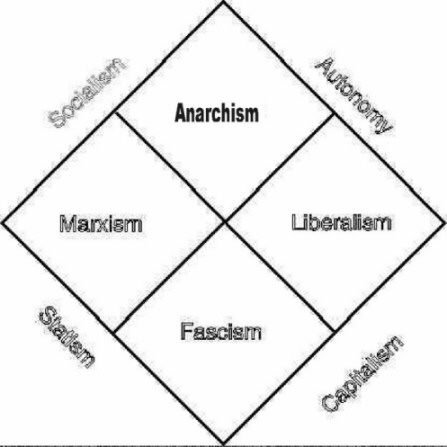
"
[The anarchy degree is 100% - the authoritarian degree within the anarchist quadrant. (Esquerda means left, and direita means right. The star indicates the Norwegian economic-political system after the velvet anarchist revolution in 1994/95.)]
And thus, the Anarchy of Norway is still going strong per 2019. Although the system is significantly anarchist, i.e. within the Quadrant of Anarchism on the economic political map, it is somewhat far from the anarchist ideal on the top of the map. "So this is heaven: Norway", the LA-TIMES in USA reports about Norway, November 2001, but this is however a bit exaggerated; see American look at Norway - Report no 1, where the article is quoted, with comments from IIFOR added. Another American article on the situation in Norway, quoted from NY-TIMES January 2002, also with comments from IIFOR, is also included.
The main policy of the Anarchist International (AI/IFA) and The Anarchist Federation of Norway (AFIN) was presented in the largest Newspaper in Norway, Verdens Gang 06.11.2001, p 39, see Anarchy is [real] democracy - article in VG. This article also states "Norway [as] a relatively anarchist country, however a bit far from the anarchist ideal (Norge som et relativt anarkistisk land, men nokså langt fra det anarkistiske ideal)."
In June 2002 a libertarian direct action against the World Bank's reactionary policy and the ABCDE-meeting, in Oslo, once more confirmed that anarchy is significantly on in Norway, see Direct action against the ABCDE-meeting and policy. Norwegian firms are more and more horizontally organized, according to Nordhaug and Gooderham at NHH (Dagsavisen 15 & 16.10.2004).
A degree of anarchism of ca 54%, as in Norway 2019 is as mentioned not a high degree of anarchism. This means the authoritarian degree is still ca 46%. If the libertarian degree is less than 50% there is no anarchy, i.e. real & green democracy, at all. About 54% anarchy degree is quite an accepted estimate. It is a.o.t. quoted in Dagens Næringsliv (the Industrial life of today, the main economical newspaper of Norway) no 2/3 June 2007 and Finansavisen (the Financial newspaper) Wednesday 17. October 2007, see anarchist articles in DN and Finansavisen.
30.05.2007. The Anarchy of Norway was rated as the most peaceful nation in the world, and since the middle of 1995 the country has also been ranked as the most democratic, libertarian and anarchist on planet Gaia, a.k.a. Tellus and Earth.
15.01.2010. Positive citizen survey: A nationwide citizen survey shows that 86 per cent of Norwegians think that their country is close to being a perfect country to live in.
02.11.2011. Flat hierarchy challenges new leaders. Norway's "flat, flat, flat" management hierarchy [i.e. not topheavy pyramid economically and/or political/adminstrative] poses a huge challenge for new leaders recruited from overseas. It can also explain why there's so few of them within the Norwegian business world. "Many leaders can feel so disrespected when they come to Norway," said Kimberly Lein-Mathisen, global alliance leader for the large US pharmaceutical company Eli Lilly. Everyone is equal, and employees are accustomed to being consulted on most matters, and having their say. Source: www.newsinenglish.no.
So called heaven or not, 54% anarchism is far from the 100% anarchist ideal, full democracy. Thus, it is plenty of room for improvement from anarchist & real democratic perspective, and by no means time for a break in the fight against authoritarian tendencies. The revolution must be fought permanent, in the daily life, to sustain and develop further. However, as long as a) Norway stays out of EU, b) populist and nationalist tendencies are put at place, and c) the left and right tendencies outbalance each other reasonable as by now, Norway will probably stay anarchist and real & green democratic, and be a lighthouse for EU and the rest of the world. We call for anarchist, real & green democratic Bottom – Up actions to sustain and increase the degree of anarchy and democracy in Norway! Source: AIIS.
18.10.2019. Lebanon. About the Lebanese Spring Revolution - a part of GGS. Lebanon protests: Thousands, including the anarchists, i.e. AI/ACAME-Lebanese Section, demand 'fall of the regime' in Beirut. Thousands of protesters march for a second day in anti-government demonstrations over the country's economic crisis and ultra-authoritarian & fascist system!
A little about Lebanon's ultra-authoritarian & totalitarian fascist economic-political system. Most of the Arab countries are totalitarian fascist states, i.e. with less than 33,33 % libertarian = democracy degree, and thus more than 66,67 % authoritarian degree. Lebanon is ranked as no 84 of countries in the world according to libertarian = democracy degree, with about 30,9 % democracy = libertarian degree, and thus 69,1 % authoritarian-degree, i.e. ultra-authoritarian and totalitarian fascism. Shattered by war between 1975 and 1990, Lebanon has one of the world's highest debt burdens as a share of its economy. Economic growth has been hit by regional conflict and instability. Unemployment among those aged under 35 runs at 37 percent. The kind of steps needed to fix the national finances have long proven elusive. Sectarian politicians, many of them civil war veterans, have long used state resources for their own political benefit and are reluctant to cede prerogatives. The crisis has been compounded by a slowdown in capital flows to Lebanon, which has long depended on remittances from its diaspora to meet financing needs, including the state's deficit. The financial crunch has added to the impetus for reform but the government's steps have yet to convince foreign donors who have offered billions in financial assistance conditional on changes. The strains have emerged recently in the real economy where importers have been unable to secure dollars at the pegged exchange rate.
Friday 18.10.2019 protesters in Lebanon block roads with burning tyres and march in Beirut for a second day in demonstrations targeting the government over the country's economic crisis. In Lebanon's biggest protest in years, thousands gathered outside the government headquarters in central Beirut on Thursday 17.10.2019 evening, forcing the cabinet to backtrack on plans to raise a new tax on WhatsApp voice calls. Tear gas was fired as some demonstrators and police clashed in the early hours of Friday 18.10.2019 morning. The unrest led Prime Minister Saad Hariri to cancel a cabinet meeting scheduled for Friday to discuss the 2020 draft budget. Lebanese media has said he would instead make a speech on the protests. Fires lit on the street in central Beirut were smouldering on Friday 18.10.2019 morning. Pavements were scattered with the glass of several smashed shop-fronts and billboards had been torn down. Two foreign workers choked to death after a fire spread to a building near the protests in Beirut, the National News Agency (NNA) said. The Anarchist Confederation of Asia and the Middle East - ACAME - Lebanese Section condemned the ochlarchy, i.e. mob rule broadly defined.
Protesters blocked roads in the north, the south and the Bekaa Valley, among other areas on Friday 18.10.2019, the NNA reported. Schools were closed on the instructions of the government. "We are one people united against the state. We want it to fall," said an anarchist protester in the town of Jeita, some 20km (12.4 miles) from Beirut. "Revolution, revolution!" they chanted. In Beirut, several thousands of people marched near the government's Serail headquarters chanting "the people want the downfall of the regime". This was the second wave of nationwide protests this month. In a country fractured along sectarian lines, the unusually wide geographic reach of these protests has been seen as a sign of deepening anger with politicians who have jointly led Lebanon into crisis. The government, which includes nearly all of Lebanon's main parties, is struggling to implement long-delayed reforms that are seen as more vital than ever to begin resolving the crisis.
The Lebanese newspaper An-Nahar described it as "a tax intifada", or uprising, across Lebanon. Another daily, al-Akhbar, declared it "the WhatsApp revolution" that had shaken Prime Minister Hariri's unity government. "We're not here over WhatsApp - we're here over everything, fuel, food, bread, everything," protesters said. Thousands have taken to the streets in Lebanon as anger grows over gov't tax plans amid an economic crisis in the country. Seeking ways to boost revenues, a government minister on Thursday announced plans to raise a new fee of 20 cents a day for calls via voice over internet protocol (VoIP), used by applications including Facebook-owned WhatsApp. "It was the last straw," a protester said, as men threw wood ripped from a nearby construction site onto a bonfire in the middle of the capital's main thoroughfare. "The people were already at the edge barely holding on. The WhatsApp issue broke whatever they were still holding on to. [But finally] ... the people have awoken," a demonstrator said. As the protests spread, Minister of Telecommunications Mohamed Choucair phoned into Lebanese broadcasters on Thursday evening to say the proposed levy had been revoked! The anarchists, i.e. AI/ACAME-Lebanese Section, call for "a real revolution with a development towards real, i.e. including green, democracy, that is Anarchy - and more of it - as soon as possible! The fascist regime must be replaced by anarchism in a real revolution, as quick as possible!" Sources: Al Jazeera and AIIS.
21.10.2019. Lebanon cabinet fast-tracks reforms as the Lebanese Spring Revolution, a part of GGS, rage on. The People shouts "revolution, revolution"! Lebanon's teetering government approved an economic rescue plan Monday 21.10.2019, but the last-ditch move was met with deep distrust from a swelling protest movement seeking the removal of the entire political class, a powerful and rich part of the Bureaucracy broadly defined, i.e. the Top of the societal pyramid in privat and public sector. Euphoric crowds partied deep into the night Sunday 20.10.2019, and gathered again Monday to listen to Prime Minister Hariri's announcement, which was broadcast on loudspeakers. The crowd erupted into shouts of "revolution, revolution" when Hariri finished his address. "We want the fall of the regime," they went on. "This is all just smoke and mirrors... How do we know these reforms will be implemented?" asked a protester.
Hariri detailed some of the measures taken by his fractious cabinet, including a programme of privatisations, a decision to scrap new tax hikes and halving the generous salaries of ministers and lawmakers. He also said his government would in three weeks approve the first batch of infrastructure projects funded by an $11-billion aid package pledged to Lebanon by international donors last year. Hariri also said he supported the idea of early elections, a key demand among the hundreds of thousands of protesters who have taken to Lebanon's streets since last Thursday, 17.10.2019. President Michel Aoun, who had been conspicuously silent since the start of the demonstrations, suggested at the start of the cabinet meeting that banking secrecy should be lifted for high-ranking officials. Lebanon has strict rules over bank account privacy that critics say makes the country susceptible to money laundering.
Dozens of demonstrators on Monday 21.10.2019 night gathered in front of the central bank in Beirut, accusing its chief Riad Salameh of worsening the country's debt through faulty monetary policies. Aoun's son-in-law and ally, Foreign Minister Gebran Bassil, has also been a particular figure of anger among protesters. For many demonstrators, the reforms Hariri announced smacked of a desperate attempt by a corrupt Top - Bureaucracy broadly defined - to cling to their jobs, and there was little sign Monday that the mobilization was weakening. "It is a day of destiny for us. All our hard work and efforts in previous days and years were to get us to this moment," said Roni al-Asaad, a 32-year-old activist in central Beirut. "If they could have implemented these reforms before, why haven't they? And why should we believe them today?" The protests have morphed into a mass non-partisan push for a total overhaul of a sectarian power system, a very top-heavy societal pyramid, both economically and political/administrative, still run mostly by civil war-era warlords at the Top, three decades after the end of Lebanon's conflict.
Given the size of the gatherings of the People, the Bottom of the societal pyramid, the five-day-old mobilization has been remarkably incident free, with armies of volunteers forming to clean up the streets, provide water to protesters and organize first aid tents. Lebanon's debt-burdened economy has been sliding towards collapse in recent months, adding to the economic woes of a population exasperated by rampant corruption, a lack of job opportunities and poor public services. Among the protesters' main grievances is the erratic supply of electricity from the state. Usually prone to blame anti-government mobilization on another party or a foreign conspiracy, Lebanon's top political figures have appeared to acknowledge that none of them have been spared in the show of public anger. "What happened in the street is a volcano that can't be contained with timely solutions," said Imad Salamey, a political science professor at the Lebanese American University. "It is difficult for the demonstrators to regain trust in the state in 72 hours and with solutions only presented on paper," he said. Schools, banks, universities and many private businesses closed their doors Monday 21.10.2019, both for security reasons and in an apparent bid to encourage people to join the demonstrations. The anarchists, i.e. AI/ACAME-Lebanese Section, once more call for "a real revolution with a development towards Real, i.e. including green, Democracy, that is Anarchy - and more of it - as soon as possible! The fascist regime must be replaced by anarchism in a real revolution, as quick as possible! This also includes Cogrips-policy and political economy in general!" Sources: AFP-France and AIIS.
25.10.2019. Anti-government protests in Lebanon break out also in Hezbollah’s heartland. The Anarchists, AI/ACAME-Lebanese Section condemn the terrorist organization Hezbollah, and call for a real anarchist revolution. The anti-government protests in Lebanon has spread also to the powerful Hezbollah heartland in the south. "They should resign!" a demonstrator in Nabatieh said. "Here, many died in the 2006 war with Israel, our homes been have destroyed. But they cannot use 'Resistance to Israel' as a trump card. We are fed up and want to live!" As elsewhere in Lebanon, the demonstrators are protesting the fascist regime they see as a very top-heavy societal pyramid, and both very corrupt and inefficient. And with three ministers in the government, the perception of Hezbollah is changing – even on the party’s hometurf. The anarchists, The Anarchist Confederation of Asia and the Middle East - ACAME - Lebanese Section condemn the terrorist organization Hezbollah, and call for "a real revolution with a development towards Real, i.e. including green, Democracy, that is Anarchy - and more of it - as soon as possible! The fascist regime, including the terrorist rule of Hezbollah, must be replaced by anarchism in a real revolution, as quick as possible! This also includes Cogrips-policy and political economy in general!" Sources: France24 and AIIS.
29.10.2019. Lebanese PM Hariri offers resignation amid protests by the People including the Anarchists declaring: the revolution must continue to a Real i.e. including Green Democracy is reached, with a political economy based on Cogrips-policy. .
Lebanon's Prime Minister Saad Hariri has said he is resigning, amid protests that have gripped the country for almost two weeks. Mr. Hariri said Lebanon had reached a deadlock and needed a shock to break the crisis. The announcement was met with cheers from protesters in Beirut. The protests over political corruption and economic turmoil, began, as mentioned, after now-scrapped plans to tax WhatsApp calls were introduced in mid-October. Lebanon has one of the highest debt levels in the world. The protests have led to a 10-day closure of banks, with many other offices, schools and universities also shut. What did Mr. Hariri say? In a televised address, the prime minister said he had reached a "dead end" and that he would tender his resignation and that of the government to President Michel Aoun. Mr Hariri said: "For 13 days, the Lebanese people have waited for a decision for a political solution that stops the deterioration. And I have tried, during this period, to find a way out, through which to listen to the voice of the people." But he added: "It has become necessary for us to make a great shock to fix the crisis. "Posts come and go, what matters is the safety and dignity of the people." President Aoun is still to comment. If the resignation is accepted, the constitution would require Mr. Hariri to stay on until a new administration is established. What is the state of the protests? The prime minister's announcement came as the situation on the ground turned increasingly violent, reflecting the deep-seated schism in Lebanese society. The militant Shia group, Hezbollah, which has dominated the coalition government led by Mr. Hariri, a Sunni, has recently hardened its stance against the protests. On Tuesday, black-clad men loyal to Hezbollah and another Shia group, Amal, ransacked a protest camp in central Beirut, chanting slogans, setting tents on fire and beating anti-government demonstrators. A roadblock set up by protesters was also attacked. Riot police and troops fired tear gas to separate the rival groups. The protesters remained defiant in central Beirut. Less than an hour after being attacked they erupted into applause at the announcement of Mr. Hariri's resignation. One demonstrator, Tima Samir, told Agence France-Presse: "This resignation is welcome but it is not enough... We want the entire system to change and we'll stay on the streets until all our demands are met."
So what happens next? Here in the capital, protesters cheered loudly as the PM announced his resignation. But the announcement brought little clarity on the way forward. Mr. Hariri said he'd reached a dead end, implying he's pulling back, leaving the mess to his governing coalition partners. But then he said that "we" need a way to fix the economy and protect the country, implying that whatever happens next, he will be part of it. The president will now have to consult parliament to form another government - but parliament is made up of the same factions that are in the outgoing coalition. Whatever they do, they will do it under intense pressure - from the protest movement and from a deepening economic and financial crisis. How did we get to this point? Simmering resentment at corruption, a dysfunctional government and its handling of the economy boiled over on 17 October when the government announced a new tax for calls made via voice-over-internet-protocol (Voip), used by apps like WhatsApp, Facebook Messenger and Apple's FaceTime. The government backtracked within hours but the protests were soon under way and quickly burgeoned. As one demonstrator said: "We are not here over the WhatsApp, we are here over everything: over fuel, food, bread, over everything." Last week, Mr. Hariri and his coalition, including Hezbollah, agreed to a plan of reforms to try to placate protesters, but their campaign continued. On Friday, Hezbollah's leader, Hassan Nasrallah, said "someone is trying to pull [Lebanon]... towards a civil war", falsely suggesting the protests were funded by foreign powers and indicating a harsher policy towards the protesters. Hezbollah had argued against Mr. Hariri's resignation, saying it could result in a void in Lebanese government Many in the population are tired of economic stagnation, endemic corruption and a lack of basic public services. The developments will alarm the West, which regards Lebanon as an island of relative stability in a turbulent Middle East. The power-sharing agreement that ended the country's civil war 30 years ago has kept the peace, but it has failed to halt the slide towards economic crisis.
The anarchists, The Anarchist Confederation of Asia and the Middle East - AI/ACAME - Lebanese Section condemn the terrorist organization Hezbollah and their counter-revolutionary attacks on revolutionary Pro-Democracy, i.e. including Green, demonstrators, and call for "a continued and real revolution with a development towards Real i.e. including Green Democracy, that is Anarchy - and more of it - as soon as possible! The fascist regime, including the terrorist rule of Hezbollah, must be replaced by anarchism in a continued and real revolution, as quick as possible! This also includes Cogrips-policy and political economy in general, rooted back to Nobel-prize winner in economics - Ragnar Frisch!" Sources: BBC and AIIS.
27.10.2019. The Islamic State IS/ISIL/ISIS/Daesh and USA. ISIS leader al-Baghdadi killed in US raid in Syria, Trump confirms. US President Donald Trump has announced that Islamic State leader Abu Bakr al-Baghdadi was killed during a US military raid in northwest Syria, confirming an avalanche of rumors on the terrorist's death. "Al-Baghdadi has been killed…in a daring nighttime raid," Trump said in a live address from the White House. The US troops involved in the elimination of the terrorist "accomplished the mission in grand style," he said. The IS leader met his end "crying and screaming" due to being terrified by Americans might, Trump stated. Source: AIIS
16.11.2019. Sudan. Recent development in Sudan 15.09.2019 - 16.11.2019. The Sudanese embryo revolution is aborted as in Egypt, and the Sudanese Spring is now a pro democracy and green opposition movement to the Hemedti Fascist Mega Terrorist State. It is clear that real and green democracy in Sudan can only be achieved via allies with significant more military muscles, supporting the People, including the Anarchists.
15.09.2019. Anarchist warning. The notorious ochlarchy (including criminal and terrorist) paramilitary group RSF, is still commanded and ruled by Hemedti, also [formally] deputy chairman of the powerful Sovereign Council, on top of the new hybrid civil-military State of Sudan. The Anarchists a) repeat that RSF must be banned and dissolved, and the main responsible for the groups criminal acts, the RSF-commander general Hemedti, must be arrested and brought to justice as soon as possible, and b) continue to warn against a development towards a Hemedti-Hamdok fascist national unity Mega-State, with a larger Bureaucracy (i.e. upper class), including most counter-revolutionary forces: RSF & armed "rebel" groups, old political parties (in FFC and Bashir's) and many more, is a clear possibility. And later multi-party elections with "flawed democracy" - without sufficient "checks and balances", i.e. totalitarian and ultra-authoritarian, and still a very top-heavy pyramid economic-political system, with heavy and even more repression and exploitation of the People (the bottom class). The Sudanese revolution, i.e. so far only an embryo-revolution, is still not over, but can soon be aborted (as in Egypt). Sources: SUNA, Sudan Tribune, Sudan Daily and AIIS.
30.09.2019. Sudan's ultra-fascist paramilitary terrorist militia ruler Hemedti: 'Time for voluntary disarmament is over'. Lt Gen Mohamed Hamdan ‘Hemedti’, formally deputy head of Sudan's Sovereign Council, de facto ultra-fascist top ruler of Sudan and Sudan’s Sovereign Council and commander of the notorious terrorist Rapid Support Forces (RSF) militia, has renewed a call to tribal leaders to collect weapons as soon as possible, pointing out that “the time of voluntary disarmament is over”. In a meeting with civil administration leaders and tribal elders in the South Darfur capital Nyala yesterday, Hemedti said: “We have no problem with anyone who voluntarily surrenders his gun.” He added that during the new administration, all rebel prisoners have been released, however, “those convicted under the Emergency Law must be re-charged because they are criminals”. Hemedti vowed that “the Sudan Armed Forces are instructed to find and arrest the outlaws and they are ordered to collecting weapons and motorcycles and prevent any trespassing on farms. Further, he emphasised the need to support the newly formed civilian government. Sources: Radio Dabanga and AIIS.
02.10.2019. Prime Minister Abdallah Hamdok: 'I work in harmony with Hemedti'. The Prime Minister Abdalla Hamdok said they are working to build a transparent and independent judiciary. He stressed that former President al-Bashir would be tried at home, and that they would not accept dictations from abroad to try him at the ICC. The PM explained his opinion on the participation of the Sudanese troops in Yemen war, and his view of the post-revolution demonstrations. Hamdok described his relationship with the military as good. He said: “We are working to make the relationship a smooth partnership in which the full cooperation for the interest of Sudan, stressing the existence of great harmony between him and the member of the sovereign council, the commander of the Rapid Support Forces (RSF), Lt. Gen Mohamed Hamdan Daglo," a.k.a. Hemedti. Thus Hamdok is from now on only a puppet of the Sudanese de facto ruler, Hemedti. There will be no Hemedti-Hamdok state, just a Hemedti Mega Terrorist State. Sources: Sudan Daily and AIIS.
16.11.2019. The Sudanese embryo-revolution is aborted, and over. The Sudanese Spring is no longer a revolution, but only an opposition movement - The Sudanese Spring Opposition - to the Hemedti fascist national unity terrorist Mega-State, with a large Bureaucracy (i.e. upper class), including lots of counter-revolutionary forces: The RSF terrorist mob & former armed "rebel" groups, old political parties in FFC and many more. And later either full dictatorship with no elections at all, or so called "multi-party elections" with only ultra-authoritarian parties, and thus with "flawed democracy" - also without "checks and balances", i.e. totalitarian and ultra-authoritarian, and a very top-heavy pyramid economic-political system, with heavy and even more repression and exploitation of the People - the bottom class - than before. The Sudanese revolution was only an embryo-revolution, and is now aborted as in Egypt. The economic-political system in Sudan is now and in the near future, and perhaps for a longer time, even more authoritarian and top heavy than the Bashir regime. The Hemedti Fascist Mega State is a terrorist regime, ruled via the terrorist ochlarchy paramilitary mob-organization Rapid Support Forces RSF, that makes up most of the STATE, after the Coup d’état and ultra-fascist counter-revolution. It is clear that real and green democracy in Sudan can only be achieved via allies with significant more military muscles, supporting the People, including the Sudanese Anarchists. Source: AIIS.
The Sudanese Anarchists and the Green Aspect. AI/ACA-Sudanese Section and Mr. Dabanga, spokesperson for the now global People's Council comment on the symposium on climate changes of 12.09.2019, and the GGS. Public Administration for Agriculture of the Ministry of Production and Economic Resources in Gaziera State in Sudan organized a symposium on Thursday 12.09.2019 entitled "Climate change, its Impacts on Rain Fed Sector and Troubleshooting". The symposium was organized in collaboration with Meteorological Sudanese Society, Gaziera State Branch. The Patron of the Society Professor Hussain Suleiman and the Eng. Arafa Mohamed Ali attended the symposium. Arafa said the objective of the symposium was for solving problems facing agriculture in the country and absorbing the requirement of the stage and boosting the agricultural renaissance in the state. For his part Professor Suleiman announced that the society was competent to solve problems related to climate change and its negative impacts on agricultural season. A number of working papers were presented by professionals in the field of distributing agricultural Arable land, soil, climate, rains, caused of deterioration of the vegetation cover and the reduction of soil fertility.
"These problems are typically negative climate changes happening in a lot of countries world wide, i.e. mainly global problems, and worsening as time goes by, according to updated scientific knowledge", Mr Dabanga, spokesperson of the now global, included Sudanese, People's Council commented 28.09.2019: "The People of Sudan and of the world in general doubt that "the society was competent to solve problems related to climate change and its negative impacts" as Professor Suleiman was alleging. The problems are mainly global, not only Sudanese and local in the Gaziera State, and thus mainly requires global actions and solutions within the framework of the Green Global Spring Revolution (GGS). The People, i.e. the Bottom Class - the Grassroots, demand 1. a change in the present hybrid civil-military ultra-authoritarian and totalitarian fascist transitional system, towards Real (i.e. included a significant Green tendency) Democracy to meet the People's demands, as soon as possible, and 2. that the Sudanese authorities support the actions of the GGS in general , and especially the "Action: China, USA and EU! Drop Coal!" mainly directed at The Highest Tops - the rulers, the evil, i.e. ochlarchist, Coal-Monarchs of China, USA and EU. These (top) rulers are the main responsible for the actions and problems of the systems, including the destruction of the environment and more by the manmade global warming, global, including Sudan. But we seriously doubt the mainly counter-revolutionary hybrid civil-military fascist ... [Hemedti Mega Terrorist State] will follow up this GGS Climate-Action." Sources: SUNA, Africa News, Sudan Tribune, Sudan Daily and AIIS. Update 16.11.2019. The Sudanese Anarchists repeat: It is clear that real and green democracy in Sudan can only be achieved via allies with significant more military muscles, supporting the domestic People, including us the Sudanese Anarchists. Soon - preferably NOW!
19.01.2020. Lebanon. At least 150 injured in Lebanese capital after violent clashes between protesters and police. More than 150 people were injured after police fired tear gas and rubber bullets in Lebanon on Saturday 18.01.2020 to disperse protesters. Clashes between police and demonstrators broke out in downtown Beirut after some protesters started throwing stones at police near the parliament building The clashes between protesters and police come as the financial crisis in the country deepens. The Lebanese Spring is thus still going on, but is so far mostly market-economy orientated and not much into environmental political economy and the climate crisis, as the core of GGS is. The anarchists condemn the ochlarchy. Sources: Euronews and AIIS.
11.02.2020. Sudan update. Sudan's former president Omar al-Bashir will be handed over to the International Criminal Court, ICC, to face war crimes charges, it was announced Tuesday 11.02.2020. Bashir, who was ousted in April 2019 by a military Coup d’état, after months of nationwide protests, faces five counts of crimes against humanity and two counts of war crimes at the ICC in The Hague. The crimes were allegedly committed during Sudan's military campaign in Darfur between 2003 and 2008. A member of Sudan's ruling sovereign council said Tuesday 11.02.2020 that all Sudanese wanted by the ICC would appear before it. A senior government source confirmed to CNN that Bashir was among them. The move is part of a proposed agreement between the Sudanese government and Darfur's rebel movement, according to the source, who asked not to be named for security reasons. No timeline has been set. ICC spokesman Fadi El Abdallah told CNN: "We are aware and following the news in relation to Mr. al-Bashir. We have no official confirmation on our side at this moment." Source: CNN.
23.02.2020. Algeria. The Situation in Algeria - the Hirak (movement). Around a year ago, on 22 February 2019, Algerians thronged the streets to protest against then-President Abdelaziz Bouteflika's bid for a fifth term after nearly 20 years in power. Mr Bouteflika stood down in April. But Algerians kept on protesting. By this time, the protests had a name - the Hirak (movement). Ten months into the protests, an election ushered in Abdelmadjid Tebboune as president. But the demonstrations continued. One year on, some political players and national figures have sounded alarm bells, warning of the movement's "failure" and "radicalism". They have called for dialogue with the authorities and the pursuit of "achievable" goals.
But others are more optimistic and insist that things will never be the same again in Algeria. Since the start of 2020, President Tebboune - who briefly served as Mr Bouteflika's prime minister - has been consulting political figures about amendments to the constitution. A referendum on the amendments is expected in the summer, followed by legislative elections by the end of the year. This month, Prime Minister Abdelaziz Djerad pitched his government's plan of action - dubbed "a new deal for a new Algeria" to parliament, promising to "cleanse the disastrous heritage" of past governance.
But many are sceptical about the authorities' promises. More than 100 protesters are reportedly still in detention, events organised by the opposition are still often banned, and the judiciary continues to show subservience to the executive branch. As for the authorities' purge against former officials and powerful businessmen, it has actually drawn criticism from many protesters and political players, who have called instead for a transitional justice system to be put in place. "Nothing has changed" is the leitmotiv repeated by human rights lawyer and political activist Mostefa Bouchachi, a familiar face at the protests who gives frequent interviews to the press. That is why Algerians will carry on, he says, far from being discouraged.
To talk or not to talk with the authorities? Whether or not to engage with the authorities has been a bone of contention, causing divisions in the movement. Sofiane Djilali, the leader of the Jil Jadid (New Generation) party and erstwhile coordinator of the Mouwatana (Citizenship) movement has warned against the "radicalism" of some segments of the Hirak and argues that cooperating with the authorities is the only way to effect real change. Despite diverging opinions about the road ahead, many Algerians share the same demands - as Mr Djilali said - and many feel that things have changed permanently. Some observers are confident that a new dynamic and social pact have been established and will bear fruit.
One word that crops up again and again in commentaries is "opportunity", conveying the sense that the Hirak is a work in progress. "Some people think the Hirak has failed because there was a presidential election… They see the Hirak as a political party that failed to make it to power. But, that's not what the Hirak is... The Hirak is political, but it's not a political party," journalist Said Djaafer said in an episode of Radio M's flagship Cafe Presse Politique programme. "It's a movement that comprises all political currents, all social classes, which wants to change the rules of the political game. They don't want to take power." "Those who say it has failed are not looking at this new dynamic: students are organizing, there are people who have never taken an interest in politics who suddenly are interested, it is these things that are being sown… you cannot talk about a failure." "It's a movement that will not stop, even if the demonstrations stop."
One journalist threw the ball back at the authorities, saying they were the ones who had "failed". "The regime has failed. It is over, and the democratic revolution is only beginning," Amin Khan said on the Radio M website. "The equation is simple. This is a historic opportunity for the country. The regime is faced with a popular movement characterised by rare wisdom. Algerians are not hungry for violence, revenge, expeditious justice or a witch hunt." "They want the peaceful and orderly departure of the regime through the law, via... democratic elections [and] the establishment of legitimate institutions... in other words, the complete opposite of a wild adventure or extravagant ambitions." A tweet by commentator Nabil Mellah - neatly sums up the protests, one year on: "Binary thinking, the main threat to the Hirak?"
The AI/ACA-Algerian Section, a member of the The Green Global Spring Revolution - GGS, calls for "a real revolution with a development towards Real i.e. including Green Democracy, that is Anarchy - and more of it - as soon as possible! The ultra-authoritarian, totalitarian fascist regime at about only 28,5% democracy = libertarian degree, and thus ca. 71,5 % authoritarian degree, must be replaced by anarchism in a continued and real revolution, as quick as possible! This also includes Cogrips-policy and political economy in general, rooted back to Nobel-prize winner in economics - Ragnar Frisch!" Sources: BBC and AIIS.
10.04.2020. Sudan authoritarian totalitarian. Following the refusal of a police officer in Ed Daein, capital of East Darfur, to file a report against an officer of the Rapid Support Forces (RSF) government militia, more medical staff of the Ed Daein Teaching Hospital stopped working on Thursday 09.04.2020. Nurses at El Obeid Teaching Hospital in North Kordofan demand more medical safety equipment. On Sunday 05.04.2020, an RSF militiaman molested deputy general surgeon Hussein Osman in the Ed Daein Teaching Hosputal. In response, the doctors of the hospital decided to lay down their tools. When the hospital wanted to lodge an official complaint, the police officer on duty refused to handle the case. “This approach represents an authoritarian totalitarian mind-set that has nothing to do with the revolution,” the Sudan Doctors’ Central Committee, the Sudanese Doctors’ Syndicate, and the Medical Consultants and Specialists Committee commented in a joint statement on Thursday 09.04.2020.
They described the behaviour of the police officer who refused to file a report as “closer to the behaviour of a gang member than that of a neutral state apparatus officer whose job is to maintain security and apply the law for all people”. The doctors demand a fair and public trial of the aggressor. The police officer who refused to file a report must be held accountable. Furthermore, police protection must be provided at their residences, to ensure that no member of the regular forces will enter them again. The medics further demand the East Darfur government to offer its apologies for “tarnishing the image of doctors when they accused them of refusing to work, and allowing the police officer on duty on the day of the attack to refuse to file a criminal report against the aggressor”.
Equipment. On Thursday, the nursing staff of El Obeid Teaching Hospital in North Kordofan embarked on a strike in protest against the lack of medical safety equipment and tools at the hospital. A health worker told Radio Dabanga from El Obeid that the nurses carried out a protest before deciding on a strike. He explained that the protestors will return after the hospital administration has provided the required medical equipment, and the hospital's medical director has been questioned about the delay in meeting their demands. Source: Radio Dabanga.
29.04.2020. Lebanon. Cash-strapped Lebanon is facing growing turmoil after the fallout from the coronavirus outbreak sparked violent protests over rising hunger and poverty. Source: CNN.
30.04.2020. Lebanon is in turmoil. The country's long-running financial crisis, which led to the resignation of its prime minister in October, has only gotten worse because of the coronavirus pandemic. Before the pandemic, the World Bank projected that 45% of people in Lebanon would be below the poverty line in 2020. Now the government believes that up to 75% of people are in need of aid, Social Affairs Minister Ramzi Musharrafieh told CNN. Anti-government protesters returned to the street with a vengeance this week after nearly two months on lockdown. In Tripoli, the country's second-largest city and its poorest, protesters hurled Molotov cocktails at banks and clashed with security forces. Since the uprising began last year, the Lebanese lira has been in a free fall, losing about half of its value. Food prices are soaring. The anarchists condemn the ochlarchy including chaos. Sources: CNN and AIIS.
More about the embryo-revolution in Lebanon: See the reports above in this issue of IJ@! 18.10.2019. Lebanon. About the Lebanese Spring Revolution - a part of GGS. Lebanon protests: Thousands, including the anarchists, i.e. AI/ACAME-Lebanese Section, demand 'fall of the regime' in Beirut. Thousands of protesters march for a second day in anti-government demonstrations over the country's economic crisis and ultra-authoritarian & fascist system! And 19.01.2020. Lebanon. At least 150 injured in Lebanese capital after violent clashes between protesters and police. See also the Introduction to this issue of IJ@ at the top of this webpage, for an updated brief summary of the embryo-revolution in Lebanon. Source: AIIS.
20.11.2020. Africa news.... Looking for anarchist contacts in Sudan or ACA ... ACA-Sudan has gone underground due to terrorist repression by Hemedti & his mob...
-----Original Message-----
From: horn_anarchists@xxx.xx
Sent: Friday, November 20, 2020 10:35 AM
To: ifa@anarchy.no
Subject: Looking for anarchist contacts in Sudan or ACA
Hello there,
We are anarchists from the Horn of Africa following the situation in Ethiopia closely. There have been thousands of migrants fleeing their homes to Sudan following attacks by government forces in the past two weeks. And we are looking for anarchist contacts in Sudan or any contact from the Anarchist Confederation of Africa to collaborate on refugee solidarity with folks there. Do you have an email address or Twitter dms to help us initiate contact?
Let us know as soon as you can.
Solidarity, Horn Anarchists
-----Original Message-----
From: Globaldistribution
Sent: Friday, November 20, 2020 1:38 PM
To: 'horn_anarchists@xxx.xx
Subject: RE: Looking for anarchist contacts in Sudan or ACA
Hi horn_anarchists@
Are you interested in joining ACA as network-members/subscribers?
http://www.anarchy.no/africa.html
http://www.anarchy.no/sudan.html
See the Sudan-file. The situation in Sudan is not safe for anarchists anymore, and ACA-Sudan is a secret network. We can contact them if you want.
Anarchist greetings Mr. Dabanga for ACA-Sudan and ACA. (Living in exile in a secret & safe place for the moment - your contact at e-mail ifa@anarchy.no)
PS. Globaldistribution sending out for ifa@anarchy.no
21.11.2020. More news from Africa…
-----Original Message-----
From: horn_anarchists@xxx.xx
Sent: Friday, November 20, 2020 4:56 PM
To: ifa@anarchy.no
Subject: Re: Looking for anarchist contacts in Sudan or ACA
We are interested in joining ACA as subscribers. However, we are semi-public so we want to keep our name off, i.e. our e-mail-address. Just saying ACA-Horn Africa should be enough for now. We have seen the Africa and Sudan file. Sorry to hear the situation in Sudan has deteriorated for anarchists.
Can you passage this message to ACA-Sudan? "Can ACA-Sudan organize refugee solidarity above ground or join NGOs in Sudan working with refugees? Can ACA-Sudan help us establish contact with anyone working with refugees there? E-mail or phone number would be great"
"The Ethiopian government is working with Sudanese government to coerce survivors of war crimes/mass killings and rape to hand them over to the Ethiopian government from whom they fled. We want to initiate contact with refugees or those helping them in Sudan to inform them about the plan and help them resist coercive return. Can ACA-Sudan help us establish contact?"
In solidarity: ACA-Horn Africa.
--- --- ---
Thank you for the subscription to ACA. You will also receive news from Sudan. We will forward the main material of your message as a newsletter from ACA and ACA-Sudan, and publish it at IJ@ 1 (41) updated and the Sudan file, with some additional comments.
In Solidarity:
@-greetings Mr. Dabanga, spokesperson for ACA-Sudan and ACA (contact-address ifa@anarchy.no ).
PS. “The most capable refugee-NGO in Sudan is the rather liberal social-democratic, i.e. libertaire (= anarchist) Danish Refugee Council, DRC, located in Sudan, e-mail-address cd.sudan@drc.ngo; and for emergency udsatte@drc.ngo. Take direct contact by e-mail.” Resolution by ACA-Sudan.
04.12.2020. Thailand’s youth rebellion: Protest movement demands monarchy reform. Thailand’s royal family are officially revered and protected by harsh laws, which can land you in jail for many years. But over the past five months a student-led protest movement has started demanding reform of the monarchy, and an end to military coups. Thailand has had 20 in modern times. The protesters want King Vajiralongkorn’s power and spending to be limited, though many Thais remain strongly loyal to him and object to the reform campaign. Source: BBC.
21.12.2020. Sudan: Hemedti’s mob militia, RSF, killed university student in North Darfur. In North Darfur, a university student was killed by members of Sudan’s paramilitary Rapid Support Forces (RSF) on Wednesday 16.12.2020. A relative of student Imran Jaralnabi told Radio Dabanga that a group of RSF members, led by a captain, intercepted the student while he was riding a motorbike from Tina in Tawila locality to Karnoi. They shot him dead, with the intention of stealing his motorbike and possessions, according to the relative. The North Darfur state security committee said that it has taken steps to reduce levels of crime in the localities of Tawila and Kutum following the death of Jaralnabi. Maj Gen Yahya El Nour, Director of North Darfur Police and the security committee, said “the committee has taken a number of technical and administrative measures to find the suspects connected to the murder of Jaralnabi, arrest them, and bring them to justice.”
He confirmed the formation of an administrative committee to investigate the RSF and a technical committee that will incorporate forensic evidence into the investigation. This will include collecting fingerprints, sketching the accident, and providing technical support. Last month, the Governor of North Darfur, Mohamed Arabi, addressed a vigil for a farmer and his son, who were shot dead by gunmen in Tawila locality on November 24. After the vigil, he said that the state government is responsible for any violent incident caused by the regular forces “represented by the army, police, and the RSF”. Any other militias not affiliated with the government will be dealt with according to the law, he said.
Arabi acknowledged that “the new government inherited a complicated situation”, explaining that the armed forces and police “face great problems”. He promised to address the problems “according to the possibilities”. The governor further said that a comprehensive change in the leadership of the regular forces in North Darfur. “On Tuesday, they decided on the collection of weapons from civilians.” UNAMID has reported 47 cases of human rights violations and the displacement of more than 50,000 people in Darfur between September 1 and November 23 of this year, including over 27,000 people in Central and South Darfur. El Nour also announced that North Darfur's security committee has supplied Kutum locality with nine vehicles to help with security during the agricultural season. Agricultural disputes occur regularly in Darfur at this time of year, due to livestock destroying farmers' crops. Source: Radio Dabanga.
19.01.2021. Tunisia. Legitimate protests - but also tendencies of ochlarchy (mob rule broadly defined) including chaos, by provocateurs.
France 24 writes: Hundreds of youths clashed with police in cities across Tunisia late on Monday 18.01.2021, throwing stones and gasoline bombs in the capital as security forces used tear gas and water cannons to try to quell the unrest. Up to 300 young men clashed with police in the capital’s Ettadamon district, Reuters journalists there said, while residents of Kasserine, Gafsa, Sousse and Monastir described street violence in those cities. Rioting and protests have followed the 10th anniversary of a revolution that brought democracy but few material gains for most Tunisians, with anger growing at chronic joblessness and poor state services. However, with no clear agenda, political leadership or backing from major parties, it is not clear whether the demonstrations will gain momentum or die down, as many previous rounds of protests have since 2011. The crowd in Ettadamon on Monday 18.01.2021 chanted no slogans during their clashes with police who wore body armour and carried batons. Security forces patrolled the area in military-style vehicles.
London-based Amnesty International called for restraint. It cited footage showing officers beating and dragging people they had detained and said authorities should immediately release Hamza Nassri Jeridi, a rights activist arrested on Monday 18.01.2021. A decade after throwing off the shackles of autocratic rule, Tunisia was heading towards an economic crisis even before the global coronavirus pandemic struck last year, wrecking the tourism industry and locking down other businesses. An Interior Ministry spokesman said on Monday that police had detained 632 people on Sunday alone after what it called rioting across the country that included looting and attacks on property. Most of the detainees were aged 15-20, it said. In Tunis’ central Bourguiba Avenue, a tree-lined boulevard flanked by government offices and colonial-era buildings where the biggest protests in 2011 took place, demonstrators on Monday said they wanted people arrested in recent days to be released. “They call everyone who protests against the system a thief...We have come with exposed faces by day and not by night to say we want jobs...We want dignity,” said Sonia, an unemployed graduate who did not want to give her family name. Demonstrators with her chanted “no fear, no fear! The street belongs to the people!” In his home Mnihla district of Tunis, President Kais Saied addressed a crowd of dozens of people affirming their right to “jobs, freedom and dignity”. He warned that some political forces sought to manipulate the protesters to “sow chaos”.
AIIS: SLOGANS FOR THE ARAB SPRING AND GGS: Less Than 1,5° C Global Warming! Drop Fossil Fuel! Green Energy! Full Employment! 5 % Green GDP growth! Small Income & Rank Differences! Down with the Gini-index to 20 %! Liberal Social-Democracy! Real & Green Democracy! Eco-Anarchy For Ever! Sufficient High Democracy Degree! Zero Population Growth!!!
22.01.2021. Iraq & the Islamic State IS/ISIL/ISIS/Daesh. Islamic State claimed responsibility for an attack in a crowded Baghdad market on Thursday 21.01.2021, killing at least 32 people in Iraq's first big suicide bombing for three years, authorities said, describing it as a possible sign of the reactivation of Islamic State. The Anarchist International condemns IS and the terrorist attack, and sends condolences to the families and friends of the victims. Sources: AIIS and France 24. See also: https://www.france24.com/en/middle-east/20210122-baghdad-suicide-bombings-highlight-is-group-s-enduring-threat
13.02.2021. Somalia. Car bomb explodes near Somali presidential palace in Mogadishu. Al-Shabaab is probably behind. The terrorist group seeks to turn Somalia into a fundamentalist Islamic state. ACA and AI/IFA condemn their terrorist attack. More information at: https://edition.cnn.com/2021/02/13/africa/somalia-blast-presidential-palace-intl-hnk/index.html. Sources: CNN & AIIS.
15.02.2021. Turkey arrests hundreds over alleged Kurdish militant links in Iraq executions, see: https://www.france24.com/en/middle-east/20210215-turkey-arrests-hundreds-over-alleged-kurdish-militant-links-in-iraq-executions. Source: France 24.
16.02.2021. Libya, 10 years on: Can the war-torn country finally turn the page? - See: https://www.france24.com/en/tv-shows/perspective/20210216-libya-10-years-on-can-the-war-torn-country-finally-turn-the-page. Source: France 24.
17.02.2021. USA - Saudi Arabia. What's behind Biden's snub of Saudi Crown Prince Mohammed Bin Salman, see: https://edition.cnn.com/2021/02/17/middleeast/saudi-biden-mbs-robertson-intl/index.html. Source: CNN.
17.02.2021. Libya marks 10 years since start of protests that overthrew Gaddafi, see: https://www.france24.com/en/africa/20210217-libya-marks-10-years-since-overthrow-of-gaddafi. Source: France 24.
18.02.2021. Algeria's president calls for dissolution of parliament, elections, see: https://www.france24.com/en/live-news/20210218-algeria-s-president-calls-for-dissolution-of-parliament-elections. Source: France 24.
25-26.02.2021. Saudi Arabia - USA. Jamal Khashoggi: US to release report on Saudi journalist murder, see: https://www.bbc.com/news/world-us-canada-56193263. Source: BBC. Jamal Khashoggi: Biden raises human rights in call with Saudi king, see: https://www.bbc.com/news/world-us-canada-56204449. Source: BBC. Under Joe Biden, US cools relations with Saudi crown prince, see: https://www.france24.com/en/middle-east/20210225-under-joe-biden-us-cools-relations-with-saudi-crown-prince. Source: France 24. US intelligence report finds Saudi Crown Prince responsible for approving Khashoggi operation, see: https://edition.cnn.com/2021/02/26/politics/biden-administration-khashoggi-report/index.html. Source: CNN.
26.02.2021. Syria, Iran & USA. Biden sends a message to Iran, but with a scalpel instead of a sledgehammer, see: https://edition.cnn.com/2021/02/26/middleeast/biden-syria-strike-iran-message-npw-intl/index.html. Source: CNN. The Khashoggi report, annotated, Published February 26, 2021, see: https://edition.cnn.com/interactive/2021/02/politics/khashoggi-report-annotated/. Source: CNN.
26.02.2021. Egypt, 10 years on: From revolution to counter-revolution, see: https://www.france24.com/en/tv-shows/revisited/20210226-egypt-10-years-on-from-revolution-to-counter-revolution. Source: France 24.
27.02.2021. Saudi Arabia - USA. Biden doesn't penalize crown prince despite promise to punish senior Saudi leader, see: https://edition.cnn.com/2021/02/26/politics/biden-mohammed-bin-salman-jamal-khashoggi/index.html. Source: CNN.
01.03.2021. Saudi Arabia - USA. Three names mysteriously removed from Khashoggi intelligence report after initial publication, see: https://edition.cnn.com/2021/02/28/politics/jamal-khashoggi-intelligence-report-three-names-removed/index.html. Source: CNN.
01.03.2021. Saudi Arabia - USA. Crown prince MBS faces fallout in Saudi-US relations after report on Khashoggi murder, see: https://www.france24.com/en/middle-east/20210301-saudi-arabia-s-mbs-faces-comedown-in-wake-of-us-report-on-khashoggi-murder. Source: France 24.
06.03.2021. Somalia. Car bomb explodes in Somalia's capital, killing at least 20 people, Al-Shabaab is probably behind. The terrorist group seeks to turn Somalia into a fundamentalist Islamic state. ACA and AI/IFA condemn their terrorist attack. More information at:: https://edition.cnn.com/2021/03/06/africa/mogadishu-car-bomb-attack-intl/index.html. Sources: CNN & AIIS.
16.03.2021. Syria. A decade long conflict, see: https://graphics.france24.com/syria-war-decade-chronology/, Source: France 24.
20.03.2021. Burma/Myanmar: About the Anarchist Revolution in Burma/Myanmar. Latest updates. See: http://www.anarchy.no/asia.html & http://www.anarchy.no/ija431.html. Source: AIIS.
23.03.2021. Saudi Arabia - UN. UN Special Rapporteur says top Saudi official issued death threat against her for role in Khashoggi investigation, see: https://edition.cnn.com/2021/03/23/middleeast/un-khashoggi-investigation-death-threat-intl/index.html. Source. CNN.
25.03.2021. Jordan police detain scores of activists, break up protests, see: https://edition.cnn.com/2021/03/25/middleeast/jordan-protests-arab-spring-arrests-intl/index.html. Source: CNN. The Anarchist International and ACAME condemn the infiltration by Islamists in the pro-democracy movement in Jordan. Source: AIIS.
04.04.2021. Jordan's former crown prince says he has been placed in isolation, see: https://edition.cnn.com/2021/04/03/middleeast/jordan-royal-family-arrested-hassan-bin-zaid-intl/index.html. Source: CNN.
11.04.2021. Jordan's Abdullah appears with half-brother for first time since palace crisis, see: https://www.france24.com/en/middle-east/20210411-jordan-s-abdullah-appears-with-half-brother-for-first-time-since-palace-crisis. Source: France 24.
26.05.2021. Two Iraqis killed at protest demanding justice for slain pro-democracy activists, see: https://www.france24.com/en/middle-east/20210525-two-iraqis-killed-at-protest-in-iraq-over-unpunished-killings. Source: France 24.
27.05.2021. The Green Global Spring Revolution. How the Arab Spring spawned a ‘green revolution’, see: https://www.dw.com/en/how-the-arab-spring-spawned-a-green-revolution/a-18172378. Source: DW.
10.06.2021. Lebanon. The Biden administration and Lebanon: Keep up the pressure!
Over the past several years, the international community has watched the tragedy in Lebanon unfold as that country continues its seemingly inexorable descent into a failed state. In its “World Report 2021,” Human Rights Watch captured Lebanon’s compounding crisis:“In 2020, Lebanon endured multiple crises, including a massive explosion in Beirut’s port, an economic collapse, rising political instability, and the COVID-19 global pandemic, all of which endangered residents’ basic rights. The Lebanese political class failed to adequately address any of these crises, some of which were of their own making. The Lebanese Pound has lost 80 percent of its value since October 2019, eroding people’s ability to access basic goods, including food, shelter, and healthcare. The COVID-19 pandemic compounded poverty and economic hardship.”
While Lebanon’s corrupt political ruling class has produced this disaster, they are also complicit in handing the levers of power to Hezbollah, enabling it to build its state within a state. Recent reports describe how Hezbollah has established its own ration card system and is stockpiling food and fuel in order to extend its control of these vital sectors of Lebanon’s failed economy. Similarly, as Lebanon’s economy implodes and its state financial and banking sectors fail, Hezbollah has moved to offer an alternative Hezbollah bank, thereby extending its reach and tightening its stranglehold on Lebanon’s economy.
A clear description of how this corruption works on the ground is captured in a recent study of Lebanon’s energy sector. This study describes how corrupt politicians and their cronies, who operate well-known, front companies, work in concert with Hezbollah and a corrupt judiciary to control Lebanon’s energy market.
Unfortunately, as other sectors of Lebanon fail, this model of Hezbollah working with its Lebanese allies to fill the gap wins loyalty and will help it gain control of all aspects of Lebanon. This is the Hezbollah model, to be both the arsonist and the fireman. It actively undermines government institutions and private enterprise and then fills the void with its ‘benevolent’ services in order to cement its dominance.
If there is any hope for the besieged people of Lebanon, it lies in the recent action taken by the international community to hold accountable Lebanon’s most corrupt: Hezbollah-aligned politicians and Hezbollah leadership. In late 2020, the Trump administration took actions to sanction the leadership of the Free Patriotic Movement (FPM). With the change of administrations in the United States, there was concern that the incoming Biden administration would soften the approach to Hezbollah and its allies as it attempted to salvage the 2015 Iran nuclear deal — a prominent part of the administration’s foreign policy. So far, that has not been the case; the Biden administration has recently announced sanctions targeting leaders of Hezbollah and its financial firm, Al-Qard al-Hassan (AQAH). The European Union is following suit by drawing up sanctions targeting these same corrupt Lebanese politicians and their Hezbollah allies.
Iran has proven masterful in mobilizing its surrogates, especially Hezbollah, to achieve its regional goals, clearly demonstrating that these Iranian proxies are inextricable tools of Iran’s foreign policy. Iran has always reacted to international pressure with increased belligerent actions by its proxy forces in Iraq, Syria, Yemen and Lebanon. The recent U.S. sanctions on Hezbollah will likely elicit a similar aggressive response and will only harden Iran’s intransigence in the negotiations surrounding the JPOA. Iran will, no doubt, present a tough choice to the Biden administration: To move forward on the nuclear deal, end the sanctions on Hezbollah.
It remains to be seen if these sanctions and other punitive measures by the United States and the EU can slow the deterioration or stop the “Hezbollization” of Lebanon. But the West, led by the United States, cannot abandon Lebanon in pursuit of an elusive nuclear deal with Iran. The United States, in concert with its allies, must maintain pressure on Hezbollah and its corrupt allies in Lebanon. The EU should institute travel bans and freeze the assets of individuals, and the U.S. should expand the use of Treasury’s OFAC sanctions to target corrupt individuals. Now is the time for action by the West to rescue the Lebanese people and stop Lebanon from becoming another Iran-dominated, failed state in a volatile region. Source: Michael D. Barbero, a retired US Army Lieutenant General who served three combat tours in Iraq, and is the former commander of the NATO Training Mission-Iraq. He was a member of Atlantic Council’s Task Force on the Future of Iraq. He is member of the IFIMES Council. This article was first published by The Hill, link: https://thehill.com/opinion/international/557304-the-biden-administration-and-lebanon-keep-up-the-pressure .
20.06.2021. Saudi Arabia. Saudi seeks religious reset as clerical power wanes, see: https://www.france24.com/en/live-news/20210620-saudi-seeks-religious-reset-as-clerical-power-wanes. Source: France24.
25.10.2021. Sudan's military dissolves civilian government and arrests leaders, see: https://www.bbc.com/news/world-africa-59033142. Source: BBC.
21.11.2021. Sudan's military to reinstate ousted PM Hamdok, see: https://www.bbc.com/news/world-africa-59364349. Source: BBC.
01.07.2022. Sudan security forces skirmish with demonstrators after protest deaths, see: https://edition.cnn.com/2022/07/01/africa/sudan-protests-deaths-intl/index.html. Source: CNN.
05.07.2022. Sudan’s Burhan says army will make way for civilian government, see: https://www.france24.com/en/africa/20220704-sudan-s-burhan-says-army-plans-to-make-way-for-civilian-government. Source: France 24.
27.02.2022. The last 'Arab Spring' democracy is dangling by a thread, see: https://edition.cnn.com/2022/07/25/middleeast/tunisia-referendum-democracy-mime-intl/index.html. Source: CNN.
30.07.2022. More than 100 injured in Baghdad clashes as demonstrators storm Iraq's parliament, see: https://edition.cnn.com/2022/07/30/middleeast/iraq-protests-baghdad-parliament-intl/index.html. Source: CNN.
31.07.2022. Hundreds of protesters camp at Iraq parliament for a second day, see: https://www.aljazeera.com/news/2022/7/31/iraq-protesters-occupying-parliament-say-no-plans-to-leave. Source: Al Jazeera.
20.08.2022. Several civilians killed in Al-Shabaab (Al-Qaeda affiliate) attack on hotel in Somalia, see: https://www.france24.com/en/africa/20220820-several-civilians-killed-in-an-al-shabaab-attack-on-a-hotel-in-somalia. Source: France 24. The Anarchist International (AI/IFA) and the Anarchist Confederation of Africa (ACA) condemn the terrorist attack.
23.08.2022. Shiite cleric Sadr's supporters launch sit-in outside top Iraq judicial body, see: https://www.france24.com/en/middle-east/20220823-shiite-cleric-sadr-s-supporters-launch-sit-in-outside-top-iraq-judicial-body. Source: France 24.
29.08.2022. Supporters storm gov’t HQ after Sadr ‘withdraws’ from politics, see: https://www.aljazeera.com/news/2022/8/29/al-sadr-withdraws-from-iraqi-politics-after-months-of-tensions. Source: Al Jazeera.
01.10.2022. Thousands of Iraqis in Baghdad protest against corruption, see: https://www.iraqinews.com/iraq/thousands-of-iraqis-in-baghdad-protest-against-corruption/. Source: Iraqinews. Baghdad – Scuffles broke out between protesters and security forces injuring dozens as thousands gathered Saturday 01.10.2022 in Iraq’s capital to mark three years since nationwide demonstrations erupted against endemic corruption.
Fra: AISC - Anarchist International Security Council - Federal Bureaus World Wide <fb@anarchy.no>
Sendt: søndag 2. oktober 2022 10:14
Til: Statsministerens kontor <postmottak@smk.dep.no>; Statsministeren - Folkets tjener? <statsministeren@smk.dep.no>; Anarchists and syndicalists etc. <fb@anarchy.no>; 'oslemb@mofa.gov.iq' <oslemb@mofa.gov.iq>; 'fridaysforfuture.iraq@gmail.com' <fridaysforfuture.iraq@gmail.com>
Kopi: 'GretaThunbergMedia@gmail.com' <GretaThunbergMedia@gmail.com>; 'international.media@fridaysforfuture.org' <international.media@fridaysforfuture.org>; 'fridays.for.future.riga@gmail.com' <fridays.for.future.riga@gmail.com>; 'fridayforfuturefrance@outlook.fr' <fridayforfuturefrance@outlook.fr>; 'fridaysforfuture.mx@gmail.com' <fridaysforfuture.mx@gmail.com>; 'fridaysforfuturebrasil@gmail.com' <fridaysforfuturebrasil@gmail.com>; fridaysforfuture.iraq@gmail.com; fridaysuganda@gmail.com; 'secretariado@iwa-ait.org' <secretariado@iwa-ait.org>; secretariat@poweringpastcoal.org; nsf_iaa@hotmail.com; Arbetaren <redaktionen@arbetaren.se>
Emne: To FFF. IJ@ 1 (41) is updated. About the situation in Iraq: Three years since nationwide demonstrations erupted against endemic corruption. 01.10.2022. Thousands of Iraqis in Baghdad protest against corruption. The Iraqi Spring!
Hi Greta & Co. included FFF-Iraq.
You must participate in the fight for real democracy, i.e. always including green, (= anarchy) in Iraq and GLOBAL! The GGS, the Green Global Spring Revolution, is ON! In Iraq, and global!!!
@-greetings Anna Quist for GGS
03.10.2022. Algeria's renewable energy potential: Solar power is the way to go, see: https://www.euronews.com/2022/10/03/algerias-renewable-energy-potential-solar-power-is-the-way-to-go, Source: Euronews.
13.10.2022. Iraq’s new President Abdul Latif Rashid, see: https://www.iraqinews.com/iraq/iraqs-new-president-abdullatif-rashid/. Source: Iraqinews
13.10.2022. Iraq’s new prime minister-designate: Who is Mohammed al-Sudani? See: https://www.aljazeera.com/news/2022/10/13/iraqs-new-prime-minister-designate-who-is-mohammed-al-sudani. Source: Al Jazeera.
15.10.2022. Iraq's Sadrist camp refuses to join new government, see: https://www.france24.com/en/live-news/20221015-iraq-s-sadrist-camp-refuses-to-join-new-government-1. Source: France 24.
15.10.2022. Tunisia mourners clash with police after young man's death, see: https://www.euronews.com/video/2022/10/15/tunisia-mourners-clash-with-police-after-young-mans-death. Source: Euronews.
15.10.2022. Thousands of Tunisian protesters demand President Saied removal after 'coup', see: https://www.france24.com/en/africa/20221015-thousands-of-tunisian-protesters-demand-president-saied-removal-after-coup. Source: France 24.
17.12.2022. Low voter turnout in Tunisia parliamentary election boycotted by opposition, see: https://www.france24.com/en/africa/20221217-low-voter-turnout-in-tunisia-parliamentary-election-boycotted-by-opposition. Source: France 24.
18.02.2023. Tunisia expels top European trade union official for taking part in protest, see: https://www.france24.com/en/africa/20230218-tunisia-expels-top-european-trade-union-official-for-taking-part-in-protest. Source: France 24.
04.03.2023. ‘Down with the police state,’ chant thousands of protesters in Tunisia, see: https://www.france24.com/en/africa/20230304-down-with-the-police-state-chant-thousands-of-protesters-in-tunisia. Source: France 24.
15.04.2023. Sudanese paramilitary group claims control of Presidential Palace, see: https://edition.cnn.com/2023/04/15/africa/sudan-presidential-palace-intl/index.html. Source: CNN.
15.04.2023. Deadly violence in Sudan capital as Army and RSF militia tensions explode, see: https://www.dabangasudan.org/en/all-news/article/deadly-violence-in-sudan-capital-as-army-and-rsf-militia-tensions-explode. Source: Radio Dabanga.
16.04.2023. Sudan: Army and RSF battle over key sites, leaving 56 civilians dead, see: https://www.bbc.com/news/world-africa-65284945. Source: BBC.
18.04.2023. Ceasefire crumbles amid chaos in Sudan as death toll reaches 270, see: https://edition.cnn.com/2023/04/18/africa/sudan-fighting-intensifies-students-intl-hnk/index.html. Source: CNN.
20.04.2023. Sudan fighting: Why it matters to countries worldwide, see: https://www.bbc.com/news/world-africa-65338247. Source: BBC.
21.04.2023. Exclusive: Evidence emerges of Russia’s Wagner arming militia leader (Hemedti = Dagalo) battling Sudan’s army, see: https://edition.cnn.com/2023/04/20/africa/wagner-sudan-russia-libya-intl/index.html. Source: CNN.
25.04.2023. Race to flee Sudan ramps up as fragile ceasefire punctuated by violence, see: https://edition.cnn.com/2023/04/25/africa/sudan-evacuations-ceasefire-intl/index.html. Source: CNN.
25.04.2023. WHO warns of ‘biological risk’ after Sudan fighters seize lab, as violence mars US-brokered ceasefire, see: https://edition.cnn.com/2023/04/25/africa/sudan-evacuations-ceasefire-intl/index.html. Source: CNN.
26.04.2023. How the West enabled Sudan’s warring generals, see: https://edition.cnn.com/2023/04/26/africa/sudan-generals-west-democratic-transition-intl/index.html. Source: CNN.
29.04.2023. Sudan crisis risks becoming a nightmare for the world - former PM Hamdok, see: https://www.bbc.com/news/world-africa-65436815. Source: BBC.
12.05.2023. Sudan's rival forces agree to protect civilians, no deal on ceasefire, see: https://www.france24.com/en/middle-east/20230512-sudan-s-rival-forces-agree-to-protect-civilians-no-deal-on-ceasefire. Source: France 24.
21.05.2023. Heavy fighting in Khartoum hours after Sudan rivals agree to upcoming ceasefire, see: https://www.france24.com/en/africa/20230521-sudan-s-army-paramilitary-rsf-sign-seven-day-ceasefire-amid-intense-fighting. Source: France 24.
28.05.2023. Nearly 1.4 million people displaced in Sudan since civil war erupted, UN report says, see: https://edition.cnn.com/2023/05/28/africa/sudan-displaced-people-gender-violence-intl-hnk/index.html. Source: CNN. Mr. Dabanga, spokesperson for ACA-Sudanese section, speaks from exile to the remaining anarchists in Sudan: Continue to keep our organization secret. Keep a low profile! Source: AIIS.
09.06.2023. Sudan government declares UN envoy Volker Perthes 'persona non grata', see: https://www.france24.com/en/africa/20230609-sudan-declares-un-envoy-volker-perthes-persona-non-grata. Source: France 24.
16.06.2023. Kill, terrorize, expel: Testimonies detail atrocities by Wagner-backed militia (Hemedti’s) in Sudan, see: https://edition.cnn.com/2023/06/16/africa/darfur-sudan-wagner-conflict-cmd-intl/index.html. Source: CNN.
09.08.2023. ‘Thousands of bodies’ left to decompose in Sudan’s capital as morgues reach ‘breaking point’, see: https://edition.cnn.com/2023/08/09/middleeast/sudan-war-bodies-decomposing-mime-intl/index.html. Source: CNN.
07.11.2023. Sudan war turning ‘homes into cemeteries’: UNHCR. See: https://news.un.org/en/story/2023/11/1143317. Source: UN News .
08.11.2023. New research from IIFOR concludes that Saudi Arabia is more authoritarian than the data from 2003 suggest. Saudi Arabia had ca 31,1% libertarian degree in 2003, but has developed in more authoritarian direction, and is now ultra-fascist with ca. 24,9% libertarian degree, i.e. 75,1% authoritarian degree. Source: AIIS.
29.02.2024. Sudan in focus with updated news about Hemedti and RSF’s war against the PEOPLE in the country, see: https://edition.cnn.com/world/sudan. Source: CNN. AI/IFA, AISC and ACA: Crush Hemedti and his RSF ultra-fascist terrorist organization RSF.
06.03.2024. World’s largest hunger crisis looms in Sudan, UN warns, as humanitarian response hits ‘breaking point’, see: https://edition.cnn.com/2024/03/06/africa/hunger-crisis-rape-sudan-war-un-intl/index.html. AI/IFA & AISC and ACA Section Sudan: We call on the West to send more humanitarian support to Sudan! At once! Source: AIIS.
01.04.2024. Israel accused of deadly strike on Iranian consulate in Syria, see: https://www.bbc.com/news/world-middle-east-68708923. Source: BBC. AI/IFA & AISC and ACAME: If Iran responds violently, we call for an uprising by the repressed People, the grassroots, in Iran! More information at http://www.anarchy.no/ija239.html and http://www.anarchy.no/antiterrorism2.html. Source: AIIS.
11.04.2024. After a year of war in Sudan, what is the situation now? Peacemaking efforts and attempts at ceasefire have all collapsed since fighting broke out in Khartoum last year. See: https://www.aljazeera.com/news/2024/4/11/why-did-war-break-out-in-sudan-a-year-ago-where-does-it-currently-stand. Source: Al Jazeera. AI/IFA & AISC and ACA Section Sudan: We call on the West to send more humanitarian support to Sudan! At once! Crush Hemedti and his RSF ultra-fascist terrorist organization! Source: AIIS.
13.04.2024. Iran launches dozens of drones toward Israel, and more, see: https://edition.cnn.com/middleeast/live-news/israel-hamas-war-gaza-news-04-13-24/index.html. Source: CNN. AI/IFA & AISC and ACAME: We support Israel. Crush the priest rulers in Iran. Crush Hamas. We call for an uprising by the repressed People, the grassroots, in Iran. A condition for an uprising is that NATO and allies arm the People of Iran. Source: AIIS.
06.09.2024. BROWN CARD TO THE ECONOMIST - OCHLARCHY - NOT "PERMANENT ANARCHY" IN SUDAN. The Economist August 31st-September 6th 2024 p.9 is misusing the word anarchy, pointing to Sudan, stating that "...Sudan to fall into permanent anarchy...". This is not true. The truth is that there are signs of ochlarchy (mob rule broadly defined) including chaos - not anarchy - in Sudan. The International Anarchist Tribunal (IAT) hands out a Brown Card to the Economist, for this Orwellian newspeak misusing the word anarchy, and breaking the Oslo Convention.
Anarchy and anarchism mean "system and management without ruler(s), i.e. co-operation without repression, tyranny and slavery". In short an-arch-y = [(an = without - arch = ruler(s)) - y = system (included optimal order and law) and management, as, say, in monarch-y]. Anarchy and anarchism are efficient and fair system and management without top heavy societal pyramid economical and/or political/administrative - in income and/or rank, i.e. significant horizontal organization - real democracy. For more information about anarchy and on Brown Cards to the Economist, see (click on); http://www.anarchy.no/apt.html, and search for The Economist. IAT homepage: http://www.anarchy.no/iat.html. About the situation in Sudan. Anarchist point of view: http://www.anarchy.no/sudan.html.
08.12.2024. The Assad regime in Syria has been overthrown, see CNN's Middle East report, with updated news: https://edition.cnn.com/world/middle-east. Source: AIIS.
15.10.2025. 'Father of our democracy': Kenya's Raila Odinga dies in India aged 80, see: https://www.bbc.com/news/articles/c1m39xg4dggo. Source: BBC. The anarchists, i.e. the Anarchist Confederation of Africa, ACA, and its Kenyan Section, see ACA - Section Kenya, offer their condolences. Source: AIIS. From IJ@ 1 (38) updated: The situation in Kenya. https://www.anarchy.no/ija138.html. Click on and read it all.
03.11.2025. Famine tightens grip on Sudan, with civilians trapped and aid blocked, see: https://news.un.org/en/story/2025/11/1166253. Source: UN News.
24.12.2025. Arab League welcomes Sudanese gov’t peace plan presented at UN. Paramilitary RSF group rejects plan, saying that proposals for its withdrawal are ‘closer to fantasy than to politics’, see: https://www.aljazeera.com/news/2025/12/24/arab-league-welcomes-sudanese-govt-peace-plan-presented-at-un. Source: Al Jazeera.
19.03.2026. NEWS ABOUT THE ANARCHIST REVOLUTION IN IRAN, SEE (CLICK ON): https://www.anarchy.no/ija239.html. NB! NB! The abolition of the ultra-authoritarian terrorist clerical regime in Iran, with terrorist proxies throughout the Middle East, and a revolution that introduces real democracy in Iran, is both a necessary and sufficient condition for peace in the Middle East!!! See (click on) IJ@ 2/09 (39) The situation in Iran - https://www.anarchy.no/ija239.html for a complete and necessary update on the situation in Iran and the wider Middle East. Source: AIIS.
Om det kommende styresettet i Syria. Vi anbefaler en konføderal løsning der ulike regionale, etniske og religiøse grupper får utstrakt selvstyre, basert på det beste av systemene i de tre anarkiene i verden, Norge, Den Sveitsiske Konføderasjon og Island.
On the coming system of management in Syria. We recommend a confederal solution in which various regional, ethnic and religious groups are given extensive self-government, based on the best of the systems in the three anarchies in the world, Norway, the Swiss Confederation and Iceland.
Best regards, The Anarchist International and the Embassy of the Anarchists, in Oslo, see: https://www.anarchy.no/embassy.html.
This resolution is also published on Folkebladet: www.anarchy.no and The NØI-INDECO-OSE-NETWORK’S news file: https://www.indeco.no/archive/samgrep.htm and at the AI-embassy and more.
10.12.2024.
Remember 12.2018. Sudan. Protests ongoing in Sudan. A series of demonstrations broke out in several cities due to dramatically rising costs of living and the deterioration of the country's economy, 19.12.2018, and later in December 2018. This is the preliminary start of the Sudanese Spring revolt, but in December 2018 there was just a broad uprising, not yet a revolution. The Sudanese Spring later developed into an embryo-revolution, but per 25.09.2019 was still not developed to a real revolution, in democratic direction, meaning a significant shift (downwards) in the authoritarian degree and the coordinates of the system on the economic-political map and in reality. The Anarchist Confederation of Africa (ACA) - Sudanese Section is a relatively small, but active and important part of the Pro-Democracy and Green Movement in Sudan. The anarchists (AI/ACA-Sudanese Section) are now de facto the Spearhead of the Pro-Democracy and Green Movement in Sudan, the popular basis for the Sudanese Spring, earlier an embryo-revolution now an opposition to the Hemedti Fascist Mega Terrorist State. In June and July 2019 the anarchists of AI/ACA and the Sudanese Section, were very active, a) trying to make the embryo-revolution in Sudan to a real revolution - and achieve (non-totalitarian) democracy - as soon as possible, and b) with domestic and international solidarity direct actions for the Sudanese people (i.e. the grassroots including the libertarians) and their pro-democracy and green class struggle! In August 2019 a new Bottom - Up Management System of the Central Administration of Sudan, with the bottom - The People as The Sovereign - via The People's Council, was established. This represents a small but important libertarian Bottom - Up democratic tendency within the still (per 25.09.2019) mainly top-heavy pyramid economic-political system of totalitarian populist/fascist type, in Sudan. Here the Sudanese Anarchists, both within and outside the revolutionary People's Council, played and play a central role. The anarchists of AI/ACA, including the Sudanese Section, will continue to participate with opposition and revolutionary information work in Sudan, for the Sudanese People and their Sudanese Spring - as long as needed. This also includes opposition to the counter-revolutionary forces broadly defined, that are strong within the newly established, non-elected hybrid military-civilian system in the country, as mentioned still per 25.09.2019 a totalitarian fascist system and per 16.11.2019 also further developed to the Hemedti Fascist Mega Terrorist State! It is clear that the Anarchists of Sudan and the Sudanese People need stronger allies with more military muscles [say NATO] to achieve a green real democracy and get rid of Hemedti and his brown terrorist mob in the Rapid Support Forces RSF ruling the Sudanese State. 10.04.2020 Radio Dabanga about Sudan: authoritarian totalitarian...
30.03.2024. This US state is not covered by the NATO treaty. Some experts say that needs to change, see: https://edition.cnn.com/2024/03/29/us/nato-treaty-hawaii-intl-hnk-ml-dst/index.html. Source: CNN. AI/IFA & AISC: Since threats to NATO countries are global, especially China, the organization must be understood as NATO & GLOBAL. From now on! Source: AIIS.
06.04.2024. West facing 'authoritarian' alliance, says Nato chief, see: https://www.bbc.com/news/uk-politics-68743805. Source: BBC.
FOLLOW THE NEWS AND COMMENTS ABOUT NATO & GLOBAL - AGAINST THE AUTHORITARIAN ALLIANCE, I.E. MAINLY CHINA, RUSSIA AND IRAN AT:
1/21 (51) The Situation in USA 2020-21 and later
1/20 (50) The Situation in China included Hong Kong NB! ALSO COVERING TAIWAN.
2/09 (39) The situation in Iran
AND «OPEN LETTER TO PUTIN» UPDATED AT: www.anarchy.no
AND «ANTITERRORISM 2» AGAINST HAMAS/IRAN ETC. AT: http://www.anarchy.no/antiterrorism2.html
BEST REGARDS... THE AI/IFA = ANORG GLOBAL & AISC, SEE: http://www.anarchy.no/ai.html, AND:
This note/resolution is also published on the Anarchy Debate: http://www.anarchy.no/andebate.html.
PS. 23.07.2024. UK must be ready to fight war in three years, says Army head, see: https://www.bbc.com/news/articles/c035d05je2jo. Source: BBC.
28.07.2024. US to revamp military forces in Japan in ‘historic’ move as regional tensions mount, see: https://edition.cnn.com/2024/07/27/asia/us-austin-trilateral-japan-south-korea-intl-hnk/index.html. Source: CNN.
28.09.2019. The Arab Spring has joined The Green Global Spring (GGS)
This file IJ@ 1 (41) http://www.anarchy.no/ija141.html covers the whole history of the Arab Spring since 2010/11, and have been, are and will be updated when something significant happens.
Click on the link above and follow the news, actions by the anarchists and others, analysis and comments.
Also feel free to click on the link above and read it all, and learn a lot about revolutions, a.o.t. relevant for the fight against global manmade warming and the Green Global Spring Revolution (GGS), inspired by the Arab Spring, see
http://www.anarchy.no/ggs1.html & http://www.anarchy.no/green.html.
Also feel free to forward this resolution to your own network.
 Back to homepage